


BlueTweak Blog
25 Best Zendesk Alternatives in 2026
Looking for a Zendesk alternative in 2026? Compare 25 top help desk platforms by pricing, AI features, voice support, workforce management, & best-fit use case

Zendesk is still one of the biggest names in customer support software, but for many teams, the real cost goes well beyond the headline subscription price. Once you add voice, AI, workforce management, advanced reporting, or multiple brands, the stack can become expensive, fragmented, and difficult to manage.
This guide breaks down the best alternatives in 2026 for teams that want a better fit. We’ve compared 25 platforms by pricing, core features, AI capabilities, voice support, and ideal use case, so you can quickly narrow the shortlist and find the right option for your support operation.
Evaluating Zendesk Alternatives in 2026
Many organizations are reassessing their customer service platforms as support volumes grow and requirements become more complex and evolve. Some are building a support stack from the ground up and wish to avoid unforeseen costs; others are looking for a better fit between capabilities, pricing, and scale.
Typical triggers include rising AI Agent costs, the need to manage separate telephony, WFM, and QA tools, and expansion into new markets where multilingual support adds further complexity.
Teams across industries are prioritizing predictable pricing, native omnichannel coverage, and AI that can enhance operational efficiency while delivering measurable improvements in speed and quality.
This guide evaluates 25 alternatives across five key dimensions: omnichannel depth, workforce management capabilities, multilingual AI, pricing transparency, and total cost of operation. The options span a range of operating models, from 20-seat BPOs to 100-agent internal teams, with a focus on simplifying support operations.
“What we're seeing across mid-market and BPO environments is a shift away from ‘best-of-breed' stacks toward unified platforms. Not because integrations don't work, but because operationally, they introduce delays, data gaps, and cost unpredictability. Teams want one system that owns the full customer journey, from first contact to resolution.” — Radu Dumitrescu, Head of Automation & Digital Transformation at BlueTweak
What Is Zendesk & Why Teams Consider Alternatives
Zendesk pioneered the modern helpdesk category in 2007, and for years, it set the standard for email-centric support. Its ticketing foundation remains strong, and the Zendesk Marketplace offers 1,500+ integrations; more than almost any competitor.
Zendesk's Strengths
- Mature ticketing engine: Custom fields, triggers, macros, and views give teams granular control.
- Ecosystem depth: Integrations with Salesforce, Shopify, Jira, Slack, and virtually every business tool.
- Brand recognition: Easy to get budget approval when presenting a known entity to leadership.
Common Triggers for Exploring Alternatives
Despite these strengths, several pain points consistently push teams to evaluate top Zendesk competitors:
If these considerations apply, this guide will be relevant. The alternatives to Zendesk cover these gaps in different ways.
Quick Comparison: Top 5 Zendesk Alternatives
Before we go into detail, here's how the leading alternatives stack up:.
Looking for a Zendesk alternative that combines ticketing, voice, AI, workforce management, and reporting in one platform? Book a demo to see how BlueTweak helps support teams simplify operations, reduce tool sprawl, and deliver omnichannel service at scale.
25 Best Zendesk Alternatives to Consider in 2026
1. BlueTweak: Best for All-in-One Omnichannel Support
BlueTweak stands out as the best Zendesk alternative for support teams that have outgrown a basic helpdesk but don’t want to assemble a stack of separate tools for voice, workforce management, quality assurance, and AI.. It’s built for mid-market customer service operations that need omnichannel support, multilingual workflows, and more predictable costs than a Zendesk setup with multiple add-ons.
Where Zendesk often relies on a core ticketing product plus extra spend on Talk, AI, and third-party tools, BlueTweak brings those capabilities together in one platform. That makes it a strong fit for teams that want to simplify operations, reduce tool-switching, and manage customer conversations across email, chat, voice, social, and SMS from a single workspace.
Why Teams Choose BlueTweak
The biggest reason teams move away from Zendesk isn’t usually ticketing. It’s everything around the ticketing layer. As support operations grow, teams often end up paying separately for voice, workforce management, quality assurance, reporting, and AI tools, which makes the stack more expensive and harder to manage.
BlueTweak is designed to solve that problem by bundling the operational pieces around customer support into one system. Instead of stitching together a helpdesk, telephony layer, QA platform, and scheduling tool, teams can manage the full support workflow from first contact to resolution in a single environment.
Features:
- Unified omnichannel support: Manage email, live chat, voice, SMS, and social conversations from one platform, with full customer history attached to every interaction.
- AI-powered service workflows: Use voicebots, chatbots, suggested replies, summaries, routing logic, and sentiment detection to speed up triage and reduce repetitive manual work.
- Built-in multilingual support: Translate customer conversations across voice and text in real time, helping multilingual teams support customers more consistently across markets.
- Workforce management & QA: Handle forecasting, scheduling, adherence, quality monitoring, and coaching without adding separate WFM or QA software to your stack..
- Knowledge base & self-service tools: Create help content for both agents and customers, with AI features that can draw on knowledge base content to improve answers and reduce resolution time.
- Reporting and SLA visibility: Track service performance through real-time dashboards, SLA monitoring, and custom reporting across channels and teams..
- Enterprise-grade security: Role-based permissions, MFA, audit logs; ISO certification in progress.
Best fit for
BlueTweak is best suited to support teams with more operational complexity than a standard helpdesk setup can comfortably handle. That includes:
- Mid-market teams with roughly 20–100 agents
- BPOs or outsourced support providers managing multiple clients or brands
- eCommerce, telecom, finance, and SaaS teams handling support across voice and digital channels
- Organizations expanding into new markets and needing multilingual support workflows
- Teams that want WFM, QA, AI, analytics, and ticketing in the same platform rather than spread across multiple vendors
Pros:
BlueTweak’s main advantage is that it’s built around the realities of running a modern support operation, not just a helpdesk inbox. For teams that need voice, multilingual support, QA, scheduling, and reporting in addition to ticketing, that changes the economics of the platform.
- All-in-one operational setup: Instead of adding separate subscriptions for voice, WFM, QA, and analytics, teams can run those functions from one interface.
- Multilingual AI built into the platform: Real-time translation across 50+ languages for voice and text, makes it easier to support customers across markets without relying on external plugins or fragmented workflows
- BPO-ready architecture: BlueTweak’s multi-tenant setup is especially useful for outsourced support teams or shared service environments that need to manage multiple brands, clients, or business units from one platform.
- More predictable total cost: Rather than stacking Zendesk with Talk, AI, and third-party tools, teams can evaluate a more consolidated cost structure from the start.
- Voicebot that actually works: Unlike basic IVRs, BlueTweak's voicebot uses NLU to understand intent, pulls answers from your KB, and hands off to humans seamlessly. Customers report 30-40% deflection on tier-1 customer queries.
- Faster implementation for operational teams: BlueTweak positions itself as a quicker path to a working omnichannel setup than assembling a broader support stack from multiple vendors
Cons:
- Smaller support operations that mainly need a lightweight email inbox or basic ticketing system may find BlueTweak more platform than they need.
- It has a smaller marketplace than Zendesk, so buyers with a heavy dependency on niche third-party integrations should validate connector requirements early in the buying process.
- Unlike tools with a self-serve free tier, BlueTweak is positioned as a guided evaluation rather than an instant sign-up product.
BlueTweak in practice
BlueTweak is built from more than two decades of BPO and customer operations experience, and that operational focus shows in how the platform is positioned. In its work with the Europe Direct Contact Centre, for example, BlueTweak reports that combining AI-powered translation, knowledge base integration, and workflow automation led to a 35% improvement in workflow efficiency and a 36% increase in overall operational efficiency.
For teams comparing Zendesk alternatives, that’s the core reason BlueTweak stands out: it isn’t trying to be a lighter version of Zendesk. It’s aimed at support organizations that want to consolidate ticketing, voice, AI, workforce management, and quality operations into one platform instead of managing them separately.
Pricing:
BlueTweak starts at €65 per agent/month for the core platform, including omnichannel support, AI features, workforce management, quality assurance, analytics, and APIs).
AI capabilities use a separate usage-based model, but the pricing structure is more predictable than tools that charge per resolution or layer multiple AI add-ons onto the core platform. Voicebot usage is billed per minute, while AI features for email and chat are billed per interaction. Translation and transcription are included within AI usage rather than charged as separate extras.
If you want to see how BlueTweak compares to a Zendesk-style support stack in practice, book a demo to explore its omnichannel support, AI, workforce management, and reporting tools in more detail.
2. Freshdesk: Best for Small to Mid-Sized Teams That Want an Affordable Help Desk with Optional AI
Freshdesk has established a reputation as an affordable and user-friendly alternative to Zendesk. It's particularly popular with small to mid-sized businesses looking for solid ticketing, basic automation, and a cleaner interface than Zendesk's legacy UI.
Features:
- Omnichannel: Email, chat, phone, social media ticketing
- AI: Freddy AI Copilot (drafts replies, summarizes tickets) and Freddy AI Agent (autonomous resolution)
- Automation: Ticket routing, SLA management, workflow rules
- Knowledge Base: Customer-facing help center with SEO optimization
- Integrations: 1,000+ apps, including Slack, Salesforce, Shopify
- Analytics: Pre-built dashboards plus custom reports
Who Uses It
Freshdesk serves a broad range from startups to enterprises. Strong adoption in e-commerce, education, healthcare, and SaaS.
Pricing:
- Free: Up to 10 agents, basic ticketing
- Growth: $15/agent/month (email, social, basic automation)
- Pro: $49/agent/month (custom objects, time tracking, multilingual KB)
- Enterprise: $79/agent/month (custom roles, sandbox, audit logs)
Add-ons and extra costs:
- Freddy AI Agent: Adds AI agent capabilities such as AI Agent Studio and Email AI Agent. Freshworks includes the first 500 sessions, after which usage is charged at £36 per 100 sessions.
- Freddy AI Copilot: Adds agent-assist features including sentiment analysis, response suggestions, live translation, summarization, and resolution support for £23 per agent/month when billed annually.
- Freddy AI Insights: Adds proactive and conversational insights, including root cause analysis, though service limits apply depending on usage and plan.
Pros:
- Affordable entry point: $15/agent gets you going with core features
- Intuitive interface: Clean, modern UI that's easier to learn than Zendesk
- Quick setup: Most teams are operational in 1-2 weeks
- Gamification: Built-in leaderboards and achievement badges boost agent morale
Cons:
- AI gets expensive: At scale, Freddy AI costs add 30-60% to your base subscription
- Voice requires Freshcaller: Not included; separate product with separate billing
- No native WFM: You'll need a third-party tool like Assembled or Playvox
- Per-session AI billing: Freddy AI Agent charges per “session” (usage-based), making costs unpredictable during volume spikes
3. Intercom: Best for Product-Led SaaS Teams Focused on Conversational Support
Intercom pioneered conversational support and remains the top choice for product-led SaaS companies. Its Messenger widget feels native in web apps, and its proactive messaging tools help onboard users and prevent churn.
Features:
- Conversational UI: Messenger widget for chat, email, and product tours
- Fin AI Agent: Autonomous resolution with $0.99/resolution pricing
- Fin AI Copilot: Agent assists with reply suggestions (+$35/agent/month for unlimited)
- Omnichannel: Email, chat, SMS, WhatsApp (usage-based channel fees)
- Product Tours: In-app onboarding flows and feature announcements
- Help Center: Customer-facing knowledge base
Who Uses It
Intercom is dominant in B2B SaaS, especially product-led growth companies.
Pricing:
- Essential: $29/seat/month (inbox, basic bots, help center)
- Advanced: $85/seat/month (workflows, routing, private help center)
- Expert: $132/seat/month (SSO, HIPAA, multi-brand messenger)
Add-ons and extra costs:
- Intercom Pro: $99/month, including AI features such as CX Score, Topics, Recommendations, Monitors, and Custom Scorecards, with analysis of 1,000 conversations per month.
- Copilot: $29 per agent/month for Intercom’s AI assistant, with unlimited usage. Includes 10 Copilot conversations and 10 AI Auto-translation conversations per agent per month for free.
- Proactive Support Plus: $99/month for advanced in-app and outbound support features, including Posts, Checklists, Product Tours, Surveys, and Series campaign builder, with 500 messages sent per month included.
Pros:
- Best-in-class messenger: Feels like it belongs in your product, not bolted on
- Proactive engagement: Product tours and in-app messages prevent support tickets
- Resolution-based AI: Fin only charges when it successfully resolves an issue
- Strong for SaaS: Explicitly built for customer service software companies with in-app needs
Cons:
- No voice support: Can't handle phone calls natively
- Unpredictable costs: Usage-based pricing for AI, SMS, WhatsApp, and email makes budgeting difficult
- Not ideal for high-volume support: Best for product-led SaaS, not 100-agent contact centers
- Expensive at scale: By the time you add Advanced plan + Fin AI + messaging channels, you're paying $120-$175 per effective agent
4. Help Scout: Best for Small Teams That Prioritize Simplicity & a Lightweight Shared Inbox
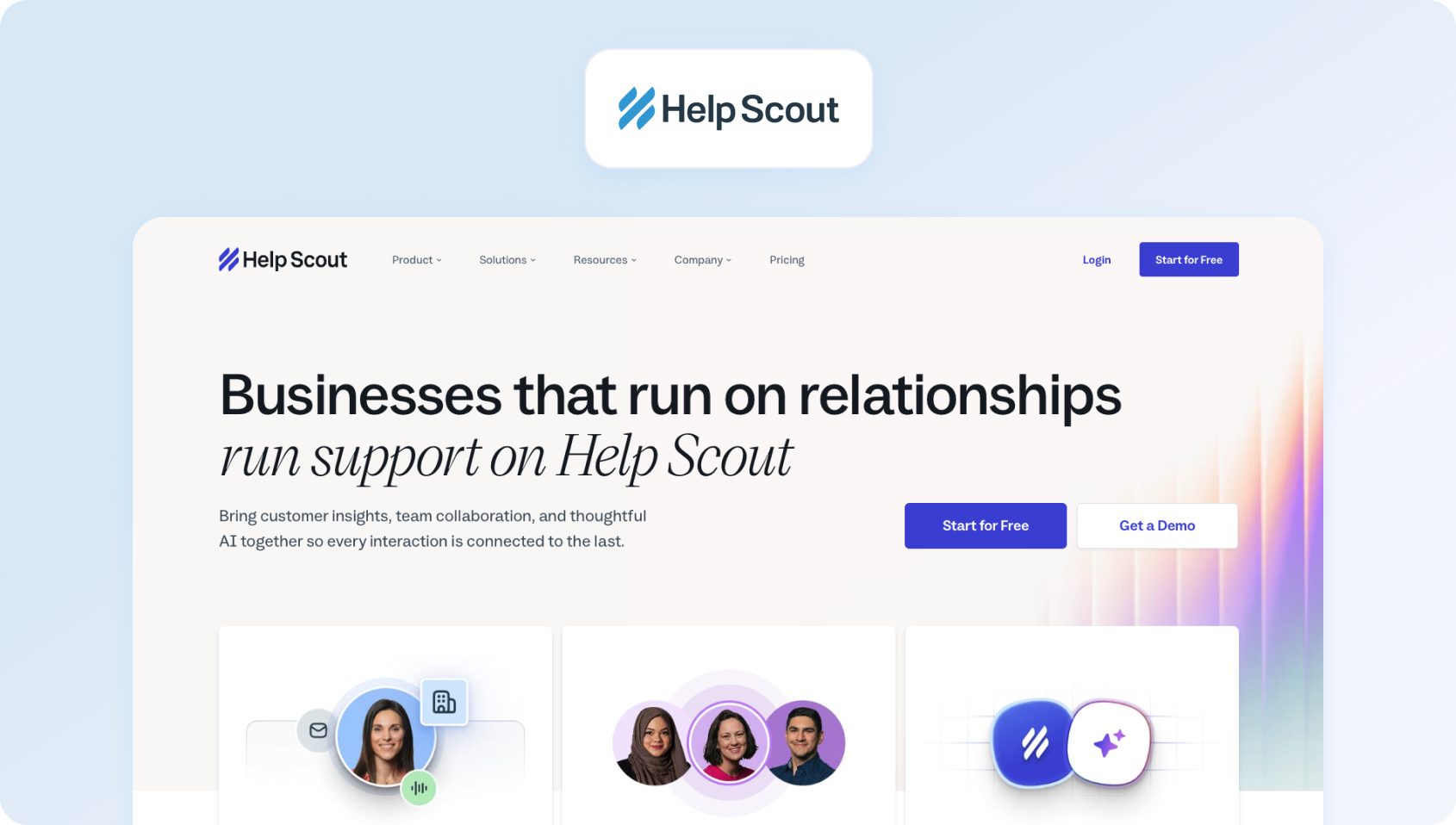
Help Scout targets teams that want email-centric support with a Gmail-like customer experience. It's beloved by small businesses and nonprofits for its simplicity and transparent pricing (recently shifted to a contact-based model, not a seat-based one).
Features:
- Shared Inbox: Email-first interface with internal notes and assignments
- Live Chat (Beacon): Embeddable widget for web and help center
- Knowledge Base (Docs): Customer-facing articles with in-widget search
- AI Features: Built-in AI Answers, AI Drafts, AI Assist (tone adjustment), AI Summarize
- Phone: Make and receive calls (logged in Help Scout)
- SMS: Send and receive texts from the inbox
Who Uses It
Small businesses, startups, and B-corps love Help Scout's ethos (they plant a tree for each customer). Strong in e-commerce, education, and service businesses.
Pricing:
Help Scout shifted from per-seat to per-contact pricing:
- Free: 100 contacts/month, (up to 5 users)
- Standard: $25/month (up to 25 users)
- Plus: $45/month (up to 50 users)
- Pro: $75/month (unlimited users)
Pricing scales with a 3-month trailing average of “contacts helped” (unique people who received replies).
Pros:
- Unlimited users: Invite your whole company without per-seat charges
- Contact-based pricing: Smooths seasonal fluctuations (3-month average)
- Built-in AI: No extra fees for basic AI customer service features
- Great for collaboration: Sales, product, and support can all access the same context
Cons:
- Unpredictable for growing teams: One successful marketing campaign that doubles support volume = doubled bill
- Limited voice capabilities: Basic calling, not suitable for high-volume phone support
- AI limited to Help Scout content: Chatbot can't access Google Docs, Confluence, or other knowledge sources
- Expensive integrations: Salesforce, Jira, and HubSpot locked in Plus plan ($70/month for 200 contacts minimum)
5. Zoho Desk: Best for Teams Already Invested in the Zoho Ecosystem
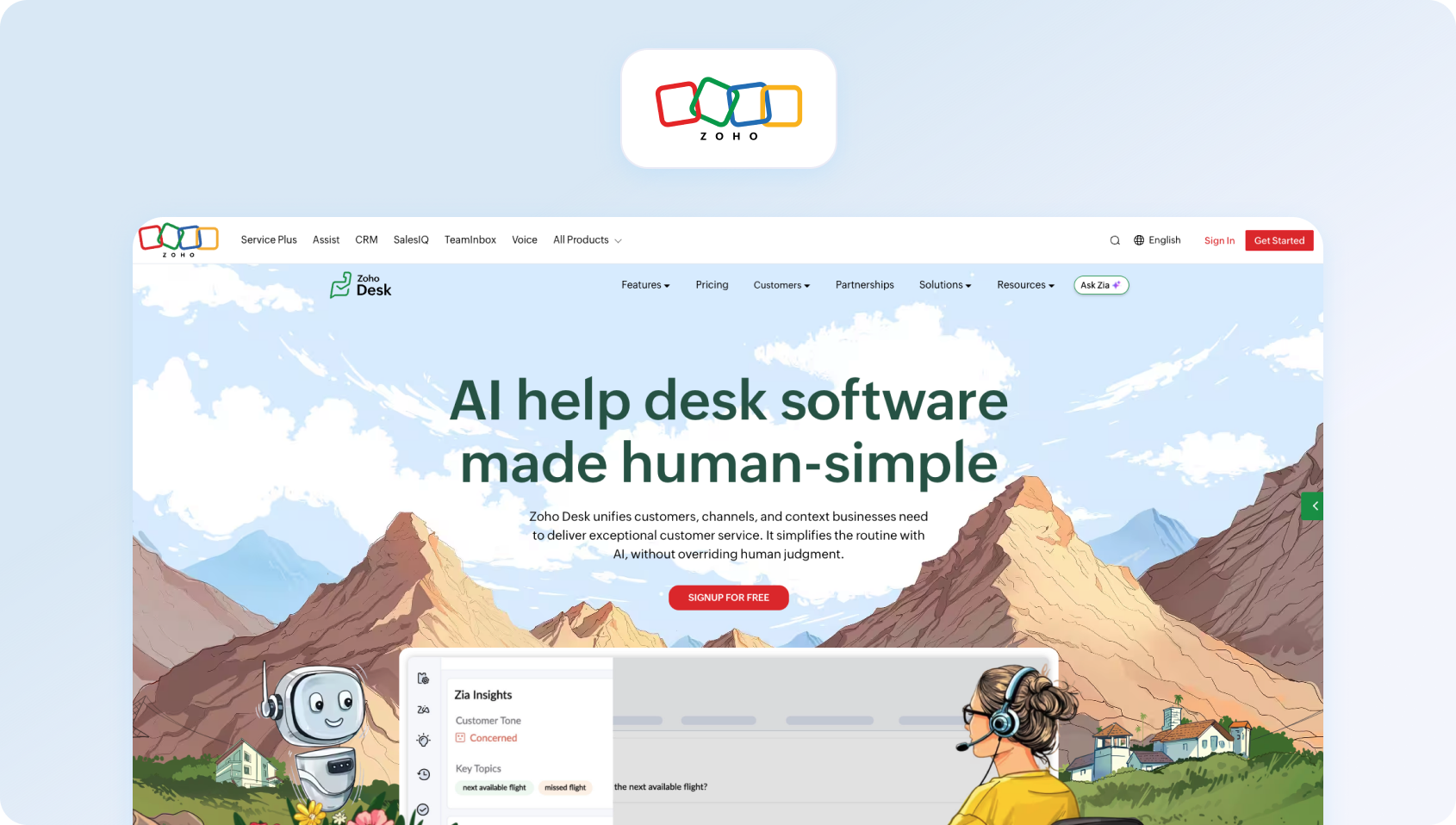
Zoho Desk appeals to teams already using the Zoho ecosystem (CRM, Books, Project Management). It offers robust features at competitive price points, although the Zoho Desk interface and setup complexity may feel dated compared to newer alternatives.
Features:
- Omnichannel: Email, phone, live chat, social media, instant messaging (WhatsApp, Telegram, etc.)
- Zia AI: Sentiment analysis, reply suggestions, predictive ticket assignment
- Automation: Workflows, macros, SLA management
- Knowledge Base: Internal and customer-facing help articles
- Community Forums: Build customer communities
- Integrations: Deep Zoho suite integration plus 100+ third-party apps
Who Uses It
Broad adoption from SMBs to enterprises. Strong in tech, retail, healthcare, and financial services.
Pricing:
- Free: 3 users, basic ticketing, email support, limited capabilities
- Express: €7/agent/month (social media, workflows, 5 users)
- Standard: €14/agent/month (instant messaging, SLAs, unlimited users)
- Professional: €23/agent/month (advanced AI, multi-department, 10 departments, unlimited users)
- Enterprise: €40/agent/month (custom modules, sandbox, 50 departments, unlimited users)
Pros:
- Aggressive pricing: Among the most affordable full-featured options
- Zoho ecosystem: Seamless data flow if you use Zoho CRM, Books, or other products
- Robust automation: Automated workflows and blueprints rival platforms 3x the price
- Generous free tier: 3 agents with real functionality, not just a trial
Cons:
- Dated UI: The interface feels cluttered and less intuitive than Freshdesk or Help Scout
- Steep learning curve: Feature depth comes with complexity; expect weeks of setup
- Limited third-party integrations: Great for the Zoho ecosystem, but weaker for Salesforce, HubSpot, and others.
- AI limited to higher tiers: Zia (AI assistant) is only available in Professional and above
6. HubSpot Service Hub: Best for HubSpot Customers That Want Support, CRM, and Automation in One Ecosystem
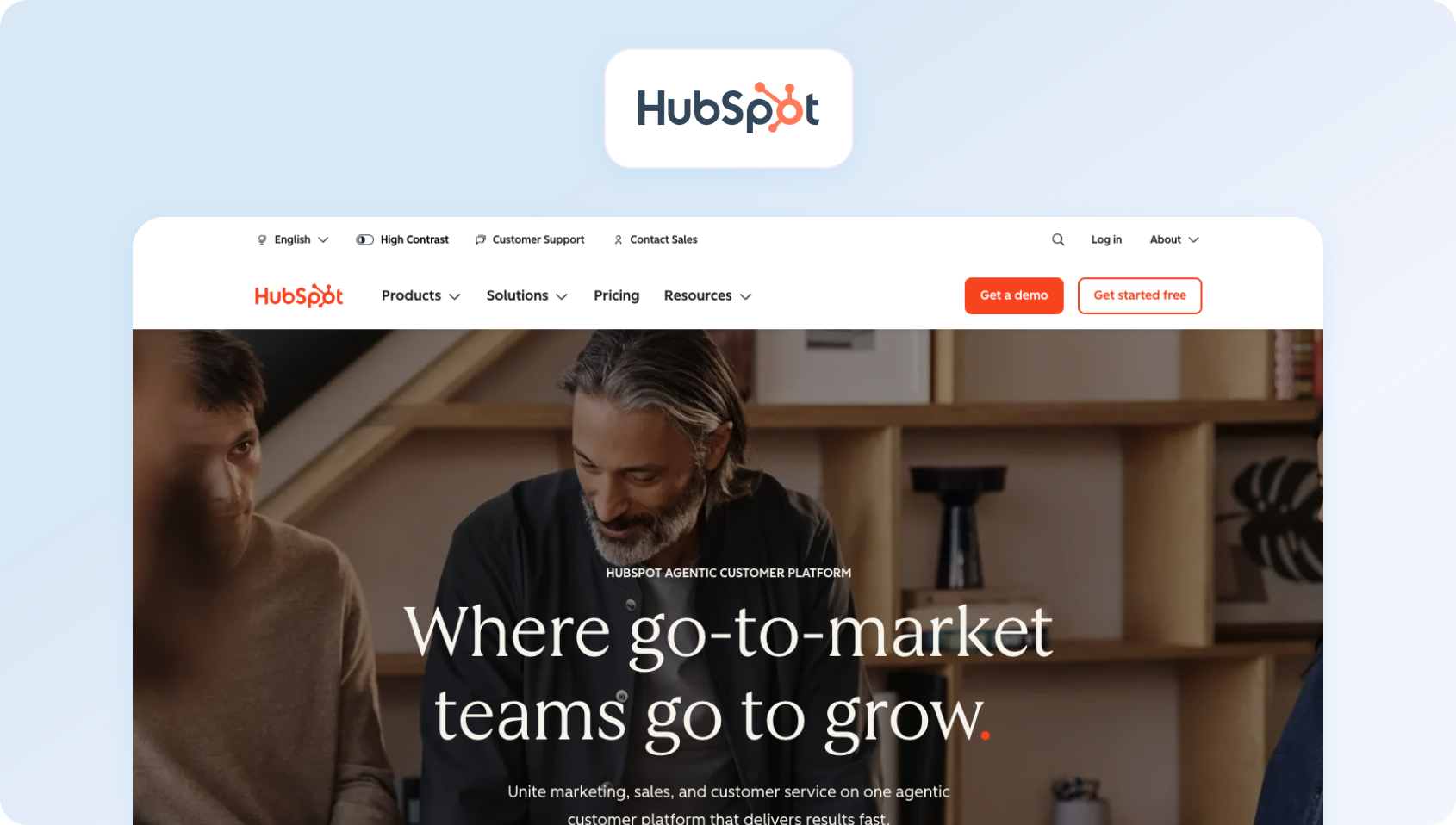
The HubSpot Service Hub is ideal for teams already using HubSpot CRM, Marketing Hub, or Sales Hub. The unified customer platform enables support agents to view every marketing touchpoint and sales conversation.
Features:
- Omnichannel: Shared inbox for email, chat, Facebook Messenger, WhatsApp
- Phone: Make and receive calls with IVR call flows
- Ticketing: Full helpdesk with pipelines, automation, SLAs
- Knowledge Base: Customer-facing help center
- Customer Portal: Secure portal for customers to track their customer requests
- Customer Feedback: NPS, CSAT, and custom customer satisfaction surveys
- AI Agents: Breeze AI (Enterprise) resolves tickets autonomously
Who Uses It
HubSpot Service Hub serves SMBs to mid-market companies that want tight alignment between marketing, sales, and support. Strong in B2B SaaS, professional services, and agencies.
Pricing:
- Free: Up to 2 users, basic ticketing, shared inbox, 1 help center
- Starter: $7/seat/month (500 HubSpot credits)
- Professional: $90/seat/month (3,000 HubSpot credits)
- Enterprise: $150/seat/month (5,000 HubSpot credits)
Pros:
- Unified customer platform: Support agents see the complete customer journey (marketing emails opened, sales calls logged, previous tickets)
- No CRM cost: HubSpot CRM has a free plan included, eliminating the need for a separate Salesforce license
- Strong for existing HubSpot users: If you're already paying for Marketing or Sales Hub, adding Service makes sense
- AI included (Enterprise): Breeze AI agents handle resolution autonomously without per-interaction fees
Cons:
- Expensive at scale: Professional tier pricing + mandatory onboarding fees add up quickly
- Limited standalone value: Works best when bundled with other HubSpot products; weaker as a standalone support tool
- No native WFM: Workforce management requires third-party integrations
- Enterprise lock-in: Best AI features, advanced automation, and success forecasting require the Enterprise tier ($150/seat, minimum 10 seats)
7. Salesforce Service Cloud: Best for Enterprises That Want Deep CRM Integration and Extensive Customization
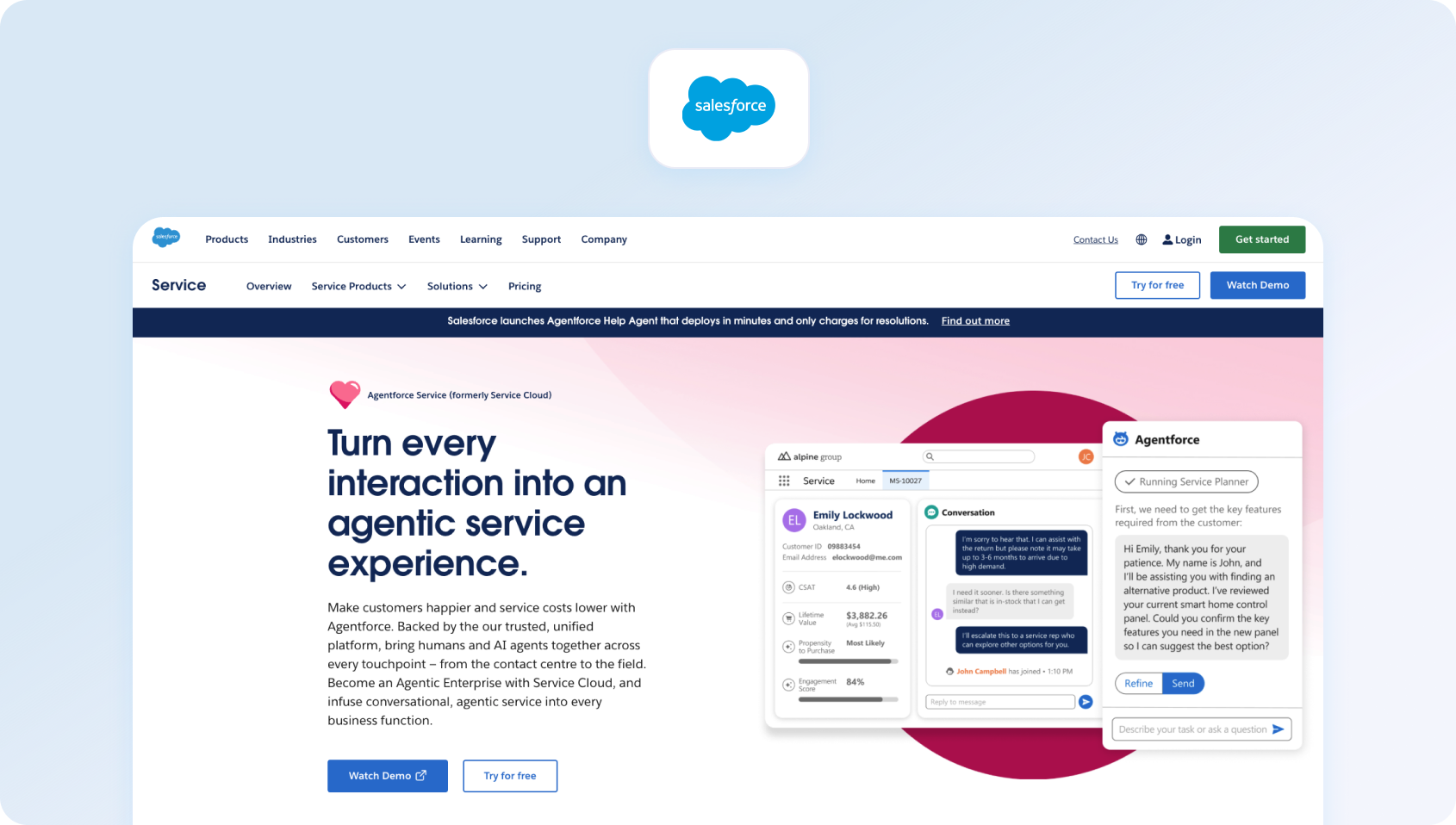
Salesforce Service Cloud (with Einstein AI) is the enterprise heavyweight in this category. If you're running Salesforce CRM and need deep customization, complex routing, or industry-specific compliance to deliver customer support requests, it's purpose-built for you.
Features:
- Omnichannel: Email, chat, phone, SMS, social media, video support
- Einstein AI: Case classification, recommended replies, next-best-action suggestions
- Field Service: Dispatch and mobile workforce management
- CTI Integration: Deep telephony integrations with major contact center platforms
- Lightning Console: Agent workspace with customizable layouts
- Salesforce Ecosystem: Native integration with the entire Salesforce platform
Who Uses It
Enterprise customers in financial services, healthcare, retail, and manufacturing. Think Fortune 500 companies with 200+ agent operations.
Pricing:
- Starter Suite: $25/user/month (10-user maximum, basic features)
- Professional: $100/user/month (workflows, knowledge, reports)
- Enterprise: $175/user/month (advanced automation, 24/7 support)
- Unlimited: $350/user/month (premier support, configuration services)
- Agentforce 1 Service: $550/user/month (As with the Unlimited package, plus the full AI suite)
Add-ons and implementation typically double the cost. Einstein AI features vary by tier.
Pros:
- Unmatched customization: Build virtually any workflow or exceptional customer service process
- Salesforce ecosystem: If you're already on Salesforce, the data integration is seamless
- Enterprise-grade: Handles 10,000+ agent deployments with ease
- Industry clouds: Pre-built solutions for healthcare, financial services, and manufacturing
Cons:
- Extremely expensive: Even mid-tier plans cost 3-5x more than alternatives
- Complex implementation: Expect 3-6 months and $50K-$200K in consulting fees
- Overkill for SMBs: Feature depth is wasted on teams under 100 agents
- Requires Salesforce expertise: You'll need dedicated admins or consultants
8. LiveAgent: Best for Budget-Conscious Teams That Need Voice, Chat, and Help Desk Features
LiveAgent positions itself as an affordable all-in-one solution with native phone support. It's particularly popular with e-commerce businesses that require a comprehensive solution combining live chat, ticketing, and a call center in one package.
Features:
- Omnichannel: Email, live chat, phone, social media (Facebook, Twitter, Instagram), contact forms
- Built-in Call Center: Unlimited inbound/outbound calls, IVR, call recording
- Live Chat: Proactive chat invitations, real-time typing view
- Ticketing System: Universal inbox, automation features, SLA management
- Knowledge Base: Customer self-service portal
- CRM: Built-in contact management
Who Uses It
LiveAgent is used across e-commerce, SaaS, and SMBs. Customers include Huawei, BMW, and USC.
Pricing:
- Small: $10/agent/month, billed annually
- Medium: $19/agent/month, billed annually
- Large: $33/agent/month, billed annually
- Enterprise: $46/agent/month, billed annually
Pros:
- Native phone included: Unlimited calling in base plans (rare at this price point)
- Affordable: Competitive pricing with generous feature inclusion
- Fast setup: Most teams are operational within days
- No per-minute charges: Flat monthly rate includes unlimited calls
Cons:
- Limited AI: Basic automation, but no modern AI chatbot or voicebot
- Dated interface: UI feels older compared to Freshdesk or Intercom
- Smaller ecosystem: Fewer integrations than major competitors
- No advanced multilingual support: Basic translation, not real-time AI-powered
9. Front: Best for Collaborative Support Teams That Manage Customer Conversations Across Shared Inboxes
Front reimagines email as a collaborative workspace. If your team lives in email and needs internal collaboration without switching to a separate help desk solution, Front keeps everything in an inbox-style interface.
Features:
- Shared Inbox: Email-first interface with comments, assignments, tags
- Omnichannel: Email, SMS, live chat, WhatsApp, social media
- Collaboration: Internal comments, @mentions, approval workflow automation
- Analytics: Response times, team performance, workload distribution
- Integrations: 100+ apps, including Salesforce, Asana, Slack
Who Uses It
Small teams in sales, success, and support who prefer email workflows.
Pricing:
- Starter: $25/seat/month (Single channel)
- Professional: $65/seat/month (Omnichannel: email, SMS, social, WhatsApp, etc.)
- Enterprise: $105/seat/month (Omnichannel: email, SMS, social, WhatsApp, etc.unlimited conversations, automation rules)
- AI add-ons available: Autopilot from $0.05/conversation, Copilot from $20 per seat/month, Smart QA from $20 per seat/month, and Smart CSAT from $10 per seat/month
Pros:
- Email-native: Teams that hate “helpdesk” interfaces love Front's familiar email UX
- Real-time collaboration: See who's typing, leave internal notes, and assign without forwarding
- Great for multi-team use: Sales, support, and success can share context
- Clean, modern UI: One of the best-looking interfaces in the category
Cons:
- No phone support: Can't handle voice calls natively
- Expensive for basic features: Paying $59+/seat for what's essentially shared email
- Not a true helpdesk: Lacks SLA tracking, escalation workflows, knowledge base
- Limited AI: Basic automation, no chatbot or AI reply assistance
10. Gorgias: Best for E-commerce Brands That Need Support, Automation, and Revenue Tools in One Platform
Gorgias is purpose-built for e-commerce, with deep Shopify integration and macros designed for order status, returns, and shipping inquiries. If you're running a Shopify store, Gorgias speaks your language.
Features:
- E-commerce Focus: Pre-built macros for order management, shipping, returns
- Shopify Integration: Deep access to order data, customer history, product info
- Omnichannel: Email, live chat, Facebook, Instagram, SMS
- Automation: Rule-based routing, auto-responses, intent detection
- Revenue Tracking: Connect support interactions to revenue generated
Who Uses It
E-commerce brands on Shopify, Magento, and BigCommerce.
Pricing:
- Starter: $40/month (50 tickets)
- Basic: $77/month (300 tickets)
- Pro: $471/month (2,000 tickets)
- Advanced: $1,227/month (5,000 tickets)
- Enterprise: Custom (unlimited tickets)
Ticket-based pricing makes costs unpredictable during sales events.
Pros:
- Built for e-commerce: Macros and workflows designed specifically for online retail
- Shopify superpowers: Access order details, issue refunds, update shipping—all from the ticket
- Revenue attribution: See which support interactions lead to purchases
- Fast for common e-commerce queries: Pre-built automations for “where's my order?”
Cons:
- Ticket-based pricing: Black Friday or a viral product launch can blow your budget
- No phone support: Can't handle voice calls
- Shopify-centric: Works best with Shopify; weaker for other platforms
- Limited for non-e-commerce: Feature set is narrow outside retail use cases
11. Kustomer: Best for High-Volume Support Teams That Want a CRM-Style Customer Timeline and Strong Omnichannel Workflows
Kustomer takes a customer-centric approach (not ticket-centric). Instead of opening multiple tickets for a single customer, everything is organized on a unified timeline. It's popular with brands that want conversational, contextual support.
Features:
- Customer Timeline: All interactions (calls, chats, orders, emails) on one view
- Omnichannel: Email, chat, SMS, WhatsApp, voice, social
- No Ticket Numbers: Conversations, not tickets (customers never see “ticket #12345”)
- AI & Automation: Chatbots, routing, suggested replies
- CRM Capabilities: Built-in customer data platform
Who Uses It
Consumer brands in retail, travel, and fintech.
Pricing:
Kustomer operates a custom pricing model; verify with the vendor directly for pricing.
Pros:
- Customer-centric UX: Agents see people, not ticket numbers
- Unified timeline: Complete interaction history without switching screens
- Good for high-touch brands: Luxury and lifestyle brands love the conversational approach
- Strong automation: Intelligent routing based on customer context and history
Cons:
- Expensive: Pricing is competitive with or higher than Zendesk Enterprise
- No public pricing: Forces sales conversations for basic information
- Requires culture shift: Teams used to ticket-based workflows need retraining
- Limited WFM: No native scheduling or forecasting tools
12. Gladly: Best for Retail and E-commerce Brands That Want a Conversation-Centric Customer Service Platform
Gladly, like Kustomer, puts customers (not tickets) at the center. Its “radically personal” approach focuses on continuous conversations across multiple channels, with each agent seeing the customer's full history.
Features:
- Lifelong Conversation Threads: All interactions with one customer in one thread
- Omnichannel: Voice, SMS, email, chat, social messaging
- Customer Profiles: Rich profiles with purchase history, preferences, and notes
- Task Management: Follow-ups and to-dos tied to customers, not tickets
- Reporting: Customer-centric metrics (not just ticket counts)
Who Uses It
Consumer brands focused on loyalty and lifetime value.
Pricing:
Gladly also operates a custom pricing model; verify with the vendor directly for pricing.
Pros:
- True omnichannel: Seamless hand-offs between voice, chat, and email in one conversation
- Customer-first philosophy: Agents build relationships, not close tickets
- Great for brand differentiation: Luxury and high-touch brands use it to stand out
- Voice native: Strong telephony built in, not bolted on
Cons:
- Very expensive: Premium pricing, even compared to Salesforce
- No public pricing: Requires a sales process and often minimum commitments
- Best for large teams: Designed for 100+ agent operations
- Limited self-service support: Not ideal if you want to deflect volume with chatbots
13. Dixa: Best for Support Teams That Want Unified Customer Conversations Across Channels
Dixa is a Scandinavian customer service platform that emphasizes “friendship through conversation.” It offers solid omnichannel capabilities with a focus on making support feel more human and less transactional.
Features:
- Omnichannel: Email, chat, voice, Facebook Messenger, WhatsApp
- Smart Routing: Skill-based routing and automatic prioritization
- Conversation Continuity: Context preserved across channels
- VoIP Included: Native calling with local numbers in 100+ countries
- Analytics: Real-time dashboards and historical reporting
Who Uses It
European SMBs and mid-market companies, especially in e-commerce and subscription services.
Pricing:
- Growth: €89 per agent/month, including omnichannel support across phone, email, forms, chat, and social, plus a knowledge base, AI Agent (Mim), intelligent routing, IVR, call recording, callbacks, SLAs, and native integrations.
- Ultimate: €139 per agent/month, adding features such as routing with external data, knowledge-centered service, standard AI intent detection, advanced automations, skills-based routing, sandbox access, and third-party AI integrations.
- Prime: €179 per agent/month, adding SSO, advanced AI intent detection, advanced insights, custom user roles, multiple organizations, queue and claim restrictions, enterprise API limits, and outbound email templates.
Pros:
- Voice included: Native calling without a separate telephony provider
- Clean Scandinavian design: Intuitive interface with minimal clutter
- Good for international: Local numbers in 100+ countries
- Conversation-focused: Less ticket-centric than traditional helpdesks
Cons:
- Limited market presence: Smaller than US-based competitors
- No public pricing: Requires sales engagement
- Basic AI: Lacks advanced automation compared to Intercom or Freshdesk
- Smaller integration ecosystem: Fewer pre-built connectors than major platforms
14. Talkdesk CX Cloud: Best for Contact Centres That Need Enterprise-Grade Support
Talkdesk began as a cloud contact center and has since evolved into a comprehensive CX platform. If voice is your primary channel and you need enterprise-grade telephony with helpdesk capabilities, Talkdesk delivers.
Features:
- Enterprise Contact Center: Advanced IVR, skills-based routing, call recording
- Omnichannel: Voice, SMS, email, chat, social messaging
- AI (Talkdesk AI): Virtual agent, sentiment analysis, call transcription
- WFM: Native workforce management with scheduling and forecasting
- Quality Management: Call recording, evaluation forms, coaching workflows
Who Uses It
Enterprises with voice-heavy support operations.
Pricing:
- CX Cloud Digital Essentials: $85 per user/month, including digital engagement, quality management, API access, dashboards, and automation tools.
- CX Cloud Essentials: $85 per user/month, including voice engagement, routing, workspace tools, and integrations.
- CX Cloud Elevate: $115 per user/month, plus quality management, screen recording, feedback, and automated notifications.
- CX Cloud Elite: $145 per user/month, adding workforce management, performance management, custom reporting, and customer experience analytics.
- Industry Experience Clouds: custom pricing for vertical-specific deployments in sectors such as healthcare, financial services, retail, and government.
Pros:
- Best-in-class voice: Purpose-built for high-volume call centers
- Native WFM: Integrated scheduling, forecasting, and adherence monitoring
- Native QA: Built-in quality management and coaching tools
- Strong AI: Voicebot and virtual agent capabilities rival specialized CCaaS platforms
Cons:
- Voice-centric: Better for call centers than email-heavy customer support teams
- Complex pricing: Multiple modules and add-ons make the true cost hard to predict
- Steep learning curve: Feature depth requires significant training
- Overkill for small teams: Designed for 50+ agent operations
15. NICE CXone: Best for Large Contact Centres That Need WEM, Routing, and Advanced CX Analytics
NICE CXone is the enterprise-grade contact center platform with CRM capabilities. It's the go-to for organizations that need compliance features, advanced analytics, and proven scalability.
Features:
- True Omnichannel: Voice, email, chat, SMS, social media in a unified agent desktop
- Enlighten AI: Real-time agent assist, sentiment analysis, coaching recommendations.
- WFM: Comprehensive workforce optimization suite
- Quality Management: Recording, evaluation, calibration, coaching
- Analytics: Real-time and historical reporting with AI-powered insights
Who Uses It
Large enterprises and BPOs in healthcare, financial services, retail, and telecom.
Pricing:
- Omnichannel Suite: $110 per agent/month
- Essential Suite: $135 per agent/month
- Core Suite: $169 per agent/month
- Complete Suite: $209 per agent/month
- Ultimate Suite: $249 per agent/month, plus $0.25 per session for certain AI-powered interactions
Industry-specific packages: Tailored CXone packages for sectors such as banking, insurance, healthcare, retail, and government, also available. Most are priced at $249 per agent/month plus $0.25 per session, with sector-specific capabilities such as self-service automation, agent assist, engagement hubs, and industry-focused insights. Government pricing is structured differently, with packages starting from $2 per consumer/year for selected public-sector use cases.
Pros:
- Enterprise-proven: Handles 10,000+ agent deployments reliably
- Comprehensive: Everything you need for contact center operations in one platform
- Strong compliance: HIPAA, PCI-DSS, SOC 2—built for regulated industries
- Best-in-class WFM: Industry-leading forecasting and scheduling
Cons:
- Extremely complex: Requires dedicated admins and a long implementation
- Expensive: Enterprise pricing puts it out of reach for SMBs
- Overkill for most: Feature depth wasted on teams under 100 agents
- Long sales cycle: Expect 3-6 months from evaluation to go-live
16. Genesys Cloud CX: Best for Omnichannel Contact Centres That Need Deep WEM and AI Capabilities
Genesys Cloud CX competes directly with NICE CXone in the enterprise CCaaS space. It's known for flexibility, AI capabilities, and strong multi-tenant architecture (critical for BPOs).
Features:
- Omnichannel: Voice, digital channels, video, co-browse
- Genesys AI: Voicebot, chatbot, agent assist, predictive routing
- Native WFM: Forecasting, scheduling, intraday management
- Quality & Analytics: Recording, evaluation, speech analytics
- AppFoundry: 300+ pre-built integrations
Who Uses It
Enterprises and BPOs.
Pricing:
- Genesys Cloud CX 1: $75 per user/month (billed annually), including voice, call routing, IVR, outbound campaigns, analytics, recording, knowledge, native bots, predictive engagement, predictive routing, and Agent Copilot.
- Genesys Cloud CX 2: $115 per user/month (billed annually), adding digital channels plus built-in quality assurance and compliance.
- Genesys Cloud CX 3: $155 per user/month (billed annually), including employee performance, resource management, AI-powered forecasting and scheduling, and speech and text analytics.
- Genesys Cloud CX 4: $240 per user/month (billed annually), including journey management, virtual agents, Supervisor Copilot, Virtual Supervisor, social listening, and 30 AI Experience tokens per named agent.
Pros:
- Multi-tenant strength: Excellent for BPOs managing multiple clients
- Flexible architecture: Highly customizable for complex requirements
- Strong AI: Voicebot and predictive engagement capabilities
- Open platform: Extensive API and integration ecosystem
Cons:
- Enterprise complexity: Not suitable for teams under 50 agents
- Expensive: Premium pricing even for mid-tier features
- Requires implementation partner: DIY setup is impractical
- Long onboarding: Expect 2-4 months to full deployment
17. ServiceNow Customer Service Management: Best for Large Enterprises That Want Customer Service Connected to Broader Service Operations
ServiceNow CSM brings ITSM discipline to customer service. If you're already using ServiceNow for IT operations and want to extend the platform to responsive customer support, CSM is the natural fit.
Features:
- Omnichannel: Email, chat, phone (via integrations), social, mobile
- Case Management: ITSM-style workflows with SLAs and escalations
- Knowledge: Robust knowledge base with AI-powered search
- Self-Service Options: Customer portal with case tracking
- Now Assist: AI for agent productivity and case resolution
Who Uses It
Enterprises already on ServiceNow platform, especially in B2B, tech, and services.
Pricing:
Custom pricing available; verify with the vendor for details.
Pros:
- Perfect for ServiceNow shops: Extends existing ITSM investment
- ITSM workflows: Best for technical support and B2B service management
- Strong knowledge management: AI-powered KB search and content recommendations
- Enterprise-grade: Security, compliance, and governance built in
Cons:
- Extremely expensive: Among the priciest options in this guide
- ITSM-centric: Better for technical support than consumer service
- Complex implementation: Requires ServiceNow expertise
- Overkill for most: Only makes sense if you're already on ServiceNow
18. Sprinklr Service: Best for Global Enterprises That Need Customer Service, Social, and Digital Engagement
Sprinklr started as a social media management platform and evolved into a unified CX platform. Its strength lies in social listening and engagement at scale, processing thousands of tweets, Instagram comments, and Facebook messages daily.
Features:
- Social-First: Native support for 30+ social channels
- Omnichannel: Voice, email, chat, messaging apps, review sites
- AI: Sprinklr AI for routing, sentiment, chatbots
- Listening: Social listening and brand monitoring
- Unified Agent Desktop: All channels in one workspace
Who Uses It
Large consumer brands managing high social media volumes.
Pricing:
Custom pricing available on completion of a product demo; verify for details.
Pros:
- Unmatched social coverage: Best platform for brands active on social media
- Social listening: Monitor brand mentions across the internet
- Handles massive volume: Built for customer service teams managing 100K+ social interactions monthly
- Unified platform: Marketing, advertising, and service in one ecosystem
Cons:
- Very expensive: Enterprise pricing out of reach for SMBs
- Overkill for most: Unless you have massive social volume, it's too much platform
- Complex: Steep learning curve and long implementation
- Not ideal for phone-heavy: Social-first means voice is secondary
19. Khoros Care: Best for Brands That Prioritize Social Customer Service and Digital Community Engagement
Khoros focuses on digital and social customer care. Like Sprinklr, it's built for brands managing support across social media, messaging apps, and review sites.
Features:
- Digital-First: Social media, messaging apps, review sites, online communities
- AI & Automation: Bot framework, intelligent routing, sentiment analysis
- Community Forums: Build and manage customer communities
- Listening: Social monitoring and brand tracking
- CRM Integration: Salesforce, Microsoft Dynamics connectors
Who Uses It
Consumer brands with a strong digital presence.
Pricing:
Khoros doesn’t publish subscription prices; verify with the vendor for details on their custom-quote model.
Pros:
- Community platform: Excels at building customer forums and peer-to-peer support
- Social expertise: Deep social media management capabilities
- Good for consumer brands: Purpose-built for B2C digital support
- Integration with social ads: Connect support data to social advertising campaigns
Cons:
- Expensive: Enterprise pricing model
- Digital-only focus: Not ideal for phone-heavy support operations
- Complex setup: Requires significant configuration and training
- Declining market position: Losing ground to Sprinklr and Salesforce Social Studio
20. LivePerson: Best for Enterprises Focused on Messaging, Automation, and AI-Led Customer Conversations
LivePerson pioneered live chat in the late 1990s and now focuses on conversational AI. Its Conversational Cloud platform combines messaging, AI, and analytics for brands going messaging-first.
Features:
- Conversational Cloud: Messaging across web, mobile, SMS, WhatsApp, Apple Business Chat
- Intent Manager: AI detects customer intent and routes accordingly
- Conversation Builder: Low-code bot building
- Agent Workspace: Unified workspace for messaging channels
- Analytics: Conversational analytics and reporting
Who Uses It
Large enterprises in retail, financial services, and telecom.
Pros:
- Messaging expertise: 25+ years focused on conversational support
- Strong AI platform: Intent detection and bot building are mature
- Asynchronous support: Customers message when convenient, agents respond when available
- Good for messaging-first customer support strategy: If you're de-emphasizing phone, LivePerson fits
Cons:
- Complex pricing: Conversation-based pricing is hard to predict
- Not ideal for voice: Better for messaging than traditional phone support
- Enterprise-focused: Minimum contracts and pricing exclude SMBs
- Declining relevance: Facing pressure from Intercom, Zendesk, and platform players
Pricing:
LivePerson doesn't publish standard pricing for Conversational Cloud. Pricing is provided through a customized sales process and typically depends on conversation volume, AI usage, messaging channels, and implementation requirements.
21. Five9: Best for Contact Centres That Need Voice, Digital Channels, and WEM
Five9 is a cloud contact center platform that recently added digital channels. If voice is 70% or more of your volume and you need enterprise-grade telephony, Five9 competes with Talkdesk and Genesys.
Features:
- Cloud Contact Center: Advanced IVR, ACD, skills-based routing
- Omnichannel: Voice, email, chat, SMS, social (digital channels are less mature)
- Five9 AI: Agent assist, virtual agent, speech analytics
- WFM: Integrated workforce management suite
- CRM Integration: Deep connectors for Salesforce, ServiceNow, Zendesk
Who Uses It
Mid-market to enterprise with voice-heavy operations.
Pros:
- Voice expertise: 20+ years building contact center telephony
- Reliable platform: 99.99% uptime SLA
- Strong WFM: Native forecasting and scheduling
- Enterprise-ready: Handles high-volume operations reliably
Cons:
- Voice-centric: Digital channels feel like afterthoughts
- Complex pricing: Multiple editions and add-ons make the total cost unclear
- Weaker for omnichannel: If email/chat are primary, better options exist
- Enterprise-focused: Overkill for teams under 50 agents
Pricing:
- Digital: $119 per seat/month, covering channels such as chat, email, SMS/MMS, and social messaging.
- Core: $159 per seat/month for all channels plus essential AI capabilities.
- Plus: custom pricing for teams that want all channels with more advanced AI functionality.
- Pro: custom pricing for teams that need all channels, AI essentials, and workforce engagement management (WEM).
- Enterprise: custom pricing for larger operations that want all channels, advanced AI, and WEM in a single package.
22. Dialpad: Best for AI-Enabled Voice and Contact Centre Teams
Dialpad built a modern business customer communications platform (voice, video, messaging) and extended it to contact centers. Its AI transcription and sentiment analysis run in real-time during calls.
Features:
- Cloud Contact Center: IVR, ACD, call recording, analytics
- Real-Time AI: Live transcription, sentiment scoring, action item detection during calls
- Omnichannel: Voice, SMS, web chat, social messaging
- Integrations: Pre-built connectors for Salesforce, HubSpot, Zendesk, and 70+ apps
- Unified Communications: Combines contact center with business phone system
Who Uses It
SMBs to mid-market teams needing modern voice + light digital communication channels.
Pricing:
- Dialpad Support (contact centre): starts at $80 per user/month for Essentials, $115/user/month for Advanced, and $150/user/month for Premium when billed annually. Monthly billing is also available at higher rates.
- Dialpad Sell (sales outreach): starts at $39 per user/month for Essentials, $95/user/month for Advanced, and $150/user/month for Premium when billed annually.
- Dialpad Connect (business communications): starts at $15 per user/month for Standard and $25/user/month for Pro when billed annually, with Enterprise pricing available on request.
For teams comparing Dialpad with Zendesk, Dialpad Support is the most relevant product, since it’s the contact centre offering.
Pros:
- Modern platform: Built for the cloud-first era, not legacy telephony
- Real-time AI: Transcription and sentiment during calls (not after)
- Easy setup: Faster implementation than Five9 or Genesys
- Unified comms: Combine contact center with business phone system
Cons:
- Contact center key features lag: Younger than Five9/Genesys, fewer enterprise features
- Limited WFM: Basic scheduling, not comprehensive workforce management
- Weaker omnichannel: Voice and SMS strong; email/ticketing weaker
- Growing pains: Rapid growth has led to occasional support issues
23. Zowie: Best for E-commerce Support Teams That Want AI Agents to Handle Repetitive Customer Conversations
Zowie is an AI-first customer service operations software built specifically for e-commerce. It lets you automate and manage customer inquiries while integrating deeply with Shopify, Magento, and other e-commerce platforms.
Features:
- AI Automation: Handles up to 60% of common e-commerce queries automatically
- E-commerce Integration: Deep connections to Shopify, Magento, WooCommerce
- Order Management: Check order status, process returns, update shipping—all automated
- Omnichannel: Chat, email, Facebook Messenger, Instagram
- Analytics: Track automation rates, customer satisfaction, and resolution times
Who Uses It
Direct-to-consumer e-commerce brands.
Pricing:
Zowie uses a pay-per-automation or outcome-based model; contact sales for pricing details.
Pros:
- E-commerce native: Explicitly built for online retail
- High automation rate: Can deflect 50-70% of common queries
- Quick setup: Most brands are operational within 2 weeks
- Good ROI for small teams: Reduces the need to hire additional agents
Cons:
- E-commerce only: No value outside online retail
- No voice: Can't handle phone support
- Limited for complex support: Works for order status, not product troubleshooting
- Small team focus: Not built for 50+ agent operations
24. Groove: Best for Small Teams That Want a Low-Cost Help Desk with Flexible AI Pricing
Groove positions itself as the simple, affordable help desk software for small businesses. If you're a 5-10 person team that finds Zendesk overwhelming and wants a shared email with basic features, Groove fits.
Features:
- Shared Inbox: Email-centric support with assignments and notes
- Knowledge Base: Customer-facing help articles
- Reporting: Basic analytics on response times and volumes
- Integrations: Slack, Shopify, Mailchimp, and 40+ apps
- Collaboration: Private notes, @mentions, collision detection
Who Uses It
Micro-businesses and startups (3-15 people). Customers include small SaaS companies, consultants, and agencies.
Pricing:
Groove no longer uses the older Standard / Plus / Pro pricing structure. Instead, it now offers a free core support platform with unlimited seats, including the shared inbox, ticketing, knowledge base, reporting, live chat, and core support workflows.
Rather than charging per seat for the platform itself, Groove positions pricing around AI outcomes (for example, charging based on AI resolutions or AI-generated drafts rather than the number of agents using the tool).
Pros:
- Affordable: Among the cheapest options that aren't just shared Gmail
- Simple: Clean user-friendly interface, minimal learning curve
- No per-ticket pricing: Flat monthly rate regardless of volume
- Good for micro-teams: Perfect for bootstrapped startups
Cons:
- Very basic: Lacks AI, automation, and advanced features
- Email-focused: No real omnichannel capabilities
- Limited integrations: Small ecosystem compared to major platforms
- Outgrow it quickly: Most teams outgrow Groove by 15-20 people
25. HappyFox: Best for Teams That Want Unlimited-Agent Pricing at Higher Support Volumes
HappyFox offers a traditional help desk with essential features at competitive prices. It's particularly popular with IT service desks and internal support teams.
Features:
- Ticketing: Multi-channel ticket management system (email, chat, phone, social)
- Knowledge Base: Internal and external help articles
- Task Management: Convert customer support tickets to customer support tasks, set dependencies
- Asset Management: Track hardware and customer support software assets (IT focus)
- Community Forums: Customer community platform
- Automation: Workflows, SLA management, smart rules
Who Uses It
IT departments, educational institutions, and SMBs.
Pricing:
Agent-based pricing:
- Basic: $29 per agent/month, up to 5 agents
- Team: $69 per agent/month, unlimited agents, plus multi-brand support and more customization
- Pro: $119 per agent/month, advanced features such as task management, asset management, and more automation
- Enterprise Pro: custom pricing for larger teams that need advanced reporting, audit logs, agent scripting, and higher storage limits
Unlimited agents pricing:
- Growth: starts at $1,999/month and includes unlimited agents with annual ticket limits
- Scale: starts at $3,999/month
- Scale Plus: starts at $5,999/month
- Enterprise Pro: custom pricing for high-volume enterprise teams
Pros:
- Affordable: Competitive pricing for the feature set
- IT-friendly: Asset management and service desk features
- Good for education: Popular with schools and universities
- Straightforward: No hidden fees or complex add-ons
Cons:
- Dated interface: UI feels older compared to modern alternatives
- Limited AI: Basic automation, no chatbot or AI agent assist
- Smaller ecosystem: Fewer integrations than major competitors
- Voice not native: Requires third-party telephony integration
How We Evaluated These Zendesk Alternatives
We assessed each platform against a consistent framework, using publicly available documentation, demo videos, pricing pages, and verified user reviews. Here's our methodology:
Features Assessment
We checked each alternative to Zendesk against the must-have checklist below. Platforms received one of three ratings:
- Meets: Feature is native, documented, and available in plans suitable for 20-100 agents.
- Partial: Feature exists but requires add-ons, workarounds, or higher tiers.
- Not Evident: No public documentation or demo evidence of the feature.
Who Uses It
We identified user segments (BPOs, e-commerce, SaaS, etc.) from case studies, public customer logos, and review site filters. Where unclear, we noted “TBD” based on the platform's positioning.
Pricing
All pricing data is sourced from vendor websites. Where pricing isn't public, we noted “Contact sales” and the stated model (seat-based, usage-based, or hybrid). Annual billing assumptions apply unless otherwise noted.
Want to put the cost side of the comparison into numbers? Try BlueTweak’s ROI calculator to estimate how much your team could save by replacing separate helpdesk, voice, WFM, QA, and AI tools with a more unified support platform.
Pros and Cons
Strengths and weaknesses tie directly to our checklist and rubric. We avoided superlatives (“best,” “easiest,” “most powerful”) and instead relied on evidence-based observations, such as “no native WFM” or “voicebot requires Professional tier.”
Must-Have Capability Checklist
Scoring Rubric
We weighted each alternative based on fit for 20-100 agent teams. Here's how we prioritized:
Platforms that required enterprise tiers for basic features, such as SSO or native voice, scored lower on “Fit for 20-100 agents.” Those with usage-based AI pricing (per resolution, per minute) scored lower on “Total cost to run” due to the unpredictability.
Choosing the Right Zendesk Alternative for 2026
Teams rarely leave Zendesk because ticketing alone falls short. More often, it’s the cost and complexity around the core helpdesk (think: voice, AI, workforce management, QA, and reporting) that turns a familiar platform into a fragmented and increasingly expensive support stack.
The best Zendesk alternatives in 2026 solve that problem by combining more of those capabilities in one place, with clearer pricing and less operational overhead.
For teams that need native voice, workforce management, multilingual AI, and predictable costs, BlueTweak offers the strongest all-round fit for mid-market support operations. It’s designed for businesses that have outgrown a basic helpdesk but don’t want to bolt together multiple tools just to run omnichannel support efficiently.
That doesn’t make it the right choice for every team. If you’re a five-person startup that only needs email and live chat, a lighter platform will probably be enough. And if you’re a large enterprise already deeply committed to a broader Salesforce or enterprise contact centre ecosystem, your requirements may point elsewhere. But for support teams in the 20–100 agent range looking to simplify operations, reduce tool sprawl, and get more value from AI, BlueTweak is the standout choice in this year’s list.
If you want to see how BlueTweak compares to a Zendesk-style stack in practice, book a demo to explore its omnichannel support, AI, workforce management, and reporting capabilities in more detail, or try the ROI calculator to estimate the cost of consolidating your support stack.
FAQs

25 Best Intercom Alternatives & Competitors in 2026
Customer expectations have changed dramatically over the last few years. Today's support teams are handling voice, email, SMS, WhatsApp, social messaging, and AI-assisted conversations simultaneously.
While Intercom remains one of the best-known customer messaging platforms, many businesses eventually hit its limits. Usage-based AI pricing, limited native voice functionality, and growing integration costs often make it difficult to scale efficiently.
If you're comparing Intercom alternatives, this guide reviews 25 leading platforms across pricing, AI capabilities, omnichannel support, workforce management, and long-term value. For mid-market teams looking to consolidate multiple tools into one platform, BlueTweak emerges as one of the strongest all-in-one options.
Why Businesses Are Looking for Intercom Alternatives
Intercom pioneered conversational support and remains the go-to choice for many B2B SaaS companies prioritizing in-app messaging and proactive customer engagement. Its Messenger widget feels native in web applications, Fin AI Agent delivers autonomous resolution, and product tours help onboard users without creating support tickets.
However, several pain points consistently drive teams to evaluate better Intercom alternatives:
- Usage-based unpredictability
- No native voice support
- Resolution-based AI pricing
- Limited for contact centers
- Expensive at scale
This guide compares alternatives across omnichannel depth, native WFM/QA, multilingual AI, pricing transparency, and total cost to operate. We've included options for every segment, from affordable email-first helpdesks to enterprise CCaaS platforms, with BlueTweak leading for mid-market teams that need everything in one subscription.
Intercom Alternatives at a Glance
With dozens of customer support platforms available, narrowing your shortlist can be overwhelming. The table below highlights our top five Intercom alternatives based on features, pricing, AI capabilities, and overall value for growing support teams.
If you're looking for a quick comparison, this is a great place to start. For a more detailed evaluation (including strengths, limitations, pricing, and best-fit use cases for all 25 vendors) continue to the full breakdown below.
Every platform excels in different areas. While this comparison provides a high-level overview, the right choice ultimately depends on your support channels, team size, AI requirements, and budget. Below, we take a closer look at all 25 Intercom alternatives, including detailed feature comparisons, pricing, pros and cons, and the types of businesses each platform is best suited for.
Looking for an easier way to replace Intercom?
If you're comparing platforms because costs are rising or you're juggling multiple customer support tools, BlueTweak brings voice, chat, email, AI, workforce management, and quality assurance together in one platform with transparent pricing. Book a personalised demo to see how it works for your team.
25 Best Intercom Alternatives to Consider in 2026
Find the right fit fast. We've ranked 25 Intercom alternatives by channels, AI, voice, and price so you can shortlist in minutes.
1. BlueTweak: Best for unified omnichannel customer support

BlueTweak is the top Intercom alternative for 20–100 agent teams that need unified omnichannel support, native voice, and multilingual AI, without add-on sprawl or usage-based surprises. Built on 20+ years of BPO operations, it offers predictable, per-seat pricing and a comprehensive CX OS (tickets, voice, chat, bots, WFM, analytics, and KB) in one stack.
Best fit
BlueTweak is ideal for businesses with 20-100 support agents that want to replace multiple customer service tools with one AI-powered platform. It combines voice, chat, email, social messaging, workforce management, quality assurance, analytics, and multilingual AI in a single subscription.
Features
- Unified omnichannel ticketing:Email,chat, voice,social, SMS with a single history and queueing model
- AI-powered service: Voicebot, chatbot, suggested replies ticket summaries, sentiment/routing
- Multilingual & translation: On-the-fly translation across voice and text; documented multi-language coverage
- Workforce & quality management: Forecasting, scheduling, adherence, scoring/coaching
- Knowledge & self-service: Knowledge base for agents and customer help center
- Analytics & SLA tracking: Real-time dashboards and custom reports
- Enterprise-grade security: Role-based permissions, MFA, audit logs; ISO certification in progress
Who Uses It
BlueTweak serves BPO providers running multi-client operations, as well as e-commerce, aero, travel, and tech companies with 20-100 agent teams.
"Most organizations don't replace Intercom because chat isn't working - they replace it because everything around chat has become too complex. As support expands across voice, messaging apps, AI, workforce management, and quality assurance, managing multiple disconnected tools quickly becomes expensive and difficult to scale. A unified platform gives teams better visibility, more consistent customer experiences, and far greater control over operational costs." — Radu Dumitrescu, Head of Automation & Digital Transformation, BlueTweak
Pros
- All-in-one simplicity: No separate subscriptions for WFM, QA, or voice
- Predictable pricing: Seat-based model avoids usage swings
- Multilingual AI at core: Real-time translation across 50+ languages for voice and text
- BPO-native architecture: Manages multiple brands/clients from one instance
- Native voice included: Voicebot with NLU, KB-grounded answers, seamless agent handoff
- Fast implementation: Most teams go live in 2-4 weeks with hands-on support
Cons
- More miniature marketplace than Intercom's extensive integration ecosystem
- Brand awareness is lower than established players
- No free tier; requires demo and sales conversation
BlueTweak in Action
BlueTweak's approach has already delivered measurable results for large-scale customer service operations. In a global BPO environment, Conectys used BlueTweak to consolidate customer support across multiple brands and channels within a single platform.
As a result, the organization reduced average resolution times by 25%, improved reporting efficiency by 40%, and increased customer satisfaction by 35%. By bringing omnichannel communications, AI-powered automation, workforce management, and analytics together in one solution, Conectys simplified day-to-day operations while giving agents faster access to the information they needed to deliver consistent customer experiences.
Pricing
BlueTweak starts from €65 per agent/month, bringing together omnichannel ticketing, native voice, AI-powered automation, workforce management, quality assurance, analytics, knowledge management, and API access in a single subscription.
Unlike many competing platforms, essential capabilities aren't split across multiple add-ons or charged on a per-resolution basis, giving growing support teams greater pricing transparency and more predictable monthly costs as they scale.
Want to understand the potential savings of consolidating multiple support tools into one platform? Try the BlueTweak ROI Calculator to estimate your return before making the switch.
2. Zendesk: Best for enterprise support ecosystems
Zendesk offers mature ticketing, an extensive marketplace (with over 1,500 integrations), and comprehensive feature coverage. It's an Intercom alternative for teams prioritizing ecosystem depth over conversational UX.
Best fit
Zendesk is best suited to organizations that need a mature help desk with extensive third-party integrations. It's a strong option for businesses already invested in a large software ecosystem and willing to pay for additional functionality.
Features
- Omnichannel: Email, chat, voice (Talk via Twilio), social, messaging
- AI: Answer Bot, workflow automation, intent detection
- Voice: Zendesk Talk with call routing and recording
- Marketplace: 1,500+ pre-built integrations
- Analytics: Explore with customizable dashboards
Who Uses It
SMBs to enterprises across e-commerce, SaaS, retail, and financial services.
Pros
- Mature ecosystem with an extensive app marketplace
- Familiar UI for many teams
- Strong integration library
- Enterprise-grade compliance options
Cons
- Voice is partner-dependent (Twilio), not native
- WFM and advanced AI are gated behind enterprise tiers
- TCO climbs quickly with add-ons
- No native voicebot—text-based Answer Bot only
Pricing
Zendesk's Suite plans start at $55/agent/month for Suite Team, rising to $89 for Suite Growth and $115 for Suite Professional (annual billing). Voice, workforce management, quality assurance, and advanced AI capabilities are priced separately, so organizations should expect the total cost to increase as additional functionality is added.
3. Freshdesk: Best for growing SMB support teams
Freshdesk offers affordable ticketing with a clean user experience. It's a strong, cheaper alternative to Intercom for SMBs prioritizing simplicity over conversational features.
Best fit
Freshdesk is a good choice for small and growing businesses looking for affordable ticket management with an intuitive interface. It offers a gentle learning curve, although advanced AI and voice capabilities increase costs as teams scale.
Features
- Omnichannel: Email, chat, phone, social media
- AI: Freddy AI Copilot (drafts, summaries), Freddy AI Agent (autonomous)
- Automation: Routing, SLA management, workflows
- Knowledge Base: Customer-facing help center
Who Uses It
Startups to enterprises; strong in e-commerce, education, healthcare, and SaaS.
Pros
- Affordable entry point ($15/agent)
- Intuitive interface, clean modern UI
- Quick setup (1-2 weeks operational)
- Gamification boosts agent morale
Cons
- AI gets expensive at scale
- Voice requires a separate Freshcaller product
- No native WFM
- Per-session AI billing creates cost unpredictability
Pricing
Freshdesk offers a free plan for up to 10 agents. Paid plans start at $19/agent/month for Growth, increasing to $49 for Pro and $79 for Enterprise (billed annually). Freddy AI Copilot is available as a paid add-on from $29/agent/month, while Freddy AI Agent uses usage-based pricing from $100 per 1,000 sessions, meaning AI costs can increase alongside support volume.
4. Help Scout: Best for email-first support teams
Help Scout offers email-centric support with a Gmail-like user experience. Recently shifted to a contact-based pricing model (unlimited users), making it a more affordable alternative to Intercom for collaborative teams.
Best fit
Help Scout works best for businesses where email remains the primary support channel. Its collaborative inbox and unlimited user pricing make it particularly attractive for customer success and smaller support teams.
Features
- Shared Inbox: Email-first interface
- Live Chat (Beacon): Embeddable widget
- Knowledge Base (Docs): Customer-facing articles
- AI Features: Built-in drafts, summaries, tone adjustment
- Phone & SMS: Make/receive calls and texts
Who Uses It
Small businesses, startups, B-corps; strong in e-commerce, education, and services.
Pros
- Unlimited users on all paid plans
- Contact-based pricing smooths seasonal fluctuations
- Built-in AI with no extra fees
- Great for cross-functional collaboration
Cons
- Unpredictable for growing teams (one campaign doubles bill)
- Limited voice capabilities
- AI is limited to Help Scout content only
- Expensive integrations are locked in the Plus plan
Pricing
Help Scout uses contact-based pricing rather than charging per agent. Paid plans start at $25/month for 100 contacts, increasing to $45 for 200 contacts and $75 for 300 contacts. Unlimited users are included on paid plans, but costs scale with the number of customers you support over a rolling three-month average.
5. Zoho Desk: Best for Zoho ecosystem users

Zoho Desk appeals to teams using the Zoho ecosystem (CRM, Books, Projects). Offers robust features at competitive prices as an alternative to Intercom.
Best fit
Zoho Desk is ideal for organizations already using Zoho CRM and other Zoho applications. Native integrations and competitive pricing deliver excellent value for businesses committed to the wider Zoho ecosystem.
Features
- Omnichannel: Email, phone, live chat, social, instant messaging
- Zia AI: Sentiment analysis, reply suggestions, predictive assignment
- Automation: Workflows, macros, SLA management
- Knowledge Base: Internal and customer-facing
- Community Forums: Build customer communities
Who Uses It
SMBs to enterprises; strong in tech, retail, healthcare, and financial services.
Pros
- Aggressive pricing (most affordable full-featured)
- Zoho ecosystem integration
- Robust automation rivals 3x-priced platforms
- Generous free tier (3 agents)
Cons
- Dated UI feels cluttered
- Steep learning curve, weeks of setup
- Limited third-party integrations
- AI is limited to Professional and above
Pricing
Zoho Desk offers one of the most affordable pricing structures in the customer support market. A Free plan supports up to three agents, while paid plans start at €9/agent/month for Express, increasing to €20 for Standard, €35 for Professional, and €50/agent/month for Enterprise (annual billing). Higher tiers unlock advanced automation, AI capabilities through Zia, and greater customisation, making Zoho a strong value option for growing support teams already invested in the Zoho ecosystem.
6. HubSpot Service Hub: Best for HubSpot CRM customers

HubSpot Service Hub extends the HubSpot CRM ecosystem into customer support, ideal for teams already using HubSpot for marketing or sales who want unified customer data across all touchpoints.
Best fit
HubSpot Service Hub is designed for companies already using HubSpot's marketing or sales tools. Bringing customer support into the same platform creates a single view of every customer interaction.
Features
- Shared Inbox & Ticketing: Email-based support with ticket management and team collaboration
- Knowledge Base: Customer-facing help center with search and article management
- Live Chat: Website chat widget with chatbot builder
- Customer Portal: Self-service area where customers track tickets and access resources
- Automation: Workflows, ticket routing, SLA management
- Breeze AI (Enterprise): AI-powered agent assist, summaries, and content generation
- Reporting: Standard dashboards with custom report builder
- HubSpot CRM Integration: Native connection to contacts, deals, and companies across all HubSpot hubs
Who Uses It
SMBs to mid-market companies already in the HubSpot ecosystem; strong adoption in SaaS, professional services, and B2B companies prioritizing unified customer platforms.
Pros
- Support, sales, and marketing data in one CRM
- No extra cost for robust contact management
- If you're on HubSpot, setup is straightforward
- Workflow builder rivals platforms at 2x the price
- Enterprise tier gets AI features without per-resolution fees
Cons
- Professional and Enterprise tiers cost more than standalone helpdesks
- Features lag competitors if not using the broader HubSpot ecosystem
- Lacks workforce management or quality assurance tools
- Requires a 10-seat minimum and an annual commitment for the top tier
- $1,500-$3,500 implementation charges on top of subscription
Pricing
HubSpot Service Hub includes a Free plan for up to two users. Paid plans start at $7/seat/month (annual billing) for Starter, increasing to $90/seat/month for Professional and $150/seat/month for Enterprise. Professional and Enterprise plans also require one-time onboarding fees of $1,500 and $3,500 respectively. While Service Hub includes AI credits with paid plans, additional usage may require purchasing extra HubSpot Credits, so costs can increase as AI adoption and support volumes grow.
7. Salesforce Service Cloud: Best for highly customised enterprise support
Salesforce Service Cloud is the enterprise CRM giant's service platform, offering unmatched customization for Fortune 500 companies with complex requirements and existing Salesforce investments.
Best fit
Salesforce Service Cloud is built for large enterprises with complex customer service requirements. Its extensive customisation options make it a powerful solution for organizations with dedicated Salesforce administrators.
Features
- Omnichannel: Email, chat, phone (via integration), SMS, social messaging, video
- Case Management: Advanced workflows, escalation rules, entitlements, SLAs
- Einstein AI: Predictive case routing, reply recommendations, knowledge suggestions, sentiment analysis
- Knowledge Base: Robust article management with AI-powered search
- Field Service: Schedule and dispatch field technicians (Lightning add-on)
- AppExchange: 7,000+ pre-built integrations and apps
- Industry Clouds: Pre-configured customer service solutions for healthcare, financial services, retail, and manufacturing
- Customization: Unlimited custom objects, fields, workflows via Apex code
Who Uses It
Fortune 500 enterprises in financial services, healthcare, retail, and manufacturing; companies with dedicated Salesforce admin teams and existing Salesforce ecosystem investments.
Pricing excludes implementation costs ($50K-$200K+), Einstein AI features (additional license), and specialized clouds.
Pros
- Build exactly what you need with Apex, Lightning components, and custom objects
- Native integration with Sales Cloud, Marketing Cloud, Commerce Cloud
- Security, compliance, and governance built for regulated industries
- Pre-built processes for healthcare, banking, insurance, and retail
- 7,000+ AppExchange apps extend functionality
Cons
- Among the most costly options ($80-$330/user + implementation)
- Requires 3-6 months and $50K-$200K in consulting fees
- Feature depth and complexity wasted on teams under 50 support agents
- Need dedicated admins who know the platform
- Customizations require ongoing developer resources
Pricing
Salesforce Service Cloud offers a range of plans for businesses of different sizes. Starter Suite begins at $25/user/month (up to 10 users), followed by Professional at $80/user/month, Enterprise at $165/user/month, and Unlimited at $330/user/month (annual billing). While the platform is highly scalable, organizations should also budget for implementation, customisation, and optional Einstein AI capabilities, which are licensed separately and can significantly increase the total cost of ownership.
8. LiveAgent: Best for affordable voice support

LiveAgent combines helpdesk ticketing with native phone support, offering unlimited calling at flat monthly rates—a rarity among Intercom alternatives in this price range.
Best fit
LiveAgent suits businesses that want native phone support without enterprise pricing. It's particularly attractive for SMBs where voice remains a key customer service channel.
Features
- Omnichannel Ticketing: Email, chat, phone, social media, contact forms
- Native Phone System: Built-in calling with IVR, call routing, recording, unlimited inbound calls
- Live Chat: Website chat widget with proactive invitations and canned responses
- Knowledge Base: Internal and customer-facing help articles
- Automation: Ticket rules, SLA management, time-based triggers
- Reporting: Standard dashboards tracking response times, ticket volumes, and agent performance
- Mobile Apps: iOS and Android for agents on the go
- Integrations: 200+ pre-built connectors, including Shopify, WordPress, Mailchimp
Who Uses It
E-commerce, SaaS, and SMBs needing voice support without per-minute charges; customers include Huawei, BMW, USC, and mid-sized retail brands.
Pros
- Built-in calling without a separate telephony provider
- No per-minute charges like Zendesk Talk or RingCentral
- $15-$85/agent is competitive, especially with phone included
- Most teams are operational within 1 week
- Strong option if phone support is the primary channel
Cons
- No chatbot, voicebot, or advanced automation features
- UI feels older compared to Freshdesk or Intercom
- 200 integrations versus Zendesk's 1,500+
- Translation requires manual setup, no real-time AI translation
Pricing
LiveAgent offers four straightforward pricing tiers. Plans start at $10/agent/month for Small, increasing to $19 for Medium, $33 for Large, and $46/agent/month for Enterprise (annual billing). All paid plans include native calling without per-minute charges, making LiveAgent one of the more affordable options for businesses that rely heavily on voice support.
All plans include unlimited calling; billed annually with a 10% discount
9. Front: Best for collaborative shared inboxes
Front transforms shared email into collaborative customer communication, blending helpdesk features with team collaboration tools. It's built for teams that live in email but need more than Gmail.
Best fit
Front is ideal for teams that collaborate primarily through email. It combines shared inbox functionality with internal collaboration tools, making it popular with customer success, sales, and support teams.
Features
- Shared Inbox: Email-centric interface with assignments, internal comments, @mentions
- Multi-Channel: Email, SMS, WhatsApp, Facebook, Twitter in one inbox
- Collaboration: Real-time editing, internal discussions, @mentions, shared drafts
- Rules & Workflows: Automate support, tagging, routing, and assignments based on conditions
- Analytics: Response time tracking, team performance, workload distribution
- Integrations: Deep connectors for Salesforce, HubSpot, Asana, Slack, 100+ apps
- Templates & Snippets: Canned responses for common queries
- Mobile Apps: Full-featured iOS and Android apps
Who Uses It
Small teams (5-30 people) across sales, customer success, and support who prefer email-centric workflows; popular with agencies, consultancies, and B2B startups.
Pros
- Feels like enhanced Gmail, not a traditional ticketing system
- Multiple people can work on the same conversation simultaneously
- Beautiful interface that teams actually enjoy using
- Sales, success, and support all collaborate in one platform
- Operational within days, not weeks
Cons
- Email, SMS, and messaging only—no voice calling
- Missing ticketing fundamentals like SLA management, queues
- Basic automation, no chatbot or voicebot capabilities
- Starter's 50-conversation cap creates unpredictable costs
Pricing
Front offers four paid plans designed for collaborative customer communication. Pricing starts at $25/seat/month for Starter, increasing to $65 for Growth, and $105 for Scale. While Front's pricing is easy to understand, businesses should note that some plans include conversation limits or are designed for larger teams, meaning costs can increase as support volumes or feature requirements grow.
10. Gorgias: Best for Shopify customer support
Gorgias built its platform exclusively for e-commerce, automating Shopify support queries and tying customer service metrics directly to revenue.
Best fit
Gorgias is purpose-built for e-commerce businesses using Shopify and similar platforms. It excels at automating order-related enquiries while connecting support directly to revenue.
Features
- E-commerce Integration: Deep connections to Shopify, Magento, WooCommerce, BigCommerce
- Omnichannel: Email, live chat, SMS, Facebook, Instagram, phone (limited)
- Order Management: View orders, process refunds, edit shipping, all from the ticket interface
- Automation: Rules engine handles “where's my order,” returns, and tracking updates automatically
- Macros: Pre-built response templates for common e-commerce scenarios
- Revenue Attribution: Track which support conversations lead to purchases
- Self-Service: Customers check order status via chat without agent involvement
- Analytics: Standard helpdesk metrics plus e-commerce KPIs (revenue per ticket, conversion rates)
Who Uses It
Direct-to-consumer e-commerce brands on Shopify, Magento, and BigCommerce; typically online retailers with moderate to high order volumes seeking automation.
Pros
- Features explicitly designed for online retail
- Best-in-class Shopify integration (edit orders, refunds in-ticket)
- See which conversations lead to sales
- Automation handles 30-40% of repetitive tickets
- Affordable entry point ($10-$60/month)
Cons
- Unpredictable costs during sales, product launches, and holidays
- Voice calling is extremely limited (Basic plan: 0 calls; Pro: 50 calls)
- Works best on Shopify; other platforms get fewer key features
- No value outside online retail
- $900/month for 5,000 tickets; overages add up quickly during peak seasons
Pricing
Gorgias offers three primary plans based on monthly ticket volumes. Basic starts at $77/month (billed annually) and includes 300 tickets and 30 AI automated interactions per month. Pro costs $471/month with 2,000 tickets and 190 AI interactions, while Advanced starts at $1,227/month, including 5,000 tickets and 530 AI interactions. Businesses exceeding their included limits pay additional per-ticket and per-interaction fees, meaning costs can increase significantly during busy sales periods or as automation usage grows.
11. Kustomer: Best for customer-centric service operations

Kustomer takes a customer-centric approach, organizing all interactions on a unified timeline rather than separate tickets. It's built for consumer brands prioritizing conversational, contextual support.
Best fit
Kustomer is well suited to brands that prioritise personalised customer experiences over traditional ticket management. Its unified customer timeline provides agents with rich context throughout every conversation.
Features
- Customer Timeline: All interactions (calls, chats, orders, emails) on one view
- Omnichannel: Email, chat, SMS, WhatsApp, voice, social
- No Ticket Numbers: Conversations, not tickets (customers never see ticket numbers)
- AI & Automation: Chatbots, routing, suggested replies
- CRM Capabilities: Built-in customer data platform
Who Uses It
Consumer brands in retail, travel, and fintech; customers include luxury and lifestyle companies.
Pros
- Agents see people, not ticket numbers
- Complete interaction history without switching screens
- Luxury and lifestyle brands love a conversational approach
- Intelligent routing based on customer context and history
- Seat-based or conversation-based models
Cons
- Pricing competitive with or higher than Zendesk Enterprise
- Forces sales conversations for basic information
- Requires full migration to Kustomer CRM
- No native scheduling or forecasting tools
- All the features with AI require additional fees on top of the base plans
Pricing
Kustomer now uses custom enterprise pricing, with organizations required to contact the sales team for a tailored quotation. Costs are typically based on factors such as the number of users, required AI capabilities, communication channels, and implementation requirements. While this provides flexibility for larger organizations, it also makes it more difficult for buyers to estimate the total cost of ownership or compare pricing with vendors that publish transparent per-seat rates.
12. Gladly: Best for premium customer experiences
Gladly puts customers (not tickets) at the center with lifelong conversation threads. It's designed for consumer brands focused on loyalty and personalized experiences.
Best fit
Gladly is designed for high-touch consumer brands focused on customer loyalty. It keeps every interaction connected in one lifelong conversation, making it ideal for premium support environments.
Features
- Lifelong Conversation Threads: All interactions with one customer in one thread
- Omnichannel: Voice, SMS, email, chat, social messaging
- Customer Profiles: Rich profiles with purchase history, preferences, and notes
- Task Management: Follow-ups tied to customers, not tickets
- Customer AI: Sidekick AI for automated conversations
- Reporting: Customer-centric metrics (not just ticket counts)
Who Uses It
Consumer brands in retail, hospitality, and travel.
Pros
- Seamless hand-offs between voice, chat, and email in one conversation
- Agents build relationships, not close tickets
- Strong telephony built in, not bolted on
- Luxury and high-touch brands use it to stand out
Cons
- Premium pricing ($150-$180/seat), even compared to Salesforce
- Requires a sales process and often minimum commitments
- Designed for 100+ agent operations
- Not ideal for deflecting volume with chatbots
- Excludes smaller teams
Pricing
Gladly also now uses a custom enterprise pricing model, with organizations required to contact the sales team for a tailored quotation. Pricing typically depends on factors such as team size, communication channels, AI capabilities, and implementation requirements. While this allows Gladly to tailor packages to larger customer service operations, it also makes it more difficult for buyers to compare costs directly with vendors that publish transparent per-seat pricing.
13. Dixa: Best for European omnichannel support

Dixa is a Scandinavian customer service platform emphasizing conversation over tickets. It offers solid omnichannel capabilities with native voice for international teams.
Best fit
Dixa is a strong choice for European businesses looking for a modern customer service platform with native voice capabilities. Its conversation-first approach helps agents deliver more personalised support.
Features
- Omnichannel: Email, chat, voice, Facebook Messenger, WhatsApp, Instagram, Twitter
- Smart Routing: Skill-based routing and automatic prioritization
- Conversation Continuity: Context preserved across channels
- VoIP Included: Native calling with local numbers in 100+ countries
- Mim AI Agent: Handles 55% of repetitive tasks
- Analytics: Real-time dashboards and historical reporting
Who Uses It
European SMBs and mid-market companies.
Pros
- Native calling without a separate telephony provider
- Intuitive interface with minimal clutter
- Local numbers in 100+ countries
- Less ticket-centric than traditional helpdesks
- Mim handles majority of repetitive tasks
Cons
- Smaller than US-based competitors
- Requires sales engagement for most plans
- Lacks advanced automation compared to Intercom or Freshdesk
- Fewer pre-built connectors than major platforms
Pricing
Dixa offers three transparent pricing plans, with all tiers billed annually. Growth starts at €89/agent/month, including omnichannel support across voice, email, live chat, social messaging, AI Agent (Mim), intelligent routing, knowledge management, and native integrations. Ultimate costs €139/agent/month, adding advanced automations, skills-based routing, AI intent detection, and third-party AI integrations. Prime starts at €179/agent/month, introducing enterprise capabilities such as SSO, advanced analytics, custom user roles, higher API limits, and multi-organization management. While Dixa includes a broad range of functionality in each tier, businesses should expect costs to increase as they move into its more advanced AI and enterprise features.
14. Talkdesk CX Cloud: Best for enterprise contact centres
Talkdesk is an enterprise cloud contact center platform with comprehensive voice, omnichannel routing, AI, native WFM, and QA capabilities.
Best fit
Talkdesk is best suited to organizations managing high volumes of voice interactions. Native workforce management, AI, and quality assurance tools make it a strong contact centre solution.
Features
- Enterprise Contact Center: Advanced IVR, skills-based routing, call recording
- Omnichannel: Voice, SMS, email, chat, social messaging
- AI (Talkdesk AI): Virtual agent, sentiment analysis, call transcription
- WFM: Native workforce management with scheduling and forecasting
- Quality Management: Call recording, evaluation forms, coaching workflows
Who Uses It
Mid-market to enterprise voice-heavy operations (100+ agents) in healthcare, retail, financial services, and hospitality.
Pros
- Purpose-built for high-volume call centers
- Integrated scheduling, forecasting, and adherence monitoring
- Built-in quality management and coaching tools
- Voicebot and virtual agent capabilities rival specialized CCaaS
- Pre-built templates for healthcare, retail, and finance
Cons
- Better for call centers than email-heavy support teams
- Multiple modules and add-ons make the true cost hard to predict
- Feature depth requires significant training
Pricing
Talkdesk offers several CX Cloud pricing tiers depending on whether organizations prioritise digital engagement, voice, or broader contact centre capabilities. CX Cloud Digital Essentials starts at $85/user/month and includes digital engagement channels, quality management, dashboards, automation tools, and API access. CX Cloud Essentials is also priced at $85/user/month and focuses on voice engagement, routing, workspace tools, and integrations. CX Cloud Elevate costs $115/user/month, adding features such as screen recording, feedback management, and automated notifications, while CX Cloud Elite starts at $145/user/month and adds workforce management, performance management, custom reporting, and customer experience analytics. Industry-specific deployments through Industry Experience Clouds use custom pricing.
15. NICE CXone: Best for large regulated enterprises
NICE CXone is the enterprise-grade contact center platform with comprehensive WFM, QA, analytics, and proven scalability for large operations.
Best fit
NICE CXone is built for large organizations that require enterprise-scale customer service with advanced compliance capabilities. It performs particularly well in highly regulated industries.
Features
- True Omnichannel: Voice, email, chat, SMS, social media in a unified agent desktop
- Enlighten AI: Real-time agent assist, sentiment analysis, coaching recommendations
- WFM: Comprehensive workforce optimization suite
- Quality Management: Recording, evaluation, calibration, coaching
- Analytics: Real-time and historical reporting with AI-powered insights
- Compliance: HIPAA, PCI-DSS, SOC 2 built for regulated industries
Who Uses It
Large enterprises and BPOs (500+ agents) in healthcare, financial services, retail, and telecom require compliance and scale.
Pros
- Handles 10,000+ agent deployments reliably
- Comprehensive: Everything needed for contact center operations in one platform
- HIPAA, PCI-DSS, and SOC 2 are built for regulated industries
- Industry-leading forecasting and scheduling
Cons
- Requires dedicated admins and a long implementation
- Enterprise pricing is out of reach for SMBs
- Feature depth wasted on teams under 100 agents
- Expect 3-6 months from evaluation to go-live
- Users report pricing complexity and unexpected costs
Pricing
NICE CXone starts at $110/agent/month for the Omnichannel Suite, increasing to $135 for Essential, $169 for Core, $209 for Complete, and $249/agent/month for Ultimate. Some advanced AI capabilities use a consumption-based pricing model alongside the seat licence, so organizations should evaluate expected AI usage when estimating total cost.
16. Genesys Cloud CX: Best for global contact centres
Genesys Cloud CX competes directly with NICE CXone in the enterprise CCaaS market, known for its flexibility, AI capabilities, and multi-tenant architecture, which is critical for BPOs.
Best fit
Genesys Cloud CX is ideal for multinational organizations and BPOs managing complex customer service operations across multiple regions. Its flexibility and scalability make it a leading enterprise platform.
Features
- Omnichannel: Voice, digital channels, video, co-browse
- Genesys AI: Voicebot, chatbot, agent assist, predictive routing
- Native WFM: Forecasting, scheduling, intraday management
- Quality & Analytics: Recording, evaluation, speech analytics
- AppFoundry: 300+ pre-built integrations
- Multi-tenant architecture
Who Uses It
Enterprises and BPOs (100+ agents); strong in telecom, finance, healthcare, and retail.
Pros
- Excellent for BPOs managing multiple clients
- Highly customizable for complex requirements
- Voicebot and predictive engagement capabilities
- Extensive API and integration ecosystem
- Handles large enterprise deployments
Cons
- Not suitable for teams under 50 human agents
- Premium pricing even for mid-tier features
- DIY setup impractical
- Expect 2-4 months for full deployment
- Complex admin interface
Pricing
Genesys Cloud CX offers four named-user plans. Cloud CX 1 starts at $75/user/month for voice contact centres, Cloud CX 2 at $115 adds omnichannel capabilities and quality management, Cloud CX 3 at $155 includes workforce engagement management, while Cloud CX 4 starts at $240/user/month and adds advanced AI capabilities. Some AI features use separate AI Experience tokens, and telecom usage charges may apply.
17. ServiceNow Customer Service Management: Best for IT service organizations
ServiceNow CSM brings ITSM discipline to customer service. Ideal for organizations already using ServiceNow for IT operations.
Best fit
ServiceNow Customer Service Management works best for enterprises already using the ServiceNow platform. It extends existing IT workflows into customer service with powerful automation and governance.
Features
- Omnichannel: Email, chat, phone (via integrations), social, mobile
- Case Management: ITSM-style workflows with SLAs and escalations
- Knowledge: Robust knowledge base with AI-powered search
- Self-Service: Customer self-service portal with case tracking
- Now Assist: AI for agent productivity and case resolution
- ITSM Integration: Seamless connection with ServiceNow ITSM
Who Uses It
Enterprises on the ServiceNow platform, especially in B2B, tech, and professional services.
Pros
- Extends existing ITSM investment
- Best for technical support and B2B service management
- AI-powered KB search and recommendations
- Security, compliance, and governance built in
- Service, IT, HR, all in one ecosystem
Cons
- Among the priciest options
- Better for technical support than consumer service
- Requires ServiceNow expertise
- Only makes sense if already on ServiceNow
- Months to implement properly
Pricing
ServiceNow doesn't publish pricing for Customer Service Management. Organizations must contact the sales team for a tailored quotation based on users, modules, and deployment requirements. Total investment typically depends on the wider ServiceNow platform, implementation services, and any additional AI or workflow automation products.
18. Sprinklr Service: Best for social customer engagement

Sprinklr is an enterprise unified CXM platform designed for large organizations managing customer service across 30+ social and digital channels.
Best fit
Sprinklr is designed for enterprises managing customer service across a large number of digital and social channels. It combines social listening, engagement, and customer support in one platform.
Features
- Social-First: Native support for 30+ social channels
- Omnichannel: Voice, email, chat, messaging apps, review sites
- AI: Routing, sentiment, chatbots
- Listening: Social listening and brand monitoring
- Unified Agent Desktop: All channels in one workspace
Who Uses It
Enterprise brands (Fortune 500) in retail, telecom, hospitality, and financial services are managing high-volume social/digital support.
Pros
- Best for brands active on social media
- Monitor brand mentions across the internet
- Built for 100K+ social interactions monthly
- Marketing, advertising, and service in one ecosystem
- Comprehensive reporting across all channels
Cons
- Enterprise pricing ($249/seat minimum) is out of reach for SMBs
- Unless massive social volume, it's too much platform
- Steep learning curve and long implementation
- Social-first means voice is secondary
Pricing
Sprinklr no longer publishes detailed package pricing for its enterprise CX platform. Businesses must request a custom quotation based on the number of users, channels, AI capabilities, and additional products required. Pricing is generally tailored to large enterprise deployments.
19. Khoros Care: Best for digital-first customer communities

Khoros focuses on digital and social customer care, built for brands managing support across social media, messaging apps, and review sites.
Best fit
Khoros Care is ideal for brands that rely heavily on online communities and social media support. It helps businesses engage customers across digital channels while building peer-to-peer support communities.
Features
- Digital-First: Social media, messaging apps, review sites, online communities
- AI & Automation: Bot framework, intelligent routing, sentiment analysis
- Community Forums: Build and manage customer communities
- Listening: Social monitoring and brand tracking
- CRM Integration: Salesforce, Microsoft Dynamics connectors
Who Uses It
Consumer brands with strong digital presence in retail, telecom, and hospitality.
Pros
- Excels at building customer forums and peer-to-peer support
- Deep social media management capabilities
- Purpose-built for B2C digital support
- Connect support relevant customer data to social advertising
Cons
- Enterprise pricing model
- Not ideal for phone-heavy support operations
- Requires significant configuration and training
- Losing ground to Sprinklr and Salesforce Social Studio
Pricing
Khoros uses bespoke enterprise pricing and doesn't publish licence costs. Organizations should contact the sales team for a customized quotation based on the size of their digital customer service operation and required modules.
20. LivePerson: Best for conversational AI engagement
LivePerson's Conversational Cloud is a messaging-first platform with Voice AI capabilities, leveraging generative AI and LLM orchestration.
Best fit
LivePerson is best suited to enterprises focused on messaging-based customer engagement. Its conversational AI capabilities help automate customer interactions across digital channels.
Features
- Conversational Cloud: Messaging across web, mobile, SMS, WhatsApp, Apple Business Chat
- Intent Manager: AI detects customer intent and routes accordingly
- Conversation Builder: Low-code bot building
- Agent Workspace: Unified workspace for customer communication channels
- Analytics Studio: Voice + text conversation analysis
- Compliance: GDPR, HIPAA, PCI DSS, CCPA
Who Uses It
Enterprise brands in retail, financial services, telecom, and hospitality are prioritizing digital-first, messaging-based engagement.
Pros
- Intent detection and bot building are mature
- Customers message when convenient
- Handles 1 billion+ conversations monthly
- Bring Your Own AI model
Cons
- Conversation-based pricing is hard to predict
- Better for messaging than traditional phone support
- Minimum contracts and pricing exclude SMBs
- Limited native voice capabilities
- Requires sales contact
Pricing
LivePerson doesn't publish standard pricing for Conversational Cloud. Pricing is provided through a customized sales process and typically depends on conversation volume, AI usage, messaging channels, and implementation requirements.
21. Five9 Intelligent CX: Best for voice-first contact centres

Five9 is a cloud contact center platform with 20+ years of voice expertise. It recently added digital channels and positioned itself for mid-market to enterprise operations, prioritizing telephony.
Best fit
Five9 is a strong choice for organizations where voice remains the primary customer service channel. Its advanced telephony capabilities are backed by workforce management and AI-powered agent assistance.
Features
- Cloud Contact Center: Advanced IVR, ACD, skills-based routing, predictive dialing
- Omnichannel: Voice, email, chat, SMS, social (digital channels are less mature than voice)
- Five9 Genius AI: Agent assist, virtual agent (IVA), speech analytics, real-time transcription
- WFM: Integrated workforce management with forecasting and scheduling
- CRM Integration: Deep connectors for Salesforce, ServiceNow, Zendesk, Microsoft Dynamics
Who Uses It
Mid-market to enterprise voice-heavy contact centers (50-500 agents).
Pros
- 99.999% uptime SLA, trusted by 3,000+ organizations
- Native forecasting, scheduling, intraday management
- Handles high-volume operations reliably
- Best-in-class Salesforce and ServiceNow connectors
Cons
- Digital channels feel like afterthoughts; a weaker omnichannel customer experience
- Multiple editions and add-ons make the total cost unclear
- If email/chat are primary channels, better options exist
- IVA, Agent Assist, and advanced features cost extra
Pricing
Five9 offers several CX Cloud bundles with pricing based on the channels, AI capabilities, and workforce engagement features required. Digital starts at $119/user/month for digital channels, while Core starts at $159/user/month and adds voice alongside AI essentials. Higher tiers, including Plus, Pro, and Enterprise, use custom pricing and add more advanced AI capabilities, workforce engagement management, analytics, and optimization tools. Five9 also notes that pricing can vary depending on whether organizations use concurrent users, named agents, or usage-based models, with additional charges potentially applying for AI and telephony usage.
22. Dialpad AI Contact Center: Best for AI-powered business communications

Dialpad built a modern business communications platform (voice, video, messaging) and extended it to contact centers. Real-time AI transcription and sentiment analysis run during calls.
Best fit
Dialpad is well suited to growing businesses looking to combine business communications and customer support. Real-time transcription and AI coaching make it particularly valuable for voice teams.
Features
- Cloud Contact Center: IVR, ACD, call recording, real-time analytics
- Real-Time AI: Live transcription, sentiment scoring, action item detection during calls
- Omnichannel: Voice, SMS, web chat, social messaging
- Integrations: Pre-built connectors for Salesforce, HubSpot, Zendesk, 70+ apps
- Unified Communications: Combines contact center with business phone system
- AI Recaps: Automatic call summaries and coaching recommendations
Who Uses It
SMBs to mid-market teams (20-200 agents) needing modern voice plus light digital channels; customers span tech, professional services, and healthcare.
Pros
- Built for the cloud-first era, not legacy telephony
- Transcription and sentiment analysis during calls (not after)
- Faster implementation than Five9, Genesys, or Talkdesk
- Combine the contact center with the business phone system in one platform
- Strong mobile experience for remote teams
- Most teams are operational in 2-4 weeks
Cons
- Younger than Five9/Genesys, fewer enterprise capabilities
- Basic scheduling, not comprehensive workforce management
- Voice and SMS are strong; email/ticketing is less mature
Pricing
Dialpad offers separate pricing tiers across its communications and contact centre products. Dialpad Support starts at around $80/user/month for contact centre capabilities, with higher tiers adding more advanced routing, analytics, integrations, and administrative controls. Dialpad AI Agent uses a conversation-based pricing model, where organizations purchase AI Agent Credits based on usage rather than paying a fixed per-seat licence.
23. Zowie: Best for AI-powered e-commerce automation
Zowie is an AI-first customer service platform built specifically for e-commerce, automating common queries while integrating deeply with Shopify, Magento, and other platforms.
Best fit
Zowie is designed specifically for online retailers wanting to automate repetitive customer enquiries. Deep e-commerce integrations help reduce support volumes without sacrificing customer experience.
Features
- AI Automation: Handles up to 60% of common e-commerce queries automatically
- E-commerce Integration: Deep connections to Shopify, Magento, WooCommerce, BigCommerce
- Order Management: Check order status, process returns, update shipping—all automated messages
- Omnichannel: Chat, email, Facebook Messenger, Instagram
- Product Recommendations: AI-powered upselling and cross-selling
- Analytics: Track automation rates, customer satisfaction, and resolution times
- Multilingual: Support for multiple languages
Who Uses It
Direct-to-consumer e-commerce brands on Shopify, Magento, WooCommerce; typically stores with moderate to high order volumes seeking automation.
Pros
- Explicitly built for online retail, not adapted from a generic helpdesk
- Most brands are operational within 2 weeks
- Reduces the need to hire additional agents
- AI understands your inventory and can make recommendations
- Instant answers for “where's my order” type questions
Cons
- No value outside the online retail vertical
- Can't handle phone support
- Works for order status, not product troubleshooting or technical issues
- Not built for 50+ agent operations
- Strongest for Shopify stores, weaker for other platforms
Pricing
Zowie uses custom enterprise pricing based on automation volumes, order volumes, and business requirements. Organizations need to contact the sales team for a tailored quotation, making it best suited to larger e-commerce businesses evaluating AI-first customer service.
24. Groove: Best for small business help desks
Groove positions itself as the simple, affordable help desk for small businesses. If you're a micro-team that finds Zendesk overwhelming and wants a shared email with basic features, Groove is a good fit.
Best fit
Groove is ideal for startups and small businesses that need straightforward ticket management without enterprise complexity. Its simple interface makes it easy to deploy and adopt quickly.
Features
- Shared Inbox: Email-centric support with assignments, notes, and collision detection
- Knowledge Base: Customer-facing help articles with search
- Reporting: Basic analytics on response times, volumes, and team performance
- Integrations: Slack, Shopify, Mailchimp, Zapier, and 40+ apps
- Collaboration: Private notes, @mentions, internal discussions
- Rules & Automation: Basic workflow automation and ticket routing
Who Uses It
Micro-businesses and startups (3-15 people); customers include small SaaS companies, consultants, agencies, and bootstrapped startups.
Pros
- Among the cheapest full-featured helpdesks (not just shared Gmail)
- Clean interface, minimal learning curve, quick onboarding
- Flat monthly rate regardless of volume
- Perfect for bootstrapped startups with 3-10 people
- Familiar workflow for teams used to Gmail/Outlook
- Can start with just 1-2 users
Cons
- Lacks AI, advanced automation, and chatbot capabilities
- No real omnichannel (no native voice, chat is basic)
- Small ecosystem (40 apps) compared to Zendesk (1,500+)
- Most teams outgrow Groove by 15-20 people
- Missing workforce management, quality assurance, and sentiment analysis
Pricing
Groove offers a free forever pricing model across its core platform, with no monthly subscription fee. Users can access the platform at $0/month, with revenue generated through transaction fees on selected products rather than software licences. For example, GrooveSell and GrooveKart charge a 5% platform fee on sales, while GrooveMail supports unlimited contacts at no cost when users connect their own SMTP provider.
25. HappyFox :Best for internal service desks

HappyFox offers a traditional help desk with essential features at competitive prices. It's particularly popular with IT service desks and internal customer support teams.
Best fit
HappyFox is well suited to IT teams and organizations that need traditional help desk functionality alongside asset management. It provides a solid mix of ticketing, automation, and knowledge management at competitive prices.
Features
- Ticketing: Multi-channel ticket management (email, chat, phone, social, web forms)
- Knowledge Base: Internal and external help articles with search and organization
- Task Management: Convert tickets to tasks, set dependencies, and track projects
- Asset Management: Track hardware and customer service software assets (IT service desk focus)
- Community Forums: Build a customer community platform for peer-to-peer support
- Automation: Workflows, SLA management, smart rules, escalations
- Reporting: Standard reports on customer service team performance, ticket volumes, and resolution times
Who Uses It
IT departments, educational institutions, and SMBs; strong adoption in schools, universities, and companies needing IT asset management alongside exceptional customer support.
Pros
- Competitive pricing for the feature set ($29-$89/agent range)
- Asset management and service desk features appeal to IT teams
- Popular with schools and universities (often with education discounts)
- No hidden fees or complex add-ons
- Built-in customer community platform included
Cons
- UI feels older compared to alternatives
- Basic automation, no chatbot or AI agent assist capabilities
- Fewer integrations (50-75) than major competitors
- Requires third-party telephony integration (not included)
- Interface complexity without corresponding power features
Pricing
HappyFox offers four help desk pricing tiers billed annually. Basic starts at $24/agent/month and includes unlimited tickets, omnichannel ticket creation, SLA management, knowledge base functionality, and SSO support for smaller teams (up to five agents). Team costs $49/agent/month, adding multi-brand support, custom roles, ticket queues, and additional support options. Pro is priced at $99/agent/month and adds advanced operational features such as asset management, task management, load-balanced ticket assignment, scheduled tickets, and uptime SLAs.
What Is Intercom & Why Teams Consider Customer Support Alternatives
Intercom revolutionized customer communication by making support conversational rather than transactional. Its strengths remain compelling: The Messenger widget integrates seamlessly into products. Proactive messaging prevents support tickets through in-app guidance. Product tours onboard users without human intervention. Fin AI Agent handles resolution autonomously at scale.
However, five factors consistently drive teams to explore Intercom chat alternatives:

- Unpredictable costs: Usage-based pricing for Fin AI ($0.99/resolution), messaging channels (SMS, WhatsApp, and email campaigns), and phone support result in monthly bills that swing 30-50%. Teams report difficulty budgeting when a single marketing campaign or product launch can triple support volume overnight.
- No voice capability: Intercom doesn't handle phone calls natively. Teams requiring voice must integrate with Twilio, Five9, or another telephony provider, resulting in fragmented workflows and duplicate customer data entry.
- Not built for contact centers: Intercom alternatives offer essential features missing from Intercom: workforce management for scheduling and forecasting, quality assurance for monitoring and coaching, skills-based routing for complex queries, and call transcription for compliance and training.
- Limited for high-volume operations: Intercom excels for product-led SaaS with moderate support volume. It's less suitable for 100-agent contact centers handling thousands of daily interactions across multiple channels and languages.
- Add-on accumulation: Base plans start at $29/seat, but effective costs range from $120 to $175/agent after adding Copilot Unlimited ($35/agent), Proactive Support Plus ($99/month), and usage-based channel fees.
If these considerations apply to you, the top Intercom alternatives listed below address these gaps in different ways.
Every support team has different challenges. Whether you're managing multilingual customer service, scaling AI automation, or introducing voice support, a personalized BlueTweak demo shows exactly how the platform fits your workflows.
How We Evaluated These Intercom Alternatives
We assessed each intercom competitor using publicly available documentation, demo videos, pricing pages, and verified user reviews.
- Features Assessment: We checked each alternative to Intercom against our must-have checklist. Platforms were categorized as Meets (native, documented, and available for 20-100 agents), Partial (requiring add-ons or higher tiers), or Not Evident (no public documentation).
- Who Uses It: We identified user segments from case studies, public logos, and review filters. Where unclear, we noted TBD based on positioning.
- Pricing: All pricing data comes from vendor websites as of October 2025. Where pricing isn't public, we noted “Contact sales” and the stated model.
- Pros and Cons: Strengths and weaknesses tie directly to our checklist and rubric, avoiding superlatives in favor of evidence-based observations.
Must-Have Capability Checklist and Advanced Features
- Omnichannel: Email, chat, voice, SMS, social, bots
- WFM & QA:
Native scheduling, forecasting, quality review - Analytics & Dashboards: Real-time, SLA tracking, custom reports
- Knowledge Base & Self-Service: Internal/external KBs, AI search, multilingual
- Multilingual AI (Voice + Text): Translation, transcription, sentiment analysis, guardrails
- APIs, Integrations & Compliance: REST API, customer relationship management (CRM)/e-commerce, data residency, ISO/GDPR
- Pricing Clarity: Transparent, seat-based, or usage tiers, bundled features
- AI Tools: Voicebot, proposed replies, auto routing/summarization
Scoring Rubric
Technology Overview: From Chat-First Helpdesks to Unified CX (2015→2026)
Between 2015 and 2026, customer support platforms evolved from chat-first helpdesks to comprehensive omnichannel solutions. Intercom defined the modern conversational support category in 2011, but the market has since consolidated around unified platforms that bundle voice, WFM, QA, and multilingual AI natively.
The old model looked like this: Purchase Intercom for in-app messaging and chat. Integrate Twilio or a separate contact center for voice. Add a third-party WFM tool for scheduling. Use spreadsheets or a separate QA platform for quality monitoring. Manage translation through plugins. Stitch together reports from 3-5 different dashboards.
This worked when support was primarily chat and email in a single language. It breaks down when managing thousands of customer interactions across multiple channels, including voice, email, SMS, WhatsApp, and social media, in various languages.
Modern Intercom competitors like BlueTweak, Genesys Cloud CX, and NICE CXone bundle these capabilities natively. This resulted in fewer vendor relationships, improved data flow between systems, cleaner customer profiles, and more predictable monthly costs.
Three forces drove this consolidation:
- Channel expansion (chat, SMS, WhatsApp, social media, voice all need unified queues)
- AI maturity (modern AI can transcribe calls, translate conversations, suggest replies, and resolve tickets, but only with unified context)
- CFO scrutiny (finance teams demand predictable TCO, not surprise usage spikes).
This shift reflects a broader change in how support is structured, As Radu Dumitrescu, Head of Automation & Digital Transformation at BlueTweak, explains: “Support teams are moving away from stitched-together tools towards unified platforms where every interaction (voice, chat, and AI) is connected. That's the only way to scale quality and control costs at the same time.”
When evaluating alternatives to Intercom, prioritize native omnichannel, integrated WFM and QA, multilingual AI with guardrails, pricing transparency, and security basics in base plans.
Choosing the Right Intercom Alternative for 2026
Teams leave Intercom when usage-based pricing volatility, lack of native voice, or missing contact center features outweigh its conversational strengths. The best Intercom alternatives for 2026 offer comprehensive omnichannel capabilities, clearer pricing structures, and modern AI.
If you need an all-in-one customer service platform with native voice, workforce management, multilingual AI, and predictable pricing, BlueTweak delivers the best balance for 20-100 agent teams. You won't need separate subscriptions for WFM, QA, or advanced AI; everything's included at €65/agent/month
BlueTweak won't fit if you're a 5-person startup that needs just chat and email, or a 500-agent enterprise that's standardized on Salesforce. But for mid-market teams (20-100 agents) looking to consolidate vendors, eliminate usage-based surprises, and add voice capabilities, it's the Editor's Choice.
If you're ready to move beyond fragmented customer service software, start a 14-day free trial or speak with our team to discover how BlueTweak combines AI, voice, omnichannel support, workforce management, and quality assurance into one platform.
.png)
The 12 Best Genesys Alternatives for Omnichannel Support in 2026
Genesys is built for scale, but that doesn’t always make it the right fit for a growing support team. For many mid-market contact centers, the real challenge is finding one that doesn’t bury core capabilities behind add-ons, long implementation cycles, and enterprise-level complexity.
If you’re comparing Genesys alternatives, this guide breaks down the best options for 2026, with a close look at platforms like BlueTweak that combine omnichannel support, AI, workforce management, and transparent pricing in one place.
Why Teams Start Looking for a Genesys Alternative
Genesys Cloud CX gives growing support teams access to enterprise-grade contact center capabilities, but for many mid-market businesses, that’s also where the friction starts. What looks like a flexible omnichannel platform on paper can become far more expensive and operationally complex once you add the AI tools, workforce management, quality assurance, and reporting features needed to run a modern support function.
Implementation often takes months rather than weeks. Core capabilities are split across plans, add-ons, or separate modules. And instead of simplifying operations, teams can end up managing a patchwork of tools, licenses, integrations, and admin workflows that feel better suited to a 500-seat contact center than a 20–100 agent support team.
That’s why more businesses are comparing Genesys alternatives built for faster time-to-value and lower operational overhead. Platforms like BlueTweak are designed to give mid-market teams the capabilities they actually need (think: voice, email, chat, social, AI, workforce management, and quality assurance) in one platform, with transparent pricing and without the enterprise implementation burden.
In the comparison below, we break down 12 Genesys alternatives for 2026 and look at what matters most when replacing Genesys: omnichannel support, AI that improves handling time and agent productivity, built-in workforce management, implementation complexity, and total cost to operate.
Looking for a simpler alternative to Genesys? Explore how BlueTweak gives teams 20–100 agents omnichannel support, AI, WFM, and QA in one platform. Book a demo or try it free for 14 days.
Best Genesys Alternatives at a Glance
If you’re comparing Genesys competitors, the quickest way to narrow the field is to look at where each platform fits best, how pricing works, and whether core capabilities like omnichannel support, AI, workforce management, and quality assurance are included or sold separately. The table below gives you a side-by-side view of the leading Genesys alternatives for mid-market contact centers, so you can quickly shortlist the platforms worth a closer look.
Not every Genesys alternative is solving the same problem. Some platforms are built for enterprise contact centers with complex routing and large agent teams, while others are better suited to mid-market businesses that need omnichannel support, AI, and workforce management without the cost and implementation burden of a heavier platform.
If you’re managing a 20–100 agent team, BlueTweak is one of the strongest options to shortlist, but the right fit still depends on your channels, team structure, and how much complexity you actually need. Below, we break down each Genesys competitor in more detail, including pricing, strengths, limitations, and the type of support team each platform is best suited to.
12 Genesys Alternatives for 2026
Before we jump into the list of platforms, it's worth grounding the evaluation in what matters for a 20–100-agent operation in 2026. Mid-market teams need reliability, omnichannel coverage, and AI that shortens handling time, not sprawling ecosystems of optional add-ons.
The right Genesys alternative should consolidate channels, reduce operational drag, and give your team modern automation without enterprise-level overhead or technical debt. Here are 12 platforms worth considering for the year ahead.
1. BlueTweak

BlueTweak is an all-in-one customer service solution built for support teams that need enterprise-grade contact center functionality without enterprise-level complexity.
Unlike Genesys, which often requires teams to layer on separate modules for AI, workforce management, quality assurance, and advanced reporting, BlueTweak brings voice, email, chat, social, AI-powered automation, analytics, workforce management, and quality assurance together in one unified platform.
That makes it a strong Genesys alternative for mid-market contact centers managing 20–100 agents. Instead of stitching together add-ons or paying for capabilities across multiple plans, teams can run omnichannel support, automate routine interactions, manage staffing, monitor quality, and track performance from a single workspace.
Why BlueTweak stands out as a Genesys alternative
BlueTweak is designed for support leaders who have outgrown help desk software but don’t want the implementation burden, fragmented pricing, or admin overhead that often comes with enterprise contact center platforms. It combines the core capabilities modern customer service teams need (omnichannel support, AI, workforce management, quality assurance, analytics, and automation) in one system, with transparent pricing and faster time-to-value.
“We built BlueTweak for support teams that have outgrown basic help desk tools but don’t want the complexity of a traditional enterprise contact center. By bringing omnichannel support, AI, workforce management, quality assurance, and analytics into one platform, we help teams improve service quality, reduce operational overhead, and get value faster.” — Radu Dumitrescu, Head of Presale & Digital Transformation, BlueTweak
Features
Omnichannel support across voice and digital channels
- Voice, email, chat, and social support in one platform, so agents can manage every customer conversation from a single workspace instead of jumping between separate tools.
- Intelligent routing based on skills, language, priority, and customer history, which helps send each interaction to the right agent faster and improves first-contact resolution.
- A unified customer profile showing full interaction history across channels, giving agents the context they need to avoid asking customers to repeat themselves.
- Multi-brand routing for teams managing multiple products, business units, or client accounts, making it easier to keep conversations organized across different service lines.
AI that helps agents work faster and automate routine support
- AI voicebot for handling routine customer inquiries with context-preserving escalation to human agents, so simple requests can be resolved automatically while more complex issues still reach the right person.
- Knowledge-base-grounded chatbot for self-service support, helping customers find answers quickly without waiting for an agent.
- Suggested replies and canned responses grounded in your help content and policies, which speeds up agent responses while keeping messaging consistent.
- AI ticket summaries that condense long conversations into actionable context, making it easier for agents and managers to understand what happened at a glance.
- Automatic call transcription that turns voice interactions into searchable text, helping teams review conversations, capture details, and improve quality assurance.
Built-in workforce management and quality assurance
- Workforce management for forecasting demand and optimizing agent schedules, so teams can staff more accurately and avoid over- or under-resourcing.
- Quality assurance scorecards for structured evaluations, giving managers a consistent way to review interactions and measure service quality.
- Calibration and coaching workflows for improving consistency across teams, which helps supervisors align on standards and support agent development.
- SLA and performance monitoring across channels and queues, so support leaders can track whether service targets are being met in real time.
Real-time analytics and visibility into support performance
- Customer sentiment tracking, which helps teams understand how customers are feeling during and after interactions.
- SLA compliance monitoring, so managers can quickly see whether service targets are being met and where delays are happening.
- Agent productivity reporting, giving leaders visibility into workload, efficiency, and performance across the team.
- Support outcome analytics in real-time, making it easier to spot bottlenecks early and improve service delivery before issues escalate.
Multilingual support and global service coverage
- Multilingual customer support capabilities with real-time translation across channels, helping teams serve customers in different languages without losing context.
- Reduced handoff friction for global teams, since translated conversations stay connected to the same customer journey.
- More consistent service experiences across languages, which helps international support teams maintain quality and responsiveness across regions.
Best for:
BlueTweak is best for mid-market customer support teams managing roughly 20–100 agents that need:
- Omnichannel support across voice and digital channels in one platform
- AI features that improve productivity and automate repetitive support work
- Built-in workforce management and quality assurance
- Multilingual support and multi-brand routing
- Clearer pricing without paying separately for every operational module
It’s particularly well suited to SaaS, ecommerce, telecom, BPO, and multi-brand service teams that need contact center depth without the complexity of an enterprise-first platform.
Pricing
€65/agent/month, with ticketing, omnichannel support, AI features, workforce management, quality assurance, analytics, and APIs included in the base platform. For teams comparing Genesys competitors on total cost of ownership, that all-in pricing model is a major advantage over platforms that split AI, WFM, QA, or advanced reporting across separate modules or premium tiers.
Want to understand the cost impact of switching from Genesys? Try BlueTweak’s ROI calculator to estimate the savings from consolidating voice, digital channels, AI, workforce management, and quality assurance in one platform.
Pros:
- All-in-one platform eliminates vendor fragmentation and reduces IT complexity
- Multilingual customer support with real-time translation preserves context across languages
- Multi-brand routing manages multiple product lines or client accounts in a single instance
- Fast implementation with guided rollout measured in weeks instead of months
- Customer support automation includes a KB-grounded chatbot and voicebot
- API-open architecture enables seamless integration with existing business systems
- Transparent pricing includes workforce management, quality assurance, and AI features
Cons:
- Newer contact center platform with a smaller third-party marketplace
- Less brand recognition than established Genesys competitors
BlueTweak In Action
BlueTweak’s value is clearest when support teams need to improve service quality and operational efficiency without expanding tool sprawl. In a medical clinic deployment, it centralized patient communications and appointment workflows, helping the team reduce response time by 50%, increase in patient satisfaction by 25%, reduce security incidents by 30%, and improve decision-making processes by 45%.
Similarly, in an airline use case, BlueTweak supported multilingual, omnichannel service across a wide range of languages, leading to a 33% increase in customer satisfaction, a 36% improvement in customer retention rates, and increasing productivity by 45%.
These two examples show the range of environments BlueTweak can support, while delivering the same core benefits: better visibility, faster handling, and a more unified customer experience.
Want the functionality of Genesys without the enterprise overhead? Book a BlueTweak demo to see how it handles omnichannel support, AI, workforce management, and quality assurance in one platform, or start a 14-day free trial with no credit card required.
2. Dialpad
Dialpad offers a cloud communications platform combining unified communications with contact center capabilities. The platform emphasizes AI-powered tools, including real-time transcription, post-call summaries, and sentiment analysis during customer conversations.
Features
- Voice and digital channels with intelligent routing based on skills and customer data
- AI capabilities (Vi) for real-time transcription, coaching, and information surfacing during calls
- Call monitoring and quality management for tracking agent performance
- Integration with business tools (Salesforce, Zendesk, Google Workspace)
- Video conferencing capabilities for remote teams and visual engagement
- Web chat and messaging channels
Who uses it
Small to mid-sized businesses that need a unified platform for business communications and contact center operations, especially remote teams needing video capabilities.
Pricing
- Dialpad Support (contact centre): starts at $80 per user/month for Essentials, $115/user/month for Advanced, and $150/user/month for Premium when billed annually. Monthly billing is also available at higher rates.
- Dialpad Sell (sales outreach): starts at $39 per user/month for Essentials, $95/user/month for Advanced, and $150/user/month for Premium when billed annually.
- Dialpad Connect (business communications): starts at $15 per user/month for Standard and $25/user/month for Pro when billed annually, with Enterprise pricing available on request.
Note: Telephony usage and some AI features are billed in addition to seat licenses.
Pros
- Real-time AI transcription and coaching during customer interactions
- Unified platform for voice, messaging, and video conferencing
- User-friendly interface with a relatively gentle learning curve
- Strong integration with Google Workspace and major CRM systems
Cons
- Usage-based pricing for minutes and AI features adds complexity to TCO
- Contact center features are less mature than specialized contact center software
- Workforce optimization capabilities require add-ons or integrations
- Voice quality can vary depending on network conditions
3. Five9

Five9 is an established contact center platform focused on inbound and outbound call center operations, with strong AI features and workforce optimization capabilities. The platform targets mid-market to enterprise contact centers needing sophisticated intelligent routing systems and campaign management.
Features
- Voice and digital channels, including email, chat, SMS, and social media
- Intelligent virtual agents for self-service automation
- Predictive dialing for outbound calls and marketing campaigns
- Conversation analytics and sentiment analysis
- AI-powered agent assist tools that surface relevant information during customer interactions
- Call flows are customizable using visual designers
Who uses it
Mid-market to enterprise contact centers managing 50+ agents with significant outbound call volumes or complex routing requirements.
Pricing
- Digital: starts at $119 per seat/month for digital channels such as chat, email, SMS/MMS, and social messaging.
- Core: starts at $159 per seat/month and adds all channels plus essential AI capabilities.
- Plus: custom pricing for teams that need all channels with more advanced AI functionality.
- Pro: custom pricing for businesses that want all channels, AI essentials, and workforce engagement management (WEM).
Enterprise: custom pricing for larger contact centers that need a full package combining all channels, advanced AI, and WEM.
Note: Five9 typically enforces minimums (often ~50 seats), so smaller teams face higher contract floors.
Pros
- Strong outbound calling capabilities with predictive dialers
- Comprehensive workforce optimization and quality management are built in
- Mature AI features, including conversation analytics and virtual agents
- Extensive integrations with CRM and business systems
Cons
- Expensive compared to alternatives for smaller contact center operations
- Minimum seat commitments exclude teams below 50 agents
- Complex pricing with numerous tiers and add-ons
- Implementation can be lengthy and requires professional services
4. NICE CXone

NICE CXone is an enterprise-grade contact center solution offering comprehensive omnichannel support, workforce optimization, and customer experience analytics. The platform serves large contact center operations requiring sophisticated analytics capabilities and journey orchestration.
Features
- Voice and digital channels with unified customer data across all customer interactions
- Virtual agents and predictive routing powered by AI
- Sentiment analysis and automated quality management
- Customer journey orchestration connecting interactions across touchpoints
- Workforce management with forecasting, scheduling, adherence tracking, and performance management
- Quality management with automated evaluations, calibration tools, and coaching workflows
Who uses it
Enterprise contact centers managing hundreds of agents with complex requirements across multiple channels and customer journey touchpoints.
Pricing:
- Omnichannel Suite: starts at $110 per agent/month.
- Essential Suite: starts at $135 per agent/month.
- Core Suite: starts at $169 per agent/month.
- Complete Suite: starts at $209 per agent/month.
- Ultimate Suite: starts at $249 per agent/month, with certain AI-powered interactions billed separately at $0.25 per session.
- Industry-specific packages: NICE also offers tailored CXone packages for sectors including banking, insurance, healthcare, retail, and government. Most of these are priced from $249 per agent/month plus $0.25 per session, and include sector-specific capabilities such as self-service automation, agent assist, engagement hubs, and industry-focused insights. Government pricing is structured differently, with some public-sector packages starting from $2 per consumer/year.
Note: Official list prices; many enterprise deals involve custom quotes and discounts.
Pros
- Enterprise-grade scalability for large contact center operations
- Comprehensive customer journey analytics and orchestration
- Strong workforce optimization and quality management capabilities
- Extensive AI features, including predictive analytics and automation
Cons
- Very expensive for mid-market teams under 100 agents
- Complex implementation requiring significant professional services
- Steep learning curve with extensive training requirements
- Overkill for straightforward contact center operations
5. Talkdesk

Talkdesk provides cloud contact center software emphasizing AI-powered automation and customer experience analytics. The platform targets mid-market to enterprise businesses seeking a balance between enterprise features and implementation simplicity.
Features
- Omnichannel support across voice, email, chat, SMS, and social media
- Virtual agents for self-service automation
- AI-powered agent assist that surfaces relevant knowledge during customer conversations
- Sentiment analysis and customer emotion detection
- Automated quality management and call monitoring
- Integration with CRM systems, connecting customer data across business communications
- Workforce management handling forecasting and scheduling
- Analytics tracking contact center performance, customer satisfaction, and agent productivity
- Customizable dashboards for real-time insights
Who uses it:
Mid-market to enterprise contact centers needing AI capabilities and omnichannel support with faster implementation than legacy platforms.
Pricing
- CX Cloud Digital Essentials: starts at $85 per user/month and includes digital engagement channels, quality management, API access, dashboards, and automation tools.
- CX Cloud Essentials: also starts at $85 per user/month, with voice engagement, routing, agent workspace tools, and integrations.
- CX Cloud Elevate: starts at $115 per user/month and adds quality management, screen recording, customer feedback tools, and automated notifications.
- CX Cloud Elite: starts at $145 per user/month, adding workforce management, performance management, custom reporting, and customer experience analytics.
- Industry Experience Clouds: custom pricing for sector-specific deployments in industries such as healthcare, financial services, retail, and government.
Note: Talkdesk pricing increases significantly as you add AI and analytics modules.
Pros
- Modern user-friendly interface with relatively quick implementation
- Strong AI capabilities, including virtual agents and agent assist
- Good balance of enterprise features without excessive complexity
- Active development with regular feature updates
Cons
- Pricing increases significantly as you add AI and analytics modules
- Workforce management capabilities are less comprehensive than specialized platforms
- Some advanced features require moving to higher-priced tiers
- Integration depth varies by third-party system
6. RingCentral

RingCentral combines unified communications with contact center capabilities (RingCX) in a cloud communications platform serving businesses of various sizes. The platform emphasizes seamless integration between internal team communications and customer-facing contact center operations.
Features
- Voice and digital channels, including chat, email, SMS, and social media
- Intelligent routing and real-time analytics
- Quality management with call monitoring and evaluation tools
- Integration with RingCentral's core UCaaS platform for smooth transitions between team chat and customer interactions
- Workforce management add-ons (AI-powered WFM from CommunityWFM acquisition) for scheduling and forecasting
- Video conferencing capabilities supporting remote teams and visual customer engagement
Who uses it
Businesses wanting unified communications for internal teams plus contact center capabilities for customer-facing operations in one platform.
Pricing
- RingEX Core: starts at $20 per user/month (billed annually) for business calling and team messaging.
- RingEX higher tiers: generally range from $25–$35 per user/month on annual plans, with more analytics, integrations, and meeting features included.
- RingCX contact center pricing: RingCentral does not publicly list standard RingCX pricing on its main plans page; verify with the vendor for a custom quote based on seat count, channels, and feature requirements.
Note: Pricing complexity between UCaaS and contact center components makes TCO difficult to predict.
Pros
- Unified platform for internal communications and customer interactions
- Strong video conferencing capabilities for remote teams
- Growing AI capabilities and feature set
- Good integration with business applications
Cons
- Contact center features are less mature than specialized platforms
- Pricing complexity between UCaaS and contact center components
- Workforce management requires additional licensing
- Some advanced contact center features require higher tiers
7. Zoom Contact Center / Zoom Phone
Zoom Contact Center extends Zoom's video conferencing platform into omnichannel contact center software. The solution targets businesses that already use Zoom for meetings and want to add customer support capabilities.
Features
- Voice, video, chat, email, and SMS in one platform
- Intelligent routing for voice and digital channels
- Video engagement for complex customer inquiries requiring visual support
- Integration with Zoom's core meeting platform for seamless escalation to expert consultations
- Quality management with call monitoring and coaching tools
Who uses it
Businesses that use Zoom for internal meetings and want integrated contact center capabilities, especially those benefiting from video customer engagement.
Pricing
- Essentials: starts at $69 per user/month (annual billing) for inbound omnichannel support across voice, video, chat, and SMS, plus IVR, surveys, and transcription.
- Premium: starts at $99 per user/month (annual billing) and adds email, social channels, outbound dialers, and co-browsing.
- Elite: starts at $149 per user/month (annual billing) and includes AI Expert Assist, advanced quality management, and workforce management.
Note: The contact center is layered on the existing Zoom subscription; PSTN/voice minutes are metered separately.
Pros
- Strong video capabilities for visual customer engagement
- Seamless integration with the Zoom meeting platform
- Familiar interface for organizations already using Zoom
- Quick deployment for existing Zoom customers
Cons
- Contact center features are less comprehensive than specialized platforms
- Usage-based voice pricing adds complexity to the total cost
- Workforce optimization capabilities are limited compared to alternatives
- Best value requires existing Zoom investment
8. 8×8
8×8 offers unified communications and contact center solutions (X Series), combining business phone systems with customer-facing contact center capabilities. The platform serves small to mid-sized businesses seeking integrated voice and digital channels.
Features
- Omnichannel support, including voice, chat, email, SMS, and social media
- Speech analytics and sentiment analysis powered by AI
- Call recording and call monitoring for compliance and coaching
- Quality management tools with evaluation scorecards and coaching workflows
- Integration with CRM system, connecting customer data across business communications
Who uses it
Small to mid-sized contact centers needing unified communications and customer support in one platform.
Pricing
- 8×8 Contact Center: pricing is no longer listed publicly as fixed tiers on 8×8’s main pricing page. Instead, the Contact Center is positioned as a quote-based product, with packages tailored to factors such as channel mix, AI capabilities, workforce engagement management, and deployment requirements.
Note: The current site directs to “request a quote” for the contact center; published numbers are historical market ranges, not hard list prices.
Pros
- Unified platform for internal communications and customer support
- Comprehensive contact center features at mid-tier pricing
- Global voice capabilities with international coverage
- Established vendor with reliable infrastructure
Cons
- Pricing structure is complex across UC and contact center tiers
- Interface feels dated compared to modern Genesys alternatives
- Some AI features require higher-priced bundles
- Customer support quality varies according to user reviews
9. Amazon Connect

Amazon Connect is AWS's cloud contact center platform, using usage-based pricing rather than per-agent licensing. The platform targets businesses seeking the flexibility to dynamically scale contact center operations based on demand.
Features
- Voice and digital channels, including chat, email, and SMS
- Amazon Lex for AI chatbots and virtual agents
- Contact Lens for conversation analytics and sentiment analysis
- Amazon Wisdom for AI-powered agent assist during customer interactions
- Call flows configured using visual designers with AWS Lambda integration for custom logic
- Integration with AWS services and existing infrastructure
Who uses it
Businesses with technical teams comfortable with AWS, especially those with variable contact center capacity needs or existing AWS infrastructure.
Pricing
Amazon Connect uses usage-based pricing rather than per-agent licensing, so costs depend on the channels and features your team actually uses.
- Inbound and outbound voice usage starts at $0.018 per minute for Amazon Connect Voice service, with standard telephony charges billed separately.
- Amazon Connect also charges separately for other channels and features, such as chat, email, messaging, AI, and workforce tools.
Note: No per-agent license fees; total cost is entirely usage-based (minutes, numbers, add-ons like Contact Lens and dialers).
Pros
- Pay-per-use pricing can be cost-effective for variable call volumes
- Deep integration with AWS services and infrastructure
- Highly customizable with Lambda functions and AWS toolkit
- No minimum seat commitments or user licenses
Cons
- Requires technical expertise to configure and maintain
- Usage-based pricing makes the total cost difficult to predict
- Workforce management requires third-party solutions
- Best suited for technically sophisticated organizations
10. Zendesk (with Contact Center Add-Ons)
Zendesk is an established customer support software that can be extended with contact center capabilities through add-ons. The platform serves businesses that want to add voice capabilities to their existing Zendesk ticketing and support workflows.
Features:
- Multi-channel ticketing across email, chat, voice, and social media
- Knowledge base with a self-service portal for customers
- AI-powered ticket classification and routing
- Workflow automation and custom triggers
- Contact Center add-on for omnichannel voice capabilities
- Zendesk Talk for phone support with usage-based or per-agent pricing
Who uses it
Mid-market to enterprise customer service teams with existing Zendesk investment wanting to add voice capabilities.
Pricing:
- Zendesk Support Team: starts at $19 per agent/month (billed annually) for email-based ticketing, basic business rules, reporting dashboards, and prebuilt analytics.
- Zendesk Suite Team: starts at $55 per agent/month (billed annually) and includes omnichannel ticketing, messaging, live chat, telephony, help center functionality, and AI agents.
- Zendesk Suite Professional: starts at $115 per agent/month (billed annually) and adds more advanced reporting, AI writing tools, admin assistance, skills-based routing, and IVR.
- Zendesk Suite Enterprise: starts at $169 per agent/month (billed annually), while Suite Enterprise + Copilot is quote-based for teams that need more advanced governance, security, and AI functionality.
- Zendesk Contact Center: is available as an add-on and starts at $50 per agent/month (billed annually) on top of a Zendesk Suite plan.
Note: Complex pricing with many add-ons; real TCO includes multiple modules.
Pros
- Established platform with extensive third-party marketplace
- Strong integration ecosystem with business tools
- Comprehensive customer support software features across tiers
- Good documentation and community forums
Cons
- Expensive when adding voice and workforce management capabilities
- AI features and automation require premium paid plans
- Complex pricing model with numerous add-ons
- Interface feels dated compared to modern alternatives
11. CloudTalk
CloudTalk is a cloud-based phone system and call center solution that emphasizes simplicity and ease of use for small- to mid-sized support teams. The platform focuses on voice capabilities, with growing support for digital channels.
Features
- Cloud phone system with call center capabilities
- Intelligent call routing and IVR customization
- Call monitoring, recording, and quality management
- Basic analytics tracking call volumes and agent performance
- Integration with popular CRM and help desk tools
- AI add-ons are available separately for voice agents and sentiment analysis
Who uses it
Small to mid-sized businesses needing a straightforward call center solution without enterprise complexity, particularly those prioritizing phone support over omnichannel operations.
Pricing
- Lite: starts at €19 per user/month (annual billing) for entry-level cloud phone functionality.
- Starter: starts at €25 per user/month and covers core calling, routing, and productivity features.
- Essential: starts at €29 per user/month and adds advanced analytics, integrations, API access, and workflow automation.
- Expert: starts at €49 per user/month and includes more advanced reporting, monitoring, Salesforce integrations, and outbound dialer capabilities.
CloudTalk also offers paid add-ons for features such as AI conversation intelligence, AI voice agents, power and parallel dialers, and branded caller ID, so total cost can rise depending on your outbound, automation, and analytics requirements.
Pros
- Affordable pricing for small teams focused on voice
- User-friendly interface with quick setup
- Good integration with popular CRM and help desk tools
- International phone numbers available
Cons
- Limited digital channel capabilities compared to omnichannel platforms
- AI features require separate add-on purchases
- Basic workforce management and quality management features
- Less suitable for complex contact center operations
12. Nextiva
Nextiva provides unified communications and contact center solutions serving small to mid-sized businesses. The platform combines business phone systems with contact center capabilities and CRM integration.
Features
- Voice and digital channels, including chat, email, SMS, and social media
- Intelligent call routing and IVR capabilities
- CRM integration with contact management
- Workflow automation across communication channels
- Call recording and quality management
- Analytics and reporting dashboards
Who uses it
Small to mid-sized businesses wanting unified communications for business phone and customer support in one platform.
Pricing
- Core: starts at $15 per user/month (billed annually) for unified business communications, including voice, SMS, video meetings, call routing, and team chat.
- Engage: starts at $25 per user/month (billed annually) and adds more customer communication and routing features, including toll-free numbers, customer-to-team SMS, advanced reporting, inbound call center functionality, and live chat/chatbot tools.
- Scale: starts at $75 per user/month (billed annually) for teams that want a broader customer experience platform, with blended inbound and outbound support, AI transcription and summaries, skills-based routing, and journey orchestration.
- Nextiva Contact Center: starts at $75 per agent/month for the Essential plan, with higher Professional and Premium tiers sold on a quote basis.
Pros
- Unified platform for business communications and customer support
- Strong CRM integration capabilities
- Good mid-market feature set without enterprise complexity
- Reliable voice quality and uptime
Cons
- Pricing complexity between UC and contact center tiers
- Contact center features are less mature than specialized platforms
- Named vs. concurrent licensing models add confusion to TCO
- Some advanced features require moving to premium tiers
What to look for in a Genesys alternative

If you’re replacing Genesys, the goal usually isn’t to find the platform with the longest feature list. It’s to find one that gives your team the capabilities it actually needs, without layering on unnecessary complexity or hidden costs.
Omnichannel support in one workspace
Your contact center platform should handle voice, chat, email, SMS, and social interactions without forcing agents to jump between separate tools or lose customer context during handoffs. The best Genesys alternatives give agents a single workspace for managing conversations across channels, so service stays consistent even as customers move between voice and digital touchpoints.
AI grounded in your knowledge base
AI features such as transcription, summaries, suggested replies, agent assist, and self-service automation only work if they’re grounded in your company’s real support content, policies, and workflows. Look for platforms that connect AI directly to your knowledge base, rather than relying on generic outputs that can introduce inconsistency or risk.
Built-in workforce management and quality assurance
Forecasting, scheduling, adherence tracking, scorecards, coaching workflows, and SLA dashboards should be part of the operating model, not a separate patchwork of tools. If workforce management and quality assurance sit in different systems, teams end up with more admin overhead, weaker reporting, and slower operational decision-making.
Clear integrations and open APIs
Your contact center software should connect cleanly with CRM, e-commerce, help desk, and BI platforms, while still giving you the flexibility to build custom workflows where needed. Strong APIs and pre-built integrations matter because they reduce implementation friction and make it easier to connect customer interactions to the rest of your support and revenue stack.
Analytics that support day-to-day decisions
At a minimum, you should be able to track metrics such as First Call Resolution (FCR), Average Handle Time (AHT), abandonment, containment, sentiment, and service levels across channels, teams, and customer segments. The goal isn’t just reporting for reporting’s sake — it’s giving support leaders the visibility they need to improve staffing, coaching, channel performance, and customer outcomes.
Transparent total cost of ownership
Look beyond the base seat price. Some Genesys alternatives charge extra for AI interactions, telephony, advanced analytics, workforce tools, or quality management, while others bundle more of those capabilities into the core platform. Comparing total cost of ownership means understanding not just the list price, but how much you’ll actually pay once the platform is configured for day-to-day contact center operations.
For mid-market teams that want to simplify rather than add more moving parts, BlueTweak is one of the strongest Genesys alternatives to consider. It combines voice, digital channels, AI, workforce management, quality assurance, analytics, and a knowledge base in one platform, which makes it a better fit for support teams that need contact center depth without enterprise overhead.
If you’re looking for a simpler alternative to Genesys, BlueTweak is worth a closer look. Book a demo to see how it combines voice, digital channels, AI, workforce management, and quality assurance in one platform, or start a 14-day free trial with no credit card required.
How We Evaluated These Genesys Alternatives
This comparison of Genesys alternatives is based on publicly available documentation, feature specifications, vendor websites, and pricing information as available at the time of writing in July 2026. We identify who uses each contact center solution through public customer logos and case studies.
Where vendors publish clear plan pricing, we’ve included it. Where pricing is quote-based or depends on deployment requirements, we’ve noted that accordingly. We also looked at how each platform positions itself in the market, the types of teams it serves, and whether its feature set aligns with the needs of mid-market contact centers.
Must-Have Capability Checklist
If you’re replacing Genesys, these are the core capabilities worth validating before you shortlist any platform:
- Omnichannel support: voice, chat, email, SMS, and social, with seamless handoffs and shared customer context across channels
- AI grounded in your knowledge base: support for transcription, summaries, suggested replies, and real-time assist, ideally tied to trusted internal content
- Operational tooling: workforce management, quality assurance, SLA tracking, and performance dashboards built into the platform or available as strong first-party capabilities
- Analytics and reporting: visibility into metrics such as First Call Resolution (FCR), Average Handle Time (AHT), containment, sentiment, and agent performance
- Security and admin controls: role-based permissions, audit logs, MFA, and data governance features that support compliance requirements
- Integrations and APIs: pre-built connectors and flexible APIs for CRM, commerce, help desk, and business intelligence systems
- Customer feedback tools: the ability to collect post-interaction feedback and connect it to broader service performance reporting
- Transparent pricing: clear visibility into whether AI, analytics, workforce tools, telephony, and quality management are included in the base plan or sold separately
Scoring Rubric
We evaluated these Genesys alternatives against the factors that matter most for support teams comparing enterprise contact center platforms:
- Fit for mid-market teams: whether the platform is practical for teams managing roughly 20–100 agents, rather than being designed primarily for large enterprise contact centers
- Voice/omnichannel depth: how well the platform supports voice alongside digital channels such as email, chat, SMS, and social
- AI coverage: whether the platform includes useful AI capabilities for both self-service and agent productivity, and whether those capabilities are grounded in reliable customer support knowledge.
- WFM and QA capabilities: whether workforce management and quality assurance are built in or require extra vendors, modules, or implementation work.
- Time-to-value: how quickly a typical support team can implement and operationalize the platform.
- Total cost to operate (TCO): not just base seat pricing, but the likely impact of add-ons, usage fees, integrations, support, and training on total cost of ownership.
- Security and control: whether the platform provides the governance, permissions, and compliance support needed for more complex service environments.
Which Genesys Alternative Is Right for Your Team?
The best Genesys alternative depends on what your support operation actually needs. Larger enterprise contact centers with hundreds of agents, highly specialized workflows, and complex routing requirements may still prefer platforms such as Five9 or NICE CXone, even if they come with higher cost and implementation overhead.
For mid-market support teams managing 20–100 agents, the priorities are usually different. The goal is less about maximizing enterprise complexity and more about finding a platform that combines voice, digital channels, AI, workforce management, and quality assurance in a way that’s easier to deploy, easier to manage, and easier to justify commercially.
That’s where BlueTweak stands out as the perfect fit. It gives growing support teams a unified platform for voice, email, chat, and social, alongside AI-powered summaries, suggested replies, transcription, workforce management, quality assurance, analytics, and automation, without forcing teams into a fragmented add-on model.
If you’re looking for a Genesys alternative that gives mid-market teams contact center depth without enterprise overhead, BlueTweak is well worth a closer look. Book a demo to see BlueTweak in action, start a 14-day free trial with no credit card required.
28 Best Help Desk Software Options for Your Contact Center in 2026
Most businesses don't outgrow their help desk because they're processing more tickets; they outgrow it because support becomes fragmented. One tool handles email, another manages phone support, while reporting, workforce planning, and AI all live somewhere else.
As customer expectations rise, that fragmented approach creates more work instead of less. Agents waste valuable team time switching between systems, manually processing tickets, tracking issues across multiple departments, and searching for answers to common questions instead of helping customers. Without artificial intelligence to automatically route enquiries, surface canned responses, or support knowledge base creation, even simple requests can require far more effort than they should.
BlueTweak was built to solve that problem. By bringing voice, email, chat, automation, workforce management, and quality assurance into one customer experience platform, it helps growing support teams spend less time switching between systems and more time resolving customer issues.
Beyond Tickets: When a Help Desk Isn’t Enough
You probably started with help desk software to keep things simple: one place to organize tickets, track requests, and tidy up your support queue. And for a while, that was enough. But as your team scaled, the cracks began to show.
Ticket volumes climbed. Questions started flooding in from every direction. You needed smarter routing to get the right agent on the right case, and faster. You wanted AI tools that could tag and classify tickets, read tone and sentiment, even draft quick replies using your own knowledge base.
That’s when your old software started to feel small. Maybe it didn’t support every channel. Maybe your reporting lived in one app, your workforce planning in another, and your QA data in a third. Or maybe the pricing tiers kept key features locked behind premium upgrades that doubled your costs.
You want omnichannel depth, AI-powered automation, and seamless integrations that tie your support ecosystem together. And you want predictable pricing that won’t punish you for growing.
This article examines why teams are reevaluating their help desk tools in 2026, what to consider in modern platforms, and which solutions stand out.
Technology Overview: Help Desk Software 2018 to 2026
Help desk software has transformed from simple ticket management systems into comprehensive customer service platforms. Understanding this evolution helps you spot which desk solutions are truly modern and which are still running on outdated technology.
Then (2018): Channel silos fragmented customer conversations. Email lived in one system, chat in another, phone calls in a third. Basic ticket management handled email support requests but struggled with integrating real-time chat and voice. AI capabilities were minimal, maybe basic keyword detection for ticket assignment. Analytics were thin, focusing on ticket volume and simple resolution metrics. Knowledge bases existed, but rarely connected meaningfully to agent workflows.
Now (2026): Omnichannel support is the foundation, not an add-on. Modern help desk tools unify voice, email, chat, and social messaging into one workspace where customer context flows seamlessly between channels. Customer support automation powered by AI handles classification, summarization, and routing automatically. Suggested reply features ground responses in your knowledge base, ensuring agents give consistent, accurate answers. Call transcription software converts voice interactions to searchable text.
Many help desk software examples still operate on 2018 architecture: bolt-on integrations, channel silos, and AI features sold as expensive add-ons. These legacy desk platforms struggle to keep pace with modern customer expectations.
Buyer takeaway: Unify your support channels, integrate your knowledge base deeply into agent workflows, and consolidate analytics for a seamless experience. Avoid stacking point tools that fragment customer data and increase vendor complexity.
Help Desk Software Platforms At A Glance
Here's a quick snapshot of the top 5 platforms on this list. The full rundown of all 28 platforms, including pricing, features, and pros/cons for each, follows below.
¹ Shown here is Zendesk's Suite Team plan, which is the entry point that actually includes omnichannel support, comparable to the other rows in this table. Zendesk also sells a Support-only plan from $19/agent/month, but that tier is email/ticketing only and doesn't include the channels or AI features being compared here.
The comparison above provides a quick overview, but every business has different requirements when it comes to AI capabilities, phone support, integrations, pricing, and scalability. Below, we'll take a closer look at each platform to help you find the best fit for your customer support team.
Want to experience our top pick before you compare the rest? Start a free 14-day BlueTweak trial (no credit card required) and explore AI-powered ticketing, omnichannel customer support, workforce management, and quality assurance from a single platform.
Top 28 Help Desk Software Providers in 2026
Choosing help desk software in 2026 means weighing a lot more than ticket volume and price per seat. Support teams now need to think about omnichannel coverage, AI automation, workforce management, and how many separate tools they'll have to stitch together to get a complete view of the customer.
To help you cut through the noise, we evaluated 28 leading platforms (from all-in-one customer experience suites to specialized live chat tools and enterprise ITSM systems) on the criteria that matter most: channel coverage, AI capabilities, ease of implementation, pricing transparency, and how well each one scales as a team grows.
Here's how they stack up, starting with our pick for the best overall help desk software in 2026.
1. BlueTweak: Best Overall Help Desk Software for AI-Powered Omnichannel Support
BlueTweak tops our list as the best overall help desk software in 2026, offering a unified customer experience platform built for growing support teams that need far more than a traditional business phone system. While many alternatives focus primarily on business calls, internal calls, video meetings, or basic VoIP functionality, BlueTweak brings voice, email, chat, social messaging, AI automation, workforce management, and quality assurance together in a single platform, making it one of the most complete solutions on the market.
Unlike voice-first providers that bolt on contact center features through separate plans or third-party integrations, BlueTweak equips support teams with everything they need to manage the entire customer journey from one workspace. That combination of breadth and depth is what sets it apart from the competition, and it's why we rank it as the top choice for teams that want a genuinely all-in-one platform. It's especially well-suited to distributed teams and organizations looking for a scalable alternative without the headache of juggling multiple vendors.
Best for: Teams that want the best overall help desk experience – mid-market support organizations that need AI-powered omnichannel capabilities, combining voice, digital channels, automation, workforce management, and quality assurance in one platform.
Features:
- Unified inbox consolidates voice, email, chat, SMS, and social media into one workspace
- Ticketing system with intelligent ticket routing based on skills, language, and priority
- AI voicebot handles routine calls with context-preserving escalation to human agents
- Call transcription software converts conversations to searchable text automatically
- Suggested reply and canned responses grounded in the knowledge base for consistent, fast answers
- AI ticket summary condenses long threads into key points
- Call center workforce management forecasts demand and schedules agents
- Customer service quality assurance with scorecards and calibration
- Customer service analytics track sentiment, SLA performance, and outcomes in real time
- Multilingual customer support with real-time translation across all channels
- Spam detection to filter out junk tickets automatically
- Customer profile view shows the complete interaction history across channels
- Multi-brand routing manages multiple product lines or client accounts in one instance
Who Uses It: Support teams managing 20 to 100 agents who need omnichannel capabilities, AI assistance, and predictable pricing without add-on complexity.
“Modern help desk software shouldn't just help agents manage tickets… it should help them solve customer problems. When AI, omnichannel support, workforce management, quality assurance, and a knowledge base all work together in one platform, support teams spend less time switching between systems and more time delivering exceptional customer experiences." — Radu Dumitrescu, Head of Presale & Digital Transformation, BlueTweak
Pros:
- All-in-one platform eliminates vendor fragmentation
- Multilingual customer support with real-time translation preserves context across languages
- Multi-brand routing manages multiple product lines or client accounts in one instance
- Fast implementation with guided rollout (weeks, not months)
- Customer support automation includes a KB-grounded chatbot and a voicebot
- API-open architecture enables seamless integration with existing systems
- Transparent pricing includes workforce management, quality assurance, and AI features
Cons:
- Newer platform with a smaller marketplace compared to established players
- Less brand recognition than legacy help desk vendors
- Some advanced security features are planned for future releases
BlueTweak in Action:
BlueTweak's impact extends beyond feature lists. One e-commerce customer replaced a fragmented support technology stack with the BlueTweak platform and, within six months, achieved a 45% increase in ticket deflection, reduced interaction times by 30%, and improved overall support team efficiency by 45%. By automating repetitive enquiries with AI while giving agents better tools for the conversations that mattered, the business was able to scale customer support without proportionally increasing headcount.
Pricing: €65/agent/month all-in (ticketing, omnichannel, AI features, WFM, QA, analytics, APIs). See BlueTweak’s pricing page for full details.
Not sure what switching from multiple support tools could save your business? Try BlueTweak's ROI Calculator to estimate your potential cost savings and see the financial impact of consolidating your customer support platform.
2. Zendesk: Best for Enterprise Teams Needing Established Integrations
Zendesk is one of the most recognized names in help desk software, having grown from an email ticketing tool into a full customer service platform with omnichannel routing, workforce management, and AI. Its feature depth is strong, but much of it, including AI and WFM, sits behind higher-priced tiers.
Best for: Zendesk is best for mid-market to enterprise teams that want a widely recognized platform with a large marketplace of integrations, and are willing to pay premium tiers for AI, workforce management, and quality assurance.
Features:
- Multi-channel support, including email, chat, voice, and social media
- Ticket management system with customizable workflows and automation
- Knowledge base with self-service customer portal
- AI-powered features including automatic ticket classification and routing
- Workforce management and quality assurance are available in higher tiers
- Extensive integration capabilities with third-party apps
- Advanced reporting and analytics
- Mobile apps for agents
Who Uses It: Mid-market to enterprise teams needing established help desk software with extensive marketplace integrations.
Pros:
- Established platform with extensive third-party integrations
- Strong marketplace of apps and plugins
- Comprehensive help desk software features across all tiers
- Good documentation and community support
Cons:
- Expensive, especially when adding voice and workforce management
- AI features and advanced automation require premium tiers
- It can feel overwhelming for small teams due to customization options
- Some users report that the interface feels dated compared to newer desk solutions
- It isn't flexible, and support time can feel long in desperate times
Pricing:
- Support Team: $19/agent/month (billed annually)
- Suite Team: $55/agent/month (billed annually)
- Suite Growth: $89/agent/month (billed annually)
- Suite Professional: $115/agent/month (billed annually)
- Suite Enterprise: From $169/agent/month (billed annually)
Note: Higher tiers add AI, WFM, and QA. Entry pricing covers basic desk features, but serious contact center capabilities require upper tiers, so total costs can increase depending on your deployment.
3. Freshworks: Best Budget-Friendly Help Desk for Growing Teams
Freshworks offers affordable help desk software for customer support with a generous free tier and scalable pricing. It targets small to mid-sized teams that need basic help desk tools without the complexity of enterprise solutions.
Best for: Freshworks is best for small to mid-sized teams that want affordable, easy-to-use ticketing with room to add automation and AI as they grow.
Features:
- Email ticketing with automated ticket routing
- Multi-channel support, including chat, phone, and social media
- Knowledge base with customer-facing portal
- Basic AI features for ticket classification
- Automation rules and workflow management
- Team collaboration tools
- Mobile apps for on-the-go support
- Integration with Freshworks ecosystem
Who Uses It: Small to mid-sized businesses needing affordable help desk software with room to scale.
Pros:
- Affordable entry pricing with a generous free tier
- Clean, user-friendly interface with minimal steep learning curve
- Good balance of help desk software features for the price
- Part of the Freshworks suite for unified business tools
Cons:
- Limited advanced features compared to enterprise platforms
- Voice capabilities are less robust than specialized contact center solutions
- Some automation features require higher tiers
- Reporting tools are not as comprehensive as competitors'
Pricing:
- Free: Basic ticketing for up to 10 agents
- Growth: $19/agent/month (annual billing): adds automation and multi-channel support
- Pro: $49/agent/month: advanced features and AI
- Enterprise: $79/agent/month: custom workflows and dedicated support
Note: A free tier is available for small teams. Real cost scales as you add channels and AI capabilities.
4. Zoho Desk: Best for Teams Already Using Zoho
Zoho Desk is part of the broader Zoho ecosystem, offering help desk software that integrates naturally with Zoho CRM, Zoho Analytics, and other Zoho products. It targets teams already using Zoho who want unified customer data.
Best for: Zoho Desk is best for small to mid-sized businesses already invested in the Zoho ecosystem who want help desk software that shares data with their CRM and analytics tools.
Features:
- Multi-channel ticketing across email, phone, chat, and social
- AI assistant (Zia) for ticket classification and response suggestions
- Knowledge base with customer self-service portal
- Automation rules and custom workflows
- Custom ticket fields and status tracking
- Integration with the Zoho ecosystem
- Mobile support for agents
- Basic analytics and reporting
Who Uses It: Small to mid-sized businesses, especially those already using Zoho products.
Pros:
- Tight integration with the Zoho ecosystem
- Affordable pricing for small teams
- An AI assistant helps with project management
- Good for teams wanting a unified Zoho experience
Cons:
- Best value requires using other Zoho products
- Less robust than standalone help desk platforms
- Limited third-party integrations outside the Zoho ecosystem
- Some users report a learning curve for advanced customization
Pricing:
- Free: Up to 3 agents with basic help desk features
- Standard: $14/agent/month (annual) – core ticketing and automation
- Enterprise: $40/agent/month (annual) – advanced AI, live chat, and multi-brand support
Note: Zoho Desk offers competitive pricing with a free plan for small teams and affordable paid tiers that scale from basic ticketing to AI-powered enterprise support.
5. Help Scout: Best for Simple, Human-Centered Support
Help Scout positions itself as help desk software focused on human connection. It emphasizes simplicity and an email-like experience over complex ticketing systems, appealing to teams that want to engage with customers without feeling like a corporate support machine.
Best for: Help Scout is best for small to mid-sized teams that want an email-like shared inbox and prioritize personal customer interactions over complex ticketing features.
Features:
- Shared inbox for email support
- Live chat with proactive messaging
- Knowledge base with customer self-service
- Customer profile view with interaction history
- Collision detection prevents agents from making duplicate replies
- Automated workflows and saved replies
- Basic reporting and analytics
- Integration with popular business tools
Who Uses It: Small to mid-sized teams prioritizing personalized customer interactions over enterprise-grade features.
Pros:
- Clean, intuitive interface feels like email rather than a traditional help desk system
- Strong focus on personalized customer service
- Good knowledge base functionality
- Excellent customer support from the Help Scout team
Cons:
- Limited channels, primarily email and chat, voice requires integration
- Basic reporting compared to enterprise platforms
- Fewer automation features than competitors
- Not suitable for teams needing advanced workforce management
Pricing:
- Standard: $25/user/month (billed annually) – shared inbox, live chat, workflows, and core automation
- Plus: $45/user/month (billed annually) – advanced workflows, reporting, Salesforce, HubSpot, and Jira integrations, plus enhanced collaboration
- Pro: $75/user/month (billed annually) – enterprise-grade security, governance, and scalability
Note: A free plan is available for small teams (up to five users), while paid plans add more advanced automation, integrations, and security features. AI Answers is priced separately based on usage, so organisations relying heavily on AI may see overall costs increase.
6. Intercom: Best for Proactive SaaS Customer Engagement
Intercom combines help desk software with customer engagement tools, positioning itself as a platform for proactive support and sales. It's particularly popular with SaaS companies that want to blend support with user onboarding and product messaging.
Best for: Intercom is best for SaaS and technology companies that want to combine reactive support with proactive messaging, onboarding, and AI chatbot automation.
Features:
- Unified inbox for email, chat, and social messaging
- AI chatbot (Fin) for automated responses
- Proactive messaging and customer engagement tools
- Knowledge base with AI-powered search
- Customer segmentation and targeting
- Product tours and onboarding flows
- Team collaboration features
- Extensive integration capabilities
Who Uses It: SaaS and technology companies wanting to blend customer support with product engagement and sales.
Pros:
- Strong proactive engagement features beyond reactive support
- Modern interface with excellent user experience
- AI chatbot (Fin) delivers good automation for common queries
- Product tours help with customer onboarding
Cons:
- Expensive, especially when AI usage scales
- Pricing complexity with seat costs plus per-resolution AI charges
- Less suitable for teams needing traditional help desk features like workforce management
- Best value comes from using the full Intercom suite, not just support features
Pricing:
- Essential: $29/seat/month (billed annually) – shared inbox, ticketing, live chat, and core customer support features
- Advanced & Expert: Custom pricing – adds more advanced automation, workflows, analytics, security, and multi-brand capabilities
- Fin AI Agent: $0.99 per resolved conversation, charged separately based on usage
Note: Intercom combines per-seat licensing with usage-based AI pricing, so costs can increase as conversation volumes grow. Businesses planning to rely heavily on Fin AI should factor these additional charges into their overall budget.
7. HubSpot Service Hub: Best for HubSpot CRM Customers
HubSpot Service Hub is part of the HubSpot CRM platform, offering help desk software that integrates seamlessly with HubSpot's sales and marketing tools. It's designed for teams already using HubSpot who want unified data across departments.
Best for: HubSpot Service Hub is best for small to mid-sized businesses already using HubSpot CRM who want unified sales, marketing, and service data in one platform.
Features:
- Ticketing system integrated with HubSpot CRM
- Live chat and chatbot builder
- Knowledge base with customer self-service
- Customer feedback surveys and NPS tracking
- Automation workflows
- Conversation routing and team inbox
- Reporting dashboards with CRM data integration
- Integration with the HubSpot ecosystem
Who Uses It: Small to mid-sized businesses using HubSpot CRM who want unified sales, marketing, and service data.
Pros:
- Seamless integration with HubSpot CRM
- Unified data across sales, marketing, and service
- User-friendly interface consistent with the HubSpot ecosystem
- Good for teams prioritizing CRM-driven support
Cons:
- Limited help desk software features compared to specialized platforms
- Voice capabilities require third-party integration
- Pricing can escalate quickly with seat count
- Best suited for existing HubSpot customers; less compelling standalone
Pricing:
- Starter: $20/seat/month (billed annually) – core help desk features, shared inbox, and basic automation
- Professional: $90/seat/month (billed annually) – advanced automation, reporting, customer portal, knowledge base, and customer feedback tools
- Enterprise: $150/seat/month (billed annually) – skill-based routing, advanced permissions, and enterprise governance
Note: HubSpot Service Hub offers a free plan alongside scalable paid tiers that expand automation, reporting, and customer support features. Organisations using AI should also factor in HubSpot Credits, which are included with paid plans but may require additional purchases as usage grows.
8. Salesforce Service Cloud: Best for Large Enterprise Customization
Salesforce Service Cloud is enterprise-grade help desk software built on the Salesforce platform. It offers comprehensive customer service features with deep CRM integration, extensive customization, and AI through Einstein.
Best for: Salesforce Service Cloud is best for large enterprises that need deep CRM integration, extensive customization, and AI through Einstein, and have the budget and resources for complex implementation.
Features:
- Omnichannel routing across email, chat, phone, and social
- Case management with advanced workflows
- Knowledge base integrated with Salesforce data
- AI-powered Einstein for predictive routing and recommendations
- Field service management capabilities
- Extensive customization through Salesforce platform
- Workforce management and quality assurance
- Comprehensive analytics and reporting
Who Uses It: Large enterprises needing a robust platform with extensive customization and Salesforce ecosystem integration.
Pros:
- Enterprise-grade scalability and reliability
- Deep integration with Salesforce CRM
- Extensive customization through the Salesforce platform
- Comprehensive AI capabilities through Einstein
Cons:
- Very expensive, especially for smaller teams
- Steep learning curve and complex implementation
- Best value requires using the broader Salesforce ecosystem
- Overkill for teams not needing enterprise-level customization
Pricing:
- Starter Suite: $25/user/month (billed monthly or annually) – core customer service tools, case management, and built-in AI
- Pro Suite: $100/user/month (billed annually) – enhanced automation, customization, AppExchange access, and advanced service capabilities
- Enterprise: $165/user/month (billed annually) – AI-powered customer service, self-service help center, and advanced workflow automation
Note: Salesforce Service Cloud offers scalable pricing for businesses of all sizes, but the total cost can increase as you add advanced capabilities. Features such as Digital Engagement, Service Cloud Voice, Workforce Engagement, and additional AI functionality may require separate licenses or higher-tier plans.
9. ServiceNow: Best for Unified Enterprise IT and Service Operations
ServiceNow focuses on IT service management (ITSM) but offers customer service management capabilities. It targets enterprises needing unified service operations across IT and customer-facing teams.
Best for: ServiceNow is best for large enterprises that want to unify IT, HR, and customer service operations on a single, highly configurable platform.
Features:
- Unified service platform for IT and customer service
- Advanced workflow automation and orchestration
- Knowledge management with AI-powered search
- Multi-channel support
- Field service management
- Extensive configuration and customization
- AI and machine learning capabilities
- Integration with enterprise systems
Who Uses It: Large enterprises needing unified service management across IT, HR, and customer support.
Pros:
- Enterprise-grade platform with comprehensive capabilities
- Unified service operations across departments
- Strong workflow automation
- Robust security and compliance features
Cons:
- Very expensive with a lengthy implementation timeline
- Steep curve requiring specialized expertise
- Overkill for teams primarily focused on customer support
- Complex pricing and licensing models
Pricing:
ServiceNow Customer Service Management is available through custom enterprise quotes rather than publicly listed per-user plans. CSM Advanced and CSM Prime packages are available, with Prime adding AI Specialists and Workforce Optimization capabilities.
Note: ServiceNow is designed for large enterprise organisations, with pricing based on users, products, implementation, and support requirements. Businesses should also factor in implementation services, platform configuration, and ongoing administration costs when evaluating the total investment.
10. Jira Service Management: Best for Technical and Dev-Adjacent Support Teams
Jira Service Management brings Atlassian's project management approach to help desk software. It's particularly popular with technical teams and companies already using Jira for development.
Best for: Jira Service Management is best for technical teams and Atlassian users that want tight integration between customer support and development workflows.
Features:
- ITSM and customer service ticketing
- Integration with Jira Software for seamless dev handoffs
- Knowledge base and self-service portal
- Automation rules and SLA management
- Custom ticket forms and workflows
- Asset and configuration management
- Mobile apps for agents
- Integration with the Atlassian ecosystem
Who Uses It: Technical teams, IT departments, and companies using Atlassian products who want unified project and service management.
Pros:
- Excellent integration with development workflows via Jira Software
- Familiar interface for teams using Atlassian products
- Strong automation and workflow customization
- Good asset and configuration management
Cons:
- Better suited for internal IT service than customer-facing support
- Learning curve for non-technical users
- Limited omnichannel capabilities compared to customer service platforms
- Voice support requires third-party integration
Pricing:
- Standard: $20/agent/month (billed annually) – incident, request, problem, and change management with automation
- Premium: $40/agent/month (billed annually) – AI-powered service management, virtual agent, asset management, and advanced analytics
- Enterprise: Custom pricing
Note: A free plan is available for small IT teams, while paid plans add AI, asset management, and more advanced service management capabilities. Jira Service Management delivers the greatest value for organisations already using the Atlassian ecosystem, although Marketplace apps and premium features can increase the overall cost.
11. Genesys Cloud CX: Best for Large-Scale Enterprise Contact Centers
Genesys Cloud CX is enterprise-grade contact center software that includes comprehensive help desk capabilities. It targets large operations needing omnichannel routing, AI, workforce management, and quality assurance at scale.
Best for: Genesys Cloud CX is best for enterprise contact centers running hundreds of agents that need sophisticated omnichannel routing, workforce management, and analytics at scale.
Features:
- Omnichannel routing across voice, email, chat, and social
- AI-powered predictive routing and automation
- Workforce management and quality assurance native
- Advanced analytics with sentiment analysis
- Knowledge base integration
- IVR with AI capabilities
- Extensive integrations
- Enterprise-grade security and compliance
Who Uses It: Enterprise contact centers managing hundreds of agents across multiple channels with sophisticated routing and analytics needs.
Pros:
- Enterprise-grade scalability and reliability
- Comprehensive contact center capabilities
- Strong workforce management and quality tools
- Extensive AI and automation
Cons:
- Very expensive, especially for smaller teams
- Complex implementation requires professional services
- Steep curve and technical expertise required
- Overkill for businesses under 100 agents
Pricing:
- Genesys Cloud CX 1: $75/user/month (billed annually)
- Genesys Cloud CX 2: $115/user/month (billed annually)
- Genesys Cloud CX 3: $155/user/month (billed annually)
- Genesys Cloud CX 4: $240/user/month (billed annually)
Note: Genesys includes native AI capabilities across all plans, with higher tiers unlocking more advanced customer experience and workforce engagement features. Some AI functionality consumes AI Experience Tokens, while additional usage-based charges may apply for telephony, AI consumption, and other services.
12. LiveAgent: Best Value Omnichannel Help Desk with Built-In Voice
LiveAgent is a help desk software that combines ticketing, live chat, and call center features at competitive pricing. It targets small to mid-sized teams that want all-in-one capabilities without the enterprise costs.
Best for: LiveAgent is best for small to mid-sized teams that want affordable ticketing, chat, and a built-in call center without paying for separate telephony.
Features:
- Multi-channel ticketing (email, chat, phone, social)
- Built-in call center with IVR
- Live chat with proactive invitations
- Knowledge base and customer portal
- Automation rules and SLA management
- Gamification for agent motivation
- Multi-brand support
- Extensive integration options
Who Uses It: Small to mid-sized support teams needing affordable omnichannel help desk software.
Pros:
- Affordable pricing with voice included
- Great feature set for the price
- Built-in call center eliminates the need for separate telephony
- Good for multi-brand operations
Cons:
- Interface feels dated compared to modern competitors
- Limited AI capabilities
- Basic workforce management
- Smaller ecosystem of integrations
Pricing:
- Small: $15/agent/month (billed annually)
- Medium: $29/agent/month (billed annually)
- Large: $49/agent/month (billed annually)
- Enterprise: $69/agent/month (billed annually)
Note: LiveAgent offers competitively priced plans that scale with your support team's needs, alongside a 30-day free trial. AI-powered features, including AI Answer Assistant and AI Chatbot, are available, while built-in voice capabilities are introduced from the Medium plan onwards.
13. Deskpro: Best for Flexible Cloud or On-Premise Deployment
Deskpro offers help desk software with both cloud and on-premise deployment options. It targets teams with specific data security requirements or those wanting control over hosting.
Best for: Deskpro is best for mid-sized teams with strict data control requirements that need the option to deploy on-premise instead of relying solely on the cloud.
Features:
- Multi-channel ticketing
- Knowledge base with client portal
- Live chat and messaging
- Automation and workflow management
- Custom ticket fields and forms
- Agent productivity tools
- Reporting and analytics
- Cloud or on-premise deployment
Who Uses It: Mid-sized teams needing flexible deployment options or specific data control requirements.
Pros:
- Flexible deployment options (cloud or on-premise)
- Good customization capabilities
- Comprehensive help desk features
- Suitable for teams with strict data requirements
Cons:
- Higher pricing than competitors for similar feature sets
- Interface is less modern than newer platforms
- Smaller user community and marketplace
- On-premises requires internal IT resources
Pricing:
- Team: $39/agent/month (minimum 5 agents)
- Professional: $59/agent/month (minimum 10 agents)
- Enterprise: $99/agent/month (minimum 25 agents)
Note: Deskpro provides flexible cloud and on-premises deployment with a free trial available. As your requirements grow, higher-tier plans unlock AI features, enterprise administration, and more advanced support capabilities.
14. Gorgias: Best Help Desk for E-Commerce Brands
Gorgias specializes in help desk software for e-commerce, with deep integrations into Shopify, Magento, and other commerce platforms. It positions itself as the solution for online retailers who need support tied to order data.
Best for: Gorgias is best for e-commerce brands on Shopify, Magento, or similar platforms that want order data and revenue attribution built directly into support tickets.
Features:
- Deep e-commerce integrations showing order data in tickets
- Multi-channel support (email, chat, social media, SMS, voice)
- Automation rules based on customer and order data
- Macros for common responses
- Revenue attribution for support tickets
- Customer satisfaction tracking
- AI features for automation
- Integration with e-commerce tools
Who Uses It: E-commerce brands using Shopify, Magento, or similar platforms who want order context in every support interaction.
Pros:
- Excellent e-commerce integrations with order data in tickets
- Revenue attribution shows support's business impact
- Unlimited agent seats on paid plans
- Strong automation for common e-commerce scenarios
Cons:
- Limited functionality outside e-commerce use cases
- Ticket-based pricing can become expensive at scale
- AI interactions metered separately
- Less suitable for non-retail businesses
Pricing:
- Starter: From $10/month – includes 50 billable tickets per month
- Basic: From $50/month (billed annually) – includes 300 billable tickets per month
- Pro & Advanced: From $300–$750/month (billed annually) – supports higher ticket volumes and unlocks more advanced capabilities
Note: Gorgias uses a ticket-based pricing model rather than charging per agent, making costs closely tied to support volume. Businesses using AI Agent should also factor in additional usage-based charges for automated resolutions.
15. Hiver: Best for Gmail-Based Support Teams
Hiver transforms Gmail into a help desk software, enabling teams to manage customer inquiries directly within their inbox. It targets small teams who want simple support tools without adopting new platforms.
Best for: Hiver is best for small teams that already live in Gmail and want lightweight ticket assignment and tracking without adopting a new platform.
Features:
- Gmail integration for shared inbox management
- Email-based ticket assignment and tracking
- Collision detection to prevent duplicate responses
- SLA management and reminders
- Basic automation rules
- Email templates and notes
- Reporting on response times and volumes
- Live chat as an add-on
Who Uses It: Small teams using Gmail who want lightweight help desk functionality without learning new platforms.
Pros:
- No learning curve for Gmail users
- Quick deployment without platform migration
- Affordable for small teams
- Familiar email-based workflow
Cons:
- Limited to email and basic chat
- Lacks advanced help desk software features
- No voice or social media support
- Not suitable for teams needing omnichannel or AI capabilities
Pricing:
- Growth: $25/user/month (billed annually)
- Pro: $55/user/month (billed annually)
- Elite: $85/user/month (billed annually)
Note: Hiver offers a free plan alongside scalable paid tiers for growing support teams. Businesses already using Gmail can manage customer support directly from their inbox, while Hiver Omni adds omnichannel capabilities, including voice, live chat, Slack, AI features, and more advanced automation. Voice support is available as an add-on from the Growth plan.
16. Front: Best for Collaborative Shared Inbox Support
Front creates a shared inbox for teams to manage email, chat, and social media conversations. It positions itself as collaborative help desk software for teams who want unified communications without traditional ticketing systems.
Best for: Front is best for small to mid-sized teams that want to collaborate on email, chat, and social conversations in a shared inbox without a traditional ticketing system.
Features:
- Shared inbox for email, chat, SMS, and social media
- Collision detection and internal comments
- Assignment rules and workflows
- Automated actions and routing
- Analytics and reporting
- Integration with business tools
- Mobile apps
- Team performance insights
Who Uses It: Small to mid-sized teams wanting shared inbox collaboration without traditional help desk complexity.
Pros:
- Clean interface focused on collaboration
- Good for teams transitioning from email to help desk software
- Strong analytics showing team performance
- Integrates well with business tools
Cons:
- Limited traditional ticketing features
- Voice support requires third-party integration
- Pricing scales quickly with seat count
- No built-in knowledge base or self-service
Pricing:
- Starter: $25/seat/month, shared inbox basics
- Pro: $65/seat/month, advanced automation and collaboration features
- Enterprise: $105/seat/month, enterprise-grade security, governance, and AI capabilities
Note: Front is designed for teams that prioritise collaborative shared inboxes over a full contact centre platform. As your requirements grow, higher-tier plans unlock more advanced automation, security, and AI features, while some AI capabilities remain available as paid add-ons.
17. HappyFox: Best for Structured Workflow and Task Management
HappyFox offers help desk software with project management and workflow automation. It targets teams that need structure without the complexity of an enterprise.
Best for: HappyFox is best for mid-sized teams that want structured ticketing combined with task management and workflow automation.
Features:
- Multi-channel ticketing (email, chat, phone, social)
- Task management and workflow automation
- Knowledge base with client portal
- SLA management and escalations
- Asset management
- Mobile apps for agents
- Reporting and analytics
- Integration capabilities
Who Uses It: Mid-sized teams needing structured help desk software with workflow management.
Pros:
- Good balance of features and usability
- Strong workflow and task management
- Comprehensive ticketing capabilities
- Mobile support for remote agents
Cons:
- Pricing not transparent (requires sales contact)
- Smaller marketplace than major competitors
- Some advanced features require higher tiers
- Less known brand compared to Zendesk or Freshdesk
Pricing:
- Basic: $24/agent/month (billed annually) – up to 5 agents
- Team: $49/agent/month (billed annually)
- Pro: $99/agent/month (billed annually)
- Enterprise Pro: Custom pricing – enterprise governance, advanced audit logs, dedicated customer success, and premium support
Note: HappyFox offers scalable pricing for growing support teams, with higher tiers adding more advanced automation, reporting, and administration features. Businesses looking for voice, AI automation, and omnichannel support can also choose the AI Contact Center Suite, which starts at $99/agent/month.
18. TeamSupport: Best for B2B Relationship-Driven Support
TeamSupport focuses on B2B customer support, offering help desk software designed for complex, relationship-driven support interactions with business customers.
Best for: TeamSupport is best for B2B companies managing complex customer accounts and internal escalations that need account-based context over individual ticket tracking.
Features:
- Account-based ticketing showing customer relationships
- Collaboration tools for internal escalations
- Customer health scoring
- Product database for asset tracking
- Knowledge base
- Customer self-service portal
- Reporting focused on customer success metrics
- Integration with business tools
Who Uses It: B2B companies managing complex customer relationships and support escalations.
Pros:
- Excellent for B2B relationship management
- Account-based view shows customer health
- Strong collaboration features for internal teams
- Good for managing complex technical support
Cons:
- Less suitable for B2C or high-volume support
- Limited AI and automation
- Smaller integration marketplace
- Higher pricing than consumer-focused help desk tools
Pricing:
- Starter: $45/agent/month
- Professional: $65/agent/month
- Scale: $85/agent/month
Note: TeamSupport is designed specifically for B2B customer support, with paid plans that scale from core ticket management to advanced AI, reporting, and customer relationship features. It's an excellent fit for businesses managing complex customer accounts rather than large-scale, high-volume support centres.
19. Kayako: Best for Cross-Channel Customer Journey Tracking
Kayako offers help desk software emphasizing customer journey tracking across all touchpoints. It positions itself as the platform for teams wanting a complete conversation history.
Best for: Kayako is best for mid-sized teams that prioritize a unified view of the customer journey across every channel and touchpoint.
Features:
- Unified customer view across channels
- Journey tracking showing customer history
- Multi-channel support (email, chat, phone, social)
- Knowledge base and self-service
- Automation and workflow rules
- Team collaboration tools
- Reporting and analytics
- Integration capabilities
Who Uses It: Mid-sized teams prioritizing customer context and journey tracking.
Pros:
- Strong customer journey tracking
- Unified view shows complete interaction history
- Good collaboration features
- Comprehensive omnichannel support
Cons:
- Pricing not transparent (requires sales contact)
- Less market presence than major competitors
- Some users report implementation complexity
- Limited advanced AI capabilities
Pricing:
- Kayako One: Custom pricing for the full customer support platform, including ticketing, a unified inbox, knowledge base, automation, analytics, and AI capabilities
- Kay AI: $1 per AI-resolved ticket – usage-based pricing with no additional seat fees for AI resolutions
Note: Rather than charging per agent for AI, Kayako prices its AI capabilities based on successful resolutions. This can offer good value for teams with high automation rates, although businesses should evaluate overall platform pricing alongside expected AI usage when comparing providers.
20. Re:amaze: Best for E-Commerce Live Chat and Support
Re:amaze provides help desk software integrated with e-commerce platforms and live chat. It targets online businesses needing customer support tied to commerce data.
Best for: Re:amaze is best for small to mid-sized e-commerce businesses that want live chat and ticketing tied directly to commerce data.
Features:
- Multi-channel support (email, chat, social, SMS, voice)
- E-commerce integrations with order data
- Live chat with chatbot automation
- Knowledge base and FAQ builder
- Workflow automation
- Customer satisfaction surveys
- Reporting and analytics
- Integration with commerce platforms
Who Uses It: Small to mid-sized e-commerce businesses needing integrated support and commerce data.
Pros:
- Good e-commerce integrations
- Affordable pricing for small teams
- Live chat with automation
- Multi-channel support included
Cons:
- Limited features outside e-commerce use cases
- Basic workforce management
- Smaller ecosystem than enterprise platforms
- Voice capabilities are less robust than specialized solutions
Pricing:
- Starter: $59/month – unlimited users with up to 500 active conversations per month
- Basic: $29/team member/month (billed annually)
- Pro: $49/team member/month (billed annually)
- Plus: $69/team member/month (billed annually)
Note: Re:amaze combines conversation-based and per-user pricing, giving e-commerce businesses flexibility as they grow. AI Agent is included across all plans, although additional usage charges apply after the included AI resolution allowance.
21. Kustomer: Best for Relationship-First Customer Timelines
Kustomer offers customer service software with a customer-centric approach, showing complete customer timelines instead of traditional ticket-based views. It targets teams wanting relationship management over ticket management.
Best for: Kustomer is best for mid-market to enterprise teams that prefer managing customer relationships through a timeline view rather than individual tickets.
Features:
- Customer timeline view showing complete history
- Omnichannel support (email, chat, phone, social, SMS)
- AI-powered routing and automation
- Workflow builder
- Knowledge base integration
- Customer satisfaction tracking
- Reporting and analytics
- Extensive integration capabilities
Who Uses It: Mid-market to enterprise teams prioritizing customer relationships over individual ticket management.
Pros:
- Innovative customer-centric view
- Strong omnichannel capabilities
- Good AI and automation tools
- Flexible pricing models (seat-based or conversation-based)
Cons:
- Expensive compared to simpler help desk tools
- Learning curve due to non-traditional approach
- Minimum seat or conversation commitments
- Best suited for teams prioritizing relationship management
Pricing:
- Custom pricing: Contact Kustomer for a tailored quote based on your business requirements.
Note: Pricing is customized according to team size, channels, AI usage, and implementation needs. Kustomer is best suited to mid-market and enterprise organisations, with annual commitments and additional deployment costs potentially increasing the overall investment.
22. Gladly: Best for Loyalty-Focused Consumer Brands
Gladly takes a radical approach to help desk software by organizing everything around people, not tickets. Each customer gets a single, lifelong conversation thread across all channels.
Best for: Gladly is best for consumer brands that want to build long-term loyalty through a single, lifelong conversation thread per customer, and can support the premium price tag.
Features:
- People-centric platform (no ticket numbers)
- Single conversation thread across all channels
- Voice, SMS, email, chat, and social media support
- Customer timeline showing complete history
- Agent desktop built for personalized service
- Workforce management capabilities
- Reporting focused on customer experience
- Integration with commerce and CRM platforms
Who Uses It: Consumer brands prioritizing highly personalized service and customer loyalty.
Pros:
- Radical customer-centric approach eliminates ticket numbers
- Excellent for brands prioritizing relationship building
- Strong omnichannel capabilities
- Good for building customer loyalty
Cons:
- Very expensive with high minimums
- Requires a mindset shift from ticket-based workflows
- Not suitable for transactional support
- Limited public pricing transparency
Pricing:
- Custom pricing: Gladly provides tailored quotes based on your organisation's requirements. Contact the sales team for a personalised estimate.
Note: Gladly is designed for mid-market and enterprise customer service teams, with pricing based on factors such as users, channels, and implementation requirements. Organizations using Gladly Voice or AI-powered capabilities should also factor in additional telephony and usage-based costs when estimating the total investment.
23. Crisp: Best Affordable Live Chat for Startups

Crisp offers help desk software built around live chat and messaging, targeting startups and small businesses needing modern customer communication tools.
Best for: Crisp is best for startups and small businesses that want modern, affordable live chat and messaging as their primary support channel.
Features:
- Live chat with chatbot automation
- Multi-channel inbox (email, chat, social)
- Knowledge base and help center
- Shared inbox for team collaboration
- CRM features and client data
- Campaign tools for proactive messaging
- Mobile apps
- Integration capabilities
Who Uses It: Startups and small businesses needing affordable live chat and help desk software.
Pros:
- Affordable entry pricing
- Modern interface focused on messaging
- Good live chat capabilities
- Quick setup for small teams
Cons:
- Limited advanced features
- Basic automation compared to enterprise platforms
- Voice support requires integration
- Best for chat-first support, not comprehensive omnichannel
Pricing:
- Free: $0/month – includes 2 seats, website chat widget, shared inbox, and basic customer messaging features
- Mini: $45/workspace/month – includes 4 seats, shared email inbox, automation, and $5 of AI credits
- Essentials: $95/workspace/month – includes 10 seats, omnichannel inbox, AI chatbot, knowledge base, analytics, and $25 of AI credits
- Plus: $295/workspace/month – includes 20+ seats, advanced AI tools, ticketing, customer portal, advanced analytics, and $75 of AI credits
- Enterprise: Custom pricing – dedicated onboarding, personalised SLAs, enhanced rate limits, and custom features
Note: Crisp uses a flat per-workspace pricing model rather than charging per agent, with each paid plan including a set number of seats and monthly AI credits. Higher tiers unlock more advanced omnichannel, AI, and customer support capabilities, while additional charges may apply for extra agents, AI usage beyond the included credits, and optional add-ons.
24. HelpCrunch: Best All-in-One Tool for Small Budgets
HelpCrunch combines live chat, email marketing, and help desk software into one platform. It targets small businesses wanting unified customer communication tools.
Best for: HelpCrunch is best for small businesses that want to combine support, live chat, and email marketing in one affordable platform.
Features:
- Live chat with proactive messaging
- Email and in-app messaging
- Shared inbox for support
- Knowledge base and help docs
- Chatbot automation
- Data and segmentation
- Mobile apps
- Integrations
Who Uses It: Small businesses wanting to combine support, marketing, and engagement in one affordable platform.
Pros:
- Affordable all-in-one solution
- Combines support and marketing features
- User-friendly interface
- Good for small teams with a limited budget
Cons:
- Limited advanced help desk capabilities
- Basic reporting and analytics
- Voice support not included
- Best suited for very small teams
Pricing:
- Basic: From $15/team member/month for live chat, shared inbox, basic automation, knowledge base, and customer messaging features
- Pro: From $25/team member/month with AI Agents, chatbots, advanced automation, multilingual knowledge base, and additional customization
- Unlimited: Custom pricing – unlimited team members, unlimited AI Agent conversations and data sources, advanced reporting, priority support, and dedicated onboarding
Note: HelpCrunch offers straightforward per-team member pricing, with higher tiers adding AI-powered automation, multilingual support, and more advanced customer service capabilities. Businesses with larger support operations can opt for the Unlimited plan, while organizations using AI Agents should factor in any additional AI conversation and data source usage beyond the included allowances.
25. LiveChat: Best for Chat-First Support and Sales Teams
LiveChat specializes in live chat software with integrated help desk capabilities. It targets teams prioritizing real-time chat conversations over traditional ticketing.
Best for: LiveChat is best for teams that treat live chat as their primary channel and want strong proactive chat and sales-oriented features.
Features:
- Live chat with proactive invitations
- Ticketing system for follow-up
- Chatbot automation (ChatBot add-on)
- Chat routing and queueing
- Customer satisfaction surveys
- Reporting and analytics focused on chat
- Mobile apps
- Integration with business tools
Who Uses It: Teams prioritizing live chat as the primary customer communication channel.
Pros:
- Strong live chat capabilities
- Good for sales and support teams
- Proactive chat features
- Clean, modern interface
Cons:
- Limited features beyond chat
- Email and voice support are basic
- Chatbot requires a paid add-on
- Higher pricing for the full feature set
Pricing:
- Starter: $19/agent/month (billed annually) – core live chat features
- Team: $49/agent/month (billed annually) – adds team management, unlimited chat history, and enhanced reporting
- Business: $79/agent/month (billed annually) – advanced reporting, work scheduler, staffing forecasts, and additional management tools
- Enterprise: Custom pricing – dedicated account management, enterprise security, and tailored support for large organisations
Note: LiveChat offers straightforward per-agent pricing, with higher tiers adding more advanced reporting, workforce management, and administration capabilities. Businesses should also factor in the cost of optional AI products, such as ChatBot, which are priced separately from the core LiveChat platform.
26. HESK: Best Free Option for Technical Teams
HESK is free, open-source help desk software for teams wanting complete control and customization without licensing fees.
Best for: HESK is best for small teams or organizations with in-house technical expertise that want a free, self-hosted, fully customizable help desk.
Features:
- Email-based ticketing system
- Knowledge base
- Client portal
- Custom ticket fields
- File attachments
- Email notifications
- Basic reporting
- Self-hosted deployment
Who Uses It: Small teams or organizations with technical resources wanting free, customizable help desk software.
Pros:
- Completely free for self-hosted deployment
- Full source code access for customization
- No per-user licensing costs
- Good for technical teams wanting control
Cons:
- Requires internal hosting and technical expertise
- Very basic features compared to commercial platforms
- No built-in live chat or voice support
- Limited community support
- Significant ongoing maintenance burden
Pricing:
- Free: Self-hosted version with core help desk features and knowledge base functionality
- HESK Cloud: $29.99/month – supports up to 10 agents with managed hosting, updates, backups, and cloud-only features
- HESK Cloud Pro: $49.99/month – supports up to 50 agents with advanced automation, surveys, recurring tickets, and branding removal
- HESK Cloud MAX: $99.99/month – supports up to 200 agents with additional storage and enterprise-scale capacity
Note: HESK offers both a free self-hosted edition and managed cloud plans with flat monthly pricing rather than per-agent licensing. Higher-tier plans add cloud-exclusive features and support for larger teams, making HESK a cost-effective option for organisations that prefer predictable pricing over traditional per-user subscriptions.
27. ManageEngine ServiceDesk Plus: Best Affordable ITSM for IT Departments
ManageEngine ServiceDesk Plus focuses on IT service management with help desk capabilities. It targets IT departments needing unified ITSM and support.
Best for: ManageEngine ServiceDesk Plus is best for IT departments and MSPs that need ITSM features like asset and change management alongside affordable per-technician pricing.
Features:
- ITSM ticketing and incident management
- Asset and configuration management
- Change and release management
- Knowledge base
- Self-service portal
- Automation and workflow rules
- Reporting and analytics
- Cloud and on-premise options
Who Uses It: IT departments and MSPs needing ITSM with help desk functionality.
Pros:
- Comprehensive ITSM capabilities
- Affordable for IT departments
- Asset and configuration management included
- Good for internal IT service
Cons:
- Better suited for internal IT than customer-facing support
- Interface feels dated
- Learning curve for non-technical users
- Limited omnichannel capabilities for customer service
Pricing:
- Standard: From $13/technician/month (billed annually)
- Professional: From $27/technician/month (billed annually)
- Enterprise: From $67/technician/month (billed annually)
Note: ManageEngine ServiceDesk Plus offers transparent per-technician pricing, with higher tiers adding more advanced IT service management and asset management capabilities. Organisations should also factor in optional add-ons, such as live chat, remote control, and other ITSM modules, when estimating the total cost of ownership.
28. SolarWinds Service Desk: Best for IT Asset Management
SolarWinds Service Desk provides help desk software, integrated with IT service management and asset tracking.
Best for: SolarWinds Service Desk is best for IT departments and MSPs that want strong asset management and tracking bundled with their help desk ticketing.
Features:
- Ticketing and incident management
- Asset management and tracking
- Change management
- Knowledge base
- Self-service portal
- Automation workflows
- Reporting and dashboards
- Cloud-based deployment
Who Uses It: IT departments and MSPs needing help desk software with asset management.
Pros:
- Strong asset management capabilities
- Good for IT service management
- Unlimited end-user support
- Cloud-based with good uptime
Cons:
- Expensive for basic help desk needs
- Best suited for IT departments, not customer service
- Limited omnichannel capabilities
- Some users report complex configuration
Pricing:
- Essentials: $39/technician/month (billed annually)
- Advanced: $99/technician/month (billed annually)
- Premier: $124/technician/month (billed annually)
Note: SolarWinds Service Desk offers transparent per-technician pricing, with higher tiers adding AI-powered automation, enterprise service management, and more advanced ITSM capabilities. Organizations should also factor in asset management licensing and optional AI features when estimating the total cost of ownership.
What Matters for a Help Desk Software in 2026
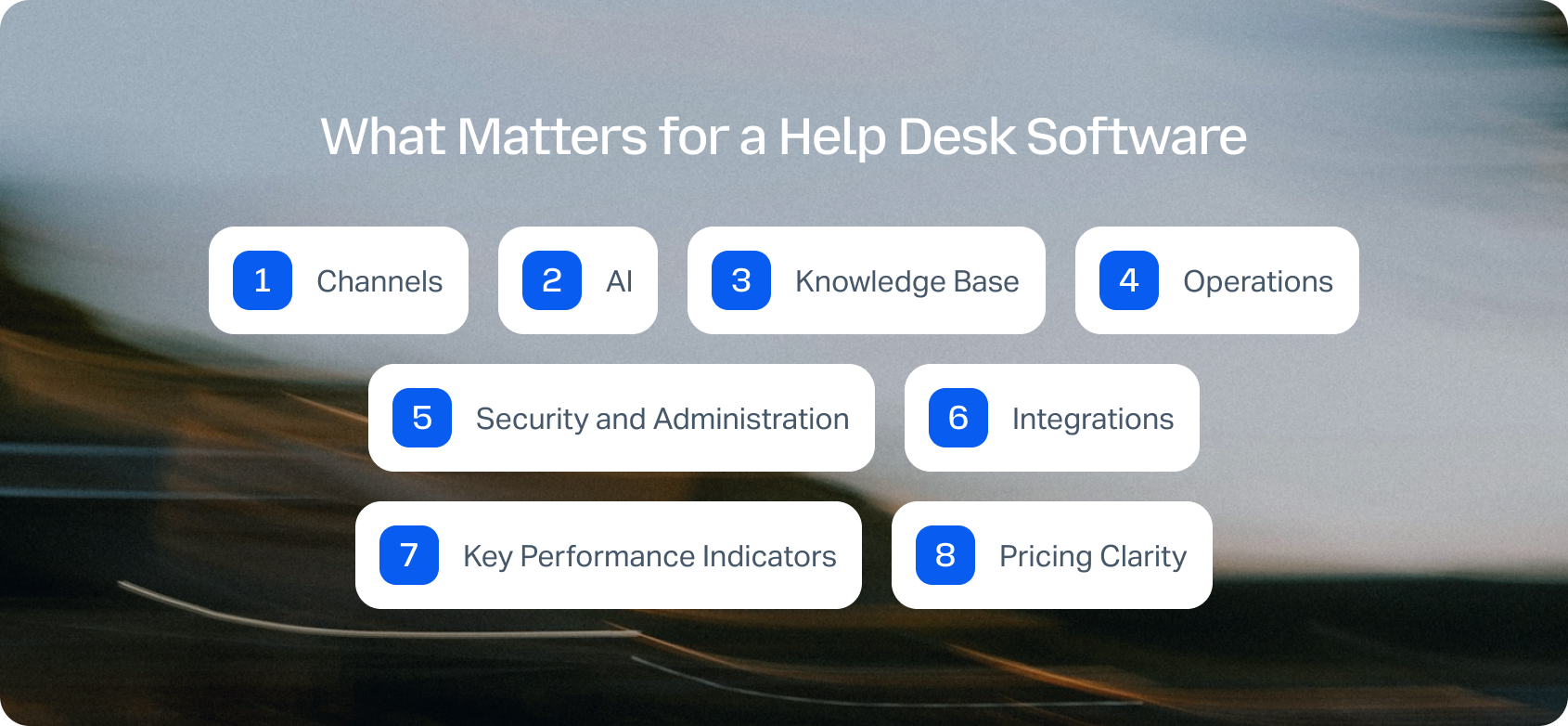
Channels
Modern help desk software for customer support needs to meet people where they are. Whether they want to chat on the phone or via social media, companies need to be agile. A robust help desk system consolidates these multiple support channels into a unified inbox, allowing agents to view the complete customer history regardless of how customers contact you. Seamless handoffs from chat to voice or email to chat prevent customers from repeating themselves and keep your support agents working in one workspace.
AI
AI supports the flow from intake to resolution. Incoming messages are classified with natural language processing, which tags issue type, priority, and required skills to route work to the correct queue. Agents receive a concise AI ticket summary, as lengthy email threads or chats are distilled into key points. During the conversation, suggested replies pull trusted content from your knowledge base to speed up responses and keep them consistent, while real-time translation enables agents to assist customers in any language. In parallel, sentiment analysis flags at-risk conversations, allowing leaders to prioritize follow-up and prevent escalations. Agents are not overwhelmed with redundant tickets due to spam filtering.
Knowledge Base
A smart knowledge base does more than store articles. It integrates into agent workflows, surfacing relevant help articles mid-conversation. For customers, it enables self-service options through a customer portal, thereby reducing ticket volume and enhancing the customer experience. The best help desk tools ground their AI-proposed replies in knowledge base content, ensuring agents provide accurate and consistent information without relying on guesswork.
Operations
Call center workforce management uses ticket trends to forecast demand and schedules agents to meet it. Customer service quality assurance samples interactions, scores them against rubrics, and surfaces coaching opportunities. SLA dashboards show real-time performance by agent, team, channel, and priority. Automated ticket routing distributes workload effectively across your customer support team.
Security and Administration
Administration features, including multi-factor authentication, audit logs, role-based permissions, and data retention policies, are non-negotiable for compliance with regulations like the General Data Protection Regulation. You need controls in place to determine who can change routing rules, access customer data, or modify system configurations. Enterprise help desk software must meet strict data security standards.
Integrations
Your help desk should integrate with CRM systems (such as Salesforce or HubSpot), commerce platforms (like Shopify or Magento), telephony systems, and business intelligence tools. Open APIs and webhooks enable custom workflows without the need for middleware. The best help desk software solutions offer extensive customization options through integration capabilities that connect your entire tech stack.
Key Performance Indicators
Begin with a concise scorecard that tells a single story. First-contact resolution indicates whether issues are resolved on the first interaction, while average handle time reflects agent productivity. In parallel, the containment rate indicates how well your AI voicebot or AI customer service chatbot deflects tickets, and the abandonment rate signals capacity or wait-time problems. Pair these with time-to-resolution to see how quickly cases close; layer in sentiment scores to identify at-risk customers; and use CSAT to confirm that the experience was well-received.
Pricing Clarity
Understand seat-based costs versus usage fees. Some help desk software SaaS platforms charge per user per month for basic features, then meter additional services such as tickets, AI interactions, or support requests separately. Others use ticket-based pricing models that scale with volume. Avoid desk platforms that require expensive add-ons for essential help desk software features, such as automated ticket routing, knowledge base integration, or AI assistance. Look for transparent pricing that includes core capabilities without forcing everything into premium tiers.
Understanding what to look for is one thing, seeing it in action is another. If you'd like to explore how AI-powered ticketing, phone support, workforce management, quality assurance, and omnichannel customer service work together in a single platform, book a personalized BlueTweak demo.
We'll show you how teams can automate ticket routing, improve agent productivity, and deliver faster, more consistent customer support.
How We Evaluated
This customer help desk software comparison draws on publicly available sources, including vendor documentation, feature breakdowns, and real-world case studies.
We also reviewed public customer logos and case studies to see which platforms are being used in practice. When pricing is listed on a vendor’s site, you’ll see it here. If it’s hidden behind a quote request or varies by plan, we’ve also noted that.
The pros and cons aren’t guesses or marketing fluff, either. Our help desk tools comparison is grounded in what’s verifiable. No hype, no filler. Just a straightforward, evidence-based comparison of help desk software to help you choose the right help desk software for your team.
Must-Have Capability Checklist
When evaluating top help desk software, it has to cover these foundational requirements:
- Omnichannel intake: Email, chat, voice, and social messaging, so customer context flows between channels
- Knowledge base integration: Strong KB-grounded answers for consistent support
- AI features: Classification, summarization, proposed reply, and translation to streamline communication
- Analytics: Track 2–3 KPIs, including ticket resolution rates, customer satisfaction, and agent performance
- Workforce management and quality assurance: Native modules or strong first-party integration
- Security and administration: MFA, audit logs, role-based permissions for compliance
- Integration capabilities: APIs and pre-built connections with CRM, commerce, and business systems
- Transparent pricing: Core AI features included, not only sold as add-ons
- Task management: Organizational tools to help agents prioritize and track customer inquiries
Scoring Rubric
These factors guided our evaluation of the best help desk tools:
Choosing the Right Help Desk Software in 2026
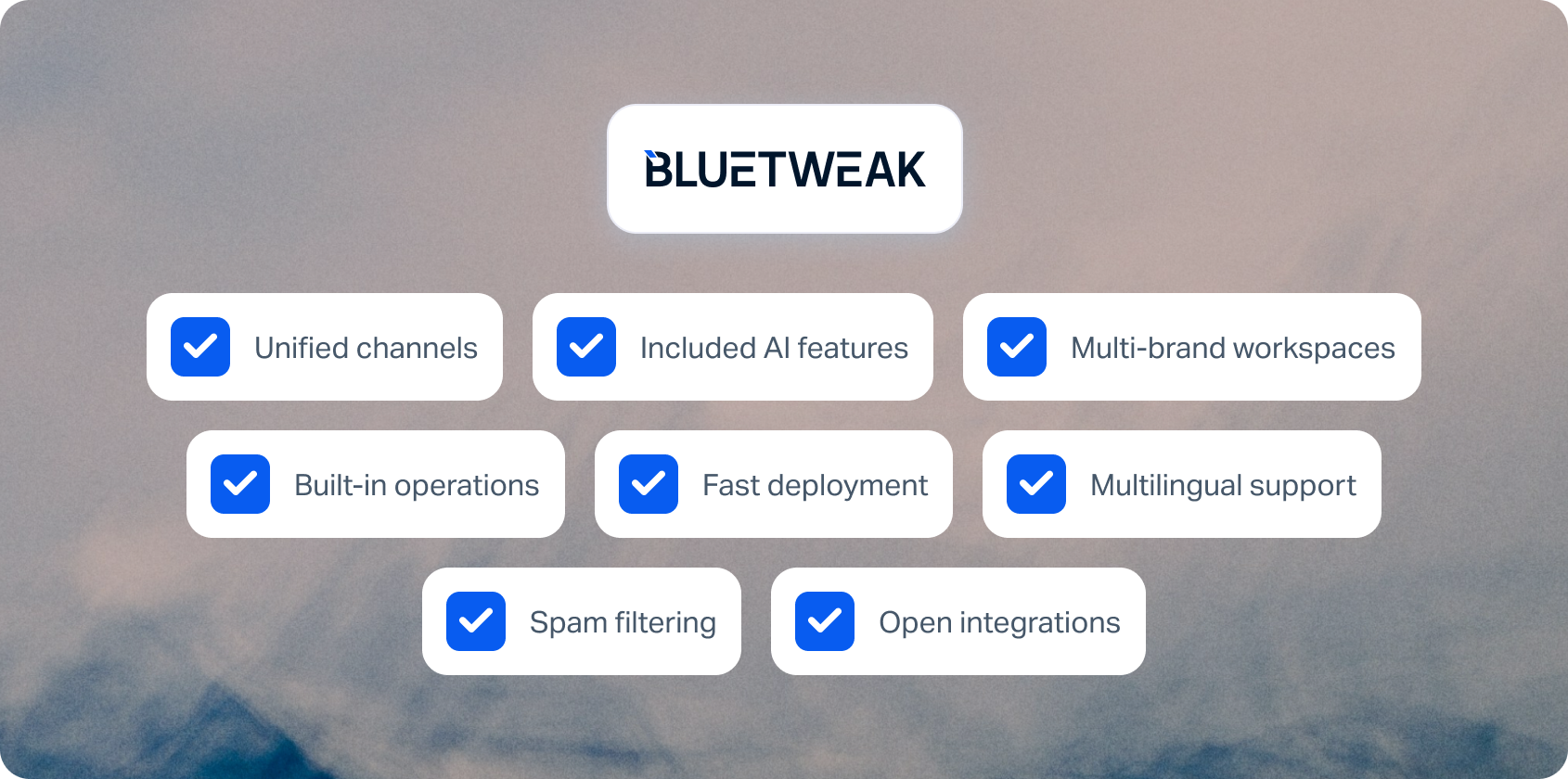
The best help desk software in 2026 depends on your team size, channel requirements, AI needs, and operational complexity. If you're a small team primarily handling email support with occasional chat, platforms like Help Scout, Freshdesk, or Zoho Desk offer simplicity and affordable entry pricing. For enterprises managing hundreds of agents across multiple channels, Salesforce Service Cloud, ServiceNow, and Genesys Cloud CX provide extensive capabilities, albeit with greater complexity and higher costs.
For customer support teams with 20 to 100 agents that need true omnichannel coverage, AI-powered automation, and workforce management without relying on multiple disconnected tools, BlueTweak stands out. It combines voice, email, chat, and social messaging with AI-powered ticket summaries, suggested replies, call transcription, workforce management, quality assurance, and transparent pricing in a single platform.
BlueTweak is a strong fit if you:
- Need a customer service platform that unifies voice, email, chat, and social channels
- Want AI features like call transcription, ticket summarisation, and knowledge base-grounded suggested replies included without expensive add-ons
- Manage multiple brands or client accounts from a single workspace
- Need built-in workforce management and quality assurance instead of third-party integrations
- Want to deploy in weeks rather than months
- Support multilingual customers with real-time translation
- Need automated spam detection to keep agents focused on genuine customer enquiries
- Prefer an API-first platform that integrates with your existing business systems
Ready to see BlueTweak in action? Book a personalised demo to explore its omnichannel capabilities, AI-powered automation, workforce management, and unified analytics. You can also use the ROI Calculator to estimate how much your business could save by consolidating customer support into a single platform.
Latest articles

Zendesk vs Twilio vs BlueTweak: Which To Implement In 2026?
Zendesk vs Twilio Flex in 2026: What’s Changed in Buyer Expectations?
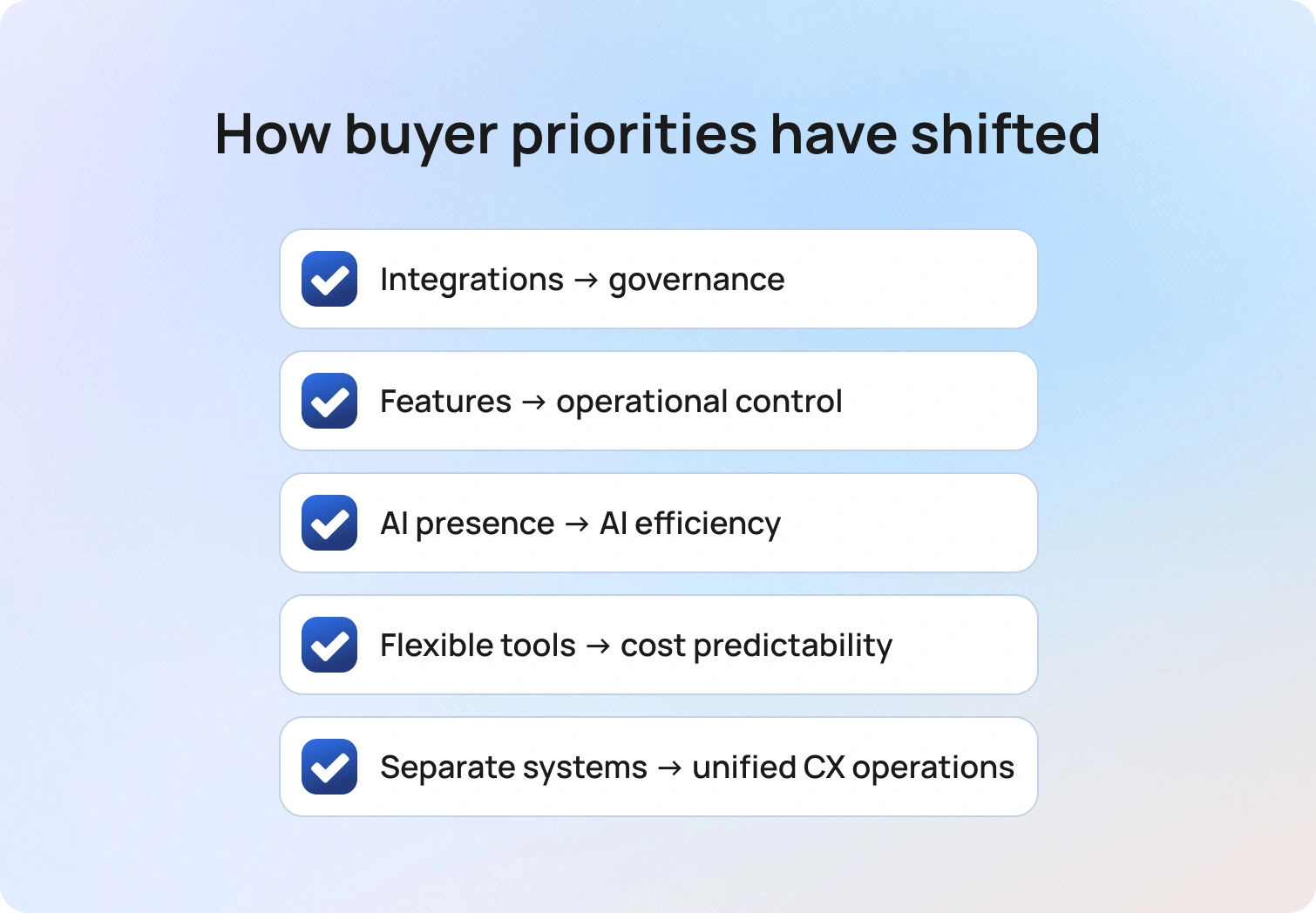
The conversation around Zendesk vs Twilio Flex has shifted significantly in the past few years. In 2023, buyers focused on channels and integrations; in 2026, they are focused on governance, cost predictability, and operational clarity.
According to the Deloitte Digital “Future of Service” report (2026), 43% of surveyed organisations believe AI will enable contact centre cost reductions of 30% or more within the next three years. That expectation changes how platforms are evaluated. Leaders are not simply asking which tool has AI, but which one can deliver measurable efficiency without creating governance risk or unpredictable usage costs. They’re asking how it will improve outcomes for customers without increasing operational risk.
This is why most mid-market teams evaluating Twilio Flex vs Zendesk find themselves at a strategic fork.
Do you adopt a ticketing-first suite and layer voice and automation on top? Do you build a programmable contact centre with engineering ownership? Or do you consolidate into a unified CX operating system designed to reduce system sprawl while maintaining operational control?
In 2026, the right decision is less about feature parity and more about how you want to run your operation over the next five years. For many teams, that means rethinking not just their contact centre, but their broader call center strategy and how voice, messaging, and digital support connect into one coherent operating model. While this discussion is often framed as Twilio Flex vs Zendesk, many teams are also exploring unified platforms, like BlueTweak, that aim to replace both the ticketing-first and build-your-own approaches altogether.
At a Glance: Twilio Flex, Zendesk, and BlueTweak
Before diving deeper into the nuances of Zendesk and Twilio Flex, it helps to step back and look at how each platform positions itself at a high level. This includes newer unified platforms like BlueTweak, which are designed to consolidate multiple systems into a single operating model.
The comparison below summarizes where they differ in operating model, strength, and cost structure, which is often where the real decision is made.
| Category | Zendesk | Twilio Flex | BlueTweak |
|---|---|---|---|
| Who it’s for | Structured support teams | Engineering-led teams | 20–100 agent ops teams |
| Core strength | Mature ticketing workflows | Programmable CCaaS | Unified CX OS |
| Voice | Plan/add-on dependent | Highly customizable | Native & integrated |
| Omnichannel | Strong ticket-led case management | Custom-built orchestration | Unified queue across channels |
| AI | Tier-based AI capabilities | Composable AI stack | KB-grounded, outcome-focused AI |
| KB / Self-Service | Mature Help Center | Integration-led knowledge layer | Single-source, multi-brand KB |
| WFM / QA | Add-ons or partners (plan dependent) | Integration-led / custom | Built-in operations layer |
| Security / Admin | Plan-based controls | Architecture-driven governance | Ops-focused governance model |
| Pricing note | Varies by plan / Verify | Usage-based / Verify | €65 per agent/month (full stack) |
What Each Platform Is (and What It’s Not)
Before comparing features, it’s important to understand the operating philosophy behind each platform. In the Zendesk vs Twilio Flex debate, the differences start with what each system was originally designed to do… and what it was not.
Zendesk
Zendesk started as a help desk platform, and its strength remains structured ticket workflows, SLA management, and Help Center publishing. It is particularly effective for teams whose support model is built around case resolution and escalation patterns. Voice capabilities can be layered in, but depth and flexibility depend on plan level and configuration choices.
Zendesk is not inherently a programmable contact center. While it integrates widely and offers AI features, buyers must confirm what is included at their chosen tier, especially around voice, WFM, and AI automation.
Twilio Flex

In contrast, Twilio Flex was never built as a ticketing suite. It was designed as a programmable communications platform that can become whatever your architecture requires.
Twilio Flex is fundamentally different. It is a programmable contact center platform that allows teams to design their own routing logic, agent desktop, and workflows. For organisations with engineering resources, this provides significant flexibility and architectural control.
However, Flex assumes technical ownership. Knowledge bases, analytics layers, and advanced automation often require integrations or custom development. It excels when you want to build your own experience, not when you want an out-of-the-box operating system.
BlueTweak

BlueTweak enters the conversation from a different angle. Rather than starting with a standalone ticketing system or heavy programmability, it starts with operational consolidation.
BlueTweak is positioned as a unified CX operating system and end-to-end customer service solution for mid-market operations. Rather than assembling components, it combines voice,omnichannel customer support case management, bots, WFM, QA, and analytics into a single workspace.
The focus is on operational clarity: one queue, shared reporting aligned to core customer support metrics, knowledge-grounded AI, such as AI proposed replies and built-in call transcription software, and multi-brand routing within the same admin model. It is not a developer toolkit; it is designed for operations leaders who want to reduce system sprawl while maintaining governance.
Feature-by-Feature Comparison
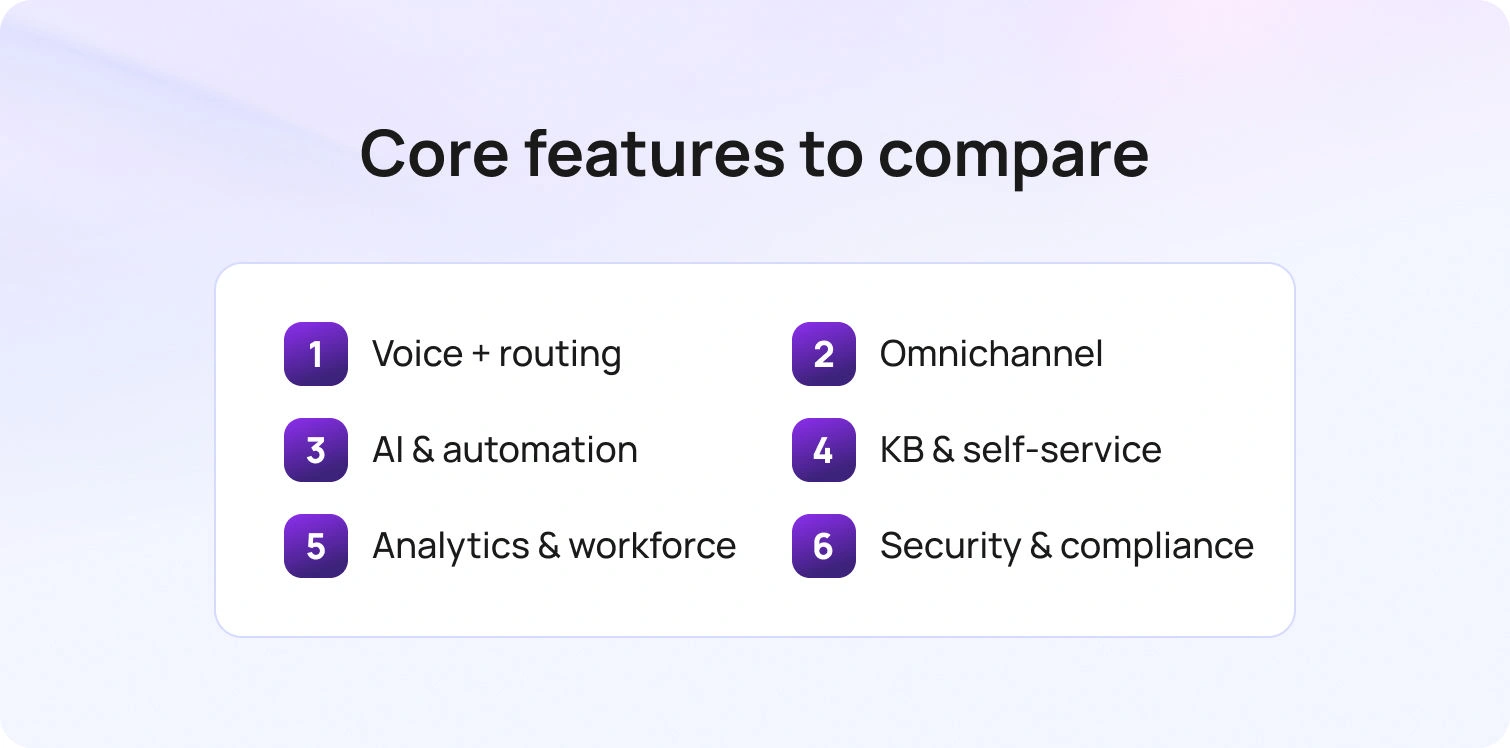
When people compare Twilio Flex to Zendesk, or bring alternatives like BlueTweak into the conversation, the real questions usually surface once you get past positioning and into the day-to-day reality: What will agents actually use? How complex will routing become? And how much admin work sits behind the scenes to keep everything running smoothly?
This is where operating philosophy translates into day-to-day agent experience and administrative complexity in practical ways, like workflows, reporting, governance, and the overall operational load on your team.
Voice + Routing
Voice architecture is often where a decision between Twilio and BlueTweak becomes tangible. The differences shape how calls flow, how agents work, and how much control your team really has.
Twilio Flex is built for programmability. Teams can design routing logic, queues, and agent interfaces around highly specific operational needs. That flexibility is powerful, but it assumes engineering ownership and ongoing technical management. It also means the end user experience, both for agents and supervisors, depends heavily on how well the environment is configured.
Zendesk approaches voice from a suite perspective. Voice functionality can support blended support teams and integrate into ticket workflows, but depth and configuration vary by plan and add-ons. It works well when voice is important, but not the architectural centre of your customer experience (CX) operation. However, forecasting call volumes and reducing customer waiting times may require additional configuration depending on your setup.
BlueTweak integrates native voice directly into the same agent workspace and ticket record. Routing, multilingual support, and handoffs between brands sit within one operational layer. This makes it easier to direct each interaction to the right agent without adding complex routing logic. For teams focused on clarity and speed rather than custom build complexity, this can significantly reduce friction.
Omnichannel Case Management
When evaluating vendors, remember, omnichannel isn’t just about how many channels are supported. It’s about how interactions are orchestrated and how much context agents retain across conversations.
Twilio Flex allows you to design a fully customised omnichannel desktop. You can orchestrate flows across voice, messaging, and digital channels using integrations and bespoke logic. This often includes connecting website chat, social messaging, and backend systems into one orchestrated workflow. The trade-off is that orchestration has to be built and maintained; it gives you the tools, but you have to decide how everything fits together.
Zendesk approaches omnichannel through a ticket-first lens. Every interaction becomes part of a structured case workflow, complete with SLAs, escalation rules, and collaboration patterns. This suits teams that rely on formalised support processes and documented resolution paths.
BlueTweak centres on a unified queue across channels, designed to keep context intact without forcing agents to switch systems. Multi-brand routing and reporting are built into the same environment, which can reduce operational noise in growing teams.
AI, Automation & Deflection
AI has become central to the Twilio Flex vs Zendesk conversation, but the real differentiator in 2026 is governance and measurable impact, not novelty.
Twilio Flex typically follows a composable AI model. You combine Twilio capabilities, third-party tools, and your own workflows to create automation. This offers flexibility, but it increases implementation effort and governance responsibility.
Zendesk provides AI features suited to ticket-led environments, including automation and assistance capabilities that vary by tier. For many teams, it delivers incremental efficiency gains, but buyers should confirm exactly what’s included around summaries, suggested replies, and routing intelligence.
BlueTweak focuses on knowledge-grounded assistance and outcome-driven automation. AI is embedded into the same operational layer as voice, tickets, and reporting, with an emphasis on human oversight. The focus isn’t just on automation, but consistent, auditable workload reduction. That consistency ultimately improves response quality for customers across every channel.
KB & Self-Service
Knowledge strategy often becomes the quiet driver of deflection, agent speed, and AI quality.
Twilio Flex generally relies on integrated knowledge bases and bot layers. This provides architectural freedom, but it means self-service and agent assistance often live across multiple systems.
Zendesk offers a mature Help Center and publishing workflow that supports structured content operations. For organisations investing heavily in deflection through articles and self-service portals, this ecosystem is well established. It allows customers to resolve common issues independently before reaching an agent
BlueTweak positions its knowledge base as a single source of truth powering both bots and agent assistance. In multi-brand environments, keeping content, routing, and reporting aligned inside one system can simplify both governance and performance tracking.
Analytics, Workforce Management & Quality Assurance
Reporting and workforce visibility are often underestimated during evaluation. Yet over 12 months, operational insight can matter more than channel breadth.
Twilio Flex can support advanced analytics and workforce management through integrations or custom builds. This allows deep customisation, but each additional layer adds vendor coordination and administrative overhead.
Zendesk delivers strong reporting around ticket metrics and performance KPIs. Workforce management and quality assurance capabilities typically depend on plan-level or partner solutions, so buyers should verify what is native versus add-on.
BlueTweak includes analytics, WFM, and QA within the same operational layer as case management and voice. For 20–100 agent teams, this unified visibility can reduce reconciliation work across systems and simplify forecasting.
Security, Admin & Compliance
As AI adoption increases, governance and auditability are becoming board-level concerns.
Twilio Flex is well-suited for organisations that want security controls aligned to a custom architecture. However, responsibility for compliance design spans all integrated components, meaning oversight must be intentional and ongoing.
Zendesk provides admin and security controls that scale by plan. Features such as MFA, audit logs, and data controls should be confirmed at the appropriate tier, particularly if AI governance is a priority.
BlueTweak focuses on mid-market governance, offering role controls, MFA, and audit logs within a unified admin model. For multi-brand operations, consistent oversight across queues, content, and reporting can reduce compliance complexity.
Pricing & 12-Month TCO Modeling
A serious Zendesk versus Twilio Flex comparison requires modelling the full 12-month cost of running your contact centre, not just comparing seat prices. The headline number rarely reflects the true operational cost once voice minutes, AI usage, analytics, and admin overhead are layered in.
With Zendesk, pricing typically starts with a seat-based model tied to your ticketing system, then expands. Voice (often via Zendesk Talk), advanced AI, workforce management, and deeper analytics features may depend on plan tier or add-ons. If you’re running multiple channels or operating more than one Zendesk instance, clarity around what’s native versus extra becomes critical.
With Twilio Flex, the structure is different. Pricing may combine seat or active user hour models with communications usage, including interactive voice response (IVR), call recording, and messaging. In a Twilio Flex vs Zendesk cost model, Flex can look flexible on paper, but forecasting usage across voice and digital contact volumes requires discipline. The ability to customize your contact center comes with shared responsibility for cost control.
BlueTweak anchors pricing at €65 per agent per month, paying monthly for a fully integrated environment. That includes voice, case management, bots, WFM, and analytics in one system. For business leaders evaluating market options, the question becomes less about the lowest entry cost and more about predictable service spend over 12 months.
Before signing with any company, check the details around:
- Voice minutes, recording, transcription, & interactive voice response charges
- AI usage metering and overage rules
- Sandbox or staging environment fees
- Support tiers and implementation services
- Multi-brand reporting and admin access model
Today, cost transparency is a competitive differentiator. But pricing alone doesn’t determine success; operational fit does. The platform that looks affordable on a pricing page can become expensive if it adds administrative load, integration overhead, or governance complexity over time. That’s why the next step isn’t just comparing numbers, it’s understanding which model aligns with how your contact centre actually runs.
When Each One Fits
At a strategic level, the debate between Twilio Flex and Zendesk often reflects how your business prefers to operate.
Choose Twilio Flex if your goal is to build a highly customized contact center and you have technical ownership in-house. The real strength of Flex lies in how far you’re willing (and able) to customize your environment. It’s particularly suited to organisations that want granular control over routing logic, user interface design, and how customer interactions flow across different channels. If you are comparing Twilio Flex, consider options in the enterprise market. Flex appeals when flexibility and architecture control outweigh simplicity.
Choose Zendesk if you are fundamentally ticketing-first and want a mature ticketing system at the core of your customer support model. Zendesk stands strongest where structured workflows, SLAs, and help content drive service consistency. Many Zendesk customers expand into voice and digital contact over time, often layering Zendesk Talk or additional Zendesk integration tools as their needs grow.
Choose BlueTweak if you want one platform to manage customer conversations across voice, chat, and digital channels without stitching multiple tools together. It’s designed for mid-market teams that want to control operations, unify data, and reduce complexity without building a custom stack. For 20–100 agents, especially across multi-brand environments, consolidation often becomes more valuable than customization.
Implementation Considerations

Implementation effort varies significantly depending on the platform’s philosophy. With Zendesk, you’re typically migrating customer data into a new Zendesk instance, configuring workflows, and refining your Help Center structure. If you’re layering voice or expanding into deeper automation, governance around add-ons and Zendesk integration decisions becomes part of the rollout.
With Twilio Flex, implementation begins with architecture. You define routing, interactive voice response (IVR) logic, and the user interface for agents. You’ll also set up integration layers, for example, a Flex Zendesk integration or data sync if you’re connecting to an existing ticketing system. Additionally, you might need to import customer data from legacy platforms and decide how conversations flow between systems. This approach is highly flexible, but it does require ongoing technical ownership.
With BlueTweak, implementation centres on unifying channels inside a single contact centre environment. That means importing knowledge content, configuring multi-brand routing, aligning dashboards, and ensuring agents can access customer data in one place. That shared visibility helps teams respond to customers faster and with more context. The emphasis is less on building from scratch and more on operational alignment.
The real difference boils down to whether you're assembling solutions or deploying a system designed to manage customer experience end-to-end.
How We Evaluated
This Zendesk vs Twilio Flex comparison is based exclusively on vendor-owned documentation. We reviewed official product pages, pricing details, help centres, integration listings, and public case studies across the market.
We assessed each platform across channels, voice capabilities, interactive voice response options, AI functionality (including transcription and summarisation), knowledge base structure, analytics, workforce management, security controls, and API access. Where Twilio and Zendesk's positioning overlaps, particularly around integration and omnichannel service, we focused on documented capabilities rather than third-party opinion.
We also reviewed public examples of how companies manage customer interactions and conversations using each system.
Final Thoughts: Choosing the Right Contact Center for 2026
When evaluating Twilio Flex, Zendesk, or any alternative contact center, the decision is rarely about features alone. It’s about choosing the call center foundation that will support your customers, agents, and growth strategy over the next several years. It’s about how a platform shapes the day-to-day customer experience, how it lets your agents manage conversations, and how your business can scale operations without adding unnecessary complexity.
A Twilio Flex compare exercise shows that Twilio is powerful for companies that want maximum flexibility and control over routing, interactive voice response, and integrations. It can create highly customised workflows, but doing so often requires ongoing technical ownership and investment in tools to keep everything aligned. For teams without a dedicated engineering function, the risk is that the operational complexity of Twilio Flex outweighs the benefits of its flexibility.
Alternatives like Zendesk focus on structured ticketing systems and predictable workflows, which can streamline customer support and help resolve customer issues quickly. This structure can work well for companies serving high volumes of customers with repeatable queries.
Platforms such as BlueTweak combine voice, chat, analytics, and WFM into a unified environment, enabling companies to manage multiple channels and maintain a high-quality contact experience without juggling disparate tools.
Ultimately, the right choice depends on your company, your employees, and how you want to balance flexibility, operational control, and cost. A short pilot test can help you see how each solution performs with real customers, ensuring you choose the platform that truly supports the right user experience, keeps your agents productive, and aligns with your broader business goals.
Ready to see how a unified contact center can simplify operations, improve customer experience, and empower your agents?
Request a BlueTweak demo today to explore voice, chat, analytics features, and multi-channel workflows in action.

Zendesk vs Zoho vs BlueTweak: Which To Implement In 2026?
Zendesk vs Zoho vs BlueTweak: Why support teams are re-evaluating their CX platforms in 2026
Comparisons like Zendesk vs Zoho Desk (previously known as Zoho Support) used to be relatively simple; one platform handled tickets, another added a few channels, and most teams could run their support operation from a single help desk system.
But that’s no longer the reality for most customer support organizations.
Today’s buyers are evaluating platforms through a much wider operational lens. Support leaders now have to think about tool sprawl, voice and messaging channels, AI governance, and multi-brand operations, all while keeping total cost and time-to-value under control.
Customer expectations are rising at the same time. According to PwC’s 2025 Customer Experience Survey, 70% of executives say customer expectations are evolving faster than their company can adapt. This pressure is forcing support teams to modernize their technology stacks.
Meeting increasing demands and expectations with fragmented tools (one system for tickets, another for voice, another for analytics) quickly becomes difficult to manage. As a result, when organizations evaluate Zoho Support vs Zendesk, they’re often solving a bigger question than “which help desk is better?”
They’re asking which platform architecture will support modern customer operations, including:
- Reducing tool sprawl and administrative overhead
- Expanding voice and messaging channels
- Introducing AI with proper governance and oversight
- Managing multi-brand environments or BPO operations
- Maintaining predictable total cost and operational simplicity
This is also why newer platforms like BlueTweak are entering the conversation. Rather than focusing purely on ticketing, they aim to combine omnichannel support, voice, workforce management, analytics, and knowledge-driven AI into one operational platform.
So when comparing Zoho Support vs Zendesk, the real decision is less about individual features and more about how each platform fits into the future of your support operation.
At a glance: Zendesk vs Zoho vs BlueTweak
Before diving deeper into the Zoho vs Zendesk debate, here’s a simplified overview of how the platforms position themselves.
| Feature | Zendesk | Zoho Desk | BlueTweak |
|---|---|---|---|
| Who it’s for | Mid-to-large teams that want powerful ticketing and customization | SMB teams already using Zoho apps | 20–100 agent teams and multi-brand environments |
| Core strength | Mature workflows and a large marketplace ecosystem | Value-focused help desk within the Zoho ecosystem | Unified CX platform (tickets, voice, WFM, analytics) |
| Voice | Native or add-ons depending on suite tier (Verify) | Telephony integrations or add-ons (Verify) | Native voice integrated with tickets |
| Omnichannel | Strong omnichannel ticketing foundation | Omnichannel support with plan limits (Verify) | Full omnichannel workspace |
| AI | Features vary by suite tier or add-ons (Verify) | AI capabilities vary by plan (Verify) | KB-grounded AI with human oversight |
| KB / Self-service | Mature Help Center capabilities | Integrated help center | Single knowledge source powering agents and bots |
| WFM / QA | Often handled via add-ons or partners (Verify) | Usually handled via integrations (Verify) | Built-in WFM and QA tools |
| Security / Admin | Enterprise-grade admin controls | Standard roles and security features | Centralized multi-brand admin controls |
| Pricing note | Tiered suite pricing plus add-ons | Lower entry price with feature tiers | €65 per agent/month |
What each platform is (and what it isn’t)
Before comparing features, it’s worth clarifying what these platforms were originally designed to do. Each platform has evolved differently, which explains many of the architectural trade-offs buyers encounter.
Zoho Desk (formerly Zoho Support)
When people search Zoho vs Zendesk, they’re often comparing two ticketing systems. Zoho Desk is fundamentally a help desk platform designed to integrate deeply with the broader Zoho ecosystem.
Strengths include:
- Tight integration with Zoho CRM and other Zoho apps
- Solid ticketing automation
- Strong value for SMB teams
However, more advanced operational layers, like telephony, workforce management, or deeper analytics, may rely on additional Zoho products or integrations, depending on the plan.
For organizations already committed to Zoho tools, this ecosystem alignment can be a major advantage.
Zendesk
Zendesk is widely considered the gold standard for ticketing workflows. The platform’s architecture focuses on:
- Powerful automation rules
- Mature escalation patterns
- Extensive marketplace integrations
Voice, AI features, and advanced operational tooling can vary by suite tier or add-ons, which means the final architecture often looks different from company to company.
Zendesk’s strength is flexibility, but that flexibility can sometimes translate into operational complexity as systems grow.
BlueTweak
BlueTweak takes a different approach. Rather than starting with a ticketing system and expanding outward, the platform is designed as a unified customer experience (CX) operating system.
That means bringing together:
- Ticketing
- Voice
- Messaging channels
- Bots
- Workforce management
- Analytics
- Knowledge-grounded AI
This architecture is particularly tuned for teams of 20–100 agents and organizations managing multiple brands or support environments.
The core goal BlueTweak is focused on addressing is reducing the number of tools needed to run customer operations.
Feature-by-Feature Comparison
The differences between Zendesk vs Zoho Desk vs BlueTweak become clearer when evaluating specific operational areas. Most customer support solutions can appear similar at a high level; ticketing, automation, knowledge bases, and reporting are now standard features across the industry. But once teams move beyond marketing pages and begin evaluating real workflows, meaningful differences start to emerge.
To make the comparison clearer, we’ve broken the platforms down into the operational layers that typically matter most to modern support teams. These include core ticketing workflows, omnichannel case management, voice support, knowledge base capabilities, AI and automation, analytics and workforce management, security and administration, and ecosystem integrations.
Looking at Zoho Desk and Zendesk through these practical lenses helps highlight where each platform excels, and where organizations may need to rely on additional tools or integrations. It also provides a clearer view of how platforms like BlueTweak approach the same operational challenges through a more unified architecture.
Ticketing workflows, SLAs, and escalation
Ticketing is the backbone of most support platforms.
Zoho Desk
Zoho Desk offers a strong ticketing engine with automation, SLAs, and workflow customization.
Strengths include:
- Automated ticket assignment
- SLA tracking and escalation rules
- Integration with Zoho CRM data
More advanced routing or operational workflows may require higher-tier plans or integration with other Zoho applications (Verify).
Zendesk
Zendesk remains one of the strongest ticketing platforms on the market.
Capabilities include:
- Advanced triggers and automations
- Macro libraries for response consistency
- Escalation frameworks across departments
Some capabilities (particularly advanced automation layers) can vary by suite tier or add-ons (Verify).
BlueTweak
BlueTweak approaches ticketing from a unified queue perspective.
Instead of separating channels, all interactions (voice, messaging, chat, and email) feed into one operational queue.
This reduces context switching for agents and simplifies multi-brand routing and reporting.
Omnichannel case management (email, chat, social, messaging)
Customer interactions now span many channels. The question isn’t whether platforms support them, but how well they unify them.
Zoho Desk
Zoho Desk supports multiple channels, including email, chat, and social messaging.
Cases from these channels can be consolidated into ticket records, though channel availability and depth may vary by plan (Verify).
Zendesk
Zendesk provides a strong omnichannel foundation with extensive integrations.
Organizations can extend channel support using the Zendesk marketplace, allowing them to add messaging apps and other communication tools.
BlueTweak
BlueTweak brings all channels into one workspace designed for faster handoffs and consistent customer context.
The goal is to reduce friction when agents switch between messaging platforms or escalate conversations between channels.
Voice (native vs add-on) and context preservation
Voice remains critical for many support operations, yet voice support varies widely across platforms.
Zoho Desk
Voice functionality is typically enabled through telephony integrations or add-ons (Verify).
Whether transcripts automatically link to ticket records may depend on the telephony integration being used.
Zendesk
Zendesk offers voice capabilities through its Zendesk Voice product and related add-ons (Verify).
Call recordings, transcripts, and reporting can integrate with ticket workflows depending on configuration.
BlueTweak
BlueTweak includes native voice integrated directly with ticketing.
Calls generate transcripts that attach to cases, allowing agents to review conversation history and maintain context across channels.
This can be particularly valuable for multilingual operations or high-volume voice environments.
Knowledge base and self-service
Self-service plays an increasingly important role in customer experience. According to Gartner research, 55% of service leaders are actively exploring customer-facing generative AI chatbots as part of their support strategy, highlighting the growing investment in automated and self-service experiences.
Platforms, therefore, need knowledge bases that are easy to maintain and govern.
Zoho Desk
Zoho Desk includes help center capabilities with:
- Article publishing
- Categorization and organization
- Localization support
Feature depth may vary by plan (verify).
Zendesk
Zendesk’s Help Center is one of the platform’s strongest components. Due to its maturity, content teams can manage:
- Multi-language documentation
- Content governance
- Advance article organization
BlueTweak
BlueTweak positions the knowledge base as the single source of truth for support operations.
Articles can power:
- Agent assistance
- Customer self-service
- Automation and bots
This helps maintain consistency across multiple brands or support channels.
AI, automation, and deflection
AI has become central to modern support platforms—but governance is increasingly important.
Zoho Desk
Zoho Desk includes AI capabilities depending on the plan, often focused on:
- Response suggestions
- Automation
- Customer interaction insights
Availability and governance features may vary by tier (Verify).
Zendesk
Zendesk offers several AI features, such as:
- Conversation summarization
- Suggested replies
- Automated bots
Capabilities vary by suite tier and add-ons (Verify).
BlueTweak
BlueTweak focuses on knowledge-grounded AI with human oversight. Key capabilities include:
- Automation that references the knowledge base to maintain consistency and accuracy
- Context-aware AI suggested replies to assist agents with faster, relevant responses
- Reduced reliance on purely generative AI, ensuring that all interactions reflect company knowledge and previous customer history
Analytics, WFM, and QA
Operational insight is critical for scaling support teams and tracking key customer support metrics.
Zoho Desk
Zoho Desk offers reporting dashboards and analytics.
More advanced workforce management or QA capabilities may require adjacent tools or integrations (Verify).
Zendesk
Zendesk provides strong analytics capabilities through its reporting framework.
However, workforce management and QA functions are often handled through add-ons or partner integrations (Verify).
BlueTweak
BlueTweak includes built-in analytics, WFM, and QA capabilities, designed specifically for support teams between 20 and 100 agents.
This allows managers to track performance without adding multiple operational tools.
Security, admin, and compliance readiness
Security and governance are essential for customer operations platforms.
Zoho Desk
Zoho Desk offers standard security controls, including:
- Role-based access
- MFA
- Audit logging
- Data retention controls
Availability may vary by plan (Verify).
Zendesk
Zendesk includes enterprise-grade security features such as:
- Role-based permissions
- MFA
- Audit logs
- Data residency options
Exact availability depends on the suite tier (Verify).
BlueTweak
BlueTweak focuses on simplified administration with:
- Multi-brand management
- Role-based access
- Audit logs
Some certifications may still be in progress, depending on deployment requirements.
Integrations and ecosystem
The ecosystem surrounding a platform often determines long-term flexibility.
Zoho Desk
Zoho Desk is particularly powerful when used within the Zoho ecosystem, integrating with CRM, marketing, and commerce tools.
External integrations are available but may require additional configuration.
Zendesk
Zendesk has one of the largest CX marketplaces in the industry.
Organizations can add hundreds of integrations, although this can create additional governance and administration overhead as systems grow.
BlueTweak
BlueTweak offers an API-open architecture, but emphasizes pre-configured capabilities designed to reduce setup complexity.
This can accelerate time-to-value, especially for multi-brand support environments.
Pricing and 12-month TCO modeling
When comparing customer support software, most buyers initially focus on the monthly license price. But in practice, the subscription fee is only one piece of the overall cost equation.
As support operations expand across channels, introduce AI features, or integrate additional tools, the true cost of running a customer support platform becomes much broader than seat pricing alone.
This is why experienced support leaders increasingly evaluate platforms based on total cost of ownership (TCO) over a 12-month period. Instead of asking “what does the license cost?”, the better question is: what does it take to actually run this platform in a real support environment?
For a typical 50-agent team supporting customers across 3–5 channels, the full cost picture often includes several operational components.
- Seat licenses - the baseline cost of the platform itself, usually calculated as a monthly fee per agent. This is the most visible line item, but rarely the only one.
- Voice and telephony usage - if the support operation includes phone support, additional costs may apply for minutes, call recordings, transcription, and storage.
- AI capabilities and automation usage - many platforms now offer AI-powered tools such as response suggestions, summarization, and chatbots. These features may be bundled into higher tiers or priced separately based on usage.
- Workforce management and quality assurance tools - scheduling, forecasting, and QA capabilities are sometimes included in CX platforms but are often sold as separate modules or handled through integrations.
- Implementation and migration services - initial setup can include ticket migration, knowledge base structure, workflow configuration, and channel onboarding. Depending on the platform, this may require professional services or internal resources.
- Marketplace applications and integrations - many support teams rely on integrations with CRM systems, telephony providers, analytics tools, or ecommerce platforms. These integrations can introduce additional subscription costs over time.
- Ongoing administrative overhead - finally, there’s the time cost associated with maintaining the platform; managing integrations, adjusting workflows, updating automations, and monitoring performance.
Taken together, these factors create the real operating cost of a support platform, which can look very different from the headline license price.
Vendor pricing notes:
Zoho Desk offers multiple pricing tiers that scale functionality across automation, analytics, and AI features. Many capabilities are unlocked at higher plan levels, so buyers evaluating Zoho vs Zendesk should confirm exactly which features are included in each tier (Verify).
Zendesk pricing typically follows suite tiers, with additional charges possible for voice capabilities, advanced AI features, and marketplace integrations, depending on the configuration.
BlueTweak pricing starts at €65 per agent per month, with some AI-related capabilities based on usage. The platform’s positioning focuses on combining multiple CX operational layers (ticketing, voice, WFM, and analytics) within a single environment.
Questions to ask sales
Before committing to any platform, buyers should clarify:
- What features are included in the base plan vs add-ons?
- Are there minimum seat counts or annual contracts?
- How are voice minutes, recordings, and transcripts priced?
- How is AI usage metered?
- Are sandbox or staging environments available?
- What support tiers and implementation packages exist?
- How does the platform handle multi-brand environments?
These questions often reveal the true total cost of ownership.
When each platform fits

Choosing between Zoho Desk, Zendesk, or BlueTweak ultimately depends on the structure, maturity, and operational priorities of your support organization. While all three platforms aim to help teams manage customer interactions more effectively, they take different architectural approaches to solving the problem.
Some platforms prioritize deep ticketing workflows and customization, others focus on ecosystem integration and affordability, while newer platforms aim to consolidate multiple CX capabilities into a single operational environment. As a result, the “best” platform is rarely universal; it depends on factors such as team size, channel mix, internal technical resources, and whether your organization prefers assembling a stack of specialized tools or running support operations from a more unified system.
The following scenarios highlight where each platform tends to fit best based on those operational considerations.
- Choose Zoho Desk if you want a cost-effective help desk with strong fundamentals and already rely heavily on Zoho applications.
- Choose Zendesk if you want highly customizable ticketing workflows and the flexibility of a large marketplace ecosystem.
- Choose BlueTweak if you want one platform that combines omnichannel support, voice, WFM, and analytics, particularly for teams between 20 and 100 agents or organizations supporting multiple brands.
Implementation considerations
Implementation complexity can vary significantly depending on how each platform is structured and how your current support environment operates. Migrating from an existing help desk or deploying a new CX platform typically involves more than simply importing tickets; it requires configuring workflows, structuring knowledge bases, onboarding channels, and ensuring reporting aligns with operational KPIs.
When comparing Zendesk, Zoho Desk, and BlueTweak, buyers should consider not only feature sets but also how much time and internal expertise may be required to deploy and maintain the platform.
Zoho Desk
Implementing Zoho Desk typically begins with migrating existing tickets, customers, and support data into the new system. Teams also need to structure the knowledge base so that articles are properly categorized for both agents and customers.
Workflow automation is another key part of the deployment process, including configuring ticket routing rules, SLAs, and escalation paths. If the organization uses other Zoho products, such as Zoho CRM, integrations may also need to be configured to ensure customer data flows smoothly between systems.
For teams already operating within the Zoho ecosystem, implementation is often relatively straightforward. However, organizations relying on external tools may need additional integration work to connect telephony platforms, analytics tools, or messaging channels.
Zendesk
Zendesk implementations often involve a deeper level of workflow configuration due to the platform’s flexible automation framework. In addition to migrating tickets and knowledge base content, teams typically spend time configuring triggers, automations, and macros that standardize how agents respond to different types of requests.
Because Zendesk relies heavily on its marketplace ecosystem, implementation may also include installing and configuring third-party integrations for capabilities such as voice support, analytics, or workforce management. As the number of integrations grows, organizations often establish governance practices to ensure apps remain compatible and workflows remain manageable.
This flexibility is one of Zendesk’s strengths, but it also means that implementation timelines can vary depending on how customized the environment becomes.
BlueTweak
BlueTweak deployments generally focus on consolidating support channels and operational workflows into a unified environment. Instead of connecting multiple external tools, the implementation process typically centers on bringing channels such as email, chat, messaging apps, and voice into a single workspace.
Knowledge base content is also structured early in the deployment so it can support both agent workflows and AI-powered assistance. For organizations managing multiple brands or support environments, routing rules and reporting structures are configured to ensure tickets and conversations are correctly segmented.
Implementation often concludes with configuring dashboards, analytics views, and workforce management settings so support leaders can monitor performance and staffing from day one.
How we evaluated Zendesk vs Zoho vs BlueTweak
This comparison is based on information from vendor documentation and publicly available product pages. The goal is to present a practical overview of how each platform approaches common customer support challenges rather than relying on third-party review sites.
Where platform capabilities vary depending on plan tiers or configuration, they are labeled “Varies by plan” or “Verify.” Buyers should confirm these details directly with vendors during the evaluation process for relevant specifics for their needs.
Final thoughts: the verdict for modern support operations
When comparing customer support solutions, the real decision isn’t just about ticket management features or pricing tiers. Each platform approaches customer support from a different architectural perspective, which affects how easily teams can scale, automate workflows, and manage multiple channels over time.
Zoho Desk is often the logical choice for organizations already invested in the Zoho suite, particularly those already using Zoho CRM, Zoho Analytics, and other Zoho apps to manage customer relations. The platform offers strong automation capabilities, customizable ticket forms, and an intuitive interface that works well for smaller or mid-sized teams.
Zendesk, on the other hand, remains one of the most mature platforms in the market. With tools like Zendesk Explore, Zendesk Talk, and the broader Zendesk Support Suite, it offers customization options, advanced reporting, and an ecosystem of third-party apps. For organizations willing to manage integrations and configuration complexity, it is a powerful and scalable customer service platform.
BlueTweak represents a newer architectural approach, designed to consolidate support tools into a unified environment. Instead of relying on multiple integrations, the platform focuses on combining ticket management, voice, analytics, workforce management, and AI tools in one system to help teams streamline customer support.
Ultimately, the right choice depends on the maturity of your support operations, the size of your team, and whether your organization prefers assembling a flexible support stack or running customer support from a more unified platform.
For many organizations evaluating Zoho Desk and Zendesk, the most practical next step is a short pilot with identical workflows and KPIs. Testing each platform with real incoming tickets, automation rules, and reporting needs will provide the clearest view of which system best supports your long-term customer experience strategy.
If you'd like to see how a unified CX platform works in practice, you can book a BlueTweak demo to explore how ticketing, voice, analytics, and automation can operate within a single support environment.
Help Scout vs. Zendesk vs. BlueTweak: Which Platform Fits Best?
Help Scout vs. Zendesk vs. BlueTweak: Choose by Team Maturity, Not Brand Recognition
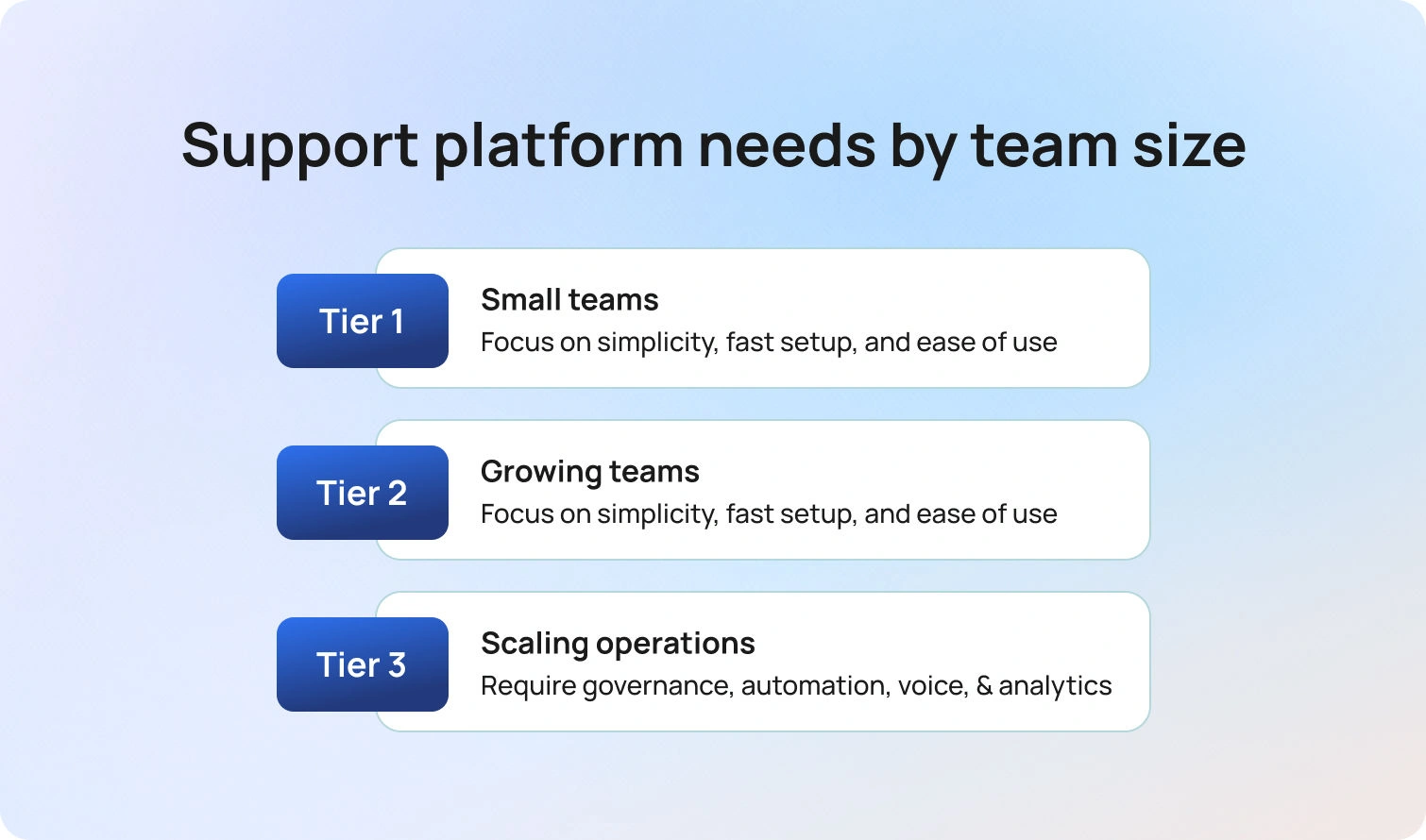
The mistake most buyers make in the Help Scout vs Zendesk debate is comparing feature lists without mapping them to operational complexity. On paper, both Zendesk and Help Scout promote powerful key features, from ticketing systems and collaboration tools to self-service options and automation, but the real question isn’t which platform has more features. It’s the customer support platform that aligns with how your support team actually operates.
Customer support software is no longer just about answering tickets. According to a 2025 global customer experience survey by PwC, 73% of consumers say experience is a key factor in purchasing decisions, and companies are increasing investment in automation, AI, and analytics to protect loyalty and revenue. That means the platform you choose directly impacts business performance, customer satisfaction, and the quality of customer interactions, not just how efficiently agents close support requests.
In 2026, the pressure on support teams extends far beyond inbox management. Leaders are expected to reduce resolution times, automate routine tasks, unify support channels, and deliver personalized support at scale. Modern customer support operations require more than a basic ticketing system; they demand reporting clarity, collaboration tools, support resources like community forums, a comprehensive knowledge base, and automation that enables businesses to streamline customer support while maintaining quality.
This is where the difference between Zendesk and Help Scout becomes clearer. Both Zendesk and Help Scout can support growing teams, and Zendesk's suite of professional and enterprise tiers introduces advanced features for scaling. However, complexity increases alongside capability, particularly for Zendesk customers configuring workflow automation, phone support, and expanded support channels. Meanwhile, Help Scout often appeals to new users and small teams seeking a user-friendly interface and minimal administrative overhead, sometimes even starting on a free plan before upgrading.
A newer category of platform is also emerging. Tools like BlueTweak are designed to unify ticketing, voice, chat, analytics, and automation into a single operational layer, reducing the need for multiple integrations as teams scale. Instead of choosing between simplicity and depth, these platforms aim to support growing teams with a more cohesive customer support stack.
That’s why the real question in the Zendesk vs Help Scout comparison isn’t which customer support tools look stronger in a demo. It’s which platform supports your operational tier today, and which one can evolve with your support process tomorrow.
For Tier 1 teams, typically between one and ten agents, speed and simplicity matter more than deep operational tooling. These teams prioritize ease of use, fast onboarding, and minimal administrative overhead.
Tier 2 teams, often ten to thirty agents, begin to feel the weight of scale. Workflows, SLAs, reporting, and self-service infrastructure start to matter because consistency becomes harder to maintain without structure.
By Tier 3, usually thirty to one hundred agents, support becomes an operations-led function. Governance, workforce management, quality assurance, voice support, automation, and advanced analytics shift from “nice to have” to essential.
At a glance: Help Scout vs. Zendesk vs. BlueTweak
Before diving into the tier-by-tier analysis, it’s helpful to get a high-level view of how Help Scout, Zendesk, and BlueTweak stack up across the features that matter most in 2026. This snapshot highlights each platform’s core strengths, channel coverage, and operational capabilities, giving you a quick sense of which tool might suit your team before we break it down by maturity tier.
| Category | Zendesk | Help Scout | BlueTweak |
|---|---|---|---|
| Who It’s For | Structured CX teams scaling toward enterprise | Lean teams that want simplicity | Mid-market, multi-brand, ops-led teams |
| Core Strength | Ticketing-first CX suite with broad ecosystem | Shared inbox + help docs/self-service | Unified CX OS (tickets + voice + chat + bots + WFM + analytics) |
| Voice | Add-on / tier-based | Limited | Built-in |
| Omnichannel | Broad coverage (tier-dependent) | Email-first; chat optional | Built-in omnichannel |
| AI | Varies by plan and add-ons | Plan-dependent | KB-grounded + human-in-the-loop |
| KB / Self-Service | Mature Help Center tooling | Strong and straightforward | Single source of truth for agents + bots |
| WFM / QA | Add-on or partner-dependent | Not core focus | Built-in |
| Security / Admin | Advanced at higher tiers | Straightforward controls | Multi-brand governance + ops controls |
| Pricing Note | Expands with add-ons and tiering | Predictable at small scale | Designed to reduce tool sprawl |
What each platform is (and what it isn’t)
When evaluating Help Scout and Zendesk, it’s important to think beyond checklists. Each platform is built with a philosophy that shapes how teams operate, scale, and measure success.
Help Scout is designed for teams that prize simplicity and speed. Its shared inbox and lightweight knowledge base make it ideal for small teams that need to resolve tickets quickly without complex setup. The strength here is clarity: agents spend less time navigating tools and more time solving problems. But that simplicity comes at a cost; Help Scout is not built for advanced workforce management, complex routing, or multi-brand operations. As teams grow, these limitations can become bottlenecks.
Zendesk takes a more structured, ticketing-first approach. It provides depth through workflows, automations, and an extensive ecosystem of integrations. This makes Zendesk attractive for teams that expect to scale quickly or require rigorous SLA management. However, that breadth also introduces its own complexity: additional features often come as tiered add-ons, and governance can become a challenge if your team is managing multiple brands or high-volume, multi-channel operations.
BlueTweak positions itself as a unified customer experience (CX) operating system, bringing together tickets, voice, chat, bots, workforce management, analytics, and KB-grounded AI into a single platform. For teams supporting multiple regions, multilingual voicebots can further streamline global customer support without adding new platforms. This approach is designed for mid-market teams that need operational consistency across multiple brands or languages, without the burden of integrating disparate tools. Where Help Scout and Zendesk may require stitching together five different apps to cover these needs, BlueTweak consolidates them into one coherent workflow, giving leaders both visibility and control.
Which is best for your tier and team in 2026?
Selecting the right platform isn’t as much about feature volume as it is about matching operational maturity and team size with the platform’s strengths.
Tier 1 (1–10 agents): Keep it simple, don’t overbuy
For lean teams, speed and ease of use outweigh deep operational tooling. Help Scout excels here, giving teams a clear, frictionless workflow for shared inboxes and lightweight self-service. Zendesk can still work, but its complexity may be unnecessary at this stage unless you anticipate rapid growth or want to lay the groundwork for structured processes. BlueTweak may be bordering on overkill for pure Tier 1 needs unless you already need multi-brand or omnichannel functionality from the start.
Tier 2 (10–30 agents): Workflows, SLAs, and reporting start to matter
As teams grow, managing processes consistently becomes a priority. Help Scout can still be sufficient for teams that maintain simple workflows, but it’s crucial to validate reporting and SLA capabilities. Zendesk shines in this tier with its automation, structured ticketing, and reporting features, though many capabilities remain tier-dependent. BlueTweak offers a pragmatic alternative: omnichannel support, multi-brand handling, and operational visibility, all in a single stack, reducing the risk of tool sprawl. For guidance on evaluating these factors, see our article on how to choose help desk software.
Tier 3 (30–100 agents): ops-led support, higher volume, more governance
At this stage, teams need governance, workforce management, quality assurance, and analytics. Help Scout’s lightweight design may feel limiting, particularly if routing and multi-brand operations are critical. Zendesk can meet these needs, but often at the cost of added tiers and marketplace complexity. BlueTweak is designed for exactly this use case. It provided a unified stack that supports omnichannel engagement, voice, WFM, QA, and real-time analytics, all while consolidating multi-brand reporting.
Multi-brand or BPO teams (any size): segmentation and reporting are the real test
Here, the difference between tools is less about individual features and more about operational coherence. Help Scout requires careful setup to segment brands and manage permissions. Zendesk supports multi-brand workflows but often needs tiered configurations or add-ons to keep governance manageable. BlueTweak provides native multi-brand routing and reporting, giving leaders a single platform to govern complex operations without sacrificing context or oversight.
Feature-by-Feature Comparison
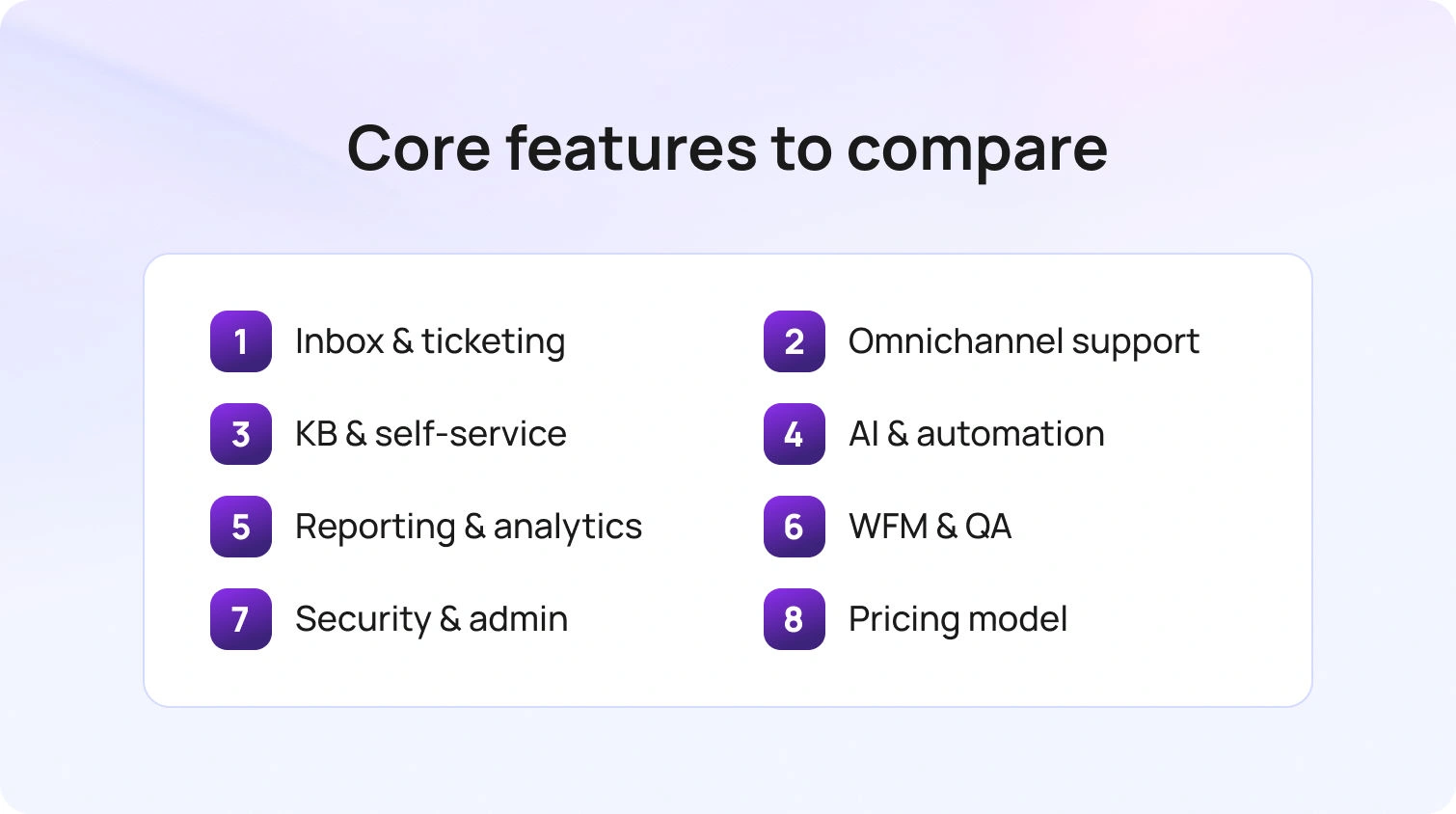
Choosing the right platform means you need to understand how each tool’s design philosophy shapes the way your team works, scales, and delivers value to customers. Two platforms might offer the same “features,” but the operational impact can be very different depending on workflow design, tier limitations, and integration requirements.
Inbox & ticketing workflows (SLAs, automations, collaboration)
- Help Scout: Optimized for speed and clarity in small teams; SLA and automation depth may be limited.
- Zendesk: Structured workflows with escalation logic; scale comes at a cost and often requires tier upgrades.
- BlueTweak: Unified queue across channels with multi-brand and ops-ready structures, reducing friction as teams scale.
Omnichannel support (email, chat, social, messaging)
- Help Scout: Primarily email-first; chat and messaging options are limited.
- Zendesk: Broad channel coverage, often tier-dependent; additional integrations may be required.
- BlueTweak: Omnichannel is built in, preserving context and minimizing tool switching.
Self-service & knowledge base (help center, content ops)
- Help Scout: Clean, approachable documentation workflows for small teams.
- Zendesk: Mature content management, but some features require add-ons.
- BlueTweak: Single source of truth for agents and bots, aligned across brands.
AI, automation, and deflection (outcome-first)
- Help Scout: Offers AI drafting and summarization depending on plan.
- Zendesk: AI varies by tier and add-ons; outcome measurement may be inconsistent.
- BlueTweak: KB-grounded AI with human-in-the-loop, designed for measurable improvements in speed, accuracy, and workload reduction. Features like proposed replies help agents respond faster while maintaining quality and consistency.
Reporting & analytics (visibility into what’s working)
- Help Scout: Adequate for small teams but limited beyond Tier 1.
- Zendesk: Advanced dashboards at higher tiers; segmentation and exports may require add-ons.
- BlueTweak: Real-time, multi-brand analytics designed for operational oversight.
WFM & QA (do you need it now, or later?)
- Help Scout: Not a core focus.
- Zendesk: May require partners or add-ons.
- BlueTweak: Built-in for teams of 20–100 agents, reducing the need for multiple vendors.
Security, admin, and compliance readiness
- Help Scout: Straightforward controls suitable for smaller teams.
- Zendesk: Advanced admin features at higher tiers.
- BlueTweak: Multi-brand governance, audit logs, and operational oversight built in.
Pricing and “true cost” by tier
When evaluating Zendesk vs Help Scout, and while figuring out where BlueTweak fits, remember that pricing isn’t just a per-agent number. The true cost of a support platform emerges as your team grows, channels multiply, and operational complexity increases. Investing in the right platform now can save time, prevent tool sprawl, and protect revenue and customer loyalty later.
Tier 1 teams (1–10 agents)
Lean teams often prioritize predictable pricing and minimal overhead. Help Scout typically fits neatly here, providing a shared inbox, basic self-service, and essential reporting at a low monthly cost. Zendesk can also work, but many of its advanced features are tier-gated, so the platform may exceed needs and add unnecessary complexity.
BlueTweak may appear overpowered for purely Tier 1 operations; however, it becomes relevant if your team is already managing multiple brands or channels, as its built-in omnichannel and voice capabilities reduce the need for additional tools later.
Tier 2 teams (10–30 agents)
Workflow automation, SLAs, multi-channel support, and basic analytics start to drive operational efficiency. As reporting expectations grow, tracking the right customer support metrics becomes essential for proving ROI and maintaining service quality at scale.
Help Scout may still suffice for teams maintaining lightweight processes, but it’s important to verify whether SLA management and reporting capabilities meet your needs. Zendesk shines here with structured workflows and dashboards, though add-ons for chat, voice, or advanced analytics can increase costs. BlueTweak consolidates these capabilities in a single platform, helping teams avoid the hidden expenses of multiple tools, fractured reporting, and administrative overhead.
Tier 3 teams (30–100 agents)
Here, the total cost of ownership extends beyond per-agent fees. Governance, workforce management, quality assurance, analytics, and multi-brand operations all influence both implementation and ongoing administration.
Help Scout’s simplicity may limit efficiency, while Zendesk can meet these needs but often requires multiple add-ons, tier upgrades, and marketplace governance, all of which increase cost and operational friction. BlueTweak positions itself as a unified CX OS: built-in WFM, QA, omnichannel, voice, and multi-brand reporting reduce the need for additional vendors, simplify oversight, and accelerate time-to-value.
To make these considerations actionable during vendor evaluation, leaders should verify the following:
- What is included vs. add-on: Confirm which capabilities are bundled versus requiring extra licenses or tier upgrades.
- AI metering and deflection measurement: Understand how AI usage is tracked, billed, and tied to workload reduction metrics.
- Channel add-ons (voice, chat, messaging): Identify which channels are included natively and which require additional costs.
- Reporting, exports, and advanced permissions: Ensure dashboards, data access, and governance align with team requirements.
- Implementation and onboarding costs: Factor in time, training, and any professional services needed to get teams operational.
- Multi-brand structure and reporting overhead: Assess how the platform handles brand segmentation, routing, and consolidated analytics.
By combining a strategic lens with this checklist, support leaders can see beyond simple per-seat fees to understand the true operational and financial impact of each platform. For reference, see BlueTweak pricing to explore how a unified approach can streamline costs and reduce vendor sprawl.
Implementation Considerations: What Actually Drives Time-to-Value
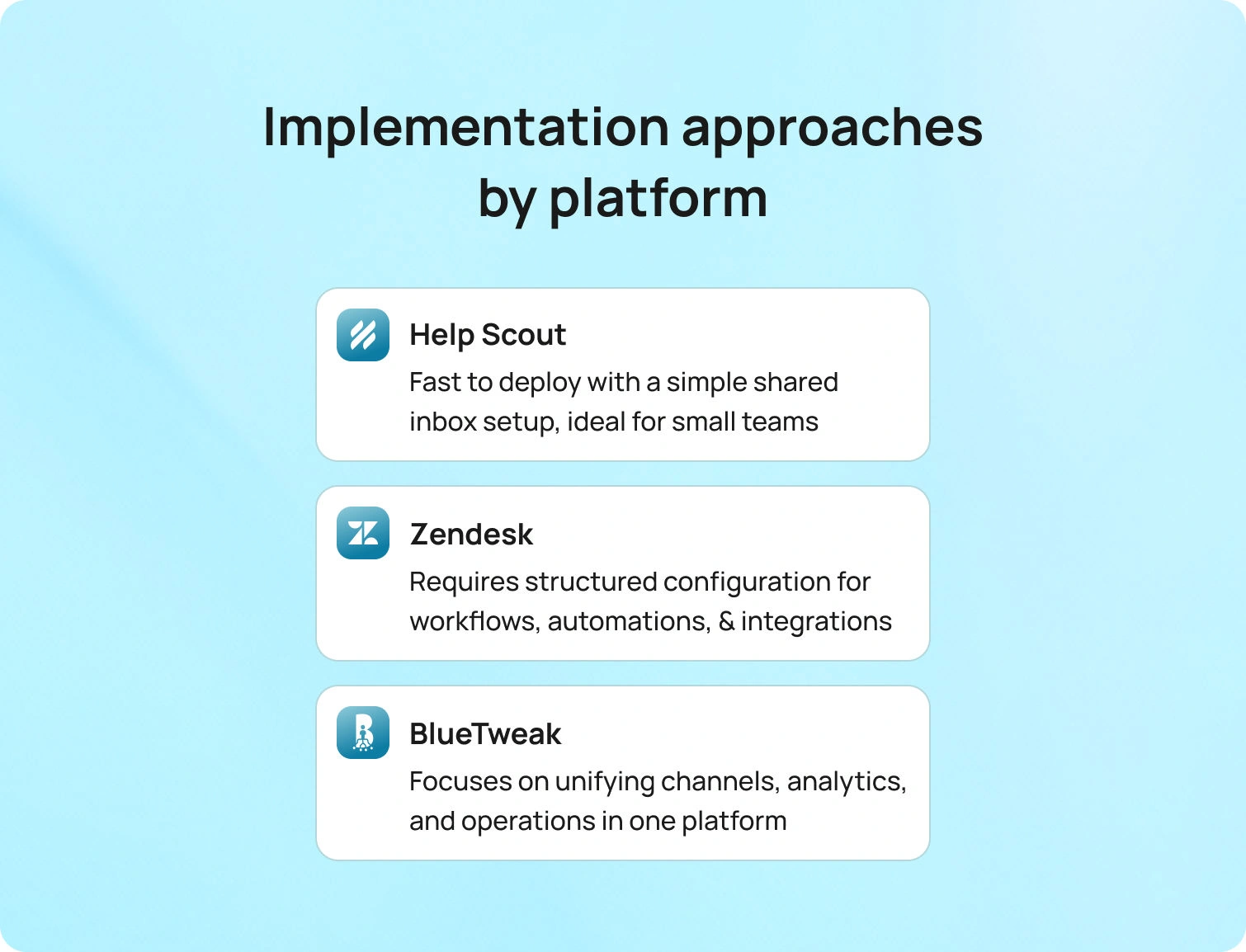
Choosing between Help Scout and Zendesk isn’t only about features or pricing. It’s about how quickly your team can operationalize the platform and begin delivering measurable improvements in response times, resolution quality, and customer satisfaction.
Implementation complexity varies significantly depending on the platform’s architecture and your operational tier. For Tier 1 teams, setup may be measured in days. For Tier 3 teams managing multiple brands and channels, it may involve structured planning, governance design, and workflow engineering.
Here’s how implementation typically differs across platforms:
Help Scout
Help Scout is generally the fastest to deploy because of its shared inbox–first philosophy. The setup process is straightforward, particularly for lean teams.
Time-to-value is primarily driven by:
- Inbox configuration and team permissions
- Tagging taxonomy design for reporting clarity
- Knowledge base structure and content migration
- Basic automation rules and saved replies
- Agent onboarding and workflow alignment
For smaller teams, this simplicity can translate into rapid adoption. However, as operational complexity increases, leaders may need to supplement reporting, QA, or workforce processes with external tools.
Zendesk
Zendesk implementation tends to require more structured planning, especially as you move up tiers. Its flexibility is a strength, but that flexibility introduces configuration depth.
Key drivers of time-to-value include:
- Historical data migration from legacy systems
- Designing triggers, automations, SLAs, and macros
- Information architecture for the Help Center
- Configuration of channel add-ons (chat, voice, messaging)
- Marketplace app selection and governance controls
For growing or enterprise teams, the upfront investment can pay off in structured workflows and reporting. However, governance and administrative overhead should be factored into both timeline and cost expectations.
BlueTweak
BlueTweak’s implementation approach centers on unification rather than extension. Instead of layering add-ons, the goal is to bring channels, analytics, and operational tooling into a single coherent system.
Time-to-value is typically influenced by:
- Unifying email, chat, voice, and messaging channels into one queue
- Importing and structuring the knowledge base for AI grounding
- Configuring multi-brand routing and consolidated reporting
- Setting up dashboards aligned to operational KPIs
- Deploying workforce management (WFM) and QA workflows
For Tier 2 and Tier 3 teams, this consolidation often shortens long-term ramp time by eliminating the need to integrate multiple systems post-launch.
How We Evaluated Zendesk vs. Help Scout
This comparison of Zendesk vs Help Scout, and BlueTweak’s positioning alongside the others, is grounded in primary vendor documentation and publicly available pricing materials.
Specifically:
- We reviewed vendor feature documentation and pricing pages.
- Any capability that varies by plan is indicated as “Varies by plan / Verify.”
- We did not use third-party review sites as validation or proof points.
- We avoided speculative claims about certifications or enterprise capabilities not clearly documented.
This approach ensures that the evaluation reflects official positioning and transparent claims rather than anecdotal ratings or marketplace commentary.
Final Thoughts: The Right Customer Service Platform Depends on Your Operational Tier
The debate around Help Scout and Zendesk often centers on features, but a better way to evaluate is when you consider operational maturity. Both are credible customer support platforms, and both can work exceptionally well when aligned with the right team profile.
For lean support teams prioritizing speed, a user-friendly interface, and lightweight workflows, Help Scout remains a cost-effective solution. It helps small to medium businesses manage support tickets, customer queries, and knowledge base content without unnecessary overhead. If your primary goal is managing customer support efficiently without complex workflows, this simplicity can be an advantage.
Zendesk, by contrast, is built for structure. Its ticketing system, workflow automation, and advanced reporting make it attractive for medium-sized businesses and large support teams that need deeper governance and automation features. As teams grow, Zendesk’s suite professional and suite enterprise tiers introduce more advanced features, customization options, and support channels, including phone support. However, those capabilities often come with additional pricing plans, add-ons, and third-party tools that increase the total cost of ownership.
BlueTweak is designed for teams that have moved beyond managing customer support reactively and are now optimizing customer support operations strategically. By unifying ticketing, voice, chat, bots, WFM, analytics, and a comprehensive knowledge base, it enables businesses to streamline customer support while reducing tool sprawl. For teams handling high volumes of customer interactions across multiple brands, the value lies not just in features, but in cohesion; one platform, one reporting layer, one governance model.
If you’re comparing any of these solutions in 2026, the debate is around which platform aligns with your support process, growth trajectory, and operational ambition.
If you’re ready to see how a unified approach can support your team’s next stage of growth, request a demo and explore how BlueTweak can help you deliver a cohesive support experience at scale.
Intercom vs Help Scout vs BlueTweak: Which To Implement In 2026?
Why the Intercom vs Help Scout Debate Still Matters and Why BlueTweak Should Be Considered
Choosing between Help Scout and Intercom isn’t just about picking a chat widget or a shared inbox anymore. In 2026, customer experience leaders face a much deeper strategic question: how to build a support operation that meets rising customer expectations while still keeping costs, complexity, and tool sprawl under control.
Customers are redefining what good service looks like. According to a 2025 survey from Gartner, more than half of all customer service journeys now begin on third-party platforms such as search engines, YouTube, or generative AI tools, not just on a brand’s own site or social pages. This shift highlights two realities: service must be discoverable where customers already are, and experiences need to be seamless across channels, not just reactive in a single inbox or chat feed.
At the same time, adoption of AI and automation in support continues to accelerate, driven by operational efficiency and customer expectations. But simply adding AI isn’t a panacea. Too many teams find that “AI features” without clear governance, knowledge control, or integration with existing workflows create noise rather than value. The result is a landscape where automation must be purposeful, knowledge-grounded, and channels unified.
This evolving context is why comparisons like Intercom vs Help Scout remain relevant in 2026. One platform may win on conversational automation, another on simplicity. But today’s leaders need to think beyond features: they need clarity on how each solution supports omnichannel service, integrates AI responsibly, and scales predictably as support volumes and customer expectations grow.
Increasingly, that conversation also includes platforms like BlueTweak. For teams that have outgrown a simple inbox but don’t want to assemble a stack of separate tools for chat, voice, reporting, and automation, unified CX platforms are becoming a practical alternative. Instead of choosing between conversational automation or operational simplicity, solutions like BlueTweak aim to provide a single environment where tickets, chat, voice, analytics, and AI work together as support operations scale.
At a Glance: Intercom vs Help Scout vs BlueTweak
When comparing Intercom vs Help Scout vs BlueTweak, it helps to step back from feature lists and look at the structural differences in how each platform approaches customer support. While the tools may overlap in areas like messaging, ticketing, and automation, they are built around very different operational philosophies.
Intercom is designed around conversational engagement and AI-driven messaging, making it popular with product-led teams that prioritize real-time chat and automation. Help Scout takes a more streamlined approach, focusing on a clean shared inbox and self-service tools that help lean teams manage support without heavy configuration.
BlueTweak sits in a slightly different category. Rather than centering the experience around chat or email, it positions itself as a unified CX platform that brings tickets, chat, voice, analytics, and workforce management into a single operational environment. For teams that are scaling beyond startup simplicity but don’t want the complexity of enterprise CX suites, this approach can provide a more structured foundation for multi-channel support.
The table below summarizes how each platform is positioned operationally in 2026, not just what features exist, but how each vendor approaches AI, omnichannel service, and support team scalability.
| Capability | Intercom | Help Scout | BlueTweak |
|---|---|---|---|
| Who it’s for | Digital-first SaaS and product-led teams prioritizing conversational CX | Lean teams wanting shared inbox simplicity without heavy admin | Scaling teams (20–100 agents) running multi-brand or multilingual support |
| Core strength | AI-forward conversational customer service suite | Email-first shared inbox with lightweight self-service | Unified CX operating system built for structured growth |
| Voice | Available by plan (verify specifics) | No native voice | Native voice is integrated into the same queue and reporting layer |
| Omnichannel | Chat-centric, with expanded channel options | Email + Beacon chat | Chat, tickets, and voice unified in one operational environment |
| AI | Fin AI Agent + Copilot; managed knowledge sources | AI drafting + Docs-based assistance (verify by plan) | Knowledge-base-grounded AI with human oversight and operational controls |
| Knowledge Base / Self-Service | Help Center powered by managed knowledge | Docs + Beacon widget | Single source of truth powering agents, bots, and multilingual routing |
| WFM / QA | Varies by plan | Limited WFM depth | Built-in workforce management and QA visibility without add-ons |
| Security / Admin | Enterprise controls by tier | Straightforward roles and permissions | Role-based controls, audit logs, and multi-brand governance (ISO in progress) |
| Pricing model | Seat-based tiers + AI/usage-style elements (verify) | Published tier pricing | €65/agent/month anchor with clearer packaging for mid-market teams (verify usage components) |
What Each Platform Is (and What It Isn’t)
When evaluating Help Scout vs Intercom vs BlueTweak, many buyers focus on feature parity. But a more useful lens is operating philosophy. Each platform represents a different approach to how customer support should function in 2026. Understanding that philosophy helps you avoid choosing a system that feels right at 10 agents, but restrictive at 40.
Intercom
Intercom has evolved from a live chat tool into a broader, AI-forward customer service suite. Today, its positioning centers around conversational support, automation, and AI-driven resolution. Fin AI Agent and Copilot are designed to assist, and in some cases autonomously resolve, customer conversations using managed knowledge sources.
Intercom’s strength lies in real-time engagement. It is built around messaging-first workflows, where conversations flow naturally between automation and human agents. For product-led and SaaS businesses that want support tightly integrated into the customer journey, this model is compelling.
However, Intercom assumes operational readiness for automation. Teams must:
- Curate and govern knowledge sources carefully
- Design automation flows intentionally
- Monitor AI resolution metrics and usage patterns
It is not a lightweight inbox solution, but rather a configurable, AI-layered environment. That can be a powerful option, but it requires clarity on governance, measurement, and cost modeling.
In short, Intercom is best understood as a conversational CX suite where AI and automation sit at the center of the service model.
Help Scout
Help Scout takes a different path. Its foundation is the shared inbox; simple, clean, and email-first. Docs provides knowledge base functionality, and Beacon acts as the customer-facing entry point for chat and self-service.
Help Scout avoids unnecessary complexity and focuses on enabling teams to respond quickly and collaboratively without heavy configuration. For lean teams, especially those prioritizing email support with light chat capability, this simplicity is often considered a competitive advantage. Implementation is typically faster, admin overhead is lower, and the learning curve is minimal.
Where Help Scout can feel limiting is in deeper operational layers. Native voice, workforce management tooling, and complex multi-brand routing are not its primary focus; it is intentionally streamlined.
Help Scout is best understood as a modernized shared inbox platform with integrated self-service, ideal for teams that want structure without suite-level complexity.
BlueTweak
BlueTweak is positioned differently. Rather than centering on either chat automation or inbox simplicity, it frames itself as a unified customer experience (CX) operating system for scaling teams.
BlueTweak brings tickets, chat, voice, bots, workforce management, analytics, and a knowledge-base-grounded AI layer into a single operational environment. The focus isn’t just on responsiveness, but also visibility and control across channels, brands, and regions.
This matters particularly for teams in the 20–100 agent range, where complexity increases quickly:
- Multiple queues
- Multiple brands
- Multilingual support
- Escalation layers
- SLA tracking
- Performance monitoring
At this stage, stitching together separate tools for telephony, reporting, QA, and chat can create blind spots. BlueTweak’s positioning is that these components should exist inside one governed system, rather than across five dashboards.
It is not a chat-only automation suite, nor is it a minimalist inbox tool. It is built for organizations that have moved beyond startup simplicity, but do not want enterprise bloat.
The Strategic Difference
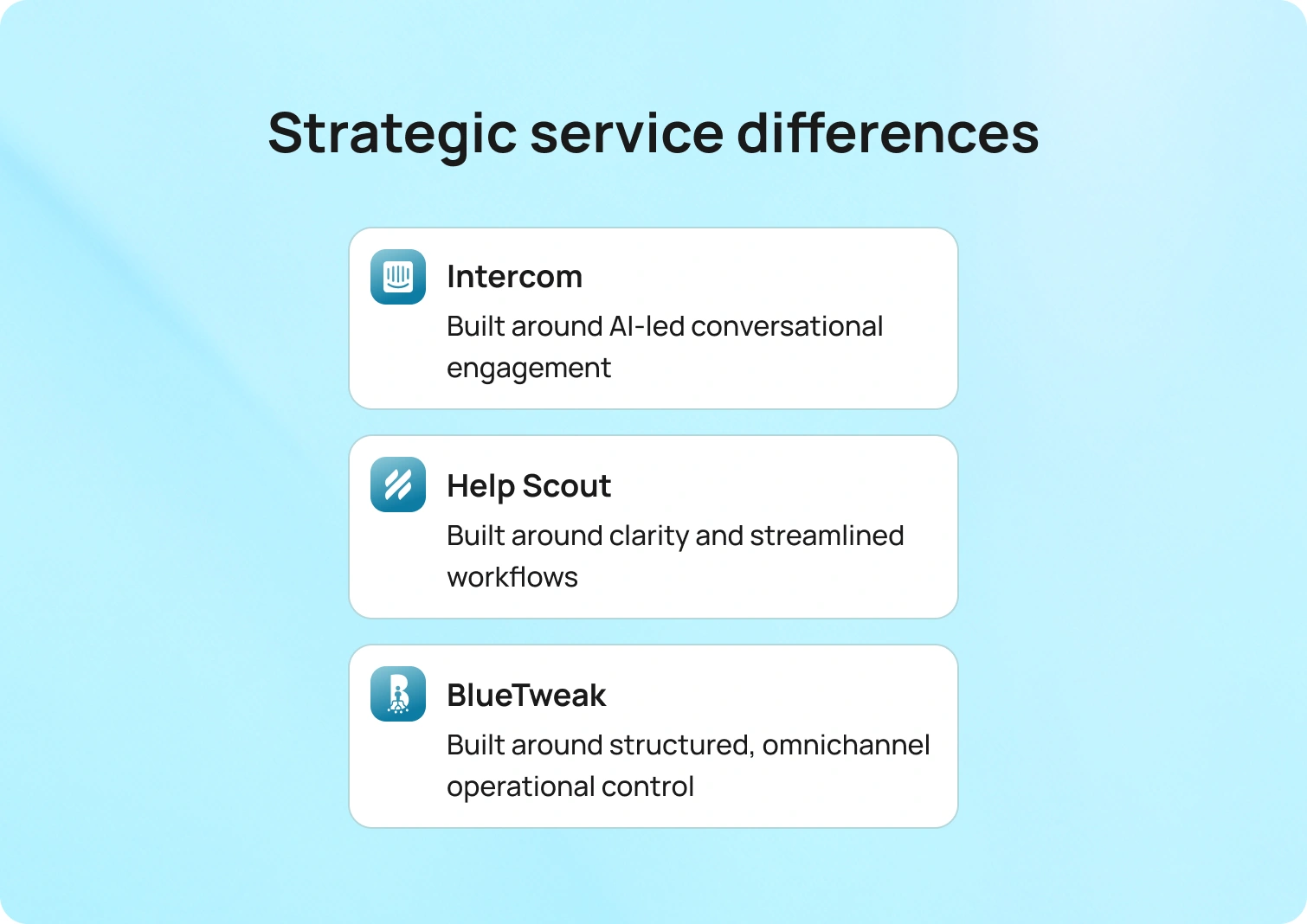
The Intercom vs Help Scout vs BlueTweak debate often starts with channels and features, but mature CX decisions rarely hinge on feature checklists; they hinge on operating model alignment.
- Are you designing a support function that revolves around conversational automation?
- Are you prioritizing speed and simplicity for a lean team?
- Are you building an operational backbone that must handle multiple brands, voice, performance management, and multilingual complexity without fragmentation?
Those are fundamentally different trajectories.
- Intercom is built around AI-led conversational engagement.
- Help Scout is built around clarity and streamlined workflows.
- BlueTweak is built around structured, omnichannel operational control.
The decision, then, isn’t about which tool has more features, but rather, which platform matches the complexity you have today, as well as the complexity you’re likely to inherit over the next 24 months.
Choosing for month one is easy. Choosing for year two is where most teams get it wrong.
Feature-by-Feature Comparison
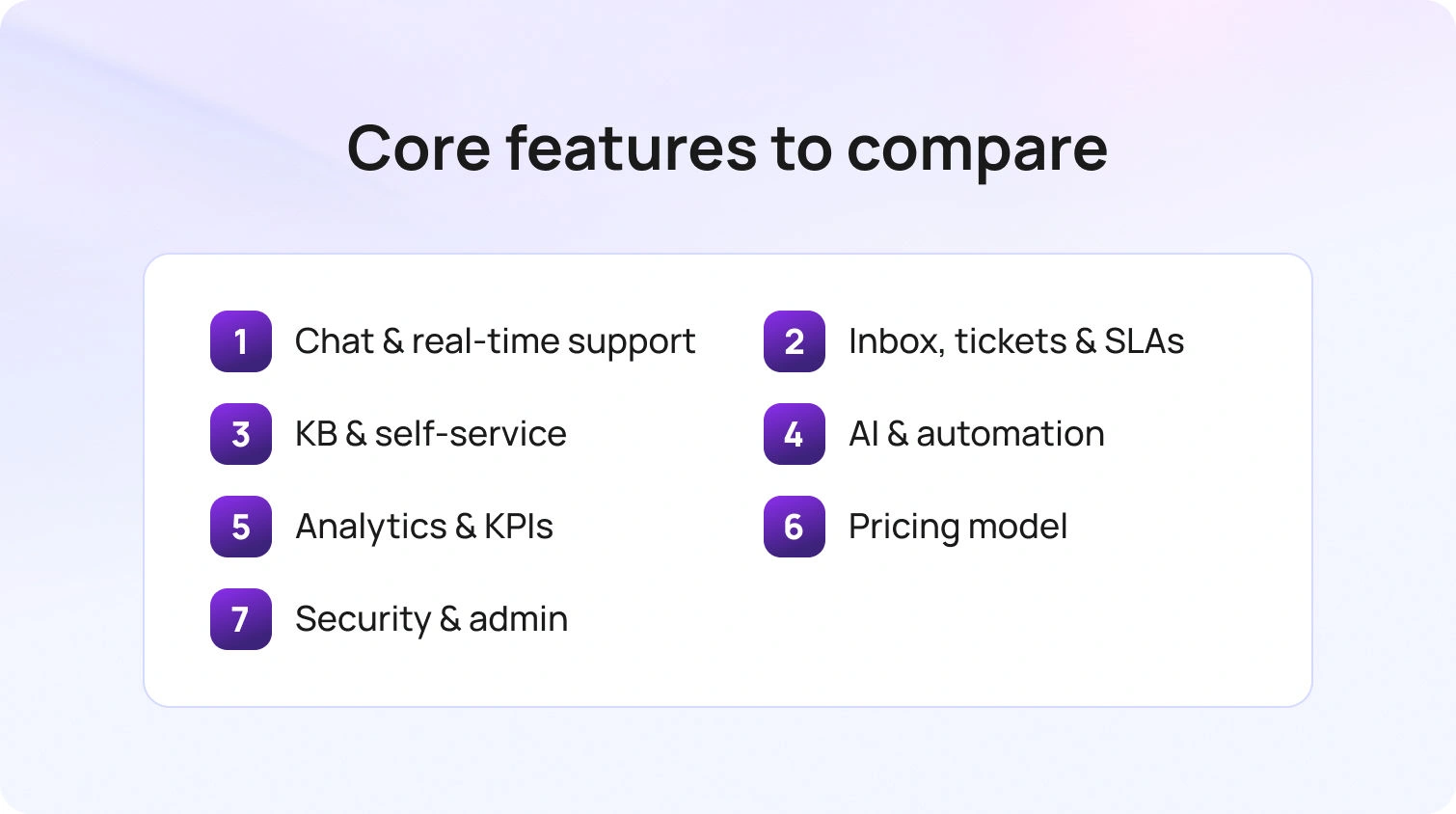
High-level positioning is useful, but buying decisions are made in the details. When evaluating Help Scout vs Intercom vs BlueTweak, this is the stage where nuance matters: how messaging behaves under load, how SLAs function across channels, how AI is governed, how reporting scales, and how cost shifts as usage patterns evolve.
The sections below focus on how each platform behaves operationally, especially as complexity increases.
Live chat, messaging, and real-time support
Real-time support is where Intercom and Help Scout most visibly diverge, and where BlueTweak positions itself differently again.
Intercom is built around conversational messaging. Live chat is not an add-on; it is the core workflow. Automation, AI agents, and human agents operate within a unified conversational thread. For digital-first businesses where chat volume is high and immediate engagement drives revenue, this architecture is a strength.
However, chat-first systems assume conversational maturity: routing rules, automation design, and AI supervision require ongoing tuning.
Help Scout delivers chat primarily through Beacon. It works well as a support entry point layered onto an inbox-centric workflow. For teams that view chat as a complement to email rather than the primary support channel, this lighter implementation reduces admin complexity.
BlueTweak approaches chat as one channel within a broader operational system. Chat, tickets, and voice share queue logic and reporting. The differentiator here is context continuity; agents are not switching systems to handle different real-time vs asynchronous conversations.
If real-time chat sits at the heart of your acquisition or retention strategy, Intercom’s conversational architecture and automation depth give it a structural advantage. But if chat plays a secondary role to email-based support and you’re primarily optimizing for simplicity and speed, Help Scout’s lighter implementation may be entirely sufficient.
However, if chat needs to operate alongside voice and ticket workflows inside a single operational framework, without agents toggling between systems or managers reconciling separate reporting layers, BlueTweak becomes a strategically relevant choice. The distinction isn’t just about chat capability; it’s about how seamlessly that capability integrates into the broader support environment as complexity increases.
Inbox, ticketing workflows, SLAs, and collaboration
Inbox design shapes agent productivity more than most teams realize.
Intercom incorporates helpdesk-style workflows inside its suite, with automation layered heavily into routing and resolution. SLAs and collaboration features vary by plan, so teams should validate exact capabilities during evaluation. The system is designed for speed and automation leverage.
Help Scout prioritizes clarity. The shared inbox model is intentionally straightforward: conversations, assignments, notes, and tags. For lean teams, this simplicity minimizes friction and onboarding time.
BlueTweak focuses on cross-channel SLA consistency. Ticketing logic extends across chat, email, and voice, allowing teams to manage performance targets holistically. Multi-brand routing and structured escalation paths are core considerations, not bolt-ons.
The question here isn’t “does it have SLAs?” It’s whether SLAs remain visible and enforceable as channels and brands multiply.
KB and self-service
Self-service maturity directly impacts cost per ticket.
Intercom powers its Help Center and AI workflows through managed knowledge sources. This creates a tightly integrated environment where content can directly fuel AI resolution. However, governance becomes critical: what content is exposed, how it’s versioned, and how it’s targeted should all be validated.
Help Scout pairs Docs with Beacon. It’s a clean model: publish helpful articles, surface them contextually, and reduce inbound volume. For smaller teams, this simplicity often delivers quick wins.
BlueTweak positions its knowledge base as a single source of truth powering both agents and AI. Because it sits inside a broader operational framework, knowledge routing can be tied to brand, language, or queue logic. That matters for multilingual and multi-region support teams.
In 2026, self-service is centered on whether your knowledge strategy reduces volume without increasing AI unpredictability.
AI, automation, and deflection
AI is no longer optional in the Intercom vs Help Scout discussion, but its implementation varies meaningfully.
Intercom’s Fin AI Agent and Copilot are designed to resolve conversations and assist agents. The model is automation-forward. Buyers should clarify how AI resolutions are defined, how usage is billed, and how knowledge boundaries are enforced.
Help Scout focuses AI primarily on drafting assistance and self-service enhancement. It is typically augmentation rather than autonomous resolution, though exact capabilities vary by plan.
BlueTweak emphasizes knowledge-base-grounded AI with human oversight. Rather than maximizing autonomous resolution volume, the focus is on measurable improvements in handle time, first contact resolution, and multilingual efficiency.
This focus on governed automation is reflected in real-world implementations. In one BlueTweak deployment for a growing e-commerce company, AI-powered support workflows helped increase ticket deflection by 45% and reduce interaction time by 30%, allowing the team to scale support without proportionally increasing agent headcount. The case highlights how combining AI with structured knowledge and unified channels can improve both efficiency and customer satisfaction.
For teams looking to implement AI responsibly, BlueTweak also offers proposed replies that help agents maintain quality and consistency while leveraging automation.
This is where thought leadership matters: AI success in 2026 is not about volume handled. It is about governed deflection with predictable cost dynamics.
Analytics, reporting, and operational KPIs
As teams scale, reporting depth becomes a constraint.
Intercom provides analytics tied to conversations, automation, and AI performance. Teams should validate SLA tracking depth and how AI outcomes are measured within reporting layers.
Help Scout offers clear, accessible reporting aligned with its simplicity model. For straightforward environments, this is often sufficient. Scaling teams should evaluate whether multi-brand or workforce performance visibility requires additional tooling.
BlueTweak integrates analytics with workforce management and QA visibility. For 20–100 agent teams, real-time dashboards across brands and channels reduce the need for separate BI or WFM systems.
Reporting is often where tool sprawl begins; the more fragmented the channel stack, the more fragmented the data.
Pricing model and predictability
Pricing is often where the Help Scout vs Intercom comparison becomes clearer. Once features align, the real question is how each platform’s cost model behaves as agent counts, automation usage, and channel volume increase.
Intercom uses seat-based tiers, with AI and usage-style elements layered in depending on plan. As automation increases, usage metrics may become more influential in total cost. Teams should model growth scenarios, not just current volume.
Help Scout presents published tier pricing that feels straightforward. Feature access varies by plan, so mapping your required capabilities to the correct tier is essential.
BlueTweak anchors pricing at €65 per agent per month, positioned for mid-market clarity. Usage-based elements should be verified where applicable, but the model is structured around operational predictability rather than layered AI charges.
At smaller team sizes, pricing differences between platforms are often marginal. But as support organizations grow, particularly beyond 50 agents, usage assumptions, automation volume, and channel expansion can start to materially influence total cost.
Security, admin, and compliance readiness
Security and administrative control rarely dominate early product demos, but they become critical once a support platform is embedded into daily operations. Customer service systems often contain sensitive customer data, internal notes, and performance metrics, which means governance, access controls, and auditability should be evaluated early in the intercom vs help scout decision process.
Intercom provides a range of security and compliance capabilities across its platform tiers, including data processing controls, regional hosting considerations, and administrative permissions. Because Intercom increasingly incorporates AI-driven workflows, teams should also confirm how AI interactions are logged, how knowledge sources are governed, and how conversation data is stored or retained. These details can vary by region and plan, so reviewing official documentation during procurement is essential.
Help Scout follows a simpler model that aligns with its broader philosophy of operational clarity. Teams can manage roles, permissions, and access controls within the shared inbox environment, while auditability and retention settings can be configured to support internal governance requirements. For organizations operating in regulated environments, confirming how these controls map to internal compliance policies is an important evaluation step.
BlueTweak emphasizes administrative visibility and control across multi-brand support environments. Role-based permissions and audit logs help teams maintain governance as agent counts grow and operational complexity increases. BlueTweak also enables teams to manage multiple brands or support queues within a single environment, simplifying administrative oversight for larger support organizations. The platform is ISO 27001 certified, providing assurance around information security and data governance. When evaluating alternatives, teams should also confirm the compliance certifications and security standards maintained by other vendors under consideration.
For growing support organizations, these controls are less about ticking a compliance checkbox and more about maintaining operational discipline. As teams scale, the ability to manage access, monitor changes, and maintain clear governance over customer data becomes an increasingly important part of platform selection.
Pricing & 12-month TCO modeling (framework, not promises)
Feature comparisons help narrow a shortlist, but long-term platform decisions are often made on total cost of ownership. In the Help Scout vs Intercom discussion, the list price rarely tells the full story. Pricing models can behave very differently as agent counts grow, automation usage increases, and new channels are introduced.
A useful exercise is to model a realistic 12-month scenario. For example, imagine a support team with 50 agents, moderate chat volume, and a growing self-service strategy. Over the course of a year, several variables can influence total platform cost:
- AI deflection increases. Ticket volume may fall, but AI interactions or automated resolutions could rise, depending on how the platform meters usage.
- Chat volume grows. As customers adopt messaging channels, conversation counts often increase faster than ticket counts.
- Voice is introduced. Many teams add voice support later as escalation needs grow.
- Additional brands or queues are added. Multi-brand operations can introduce workspace or routing complexity depending on platform architecture.
In other words, the most useful pricing comparison isn’t today’s invoice; it’s how the platform behaves once your support operation becomes more sophisticated.
Questions to ask Sales during pricing discussions
Before committing to any platform, it’s worth clarifying how pricing behaves under real operational conditions:
- What is included vs metered (AI resolutions, messages, automation usage, or seats)?
- Are there limits on knowledge sources, AI training material, or content targeting?
- What are the policies for data retention, exports, audit logs, and AI supervision controls?
- How does multi-brand support work: separate workspaces or true multi-tenant routing and reporting?
- What does implementation and onboarding typically involve for a team of your size?
These questions often reveal cost dynamics that aren’t immediately obvious in pricing calculators.
Implementation considerations
Choosing a platform is only the first step. Successful deployments typically depend less on the software itself and more on how well the support organization prepares its workflows, knowledge base, and operational processes.
Intercom implementations often focus on preparing the knowledge environment that powers automation and AI. This can involve structuring the Help Center, defining knowledge sources, designing automation flows, and setting up routing rules that ensure conversations reach the right agents. Teams should also plan how they will measure automation success and AI-assisted resolutions.
Help Scout deployments tend to be simpler, but still benefit from thoughtful setup. Structuring inboxes clearly, building a logical information architecture for Docs, and configuring Beacon entry points can significantly influence the effectiveness of self-service. Basic automation and tagging strategies can further improve agent efficiency.
BlueTweak implementations typically focus on bringing multiple channels into one operational system. This often involves unifying chat, email, and voice workflows, structuring the knowledge base so it can ground AI responses, and configuring multi-brand routing and reporting. Rolling out dashboards and workforce management visibility is also an important step for teams managing larger support environments.
How We Evaluated Intercom, Help Scout, and BlueTweak
This comparison is based on vendor documentation, official feature descriptions, and publicly available pricing information. Where capabilities vary by plan or region, they are indicated as ‘Varies by plan’ or ‘Verify’.
No third-party review platforms were used as evidence. The goal of this article is to provide a clear framework for evaluating help scout vs intercom, while also introducing BlueTweak as an alternative for teams whose operational needs extend beyond either model.
Intercom vs Help Scout vs BlueTweak: Which Platform Is Right For You?
At this stage of the Intercom vs Help Scout vs BlueTweak evaluation, the focus isn’t on finding the universal ‘winner’. Each platform is designed for a slightly different support environment, and the right choice usually reflects the complexity of your CX operation rather than the number of features on a checklist.
Choose Intercom if real-time messaging and AI-led automation are central to your support strategy. Intercom’s conversational architecture is designed for organizations where chat drives customer engagement, and automation is expected to resolve a growing share of interactions.
Choose Help Scout if you want a streamlined shared inbox environment that prioritizes clarity over configuration. Help Scout is well-suited to lean teams that rely heavily on email support, with self-service layered through Docs and Beacon.
Choose BlueTweak if you’re building a support operation that spans multiple channels and requires stronger operational visibility. BlueTweak’s unified approach to tickets, chat, voice, analytics, and workforce management is designed for teams in the 20–100 agent range that want to avoid stitching together multiple systems as they scale.
Final Thoughts: Choosing the Right Help Desk for Your Team
Choosing the right help desk ultimately comes down to how your team manages customer interactions, scales support, and delivers exceptional customer service as your company grows.
In this Intercom feature comparison, we’ve looked at how each platform approaches support tickets, customer relationships, and modern AI features. While Intercom offers an AI-first approach with tools like AI assistants, AI answers, and instant answers, teams should weigh these capabilities carefully against Intercom's pricing, especially when usage grows or when moving into higher-tier plans.
For many teams, the decision will hinge on how well a platform balances advanced features, usability, and long-term value. Scout offers a pretty straightforward help desk experience with a strong ticketing system, a unified inbox, and useful self-service options, making it attractive for small businesses or teams prioritizing simplicity.
However, when organizations need multi-channel support, phone support, phone calls, deeper reporting, and powerful automation capabilities, a third option like BlueTweak can provide a fully integrated environment that brings messaging, support tickets, analytics, and workforce tools together in one platform.
The real difference often appears once teams start handling high-volume customers, managing multiple inboxes, or coordinating growing support teams across different platforms. At that stage, factors like automation tools, AI capabilities, proactive support, and how easily new team members can adopt the system all play a role in delivering the level of service customers expect today.
If you're weighing help desk features, reviewing an intercom pricing comparison, or looking for a cost-effective platform that scales as your customers grow, the most useful step is seeing the system in action.
Book a demo to see how BlueTweak helps teams manage customer interactions, streamline support tickets, and deliver exceptional customer service to customers at scale.
11 Best Zoho Desk Alternatives to Choose From in 2026
Why Consider Zoho Desk Alternatives for Omnichannel Customer Support in 2026?
For growing support and customer experience teams, a traditional help desk can quickly become a bottleneck. As customer expectations evolve, so do the demands on support platforms. According to PwC’s 2025 Customer Experience Survey, 70% of executives say customer expectations are evolving faster than their company can adapt, and nearly a third of consumers will abandon a brand due to poor service.
That dual pressure, to deliver quality and scale efficiently, is why many teams start exploring Zoho Desk, competitors. But not all Zoho Desk alternatives deliver the same solution; some offer deeper reporting and automation, others excel at conversational workflows, and a few specialise in specific industries like e-commerce or IT service management.
This article goes beyond simply listing every tool you could consider. We’ve curated the best Zoho Desk alternatives in 2026 by real, operational value, so you can pick with confidence, not guesswork.
When You Actually Need a Zoho Desk Alternative (And When You Don’t)
Many teams outgrow a basic ticketing tool long before they realize it. At first, a simple help desk is enough to manage emails and phone tickets, but as operations grow, small inefficiencies compound. Reporting gaps, multi-channel fragmentation, and manual processes begin to slow down your team and limit visibility into performance.
Consider switching to a more capable platform when you start running into operational bottlenecks or unmet support needs:
- You need more advanced reporting and operations visibility (beyond simple queues and statuses). Advanced dashboards, real-time metrics, and cross-brand analytics become critical for managing workload and demonstrating ROI.
- You’re adding live chat, messaging, or voice channels, and need native routing and analytics. Managing multiple channels in separate tools creates friction and increases the risk of lost tickets or inconsistent customer experiences.
- AI governance matters; you want grounded, auditable AI, not experiment-only add-ons. If AI is driving summaries, suggested replies, or chatbots, visibility and compliance become essential.
- Support shifts from “task management” to “service operations” with workforce planning, QA, and performance metrics. Once support becomes a strategic function, a basic ticketing tool may not offer the operational depth your team requires.
- Multi-brand routing, reporting, or shared inboxing becomes painful in a basic help desk. Complexity grows exponentially with each additional brand, language, or customer segment.
On the other hand, you might not need a full alternative if your support load remains simple, focused on email or phone, and you don’t plan to scale channels, languages, or operational complexity in the next 12–18 months. In those cases, sticking with a lightweight help desk can still make sense, saving cost and minimizing disruption.
11 Best Zoho Desk Alternatives to Choose From in 2026
As support teams grow and operational complexity increases, evaluating how to choose help desk software becomes critical before selecting the right Zoho Desk alternative. With the right framework, you can quickly identify platforms that match your needs and scale with your team.
Best “all-in-one” alternatives for teams scaling past basic ticketing
BlueTweak
Best for: 20–100 agent support ops, multi-brand teams, BPOs
BlueTweak is designed for support teams that have outgrown basic help desk tools but don’t want the complexity or fragmented packaging of larger enterprise suites, making it a strong Zoho Desk competitor. It combines ticketing, chat, voice, automation, workforce management, and analytics in one platform, giving operations leaders a unified view of performance and customer interactions. For multilingual or multi-brand environments, that consolidation can simplify routing, reporting, and day-to-day management.
Several organizations have adopted this unified approach to streamline operations and reduce tool sprawl. For example, one BlueTweak customer case study highlights how consolidating ticketing, voice, and analytics into a single platform helped support leaders improve operational visibility while simplifying day-to-day management.
Pricing note: From €65/agent/month core (plus usage-based AI components where applicable).
Top integrations: CRM systems, telephony carriers, knowledge bases, analytics platforms.
Migration tip: Export tickets, SLAs, and tags from Zoho Desk first, then import into BlueTweak’s migration templates.
Watch-outs: Verify any industry-specific integrations you need.
Zendesk
Best for: Teams that want mature ticketing, self-service, and a deep app marketplace
Zendesk is one of the most established support platforms in the market and is often chosen by teams that want a highly customizable help desk with a large ecosystem of integrations. Its workflow automation, ticket management, and knowledge base capabilities are mature and widely adopted. For organizations that value marketplace extensibility and enterprise-grade configurability, Zendesk remains a strong contender.
Pricing note: Suite tiers with add-ons (Verify).
Top integrations: CRM, analytics, chat, phone systems.
Migration tip: Use Zendesk’s import tools and maintain ticket metadata for continuity.
Watch-outs: Tiering and marketplace reliance can increase the total cost of ownership.
Freshdesk
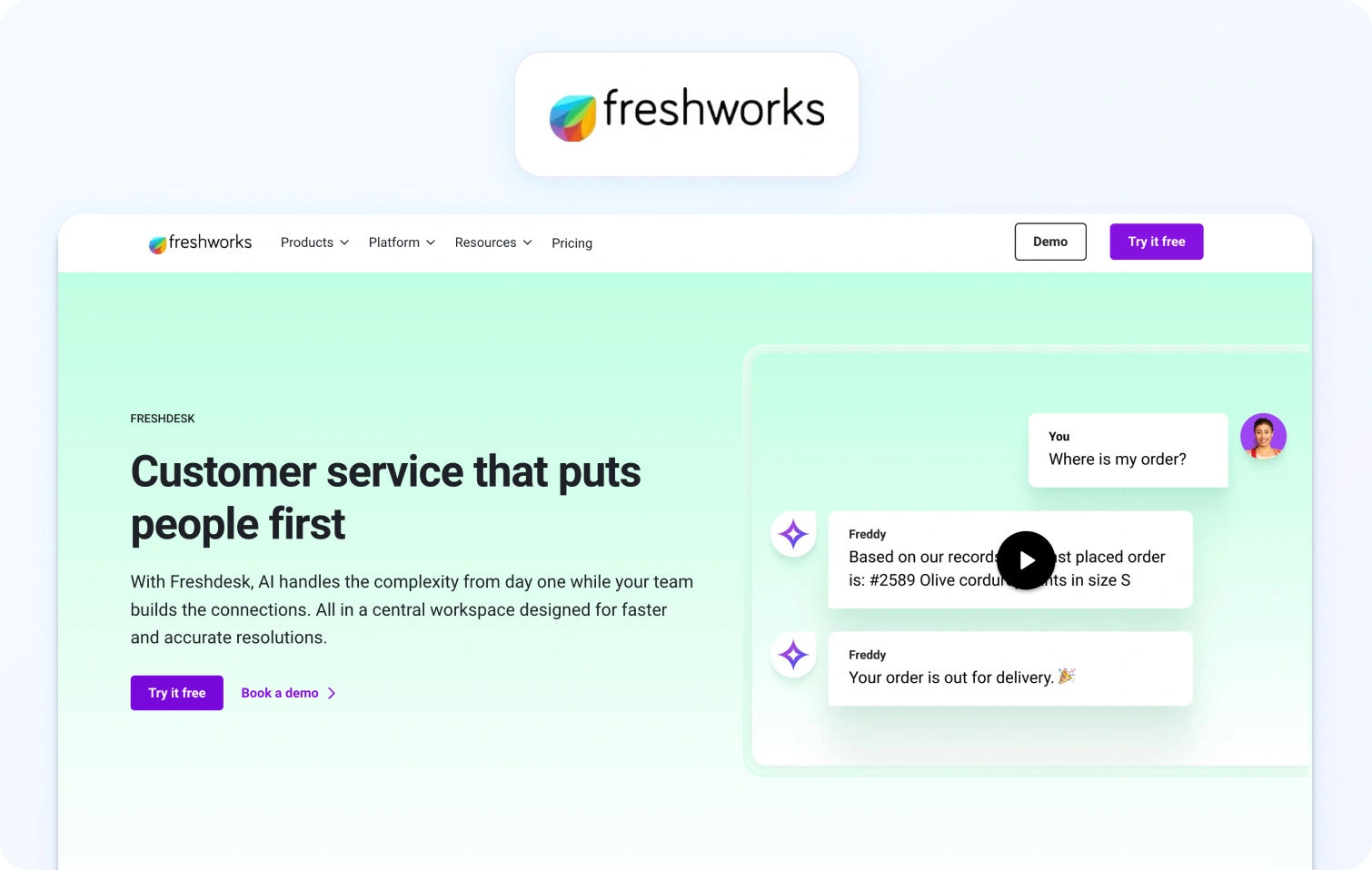
Best for: Budget-conscious teams that still want full help desk fundamentals
Freshdesk is often considered one of the more approachable Zoho Desk competitors thanks to its intuitive interface and quick setup. It offers the core capabilities most support teams need (think: ticketing, automation rules, knowledge bases, and reporting) without a steep learning curve. For smaller teams or companies prioritizing fast deployment and usability, it provides a practical entry point into structured support operations.
Pricing note: Tier-based (Verify).
Top integrations: CRM, Slack, telephony, chatbots.
Migration tip: Bring over workflows first, then tickets, to minimize interruptions.
Watch-outs: Advanced ops depth often requires higher tiers.
HubSpot Service Hub
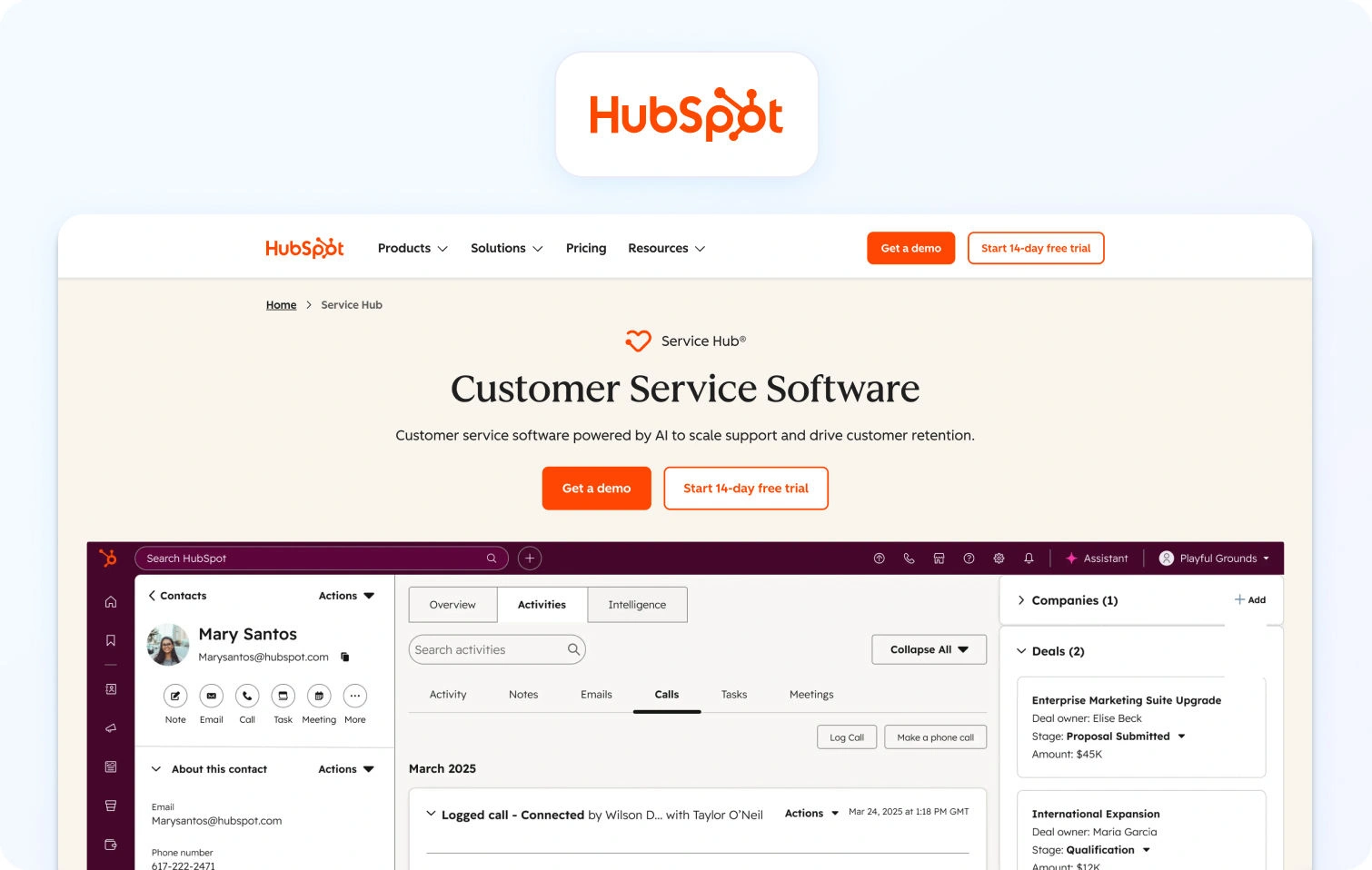
Best for: Teams already using HubSpot CRM and wanting tight customer context
HubSpot Service Hub works best for companies that already rely on HubSpot’s CRM and marketing platform. Because support data lives within the same ecosystem, agents can see the full customer journey, including marketing interactions, deals, and product activity, without switching systems. That unified customer record makes it particularly attractive for companies focused on aligning sales, marketing, and service.
Pricing note: Tier-based, starting with a limited, free plan (verify).
Top integrations: HubSpot CRM, marketing tools, and knowledge base.
Migration tip: Consolidate CRM data before importing support histories.
Watch-outs: Deeper service operations capabilities may require higher tiers.
Best alternatives for conversational support and automation
Intercom
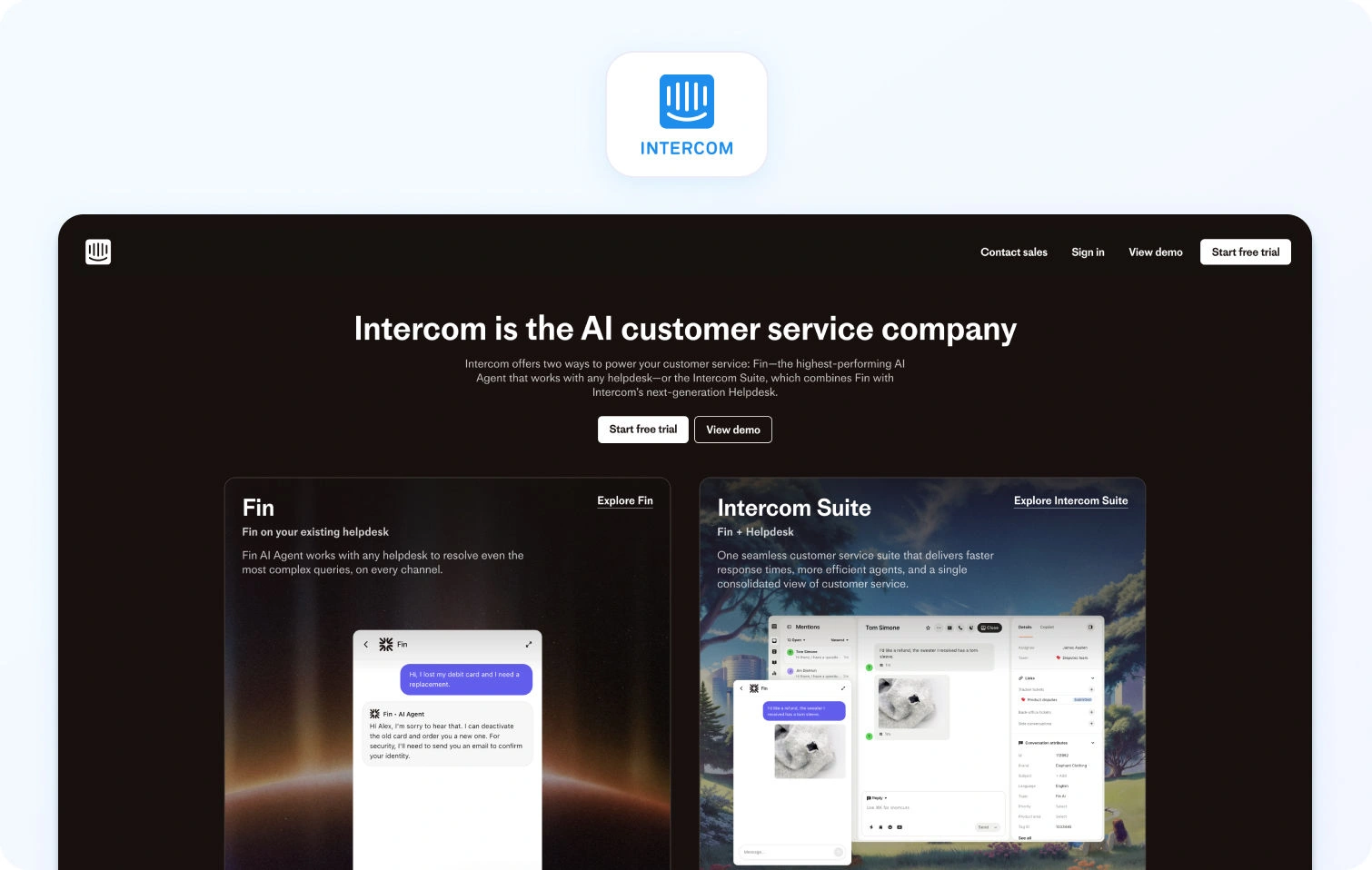
Best for: Product-led companies where in-app chat and automation are core
Intercom takes a messaging-first approach to customer support, making it particularly popular with SaaS companies and product-led organizations. Its platform is built around real-time chat, automation, and in-app customer engagement rather than traditional ticket queues. If your support model revolves around proactive messaging and AI-assisted conversations, Intercom offers one of the most mature ecosystems in that category.
Pricing note: Seat + usage components. Plans start at $29 per seat/month, billed annually (verify).
Top integrations: Product analytics platforms, CRM systems, chatbot engines.
Migration tip: Map in-app contexts early to preserve conversational threads.
Watch-outs: Costs can scale with usage and seat counts.
Gorgias
Best for: Shopify-heavy ecommerce teams handling order-centric volume
Gorgias is purpose-built for ecommerce support teams, particularly those running on Shopify. It integrates deeply with order management and customer purchase data, allowing agents to handle refunds, shipping updates, and order queries without leaving the help desk. For e-commerce brands managing high-ticket volumes tied to orders, this retail-focused workflow can significantly reduce resolution times.
Pricing note: Plans start at $10 per seat/month, billed monthly (verify).
Top integrations: E-commerce platforms, CRM, and inventory systems.
Migration tip: Bring order tags into your automation rulesets.
Watch-outs: Verify pricing mechanics and channel limits.
Best alternatives for shared inbox simplicity (lean teams)
Help Scout
Best for: Lean support teams that want a clean shared inbox + docs
Help Scout focuses on simplicity and usability, offering a shared inbox model that feels familiar to teams used to email. It’s particularly strong for companies that want to manage support conversations collaboratively without introducing complex workflows or administrative overhead. Paired with its knowledge base features, it provides a straightforward solution for smaller teams that prioritise clarity over customization.
Pricing note: Tier-based (Verify).
Top integrations: Docs, CRM, messaging tools.
Migration tip: Migrate mailboxes first, then workflow rules.
Watch-outs: Confirm advanced routing or operations needs as you scale.
Front

Best for: Teams that live in email but want collaboration + workflows
Front blends the concept of a shared inbox with collaboration tools that help teams coordinate responses across departments. Internal comments, shared drafts, and workflow automation make it easier for support, sales, and operations teams to work together inside a single email environment. For companies where customer communication still revolves around email, Front offers a structured but familiar approach.
Pricing note: Tier-based. Plans start at $25 per seat/month, billed annually (verify).
Top integrations: Slack, CRM, chat platforms.
Migration tip: Recreate shared inbox structures before importing messages.
Watch-outs: Help desk depth vs inbox collaboration needs.
Best alternatives for IT-style workflows and complex service operations
Jira Service Management (Atlassian)
Best for: Companies wanting service workflows aligned with IT and engineering
Jira Service Management is particularly well-suited for organizations where support workflows intersect with engineering or IT operations. Built on the Atlassian ecosystem, it allows teams to link customer issues directly with development tasks, incidents, and change management processes. For companies running DevOps-driven environments, that integration can dramatically improve collaboration between support and engineering teams.
Pricing note: Tier-based, starting with a limited, free plan (verify).
Top integrations: DevOps platforms, asset management tools.
Migration tip: Align project types and issue hierarchies first.
Watch-outs: Requires more configuration and administrative discipline.
Salesforce Service Cloud
Best for: Enterprises standardizing on Salesforce CRM
Salesforce Service Cloud is often the natural choice for organizations already running their customer data and revenue operations on Salesforce. Its deep customization capabilities allow enterprises to design highly tailored service workflows, reporting models, and customer journeys. For companies that require tight CRM alignment and enterprise governance, the platform offers significant flexibility.
Pricing note: Tier-based, starting with a limited, free plan (verify).
Top integrations: Salesforce ecosystem.
Migration tip: Sync CRM records before importing service data.
Watch-outs: Implementation complexity and administrative overhead.
ServiceNow Customer Service Management
Best for: Large organizations needing enterprise workflow orchestration
ServiceNow’s Customer Service Management platform extends beyond traditional help desk functionality into enterprise workflow orchestration. It is designed for organizations that want to unify service delivery across departments while maintaining strict governance and operational visibility. In large enterprises, the ability to connect customer issues with internal processes can help reduce friction across teams.
Pricing note: Quote-based (verify).
Top integrations: ITSM platforms, asset management tools, and knowledge systems.
Migration tip: Map key process flows before decommissioning existing systems.
Watch-outs: May be heavy for SMB or mid-market environments.
Best alternatives with built-in omnichannel + call center angle
LiveAgent
Best for: Teams wanting omnichannel support with a built-in call center
LiveAgent combines a traditional help desk with multi-channel communication tools, including voice support and live chat. This makes it appealing to teams that want to consolidate customer communication channels into a single platform without relying heavily on third-party integrations. For organizations handling both ticket-based and real-time conversations, it offers a practical hybrid approach.
Pricing note: Tier-based with plans starting at $15 per agent/month, billed annually (verify).
Top integrations: Telephony, chat, CRM platforms.
Migration tip: Prioritize channel setup before importing historical tickets.
Watch-outs: Verify reporting depth and long-term scalability.
HappyFox
Best for: Teams wanting structured workflows and reporting without enterprise-suite weight
HappyFox focuses on structured ticket workflows and operational reporting, making it appealing to teams that want more control over how support processes run. Its rule-based automation and reporting dashboards help managers monitor performance and ensure service levels are maintained. For organizations looking to formalize their support operations without adopting a large enterprise suite, it offers a balanced approach.
Pricing note: Tier-based with plans starting at $24 per agent/month, billed annually (verify).
Top integrations: CRM, automation platforms.
Migration tip: Define analytics goals before configuring workflows.
Watch-outs: Verify channel packaging and add-ons.
Kayako
Best for: Teams prioritizing omnichannel conversations and workflow customization
Kayako focuses on delivering a unified conversation view across channels, helping agents see the full context of a customer interaction regardless of how the conversation started. This conversation-centric model can improve continuity for customers moving between chat, email, and other channels. For teams focused on delivering seamless omnichannel experiences, that perspective can be valuable.
Pricing note: Pricing is resolution-based, vendor states $1 per resolution (verify).
Top integrations: Chat platforms, CRM systems.
Migration tip: Preserve conversation histories during import.
Watch-outs: Verify roadmap and packaging.
How We Evaluated Zoho Desk Alternatives
Customer support technology has evolved rapidly in the last few years. Platforms that once focused purely on ticket management are now expected to support omnichannel conversations, automation, AI-assisted workflows, and operational analytics. That shift has made choosing a help desk far more strategic than it used to be.
Customer expectations are rising at the same time. Recent industry research shows that around 60% of consumers say their expectations for customer service are higher today than they were just a year ago, highlighting how quickly support teams must adapt their tools and processes. For support leaders, that means the tools powering customer service must do more than manage tickets; they need to support scalable operations, real-time visibility, and increasingly complex channel strategies.
Our evaluation combined documentation reviews, pricing analysis, and observable product capabilities to understand how each platform performs for modern support teams.
Specifically, we looked at:
- Product documentation and feature pages to confirm capabilities such as ticketing, automation, and omnichannel support.
- Public pricing pages to understand seat-based vs. usage-based models and potential cost scaling.
- Customer case studies and logos to see which types of organizations typically adopt each platform.
- Marketplace listings and integrations to gauge ecosystem maturity and extensibility.
Where possible, pros and limitations were based on documented functionality or public product positioning, rather than anecdotal reviews. The goal is not to declare a single best choice, but to help teams identify which tool is best suited to their operational needs.
Like any comparison, there are limits. Product capabilities evolve quickly, packaging changes frequently, and implementation experience can vary depending on integrations and configuration. Readers should always validate shortlists with a pilot or product demo before committing.
Must-Have Capability Checklist
When comparing Zoho Desk competitors, certain capabilities increasingly separate basic help desk tools from full customer support platforms. Modern support teams rarely operate on a single channel or workflow, and platforms must support a mix of automation, analytics, and operational management.
For this list, we focused on solutions that provide, or can realistically support, the following capabilities:
- Voice and messaging channels that connect directly to the help desk workflow, allowing agents to manage conversations across channels without losing context.
- Knowledge-base grounded answers or strong knowledge base integrations to support self-service and AI-driven responses.
- AI capabilities for agent productivity, including transcription, summarization, and suggested replies.
- Operational analytics enables managers to monitor ticket volumes, agent productivity, and service-level performance.
- Workforce management or quality assurance tools, either built-in or available as first-party modules.
- Security and administrative controls, including multi-factor authentication, audit logs, and role-based access.
- Robust integrations and APIs, allowing the help desk to connect with CRM, product, and communication platforms.
- Pricing structures that include meaningful AI capabilities, rather than locking them entirely behind expensive add-ons.
- Customer feedback tools, such as CSAT surveys or satisfaction tracking, to monitor support quality.
Platforms that meet these criteria are generally capable of supporting operations as they scale from small teams to more structured service organizations. BlueTweak, for example, meets each of these requirements through its unified platform covering ticketing, automation, analytics, and operational management.
Scoring Rubric
Once the baseline capabilities were confirmed, we evaluated each platform based on how well it supports the needs of growing support teams, particularly organizations operating with 20–100 agents, where operational complexity begins to increase.
Our scoring focused on several factors that typically influence long-term success with a support platform:
- Fit for mid-sized support teams (20–100 agents) and whether the platform scales operationally without becoming overly complex.
- Voice and omnichannel depth, including how well different channels integrate with the ticketing workflow.
- AI coverage, particularly tools that assist agents with summaries, suggested replies, and knowledge-grounded answers.
- Workforce management and quality assurance, which help support leaders in managing performance, scheduling, and service quality.
- Time-to-value, meaning how quickly teams can deploy the platform and begin operating effectively.
- Total cost to operate (TCO), including seat pricing, usage-based components, and ecosystem dependencies.
- Security and operational controls, such as role-based access, audit logs, MFA, and data governance capabilities.
This rubric reflects how modern support leaders evaluate tools today. As support functions grow more strategic within organizations, the right platform won’t just be focused on handling tickets, but also enabling efficient operations, visibility, and scalable customer experience management.
Migration Notes (Making the Switch Feel Manageable)
Switching help desk platforms can feel like a major project, but in practice, most migrations follow a predictable set of steps. Modern support platforms typically provide export tools, APIs, or onboarding support that make moving historical tickets, users, and workflows far more straightforward than many teams expect.
The key is to treat the migration as an operational transition rather than a one-day system swap. With the right preparation, most support teams can move to a new platform with minimal disruption to agents or customers.
When planning a transition from Zoho Desk or another help desk tool, support leaders typically focus on a few core steps:
- Export and import tickets and users. Historical tickets, customer profiles, and agent accounts can usually be exported from the existing platform and imported into the new system. While some teams only migrate recent ticket history, others move several years of data to preserve reporting continuity.
- Preserve tags, macros, and SLA policies. Tags, saved replies, automation rules, and service level agreements often represent months or years of operational tuning. Documenting these workflows ahead of time makes it easier to rebuild them in the new platform.
- Rebuild the knowledge base structure. If your support team uses help articles or documentation, expect to recreate the article structure and set up redirects so existing links continue working. This is also a good opportunity to clean up outdated or duplicated content.
Beyond the technical setup, the most successful migrations include a short testing phase before fully switching systems.
Running a parallel pilot for two to four weeks allows a subset of agents to test the new platform while the existing system remains active. This helps teams validate routing rules, automation, reporting, and integrations before rolling the system out across the entire support organization.
During the pilot phase, it’s also important to track a few baseline operational metrics to ensure service quality remains stable during the transition. Common metrics include:
- SLA performance
- Ticket backlog
- First contact resolution (FCR)
- Average handle time (AHT)
Monitoring these indicators helps teams quickly identify workflow gaps or configuration issues early in the migration.
The good news is that once a platform is configured correctly, most teams find that a well-planned migration quickly pays off. Better visibility, improved automation, and unified communication channels often reduce operational friction and make support teams more effective almost immediately.
Final Thoughts: Choosing the Right Zoho Desk Alternative for Your Support Team
Choosing the right Zoho Desk alternative ultimately comes down to how your customer support operation is evolving. For many teams, Zoho Desk works well as a starter ticketing system, especially for small businesses that only need basic features and simple email workflows. But as support teams grow, the requirements often expand to include omnichannel support, advanced automation, deeper knowledge base capabilities, and the operational visibility needed to improve customer satisfaction.
That’s where many organizations begin exploring Zoho Desk competitors and other help desk software platforms designed for scaling teams.
The top Zoho Desk competitors bring together live chat, messaging, and even voice into a unified system, helping support agents manage support tickets, customer conversations, and customer queries from a single interface. Combined with tools like advanced analytics, intelligent routing, and AI-driven workflows, these platforms can significantly improve agent productivity and enable support leaders to operate customer service as a true business function rather than just a queue of tickets.
For medium-sized businesses in particular, the next generation of customer service platforms focuses on omnichannel support, knowledge base-driven automation, and AI features that assist agents with summaries, suggested replies, and faster resolution. When combined with capabilities like workforce management, SLA management, and smarter routing rules, modern desk software designed for operations teams can transform how organizations manage customer relationships and deliver consistent service across channels.
If you’re currently evaluating a Zoho Desk alternative, the most important step is validating the platform in your own environment. Every support team has different channels, workflows, and reporting needs, so a short pilot can quickly reveal which desk solution truly fits your organization.
If you want to see how a modern Zoho Desk alternative works in practice, including omnichannel support, AI tools, and built-in operational analytics, book a demo of BlueTweak today and explore how your support operation could run on a single, unified platform.
20 Customer Service Email Templates For Faster, Friendlier Support in 2026
Why Templates Still Matter in 2026 (And What Changed)
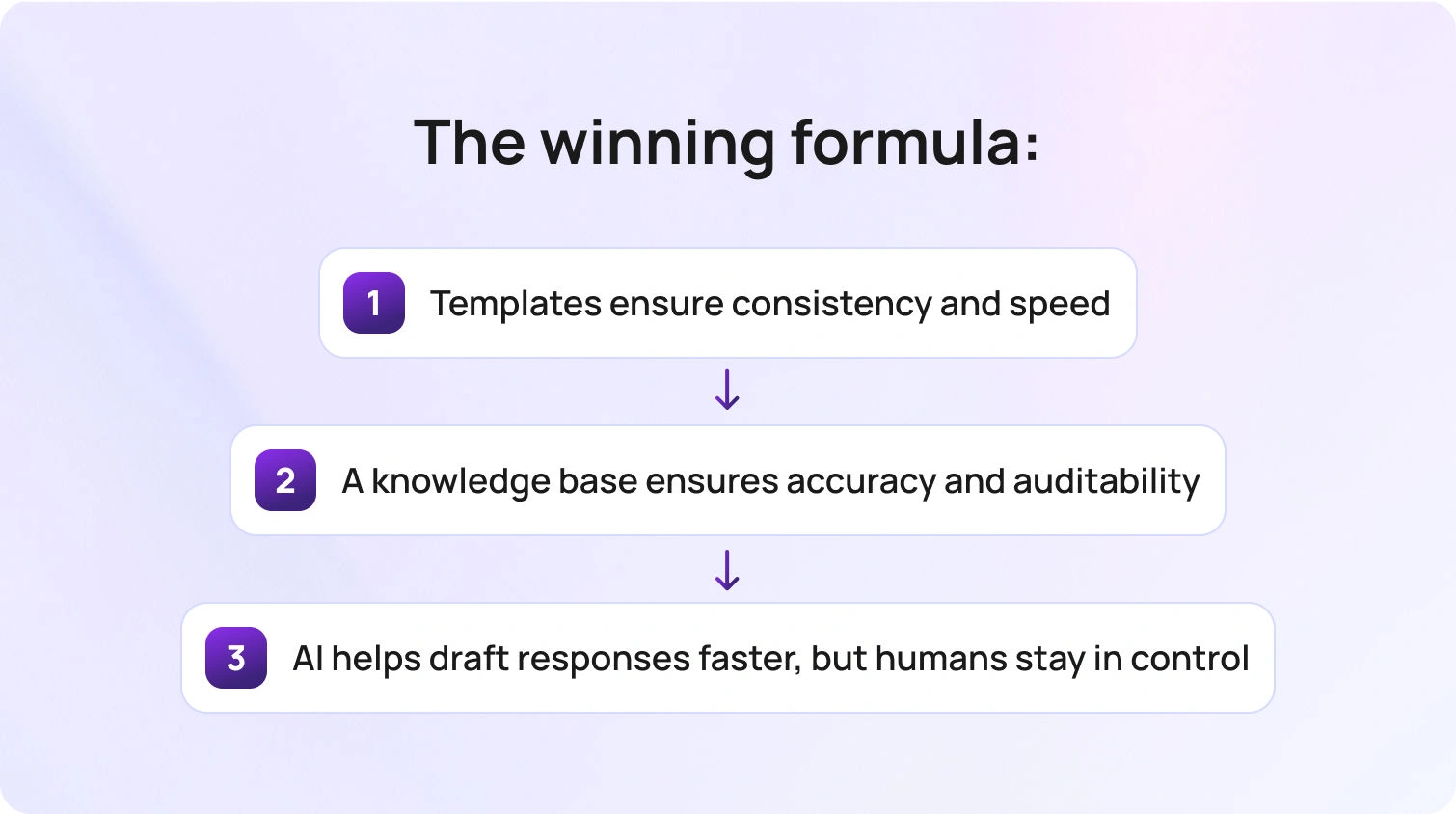
Customer expectations haven’t just increased, they’ve accelerated. Faster replies are now the baseline, not a differentiator. At the same time, support teams are handling more volume, more channels, and more complexity than ever before.
That’s where customer service email templates still deliver outsized value. They reduce average handling time, improve consistency, and eliminate avoidable errors, especially for repeatable requests. But what’s changed is how templates fit into the modern support stack.
According to McKinsey, companies that invest in personalization and modern customer experience capabilities, combining technology, data, and operational improvements, see significant gains in efficiency and customer satisfaction. The lesson here isn’t to replace templates with AI, it’s the opposite. Templates provide the guardrails AI needs to stay accurate, compliant, and on-brand.
This shift reflects a broader move toward more structured, customer-centric operations, where understanding customer needs and resolving issues efficiently becomes a core capability of any modern support team.
In 2026, the winning formula looks like this:
- Templates ensure consistency and speed
- A knowledge base ensures accuracy and auditability
- AI helps draft responses faster, but humans stay in control
Used together, they transform email support from reactive to operational. Platforms like BlueTweak help customer support teams bring these elements together, combining email templates, knowledge, and AI to improve response time and deliver more consistent customer experiences at scale.
20 Customer Service Email Templates
Below are 20 best customer service email templates, grouped by common support scenarios.
Cluster A: First Response + Triage
A strong first response sets the tone and prevents unnecessary follow-ups.
1. Auto-Acknowledgement / First Response
Use when: Confirming receipt and setting expectations
Subject options:
- We’ve received your request
- Your support request is in progress
Email body:
Hi {FirstName},
Thanks for reaching out. We’ve received your request, and our team is reviewing it now.
To help us resolve this as quickly as possible, could you confirm:
- {NextStep}
We’ll update you within {ETA}.
Best,
{AgentName}
Optional internal note (for agent only): Ensure required fields are requested upfront to avoid back-and-forth.
Escalation trigger: Missing critical account info after 2 follow-ups
2. Request More Information
Use when: Additional details are needed to proceed
Subject options:
- Quick info needed to move forward
- Can you confirm a few details?
Email body:
Hi {FirstName},
Thanks for your message. To move forward, we just need a bit more detail:
- Steps taken before the issue occurred
- Any screenshots (if available)
- Relevant account info (last 4 digits only)
Once we have this, we’ll take the next step right away.
Best,
{AgentName}
Optional internal note (for agent only): Avoid asking for full sensitive details, stick to secure identifiers only.
Escalation trigger: Customer unable to provide required verification
3. Handoff to Another Team
Use when: Transferring ownership to a specialist team
Subject options:
- We’re connecting you with the right team
- Your request has been escalated
Email body:
Hi {FirstName},
Thanks for your patience. I’ve shared your request with our {TeamName} team, who are best placed to help.
They’ll review and follow up within {ETA}. You don’t need to do anything further right now.
Best,
{AgentName}
Optional internal note (for agent only): Include full context and previous correspondence in handoff.
Escalation trigger: No response from the receiving team within the SLA
4. Still Working on It
Use when: Providing an update without resolution
Subject options:
- Update on your request
- We’re still working on this
Email body:
Hi {FirstName},
Just a quick update - we’re still working on your request and haven’t forgotten about it.
We’ll share the next update by {ETA}.
Thanks for your patience,
{AgentName}
Optional internal note (for agent only): Always set a clear next update time to prevent churn.
Escalation trigger: Issue exceeds expected resolution time
Cluster B: E-commerce / Order + Shipping
These customer service email templates handle high-volume order and delivery queries (including tracking number and tracking information requests) quickly, while keeping customers informed and reassured.
5. Order Status (WISMO)
Use when: Customer asks for order status
Subject options:
- Your order {OrderID} status
- Update on your delivery
Email body:
Hi {FirstName},
Your order {OrderID} is currently {Status}.
Estimated delivery: {ETA}. You can track it here: {TrackingLink}.
Let us know if you need anything else.
Best,
{AgentName}
Optional internal note (for agent only): Confirm tracking link is active before sending.
Escalation trigger: Tracking unavailable or stalled
6. Shipping Delay
Use when: Order is delayed
Subject options:
- Update on your delivery
- Shipping delay notification
Email body:
Hi {FirstName},
We wanted to let you know that your order has been delayed due to {Reason}.
The new estimated delivery date is {ETA}. We’ll keep you updated if anything changes.
Thanks for your patience; we appreciate it.
Best,
{AgentName}
Optional internal note (for agent only): Offer compensation if delay exceeds policy threshold.
Escalation trigger: Delay exceeds SLA or customer dissatisfaction
7. Delivered but Not Received
Use when: Order marked delivered but missing
Subject options:
- Let’s locate your delivery
- Delivery confirmation issue
Email body:
Hi {FirstName},
Our records show your order {OrderID} was delivered.
We recommend checking:
- With neighbors or reception
- Safe places around your property
If it’s still missing, let us know, and we’ll investigate with the carrier.
Best,
{AgentName}
Optional internal note (for agent only): Initiate carrier claim after customer confirmation.
Escalation trigger: High-value order or repeated delivery issues
8. Address Change Request
Use when: Customer requests an address update
Subject options:
- Update your shipping address
- Address change request
Email body:
Hi {FirstName},
Thanks for your message. We can update your address if your order hasn’t shipped yet.
Please confirm the new address: {NextStep}
Once confirmed, we’ll update it right away.
Best,
{AgentName}
Optional internal note (for agent only): Verify order status before confirming change.
Escalation trigger: Order already shipped
Cluster C: Refunds / Returns / Exchanges
Clear, policy-aligned responses are essential here; these templates help you set expectations while maintaining trust. Refunds are typically processed within a set number of business days, depending on the original payment method.
9. Refund Request Received
Use when: Customer submits a refund request, and you need to confirm receipt
Subject options:
- We’ve received your refund request
- Your refund request is being reviewed
Email body:
Hi {FirstName},
Thanks for your request. We’ve received your refund request for order {OrderID}.
Our team is reviewing this in line with our policy here: {PolicyLink}.
We’ll confirm the outcome within {ETA}. If we need anything further, we’ll let you know.
Best,
{AgentName}
Optional internal note (for agent only): Check eligibility window and payment method before confirming timeline.
Escalation trigger: Refund exceeds threshold or falls outside standard policy
10. Refund Approved
Use when: Refund has been approved and processed
Subject options:
- Your refund has been approved
- Refund processed for order {OrderID}
Email body:
Hi {FirstName},
Good news, your refund for order {OrderID} has been approved.
The amount will be returned to your original payment method within {ETA}.
If you don’t see it after this time, feel free to reach out, and we’ll take a closer look.
Best,
{AgentName}
Optional internal note (for agent only): Confirm refund method matches original payment route.
Escalation trigger: Payment failure or refund delay beyond SLA
11. Return / Exchange Instructions
Use when: Customer needs to return or exchange an item
Subject options:
- How to return your item
- Your return instructions
Email body:
Hi {FirstName},
You can return or exchange your item using the steps below:
- Package the item securely
- Include your order reference: {OrderID}
- Send it to the address provided here: {PolicyLink}
Once received, we’ll process your return within {ETA}.
Let us know once it’s been shipped, and we’ll keep an eye out for it.
Best,
{AgentName}
Optional internal note (for agent only): Check if prepaid label applies based on region/order value.
Escalation trigger: High-value item or missing return tracking
12. Policy Ineligibility (Denial)
Use when: Request falls outside the refund/return policy
Subject options:
- Update on your request
- Regarding your recent request
Email body:
Hi {FirstName},
Thanks for your request. After reviewing the details, this falls outside our policy guidelines: {PolicyLink}.
While we’re unable to process this request, we’d still like to help where possible. {NextStep}
If you have any questions, feel free to reply - we’re here to help.
Best,
{AgentName}
Optional internal note (for agent only): Always offer alternative (store credit, discount, etc.) where allowed.
Escalation trigger: Customer disputes policy or threatens a chargeback
Cluster D: Complaints + De-escalation
When emotions run high, the right structure helps agents stay calm, take ownership, and move the conversation toward resolution.
13. Angry Customer De-escalation
Use when: Customer expresses frustration or anger
Subject options:
- We’re here to help
- Let’s get this resolved
Email body:
Hi {FirstName},
I understand how frustrating this situation must be, and I appreciate you bringing it to our attention.
Here’s what I’m doing to help:
- {NextStep}
I’ll personally make sure this is followed through and update you by {ETA}.
Best,
{AgentName}
Optional internal note (for agent only): Acknowledge emotion, avoid defensiveness, take ownership.
Escalation trigger: Threats, chargebacks, or abusive language
14. Poor Service Experience
Use when: Customer reports a bad experience
Subject options:
- We appreciate your feedback
- Sorry about your experience
Email body:
Hi {FirstName},
I’m sorry to hear about your experience. That’s not the standard we aim to deliver.
We’re reviewing what happened and taking steps to address it. In the meantime:
- {NextStep}
Thank you for your feedback. It helps us improve.
Best,
{AgentName}
Optional internal note (for agent only): Log feedback internally for QA review.
Escalation trigger: Repeated complaints or public escalation risk
15. Multiple Transfers / Escalation Frustration
Use when: Customer is frustrated by being passed around
Subject options:
- I’ll take this from here
- Let’s resolve this together
Email body:
Hi {FirstName},
I’m sorry for the back-and-forth - you shouldn’t have to repeat yourself.
I’ll take ownership of your request from here and ensure it’s resolved.
Next step: {NextStep}
Update by: {ETA}
Best,
{AgentName}
Optional internal note (for agent only): Keep single-thread ownership until resolution.
Escalation trigger: Complex cross-team dependency
Cluster E: Technical Issue + Outage
These templates ensure customers stay informed during technical issues, with clear updates, next steps, and realistic timelines, including directing customers to a status page where appropriate.
16. Bug Report Acknowledgement
Use when: Customer reports bug
Subject options:
- Thanks for reporting this
- We’re looking into your report
Email body:
Hi {FirstName},
Thanks for flagging this. We’ve logged it with our technical team.
To help us investigate further, could you confirm:
- {NextStep}
We’ll keep you updated as we learn more.
Best,
{AgentName}
Optional internal note (for agent only): Attach logs or reproduction steps where possible.
Escalation trigger: Critical bug affecting multiple users
17. Known Issue / Outage
Use when: Issue already identified
Subject options:
- Service update
- Known issue we’re working on
Email body:
Hi {FirstName},
We’re aware of an issue currently affecting {Feature}.
Our team is actively working on a fix. In the meantime, you can try:
- {NextStep}
We’ll provide another update by {ETA}.
Best,
{AgentName}
Optional internal note (for agent only): Use consistent messaging across all affected tickets.
Escalation trigger: Enterprise customers or SLA breach risk
18. Troubleshooting Steps
Use when: Providing structured resolution steps
Subject options:
- Steps to resolve your issue
- Let’s fix this together
Email body:
Hi {FirstName},
Let’s try the following steps to resolve this:
- Step 1: {NextStep}
- Step 2: {NextStep}
- Step 3: {NextStep}
Once completed, let me know the outcome, and we’ll take it from there.
Best,
{AgentName}
Optional internal note (for agent only): Keep steps concise and ordered logically.
Escalation trigger: Steps fail, or issue persists
Cluster F: Account / Billing + Trust
For sensitive topics like billing and security, these templates prioritize clarity, accuracy, and customer confidence.
19. Billing / Charge Question
Use when: Customer questions a charge
Subject options:
- About your recent charge
- Billing query update
Email body:
Hi {FirstName},
Thanks for reaching out about this charge.
Here’s what we can see on our end:
- {NextStep}
We’re reviewing this further and will update you by {ETA}.
Best,
{AgentName}
Optional internal note (for agent only): Cross-check billing system and subscriptions.
Escalation trigger: Potential fraud or dispute
20. Account Security Verification
Use when: Verifying account safely
Subject options:
- Quick account verification
- Security check for your account
Email body:
Hi {FirstName},
To help us securely access your account, we need to verify a few details.
Please confirm:
- The last four digits associated with your account
- Any recent activity you recognize
For your security, please do not share full passwords or sensitive information.
Best,
{AgentName}
Optional internal note (for agent only): Follow security protocol strictly—never request full credentials.
Escalation trigger: Suspicious activity or failed verification
When to Use a Template vs a Fully Custom Reply
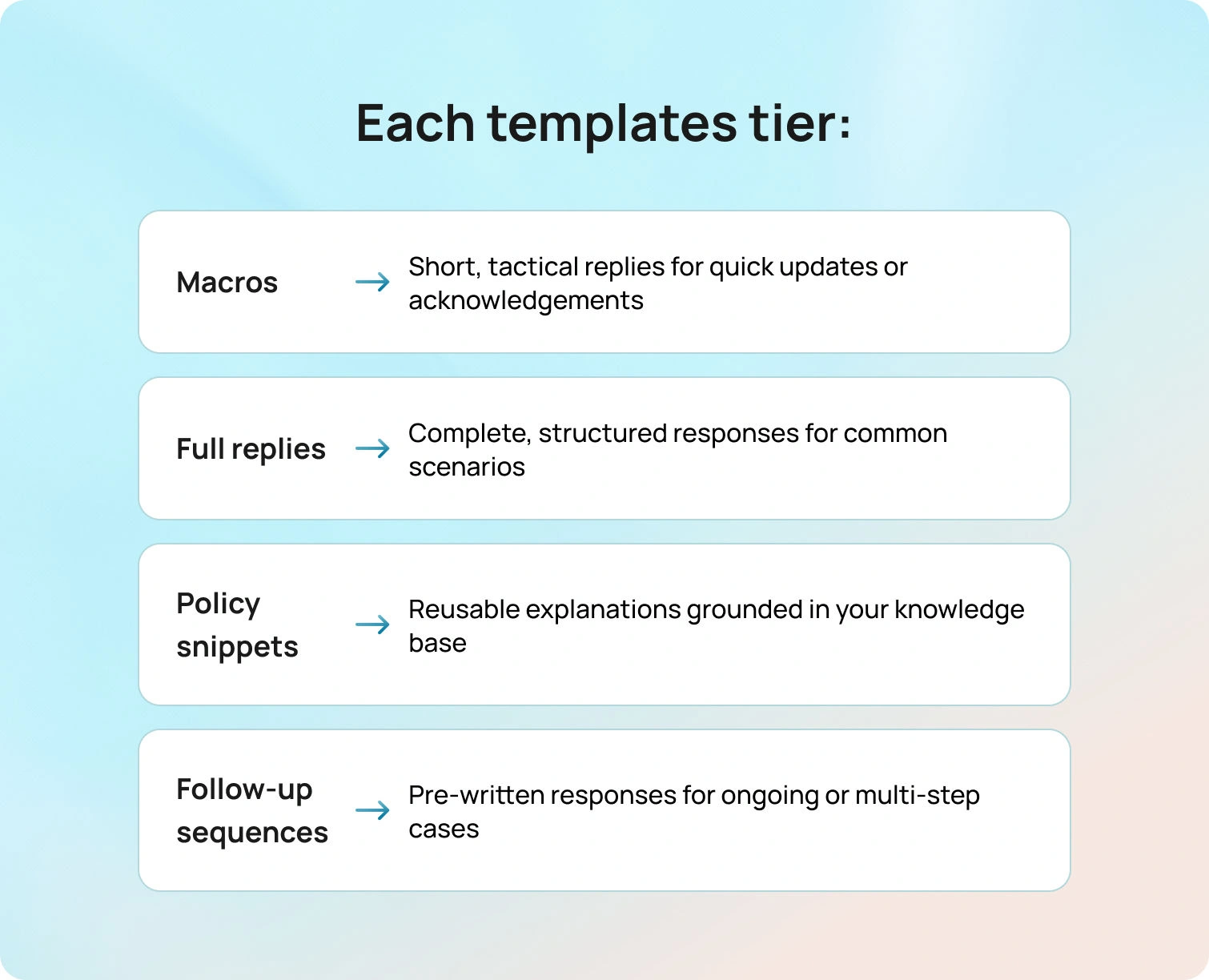
Not every ticket should get a templated response, and knowing the difference is what separates efficient teams from robotic ones.
Templates work best when the situation is predictable and repeatable. In these cases, speed and consistency matter more than originality. A well-written customer service email template ensures customers get a clear, accurate response without unnecessary delays, while also reducing the cognitive load on agents handling high volumes.
Use a template when the request follows a familiar pattern, such as order status updates, refund requests, or common troubleshooting steps. These scenarios typically rely on known policies, standard next steps, and repeatable workflows, which makes them ideal for structured responses.
By contrast, fully custom replies are essential when nuance matters more than speed. High-severity issues, sensitive personal situations, or cases involving legal or financial implications require a more tailored approach. In these moments, customers are looking for reassurance, ownership, and careful handling. This is especially important for customer service agents handling complex or emotional situations, where clear, thoughtful communication can make the difference between a resolved issue and a negative experience.
It’s helpful to think about templates not as a single format, but as a spectrum of support tools. Most teams benefit from structuring their customer service email response templates into tiers, depending on the complexity of the interaction:
- Macros: Short, tactical replies for quick updates or acknowledgements
- Full replies: Complete, structured responses for common scenarios
- Policy snippets: Reusable explanations grounded in your knowledge base
- Follow-up sequences: Pre-written responses for ongoing or multi-step cases
The goal is to remove friction where possible, so agents can focus their attention where it matters most. At their best, templates don’t replace human judgment; they support it.
Anatomy of the Best Customer Service Email Templates (2026-Ready)
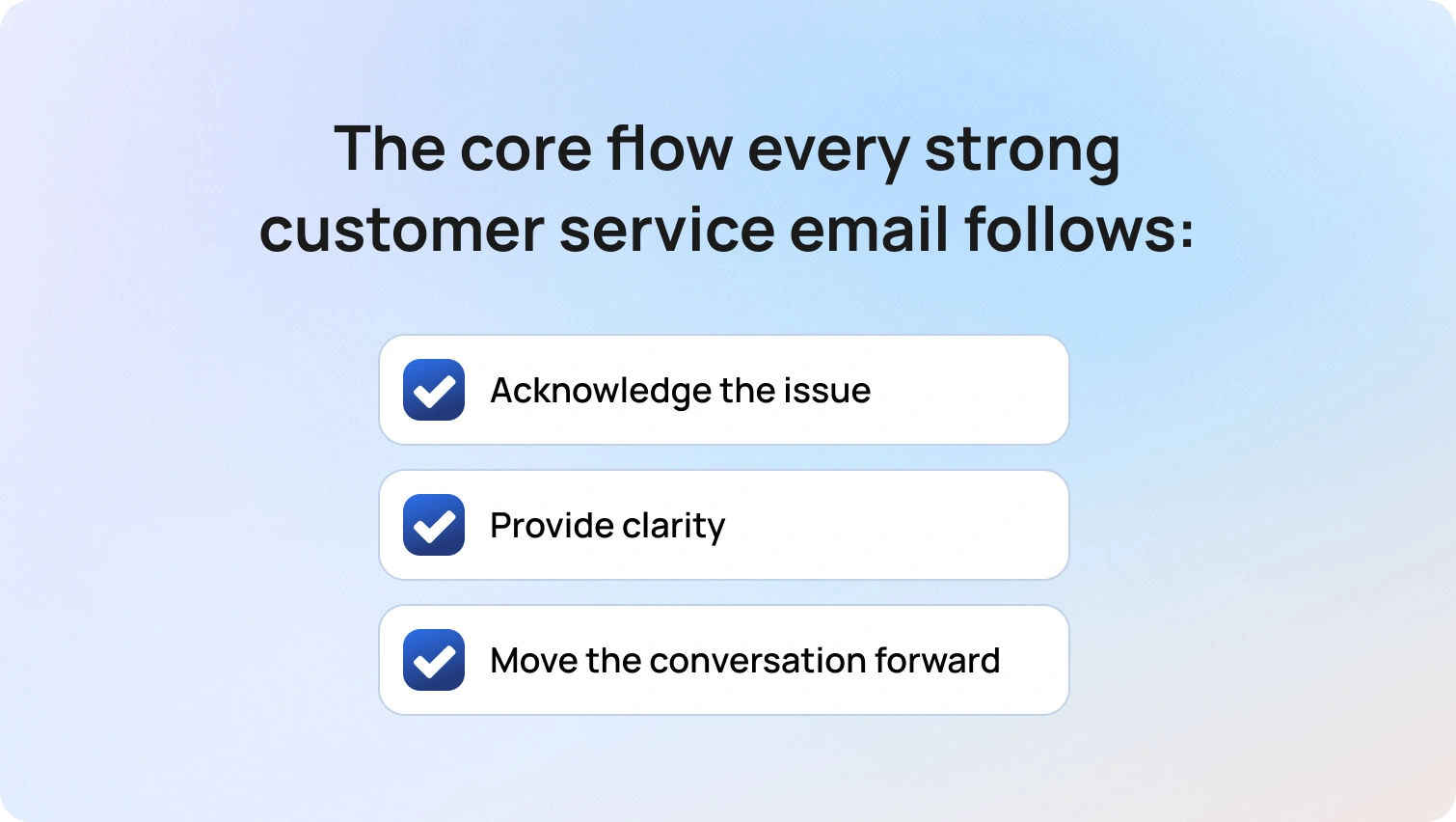
Before diving into the sample customer service email templates, it’s worth understanding what separates a good template from one that actually improves performance.
Standard, pre-written responses aren’t the most effective way of addressing customer concerns. Templates, when used well, are structured frameworks that guide agents toward clarity, empathy, and action. In 2026, that structure matters even more, as templates increasingly power AI-assisted replies and need to hold up under automation as well as human use.
At a high level, every strong customer service email template follows the same core flow:
- Acknowledge the issue
- Provide clarity
- Move the conversation forward
The difference lies in how clearly and consistently that structure is applied.
It starts with the subject line. This should be clear, neutral, and specific enough to set expectations before the email is even opened. Overly urgent or vague subject lines can create confusion, or worse, unnecessary concern.
From there, the opening line should acknowledge the customer’s situation and establish a human tone. This doesn’t mean over-apologizing, but it does mean showing that the issue has been understood. A simple, direct acknowledgment is often more effective than a long-winded expression of empathy.
The body of the email should focus on two things: what’s already been done, and what needs to happen next. This is where light structure, such as short paragraphs or occasional bullet points, can improve readability, especially for more complex responses.
Where relevant, templates should also guide customers toward self-serve options. Linking to your knowledge base not only speeds up resolution but also reduces repeat queries and builds customer confidence.
Finally, every template should close with clarity. That means:
- A clear next step
- A realistic timeline
- A sign-off that feels human, not transactional.
Including a reference like a case ID can also help maintain continuity across longer threads.
To make templates scalable and adaptable, it’s important to use consistent placeholders that agents can quickly personalize before sending. These typically include key details like the customer’s first name, order ID, or the last four digits of an account identifier, along with operational fields such as estimated timelines, relevant policy links, next steps, and the assigned agent’s name. Using standardized placeholders ensures every response feels tailored, while still maintaining speed and consistency across the team.
Tone also plays a critical role. The best templates are flexible enough to adapt; whether that means a more formal tone for sensitive issues, or a shorter, more conversational style for quick updates.
This structure underpins all the best customer service email templates that follow. When applied consistently, it turns templates from simple shortcuts into a reliable system for delivering fast, high-quality support. As more teams introduce AI into their workflows, maintaining this structure becomes even more important, helping support agents avoid inconsistent or inaccurate automated responses.
Best Practices to Make Templates Feel Human (and Not Robotic)
Even the most well-crafted sample customer service email templates can feel flat if they come across as scripted. The key is to write like a human solving a problem, not a system processing a ticket. Personalization is important, but it should be meaningful: including the customer’s first name or specific order details adds warmth, but overusing names or generic phrases can feel forced.
It’s also critical to keep each email focused. Sticking to one clear question or action per message prevents confusion and reduces unnecessary back-and-forth. Structure is your friend (it helps guide the customer through the conversation), but it shouldn’t feel restrictive. Every email should clearly indicate the next step, so the customer knows exactly what to do or expect. Apologies, if needed, should always be proportional: one sincere acknowledgment is enough; repeated apologies can weaken trust.
Some common phrases to avoid include overly formal or overused lines like “We apologize for any inconvenience caused” or “Your patience is greatly appreciated.” Instead, aim for natural, straightforward language that shows empathy, clarity, and a commitment to solving the customer’s issue.
Striking the right balance between automation and empathy is critical, especially as more customer support teams look to scale without losing the human touch.
How to Operationalize Templates (So They Actually Improve SLAs)
Templates are only effective if they are actively maintained and properly integrated into your support workflows. A shared, governed library ensures that every agent has access to the most up-to-date templates, and assigning clear ownership per category prevents outdated responses from lingering in circulation. Linking templates directly to your knowledge base guarantees accuracy and consistency, while weekly reviews of real tickets help identify gaps or improvements.
For any customer service department, this means moving beyond static documents and building a system where templates, workflows, and performance tracking are tightly connected.
Mapping templates to specific intents and tags further streamlines operations, allowing agents to select the right response quickly and maintain quality across the team. Training is just as important: new agents should practice using templates in realistic scenarios rather than simply reading them. This hands-on experience reinforces both tone and policy compliance, making templates a true productivity tool rather than a static resource.
Measuring Template Performance (What to Track)
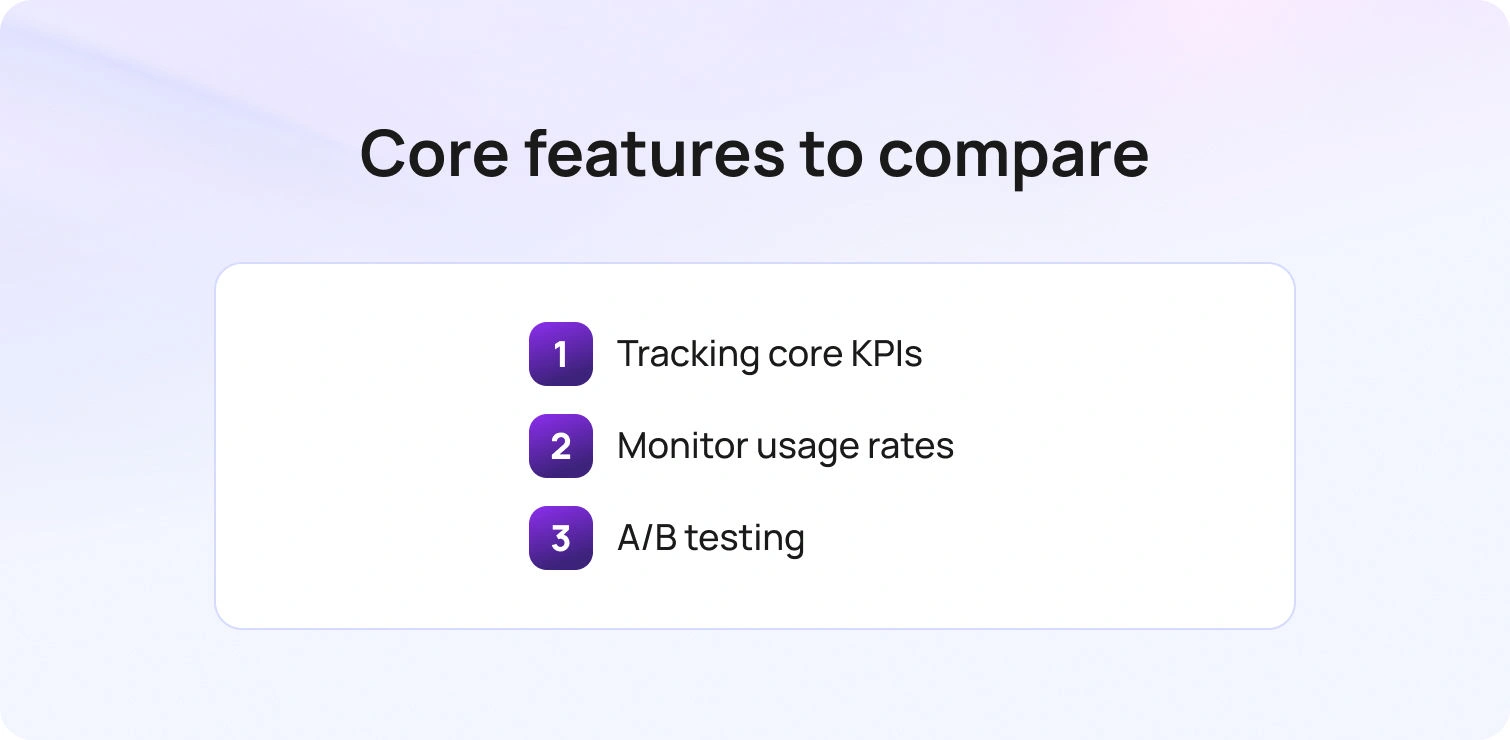
Templates should do more than just save time; they should improve outcomes. Start by tracking core KPIs such as first response time, time to resolution, reopen rate, customer satisfaction (CSAT), and escalation rate. These metrics reveal whether templates are helping agents resolve issues efficiently while maintaining a positive customer experience.
At a more granular level, monitor template usage rates, edit frequency, and adoption of saved responses. This helps identify which templates are truly effective and which might need refinement. A/B testing is also invaluable: experimenting with subject lines, opening sentences, and CTA placement can optimize engagement and response rates, giving your team data-backed insights into what works best for your customers. These insights not only improve individual email responses but also help teams build a more customer-centric strategy over time.
How We Built This Template Set
This set of customer service email templates was developed by analyzing common support scenarios across e-commerce, SaaS, and service teams. Templates were grouped by intent, allowing agents to quickly select the right response for any situation. Flexible placeholders were added to ensure messages remain personalized without sacrificing efficiency.
We also incorporated escalation triggers and guardrails, giving agents guidance on when to escalate complex issues or exceptions. Every template remains fully customizable to match your company’s policies, timelines, and tone of voice, making them both practical and adaptable for 2026 workflows. These patterns reflect broader trends shaping modern customer support, where speed, personalization, and consistency are no longer trade-offs but expectations.
How BlueTweak Helps You Scale Email Support (Without Losing the Human Touch)
Templates are just the starting point. The real impact comes when they’re embedded into your workflows and supported by the right systems. This kind of operational approach is becoming more accessible as modern customer service software evolves, with flexible solutions designed to support teams of all sizes.
BlueTweak helps teams move from static templates to dynamic, high-performing support operations, where speed, consistency, and quality are built in by design.
Instead of starting from scratch, agents begin with strong, AI-assisted drafts grounded in your templates and knowledge base. They review, refine, and send, keeping humans firmly in control while dramatically reducing response time.
That’s where BlueTweak goes beyond traditional tooling. It connects templates, automation, and knowledge into a single, operational system:
- Turn templates into consistent, on-brand replies, fast: Agents start with AI-suggested responses based on your approved templates, reducing variability and improving speed.
- Ground every response in your knowledge base: Replies are backed by your KB, ensuring accuracy and consistency, especially for policy-heavy topics like refunds, eligibility, and troubleshooting.
- Handle more volume with less agent fatigue: Ticket summaries and suggested replies reduce reading and writing time, helping agents process more requests without burnout.
- Support customers in multiple languages: Real-time translation extends your template approach across languages, maintaining consistency globally.
- Unify email with chat and voice: BlueTweak brings all channels into one place, so context isn’t lost when conversations escalate beyond email.
- Run support like an operation, not an inbox: Built-in analytics and workforce management tools help you manage SLAs, staffing, and demand more effectively.
- Scale across multiple brands with ease: Native multi-brand support allows teams to manage different storefronts or business units without losing consistency.
With everything connected (think: templates, knowledge, and AI) teams can move faster without sacrificing quality. The result is faster replies, better consistency, and support that scales without feeling robotic.
Final Thoughts: Scale Customer Service Email Templates Into Real Performance Gains
Customer service email templates remain one of the most effective ways for any customer service team to deliver fast, reliable support at scale. When used correctly, they help support agents respond in a timely manner, reduce errors, and maintain consistent service quality across every customer interaction.
But templates alone aren’t enough. The teams delivering great customer service in 2026 are the ones that treat templates as part of a wider system, one that combines structured email templates, knowledge base guidance, and AI-assisted drafting. This approach helps customer service agents handle more volume, improve response time, and ensure every reply aligns with your brand voice.
Whether it’s helping a frustrated customer, resolving a customer complaint, or supporting technical support queries, the goal is always the same: deliver clear, accurate, and human responses that improve the overall customer experience. When your entire team is working from the same foundation, it becomes much easier to stay aligned, reduce back-and-forth, and keep everyone on the same page.
If you’re ready to move beyond static templates and build a smarter, more scalable approach to customer support, now is the time to take the next step.
Request a demo of BlueTweak to see how you can turn customer service email templates into faster response times, better customer satisfaction, and more consistent service across your entire team, without losing the human touch.
20 Best E-commerce Customer Service Software Tools in 2026
Why E-commerce Customer Service Software Is Now a Revenue Lever
Most e-commerce brands still treat support as a cost center. That assumption is very expensive.
According to PwC’s 2025 research, 55% of consumers will stop buying from a company after several bad experiences. This reframes support entirely; it’s not a post-purchase function, it’s a retention system. At the same time, the pressure on support teams is increasing faster than most organizations can respond to it. PwC also found that 70% of executives say customer expectations are outpacing their ability to deliver. This aligns with broader shifts outlined incustomer support trends shaping modern CX, where expectations continue to rise faster than most support systems can adapt.
That gap is not caused by effort; it’s caused by infrastructure. Most support teams already understand what a good customer experience looks like. They’ve defined SLAs, built help centers, trained agents, and invested in automation. The constraint is execution under real-world conditions.
In e-commerce, those conditions are unforgiving, often shaped by small but compounding friction points across the customer journey that, left unresolved, quietly erode both experience and efficiency. Volume spikes without warning, customers expect instant answers across multiple channels, and the majority of queries require real-time order context. When systems aren’t designed for that environment, even well-trained teams are forced into reactive workflows; switching between tools, duplicating effort, and relying on incomplete information.
This is where the gap widens. Not because teams aren’t capable, but because their tooling introduces friction at exactly the moments where speed and accuracy matter most.
For buyers, the implication is clear: improving support performance isn’t just about hiring more agents or refining processes. It’s about removing the structural bottlenecks that prevent teams from executing consistently at scale.
In practice, that friction shows up in familiar ways:
- Agents switching between systems to answer simple order questions
- Delays during peak periods that compound into churn
- Inconsistent answers across channels that erode trust
This is why the role of customer service software for e-commerce has fundamentally shifted. The best platforms no longer just manage tickets—they enable decisions, context, and scale.
They act as:
- A decision layer (what should happen for this customer, right now?)
- A context engine (what do we know about the order, history, and risk?)
- A throughput system (how do we handle 3x demand without degrading CX?)
If your tooling can’t support those outcomes, it doesn’t just slow support; it limits growth.
The 20 Best E-Commerce Customer Service Software Tools
Not all platforms are built for ecommerce complexity. Below, we’ve grouped the best e-commerce customer service software based on how they approach support operations.
BlueTweak — Editor’s Choice
Best for: Scaling e-commerce teams, managing multiple brands, and high-volume support
BlueTweak is designed specifically as e-commerce customer service software, rather than a general-purpose help desk adapted for retail.
Its core advantage is consolidation. Instead of stitching together separate tools for chat, voice, analytics, and workforce management, it brings these into a single system with shared context.
This enables:
- Faster resolution times, because agents don’t switch systems
- More consistent answers, because AI is grounded in a unified knowledge base
- Better operational control, because analytics and WFM sit alongside support workflows
For teams managing multi-store operations or high ticket volumes, this reduces both complexity and time-to-value.
“Our goal has always been to remove friction from e-commerce support. By unifying chat, voice, AI, and analytics in a single platform, we empower teams to focus on customers, not toggling between systems” Radu Dumitrescu, Head of Digital Transformation at BlueTweak.
E-commerce fit: Strong (multi-store, API-first integrations)
Channels: Chat, email, voice, omnichannel routing
Automation & AI: Summaries, suggested replies, smart KB, workflow automation
KB/self-service: Advanced, AI-grounded
Ops analytics/WFM/QA: Built-in
Pricing: Transparent, all-in-one pricing starts at approximately €65 per agent/month (~$70 USD), with core capabilities (AI, omnichannel support, WFM, QA, and analytics) included rather than sold as add-ons. Verify with the vendor.
Watch-out: None significant, designed to reduce tool sprawl
Ecommerce-First Tools (Shopify-heavy, retail-native)
2) Gorgias
Best for: Shopify-centric brands
Gorgias is one of the most established e-commerce customer service software platforms built specifically for Shopify-first brands. It focuses heavily on connecting support tickets with order data, enabling agents to take actions like refunds or edits directly within the support interface. Its strength lies in tight Shopify integration and automation around common e-commerce workflows.
E-commerce fit: Strong (Shopify-first, multi-store support)
Channels: Email, chat, social, SMS
Automation & AI: Rules, macros, and intent-based automation
KB/self-service: Basic
Ops analytics/WFM/QA: Limited WFM, standard reporting
Pricing: Tiered pricing based on ticket volume, starting from entry-level plans with usage-based scaling as support volume increases. Additional automation and integrations may increase costs; verify with the vendor.
Watch-out: Costs can scale quickly with ticket volume and add-ons
3) Re:amaze
Best for: SMB ecommerce teams
Re:amaze is a lightweight, ecommerce-focused support platform designed for smaller teams that want an accessible, all-in-one solution without enterprise complexity. It combines chat, email, and social support with built-in ecommerce integrations. Its positioning is simplicity and speed to value.
E-commerce fit: Strong (Shopify, BigCommerce, WooCommerce)
Channels: Chat, email, social, SMS
Automation & AI: Basic automation and chatbots
KB/self-service: Included
Ops analytics/WFM/QA: Limited
Pricing: Transparent tiered pricing starts at a per-user monthly rate (entry-level plans publicly listed), with higher tiers unlocking automation and integrations. Verify with the vendor.
Watch-out: May require migration as operational complexity increases
4) Richpanel
Best for: Self-service-first ecommerce brands
Richpanel is built around the idea that most e-commerce support should be resolved without agent involvement. It emphasizes self-service, automation, and customer-facing workflows to reduce ticket volume. Its approach prioritizes deflection over traditional ticket handling.
E-commerce fit: Strong (Shopify-focused, ecommerce-native)
Channels: Chat, email
Automation & AI: Strong automation and self-service workflows
KB/self-service: Advanced, customer-facing portal
Ops analytics/WFM/QA: Moderate
Pricing: Usage-based pricing aligned to support volume and automation usage, typically requiring vendor consultation for full visibility. Verify with the vendor.
Watch-out: Less robust for teams with significant voice or complex workflows
5) Gladly
Best for: Retail customer experience teams
Gladly is designed around a customer-centric model rather than a ticket-centric one, making it well-suited for retail and ecommerce brands focused on delivering premium support experiences. It organizes conversations around the customer, not individual tickets.
E-commerce fit: Moderate–strong (retail-focused integrations)
Channels: Omnichannel (chat, email, voice, SMS)
Automation & AI: Growing AI capabilities
KB/self-service: Strong
Ops analytics/WFM/QA: Good reporting, limited WFM
Pricing: Custom pricing model based on seats and feature requirements, typically positioned for mid-market to enterprise teams. Verify with the vendor.
Watch-out: Not purely e-commerce-native, may require integrations for a full commerce context
Help Desk Suites (Strong Ecosystems)
6) Zendesk
Best for: Enterprise teams
Zendesk is one of the most widely used customer service platforms, offering a broad ecosystem of tools that can be adapted for e-commerce through integrations. Its strength lies in flexibility and scale.
E-commerce fit: Moderate (integration-dependent)
Channels: Omnichannel + voice
Automation & AI: Advanced (Zendesk AI)
KB/self-service: Strong
Ops analytics/WFM/QA: Strong
Pricing: Tiered per-agent pricing starting from entry-level plans, with advanced features (AI, analytics, voice) typically available in higher tiers or add-ons. Verify with the vendor.
Watch-out: Pricing and feature access can become complex across tiers
7) Freshdesk (Freshworks)
Best for: Growing teams
Freshdesk offers a balance between usability and functionality, making it a popular choice for scaling teams that need more structure without enterprise overhead. It provides a broad feature set with relatively quick setup.
E-commerce fit: Moderate
Channels: Omnichannel
Automation & AI: Freddy AI
KB/self-service: Included
Ops analytics/WFM/QA: Moderate
Pricing: Free tier available, with paid plans starting at a per-agent monthly rate and scaling based on features like automation, AI, and analytics. Verify with the vendor.
Watch-out: Advanced capabilities often require higher-tier plans or add-ons
8) Zoho Desk
Best for: Budget-conscious teams
Zoho Desk is part of the broader Zoho ecosystem, offering cost-effective support capabilities with tight integration across Zoho products. Its strength is affordability and ecosystem depth.
E-commerce fit: Moderate
Channels: Omnichannel
Automation & AI: Zia AI
KB/self-service: Included
Ops analytics/WFM/QA: Moderate
Pricing: Tiered pricing starting from low-cost per-agent plans, with AI and advanced automation available in higher tiers. Verify with the vendor.
Watch-out: Interface and UX can feel complex for new users
9) Salesforce Service Cloud
Best for: Enterprise ecosystems
Salesforce Service Cloud is designed for large organizations already operating within the Salesforce ecosystem. It offers deep customization and enterprise-grade capabilities. Its value comes from integration and scale.
E-commerce fit: Strong (with integrations)
Channels: Omnichannel
Automation & AI: Einstein AI
KB/self-service: Advanced
Ops analytics/WFM/QA: Strong
Pricing: Enterprise pricing model with per-user monthly costs typically starting at higher tiers, with additional costs for AI, automation, and integrations. Verify with the vendor.
Watch-out: High total cost of ownership and implementation complexity
10) ServiceNow CSM
Best for: Enterprise retail operations
ServiceNow CSM is built for large-scale service operations, often spanning multiple departments beyond customer support. It focuses on process orchestration and enterprise workflows.
E-commerce fit: Strong (enterprise retail focus)
Channels: Omnichannel
Automation & AI: Advanced
KB/self-service: Enterprise-grade
Ops analytics/WFM/QA: Strong
Pricing: Custom enterprise pricing based on users, workflows, and modules, typically requiring consultation. Verify with the vendor.
Watch-out: Significant implementation time and resource requirements
Messenger-Led / Proactive Chat + Bots
11) Intercom
Best for: Conversational, chat-first support teams
Intercom is built around real-time, messenger-led customer communication, combining live chat, bots, and proactive messaging into a single interface. It’s particularly strong for brands that want to engage customers before and after purchase. Its focus is on reducing friction through conversation rather than traditional ticketing.
Ecommerce fit: Moderate (integration-dependent)
Channels: Chat, email, in-app messaging
Automation & AI: Strong (Fin AI agent, automation workflows)
KB/self-service: Strong
Ops analytics/WFM/QA: Moderate
Pricing: Modular pricing structure with a base platform fee plus per-seat and AI usage costs (Fin AI billed separately), which can scale with usage. Verify with the vendor.
Watch-out: Pricing can increase significantly with AI and messaging volume
12) Tidio
Best for: SMB ecommerce brands
Tidio is a lightweight, chat-first support tool designed for small to mid-sized ecommerce teams. It combines live chat with AI chatbots to automate common queries. Its strength lies in simplicity and quick setup.
E-commerce fit: Strong (Shopify, WooCommerce integrations)
Channels: Chat, email
Automation & AI: AI chatbot (Lyro)
KB/self-service: Basic
Ops analytics/WFM/QA: Limited
Pricing: Free plan available, with paid tiers starting at a low monthly cost and scaling based on chatbot usage and features. Verify with the vendor.
Watch-out: Limited depth for scaling teams or complex operations
13) Crisp
Best for: Startups and early-stage teams
Crisp is a simple, cost-effective messaging platform that combines live chat, email, and basic automation in a single interface. It prioritizes accessibility over complexity.
E-commerce fit: Moderate
Channels: Chat, email, messaging apps
Automation & AI: Basic chatbot and automation
KB/self-service: Included
Ops analytics/WFM/QA: Basic
Pricing: Flat-rate pricing model with entry-level paid plans offering unlimited seats, with higher tiers unlocking automation and integrations. Verify with the vendor.
Watch-out: Limited scalability for high-volume support environments
14) Helpshift
Best for: Mobile-first ecommerce apps
Helpshift is designed for in-app customer support, making it particularly strong for e-commerce brands with mobile apps as a primary channel. It focuses on embedding support directly within the product experience.
E-commerce fit: Strong (mobile-first environments)
Channels: In-app messaging, chat
Automation & AI: Strong automation and bots
KB/self-service: Strong
Ops analytics/WFM/QA: Moderate
Pricing: Enterprise-oriented pricing model based on usage and scale, typically requiring vendor consultation. Verify with the vendor.
Watch-out: Less suited for web-first or omnichannel-heavy brands
Shared Inbox / Collaboration-Led
15) Front
Best for: Collaborative support teams
Front combines shared inbox functionality with collaboration tools, allowing teams to manage customer conversations similarly to email while adding workflows and automation. Its strength is internal collaboration.
E-commerce fit: Moderate
Channels: Email, chat, SMS
Automation & AI: Moderate
KB/self-service: Basic
Ops analytics/WFM/QA: Limited
Pricing: Per-user monthly pricing starting from entry-level plans, with advanced automation and analytics in higher tiers. Verify with the vendor.
Watch-out: Not ecommerce-native, requires integrations for full context
16) Help Scout
Best for: Customer-centric support teams
Help Scout focuses on simplicity and a human-centered support experience, with a clean interface and integrated knowledge base. It’s designed to feel more personal than traditional ticketing systems.
E-commerce fit: Moderate
Channels: Email, chat
Automation & AI: Moderate
KB/self-service: Strong
Ops analytics/WFM/QA: Basic
Pricing: Tiered per-user pricing with plans increasing based on features, users, and contact volume. Verify with the vendor.
Watch-out: Limited automation and operational depth at scale
17) Hiver
Best for: Gmail-based support teams
Hiver transforms Gmail into a shared support inbox, allowing teams to manage customer queries without leaving their email environment. It's aimed at teams already operating in Gmail, offering a low-friction solution.
E-commerce fit: Moderate
Channels: Email
Automation & AI: Basic
KB/self-service: Limited
Ops analytics/WFM/QA: Basic
Pricing: Per-user monthly pricing with tiered plans based on features like automation and analytics. Verify with the vendor.
Watch-out: Limited omnichannel and scalability capabilities
Voice / Contact Center (Phone-heavy brands)
H4: 18) Genesys Cloud CX
Best for: Enterprise voice and contact center operations
Genesys Cloud CX is a full-featured contact center platform designed for large-scale customer support operations, with strong capabilities in voice, routing, and workforce management. For e-commerce brands with significant phone support, it provides enterprise-grade infrastructure.
E-commerce fit: Moderate
Channels: Voice-first, with digital channel
Automation & AI: Advanced
KB/self-service: Moderate
Ops analytics/WFM/QA: Strong
Pricing: Usage-based pricing model with per-user and consumption-based costs (voice, digital, AI), typically requiring detailed vendor consultation. Verify with the vendor.
Watch-out: Complexity and cost for teams that don’t require full contact center capabilities
19) Five9
Best for: Call-heavy support environments
Five9 is a cloud contact center platform focused on voice and AI-driven automation, often used by teams with high inbound and outbound call volumes. It emphasizes efficiency and automation in voice workflows.
E-commerce fit: Moderate
Channels: Voice, digital
Automation & AI: Strong
KB/self-service: Moderate
Ops analytics/WFM/QA: Strong
Pricing: Custom pricing based on usage, seats, and features, typically structured around consumption (minutes, AI usage). Verify with the vendor.
Watch-out: Limited ecommerce-specific context without integrations
20) Talkdesk
Best for: Omnichannel contact center teams
Talkdesk combines contact center capabilities with digital channels, positioning itself as a modern alternative to legacy voice systems. It focuses on flexibility and AI-driven automation.
E-commerce fit: Moderate
Channels: Voice, chat, email, SMS
Automation & AI: Strong
KB/self-service: Moderate
Ops analytics/WFM/QA: Strong
Pricing: Subscription-based pricing with additional costs for AI, automation, and usage-based components like voice minutes. Verify with the vendor.
Watch-out: Add-ons can increase the total cost of ownership
What Ecommerce Support Teams Need in 2026 (and Why Generic Help Desks Fall Short)
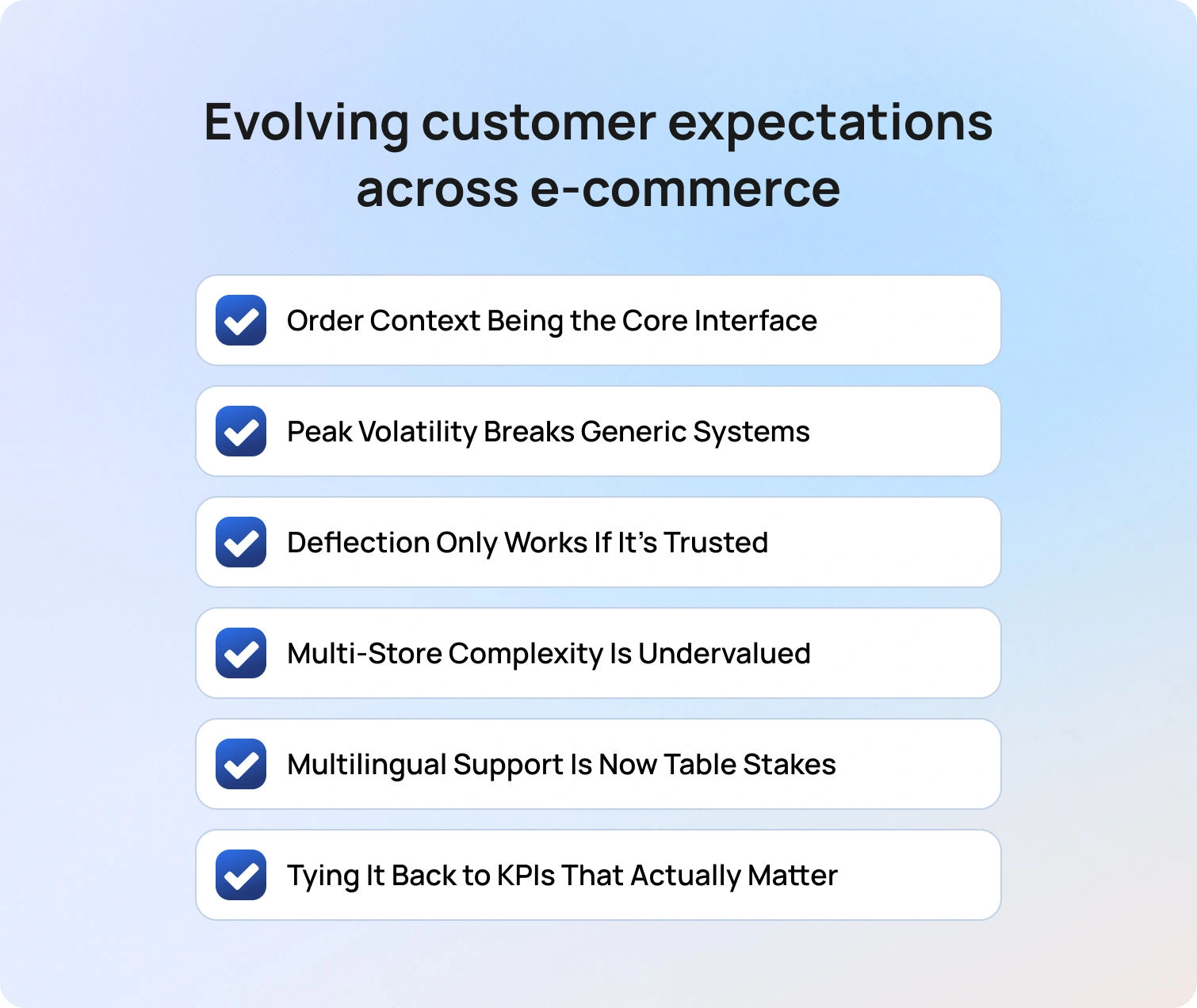
There’s a structural mismatch between what e-commerce support requires and what traditional help desks were designed to do. Help desks were built around tickets. E-commerce runs on events: orders, shipments, delays, refunds, subscriptions.
That difference matters more than most buyers realize, and this shift reflects a broader move toward adapting to evolving customer expectations across e-commerce.
1. Order Context Isn’t a “Nice-to-Have”, It’s the Core Interface
In e-commerce, the majority of support queries are not abstract; they are tied to a transaction. Agents need immediate access to:
- Order status and fulfillment stage
- Shipping and carrier data
- Return eligibility and policy logic
- Refund timelines and payment status
Without this, resolution becomes a multi-tab, multi-tool process, which directly increases handle time and error rates.
More importantly, it erodes customer trust. Customers can tell when your agent is “looking things up” versus actually understanding their situation.
2. Peak Volatility Breaks Generic Systems
E-commerce doesn’t scale linearly; it spikes. Promotions, product drops, and delivery disruptions can increase ticket volume by 2–5x in just a matter of hours.
Generic tools struggle here because they lack:
- Concurrency visibility
- Workforce management (WFM) is tied to real demand
- Forecasting based on e-commerce-specific triggers
This is where many teams quietly lose margin; by overstaffing to compensate, or underperforming during peaks. The better approach is systems that absorb volatility, not just report on it.
3. Deflection Only Works If It’s Trusted
Every vendor promises “ticket deflection,” but few address the real constraint: accuracy. If your self-service or AI:
- Misrepresents return policies
- Gives outdated shipping timelines
- Provides generic answers to specific queries
You don’t reduce tickets; you create follow-ups, complaints, and churn. Effective deflection in e-commerce depends on:
- Policy-aware knowledge bases
- Real-time data (orders, carriers, inventory)
- AI grounded in that data, not just trained on past conversations
This is where many “AI-powered” tools fall short; they generate answers, but not reliable ones. Balancing automation with accuracy is critical, particularly when maintaining trust in the interplay between automation and personalization.
4. Multi-Store Complexity Is Undervalued (Until It Breaks Reporting)
As brands expand across regions, storefronts, and product lines, support complexity compounds quickly. What starts as a single queue evolves into a layered operation with different SLAs, policies, and customer expectations, often without the infrastructure to match.
At that point, you’re no longer managing “a queue.” You’re managing fragmented experiences.
Without proper routing and reporting, teams lose visibility into:
- Which store is driving volume
- Where performance is degrading
- How resources should be allocated
This is one of the biggest blind spots in scaling ecommerce operations.
5. Multilingual Support Is Now Table Stakes
Global ecommerce has made multilingual support a baseline expectation, not a premium feature. But translation alone isn’t enough. Consistency here depends heavily on effective written customer support communication across languages and channels.
What matters is:
- Context-aware responses in the correct tone
- Localized policies and FAQs
- QA processes that ensure consistency across languages
This is where AI can add real value, but only when paired with structured content and governance.
Tying It Back to KPIs That Actually Matter
All of these challenges ultimately surface in the metrics ecommerce teams are measured against, but not always in obvious ways.
First contact resolution improves when agents have immediate access to order context, rather than piecing together information across systems. Average handle time decreases when workflows are streamlined and repetitive actions are automated. Deflection rates only increase when self-service and AI responses are accurate enough to be trusted, rather than escalated. Even customer satisfaction and sentiment are less about speed in isolation, and more about consistency; getting the right answer, the first time, regardless of channel.
Concurrency is where these factors converge. During peak periods, it becomes the defining constraint on whether a support team can maintain performance without increasing headcount. When systems lack the infrastructure to support agents at scale, teams are forced into trade-offs between speed, quality, and cost.
The result is that performance issues are often misdiagnosed, with teams optimising surface-level metrics instead of addressing the underlying operational constraints that actually drive outcomes.
That distinction matters. Because once support is understood as an operational system (rather than a reactive function), the role of e-commerce customer support software becomes much clearer. It’s not just there to manage demand. It determines how efficiently, consistently, and profitably demand can be handled.
Common E-commerce Use Cases (Support Workflows Buyers Actually Automate)
The real value of modern e-commerce customer service software is in how effectively it removes repetitive operational load from support teams. The highest-performing teams aren’t trying to automate everything; instead, they align workflows to a customer-centric strategy that prioritises high-impact interactions. They focus on a core set of high-frequency, high-friction interactions that consistently drive volume and erode customer experience when handled manually.
Order tracking remains the most obvious example. “Where is my order?” queries can account for a significant share of inbound volume, particularly during peak periods. Leading teams reduce this through a combination of proactive notifications and automated responses grounded in real-time carrier data, effectively eliminating the need for agent intervention in most cases.
Returns and exchanges follow a similar pattern. Rather than handling these as ad hoc conversations, mature teams implement guided workflows that apply policy logic consistently, ensuring faster resolution for customers while maintaining control over outcomes like refunds, exchanges, or store credit.
Other operational pressure points tend to cluster around status-based queries such as refund timelines, delivery issues, or subscription changes. These are rarely complex, but they are time-sensitive and volume-heavy. When handled manually, they create bottlenecks. When automated with the right integrations and approval flows, they become predictable, low-effort processes.
There’s also a second layer of use cases that’s less about volume and more about consistency. Product questions, social-driven spikes in demand, VIP customer handling, and multilingual support all introduce variability into the system. Without structure, that variability leads to inconsistent answers and fragmented experiences. With the right combination of knowledge base, routing, and automation, it becomes manageable at scale.
The pattern across all of these is consistent: the goal isn’t just faster responses. It’s removing the need for responses altogether where possible, and standardising them where it isn’t.
What to Look For in Ecommerce Customer Service Software: Your 2026 Checklist
Choosing e-commerce customer service software in 2026 is less about feature comparison and more about identifying where operational friction exists, and whether a platform is designed to remove it.
At a foundational level, ecommerce context is non-negotiable. Support teams need immediate access to order data, delivery status, returns history, and customer context without switching systems. Platforms that rely heavily on third-party integrations rather than native or deeply embedded connections often introduce latency at exactly the wrong moments.
From there, omnichannel support is table stakes, but the nuance is in how those channels are unified. It’s not enough to offer email, chat, social, and voice. The system needs to maintain continuity across them, so customers don’t have to repeat themselves, and agents aren’t reconstructing context manually.
Automation is where meaningful differentiation starts to emerge. Basic routing and macros are no longer enough. Buyers should be looking for depth: systems that operationalise decisions, not just responses.
AI is now embedded across most platforms, but its effectiveness depends on guardrails. Features like summaries, suggested replies, and intent detection are only valuable when grounded in accurate knowledge and real customer context. Without that, they risk introducing inconsistency rather than reducing it. However, implementation is often where value is lost, particularly when teams underestimate AI customer support challenges in practice.
Self-service plays a critical role, particularly for high-volume ecommerce queries like order tracking and returns. The best implementations don’t just deflect tickets; they resolve customer needs entirely, without escalation.
Finally, operational visibility and control often become the deciding factor at scale. Analytics, workforce management, quality assurance, and forecasting are what allow teams to maintain performance as demand fluctuates.
In practical terms, your checklist should look like this:
- Native ecommerce context: Order data, delivery status, returns, and customer history accessible in one place
- True omnichannel continuity: Conversations persist across email, chat, social, and voice without losing context
- Advanced automation: SLA management, intelligent routing, and approval workflows—not just macros
- AI with guardrails: Accurate summaries, suggestions, and intent detection grounded in real data
- Self-service that resolves (not deflects): Order tracking, returns, and FAQs handled without agent intervention
- Operational control: Reporting, QA, and workforce management to maintain performance at scale
- Flexible integrations & APIs: Ability to connect cleanly with the wider ecommerce stack
- Transparent pricing: Clear visibility into add-ons, usage costs, and total cost of ownership
Across all of this, pricing transparency remains an underappreciated differentiator. Many platforms appear cost-effective at the entry level but introduce significant add-ons for AI, reporting, or channel expansion. Understanding the total cost of ownership upfront is essential.
How We Evaluated
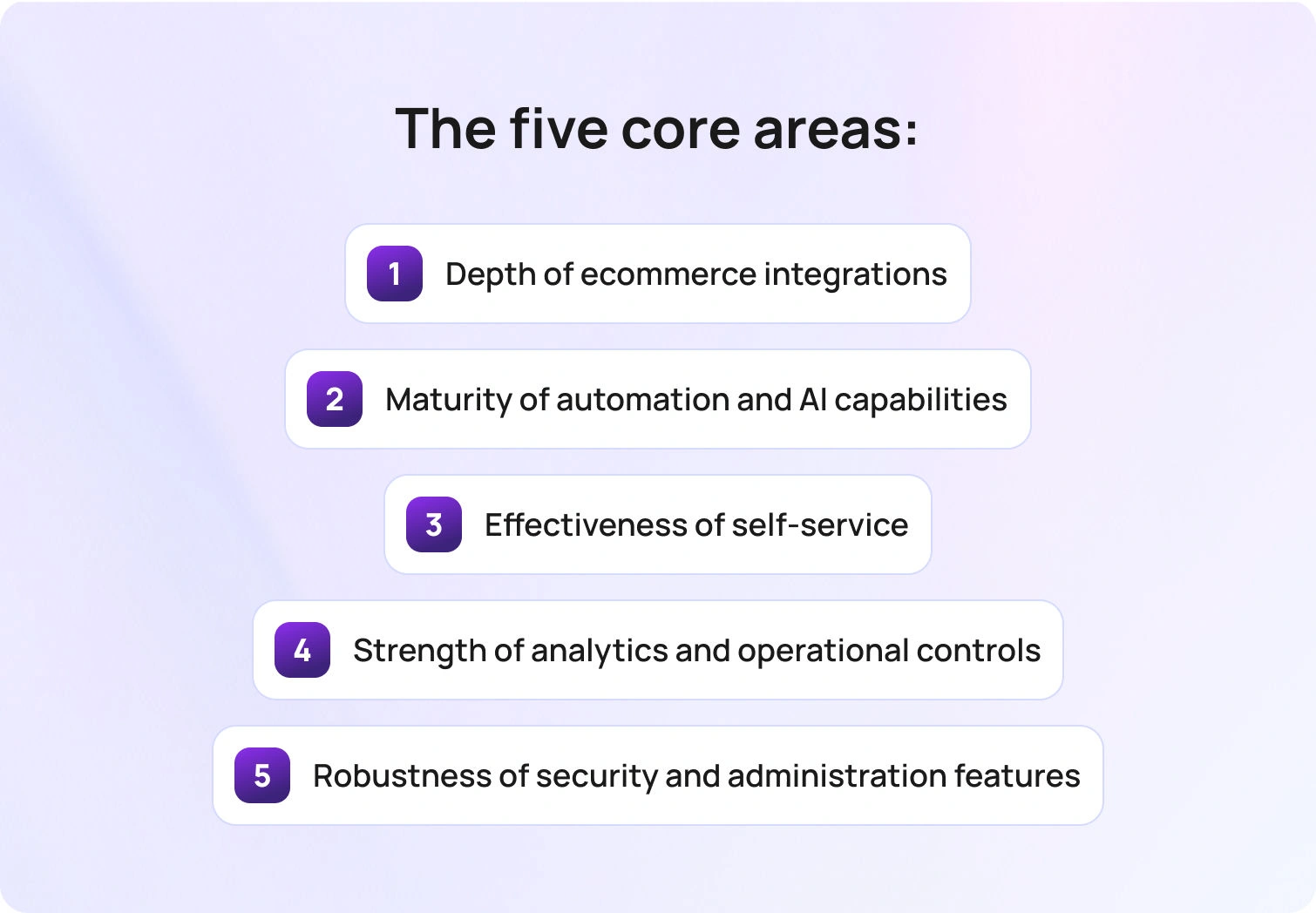
To identify the best customer service software for e-commerce, we applied a consistent evaluation framework designed to reflect how these platforms perform under real operating conditions, not just how they’re positioned in marketing. This approach is intended to mirror how buyers actually compare customer support software for e-commerce and broader e-commerce customer service tools in practice.
Each vendor was assessed based on publicly available product documentation, pricing pages, and integration ecosystems. This was supplemented by a detailed review of feature sets across automation, AI, self-service, and operational tooling; areas that consistently define the gap between baseline tools and the best ecommerce customer service tools on the market.
The evaluation focused on five core areas:
- Depth of ecommerce integrations
- Maturity of automation and AI capabilities
- Effectiveness of self-service
- Strength of analytics and operational controls
- Robustness of security and administration features
Where possible, we prioritised evidence of how these capabilities work together. Individual features are less meaningful than how well they integrate into a cohesive system that supports real workflows—particularly for teams evaluating e-commerce software customer support solutions that need to operate at scale.
There are, however, some limitations to note. Pricing structures vary significantly by plan, usage, and negotiation, and are not always fully transparent. Feature sets also evolve quickly, particularly in areas like AI, meaning buyers should validate key capabilities during the demo process.
The goal of this methodology is not to provide a definitive ranking, but to give buyers a clear, structured way to evaluate trade-offs based on their own operational priorities when selecting customer service tools for e-commerce.
Must-Have Capability Checklist
Most e-commerce teams don’t lose time choosing tools; they lose time fixing gaps they didn’t catch during evaluation. Use this checklist to pressure-test whether a platform is truly fit for purpose.
Core platform capabilities:
- E-commerce-native context: Orders, returns, delivery status, and customer history in one view
- Omnichannel continuity: Seamless conversations across email, chat, social, and voice
- Automation depth: SLA management, intelligent routing, and workflow automation
- AI assistance: Accurate summaries, suggested replies, and intent detection
- Self-service resolution: Order tracking, returns, and FAQs handled without agent input
Operational & scaling capabilities:
- Analytics & reporting: Visibility into performance, volume, and resolution times
- Workforce management: Forecasting, scheduling, and capacity planning
- Quality assurance: Structured QA processes to maintain consistency
- Security & admin controls: Permissions, audit logs, and data protection
- APIs & integrations: Flexibility to connect with your wider ecommerce stack
Commercial considerations:
- Transparent pricing: Clear breakdown of seat costs, usage, and add-ons
- Scalable cost model: Predictable pricing as ticket volume and team size grow
A strong platform won’t just meet these requirements; it will handle them natively, without excessive reliance on workarounds or third-party tools.
Scoring Rubric (How to Compare Vendors Side-by-Side)
A checklist tells you what to look for. A scoring rubric helps you decide.
When multiple platforms appear to meet the same requirements, the difference usually comes down to depth: how well each capability actually performs under real operating conditions. Scoring vendors across a consistent framework makes those differences visible.
Score each category from 1–5 (1 = limited, 5 = best-in-class):
Product & Experience
- E-commerce context: Depth and accessibility of order, returns, and customer data
- Omnichannel experience: Continuity across channels without loss of context
- Agent experience: Usability, speed, and workflow efficiency
Automation & AI
- Workflow automation: Routing, SLAs, approvals, and process design
- AI effectiveness: Accuracy of summaries, suggestions, and intent detection
- Self-service capability: Ability to fully resolve high-volume queries
Operations & Scale
- Reporting & analytics: Visibility into performance and actionable insights
- Workforce management: Forecasting, scheduling, and capacity planning
- Quality assurance: Tools to maintain consistency and improve performance
Commercial & Technical Fit
- Pricing transparency: Clarity of costs across seats, usage, and add-ons
- Scalability of cost: How pricing evolves with growth and peak demand
- Integrations & flexibility: Ease of connecting to your existing stack
Once scored, patterns emerge quickly. Some platforms will perform well at a surface level but fall short operationally. Others may be powerful but introduce complexity or cost at scale.
The goal is to identify the platform that aligns best with how your support operation actually runs today, and how it needs to evolve.
Pricing & TCO Modeling for Ecommerce Teams
Pricing for e-commerce customer service software is rarely straightforward, and headline figures often underrepresent the true cost of ownership. Most platforms combine multiple pricing dimensions, including per-agent seat costs, usage-based fees for messaging or automation, AI consumption, and, in some cases, voice minutes. On top of this, integrations, advanced reporting, and implementation services are frequently positioned as add-ons.
This creates a situation where two platforms with similar entry-level pricing can diverge significantly as usage scales.
Hidden costs tend to emerge in predictable areas. AI features are often priced separately or metered based on usage. Advanced analytics and reporting may sit behind higher-tier plans. Multilingual support, workforce management, and certain integrations can also introduce additional fees.
A more effective approach to evaluation is to model total cost across different growth scenarios. Estimating costs at 25, 50, and 100 agents (while factoring in peak season demand) provides a more realistic view of how pricing behaves over time. The key is to surface these variables early, rather than discovering them post-implementation.
Implementation Playbook (Go Live Without Breaking CX)
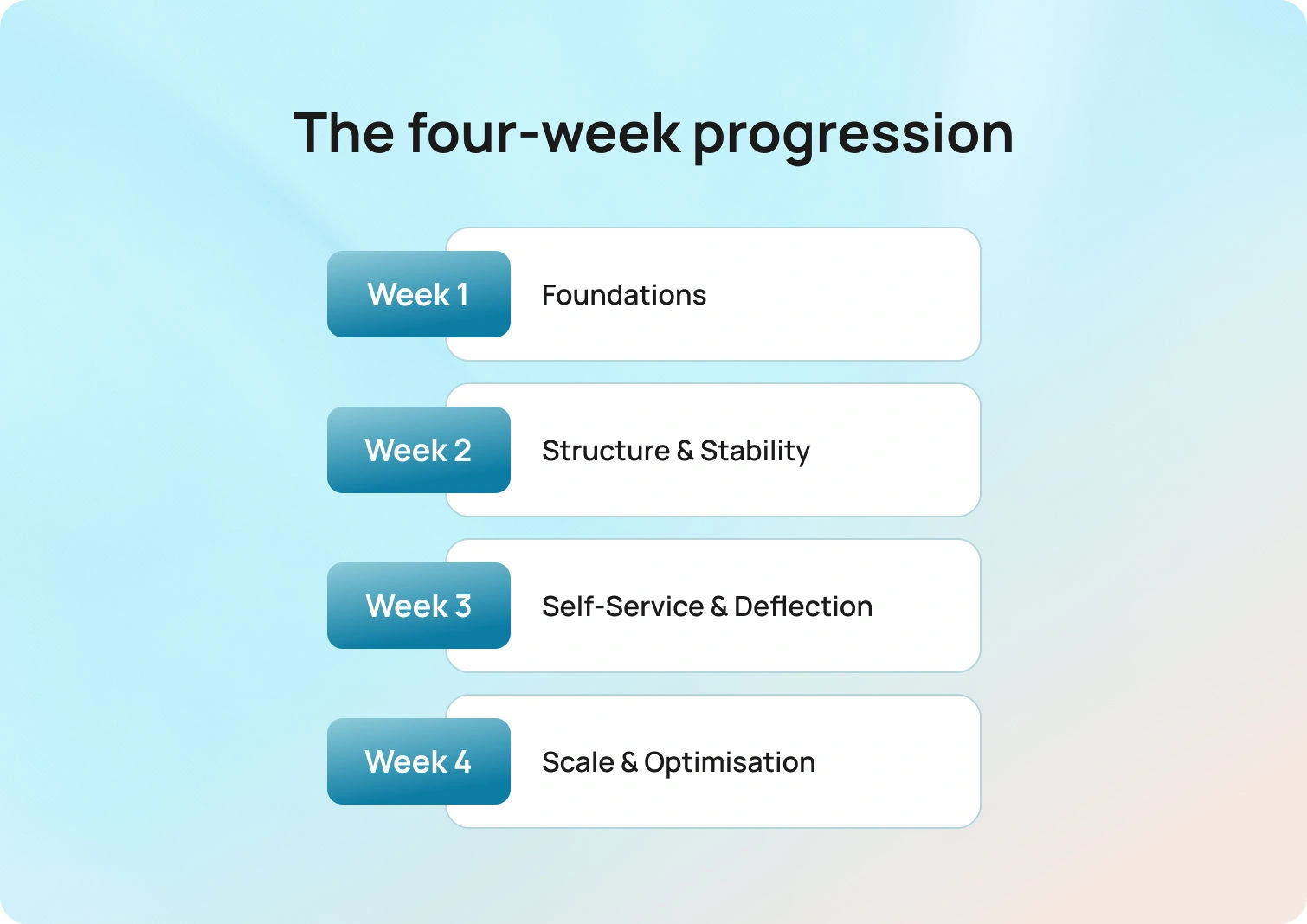
Implementing new customer service software in an e-commerce environment isn’t just a technical rollout; it’s an operational transition. The most effective teams take a phased approach, introducing structure before scale.
A typical rollout follows a four-week progression:
Week 1: Foundations: the focus here is alignment. Teams define success metrics, map high-volume customer intents, and audit existing workflows. At the same time, core systems (such as ecommerce platforms, order data, and knowledge bases) need to be clean, connected, and reliable. Gaps at this stage tend to compound later, so it’s worth getting the fundamentals right.
Week 2: Structure & Stability: with the foundation in place, attention shifts to how work flows through the system. Routing logic, SLA frameworks, and initial automation rules are introduced to create consistency. AI-assisted features like summaries and suggested replies can be layered in here, helping agents move faster without disrupting quality.
Week 3: Self-Service & Deflection: this is where teams start to reduce volume meaningfully. High-frequency queries, particularly order tracking and returns, are transitioned into self-service workflows. Done well, this removes a significant portion of inbound demand without requiring customers to change behaviour.
Week 4: Scale & Optimisation: once the core system is stable, teams can expand with confidence. Additional channels can be introduced, automation refined, and more advanced capabilities, such as forecasting, workforce management, and QA, brought online. The focus shifts from setup to performance.
Across each stage, governance is what holds everything together. Clear ownership of workflows, consistent terminology, and defined escalation paths ensure the system scales without introducing inconsistency.
Final Thoughts: Choosing the Right E-commerce Customer Service Software for Growth
The most important shift in how ecommerce teams approach customer service software is recognising that it’s no longer just a support function; it’s an operational layer that directly impacts retention, efficiency, and growth.
The platforms that perform best in this environment are those that combine deep ecommerce context with true omnichannel support, layered automation, and AI that enhances rather than disrupts consistency. Just as importantly, they provide the operational visibility needed to manage performance as demand scales.
Pricing transparency also plays a critical role. Tools that appear flexible early on can become restrictive as costs accumulate across add-ons and usage-based components.
Within this landscape, BlueTweak stands out for teams that want to consolidate these capabilities into a single system. By combining support workflows, AI, analytics, and workforce management in one platform, it reduces the need for additional tooling and simplifies execution at scale.
For e-commerce teams managing multiple stores, high ticket volumes, or complex customer journeys, that consolidation translates directly into faster time to value and more consistent customer experience. You can explore how this works in practice with a BlueTweak demo.
The Shift from Reactive to Proactive Customer Service, And Why It Matters
Proactive Customer Service: Anticipating Needs, Preventing Problems, Elevating Experience
Customer expectations have evolved faster than many companies can adapt; 70% of executives acknowledge this shift, and nearly half of consumers say they’ve stopped buying from a brand due to poor customer experience. This is where anticipating customer needs becomes essential.
At its core, proactive customer service means stepping in before a customer even realizes there’s an issue. Today’s customers expect more than rapid reactions; they want experiences that feel effortless, personalised, and intuitive. Research shows that 68% of customers now expect brands to provide proactive assistance and resolve issues before they notice them themselves.
Take something as simple as a travel update. Instead of waiting for a gate change complaint after a disruption, leading brands send timely alerts and alternative options long before frustration arises. That kind of anticipatory interaction doesn’t just prevent dissatisfaction, it reinforces trust.
When businesses focus on preventing customer frustration instead of only responding to it, the impact is measurable: reduced escalations, higher satisfaction scores, lower churn, and stronger customer loyalty. Proactive customer service isn’t about fixing problems faster; it’s about keeping problems from happening at all.
But how does this differ from traditional support models?
Reactive support waits for customers to initiate contact about a problem. Proactive customer service analyses customer behaviour and signals, reaches out early, and resolves emerging issues before they become full-blown complaints or support deficits.
What is Proactive Customer Service?
Proactive customer service is the practice of identifying and addressing customer needs or potential problems before the customer has to ask.
Rather than waiting for support tickets, complaint emails, or negative reviews, companies analyze customer data, monitor behavior patterns, and anticipate friction points in advance. They reach out first, fix issues early, and create clarity before confusion sets in.
To fully understand its impact, it helps to examine proactive vs reactive customer service side by side.
Reactive customer service responds after a problem occurs. The customer initiates contact, explains the issue, and waits for resolution. It’s often focused on recovery and damage control.
Proactive customer service, on the other hand, acts before a problem arises. The business initiates communication, prevents disruption, and optimizes the experience. It shifts the focus from fixing dissatisfaction to preventing it altogether.
Understanding the difference between proactive and reactive customer service is critical for organizations aiming to improve retention, reduce operational strain, and build long-term customer trust. In increasingly competitive markets, the brands that win are rarely the ones that respond fastest; they’re the ones that anticipate best.
Why Proactive Customer Service Matters
Implementing proactive strategies to prevent poor customer service experiences can dramatically impact business performance:
- Enhanced Customer Satisfaction: Customers feel understood and valued.
- Increased Loyalty: Anticipating needs builds trust and long-term relationships.
- Positive Word-of-Mouth: Customers share exceptional experiences.
- Higher Sales: Personalized recommendations increase conversions.
- Reduced Support Costs: Fewer inbound complaints lower operational strain.
Proactive Customer Service Examples Across Industries
Below are clear examples of proactive customer service in action.
Airlines
- Real-time flight delay notifications
- Automated gate change alerts
- Personalized seat and meal recommendations
This is a classic example of proactive customer service that reduces stress before it happens.
Retail & E-commerce
- Restock alerts based on purchase history
- Personalized product recommendations
- Delivery delay notifications
Hospitality
- Remembering guest preferences
- Automatic room upgrades for milestones
- Pre-arrival check-in reminders
Banking
- Fraud alerts before transactions finalize
- Spending pattern insights
- Financial planning nudges
Healthcare
- Appointment reminders
- Medication refill notifications
- Preventative care prompts
These examples of reactive and proactive customer service show how businesses can shift from resolving dissatisfaction to preventing it.
Proactive Customer Service Strategies
Understanding the proactive customer service definition is one thing. Operationalising it at scale is another.
Truly proactive organizations don’t rely on isolated tactics. They build structured systems designed to detect risk, anticipate friction, and intervene early. Below are proactive customer service strategies that move beyond surface-level improvements and instead reshape how support functions operate.
1. Turn Customer Data into Early-Warning Signals
Most businesses collect large volumes of customer data. Far fewer use it predictively.
Proactive customer service begins by identifying leading indicators of dissatisfaction. This might include reduced product usage, repeated logins without task completion, delayed payments, negative sentiment in support interactions, or declining NPS scores. These signals often appear weeks before churn or complaints.
Advanced CRM systems and behavioural analytics tools should be configured not simply to record activity, but to flag risk patterns automatically. The focus must be on earlier intervention when risks arise.
This is one of the most effective proactive strategies to prevent poor customer service experiences: spotting dissatisfaction before it becomes visible to the customer themselves.
2. Build Continuous Feedback Loops, Not One-Off Surveys
Many organizations conduct annual surveys and consider the job done. Proactive businesses treat feedback as a live data stream.
Micro-surveys at key journey stages, post-interaction sentiment analysis, customer health scoring, and structured check-ins allow companies to monitor experience in near real time. The focus should be on identifying friction at specific touchpoints rather than collecting generic satisfaction scores.
When feedback loops are continuous, organizations can course-correct quickly, preventing small irritations from becoming formal complaints.
3. Redesign Processes Around Prevention, Not Resolution
A reactive support model optimises for ticket handling time and resolution rates. A proactive model optimises for ticket avoidance.
This requires examining recurring support themes and asking a different question: not “How do we resolve this faster?” but “Why is this happening at all?”
Proactive and reactive customer service differ fundamentally here. Reactive teams refine workflows to improve response efficiency. Proactive teams eliminate the root causes generating demand in the first place.
That may involve improving onboarding clarity, simplifying billing communication, refining UX flows, or strengthening operational quality controls upstream.
4. Empower Frontline Teams with Context, Not Just Scripts
Frontline employees are often the first to sense emerging issues. However, without data visibility or decision-making authority, they remain reactive by default.
Empowering teams means equipping them with:
- Real-time customer health indicators
- Historical interaction context
- Authority to issue goodwill gestures or escalate early
- Clear guidance on identifying risk signals
When agents can see patterns, not just individual tickets, they can shift from solving isolated problems to preventing future ones.
This is a critical part of how to be proactive in customer service: aligning people, data, and authority.
5. Implement Proactive Customer Service Strategies with AI Carefully
AI is increasingly central to modern proactive customer service strategies. Predictive modelling can identify churn risk, sentiment analysis can detect dissatisfaction, and automated triggers can initiate outreach before customers contact support.
Common proactive customer service examples powered by AI include:
- Automated notifications when service disruptions are detected
- Behaviour-based onboarding prompts
- Intelligent chatbots that surface relevant help content
- Next-best-action recommendations for support agents
However, there are also shortcomings of AI in proactive customer service.
AI systems can misinterpret context, generate false positives, or over-automate sensitive interactions. Predictive models are only as strong as the data feeding them. Poor governance can also create privacy or compliance risks.
Is AI Worth It for Proactive Customer Service?
AI has rapidly become central to proactive customer service strategies with AI, particularly in environments where scale and speed matter. Predictive analytics can identify behavioural anomalies, sentiment shifts, churn risk signals, and service disruption patterns far earlier than manual monitoring ever could. Machine learning models can analyse thousands of data points simultaneously (from product usage trends and support interactions to billing activity and engagement rates), and surface patterns that human teams might not detect until dissatisfaction has already escalated.
In this sense, AI meaningfully strengthens the proactive customer service definition: it allows organizations to anticipate not just common issues, but statistically probable future friction.
For example, AI can:
- Flag customers whose usage patterns suggest declining engagement
- Detect frustration in written communication before a formal complaint is made
- Trigger automated outreach when operational thresholds are breached
- Recommend next-best actions to agents based on similar historical cases
- Identify systemic service weaknesses across large datasets
These capabilities can dramatically reduce inbound ticket volume and enable earlier intervention, two critical outcomes when comparing proactive vs reactive customer service models.
However, the conversation cannot stop at capability. There are genuine shortcomings of AI in proactive customer service that leaders must weigh carefully.
First, AI lacks contextual judgment and emotional intelligence. It can detect sentiment polarity, but it cannot fully interpret nuance, tone shifts influenced by personal circumstances, or cultural context. In emotionally charged situations, automation can inadvertently amplify frustration rather than alleviate it.
Second, predictive systems are probabilistic by nature. False positives can result in unnecessary outreach, while false negatives can miss genuinely at-risk customers. Over-reliance on predictive scoring without human validation can distort prioritisation.
Third, over-automation creates the risk of impersonality. Proactive outreach that feels scripted, premature, or misaligned with actual customer needs can erode trust. Customers may perceive automated “check-ins” as surveillance rather than support if execution lacks care.
There are also structural considerations: data privacy compliance, governance requirements, model bias, and ethical transparency. Poorly trained models can inadvertently reinforce inequities or misclassify customer segments, undermining both experience and brand integrity.
So, is AI worth it for proactive customer service?
Strategically deployed, yes, but only as an augmentation layer.
The most effective proactive and reactive customer service frameworks do not replace human teams with AI. They equip teams with predictive intelligence that enhances decision-making. AI surfaces risk signals. Humans apply judgment, empathy, and discretion. AI identifies patterns. Humans build relationships.
When implemented thoughtfully, proactive customer service strategies with AI reduce operational strain while increasing personalisation and precision. When implemented carelessly, they risk scaling friction rather than preventing it.
The distinction lies not in the technology itself, but in governance, oversight, and cultural integration. Proactive customer service is not an automation strategy; it’s an organizational mindset that AI can strengthen, but not substitute.
Proactive vs Reactive Customer Service: A Strategic Shift
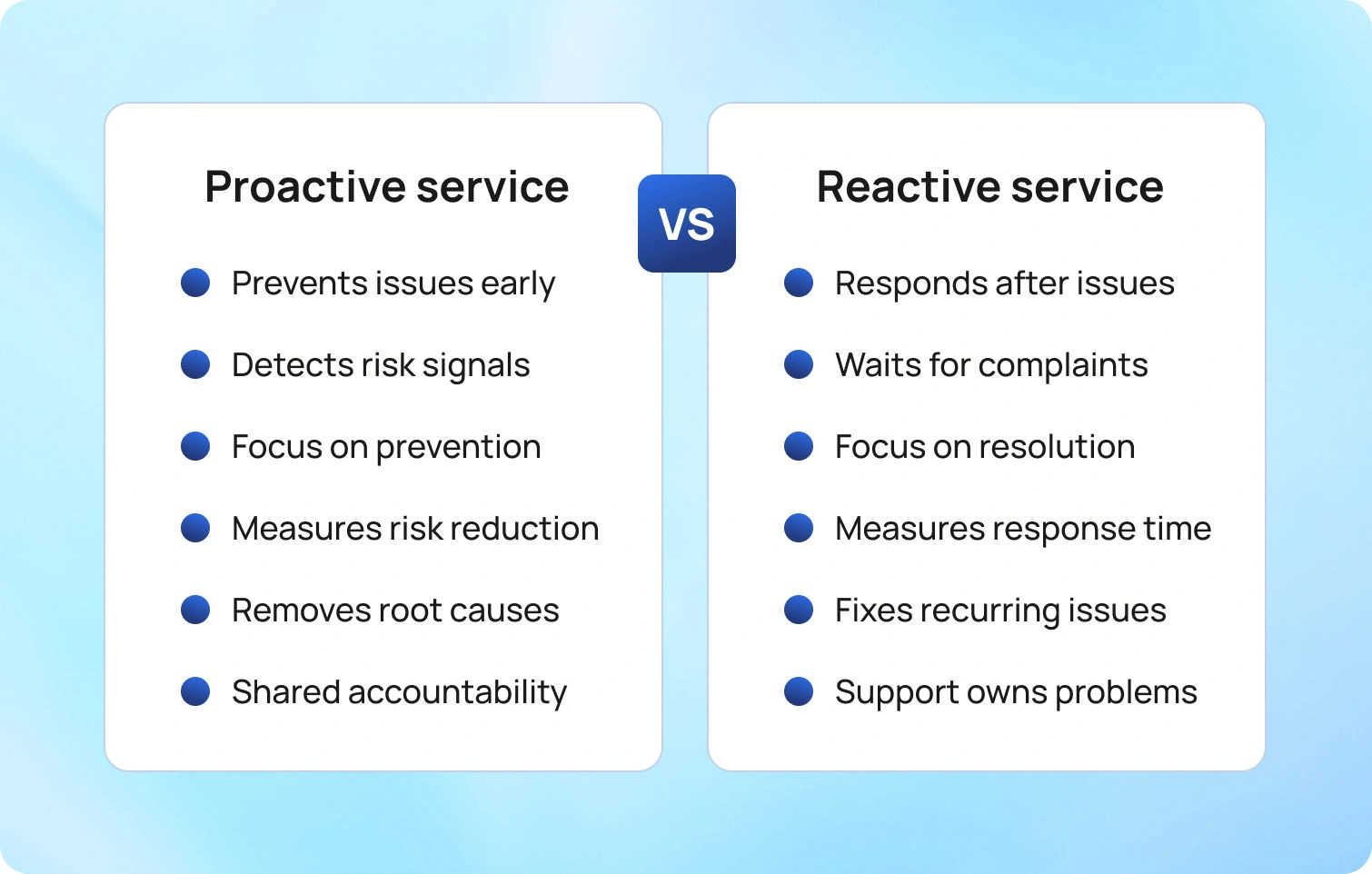
Many organizations still operate within a reactive customer service model. Support teams wait for complaints, tickets, escalations, or cancellations before intervening. Performance is measured by response time, resolution time, and case closure rates. While these metrics are important, they reflect recovery, not prevention.
The move from reactive to proactive customer service is a structural shift in operating philosophy:
- Reactive service assumes friction is inevitable and optimises for fixing it quickly.
- Proactive service assumes friction is preventable and optimises for eliminating it altogether.
This shift requires deliberate change across several dimensions.
Cultural change is foundational. Teams must move from a “firefighting” mentality to a preventative mindset. Instead of celebrating heroic recoveries, organizations must reward early detection, risk mitigation, and systemic improvement.
Process redesign is equally critical. Recurring support themes should trigger root-cause analysis, not simply workflow refinement. If the same billing confusion appears repeatedly, the issue is not agent performance; it is communication design. Proactive strategies to prevent poor customer service experiences start upstream, often in product, operations, or policy.
Technology investment supports this evolution. Monitoring systems, predictive analytics, real-time quality tracking, and intelligent alerts enable earlier visibility into emerging issues. However, technology alone does not create proactivity; it enables it.
Cross-department alignment is often the most overlooked requirement. Customer experience does not sit solely within support. Operations, product, compliance, logistics, and finance all influence friction points. A proactive model demands shared accountability for prevention, not isolated ownership of resolution.
When implemented effectively, the long-term payoff is significant:
- Fewer escalations and crisis scenarios
- Reduced support volume driven by recurring issues
- Improved customer lifetime value
- Stronger retention and loyalty metrics
- Enhanced brand equity built on reliability and trust
Understanding proactive vs reactive customer service at this strategic level reframes support from a cost centre to a preventative growth lever.
How BlueTweak Supports Proactive Customer Service
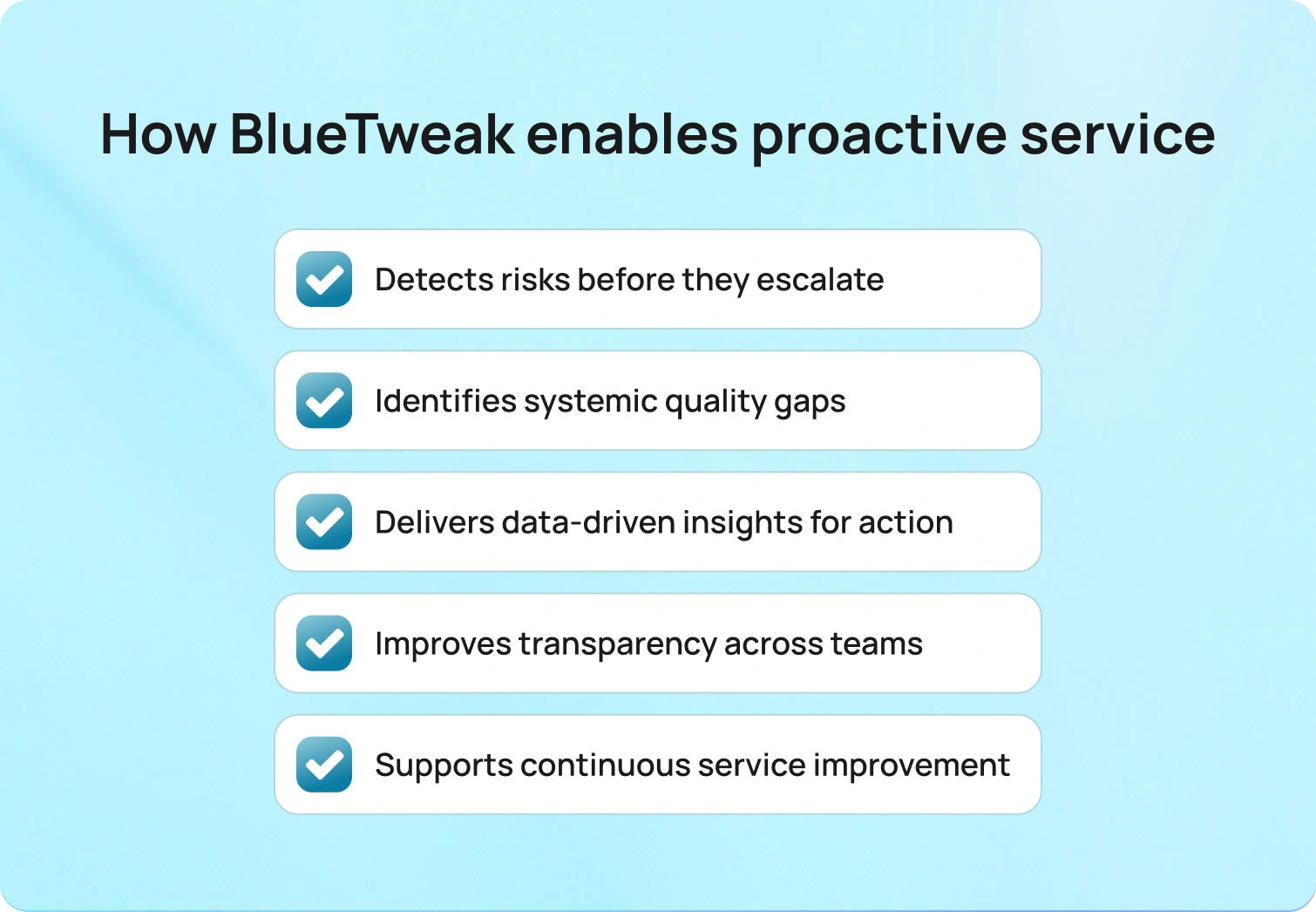
Transitioning from reactive to proactive service requires more than intention. It demands visibility, control, and continuous oversight across operational workflows. This is where BlueTweak plays a critical role.
BlueTweak enables organizations to identify operational risks before they impact customers, shifting the focus from post-incident correction to pre-incident prevention. By monitoring quality metrics in real time, teams gain early-warning visibility into performance deviations that could otherwise translate into service breakdowns.
Rather than waiting for customer dissatisfaction to surface externally, businesses can intervene internally.
BlueTweak supports proactive customer service strategies by:
- Detecting inconsistencies and compliance risks before they escalate
- Highlighting systemic quality gaps across processes
- Providing data-driven insights that inform preventative action
- Creating transparency across departments to reduce siloed blind spots
- Supporting continuous improvement across every customer touchpoint
This operational visibility strengthens proactive and reactive customer service frameworks alike. Reactive capabilities remain necessary, but with stronger monitoring and insight layers, the volume of reactive incidents decreases over time.
Organizations that embed proactive customer service strategies into operational infrastructure don’t simply respond faster; they operate smarter, reduce avoidable friction, and protect customer trust before it is tested.
By embedding proactive strategies into governance, monitoring, and performance systems, businesses move beyond service recovery. They anticipate, they optimize, and ultimately, they lead.
Final Thoughts: The Business Case for Proactive Customer Care
Proactive customer service is not a surface-level enhancement. It is a proactive approach that reshapes how organizations think about customer needs, customer behavior, and long-term growth.
Unlike reactive customer service, which responds to customer complaints and inbound support requests, a proactive customer service approach begins earlier. It focuses on how businesses anticipate customer risk, reduce customer frustration, and exceed customer expectations before problems escalate.
When organizations implement proactive customer service effectively, they shift from managing volume to preventing friction. They monitor customer sentiment, analyse customer interactions for early warning signals, and notify customers before customer issues turn into formal customer inquiries. Instead of relying on phone calls or reactive contact center workflows, they provide proactive customer support at the first sign of risk.
Proactive customer service aims to anticipate customer needs across the full lifecycle. It uses customer relationship management systems and continuous customer feedback to generate valuable insights that guide intervention. Most importantly, it empowers support teams and the wider customer service team to act before dissatisfaction spreads.
The benefits of proactive customer models are clear: improved customer satisfaction, increased customer retention, stronger customer loyalty, and repeat business. By reducing avoidable support requests and recurring customer concerns, organizations free their contact center to focus on complex cases that deepen customer relationships.
To provide proactive customer care at scale, businesses must combine data visibility, governance, and human judgment. AI can enhance detection, but lasting impact comes from thoughtful execution. Organizations that deliver proactive customer service consistently build trust before it is tested, and that trust becomes a durable competitive advantage.
Ready to shift from reactive recovery to proactive prevention? Book a demo today to see how BlueTweak helps you identify risk early, reduce avoidable customer issues, and deliver proactive customer service at scale.
12 Best LiveAgent Alternatives to Consider in 2026
The Evolution of AI and Omnichannel Support in 2026
Support leaders are recalibrating their technology stack in 2026, not because ticket volume has increased, but because operational expectations have changed.
According to a Gartner survey of 265 customer service and support leaders, 73% of organizations were expected to have implemented agent assist solutions by the end of 2025, reflecting a shift toward AI-supported workflows embedded directly into agent desktops. In the same report, Gartner stated that self-service and live chat are projected to surpass traditional support channels as leading customer service technologies by 2027.
These findings signal a structural shift: AI and digital channels are no longer experimental layers. They are becoming core infrastructure for customer support teams today.
As AI moves from pilot to production, many teams are reassessing whether their current help desk can support deeper voice capabilities, multilingual automation, knowledge base–grounded suggested replies, and integrated workforce management. The question is no longer whether a platform can manage tickets. It is whether it can improve measurable outcomes such as First Contact Resolution (FCR), Average Handle Time (AHT), containment rate, abandon rate, and sentiment across channels.
This is where the search for a more operationally complete LiveAgent alternative begins, and where platforms like BlueTweak, built around unified chat, voice, email, and embedded AI, enter the shortlist.
Against this backdrop, many teams are re-evaluating their current stack and searching for a liveagent alternative that offers deeper voice capabilities, multilingual AI beyond macros, stronger analytics, and clearer cost control.
This guide compares 12 leading options, including BlueTweak, using a consistent decision lens. The goal is not feature volume, but operational impact: improving First Contact Resolution (FCR), lowering Average Handle Time (AHT), increasing containment and deflection, and reducing abandon-rate across chat, voice, and email.
Why Teams Look for an Alternative to LiveAgent
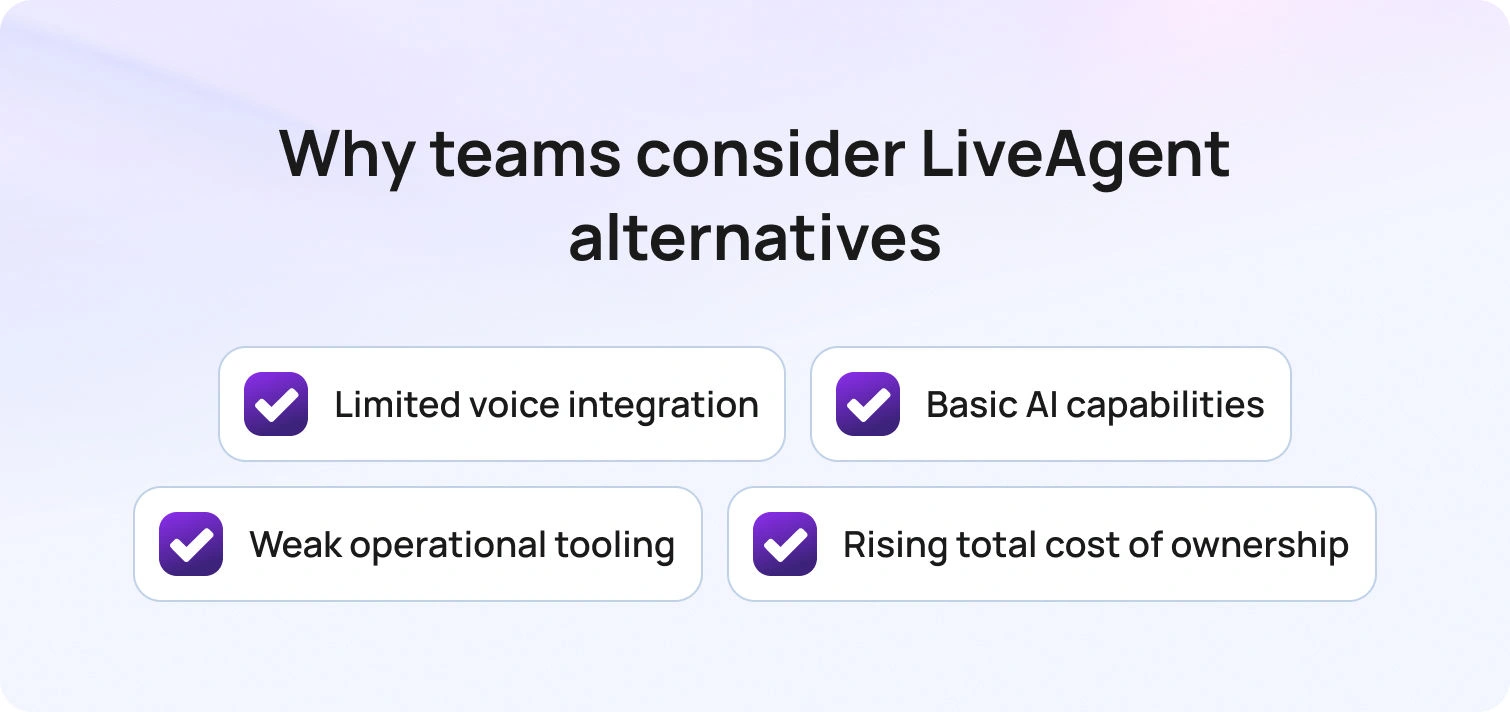
Support teams rarely switch platforms without reason. Today, the common triggers are operational rather than cosmetic.
First, voice depth and telephony maturity matter more. Many teams now expect seamless handoff between voice and tickets, along with post-call notes, transcription, sentiment analysis, and MOS (Mean Opinion Score) tracking in one system. When voice operates outside the help desk, reporting and accountability become fragmented.
Second, AI expectations have shifted. Macros and canned responses are no longer enough. Teams are asking for:
- Real-time language detection and translation
- Conversation summarization
- Knowledge base–grounded suggested replies with citations
- Personally Identifiable Information (PII) redaction and compliance guardrails
Third, managers want stronger operational tooling. Analytics filtered by language or brand, SLA dashboards, forecasting, adherence tracking, and quality assurance (QA) workflows are becoming baseline expectations.
Finally, Total Cost of Ownership (TCO) is under scrutiny. Per-seat pricing plus add-ons for AI, analytics, or telephony can make forecasting difficult.
The 12 Best LiveAgent Alternatives
We reviewed vendor product pages, pricing pages, help documentation, and marketplace listings only. When pricing or feature depth is unclear, we’ve noted “Varies by plan” or “Contact vendor for pricing” and recommend verification directly with the vendor. No third-party ratings have been used.
1) BlueTweak — Editor’s Choice
For teams seeking a consolidated liveagent alternative, BlueTweak stands out for combining omnichannel support with operational tooling in one stack. BlueTweak’s approach aligns with its positioning as an omnichannel support platform that integrates chat, voice, and email with AI and WFM at the core .
BlueTweak unifies chat, voice, and email inside a single ticketing system. Every interaction, regardless of channel, is converted into a structured ticket, automatically routed, classified, summarized, and tagged. Where BlueTweak differentiates itself is in AI depth and operational control:
- Knowledge base–grounded suggested reply for email. AI drafts responses using help articles and past tickets, and agents approve before sending.
- Real-time chat translation using neural machine translation for multilingual customer support operations without external tools.
- Call transcription with diarization, converting voice into structured, searchable text.
- AI summarization across channels.
- Sentiment analysis and classification to prioritize urgent issues.
The BlueTweak knowledge base is not static; it's designed for agent assist and self-service, using embedding models to match questions with relevant content and generate context-based answers.
Operationally, BlueTweak includes:
- Analytics dashboards with customizable reports
- Workforce Management (forecasting, shift planning, adherence tracking)
- Quality scoring and review workflows
- Multi-brand routing and reporting
Security and administration are also built in: role-based permissions, multi-factor authentication (MFA), audit logs, and encrypted data in transit and at rest.
For 20–100 agent teams, this consolidation can simplify TCO. Instead of separate systems for telephony, AI assist, analytics, and WFM, BlueTweak centralizes these capabilities.
Best for: Mid-market teams seeking faster time-to-value and fewer integrations to maintain.
Pricing: From €65 per agent/month for the full stack.
2) Zendesk
Zendesk is a widely adopted customer service platform positioned as an omnichannel support solution. It supports email, chat, social messaging, and voice, though telephony depth and AI capabilities vary depending on the selected suite and add-ons.
Zendesk’s strength often lies in its ecosystem and extensibility; it offers a large integration marketplace and structured workflows that can scale across multiple departments. From a capability perspective, Zendesk typically includes:
- Multichannel ticketing across email, chat, and social
- Voice support (plan-dependent)
- Automation rules and workflow triggers
- Suggested replies and AI-powered content recommendations (tier-based)
- Reporting dashboards, with advanced analytics in higher tiers
Workforce management and quality assurance functionality may require additional modules or higher plans.
Best for: Teams seeking broad marketplace integrations and structured workflow customization.
Pricing: Contact vendor for pricing.
3) Freshdesk
Freshdesk positions itself as a flexible help desk platform with omnichannel capabilities and automation tools. It supports ticketing across email and chat, with telephony features available depending on configuration.
Freshdesk can appeal to teams that prefer modular scaling rather than a consolidated stack from day one. Core capabilities typically include:
- Multichannel ticketing (email, chat, social)
- Automation rules and SLA management
- Canned responses and workflow triggers
- AI-based suggestions in higher plans
- Reporting dashboards with plan-based depth
Voice functionality, AI enhancements, and advanced analytics often sit in premium tiers.
Best for: Teams that want modular adoption and are comfortable scaling into higher tiers over time.
Pricing: Tiered plans available starting at £15 per agent / per month (billed annually) for the Growth plan, with Pro typically around £39 per agent / per month and Enterprise around £67 per agent / per month on annual billing.
4) Intercom
Intercom is primarily messaging-led. It focuses on conversational support, proactive engagement, and product-driven customer communication.
Intercom may suit teams whose support model is heavily chat-based and integrated into the product experience. Its capabilities often emphasize:
- Live chat and in-app messaging
- Automation bots and proactive campaigns
- AI-driven conversational workflows
- Help center functionality
- Usage-based pricing structures
Voice functionality typically requires integrations, and workforce management features may not be native.
Best for: Product-led teams prioritizing chat and proactive messaging
Pricing: Tiered plans starting at $29 per seat / per month (billed annually) plus $0.99 per Fin AI resolution; optional add-ons and usage fees apply.
5) Zoho Desk
Zoho Desk is part of the broader Zoho ecosystem and provides multichannel ticketing with workflow automation and analytics. For organizations already using Zoho CRM or other Zoho applications, it can present a structurally aligned alternative to LiveAgent.
Core capabilities typically include:
- Email, chat, and social ticketing
- Workflow automation and SLA tracking
- Knowledge base management
- Analytics dashboards
- Telephony integrations (plan-dependent)
AI features and deeper reporting vary by edition.
Best for: Organizations standardized on Zoho products
Pricing: Tiered plans starting at €7 per user / per month (Express plan, billed annually), followed by Standard at €14, Professional at €23, and Enterprise at €40 per user / per month (billed annually). AI features and advanced analytics are typically included in higher tiers.
6) Help Scout
Help Scout focuses on shared inbox workflows and email-centric customer support. It is often selected by smaller or mid-sized teams that prioritize simplicity.
It may appeal to support teams with limited voice requirements and a strong email focus. Capabilities generally include:
- Shared inbox management
- Knowledge base tools
- Basic reporting dashboards
- Automation rules
- Chat functionality in selected plans
Advanced AI features, voice depth, and workforce management may require integrations.
Best for: Email-first teams seeking collaborative inbox workflows
Pricing: While there is a limited free plan, paid plans are tiered, starting at $20 per user / per month, billed annually (Standard); higher tiers are available with more capabilities.
7) Salesforce Service Cloud
Salesforce Service Cloud is an enterprise-grade case management platform deeply integrated with CRM data. It is often selected by larger organizations with complex workflows and internal admin resources.
It offers significant customization potential, and typical capabilities include:
- Case management integrated with CRM records
- Omnichannel routing
- AI-driven recommendations (tier-dependent)
- Advanced reporting and analytics
- Extensive API and integration ecosystem
However, configuration complexity and add-on pricing can impact time-to-value and TCO forecasting.
Best for: CRM-centric enterprises with dedicated administrative resources
Pricing: Tiered plans starting at approximately £20 per user / per month (Starter, billed annually), followed by Professional at around £80 per user / per month, Enterprise at approximately £140 per user / per month, and Unlimited at approximately £280 per user / per month (billed annually). Advanced AI, digital engagement, and workforce optimization features may require higher tiers or additional add-ons.
8) Gorgias
Gorgias is positioned primarily for e-commerce operations. It integrates with commerce platforms to surface order data and automate common workflows.
For e-commerce brands evaluating LiveAgent alternatives, Gorgias can align closely with order-related support processes.
Capabilities often include:
- E-commerce platform integrations
- Automated order-related responses
- Multichannel ticketing
- Workflow automation
- Usage-based pricing models
Voice functionality and workforce management depth vary.
Best for: E-commerce-focused support teams
Pricing: Tiered plans starting at $10 per month (Starter), which includes up to 50 tickets / per month. Higher tiers scale based on ticket volume: for example, Basic at $60 per month (up to 300 tickets), Pro at $360 per month (up to 2,000 tickets), and Advanced at $900 per month (up to 5,000 tickets). Additional charges apply for extra tickets, automation usage, and added seats.
9) Kustomer
Kustomer organizes support around customer timelines rather than traditional ticket queues. Conversations are structured within a unified customer history.
Kustomer may appeal to teams that prefer a CRM-style interface. Its capabilities typically include:
- Customer timeline view
- Omnichannel messaging
- Automation workflows
- AI-driven assistance (plan-dependent)
- Reporting dashboards
Voice and advanced WFM features depend on configuration.
Best for: Teams prioritizing unified customer context over ticket-centric workflows
Pricing: Tiered plans starting at $89 per user / per month (Enterprise plan, billed annually), which includes core omnichannel messaging and automation features. Higher tiers, such as Ultimate, add advanced AI, automation, and customization capabilities. Final pricing depends on feature scope, integrations, and AI configuration.
10) Dixa
Dixa emphasizes intelligent routing and distribution of conversations across channels. Its positioning often centers on optimizing how inquiries reach the right team.
For teams where routing efficiency is a priority, it may serve as an option. Dixa capabilities include:
- Omnichannel messaging and voice
- Intelligent routing rules
- Analytics dashboards
- AI-assisted automation (tier-based)
- Integration APIs
Workforce management and QA tooling may vary by configuration.
Best for: Teams focused on routing logic and queue optimization
Pricing: Tiered plans billed annually: Growth at €89 per agent / per month, Ultimate at €139 per agent / per month, and Prime at €179 per agent / per month. All plans include omnichannel support across phone, email, chat, and social, and AI products can be added to any plan.
11) Front
Front is built around collaborative inbox workflows. It blends email management with team communication.
As an alternative to LiveAgent, it can suit cross-functional teams handling shared communication channels. Front capabilities include:
- Shared inbox collaboration
- Workflow automation
- Analytics dashboards
- Messaging integrations
- App marketplace integrations
Voice, AI depth, and WFM functionality may require additional tools.
Best for: Cross-team inbox collaboration environments
Pricing: Plans are tiered, starting at $25 per user / per month, billed annually (Starter); higher tiers with more capabilities are available.
12) Tidio
Tidio is typically positioned for small to mid-sized businesses prioritizing chat automation and lightweight deployment. Its capabilities include:
- Live chat widgets
- Basic chatbot automation
- Email ticketing
- Integration options
- Tiered pricing
Voice functionality, WFM, and deeper analytics may be limited compared to more operationally comprehensive platforms like BlueTweak.
Best for: Small teams seeking chat-first automation
Pricing: Tiered plans starting at €24.17 per month (Starter plan, billed annually). Higher tiers (Growth, Plus, and Premium), increase billable conversations volume, additional security, and services.
Customer Engagement and Live Chat Expectations
Beyond operational depth, many businesses focused on growth are reassessing how their customer support team engages across live chat and digital channels. Modern live chat capabilities are expected to do more than collect support tickets; they must support real-time customer engagement and deliver a seamless customer experience from first contact to resolution.
Teams are increasingly looking for a user-friendly platform that allows support agents to manage customer queries across chat, voice, and email without switching between multiple tools. Strong desk features such as shared inbox visibility, AI automation, and structured ticket routing help reduce support costs while improving customer satisfaction.
For organizations scaling their customer support operations, exceptional customer service depends not only on technology but also on extensive training and adoption. A desk software solution that balances automation with clarity makes it easier for the customer support team to manage support efficiently while maintaining quality.
What to Look For in a LiveAgent Alternative
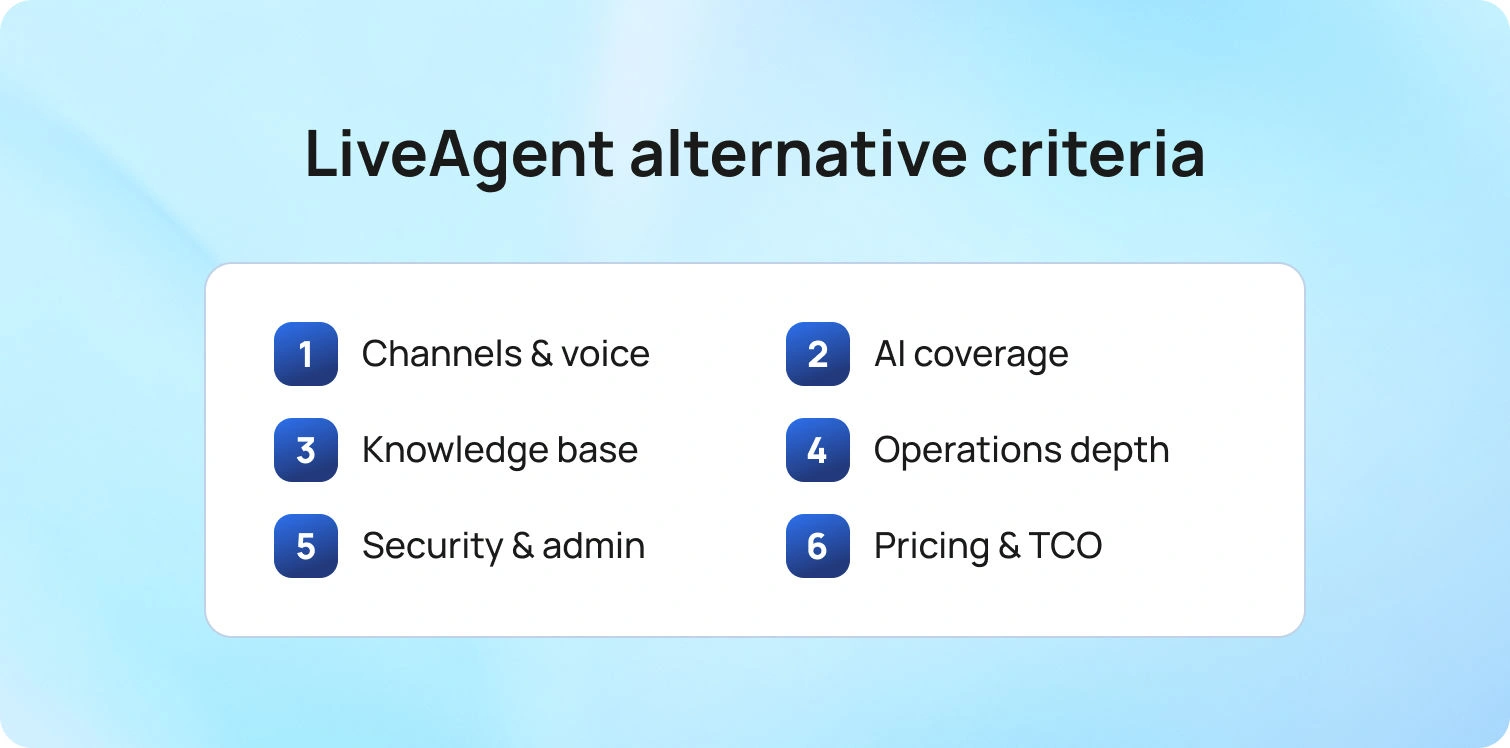
Choosing the right alternative to LiveAgent requires more than a feature checklist. It requires evaluating how the platform will influence operational outcomes across voice, chat, and email. The goal is to improve measurable performance indicators such as First Contact Resolution, Average Handle Time, containment rate, abandon rate, and customer sentiment.
Below are the areas that consistently separate a basic ticketing system from a modern support platform.
Channels and Voice
Many teams underestimate how important voice integration is until reporting gaps appear. If voice lives in a separate telephony tool, service metrics often become fragmented. Supervisors may struggle to align call performance with ticket resolution data.
When assessing a LiveAgent alternative, look for native telephony capabilities that sit inside the same environment as chat and email. Specifically, evaluate whether the system supports:
- Seamless handoff between voice interactions and help desk tickets
- Post-call notes captured directly within the ticket record
- Automatic call transcription with speaker separation
- Sentiment tracking and quality scoring within the same reporting layer
BlueTweak, for example, converts every voice interaction into a structured ticket and supports transcription, summarization, and sentiment analysis within the same platform. This alignment helps ensure that metrics such as FCR and AHT reflect the full customer journey, not just one channel.
AI Coverage
AI expectations have evolved. Basic macros are no longer sufficient in multilingual or high-volume environments.
When reviewing AI depth, move beyond marketing language and focus on how AI improves customer support in measurable, operational ways. Strong platforms should provide
- Automatic language detection
- Real-time chat translation
- Conversation summarization across channels
- Knowledge base–grounded suggested replies
- Call transcription
- Personally identifiable information redaction to support compliance
The distinction that matters is whether AI is grounded in your knowledge base. BlueTweak’s suggested reply feature, for example, draws from help articles and historical tickets and requires agent approval before sending. This ensures speed without removing human oversight.
Knowledge Base
A knowledge base should not function as a static article repository. It should actively support agents and customers in real time.
When evaluating a platform, consider whether the knowledge base allows:
- Per-locale content mapping for multilingual operations
- Terminology control and glossary management
- Citation visibility in AI-generated drafts
- Structured publishing workflows for self-service
A well-integrated knowledge base directly influences operational metrics. When answers are accurate and easy to surface, Average Handle Time decreases and First Contact Resolution improves. In BlueTweak, the knowledge base works alongside AI tools to assist agents during live interactions rather than operating as a separate reference system.
Operations Depth
As support teams scale, operational tooling becomes as important as channel coverage. Managers need visibility into performance by language, brand, queue, and channel.
Look for analytics that allow filtering and segmentation across these dimensions. In addition, evaluate whether workforce management and quality assurance are first-party capabilities rather than external add-ons.
Operational depth should include:
- Real-time dashboards and customizable reporting
- Forecasting and scheduling tools
- Adherence tracking
- Quality scoring and review workflows
- SLA monitoring by queue or brand
BlueTweak includes analytics dashboards and Workforce Management tools within the same environment as ticketing and AI, reducing the need for separate reporting systems.
Security and Administration
Security is often treated as a checklist item, but it directly affects governance and compliance.
At a minimum, ensure the platform includes:
- Multi-factor authentication
- Role-based access controls
- Audit logs that track user actions
- Encryption in transit and at rest
- Administrative control over permissions and data visibility
BlueTweak’s architecture includes encrypted data handling and role-based permissions to support structured access control across teams.
Pricing and Total Cost of Ownership
Pricing structures vary significantly between platforms. Some are seat-based. Others rely on usage metrics such as ticket volume, AI resolutions, or telephony minutes.
Before selecting a LiveAgent alternative, clarify:
- Whether pricing is per seat, per ticket, or usage-based
- Whether AI features are included or locked behind add-ons
- Whether telephony minutes are bundled or billed separately
- Whether analytics or Workforce Management requires higher tiers
Transparent pricing makes it easier to model the 12-month total cost of ownership. Consolidated platforms such as BlueTweak, which combine omnichannel support, AI, analytics, and WFM within a single pricing structure, may simplify forecasting for mid-sized teams.
Implementation Playbook
Switching to any new software should follow a structured and phased rollout. Rushing implementation often leads to inconsistent AI behavior, fragmented reporting, and reduced agent confidence. A practical four-week structure is outlined below.
Week 0 to Week 1
Begin with a foundational configuration. This includes importing ticket history and knowledge base content, configuring glossary rules, and setting up user roles and permissions.
Key activities typically include:
- Data and knowledge base import
- Terminology and glossary configuration
- Single sign-on and role-based access setup
- Queue and SLA configuration
Establishing structure early prevents operational drift later.
Week 1 to Week 2
Once the core system is stable, begin rolling out AI customer support capabilities in controlled pilots. This stage often includes:
- Activating real-time translation
- Enabling conversation summarization
- Deploying the suggested reply in one or two queues
- Conducting language quality audits on at least two percent of conversations per supported language
Piloting ensures that AI outputs align with brand tone and knowledge base accuracy before broader deployment.
Week 3 to Week 4
In the final rollout stage, expand to voice integration and operational dashboards. Activities typically include:
- Activating voice handoff and post-call notes
- Fine-tuning analytics filters and reports
- Configuring Workforce Management forecasting
- Finalizing dashboards segmented by language and brand
At this stage, leadership should begin tracking measurable impact.
Success metrics may include:
- Increased First Contact Resolution
- Reduced Average Handle Time
- Higher containment rates in automated flows
- Lower abandonment rates
- Improved CSAT and sentiment trends
How We Evaluated Each LiveAgent Alternative
This guide focuses exclusively on vendor-published information. We reviewed product pages, pricing documentation, and help articles for each platform to assess how well each desk solution helps teams manage support across multiple channels.
We verified the following across vendors:
- Channel coverage and voice integration depth
- AI capabilities, including summarization, suggested replies, translation, and transcription
- Knowledge base structure and integration
- Analytics and Workforce Management availability
- Security and administrative controls
- Integration ecosystem and API openness
We also assessed how platforms handle support requests, customer queries, and customer data within shared inbox environments or customer portal experiences. Particular attention was given to customer satisfaction tracking, seamless integration capabilities, and whether pricing models relied on transparent tiers or custom pricing structures that may influence long-term support costs.
Where pricing or feature access was unclear, we noted that verification is required.
Must-Have Capability Checklist
To maintain consistency across comparisons, we assessed each platform against the following baseline capabilities:
- Unified voice and messaging with help desk integration
- Knowledge base–grounded answers with terminology control
- AI features, including translation, transcription, summarization, and suggested replies
- Analytics that allow filtering by language or brand
- Native or first-party Workforce Management and Quality Assurance
- Multi-factor authentication, audit logs, and granular role controls
- Open APIs and integration support
- Transparent AI pricing rather than AI locked only behind add-ons
- Customer satisfaction survey capability
We also considered how effectively each desk solution supports live chat functionality, structured management of customer data, and scalable self service options within a unified desk software environment. For medium-sized businesses, clarity across pricing plans and operational depth often matters more than simply offering extensive features.
Based on published materials, BlueTweak meets these criteria, combining omnichannel support with AI, analytics, Workforce Management, and security controls in one platform.
Scoring Rubric
To ensure fairness, we weighted platforms based on practical operational fit rather than brand recognition.
Key criteria included:
- Suitability for teams with 20 to 100 agents
- Depth of omnichannel and voice support
- Breadth of AI coverage and knowledge base grounding
- Inclusion of Workforce Management and QA
- Time-to-value and implementation complexity
- Twelve-month total cost clarity
- Security and administrative control
We also evaluated how well each desk solution supports live chat functionality, self-service options, and structured management of customer data within a unified environment. This ensures that the desk software is suitable for medium-sized businesses focused on operational clarity, transparent pricing plans, and reducing reliance on multiple tools.
This structure prioritizes operational impact over feature volume or simply listing extensive features.
Choosing the Right LiveAgent Alternative in 2026
Selecting a LiveAgent alternative in 2026 is essentially about aligning your support stack with measurable operational goals, rather than just replacing one ticketing tool with another.
Industry research reflects this shift with Gartner reporting that conversational AI deployments in contact centers are expected to reduce agent labor costs as automation increasingly handles routine interactions.
At the same time, investment continues moving toward digital and unified service environments. These signals indicate that AI, voice integration, and operational visibility are no longer optional enhancements; they are becoming foundational components of modern support operations.
When evaluating an alternative to LiveAgent, focus on structural capability rather than surface features. A strong platform should unify chat, voice, and email within a single system. AI should be grounded in a structured knowledge base rather than operating as a disconnected layer. Analytics and Workforce Management should sit alongside ticketing, not in a separate reporting tool. Pricing should be transparent enough to model the twelve-month total cost of ownership with confidence.
For teams managing 20 to 100 agents, consolidation often delivers the greatest clarity. Fragmented systems can distort key performance indicators such as First Contact Resolution, Average Handle Time, containment rate, abandon rate, and sentiment tracking. Unified platforms reduce that fragmentation.
BlueTweak is positioned for teams that want omnichannel chat, voice, and email combined with knowledge base–grounded AI and built-in analytics and Workforce Management. By consolidating routing, classification, suggested replies, transcription, and scheduling into one environment, BlueTweak helps reduce tool sprawl and accelerate time-to-value.
If your evaluation criteria include voice depth, multilingual AI, operational visibility, and predictable total cost, BlueTweak is a practical platform to shortlist as your next liveagent alternative. Request a demo to explore how BlueTweak supports measurable service performance improvements.
No results



