



TL;DR
Gladly vs Zendesk vs BlueTweak comes down to one core difference: Gladly is built around lifelong customer conversations without tickets, while Zendesk is built around structured ticket management at enterprise scale. Gladly suits relationship-driven support teams that prioritize personalized service and customer loyalty. Zendesk suits organizations that need advanced workflows, SLA governance, and deep integrations across multiple communication channels. BlueTweak enters as the AI-native third option for teams that want native AI, voice, WFM, and QA in a single platform without relying on costly add-ons.
Gladly, Zendesk, and BlueTweak at a Glance
Gladly, Zendesk and BlueTweak are customer support platforms designed to help businesses manage customer interactions across multiple communication channels, but each platform is built around a fundamentally different operational philosophy.
For businesses evaluating Gladly vs Zendesk in 2026, the decision is no longer just about managing support tickets. Modern customer service operations now depend on how effectively platforms combine AI capabilities, omnichannel support, workforce management, reporting, voice, automation, and customer experience into a unified operational model. Businesses evaluating modern customer support platforms are also increasingly reassessing what they need from a traditional help desk software environment as AI and omnichannel expectations continue to evolve.
Zendesk remains one of the most established platforms in the market, known for its enterprise-grade ticketing system, advanced workflows, and extensive integration ecosystem. Gladly differentiates itself through a person-centric approach that replaces traditional tickets with lifelong customer conversations designed to improve personalized service and customer loyalty.
At the same time, AI-native platforms like BlueTweak are increasingly entering the same evaluation process, particularly among businesses looking to consolidate AI, voice, quality assurance, workforce management, and omnichannel support into a single platform experience rather than layering multiple third-party tools together.
IN 2026, that difference matters more than ever. According to PwC’s 2025 Customer Experience Survey, 29% of consumers stopped buying from a brand because of poor service experiences, while 70% of executives admit customer expectations are evolving faster than their companies can adapt. The findings highlight a growing gap between how businesses think they deliver customer experience and how customers actually perceive it.
The BlueTweak Gladly vs Zendesk Comparison Table
| Comparison Area | Gladly | Zendesk | BlueTweak |
|---|---|---|---|
| Core Philosophy | Person-centric — no tickets | Ticket-centric — case management | AI-native omnichannel support |
| Best For | High-touch consumer brands, luxury retail, hospitality | Enterprise support teams need scale, governance, and integrations | Teams needing AI, voice, WFM, and QA in one platform |
| AI Native | Partial | Add-on dependent | Yes |
| Voice | Yes | Yes | Yes |
| WFM Native | No | Limited / Add-on | Yes |
| Starting Price | Verify / Contact Sales | From ~$55 per agent/month annually | Transparent custom pricing |
| Unique Edge | Full customer conversation history in one view without ticket IDs | Largest ecosystem and integration marketplace | Native AI, voice, WFM, and KB-grounded responses included in the base platform |
The biggest mistake businesses make during the Gladly comparison process is evaluating customer support platforms purely on features rather than operational fit.
Organizations prioritizing structured workflows, SLA governance, and advanced reporting often lean toward Zendesk. Businesses focused on relationship building, customer lifetime value, and personalized service frequently prefer Gladly. Meanwhile, teams looking to reduce operational complexity by combining AI, voice, QA, WFM, and omnichannel support inside a unified environment are increasingly evaluating platforms like BlueTweak alongside both vendors.
The Three Operational Models Behind Modern Customer Support
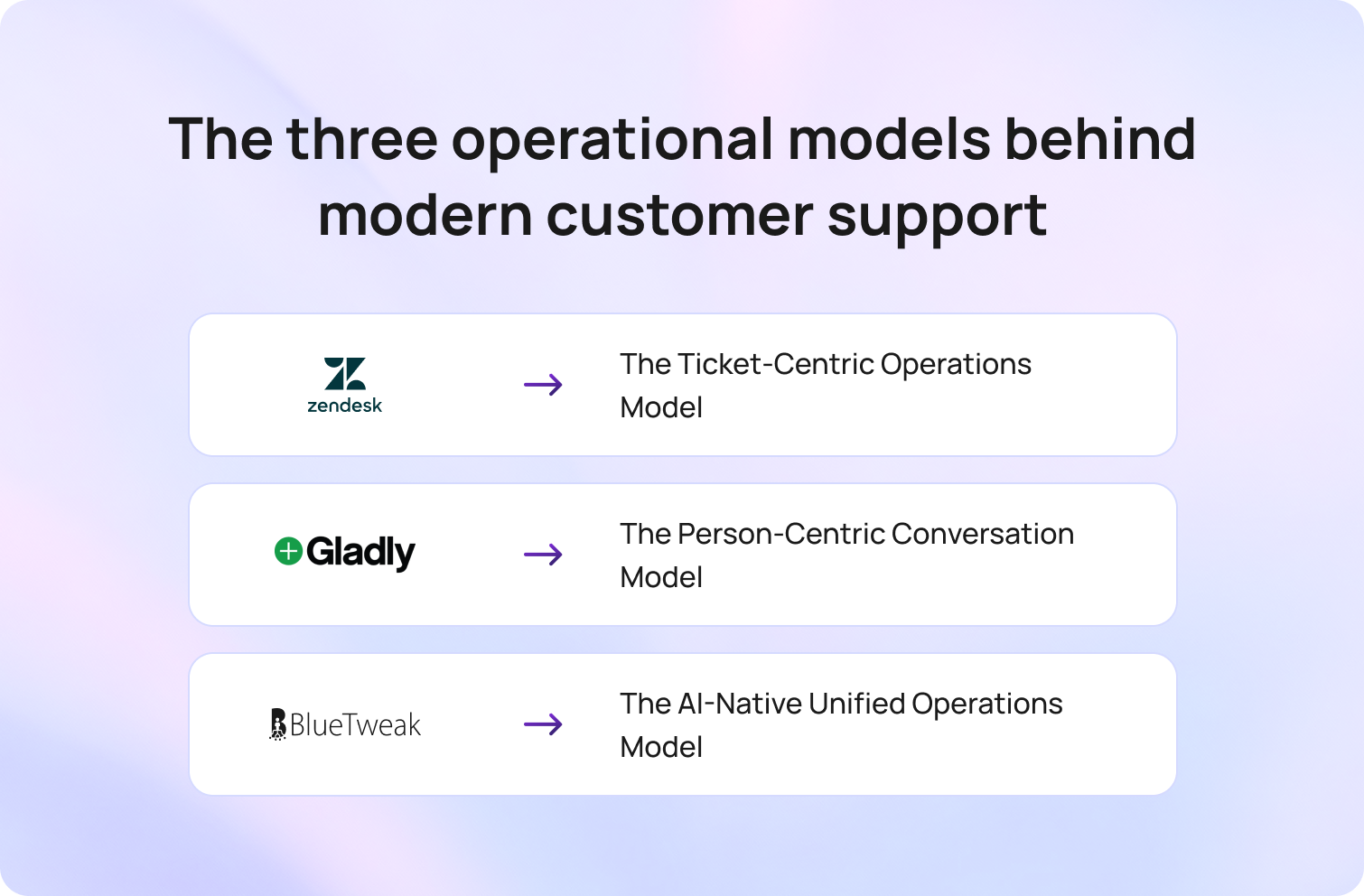
Modern customer support platforms are no longer differentiated purely by features. Gladly, Zendesk, and BlueTweak each represent a different operational model for managing customer interactions, customer service performance, and long-term customer experience at scale.
Most Gladly vs Zendesk comparisons oversimplify the decision into a feature checklist. In reality, the bigger distinction is how each platform structures customer service operations behind the scenes, because that operational philosophy directly impacts agent efficiency, reporting, AI adoption, customer satisfaction, and service quality.
Zendesk: The Ticket-Centric Operations Model
Zendesk represents the traditional ticket-centric model built around structured case management and operational governance. Every customer inquiry becomes a structured case within a ticketing system. Tickets are assigned IDs, statuses, priorities, queues, SLAs, and business rules that help support teams manage high support volumes across multiple channels.
This model gives organizations exceptional operational control. Customer service agents can route tickets automatically, enforce advanced workflows, track escalations, manage compliance requirements, and generate highly granular operational reporting. Zendesk offers one of the most mature ecosystems for organizations that need structured case management, deep integrations, and sophisticated governance across customer support operations.
That structure becomes particularly valuable for enterprise support environments handling large numbers of support tickets across multiple departments, including customer service, IT, operations, and e-commerce support.
The trade-off is that the workflow can become ticket-first rather than customer-first. When customers move between communication channels, interactions may still exist across separate tickets unless workflows are tightly managed. For some businesses, that creates friction within the customer experience and limits relationship continuity between agents and customers.
Gladly: The Person-Centric Conversation Model
Gladly represents a person-centric support model designed around lifelong customer conversations rather than traditional tickets. Rather than organizing support around tickets, Gladly unifies customer interactions into a single conversation history connected directly to the customer profile. Email, chat, SMS, voice, and social messaging all appear within the same timeline, giving agents full visibility into the customer’s history regardless of support channel.
Instead of managing queues of disconnected support tickets, agents manage ongoing customer relationships. The same agent can often continue conversations across multiple communication channels, creating a more personalized experience for the customer while reducing the frustration of repeated context switching.
For brands where customer loyalty and customer lifetime value are operational priorities, this model can improve relationship building and deliver more exceptional customer service experiences. That is why Gladly customers are often concentrated in industries like luxury retail, hospitality, subscription services, and e-commerce brands, where personalized service matters more than rigid case structures.
However, the person-centric model can create limitations for organizations requiring highly structured workflows, advanced SLA governance, or deeply layered operational reporting tied to ticket states and queue management.
BlueTweak: The AI-Native Unified Operations Model
BlueTweak represents an AI-native operational model built around consolidating AI, voice, workforce management, QA, and omnichannel support into a unified customer service environment.
Rather than centering operations around either tickets or conversations alone, BlueTweak focuses on reducing operational fragmentation across the customer support stack.
The platform is designed around the reality that many modern support teams now operate across disconnected systems for voice, digital support, QA reviews, workforce scheduling, knowledge management, coaching, reporting, and AI automation. This fragmentation creates operational inefficiency with agents moving between platforms, managers struggling with disconnected reporting, AI initiatives becoming siloed, and customer experience suffering as operational complexity increases.
BlueTweak’s approach is built around reducing that operational sprawl by combining AI-native workflows, voice support, QA, WFM, intelligent automation, and omnichannel customer interactions inside a unified platform architecture.
The biggest challenge facing customer support teams today is not access to AI or channels. It is operational fragmentation. When agents work across disconnected systems, customer experience becomes inconsistent, reporting becomes unreliable, and scaling service quality becomes significantly harder.

This operational model is becoming increasingly relevant as customer expectations continue to evolve. According to PwC’s 2025 Customer Experience Survey, 70% of executives say customer expectations are evolving faster than their businesses can keep pace with, placing increasing pressure on support teams to deliver faster, more personalized, and more efficient customer experiences across every support channel.
Which Operational Model Fits Your Team Best?
The Gladly vs Zendesk vs BlueTweak decision ultimately comes down to operational priorities rather than feature parity alone.
Businesses prioritizing enterprise governance, advanced reporting, and structured workflows will often lean toward Zendesk. Businesses prioritizing relationship-driven support and lifelong customer conversations may prefer Gladly. Businesses prioritizing operational consolidation, AI-native workflows, unified voice and digital support, and lower operational complexity are increasingly evaluating platforms like BlueTweak alongside both traditional models.
Gladly vs Zendesk vs BlueTweak: Head-to-Head Comparisons
Gladly, Zendesk and BlueTweak all support modern omnichannel customer service operations, but they differ significantly in AI maturity, operational philosophy, reporting depth, workforce tooling, implementation complexity, and long-term total cost of ownership.
For businesses evaluating Gladly vs Zendesk in 2026, the real challenge is in understanding how effectively each platform supports your operational model, customer experience strategy, and long-term scalability goals.
The sections below break down the biggest differences between all three platforms across the areas that matter most to support leaders and customer experience teams.
AI Capabilities
AI capabilities refer to the automation, agent assistance, intelligent workflows, and knowledge management tools that help support teams improve customer service performance while reducing repetitive tasks.
AI has rapidly become one of the most important decision factors in the Gladly vs Zendesk vs BlueTweak conversation, largely because many vendors now separate advanced AI functionality into premium add-on pricing tiers.
Zendesk:
Zendesk has invested heavily in AI capabilities over the last several years. Its platform now includes AI-generated summaries, suggested replies, intelligent triage, generative search, AI agents, automated responses, and Copilot functionality for customer service agents.
However, many of Zendesk’s most advanced AI capabilities still require additional investment beyond the base Zendesk Suite plan. Real-time agent assistance, autonomous resolution workflows, QA automation, and advanced AI orchestration often sit behind premium add-ons.
Gladly:
Gladly also offers AI functionality, including conversation summaries, suggested responses, self-service capabilities, and automation designed to support personalized service and customer continuity. Its AI positioning focuses more heavily on enabling agents and improving customer interactions than on building highly automated support environments.
BlueTweak:
Rather than treating AI as a separate layer added onto existing workflows, BlueTweak positions AI as part of the platform’s operational foundation. AI-powered agent assistance, suggested replies, and KB-grounded responses, intelligent automation, post-interaction summarization, coaching support, and omnichannel AI workflows are integrated directly into the platform experience.
Fragmented AI deployments often create operational inconsistency. Support teams frequently discover that AI tools layered across disconnected systems increase complexity rather than reduce it, particularly when voice, QA, workforce management, and digital channels operate separately.
In summary:
Zendesk currently offers the broadest enterprise AI ecosystem, but reaching full capability often requires significant add-on investment. Gladly delivers a more relationship-focused AI experience centered around customer continuity. BlueTweak stands out for organizations seeking AI-native operational workflows embedded directly across voice, QA, WFM, and omnichannel support from day one.
Channel Coverage
Channel coverage refers to the communication channels a platform supports natively, including voice, email, SMS, live chat, WhatsApp, social messaging, and self-service options.
Modern customer service operations depend heavily on omnichannel support because customers increasingly expect to move between communication channels without losing context.
Zendesk:
Zendesk offers extensive channel coverage across email, voice, live chat, SMS, WhatsApp, social messaging, and community forums. The Zendesk Agent Workspace centralizes these channels into a unified interface, while the broader ecosystem supports extensive third-party integrations.
Gladly:
Gladly also supports voice, email, SMS, live chat, and social channels, but its key differentiator is not simply channel availability. It is how Gladly unifies conversations into a single customer timeline designed around relationship continuity rather than ticket management.
BlueTweak:
BlueTweak positions omnichannel support as part of a broader operational architecture combining voice, AI, QA, WFM, and digital channels within a single environment. Rather than treating voice as a separate integration layer, BlueTweak emphasizes native voice and digital support working together operationally. This operational consolidation is particularly valuable for businesses managing both digital customer interactions and high voice volumes.
In summary:
Zendesk offers the deepest integration ecosystem and channel flexibility. Gladly excels at maintaining conversational continuity across channels. BlueTweak differentiates itself through operationally unified voice and digital support built directly into the platform architecture.
Reporting and Analytics
Reporting and analytics refer to the KPIs, dashboards, operational metrics, forecasting tools, and customer insights that support leaders use to measure service quality and optimizing customer service operations.
This is one of the most significant operational distinctions between Gladly, Zendesk, and BlueTweak.
Zendesk:
Zendesk has long been known for advanced reporting features and operational analytics. Teams can track first contact resolution, average handling time, CSAT, SLA compliance, sentiment, resolution times, ticket backlog, and agent performance through highly customizable dashboards and structured reporting environments. Because Zendesk uses a ticket-centric operational model, reporting structures tend to be highly granular and process-oriented.
Gladly:
Since Gladly organizes support around customer conversations rather than support tickets, reporting focuses more heavily on customer relationships, conversation continuity, and customer experience outcomes. This can be highly effective for brands prioritizing customer loyalty and personalized service, although some operations teams may find the reporting model less granular for queue-level governance.
BlueTweak:
BlueTweak focuses on consolidating operational visibility across AI, voice, QA, workforce management, and digital support within a unified reporting environment. Rather than separating reporting across multiple operational systems, the platform aims to provide broader visibility into customer service performance across the entire support operation.
That becomes increasingly important as support environments grow more operationally fragmented. According to Deloitte’s 2025 Global Business Services Survey, organizations are increasingly prioritizing AI, digital transformation, and more integrated service delivery models to improve customer experience, operational efficiency, and scalability.
In summary:
Zendesk remains strongest for highly structured operational reporting and advanced case management analytics. Gladly delivers stronger visibility into relationship-driven customer experiences. BlueTweak stands out for organizations seeking consolidated reporting across AI, voice, workforce management, QA, and omnichannel support operations.
Pricing and Total Cost of Ownership
Pricing and total cost of ownership refer to the combined software, AI, implementation, integration, support, and operational costs required to run a customer support platform effectively over time. Pricing transparency has become a major factor in the Gladly comparison process as businesses evaluate the long-term operational impact of AI add-ons and fragmented tooling.
Zendesk:
Zendesk pricing is publicly available, with Suite plans starting at roughly $55 per agent, per month, billed annually. Advanced AI capabilities, Copilot functionality, QA tooling, and enterprise workflow requirements can significantly increase overall annual billing with advanced plans reaching up to $219 per agent, per month. For example, a 50-agent support team using advanced Zendesk AI tooling can quickly move into six-figure annual platform costs once AI add-ons, implementation support, and operational modules are included.
Gladly:
Gladly does not publicly display transparent pricing, which can make forecasting more difficult during vendor evaluation. Public discussions generally position Gladly within the mid-market and enterprise pricing category, particularly for businesses prioritizing high-touch support environments.
BlueTweak:
BlueTweak positions itself around operational consolidation and predictable pricing, particularly for businesses that want AI, voice, workforce management, QA, and omnichannel support within a single platform rather than across multiple disconnected vendors.
Rather than charging separately for core operational capabilities, BlueTweak’s model focuses on reducing the need for additional AI add-ons, third-party WFM platforms, standalone QA tools, and separate voice infrastructure. BlueTweak is priced at €65 per agent, per month, with all core features included. For growing support teams, this significantly reduces both software spend and operational complexity over time.
This matters because many businesses underestimate the long-term cost of fragmented customer support operations. While individual platform costs may appear competitive initially, operational overhead often increases once AI tooling, voice integrations, QA software, workforce management systems, implementation services, and ongoing maintenance are layered into the environment.
For teams looking to scale customer service operations efficiently, BlueTweak’s value proposition is not simply lower platform pricing; it is the ability to consolidate critical support operations into a unified environment that reduces complexity, accelerates time-to-value, and improves operational visibility across the entire customer experience function.
In summary:
Zendesk offers the most transparent entry pricing, but costs can scale rapidly as advanced AI and operational tooling are added. Gladly’s pricing opacity may create procurement friction for some buyers. BlueTweak is best suited to organizations prioritizing operational consolidation and reducing dependency on multiple add-on platforms.
Workforce Management and QA
Workforce management and QA refer to forecasting, scheduling, adherence tracking, coaching, scorecards, call reviews, and quality assurance processes that help support teams maintain service quality at scale. As support operations grow, workforce optimization becomes increasingly critical to maintaining customer satisfaction and operational efficiency.
Zendesk:
Zendesk offers workforce management and QA capabilities through a combination of native tooling and integrations. Larger organizations can build sophisticated operational environments around forecasting, QA reviews, coaching workflows, and agent performance management, although some functionality depends on third-party modules.
Gladly:
Gladly’s operational strength remains centered around customer relationships and conversation continuity rather than workforce optimization. Many Gladly deployments rely more heavily on integrations for advanced workforce management and QA capabilities.
BlueTweak:
BlueTweak approaches workforce optimization as part of the core operational environment rather than an external add-on category. The platform combines workforce management, QA, coaching workflows, voice operations, and AI-assisted performance support inside a unified operational model designed to reduce fragmentation between support operations and workforce management processes.
This can simplify operational management for growing support teams that would otherwise need to coordinate multiple disconnected systems.
In summary:
Zendesk offers strong operational flexibility and mature ecosystem support for enterprise workforce optimization. Gladly is better suited to relationship-focused support environments where workforce tooling is less operationally central. BlueTweak stands out for organizations looking to unify QA, WFM, AI, and omnichannel support operations within a single environment.
Implementation and Time-to-Value
Implementation and time-to-value refer to how quickly a platform can be deployed, configured, adopted by agents, and operationalized successfully across the business.
All three platforms require implementation planning, but the complexity profile differs significantly depending on operational requirements.
Zendesk:
Zendesk can deploy relatively quickly for straightforward support environments, but enterprise implementations involving advanced workflows, custom business rules, integrations, and omnichannel routing can become highly complex over time.
Gladly:
Gladly implementations often involve broader operational redesign because the platform changes how support teams fundamentally manage customer interactions. Organizations moving away from traditional ticketing systems may require additional process adaptation, reporting redesign, and agent retraining.
BlueTweak:
BlueTweak positions itself around operational simplicity and faster consolidation by reducing the number of separate systems businesses need to integrate together across AI, voice, QA, WFM, and digital support.
That simplification can accelerate time-to-value for organizations currently operating fragmented support environments across multiple vendors.
In summary:
Zendesk offers flexibility and scalability, but can become operationally complex as environments mature. Gladly may require greater organizational adaptation because of its ticket-free model. BlueTweak is strongest for organizations prioritizing operational consolidation, faster onboarding, and reducing implementation overhead across multiple support systems.
When Gladly Is the Right Fit
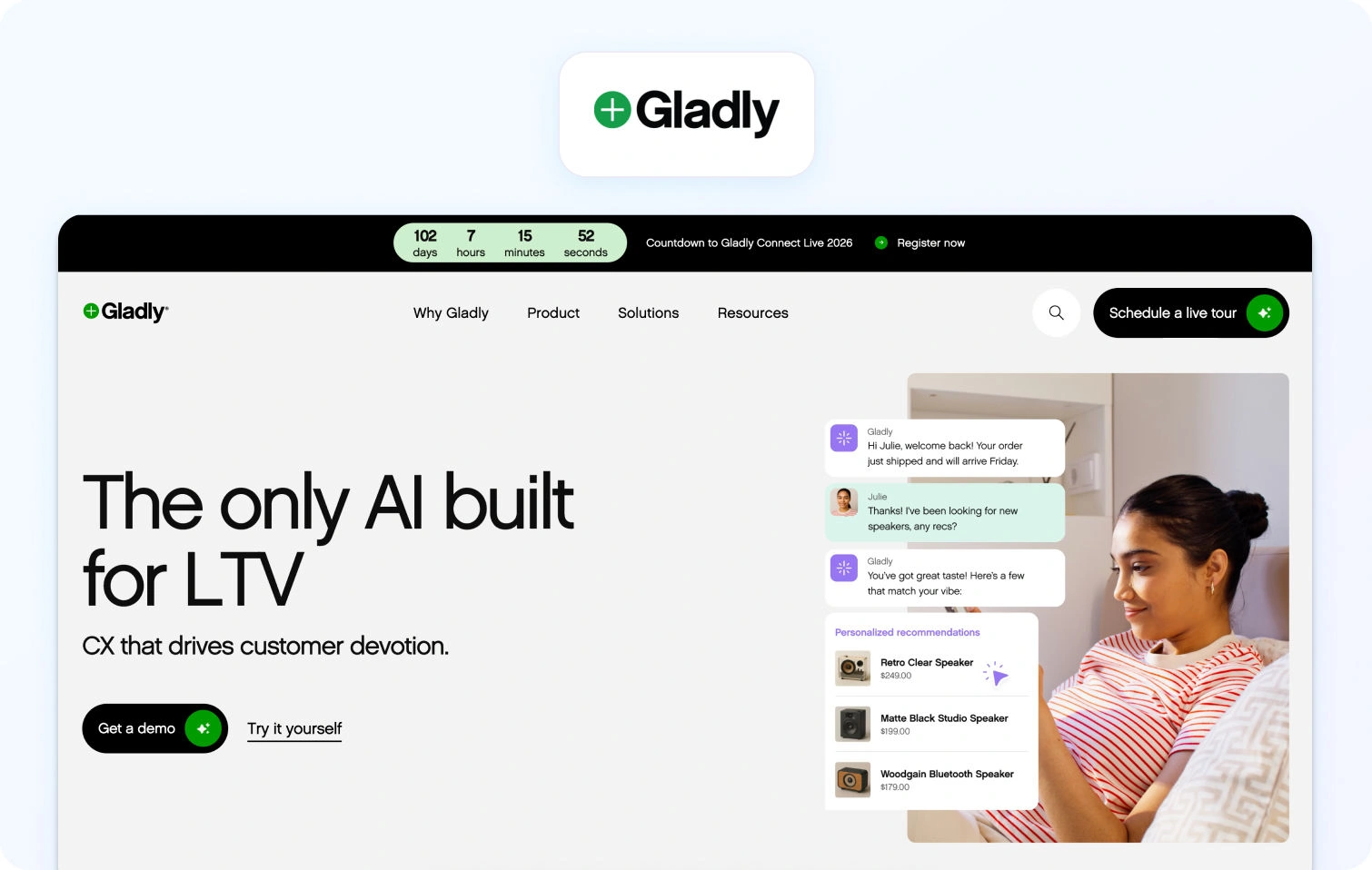
Gladly is best suited for businesses that prioritize relationship-driven customer experience over highly structured ticket management workflows.
For teams where customer loyalty, customer lifetime value, and personalized service are operational priorities, Gladly’s person-centric model can fundamentally improve how customer service agents engage with customers across multiple communication channels.
Rather than forcing agents to manage disconnected support tickets, Gladly unifies conversations into a single customer timeline, allowing support teams to deliver more continuous and contextual customer interactions. This approach is particularly effective for brands where emotional connection and long-term relationship building directly influence revenue and retention.
Industries that often align well with Gladly include:
- Luxury retail
- Hospitality
- Subscription services
- Direct-to-consumer ecommerce brands
- Premium customer support environments
Gladly is especially effective when:
- Customer inquiries are high-touch and conversational rather than transactional
- The same agent managing ongoing conversations improves customer satisfaction
- Personalized experience matters more than ticket throughput metrics
- Support teams want to reduce context switching across multiple channels
- Customer experience is positioned as a brand differentiator rather than a cost center
The platform’s user-friendly interface and conversation-first approach can also improve agent efficiency by giving agents immediate access to the customer’s history without requiring ticket merging or manual context gathering.
However, buyers should also evaluate the operational trade-offs carefully. Organizations requiring deeply structured SLA governance, highly granular ticket reporting, or advanced operational workflows may find Gladly’s model less rigid than traditional ticket-centric platforms. Pricing transparency may also be a consideration for procurement teams evaluating long-term scalability and budgeting.
When Zendesk Is the Right Fit
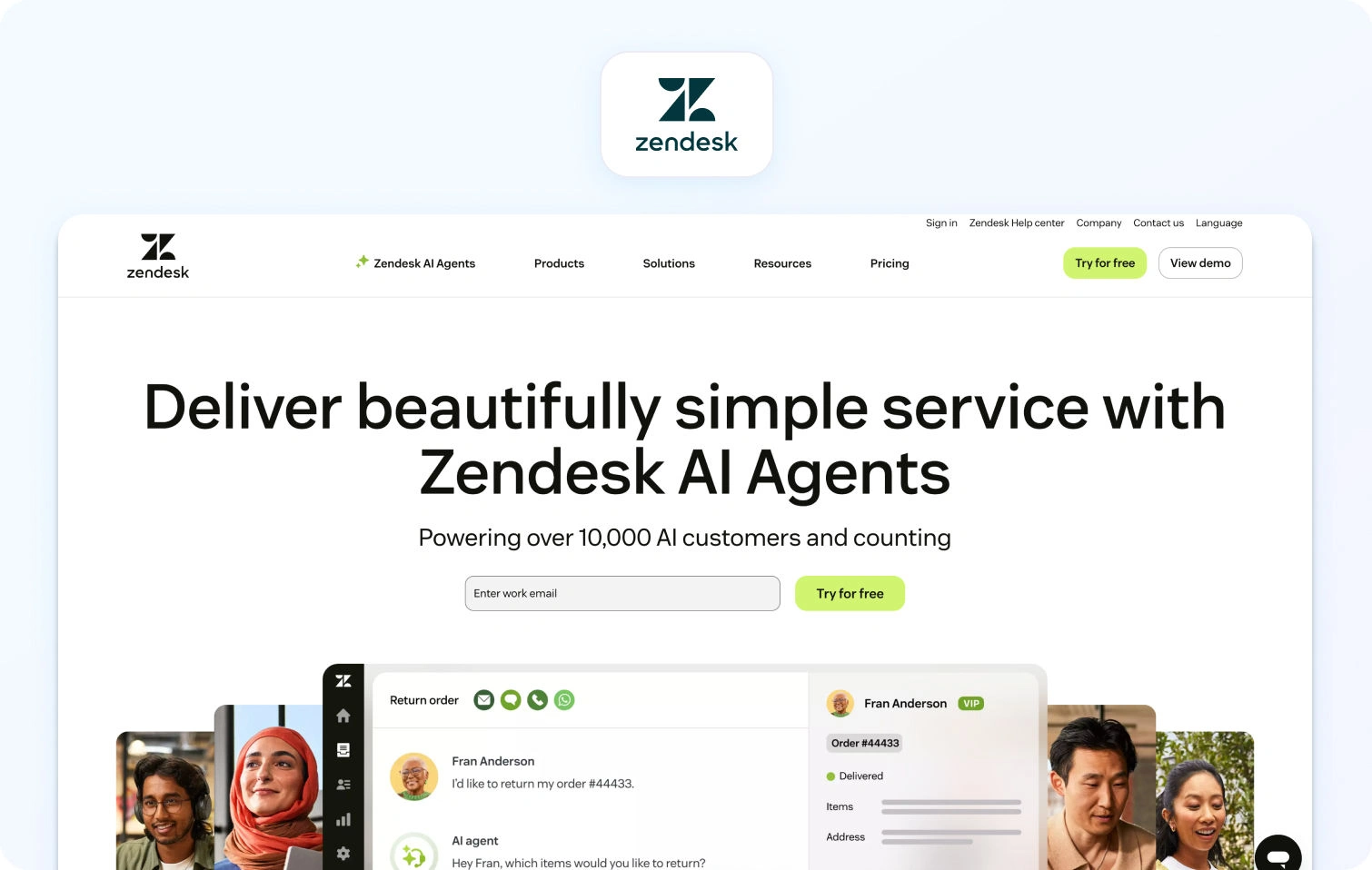
Zendesk is best suited for organizations that require operational scale, structured workflows, and enterprise-grade support governance across complex customer service operations.
Its ticket-centric architecture gives businesses detailed control over support tickets, routing, escalations, business rules, and SLA management, making it particularly effective for organizations handling large support volumes across multiple departments and communication channels.
Zendesk stands out when operational consistency and process control are the primary priorities. This is especially true for:
- Enterprise customer support teams
- IT service environments
- Businesses with complex escalation structures
- Organizations requiring advanced workflows and compliance processes
- Companies needing extensive integrations across their technology stack
Zendesk offers one of the largest integration ecosystems in the customer support market, connecting with platforms like Salesforce, Jira, Slack, e-commerce platforms, and hundreds of third-party applications. This makes Zendesk particularly attractive for organizations with mature operational environments or existing enterprise infrastructure.
The platform also delivers strong reporting features, advanced automation, self-service capabilities, and customizable workflows that help support leaders manage customer service performance at scale.
However, buyers should factor in the platform’s growing operational complexity. As AI capabilities, QA tooling, workforce management, and omnichannel support requirements expand, many organizations discover that achieving a fully unified support environment within Zendesk often requires additional add-ons, integrations, and implementation overhead. Smaller businesses or rapidly growing support teams may also find the platform more operationally complex than necessary for their requirements.
When BlueTweak Is the Right Fit
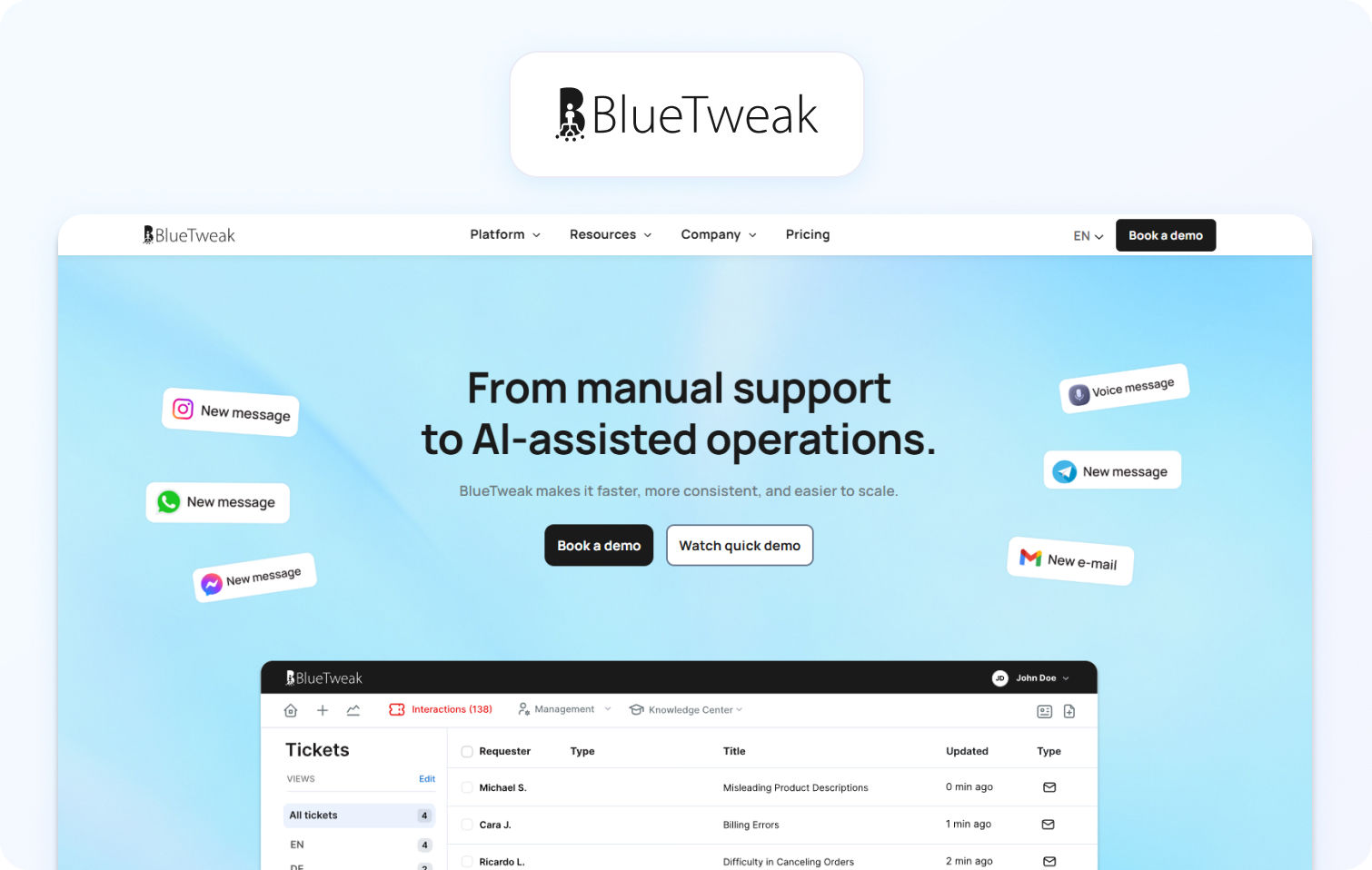
BlueTweak is best suited for organizations that need AI, voice, workforce management, QA, and omnichannel customer support consolidated into a single operational platform without relying heavily on third-party add-ons or disconnected systems.
By the time many businesses reach this stage of the Gladly vs Zendesk evaluation process, the decision has normally moved beyond whether they prefer tickets or conversations and instead focuses on operational complexity.
Some organizations find Zendesk exceptionally powerful, but operationally heavy once AI add-ons, QA tooling, workforce management, voice infrastructure, and advanced workflows are layered into the environment. Others appreciate Gladly’s customer-centric approach, but discover that the ticket-free model can feel too limiting for teams that still require more structured operational workflows, detailed governance, or broader workforce optimization capabilities.
This is where BlueTweak stands out.
Rather than positioning AI, voice, QA, and workforce management as separate operational layers, BlueTweak combines them inside a unified customer service environment designed to reduce fragmentation across the support stack.
That includes:
- Native AI capabilities like suggested replies, KB-grounded responses, post-interaction summarization, intelligent automation, and real-time agent coaching
- Native voice telephony is integrated alongside digital communication channels
- Built-in workforce management and QA tooling without requiring separate third-party modules
- Unified reporting across voice, AI, QA, WFM, and omnichannel customer interactions
- More transparent operational pricing compared to environments heavily dependent on layered add-ons
This operational model can be particularly valuable for growing support organizations that want enterprise-grade functionality without managing multiple disconnected platforms across customer service operations.
Instead of stitching together separate vendors for voice, QA reviews, workforce scheduling, AI tooling, analytics, and omnichannel support, teams can centralize more of the customer experience operation inside a single platform environment.
This reduces implementation overhead, simplifies agent workflows, improves operational visibility, and accelerates time-to-value for support teams scaling across multiple channels.
BlueTweak’s platform architecture is also designed around modern cloud and AI infrastructure, helping organizations operationalize AI-driven customer support without adding unnecessary platform complexity. The platform uses enterprise-grade AI and cloud technologies to support scalable automation, real-time agent assistance, and omnichannel customer interactions within a unified operational model.
Support leaders are no longer evaluating platforms purely on channel coverage or ticket management. They are evaluating how quickly they can operationalize AI, reduce complexity, and create a support environment that scales efficiently across both customer experience and workforce operations.
This is not necessarily about replacing Zendesk or Gladly outright. Zendesk remains highly effective for organizations prioritizing deep governance, structured workflows, and enterprise-scale ticket operations. Gladly remains exceptionally strong for brands focused on high-touch customer relationships and lifelong conversations.
BlueTweak becomes the stronger fit when businesses want operational consolidation, AI-native workflows, integrated voice and digital support, native WFM and QA, and faster time-to-value without building a heavily fragmented support architecture.
One example is BlueTweak’s work with Conectys, where the global outsourcing provider consolidated customer support operations using BlueTweak’s unified platform environment. According to the case study, the business achieved a 40% increase in reporting efficiency, a 35% improvement in customer satisfaction scores, and a 25% reduction in resolution times after centralizing omnichannel support, reporting, and operational workflows inside a single platform.
Final Thoughts: Choosing the Right Customer Support Platform in 2026
Gladly, Zendesk and BlueTweak each solve customer support challenges from a fundamentally different operational perspective.
Gladly is strongest for businesses prioritizing relationship-driven customer experience, lifelong conversations, and personalized service across multiple communication channels. Its person-centric model is particularly effective for premium brands where customer loyalty and customer lifetime value matter more than rigid ticket structures.
Zendesk remains one of the most powerful enterprise customer support platforms available for organizations requiring structured ticket management, advanced workflows, deep integrations, and highly detailed operational reporting. For large-scale support environments with complex governance requirements, Zendesk continues to set the benchmark for operational control and scalability.
BlueTweak, rather than focusing purely on tickets or conversations, is designed for organizations looking to consolidate AI, voice, workforce management, QA, and omnichannel customer support into a unified operational environment. For teams that want native AI capabilities, integrated voice support, transparent operational tooling, and faster time-to-value without relying heavily on disconnected add-ons, BlueTweak offers a compelling alternative operational model.
Ultimately, the right platform depends on how your business wants to scale customer service operations. The most important decision is not simply which platform has the most features. It is the operational model that best aligns with your support team, customer expectations, and long-term customer experience strategy.
If you are currently evaluating Zendesk vs Gladly and want to explore how BlueTweak compares in practice, book a demo or try the platform for free to see how AI, voice, QA, WFM, and omnichannel support can operate inside a single platform environment.
Get your free 14-day BlueTweak free trial
Start Now
As Head of Digital Transformation, Radu looks over multiple departments across the company, providing visibility over what happens in product, and what are the needs of customers. With more than 8 years in the Technology era, and part of BlueTweak since the beginning, Radu shifted from a developer (addressing end-customer needs) to a more business oriented role, to have an influence and touch base with people who use the actual technology.



