



TL;DR
A Hiver alternative helps teams move beyond Gmail-based shared inboxes as customer support operations become more complex. The best Hiver alternatives in 2026 include BlueTweak, Zendesk, Freshdesk, Help Scout, Front, Missive, and Gmelius, each suited to different team sizes and support requirements. For organizations that need AI automation, omnichannel support, workforce management, and quality assurance in one platform, BlueTweak stands out as the strongest option for long-term growth.
Many teams start with Hiver because it offers a simple way to manage shared inboxes inside Gmail. But as customer support operations grow, what once felt efficient can quickly become limiting.
Support teams today are expected to manage conversations across email, chat, voice, social media, and messaging apps while maintaining fast response times, consistent service quality, and operational visibility. At the same time, AI-powered automation is becoming a competitive requirement rather than a nice-to-have feature.
That's why more organizations are evaluating Hiver alternatives. Some need greater flexibility outside the Google ecosystem, while others need advanced automation, omnichannel support, and deeper operational insights. Platforms such as BlueTweak are designed specifically for this next stage of growth, helping teams move beyond shared inbox management and build a more scalable customer support operation.
Why Teams Look for a Hiver Alternative
Most searches for a Hiver alternative happen when a team's customer support requirements have outgrown the shared inbox model that Hiver was built around.
Hiver remains a popular choice for small teams using Google Workspace as its user-friendly interface, collaborative shared inbox functionality, and seamless Gmail integration make it an attractive starting point for customer support teams that primarily handle email-based customer communication.
However, most searches for a Hiver alternative are driven by three common challenges. As support teams grow, customer expectations change, and support channels multiply, many organizations find that Hiver's strengths become limitations.
Gmail Lock-In Limits Flexibility
Hiver is built directly inside Gmail as a Chrome extension. While this approach makes onboarding simple for Google Workspace users, it also creates dependency on Google's ecosystem.
Teams using Microsoft Outlook, or organizations considering a move away from Google Workspace, cannot simply take Hiver with them. The platform's functionality is fundamentally tied to Gmail accounts, Gmail labels, and the Google environment.
For support leaders evaluating long-term customer support software investments, this can create unnecessary restrictions. A platform decision should support future business needs, not dictate which productivity suite the organization must use.
As companies expand, merge with other organizations, or introduce new customer support operations, flexibility often becomes more important than convenience.
Pricing Pressure Increases as Teams Grow
Pricing scalability is another common reason teams begin exploring Hiver alternatives.
Hiver's pricing model is based on per-agent subscriptions, with additional costs for AI capabilities. While this may be manageable for very small teams, costs can rise quickly as support teams expand from five agents to 20 or more.
This creates a challenge for growing organizations. Support leaders are not simply evaluating software costs today; they are forecasting what customer support software will cost 12 to 24 months from now.
Many modern help desk software providers now include AI features, automation capabilities, advanced reporting, and workflow management tools within their core offerings. As a result, organizations often find themselves comparing Hiver's add-on costs against platforms that bundle advanced functionality into a more comprehensive package.
Teams Eventually Outgrow the Shared Inbox Model
The biggest reason organizations search for an alternative to Hiver is that they have outgrown the shared inbox model entirely.
Hiver was designed around collaborative email management. It helps multiple team members manage shared inboxes, assign tasks, leave internal notes, and track incoming requests without leaving Gmail. For many teams, that works perfectly.
However, modern customer support rarely happens through email alone.
Today's customer support teams often manage conversations across live chat, voice, SMS, social media, messaging apps, self service portals, and knowledge base channels. They also need AI tagging, advanced automation, AI agents, collision detection, proactive messaging, and advanced analytics to maintain efficiency as volumes increase.
According to PwC's 2025 Customer Experience Survey, 70% of executives believe customer expectations are evolving faster than their organizations can adapt. This helps explain why many support teams begin searching for a Hiver alternative. As customer interactions spread across chat, voice, social media, messaging apps, and self-service channels, a shared inbox alone often struggles to provide the visibility, automation, and consistency needed to keep pace.
This is where many teams discover that a basic shared inbox is no longer enough. They need omnichannel support, automation rules, workflow orchestration, and AI-powered customer service capabilities that extend far beyond email collaboration tools.
As a result, the search for a Hiver alternative is often less about replacing Hiver itself and more about finding a platform that can support the next stage of growth.
Hiver Alternatives at a Glance
A Hiver alternative comparison helps support leaders quickly identify which platform best aligns with their team's size, support channels, AI requirements, and long-term growth plans.
The market offers everything from lightweight Gmail-based collaboration tools to enterprise-grade customer service software with AI automation, omnichannel routing, and advanced reporting capabilities.
The comparison below provides a high-level overview of the leading Hiver alternatives available in 2026. Pricing should always be verified directly with each vendor before making a purchasing decision, as plans and included features can change.
BlueTweak Hiver Alternatives Comparison Table
*Pricing verified at the time of writing and subject to change. Always confirm current pricing, AI feature availability, and billing terms directly with the vendor before making a purchasing decision.
While feature checklists are useful, they rarely tell the whole story. The real question is not which platform has the most features, but which platform aligns with how your customer support operation will evolve over the next 12 to 24 months.
The sections below provide a more detailed breakdown of each platform, including where it excels, where it falls short, and the types of teams most likely to benefit from switching.
7 Best Hiver Alternatives in 2026
A Hiver alternative can range from a simple shared inbox replacement to a fully featured customer support platform with AI automation and omnichannel capabilities.
The tools below represent the strongest Hiver alternatives in 2026. Each assessment covers what the platform does well, where it falls short, pricing considerations, and the type of team it is best suited for. Pricing was verified at the time of writing but should always be confirmed directly with the vendor before making a purchasing decision.
1. BlueTweak: Best for AI-Powered Omnichannel Customer Support
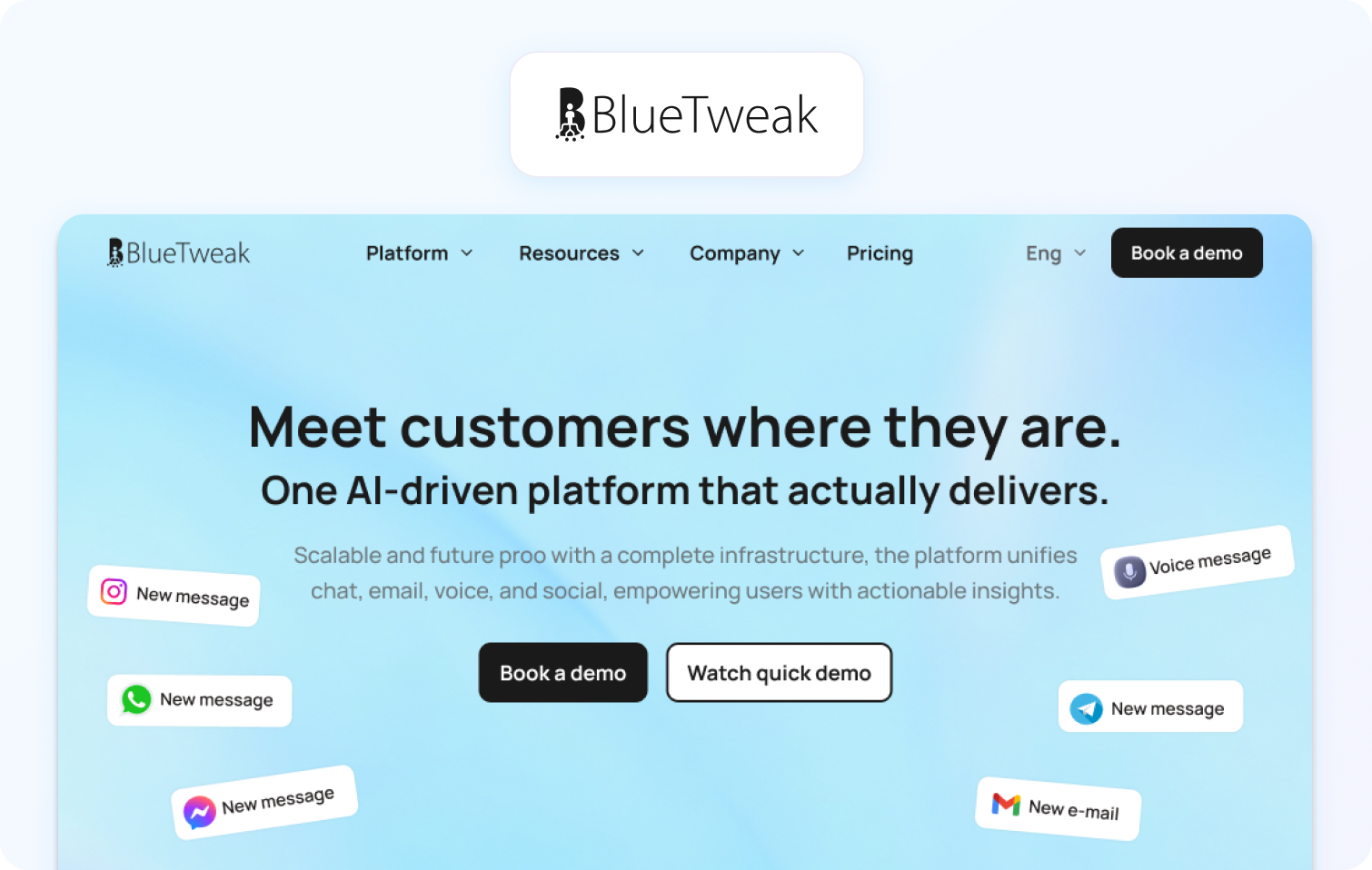
BlueTweak is an AI-powered customer support platform designed for organizations that need to manage customer interactions across voice, email, live chat, social media, and messaging channels from a single workspace. Unlike a basic shared inbox, it combines customer support operations, AI automation, workforce management, and quality assurance in one platform.
Why it beats Hiver for growing teams: Hiver is fundamentally a shared inbox layer built inside Gmail. BlueTweak is a complete customer support platform built for teams that have outgrown email-centric support and need a unified approach to customer communication across multiple channels.
Key capabilities:
- Conversational AI agents for tier-one support - automatically resolve common customer enquiries, reducing ticket volumes and freeing agents to focus on more complex issues.
- AI ticket triage and intelligent routing - categorise, prioritise, and assign support tickets automatically so customers reach the right team faster.
- AI-generated ticket summaries and suggested replies - reduce manual admin work and help agents respond more quickly with relevant, context-aware recommendations.
- Multi-brand support from a single workspace – manage customer interactions across multiple brands, business units, or product lines without switching platforms, giving agents a unified view while maintaining separate brand experiences.
- Real-time knowledge base retrieval for agents - surface accurate information during live interactions, improving consistency and reducing resolution times.
- Workforce management and scheduling tools - forecast demand, optimise staffing levels, and improve operational efficiency across support teams.
- 100% automated QA coverage and performance monitoring - review every customer interaction automatically to identify coaching opportunities and maintain service quality at scale.
- Advanced analytics and reporting across channels - track performance, customer satisfaction, and operational trends through a single reporting environment
The biggest mistake support leaders make is treating AI as an add-on rather than an operating model. Shared inboxes solve collaboration challenges, but they don’t fundamentally transform customer support. The organizations seeing the strongest results are using AI across routing, quality assurance, knowledge retrieval, workforce optimization, and customer interactions in a single ecosystem.

The honest limitation: BlueTweak is not the right fit for a three-person team looking to manage a Gmail account collaboratively with minimal setup. The platform is built for organizations that need automation, omnichannel support, quality oversight, and operational scalability.
Pricing: BlueTweak operates a transparent pricing model of €65 per agent, per month, all-in (including ticketing, omnichannel, AI chatbot, AI voicebot, copilot tools, WFM, QA, analytics, integrations). This pricing model is designed to keep things simple, affordable, and easy to scale as your team does.
Best for: Mid-market and enterprise support teams that need AI automation, omnichannel routing, and operational visibility beyond a traditional shared inbox.
If you're evaluating Hiver alternatives and want to see what a fully integrated AI-powered customer support platform looks like in practice, start a free BlueTweak trial and explore the platform firsthand.
2. Zendesk: Best for Enterprise Teams Needing Scale and Ecosystem Breadth

Zendesk is one of the most established customer service software platforms on the market. It combines ticketing, self-service portals, workflow management, reporting, AI capabilities, and one of the largest integration marketplaces in the industry.
Why teams choose it: Zendesk's greatest strength is scale; large support organizations can manage customer support operations across multiple channels while integrating deeply with CRM systems, e-commerce platforms, and business applications. Its AI capabilities have matured considerably in recent years, transforming Zendesk from a traditional ticketing system into a broader customer experience platform.
Key capabilities:
- Omnichannel customer support and ticketing
- AI-powered agent assistance and automation
- Extensive integration marketplace
- Advanced workflow management and automation rules
- Self-service portals and knowledge base functionality
- Enterprise-grade reporting and analytics
- Support for large-scale customer service operations
The honest limitation: Zendesk is significantly more complex than Hiver. While that complexity unlocks flexibility, it also increases implementation effort, administration requirements, and overall cost.
Teams that already feel overwhelmed by customer support software may find Zendesk introduces more functionality than they realistically need. Organizations seeking simplicity often face a steep learning curve and higher ownership costs than expected. If you value simplicity, it’s worth looking into Zendesk alternatives.
Pricing: Zendesk uses a custom pricing model, but costs can become difficult to predict as teams add advanced functionality. Many AI features, automation capabilities, and enterprise-level tools are only available on higher-tier plans or through additional add-ons, which can significantly increase the total cost of ownership.
Best for: Large support teams that need enterprise scalability, deep integrations, and sophisticated workflow management.
3. Freshdesk: Best for Mid-Market Teams Wanting Breadth at Lower Cost

Freshdesk is a popular help desk software platform that offers a broad range of customer support features at a lower entry price than many enterprise competitors. It is often considered by teams that need more than a shared inbox but are not yet ready for enterprise-grade complexity.
Why teams choose it: Freshdesk strikes a balance between affordability and functionality. Teams can start with a free plan and gradually add capabilities as support operations become more sophisticated. Its Freddy AI suite, omnichannel support options, and modular pricing structure make it attractive to growing customer support teams that need flexibility.
Key capabilities:
- Omnichannel support across email, chat, phone, and messaging
- Freddy AI tools for automation and agent assistance
- Ticketing system and workflow automation
- Knowledge base and self-service portals
- Team inbox management and collaboration tools
- Advanced reporting and customer satisfaction tracking
- Free plan for small support teams
The honest limitation: Freshdesk's breadth can become complex. Teams looking for a simple customer support solution may find the number of features, menus, and configuration options overwhelming during implementation. Additionally, many advanced AI capabilities require higher-tier subscriptions or add-ons, which can increase costs significantly as teams grow.
Pricing: A limited free plan is available, with paid plans typically starting from around $15 per agent, per month (billed annually). Pro and Enterprise tiers are priced at $49 and $79 per agent, per month, respectively. Freddy AI functionality may require additional investment; verify with the vendor for details.
Best for: Growing mid-market teams that want a wide feature set and are comfortable investing time in setup and configuration.
4. Help Scout: Best for Small Teams That Want Email-First Simplicity

Help Scout is an email-first help desk platform designed for organizations that want a cleaner, more structured approach to customer support without the complexity of larger enterprise systems.
Why teams choose it: Many organizations choose Help Scout because it delivers a genuine help desk experience while remaining remarkably easy to use. Teams can move beyond a shared inbox without facing the steep learning curve often associated with larger customer service software platforms. Its combination of shared inboxes, live chat, and knowledge base functionality makes it a strong fit for growing support teams.
Key capabilities:
- Shared inbox and team inbox management
- Live chat and customer messaging
- Knowledge base creation and management
- AI Assist and AI Summarize features
- Internal notes and collision detection
- Email assignments and workflow automation
- Customer conversation history tracking
The honest limitation: Help Scout is not designed for voice support, advanced AI automation, or highly complex routing scenarios. While it excels at email and chat-based support, organizations requiring sophisticated omnichannel customer support may eventually outgrow the platform.
Pricing: Pricing is positioned toward teams that want a dedicated support platform without enterprise-level complexity. Plans have historically started around $25 per user, per month, for core shared inbox and collaboration features, with higher tiers adding capabilities such as advanced automation, reporting, and AI tools. Pricing is available on monthly or annual billing cycles.
Best for: Small to mid-sized support teams that prioritize simplicity, quick deployment, and email-first customer support.
5. Front: Best for Teams Blending Internal and External Communication
Front is a collaborative inbox platform that combines customer-facing communication with internal team collaboration. It is designed for organizations where customer conversations often involve multiple departments and stakeholders.
Why teams choose it: Front helps teams manage both internal discussions and external customer communication within the same workspace. This makes it particularly useful for organizations where support, sales, operations, and account management frequently collaborate on customer issues. Its collaborative approach feels familiar to teams moving from email management software and shared inbox tools.
Key capabilities:
- Shared inboxes for team collaboration
- Internal commenting and conversation threads
- Email, SMS, and social media support
- AI drafting and response assistance
- Workflow automation and routing rules
- Team assignments and collaboration features
- Customer communication tracking
The honest limitation: Front can become expensive as team sizes increase. While its collaboration features are strong, its AI capabilities are generally less advanced than platforms built specifically around AI-powered customer support operations. Organizations looking for advanced automation or AI agents may find themselves needing additional tools.
Pricing: Front offers several pricing tiers depending on team size and workflow complexity:
- Starter plans begin at approximately $25 per seat, per month (capped at 10 seats) and include core shared inbox and collaboration features.
- Growth plans start around $65 per seat, per month and add more advanced automation, workflow management, and reporting capabilities.
- Scale plans begin at roughly $105 per seat, per month and introduce enterprise-focused features, governance controls, and enhanced support options.
Best for: Teams that need to manage internal collaboration and external customer communication from a single platform.
6. Missive: Best for Gmail and Outlook Teams Wanting Collaborative Email
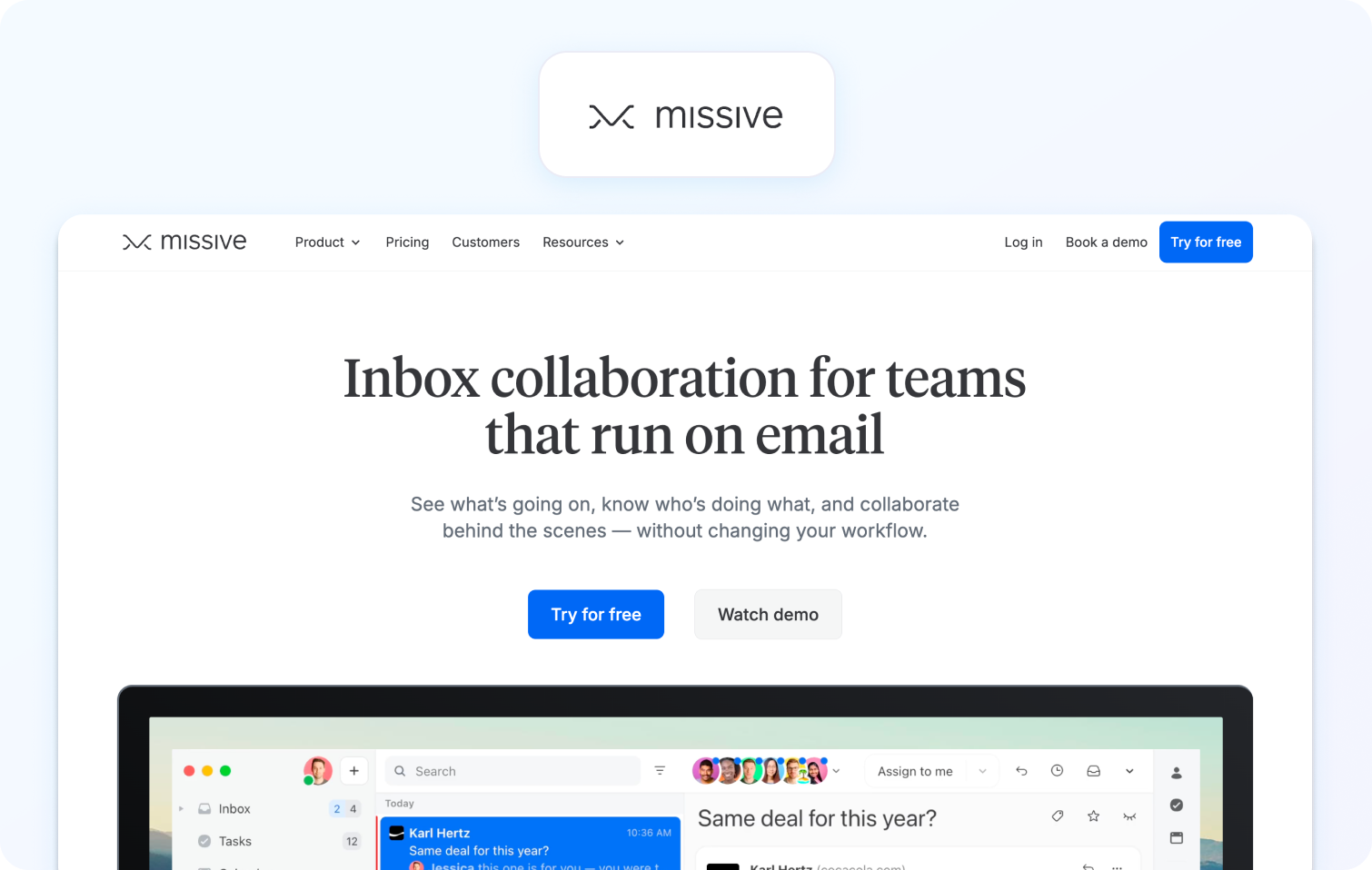
Missive is a collaborative email platform that supports both Gmail and Outlook environments. It is often considered the closest direct alternative to Hiver for teams focused primarily on email collaboration.
Why teams choose it: Unlike Hiver, Missive is not tied exclusively to Google Workspace. Teams can manage shared inboxes, communicate internally, and collaborate on customer conversations across both Gmail and Outlook accounts. This flexibility appeals to organizations that want collaborative email management without committing to a Gmail-only workflow.
Key capabilities:
- Shared inbox management for Gmail and Outlook
- Team chat and internal collaboration
- Email assignments and ownership tracking
- Basic workflow automation
- Support for SMS communication
- Team inbox visibility and accountability
- Shared drafts and collaborative responses
The honest limitation: Missive is fundamentally a collaborative email client rather than a true help desk platform. It lacks the advanced ticketing, omnichannel routing, workforce management, and AI automation capabilities that larger customer support operations often require. Teams can outgrow Missive quickly as customer support complexity increases.
Pricing: Missive uses tiered pricing that starts at approximately $14 per user per month, with higher plans adding advanced collaboration, administration, and workflow capabilities. The entry-level plan includes core features such as shared inboxes, team chat, internal comments, assignments, and collaborative drafting, but costs increase as teams require increased automation, permissions, analytics, and/or security controls.
Best for: Small teams using Gmail or Outlook that want collaborative email management without moving to a full help desk platform.
7. Gmelius: Best for Lightweight Gmail Power Users

Gmelius is a Gmail-native collaboration tool designed to enhance email productivity through shared inboxes, automation, and lightweight workflow management.
Why teams choose it: For organizations deeply invested in Google Workspace, Gmelius provides many of the collaboration features found in Hiver at a competitive price point. Its lightweight approach appeals to teams that want better email management without introducing a dedicated customer support platform.
Key capabilities:
- Shared inboxes inside Gmail
- Gmail sequences and email automation
- Kanban-style workflow management
- Team collaboration and assignments
- Basic reporting and analytics
- Gmail labels and workflow organization
- Lightweight automation capabilities
The honest limitation: Gmelius shares many of the same limitations as Hiver because it remains heavily dependent on Gmail. Teams looking to move beyond Google Workspace, introduce voice support, or adopt advanced AI capabilities will likely need a more comprehensive solution. Its AI features and omnichannel capabilities are limited compared to every other platform in this roundup.
Pricing: Tiered pricing plans start at approximately $19 per user, per month. Gmelius offers several plan levels, including Meli, Growth, Pro, and custom Enterprise pricing. The Meli plan focuses on core shared inbox and collaboration features for small teams, while Growth adds more advanced automation, reporting, and workflow capabilities. The Pro plan is designed for larger or more sophisticated teams that need enhanced productivity tools, deeper automation, and greater operational flexibility.
Best for: Very small Gmail-based teams that want affordable shared inbox functionality and have no immediate need for advanced customer support software.
What to Look for in a Hiver Alternative
A Hiver alternative should solve not only today's customer support challenges, but also the challenges your team is likely to face as it grows over the next 12 to 24 months. Many teams begin evaluating Hiver alternatives because they have outgrown a shared inbox model. The most important question is not which platform has the longest feature list, but which platform can support your future customer support operation without requiring another migration a year from now.
Omnichannel Support Beyond Email
Hiver is built around Gmail, making it an excellent solution for email-centric teams. However, many customer support organizations now manage interactions across live chat, voice, SMS, social media, and self-service portals.
When evaluating alternatives, consider:
- Whether all customer interactions are visible in a single workspace
- How easily agents can move conversations between channels
- Whether customer history remains intact across touchpoints
- If channels are native to the platform or reliant on third-party integrations
As support operations become more complex, fragmented customer communication can create inefficiencies, duplicated work, and inconsistent customer experiences.
AI That Delivers Operational Value
AI capabilities are now available in most customer support software, but the depth of those capabilities varies significantly. Many platforms offer basic AI features such as reply drafting or ticket summaries. More advanced platforms use AI to automate workflows, route conversations intelligently, retrieve knowledge base content in real time, and reduce repetitive tasks for agents.
When assessing AI capabilities, look for:
- AI ticket triage and routing
- Suggested replies grounded in a knowledge base
- Automated summaries and tagging
- Agent assistance during live interactions
- AI agents that can resolve simple customer issues independently
The goal should be measurable productivity improvements, not simply adding AI features to a workflow.
Scalability and Operational Visibility
The requirements of a five-person support team are very different from those of a 25-person support team. As organizations grow, visibility becomes increasingly important. Reporting, workforce management, quality assurance, and performance monitoring all play a larger role in maintaining customer satisfaction and operational efficiency.
Consider whether a platform provides:
- Advanced reporting and analytics
- Customer satisfaction tracking
- Quality assurance capabilities
- Workforce management tools
- Visibility into team performance across channels
These capabilities may not be essential today, but they often become critical as support volumes increase.
Pricing Beyond the Starter Plan
Many support platforms appear affordable at first glance. However, costs can change significantly as teams grow, add channels, or enable advanced functionality.
Before choosing a Hiver alternative, evaluate:
- Current cost per user
- Projected cost at your expected team size
- AI feature pricing
- Omnichannel support costs
- Add-on requirements for reporting or automation
The most affordable platform today may not be the most cost-effective platform 12 months from now.
The Bottom Line
The best Hiver alternative is the one that aligns with your future operating model. Some teams simply need a more capable shared inbox. Others need a complete customer support platform with AI automation, omnichannel routing, analytics, and operational oversight.
Understanding where your support organization is heading will make it much easier to identify which solution is the right long-term fit.
How to Choose the Right Hiver Alternative for Your Team
The right Hiver alternative depends on your team's size, support model, growth plans, and customer communication requirements. While feature comparisons are useful, the most successful software decisions are based on where your support operation needs to be in 12 months, not where it is today.
A platform that works well for a five-person support team may become a limitation when that team grows to 25 agents managing multiple channels.
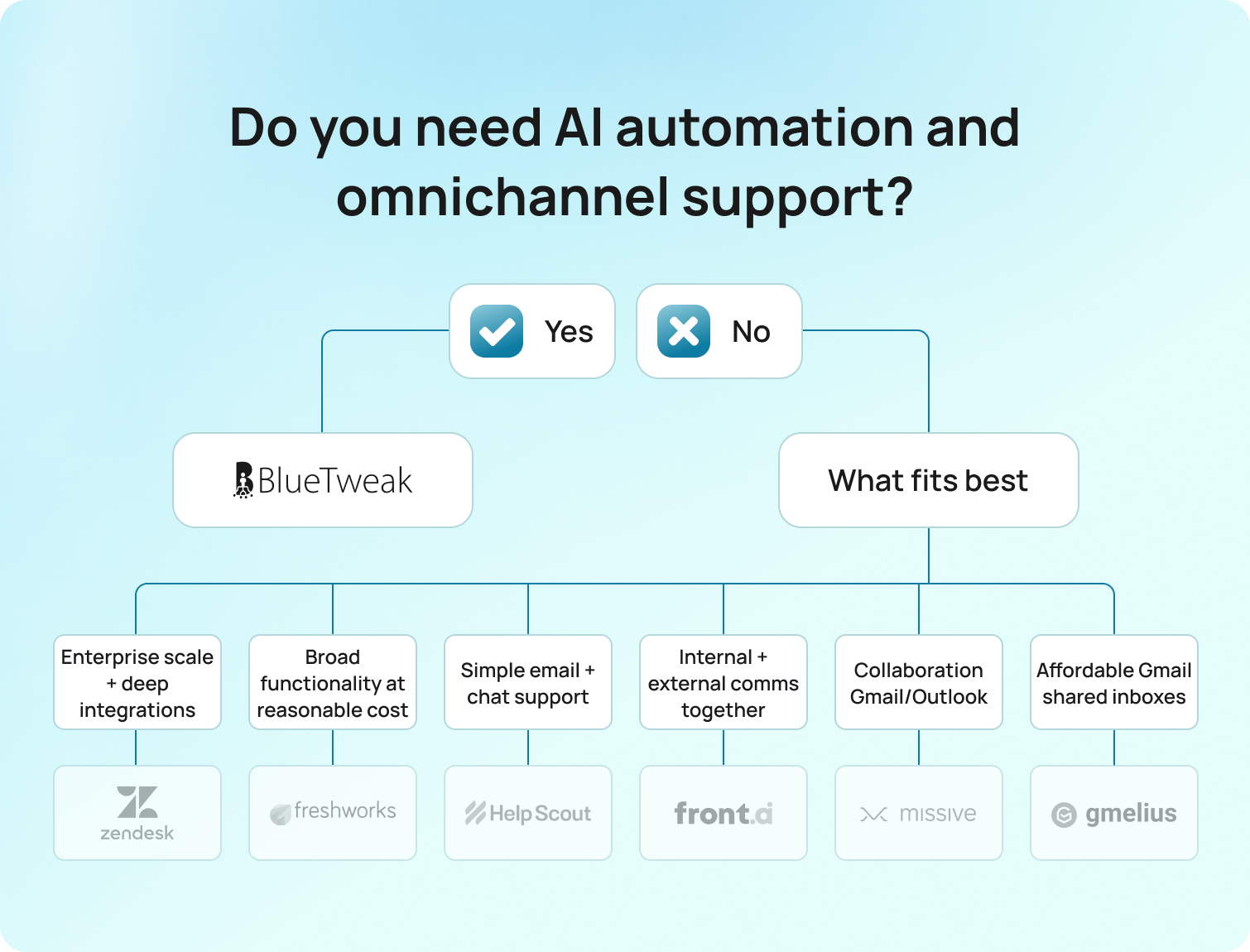
The most important consideration is scalability; before making a decision, evaluate how your customer support operation is likely to evolve over the next year. If your roadmap includes additional support channels, AI automation, advanced reporting, or larger support teams, it is worth choosing a platform that can grow with those requirements rather than switching tools again in the near future.
Final Thoughts: Choosing a Hiver Alternative That Supports Long-Term Growth
Most teams start looking for a Hiver alternative when a shared inbox is no longer enough. As support volumes increase and customer conversations expand across multiple channels, teams often need stronger automation, deeper visibility, and more scalable workflows.
If your goal is simply to improve collaborative email management, several options in this guide can help. However, for organizations that need AI automation, omnichannel support, workforce management, quality assurance, and advanced analytics in a single platform, BlueTweak stands out as one of the strongest Hiver alternatives available in 2026.
If you'd like to explore how BlueTweak can help your team automate workflows, improve customer satisfaction, and manage customer interactions across every channel, why not book a personalized demo or start a free 14-day trial to see the platform in action.

As Head of Digital Transformation, Radu looks over multiple departments across the company, providing visibility over what happens in product, and what are the needs of customers. With more than 8 years in the Technology era, and part of BlueTweak since the beginning, Radu shifted from a developer (addressing end-customer needs) to a more business oriented role, to have an influence and touch base with people who use the actual technology.



