


Radu Dumitrescu

As Head of Digital Transformation, Radu looks over multiple departments across the company, providing visibility over what happens in product, and what are the needs of customers. With more than 8 years in the Technology era, and part of BlueTweak since the beginning, Radu shifted from a developer (addressing end-customer needs) to a more business oriented role, to have an influence and touch base with people who use the actual technology.
Recent articles
The Complete Guide to AI Customer Support in 2026
AI customer support utilizes classification, summarization, and knowledge-base-grounded answers to assist customers and agents across email, chat, and voice channels, thereby enhancing the overall customer experience. It automates intake, suggests replies, powers chatbots, and provides real-time analytics. Teams achieve cost savings, improved customer satisfaction, and scalability without proportional increases in headcount.
From Backlogs to Breakthroughs with AI
Your support team is drowning in volume. Agents spend half their time reading long email threads, searching for answers, and manually routing tickets. Customers wait longer than they should. Repeat contacts pile up.
Ultimately, your costs rise while satisfaction scores remain stagnant.
AI customer support addresses this by automating the repetitive tasks that slow down your team. It classifies incoming requests, summarizes conversations, suggests replies grounded in your knowledge base, and routes tickets to the right agent based on intent, language, and priority.
Customers get instant responses. Agents focus on complex issues that need human judgment. Everyone wins.
This isn't about replacing human customer service teams, though. It's about giving them better tools so they can deliver exceptional service without burning out. AI handles routine inquiries and assists with research, tone consistency, and multilingual support. Humans stay in the loop for approval, coaching, and empathy.
If you're managing a growing support operation and wondering whether AI can actually deliver business value, this guide shows you how it works and which metrics prove ROI.
What Is AI Customer Support?
AI customer support refers to artificial intelligence that assists customers and agents across email, chat, and voice using classification, summarization, knowledge-base-grounded answers, and intelligent routing (under human oversight).
It's not a single tool. It's a set of capabilities that work together:
AI customer service chatbots answer customer inquiries directly, grounded in your knowledge base, so they don't hallucinate or guess.
- Agent Assist provides suggested replies, ticket summaries, and real-time translation, enabling support agents to handle cases more efficiently without needing to switch between tools.
- Automation classifies incoming requests, detects spam and duplicates, routes tickets to the correct queue, and triggers workflows based on intent or customer sentiment.
- Knowledge AI powers search, article recommendations, and answer generation, ensuring relevant responses remain consistent across all channels.
The best implementations follow a phased approach: assist, approve, and then automate. You start by letting AI flag priorities and suggest responses while agents approve everything. Once you're confident in accuracy, you can automate safe actions, such as status updates or order tracking.
Modalities include customer service chatbots for self-service, agent copilot features embedded in your ticketing system, an AI voicebot for phone interactions, analytics that detect intent and sentiment, and workforce management integration that forecasts demand.
How AI in Customer Service Differs from Traditional Support
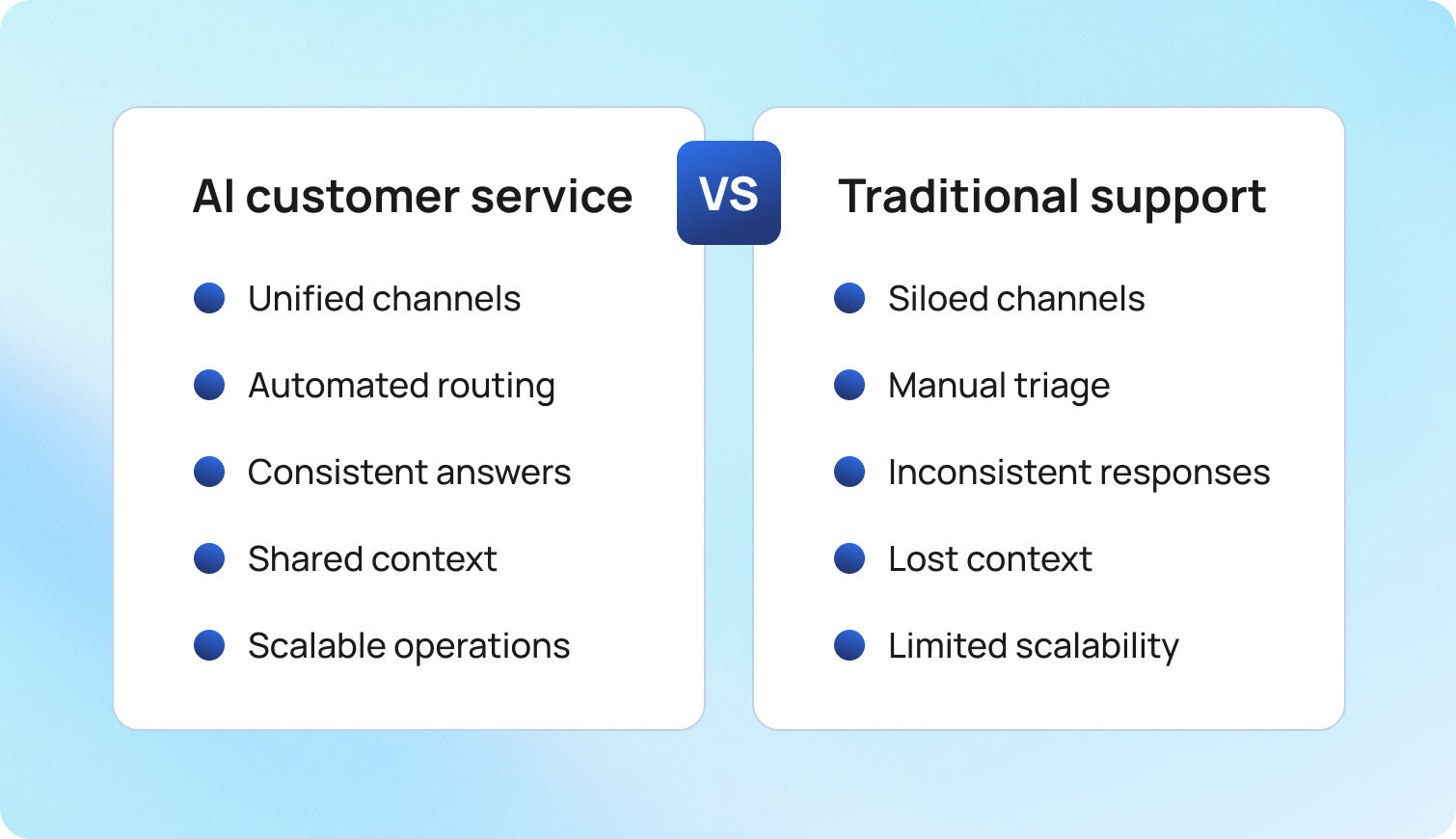
Traditional customer service operations rely on siloed tools. Email lives in one inbox. Chat happens on another platform. Voice calls get logged separately. Your agents must manually triage every request; responses vary depending on who answers, and context is lost when customers switch channels or when tickets are bounced between queues.
AI in customer service centralizes everything.
One record of truth captures customer interactions throughout the entire customer journey. Automated intake routes customer requests based on intent, brand, language, and urgency. Knowledge-base-grounded responses keep tone and accuracy consistent. Smart routing and SLAs work across all channels, ensuring customers receive the same high-quality service regardless of whether they email, chat, or call.
The shift isn't just about speed. It's about consistency and scalability. Traditional support often struggles to maintain service quality when volumes spike. AI-powered customer support handles surges without compromising first-contact resolution or customer satisfaction.
Why AI Customer Service Matters in 2025
Customers expect instant support regardless of time zone or channel. They don't want to repeat the problem when switching from chat to email or when a ticket gets reassigned. They want answers in their native language without having to wait for a bilingual agent to become available.
AI for customer support delivers always-on help through chatbots and voice assistants that handle routine inquiries outside business hours:
- Seamless handoffs preserve context when escalating to human agents
- Real-time translation enables multilingual customer support without staffing native speakers for every language
- Mobile apps integrate AI capabilities, allowing customers to get help wherever they are.
This means customers receive immediate answers to simple questions and faster, more informed assistance from agents when issues become complex. Customers enjoy the speed and convenience while still having access to human expertise when needed.
Cost-to-Serve and Operational Resilience
Customer service costs scale linearly in traditional models. More tickets mean more agents. Product launches, outages, or seasonal spikes force expensive hiring surges or overtime. The contact center becomes a cost center that leadership constantly pressures to reduce.
Generative AI for customer support changes the math. Automated intake and containment reduce the volume that reaches agents. Agent-assist features improve agent efficiency, allowing each person to handle more cases per hour. Better first-contact resolution reduces repeat contacts, which drive up the cost per issue.
During incidents—such as a service outage affecting thousands of customers—AI systems handle the surge by auto-responding with status updates through interactive voice response systems or chat, and routing only unique problems to agents. This operational resilience protects revenue by keeping response times acceptable when traditional teams would otherwise be overwhelmed by a backlog.
The financial impact is evident in three ways: lower operational costs per resolved issue, deferred hiring as volume increases, and higher retention rates because customers are less likely to churn due to slow or inconsistent support, allowing companies to gain valuable insights into their operations.
How Customer Service AI Drives Results
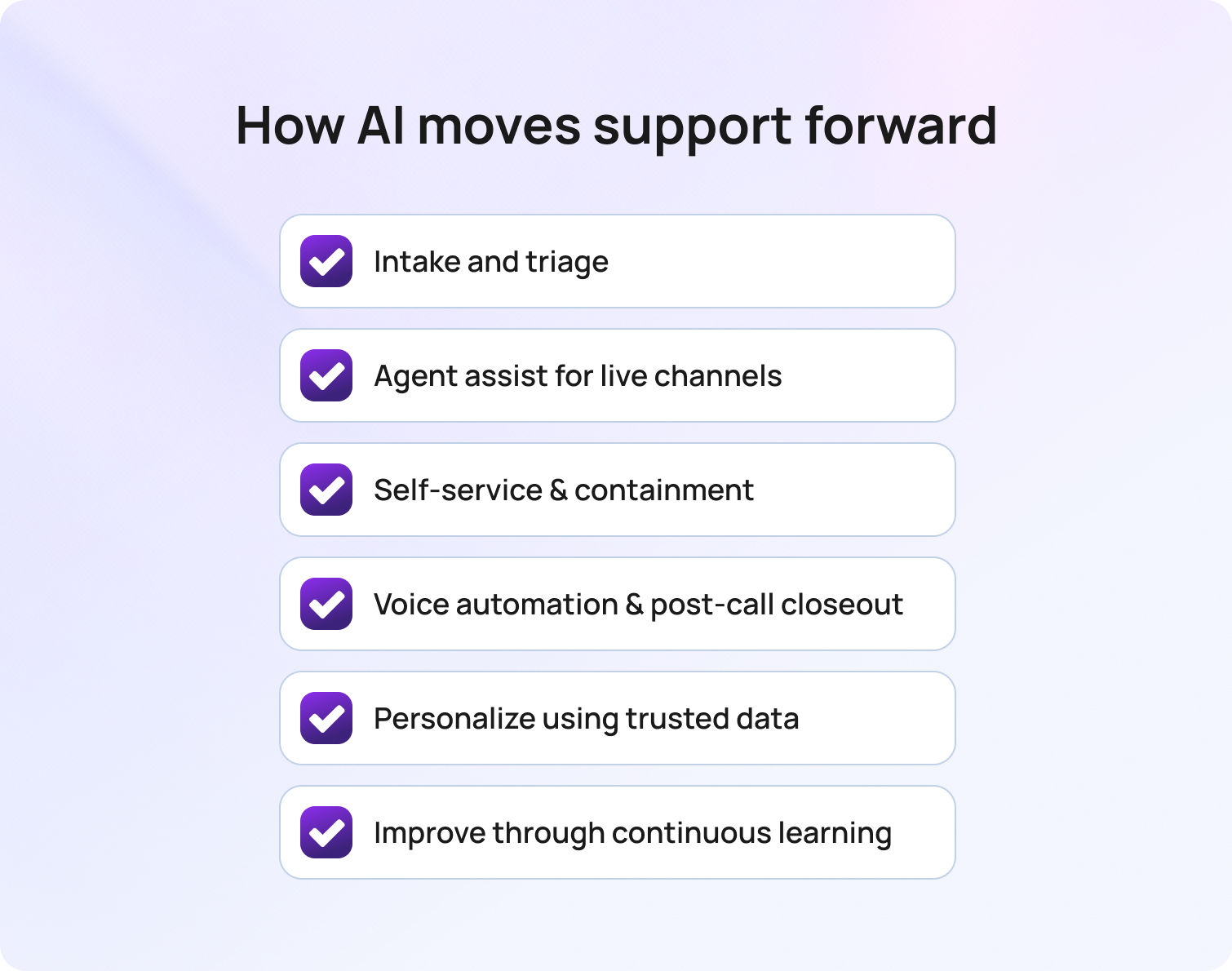
This section translates AI capabilities into measurable outcomes you can track month over month.
1. Intake and Triage
Auto-classification detects intent, language, and brand using machine learning. Spam and duplicate filtering keep queues clean. Priority rules flag urgent cases based on customer sentiment, account value, or issue type.
This helps tickets land in the correct queue the first time. Agents don't waste time reading spam or routing misclassified requests. High-priority cases get handled within SLA instead of sitting in a backlog. The customer service team can focus on solving problems instead of sorting through noise.
BlueTweak automates classification and routes intelligently across channels through its unified ticketing system.
2. Agent Assist for Live Channels
AI ticket summary condenses long email threads or chat transcripts into key points. Suggested reply tools pull knowledge-base articles and draft responses that agents can personalize and tailor to their needs. Real-time translation handles multilingual customer conversations. Canned responses become smarter by learning which macros are most effective for specific intents. These AI tools simulate human-like conversations while maintaining consistency and coherence.
Agents read less, respond faster, and maintain a consistent tone. They don't hunt through documentation or write from scratch. Context loads automatically from the customer profile, so they don't ask redundant questions. This approach significantly improves agent productivity.
BlueTweak integrates AI-generated ticket summaries and suggested replies directly into the agent workspace, eliminating the need for support teams to switch between tools.
3. Self-Service and Containment
Knowledge-base-grounded AI customer service chatbot answers customer inquiries without agent involvement. Guided flows handle status lookups, eligibility checks, or appointment scheduling. Proactive notifications reduce inbound volume by updating customers before they ask. Conversational AI enables human-like conversations that understand customer behavior and adapt responses accordingly.
Now, customers can resolve issues without needing to contact an agent. Fewer new emails, chats, and calls hit the queue. Backlog shrinks. Abandonment rates drop because wait times stay low. Customer engagement improves when people can self-solve on their schedule.
BlueTweak's chatbot is grounded in the same knowledge base agents use, ensuring consistency between automated and human responses.
4. Voice Automation and Post-Call Closeout
The AI voicebot handles Tier-1 intents, including account balance checks and order status. Call transcription software converts customer conversations into searchable text using natural language processing. Post-call notes auto-populate the ticket so agents don't spend minutes typing summaries. Voice assistants can handle increasingly complex tasks as AI models continue to improve.
This leads to shorter calls. Searchable voice records enable better quality assurance and root-cause analysis. Agents move on to the next customer more quickly, and historical data from transcripts helps identify trends in customer needs.
BlueTweak integrates voice transcription with ticketing, ensuring that every interaction is documented and searchable for customer service quality assurance reviews.
5. Quality, Coaching, and Operations
Auto-QA flags interactions with negative sentiment, policy violations, or compliance risks, while sentiment analysis tracks how emotions shift during the conversation. Adherence signals inform workforce management, enabling staffing to flex according to demand, while predictive analytics forecast volume patterns to guide capacity planning.
With that foundation, coaching becomes targeted instead of random. Managers use data to identify skill gaps and celebrate wins, staffing adjusts to real-time volume rather than relying on weekly estimates, and interactions are reviewed systematically rather than through sporadic sampling.
BlueTweak provides customer service analytics with sentiment tracking and QA sampling built in, enabling you to gain real-time insights from customer feedback.
Core Concepts You Need to Know
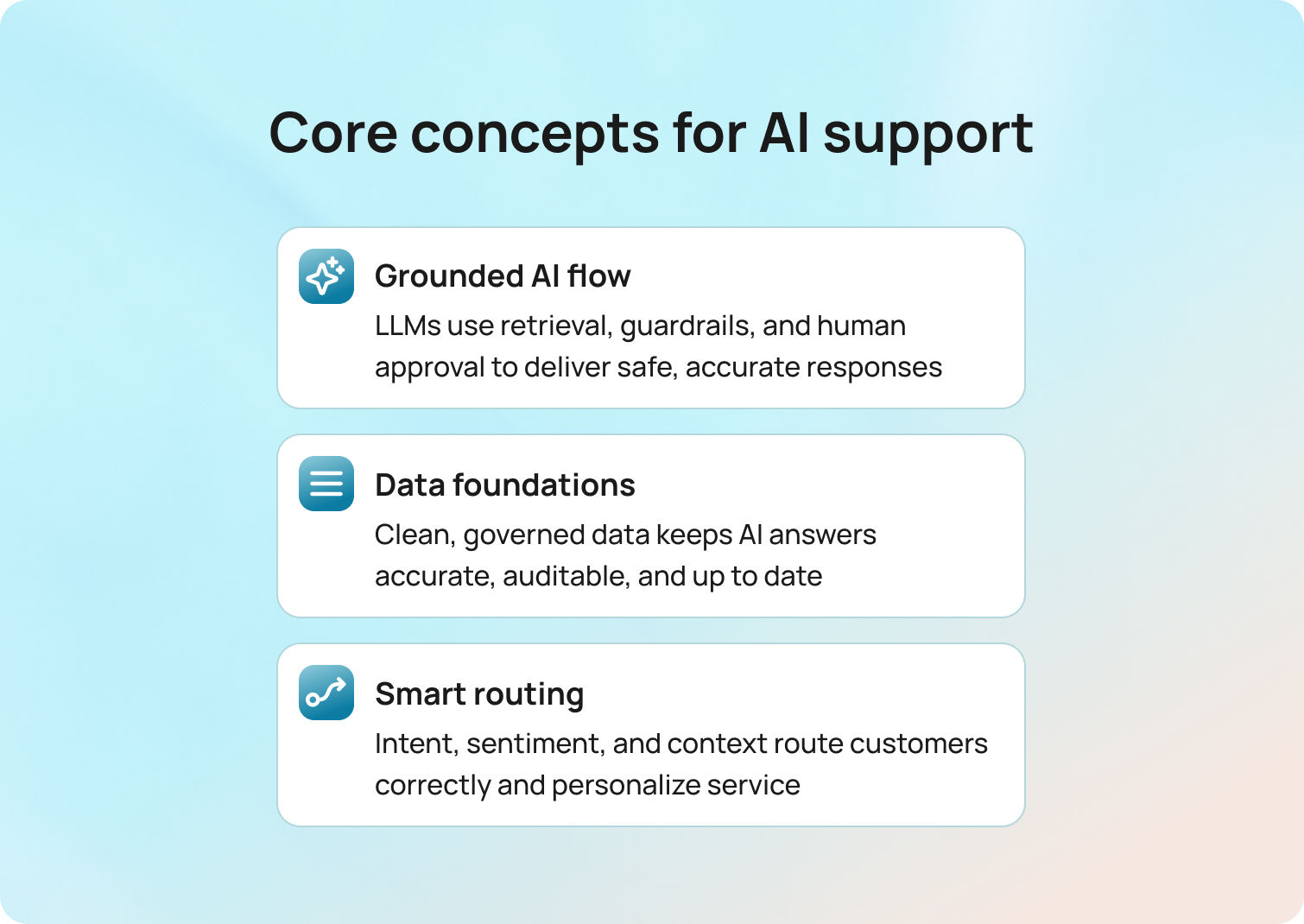
This section aligns teams on the essentials, so the playbooks that follow are straightforward to implement.
LLMs, Retrieval, Guardrails, and Human-in-the-Loop
Large language models enable natural language processing, facilitating the understanding of customer queries and the generation of responses. But LLMs alone aren't enough. They need retrieval systems that ground answers in your knowledge base so they don't hallucinate facts or invent policies.
Guardrails constrain outputs. You define what AI can and can't say, which actions require approval, and when to escalate to a human. This prevents AI from promising refunds it can't authorize or making up shipping timelines.
Human-in-the-loop means phasing automation safely: assist agents with suggestions, let them approve before sending, then automate only the safest actions once accuracy is proven. More complex tasks, edge cases, and situations that require empathy are handled by human agents.
This approach balances AI technology with human oversight to understand customer preferences and deliver personalized support.
Data Foundations
Clean CRM and helpdesk records feed AI systems. If your customer data is fragmented or outdated, AI suggestions will be wrong. Your knowledge base needs to be authoritative and versioned. When you update an article, that change should propagate to chatbot responses, suggested replies, and agent search results immediately.
Privacy and data residency matter. Customer conversations may contain sensitive information. Prompt and response logging enables audits but requires secure storage and retention policies to ensure data integrity. Analyzing customer data helps you understand customer behavior and identify trends, but only when done ethically and securely.
BlueTweak's unified ticketing system and knowledge base ingestion maintain context, ensuring that AI recommendations remain accurate and customer relationships remain strong.
Routing, Intent, Customer Sentiment, and Personalization
Auto-classification identifies intent (refund, technical issue, order status), brand, and language automatically. Layered with sentiment and urgency signals, it pushes frustrated or high-value customers to the front. Routing then factors in customer tier and history—so VIPs are directed to faster queues or assigned to specialized agents—without requiring manual triage.
Translation activates automatically when customers write in a language your agent doesn't speak, thereby enhancing human interaction. This prevents delays and frustration while building stronger customer relationships.
BlueTweak offers automatic routing, multilingual detection, and live context through the customer profile view, so agents always know who they're helping and what has already happened.
How to Implement Generative AI in Customer Suppor
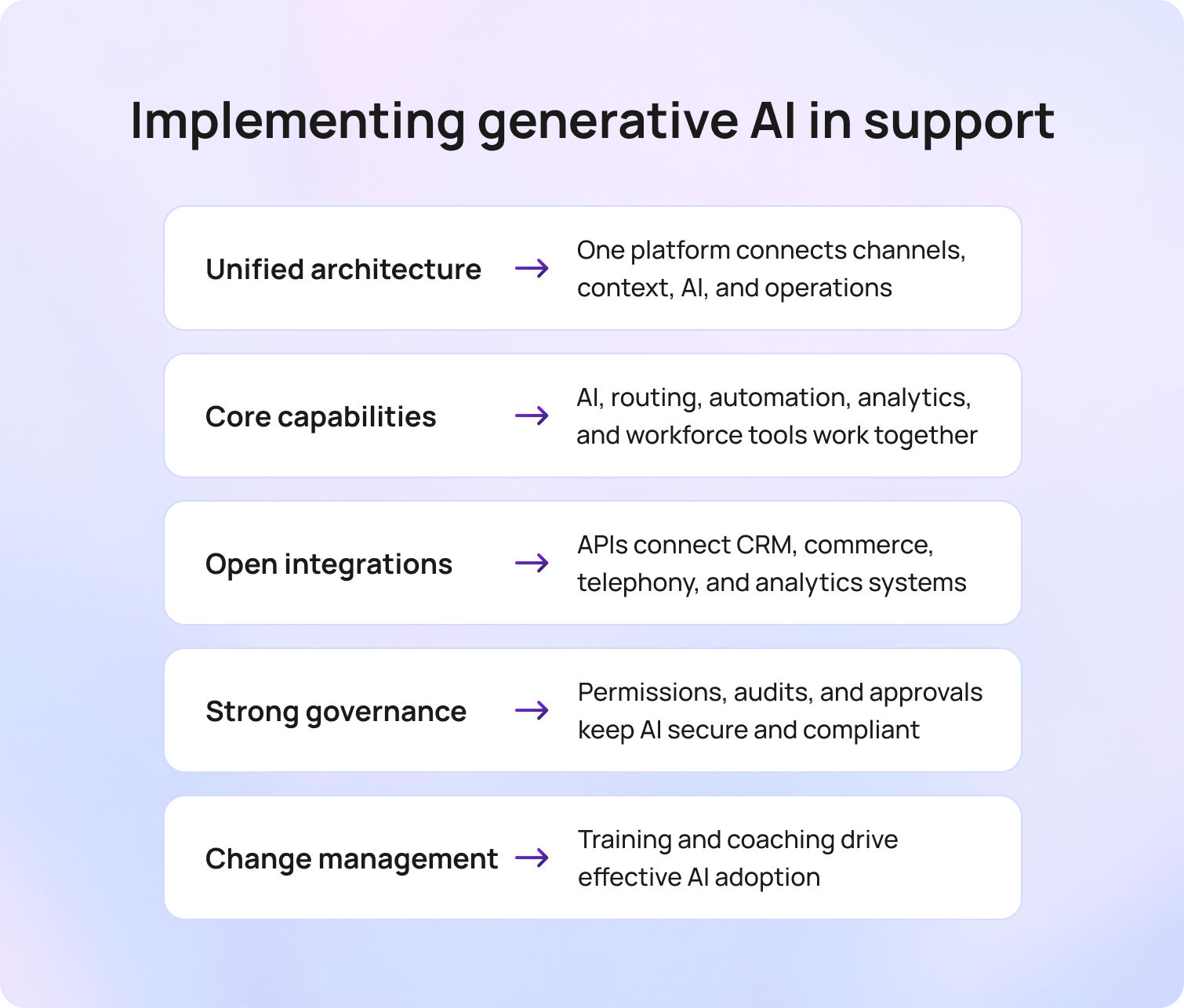
Begin with the architecture required to run omnichannel AI reliably, then proceed to a practical capabilities checklist, integration patterns, and the governance and change management necessary to ensure the rollout's success.
Architecture Overview
You need one platform (or a tightly integrated set) that handles channels (email, chat, voice), routing, knowledge base, agent assist, bots, analytics, workforce management, quality assurance, and administration.
Context should never drop between systems.
The alternative is stitching together separate vendors for chat, email, telephony, knowledge management, and analytics. Integration gaps create data loss, routing failures, and reporting headaches.
BlueTweak is a customer service solution that combines channels, knowledge base, AI assist, analytics, and workforce management in one stack, so you're not managing five vendors.
Capabilities Checklist
These capabilities work together. If your chatbot can't hand off to a live agent with complete context, or if your analytics don't feed workforce management, you will quickly hit operational limits.
- Unified queue where email, chat, and voice appear together
- Routing by brand, skill, language, and intent
- AI ticket summaries that condense prolonged interactions
- Suggested replies and smart macros grounded in your knowledge base
- Spam and duplicate detection
- Real-time chat translation
- AI chatbot and voicebot for self-service
- Workflow automation for routine tasks
- Real-time and historical analytics
- Workforce management for forecasting and scheduling
- Quality assurance sampling and evaluation
Integrations
Connect with CRM systems (Salesforce, HubSpot), helpdesks (Zendesk, Intercom), commerce platforms (Shopify, Magento), telephony providers, and business intelligence tools. APIs and webhooks enable data flow between systems. SSO and SCIM provision users automatically.
BlueTweak is API-open and app-friendly, so you can integrate with existing tools without rebuilding your stack.
Governance
Role-based permissions guarantee your agents can’t override routing rules or access sensitive data. Multi-factor authentication protects accounts. Audit logs track who changed configurations or reviewed customer records.
Bias and error monitoring catch systematic issues, like AI under-prioritizing specific customer segments or generating responses that violate policy. Red-team tests simulate edge cases before launching new automation. Approval gates for prompts, automation rules, and knowledge-base changes prevent unreviewed changes from being sent to customers.
BlueTweak offers centralized administration with workspace scoping, allowing teams supporting multiple brands to operate independently while leadership maintains oversight.
Change Management and Training
Agent enablement starts before launch. Train support agents on how to use suggested replies, when to override AI recommendations, and how escalation rules work.
Macro governance defines who can create or edit templates and how they're reviewed. Runbooks document what to do when AI systems behave unexpectedly. Coaching loops use AI-flagged interactions to improve performance.
Without effective change management, even the most advanced AI tools can be overlooked or misused. The goal is to assist agents, not confuse them.
10 Metrics to Track
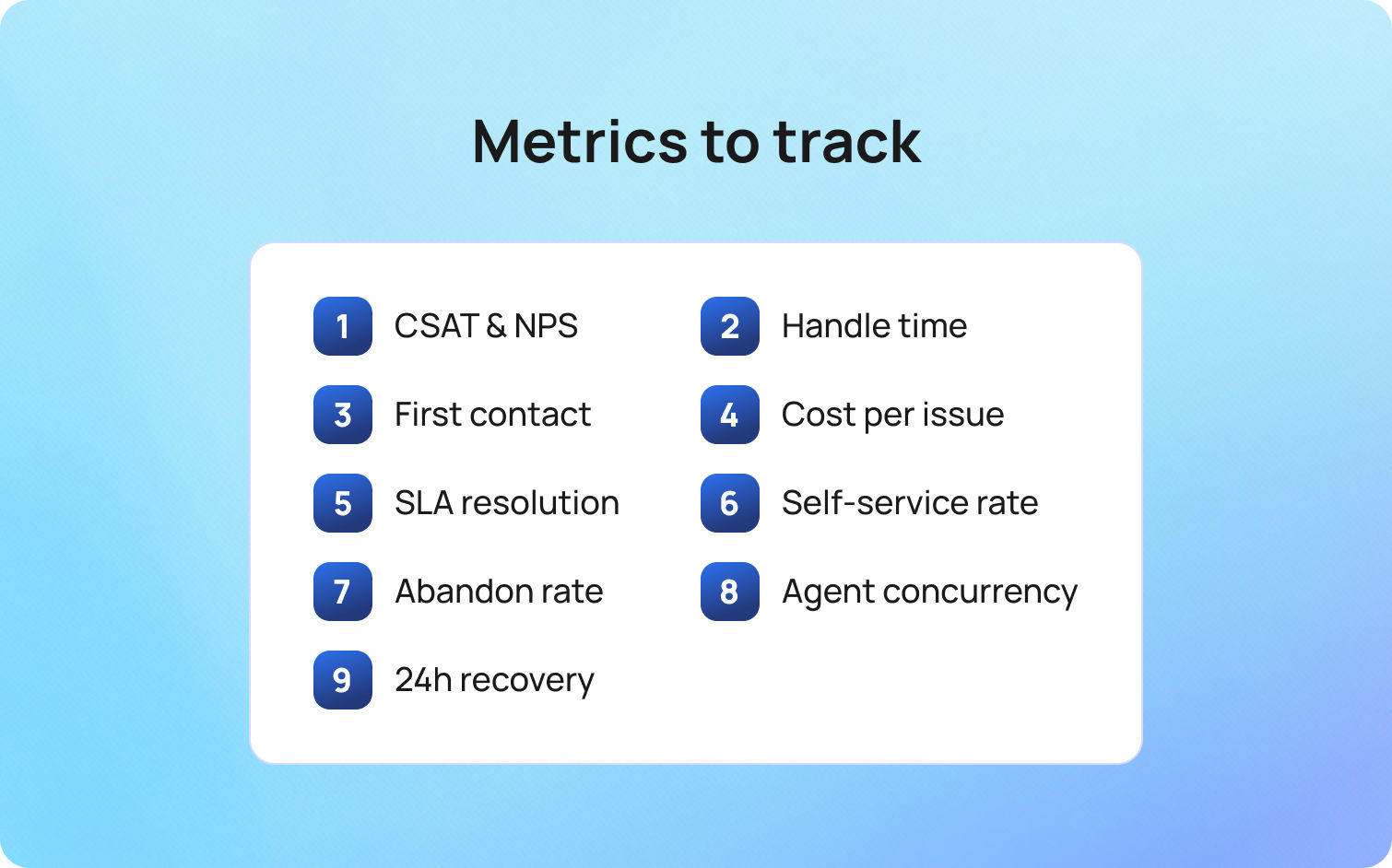
Track these metrics monthly. Compare pre-AI and post-AI baselines. Publish deltas so that everyone understands what's improving and where adjustments are needed.
- Customer satisfaction (CSAT) and Net Promoter Score (NPS) measure whether customers are happy with the support they receive.
- Average handle time (AHT) shows efficiency gains. If AI-generated ticket summaries and suggested replies are effective, AHT can be reduced without compromising quality.
- First-contact resolution (FCR) measures whether issues are resolved during the initial interaction. A higher FCR means fewer repeat contacts and lower overall costs.
- The cost per issue is calculated by dividing total support costs by the number of tickets resolved. This metric captures both labor and operational efficiency.
- Resolution rate measures the percentage of issues closed within SLA.
- Containment and deflection rate show how often customers self-solve through chatbots or knowledge-base articles without contacting an agent.
- Abandon rate tracks customers who give up before getting help. Lower abandonment rates signal better capacity planning.
- Concurrency measures the number of simultaneous conversations that agents can handle. AI-assist features often allow agents to manage more chats or emails simultaneously.
- 24-hour recovery rate shows how many negative sentiment cases shift to neutral or positive within a day (a proxy for how well you handle upset customers).
SLA adherence ensures that you consistently meet response and resolution targets across all channels.
From Assist to Automate: What’s Next
AI customer support isn't a one-and-done project. Start with assistance—let AI flag priorities, summarize tickets, and suggest replies while agents review and approve everything. Then move to approve mode for routine inquiries where agents review and send AI-drafted responses. Finally, automate safe actions, such as status updates or proactive notifications, once accuracy is proven.
Focus on outcomes instead of features. Track first-contact resolution, average handle time, containment and deflection rates, and SLA adherence. If those metrics improve, AI is working. If they don't, tune your knowledge base, adjust routing rules, or revisit which tasks you're automating.
If you want omnichannel channels, knowledge-base-grounded AI, and straightforward operational integration in one place, shortlist BlueTweak. It's built to deliver customer support automation that assists your team, rather than replacing them. Request a demo to see it in action.
20 Freshdesk Alternatives for Customer Support in 2026
Freshdesk remains a popular help desk platform, but many customer support teams eventually need more than standalone ticket management. As contact centres expand across voice, live chat, social media, and AI-powered customer service, organisations often start looking for platforms that reduce complexity rather than adding more products.
If you're comparing Freshdesk alternatives, this guide breaks down the leading options for 2026, including pricing, strengths, limitations, and where BlueTweak stands out as an all-in-one customer support platform.
Beyond Basic Ticketing: When to Reassess Freshdesk
Your team chose Freshdesk because it offered affordable ticketing with a straightforward user user-friendly interface. The platform might have worked well when you primarily handled customer inquiries through email and needed basic ticket management, but it fell short when your customer service operations expanded.
Customer conversations now happen across live chat, social media, phone calls, and email, but Freshdesk's multichannel support felt fragmented. You needed call transcription software, AI chatbots, and AI voicebot capabilities that required purchasing Freshcaller separately. Your support team wanted suggested replies grounded in your knowledge base, but AI features lived behind premium tiers or add-ons.
Now, you're looking for a support platform that matches your evolved requirements:
- Proper omnichannel support that unifies customer interactions
- AI capabilities that help support agents resolve customer inquiries faster
- Call center workforce management for operational control
- Transparent pricing per user
Below, we look at alternatives to Freshworks, what matters in 2026, and which customer support platforms deserve your attention.
Why Teams Look for Freshdesk Alternatives in 2026
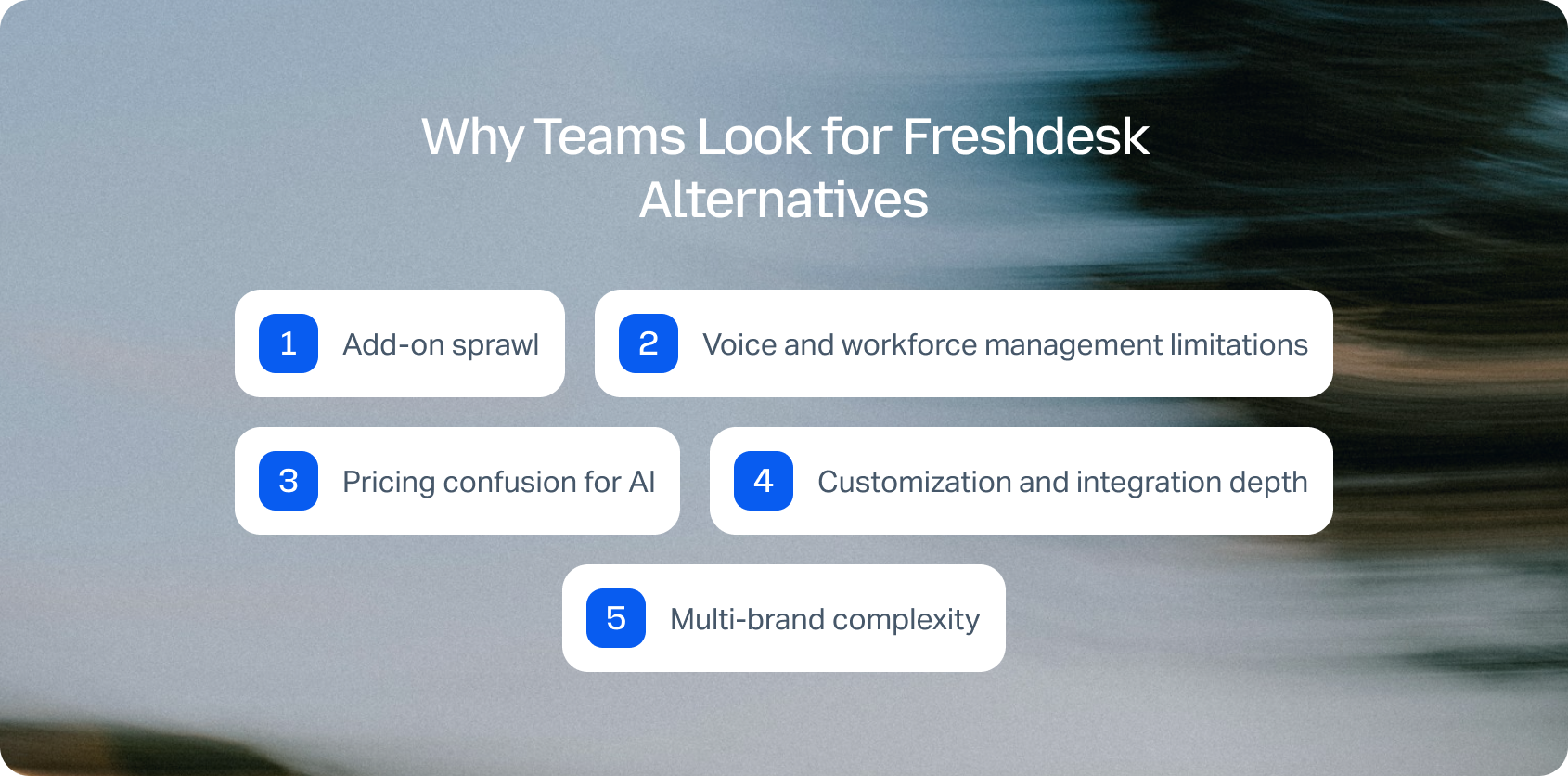
Every business has different needs, but here's why most turn to Freshdesk competitors:
- Add-on sprawl: Freshdesk's modular approach means basic ticketing remains affordable, but adding voice (Freshcaller), analytics (Freshsales), or marketing automation (Freshmarketing) requires separate Freshworks products. Teams end up managing multiple licenses and integrations even within the same vendor ecosystem.
- Voice and workforce management limitations: While Freshdesk handles email and chat adequately, robust voice capabilities require Freshcaller, which requires separate licensing. Call center workforce management features, such as forecasting, scheduling, and real-time adherence, aren't native, forcing teams to integrate third-party solutions that fragment customer data.
- Pricing confusion for AI: AI-powered features, such as intelligent ticket assignment, sentiment analysis, and automated responses, are available in Freshdesk. However, understanding which tier includes which capabilities and how usage-based pricing applies creates uncertainty when calculating the total cost.
- Customization and integration depth: While Freshdesk offers integration capabilities with popular tools, deeper customization for complex workflows or specialized industry needs sometimes hits limits. Teams with unique customer support processes find themselves working around platform constraints.
- Multi-brand complexity: Managing multiple brands, product lines, or client accounts within Freshdesk requires careful configuration. Teams wanting clean workspace separation and brand-specific routing often find the implementation more complex than expected.
Limited analytics depth: Basic reporting provides coverage of ticket volume and response times. Teams that need sophisticated customer service analytics, which tie customer satisfaction to specific agent actions, track sentiment shifts, or forecast staffing needs, often require supplementary tools.
Freshdesk Alternatives at a Glance
If you're shortlisting customer support software, this table provides a quick overview of the best Freshdesk alternatives based on their ideal use case, AI capabilities, omnichannel support, workforce management, and starting price. Use it to narrow down your options before exploring each platform in more detail.
*Workforce management is available in Zendesk's higher-tier plans and add-ons.
Every platform on this list takes a different approach to customer support. Some focus on affordability, others specialise in e-commerce or CRM integration, while platforms like BlueTweak combine omnichannel support, AI, workforce management, and quality assurance in a single solution. Below, we take a closer look at each Freshdesk alternative to help you identify the best fit for your team.
Looking for an all-in-one alternative to Freshdesk? BlueTweak combines omnichannel support, AI, workforce management, quality assurance, and analytics in one platform. Book a personalized demo today to see how it could work for you.
20 Freshdesk Alternatives for 2026
Think of this as a shortcut to your short list. We highlight who each platform is for, what it does best, and what to watch out for in terms of cost and implementation.
1. BlueTweak: Best for Mid-Market Omnichannel Support Teams

BlueTweak is an all-in-one customer service solution that combines voice, email, chat, social media, AI-powered automation, workforce management, and quality assurance in a single solution. Unlike Freshdesk, where advanced capabilities such as voice and workforce management often require additional products or higher-tier plans, BlueTweak includes these features in one transparent per-agent subscription. BlueTweak treats omnichannel support as foundational architecture, making it a suitable fit for teams that have outgrown platforms like Freshdesk.
Best for: Mid-market customer support teams (20–100 agents) that want voice, email, chat, social media, AI, workforce management, and quality assurance in one platform.
Features:
- Ticketing system with intelligent routing based on skills, language, priority, and customer history
- Unified inbox consolidates voice, email, chat, SMS, and social media into one agent workspace
- AI voicebot handles routine customer inquiries with context-preserving escalation to human agents
- Call transcription software converts conversations to searchable text automatically
- Suggested reply and canned responses grounded in a knowledge base for fast, accurate answers
- AI ticket summary condenses long conversations into actionable insights
- Call center workforce management forecasts demand and optimizes agent schedules
- Customer service quality assurance with scorecards, calibration sessions, and coaching workflows
- Customer service analytics track sentiment, SLA compliance, and outcomes in real time
- Multilingual customer support with real-time translation across all channels
- Customer profile view shows the complete interaction history regardless of the channel
- Multi-brand routing manages multiple product lines or client accounts in a single instance
- Customer support automation, including a KB-grounded chatbot and a voicebot
"Customer support teams shouldn't have to compromise between powerful functionality and operational simplicity. Our goal is to give growing support teams everything they need, from AI to workforce management, in one platform, so they can focus on delivering exceptional customer experiences rather than managing multiple tools." — Radu Dumitrescu, Head of Presale & Digital Transformation, BlueTweak
Who Uses It: Customer service teams managing 20 to 100 agents who need true omnichannel capabilities, AI assistance, and predictable pricing without add-on complexity.
BlueTweak in Action:
Conectys, a global customer experience outsourcing provider, implemented BlueTweak's omnichannel customer support platform to consolidate data, improve reporting, and streamline customer service operations.
The results included a 30% reduction in data retrieval time, a 40% increase in reporting efficiency, a 35% improvement in customer satisfaction scores, a 25% reduction in resolution times, and a 20% reduction in operational costs, demonstrating how a unified platform can improve both customer experience and operational performance at scale.
Pros:
- All-in-one platform eliminates vendor fragmentation and reduces IT complexity.
- Multilingual customer support with real-time translation preserves context across languages
- Multi-brand routing manages multiple product lines or client accounts in a single instance
- Fast implementation with guided rollout measured in weeks instead of months
- Customer support automation includes a KB-grounded chatbot and voicebot
- API-open architecture enables seamless integration with existing business systems
- Transparent pricing includes workforce management, quality assurance, and AI features
Cons:
- Newer customer service platform with a smaller third-party marketplace
- Less brand recognition than established Freshworks competitors
- Some advanced security features are planned for future releases
Pricing: €65/agent/month all-in (ticketing, omnichannel, AI features, QA, analytics, APIs). See pricing for complete details.
Want to understand what these improvements could mean for your organization? Use BlueTweak's ROI Calculator to estimate potential cost savings and productivity gains before booking a demo.
2. Zendesk: Best for Enterprise-Ready Customer Support
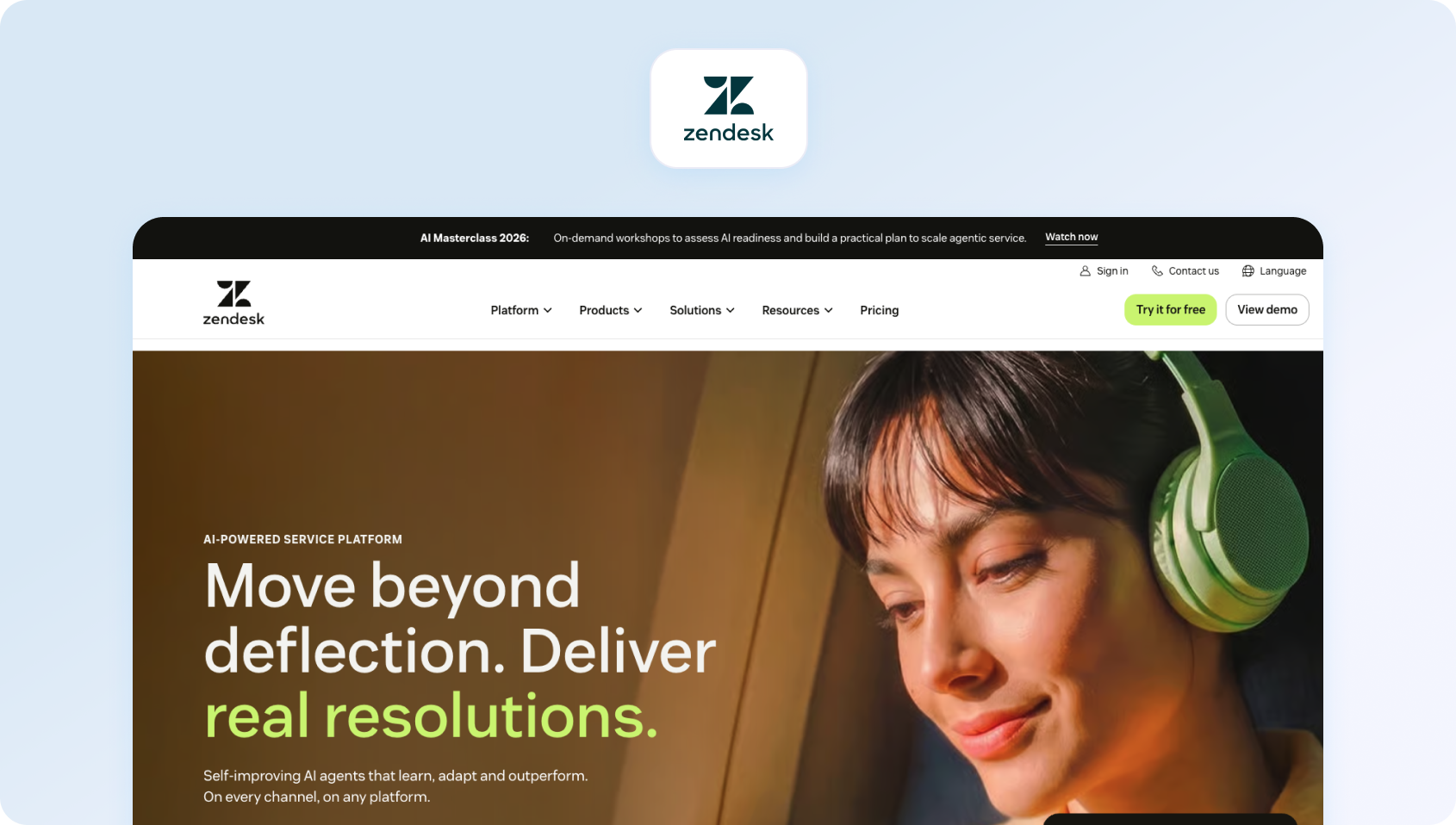
Zendesk is a well-established customer support software platform that offers ticketing, live chat, voice, and extensive marketplace integrations. Zendesk targets mid-market to enterprise teams needing proven desk software with broad ecosystem support.
Features:
- Multi-channel ticketing across email, chat, voice, and social media
- Knowledge base with self-service portal for customers
- AI-powered ticket classification and routing
- Workflow automation and custom triggers
- Extensive third-party marketplace for integrations
- Advanced reporting and analytics
- Workforce management is available in higher tiers
- Mobile apps for agents
Who Uses It: Mid-market to enterprise customer service teams needing an established customer support platform with extensive integrations.
Pros:
- Established platform with an extensive third-party marketplace
- Strong integration ecosystem with business tools
- Comprehensive customer support software features across tiers
- Good documentation and community forums for support
Cons:
- Expensive when adding voice and workforce management capabilities
- AI features and automation require premium paid plans
- Complex pricing model with numerous add-ons
- Interface feels dated compared to modern Freshdesk alternatives
Pricing:
- Support Team: $19/agent/month (billed annually)
- Suite Team: $55/agent/month (billed annually)
- Suite Growth: $89/agent/month (billed annually)
- Suite Professional: $115/agent/month (billed annually)
- Suite Enterprise: From $169/agent/month (billed annually)
Note: Advanced AI, Workforce Management, and Quality Assurance are available through additional products or higher-tier enterprise configurations, so total costs can increase depending on your deployment
3. Zoho Desk: Best for Zoho Ecosystem Users

Zoho Desk is part of the broader Zoho ecosystem, offering customer support software that integrates naturally with Zoho CRM and other Zoho products. It offers competitive entry-level pricing, along with a generous free plan.
Features:
- Multi-channel support across email, phone, chat, and social media
- AI assistant (Zia) for ticket classification and agent assistance
- Knowledge base with customer portal
- Workflow automation and custom rules
- Integration with the Zoho ecosystem
- Basic analytics and reporting
- Mobile support for agents
- Context-aware ticket management
Who Uses It: Small to mid-sized businesses, especially those using other Zoho products, who want unified customer data.
Pros:
- Affordable with a generous free plan for small teams
- Tight integration with the Zoho ecosystem
- An AI assistant helps automate repetitive tasks
- Good value for teams wanting a unified Zoho experience
Cons:
- Best value requires using other Zoho products
- Limited third-party integrations outside Zoho
- Voice capabilities are less robust than specialized platforms
- Learning curve for advanced customization
Pricing:
- Free: Up to 3 agents with basic help desk features
- Standard: $14/agent/month (annual) – core ticketing and automation
- Enterprise: $40/agent/month (annual) – advanced AI, live chat, and multi-brand support
Note: Zoho Desk remains one of the most affordable Freshdesk alternatives, with paid plans starting at $7/agent/month (Express) and scaling to Enterprise for organisations needing more advanced automation and AI.
4. Intercom: Best for Conversational Customer Engagement

Intercom combines customer support tools with customer engagement and proactive messaging. It's popular among SaaS companies that want to blend reactive support with product communication.
Features:
- One inbox for email, chat, and social messaging
- AI chatbot (Fin) for automated customer interactions
- Proactive messaging and customer engagement campaigns
- Knowledge base with AI-powered search
- Customer segmentation and targeting
- Product tours and onboarding workflows
- Team collaboration features
- Extensive integration capabilities
Who Uses It: SaaS and technology companies wanting to blend customer support with product engagement and sales.
Pros:
- Modern interface with excellent user experience for agents
- Strong proactive engagement features beyond reactive support
- AI chatbot (Fin) delivers good automation for common customer queries
- Product tours help with customer onboarding and reduce support tickets
Cons:
- Expensive, especially when AI usage scales with customer interactions
- A complex pricing model makes the total cost difficult to predict
- Less suitable for traditional customer service operations
- Best value requires using the complete Intercom platform
Pricing:
- Essential: $29/seat/month (billed annually) – shared inbox, ticketing, live chat, and core customer support features
- Advanced & Expert: Custom pricing – add more advanced automation, workflows, analytics, security, and multibrand capabilities
- Fin AI Agent: $0.99 per resolved conversation (outcome), charged separately based on usage
Note: Intercom combines per-seat pricing with usage-based AI and channel charges, so total costs increase as interaction volume grows.
5. Help Scout: Best for Email-First Support Teams
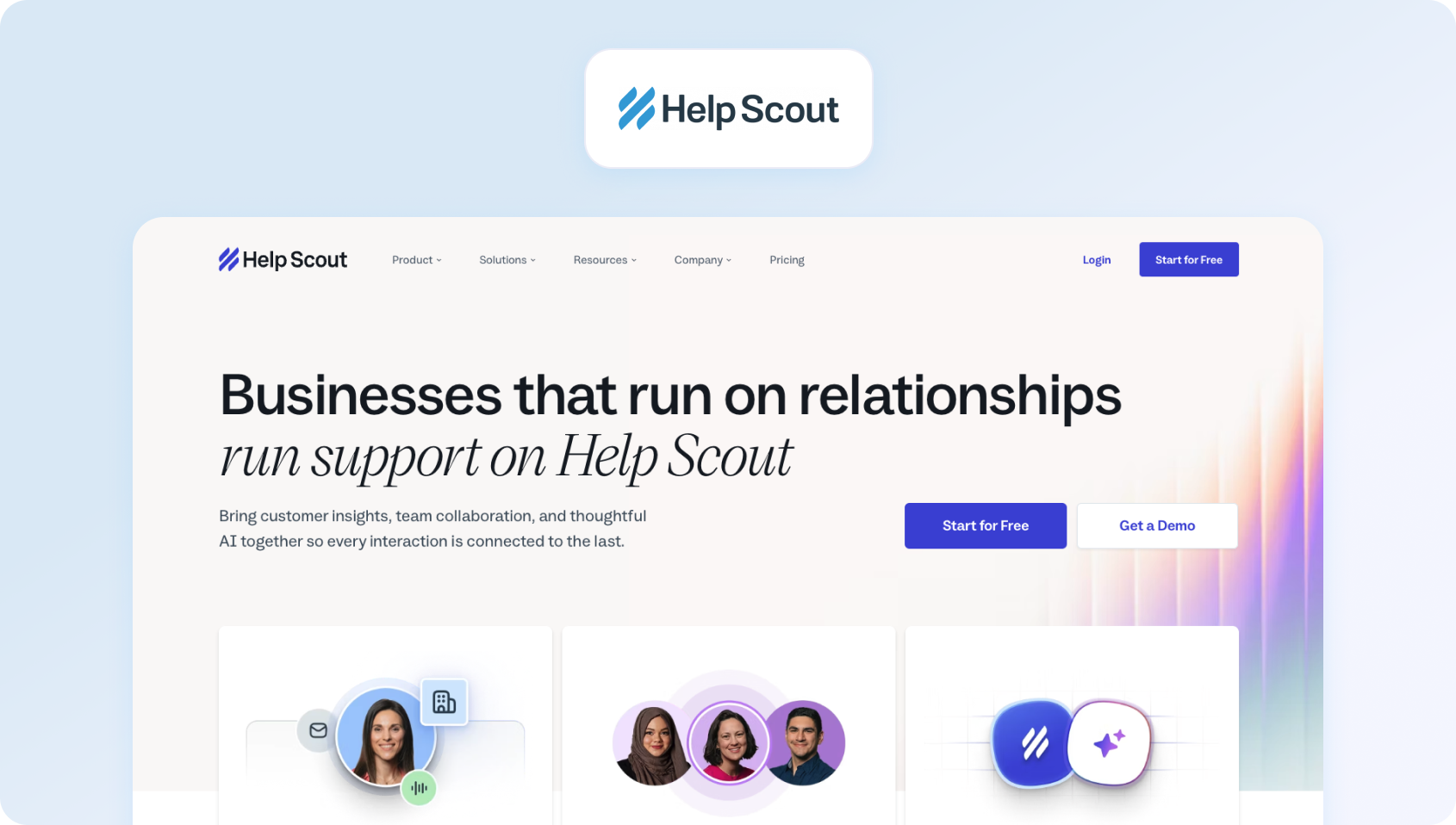
Help Scout emphasizes human connection in customer service, offering an easy-to-use platform that feels like email rather than complex ticketing systems.
Features:
- Shared inbox for email customer support
- Live chat with proactive messaging
- Knowledge base with self-service options
- Customer profile showing interaction history
- Collision detection prevents duplicate agent responses
- Automated workflows and saved replies
- Basic reporting and analytics
- Integration with popular business tools
Who Uses It: Small to mid-sized customer service teams prioritizing personalized customer interactions over enterprise features.
Pros:
- The clean, intuitive interface feels like email rather than traditional desktop software.
- Strong focus on personalized customer service experience
- Good knowledge base functionality for self-service
- Excellent customer support from the Help Scout team
Cons:
- Limited channels, primarily email and chat, voice requires integration
- Simple reporting compared to enterprise platforms
- Fewer automation features than Freshworks competitors
- Not suitable for teams needing workforce management
Pricing:
- Free: Up to 5 users with one inbox and basic help desk features
- Standard: $25/user/month (billed annually) – shared inbox, live chat, workflows, and core automation
- Plus: $45/user/month (billed annually) – advanced workflows, reporting, Salesforce/HubSpot/Jira integrations, and enhanced collaboration
- Pro: $75/user/month (billed annually) – enterprise-grade security, governance, and scalability
Note: Help Scout also offers AI Answers as a usage-based add-on. While the platform delivers excellent value for email-first support teams, advanced AI capabilities and enterprise features increase the overall cost.
6. HubSpot Service Hub: Best for HubSpot CRM Users

HubSpot Service Hub integrates customer support software with HubSpot's CRM platform, providing a unified approach to customer relationship management across sales, marketing, and service departments.
Features:
- Ticketing system integrated with HubSpot CRM
- Live chat and chatbot builder
- Knowledge base with customer portal
- Customer feedback surveys and NPS tracking
- Workflow automation across departments
- Conversation routing and shared inbox
- Reporting dashboards with CRM integration
- Seamless data flow across HubSpot tools
Who Uses It: Small to mid-sized businesses using HubSpot CRM who want unified data across departments.
Pros:
- Seamless integration with HubSpot CRM for a unified customer view
- Unified data across sales, marketing, and customer service
- User-friendly interface consistent with the HubSpot ecosystem
- Suitable for teams prioritizing CRM-driven customer support
Cons:
- Limited customer support software features compared to specialized platforms
- Voice capabilities require third-party integration
- Pricing escalates with seat count and feature additions
- Best suited for existing HubSpot customers
Pricing:
- Free: Up to 2 users with basic ticketing, live chat, and CRM tools
- Starter: $20/seat/month (billed annually) – core help desk features, shared inbox, and basic automation
- Professional: $90/seat/month (billed annually) – advanced automation, reporting, customer portal, knowledge base, and customer feedback tools
- Enterprise: $150/seat/month (billed annually) – skill-based routing, advanced permissions, and enterprise governance
Note: HubSpot Service Hub delivers the best value for organisations already using HubSpot's CRM and wider customer platform. AI features use HubSpot Credits, with allocations included in paid plans and additional credits available if needed.
7. Salesforce Service Cloud: Best for Large Enterprise Service Teams
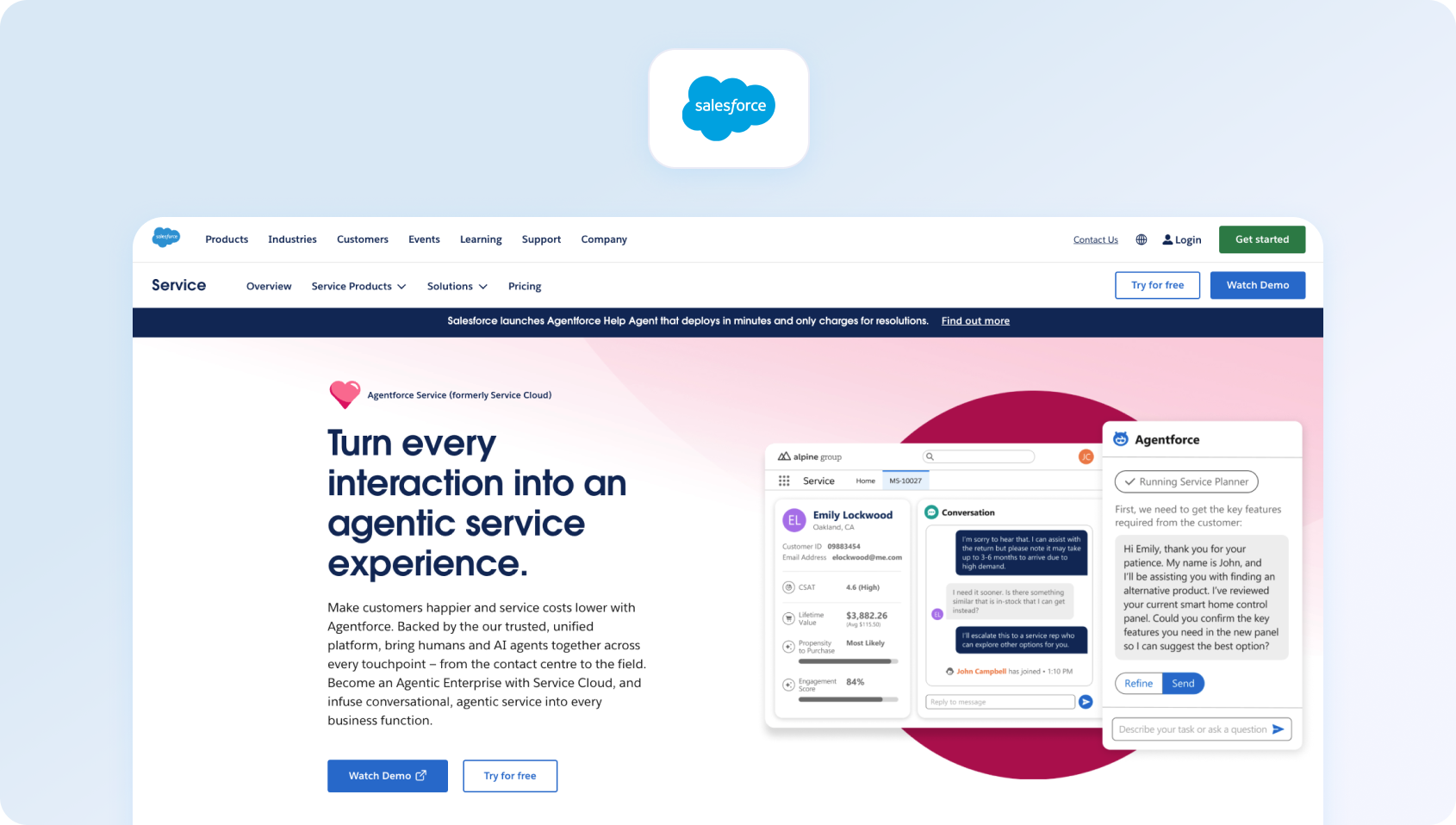
Salesforce Service Cloud is an enterprise-grade customer service software built on the Salesforce platform, offering comprehensive features with deep CRM integration and extensive customization options.
Features:
- Omnichannel routing across email, chat, phone, and social
- Case management with sophisticated workflows
- Knowledge base integrated with Salesforce data
- AI through Einstein for predictive routing and recommendations
- Field service management capabilities
- Extensive customization through the Salesforce platform
- Workforce management and quality assurance
- Comprehensive analytics and reporting
Who Uses It: Large enterprises needing a robust customer service platform with extensive customization and Salesforce ecosystem integration.
Pros:
- Enterprise-grade scalability and reliability for large customer service operations
- Deep integration with Salesforce CRM and ecosystem
- Extensive customization through the Salesforce platform
- Comprehensive AI capabilities through Einstein
Cons:
- Very expensive compared to alternatives to Freshdesk
- Complex implementation and steep learning curve
- Best value requires broader Salesforce investment
- Overkill for smaller customer service teams
Pricing:
- Starter Suite: $25/user/month (billed monthly or annually) – core customer service tools, case management, and built-in AI
- Pro Suite: $100/user/month (billed annually) – enhanced automation, customization, AppExchange access, and advanced service capabilities
- Enterprise: $165/user/month (billed annually) – AI-powered customer service, self-service help center, and advanced workflow automation
Note: Salesforce Service Cloud pricing varies by edition, add-ons, and user count. Features such as Digital Engagement, Service Cloud Voice, Workforce Engagement, and additional AI capabilities may require separate licenses or higher-tier plans.
8. ServiceNow: Best for Enterprise Service Management
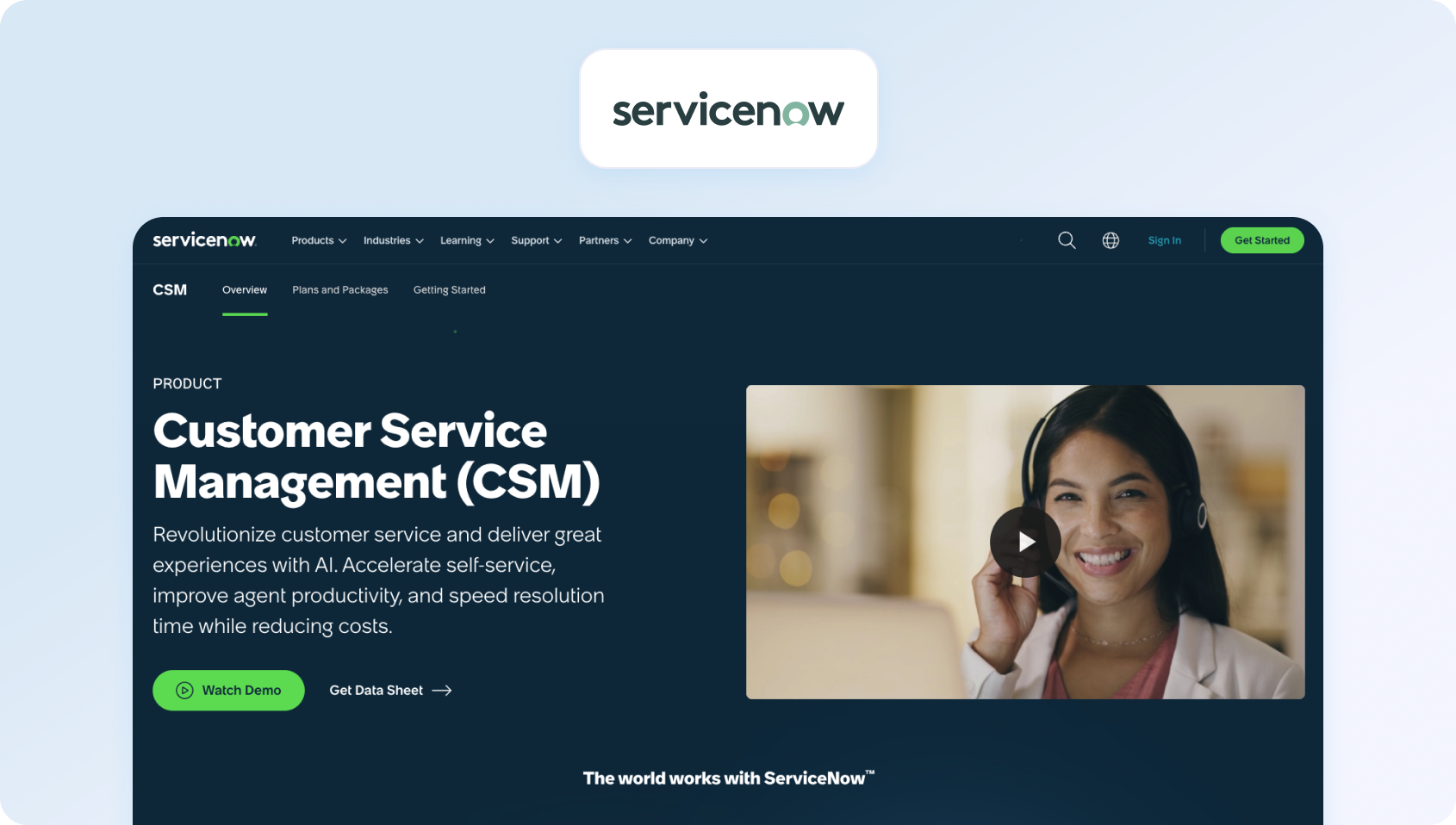
ServiceNow focuses on IT management but also offers customer service management capabilities for enterprises that need unified service operations.
Features:
- Unified platform for IT and customer management
- Advanced workflow automation and orchestration
- Knowledge management with AI-powered search
- Multi-channel customer support
- Field management
- Extensive configuration options
- AI and machine learning capabilities
- Integration with enterprise systems
Who Uses It: Large enterprises needing unified management across IT, HR, and customer-facing teams.
Pros:
- Enterprise-grade customer service platform with comprehensive capabilities
- Unified service operations across departments
- Strong workflow automation for complex processes
- Robust security and compliance features
Cons:
- Very expensive with a lengthy implementation timeline
- Steep learning curve requiring specialized expertise
- Overkill for teams focused primarily on customer support
- Complex pricing and licensing models
Pricing:
- Custom pricing – ServiceNow Customer Service Management is sold through custom enterprise quotes rather than publicly listed per-user plans
- Packages: CSM Advanced and CSM Prime, with Prime adding AI Specialists and Workforce Optimization capabilities
Note: ServiceNow is designed for large enterprise deployments, with pricing varying based on users, products, implementation, and support requirements. Total costs typically include implementation services and ongoing platform configuration, making it a significant investment for smaller support teams.
9. Jira Service Management: Best for IT Service Teams
Jira Service Management brings Atlassian's project management approach to customer service software, particularly popular with technical teams and IT departments.
Features:
- ITSM and customer service ticketing
- Integration with Jira Software for development handoffs
- Knowledge base and self-serve portal
- Workflow automation and SLA management
- Custom forms and approval workflows
- Asset and configuration management
- Mobile apps for agents
- Integration with the Atlassian ecosystem
Who Uses It: Technical teams, IT departments, and companies using Atlassian products wanting unified project and service management.
Pros:
- Excellent integration with development workflows via Jira Software
- Familiar interface for teams using Atlassian products
- Strong automation and workflow customization
- Good asset and configuration management
Cons:
- Better suited for internal IT service than external customer support
- Learning curve for non-technical customer service teams
- Limited omnichannel capabilities for customer interactions
- Voice support requires third-party integration
Pricing:
- Free: Up to 3 agents with core IT service management features
- Standard: $20/agent/month (billed annually) – incident, request, problem, and change management with automation
- Premium: $40/agent/month (billed annually) – adds AI-powered service management, virtual agent, asset management, and advanced analytics
- Enterprise: Custom pricing
Note: Jira Service Management delivers good value for IT and DevOps teams already using the Atlassian ecosystem. Costs can increase with Marketplace apps and higher-tier plans, making it better suited to internal service management than customer-facing contact centres.
10. Genesys Cloud CX: Best for Large Contact Centres
Genesys Cloud CX is enterprise-grade contact center software with comprehensive customer support capabilities, workforce management, and advanced analytics.
Features:
- Omnichannel routing across voice, email, chat, and social
- AI-powered predictive routing and automation
- Workforce management and quality assurance are native to the platform
- Advanced analytics with sentiment analysis
- Knowledge base integration for agent assistance
- IVR with AI capabilities
- Extensive integrations with business systems
- Enterprise-grade security and compliance
Who Uses It: Enterprise contact centers managing hundreds of agents across multiple channels with sophisticated requirements.
Pros:
- Enterprise-grade scalability for large customer service operations
- Comprehensive contact center capabilities in one platform
- Strong workforce management and quality assurance tools
- Extensive AI and automation features
Cons:
- Very expensive, especially for smaller customer service teams
- Complex implementation requires professional services
- Steep learning curve and technical expertise required
- Overkill for businesses under 100 agents
Pricing:
- Genesys Cloud CX 1: $75/user/month (billed annually)
- Genesys Cloud CX 2: $115/user/month (billed annually)
- Genesys Cloud CX 3: $155/user/month (billed annually)
- Genesys Cloud CX 4: $240/user/month (billed annually)
Note: All Genesys plans include native AI capabilities, although some advanced AI features consume AI Experience Tokens. Additional usage-based charges may also apply depending on telephony, AI consumption, and deployment requirements.
11. LiveAgent: Best for Affordable Omnichannel Support

LiveAgent offers multi-channel customer support software that combines ticketing, live chat, and call center features at competitive pricing.
Features:
- Multi-channel ticketing across email, chat, phone, and social
- Built-in call center with IVR capabilities
- Live chat with proactive invitations
- Knowledge base and customer portal
- Workflow automation and SLA management
- Gamification for agent motivation
- Multi-brand support for managing multiple businesses
- Extensive integration options
Who Uses It: Small to mid-sized customer support teams needing an affordable omnichannel desk solution often opt for LiveAgent.
Pros:
- Affordable omnichannel customer support platform
- Built-in call center eliminates separate telephony costs
- Good feature set for the price point
- Suitable for multi-brand operations
Cons:
- Interface feels dated compared to modern Freshdesk alternatives
- Limited AI capabilities for automation
- Basic workforce management features
- Smaller ecosystem of third-party integrations
Pricing:
- Small: $15/agent/month (billed annually)
- Medium: $29/agent/month (billed annually)
- Large: $49/agent/month (billed annually)
- Enterprise: $69/agent/month (billed annually)
Note: LiveAgent offers competitive pricing for growing support teams, a 30-day free trial, and AI features such as AI Answer Assistant and AI Chatbot. Voice capabilities become available from the Medium plan onwards.
12. Deskpro: Best for Flexible Deployment Options
Deskpro offers customer support software with both cloud and on-premise deployment options for teams with specific data control requirements.
Features:
- Multi-channel ticketing across standard channels
- Knowledge base with customer-facing portal
- Live chat and messaging capabilities
- Workflow automation and custom triggers
- Custom ticket fields and forms
- Agent productivity tools
- Reporting and analytics
- Flexible deployment (cloud or on-premise)
Who Uses It: Mid-sized customer service teams needing flexible deployment options or specific data control requirements.
Pros:
- Flexible deployment options accommodate different requirements
- Good customization capabilities for workflows
- Comprehensive customer support software features
- Suitable for teams with strict data requirements
Cons:
- Higher pricing than some alternatives to Freshworks
- Interface is less modern than newer platforms
- Smaller user community and marketplace
- On-premises requires internal IT resources
Pricing:
- Team: $39/agent/month (minimum 5 agents)
- Professional: $59/agent/month (minimum 10 agents)
- Enterprise: $99/agent/month (minimum 25 agents)
Note: Deskpro offers both cloud and on-premises deployment. All plans include a free trial, while higher tiers introduce AI features, enterprise administration, and more advanced support capabilities .
13. Gorgias: Best for E-commerce Customer Support
Gorgias specializes in customer support software for e-commerce, with deep integrations into Shopify, Magento, and other commerce platforms.
Features:
- Deep e-commerce integrations showing order data in tickets
- Multi-channel support across email, chat, social, SMS, and voice
- Automation rules based on customer and order data
- Macros for common customer questions
- Revenue attribution showing support's business impact
- Customer satisfaction tracking
- AI features for automation
- Integration with e-commerce tools
Who Uses It: E-commerce brands using Shopify, Magento, or similar platforms wanting order context in every customer interaction.
Pros:
- Excellent e-commerce integrations with order data visible in tickets
- Revenue attribution demonstrates support's business value
- Unlimited agent seats on paid plans reduce per-user costs
- Strong automation for common e-commerce customer questions
Cons:
- Limited functionality outside e-commerce use cases
- Ticket-based pricing can become expensive at scale
- AI interactions may be metered separately
- Less suitable for non-retail customer service operations
Pricing:
- Starter: From $10/month – includes 50 billable tickets/month
- Basic: From $50/month (billed annually) – includes 300 billable tickets/month
- Pro & Advanced: From $300–750/month (billed annually) for higher ticket volumes and more advanced capabilities.
Note: Gorgias uses a ticket-based pricing model rather than charging per agent. AI Agent is priced separately based on automated resolutions, so total costs increase with support volume and AI usage.
14. Hiver: Best for Gmail-Based Support Teams
Hiver transforms Gmail into customer support software, allowing teams to manage customer inquiries without leaving their inbox.
Features:
- Gmail integration for shared inbox management
- Email-based ticket assignment and tracking
- Collision detection prevents duplicate responses
- SLA management with automated reminders
- Basic workflow automation
- Email templates and internal notes
- Reporting on response times and volumes
- Live chat as an optional add-on
Who Uses It: Small customer service teams using Gmail who want lightweight support tools without adopting new platforms.
Pros:
- No learning curve for Gmail users
- Quick deployment without platform migration
- Affordable for small customer service teams
- Familiar email-based workflow
Cons:
- Limited to email and basic chat functionality
- Lacks advanced customer support software features
- No voice or comprehensive social media support
- Not suitable for teams needing omnichannel or AI capabilities
Pricing:
- Free: Up to basic email, live chat, and help desk features.
- Growth: $25/user/month (billed annually)
- Pro: $55/user/month (billed annually)
- Elite: $85/user/month (billed annually)
Note: Hiver offers both Hiver Omni (omnichannel) and Hiver in Gmail. It's an excellent choice for teams already using Gmail, while the newer Omni platform adds voice, live chat, Slack, and AI capabilities. Voice is available as an add-on on the Growth plan.
15. Front: Best for Collaborative Shared Inboxes
Front creates a shared inbox enabling teams to manage conversations across email, chat, and social media collaboratively.
Features:
- One inbox for email, chat, SMS,and social media
- Collision detection and internal comments for collaboration
- Assignment rules and automated workflows
- Analytics showing team performance
- Integration with business tools
- Mobile apps for remote agents
- Custom views and filters
- Automation features for routine tasks
Who Uses It: Small to mid-sized customer service teams wanting shared inbox collaboration without traditional ticketing complexity.
Pros:
- Clean interface focused on team collaboration
- Suitable for teams transitioning from email to structured support
- Strong analytics showing team performance metrics
- Integrates well with standard business tools
Cons:
- Limited traditional ticketing features compared to full desk software
- Voice support requires third-party integration
- Pricing scales quickly with seat count
- No built-in knowledge base or self-serve capabilities
Pricing:
- Starter: $25/seat/month: shared inbox basics
- Pro: $65/seat/month: advanced automation
- Enterprise: $105/seat/month: enterprise features
Note: Front focuses on collaborative shared inboxes rather than a full contact centre platform. AI features are included primarily in the Enterprise plan, while some AI capabilities and automation remain paid add-ons on lower tiers.
16. HappyFox: Best for Workflow-Driven Support Teams

HappyFox offers customer support software with task management and workflow automation for teams that need structure without the complexity of enterprise solutions.
Features:
- Multi-channel ticketing across email, chat, phone, and social
- Task management and workflow automation
- Knowledge base with customer portal
- SLA management and escalation rules
- Asset management capabilities
- Mobile apps for agents
- Reporting and analytics
- Integration with business systems
Who Uses It: Mid-sized customer service teams needing structured desk software with workflow management.
Pros:
- Good balance of features and usability
- Strong workflow and task management capabilities
- Comprehensive ticketing features
- Mobile support for remote agents
Cons:
- Pricing not always transparent (may require sales contact)
- More miniature marketplace than a major Freshworks competitor
- Some advanced features require higher tiers
- Less brand recognition than established platforms
Pricing:
- Basic: $24/agent/month (billed annually) – up to 5 agents.
- Team: $49/agent/month (billed annually)
- Pro: $99/agent/month (billed annually)
- Enterprise Pro: Custom pricing – enterprise governance, advanced audit logs, dedicated customer success, and premium support
Note: HappyFox also offers an AI Contact Center Suite starting at $99/agent/month, which bundles voice, AI automation, chat, and help desk capabilities. The Help Desk plans remain a good fit for small to mid-sized support teams, while Enterprise Pro is designed for larger deployments.
17. TeamSupport: Best for Complex B2B Support
TeamSupport focuses on B2B customer support, offering desk software designed for complex, relationship-driven support interactions.
Features:
- Account-based ticketing showing customer relationships
- Collaboration tools for internal escalations
- Customer health scoring
- Product database for asset tracking
- Knowledge base capabilities
- Customer self-serve portal
- Reporting focused on customer success metrics
- Integration with business tools
Who Uses It: B2B companies managing complex customer relationships and technical support escalations.
Pros:
- Excellent for B2B customer relationship management
- Account-based view shows customer health across touchpoints
- Strong collaboration features for internal teams
- Suitable for managing complex technical customer support
Cons:
- Less suitable for B2C or high-volume customer support operations
- Limited AI and automation compared to modern platforms
- Smaller integration marketplace
- Higher pricing than consumer-focused alternatives to Freshdesk
Pricing:
- Starter: $45/agent/month
- Professional: $65/agent/month
- Scale: $85/agent/month
Note: TeamSupport is purpose-built for B2B customer support teams. Pricing reflects its focus on customer relationship management, AI-powered support workflows, and advanced reporting rather than high-volume contact centre operations.
18. Kayako: Best for Customer Journey Visibility
Kayako provides customer support software emphasizing customer journey tracking across all interaction touchpoints.
Features:
- Unified customer view across channels
- Journey tracking showing complete customer history
- Multi-channel support across email, chat, phone, and social
- Knowledge base and self-service options
- Workflow automation and routing rules
- Team collaboration tools
- Reporting and analytics
- Integrations with business systems
Who Uses It: Mid-sized customer service teams prioritizing customer context and journey tracking.
Pros:
- Strong customer journey tracking capabilities
- Unified view shows complete interaction history
- Good collaboration features for support teams
- Comprehensive omnichannel support
Cons:
- Pricing not fully transparent (may require sales contact)
- Less market presence than major Freshdesk competitors
- Some users report implementation complexity
- Limited advanced AI capabilities
Pricing:
- Kayako One: Custom pricing for the full customer support platform, including ticketing, unified inbox, knowledge base, automation, analytics, and AI capabilities.
- Kay AI: $1 per AI-resolved ticket – usage-based pricing with no additional seat fees for AI resolutions.
Note: Kayako uses an outcome-based pricing model for AI automation rather than traditional per-agent pricing. While this can make costs predictable for teams with high automation rates, organisations should consider overall platform costs and AI resolution volumes when comparing alternatives.
19. Re:amaze: Best for Growing E-commerce Brands
Re:amaze provides customer support software integrated with e-commerce platforms and live chat for online businesses.
Features:
- Multi-channel support across email, chat, social, SMS, and voice
- E-commerce integrations with order data visibility
- Chat with chatbot automation
- Knowledge base and FAQ builder
- Workflow automation for common scenarios
- Customer satisfaction surveys
- Reporting and analytics
- Integration with commerce platforms
Who Uses It: Small to mid-sized e-commerce businesses needing integrated customer support and commerce data.
Pros:
- Good e-commerce integrations with order context
- Affordable pricing for small customer service teams
- Chat with automation capabilities
- Multi-channel support included at the entry level
Cons:
- Limited features outside e-commerce use cases
- Basic workforce management capabilities
- Smaller ecosystem than enterprise platforms
- Voice capabilities are less robust than specialized solutions
Pricing:
- Starter: $59/month – unlimited users with up to 500 active conversations per month.
- Basic: $29/team member/month (billed annually)
- Pro: $49/team member/month (billed annually)
- Plus: $69/team member/month (billed annually)
Note: Re:amaze offers a flexible pricing model for ecommerce businesses, with both per-user plans and volume-based options available. AI Agent capabilities are included across plans with additional usage charges after the included resolution allowance.
20. Kustomer: Best for Customer-Centric Support Teams

Kustomer offers customer service software with a customer-centric approach, displaying complete customer timelines instead of traditional ticket views.
Features:
- Customer timeline view showing complete interaction history
- Omnichannel support across email, chat, phone, social, and SMS
- AI-powered routing and workflow automation
- Visual workflow builder for custom processes
- Knowledge base integration for agent assistance
- Advanced reporting and analytics
- Extensive integrations
Who Uses It: Mid-market to enterprise customer service teams prioritizing customer relationships over individual ticket management.
Pros:
- Innovative customer-centric view rather than ticket-centric
- Strong omnichannel capabilities across all customer communications
- Good AI and workflow automation features
- Flexible pricing models (seat-based or conversation-based)
Cons:
- Expensive compared to simpler Freshdesk alternatives
- Learning curve due to a non-traditional approach
- Minimum seat commitments required
- Best suited for teams prioritizing relationship management
Pricing: Custom pricing for all Kustomer clients; verify for details.
Note: Kustomer uses a premium pricing model designed for mid-market and enterprise teams. Annual commitments and minimum user requirements may apply, while additional costs can vary depending on channels, AI usage, and implementation needs.
What to Look for in a Customer Support Platform
Here are some key points to consider before comparing. Start by mapping your must-have channels and guardrails, then assess how each platform handles AI, knowledge, operations, and security within a single workflow. Finally, consider integrations, KPIs, and total cost of operation to ensure you're choosing for fit today and scale tomorrow.
Channels
A modern customer service platform requires omnichannel support that extends beyond email ticketing. Customers expect to reach your support team through live chat, phone calls, social media, SMS, and email, and then switch between channels mid-conversation without having to start over. A ticketing system that unifies these customer communications enables support agents to work in a single workspace with complete customer context, regardless of the contact method.
AI-powered features transform how customer support teams operate. Intelligent classification automatically categorizes support tickets by issue type, priority, and required skills. AI ticket summary condenses lengthy customer conversations into actionable insights. Suggested reply helps agents respond faster with answers grounded in your knowledge base, maintaining consistency across customer interactions. Real-time translation breaks language barriers. Automation tools handle repetitive tasks, such as ticket routing, status updates, and follow-ups, freeing agents to focus on more complex customer queries.
A smart knowledge base does more than store articles. It integrates deeply into agent workflows, surfacing relevant content during conversations. For customers, it powers self-service portals where they can resolve customer inquiries independently, reducing ticket volume. The best customer support software grounds its AI-proposed replies in KB content, ensuring agents deliver accurate, consistent information without guessing.
Operations
Call center workforce management handles forecasting based on historical ticket trends and schedules agents to match anticipated demand. Customer service quality assurance involves sampling customer interactions, scoring them against established rubrics, and identifying coaching opportunities to enhance team performance. SLA dashboards show real-time performance metrics by team, channel, and priority level, enabling proactive support rather than reactive firefighting.
Security and Administration
Multi-factor authentication, audit logs, role-based permissions, and data retention policies are foundational for compliance. Administration features give you control over who can modify routing rules, access customer data, or change system configurations, essential for regulated industries and enterprise security requirements.
Your customer support platform must integrate with CRM systems (such as Salesforce and HubSpot), commerce platforms (like Shopify and Magento), telephony providers, and analytics tools. Open APIs and webhooks enable custom workflows and data synchronization, streamlining customer support processes across your entire tech stack.
Key Performance Indicators
Track metrics that drive decisions: first-contact resolution shows efficiency, average handle time measures agent productivity, containment rate reveals self-service success through chatbots and portals, abandon rate flags capacity problems, concurrency shows how many simultaneous interactions agents handle, sentiment analysis identifies at-risk customer relationships, and customer satisfaction scores measure overall service quality.
Pricing Clarity
Understand the total cost to operate. Some of the best Freshworks alternatives charge a monthly fee per user for basic features, then add usage-based pricing for AI interactions, phone minutes, or support tickets. Others bundle core capabilities into transparent per-agent pricing. Avoid platforms that require expensive add-ons for essential features like advanced automation or customer service analytics, as these can dramatically increase costs beyond initial estimates.
How We Evaluated
This comparison of Freshdesk alternatives relies on publicly available documentation, feature specifications, vendor websites, and published case studies as of November 2026. We identify who uses each customer service software through public customer logos and case studies. Where pricing appears clearly on vendor sites, we cite it. Where pricing requires contact sales, we note it. Pros and cons reflect evidence-based analysis, free from marketing hype and unverifiable claims.
Must-Have Capability Checklist
When comparing Freshdesk competitor platforms, verify these foundational capabilities:
- Omnichannel intake: Email, live chat, voice, and social media, so customer context flows seamlessly between channels
- Knowledge base integration: Strong KB-grounded answers or robust integration for consistent customer support
- AI features: Classification, summarization, suggested reply, and translation to accelerate agent workflows
- Analytics: Track core KPIs including resolution rates, customer satisfaction, and agent productivity
- Workforce management and quality assurance: Native modules or strong first-party options to avoid vendor sprawl
- Security and administration: MFA, audit logs, role-based permissions for compliance
- Integration capabilities: APIs and pre-built connectors with CRM, commerce, and business systems
- Transparent pricing: Core AI and analytics features included in base plans per user, not exclusively sold as add-ons
- Customer satisfaction surveys: Built-in CSAT monitoring to collect customer feedback after interactions
Scoring Rubric
These factors guided our evaluation of the best Freshdesk alternatives:
- Fit for 20–100 agents: We prioritize customer support tools that work for small to mid-sized customer service teams without forcing enterprise contracts
- Omnichannel depth: Does it provide a true unified inbox experience across email, chat, voice, and social?
- AI coverage: Agent assistance plus knowledge base grounding, not just basic automation
- Workforce management and quality assurance: Native tools reduce complexity and accelerate deployment
- Time-to-value: How quickly can you implement and start improving customer experience?
- Total cost to operate: Include licensing, usage fees, integrations, training, and ongoing support
- Security and control: Compliance-ready features for regulated industries
Putting the Right Platform in Place
The best alternative to Freshworks depends on your team size, channel requirements, AI needs, and operational complexity. If you primarily handle email customer support with occasional chat, platforms like Help Scout, Zoho Desk, or Hiver offer simplicity and affordable entry points. If you're managing enterprise customer service operations with hundreds of agents, Salesforce Service Cloud, ServiceNow, or Genesys Cloud CX offer depth, but at an enterprise level of pricing and implementation complexity.
If you have 20 to 100 agents, then BlueTweak is the perfect fit. It consolidates voice, email, chat, and social channels with AI-driven ticket summaries, suggested replies, call transcription, workforce management, and quality assurance into one platform, offering transparent pricing.
When to Shortlist BlueTweak:
- You want a comprehensive customer support platform that brings all channels together, eliminating silos and switching tabs.
- You want AI features like call transcription, ticket summaries, and knowledge-base–driven reply suggestions, and you want it baked into the base price (not as pricey extras).
- You manage multiple brands or clients and need clear workspace separation without juggling multiple logins or instances.
- You'd rather have built-in workforce management and quality assurance than patch together third-party tools that scatter your data.
- You prefer a rollout that takes weeks, not months, and doesn't require a heavy professional services lift.
- You serve global customers and require multilingual support with real-time translation that preserves context.
Request a demo to see BlueTweak in action. Check out the pricing page for transparent costs that include workforce management, quality assurance, and AI features without add-on complexity.
Omnichannel Customer Support: The Complete Guide For Modern Teams
From Siloed Channels to One Conversation
Your customer starts a conversation on chat, doesn't get an answer, and decides to send an email. Still frustrated, they call. Three channels, three agents, same question repeated each time. By the time someone actually solves the problem, your customer is exhausted, and your team has wasted hours.
That's what happens when you run multichannel customer support without connecting the dots. Each channel lives in its own silo. Agents can't see what has already happened. Context disappears between conversations.
And customers feel like they're starting over every single time.
Omnichannel customer service addresses this by treating every interaction as part of a single, continuous conversation. Email, chat, voice, social media platforms, and messaging apps all feed into a unified system. Agents see the whole customer journey. Routing rules work across channels. Service levels stay consistent. Customers get faster answers without the frustration of repeating themselves.
For support teams, this means cleaner queues, better forecasting, and fewer escalations that could have been prevented. For leadership, it means reliable reporting, simpler governance, and measurable impact on customer retention.
Everyone wins.
If you're still managing separate inboxes for each channel, this guide shows you what you're missing and how to rectify the issue.
What Is Omnichannel Customer Support?
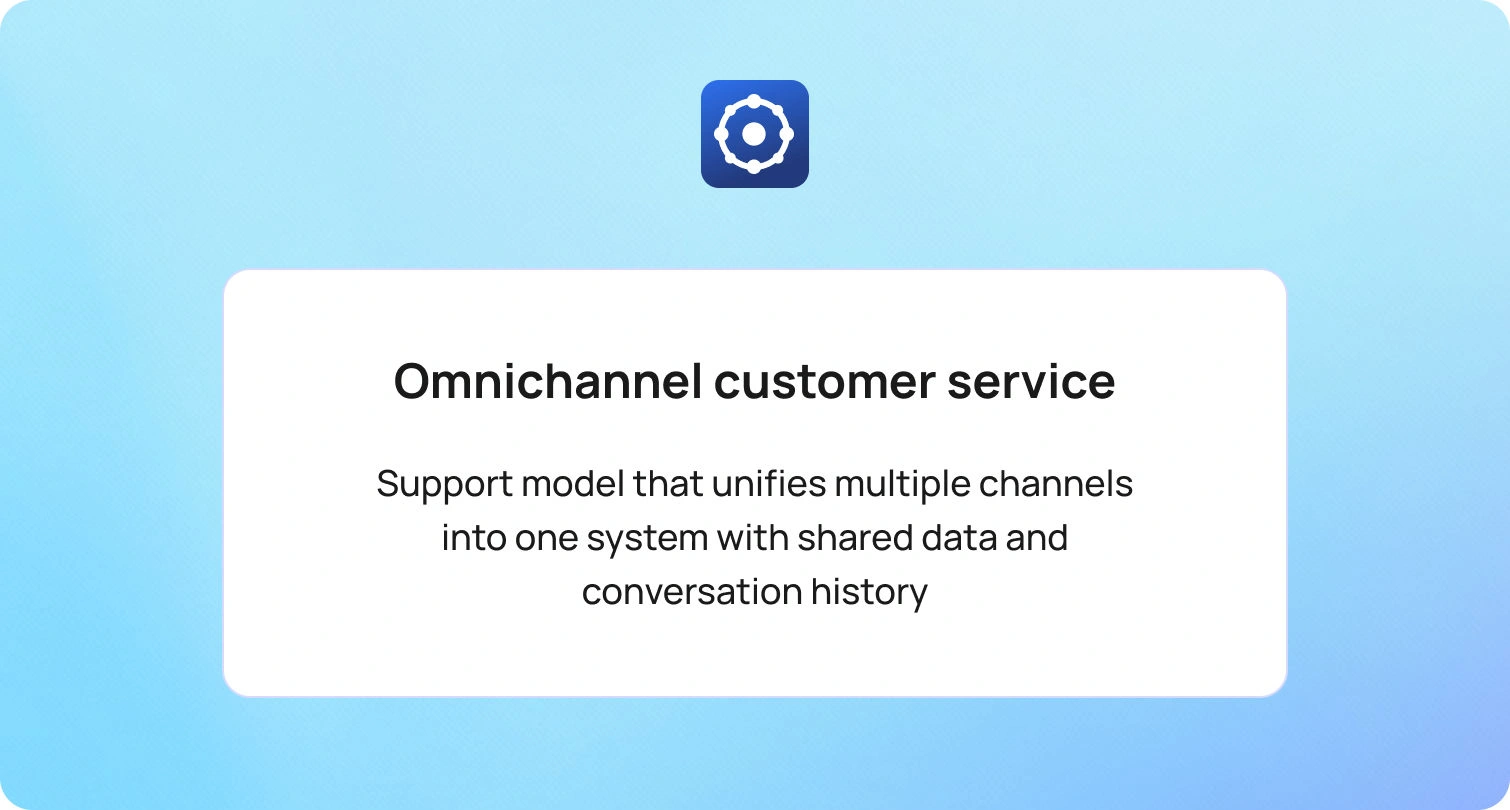
Omnichannel customer support is a single, continuous conversation across email, chat, voice, social media, and SMS, with a shared source of truth and context for both human agents and bots.
Traits that define it:
- Unified inbox and queue where all channels flow into one workspace. Agents don't switch between platforms to see the whole picture.
- Automatic routing by brand, skill, language, and intent. The system determines which agent is best suited to handle each interaction based on their expertise, workload, and customer needs.
- Live context that follows customers across channels. If someone starts on chat and calls five minutes later, the agent already knows what happened.
- Consistent SLAs across channels so customers don't get faster service on email than they do on chat or voice.
The ticketing system sits at the center. Every interaction becomes a record. Context builds over time. Agents, bots, and analytics all pull from the same data.
This system views customer interactions as a continuous relationship, rather than isolated events.
Why It Matters for CX, Efficiency, and Revenue
Ultimately, customers get faster answers because agents don't waste time asking for information that's already in the system. They explain their problem once, and every subsequent interaction builds upon the last one.
Fewer repeat explanations mean less frustration. A consistent tone and outcome across channels builds trust: a customer who has a great chat experience expects the same seamless support when they call or email.
Operations Impact
First-contact resolution rates increase when agents have the complete story. They resolve issues on the first try, rather than transferring customers between queues or re-asking the same questions.
Containment and deflection improve when bots and the knowledge base collaborate. Routine questions are answered through self-service before they reach an agent, allowing your team to focus on more complex problems that require human judgment and expertise.
Average handle time drops because agents aren’t digging for context or transferring calls. Abandonment rates fall, too—customers trust they’ll get help without waiting in multiple lines.
Forecasting gets easier when you can spot patterns across every channel instead of guessing from fragments. With that visibility, WFM can balance workloads across email, chat, and voice in real time, so staffing decisions feel straightforward instead of stressful.
Leadership Lens
Reliable cross-channel reporting reveals where customers actually struggle, rather than leaving you to juggle five dashboards that don't communicate with each other. Escalations are cleaner when routing rules behave the same everywhere. Governance is simpler and safer when you manage a single platform with unified security and compliance controls, rather than a patchwork of tools.
All of this translates to lower operational costs and higher customer retention. Teams that scale omnichannel customer support see measurable improvements in customer satisfaction scores and agent productivity within the first quarter.
Customer service analytics built into the platform give you real-time visibility into what's working and what needs adjustment.
Core Concepts You Need to Know for Customer Support Teams
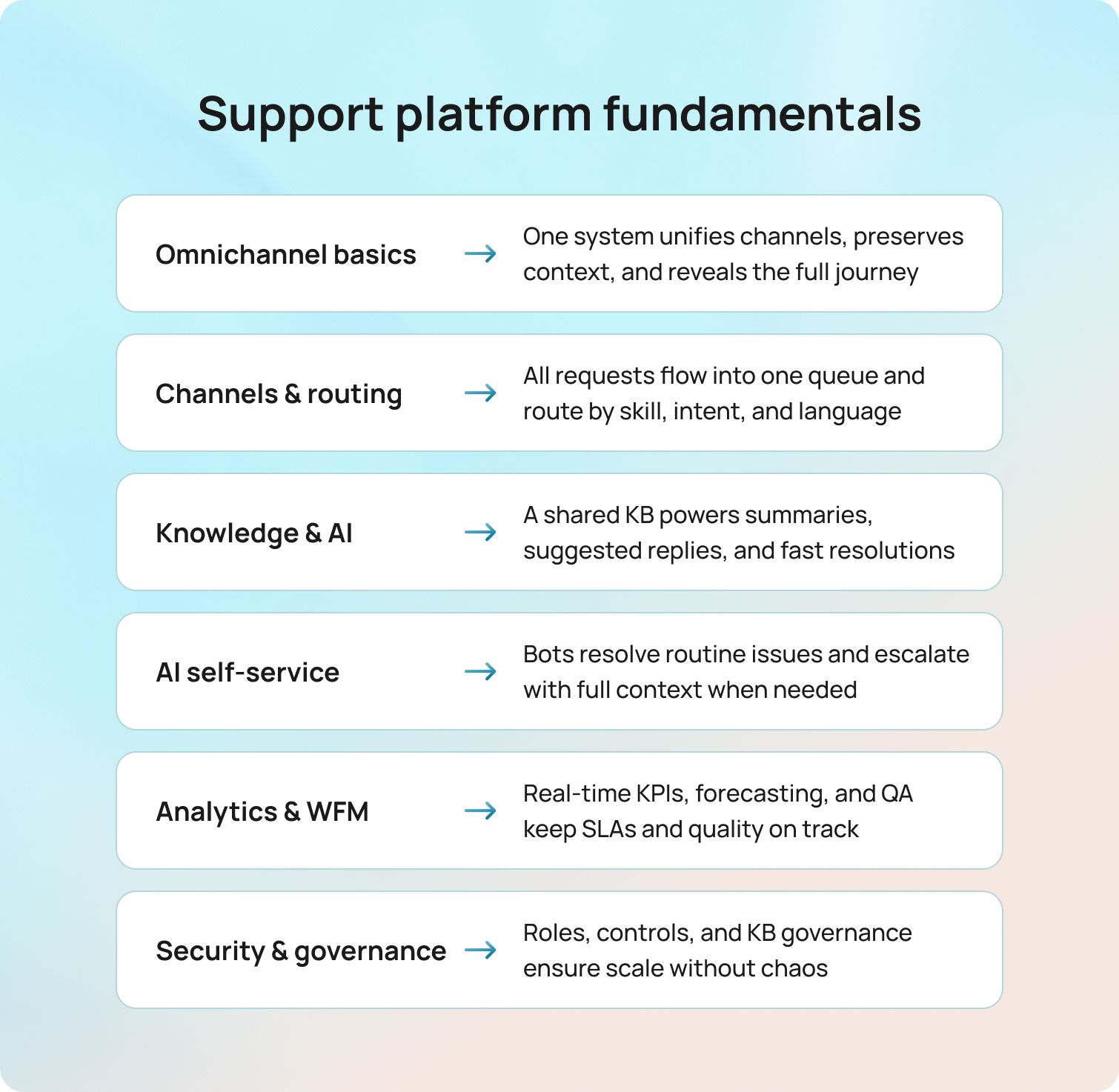
Before the tactics, align on the fundamentals that make omnichannel work. The following section defines each concept in plain language and shows how it drives faster resolution and a smoother customer journey.
Omnichannel vs. Multichannel
Multichannel customer service involves providing support through multiple channels, including email, chat, and phone. But each channel operates independently:
- Email tickets live in one system
- Chat conversations happen in another
- Voice calls get logged separately
- Agents jump between tools
- Customer history fragments across platforms
Omnichannel customer service ties every touchpoint together. One platform handles all channels, and context follows the customer from chat to email to voice. The knowledge base powers answers everywhere, and cross-channel reporting surfaces patterns you would miss in silos.
Here's what changes:
- Context continuity: Multichannel loses it between channels. Omnichannel preserves it.
- Routing: Multichannel routes within each channel. Omnichannel routes based on customer needs across all channels.
- Knowledge base usage: Multichannel may have separate FAQs for each channel. Omnichannel uses one smart KB that powers everything.
- Analytics: Multichannel gives you separate reports. Omnichannel shows the entire customer journey mapping.
- Admin scope: Multichannel means multiple login systems. Omnichannel means one set of roles and permissions.
BlueTweak is a customer service solution that handles multiple communication channels, a knowledge base, and analytics all in one platform, so you're not stitching together tools that don't integrate with each other.
Communication Channels and Routing
Channels include email, live chat, voice, social media, and SMS. All of them feed into a unified queue where support agents see every interaction, regardless of how it arrived.
Routing signals determine which agent handles each request:
- Brand: If you support multiple product lines, tickets are routed to brand-specific queues, allowing agents with the right expertise to handle each case.
- Skill: Complex billing questions go to agents trained on payment systems. Technical issues route to product specialists.
- Language: Customers writing in Spanish get routed to Spanish-speaking agents or trigger real-time translation if no native speaker is available.
- Intent: The system detects whether someone wants a refund, needs troubleshooting assistance, or has a general question and routes them accordingly.
- Collision detection: Prevents two agents from working on the same ticket simultaneously.
- Concurrency controls: Balance how many chats, emails, and calls each agent handles at once based on their capacity and current workload.
BlueTweak handles unified intake and routing across channels. The AI voicebot can handle routine voice interactions while the ticketing system tracks everything in one place.
Smart Knowledge Base and AI Assist
An intelligent knowledge base powers classification, summarization, and suggested replies across every channel.
Proposed replies for agents maintain consistency and speed. Instead of writing responses from scratch, agents get a draft pulled from KB content that they can personalize and send. This maintains a consistent tone and reduces the time spent on routine responses.
AI ticket summary tools reduce reading time by condensing long email threads or chat transcripts into key points. Spam and duplicate detection keep queues clean, allowing agents to focus on real customer issues.
Real-time chat translation preserves tone and context when customers switch languages during a conversation, ensuring seamless communication. This prevents frustrated customers from getting stuck with agents who can't understand them.
BlueTweak combines the knowledge base with suggested reply features and AI-driven ticket summaries, allowing agents to spend less time searching and more time solving problems.
Self-Service and Automation
AI customer service chatbot tools grounded in your knowledge base handle routine questions without human intervention. When the bot can't answer or detects frustration, it escalates to a human agent, preserving full context so the customer doesn't have to start over.
AI voicebot handles status lookups, appointment scheduling, and other structured flows. Event-driven notifications and proactive outreach enable you to reach customers before they need to contact support—such as sending shipping updates or service restoration notices.
Well-structured self-serve options don't replace human agents. They filter out routine questions, allowing your customer service team to focus on complex issues that require judgment and empathy.
BlueTweak offers both AI chatbot and AI voicebot capabilities that connect to the same knowledge base your agents use, ensuring consistency across automated and human interactions.
Analytics, WFM, and QA
Analytics provide real-time SLA performance, cohort reports by brand, channel, and intent, as well as exports and APIs for business intelligence tools. You need visibility into what's working and what's breaking before customers churn.
Call center workforce management forecasts demand by interval, schedules agents to meet concurrency and SLA targets, and re-forecasts intraday when volume spikes unexpectedly. Without this, you're either overstaffed and wasting money or understaffed and missing SLAs.
Customer service quality assurance auto-samples interactions by risk level and evaluates them against a rubric tied to sentiment and keywords. This catches coaching opportunities and ensures consistent quality across digital channels.
BlueTweak provides a single pane for key performance indicators with hooks into staffing and QA workflows, so you're not managing three separate systems.
Security, Governance, and Scale
Administration and security require role-based permissions, multi-factor authentication, audit logs, data retention policies, and change tracking. Not every agent needs access to override routing rules or view sensitive customer data.
Governance means your knowledge base is the source of truth. Version control, publishing gates, and a multilingual article strategy ensure content accuracy and consistency. When you update an article, the change should be reflected everywhere, including chatbot responses, suggested replies, and agent search results.
Change management encompasses agent enablement, macro governance (defining who can create canned responses and how they're reviewed), and escalation hygiene (ensuring that high-priority cases are handled urgently).
BlueTweak offers centralized administration with brand-scoped workspaces, allowing teams supporting multiple products to operate independently while leadership maintains oversight. However, while BlueTweak supports these governance capabilities, some advanced security features are available through API integration and will expand as part of the platform roadmap.
How to Implement Omnichannel Customer Service
You need one platform (or a tightly integrated set of tools) that handles channels, routing, knowledge base, bots, analytics, workforce management, quality assurance, and administration.
Context should never drop between systems.
The alternative is stitching together separate vendors for chat, email, voice, KB, and analytics. That approach creates integration gaps where customer information gets lost, routing rules break, and reporting becomes a manual nightmare.
Modern omnichannel customer support platforms centralize all information, enabling agents to work within a single interface and allowing data to flow automatically between systems.
If you're evaluating omnichannel customer support software, here's what you need:
- Unified queue where all channels appear in one workspace
- Routing by brand, skill, language, and intent with concurrency controls
- Knowledge base integration with suggested reply generation
- AI-powered summaries that condense prolonged interactions
- Real-time chat translation for multilingual customer support
- AI chatbot and voicebot grounded in your KB
- Real-time analytics and historical reporting
- Workforce management for forecasting and scheduling
- Quality assurance sampling and evaluation
- Role-based access control and audit logs
- APIs and webhooks for integration with CRM, commerce platforms, telephony systems, and BI tools
- SSO and user provisioning for secure onboarding
- Customer profile view with full interaction history and purchase history
Those are the must-haves, but a few helpful extra nice-to-haves can go a long way. They include:
- Native integrations with popular CRMs and help desks
- Sentiment analysis and emotion detection
- Proactive outreach triggered by customer behavior
- Advanced customer support automation workflows
- Call transcription software for voice interactions
BlueTweak is API-open and app-friendly, which means you can connect it to existing systems without rebuilding your entire stack.
Benefits & Trade-offs of Omnichannel Support
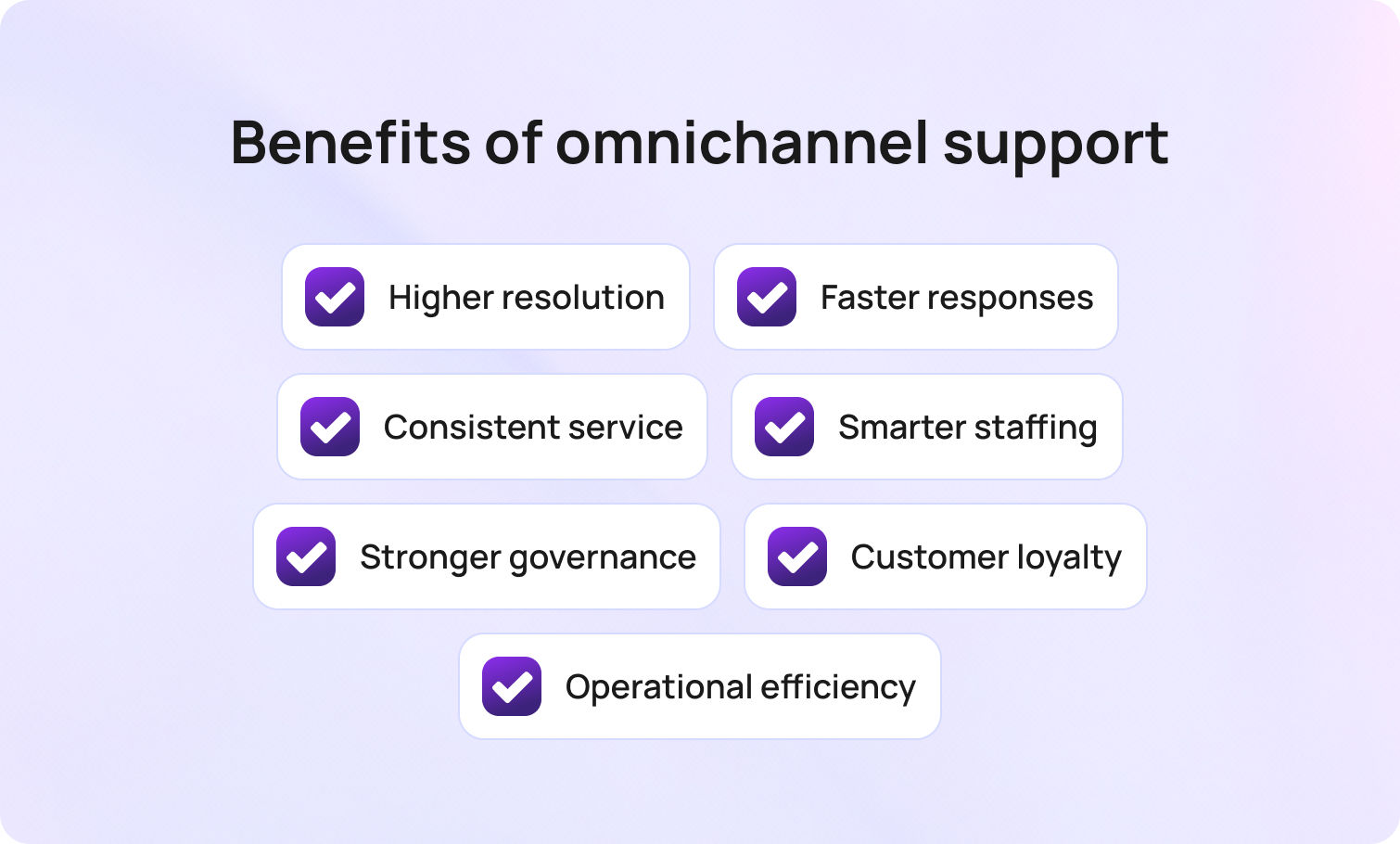
The following section provides a concise overview of the pros and cons, enabling you to assess the suitability before making an investment.
Pros
- Higher first-contact resolution because agents have full context and can solve problems on the first try.
- Faster responses across all channels since routing is more intelligent, and agents spend less time searching for information.
- Consistent SLAs and tone so customers get the same quality of service whether they email, chat, or call.
- Better staffing decisions are made possible because workforce management tools track demand across all channels and balance workloads in real-time.
- Enhanced governance, as you're managing a single platform instead of five separate systems with distinct security models.
- Increased customer loyalty because a seamless and consistent experience across touchpoints builds trust.
- Improved operational efficiency by reducing duplicate work and enabling support teams to handle more volume without proportional headcount increases.
Trade-offs
- Consolidation work takes time. Migrating from multiple systems to a single platform requires careful planning, thorough data cleanup, and comprehensive training for agents.
- Change-management lift is real. Agents need to learn new workflows. Managers need to rethink how they supervise and report their work. Leadership needs to align on new KPIs.
- Knowledge base hygiene becomes critical. If your KB is outdated or incomplete, AI-powered suggestions will amplify bad information across every channel instead of helping.
From Omnichannel Plan to Outcomes
Omnichannel customer support isn't a plug-in you install and forget. It's a process of unifying channels, connecting them to a smart knowledge base, and using analytics to continuously improve.
Start by consolidating your channels into a unified queue. Add AI-powered routing that considers brand, skill, language, and intent. Ground your chatbot and suggested replies in a knowledge base that stays current. Then layer in workforce management and quality assurance to optimize for both customer experience and operational efficiency.
Focus on the metrics that matter: first-contact resolution, containment and deflection rates, average handle time, abandon rates, and sentiment shifts. Publish deltas every 30 days to track improvements and identify areas where adjustments are needed.
If you're managing support for multiple brands, dealing with high volumes across email, chat, and voice, or trying to scale without proportional increases in headcount, you need the best omnichannel customer service software that connects everything in one place.
BlueTweak was built to deliver personalized support at scale with unified channels, AI-powered automation, and real-time analytics. See how it works by booking a demo.
15 Strategies to Reduce Customer Support Calls Without Hurting CX
Fewer Calls, Better CX, Stronger Operations
A high call volume typically indicates friction, such as missing or hard-to-find information, unclear intake, or routing gaps that necessitate repeat contacts. High call volume can also negatively impact support staff morale and lead to burnout due to increased workloads and stress. Modern teams handle customer interactions across multiple channels, so issues multiply when context drops between systems. Customers expect consistent outcomes and tone, whether a conversation occurs in chat, email, voice, social media, or a self-service portal. When accurate information and clear paths exist at the moment of need, incoming calls decline and ticket volume follows.
Reducing calls is not about blocking access to humans. The goal is straightforward: automate routine tasks with comprehensive knowledge bases, then reserve human intervention for complex issues that benefit from expertise and empathy. Automation and streamlined operations not only reduce workload but also improve operational efficiency across departments. Clean routing, structured intake, and a unified ticketing system streamline the support process by ensuring tickets are handled efficiently and routed correctly, eliminating unnecessary handoffs and reducing the time to resolution. Benefits include lower average handling times, fewer repeat tickets, and more reliable service levels across multiple channels.
This article outlines 15 practical strategies to reduce customer support calls and ticket volume, while enhancing customer satisfaction and improving the overall support experience. It explains the implementation steps, key metrics to track.
15 Strategies That Reduce Calls and Raise Satisfaction
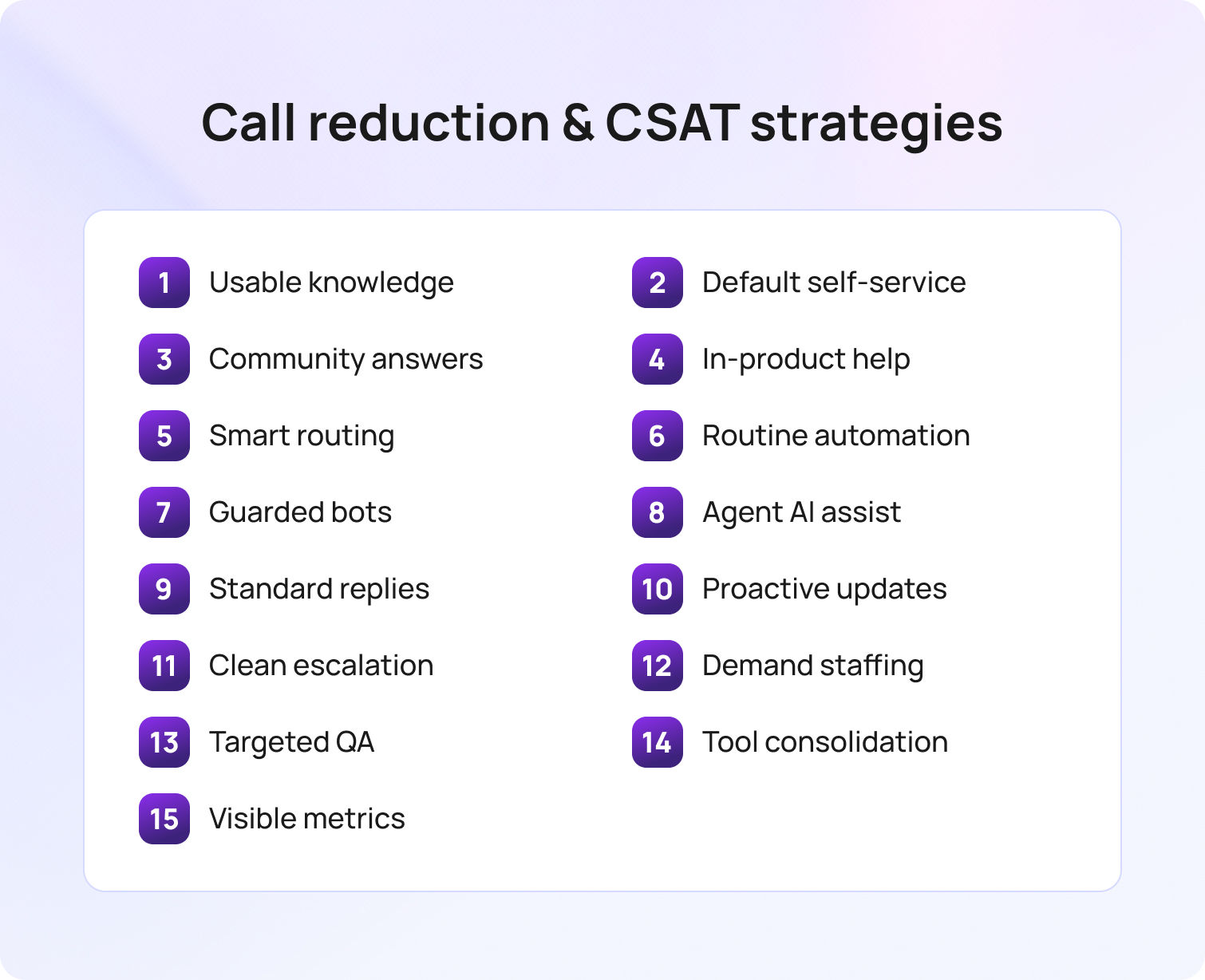
Before the list, a quick orientation. The strategies below begin with foundational elements that reduce ticket volume across the board: a smart knowledge base, a self-service portal that customers prefer, and routing that preserves conversations intact. Later sections cover automation, analytics, workforce management, and quality assurance. Each strategy aligns with core KPIs, including first contact resolution, abandonment, average handling time, repeat tickets, and sentiment.
Effective support strategies are designed to both reduce call volume and improve customer satisfaction by tracking customer feedback, enhancing internal collaboration, and fostering a supportive community.
Implementing these customer support strategies delivers key benefits, including improved efficiency, reduced support workload, and increased customer loyalty.
1) Build a Knowledge Base That Customers Actually Use
A knowledge base is often the first place customers look for answers, and relevant knowledge base articles written in the customer's language reduce customer support tickets before they start.
The strongest articles lead with the answer, followed by clear steps, expected results, and screenshots. Titles that mirror real search queries, such as password resets, billing changes, shipping status, or subscription updates, help readers find the right page. Cross-links between related topics guide the jump from broad questions to precise solutions without opening a support ticket. Searchability, precise categorization, and regular updates are key components of an effective knowledge base.
Strong governance keeps quality high. Each content area has an owner and a review schedule, with outdated material retired. Zero-result searches and bot fallbacks surface gaps that need new or revised content. With steady upkeep, the knowledge base becomes a reliable self-service engine that reduces the support load and improves the customer experience.
BlueHub (by BlueTweak) fit: The smart knowledge base powers suggested replies for agents, grounds chatbot and voicebot answers, and ensures consistent answers across chat, email, and voice.
2) Make the Self-Service Portal the Default Path
Incoming tickets drop when the self-service portal provides a quicker path to accurate answers than contacting support. List top tasks at the top of the page, align categories with real customer inquiries, and surface context-aware suggestions. The portal should also provide access solutions, such as knowledge bases and self-service resources, that empower users to resolve issues independently.
For escalations, structured forms should capture intent, product or brand, language, and relevant IDs so the ticketing system starts with context instead of guesswork.
BlueHub Fit: The portal leverages a smart knowledge base and consolidates escalations into a single queue for email, chat, and voice.
3) Use Community Forums to Turn Answers Into Assets
A community forum provides a space for peer-to-peer support and the sharing of reusable solutions. Threads capture real language, edge cases, and step-by-step fixes that mirror how customers ask questions.
Clarity starts with structure. Accepted answers sit at the top, tags group threads by topic, and links point back to the right knowledge base articles. Recognition programs keep experts engaged and encourage steady contributions. The payoff is practical: fewer repetitive queries, lower ticket volume, and faster access to accurate information.
4) Embed Help Inside the Product Experience
Contextual help reduces calls by solving problems where they occur. An in-app help panel can show relevant knowledge base articles based on the current page or error, and is designed to quickly identify and address common customer problems. The goal is to help customers solve problems efficiently without needing to contact support. Guided flows, tooltips, and empty-state guidance prevent common missteps. Product analytics point to friction points, so help appears before frustration builds.
BlueHub Fit: The help center uses the smart knowledge base for answers and escalates with full context into one queue for email, chat, and voice.
5) Improve Intake and Routing to Prevent Duplicate Contacts
Duplicate contacts add noise and slow queues. Structured intake, account identifiers, and clear routing rules keep a single conversation thread across channels. The assignment should consider brand, skill, language, intent, and urgency so that the first agent is the right agent. That approach reduces transfers, shortens time to first response, and improves efficiency. Layering sentiment and priority signals helps frustrated customers and high-value accounts reach the front of the line without breaking SLAs.
BlueHub Fit: An omnichannel queue unifies chat, email, and voice, while automatic routing, a smart knowledge base, spam detection, real-time chat translation, and sentiment tracking help triage and prioritize without manual effort.
6) Automate Routine Tasks Before Automating Complex Answers
Many customer questions do not require a conversation. Automate high-volume, low-risk workflows such as password resets, order lookups, status updates, appointment changes, and policy-bound refunds. Automation tools streamline these processes, freeing up agents to focus on more complex issues. Provide confirmations and a human fallback to maintain trust and confidence. These automations reduce the average handling time and eliminate repetitive queries that rarely require agent expertise.
BlueHub Fit: Workflow automation handles routine tasks and records outcomes within the ticket, preserving omnichannel context.
7) Deploy AI Chatbots and Voicebots with Guardrails
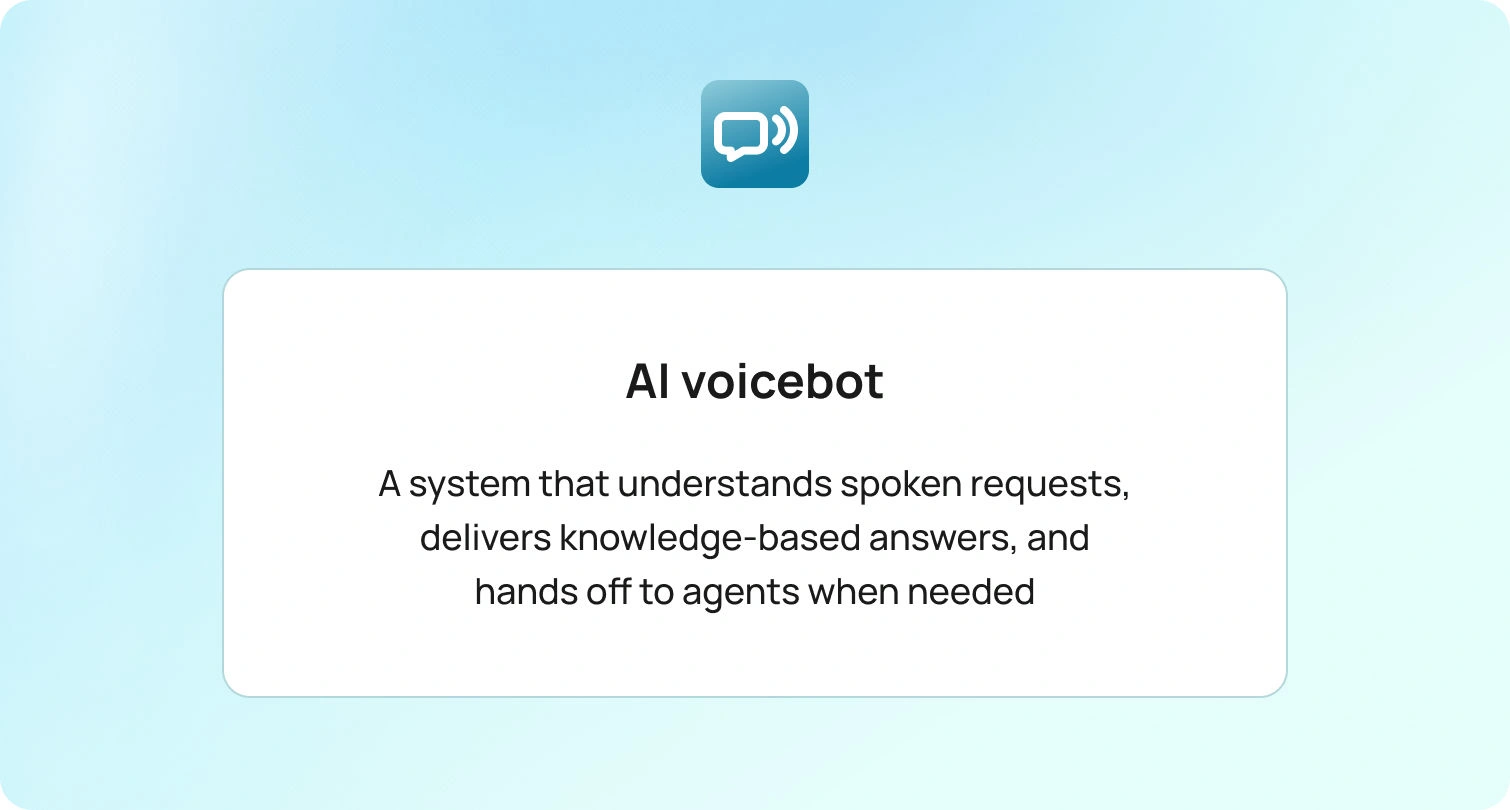
Bots reduce support ticket volume when grounded in a verified knowledge base and guided by confidence thresholds. Chatbots and voicebots are designed to reduce support tickets by efficiently handling common customer queries, providing instant responses, and freeing up human agents for more complex issues. When a question is out of scope, a smooth handoff to a live agent should occur, including transcript and metadata. Analytics from bot fallbacks should feed knowledge base improvements.
Chatbots absorb repetitive queries at scale. Voicebots capture intent, authenticate callers, provide status updates, and route calls with context, which reduces the need for agents to handle routine tasks.
BlueHub Fit: Native, multilingual bots use citations from the knowledge base, respect guardrails, and escalate with full context.
8) Equip Agents with AI Assist for Summaries and Suggestions
Long threads and complex histories can slow down the resolution. AI assist can summarize conversations, capture structured fields, and draft replies with citations to relevant knowledge base articles. The effect is faster first-contact resolution, a consistent tone, and less time spent searching for context.
Additionally, AI assist helps reduce ticket resolution time by giving agents quick access to the information they need to resolve issues efficiently.
BlueHub Fit: Suggested replies surface accurate answers from the knowledge base, while AI ticket summaries reduce reading time for support agents.
9) Standardize Macros, Templates, and Checklists
Macros and templates maintain consistency in language while reducing friction in each interaction. Paired with dynamic fields for personalization and deep links to the exact knowledge base article, replies land accurate and complete the first time. Checklists cover edge cases, such as regional compliance or warranty terms, ensuring that steps are not missed under pressure. Taken together, this standardization lowers average handling time and cuts repeat tickets.
10) Communicate Proactively During Incidents and Known Issues

Outages, product changes, or supply delays can spark call spikes. Late or unclear updates frustrate customers and inflate ticket volume. Proactive communication across status pages, targeted email or SMS, social posts, and in-product banners sets expectations early. Include scope, timelines, any necessary workarounds, and links to relevant knowledge base articles. Clear, consistent updates cut repetitive queries and stabilize sentiment.
BlueHub Fit: Analytics highlight surges, enabling teams to publish coordinated updates. Meanwhile, canned responses, bots, and the smart knowledge base maintain consistent messaging across chat, email, and voice.
11) Keep Escalation Easy, with Context Preserved
Reducing calls does not mean hiding a phone number. Escalation should be simple, with full context carried forward. Agents need a clear view of what has already happened: articles viewed, bot steps completed, device or browser details, and account data. With that information inside the ticket, resolution starts at step three instead of step zero. The result is faster answers, fewer handoffs, and less frustration. Clean escalation also lowers abandonment and prevents parallel contacts across channels for the same problem.
12) Align Workforce Management to Real Demand
Understaffing leads to long waits and increased channel hopping. Overstaffing adds cost without benefit. Workforce management that combines real-time and historical analytics enables schedules to align with demand by intent, language, and channel. Better alignment prevents burnout, maintains steady service levels, and protects response times. Intraday moves then shift agents between queues to absorb spikes without breaking SLAs.
BlueHub Fit: Forecasting and scheduling features balance workloads across email, chat, and voice, with dashboards that track essentials such as handle time and abandonment rate.
13) Apply QA and Auto-QA with Targeted Coaching
Random sampling misses systemic patterns. Auto-QA can flag tone issues, policy risks, or inaccuracies at scale. Human review then provides targeted coaching and updates macros or knowledge base content as needed.
It is also essential to gather feedback from customers and utilize it to refine support processes and content. Closing the loop prevents repeat tickets and maintains consistent service quality.
BlueHub Fit: Quality reviews and analytics help target coaching, and updates flow back into macros and the knowledge base to improve daily operations.
14) Consolidate Multiple Tools into a Unified Platform
Multiple tools produce context loss, duplicate data, and reporting delays. Consolidation around an omnichannel platform eliminates brittle integrations and duplicate licenses. Modern contact centers benefit from unified solutions that streamline operations, enhance agent efficiency, and improve the overall customer experience. For example, a proactive software company can leverage platform consolidation to reduce support workload, improve customer self-help resources, and optimize overall efficiency. A single data model enables cross-channel reporting that reveals patterns silos cannot show. Consolidation reduces customer service costs and simplifies governance.
BlueHub Fit: Channels, routing, a smart knowledge base, bots, analytics, and workforce management operate in one platform. Integrations stay open through APIs.
15) Instrument Everything and Publish the Deltas
Visible data drives improvement. Track ticket volume by intent and channel, deflection from self-service, first contact resolution, average handling time, abandonment, sentiment, and repeat tickets inside 14 days. Incorporate user feedback into the optimization process to identify common issues and refine support features. Then, connect automation to outcomes, such as password resets completed without human intervention or the bot containment rate for status queries.
These practices are designed to ensure customers have a seamless and practical support experience. Publish a monthly deltas report that identifies what has improved, what has regressed, and which strategies should be scaled next.
BlueHub Fit: Real-time dashboards and historical analytics give support, product, and leadership a shared view of performance. Reporting creates clear ownership and follow-through.
ROI and Real Cost Savings
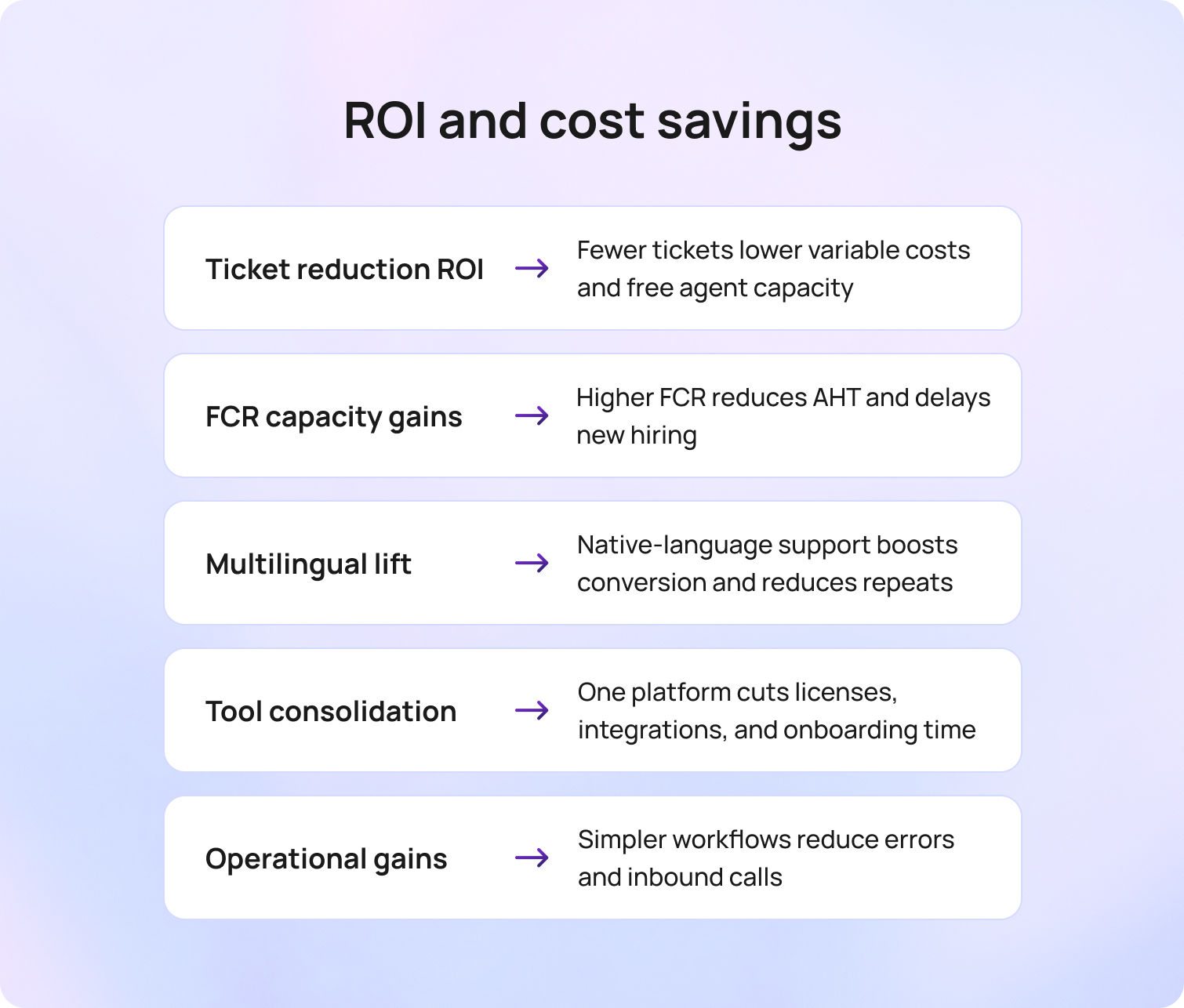
Concrete math clarifies impact. Consider a contact center that handles 20,000 monthly contacts across multiple channels at an average variable cost of $4 per contact. A 20% reduction in ticket volume through self-service and automation equals 4,000 fewer contacts. At $4 per contact, that is $16,000 in monthly operating expense avoided.
Reducing ticket volume not only saves costs but also eases the workload on the customer support team, allowing them to dedicate more time to complex customer issues rather than routine inquiries. If first contact resolution increases from 62% to 72%, the average handling time typically drops as well, thereby opening capacity that would otherwise require additional headcount.
Multilingual capability adds a top-line effect. When chat and voice can serve customers in native languages and switch mid-conversation, more prospects complete inquiries and fewer abandon forms. For a site with 80,000 monthly visits and a chat conversion rate of 2.0%, enabling multilingual chat that increases conversion to 2.6% generates approximately 480 additional engaged leads per month. That same capability in post-sale support reduces repeat tickets caused by language misunderstandings and improves sentiment score for global regions, which correlates with higher retention.
Unified tools also remove license and integration costs. Replacing three or four systems with a single platform cuts overlap, decreases integration maintenance, and shortens onboarding time for new agents. Fewer moving parts reduce error rates that trigger incoming calls.
Optimization Practices
Effective optimization resembles a standing experiment cadence, rather than ad-hoc changes. A practical approach:
- Prioritize the top five intents by volume and cost.
- For each intent, define one self-service improvement and one agent-assist improvement.
- Run A/B tests on knowledge base headlines and first-paragraph phrasing. Measure search-to-resolution rate and repeat tickets within 14 days.
- Test macro variants for clarity and next-step links. Measure follow-up contact rate and average handling time.
- Iterate chatbot prompts for the same intent. Track containment rate, transfer rate, and sentiment score by interaction.
- Adjust routing rules. Measure transfer rate and time to first response.
These practices are designed to enhance customer satisfaction by reducing support tickets, improving self-service options, and ultimately delivering better service through continuous feedback and support strategy enhancements.
Dynamic adaptation should feed on zero-result searches, bot fallbacks, and QA flags. A monthly optimization review selects three winning changes and retires underperformers. This steady cycle moves KPIs in the right direction without large swings or risky bets.
Future Look
Customer experience leaders expect support platforms to advance in three practical ways:
- Multilingual by default. Voice and chat should recognize and switch languages midstream, including mixed sentences. Decision-makers will expect real-time translation for agents and bots that maintain tone and policy accuracy.
- Assist in approving to automate. Agent Copilot usage will transition from drafting replies to approving workflows and ultimately automating end-to-end safe tasks. Governance will require the integration of approval gates, audit logs, and bias monitoring into daily operations.
- Signal-driven routing and planning. Sentiment, intent, and customer tier will drive assignment as much as basic SLAs. Workforce plans will shift intraday based on live channel mix rather than static forecasts.
As support platforms evolve, streamlining support processes and empowering the support team with new tools will be essential for future success.
Platforms that combine omnichannel ticketing, a smart knowledge base, AI assist, bots, analytics, workforce management, and QA in one place will set the pace. Buyers will expect open APIs, data residency options, and ISO-aligned controls as standard. BlueHub aligns with this direction by keeping AI grounded in the knowledge base, staying API-open, and providing the operational controls required for scale.
Bring It All Together
Reducing customer support calls without hurting CX requires a connected system. Comprehensive knowledge bases, a self-service portal that customers prefer, structured intake, automatic routing, and automation for routine tasks create fewer tickets and faster resolutions. Analytics, workforce management, and quality assurance help maintain steady performance as volume fluctuates. Consolidation reduces customer service costs and removes points of failure between tools.
BlueHub combines these pieces into a single platform centered around chat, email, and voice. The application includes proposed reply, classification, summarization, real-time chat translation, spam detection, and automatic routing features. Workforce management and analytics tie everything together, enabling the customer service team to monitor key metrics, including first-contact resolution, abandonment rate, containment rate, and average handling time.
The outcome is fewer calls, fewer tickets, and higher confidence in service quality. By consistently meeting customer expectations and providing excellent support, organizations can foster loyal customers who return and advocate for the brand.
Request a demo to see BlueHub reduce ticket volume while improving customer satisfaction.

Freshdesk vs Zendesk vs BlueTweak: Which Solution to Adopt In 2026?
Freshdesk vs Zendesk vs BlueTweak — how to choose without overbuying
Your support team has outgrown shared inboxes. Chat and voice are on the roadmap, with social potentially following. Three options keep emerging: Freshdesk, Zendesk, and BlueTweak.
Here’s the quick take. Freshdesk feels light and affordable to start. Zendesk signals its “enterprise” capabilities with a large marketplace and modular add-ons. BlueTweak bundles the core stack—omnichannel ticketing, AI assist, workforce management, analytics, and a knowledge base—into one platform designed to reduce tool sprawl and implementation drag.
The real decision isn’t a feature checklist. Its pricing model, time-to-value, and the level of integration and maintenance you’ll own once you add AI, telephony, WFM, and QA. BlueTweak’s positioning is outcome-first—omnichannel, AI, and WFM in one stack at a transparent per-agent price—so mid-market teams can scale without needing to chase additional modules.
This guide compares Freshdesk vs. Zendesk with a third option: BlueTweak — built for teams that want chat, voice, email, bots, analytics, and WFM all together to enhance the customer experience, not pieced together. You’ll see where each tool fits, what add-ons really mean in terms of cost and complexity, and when a unified CX OS makes more sense than stitching together multiple vendors.
Help Desk Platforms: 2018 to 2025
Customer service software looked different in 2018. Most platforms were ticket management systems with a bolt-on chat feature. AI meant basic keyword matching. Reporting was an afterthought. If you wanted a voice, you integrated a separate call center. Multi-channel support meant managing three disconnected tools.
By 2025, the baseline shifted. Omnichannel isn't a premium feature—it's a table-stakes requirement. Knowledge base integration powers both agent assist and customer self-service options. AI classifies tickets, summarizes conversations, suggests replies, and translates in real time.
Ultimately, you need to unify support channels, knowledge base, and analytics under one roof. Avoid stacking point tools that fragment customer data and force agents to context-switch. The platforms that survived consolidated capabilities. The ones that didn't became integration projects.
What Matters in 2026: Everything Under the Same Umbrella
There’s a lot that goes into choosing a comprehensive customer support solution, and it’s easier to get lost in the noise. Here’s what really matters when investing in your business:
- Channels
- AI
- Knowledge Base
- Operations
- Security and Administration
- Integrations
- Key Performance Indicators
- Pricing Clarity
Channels
Email, chat, and voice are non-negotiable. Social media and SMS are optional but increasingly expected. Your support desk needs to handle all of them in a unified queue so agents see the entire customer journey without switching tools.
Knowledge Base
Smart knowledge base articles power agent searches, customer self-service portals, and chatbot responses. When you update an article, the change should reflect everywhere: agent workspace, help center, and bot answers. Knowledge base articles aren't static FAQs; they're dynamic, continually updated resources. They're the foundation of consistent support across channels.
Integrations
Your stack has to talk to itself. The CRM stays in sync via connectors, commerce integrations bring order history into the ticket, telephony handles routing and recording, and your BI tools pull support metrics without requiring manual data wrangling. Open APIs and webhooks tie it all together, allowing you to automate the workflows that matter most. If the platform can’t meet your stack where it is, you’ll end up rebuilding it.
AI
AI assistance keeps work moving: tickets are classified and routed to the right team; long threads are summarized so agents get the gist fast; suggested replies draw from your knowledge base to provide editable drafts; real-time translation supports customers in their language without hiring for every locale; and spam/duplicate detection keeps queues clean, ultimately improving customer satisfaction.
Operations
Operations stay tight when the basics are unified: workforce management forecasts demand, builds schedules, and tracks real-time adherence; quality assurance samples customer interactions, scores them against rubrics, and flags coaching opportunities; SLA dashboards roll up performance by channel, team, and priority. Without this stack, you’re back to stitching spreadsheets.
Security and Administration
Multi-factor authentication, audit logs, role-based permissions, and data retention policies aren't nice-to-haves. They're compliance requirements. You need controls in place to restrict who can change routing rules, access sensitive customer data, or modify AI configurations.
Key Performance Indicators
First-contact resolution, containment rate, deflection rate, abandonment rate, concurrency, and sentiment shifts indicate whether customer support operations are improving or deteriorating, highlighting the importance of proactive support. Track these metrics monthly and publish deltas so leadership can see the impact.
Pricing Clarity
Core AI features shouldn't require add-ons. Telephony minutes, advanced analytics, and premium support are fair upsells. However, if you cannot obtain ticket classification or suggested replies without a separate SKU, you're looking at pricing complexity that scales poorly.
How We Evaluated Freshdesk and Zendesk, and BlueTweak
This Freshdesk vs. Zendesk comparison draws on publicly available documentation, feature matrices, and case studies as of November 2025.
Must-Have Capability Checklist
- Omnichannel intake covering email, chat, and voice at a minimum. Social media and SMS are optional but valuable for retail and e-commerce.
- Knowledge base-grounded answers so AI doesn't hallucinate policies or invent shipping timelines.
- AI features include classification, summarization, suggested replies, and real-time translation.
- Analytics tracking at least two to three KPIs from the list above: first-contact resolution, containment rate, sentiment analysis, or SLA adherence.
- Workforce management or quality assurance, either native or through a strong first-party module.
- Security and administration with MFA, audit logs, and role-based access.
- Integrations and APIs that connect to CRM, telephony, and BI tools.
- Pricing that includes core AI features without forcing every capability into add-on SKUs.
Scoring Rubric
Here are the things we evaluated and based our scoring upon:
- Omnichannel depth, especially voice integration and unified queuing.
- AI coverage across agent assist and knowledge-base grounding, not just chatbot features.
- Native or first-party workforce management and QA tools.
- Time-to-value is documented in onboarding timelines.
- Total cost to operate, including licensing, add-ons, telephony, and implementation services.
- Security and control for compliance-heavy industries.
Feature-by-Feature Comparison: Freshdesk vs Zendesk vs BlueTweak

Below is a structured, like-for-like view of core capabilities, required add-ons, and the typical impact on implementation. The comparison focuses on the functions most relevant to mid-market support operations, helping you align features with your budget and timelines.
1. Omnichannel Support Coverage
Omnichannel coverage means unified intake for email, live chat, voice, and optionally social media or SMS. Agents work from a single queue with collision detection to prevent duplicate responses. Customer interactions remain synchronized across all channels.
- BlueTweak: The platform unifies email, chat, voice, and social, allowing agents to work from a single workspace. Its multi-tenant design enables operations to segment queues by client/brand without requiring additional instances. The AI voicebot handles routine calls, providing instant escalation to live agents when needed.
- Freshdesk: Freshdesk Omnichannel Suite combines email, chat, phone, and social channels into a single agent interface. Freshchat offers live chat and messaging capabilities, while Freshdesk Contact Center enhances this with telephony and IVR functionality. Agent collision detection prevents multiple agents from responding to the same customer simultaneously.
- Zendesk: Zendesk Suite bundles Support, Messaging, and Talk to deliver omnichannel coverage with a unified workspace. Skills-based routing assigns tickets based on agent expertise, language, and availability. Zendesk Talk integrates voice seamlessly with ticketing, so call history appears alongside email and chat interactions.
All three platforms cover core omnichannel needs. BlueTweak stands out for its native multi-brand routing within a single platform, which simplifies operations for teams managing multiple product lines or regional brands, eliminating the need for separate instances.
2. Advanced AI Assistance
AI assistance includes ticket summaries, automatic classification, suggested replies, spam filtering, real-time translation, and post-interaction notes, all supported by a robust knowledge base. These features reduce agent workload and maintain consistency across support conversations.
- BlueTweak: AI Ticket Summary condenses email threads and chat transcripts so agents don't waste time reading long histories. Suggested Reply drafts responses grounded in the knowledge base that agents can personalize before sending. Spam and duplicate filtering keep queues focused on real customer inquiries, while real-time chat translation supports multilingual customer support without delays. Post-call notes and next-best-action recommendations streamline follow-up workflows.
- Freshdesk: Freddy AI provides ticket summaries and response suggestions to help agents reply more quickly. Spam detection filters low-value inquiries before they reach the queue. Translation features support multilingual interactions across email and chat, while AI-powered intent detection routes tickets automatically to the appropriate team based on content analysis.
- Zendesk: Zendesk AI provides summaries, suggested responses, and intent classification to expedite ticket resolution. Real-time translation enables seamless chat and email communication in multiple languages, eliminating the need for manual translation steps. Talk transcription converts voice calls into searchable text for future reference, and sentiment analysis flags customers who are frustrated for priority handling.
All three platforms offer robust AI features. BlueTweak emphasizes knowledge-base grounding across all AI outputs, ensuring consistency between agent assist and self-service. Freshdesk and Zendesk both offer robust AI capabilities, although the availability of these features varies by plan tier.
3. Knowledge Base and Self-Service Options
A smart knowledge base powers agent searches, customer self-service portals, help center widgets, and chatbot responses, enabling seamless interactions across various channels. Agents need fast access to accurate information. Customers need intuitive self-service that actually solves problems.
- BlueTweak: The knowledge base integration grounds AI reply suggestions and chatbot answers in approved content, reducing the risk of hallucinations while maintaining agent control and autonomy. Customers get a self-service portal, and agents use the internal KB for policy and process. Canned responses help teams answer common questions quickly and consistently.
- Freshdesk: Solutions (Freshdesk's knowledge base) powers both agent assist and customer-facing portals with searchable articles. Portal widgets and templates let you customize the help center experience to match your brand. Multi-language support enables global customer bases to access content in their preferred language.
- Zendesk: Guide serves as Zendesk's knowledge base platform with robust content management, including versioning and publishing workflows. Help Center widgets embed articles across channels, allowing customers to self-solve without needing to contact support. Multilingual article support scales globally with translation management built in.
All three provide capable knowledge base platforms. BlueTweak's approach tightly couples the knowledge base with AI-generated suggestions and chatbot responses, minimizing the risk of inconsistent answers between automated and human-assisted channels.
4. Analytics and Reporting
Analytics show real-time SLA performance, historical trends, and KPI tracking. You need visibility into first-contact resolution, containment rates, sentiment shifts, and agent productivity to make data-driven decisions.
- BlueTweak: Real-time SLA and performance dashboards track performance with built-in analytics, eliminating the need for a separate module. Sentiment analysis highlights negative interactions for quick follow-up, while resolution categories and labels support trend analysis and informed decision-making. Post-interaction summaries capture what happened (and why) across chat, email, and calls, feeding continuous improvement.
- Freshdesk: Dashboards and custom reports track key metrics, including ticket volume, agent performance, and SLA adherence. Reporting tools provide visibility into support operations, enabling filtering by channel, team, and time period. Sentiment and containment tracking capabilities vary by plan tier.
- Zendesk: Explore analytics provides advanced reporting with custom dashboards and business intelligence features. SLA tracking and CSAT measurement come standard, while custom metrics let you define business-specific KPIs. Data export and API access enable integration with external BI tools for deeper analysis.
All three offer analytics. The differentiation lies in how sentiment and outcome data are tied back to operational actions. BlueTweak's analytics directly inform routing and prioritization rules, while Freshdesk and Zendesk lean more on reporting for post-hoc analysis.
5. Workforce Management and Quality Assurance
Workforce management handles forecasting, scheduling, and adherence tracking. Quality assurance samples interactions, scores them against rubrics, and identifies opportunities for coaching and improvement.
- BlueTweak: Call center workforce management includes forecasting and scheduling tools that predict demand and optimize staffing levels. Customer service quality assurance provides scorecards and calibration workflows for consistent evaluation. Native integration enables data to flow automatically between WFM, QA, and a robust ticketing system without the need for middleware.
- Freshdesk: Workforce management and quality assurance are typically handled through marketplace partners rather than native modules. Integration options include dedicated WFM and QA vendors that connect via API. This approach offers flexibility in choosing specialized tools, but it requires additional management of vendors.
- Zendesk: Workforce management and QA primarily operate through the partner ecosystem, with integrations from companies such as Tymeshift and Playvox. Native analytics support WFM planning with historical data and forecasting inputs; however, dedicated WFM tools offer more advanced scheduling and adherence features.
BlueTweak includes workforce management and QA natively, reducing time-to-value and eliminating vendor complexity. Zendesk and Freshdesk rely on partner integrations, which are effective but add an additional layer of setup and cost.
6. Administration and Security
Administration covers user roles, permissions, audit logs, and data retention policies. Security includes MFA, access controls, and guardrails around AI features and routing changes.
- BlueTweak: Centralized administration with role-based permissions enables teams to segment work by client or brand within a single platform, while audit logs provide traceability for configuration and content changes.
- Freshdesk: Role-based access control and multi-factor authentication secure user accounts across plan tiers. Audit logs track system changes and user activity on higher-tier plans. AI guardrail configurability enables administrators to establish boundaries for automated actions and escalation rules.
- Zendesk: The Admin Center provides centralized control over platform configuration, including roles, permissions, and MFA standards, across all plans. Audit logging and compliance features scale up on enterprise tiers. AI configuration controls enable administrators to manage how automation behaves and when it escalates to human intervention.
All three handle administration and security competently. BlueTweak's workspace scoping is particularly useful for teams managing multiple brands or client accounts within a single platform instance.
7. Integrations and Extensibility
Integrations connect your support platform to CRM systems, commerce platforms, telephony providers, and business intelligence tools. APIs and webhooks enable custom workflows.
- BlueTweak: API connections and broad SaaS integrations support custom workflows, linking with popular CRM and BI tools and connecting to key messaging and voice channels. Ticketing workflow triggers can initiate downstream actions, and teams receive integration assistance during onboarding to accelerate time-to-value.
- Freshdesk: The large marketplace includes hundreds of pre-built integrations spanning CRM, productivity, analytics, and specialized tools. The app gallery provides one-click installation for common platforms. API access is available across all plan tiers with rate limits that scale by subscription level.
- Zendesk: An extensive marketplace ecosystem provides integrations for virtually any enterprise system. The Sunshine platform enables custom data models and deep integrations for complex requirements. API documentation and an active developer community support custom development. Pre-built connectors seamlessly integrate with major enterprise systems out of the box.
All three platforms support integrations. Freshdesk and Zendesk have larger marketplace ecosystems due to longer market presence. BlueTweak prioritizes core integrations with API flexibility for custom needs.
8. Multilingual Support
Multilingual support means real-time chat translation grounded in the knowledge base, bot language handling, and voice handoff that preserves context across languages.
- BlueTweak: Multilingual customer support includes real-time translation that maintains context and tone across languages. The multilingual voicebot handles voice interactions in multiple languages with seamless escalation to human agents. Context-preserving handoff ensures that when a conversation switches languages or escalates, the agent sees the full interaction history without gaps.
- Freshdesk: Translation features support multilingual chat and email interactions with automatic language detection. Bot language capabilities handle common inquiries in multiple languages. Multi-language knowledge base articles ensure customers can self-solve in their preferred language.
- Zendesk: Translation and multilingual workflows span all channels, including email, chat, and social. Voice handoff capabilities maintain context when transitioning between automated and human support. The multi-language help center and bot support scale globally with translation management tools.
All three handle multilingual scenarios. BlueTweak's strength lies in maintaining context during language switches, particularly in voice interactions where translation often disrupts escalation flows.
9. Implementation and Onboarding
Implementation speed determines time-to-value. Fast onboarding means agents start delivering value in weeks, not months.
- BlueTweak: Guided onboarding with the team accelerates time-to-value, and AI Suggested Reply is designed for a simple setup, delivering value from day one by drawing on your knowledge base for grounded drafts that agents can approve. The platform ships with documented best practices across ticketing/automation to shorten the learning curve. Overall, BlueTweak emphasizes fast implementation and immediate impact rather than long, multi-month rollouts.
- Freshdesk: Migration tools facilitate the transfer of data from legacy systems, including tickets, customer records, and interaction history. Freddy AI setup includes training on historical ticket data to improve classification accuracy. Self-service and assisted onboarding options offer flexibility tailored to team size and complexity. Implementation timelines vary depending on customization requirements.
- Zendesk: Migration kits and professional services support enterprise implementations with complex requirements. Zendesk AI trains on historical data to understand ticket patterns and routing logic. Macro and workflow setup optimizes agent efficiency from the start. Enterprise implementations can span months when integrating with multiple systems and customizing workflows extensively.
BlueTweak prioritizes fast time-to-value with included implementation support, which helps mitigate the initial learning curve for new users. Freshdesk offers flexibility between self-service and assisted onboarding. Zendesk implementations scale with complexity but often require professional services for enterprise deployments.
Pricing and TCO Framework
Use this to compare not just the sticker price but the actual total cost, including licenses, required add-ons (such as AI, telephony, and WFM), implementation, integrations, training, and ongoing administration. The framework helps you map each line item to ROI and time-to-value, ensuring that budgeting reflects how the platform will actually operate in your environment.
Seat vs Usage: What's Included and What Costs Extra
Most customer service software pricing splits between per-seat costs and usage-based add-ons. Understanding this division prevents surprise bills.
Included in seat pricing typically:
- Core ticketing system functionality
- Multiple channels, like email and basic chat UI
- Basic analytics and reporting
- Standard SLAs and data retention
- Role-based access and permissions
Usage or add-on pricing typically:
- AI features like summaries, suggested replies, and classification
- Workforce management modules
- Telephony minutes for voice support
- Advanced analytics and custom dashboards
- Bots and automation workflows
- Extra storage or extended data retention
- Premium support, SSO, or HIPAA compliance packs
- Sandbox environments for testing
BlueTweak: BlueTweak bundles core AI features, including classification, summarization, and suggested replies, into base pricing. Workforce management and QA are included. This simplifies budgeting and eliminates the need for separate negotiations for each feature. See pricing for current rates and ROI calculators.
Freshdesk: Freshdesk tiers range from free plans with basic features to enterprise bundles. Freddy AI capabilities, contact center minutes, and advanced add-ons sit in higher tiers or as separate SKUs. Specific pricing varies by region and contract.
Zendesk: Zendesk pricing includes base Support, with Talk (voice), Explore (analytics), and Zendesk AI as add-ons or bundled in Suite plans. Telephony minutes and advanced features scale with tier selection. Enterprise packs add compliance and governance features.
Pricing complexity grows when AI, voice, and analytics each carry separate costs. Customer support teams evaluating Freshdesk vs Zendesk should model total costs, including all necessary add-ons, not just base seat pricing.
Conclusion

The Zendesk vs. Freshdesk vs. BlueTweak comparison boils down to trade-offs between feature depth, implementation complexity, and total cost of operation.
Freshdesk positions itself as an intuitive interface with a free plan for small teams and affordable tiers for growing support operations. It covers essential features without overwhelming users. The trade-off: advanced features and AI capabilities often require higher-tier plans or add-ons.
Zendesk offers extensive customization and advanced AI features, making it a strong fit for large, complex support organizations that have the technical expertise and budget. The trade-off: steeper learning curve, higher cost, and longer implementation timelines.
BlueTweak consolidates support, AI-powered automation, workforce management, and quality assurance into one platform with predictable pricing. It's built for teams that want comprehensive multi-channel support without fragmented tools or surprise add-ons.
When to shortlist BlueTweak:
- You're supporting 20 to 100 agents and want an all-in-one platform that doesn't require stitching together five vendors.
- You need omnichannel coverage, encompassing voice, email, chat, and social media, with unified customer profiles.
- You want customer service features like ticket summaries, suggested replies, and real-time translation included in base pricing, not sold as add-ons.
- You're managing multiple brands or client accounts and need workspace scoping within a single platform.
- You prefer launching in weeks instead of months, with professional services.
Request a demo to see BlueTweak's omnichannel capabilities, AI assist features, and analytics in action. Or skip ahead to see pricing for transparent costs that include core key features without surprise add-ons.

How To Improve First Call Resolution Using AI Routing And QA
Why First Call Resolution Stalls in Modern Contact Centers
First call resolution (FCR) falters for predictable reasons. Calls land in the wrong department. Agents open the line with thin context and a blank screen. Answers often lie hidden in lengthy policy documents written for audit purposes, rather than for day-to-day work. For leaders seeking to improve FCR in a call center, these are the friction points that hinder progress.
Inefficient internal processes and inadequate agent training often lead to poor customer service, as support agents struggle to resolve issues efficiently, resulting in lower FCR and increased customer frustration. Well-trained call center agents and a strong support department are essential for improving FCR, as they ensure agents have the skills and resources needed to resolve issues on the first contact. Support teams and center agents play a crucial role in identifying internal inefficiencies, fostering effective communication, and resolving issues efficiently, which reduces repeat contacts and boosts operational efficiency. Authority lives two approvals away, so a clean fix becomes a transfer or a callback. Empowering call center agents to make decisions independently is critical to avoid unnecessary escalations and improve first contact resolution rates. QA notices the failure a month later and files a memo that can’t help this week’s queue. The center ends up handling the same issue twice, sometimes three times, and the customer experience absorbs the cost.
At its core, this is a routing and feedback loop problem. If contact center software cannot quickly recognize intent and direct the first contact to someone with the right skills and authority, even well-trained agents will struggle to improve the first call resolution rate. If QA samples a tiny fraction of calls and returns guidance weeks later, improvements arrive after the damage is done. The rest of this article outlines a practical, platform-agnostic plan: what FCR actually measures, how AI routing and AI-assisted QA work together, and how do you improve first call resolution in a way that turns ideas into steady, weekly gains.
What First Call Resolution Actually Measures
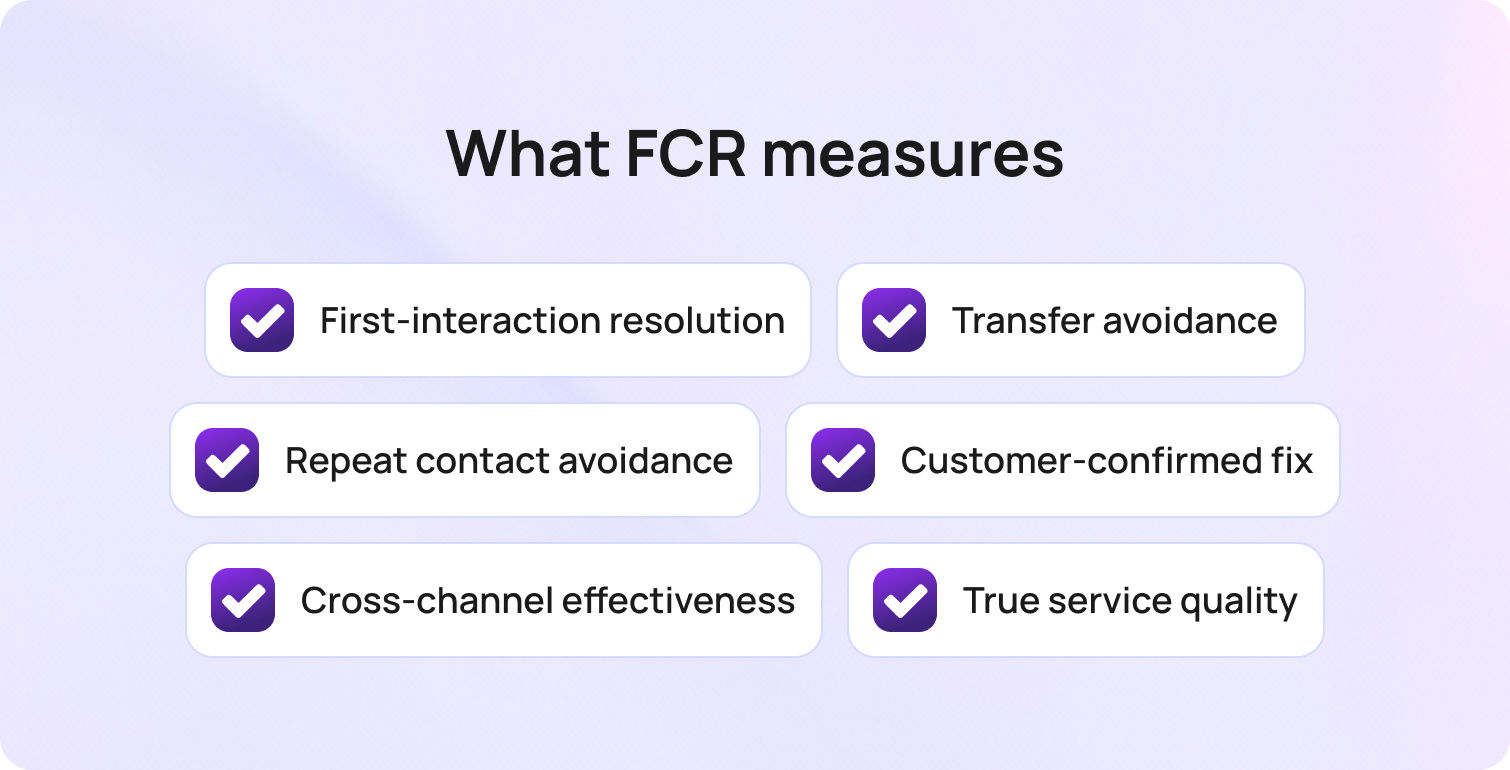
First call resolution measures how often a customer’s issue is fully resolved during the first phone call, with no transfers and no callbacks. First contact resolution applies the same concept to every channel, including chat, email, and social media. Tracking first call resolution scores is essential, as these scores provide insight into overall service quality and highlight areas for improvement. Track both on the same dashboard, segment them by intent and by channel, and review them alongside customer satisfaction (CSAT), customer effort score (CES), net promoter score (NPS), and customer satisfaction scores.
Customer satisfaction scores play a key role in benchmarking performance and identifying trends in customer experience. Speed without quality is the wrong win; therefore, resolution should only count when the customer agrees that the issue is closed. Teams aiming for a first-call-resolution improvement target will want that customer-confirmed view.
Keep the metric honest with two safeguards. First, define eligibility and exclude wrong numbers, abandoned calls, and duplicate contacts within a short window. Second, define what “resolved” means and validate it. Count an interaction as a win only when the customer confirms the fix, for example, through a brief follow-up survey or feedback prompt. Clear rules eliminate debate when comparing contact resolution rate and first contact resolution rate across teams, channels, or vendors, and the resulting data accurately reflects real service quality. Collecting first-call resolution data and utilizing the contact resolution metric and first-contact resolution metric helps inform process improvements and drive better customer outcomes.
How To Improve First Call Resolution Using AI Routing And QA
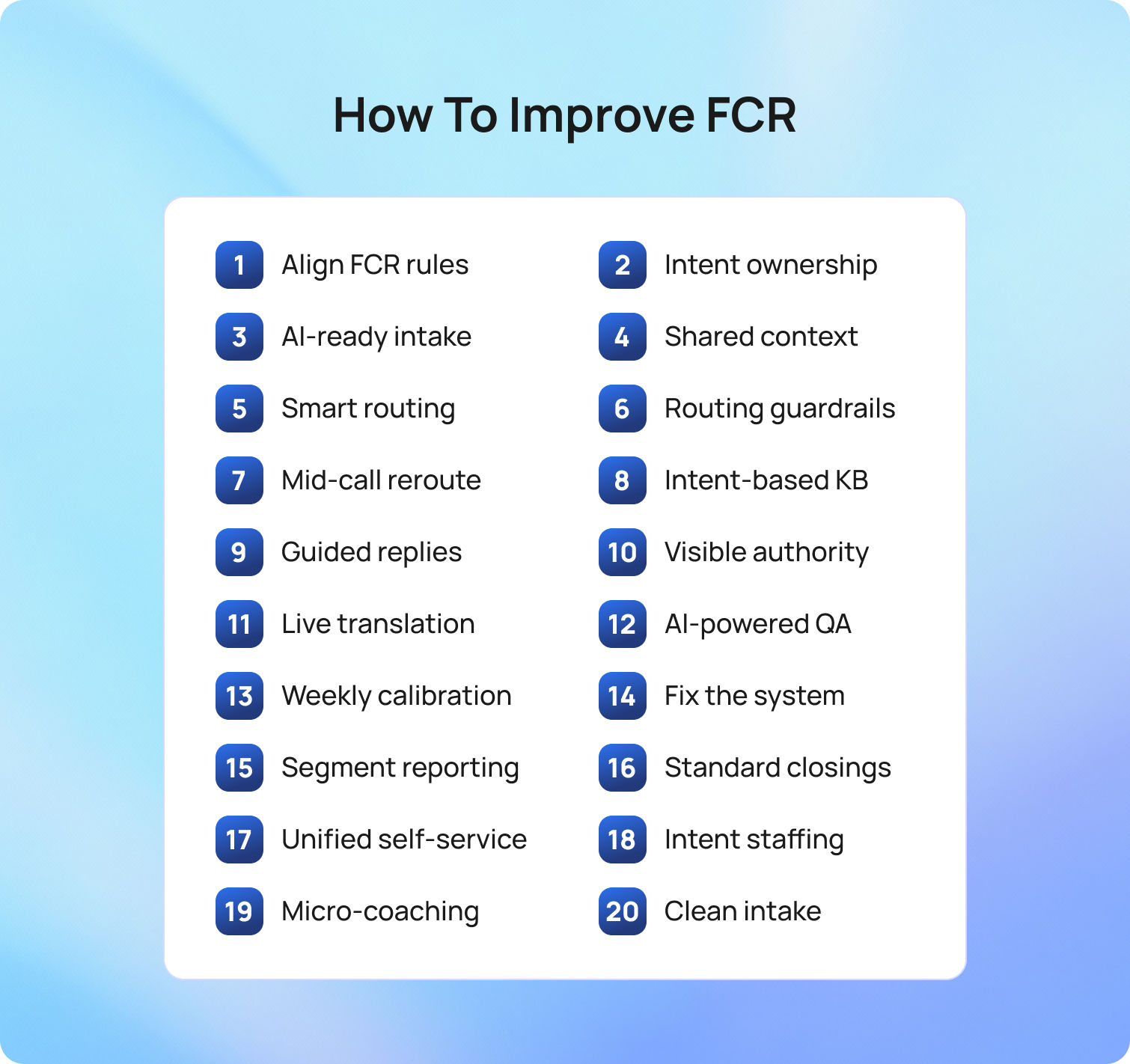
Below is a single, coherent program. Every item contributes to higher contact resolution rates. Continuous improvement is essential for maintaining high contact resolution rates, as it relies on regular feedback, performance monitoring, and data-driven decisions to drive ongoing enhancements. Together, they form a weekly loop that keeps progress visible—an FCR improvement action plan you can execute without heavy projects and a practical solution for how to improve first-call resolution rates with intelligent routing.
1. Align definitions and Eligibility
Clean labels power good models. Treat FCR as “resolved on the initial contact without transfer or callback,” and record exclusions, such as wrong numbers, abandons before connection, and duplicates, within a 3–7 day window. A small minimum talk-time filter prevents zero-effort calls from inflating success rates. With the ground truth stable, AI learns from real wins, and reports remain comparable.
2. Build an Intent Catalog and Ownership Map
Resolution begins with clarity about why customers reach out. An intent list of the top 30–50 reasons, the fields that define each, and the team with authority to finish it becomes the router’s label space and QA’s rubric. Three examples and one counterexample per intent help the model separate close cousins. A named fallback makes low-confidence cases safe rather than slow.
3. Upgrade Intake with AI-Friendly IVR and Pre-Chat Phrasing
Natural language gives stronger signals than number-heavy menus. A short tree, plus one open prompt, captures text that the model can classify. One disambiguator, such as an order ID or device model, reduces guesswork on look-alike intents. Using the same prompts in chat creates consistent vocabulary across channels and lifts precision on the first pass.
4. Pull Real Context into Both the Console and the Model
Agents move faster when the plan tier, recent orders, the last three cases, promises due, flags, and comprehensive customer history are all available beside the conversation. Leveraging customer history enables agents to provide more personalized and effective support, thereby reducing miscommunication and resolving issues more efficiently. The router benefits from the same fields as features.
Understanding the customer's journey—such as a profile like “premium plan with a failed payment last week”—helps tailor the support experience, manage expectations, and tilt decisions toward billing instead of generic support, which streamlines interactions and improves first-contact outcomes.
5. Route by Intent, Skills, Authority, and Live Availability
Intent prediction chooses the lane, while skills and permissions decide who can complete the fix. Queue health determines who can do it now. A practical policy selects the highest-confidence team that meets the authority threshold, then a capable neighbor when that pod is saturated. Decision logs, including confidence, skills match, and queue state, make misroutes explainable and tunable.
6. Keep Guardrails and Explainability in Routing
Some topics are rule-first. Mentions of fraud, legal requests, or safety issues should bypass scores and flow to secure pods. A visible trail—inputs seen, intents scored, thresholds used, rule applied, destination chosen—builds trust with operations and gives QA a clean line of sight to outliers.
7. Enable Mid-Call Reclassification with Context-Preserving Handover
Stories change once details emerge. A single keystroke should update the intent, trigger a warm transfer, and carry notes, captured fields, and verification status forward. Streaming inference can rescore in real time, so first-call resolution remains possible even after a course correction.
8. Link Job-Ready Knowledge to Intents, Not Just Policies
Articles written for action shorten calls. Each intent should point to a how-to that lists prerequisites, numbered steps, a quick “validate the fix,” and “when to escalate.” Knowledge bases play a crucial role in providing agents with quick and accurate information, enabling them to resolve customer issues efficiently. Enhancing agent knowledge with up-to-date resources helps resolve issues more quickly and improves first-call resolution (FCR). A clear owner and last-updated date tighten the loop when content needs edits. Because routing, drafting, and QA reference the same source, variance drops across shifts.
9. Place Suggested Reply and Guided Steps Inside the Console
Agents do better with a grounded start than a blank page. The system retrieves the intent article and recent resolutions, then assembles a suggested reply that the agent reviews and sends. For multi-step problems, short guided checklists keep discovery on track. Composition time falls, tone steadies, and first-contact resolution rises.
10. Expose Authority Limits to Both People and AI
Small approvals should not cause long holds. Published thresholds for credits, replacements, and exceptions, stored as routing features, steer contacts to pods that can act without escalation. Calls land where decisions happen, which protects FCR and reduces callbacks.
11. Remove Language Friction with Real-Time Translation
Language mismatch adds effort and transfers. Real-time chat translation enables agents to write in their native language while customers read in theirs. Language becomes a routing feature: bilingual agents receive preference when available; translation is engaged when it resolves faster than waiting for a language match.
12. Scale Quality with AI-Assisted QA
Coverage and speed matter more than elaborate scorecards. Auto-summaries produce a clear brief, while checklists test the ingredients that predict FCR: the issue framed in the customer’s words, the correct path followed, validation completed, and a clean close. Collecting and analyzing resolution data helps identify patterns in customer interactions and informs targeted coaching for agents. With most interactions reviewed, first-call-resolution data can be used to monitor performance and drive improvements in QA processes, allowing coaches to focus on outliers rather than sifting through them.
13. Calibrate QA Weekly So Scores Stay Fair and Useful
AI highlights moments; people decide what to change. A short panel reviews edge cases, aligns on definitions, and documents rulings. Notes flow back to routing thresholds, knowledge edits, and micro-training. An inter-rater agreement above 0.7 maintains confidence in the program and stabilizes trends.
14. Turn QA Findings Into Environment Changes
Scoring alone does not move FCR. If misses cluster around “ownership change after relocation,” the fix lives in three places: add a field to intake, update the article, and teach the router to treat that field as a feature. Watching next week’s FCR for that intent confirms whether the change landed.
15. Instrument by Intent, Channel, Segment, and Routing Confidence
Global averages hide the truth. Reporting should show FCR, transfers, callbacks, AHT, customer effort, and CSAT by intent and channel. Misroute rate and average routing confidence reveal whether a dip originates from intake language, model drift, or staffing issues. Clarity shortens the path from signal to action.
16. Standardize Closes So the Model Learns From Clean Wins
Clear endings prevent “same issue” callbacks and produce better labels. A one-line note that states what changed, how the customer will verify, and any timeframe creates reliable training data for both routing and QA. Closure codes mapped to intents keep analytics honest.
17. Tie Self-Service to the Same Knowledge Agents Used
Deflection raises effective FCR by removing predictable work before it reaches a live channel. Password resets, status checks, appointment changes, and simple plan adjustments should be handled through the portal. Optimizing self-service tools like FAQs, chatbots, and support portals empowers customers to resolve issues independently. When self-service stalls, the handoff should include captured context and intent, allowing agents to complete the task in one touch.
18. Schedule Against Intent Arrival and Complexity, Then Inform Routing
Expertise needs to meet demand on an hourly basis. Forecast arrivals by intent, seat senior agents where complex issues cluster, and reserve quick-solve pods for high-volume intents. Feeding the schedule into routing features enhances choices during peak periods and prevents avoidable bounces.
19. Teach Discovery and Decision Paths with AI-Curated Micro-Clinics
Short sessions built from summarized calls show how strong discovery lands the right intent and how the chosen path avoids callbacks. One misroute example, plus the updated rule that now prevents it, makes the lesson stick. Two “golden calls” are published each week, keeping good patterns easy to copy. Encouraging collaboration and open communication among customer service team members helps spread these best practices and improves issue resolution.
20. Protect Intake with Spam and Duplicate Detection
Queues slow when bots and duplicates pollute the stream. Lightweight classifiers and fuzzy matching remove most of the noise. Cleaner intake improves model accuracy, preserves agent time for real-world problems, and provides QA with a higher-value sample to learn from.
Run a Weekly Change Cadence with Visible Ownership
Momentum comes from minor, shipped updates. A 20-minute review covers FCR, transfers, callbacks, CSAT, misroute rate, and routing confidence by intent. Two misses and two wins get played and discussed. One change ships with a named owner, followed by a short “what changed and why.” Over a quarter, that rhythm reshapes outcomes more than any one-time project.
How BlueTweak Improves FCR with AI Routing and QA
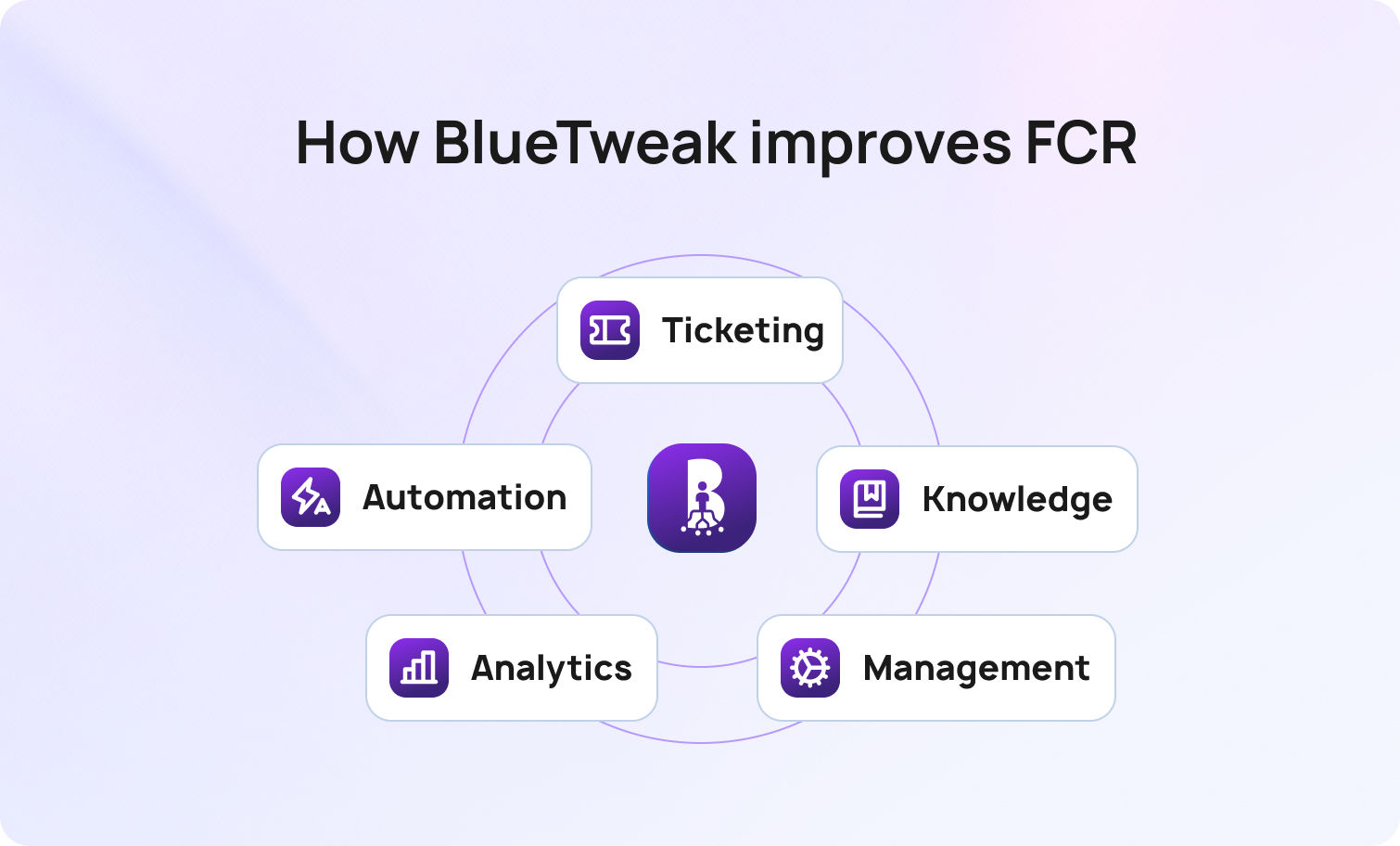
BlueTweak keeps the core loop—getting each contact to the right solver, then learning from the interaction—inside one workspace for chat, voice, and email. Routing draws on signals the platform already sees, such as short voice or pre-chat phrases, recent case history, team skills, language, brand, and live queue health. Sensitive intents can follow explicit rules, and routing decisions are logged, allowing operations and QA to review outcomes instead of guessing why a repeat call occurred. The goal is to achieve a predictable handoff to someone who can complete the job on the first contact.
Resolution depends on what appears in the agent’s console. BlueTweak places a smart knowledge base beside the conversation and turns approved content into a suggested reply that the agent can review, adjust, and send. The same articles power self-service, which removes predictable work before it reaches a live channel. Because the platform is API-open, CRM, order, or device details can be pulled in at the start, while built-in spam detection keeps the intake clean, ensuring routing remains reliable.
Quality assurance closes the loop rather than scoring from afar. AI-generated ticket summaries and classification condense long threads into clear, concise briefs; QA teams can apply lightweight checklists that focus on behaviors tied to first-call resolution, such as stating the issue in the customer’s words, following the correct steps, validating the fix, and closing cleanly. A short, regular calibration ensures fair scoring, and the findings are rolled back into routing rules, knowledge updates, and micro-training, so next week’s queue performs better than this week’s.
Leaders see one picture of FCR, transfers, callbacks, AHT, CSAT, customer effort, and staffing, which makes the weekly “what changed and why” conversation specific and short. Real-time chat translation keeps multilingual queues moving without extra staffing. With governance features like role-based permissions and audit logs in place, the result is a steady increase in first-call resolution, driven by AI-assisted routing and QA, with transparency that the organization can trust.
ROI and Real Cost Savings
Higher FCR returns time to the operation and reduces avoidable spend. Imagine 20,000 monthly voice contacts with a 58% first call resolution rate. Tracking first call resolution rates is essential for measuring call center performance and identifying opportunities for improvement. Raising FCR to 66% prevents roughly 1,600 repeat calls on the same issue. At five minutes of agent time per repeat, that’s 8,000 minutes—more than 130 agent hours—returned every month, significantly improving operational efficiency.
Some centers turn those hours into more answered calls during peak times. Others use them to cut overtime, invest in micro-clinics, or accelerate knowledge work. Improved first call resolution not only reduces costs but also leads to higher customer satisfaction, increased customer loyalty, and greater customer retention. Satisfied and loyal customers are more likely to return and recommend your brand, boosting long-term business growth.
Multilingual programs see an additional revenue boost: real-time translation enables sales-adjacent conversations to be completed on the first contact, rather than waiting for a bilingual agent, which increases qualified leads and shortens cycles in non-primary languages.
Optimization Practices
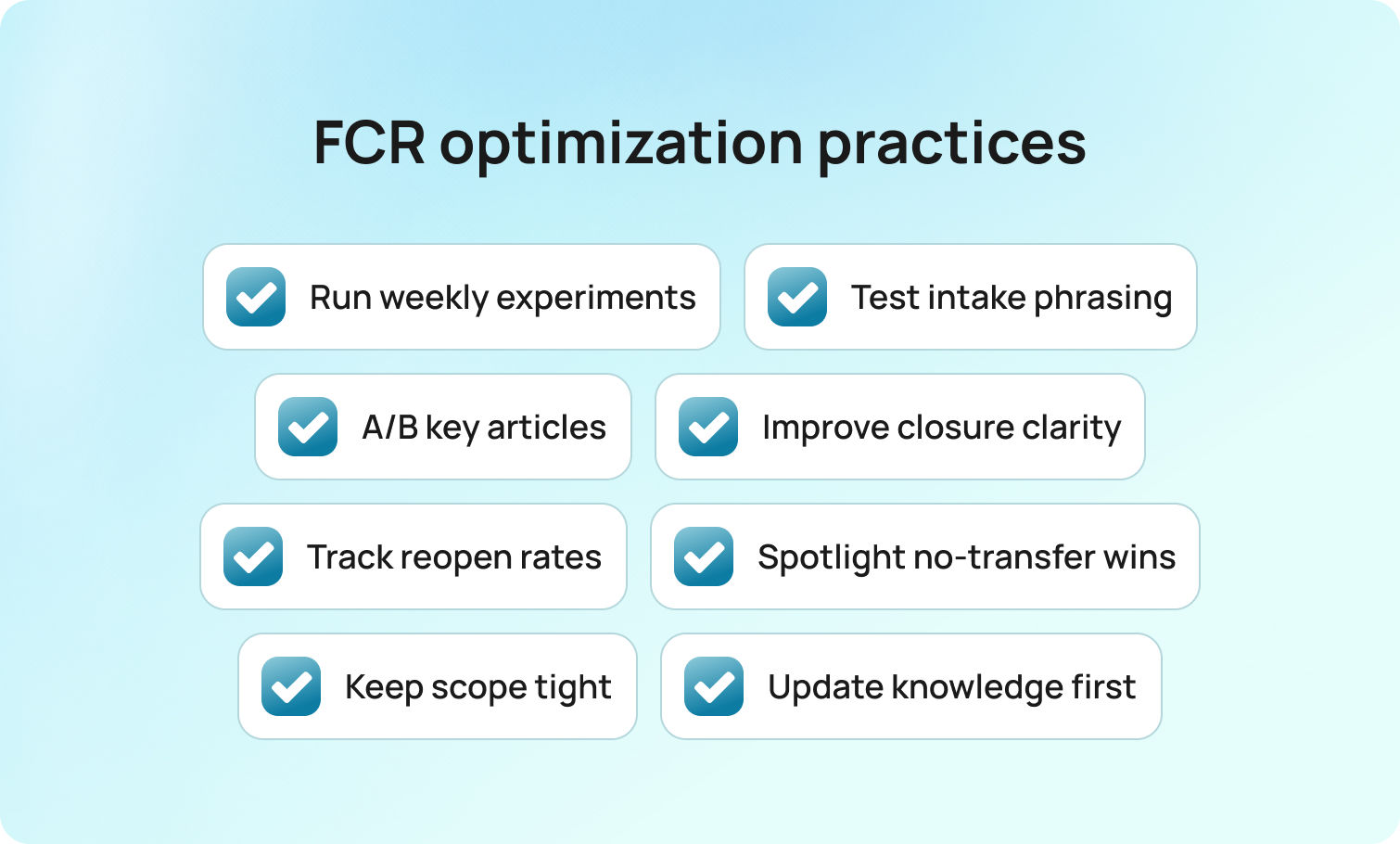
Think of FCR as a product with a weekly release. Small, visible experiments, each scoped to a single change and a single metric, build momentum without disrupting the queue.
Intake usually offers the fastest lift. Rather than a wholesale IVR redesign, run a simple A/B on the greeting and one discovery line for your top intent. After a week, compare misroute rates and first-contact resolution. More precise phrasing at the front door often reduces transfers while also increasing FCR. Quickly resolving customers' problems and resolving issues efficiently at this stage is crucial for improving FCR and overall customer satisfaction.
Findability comes next. Two versions of the same article title (and opening sentence) can yield very different results. Put them head-to-head and watch agent insert rates alongside FCR for that intent. When the right content surfaces quickly, calls are directed to the correct path earlier, and fewer require a second touch.
Endings deserve the same attention as openings. Try two closure frames—one that summarizes what changed, another that also states how the customer will know the fix worked. Seven-day reopen rates tell you which version locks resolution more reliably. Resolving issues and resolving customer problems on the first contact ensures the customer's inquiry is addressed, prevents repeat calls, and directly improves FCR and the overall customer experience.
Behavior follows recognition. A small, time-boxed spotlight on “no-transfer wins” in the toughest intent this month helps good habits spread. Share specific examples so the team sees what “right” looks like in practice. Highlighting effective customer interactions and fostering collaboration within the customer service team is essential. Empowering agents to resolve issues and customer problems promptly not only boosts FCR but also increases customer satisfaction by ensuring customer issues are addressed efficiently.
Keep experiment hygiene tight. Narrow scope, fixed window, published result, merged winner. The cadence builds trust because everyone can see what changed and why. Collecting direct customer feedback after interactions provides valuable insights to inform improvements and further optimize FCR.
Policy shifts call for deliberate updates. Start with the article, then refresh any templates that draw from it, and only then adjust IVR or pre-chat prompts that collect new details. That order prevents mismatches, avoids unnecessary discovery, and protects first-contact resolution while the change is rolled out.
A Look to the Future
FCR improvement is moving toward transparent, retrieval-grounded AI. Routing will use more context from devices and accounts, not only what callers say. QA will shift closer to real time, with on-screen nudges that remind agents to verify identity or confirm the fix before closing. Decision-makers will expect receipts, including details on which sources informed a draft, why a call was routed to a specific pod, and how a change was designed to affect the resolution rate.
Tracking FCR across all communication channels—including phone calls, live chat, email, and social media—is crucial for enhancing customer experiences and pinpointing areas for improvement. Call centers play a crucial role in resolving customer issues efficiently during phone calls, making first-call resolution a key contact center metric.
To stay competitive, organizations must optimize their communication channels and consistently monitor key contact center metrics, such as first-contact resolution and agent efficiency. The average call center benchmarks FCR rates—typically between 70% and 79%—and adapts to new technologies to stay competitive. Platforms that are API-open, grounded in approved knowledge, and explicit about guardrails will earn trust as contact centers bring AI deeper into support services.
Make FCR a Weekly Win
Getting to first call resolution is not a leap of faith. It is the result of a system that sends each contact to the right solver, puts the proper context and knowledge beside the conversation, and learns from every interaction. AI routing makes that first step reliable by reading intent, skills, authority, and live availability, so the call lands where it can be finished. AI-assisted QA keeps the improvement loop tight by showing, within days, which behaviors raised the resolution rate and which details slowed it down.
Understanding why the customer called and focusing on reducing multiple calls and repeat contacts leads to better FCR outcomes. Identifying repeat contact is crucial, as it often signals unresolved issues or friction points in the customer journey. By analyzing customer interactions, teams can identify patterns that lead to repeat contacts and address them proactively, thereby improving support efficiency and customer satisfaction.
The outcome feels different across the floor. Agents start with context and a clear path, not a blank screen. Customers explain their story once and hear a direct answer. Leaders review one set of numbers that connect resolution, satisfaction, and cost, then ship small changes each week. First-call resolution rises because the work aligns with the team, not because targets have become louder. Customer satisfaction follows because clarity replaced handoffs. Operating costs ease because fewer minutes are spent chasing the same fix.
If you want to see the loop in one place, BlueTweak brings routing, proposed reply, summarization, analytics, and WFM into a single workspace. Request a demo to watch the flow end-to-end.
How to Improve Average Handle Time: 21 Ways in Customer Support
Why AHT Pressure Needs A Better Plan
Pressure to “go faster” sits on every support leader’s desk. The instinct is understandable: long waits and meandering calls are taxing for both agents and customers. Yet most teams also believe, rightly, that slashing minutes without protecting quality just moves problems downstream. This guide takes that belief seriously.
Budgets are flat, volumes aren’t, and leadership still expects higher customer satisfaction. Agents feel the squeeze during peak hours when context is missing and after-call work stretches into the next ticket. AHT becomes a stand-in for whether the system helps or hinders real work. As a key center metric, AHT is one of several key metrics used to assess operational efficiency in customer support environments, providing insight into productivity, resource utilization, and service quality. Inefficient customer support systems can generate hidden costs that affect these crucial metrics.
A “good” average handle time hovers around six minutes across many contact centers. At the same time, more than half of customers say that a single bad experience can prompt them to switch to a competitor, which means speed without clarity is a false win.
The real conflict here isn’t agents versus targets. It’s the tension between shaving time and maintaining accurate, human, and traceable answers. Shortcuts that disregard discovery, knowledge, or authority lead to rework and erode trust. Practices that strengthen intake, knowledge, routing, and drafting reduce handle time while improving the experience.
What you’ll get in the following sections is a practical path for how to improve average handle time without trading away quality: clear signals to diagnose where minutes collect, twenty-one proven ways to remove friction, a cost model you can run in an afternoon, optimization habits for ongoing gains, and a brief look at what’s changing as AI becomes standard in contact centers.
Before the Fixes: What AHT Really Measures
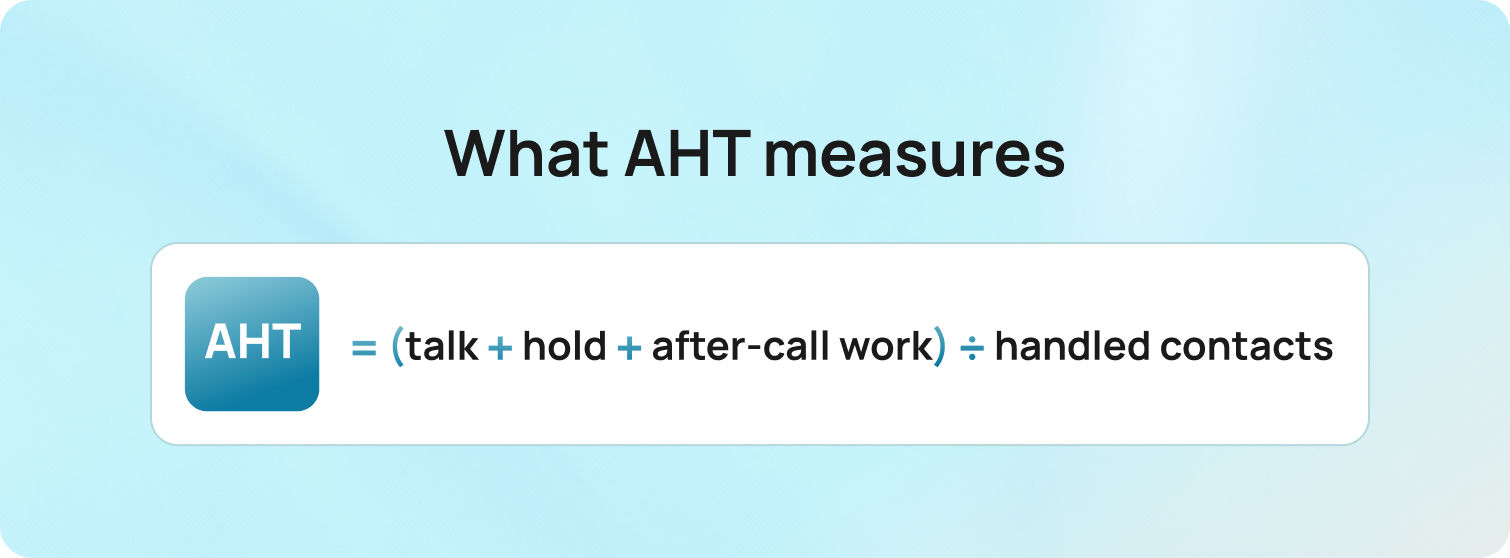
Average handling time (AHT), also known as average handle time (AHT), is the sum of three components of a contact: talk time, hold time, and after-call work (also known as wrap-up time). The math stays simple: AHT = (talk + hold + after-call work) ÷ handled contacts. Break the number down by channel and by queue. Voice seldom behaves like chat or messaging, and a single center-wide figure hides meaningful differences.
AHT measures the actual interaction between the agent and the customer, distinguishing it from related time measures, such as after-call work or hold time. AHT only matters next to quality. Shorter calls are beneficial when customer satisfaction, first-contact resolution, and transfer rates remain steady. Read AHT alongside these other customer service metrics so speed stays tied to clarity, not shortcuts.
The minutes usually collect in predictable places. Rising wrap-up time, combined with flat talk time, often indicates the use of free-form notes and unclear disposition fields. Hold times that grow without added complexity usually trace back to approvals outside the agent’s reach. Higher transfers with lower first-contact resolution signal routing gaps or authority mismatches. An AHT that climbs while customer satisfaction scores and Net Promoter scores slip tells a different story: waste has entered the process.
Numbers set direction, but listening confirms it. Recorded calls and transcripts reveal long silences during searches, policy read-outs where plain steps should appear, and replies typed from scratch instead of drawn from a well-organized knowledge base. Those patterns lead directly to fixes in knowledge, intake, routing, and drafting. The same levers lower AHT while protecting the customer experience.
21 Ways to Improve Average Handle Time in Customer Support
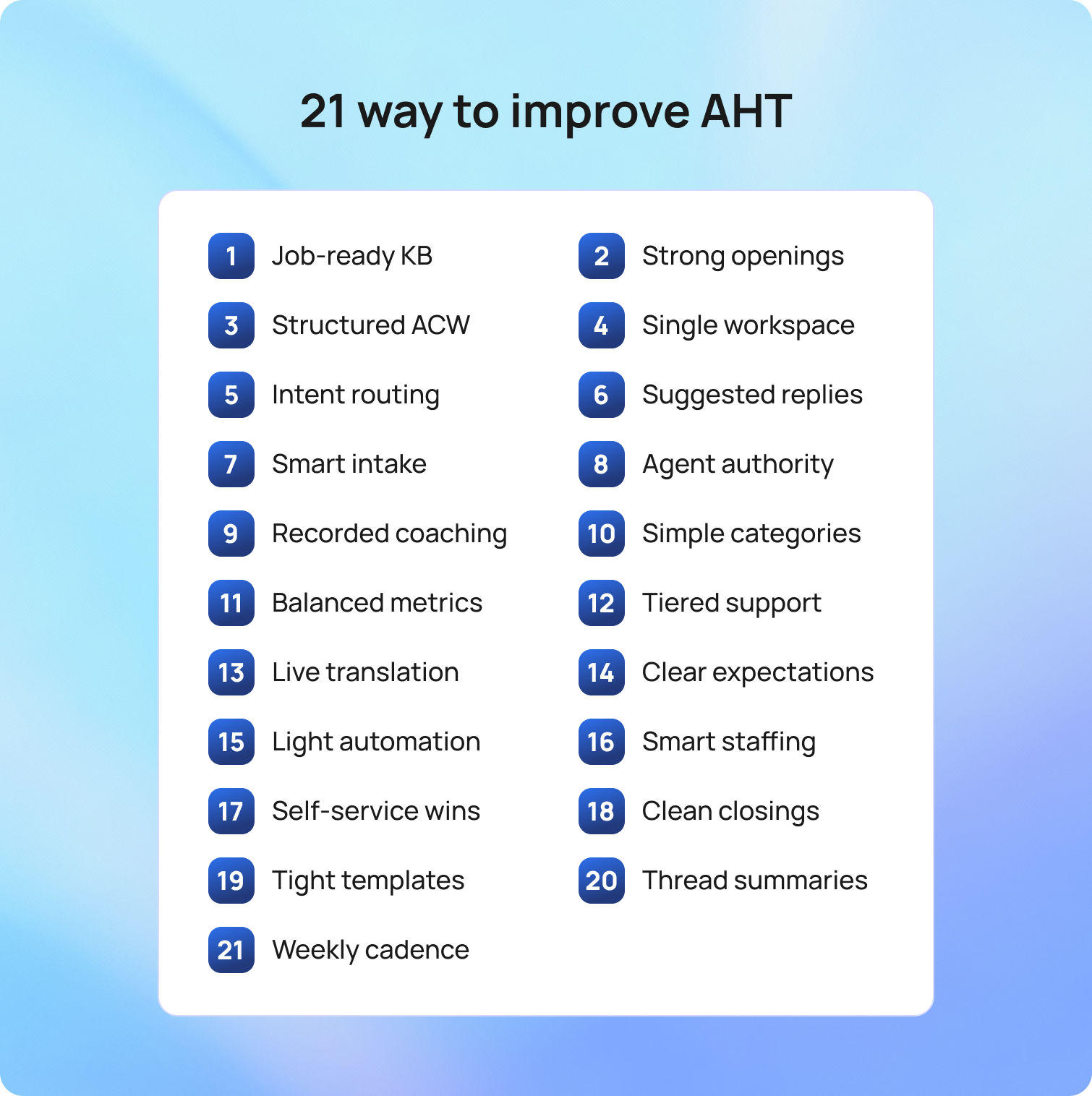
Each practice below removes minutes without trading away accuracy. Choose three to start, ship changes weekly, and review results alongside quality.
1) A Job-Ready Knowledge Base As the Fastest Path to Accuracy
AHT drops when answers are written for the job, not for posterity. Task-first articles with numbered steps, precise prerequisites, and a quick “validate the fix” line keep call handling tight and reduce repeats. Key features of a well-structured knowledge base include management systems for agents, self-service resources for customers, clear labeling by service, product, and audience, as well as efficient content organization.
Labels by service, product, and audience make search more predictable and help agents insert accurate answers without having to search. Retiring duplicates matters as much as adding content because fewer choices speed decisions. A comprehensive knowledge base is particularly valuable for quickly and effectively training new agents.
2) An Opening 90 Seconds That Sets Direction
The first minute shapes talk time more than any script. A brief confirmation in the customer’s words, followed by a plain-language path (“we’ll check X, then do Y”), prevents meandering discovery. One guided prompt in chat often replaces five ad-hoc questions, lowering the customer effort score. Teams that record and review two strong openings per week experience steadier call volumes and fewer transfers.
3) Structured After-Call Notes That Shrink Wrap Up Time
After the call, work expands when notes turn into essays. Short fields for category, cause, resolution, and follow-up keep ACW consistent and make reporting useful. A brief, editable summary from the transcript replaces free-form writing without losing nuance.
4) One Workspace For Context, Not Five Tabs
Every context switch adds seconds that do not improve customer experience. A single view that shows the live thread, the last three cases, and essential account or device data—along with accurate customer data—keeps the support team moving. Inline actions for resets, credits, or replacements save minutes that would otherwise be lost to tool hopping. Modern center tools integrate customer data and context into a single workspace, further improving efficiency for agents.
5) Intent-Aware Routing That Pairs Issues With Solvers
AHT inflates when the first agent is unable to complete the job. Routing by intent collected in IVR or pre-chat sends predictable work to the right queue on the first try. Small, clearly owned resolver groups reduce ping-pong and improve agent performance.
Many call center tools now include advanced routing features, such as intent-aware routing, to ensure customer issues are paired with the right solvers.
6) Suggested Reply for Consistent, Quick Drafting
Drafting replies from scratch is slow and inconsistent. A suggested reply grounded in approved knowledge provides agents with a correct first draft that they can adapt and send, thereby reducing composition time and minimizing reopens. Consistency improves across shifts and regions because structure, tone, and policy stay aligned.
7) IVR and Pre-Chat Intake That Collects What Matters
Menus that gather one valid identifier and offer a handful of clear choices shorten discovery. Interactive voice response (IVR) menus and pre-chat forms that request an order ID, device model, or error text help reduce the time spent clarifying basic information. In-queue callbacks prevent long holds from becoming long calls. Teams that revisit prompts monthly usually find quick wins in call handling processes.
Interactive voice response and pre-chat forms are valuable self-service options that empower customers to resolve simple issues independently, improving efficiency and satisfaction.
8) Frontline Authority Matched to Common Resolutions
Long holds for routine approvals hurt customer satisfaction and AHT. Clear thresholds for credits, replacements, and minor exceptions let agents act with an audit trail. Authority aligned to frequent requests builds confidence, trims hold time, and keeps work moving without supervision. Empowering agents to resolve customer issues on the spot reduces hold times and improves efficiency. Quality remains intact when rules and spot checks are clearly defined.
9) Coaching Grounded in Recorded Interactions
Generic coaching rarely changes outcomes. Short clinics, which utilize recorded calls, call recordings, and screen captures, make the friction obvious—long silences during searches, missed knowledge cues, or slow closings. Publishing two “golden” examples each week gives center agents a concrete model to emulate.
10) A Smaller, Clearer Category Tree
Overgrown dispositions add minutes and pollute data. A compact taxonomy that reflects the top use cases speeds ACW and enables later automation. Rare cases can sit under an “Other” bucket with a single free-text line. Cleaner fields also make it easier to calculate average handle time by intent and to compare like with like.
11) AHT Read Alongside Adjacent Metrics
Speed without quality is a false win. AHT should be aligned with first-contact resolution, transfer rate, abandon rate, customer satisfaction score, and Net Promoter Score—these are key metrics for evaluating call center performance—so that trade-offs are visible. Analysts who check the ACW trend and the talk time trend together catch measurement bias early.
12) A Tiered Operating Model That Truly Shifts Left
Tier 1 support agents focus on resolving everyday work efficiently; Tier 2 handles complex issues; Tier 3 addresses platform and deep-seated fixes. Acceptance criteria for escalations (including steps taken, artifacts attached, and expectations set) help eliminate restarts that lengthen AHT. Clear swimlanes make staffing and training planning easier.
13) Real-Time Translation Where Language Adds Minutes
Language mismatches can create delays and confusion. Real-time chat translation enables agents to work in their own language while customers read in theirs, maintaining a seamless experience without requiring staffing for every language on every shift. Multilingual capability also opens up new markets, often resulting in more leads and higher sales conversions.
14) Openings That Set Expectations and Keep Momentum
Warmth matters; lengthy introductions do not. A concise greeting, a reflection of the issue, and a preview of the path move the interaction forward. When research is required, an agreed time and channel for follow-up prevents “any update” loops that add minutes today and tomorrow.
15) Lightweight Automation For Repetitive Steps
Automation belongs where repetition hides, not where judgment lives. Classification hints, suggested priority, and inline data lookups remove friction while leaving decisions with the agent. It is smart to combine classification and summarization, automatic routing, and spam detection so repetitive tasks shrink while oversight remains simple. These automations help automate tasks that would otherwise consume agent time, increasing efficiency and allowing agents to focus on more complex issues.
16) Staffing Aligned to Arrival Patterns and Complexity
AHT suffers when expertise and demand do not align promptly. Interval-level arrival curves and a view of issue mix guide smarter rosters, placing experienced agents where complex inquiries are most likely to occur. Recognizing call volume patterns is critical for aligning staffing with demand. New colleagues handle “easy wins” with help nearby, which strengthens the ramp and smooths the queue.
17) Self-Service For Predictable Success Paths
Deflection lowers AHT indirectly by removing avoidable work. Password resets, delivery status, appointment scheduling, and simple plan changes usually fit. Customers often attempt to resolve issues on their own before contacting the contact center. Customers move faster, and the contact center focuses on decisions that require people.
18) Closings That Prevent Reopen Cycles
Unclear endings turn into repeat contacts. A single-line summary of the action taken, the next step, and the timeframe for any follow-up will most often prevent reopens. Addressing customer queries thoroughly at the end of the interaction reduces the likelihood of follow-up contacts, as customers leave with all their questions answered. When a public article guides the fix, sharing the link gives the customer a reference and shortens future conversations. ACW also falls because documentation becomes consistent.
19) Templates and Snippets Maintained For Precision
Templates are most effective when they are concise, specific, and up-to-date. Having one canonical answer per policy helps prevent drift across shifts and regions, ensuring consistency and accuracy. Teams that retire wordy fragments and keep tone guides close see faster composition and fewer edits.
20) Summaries That Tame Long Threads
Long histories invite rereading and delay. A concise summary that highlights the latest decision, the pending step, and any promises already made enables the next agent to act promptly. These summaries make it easier for agents to review previous conversations and take prompt action. Summarization also reduces after-call work time because the same brief becomes the note.
21) A Weekly Improvement Cadence That Compounds
Sustained AHT gains come from small changes shipped often. A 20-minute meeting that reviews AHT, hold time, and ACW alongside quality, samples two interactions, and commits to one fix creates momentum that the team can feel. Teams should regularly review performance data and recorded calls to identify areas for improvement, thereby supporting ongoing learning and development. Over quarters, that cadence reshapes center operations more than any single tool rollout.
How BlueTweak Supports Faster, Better AHT
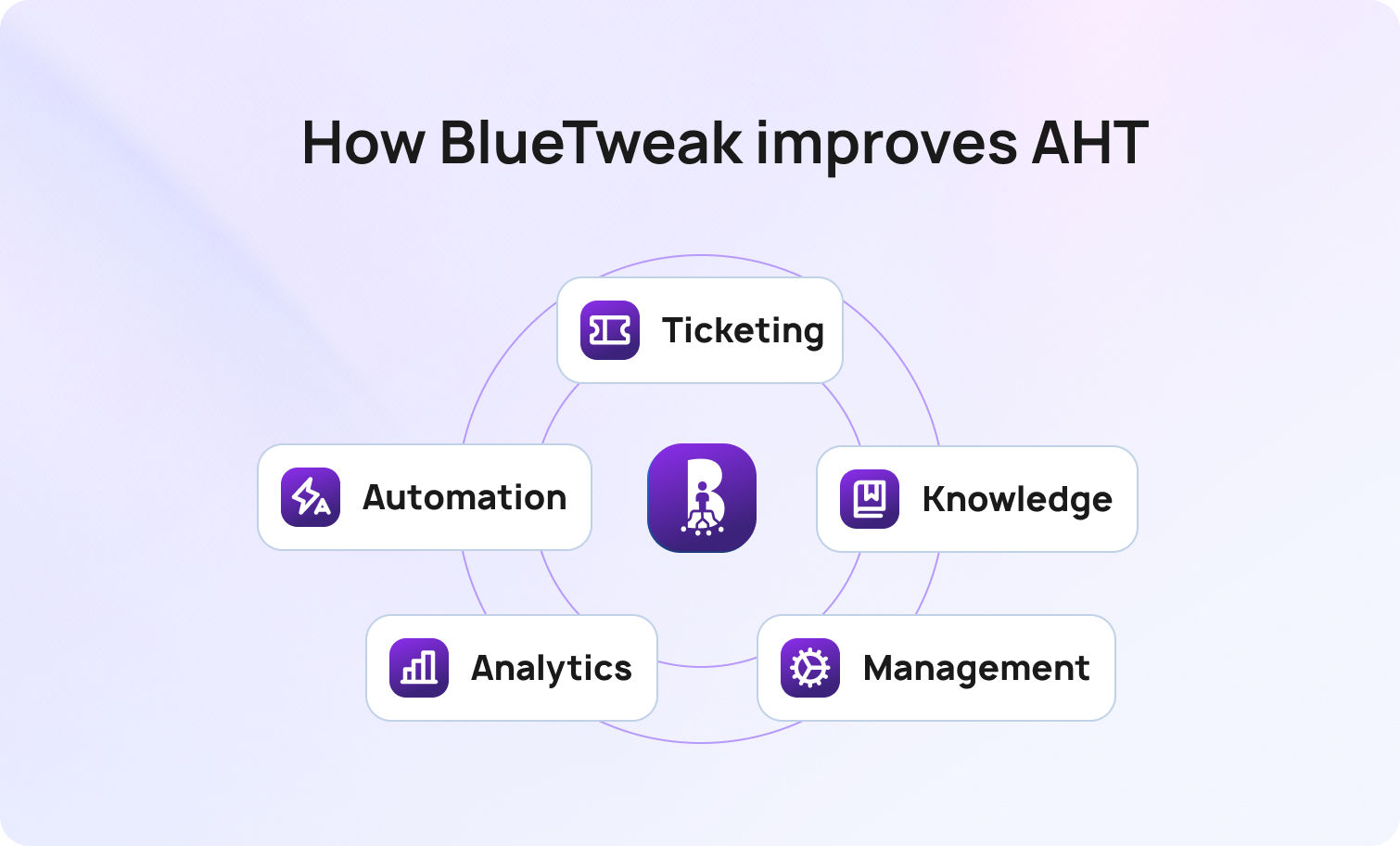
BlueTweak brings chat, voice, and email into a single workspace, with knowledge, customer service analytics, and workforce management alongside the conversation. Agents stay in one place, see the necessary context, and document outcomes without needing to switch between tabs. That coherence trims seconds from every step, which adds up across a busy day. These efficiencies increase agent productivity and enable the team to handle more calls per shift.
At the core sits a smart knowledge base. Rather than sending agents hunting, BlueTweak draws directly from approved articles to offer a suggested reply that the agent can review, edit, and send. The same content powers self-service, so straightforward requests never reach the queue. Upstream, automatic routing and classification steer each contact toward the team most likely to resolve it.
Downstream, AI ticket summarization condenses long threads into concise summaries that agents can scan, while spam detection filters out noise before it consumes time. These features help reduce average handle time and streamline processes across the support operation. Global programs keep pace because real-time chat translation lets agents work in their own language while customers read in theirs.
Leaders see the whole picture in one place. AHT, hold time, after-call work, transfer rate, CSAT, and staffing appear together, which makes the weekly “what changed and why” conversation short and specific. BlueTweak is open to integration and API access, allowing order or device details to be displayed alongside the conversation, rather than in another system. Automation remains human-in-the-loop throughout: repetitive steps are handled by the platform, agents maintain control over sensitive messages and decisions, and service quality remains intact while average handle time decreases.
Optimization Practices That Keep Gains Growing
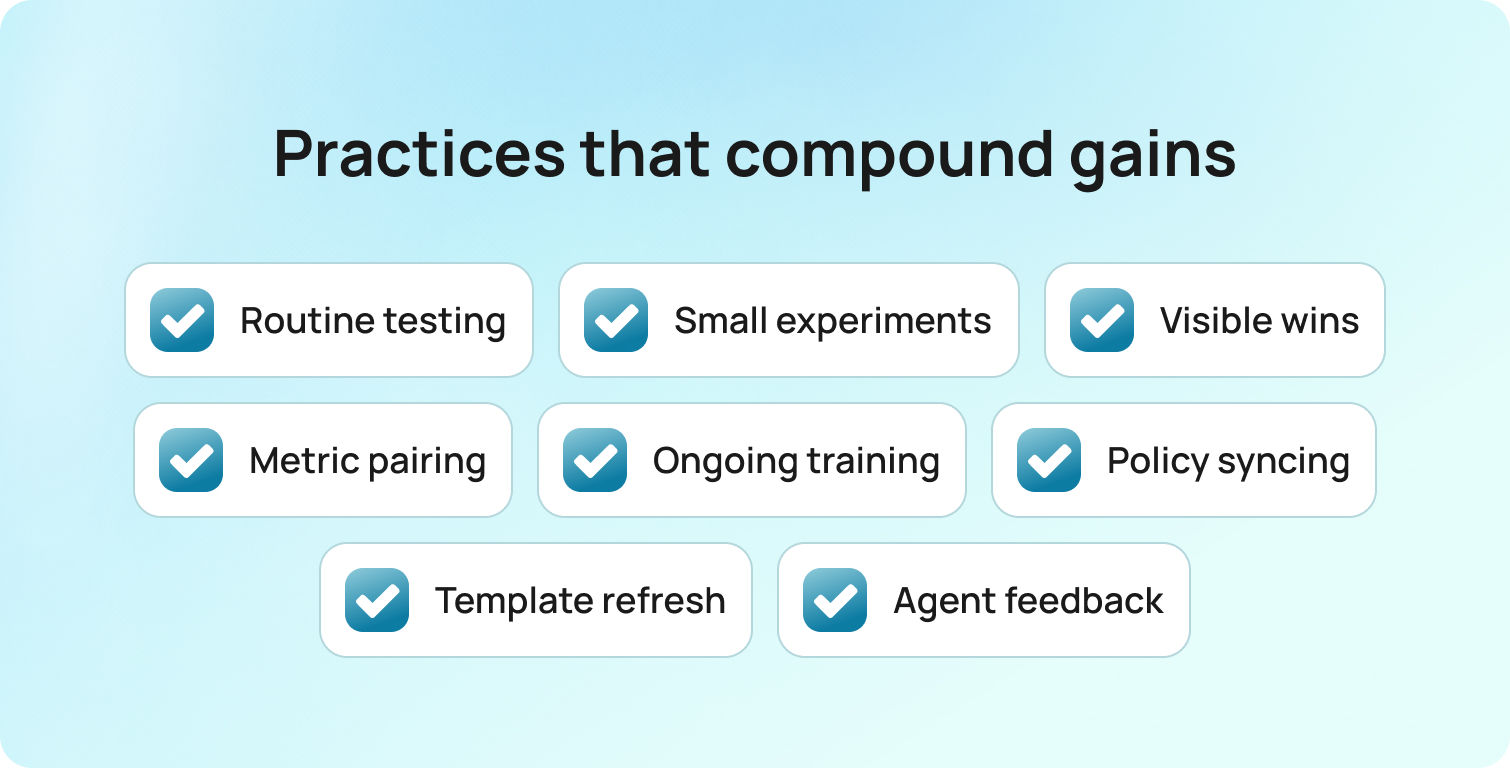
AHT falls when improvements become routine. Treat the operation like a product.
A simple A/B approach works for messages and steps. Rotate two greeting styles for a week and compare the time spent on the first meaningful action. Test two closure frames and compare reopens. Swap two article headlines that aim to answer the same intent and compare agent insert rates. Keep tests small and visible. Announce the winner and merge the change.
BlueTweak’s analytics make these comparisons practical because other metrics are presented alongside AHT, not in a separate spreadsheet. Ongoing agent training and additional training sessions help reinforce best practices, support continuous improvement, and ensure that training agents are equipped to handle calls efficiently and deliver quality service.
Dynamic adaptation matters too. When a policy changes, update the article first, then refresh the template that draws from it, and finally, amend any pre-chat prompt that collects new details. That order preserves consistency and avoids mismatches that create avoidable minutes in discovery. Encouraging agents to participate in ongoing learning and focusing on quality service ensures that improvements are sustained over time.
Where AHT Improvement is Heading
The near future blends retrieval-grounded AI with strict governance. Drafts will assemble from approved articles, recent resolutions, and account context, while access rules keep sensitive actions under review. Expect leaders to ask for transparency. They will want to know which sources shaped a message and who approved the send. They will expect analytics that show adoption, edit rates, and quality outcomes rather than vanity metrics.
Future improvements will focus on optimizing performance across the entire contact center by leveraging comprehensive center metrics, including tracking the time customers spend during each stage of an interaction. BlueTweak’s AI + API stance supports this direction by grounding outputs in approved content and keeping the agent in control of final wording.
From Minutes to Momentum
Average handle time improves when systems make good work easy. A reliable knowledge base, clear intake, intent-aware routing, and grounded drafting do most of the heavy lifting. Call center agents spend time solving rather than searching. Customers receive accurate answers faster. Adjacent metrics move in the right direction because quality remains visible. These practices lead to quality customer service and help increase customer satisfaction.
BlueTweak brings these pieces together in one place. The platform unifies voice, email, and chat, then adds capabilities that remove friction, including proposed reply, classification and summarization, automatic routing, spam detection, real-time chat translation, analytics, and WFM support. Improving customer satisfaction is a key outcome of optimizing average handle time and related processes. The result is a consistent experience for agents and customers across channels.
Request a demo to see an end-to-end flow, calculate the impact on your AHT, and map your first month of changes using the practices in this guide.
16 Tips For Handling Multilingual Customer Support Emails At Scale
Why Multilingual Customer Support Emails Stall As You Scale
Email is the backbone of customer support for many multilingual businesses, yet quality often drops as volume grows. Three structural patterns slow teams down and frustrate global customers. Language barriers can further slow down support and frustrate customers, making it harder to deliver timely and practical assistance.
First, language coverage lags demand. A fast-growing customer base reaches out in multiple languages, but providing support in each is challenging. Hiring an in-house multilingual team for every region is difficult. Messages wait for the support agent who can answer in the customer’s preferred language, leading to uneven service hours and mounting queues.
Second, knowledge is not truly multilingual. Articles exist in only one language, or translations go out of date. Support representatives improvise their phrasing, introducing variance and confusion. The same question yields different answers, and customers raise new concerns because expectations were not set in their native language. Language barriers can lead to misunderstandings and inconsistent answers, further impacting customer satisfaction.
Third, workflows are fragmented. Emails, phone support, social media platforms, and self-service options are managed in separate tools. Context does not follow the conversation across communication channels, so support teams ask for the same details again. Customers feel unknown, and effort rises. Overcoming the language barrier is essential for seamless support across all channels.
This article makes the work concrete. You will learn how to identify the bottlenecks in multilingual customer support emails, design multilingual operations that scale, and combine translation, workflow, and knowledge into a single system. It closes with a focused view on how BlueTweak helps teams deliver accurate answers in multiple languages while keeping operators in control.
What Is The Problem: Hidden Forces That Depress Quality In Multilingual Email
Quality breaks for predictable reasons, and each reason has an operational fix. Use the lenses below to find the biggest gaps and plan your support strategy.
Fragmented Language Coverage That Elevates Effort
When one person becomes the de facto owner of a language, every customer query in that language waits. It is crucial to understand which languages your customers speak to ensure proper coverage and efficient routing of support requests. Over time, spikes, backlog, and message quality grow. Customers who cannot get immediate assistance switch channels or give up. The result is higher effort for the customer and lower customer retention for the business.
A better pattern assigns emails based on intent and customer preferences, not just on inbox ownership. Language is a requirement, not the whole routing decision. You protect speed and keep context intact.
Knowledge That is Not Channel-Ready or Multilingual
A single article written for chat will not read well in email. A voice script rarely maps cleanly to a long-form reply. If multilingual knowledge base content is not channel aware, agents rewrite it on the fly, and each rewrite introduces drift. Drift becomes inconsistency, and inconsistency creates mistrust. Maintaining up-to-date knowledge bases in all supported languages is essential to ensure consistency and provide reliable self-service solutions for customers.
High-performing teams write for email as a first-class channel. They maintain short, verifiable steps, examples in the customer’s language, and closing lines that confirm outcomes. The same intent can have a chat, email, and voice variant, all tied to a single source article.
Translation Without Governance
Raw translation tools can speed up replies, but ungoverned usage introduces errors. Terms shift, legal phrasing changes, and tone feels off. A single wrong noun in a warranty sentence can trigger costly rework. Even when support agents are fluent, fatigue drives mistakes.
Governed translation means AI drafts are generated from a trusted article, use an approved glossary, and keep a changelog. Agents remain in control, and multilingual support becomes repeatable. Providing native language support further reduces errors and builds trust by ensuring customers receive assistance in their own language.
Context That Does Not Travel Across the Entire Customer Journey
Customers contact you through email, then switch to chat, then reply again by email. Without a unified view, your support team starts cold each time. Repeat questions rise, and confidence falls. The fix is a shared thread that includes identity, channel history, and the working hypothesis about the issue. Context continuity reduces effort and improves outcomes.
How To Identify Problems In Multilingual Customer Support Emails
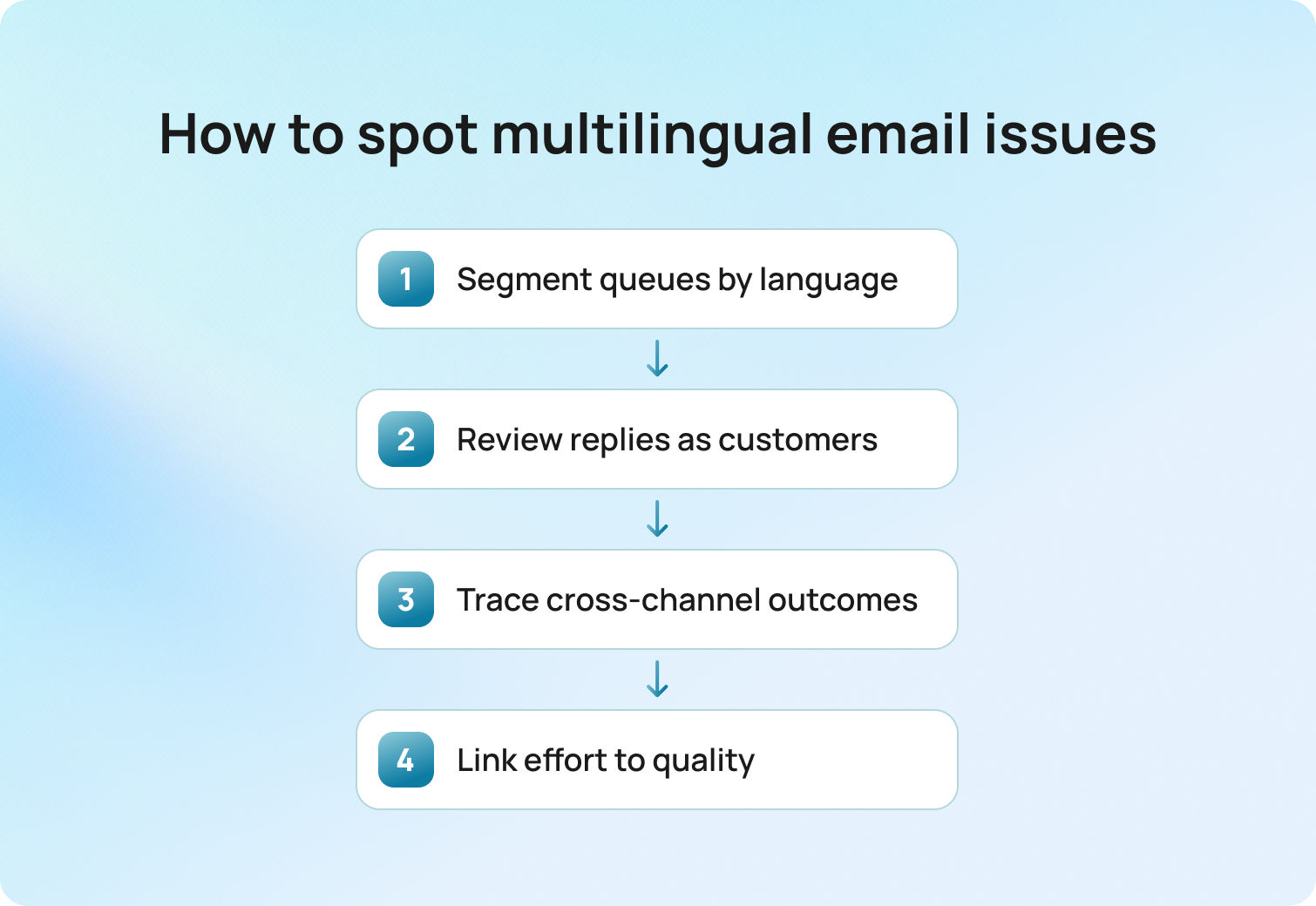
Before changing tools or rewriting content, measure where the experience breaks. Analyze customer inquiries to identify language preferences and support gaps, pinpointing where multilingual support may be lacking. The goal is to identify the bottlenecks that block multilingual customer experiences, then fix them with the least disruption.
Step 1: Inspect the Queue the Way Customers Feel It
Look beyond raw backlog. Segment the email queue by language, intent, account tier, and geography. This approach helps ensure your support is accessible and effective for a global audience. Compare the median time to first reply for each segment. If one language consistently trails others, you likely have a coverage or routing issue. If one intent has slower replies in several languages, the problem is content, not staffing.
Step 2: Read Replies From the Customer’s Seat
Sample five resolved emails per top language and intent. Check for clarity, tone, and a final step that confirms success. Look for phrases that feel translated but not local. If the reply asks the customer to repeat information already provided, you have a context problem. If the reply uses steps different from those in the public article, you have a knowledge governance problem.
Step 3: Trace Outcomes Across Channels
Pick five email threads that later moved to chat or phone support. Did the new agent have the prior summary, the language preference, and the working diagnosis? If not, the experience will feel fragmented, even if the final answer is correct. That fragmentation hurts customer satisfaction and customer experience.
Step 4: Tie Agent effort to Answer Quality
Measure edits per reply, time spent searching, and the share of messages that need a second follow-up. High search time and many edits indicate missing or poorly structured articles. A high second follow-up rate means unclear steps or unresolved expectations.
16 Tips To Fix Multilingual Customer Support Emails With Scalable Practices
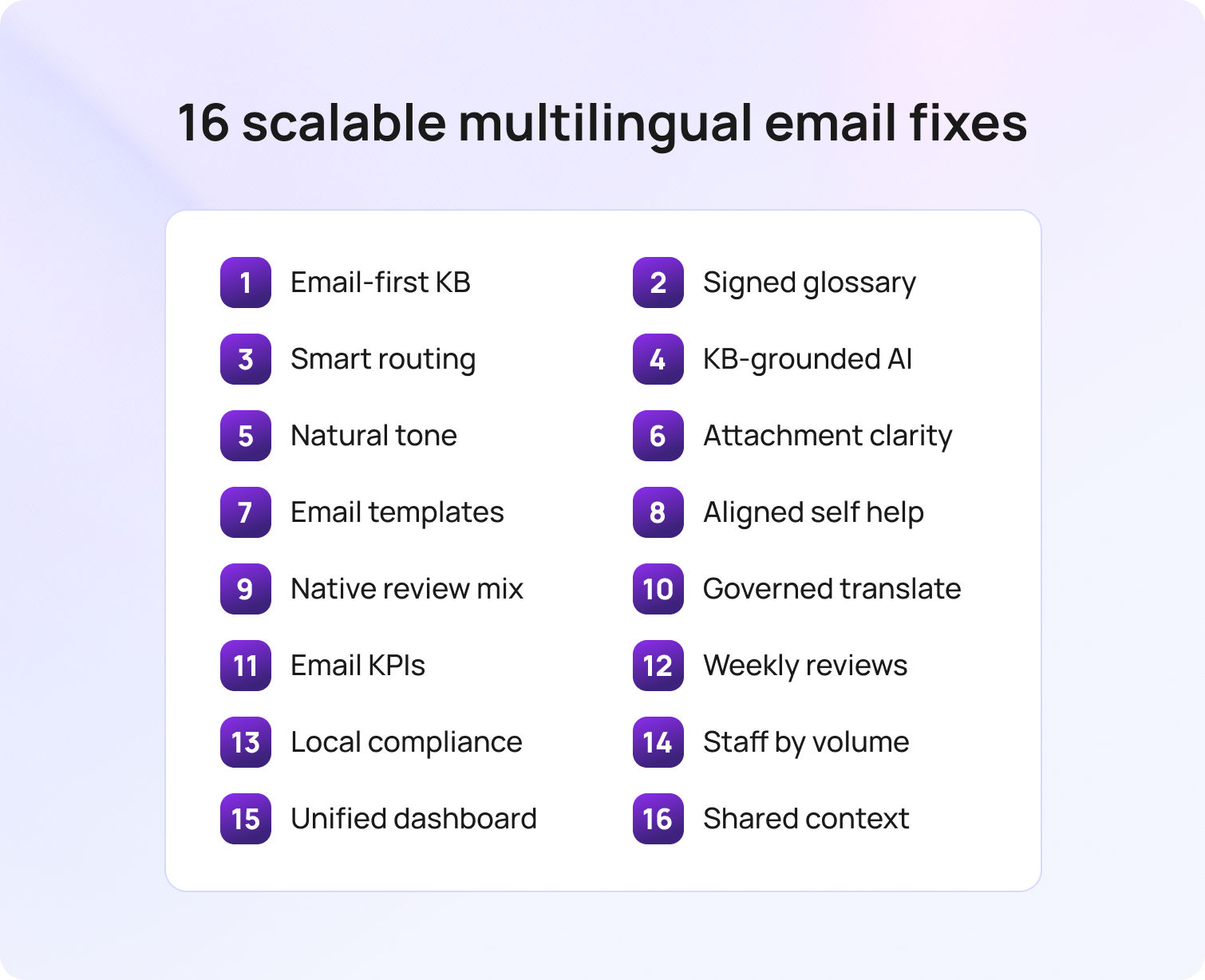
You do not need a large in-house multilingual team to deliver excellent multilingual email support. With proper practices, you can efficiently offer multilingual support and connect with a diverse, global customer base. You need consistent knowledge, precise routing, good translation governance, and a workflow that keeps humans in the loop. The practices below create durable gains.
1) Make Wmail a First-Class Channel in Your Knowledge Base
Email has its own voice. Write email variants for your most frequent intents, with short paragraphs, headers for scanning, and clear outcome checks. Include examples in the customer’s language for tricky steps. Store versions per language so updates ship together. It’s essential to ensure content is accurate in both language and the target audience's cultural context. The result is a consistent tone and fewer rewrites.
2) Build a Multilingual Glossary That Product and Legal Sign Off
Glossaries are the backbone of clear communication in multiple languages. Define product names, policy terms, and legally sensitive wording. Keep them in sync with product releases. When translation services or AI draft text, they rely on the glossary to avoid drift. This reduces risk and creates predictable responses across multilingual customer support teams.
3) Route By Intent and Language Together, Not Just By Inbox
Configure routing to account for both the customer’s topic and language. A returns email in Spanish should reach a returns specialist who writes Spanish, not any Spanish speaker. For low-volume languages, create a small guild of trained writers and back them with AI-assisted drafting. This approach ensures a consistent multilingual service for all customers. This lowers transfers and shortens time to resolution.
4) Draft with AI, But Ground Every Sentence in Knowledge
Let AI propose email replies that cite the exact article and section. The agent reviews, edits, and sends. Grounding keeps terminology aligned and gives new support agents a safe starting point. Over time, you will see fewer errors, faster first replies, and more consistent outcomes.
5) Keep Tone Natural in Both Directions
The best multilingual exchanges read as if they were written by a local. Train models and teams with approved phrasing for greetings, empathy, and closings in each language. Avoid literal translations for idioms. Maintain a short style guide per language so replies feel like they come from one brand, not a patchwork of voices.
6) Close the Loop with Attachment and Form Handling
Many customer interactions include screenshots, PDFs, or invoices. Make sure your system can extract needed fields and preserve file names across languages. Provide step-by-step instructions when asking for attachments, and confirm receipt in the customer’s preferred language. Clarity here prevents back-and-forth that frustrates multilingual clients.
7) Add Channel-Aware Templates, Then Personalize
Templates are starting points, not final messages. Build templates for the top intents per language that include a subject line, a short body, and a confirmation line. Agents personalize the middle paragraph with details from the case history. This balance maintains speed and avoids robotic replies.
8) Offer Multilingual Self-Service Resources That Match Email Content
Self-service works when it answers the same way the agent would. Align multilingual self-service resources with email variants. Link to the exact article you used to compose the reply, so customers who prefer to read on their own can follow the same steps. This creates a smooth multilingual support journey from email to portal and back.
9) Blend Native Speakers and Trained Writers
Native fluency is valuable, but not every message requires a native writer. Providing support in customers' native languages increases trust and satisfaction, helping to reduce misunderstandings and build loyalty. Pair native speakers for quality checks on high-risk topics with trained writers who handle volume using governed drafts. This model keeps costs in line while protecting nuance.
10) Use Translation, Not Guesswork
For low-volume languages, rely on AI translation constrained by the glossary and knowledge base. Ask for a brief confirmation in the customer’s language when the meaning is ambiguous. This provides coverage without hiring for rare skills and respects the sender's preferred language. This approach ensures that every global customer receives timely and accurate support, regardless of their language or location.
11) Track the Signals That Matter For Email
Measure first reply time, full resolution time, edits per reply, use of knowledge citations, and follow-up rate. Watch these by language and intent, and tie them to key performance indicators such as customer satisfaction, repeat contact rate, and refund rate. Improvement here shows that customers receive answers that resolve the issue the first time.
12) Train Continuously with Real Examples
Short, frequent sessions beat annual marathons. Review three real emails per week with the team, ideally in two languages. Then discuss subject lines, tone, steps, and closings, and highlight where the knowledge base helped and where it failed. Continuous training programs keep standards high and culture aligned.
13) Respect Privacy and Local Rules
Language work crosses borders. Store customer data in accordance with regional requirements. Standardize how you handle identity checks and sensitive disclosures in email. Then, align your glossary and templates with compliance teams to avoid legal risk across new markets.
14) Plan Staffing Around Real Volume, Not Assumptions
Use historical arrival patterns to staff by language and intent, and stagger customer service hours to cover peaks without overstaffing. Build a small bench for holidays and regional events. This protects reply times and reduces burnout.
15) Give Managers a Single View
Leaders need one dashboard that shows volume, service level, and quality by language and intent. When the view is unified, it becomes easier to tune routing, prioritize translations, and add or remove self-service options. Visibility unlocks calm operations.
16) Connect Email to the Rest of the Journey
Email is not isolated. Many cases begin with multilingual self-service options, then shift to email, and finally escalate to chat or phone. Preserve the thread across channels. Include a short summary when handing off to chat, and bring the chat recap back into the email record. This respect for the entire customer journey reduces effort and protects quality.
Why Improving Multilingual Customer Support Emails Matters For Growth
Email remains the most trusted written channel for many global customers. When messages are read clearly in the customer’s language, when steps resolve the issue, and when tone reflects local norms, customers feel respected. Respect turns into customer retention, product expansion, and referrals. In competitive categories with similar features and prices, reliable multilingual support becomes a significant competitive advantage. It signals that you understand customer expectations and that you can offer support wherever customers live and however they prefer to communicate. Offering support in the customer's preferred language is crucial for business growth, as it enhances customer satisfaction, builds loyalty, and facilitates global expansion.
Operationally, the same practices that deliver quality also reduce cost. When agents answer from one source of truth, they search less and resolve more. When routing is precise, fewer people touch each case. When templates and translation are governed, rework falls. The combination preserves speed while raising support quality.
How BlueTweak Helps Teams Handle Multilingual Customer Support Emails
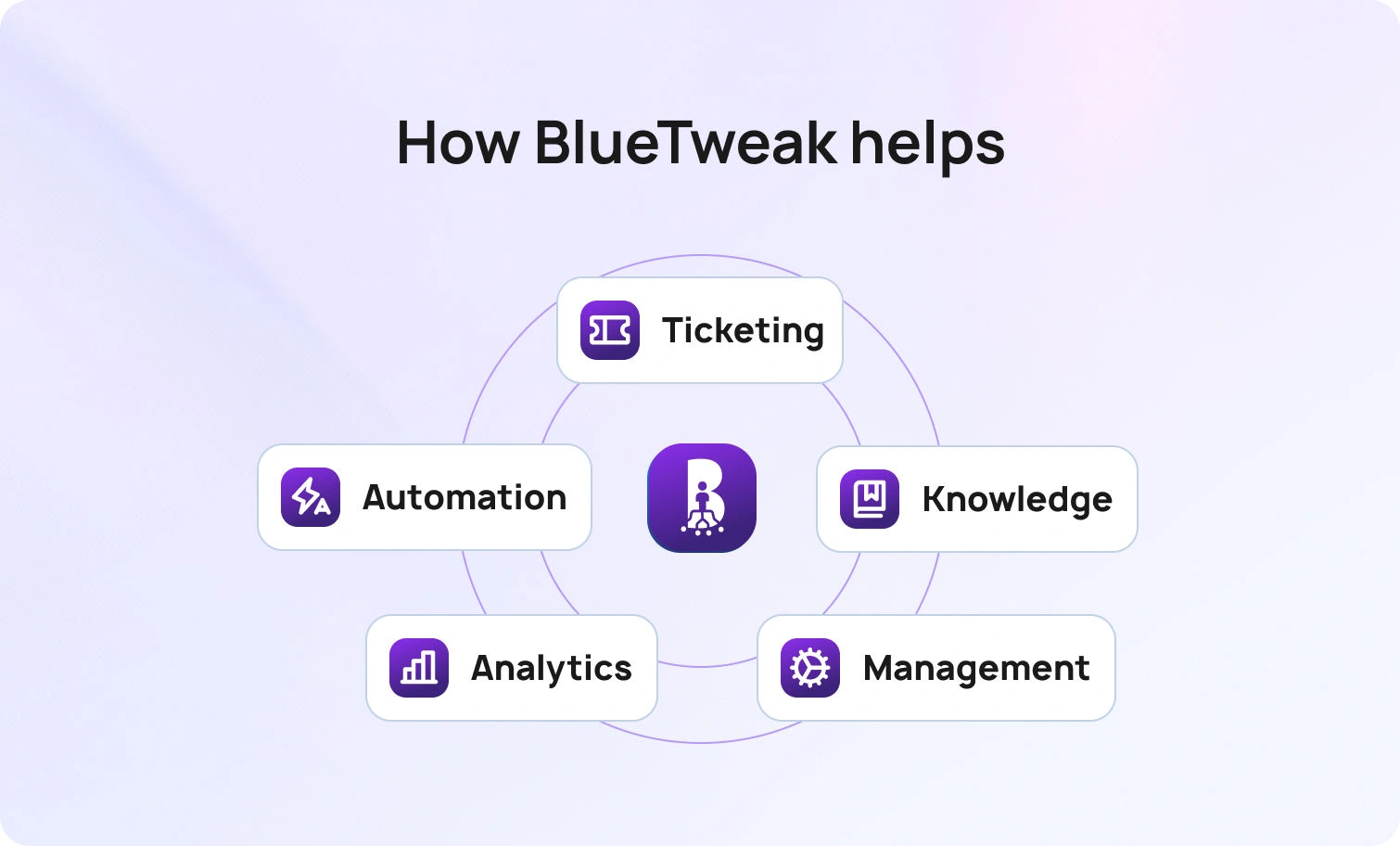
BlueTweak brings the moving parts together so your team can provide multilingual customer support at scale without chaos. It enables effective multilingual customer service across channels, ensuring consistent, high-quality support for global customers.
BlueTweak unifies email, chat, and voice into a single queue, so context travels with the conversation. An incoming email is classified by intent and routed to the right skill group. Agents receive a suggested reply that cites the exact knowledge article, is written for email, and includes an AI ticket summary of prior interactions to avoid repeat questions and ensure clear communication, as the default.
For multilingual email support, BlueTweak pairs AI translation with a multilingual knowledge base, ensuring drafts comply with product terms, policy language, and regional phrasing. Where language coverage is light, teams can still respond confidently using grounded drafts and a quick confirmation step when meaning is ambiguous.
Analytics surface core service metrics, such as first-contact resolution, sentiment, transfer, and abandon, by channel and use case. Open to integration and an API-open stance make it straightforward to connect customer data and KPIs to CRM and reporting tools, so support teams can show how offering multilingual support improves satisfaction and retention.
The result is a clean workflow that helps support agents answer in the customer’s preferred language, maintain tone, and resolve customer issues with clarity. Customers get fast, accurate help in their native language, agents work from a single source of truth, and leaders can scale into new markets with confidence.
Build A Scalable Engine For Multilingual Customer Support Email
Scaling multilingual customer support emails starts with the basics, not guesswork. Start by writing channel-ready knowledge for email in all priority languages. Then route by intent and language together, and draft with an AI grounded in approved content, not a blank model. Keep a living glossary for product and legal review, train with real examples each week, and tie the email channel to chat, voice, and multilingual self-service resources, so context follows the case.
Do this, and your replies will read naturally in the sender's native language, your team will resolve more issues in fewer touches, and your customer satisfaction scores will rise across a diverse customer base. The payoff is practical. Customers receive personalized assistance in their preferred language, support teams run smoothly, and the business gains a competitive edge through a credible global presence. These strategies help customers be more effectively assisted across languages, ensuring their needs are met no matter where they are.
Request a BlueTweak demo to learn how unified routing, AI-assisted drafting, translation with governance, and a multilingual knowledge base help you deliver multilingual customer support emails at scale.
How AI-Driven Customer Sentiment Analysis Helps Prioritize Customers
Scores Without Action Equal Missed Escalations
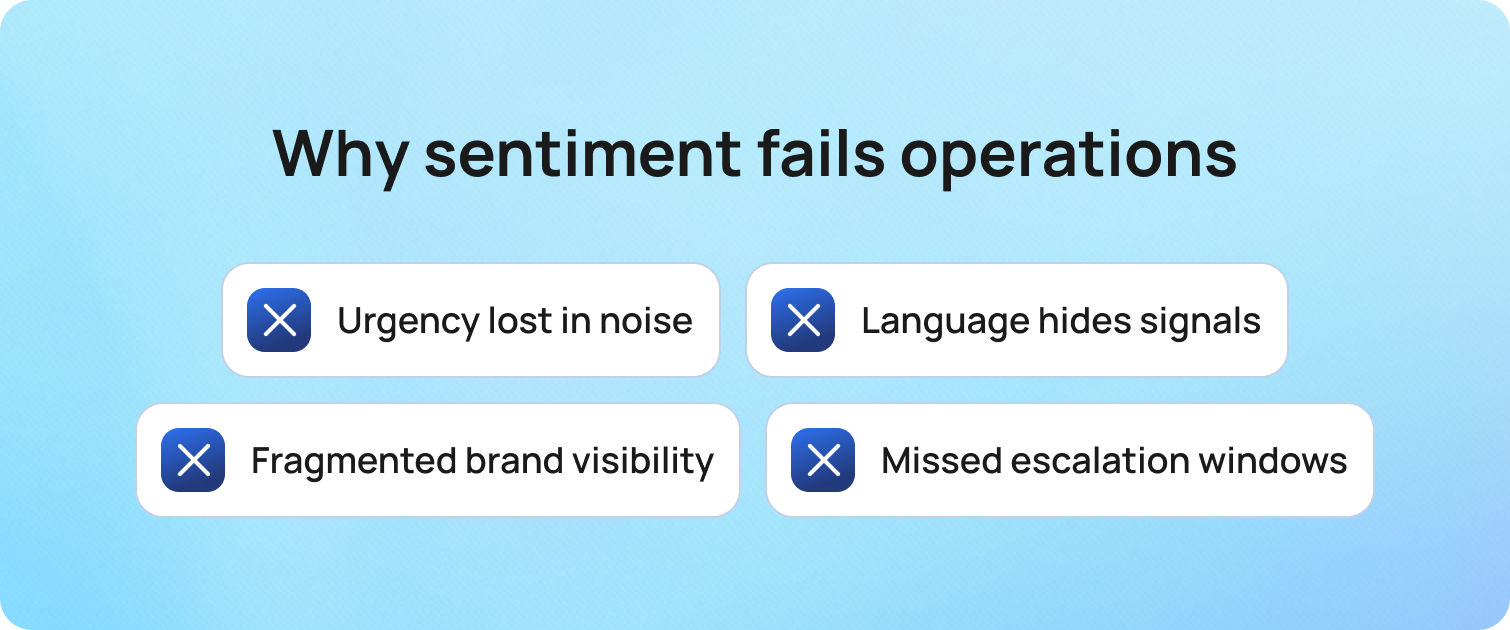
Most artificial intelligence sentiment analysis tools generate visually appealing dashboards with color-coded emotion scores, providing a clear representation of the sentiment. Your team sees a spike in negative sentiment. Someone mentions it in a meeting. Then nothing changes operationally.
Sentiment scores sit in analytics platforms while your ticketing system routes every email in the order it arrived. Unfortunately, this still places upset customers with serious customer support tickets in the same queue as someone inquiring about your business hours.
The core issues:
- Noise drowns out real urgency. Spam, routine questions, and low-priority customer feedback flood your queue. True negatives (customers at risk of churning) blend into the background. Agents triage based on subject lines or timestamps, rather than emotional state.
- Multilingual complexity hides signals. A frustrated customer writing in Spanish or switching mid-conversation from English to French often gets misrouted or stuck with an agent who can't fully understand the context. Language barriers delay triage when speed matters most.
- Multi-brand chaos fragments visibility. If you support three product lines under different brands, negative sentiment in Brand A's queue might not trigger alerts in your central view. Patterns emerge too slowly to prevent damage.
- Escalation windows close before anyone notices. By the time a supervisor reviews last week's sentiment trends, the angry customer has already canceled, left a one-star review, or moved to a competitor.
This leads to slower triage, repeat contacts from the same frustrated customers, abandoned conversations, and measurable churn. Your agents feel the pressure but lack the artificial intelligence tools to act on what the data is already telling you.
In this article, sentiment signals that correlate with urgency across email, chat, and voice are identified, and their translation into routing rules, SLA tiers, and supervisor alerts is explained, along with copy-and-paste templates for rapid adoption. It also outlines when to deploy BlueTweak to link sentiment with auto-triage, multilingual routing, and real-time analytics, ensuring that high-risk customers are directed to the right agent first.
Why Aspect-Based Sentiment Analysis Matters in 2025
AI used for customer sentiment analysis in 2025 isn't just keyword spotting. It's a real-time classification of customer emotion and intent across every channel (email, chat, and voice), enriched with account context such as billing status and order history, which helps identify emerging trends based on previous sentiment patterns.
Modern systems process natural language at scale. They pull in data from multiple modalities: a chatbot conversation where someone types "I want a refund," a voice call where pitch and volume spike mid-sentence, and an email littered with capital letters and exclamation marks. Then they combine those signals with contextual risk factors.
The best implementations follow a human-in-the-loop model:
- Assist: AI flags high-priority cases and suggests responses, but agents approve everything.
- Approve: For routine negatives, AI drafts replies; agents click send after a quick review.
- Automate safe actions: Low-risk sentiment analysis tasks get handled without human intervention, freeing agents for complex escalations.
The shift from earlier traditional sentiment analysis models is the integration with operational systems. Scores don't live in isolation. Instead, they trigger routing changes, adjust SLAs, and preload agents with context to support interactions.
H3: KPI & ROI Model
If you can't tie customer sentiment analysis AI to measurable outcomes, you're just collecting data. Here are the metrics that matter, particularly focusing on the emotional tone of customer interactions :
Primary KPIs:
- First Contact Resolution (FCR): When sentiment triggers correct routing, customers are immediately directed to the right agent, eliminating the need to bounce between queues.
- Average Handle Time (AHT): Faster triage and context-loaded agents resolve negative cases more efficiently.
- Abandon Rate on Negative Cases: Hot-queue SLAs reduce wait times for frustrated customers before they abandon the call or close the chat.
- Recovery Rate: Percentage of negative sentiment cases that shift to neutral or positive within 24 hours.
- Churn Proxy: Track repeat contacts from the same customer. Multiple negative interactions within a short window signal high risk.
ROI calculator:
Start with these inputs:
- Monthly volume of negative-sentiment tickets
- Current average handle time for escalations
- Fully loaded cost per agent hour
- Baseline recovery rate (how often you turn a negative experience around today)
Then model the impact:
- Faster triage: If sentiment-based routing reduces AHT for negative cases by 15%, calculate the hours saved, then multiply by the agent's cost.
- Higher FCR: Routing to the correct specialist queue the first time reduces repeat contacts. Estimate the number of tickets avoided × the cost per ticket.
- Improved recovery rate: If proactive outreach or a faster response increases recovery from 40% to 60%, estimate the revenue retained from customers who would have otherwise churned.
- Reduced abandonment rate: Shorter waits for hot-queue cases mean fewer customers giving up. Track revenue lost per abandoned high-value interaction.
Even conservative assumptions show a measurable impact. A 200-seat customer support team handling 50,000 tickets monthly, with 10% flagged as highly negative, might save over 500 agent hours per month while retaining six figures in at-risk revenue.
The Artificial Intelligence Signals That Detect Frustration and Urgency
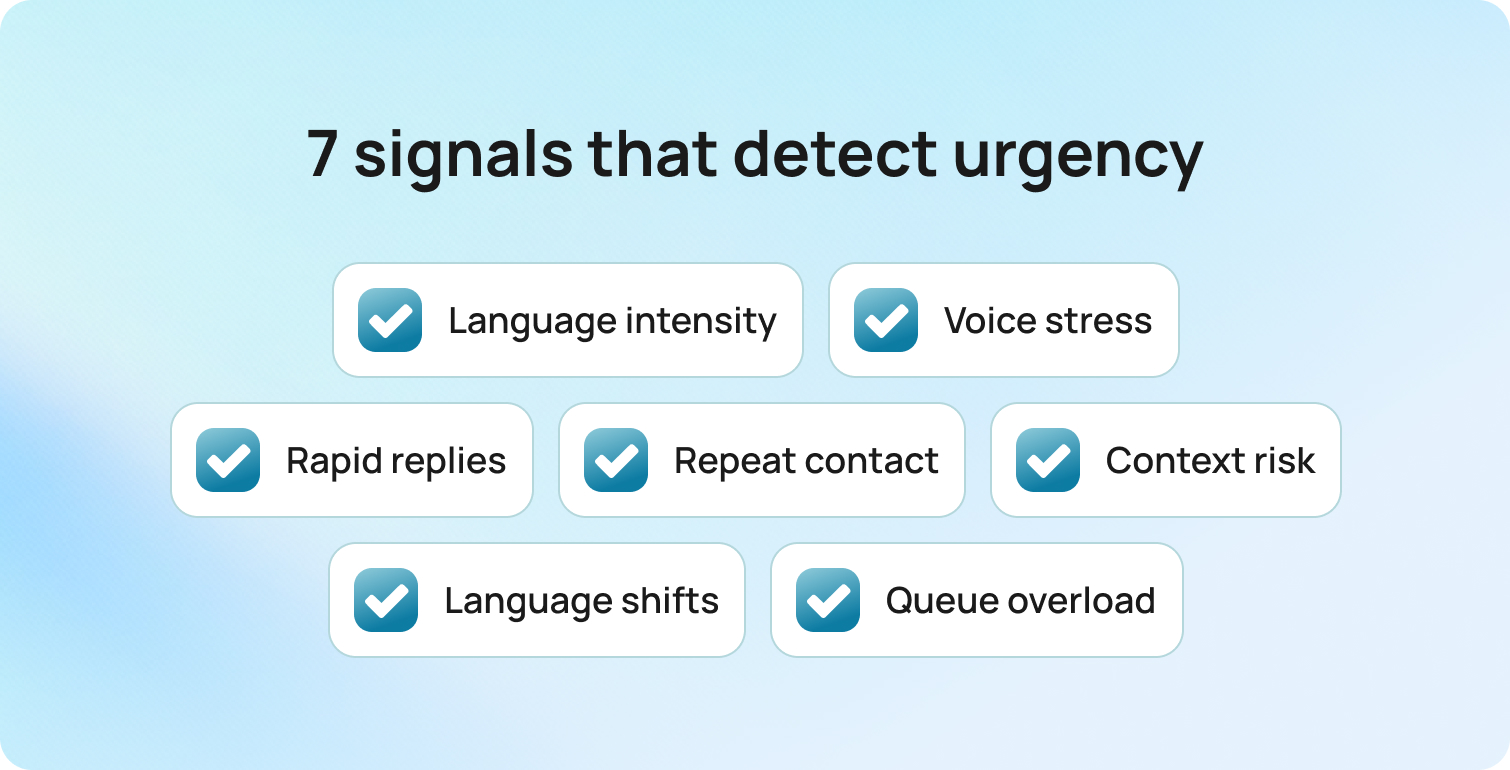
Before building rules, it helps to define the signals that actually indicate risk. The following section breaks down text, acoustic, and behavioral cues—across languages and channels—that most reliably flag frustration and urgency.
Lexical & Semantic Cues
Start with the obvious: caps lock, profanity, repeated exclamation marks, phrases like "cancel my account," "speak to a manager," or "this is unacceptable." Modern natural language processing (NLP) models go deeper. They catch sarcasm, detect passive-aggressive phrasing, and recognize negative sentiment even when customers stay polite.
Paralinguistic Voice Cues
Call transcription software, paired with prosody analysis, listens for more than just words. Pitch spikes, increased volume, speaking over the agent, long pauses, or sudden tone shifts all signal escalation risk. When someone's voice cracks or they interrupt repeatedly, the system prioritizes the conversation to prevent it from derailing completely.
Conversation Dynamics
Textual data finds patterns and gains valuable insights beyond individual messages:
- Reply latency: A customer who responds within seconds to every message is likely actively engaged, but may also be agitated.
- Repeated contact: The third interaction on the same issue within 48 hours must auto-escalate.
- Looped macros: If an agent sends the same canned response twice, the customer is likely stuck in a frustrating cycle.
These dynamics underscore the limitations of sentiment scores in capturing the urgency.
Contextual Risk Factors
Layer in customer data that changes priority:
- VIP tier: High-value accounts get faster routing regardless of sentiment.
- Outage cohort: If 200 customers in the same region experience downtime, their tickets automatically jump to the front of the queue.
- Recent failed delivery or payment dispute: These create compounding frustration; sentiment analysis combined with account status triggers immediate escalation.
Multilingual Cues
Multilingual customer support introduces unique challenges. Language switches mid-conversation, mistranslation markers, or phrases that don't translate cleanly all signal confusion or mounting frustration. Modern systems detect these cues and either route the user to a native-language agent or activate real-time translation assistance, ensuring context is not lost.
Spam and Noise Filtering
One underrated function of AI sentiment analysis customer service systems: automatically discarding non-issues. Marketing inquiries, bot traffic, and low-priority requests get filtered, so your hot queue only shows true negatives. This keeps agents focused on the conversations that matter.
Agent State and Workload Management
Call center workforce management integration enables the system to recognize when queues are overloaded, allowing for more effective management of resources. If sentiment spikes during a product launch or outage, the platform rebalances routing to prevent SLA breaches. Frustrated customers don't sit in a backlog while agents in another queue handle routine questions.
BlueTweak integrations that power these signals: Call transcription for voice analysis, AI Ticket Summary to surface patterns across interactions, multilingual support for global teams, and workforce management to optimize routing under load.
How to Fix the Problem (from Sentiment to Action)
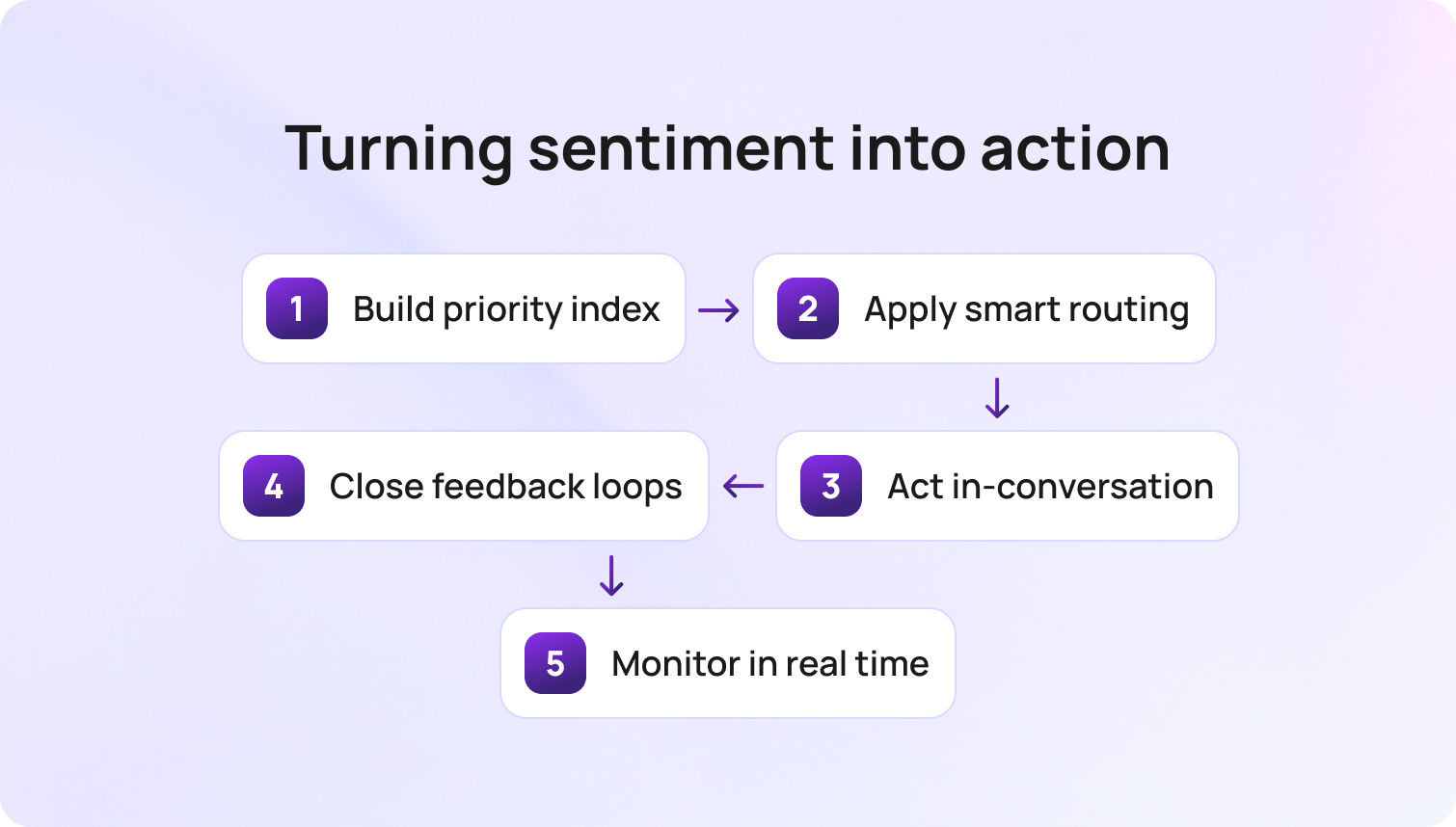
Identifying negative sentiment is step one. The real value lies in connecting scores to operations.
1. Build a Priority Index
Don't rely on raw sentiment scores alone. Create a composite Priority Index that combines:
- Normalized sentiment score ranging from -1 (highly negative) to +1 (highly positive)
- Urgency features like billing risk flags, outage impact, account value, or repeat contact count
Example formula: Priority Index = (Sentiment Score × Weight₁) + (Urgency Score × Weight₂)
Tickets above a threshold (say, PI ≥ 0.7) route to your hot queue with the shortest SLA.
2. Define Routing Rules That React in Real Time
Your ticketing system should execute logic like:
- High negative scores + VIP tier: Senior agent queue with preloaded suggested reply templates pulled from your knowledge base.
- Language = Spanish + negative scores: Route to native Spanish-speaking agents or activate translation assist.
- Product = Billing + sentiment = highly negative: Specialist queue with authority to issue refunds without supervisor approval.
- Voice call + prosody alert: Immediate callback offer via AI voicebot if hold time exceeds two minutes.
These rules turn valuable insights into operational changes that happen automatically.
3. In-Conversation Actionable Insights
Don't wait until after the interaction to respond. When sentiment crosses a threshold mid-conversation:
- Throttle the chatbot. If an AI customer service chatbot is frustrating the customer, hand off to a human immediately.
- Switch to a human with full context. Load the customer profile, interaction history, and sentiment timeline to prevent the agent from asking redundant questions.
- Preload proposed replies. Pull relevant KB articles and draft a response so the agent can personalize and send instead of writing from scratch.
- Offer a proactive callback. If wait times are long, let the customer choose a callback time instead of holding.
4. Post-Interaction Customer Feedback Workflows
After resolving a highly negative case:
- Mandatory QA sample. Route a percentage of high-priority interactions to customer service quality assurance reviewers to catch coaching opportunities.
- Trigger retention workflow. If sentiment didn't improve, flag the account for proactive outreach.
5. Real-Time Dashboards and Analytics
Your customer service analytics should show:
- Sentiment heatmap by brand, channel, and product line in real time
- SLA breaches filtered by priority index
- Recovery rate within 24 hours—how many negative interactions shifted to neutral or positive
- Sentiment trends over time to spot systemic issues before they spiral
- Social media monitoring to monitor the entire customer journey
These dashboards inform daily triage decisions and alert supervisors to emerging problems.
BlueTweak's operational integration: Automatic routing based on sentiment and context, suggested replies that accelerate recovery, an AI voicebot for callback management, and unified analytics across customer support channels.
Governance, Bias, and Qualit
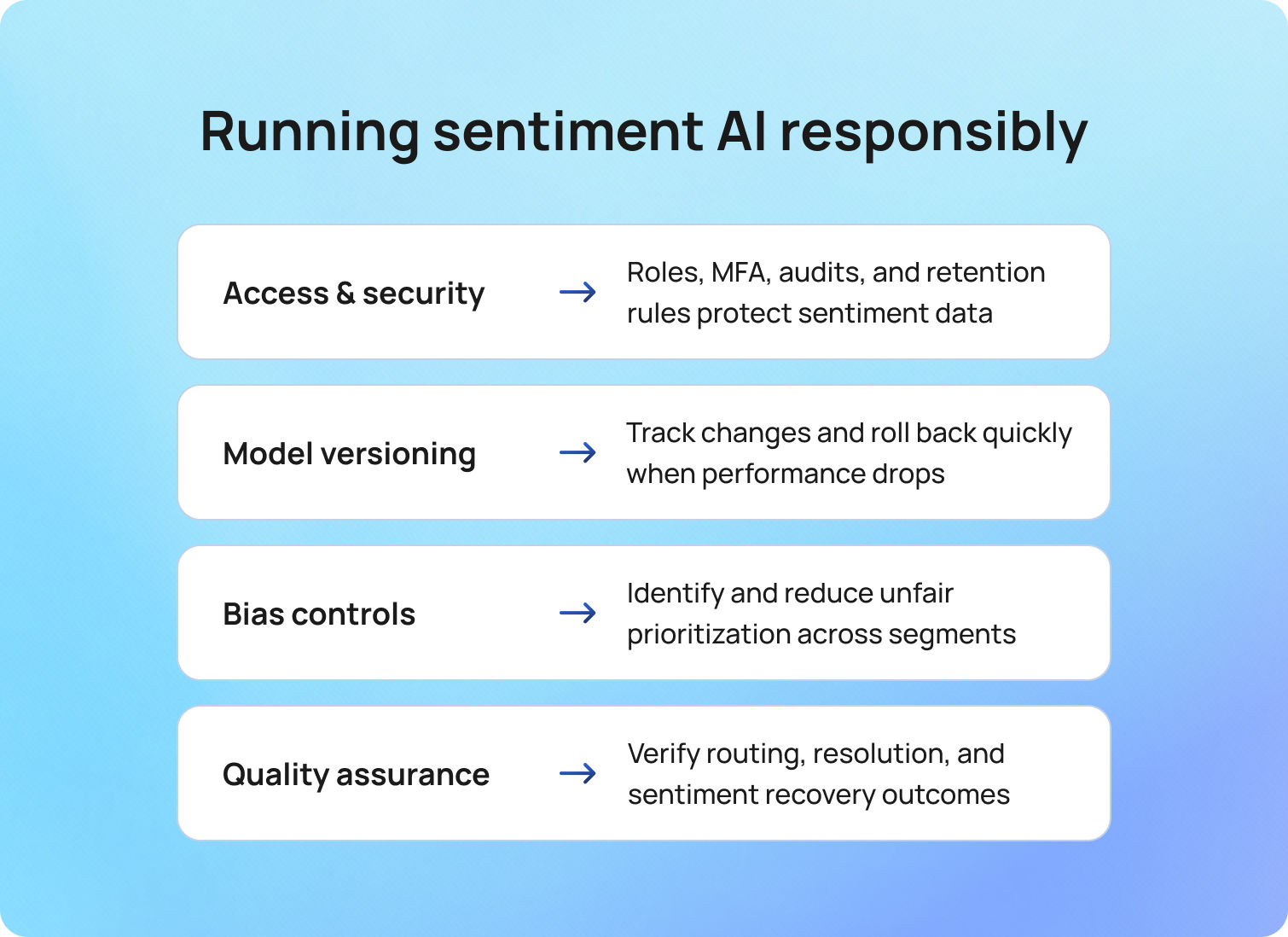
AI-enabled customer sentiment analysis systems make decisions that affect customer experience, future customer expectations, and revenue. That requires governance.
Administration and Security
Administration tools should enforce:
- Role-based access control: Not every agent needs to override routing rules or see VIP account details.
- Multi-factor authentication (MFA): Protect access to sentiment data and model configurations.
- Audit logs: Track customer sentiment by examining who modified routing logic, adjusted thresholds, or reviewed sensitive customer interactions.
- Data retention policies: Define how long overall sentiment scores and conversation transcripts are stored, especially for compliance-heavy industries.
Prompt and Model Version Control
As you tune sentiment models or adjust routing prompts, version everything. If a change tanks FCR or increases escalations, you need to roll back quickly. Document what changed, why, and which KPIs you're monitoring.
Bias Controls
Machine learning models trained on historical data can inherit biases. A model that learned from past routing decisions might systematically under-prioritize certain customer segments or over-flag others.
Mitigate this by:
- Excluding protected attributes like age, gender, or ethnicity from training data
- Reviewing false positives and false negatives across demographic groups
- Human review loops for edge cases where automated decisions might be wrong
Quality Assurance
Customer service quality assurance for sentiment-driven workflows should include:
- Rubric for hot-queue cases: Did the agent acknowledge frustration? Did they resolve the issue on first contact? Did sentiment improve?
- Track recovery rate and CSAT deltas: Measure whether sentiment-based prioritization actually improves customer satisfaction.
- Spot-check routing decisions: Periodically audit whether tickets with a negative score got routed correctly and resolved within SLA.
BlueTweak's governance features: Centralized administration with role-based access, audit trails, and integrated QA tools that surface high-priority cases for review.
How BlueTweak Helps Improve Sentiment Analysis
Not every team needs to build sentiment analysis from scratch or stitch together five tools to make it work. BlueTweak fits specific patterns:
You Want One Stack for Omnichannel Support
If you're managing voice, email, and chat with separate platforms, customer emotions get fragmented. Sentiment detected in a chatbot conversation doesn't carry over when the customer calls. Email history is stored in one system, while voice transcripts reside in another.
BlueTweak centralizes everything. Call transcription feeds into the same record as chat logs and email threads. Sentiment scores update in real time across channels. Agents see a unified customer profile regardless of how someone contacts you.
Your Knowledge Base Needs to Drive Faster Recovery
When an agent handles a highly negative case, they shouldn't waste time searching for answers. BlueTweak's knowledge base integration surfaces relevant articles automatically based on the issue and customer sentiment. Suggested replies combine KB content with conversation context, allowing agents to personalize and send responses instead of writing from scratch.
Multi-Brand Operations Need Unified Analytics
Supporting multiple product lines or regional brands creates visibility gaps. BlueTweak's customer service analytics roll up trends across brands while allowing you to drill into specific queues. You can spot patterns and route resources accordingly.
You Prefer Predictable Pricing with AI Features Included
Some platforms charge separately for sentiment analysis, call transcription, chatbot interactions, and advanced routing.BBlueTweak's pricing bundles AI-powered customer sentiment analysis with all core features. You don't pay extra when sentiment detection flags more cases or when multilingual support scales up.
You Need Customer Support Automation That Learns from Sentiment
BlueTweak's automation doesn't just handle routine questions; it also addresses complex inquiries. It learns from sentiment data to decide when to escalate. If a chatbot interaction starts trending negative, the system hands off to a human before frustration peaks. If an email reply doesn't resolve the issue and sentiment stays low, the platform triggers follow-up workflows automatically.
Turning Sentiment Into Action
Customer sentiment analysis AI only delivers value when scores drive action. Beautiful dashboards don't reduce churn. Routing rules that prioritize angry customers and adjust SLAs based on urgency are crucial when conducting sentiment analysis effectively.
Start with the assist layer: use sentiment scores to preload agents with context, surface suggested replies, and flag cases for human review. Then automate safe actions while keeping humans in the loop for complex escalations. Continuously adjust your thresholds and review recovery rates to ensure you're capturing the right signals.
If you're managing omnichannel support at scale, dealing with multilingual complexity, or supporting multiple brands under one roof, you need a customer service solution that integrates sentiment analysis with routing, automation, and analytics. BlueTweak was built for exactly that.
Request a demo to see sentiment-based routing in action



