


Radu Dumitrescu

As Head of Digital Transformation, Radu looks over multiple departments across the company, providing visibility over what happens in product, and what are the needs of customers. With more than 8 years in the Technology era, and part of BlueTweak since the beginning, Radu shifted from a developer (addressing end-customer needs) to a more business oriented role, to have an influence and touch base with people who use the actual technology.
Recent articles
How to Improve Help Desk Support: 18 Tips While Reducing Costs
When Tickets Snowball: the Moment a Service Desk Changes Course
Late on a Monday, a mid-market retailer released a point-of-sale patch, and the number of incoming tickets increased by almost half. Slack lit up. The phone queue stretched. Nobody had a budget for new headcount. The following month looked different. Not because of a massive tools overhaul, but because the IT department tightened the service catalog, made forms clearer, shipped minor fixes weekly, and insisted on a rhythm of review. This provided a clear understanding of the processes for both staff and customers, leading to improved customer experiences. Wait times fell. Resolution times stabilized. Customer satisfaction climbed.
This guide follows that arc. High-performing desks rarely depend on heroics. They operate a sensible help desk system that removes friction for end users, provides the help desk team with context in one view, and closes the loop with actionable data. Stories like the one above repeat across industries, which means the path is teachable and repeatable. Aligning help desk improvements with the broader organizational goals leads to better outcomes for both the business and its customers.
Learn how to improve help desk support with 18 tips that will help build a lean service catalog, clean intake, a smart knowledge base, targeted automation, and a six-month, cost-aware roadmap.
18 High-Impact Tips For a Successful Service Desk
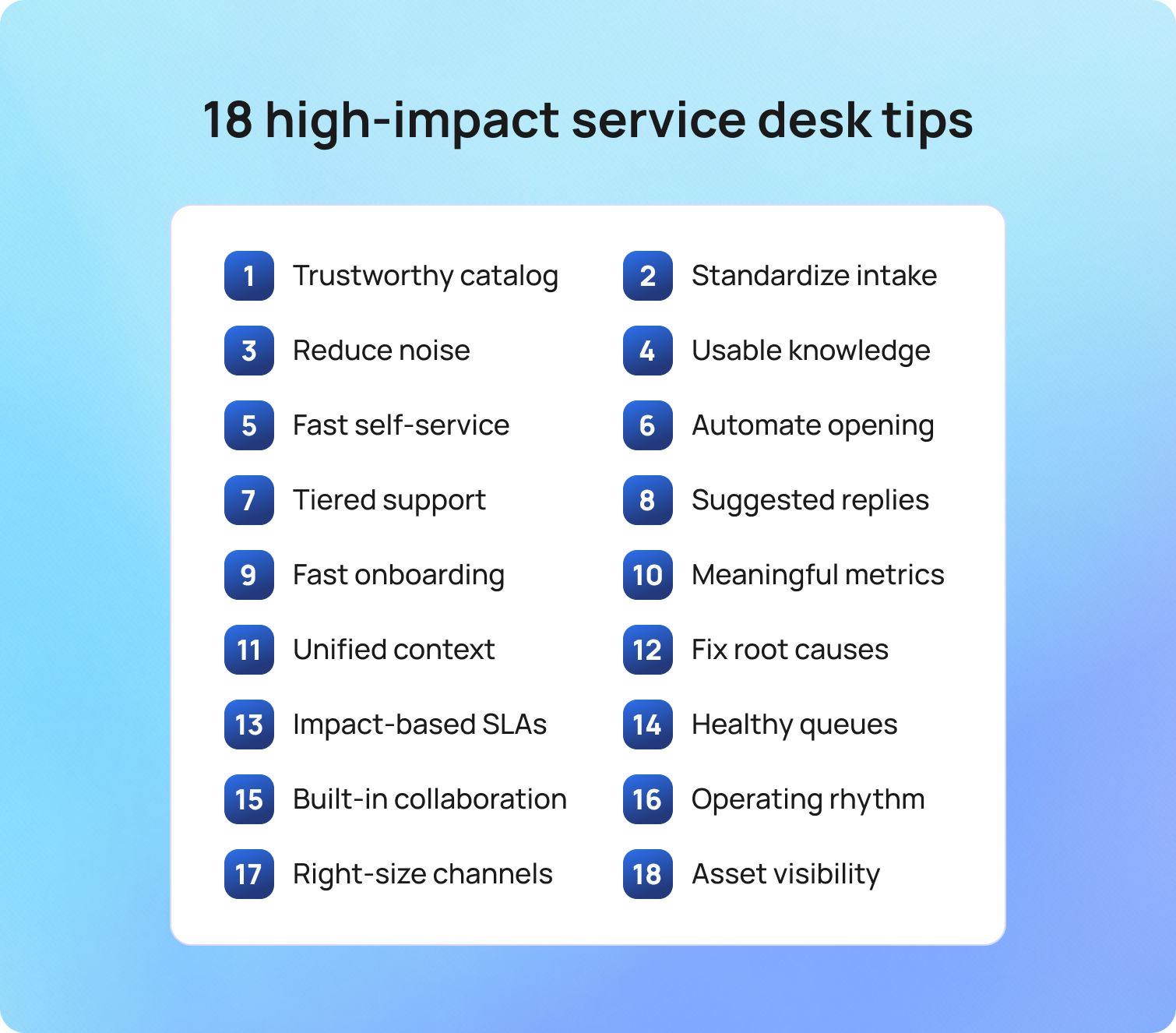
Improvements land fastest when they are small, visible, and owned by the team. The plays below target the costliest bottlenecks in desk processes. These tips are considered best practices for optimizing help desk support. Pick three for the next month and add more as capacity returns.
1) Publish a Service Catalog Users Can Trust
A catalog is a promise, not a brochure. Creating a service catalog is a foundational step in service management, as it helps to structure and improve IT support delivery. Keep it lean and living. For each service, clearly outline the scope, business hours, service levels, and troubleshooting steps that the user can try first. Add the escalation path and the right person or resolver group that owns it. Menus that reflect reality reduce misroutes and raise customer satisfaction without new spending.
BlueTweak tip: BlueTweak is an omnichannel support platform that integrates chat, voice, and email, with AI and analytics/WFM supporting operational efficiency.
2) Standardize Intake So Tickets Start Complete
Quality at the front door sets the tone for help desk performance. Forms with required fields for category, impact, urgency, asset, environment, and a concise description prevent back-and-forth. Inline examples cut guesswork. Email can remain open for convenience, but complex requests should be submitted using the designated forms. Creation and status email notifications lower “any update” messages and show progress without extra work.
BlueTweak tip: BlueTweak supports guided intake aligned to request type, helping tickets start with the correct details.
3) Add Light Validation and Spam Protection
Noise steals time. Require attachments where evidence matters, such as failed installer logs or access proofs. Filter obvious spam before it hits the queue. Soft validation helps too: block submission when category and asset contradict each other. These checks protect the desk from avoidable work and stabilize desk efficiency.
BlueTweak tip: BlueTweak supports spam detection and automatic routing, reducing low-value noise and ensuring tickets are directed to the correct queue.
4) Build a Smart Knowledge Base People Actually Use
Strong knowledge management beats tribal memory. Map the top 25 intents that drive most demand. Write task-oriented knowledge base articles with steps, screenshots, and a short “when to escalate.” Creating high-quality content is essential to ensure users can resolve issues efficiently. Label by service, product, and audience. Track views, deflections, and user feedback to identify areas for revision. Short, specific articles outperform long walls of text.
BlueTweak tip: BlueTweak includes a smart knowledge base designed to power answers and suggested responses.
5) Offer Self-Service Options That Feel Faster Than a Ticket
People choose self-service options when they save time. Providing these options helps empower users to resolve common issues on their own. Provide guided flows for password resets, MFA unlocks, access requests, device swaps, and software installs. Keep paths short and precise. When confidence drops, hand off to an agent with the ticket’s context attached. The queue lightens, and attention shifts to more complex issues.
BlueTweak tip: BlueTweak supports self-service patterns in addition to omnichannel intake.
6) Automate the First Five Minutes of Every Ticket
Most tickets share the same opening moves: classification, priority hints, related articles, and initial questions. Let rules handle them. Automation relies on equipping the help desk with the right tools to streamline the initial handling of tickets. Send incidents to incident queues and service requests to fulfillment. Early automation becomes a game-changer for desk performance, especially during periods of high demand.
BlueTweak tip: BlueTweak provides automatic routing and classification to reduce manual triage.
7) Shift Left with a Tiered Operating Model
A successful service desk finishes common fixes at Tier 1. Tier 2 handles complex issues and changes. Tier 3 focuses on platforms. The IT team relies on a clear division of job responsibilities at each tier to ensure efficient support. Document handoffs and acceptance criteria so escalations arrive with context. A small “resolver swarm” pattern helps with incidents that cross domains. Throughput rises without new headcount.
8) Use Suggested Reply to Accelerate Accurate Answers
Drafting from scratch burns minutes and invites variance. A suggested reply grounded in the knowledge base gives agents a vetted starting point. Agents adapt tone, add specifics, and send. Fewer typos. Fewer reopens. Faster outcomes. Multilingual programs can pair this with real-time translation to maintain pace without staffing every language on every shift.
BlueTweak tip: BlueTweak generates suggested replies from approved sources, which agents review and send; sensitive topics are continually reviewed and approved by humans.
9) Give New Employees a 10-Day Runway
Onboarding shapes quality. Investing in employee training and creating a positive work environment during onboarding leads to better long-term performance. A concise to-do list, including tools, queues, desk processes, and shadowing orders, lowers anxiety. A glossary decodes ticket types and acronyms. Three shadows and three reverse shadows complete the loop. New colleagues become well-versed sooner, and early variance drops.
BlueTweak tip: BlueTweak’s omnichannel workspace consolidates core tools in one place, reducing ramp-up time.
10) Measure What Moves the Needle
Leaders rarely need twenty charts. They need clarity. Track time to first response, resolution times, customer satisfaction score, first contact resolution, transfer rate, and backlog age. For chat and voice, add containment and abandonment rates. These key metrics guide continuous improvement better than a wall of numbers. Tracking these metrics is essential for measuring success in help desk support.
BlueTweak tip: BlueTweak includes analytics, enabling teams to track key metrics across multiple channels.
11) Put Context in One Place
Agents move faster when the conversation, prior tickets, asset data, and related articles live in a single view. Less tab switching. Fewer copy-paste mistakes. Cleaner handoffs. This habit alone often pays for itself in reduced handle time.
BlueTweak tip: BlueTweak unifies chat, voice, email, and knowledge, allowing agents to work from a single space. Using a centralized tool like this enhances agent efficiency and reduces errors by consolidating essential information into a single platform.
12) Turn Recurring Incidents Into Fixes and Content
Patterns hide in plain sight. Identifying recurring issues and addressing their root causes is crucial for improving help desk efficiency. Group related incidents, assign a problem owner, and document hypotheses. Close the loop with product, security, or vendors. Update monitors and articles after each fix. Costs decrease when the root cause is removed from the queue.
13) Balance Service Levels with Business Impact
Not every request deserves a 15-minute response. Tie service levels to business impact and urgency. Critical systems earn faster targets and firmer coverage. Low-impact work waits longer without harm. That is better resource allocation, not cutting corners.
14) Keep the Queue Healthy by Design
Healthy queues are visible and owned. Views such as New, In Progress, Waiting on User, and Ready to Close clearly indicate the status. Nudge when a case has been waiting on the user for a specific period. Consider auto-resolve after a friendly reminder. Silent pileups disappear; desk management becomes easier.
BlueTweak tip: BlueTweak is open to integration and supports collaboration patterns common in modern helpdesks.
15) Equip Collaboration For Real Work
Escalations move faster with internal notes, side conversations, lightweight approvals, and secure screen sharing. Keep artifacts on the ticket so the story stays intact. Email threads fade; logged context remains. Desk teams spend time solving, not hunting.
BlueTweak tip: Side conversations in BlueTweak enable specialists to provide advice without interrupting the ticket timeline.
16) Run a Light Operating Rhythm
Weekly reviews focus attention. Look at KPIs, top categories, reopens, escalations, and backlog age. Ship one improvement. It is essential to regularly review procedures, SLAs, and support processes to maintain ongoing effectiveness. Monthly, prune fields and views, refresh the service catalog, and rebalance routing. Quarterly, revisit SLAs, training plans, and staffing. Small, steady cycles outperform big projects that stall.
BlueTweak tip: BlueTweak analytics enable teams to review their weekly performance and trends.
17) Right-Size Channels and Hours
Chat excels at quick matters and triage. Phone suits incidents and urgent cases. Email and portal fit requests that need detail. Align coverage to arrival curves by hour and day. Channel strategy controls cost and sets the tone for customer experience.
18) Blend Asset Data for the Big Picture
Tickets without asset context invite guesswork. Link devices, software, warranties, and contracts to the ticket. Integrating various technologies into the help desk system provides a comprehensive view for support teams, enabling them to deliver more effective support. A quick view of the last reboot, version, and disk space turns confusion into action. IT teams choose the right path sooner.
BlueTweak tip: Asset panels in the BlueTweak surface device display details and change history alongside the conversation.
Putting It Together: a Stronger Cost-Aware Roadmap
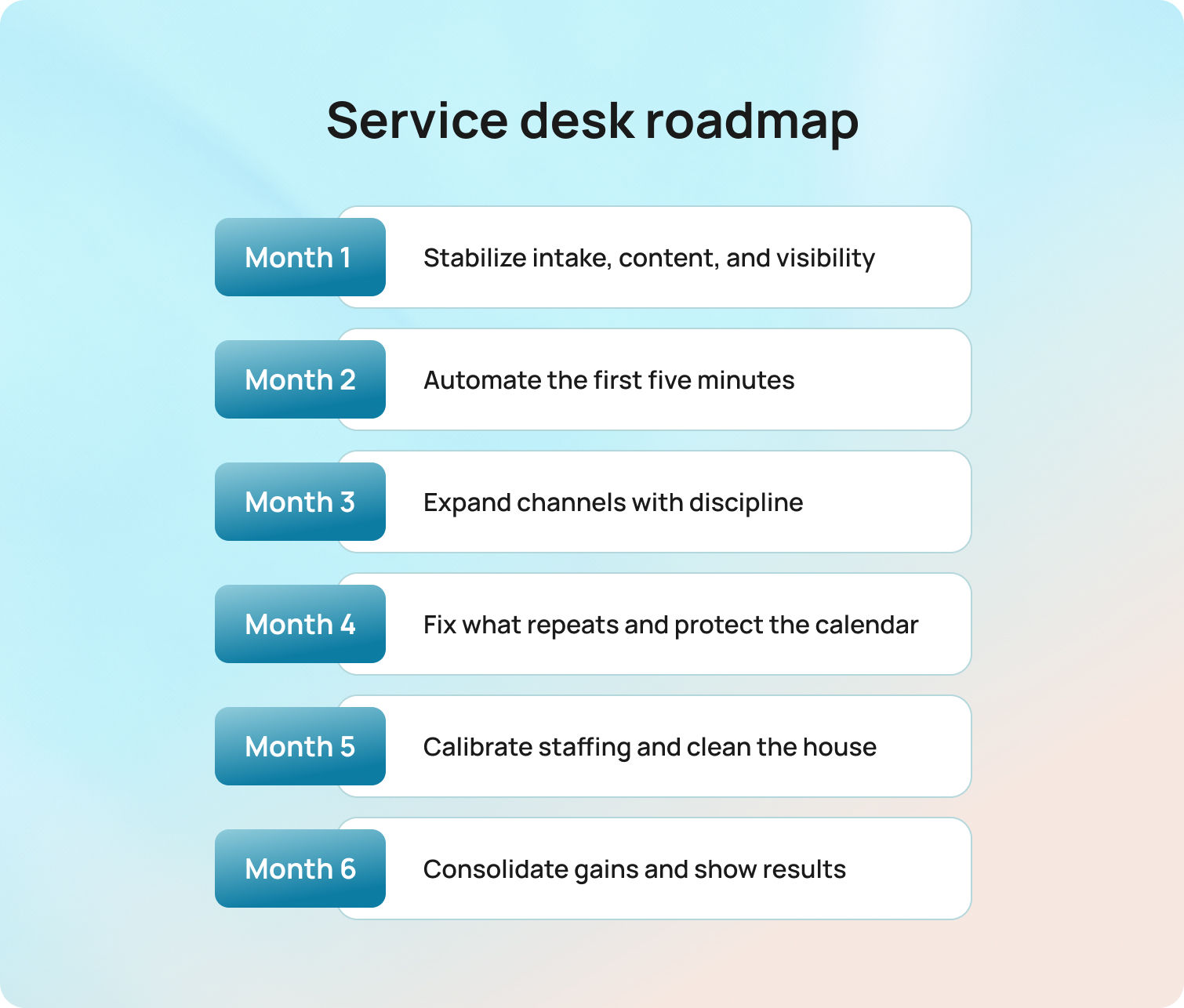
Change occurs most rapidly in small, low-risk increments. The roadmap below outlines improvements that sequence each month, with funds allocated to the next step through saved minutes, steadier queues, and fewer escalations. Choosing the right service desk software is crucial for implementing and tracking these improvements, as it enables efficient service management, self-service options, SLA tracking, and better collaboration.
Month 1: Stabilize Intake, Content, and Visibility
Start at the front door. Publish a minimum service catalog of five to ten services with scope, hours, troubleshooting steps, and escalation paths. Standardize forms and require fields that drive ticket management and routing. Enable creation and status email notifications to allow users to see progress without requiring manual follow-ups. Draft the top twenty knowledge base articles aligned to the highest-volume common issues.
A simple dashboard keeps everyone aligned. Track time to first response, resolution times, first contact resolution, backlog age, and customer satisfaction score. Managers get a shared view of the work, and the help desk team sees the same scorecard as leadership.
BlueTweak Tip: A BlueTweak starter dashboard includes the core cards and links to the tickets associated with each metric.
Month 2: Automate the First Five Minutes
Introduce rules for classification, priority hints, and queue routing. Enable suggested reply for email so answers start with a vetted draft. Add a weekly review to tune rules by outcome rather than opinion. Launch self-service for the top three requests where confidence is high.
Capacity begins to appear without new headcount. Minutes saved per case compound across a high-volume queue, and agents experience fewer repetitive starts.
Automatic routing and suggested reply in BlueTweak consistently remove manual steps from the opening phase of a case.
Month 3: Expand Channels with Discipline
Add chat during business hours for speed, not scope creep. Keep it focused on quick requests and triage. Enable AI summaries to compress long threads into something an agent can scan. Publish ten more articles and retire weak ones.
The target this month is flow. Channels serve different jobs, while the desk system stays coherent and measurable.
BlueTweak tip: BlueTweak supports AI-powered classification and summarization to speed comprehension.
Month 4: Fix What Repeats and Protect the Calendar
Group repeat incidents into problems. Assign owners and track hypotheses, symptoms, and likely root causes. Coordinate change windows with the desk so staffing matches risk. Update runbooks and knowledge bases after fixes to ensure the improvement remains effective.
Savings are evident in fewer night-and-weekend escalations and steadier desk performance. Leadership notices the drop in noise before they notice a change in dashboards.
Month 5: Calibrate Staffing and Clean the House
Study hourly arrivals and adjust schedules to match demand. Add skills-based routing for specialist queues so the right person sees the ticket first. Review transfer patterns to eliminate ping-pong. Clean up fields, labels, and views to cut cognitive load.
BlueTweak tip: BlueTweak provides automatic routing; skill-based patterns depend on configuration and integrations.
Month 6: Consolidate Gains and Show Results
Revisit SLAs and channel mix. Expand self-service where deflection is reliable. Retire workflows that add little value. Publish a short outcomes note: CSAT trend, cycle time, FCR, backlog age, and cost per case. Close with two improvements for next quarter, so momentum remains visible.
Transparency earns support. Stakeholders see consistent service, lower friction, and a plan backed by numbers.
BlueTweak tip: BlueTweak analytics support leadership-level reporting across channels.
From Firefighting to Predictable Service
Reliable support looks ordinary from the outside. Requests land with the correct details. Desk teams see the big picture on one screen. Knowledge base articles answer simple queries. Complex work reaches specialists without delay. Key metrics are moving in the right direction because they are visible and under our control.
The moves in this guide align content, flow, and allocation. A trustworthy catalog reduces noise. Clean intake produces better tickets. An intelligent knowledge base powers self-service and accurate replies. Early automation attracts scarce attention. With minor improvements shipped every week, customer satisfaction increases, desk efficiency improves, and the cost per ticket decreases. That is what a successful service desk looks like in practice. Organizations benefit from adopting service desk best practices and leveraging tools like Jira Service Management, which offers features such as self-service portals and SLA management, to streamline support operations and improve overall efficiency.
Request a demo of BlueTweak to watch intake, routing, proposed reply, and reporting run in one workspace, then map the first month using this playbook.
12 AI-Driven Tactics For Reducing Operational Costs In Customer Support
Why Support Costs Spiral and Where AI Helps
Customer expectations continue to rise, while budgets remain unchanged. Support teams face customer support challenges, including higher ticket volumes, increased channels, and a broader range of customer questions. The result is a familiar drag on operational efficiency: multiple tools with overlapping features, long average handling time, inconsistent answers, and a steady increase in customer support expenses. There is also a hidden cost associated with fragmented customer data and inefficient support processes, which can quietly inflate overall expenditures.
Practical communication tools are crucial for reducing costs and enhancing support processes, enabling both customers and support staff to resolve issues efficiently.
Reducing customer service costs does not require cutting service quality. It requires a clear plan that moves machine work to machines and keeps human agents focused on complex problem-solving and customer relationships. AI automation delivers efficiency gains by streamlining workflows, reducing the need for large support staff, and enabling companies to reallocate resources to higher-value tasks.
BlueTweak was built for precisely this shift. One stack ties together omnichannel support, a living knowledge base, AI-driven automation with guardrails, analytics that guide decisions, and workforce management that matches demand. BlueTweak helps the customer support team manage support tickets more efficiently, reduces customer support costs, and unifies customer data to minimize friction. The pages that follow keep things tactical and concrete. Each tactic reveals where costs are leaking away and how to recover them without compromising a positive customer experience.
12 AI-Driven Tactics That Show How to Reduce Customer Support Costs
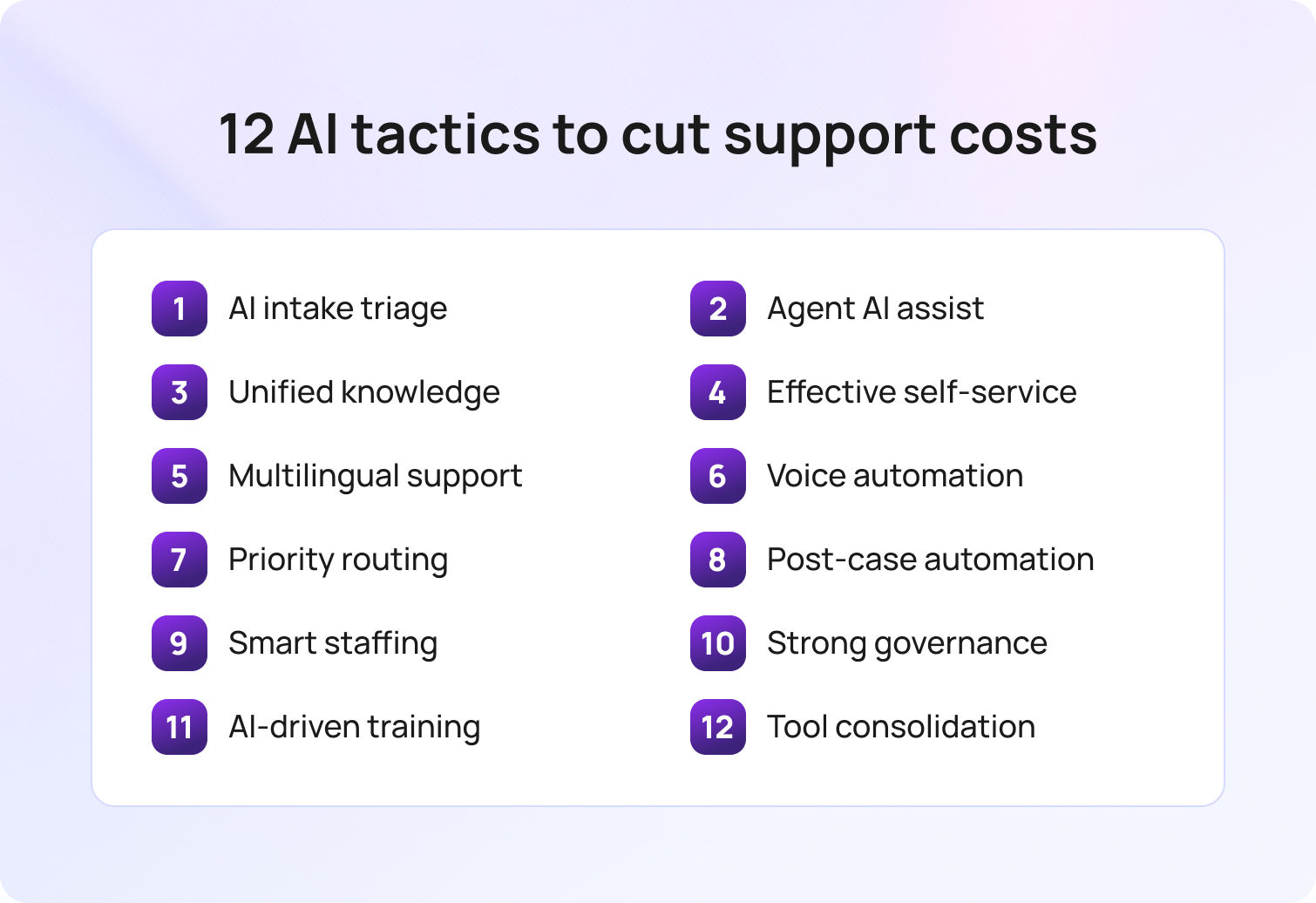
Each tactic that follows addresses a specific cost driver, explains why it inflates spending, and demonstrates how to mitigate it with AI. These strategies are designed to reduce ticket volume, save money, and achieve sustainable cost reduction by cutting customer support costs without sacrificing quality. You can expect outcomes such as fewer tickets, shorter handling times, higher first-contact resolution, steadier SLAs, and a lower cost per resolved issue.
Tactic 1: AI Intake and Triage That Stops Waste at the Front Door
When a message arrives without structure, costs begin to climb. A vague subject line, a long unbroken paragraph, a forwarded thread with missing context, or a mid-conversation language switch forces agents to slow down, reread, and guess where the issue belongs. The support ticket gets bounced between queues, ownership is unclear, collisions occur, and the wait time stretches while nobody is actually resolving the customer's problems.
AI intake restores order at the door. Each conversation is classified for intent, language, and brand or product. A simple urgency signal is applied, and obvious spam or duplicates are removed before the ticket is ever opened. Classification and routing help identify customer problems and efficiently direct customer queries to the right team using rules based on skill, tier, brand, and language, ensuring the first point of contact is the right one. Moving from manual triage to assisted triage reduces handling time, stabilizes SLA performance, and lowers support costs because agents spend their time resolving issues, not sorting them.
BlueTweak supports this flow from the first message. A unified inbox consolidates email, chat, social messages, and voice transcripts into a single queue. Built-in models tag intent and language, spot duplicates, and native routing places the ticket in the correct queue with clear ownership. Teams experience fewer transfers, faster first replies, and a clearer understanding of where the workload actually lies.
Tactic 2: Agent Assist That Lowers AHT Without Squeezing Empathy
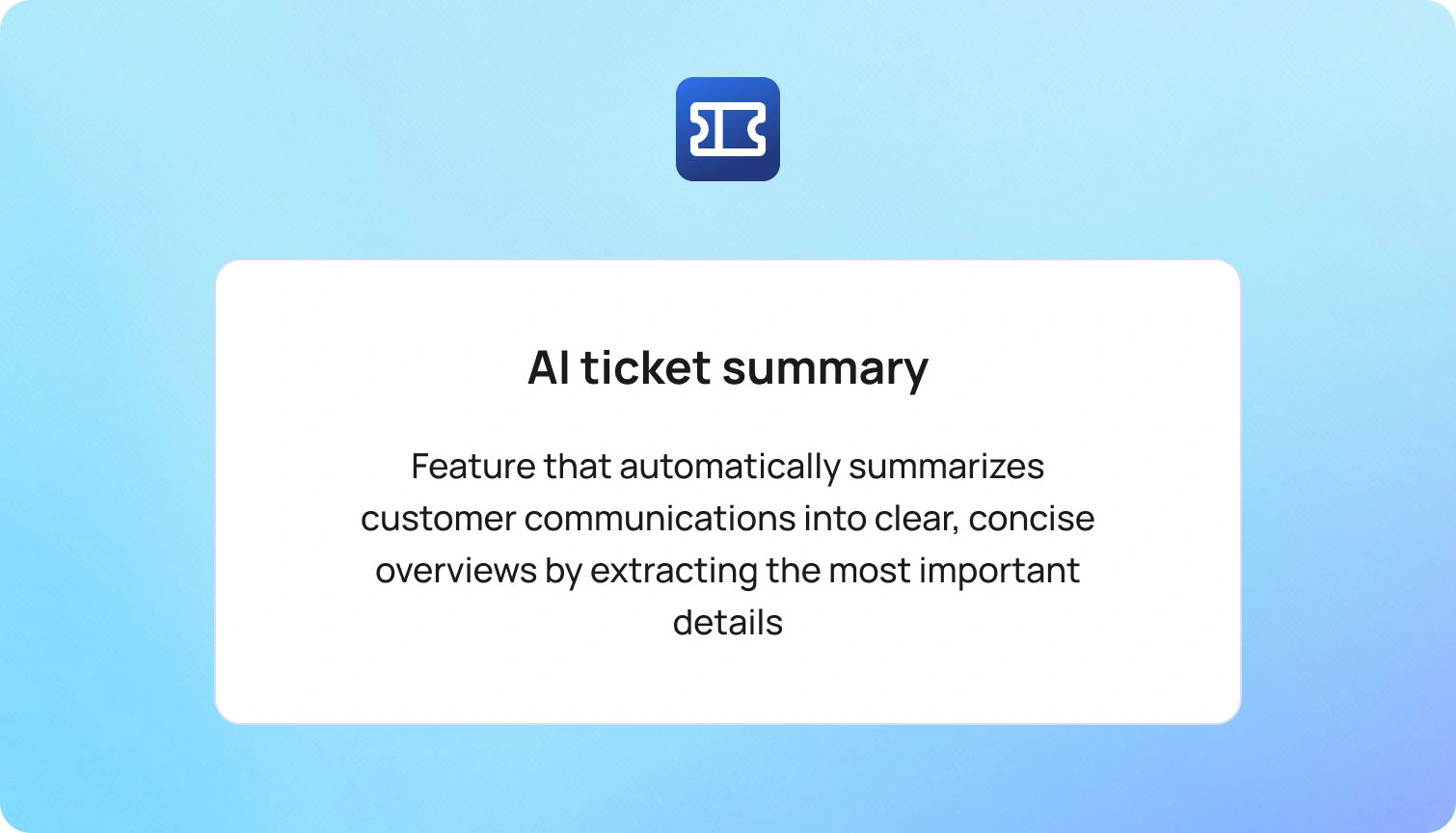
When a ticket arrives, most of the work involves searching for relevant information. Long threads, attachments, and policy pages slow everything down. Agents skim for the one detail that matters, try to match policy to the situation, then type from scratch while the queue grows.
AI assist removes that drag. The conversation is summarized, the proper knowledge article surfaces, and a policy-safe draft appears. The agent still sets the tone, but the heavy reading and blank-page typing are no longer present. Handling time falls, and the first response feels considered rather than rushed. These tools also support training agents by providing real-time guidance and best practices during customer conversations, enabling staff to learn and improve as they interact with customers.
BlueTweak makes this flow natural. AI Ticket Summary distills the thread and flags next actions. Suggested Reply draws from a smart knowledge base, ensuring wording remains accurate and on-brand. Less time per case means fewer staff hours per month for the same volume, which reduces the cost per resolved issue without compromising quality.
Tactic 3: A Knowledge Base That Powers Both Agents and Customers
Costs rise when answers are scattered across multiple documents or outdated pages. Agents improvise. Customers escalate. Simple questions turn into long exchanges.
A strong knowledge base reverses that pattern. Start with the hundred questions that drive volume. Write articles that mirror customer language, clearly outline steps, and state eligibility criteria so that dead ends are avoided later. Give each page an owner and a review cadence.
BlueTweak ties the whole loop together. Suggested Reply cites the right article for agents, and self-service widgets bring the same guidance to customers. One record of truth means less confusion, fewer follow-ups, and a lower cost per resolved issue.
Tactic 4: Self-Service That Customers Actually Use
For many needs, waiting to reach a person is unnecessary. Order status, refunds within policy, warranty checks, shipping updates, and simple how-tos are routine inquiries that should be fast and self-guided.
AI makes those paths smooth. The bot is designed to handle routine inquiries, understand the request, provide grounded answers, and know when to escalate to a person. Handoffs keep context, so the story is told once.
BlueTweak’s AI Chatbot operates on a smart knowledge base and connects to account or order data, where permitted. This approach helps reduce support tickets, abandonment improves, and agents allocate their time to higher-value work. Fewer inbound contacts mean lower operational costs at the same service level.
Tactic 5: Multilingual Support Without Staffing a Team For Every Language
Global growth does not necessarily require a doubling of support budgets. Real-time translation enables one team to serve more regions while maintaining quality consistency.
Use instant translation for chat and allow language switching in voice without losing context. Publish human-checked versions of high-traffic articles. Route sensitive cases to native speakers.
BlueTweak supports the full flow. Multilingual chat runs with real-time translation. The AI Voicebot can switch languages mid-call. The knowledge base ensures consistent answers across locales. Coverage expands without proportional hiring, which lowers the cost per contact across markets.
Tactic 6: Voice Automation for Tier-1 Tasks That Do Not Need a Person
Phone lines fill with brief requests, such as order status or appointment changes. A narrow voicebot with system access can resolve these issues in seconds.
BlueTweak’s AI Voicebot handles those flows, writes a transcript to the ticket, and hands off when the customer asks or a policy edge appears. Technical support inquiries that require more profound expertise are routed to human agents. During busy seasons, calls shorten, minutes drop, and queues calm. Reducing live-agent minutes simultaneously lowers telephony spend and labor costs per call.
Tactic 7: Priority Routing That Blends Sentiment With Business Context
Impact varies by case. A second failed delivery or a billing issue on a high-value account can snowball into refunds and churn if it waits in a standard line.
Signals make more intelligent choices. Sentiment points to frustration. Urgency flags highlight risk. Account context shows value or exposure. Together, they create a simple priority score that determines where the ticket is assigned and how quickly it progresses.
BlueTweak calculates that score in real time and routes accordingly. Hot cases land in short-SLA lanes with senior agents and policy-safe templates ready to send. Faster recovery avoids costly escalations and write-offs, which keeps support expenses and revenue leakage down.
Tactic 8: Post-Resolution Automation That Clears the Ghost Work
Tags, follow-ups, status emails, order notes, CRM updates, and archiving keep systems aligned, but none require creative effort. Left to manual work, they eat minutes and introduce errors.
Automation closes the gap. Events fire at resolution. The right message is sent, the correct tag is applied, downstream records are updated, and the transcript files are stored under the account.
BlueTweak handles this with event triggers and structured summaries. Cleaner data reduces rework later. Minutes saved across thousands of cases translate into measurable cost savings without touching service quality.
Tactic 9: Workforce Management and Concurrency That Match Real Demand
Staffing against an average creates overtime during peaks and idle time during lulls. Both add cost without improving experience.
Plan the pattern. Forecast by interval and channel. Set realistic concurrency for chat and email. Adjust intraday when volume shifts or campaigns land. Effective workforce management helps optimize support team and in-house team resources, ensuring the correct number of agents are scheduled at the right times.
BlueTweak’s WFM forecasts by queue, ties schedules to SLA targets, and supports intraday re-forecasting. Queues smooth out, overtime drops, and burnout-related errors fall. Better scheduling reduces labor variance and keeps unit cost predictable, helping the customer service team maintain service levels while controlling costs.
Tactic 10: Governance That Prevents Expensive Mistakes
Savings disappear when risky changes reach the production stage. Strong administration keeps the system stable and the numbers moving in the right direction.
BlueTweak centralizes roles and permissions, multifactor authentication, retention settings, and audit logs. Guardrails cover prompts, routing rules, and automations. New flows begin in a sandbox, then move to assist, pass approvals, and are only run unattended afterward.
That rhythm avoids outages and clean-up work. Fewer errors mean fewer emergency hours and fewer goodwill credits, which lowers support costs without adding headcount.
Tactic 11: Training That Converts AI Into Lasting Performance
Tools reduce cost once people feel fluent. Short, scenario-based practice builds that fluency fast.
Agents learn how to personalize a suggested reply, when a handoff is the right move, and how to tag outcomes so reports stay trustworthy. Coaches receive handle-time and edit-distance views in BlueTweak, which enables them to provide specific and compelling feedback. Customer feedback, including post-interaction surveys and ratings, is also used to evaluate agent performance and guide ongoing training to improve service quality.
Conversations get shorter without sounding clipped. New hires reach proficiency sooner. That mix increases throughput per person and reduces the cost per ticket across the quarter.
Tactic 12: Consolidation That Ends Too Many Tools
Context dies when it lives in five places. Extra logins slow agents. Brittle connectors create surprises. Duplicate dashboards turn into debates. The toolset becomes the work, and costs creep.
Consolidation fixes the root cause. One place to handle chat, voice, and email. One knowledge base. One set of automations. One view of analytics and workforce management.
BlueTweak brings those pieces together. Ticketing, chat, voice, bots, the smart knowledge base, analytics, and WFM sit side by side. Cleaner handoffs and faster resolution result in fewer licenses, less glue code, and lower operational costs on a day-to-day basis.
Bringing the Tactics Together
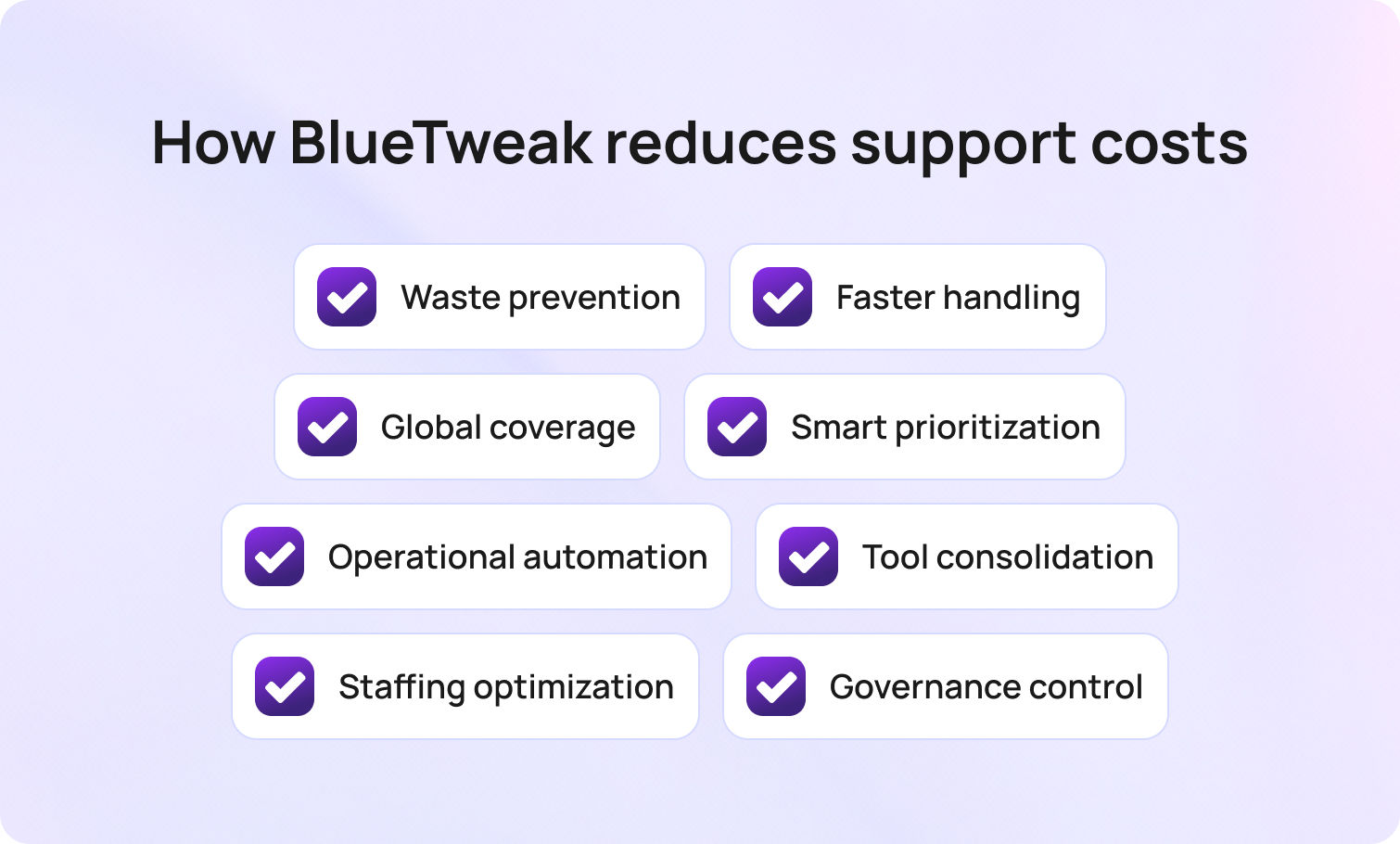
Cost decreases when waste is removed at the start, speed improves in the middle, and control is maintained at the end. By automating processes at various stages of the customer journey, support teams can deliver more personalized assistance and streamline repetitive tasks, ultimately leading to enhanced customer satisfaction. Up front, better intake stops misroutes and self-service handles the easy stuff, while a living knowledge base keeps everyone on the same page. In the conversation, agent assist shortens the reading and rewriting process, multilingual coverage widens reach without requiring new headcount, and a focused voicebot clears Tier-1 calls with clean handoffs. These strategies also help reduce operational costs across the support function.
For edge cases, priority routing prioritizes risky tickets first, ensuring minor issues don’t escalate into churn. And behind the scenes, post-resolution automation clears admin work, workforce management matches staffing to demand, governance keeps changes safe, training turns tools into consistent performance, and consolidation removes the drag of scattered systems.
BlueTweak ties those moves together. One record follows every conversation across email, chat, voice, and social. AI is applied where it’s safe and high value, with straightforward controls and audit trails. Leaders see what’s working through built-in analytics and WFM, and teams work in one place instead of five. The practical result is lower operational costs in customer support, with service quality and enhanced customer satisfaction holding steady or improving.
Cut Costs Without Cutting Care
Cost pressure will not ease. Cutting costs is essential, but it should never mean sacrificing quality. Slowing service or removing human touch invites frustration and churn. The sustainable path looks different: move routine tasks to AI with guardrails, keep complex problem-solving with people, and run it all on a platform that preserves context from first message to final note. Maintaining high service standards not only controls expenses but also supports customer retention.
The twelve tactics here form a straight line from intention to impact. Implemented together in BlueTweak, they reduce customer support costs, protect service quality, and strengthen relationships. The following budget conversation gets easier because results are visible in AHT, FCR, containment, sentiment, and cost per ticket.
Request a demo of BlueTweak to see how to cut support costs without cutting care.
How To Create A Help Desk Ticketing System In 10 Easy Steps
Why Help Desk Design Sets the Tone For Customer Experience
Support quality tracks directly to the system behind it. Fragmented tools create missed SLAs, duplicate handling, and frustrated customers. A cohesive support ticketing system transforms every interaction into a structured ticket that flows to the correct queue, reaches the appropriate support agents, and provides answers that align with brand and policy. Reliable helpdesk systems provide easy navigation for users, capture additional information without friction, and convert conversations into auditable, searchable closed tickets.
This article outlines a practical, platform-agnostic playbook for creating a help desk ticketing system that scales from a 20-agent desk to a 100-agent operation.
Before Building: Align Service, Scope, and Metrics
A stable help desk support system starts with standard definitions. Establish operating hours, languages, escalation paths, and a priority level framework. Decide which channels will be live at launch. Identify privacy and security requirements, including access controls and data retention policies. Choose a realistic footprint for Phase 1, typically involving email and web forms that feed a single queue. Note how a unified platform, such as BlueTweak, can reduce integration risk by providing ticketing, bots, email notifications, analytics, workforce planning, and a knowledge base in a single stack. Alignment at this stage limits future redesign work.
A Practical Guide For Creating A Help Desk Ticketing System: 10 Steps
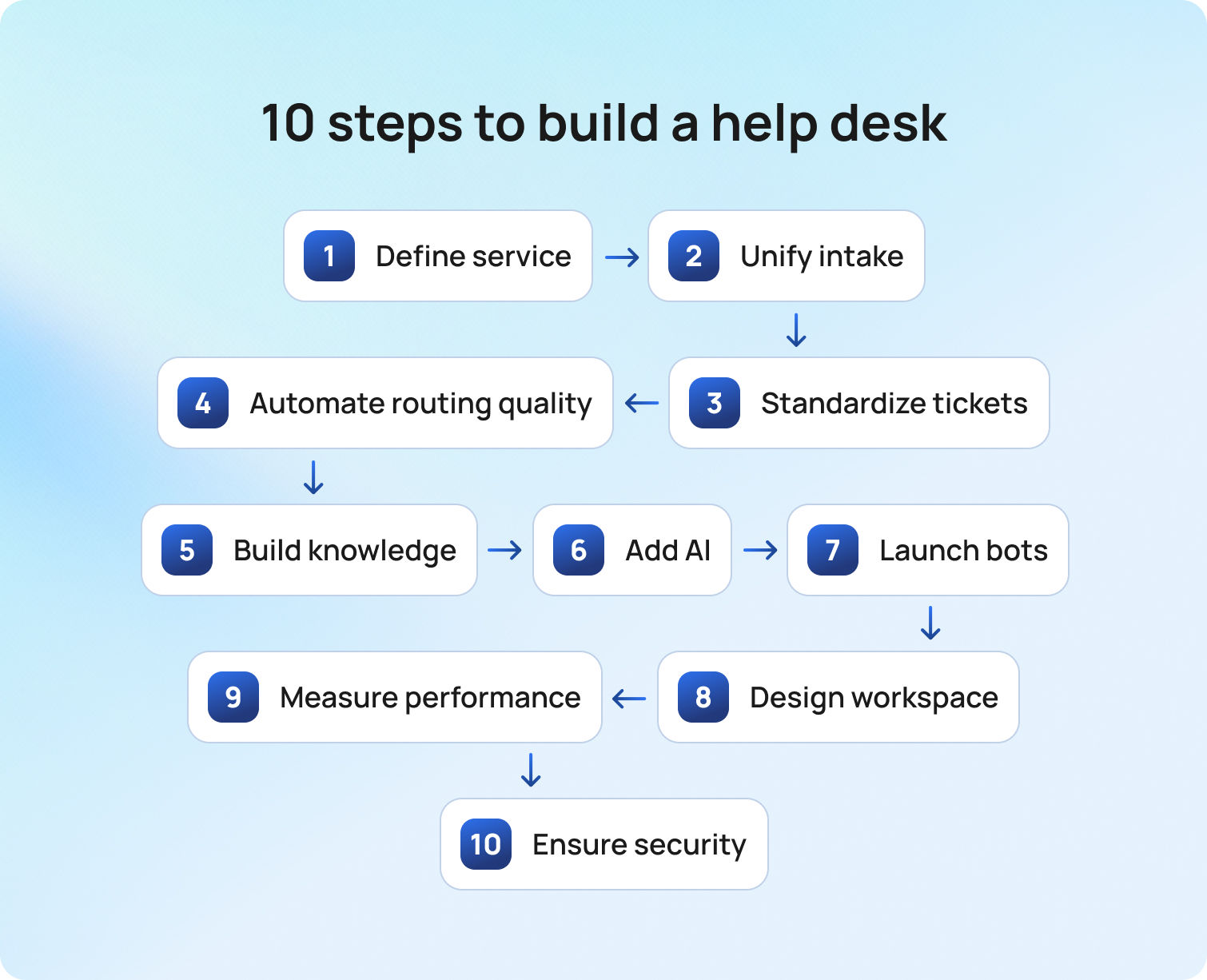
Teams often ask for a concise path from zero to reliable operations. The steps that follow cover planning, configuration, workflows, analytics, and improvement practices. Each step references familiar concepts such as ticket list, to-do list, new ticket creation, and sending notifications on status changes.
Step 1: Define the Service Model, SLAs, and Ownership States
Start with policy, not code. Document target response and resolution times per priority. Specify which teams are assigned to which categories, and describe ownership states such as new, open, pending, on hold, solved, and completed. Map escalation criteria that move a ticket to Tier 2 or a specialist queue.
When SLAs are explicit, a system can automate workflows that pause timers during waits, reopen upon customer replies, and alert supervisors before breaches occur. BlueTweak supports SLA policies, timers, and escalations inside the help desk configuration, which makes response targets auditable and consistent across brands.
Step 2: Unify Intake Across Channels Into One Queue
A ticketing system works best when every interaction arrives in one place. Bring email, web forms, chat, voice, social, and SMS into a unified queue. Normalize each interaction into a single record with an ID, contact profile, timestamps, and a conversation timeline.
A dedicated intake form can create tickets from site pages, while a specific email address, such as support@company.com, automatically converts inbound mail into tickets. Enable spam filtering to ensure agents only review important emails, and auto-acknowledgments on inbound emails so the queue remains clean and requestors receive confirmation.
BlueTweak consolidates voice, chat, email, and social interactions into a single ticket object, enabling support teams to manage a unified backlog instead of multiple ones.
Step 3: Standardize the Ticket Data Model For Managing Tickets
A clean schema supports accurate reporting and reliable ticket routing. Define the required fields, including category, subcategory, priority, channel, brand, product, language, and region. Use picklists to prevent free-text drift. Add descriptions, attachments, and custom fields only when a clear report or automation requires them. Ensure agents can fill a ticket quickly without guessing. Configure validation to prevent a ticket from being closed without the necessary fields.
BlueTweak supports multiple ticket forms, collision detection, and custom fields, which simplify ticket management at scale.
Step 4: Implement Routing, Classification, and Triage Rules
Manual sorting does not survive a surge. Start with simple rules based on keywords, customer tier, language, and order context. Add skills-based routing to protect specialist queues. Provide a fallback queue that is always staffed. Utilize automatic routing and classification, then layer on intent detection and language detection as the volume grows. As data grows, enable AI classification to detect intent, priority signals, or sentiment.
BlueTweak’s routing and intent features help reduce human triage and shorten the time to first meaningful reply, ensuring the right support staff touches the right ticket at the right time.
Step 5: Build a Knowledge Base That Powers Self-Service and Agent Assist
A knowledge base is most effective when it mirrors top ticket drivers. Start with the 25 to 50 intents that generate the largest share of volume, then expand to long-tail content. Write short, single-purpose articles with clear steps, images where helpful, and version control. Route regulated content through approvals. Link each article to a macro, a chatbot node, and a form where appropriate. Publish public content for customers and private content for internal policy.
In BlueTweak, the knowledge base integrates with suggested replies, bots, and ticket forms, which multiplies the impact of each improvement.
Step 6: Add AI Summaries and Suggested Replies For Support Agents
Long threads and call recordings slow work. Concise AI summaries present the context that matters, so agents can respond with clarity. Suggested replies grounded in knowledge base articles accelerate drafting and improve consistency. When those suggestions use retrieval from an approved knowledge base, answers stay accurate.
BlueTweak is API‑open and works hand in hand with AI, automating ticket summaries and suggested replies, including multilingual assist, so support agents spend less time reading and more time solving.
Step 7: Launch Chatbots and a Voicebot With Guardrails
Bots succeed when the scope is clear and escalation is smooth. Start with high-frequency, low-risk flows such as order status, shipping and returns, appointment changes, and password resets. Use button-driven steps for deterministic flows, then layer intent recognition. Retrieval augmented generation (RAG), grounded in the knowledge base, reduces hallucinations. For telephony, target Tier 1 calls and support mid-call language switching. Configure human handoff so the agent receives full context.
BlueTweak’s AI chatbot and voicebot can serve as references for this guarded approach to automation.
Step 8: Design the Agent Workspace For Efficient Access and Easy Navigation
A productive desk view gathers everything into one place. The ticket thread, customer profile, past cases, KB suggestions, macros, forms, and internal notes should be visible without needing to switch tabs. Collision detection prevents parallel replies. Clear ownership and timestamps provide status at a glance.
BlueTweak’s agent workspace demonstrates how a single screen can reduce fatigue and error rates, particularly in multi-brand operations.
Step 9: Close the Loop With Analytics and Workforce Management
Measurement drives improvement. Add Transfer Rate, Containment Rate, Abandon Rate, Concurrency, and Sentiment Score for voice and chat. Offer live dashboards for intraday decisions and scheduled reports for weekly reviews. Connect analytics to staffing with forecasting and scheduling, then monitor adherence.
Because BlueTweak includes analytics and WFM, supervisors move from insight to action without exporting data. Mature reporting keeps leadership aligned on trends and resource needs.
Step 10: Engineer Trust, Security, and Resilience From Day One
Security planning must not be deferred. Enforce multi-factor authentication, role-based permissions, session controls, and audit logs to ensure security and compliance. Encrypt data in transit and at rest. Set regional backups and disaster recovery plans. Document integration boundaries and vendor responsibilities. Establish date-based retention rules for tickets and recordings, and define the access privileges for each role.
BlueTweak ships the controls IT and compliance expect, which streamlines approval for go-live.
A 30-Day Rollout That Balances Speed and Safety
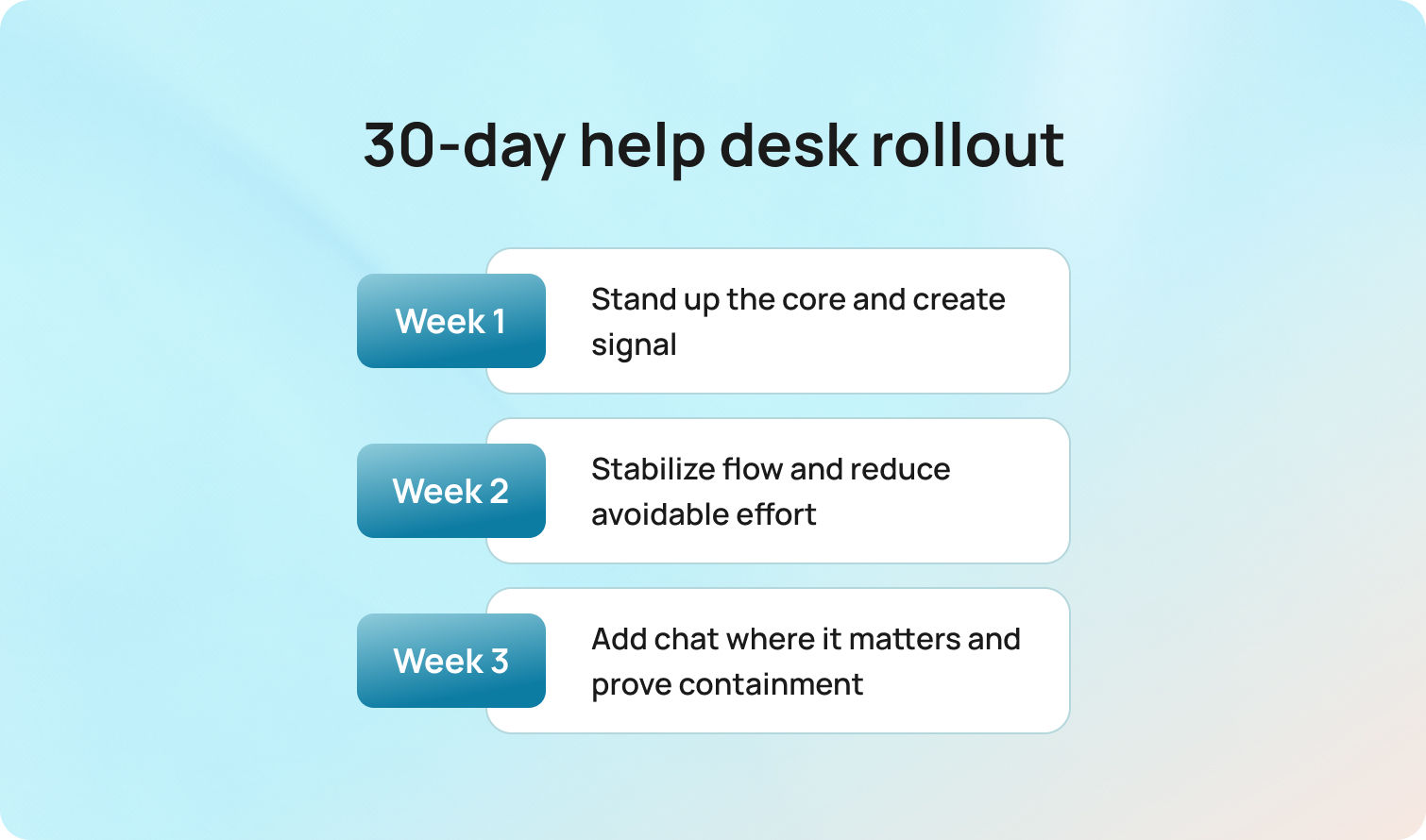
Week 1 — Stand up the core and create signal
The first seven days are about visibility, not perfection. With SLAs, queues, and intake forms agreed, work starts landing in the right places. The primary mailbox and main phone line come online, and auto-acknowledgments set clear expectations for customers. Routing stays intentionally simple to establish baselines rather than chase edge cases. Supervisors operate from a live dashboard, and to-do hygiene keeps silent pileups at bay. A brief, twice-daily ticket review (10–15 minutes) identifies risks and blockers before they escalate.
BlueTweak fit: a unified email/voice queue and AI Ticket Summary for fast internal context (assist mode only).
By Friday: cleaner intake, fewer “lost” tickets, and a shared view of SLA exposure.
Week 2 — Stabilize flow and reduce avoidable effort
Now that the plumbing is in place, the shape of the work matters. Categories and tags bring order; priority rules and escalation timers prevent hot items from cooling in the queue. Ten knowledge base articles cover the top intents, each paired with a macro, so “one click to consistent” becomes real. Ownership transitions and reopen handling are clarified to stop ping-ponging.
BlueTweak fit: Suggested Reply switches on for email (human-reviewed), while supervisors watch draft-to-send ratios to protect quality.
By week’s end: fewer back-and-forths on everyday issues, faster first responses, and a measurable AHT dip for the named intents.
Week 3 — Add chat where it matters and prove containment
Attention shifts from “seeing the work” to “shaping demand.” Chat appears on the two highest-volume pages, chosen for impact rather than breadth. Three dials deserve close tracking: containment (what the bot resolves), sentiment (whether tone is cooling), and handoffs (if human pickup feels seamless). The knowledge base expands to twenty articles, and message templates undergo a clarity review. Side conversations support cross-team input, ownership transitions are made explicit, and a daily backlog-age report keeps aging tickets visible—and actionable. Multi-brand environments extend routing to include brand, product, and language, so customers feel known rather than shuffled.
BlueTweak fit: real-time chat translation, sentiment tracking, and analytics that spotlight containment and deflection.
Expected outcome: higher chat containment without a CSAT dip, smoother handoffs, and shrinking queue age.
Week 4 — Layer in voice automation with firm guardrails
With text channels steady, limited voice automation becomes viable. A small voicebot footprint handles one or two Tier-1 flows (e.g., order status, PIN resets), while guaranteed human handoff and complete context transfer remain non-negotiable. Insights from Week 3 inform two additional chat flows. A weekly operations review now anchors decisions—SLA risk, category trends, reopens, and bot containment guide the plan—and WFM schedules align staffing with actual demand curves rather than anecdotal evidence.
BlueTweak fit: voicebot with human-in-the-loop controls plus unified ticketing, bots, analytics, and WFM, so tuning happens in one place—not across four vendors.
By Day 30: stable SLAs on hot queues, visible containment wins, and a playbook ready to scale without compromising quality.
ROI, Costs, and a Pragmatic Model
The financial case for a modern help desk usually rests on three levers. Deflection removes work before it reaches the queue. AI assistance shortens the handling time for the remaining work. Consolidation lowers license and integration overhead. A conservative approach avoids inflated promises. Use a control group in the first month, measure baseline handle times and FCR, then track changes as features roll out.
A consolidated stack simplifies the model by replacing multiple contracts and data pipelines with a single service and process for managing outcomes.
Optimization Practices That Keep Performance Rising
Treat improvement like a weekly release. Review the top ten intents by volume and by SLA risk. Update or split knowledge base articles that generate bounce backs. Link each article to a macro and a bot step. Tune templates that show high reopens. Use transcription review in voice to refine prompts and add missing intents. Monitor the watch backlog age and adjust routing if a queue becomes a bottleneck. Validate definitions in analytics to ensure metrics align with leadership goals.
Because BlueTweak shares a single content and automation backbone across ticketing, bots, and analytics, each change quickly ripples across the system.
Common Pitfalls and Practical Workarounds
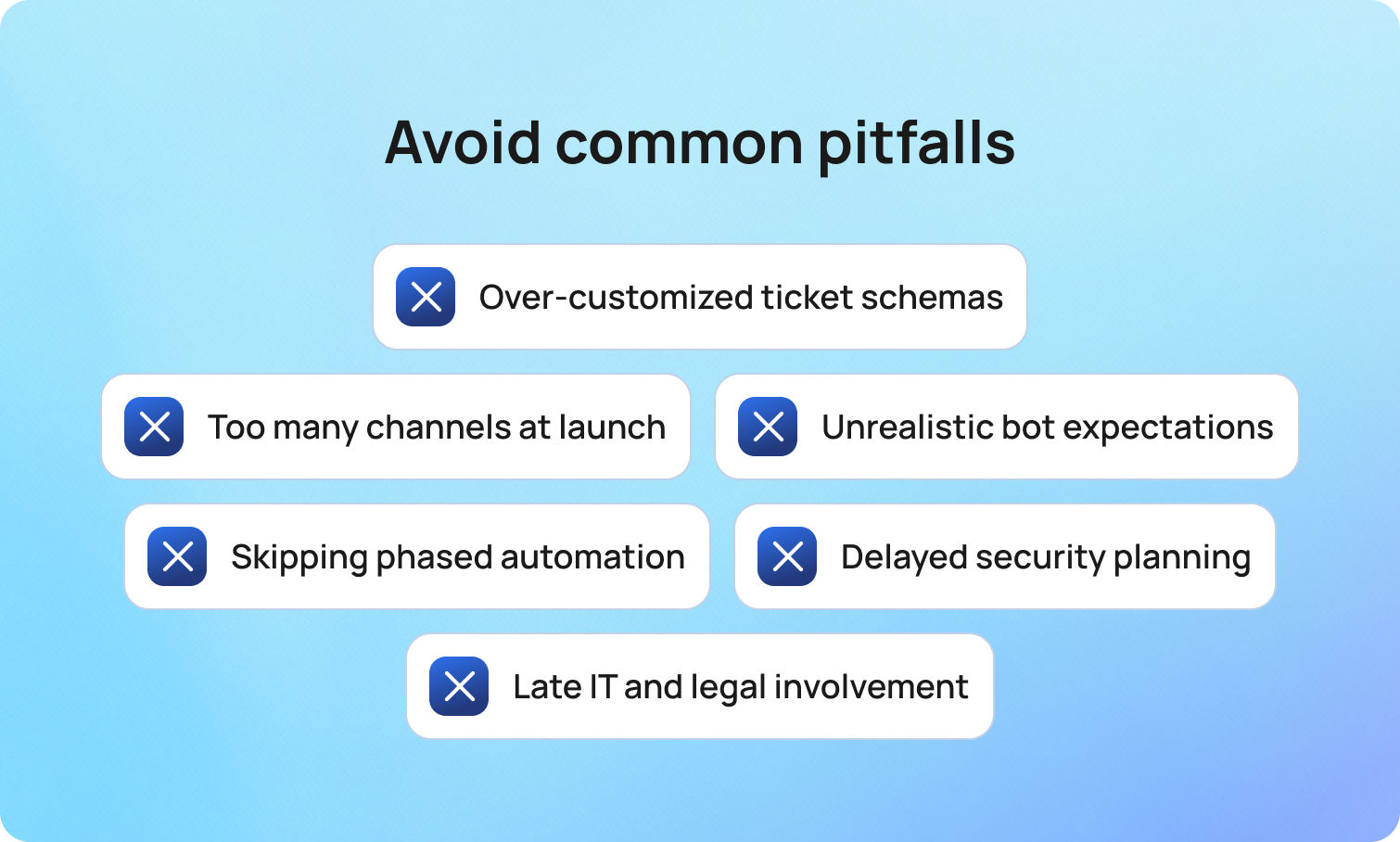
Over-customizing the schema slows every agent. Keep forms short and focused on fields that drive automation or reporting. Launching too many channels on day one spreads resources thin. Begin with email and forms, then add chat once routing and analytics are steady.
Expecting a bot to solve everything immediately creates disappointment. Start with guided flows, then add intent detection and retrieval from the knowledge base. Ignoring security early invites delay at go-live. Engaging IT and legal in step one keeps the organization on schedule.
BlueTweak mitigates several risks by centralizing features and governance on a single platform.
Conclusion: Build For Outcomes, Automate in Stages, and Protect Trust
A high-performing support system is a coordinated set of processes, not a pile of tools. Clear SLAs and queues establish predictable service. Unified intake and a tidy schema keep work visible and measurable. Intent-based ticket routing and AI assistance shorten the path to resolution.
A knowledge base powers both self-service and faster human replies. Scoped bots resolve common issues and escalate gracefully. Analytics and workforce management align staffing to demand. Security and resilience preserve customer trust.
Automation should progress in deliberate stages. Begin with assistive features such as summaries and suggested replies. Move to human-in-the-loop approvals for repetitive resolutions. Graduate to fully automated outcomes for low-risk intents once data proves reliability. Guardrails preserve accuracy, privacy, and tone. With this approach, support teams gain confidence, customers receive consistent answers, and closed tickets reflect real resolution rather than quick dismissals.
BlueTweak serves as an example throughout because it unifies ticketing, chat, voice, bots, knowledge base, analytics, and workforce planning in a single stack. Consolidation reduces tool sprawl, accelerates integration, and simplifies reporting. CTA: See BlueTweak in action and map the first month using this playbook.
Book a focused 30-minute demo to see the end-to-end flow, from submitting tickets to managing outcomes and measuring results.

12 Customer Service Analytics Tips to Improve SLAs and FCR
Turning Support Analytics into Action
Customer service data holds the answers to why queues miss SLAs, why specific issues need three touches instead of one, and why German-speaking customers wait twice as long as English speakers. The problem is not a lack of data. Analytics often reside in five different places, and tagging for terms like “billing issue” is not standardized. Additionally, monthly reports rarely impact Tuesday staffing or guide knowledge base rewrites.
Support leaders running 20 to 100 agent teams face a specific challenge: the operation is big enough that gut feel does not scale, yet small enough that a whole analytics team is out of reach. What is needed are actionable insights that drive fundamental changes to schedules, macros, workflows, and content.
This guide outlines practical steps to turn customer support analytics into better outcomes. It covers how to unify data, which metrics actually predict performance, and how to build a weekly rhythm that connects insights to action.
What Customer Service Analytics Is And Why It Matters
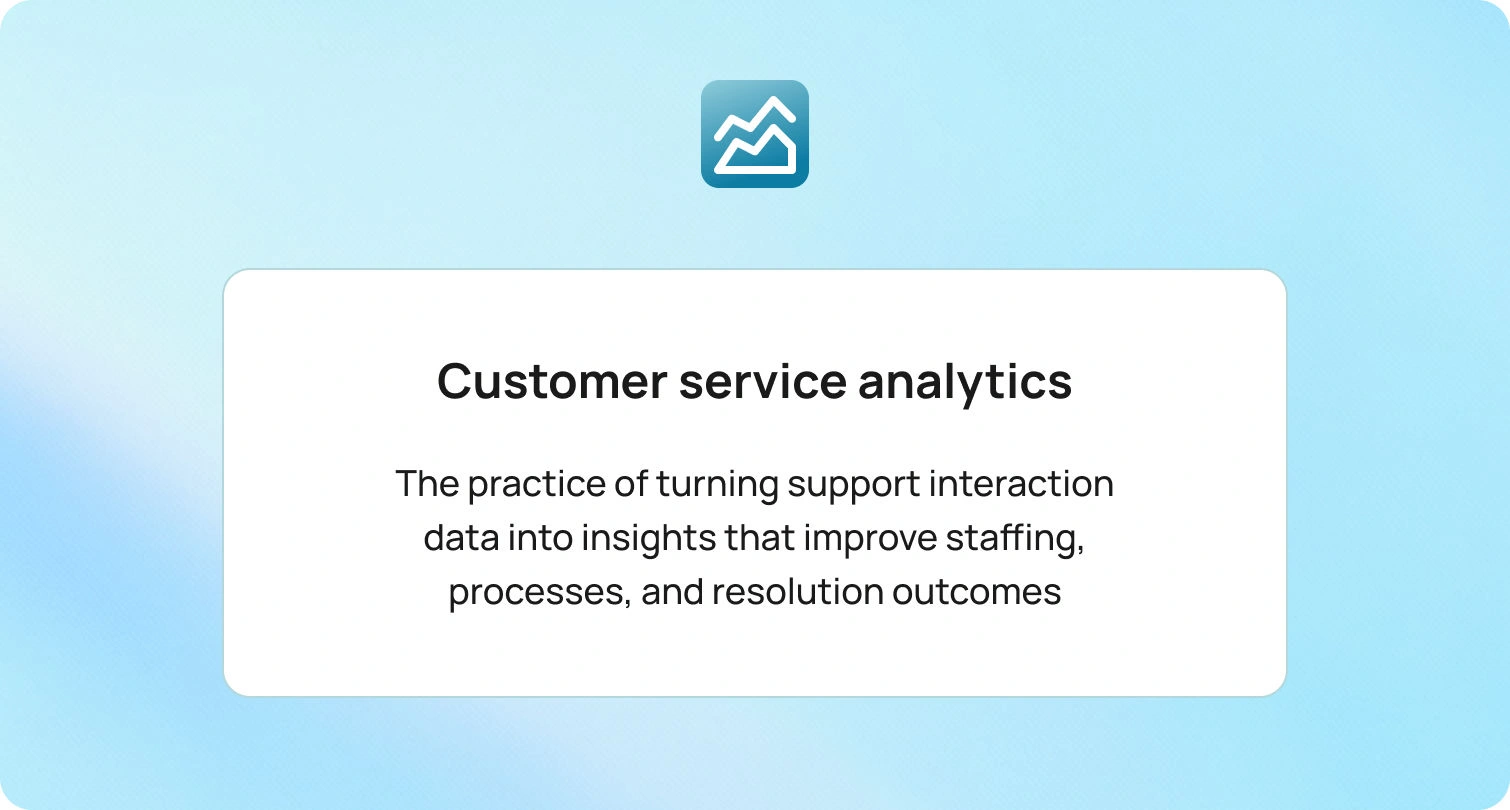
Customer service analytics means transforming interaction data (tickets, calls, chats, emails) into informed decisions about staffing, processes, and content that directly improve SLA adherence and First Contact Resolution.
This might involve identifying which queues will miss targets by Tuesday afternoon, which intents consistently fail on the first touch, and which languages exhibit worse performance. Then, it’s about adjusting agent schedules, updating canned responses, fixing handoff rules, and rewriting knowledge base articles based on what the data tells you.
Good customer service analytics close the loop from measurement to action within days. Most teams waste their analytics efforts in three ways:
- Measure everything but change nothing.
- Track vanity metrics that don't connect to business outcomes.
- Run beautiful reports that arrive too late to matter.
Technology Overview: How Customer Support Analytics Evolved (2015→2026)
Between 2015 and 2026, customer service analytics transitioned from end-of-month Excel exports to unified, real-time dashboards with intent taxonomies, role-based views, and predictive forecasting, all tied directly to staffing and coaching decisions. The old model meant pulling ticket exports at month-end, manually tagging conversations in spreadsheets, building pivot tables, and emailing static reports that led to quarterly discussions and maybe some changes that were never verified.
Modern customer service analytics software unifies data at the ticket level, applies consistent tagging through automation, displays live SLA and FCR metrics, and integrates directly with workforce management and quality assurance systems. Three forces pushed this evolution:
- Channel expansion across chat, voice, messaging, and social.
- AI maturity enabling natural language processing for auto-tagging and routing.
- CFO scrutiny demands proof that support investments improve customer retention and reduce cost per contact.
When evaluating analytics capabilities, prioritize unified ticket-level data across channels, a stable intent taxonomy you can maintain, live SLA and FCR dashboards, and closed-loop workflows. You want to connect insights to staffing changes, process improvements, and updates to the knowledge base.
What "Good" Looks Like
Effective customer service analytics involve unified data, where every ticket is assigned consistent tags for intent, channel, brand, and language. A stable taxonomy of 30-50 intents that covers 80% of volume without constant redefinition. Weekly reviews where a human interprets the numbers and assigns clear actions:
- Update this article
- Adjust Thursday staffing
- Retrain this queue on transfers
It should lead to visible changes to schedules, macros, handoff rules, and knowledge content based on what last week's data revealed.
Good doesn't require machine learning models, data lakes, or a team of analysts. It requires discipline in tagging, reviewing frequency, and accountability for taking action.
Ultimately, it's about looking beyond the metrics and understanding what they truly mean. They're numbers on a dashboard, but they help retain customers, foster customer loyalty, improve customer trust, gauge customer sentiment, enhance customer satisfaction, and inform data-driven decision-making.
12 Tips on Customer Service Analytics to Boost SLAs and FCR
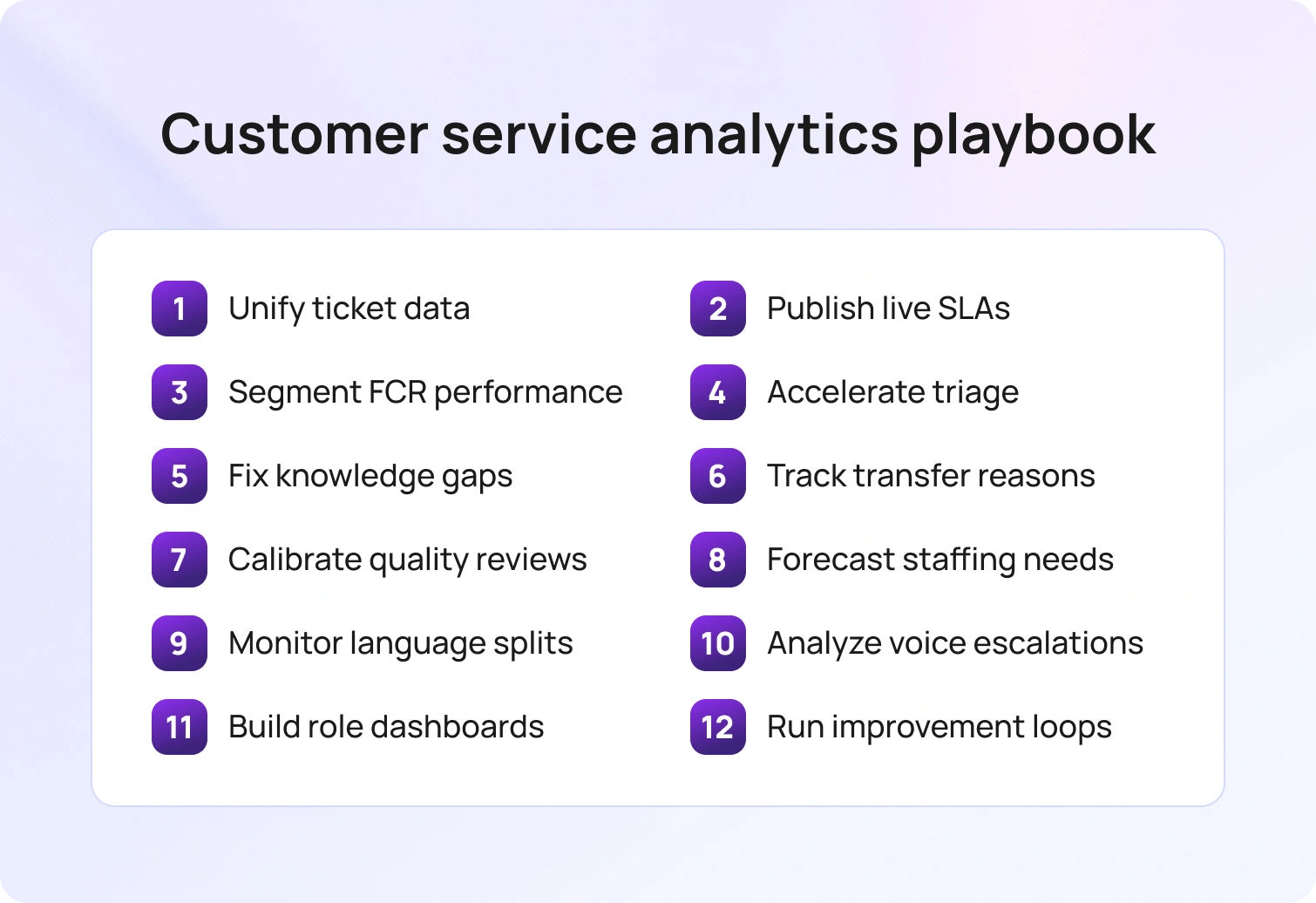
These tips begin by unifying data at the ticket level and making performance visible in real-time, so SLA and FCR issues surface by intent, channel, language, and queue. They then show how to act on those signals with AI summaries, targeted knowledge fixes, transfer-reason instrumentation, calibrated QA, WFM forecasting, language and region splits, transcript mining, role-based dashboards, and a weekly measure → change → re-measure loop.
1. Unify Your Data at the Ticket Level
Scattered data kills analytics. When voice calls reside in one system, email tickets in another, and chat logs in a third, you can't view complete customer journeys or accurately compare channel performance.
Start by centralizing all interactions in a single ticketing system, where every customer conversation is assigned a ticket with standard fields: customer ID, intent, channel, brand, language, assigned agent, timestamps, resolution status, customer lifetime value, and transfer history.
Standardize your tagging taxonomy with 30-50 intents that cover your most common scenarios. Create mandatory dropdown fields for brand and language. Create routing rules that automatically apply these tags based on keywords and context.
Without unified, tagged data, every downstream metric is suspect.
BlueTweak centralizes omnichannel interactions in unified ticketing with automatic classification, tagging, and routing based on intent detection. This gives you a single-source truth for all analytics.
2. Publish Live SLA Views for Every Queue
Monthly reports on SLA performance arrive too late to fix the problem. Build live dashboards that show current service levels by queue, updated every 5-10 minutes:
- Current SLA percentage
- Tickets answered within the target
- Tickets breaching SLA right now
- Average wait time
- Oldest ticket age
Make these visible to operations managers and team leads throughout the day with alert thresholds that trigger notifications when any queue drops below 80%.
Live visibility creates accountability and enables fast response. When you can see a queue trending toward a breach at 2 pm, you can pull agents from lower-priority channels or adjust break schedules to prevent the damage from occurring.
BlueTweak's real-time dashboards track SLA adherence by queue, priority, and channel with configurable alerts when thresholds are breached. It turns SLA monitoring from a monthly postmortem into daily operations management.
3. Track First Contact Resolution by Intent and Channel
Overall, First Contact Resolution (FCR) provides limited actionable insight at the aggregate level. However, breaking it down by intent and channel shows you exactly which scenarios fail and why.
Build reports that calculate FCR for each intent in your taxonomy and segment by channel. For example, email billing questions may achieve an 80% FCR, while chat billing questions drop to 40%.
Set a target where anything below 65% FCR deserves investigation. For each low-FCR intent, ask:
- Do we have a knowledge article?
- Is it accurate and complete?
- Do agents have the proper canned responses?
- Are we routing to the wrong team?
Then fix the root cause and re-measure after two weeks to confirm improvement.
BlueTweak's custom reporting segments FCR by intent, channel, brand, and language, allowing for precise identification of scenarios that require attention.
4. Use AI Ticket Summaries and Machine Learning to Cut Triage Time
Agents waste 90 seconds per ticket reading through conversation history to understand context before responding. AI Ticket Summaries extracts key details (customer issue, previous interactions, current status, attempted solutions) into a 3-4 sentence overview at the top of every ticket. Agents grasp the situation in 10 seconds and immediately jump to a resolution.
Shorter triage time means faster first responses. When agents handle inquiries 60-90 seconds faster, your first response time decreases by 15-20%, improving SLA attainment and creating the capacity to handle higher volumes without hiring additional staff.
BlueTweak generates AI summaries automatically for email, chat, and voice interactions, displaying them prominently in the agent workspace to accelerate triage and handoffs.
5. Close Knowledge Gaps Fast to Improve Customer Interactions
Low FCR by intent typically indicates a lack of or inadequate knowledge content. Implement a weekly knowledge review process: pull the bottom 10 intents by FCR, verify each has a current article, and update or create content where gaps exist.
Make articles actionable with clear steps, decision trees, common edge cases, and exact language agents can use in responses.
Align your knowledge base with canned responses and suggested reply features, allowing agents to pull accurate, approved language directly into tickets. After updates, re-measure FCR for that intent. If it improves by 10 percentage points or more within two weeks, the knowledge change has been effective.
BlueTweak's integrated Knowledge Base connects directly to the agent workspace, featuring AI-powered search and Suggested Reply that automatically pulls relevant content into draft responses.
6. Instrument Transfer Reasons
Transfers kill FCR. Every handoff drops resolution to zero. Add a mandatory "transfer reason" field to every handoff: wrong queue, need specialist approval, technical limitation, customer request, escalation.
Weekly, report on transfer volume by reason and originating queue to discover patterns.
Many transfers are avoidable:
- Improve initial routing to reduce"wrong queue transfers.
- Grant appropriate system permissions to eliminate "need approval" transfers.
- Train support teams on common escalation scenarios so they can handle more issues end-to-end.
BlueTweak supports custom transfer-reason fields, including required dropdowns where enabled.
7. Calibrate Quality Reviews to FCR
Add FCR-focused criteria to quality reviews:
- Did the agent provide complete information?
- Did they set accurate next-step expectations?
- Did they offer self-service resources for follow-ups?
- Did they document the resolution clearly enough that another agent could pick it up?
Review low-FCR intents specifically and use findings to build stronger customer relationships through targeted coaching.
Don't tell agents to "improve the customer experience". Show them the specific ticket where incomplete information caused a reopen, demonstrate the improved response, and track the improvement in their subsequent ten similar interactions.
BlueTweak's Quality Assurance features support custom scoring criteria, intent-filtered reviews, and coaching workflows tied to performance metrics.
8. Forecast Workload and Staff to SLA

Implement basic workforce management forecasting by analyzing historical volume by day, hour, and channel over the past 90 days. Identify patterns: Monday mornings peak 40% above average, Friday afternoons drop 25%, the first week of the month spikes 50% due to billing cycles.
Build staffing schedules that match predicted demand and protect your highest-priority queues during known peak periods.
Review forecast accuracy weekly. When the actual volume deviates significantly from the prediction, update your model and investigate the cause: did a campaign drive unexpected contacts, or was a product issue responsible for a surge?
BlueTweak includes native Workforce Management with volume forecasting, optimal schedule generation, and real-time adherence tracking to align staffing with demand and protect SLAs.
9. Watch Language and Region Splits for Better Resource Allocation
Segment all metrics by language and region to catch disparities where your secondary-language(s) queue runs at 60% SLA while English hits 85%. Compare SLA attainment, FCR rates, average handle time, and customer satisfaction scores across languages and brands.
Disparities typically arise from uneven staffing, inadequate multilingual content, or routing issues. Here’s what to do about it:
- Address staffing gaps by hiring new staff or redistributing existing coverage.
- Close content gaps with multilingual support across your knowledge base.
- Prioritize articles for low-FCR intents in underserved languages.
- Track improvements quarterly to verify that changes are working.
BlueTweak provides multilingual AI across voice and text, including instant language switching in the voicebot, multilingual knowledge base support, and analytics segmented by language and brand to identify and close performance gaps.
10. Mine Voice Escalations with Transcripts
Implement call transcription for voice interactions and review transcripts where customer feedback mentions "I tried the chat" or "I sent an email yesterday" to understand why the first attempt failed. Tag these escalation reasons: chat couldn't answer, email response unclear, knowledge article outdated, or chatbot failed.
Aggregate findings weekly and fix the upstream issues. Retrain the AI chatbot with more effective examples, revise the confusing email macro, or update the outdated article. Measure whether escalation rates for that intent drop over the following two weeks.
BlueTweak's call transcription, with options to analyze trends and escalation patterns, identifies escalation patterns and connects voice data to earlier digital interactions for root-cause analysis.
11. Create Role-Based Dashboards
Build three role-specific views instead of one support dashboard.
- Executive scorecard: High-level trends in SLA, FCR, CSAT/NPS, and cost per contact (segmented by brand and language, updated daily, reviewed weekly).
- Operations control room: Live SLA by queue, current backlog, transfer rates, top 10 intents by volume, FCR, and agent availability.
- Coach view: Agent-level trends in handle time, FCR, transfers, quality scores, and suggested coaching priorities..
Each role needs different data analytics at different frequencies. Operations need real-time visibility to react within hours. Coaches need daily trends to spot skill gaps. Executives need strategic context, not minute-by-minute noise.
BlueTweak provides pre-built dashboards tailored to typical roles, along with custom analytics and role-based views and permissions. This helps each team member see the metrics they need to act on without being overwhelmed by irrelevant data.
12. Run Weekly "Measure → Change → Re-Measure" Loops
Establish a weekly 30-minute meeting where you review the numbers, assign specific changes, and track outcomes. Review SLA and FCR by queue, language, and intent, and flag any items that fall below target.
Identify the top 3 issues and assign owners for each fix. Confirm last week's changes worked. Document decisions and outcomes in a shared log.
Minor, frequent improvements compound better than quarterly overhauls. Fixing three knowledge gaps per week means 150+ improvements per year. Weekly reviews create accountability, and assigned changes actually happen because everyone knows they'll report progress next Tuesday.
BlueTweak's analytics platform provides the data you need for these reviews, and the integrated Knowledge Base, Quality, and WFM tools let you implement and verify changes without leaving the platform.
"Predictive" in Practice
The practical path for most 20-100 agent teams starts with workforce management forecasting to predict next week's volume and staff accordingly. If historical data shows product-launch weeks drive 60% more "how-to" tickets, you can predict the spike (and future outcomes), pre-staff appropriately, and create knowledge articles in advance.
Advanced predictive models (identifying high-risk customers likely to churn, predicting which existing high-value customers will upgrade, forecasting individual ticket resolution times) typically require exporting customer service data to business intelligence platforms where you can join it with CRM, billing, and product usage data.
Ultimately, predictive analytics are all about informing proactive measures. You want to understand customer needs, customer expectations, and what they need for improved customer satisfaction.
BlueTweak's supports both paths: native WFM forecasting for staffing, plus integrations to external BI tools for advanced predictive models.
Implementation Roadmap (30/60/90)

First 30 Days: Finalize intent taxonomy, enable live SLA dashboards, baseline current FCR overall and by top 10 intents, fix top 10 article gaps, implement mandatory transfer-reason tracking.
Days 31-60: Build role-based dashboards, calibrate quality reviews to include FCR criteria, pilot AI Ticket Summaries with one team, create a weekly analytics review meeting with an action log, and add language/region segmentation to all reports.
Days 61-90: Integrate Workforce Management forecasting into staffing process, expand Knowledge Base coverage to all intents below 65% FCR, implement call transcription and escalation mining, document "measure → change → re-measure" playbook, establish quarterly analytics review for strategic initiatives.
KPIs That Move SLAs and FCR
Measure what matters:
- Service Level Agreement (SLA) Attainment: Percentage of tickets answered within target by queue, priority, and channel; current SLA status and trend; tickets currently breaching SLA; oldest ticket age by queue.
- First Contact Resolution (FCR): Overall FCR percentage; FCR by intent, channel, brand, language; reopen rate; transfer rate by queue and reason.
- Response and Resolution Times: First response time, average handle time by channel and intent, time to resolution by priority, and backlog age distribution.
- Quality and Satisfaction: Quality assurance scores, customer satisfaction (CSAT) by channel, Net Promoter Score (NPS) by brand, customer effort score.
- Operational Efficiency: Cost per contact by channel, contacts per agent per day, agent utilization and adherence, knowledge article usage, and deflection rate.
BlueTweak tracks all these metrics in real-time dashboards with custom reporting, filtering by any ticket attribute, and exportable data for deeper analysis.
Customer Service Analytics That Matter
Customer service analytics matter only when they drive change, such as staffing decisions, knowledge articles, coaching priorities, or process workflows. The difference between teams that improve SLAs and FCR and teams that just report on them comes down to closing the loop from measurement to action.
Start with unified ticket-level data across all customer service channels. Build live dashboards that show current SLA and FCR performance by queue, intent, channel, and language. Establish a weekly rhythm where you review the numbers, assign specific fixes, and confirm previous changes worked.
Most improvements don't require AI or advanced predictive customer behavior models. They just require consistency in tagging, discipline in reviewing, and accountability for taking action.
See BlueTweak in action. Book a 30-minute demo to explore unified customer service anal
How AI Improves Customer Support: A Practical Playbook for Efficient, Satisfying Service
Introduction: From Firefighting to Thoughtful Service
Many contact centers operate in a state of permanent triage. Tickets arrive from multiple channels, similar customer questions repeat across queues, and pressure to improve customer service never lets up. AI technology now offers credible ways to reduce backlogs, stabilize service quality, and free up time for complex customer issues.
The aim is not to replace people, but rather to ensure excellent customer service. The goal is to provide customer service agents with more innovative AI tools that cater to the real needs of customers. With routine tasks handled, agents can focus on meaningful conversations that build relationships. This matters most for complex issues, where judgment and empathy are essential.
This playbook maps a straightforward path for transforming customer service. First, define the tasks that AI systems should handle and those that remain with service professionals. Next, connect AI to the existing knowledge and systems that power customer service and support operations.
Then, coach agents to collaborate with implementing AI practices and measure outcomes in short cycles. Along the way, the article highlights how BlueTweak serves as a consolidated platform for customer service solutions, and how grounded responses, transparent governance, and respectful handling of customer data contribute to protecting the customer experience. Precise instrumentation also helps identify trends, analyze customer sentiment, and accurately anticipate customer needs.
The steps that follow show how AI is changing customer support in practical, measurable ways.
What AI is Actually Good At in Customer Service

The fastest way to see how AI enhances customer service outcomes is to examine the actual work being done inside contact centers. A small set of intents typically drives most customer service interactions, including shipment status, eligibility questions, password resets, appointment changes, and basic troubleshooting. These are typically routine customer inquiries. They demand consistent answers and quick delivery, but rarely require complex judgment.
AI customer service is well-suited to this layer. A knowledge-grounded chatbot can handle initial customer inquiries in the same language used by the customer service team, pull context from customer history when appropriate, and escalate to human interaction with a clear summary when the situation becomes complex. When conversations carry emotional weight or require discretion, human review remains the default. The goal is to match the task to the resource. In plain terms, this is how AI improves customer support services: automates routine questions, keeps humans for judgment calls, and passes clean summaries between them.
Market research supports a blended model. McKinsey’s customer care analysis highlights tangible benefits from summarization, suggested responses, and reduced post-contact work, particularly when process design and coaching align with technology to enhance customer satisfaction.
BlueTweak aligns with this evolution. The platform combines customer service AI for chat with ticketing, analytics, and workforce management, so answers are grounded in approved content and linked back to sources. Agent assists in drafting replies and condenses lengthy customer conversations. Leaders see the combined effect on queues, schedules, and quality without having to stitch together extra tools, which contributes to efficient service and higher agent productivity.
A Simple Path to Value, From First Week to First Quarter
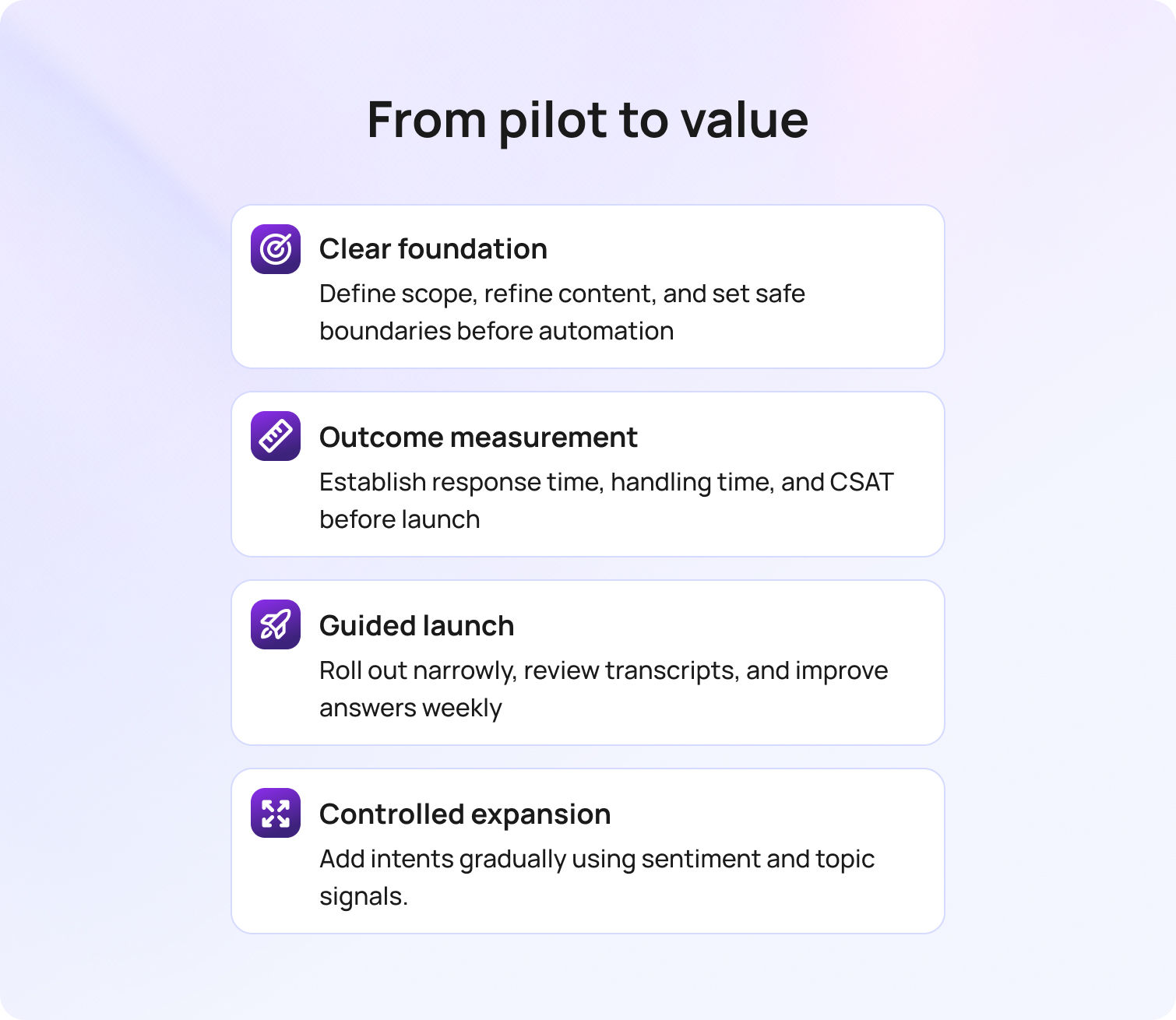
This section addresses a common question—how can AI automate customer support—by outlining a focused rollout from week one to the end of the first quarter. It begins with a focused foundation, moves into precise instrumentation, follows with a narrow launch and active coaching, and finishes with careful expansion. BlueTweak ties the steps together by keeping knowledge, chatbot, analytics, and workforce management aligned so support teams can deliver consistent service delivery.
1. Foundation: Define Scope and Prepare Content
Effective programs start with a clear understanding of customer behavior. The most frequent customer queries are identified, transcripts are reviewed to capture authentic phrasing, and answers are drafted in plain language. Those answers become the backbone of knowledge-grounded service. Policies that cannot be explained succinctly are refined before automation. This is the moment where service quality is set.
BlueTweak supports this preparation by connecting to the knowledge base, marking allowed sources, and enforcing role-based access. Clear boundaries matter. High-risk topics and ambiguous issues should escalate directly to human agents. A successful launch depends on the clarity of both the content and the handoff.
2. Instrumentation: Measure Outcomes Before Turning Anything On
Programs thrive when success is defined up front. Three measures are sufficient at the start: time to first response, average handling time, and customer satisfaction. Deflection for routine tasks and agent assists for complex customer inquiries are tracked with consistent labels. In BlueTweak, resolution codes and compact agent summaries support sustainable measurement, enabling the quick resolution of customer pain points.
3. Launch and Coaching: Improve Answers and Tone in Short Cycles
Initial rollouts are intentionally narrow. A single channel or a limited audience segment receives the experience first. Transcripts are sampled every few days. Where answers sound generic, the knowledge base is strengthened. Where tone needs adjustment, style guidance is updated. Customer feedback is collected and addressed promptly. These feedback loops are how customer service strategies turn into steady improvements across customer service experience touchpoints.
4. Expansion: Add Coverage Without Adding Complexity
New intents are added only after the first set is stable. Topic-level sentiment analysis tracks whether specific products, policies, or regions show emerging friction. When a pattern appears, the source of the pain is addressed rather than coaching agents to move faster through flawed steps. BlueTweak’s topic and sentiment trends, combined with predictive analytics, provide the signals to identify trends and fix upstream issues that generate avoidable customer requests.
Personalization That Respects Privacy
Personalized support should read as context-aware, not intrusive. Appropriate personalization uses analyzing customer data that a service team would ordinarily reference, such as entitlements or recent orders, to tailor personalized interactions and guidance. It does not expose unnecessary details or exceed the scope of consent. Thoughtful personalization strengthens customer loyalty, and customer preferences are respected.
To achieve this balance, AI systems are grounded in specific sources with documented permissions. Audit logs are kept by default, so access history is traceable. Transient session data is retained only as long as necessary. Transparent links to DPA, SCCs, and a public list of sub-processors enable buyers and auditors to understand how data is handled.
BlueTweak follows this pattern with knowledge-grounded chat, role-based permissions, and audit logs, while allowing organizations to publish Trust Center links for formal disclosures that support a trustworthy AI customer experience.
What to Measure and How to Change Course

Metrics are effective when they inform decisions rather than decorate dashboards. The starting set tells a clear story about speed, quality, and cost. Time to first response indicates whether routine tasks are handled promptly. Average handling time shows whether agents are assisted efficiently. First contact resolution and simple feedback prompts help determine whether customers leave satisfied and whether the content is clear and explicit.
Analyzing customer sentiment adds a layer of prioritization. Combined with topics, it reveals which products or policies drive frustration. These insights guide improvements to the knowledge base, the process, or the upstream experience that generated the ticket.
BlueTweak’s analytics bring these signals together in one place. Queue health, backlog trend, topic-level sentiment, and staffing plans sit side by side. Workforce management helps match capacity to forecasted demand as automation reshapes the queue. The result is a more stable customer service experience without a maze of integrations.
Narrative Examples That Show Real Outcomes
These examples from BlueTweak deployments show how grounded AI and a consolidated workspace translate into practical outcomes across different environments. Each story pairs automation for routine inquiries with clear handoffs for exceptions, with BlueTweak coordinating chatbot, ticketing, analytics, and workforce management.
1. Airline Operations: Real-Time Updates and Simpler Agent Work
At Aeroitalia, BlueTweak was introduced to unify customer interactions across channels and surface real-time journey information. Agents described the interface as straightforward to learn, and leaders reported smoother interoperability with existing systems. The result was efficient service that reduced manual work for staff while keeping passengers informed during changes.
2. High-Volume Call Center: Structure First, Speed Follows
A global call center team adopted BlueTweak’s automated ticketing and routing to bring order to a fast-moving queue. Requests are now categorized and prioritized consistently, which reduces wait times and provides support teams and agents with more precise next steps to take. The team attributes the improvement to structured workflows and agent assistance, which have enhanced day-to-day productivity and customer satisfaction.
3. BPO At Scale: One Place to Run Multi-Client Support
Conectys implemented BlueTweak to manage multi-brand, multi-client operations within a single workspace. Omnichannel support and role-based views standardized quality across programs, while built-in analytics and data capture informed staffing and coaching. Crucially, teams can be separated per brand/project, with routing, views, and reporting scoped to each, so work stays in clean “chunks” and no overlaps occur. Leaders highlight consistent delivery across clients without adding new tools.
Narrative Examples That Show Real Outcomes
These examples from BlueTweak deployments show how grounded AI and a consolidated workspace translate into practical outcomes across different environments. Each story pairs automation for routine inquiries with clear handoffs for exceptions, with BlueTweak coordinating chatbot, ticketing, analytics, and workforce management.
1. Airline Operations: Real-Time Updates and Simpler Agent Work
At Aeroitalia, BlueTweak was introduced to unify customer interactions across channels and surface real-time journey information. Agents described the interface as straightforward to learn, and leaders reported smoother interoperability with existing systems. The result was efficient service that reduced manual work for staff while keeping passengers informed during changes.
2. High-Volume Call Center: Structure First, Speed Follows
A global call center team adopted BlueTweak’s automated ticketing and routing to bring order to a fast-moving queue. Requests are now categorized and prioritized consistently, which reduces wait times and provides support teams and agents with more precise next steps to take. The team attributes the improvement to structured workflows and agent assistance, which have enhanced day-to-day productivity and customer satisfaction.
3. BPO At Scale: One Place to Run Multi-Client Support
Conectys implemented BlueTweak to manage multi-brand, multi-client operations within a single workspace. Omnichannel support and role-based views standardized quality across programs, while built-in analytics and data capture informed staffing and coaching. Crucially, teams can be separated per brand/project, with routing, views, and reporting scoped to each, so work stays in clean “chunks” and no overlaps occur. Leaders highlight consistent delivery across clients without adding new tools.
Where BlueTweak Fits
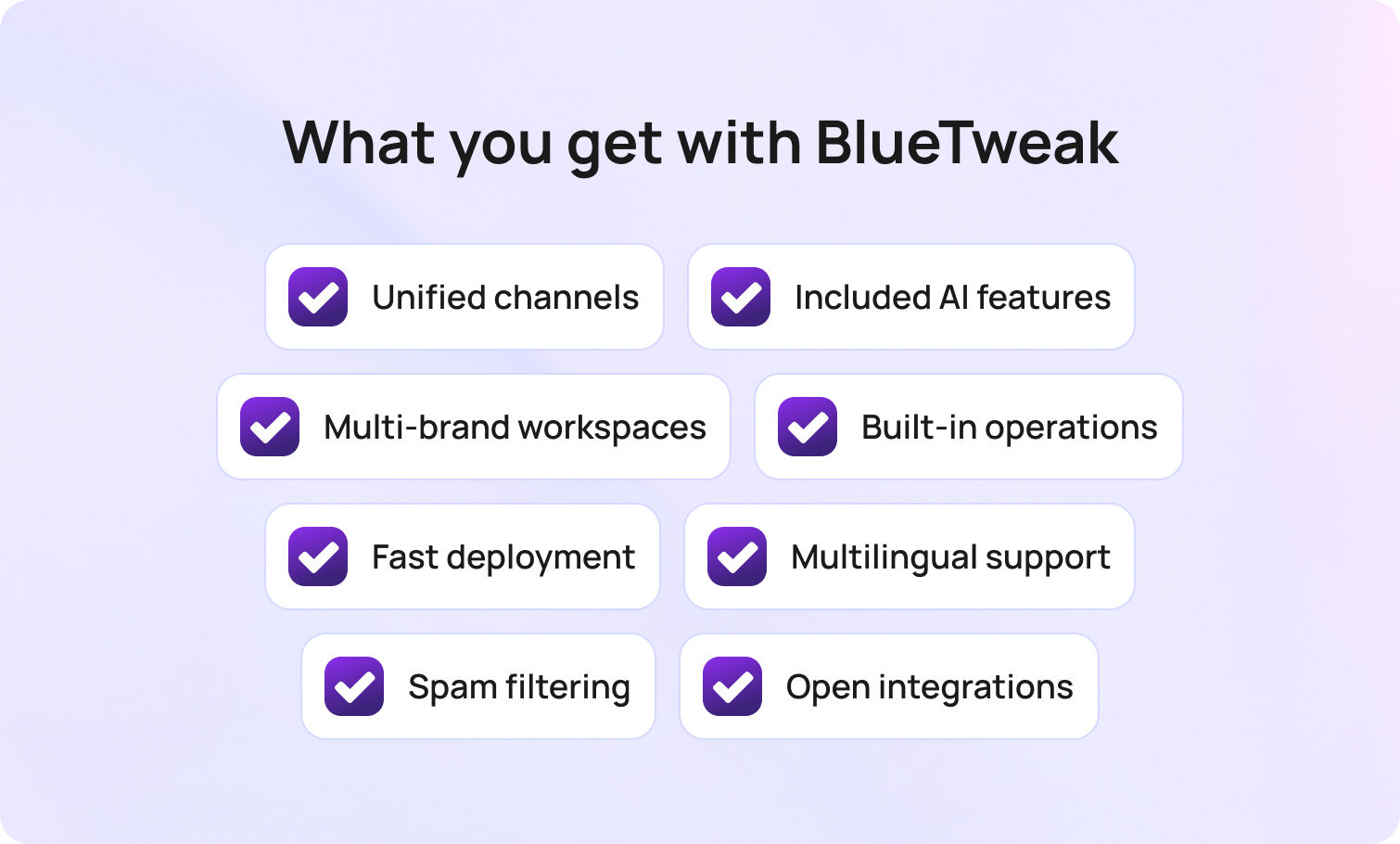
Most support teams want efficient service without the need for extensive integrations. BlueTweak consolidates core components of modern customer service solutions. Ticketing, knowledge-grounded chat, agent assist, analytics, and workforce management operate in one workspace, reducing context switching and making outcomes easier to see.
The chatbot resolves straightforward customer queries and refers complex inquiries to an agent, providing a clear ticket summary, which contributes to excellent customer service. Suggested replies help newer staff deliver consistent answers. Leaders track impact through a unified view of queues, staffing, and quality.
Governance features include audit logs and configurable data location options, with public links to DPA, SCCs, and sub-processors recommended for buyers who thoroughly evaluate their data posture.
Pricing for the core stack starts at €65 per agent per month.
A Short Field Guide For Leadership Teams
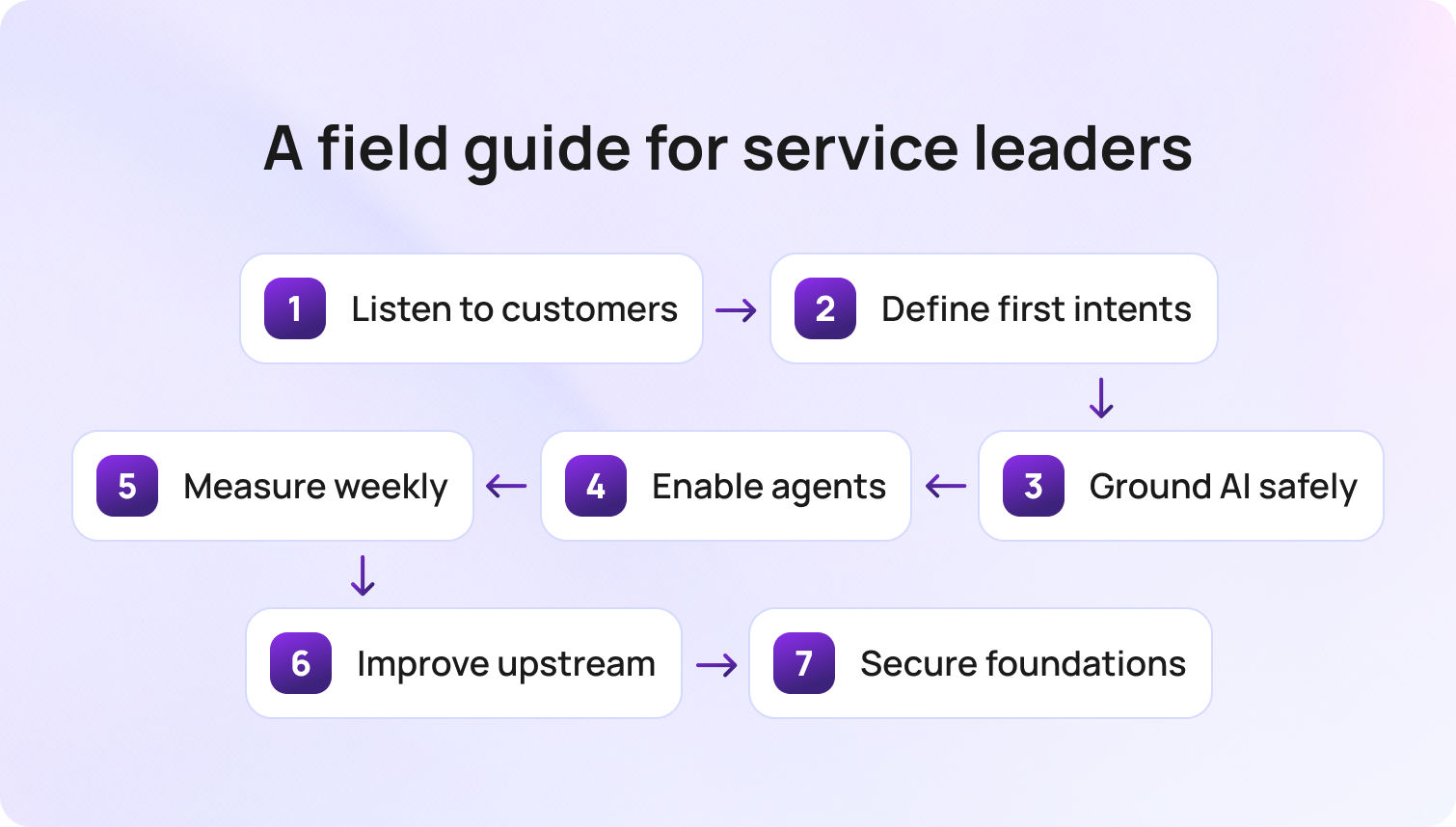
Momentum begins with listening. Transcripts are reviewed to find recurring friction. Agents identify the top three questions that waste time. These topics become the first intents. Answers are written in clear language and tested internally before publication. If a policy cannot be explained briefly, the policy is reviewed.
Access for AI is limited to sources suitable for citation in a help center or customer service faq. Grounding is the heart of reliable AI customer service. A model that sees everything can say anything. A model that sees the correct sources will say the right things more often.
Agent enablement receives the same attention as algorithms. Teams learn how suggested replies are constructed from knowledge and past interactions, and how to decide when to accept or edit them. Thin or outdated content is flagged and updated quickly. Contributors who improve the knowledge base are recognized because content amplifies the impact of every tool.
Measurement runs in short cycles. A weekly review during the first month checks time to first response, average handling time, and the percentage of cases resolved without escalation. A small set of customer feedback is read, tagged by theme, and used to adjust answers, routing, and coaching. When patterns harm the customer experience, adjustments are made upstream to improve it. Dashboards support action, not vanity, which helps AI improve customer service initiatives and stay focused.
Finally, the basics matter. Versioned content, explicit permissions, and audit logs do not attract attention, but they underpin trustworthy service. These are the foundations of a program that continually improves service quality and enhances customer interactions.
Build a Service Operation That Keeps Learning
Customer expectations continue to rise, but the fundamentals of excellent service remain stable. Customers want fast, accurate answers and personalized interactions, with their information handled respectfully and securely. Agents want clear guidance, practical tools, and room to exercise judgment. Leaders want reliable data and a small set of levers that actually change outcomes.
AI contributes when it serves these realities. It handles routine tasks, so queues move faster. It drafts summaries and replies, allowing agents to focus on complex issues. It analyzes customer sentiment, allowing emerging problems to be addressed earlier. Over time, service quality improves and operational costs settle into a more sustainable range. It also clarifies how generative AI can enhance customer support through grounded summaries, suggested replies, and pattern detection that inform upstream fixes.
BlueTweak is designed for this work. The platform consolidates the essential components of modern customer service in one place, reducing integration risk and enabling teams to move with confidence.
Start small, measure honestly, and continually improve the content every week to meet evolving customer expectations. That is how AI enhances customer support and enhances the overall customer experience.
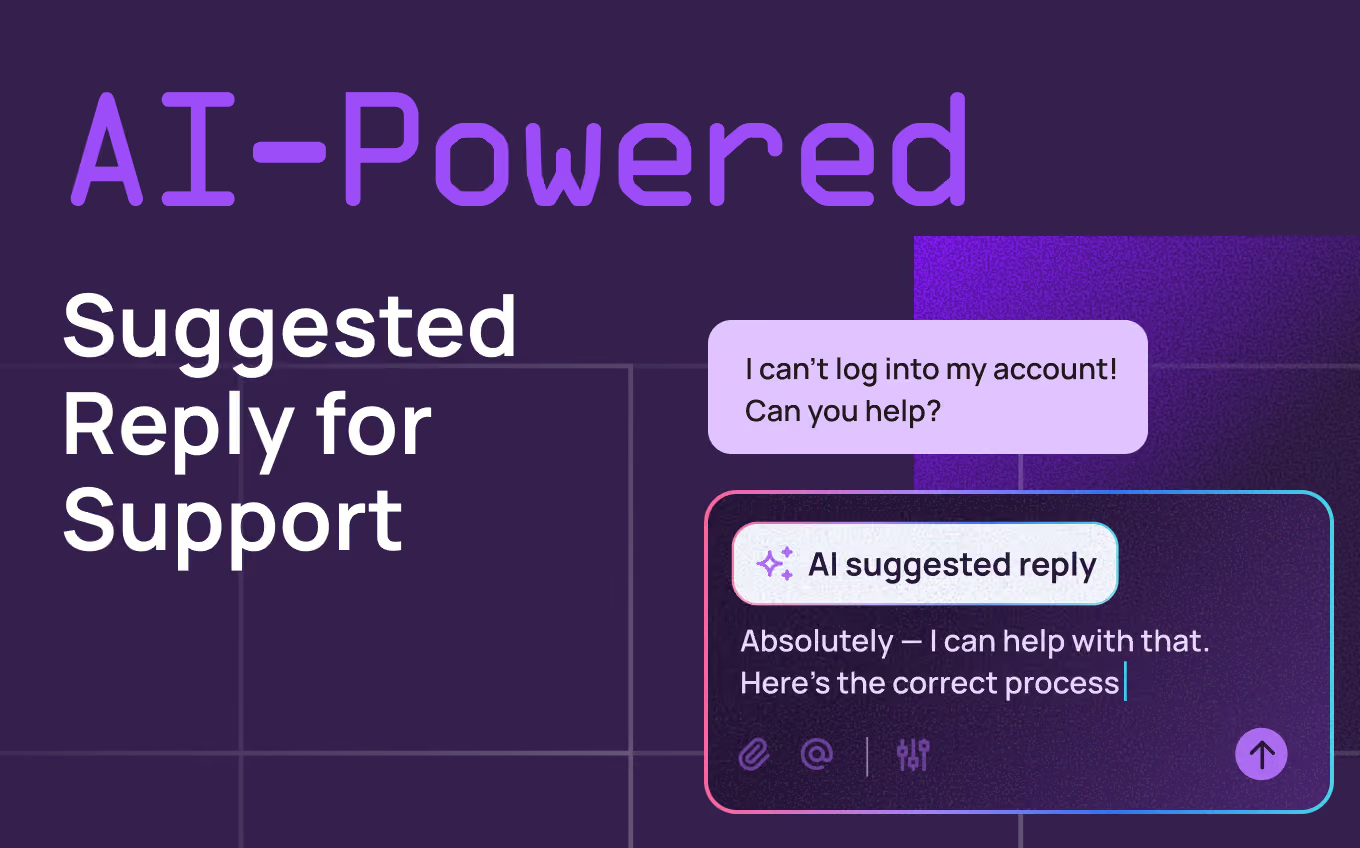
AI-Powered Suggested Reply for Support: A Practical Guide to Faster, Better Service
Why The First Draft Decides The Outcome
In support, the space between a customer’s question and a policy-correct answer is where delays and do-overs creep in. AI-powered suggested reply closes that gap by generating a grounded first draft the instant an incoming message arrives, pulling policy, context, and brand voice into a single starting point. Agents start with an AI-generated draft, quickly adjust tone or details, and send, delivering faster replies, steadier quality, and lower cognitive load. This keeps a human-in-the-loop (HITL) at every step.
The article ahead demonstrates how AI-powered suggested replies for support operate daily, the habits that ensure suggestions remain accurate and on-brand, and how BlueHub integrates this workflow into ticketing, knowledge management, analytics, and workforce management.
The Moment Support Teams Meet a Blank Page
A shipment-delay ticket lands in the queue. The incoming message is short: “Where is my order?” In the agent’s console, AI-powered reply suggestions pull the latest tracking scan, the relevant policy snippet, and the approved response style. A draft appears with plain-language context, next steps, and a friendly sign-off. The agent adjusts the date, adds the order number, and sends it.
Now the pace holds. An access issue arises, and the suggestion includes the correct verification steps, along with a transparent fallback in case the customer is unable to complete the verification. A more tense conversation follows; the system offers a de-escalation template that acknowledges key points, specific needs, impact, and sets a time for the next update. Throughout, the agent remains in control while the system ensures accurate, on-brand, and fast responses. The result is fewer do-overs, steadier quality, and room for judgment where it matters.
What “Suggested Reply” Really Is
Reply suggestions are a governed drafting layer inside the agent console. Instead of auto-sending, the system produces an on-brand first draft that agents can review, adjust, and approve immediately. Under the hood, a large language model operates only with approved inputs, i.e., knowledge articles, macros, recent resolutions, and account context, ensuring the language reflects the current policy and the organization’s response style.
Admins set tone rules, required disclaimers, and escalation boundaries; agents keep control of the send. In practice, AI-suggested replies function as a governed drafting layer that speeds work without removing human judgment.
Think of it as an in-house writing assistant with receipts. Each draft is grounded in cited sources, inherits the correct voice, and adapts to the conversation’s context without inventing facts. Sensitive scenarios (refund thresholds, identity checks, legal complaints) are flagged for human review.
Quality improves over time through lightweight feedback; agents can mark a draft helpful or not, add a note, and content owners update the underlying articles. Analytics surface adoption and editing patterns, allowing leaders to focus on better inputs rather than heavier oversight.
In short, the suggested reply combines three disciplines: retrieving the correct data, generating the right voice, and applying human judgment at the right moment. The three disciplines work together to deliver accurate, relevant, and consistent answers without turning service into an auto-reply.
How It Helps in the Moments That Matter
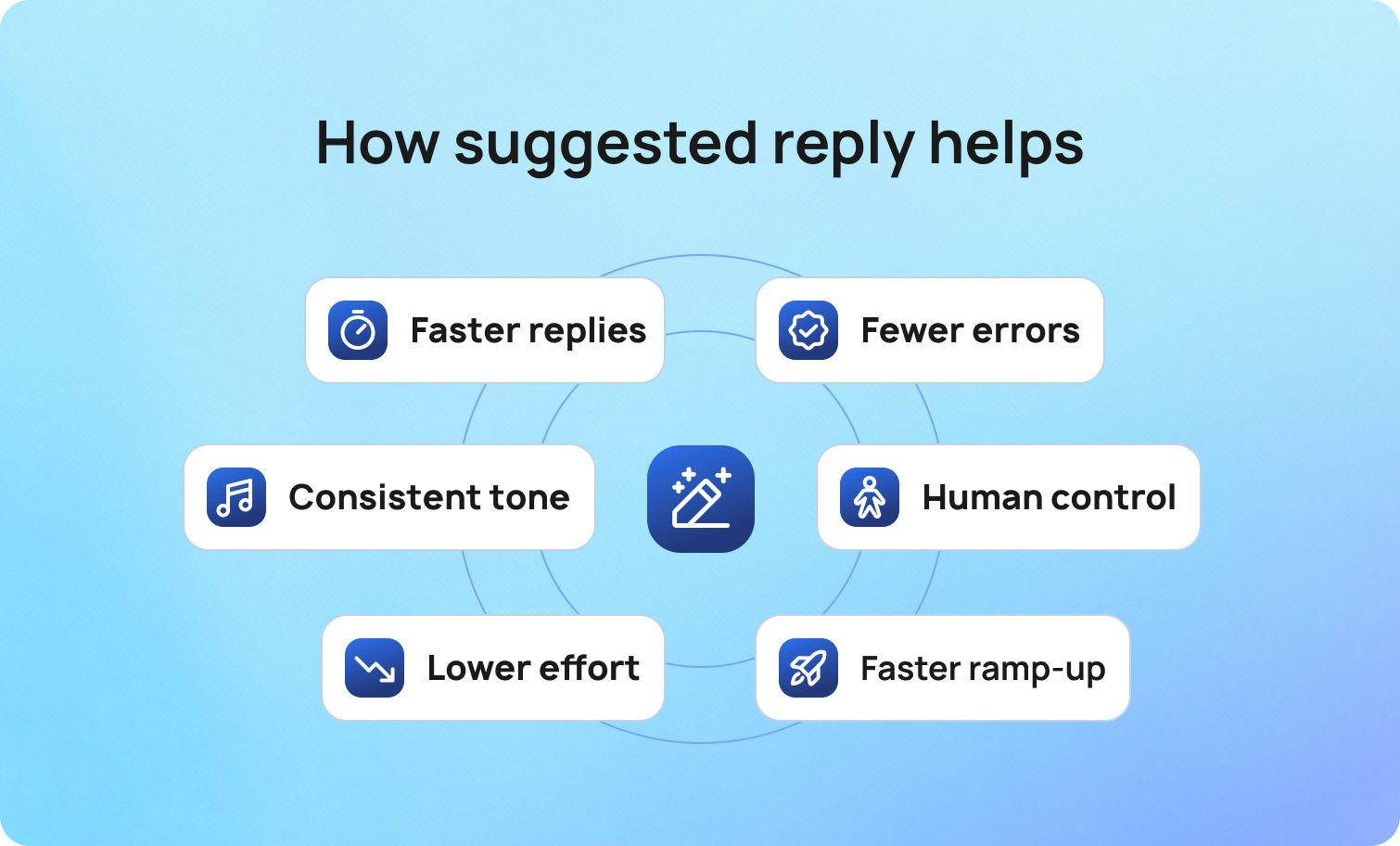
Consider discussing a return window. The system proposes a reply that confirms timing, lists conditions, and offers the next step with a link already filled in. The agent checks the order date and sends it. In a how-to message for a new feature, the suggestion outlines numbered steps, warns about a common mistake, and includes a brief validation step to ensure the customer knows the fix has worked.
When a warranty question arises, the draft requests one missing detail, then provides the correct path if the product qualifies. In each case, the suggestion eliminates guesswork and provides the agent with a strong starting point.
Consistency improves as well. Shifts and regions often phrase things differently. A tuned AI text response generator reduces that variance by standardizing the structure and wording of suggested responses, while leaving room for personalization. Customers notice the difference. Messages appear to come from the same service team, regardless of who typed them. That steadiness is a quiet, yet persistent, driver of improved customer satisfaction, leading to stronger customer relationships.
There is also a less visible but powerful effect on the people doing the work. When agents spend less time hunting for fragments and more time applying judgment, fatigue drops. The work feels focused. New colleagues ramp up faster because the suggested replies model good habits that lead to improved customer satisfaction. Leaders see cleaner metrics not because dashboards changed, but because the process did.
A Day in the Life With Suggested Reply
Morning opens with a queue full of short questions and a handful of complex threads. A customer asks about a shipment delay. The system presents a draft that confirms the latest scan, explains its meaning in plain language, and suggests the following action. The agent edits the date, adds a friendly sign-off, and sends it.
Another incoming message is about account access. The suggestion includes the proper verification steps and a contingency path in case the customer cannot pass them. Later, a conversation escalates; the agent uses a de-escalation template proposed by the system for a quick reply, which acknowledges the impact and commits to the next update window. Throughout the day, the agent marks drafts as helpful or not, leaving one-line feedback that content owners use to refine the knowledge base. The loop closes. The responses get better.
Across dozens of interactions, the pattern repeats: ground, generate, review, respond. It works for simple moments and supports the handoff in complex issues, where human judgment remains the anchor. The system saves time, but it also reduces rework by preventing partial answers and unclear next steps.
What It Takes To Trust The Suggestions
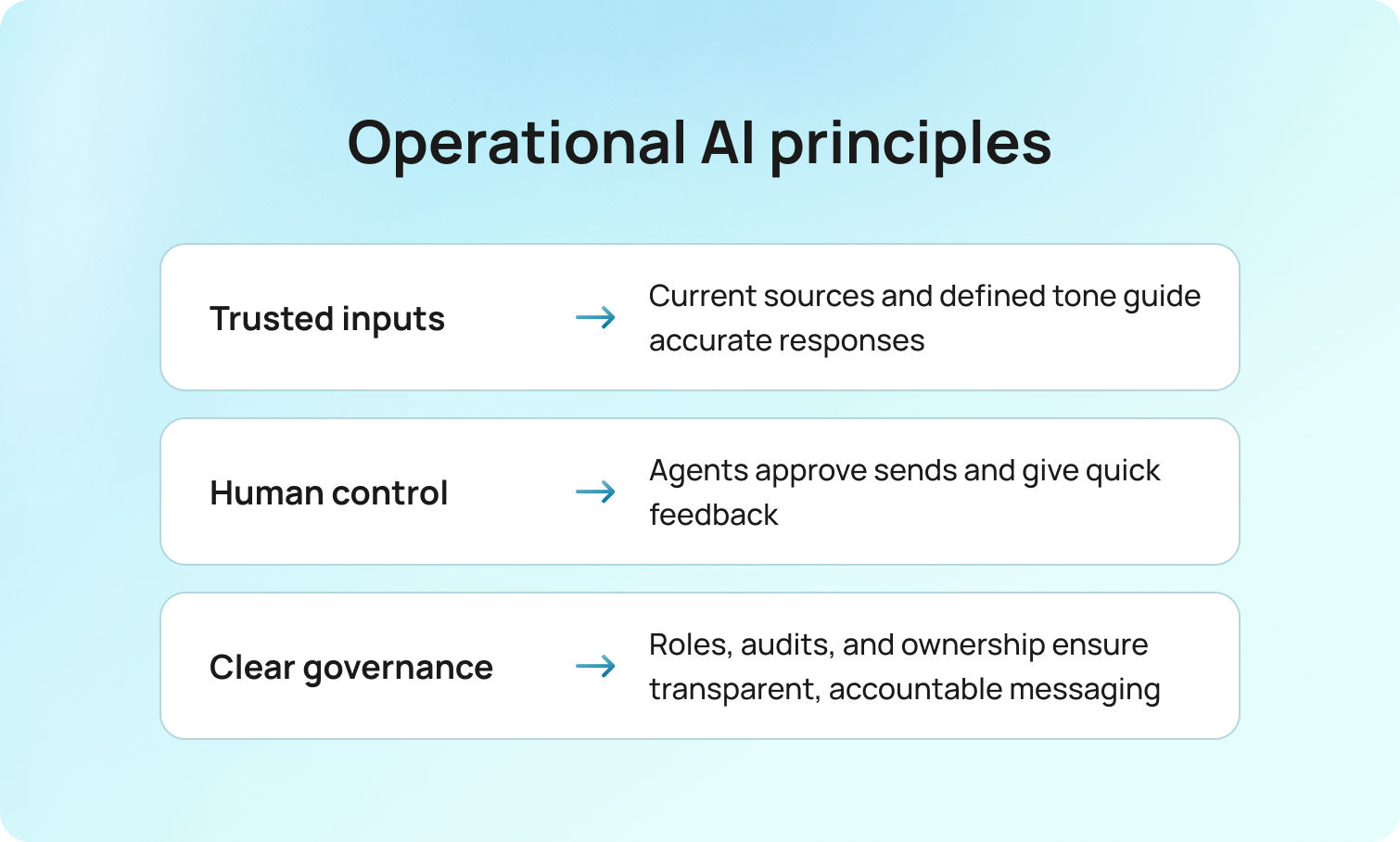
Trust starts with sources. If articles are outdated, the model will echo old guidance. Content quality is the fuel for accurate suggestions. The next ingredient is tone: codify response style so the system can maintain it. Provide examples for apologies, policy denials, and fix-forward messages. Set clear rules for language and clarity, especially in regulated contexts. With those inputs, the model can understand context and keep messages aligned with how the brand speaks.
Human-in-the-loop design remains non-negotiable. Auto-sending might look efficient, but it risks missing nuance. Keep humans in control of the send button, particularly for refunds, escalations, and any transactions that involve sensitive data. Finally, make feedback easy. A one-click rating with a short note is enough to identify gaps and drive improvements without adding friction to the workday.
Governance is part of the story. Role-based access, audit logs, and a straightforward content ownership process keep the system responsible and reviewable. When a leader asks how a message was produced, the team can show sources and edits. That transparency builds confidence within the business and with customers.
Measuring What Matters (Without Drowning in Dashboards)
Four signals tell the story: time to first response, handle time, first-contact resolution, and customer satisfaction. If AI-generated responses are effective, the team engages more quickly, composes responses more efficiently, resolves more issues on the first touch, and experiences a positive trend in feedback. Two program metrics round it out: how often agents use or customize the suggested replies, and content gaps where drafts are marked not helpful because a file or macro is missing.
Leaders do not need twenty charts. They need a short conversation each week about what changed and why. If performance stalls, check the content before tuning prompts. Improvements in knowledge usually move the numbers more than any upstream tweak in modeling.
Use Cases That Consistently Deliver Value
Some situations are made for reply suggestions. Order status is a classic example because clarity beats creativity: confirm what is true, set expectations, and explain the next step. Account and access flows benefit because the system can generate a complete set of verification steps, not just a link. Returns and eligibility messages improve when the draft spells out conditions and what to attach. Warranty troubleshooting proceeds more smoothly when the model recognizes the device, proposes the correct path, and requests the missing detail. For how-to setups, stepwise instructions that avoid jargon help the end user succeed the first time.
In each of these scenarios, the AI response generator provides a strong first draft. Agents still adjust, personalize, and decide, but the heavy lifting is handled. Over time, the team writes less from scratch and more from a grounded starting point, resulting in a predictably clear customer experience.
How BlueTweak Approaches Suggested Reply
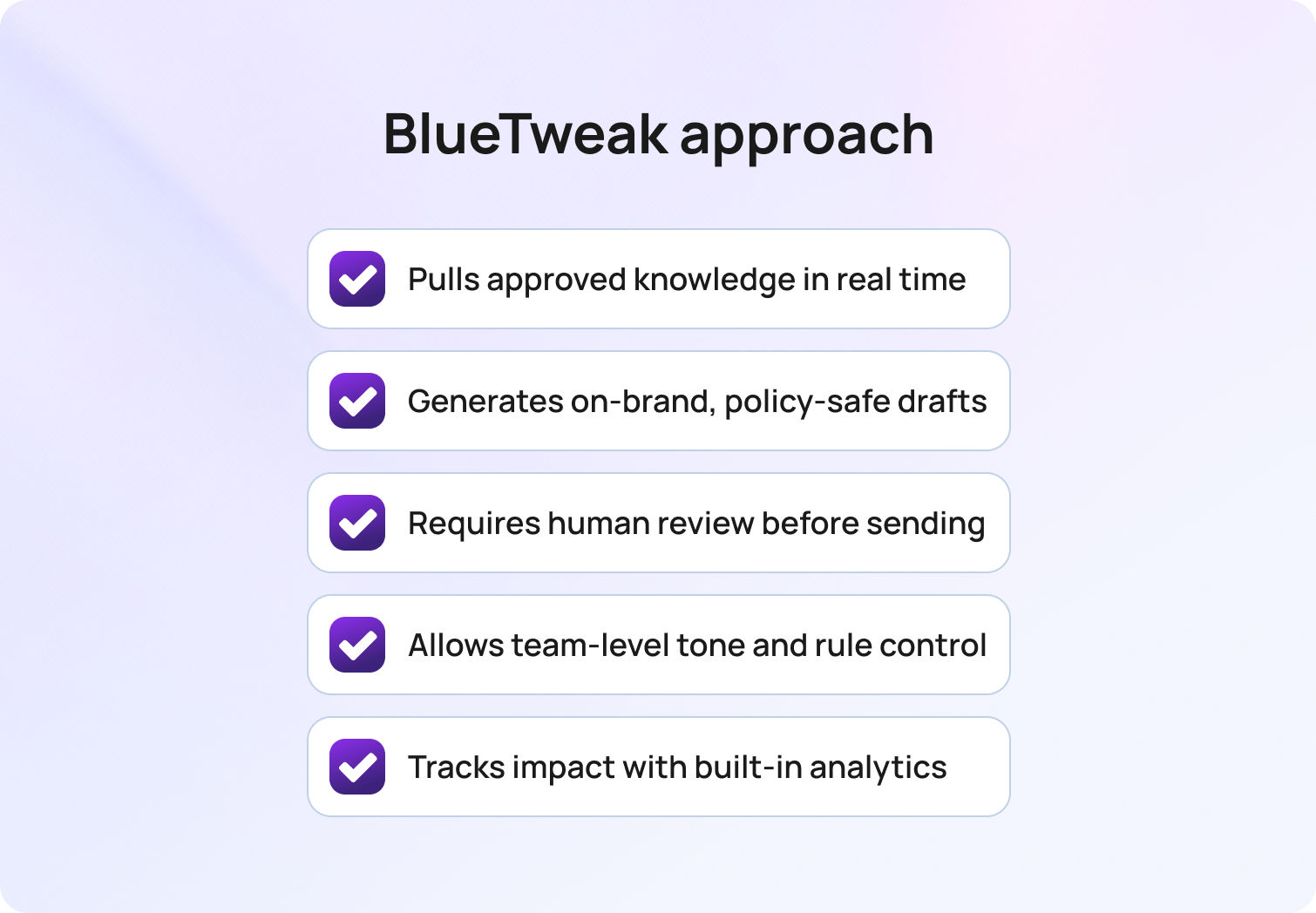
BlueTweak is a unified customer support platform. It brings ticketing, knowledge, analytics, and workforce management into the same space where agents handle customer conversations. Suggested replies live inside that flow. When a customer message arrives, BlueTweak retrieves relevant knowledge and recent resolutions, and the AI response generator composes suggested replies in real-time. Agents can customize the draft, adjust tone, add a note, and send with one click. Nothing is auto-sent. Human review remains the default for sensitive topics.
Two aspects define the approach. First, grounding is built in. Drafts are generated from approved content, so messages stay accurate and consistent with policy. Second, control belongs to the team. Program owners set response style and disclaimers, and decide where suggestions appear. Analytics reveal core outcomes, such as response time and resolution, allowing leaders to see the impact without exporting data across multiple tools.
Because BlueTweak aligns suggested replies with ticketing and workforce management, the process works at the scale of daily operations. When handle time drops, scheduling can adapt. When content gaps appear, owners update articles, and future drafts improve. It is a system designed to maintain quality while moving faster, not a bolt-on widget.
(For governance, BlueTweak supports audit logs and data location options. Organizations can publish data handling details on their Trust Center for buyers who evaluate residency and sub-processors.)
From High-Level Promise to Everyday Practice
Adopting the suggested reply is not a matter of flipping a switch. It is a series of habits. The team agrees on the first set of intents where suggestions are most helpful. Knowledge owners keep articles short, current, and specific. Leaders set expectations for tone and structure. Agents add a sentence of feedback when a draft falls short of the mark. The system gets better as the team uses it. Generative AI provides the speed to save time; the business supplies the judgment.
As the habits take root, something subtle happens. The work feels less chaotic. Agents shift attention from hunting for snippets to solving problems. Conversations are more explicit, even when the topic is complex. The support organization stops spinning on the blank page and starts delivering the right message at the right moment. That is how AI enhances customer support services in a way that customers notice and remember.
Closing The Loop
Suggested replies are a practical way to combine the speed of AI with the care of human service. With good sources, clear tone, and human review, agents produce better answers faster; customers receive helpful, relevant guidance; and leaders see steadier operations. The pattern is simple: ground the message, generate the draft, review and edit, and respond with confidence.
See how it works in BlueTweak. Explore AI-powered suggested replies within a unified workspace, enabling the team to move faster while maintaining quality in every message.
12 Strategies To Improve FCR With AI Ticket Classification (2026)
A Better Starting Point For Every Ticket
At 9:07 a.m., the queue turns red. Support tickets regarding technical issues, billing, stalled shipments, and account access accumulate. Most delays do not stem from complex diagnoses, but rather from support teams ensuring that each AI ticket is directed to the correct department with the relevant context.AI ticket classification
optimizes the quiet part of the day: sorting, routing, and the initial response. When artificial intelligence reads natural language, understands conversation context, and assigns a clear label with the correct priority, the work begins in the right place. That is how FCR rises and customer experience stabilizes.What follows are concrete strategies that support leaders can apply now. They move from principle to practice, with sufficient specificity to implement within a week and enough structure to scale over the course of a year.
How Automatic Ticket Classification Works
Modern systems combine three ingredients. First, data collection: the system ingests the message text, channel, customer tier, product, region, and any attachments.Second,NLP
and deep learning models infer customer intent from natural language, compare it to similar ticket types in history, and predict ticket categories with confidence scores.Third, workflow: business rules map the prediction to queues, SLAs, and macros in the ticketing system.When confidence is high, routes are automatically selected. When confidence is low, ask a human to confirm with one click. Each correction becomes a continuous learning opportunity within the workflow, allowing performance to improve without requiring extensive retraining.Watch how BlueTweak's AI-assisted routing automatically directs tickets to the right queue — with human-in-the-loop controls built right in:
12 Strategies to Improve FCR With AI Ticket Classification
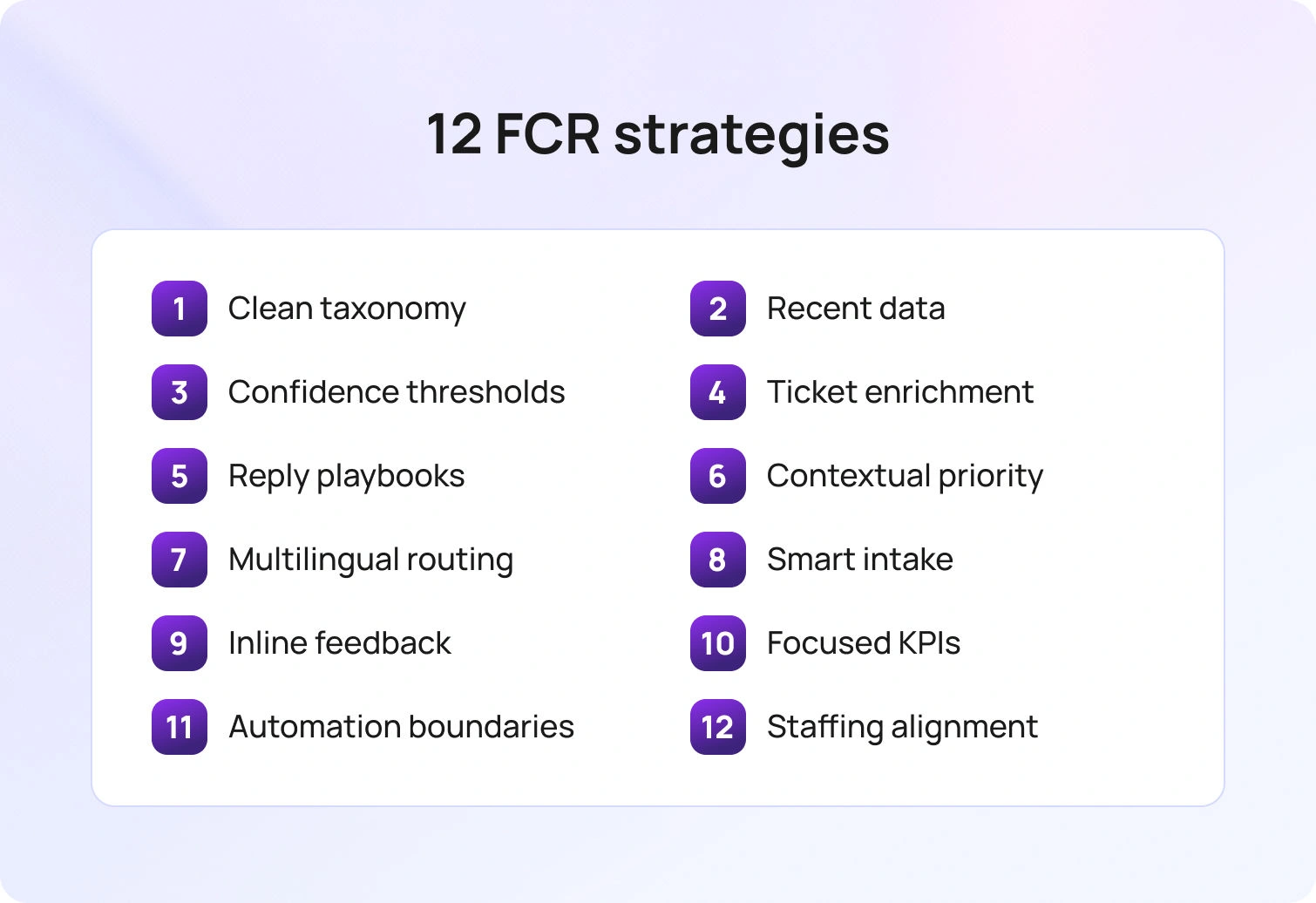
1) Clean the Taxonomy Before You Classify
FCR starts with labels that make sense. Reduce noise by merging duplicate categories, removing obsolete ones, and writing one-sentence definitions that a new agent can follow. Keep predefined categories broad enough to route support tickets
effectively and narrow enough to guide the first reply. Add two simple examples per label to ensure human agents make consistent choices. This foundation ensures that automatic ticket classification is reliable and keeps support tools aligned with your company's actual workflow.
"The biggest FCR gains we see aren't from smarter AI models — they're from teams who finally agree on what a category actually means before they automate anything. A clean taxonomy with clear definitions is worth more than any algorithm tweak."— Radu Dumitrescu, Head of Presale & Digital Transformation, BlueTweakBlueTweak fit
: Categories, owners, and SLAs are managed in the same workspace. When a category definition or routing rule is updated, the linked queues, automations, and macros automatically follow the new configuration, and reporting reflects the change without requiring additional exports.
2) Train on Real, Recent Ticket Data
Great models learn from the business you run today. Build a training set from recent months that includes peak periods, launches, and multiple regions. Include mistakes and edge cases. Tag the proper category, the queue, and the macro used to resolve. The more representative the customer ticket data is, the stronger the AI-powered classification becomes. Plan a monthly refresh to ensure the system keeps pace with new requests and evolving language.Why it lifts FCR
: Better predictions made by artificial intelligence put the ticket in the right team's queue with the context needed for a proper first-contact resolution reply.
3) Use Confidence Thresholds With Human-in-the-Loop
Set two thresholds: auto-route above a high confidence mark; request single-click confirmation in the middle band; fall back to manual if confidence is low. Show the top two predicted categories with reasons the model thinks they fit. This balances speed with control, cutting misroutes without slowing the line.BlueTweak fit:
Predictions appear with confidence scores, and agents can confirm or correct inline. Those confirmations and corrections are captured in the same workspace and can be used to improve future classifications based on your configuration.
4) Enrich Tickets With the Fields a Resolver Needs
Classification is not only a label. Enrich each ticket with the fields the queue uses to act: product, platform, region, entitlement level, device, carrier, error code, or purchase ID. Populate these from the message, CRM, or form. Attach the relevant knowledge base article and the correct macro. Routed with the right details, the first human answers with substance instead of asking for basics.FCR impact:
Fewer ping-pong loops. More one-touch fixes that have a significant impact. Happier customers.Here's how one team put AI-powered ticket classification and enrichment into practice to drive real FCR gains:BlueTweak's AI-Powered Customer Support Transformation for E-Commerce Client
5) Pair Every Category to a First-Reply Playbook
For each label, define the first move: the macro to load, the knowledge article to surface, the checklist to request logs, or the policy excerpt to include. This transforms ticket categorization into the first step of resolution, rather than merely a clerical sorting process. The playbook can branch by sentiment
or tier if needed.Tip:
Keep these playbooks short and use the same phrasing your clients understand. Consistency here builds loyalty.
6) Let Sentiment and Business Context Shape Priority
Add lightweight sentiment and risk signals to priority logic. A negative tone from a high-value customer, safety keywords, or a second contact within 24 hours can prompt a priority shift. Clear success paths can steer it in the right direction. This keeps the line fair and pushes likely escalations into view before they churn.BlueTweak fit:
Priority rules can factor in category, customer tier, and available sentiment signals captured in the case. Agents and owners can review and adjust priority without leaving the case view, based on your configuration.
7) Build Multilingual Classification the Responsible Way
Global support operations perceive the same intent expressed in various ways and languages. With the rise of multilingual customer support
, provide a concise glossary for product names and sensitive terms, seed the model with bilingual examples, and maintain human approval for new markets until confidence is established. Route to teams that respond in the customer's language and surface localized articles.Outcome:
Useful first replies in the correct language without guesswork.
8) Classify at the Edge to Prevent Bad Tickets
Stop garbage in. Use category-aware forms that collect the minimum required fields per label. If the text implies a "password reset," capture the device type and MFA status upfront. If it implies "billing," capture plan, last four digits, or invoice number. Pre-classification at intake makes the downstream process smoother and the first reply faster.BlueTweak fit:
Intake forms can be mapped to categories, and AI can suggest a likely category and populate related fields for agent review. Required fields update based on the selected category, and agents confirm or edit before submission.
9) Close the Loop With Inline Feedback and Micro-Training
Ask agents to give one signal when they change a label: "too broad," "missing option," or "ambiguous wording." That single bit of feedback directs the next edit of the taxonomy. Share a 90-second screen capture that shows the correct choice. Micro-training keeps the entire team on the same page without long sessions.Why it matters:
Clean data sustains the model. The model sustains FCR.
10) Use Small, Stable KPIs To Steer the Program
Track a tight set by category and department. Look for simple causes: a category with high transfers usually needs a more precise definition or a different owner queue. Fix the workflow, not the dashboard.
11) Draw the Line Where Automation Stops
Some topics are automation-adjacent, not automation-owned. Keep human agents on refunds above a threshold, identity checks, legal complaints, and safety issues. Teach the model to flag and fast-route these with clean context. Responsible boundaries preserve trust while everything else speeds up.
12) Tie Classification To Staffing So Wins Persist
When routing improves, workload shifts by label and queue. Feed category volume and handle time into your staffing plan so that the management layer can allocate people to where wins are expected. FCR gains last when the right people pick up the right work.BlueTweak fit:
Workforce management sits alongside classification and analytics in the same company workspace, allowing leaders to rebalance coverage and schedules without relying on spreadsheets for routine adjustments.
KPIs To Steer the Program
| KPI | What It Measures | Type |
|---|---|---|
| Time to first reply | Speed of initial response after ticket opens | Outcome |
| Transfer rate | How often tickets move between queues | Outcome |
| FCR | Tickets resolved without a follow-up contact | Outcome |
| Reopen rate | Tickets reopened after closure | Outcome |
| CSAT | Customer satisfaction scores | Outcome |
| Auto-route percentage | Share of tickets routed without human input | Program signal |
| Label correction rate | How often agents change AI-assigned labels | Program signal |
| Macro use rate | How often suggested macros are applied | Program signal |
Key signals surface in the same workspace where agents and managers work, so owners can adjust labels and routing rules in place (no export required for routine changes).
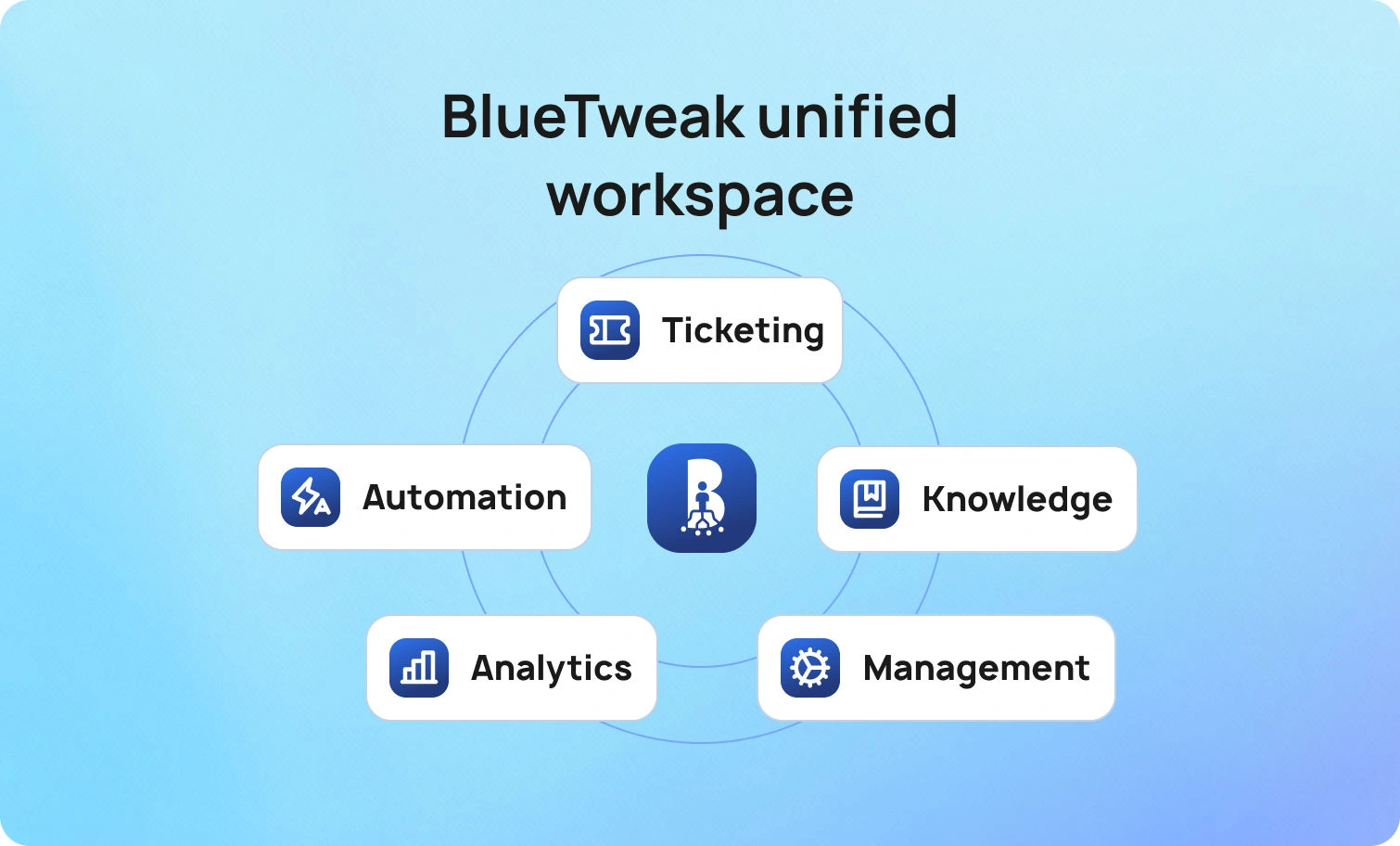
Where BlueTweak Fits
BlueTweak integrates ticketing systems,knowledge bases workflow automation analytics
, and workforce management
into a single workspace. It supports voice
, email,chat
, SMS, and social messaging in one unified queue, ensuring every conversation follows the same rules, SLAs, and reporting standards. AI ticket classification runs at intake. Predictions include a confidence indicator and a brief explanation of key factors; high-confidence cases can auto-route to the right team, apply the configured SLA and macro, and surface the matching article.Lower-confidence cases present the top options for one-click human confirmation. Agent corrections are captured in place and used to refine labels, rules, and models over time. Managers can view adoption rates, transfer rates, and first-contact outcomes by ticket category, as well as sentiment trends by queue. Schedulers adjust staffing as volume shifts, all within the same screen.
What Good Looks Like
Consider three ticket types. A purchase was not completed, an account cannot sign in, and a package is stuck. The model labels Payments: Charge Failure, Access: Password Reset, and Logistics: In-Transit Delay. It fills the marketplace, device, or carrier, requests the right artifact, and loads the playbook. Payments replies with a verification checklist and the correct next step. Access includes MFA guidance tailored to the device. Logistics explains the scan and sets the next checkpoint. Each route starts usefully, which shortens the path to resolution. The agent ensures that the customer gets an answer that actually helps on the first touch. Happier customers, calmer support.
Data Quality, Ethics, and Guardrails
Limit models to allowed sources, keep audit logs enabled, and adhere to regional data rules. Show confidence and explain so that people understand why a label was chosen. Keep nothing free-floating outside governance. Make opt-out and access requests easy to honor. Doing the basics well keeps trust intact while you gain speed.
Cost, Scale, and Practical ROI
The money is reflected in the minutes saved. Auto-sorting removes manual triage at the front; intelligent routing removes rework at the back. Clean labels improve forecasting and planning. When the first responder sees the proper context, an honest answer replaces the need for a second round of questions. Those minutes accumulate over thousands of tickets, reducing the workload and resulting in fewer escalations, callbacks, and late SLAs. The end state is higher FCR, shorter response times, and steadier customer satisfaction without adding headcount.
Getting Started
Select five high-volume labels where misroutes are frequently encountered. Define the labels and owners, write a one-sentence definition and two examples for each, and seed a small training set from recent tickets. Turn on classification for one channel. Review a daily sample for two weeks and correct in place. Adjust thresholds and playbooks where patterns appear. Add languages and labels only after the first set stabilizes. Create, observe, adjust, expand. It is a simple workflow that works.
BlueTweak, Day to Day
In BlueTweak, incoming tickets are classified as they arrive. The correct team receives the case with key fields prefilled, a suggested macro, and links to the relevant knowledge article. Agents confirm or correct the label in one click, respond with substance, and move on. Leaders view a compact dashboard of categories, queues, and outcomes, then make the single change that moves the number, without needing to export to separate tools. Faster beginnings, better endings.
Conclusion: Faster Beginnings, Better Endings
AI ticket classification does not replace care. It removes the drag at the start, allowing human agents to focus on solving complex problems. When an AI-powered system reads natural language,routes to the right team
, and supplies the proper context and playbook, first replies get useful, transfers fade, and queues calm down. That is how support operations achieve higher FCR, shorter response times, and lasting improvements in customer satisfaction.See BlueTweak in action
. Request a walkthrough to watch classification, intelligent routing, and knowledge work together from first contact to resolution.
FAQ
| Question | Answer |
|---|---|
| What is AI ticket classification? | AI ticket classification uses models to read incoming tickets, understand natural language, and automatically apply the right category, priority, and route, replacing manual sorting, so work starts faster. BlueTweak embeds this directly in the ticketing flow, proposing labels with confidence and sending items to the correct queue with relevant context. |
| How does it improve first-contact resolution and customer satisfaction? | Accurate labels and enriched fields mean the first responder starts with what they need, reducing transfers and confusion. Clear starts lead to higher FCR and smoother experiences; BlueTweak reinforces this with playbook triggers, macros, and knowledge suggestions at the moment of triage. |
| How does BlueTweak handle classification? | BlueTweak classifies inside the ticketing system, proposes labels with a confidence score, applies queues, SLAs, and macros, attaches relevant knowledge, and learns from agent corrections, so teams stay in control while the system handles sorting and routing at scale. |
| What data is needed to train effectively? | High-quality, labeled tickets from real channels, coverage of top issue types, and the languages you support. Keep the taxonomy aligned with current processes and capture inline agent corrections as training signals; BlueTweak automatically records these signals to improve over time. |
| How should success be measured? | Track time to first reply, transfer rate, FCR, reopen rate, and CSAT, along with program metrics like auto-route percentage and label-correction rate. Use these to refine taxonomy, routing rules, and playbooks; BlueTweak dashboards tie these outcomes back to queues, intents, and languages for targeted tuning. |
FAQ
How to Build an AI Customer Support Knowledge Base That Scales
From Knowledge-Base Chaos to Measurable Deflection
Support teams create knowledge bases to reduce ticket volume and enable self-service; yet, six months later, the same common customer questions often flood the queue. Agents struggle to surface the correct answers and articles, and customers abandon self-service after two unsuccessful searches.
Execution is the blocker. Teams stall due to content sprawl, characterized by hundreds of loosely categorized articles, multilingual overhead that translates everything rather than prioritizing high-impact material, and a weak feedback loop between articles and resolution outcomes.
This guide outlines an intent-driven information architecture, standardized article templates, governance workflows that prevent drift, and metrics that prove continuous improvement in cost reduction and better customer experiences. It also illustrates where BlueTweak) fits within this framework and how the model is applied across platforms.
What Is an AI-Ready Customer Support Knowledge Base?
An AI customer support knowledge base is a structured library of help articles, troubleshooting guides, and support documentation that serves both customers (as an effective self-service knowledge base) and support agents (as an internal reference). AI-ready knowledge bases are machine-readable, ensuring a positive experience for both customers and support agents. That means they’re formatted so AI chatbots and voicebots can retrieve canonical answers to save time, present them conversationally, and escalate with context when human support is needed.
Two core libraries:
- External (customer-facing): Published self-service content accessible via help center, chatbot, or search engines. Reduces ticket volume by enabling customers to resolve issues independently.
- Internal (agent-facing): Troubleshooting tips, escalation procedures, and compliance notes not suitable for public access. Speeds up training time for new agents and ensures consistency across customer support teams.
Global support operations require knowledge management for customer support in over 10 languages. The choice isn't whether to localize, it's which content to prioritize and how to validate translations.
BlueTweak provides an internal knowledge base and a customer-facing help center. The AI chatbot uses KB content with guardrails to reduce hallucinations. Multilingual support is available across chat, email, and voice, and the chatbot can respond in the customer’s preferred language. During ticket resolution, agents surface KB articles in the workspace, and suggested replies for email draw from KB content to maintain consistency.
Technology Overview: From Static FAQs to AI-Ready Knowledge Base Software (2015→2026)
Customer service teams transitioned from static FAQ pages and ad-hoc macros stored in spreadsheets to structured, machine-readable customer support knowledge management systems that serve both customers and agents across channels. Rising volumes in email, chat, and social media (plus multilingual expansion) forced teams to tie knowledge directly to resolution metrics (containment, FCR, AHT) rather than vanity metrics like page views.
That’s because previous methods weren’t working:
- Older stacks couldn't connect "article viewed" to "issue resolved."
- Free-form articles without standardized templates, duplicate content across brands and languages, and siloed internal/external libraries resulted in inconsistent answers and cumbersome escalations.
- Support agents toggled between the help center, shared Google Docs of unofficial fixes, and Slack channels to find answers.
- Chatbots couldn't parse these inconsistencies, leading to escalations where customers had to repeat their issues to agents who lacked context.
Today's platforms prioritize clear information architecture, standardized article templates, and KB grounding for chat and voice automation to meet customer expectations. Analytics connect article usage to SLA/FCR outcomes, enhancing the overall customer experience while supporting multilingual segmentation.
The Scalable Framework: Plan → Build → Govern → Grow
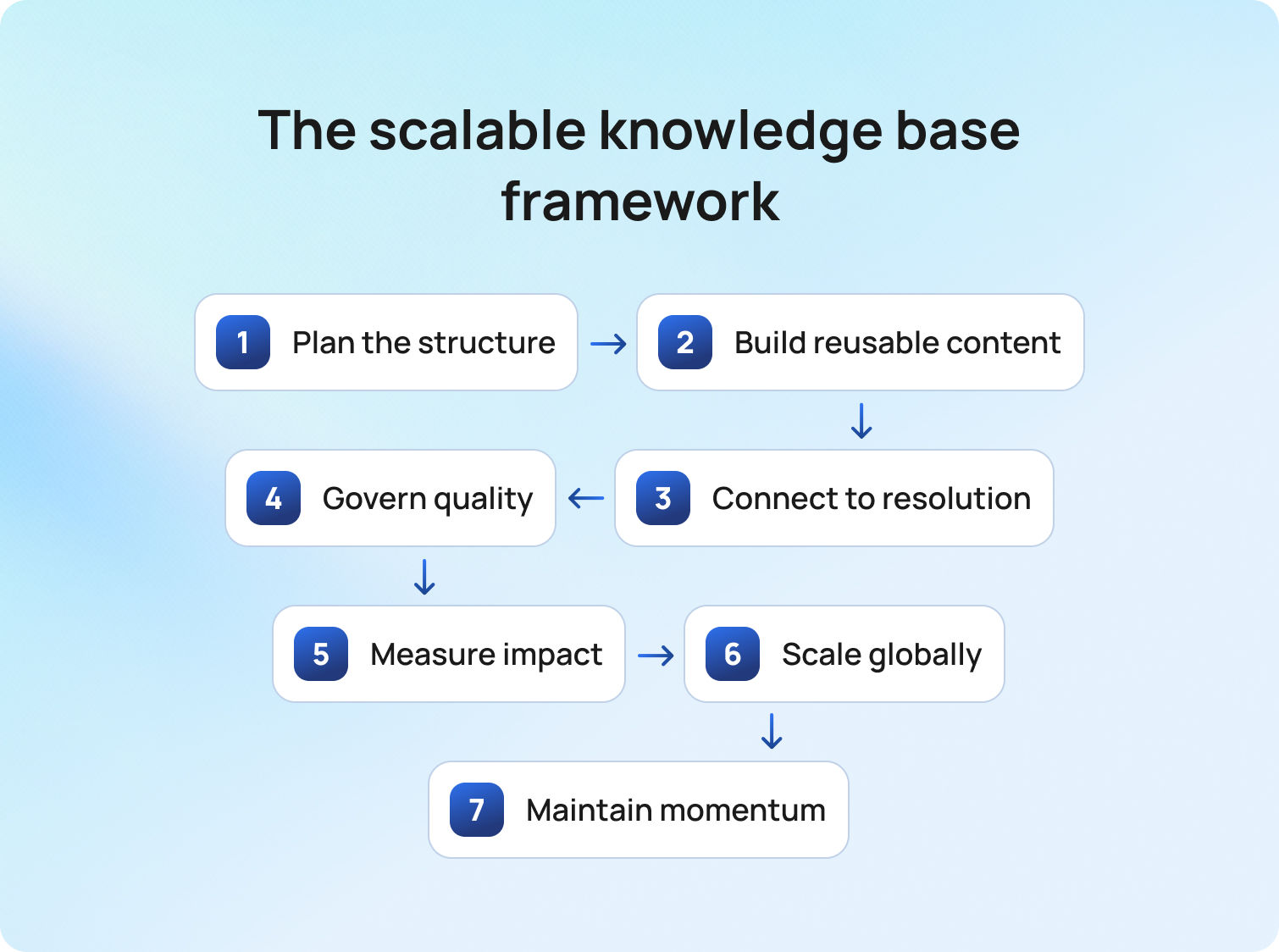
Building a customer support knowledge base that scales requires seven stages:
- Plan
- Build
- Connect
- Govern
- Measure
- Localize
- Maintain
1. Plan: Information Architecture & Sources of Truth
Before writing a single article, map your top customer intents and ticket drivers. Pull six months of ticket data from your ticketing system, group by topic (e.g., "password reset," "order tracking," "refund policy"), and rank by volume × handle time.
This indicates that 20% of issues account for 80% of costs. These are your highest-impact knowledge base articles.
Define categories and article types:
- How-to: Step-by-step instructions for completing a task (e.g., "How to update billing information").
- FAQ: Single-question answers for policy or feature clarifications (e.g., "What is your return window?").
- Troubleshooting: Diagnostic flows for error messages or unexpected behavior (e.g., "Why is my payment failing?").
Tag every article with product, version, brand (for multi-brand customer service operations), and locale. This enables filtered search ("Show me articles for Product A, English, Brand X") and prevents outdated guidance from surfacing.
Customer profiles in BlueTweak surface cross-channel interaction history and provide a unified customer view, helping reveal recurring issues and patterns. Multilingual support spans all major channels, and combined with analytics, helps prioritize which languages to roll out next.
2. Build: Standardized Articles That Bots & Humans Can Use
Inconsistent formatting breaks AI retrieval and frustrates agents. Use a standardized article template for every piece of content:
- Title: Action-oriented, includes primary keyword (e.g., "Reset Your Password in 3 Steps").
- Summary: A one-sentence overview that the chatbot can present as a standalone answer.
- Preconditions: What the customer needs to have in place before starting (e.g., "You must have access to your registered email").
- Steps: Numbered, concrete actions with one intent per step.
- Expected Result: What success looks like (e.g., "You will receive a confirmation email within 5 minutes").
- Exceptions: Edge cases or error states (e.g., "If you don't receive the email, check your spam folder").
- Related Articles: Links to next-step content (e.g., "How to Update Your Email Address").
AI chatbots retrieve answers by matching customer queries to article snippets. Use clear, canonical steps ("Click Settings → Account → Change Password") rather than prose ("Navigate to your account settings and look for the password option"). This ensures the AI chatbot can extract the correct answer and present it in a conversational manner.
BlueTweak’s knowledge base offers article authoring and hosting, complete with approval, hierarchy, and version management. Canned responses and email Suggested Replies leverage KB content to reduce inconsistency. Because Suggested Replies pull from the KB, updated articles can inform future suggestions without manual rework.
3. Connect: From Knowledge to Resolution
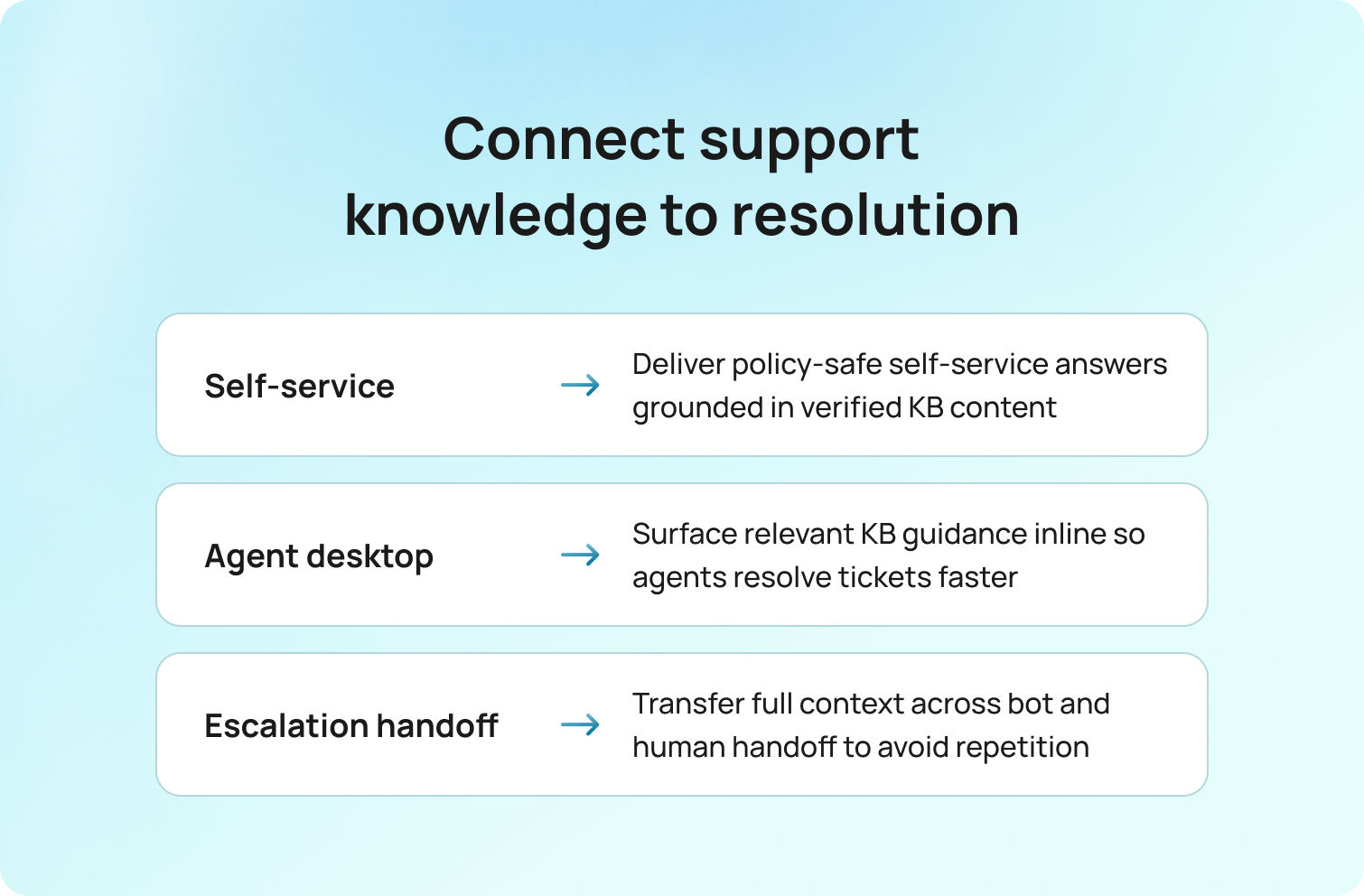
A knowledge base that isn't wired into support workflows won't reduce ticket volume. Connect your KB to three touchpoints:
- Self-service (AI Chatbot): Ground your AI chatbot in KB content so it retrieves answers rather than generating responses from a generic language model. This prevents hallucinations and ensures the chatbot reflects your policies. Customers access self-service options via your website, mobile app, or messaging channels (WhatsApp, Facebook Messenger).
- Agent desktop: Expose KB articles inline during ticket resolution. Agents should see suggested articles based on ticket content (keywords, category, customer history) without leaving the ticketing interface. This reduces time spent searching and ensures agents reference official guidance rather than improvising.
- Escalation handoff: When a chatbot escalates to a human agent, pass the full transcript, KB articles already presented, and customer context (customer profile with interaction history). This prevents customers from repeating their issue and provides agents with immediate context to resolve the ticket more efficiently.
BlueTweak's AI chatbot leverages a knowledge base with guardrails to minimize hallucinations and deliver consistent answers. When a conversation escalates, the handoff to ticketing includes the chat transcript and can include the knowledge articles referenced. With call transcription enabled, voice escalations carry full context, allowing phone agents to view prior steps taken in chat.
4. Govern: Quality, Ownership, and Lifecycle
Without governance, knowledge bases decay. Articles drift out of date, duplicates multiply, and terminology diverges across teams and languages. Establish clear ownership and review workflows:
- Assign content owners: Every article requires a named owner (product manager, senior agent, or ops lead) responsible for ensuring accuracy. Owners triage feedback, approve edits, and trigger reviews when products change.
- Set review cadences: High-impact articles (those in the top 20% by usage) should be reviewed quarterly. Low-traffic articles can be reviewed annually or triggered by events (product launch, policy change, spike in related tickets).
- Capture feedback: Add "Was this helpful?" to every customer-facing article. Collect qualitative feedback ("What was missing?") and route it to content owners. Triage suggestions weekly: quick fixes (typos, broken links) get published immediately; structural rewrites go into the backlog.
- Deduplicate and retire: Audit for duplicate articles covering the same intent. Consolidate into one canonical article, redirect the old URLs, and update canned responses to reference the new version. Retire outdated articles (deprecated features, expired promotions) to prevent agents from surfacing stale guidance.
Quality assurance capabilities in BlueTweak support review and coaching workflows. Analytics monitor article usage and outcomes (deflection rate, FCR by article). Administration tools provide roles/permissions (draft, publish, archive) and audit logs tracking who edited what and when, ensuring safe governance at scale.
Risks of Poor Governance
When knowledge bases aren't maintained, content drifts out of date, duplicates multiply, and terminology diverges across teams and languages. Agents lose confidence in the knowledge base, often bypassing it entirely in favor of Slack channels or relying on tribal knowledge.
Escalations become clumsy: customers repeat their issue because agents lack context. Self-serve options fail, and that ultimately drives higher ticket volume, longer handle times, and avoidable reopens.
In regulated contexts (finance, healthcare, insurance), stale guidance creates policy and compliance risk. Outdated refund policies, incorrect data retention timelines, or deprecated security procedures expose the organization to audits and customer disputes.
A light, user-friendly, and consistent governance cadence (content owners, quarterly reviews, and systematic retirements) prevents this spiral and keeps the customer support knowledge base a trusted source of truth.
5. Measure: Metrics That Prove Scale
Vanity metrics (such as page views and total articles published) don't prove that the knowledge base reduces costs. Track metrics tied to resolution outcomes:
- Deflection/containment: Percentage of chatbot interactions resolved without agent involvement. Target: 60–80% for high-volume intents.
- Time to first helpful answer: How long does it take customers to find a relevant article via search or chatbot? Faster = better UX.
- Assisted handle time (AHT): Average time agents spend resolving tickets when KB articles are used vs not used. A well-connected KB should reduce AHT by 20–30%.
- First contact resolution (FCR): Percentage of tickets resolved on first interaction. KB-assisted tickets should have a higher FCR than tickets where agents improvise.
- Customer satisfaction (CSAT/NPS): Survey customers after self-service interactions and agent-assisted resolutions. Compare scores for KB-assisted vs non-assisted interactions.
- Search-to-click and dead-end queries: Track how often customers search but don't click on an article (poor relevance) or click but bounce immediately (the article didn't help). These signal content gaps or quality issues.
Segment all metrics by brand and language to identify where your multilingual rollout is succeeding or stalling, thereby enhancing customer relationships.
BlueTweak's customer service analytics deliver real-time or near-real-time dashboards and historical reports for deflection, FCR, AHT, and satisfaction, with breakdowns by channel, language, and team, plus article-level insights when the knowledge base is connected. Workforce management tools support forecasting and intraday reallocation as deflection improves, and reporting can estimate cost impact from reduced ticket volume.
H4: Gap Analysis Method Best Practices
Identify missing or weak content by triangulating signals from multiple sources:
- Failed/low-confidence chatbot answers: Review interactions where the chatbot couldn't provide a confident answer or escalated immediately. Cluster by intent.
- "No results" search queries: Track customer searches in your help center that returned zero results or low-relevance results. These reveal terminology mismatches or missing topics.
- Recurring ticket topics/transfer reasons: Pull ticket data by category and transfer reason ("escalated to billing," "product question," "technical issue"). High-volume topics without corresponding KB articles are gaps.
- Reopen notes: Review support tickets that have reopened within the last 72 hours. If agents cite "customer tried article X but it didn't work," the article needs revision.
- Prioritize by volume and business impact: A missing article about a billing error affecting 500 customers/month matters more than a niche feature question affecting 5 customers/month.
- Create or consolidate: Use a standardized article template to write new content or merge duplicates. Re-publish, link canned responses and macros to the new articles, and re-measure containment, FCR, and search success to confirm the gap is closed.
6. Localize: Multilingual Knowledge Management Without Chaos
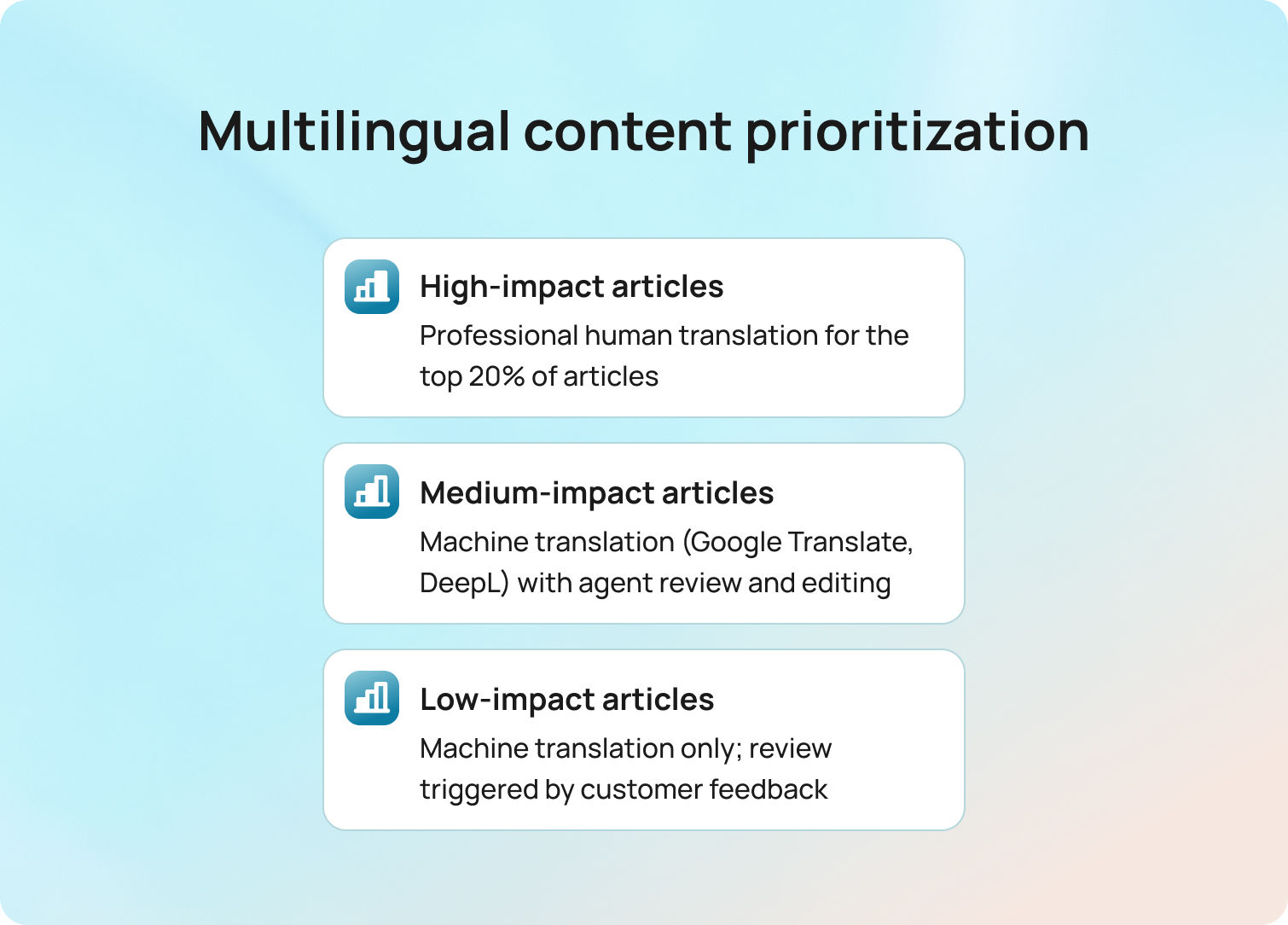
Global support teams require multilingual customer support; however, translating all 500 articles into 15 languages upfront creates bottlenecks. Prioritize systematically:
Start with languages driving the highest ticket volume (Spanish, French, German) rather than niche languages with low ticket counts.
Define translation workflow:
- High-impact articles: Professional human translation for the top 20% of articles (high-volume intents, compliance-driven content).
- Medium-impact articles: Machine translation (Google Translate, DeepL) with agent review and editing.
- Low-impact articles: Machine translation only; review triggered by customer feedback.
Not everything needs translation. Localize article bodies, UI terms, and compliance notes (GDPR language, regional return company policies). Leave product names, version numbers, and technical error codes in English to maintain consistency.
Even machine-translated content should be reviewed by native speakers (agents in that language) to catch terminology errors, cultural mismatches, or awkward phrasing.
BlueTweak offers multilingual support across various channels, including chat, email, SMS, voice, and social media. The AI chatbot uses knowledge base content to deliver context-aware answers in the customer’s language. For live agent interactions, on-the-fly translation is available across both text and voice, allowing conversations to continue in the customer’s preferred language without requiring a switch in tools.
7. Maintain: The 30-Day and 90-Day Routines
Knowledge bases decay without regular maintenance. Establish predictable routines:
30-day routine (tactical):
- Fix top feedback items flagged as "not helpful" by customers.
- Publish missing "how-to" articles for new product features launched in the past month.
- Update canned responses to reference new KB articles.
- Review and triage new ticket categories that spiked in volume.
90-day routine (strategic):
- Audit the top 20 articles by usage: are they still accurate? Do screenshots reflect the current UI?
- Retire duplicates identified through search analytics or agent feedback.
- Refresh visuals (screenshots, diagrams) for articles with high bounce rates.
- Remap intents to new product realities (e.g., a feature has been deprecated; consolidate related articles).
- Review multilingual performance: which languages have the lowest deflection? Prioritize content gaps in those locales.
Tooling Requirements (What to Look For)
To execute this framework, your platform needs:
- Knowledge base (internal + external): Separate libraries for customer-facing and agent-facing content, with version control and content staging.
- AI chatbot grounded on your KB: Retrieves answers from articles rather than generating responses from generic models; prevents hallucinations.
- Ticketing integration: KB articles are surfaced inline during ticket resolution; escalation handoffs include the transcript and articles that have already been presented.
- Analytics (real-time + custom): Track deflection, FCR, AHT, satisfaction by article, language, and channel; export to BI tools for deeper analysis.
- Multilingual support: Real-time translation across chat, email, and voice; chatbot delivers answers in the customer's language from KB content.
- Roles/permissions: Control who can draft, publish, and archive articles, with separate permissions for internal and external libraries.
- Audit logs: Track who edited what and when; essential for governance and compliance.
- Data-location options: EU data residency for GDPR compliance; on-prem options for regulated industries.
- Open APIs/integrations: Connect KB to CRM, BI tools, and custom workflows.
BlueTweak provides all of this (and more) in one unified platform. You get all capabilities available in one customer service solution. Knowledge base with AI chatbot grounding, ticketing integration, analytics, multilingual support, administration tools (roles, audit logs), and open APIs. No vendor sprawl, no feature gating, just transparent pricing at €65/agent/month.
Conclusion
Scalable customer support knowledge management is a workflow: publish fast, govern continuously, and connect knowledge to automation so answers become resolutions. The framework prevents content sprawl, multilingual chaos, and weak feedback loops. It empowers customers and your online community with up-to-date, on-demand support.
Schedule a 30-minute demo to see BlueTweak in action and learn how one platform delivers KB-grounded AI automation, multilingual support, and analytics proving your knowledge base reduces ticket volume.
FAQ For Customer Support Knowledge Bases
10 Best AI Voicebot Software Solutions for Customer Support
Selecting an AI Voicebot for Real-World Support Operations
Modern customers expect instant support and instant answers without IVR wait times or repeated explanations. AI voicebots meet that demand by replacing rigid press-1 trees with natural conversations that resolve inquiries end-to-end or escalate smoothly to human agents, resulting in happier customers.
This guide evaluates leading AI Voicebot platforms for customer support teams with 20 to 100 agents or more. The comparison covers multilingual depth, knowledge grounding, handoff experience, analytics, security, and total cost to operate to help identify software that reduces handle time while improving customer satisfaction.
What Is an AI Voicebot (for Support): A 2026 Snapshot
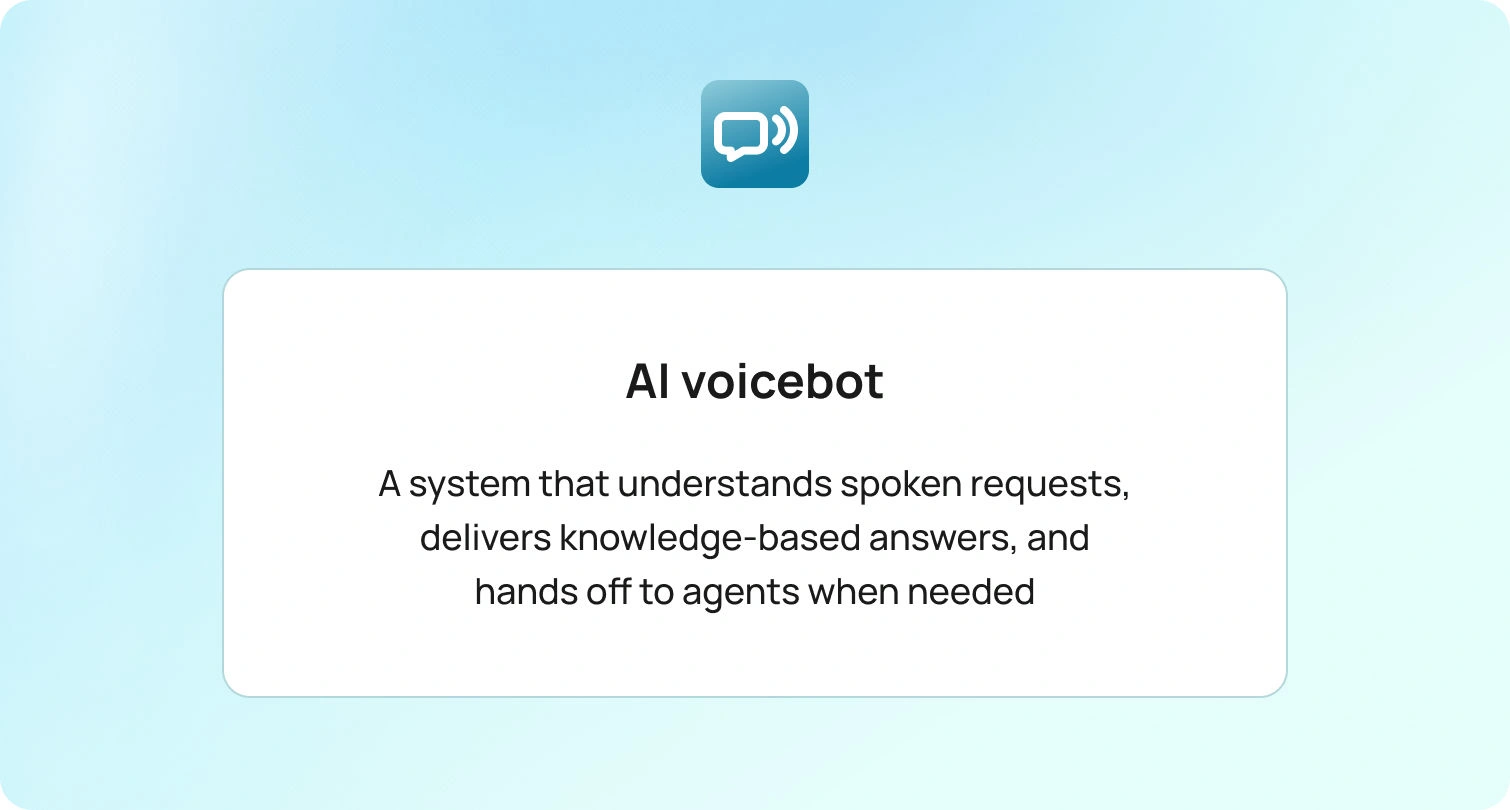
An AI voicebot converts speech to text, detects intent using natural language understanding, retrieves knowledge-grounded responses, and delivers answers via text-to-speech. AI voicebots recognize spoken requests, engage in multi-turn conversations, and execute actions such as booking appointments or checking order status.
When issues exceed the bot's scope, it transfers context and conversation history to live agents for an appropriate response and smooth resolution.
Technology Overview: From IVR Trees to AI Voicebots and Natural Language Processing (2016→2026)
Teams transitioned from menu-based IVR and scripted call flows to AI-assisted voice, featuring speech-to-text, language understanding, knowledge-grounded answers, and natural turn-taking. Higher call volumes, the need to support more languages and brands, and the requirement to reduce transfers and handle calls efficiently without compromising the customer experience drove this shift.
Older stacks utilized press-1 menus, brittle rules, separate translation layers, and siloed reporting, which led to repeated explanations, slow escalations, and inconsistent terminology, lacking an understanding of human speech.
For buyers, this evolution means prioritizing voice quality and latency, multilingual coverage, knowledge base grounding with guardrails, and clean transfer design (agent handoff with transcript and context). Double-check analytics tie interactions to staffing and quality assurance, and confirm security and data controls, including multi-factor authentication, roles and permissions, audit logs, SSL, and data-location options.
This guide's must-have capability checklist and scoring rubric reflect these priorities, focusing on software that enhances agent productivity, the experience, and reduces operational load.
How We Evaluated Each AI Voicebot Platform
- Features: Checked against the must-have checklist below using public documentation and demos.
- Who uses it: From public logos and case studies.
- Pricing: From public pricing pages.
- Pros/cons: Evidence-based strengths and gaps tied to the checklist and rubric criteria; no marketing superlatives.
Must-Have Capability Checklist
- Multilingual AI voice bots: Instant language switching across channels, with auto-detection, knowledge-base-grounded answers, consistent terminology, seamless handoff to agents with full context.
- Knowledge-base answers: Can draw from your knowledge base and self-service content for consistent service and customer conversations.
- Handoff to human agents: Seamless escalation into a unified ticketing system with conversation history and customer profile context; call transcription available.
- Workforce management and quality assurance: Both are native features (scheduling/monitoring and quality scoring/coaching).
- Analytics and dashboards: Real-time KPIs (SLA, CSAT, FCR, AHT) with drill-down by agent, channel, or topic; role-based access.
- Security and data controls: Multi-factor authentication, audit logs, SSL, and data-residency options (ISO certification in progress).
- Integrations: First-party APIs and connectors for CRM, commerce (including Shopify), and telephony.
- Pricing clarity: Single, bundled per-seat price.
Scoring Rubric
- Fit for 20–100 agents
- Channel coverage and handoff experience
- Multilingual depth
- Knowledge grounding and guardrails
- Response quality
- Analytics depth
- Time to value
- Total cost to operate
- Security and data controls
10 Best AI Voicebot Software Solutions
1. BlueTweak – Editor's Choice

BlueTweak is an AI-native omnichannel platform designed for contact centers that require everything in one subscription. The AI voicebot goes beyond IVR: it delivers conversational routing with LLM intent recognition, dynamic, on-brand responses in the caller’s language, and seamless agent handoff. It can resolve issues end-to-end from the knowledge base or escalate with full context. If a classic IVR is preferred, the voicebot can run alongside (or behind) the existing IVR, allowing for a seamless switch at the desired pace. The voicebot pulls answers from your internal knowledge base, automatically responds in the caller's language, and resolves issues end-to-end or escalates with full context.
BlueTweak bundles call transcription, AI ticket summaries, suggested replies, native workforce management (forecasting, shift planning, real-time monitoring), quality assurance (scoring, coaching), and analytics (live SLA, CSAT, NPS, FCR, AHT by agent/channel/topic).
No separate vendor for voice, no bolt-on WFM tool, no per-resolution AI fees.
It's a comprehensive customer service solution that handles email, chat, SMS, WhatsApp, Facebook Messenger, and phone in one unified inbox, complete with customer profiles and administrative controls.
Who Uses It: BPO providers and internal CX teams (20–100+ agents) across e-commerce, travel, finance, and aero.
Key Features:
- AI voicebot & chatbot: Multilingual, KB-grounded conversations with seamless agent handoff
- Copilot assist: Call transcription, ticket summaries, suggested replies in under 10 seconds
- Omnichannel inbox: Email, chat, voice, SMS, WhatsApp, Facebook Messenger unified
- WFM is native; QA tools available: Forecasting, real-time dashboards, shift planning, scoring, feedback loops
- Multilingual AI: Translation across all channels (voice + text)
- Analytics: Live SLA, CSAT, NPS, FCR, AHT by agent/channel/topic; custom reports
- Security: Role-based permissions, MFA, audit logs, data-location options (cloud or on-prem)
- Integrations: Unlimited API access; pre-built connectors for major platforms
- Knowledge base: Self-service portal + agent assist; embeddings + LLM for accurate answers
- Customer support automation: Intelligent routing, auto-classification, sentiment analysis
Pricing:
- €65/agent/month all-in (ticketing, omnichannel, AI features, WFM, QA, analytics, integrations)
- Transparent tier-based pricing
Pros:
- Only platform bundling agentic AI (chatbot + voicebot), copilot tools, native WFM/QA, and full omnichannel
- No feature gating; transparent tier-based pricing
- Fast time-to-value (weeks, not months); onboarding support from the BlueTweak team
- Multilingual across voice and text with KB-grounding to reduce hallucinations
- Built for BPOs: multi-tenant, multi-brand configuration in one instance
Cons:
- Newer brand compared to legacy vendors
- AI usage scales with volume; per-interaction pricing available
Request a demo to see how BlueTweak's unified AI voicebot handles deflection, agent copilot workflows, and real-time workforce analytics.
2. Google Dialogflow CX + Contact Center AI
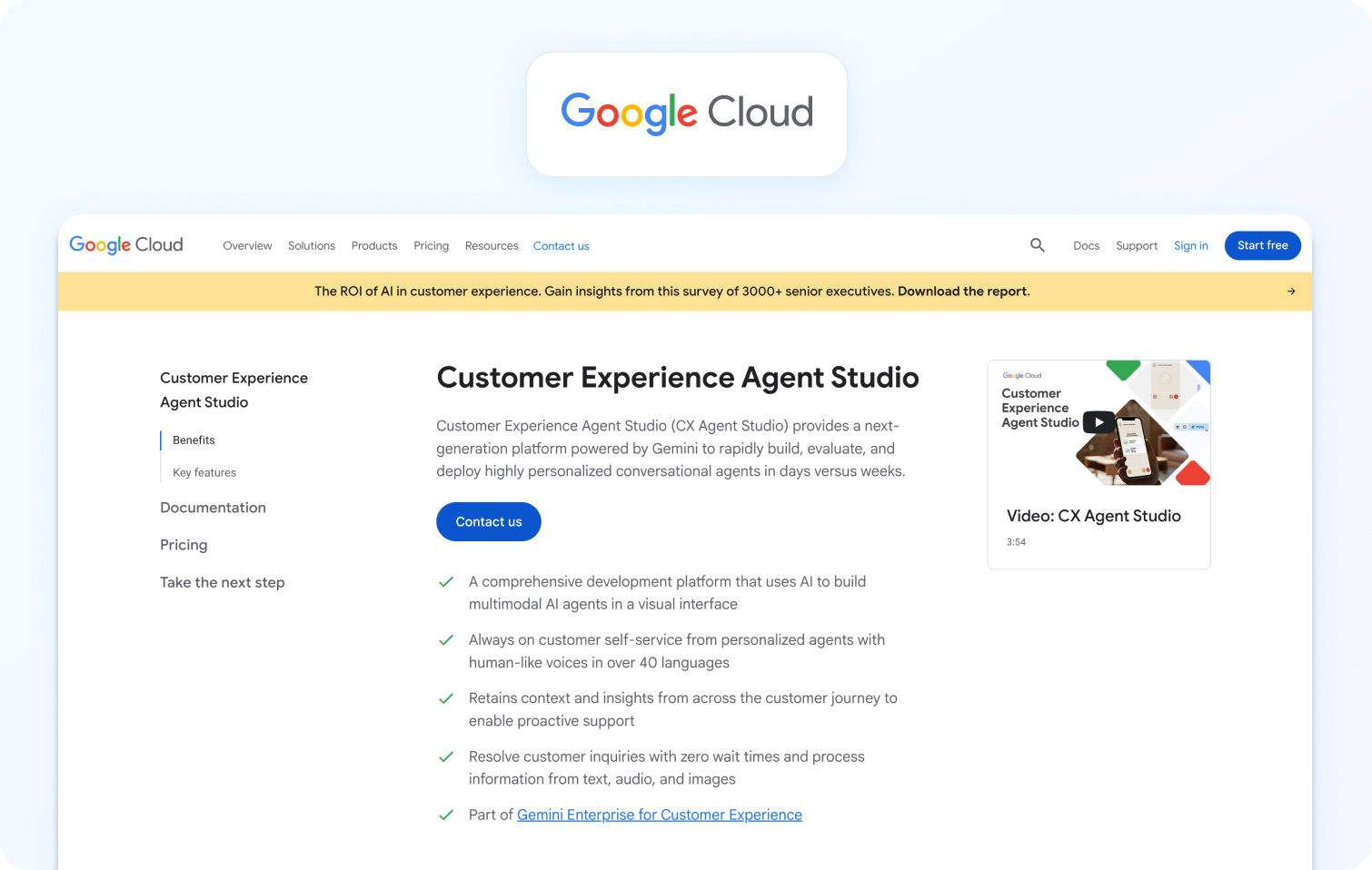
Google's Conversational Agents (formerly Dialogflow CX) uses Gemini models to build voicebots and chatbots with natural language understanding. Contact Center AI integrates virtual agents, agent assist with live guidance and knowledge recommendations, and insights with NLU-powered analytics. Voice capabilities include speech recognition, text-to-speech, and sentiment analysis. The platform offers a visual flow builder and integrates with existing telephony and contact center applications.
Who Uses It: Enterprises and developers already in the Google Cloud ecosystem; tech, e-commerce, and digital-first businesses.
Key Features:
- Gemini-powered natural language understanding
- Visual flow builder with state machine approach
- Agent Assist with real-time knowledge recommendations
- Sentiment analysis and intent detection
- Multi-channel deployment (voice, chat, SMS, social)
- Advanced performance dashboards
- Integration with Google Cloud services
Pricing:
- Dialogflow CX: $0.007 per text request
- Voice: $0.001 per second
- Contact Center AI products are priced per-use monthly
- Voice minutes, speech-to-text translation, and text-to-speech charged separately
Pros:
- Powerful for teams already using Google Cloud
- Advanced Gemini AI capabilities
- Strong integration with the Google ecosystem
- Comprehensive analytics
Cons:
- Pricing escalates significantly at scale
- Complex learning curve for Dialogflow CX
- Not recommended for beginners; steeper than Dialogflow ES
- Per-use pricing can be unpredictable
3. Amazon Lex (with Amazon Connect)
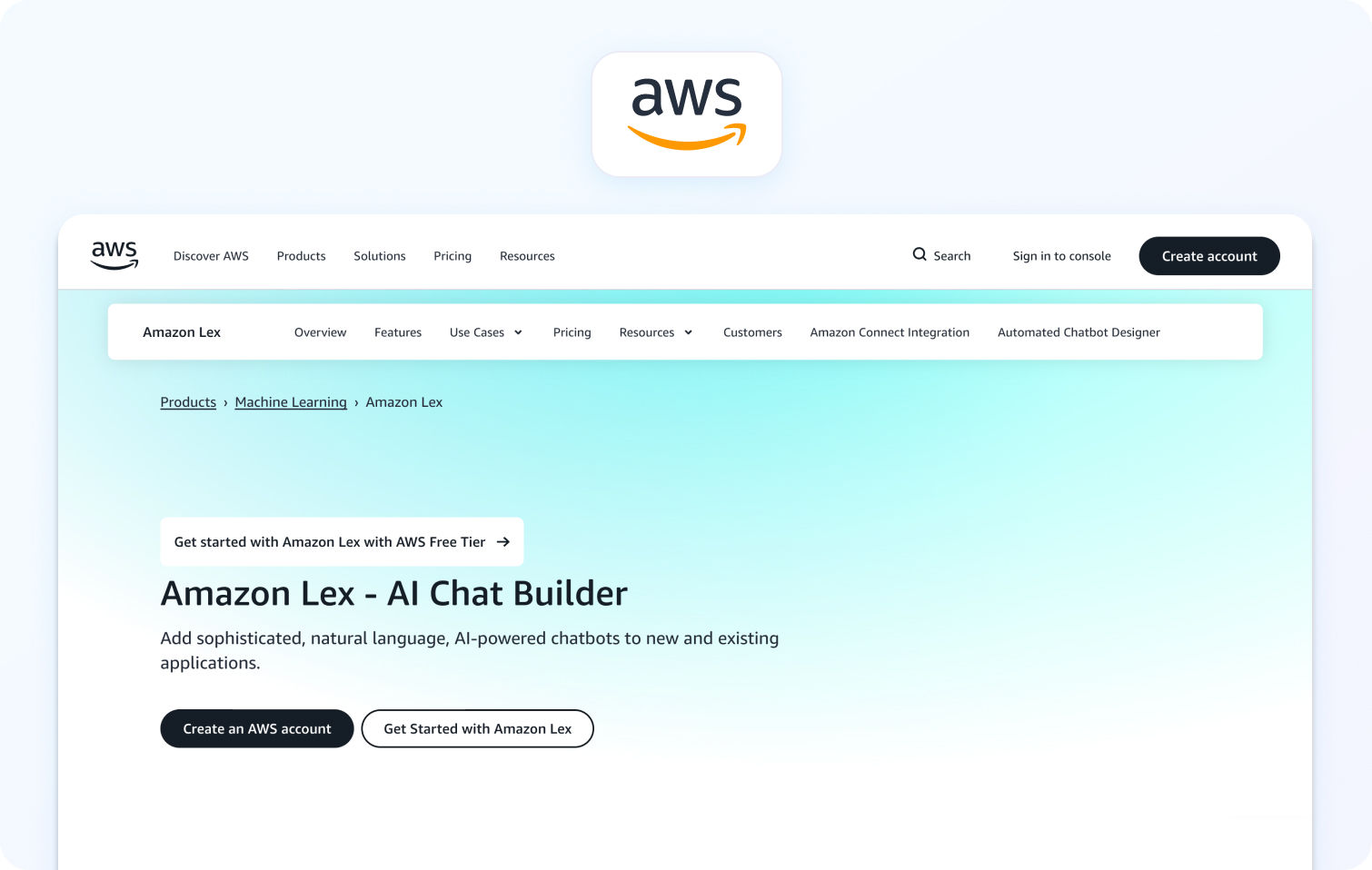
Amazon Lex uses the same technology as Alexa to create conversational interfaces that support both voice and text interactions, leveraging natural language processing (NLP). When paired with Amazon Connect, it provides native voice integration for automated phone conversations. The platform offers automatic speech recognition, language understanding, and a visual conversation builder. It integrates with AWS services like Lambda, Polly, and CloudWatch.
Who Uses It: Companies already using AWS infrastructure; e-commerce, banking, and healthcare organizations.
Key Features:
- Alexa-powered language understanding
- Visual Conversation Builder for no-code design
- Native integration with Amazon Connect for voice
- Automated chatbot designer using conversation transcripts
- Multi-channel deployment (mobile, web, messaging apps)
- Pay-per-use model with no upfront commitments
Pricing:
- Free tier: 10,000 text customer requests and 5,000 speech requests per month for the first year
- After free tier: $0.004 per voice request, $0.00075 per text request
- Pay-as-you-go with no upfront commitments or minimum fees
Pros:
- Cost-efficient pay-as-you-go pricing
- Seamless integration with AWS services and Amazon Connect
- Easy-to-use console for quick bot creation
- Multilingual customer support
- Scalable infrastructure
Cons:
- Integration with non-AWS services is limited
- Issues handling accents or slight inflections; delays more than preferred over the phone
- Limited customization options and third-party integrations
- Documentation issues
- Voice quality depends heavily on the configuration
4. Genesys Voicebots
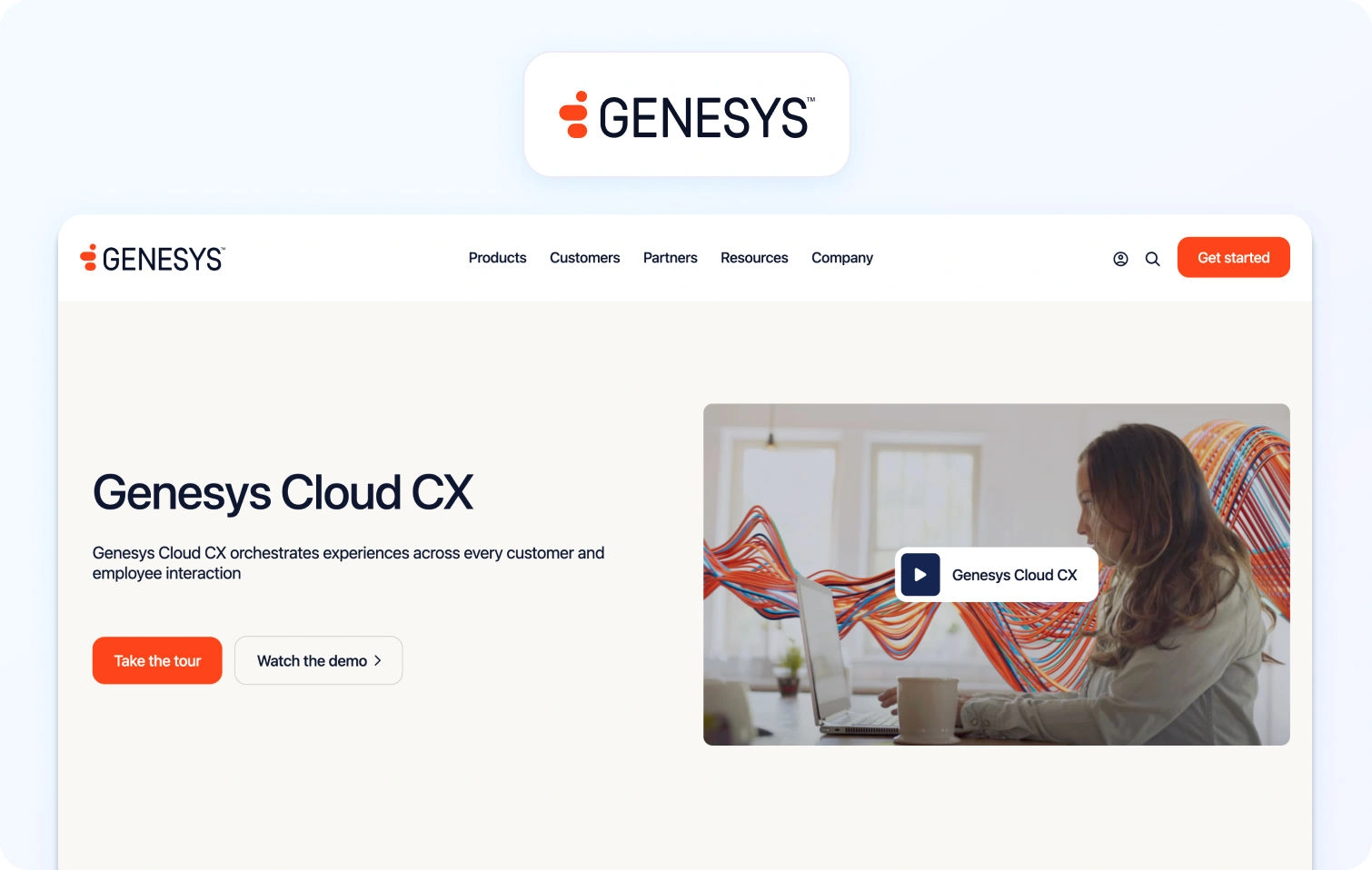
Genesys voicebots use AI-powered virtual voice assistants that converse with customers using natural-sounding language and voice recognition, handling common questions and escalating complex issues to live agents with full context. Built with drag-and-drop flow builder, built-in dialog management, and NLU features. The platform supports personalized interactions using customer data and AI, and integrates across the Genesys Cloud CX ecosystem.
Who Uses It: Large contact centers (100+ agents) in telecom, finance, healthcare, and retail.
Key Features:
- Drag-and-drop voicebot builder
- Natural language built-in
- Seamless handoff to live agents with context
- Integration with customer and interaction data
- Real-time personalization
- Cross-selling and up-selling capabilities
- Multiple language support
Pricing:
- Cloud CX 1: $75/user/month
- Cloud CX 2: $115/user/month
- Cloud CX 3: $155/user/month
- Annual commitment required
- Voicebot conversations: Charged per minute on voice channels, per session on digital channels
Pros:
- Full enterprise contact center stack
- Correctly matching from a list of 30 different intents in over 80% of cases
- Native WFM and QA included
- Strong compliance for regulated industries
- Proven scalability
Cons:
- Expensive for teams under 100 agents
- High costs with add-ons for CRM integrations and AI features
- Complex setup; steep learning curve
- Occasional stability issues and mixed feedback on post-sale personalized support
5. Cognigy Voice Gateway

Cognigy Voice Gateway combines artificial intelligence, native voice connectivity, and best-in-class speech technology to create hyper-realistic spoken language. It enables turnkey connectivity into CCaaS and CPaaS infrastructure, with pre-integrated speech services and leading-edge NLU and GenAI. The platform supports 100+ languages with built-in machine translation and handles tens of thousands of concurrent live phone calls.
Who Uses It: Large enterprises requiring sophisticated voice automation and multilingual support.
Key Features:
- Hyper-realistic voice interactions with state-of-the-art speech technology
- 100+ spoken languages with built-in machine translation
- Low-code AI flow editor for voice authoring
- Integration with multiple speech providers (Google, Azure, custom)
- Barge-in, DTMF handling, recording, seamless agent handoff
- Cloud, managed AI service, or on-premises deployment
- GDPR-compliant voice infrastructure
- Real-time call monitoring with proactive alerts
Pricing:
- Starting at $2,500/month for platform access
- Most enterprise contracts begin above $300K annually
- Voice, chat, and LLM workloads are charged separately
- Add-ons like Agent Copilot or Knowledge AI cost extra
- No free tier or public pricing
- Requires a custom quote
Pros:
- Named a Leader in the 2025 Gartner Magic Quadrant for Conversational AI
- Sophisticated multilingual capabilities
- Complete flexibility with JavaScript nodes, API connectors, and LLM orchestration
- HIPAA, SOC 2, GDPR, ISO27001 compliant
Cons:
- Not voice-first by default; requires Voice Gateway configuration
- Enterprise deployments typically take 2 to 4 months
- Learning curve can overwhelm non-technical users
- Very high entry cost; no free trial or self-serve plan
6. Kore.ai SmartAssist
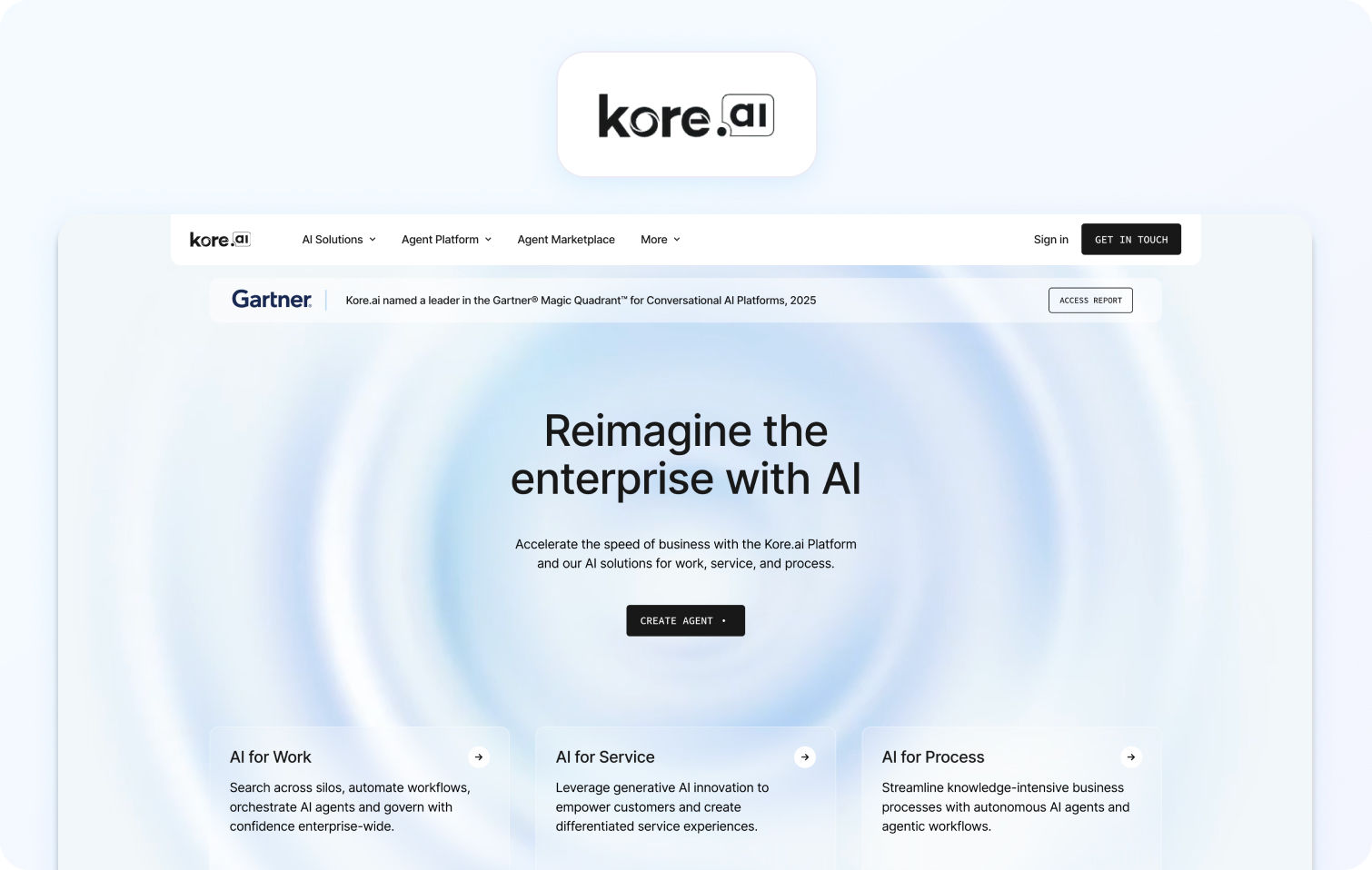
Kore.ai SmartAssist is an AI-native omnichannel contact center solution built on Kore's virtual assistant platform, enabling voice and text-based virtual agents with human-like customer interactions and AI-driven intent detection. It accurately responds to sophisticated, human-like conversations across voice and digital channels, automatically escalating to live agents with seamless, contextual continuity. The platform includes AgentAssist for live agent support and an intuitive desktop console.
Who Uses It: Enterprise teams in banking, healthcare, and telecom; Fortune 2000 companies.
Key Features:
- AI-native backend systems from the ground up using [ML]+2 Natural Language Understanding engines
- Voice and digital channel support
- AgentAssist virtual assistant for context and history
- No-code conversational AI platform
- Intent detection and sentiment analysis
- Multilingual support
- Flexible deployment (cloud, hybrid, on-prem)
Pricing:
- No public pricing available
- Most deployments begin around $300K annually
- Voice bot usage, advanced analytics, and custom integrations increase the cost significantly
- No free trial or self-serve plans
- Smaller teams are unlikely to meet the entry-level budget
Pros:
- Comprehensive enterprise-grade platform
- Strong compliance (HIPAA, SOC 2, GDPR, ISO 27001)
- Extensive backend integration flexibility
- 30+ communication channels supported
Cons:
- Not immediately intuitive; can overwhelm non-technical users
- Voice-first deployments are not the platform's strongest area; latency averages 800-1000ms
- Smaller teams are unlikely to meet the entry-level budget
- Regional language variations require manual effort
7. Five9 AI Agents
Five9 AI Agents deliver hyper-personalized, autonomous self-service by blending generative AI and large language model capabilities with conversational AI and NLP models, enabling real-time understanding of customer intent and orchestrating personalized journeys. The Intelligent Virtual Agent provides a conversational customer experience for automated voice interactions, available 24x7, with seamless transfer to live agents. The platform includes Agent Assist for real-time guidance and call summarization.
Who Uses It: Mid-market to enterprise businesses.
Key Features:
- Generative AI-powered intent detection and entity extraction
- Zero-training approach accelerating time to value
- Multi-channel deployment (voice, chat, SMS, WhatsApp)
- Real-time agent assists with guidance cards and checklists
- Call summarization using OpenAI GPT reduces after-call work
- No-code development platform with more complex task templates
- Virtual Voiceover with 25 standard voices plus custom avatars
Pricing:
- Plans start at $119/user/month
- 50-user minimum required
- Digital plan: $119/user/month (digital channels only)
- Core plan: $119/user/month (adds voice)
- IVA (Intelligent Virtual Agent) pricing not disclosed publicly
- Contact support for detailed IVA pricing
- Additional costs for advanced AI features and add-ons
Pros:
- 80% intent-matching accuracy
- Omnichannel communication across voice, SMS, email, chat, and social
- User-friendly and easy to learn
- Workforce engagement management tools included
Cons:
- Additional costs for IVA and advanced AI features
- Higher starting price compared to alternatives
- Limitations in integration options
- Native automation for chat and messaging is sometimes lacking
8. Talkdesk AI Agents for Voice
Talkdesk CX Cloud provides native voice capabilities, including AI-powered routing, sentiment analysis, and agent assistance, across both voice and digital channels. The platform offers industry-specific solutions for healthcare, retail, and financial services, featuring native WFM and QA capabilities.
Who Uses It: Mid-market to enterprise contact centers (100+ agents) in healthcare, retail, financial services, and hospitality.
Key Features:
- Native voice with advanced telephony
- AI-powered routing and sentiment analysis
- Agent Assist with real-time recommendations
- Native WFM (forecasting, scheduling, adherence)
- Native QA (automated scoring, feedback)
- Industry-specific pre-built solutions
- Compliance (HIPAA, PCI, GDPR)
Pricing:
- CX Cloud Essentials: ~$75/user/month
- CX Cloud Elevate: ~$95/user/month
- CX Cloud Elite: ~$125/user/month
- Custom enterprise pricing available
- Industry add-ons are priced separately
- Native WFM/QA included in all tiers
Pros:
- Full enterprise CCaaS with strong voice
- Native WFM/QA in all tiers
- Industry-specific solutions ready to deploy
- Strong compliance for regulated industries
Cons:
- Expensive for teams under 100 agents
- Complex implementation requiring months
- Steep learning curve
- High total cost of ownership at scale
9. LivePerson Voice AI
LivePerson's Conversational Cloud is a messaging-first platform with Voice AI capabilities leveraging generative AI and LLM orchestration. The platform specializes in digital-first customer engagement across SMS, WhatsApp, web, and social channels, with voice as an additional channel.
Who Uses It: Enterprise brands in retail, telecom, finance, and hospitality prioritize digital-first engagement.
Key Features:
- Conversational Cloud messaging-first platform
- Generative AI and LLM orchestration
- Bring Your Own AI (BYOAI) flexibility
- Intent Manager and no-code Conversation Builder
- Agent Assist and Conversation Copilot
- Analytics Studio for voice + text analysis
- Compliance (GDPR, HIPAA, PCI DSS, CCPA)
- Handles 1 billion+ conversations monthly
Pricing:
- Custom pricing only; no public plans
- Usage-based fees for AI resolutions
- No free plan; free trial available
- Requires a sales contact for a quote
Pros:
- Strong for messaging-heavy operations
- Advanced generative AI capabilities
- Deep social and messaging integrations
- Flexible BYOAI model
Cons:
- No transparent pricing
- Expensive for SMBs
- Messaging-focused; limited native voice
- Complex navigation
- Not ideal for voice-heavy contact centers
10. Yellow.ai VoiceX
Yellow.ai offers an enterprise conversational AI platform, VoiceX, for voice automation. The platform offers multilingual AI agents, a no-code bot builder, and integration capabilities across voice and digital channels.
Who Uses It: Mid-market to enterprise companies across industries seeking voice automation capabilities.
Key Features:
- Voice automation with natural language understanding
- No-code bot builder
- Multilingual support (100+ languages)
- Omnichannel deployment
- Integration with enterprise systems
- Analytics and reporting dashboards
- Workflow automation
Pricing:
- Custom pricing based on volume and features
- No public pricing available
- Requires contact with the sales team for a quote
- Pricing varies significantly by implementation scope
Pros:
- Extensive language support
- No-code interface accessible to non-technical teams
- Enterprise-grade security
- Flexible integration options
Cons:
- No transparent pricing
- Limited public information on voice-specific capabilities
- The implementation timeline varies significantly
- Voice quality depends on the configuration
Conclusion: Choosing the Right AI Voicebot Software
The right AI voicebot delivers multilingual conversations, knowledge-grounded answers, seamless agent handoff, and unified analytics. It should also be done without requiring multiple vendors or hidden per-resolution fees.
If you're running a 20–100 agent team and need a voicebot, copilot assist, native WFM/QA, and full omnichannel in one subscription, BlueTweak delivers predictable costs, fast deployment, and measurable results.
Book a demo to see how BlueTweak's AI voicebot handles deflection, multilingual conversations, and real-time workforce analytics in one unified platform.



