7 Proven Use Cases of NLP Customer Support


BlueTweak is an AI Customer Support Platform that unifies every conversation, customer record, and automation into one workspace.
Explore more
Insights, trends, and practical ideas from customer experience and AI
Real-world scenarios showing how teams use BlueTweak to deliver better service
The daily blueprint that guides customer support leadership.
ROI and savings calculators for support teams
See how BlueTweak stacks up against leading customer support platforms
Customer support NLP (natural language processing) turns messy customer language into clear, actionable steps that lift first-contact resolution, shorten handle time, and improve CSAT. NLP-powered chatbots deliver quick, accurate responses to customer inquiries, automating routine tasks and providing 24/7 support, improving efficiency and customer satisfaction. Below are 17 proven use case for customer support NLP and customer support natural language processing, with practical metrics and guardrails. BlueHub (by BlueTweak) brings tickets, a multilingual chatbot, AI voice bot, knowledge, bots, and analytics into one workspace so teams can deploy advanced NLP AI for customer support safely and see what changed.
Picture Monday morning. Your queue is full of long messages, screenshots, and urgent requests written in different languages. Agents are talented, but they spend time translating, searching, and retyping instead of solving. Leaders see the symptoms, reopens, transfers, long handle times, yet the root cause is simple: your system does not understand how customers talk. Traditional systems struggle to understand context and interpret the nuances of customer feedback, making it difficult to accurately address customer needs.
NLP (natural language processing) customer support fixes that gap. It uses AI to process human language, recognize language, detect intent, extract the details agents need, and draft grounded replies that match policy and tone. By processing human language, NLP can interpret intent and meaning more effectively. The result is practical: faster first replies, fewer second contacts, clean data, and a calmer day.
This article walks through 17 specific, field-tested use cases. Each one explains what it does, why it works, how to measure impact, and how BlueHub (by BlueTweak) helps you run it without disrupting the queue.

Treat this section as an execution playbook. Begin with two or three high-volume intents, validate impact against clear baselines, then expand methodically. For practical NLP in customer service, it is crucial to integrate NLP with existing systems, such as CRM platforms and ticketing systems. This ensures seamless functionality and maximizes the benefits of NLP in customer service by enhancing efficiency, personalization, and automation.
When a conversation arrives, the first decision is language. NLP identifies the customer’s language across email, chat, social, and voice transcripts and automatically sets the ticket field. That single step improves routing, template selection, and tone from the very first reply. If confidence is low, include a brief confirmation line. In BlueHub, detected language flows into routing and a localized AI customer support knowledge base, so agents start in the correct lane.
Why it works: Correct language enables the correct first move. Multilingual support ensures seamless communication for a diverse customer base, allowing global businesses to provide consistent service across multiple channels and regions.
Measure: Fewer misroutes; faster first response for non-default languages.
Free text often masks a simple need, such as refund eligibility, identity verification, shipping delays, or outage reporting. NLP algorithms and techniques are used to analyze customer messages, identify patterns, and map them to a compact, well-defined set of intents your team can act on. The proper taxonomy triggers the right lane and snaps the right template into place.
Why it works: Focused categories reduce guesswork and rework.
Measure: Lower manual triage time; fewer transfers; higher SLA attainment on top intents.
Customers rarely place data where agents need it. NLP extracts order IDs, invoice numbers, device models, error codes, and emails from messages and attachments, then proposes values for structured fields. Agents confirm with a click.
Why it works: Less hunting, more solving.
Measure: Minutes saved per case; fewer follow-ups for missing details.
Not every P2 carries equal risk. NLP flags phrasing that signals safety, security, legal, or revenue exposure and recommends a tighter update cadence or a one-level priority nudge. Keep human approval in the loop.
Why it works: Urgency aligns with risk, not noise.
Measure: Faster acknowledgments on risk cases; fewer unmanaged VIP escalations.
Long threads become short, accurate recaps grounded in your knowledge base, generated using natural language generation techniques to ensure concise, empathetic summaries, paired with one concrete next step and a promised update time. Customers relax, and work moves forward.
Why it works: Clear context reduces the need for second touches.
Measure: Higher first-contact resolution; lower second-contact rate.
NLP drafts suggested replies in the customer’s language, using approved templates and localized snippets, leveraging its ability to generate human-like responses. Agents adjust tone and specifics, then send. Keep “approve before send” on sensitive intents until results stabilize.
Why it works: Reuse maintains consistency and speed.
Measure: Agent edit rate; handle time; QA pass rate.
Once intent and language are known, routing assigns the case to the first qualified owner based on language, product area, and certification. This process ensures that support agents with the right skills and language abilities handle each case, improving the quality and efficiency of customer support. Overflow rules protect scarce skills, such as payments or identity.
Why it works: Fewer transfers shorten time to resolution.
Measure: Transfer rate; time to first qualified touch; time to resolution.
During calls, streaming transcription detects emerging intent and surfaces the next step or checklist in real time (verification, exception handling, required disclosures), keeping agents engaged with the customer. This process relies on advanced speech recognition, a core component of NLP customer support, to accurately interpret spoken language. Additionally, voice assistants powered by NLP can provide real-time guidance and automate responses, further enhancing the efficiency of customer interactions.
Why it works: In-flow guidance beats recall under pressure.
Measure: Voice AHT; after-call work; policy-adherence scores.
NLP highlights frustration, urgency, or relief through AI customer sentiment analysis, detects customer emotions to tailor responses, and recommends tone and cadence that fit the moment. Treat outputs as nudges, not hard rules.
Why it works: Emotional context prevents unnecessary escalation.
Measure: Escalation rate; VIP aging; CSAT variance by sentiment band.
Semantic search identifies the most relevant paragraph from your knowledge base using the customer’s wording and inserts it into the draft, surfacing the most relevant information for each inquiry. Agents click once, not fifteen times.
Why it works: The right step appears at the right time.
Measure: Article reuse rate; faster replies; fewer reopens tied to missing steps.
Neural translation supports inbound and outbound messages while respecting formality and regional norms, guided by a concise glossary for product and policy terms. Pair with weekly “meaning preserved” checks. Multilingual translation is a key component of comprehensive customer service strategies, enabling businesses to efficiently address diverse customer needs and enhance satisfaction across languages.
Why it works: Accuracy plus appropriateness builds trust.
Measure: FCR and AHT for translated interactions; “meaning preserved” QA scores.
Outages echo across the inbox. NLP links related tickets to a parent incident and cascades updates in a single note, efficiently managing support tickets during incidents. Agents confirm linkages by clicking to protect quality.
Why it works: One authoritative update beats many inconsistent ones.
Measure: Time saved during incidents; message consistency; faster closure.
Multi-label classification applies product, feature, and root-cause tags from content rather than relying on manual selection. This process helps organize and analyze customer data, enabling better insights into customer needs and support trends. Keep the tag set compact and stable so trends remain meaningful.
Why it works: Clean data drives better planning and product decisions.
Measure: Fewer uncategorized cases; analyst time saved; audit accuracy.
NLP reads the request, interprets specific customer queries, and prompts for the exact screenshot, log, or photo needed to unblock the next step, including the file type and size. Customers attach what matters on the first pass.
Why it works: Correct evidence eliminates avoidable back-and-forth.
Measure: Lower second-contact rate; faster time to unblock.
Grounded summarization records what happened and creates dated tasks or approvals inside the ticket. Promises stay visible and owned. This step streamlines support processes by ensuring follow-up actions are tracked and accountability is maintained throughout the workflow.
Why it works: Clear handoffs prevent silent drift.
Measure: Reduced after-call work; fewer reopens from missed follow-ups.
NPS comments, post-chat surveys, and social posts are rich but noisy. NLP facilitates analyzing customer interactions and feedback, clustering themes, surfacing rising issues with example quotes, and extracting valuable insights that point to likely owners. Share what changed each month.
Why it works: Real customer language guides practical fixes.
Measure: Time from theme to fix; volume drop on targeted issues.
Language patterns predict effort. NLP converts intent mix, sentiment, translation usage, and transfer patterns into expected handle time and deflection opportunities by region and language, so planners schedule skills, not guesses. By leveraging predictive analytics, organizations can enable proactive support, anticipating customer needs and potential issues, leading to better workforce planning and improved customer experience.
Why it works: Forecasts reflect real work rather than averages.
Measure: Forecast error reduction; overtime avoided; adherence improvement.
Use conservative assumptions tied to familiar levers:
– First-reply acceleration: If grounded suggested replies cut the first response by 1 minute on 30,000 monthly messages at €30/hour, fully loaded, the capacity returned is ~€15,000 per month.
– Transfer reduction: Dropping transfers from 18% to 12% on 20,000 chats at 3 minutes per transfer avoids ~600 hours per month, or ~€18,000.
– Deflection via knowledge matching: A 2-point lift on a 50,000-visit help center removes ~1,000 agent contacts; at 5 minutes each, ~417 hours, ~€12,500.
– Reopen reduction: Moving from 9% to 6% reopens on 15,000 tickets avoids 450 second contacts; at 7 minutes each, ~52.5 hours, ~€1,575.
NLP customer support solutions help reduce operational costs by automating routine tasks, thereby decreasing the need for large support teams and increasing efficiency. These technologies also enhance customer service by improving response times and extracting actionable insights from customer feedback, leading to higher satisfaction. Additionally, NLP improves service quality by enabling more accurate analysis of inquiries and feedback, resulting in more effective support.
These improvements have been implemented to enhance communication and operational efficiency through technological solutions.
Put these side by side, and the question shifts from “why NLP” to “how fast do we want the return.”

Here’s what’s coming and how it will feel in the day-to-day:
Looking ahead, large language models and NLP enable computers to understand and generate human language, powering advanced customer support solutions. This technology delivers an enhanced customer experience by personalizing interactions, understanding user intent, and tailoring communication across channels.
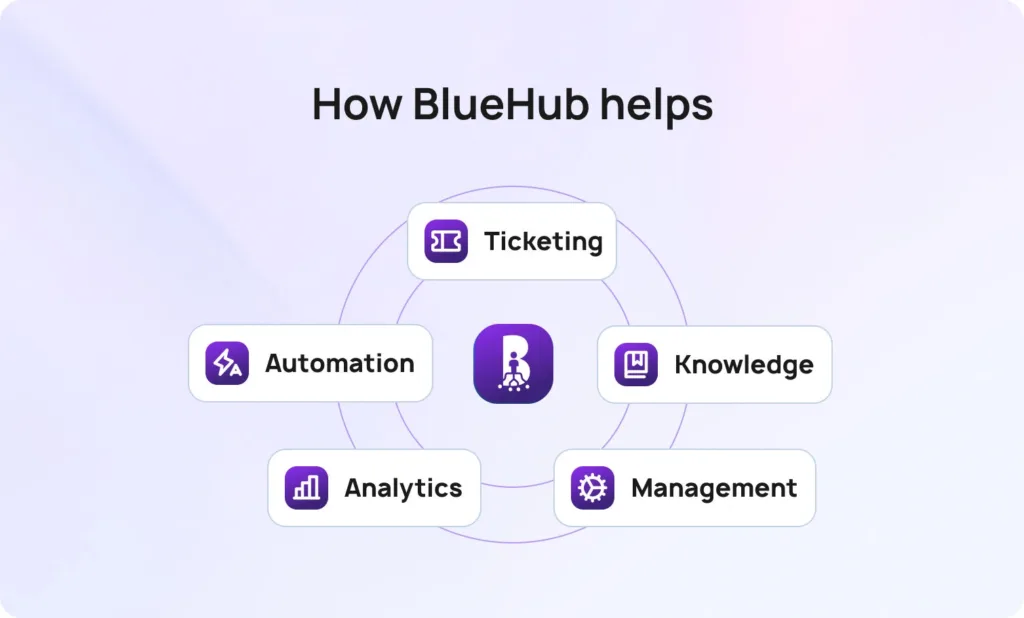
BlueHub is a unified CX workspace that brings:
together, so NLP operates exactly where agents work. The moment a case opens, language and region are identified, intent is classified, key entities are extracted, and the most relevant knowledge is surfaced. BlueHub provides agent support by helping support agents better understand customer inquiries, automating responses, and streamlining workflows.
The platform also optimizes customer service operations by automating routine tasks and integrating seamlessly with existing systems, enhancing overall service quality. Suggested replies are grounded in your approved articles and templates; translation respects tone and uses glossary terms; and risk cues prompt a tighter cadence when safety, security, legal, or revenue exposure is present.
Operational control is built in. Approvals are configurable by intent, and every suggested action records who approved it, why it was taken, and what happened next. Versioned templates, articles, and prompts are available alongside a visible change log, so audits rely on facts rather than memory. Role-based access, field masking, and data residency options support privacy and compliance. ISO certification is in progress, and all activity is captured in an auditable trail.
Leaders get attribution they can trust. BlueHub links movement in first-contact resolution, average handle time, transfer rate, reopens, SLA attainment, and sentiment to the exact asset or rule that changed, whether it was a template, a route, a checklist step, or a knowledge edit. Workforce management uses the same signals to forecast demand by channel, language, and intent, then publishes skill-aligned schedules that adjust intraday with a single click when reality shifts.
Integration is straightforward. Open APIs and selected connectors bring commerce and CRM data into the same view, so routing, identity, and entitlement checks do not require tab switching. Multitenant controls support multi-brand or multi-client operations with clean separation for routing, reporting, and permissions. You can start with one or two high-volume intents, keep approvals on for sensitive flows, and expand as the data proves lift.
Your customers are already telling you what they need. NLP customer support turns those words into a faster first reply, a cleaner handoff, and a confident resolution. By leveraging NLP to enhance customer interactions, you can automate, analyze, and optimize them to deliver a better customer experience and stronger customer relationships.
The 17 use cases here are practical and measurable: detect language, classify intent, extract the details, draft a grounded answer, route by skill, collapse duplicates, mine feedback, and feed the plan with what the queue learned. Keep humans in the loop for sensitive steps. Log changes. Report outcomes in business terms. That is how you turn language into a reliable operating advantage.
BlueHub helps you execute this without pausing the operation. It places advanced NLP AI for customer support where agents already work, grounds every suggestion in your knowledge, and links improvements in FCR, AHT, SLA attainment, and CSAT to the specific change that drove them. If you want to see this in your own data, request a BlueHub demo and leave with a starter plan mapped to your top intents and languages.
Start where language slows you down: language detection, intent classification, entity extraction, and grounded suggested replies on your top two or three intents. BlueHub places these NLP steps at intake and in the agent console, so detection, classification, and suggested replies flow into routing, templates, and knowledge without requiring changes to existing tools. These steps rely on processing large amounts of natural language data using NLP processes, such as part-of-speech tagging, to better understand and interpret customer interactions.
Require every suggested reply to cite approved knowledge or policy and block sending if no source exists. Keep sensitive intents on human approval. BlueHub enforces grounding and approvals by intent and links outcomes such as FCR and reopens to the exact article or template used, so you can see quality hold as speed improves.
Yes, if you pair translation with tone controls and a glossary of terms. Run weekly “meaning preserved” sampling and localize three core messages per intent: first response, progress update, and delay note. BlueHub routes by language, surfaces localized templates, applies glossary constraints, and reports FCR and AHT by market to verify parity.
Provide only task-relevant text, mask credentials and payment hints, and apply role-based access to transcripts and summaries. Log prompts, sources, approvals, and outcomes for audits. BlueHub supports field-level masking, scoped permissions, retention controls, and full audit trails across NLP features.
Track queue outcomes where features are active: FCR, AHT, transfer rate, reopens, CSAT, and analyst time saved. Convert time saved and deflection into capacity or cost equivalents. BlueHub attributes metric movement to the specific template, article, prompt, or route you changed, making the business case clear to finance and operations.
In practice, it assists by detecting language, classifying intent, extracting details, drafting grounded replies, and suggesting next steps, so agents can focus on judgment and empathy. NLP automates routine customer inquiries, allowing human agents to focus on more complex or nuanced issues. BlueHub keeps humans in the loop with configurable approvals and visible timers, then shows the lift in FCR, AHT, SLA attainment, and CSAT.
As Head of Digital Transformation, Radu looks over multiple departments across the company, providing visibility over what happens in product, and what are the needs of customers. With more than 8 years in the Technology era, and part of BlueTweak since the beginning, Radu shifted from a developer (addressing end-customer needs) to a more business oriented role, to have an influence and touch base with people who use the actual technology.