



TL;DR
Most customer support knowledge bases fail due to content sprawl, multilingual complexity, and the absence of a feedback loop connecting articles to outcomes. This guide provides a practical framework, along with templates and metrics, to build an AI-ready customer service knowledge base that reduces ticket volume and scales across multiple languages.
From Knowledge-Base Chaos to Measurable Deflection
Support teams create knowledge bases to reduce ticket volume and enable self-service; yet, six months later, the same common customer questions often flood the queue. Agents struggle to surface the correct answers and articles, and customers abandon self-service after two unsuccessful searches.
Execution is the blocker. Teams stall due to content sprawl, characterized by hundreds of loosely categorized articles, multilingual overhead that translates everything rather than prioritizing high-impact material, and a weak feedback loop between articles and resolution outcomes.
This guide outlines an intent-driven information architecture, standardized article templates, governance workflows that prevent drift, and metrics that prove continuous improvement in cost reduction and better customer experiences. It also illustrates where BlueTweak) fits within this framework and how the model is applied across platforms.
What Is an AI-Ready Customer Support Knowledge Base?
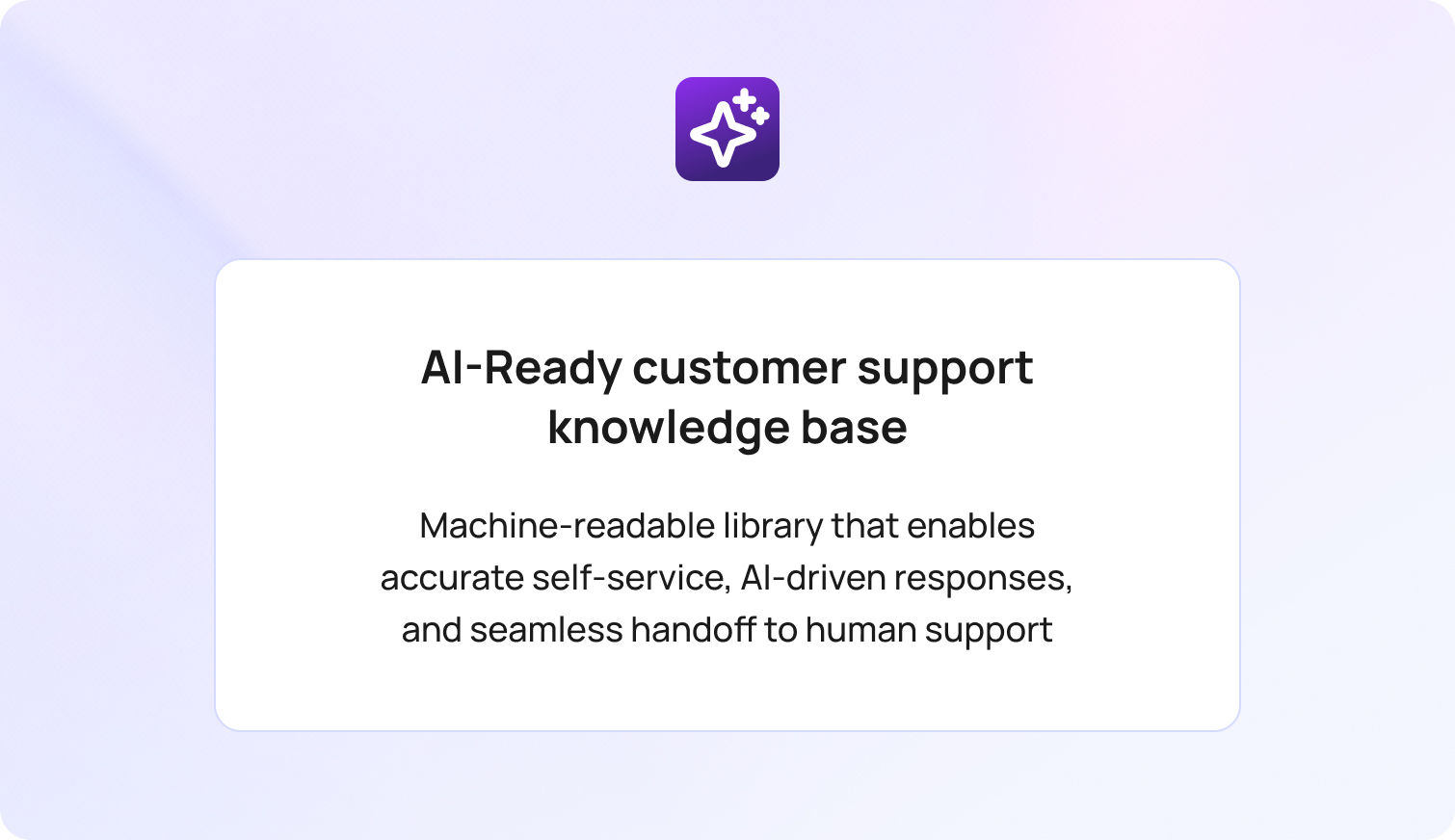
An AI customer support knowledge base is a structured library of help articles, troubleshooting guides, and support documentation that serves both customers (as an effective self-service knowledge base) and support agents (as an internal reference). AI-ready knowledge bases are machine-readable, ensuring a positive experience for both customers and support agents. That means they’re formatted so AI chatbots and voicebots can retrieve canonical answers to save time, present them conversationally, and escalate with context when human support is needed.
Two core libraries:
- External (customer-facing): Published self-service content accessible via help center, chatbot, or search engines. Reduces ticket volume by enabling customers to resolve issues independently.
- Internal (agent-facing): Troubleshooting tips, escalation procedures, and compliance notes not suitable for public access. Speeds up training time for new agents and ensures consistency across customer support teams.
Global support operations require knowledge management for customer support in over 10 languages. The choice isn't whether to localize, it's which content to prioritize and how to validate translations.
BlueTweak provides an internal knowledge base and a customer-facing help center. The AI chatbot uses KB content with guardrails to reduce hallucinations. Multilingual support is available across chat, email, and voice, and the chatbot can respond in the customer’s preferred language. During ticket resolution, agents surface KB articles in the workspace, and suggested replies for email draw from KB content to maintain consistency.
Technology Overview: From Static FAQs to AI-Ready Knowledge Base Software (2015→2026)
Customer service teams transitioned from static FAQ pages and ad-hoc macros stored in spreadsheets to structured, machine-readable customer support knowledge management systems that serve both customers and agents across channels. Rising volumes in email, chat, and social media (plus multilingual expansion) forced teams to tie knowledge directly to resolution metrics (containment, FCR, AHT) rather than vanity metrics like page views.
That’s because previous methods weren’t working:
- Older stacks couldn't connect "article viewed" to "issue resolved."
- Free-form articles without standardized templates, duplicate content across brands and languages, and siloed internal/external libraries resulted in inconsistent answers and cumbersome escalations.
- Support agents toggled between the help center, shared Google Docs of unofficial fixes, and Slack channels to find answers.
- Chatbots couldn't parse these inconsistencies, leading to escalations where customers had to repeat their issues to agents who lacked context.
Today's platforms prioritize clear information architecture, standardized article templates, and KB grounding for chat and voice automation to meet customer expectations. Analytics connect article usage to SLA/FCR outcomes, enhancing the overall customer experience while supporting multilingual segmentation.
The Scalable Framework: Plan → Build → Govern → Grow
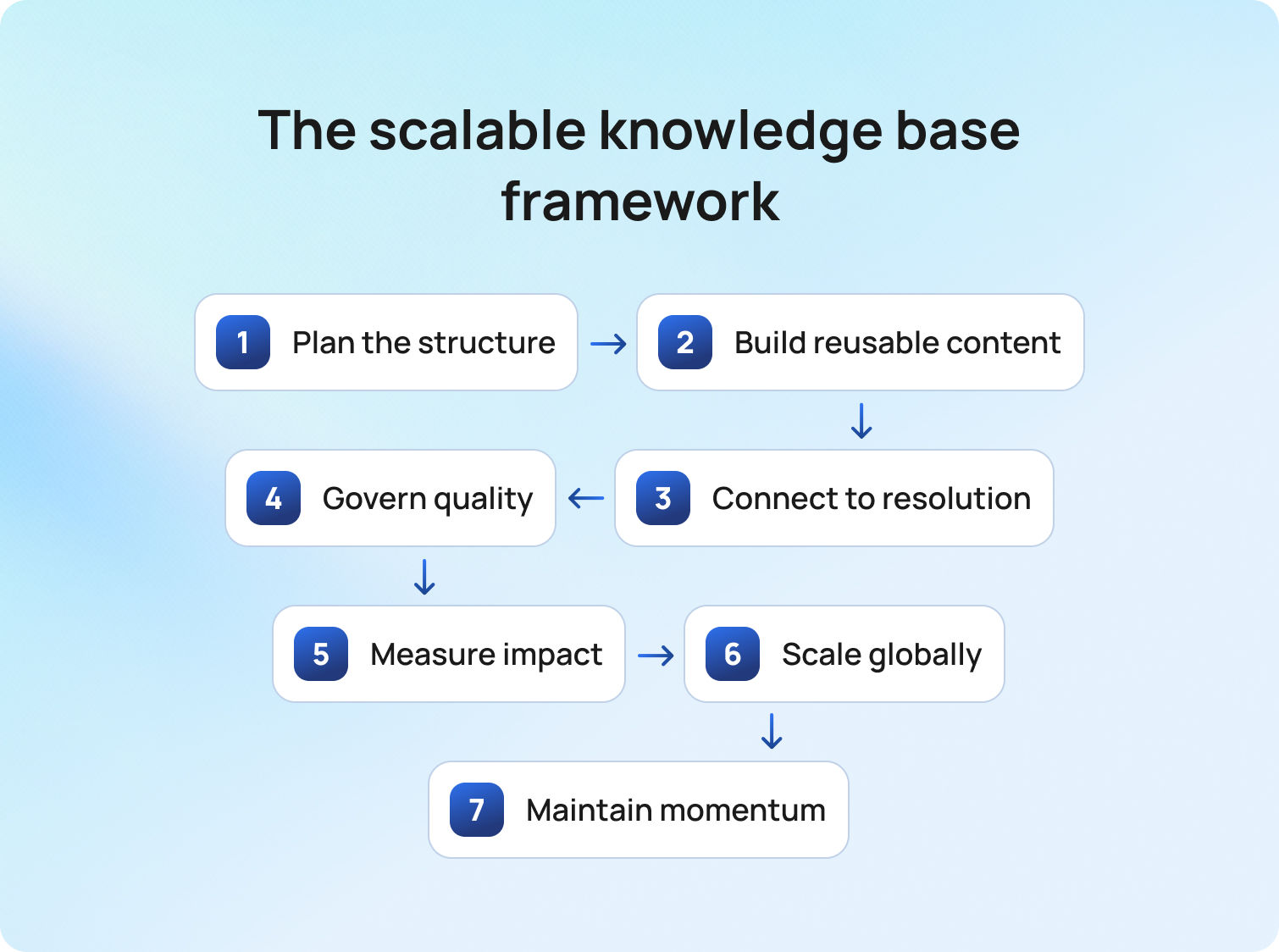
Building a customer support knowledge base that scales requires seven stages:
- Plan
- Build
- Connect
- Govern
- Measure
- Localize
- Maintain
1. Plan: Information Architecture & Sources of Truth
Before writing a single article, map your top customer intents and ticket drivers. Pull six months of ticket data from your ticketing system, group by topic (e.g., "password reset," "order tracking," "refund policy"), and rank by volume × handle time.
This indicates that 20% of issues account for 80% of costs. These are your highest-impact knowledge base articles.
Define categories and article types:
- How-to: Step-by-step instructions for completing a task (e.g., "How to update billing information").
- FAQ: Single-question answers for policy or feature clarifications (e.g., "What is your return window?").
- Troubleshooting: Diagnostic flows for error messages or unexpected behavior (e.g., "Why is my payment failing?").
Tag every article with product, version, brand (for multi-brand customer service operations), and locale. This enables filtered search ("Show me articles for Product A, English, Brand X") and prevents outdated guidance from surfacing.
Customer profiles in BlueTweak surface cross-channel interaction history and provide a unified customer view, helping reveal recurring issues and patterns. Multilingual support spans all major channels, and combined with analytics, helps prioritize which languages to roll out next.
2. Build: Standardized Articles That Bots & Humans Can Use
Inconsistent formatting breaks AI retrieval and frustrates agents. Use a standardized article template for every piece of content:
- Title: Action-oriented, includes primary keyword (e.g., "Reset Your Password in 3 Steps").
- Summary: A one-sentence overview that the chatbot can present as a standalone answer.
- Preconditions: What the customer needs to have in place before starting (e.g., "You must have access to your registered email").
- Steps: Numbered, concrete actions with one intent per step.
- Expected Result: What success looks like (e.g., "You will receive a confirmation email within 5 minutes").
- Exceptions: Edge cases or error states (e.g., "If you don't receive the email, check your spam folder").
- Related Articles: Links to next-step content (e.g., "How to Update Your Email Address").
AI chatbots retrieve answers by matching customer queries to article snippets. Use clear, canonical steps ("Click Settings → Account → Change Password") rather than prose ("Navigate to your account settings and look for the password option"). This ensures the AI chatbot can extract the correct answer and present it in a conversational manner.
BlueTweak’s knowledge base offers article authoring and hosting, complete with approval, hierarchy, and version management. Canned responses and email Suggested Replies leverage KB content to reduce inconsistency. Because Suggested Replies pull from the KB, updated articles can inform future suggestions without manual rework.
3. Connect: From Knowledge to Resolution
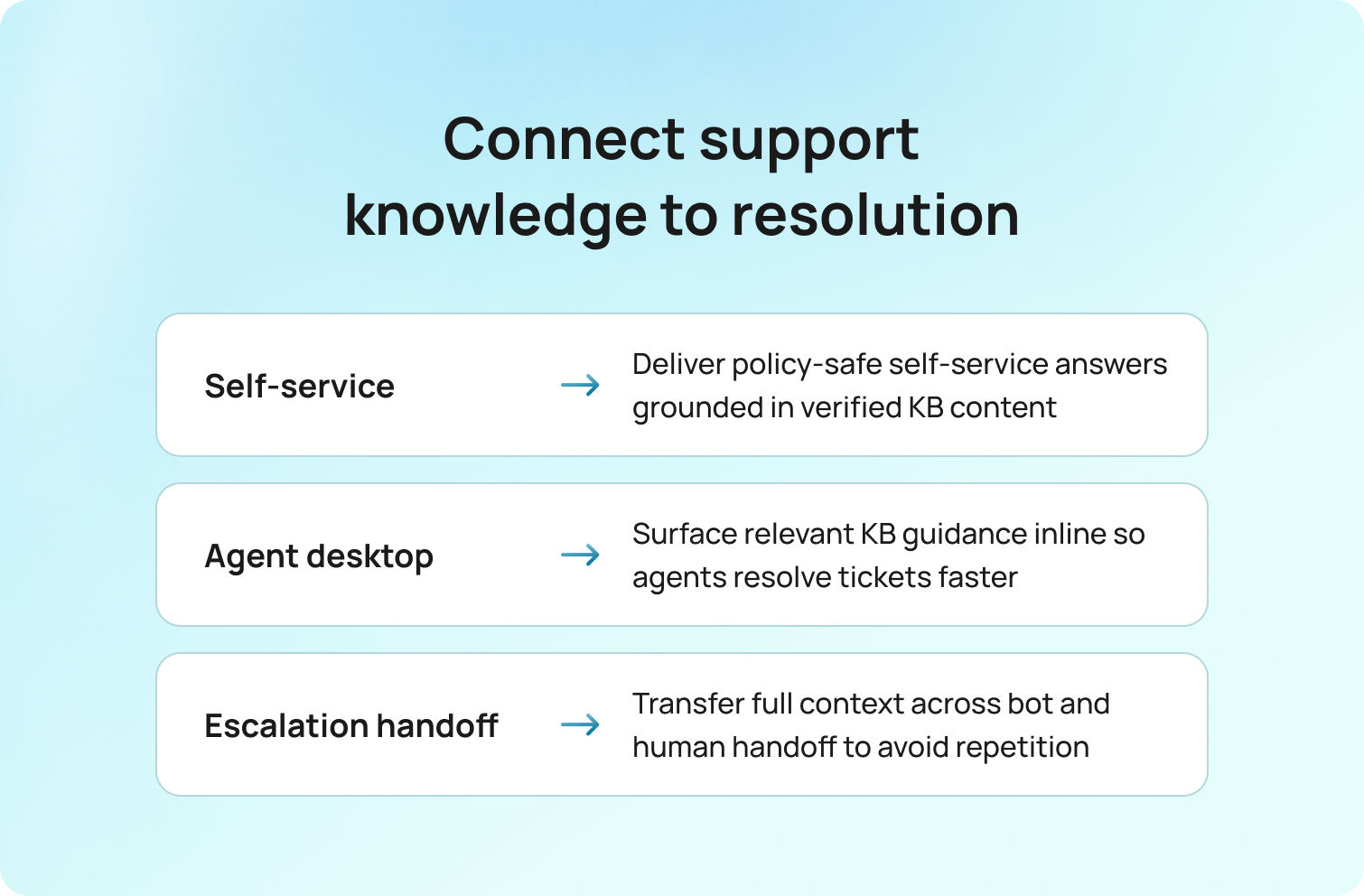
A knowledge base that isn't wired into support workflows won't reduce ticket volume. Connect your KB to three touchpoints:
- Self-service (AI Chatbot): Ground your AI chatbot in KB content so it retrieves answers rather than generating responses from a generic language model. This prevents hallucinations and ensures the chatbot reflects your policies. Customers access self-service options via your website, mobile app, or messaging channels (WhatsApp, Facebook Messenger).
- Agent desktop: Expose KB articles inline during ticket resolution. Agents should see suggested articles based on ticket content (keywords, category, customer history) without leaving the ticketing interface. This reduces time spent searching and ensures agents reference official guidance rather than improvising.
- Escalation handoff: When a chatbot escalates to a human agent, pass the full transcript, KB articles already presented, and customer context (customer profile with interaction history). This prevents customers from repeating their issue and provides agents with immediate context to resolve the ticket more efficiently.
BlueTweak's AI chatbot leverages a knowledge base with guardrails to minimize hallucinations and deliver consistent answers. When a conversation escalates, the handoff to ticketing includes the chat transcript and can include the knowledge articles referenced. With call transcription enabled, voice escalations carry full context, allowing phone agents to view prior steps taken in chat.
4. Govern: Quality, Ownership, and Lifecycle
Without governance, knowledge bases decay. Articles drift out of date, duplicates multiply, and terminology diverges across teams and languages. Establish clear ownership and review workflows:
- Assign content owners: Every article requires a named owner (product manager, senior agent, or ops lead) responsible for ensuring accuracy. Owners triage feedback, approve edits, and trigger reviews when products change.
- Set review cadences: High-impact articles (those in the top 20% by usage) should be reviewed quarterly. Low-traffic articles can be reviewed annually or triggered by events (product launch, policy change, spike in related tickets).
- Capture feedback: Add "Was this helpful?" to every customer-facing article. Collect qualitative feedback ("What was missing?") and route it to content owners. Triage suggestions weekly: quick fixes (typos, broken links) get published immediately; structural rewrites go into the backlog.
- Deduplicate and retire: Audit for duplicate articles covering the same intent. Consolidate into one canonical article, redirect the old URLs, and update canned responses to reference the new version. Retire outdated articles (deprecated features, expired promotions) to prevent agents from surfacing stale guidance.
Quality assurance capabilities in BlueTweak support review and coaching workflows. Analytics monitor article usage and outcomes (deflection rate, FCR by article). Administration tools provide roles/permissions (draft, publish, archive) and audit logs tracking who edited what and when, ensuring safe governance at scale.
Risks of Poor Governance
When knowledge bases aren't maintained, content drifts out of date, duplicates multiply, and terminology diverges across teams and languages. Agents lose confidence in the knowledge base, often bypassing it entirely in favor of Slack channels or relying on tribal knowledge.
Escalations become clumsy: customers repeat their issue because agents lack context. Self-serve options fail, and that ultimately drives higher ticket volume, longer handle times, and avoidable reopens.
In regulated contexts (finance, healthcare, insurance), stale guidance creates policy and compliance risk. Outdated refund policies, incorrect data retention timelines, or deprecated security procedures expose the organization to audits and customer disputes.
A light, user-friendly, and consistent governance cadence (content owners, quarterly reviews, and systematic retirements) prevents this spiral and keeps the customer support knowledge base a trusted source of truth.
5. Measure: Metrics That Prove Scale
Vanity metrics (such as page views and total articles published) don't prove that the knowledge base reduces costs. Track metrics tied to resolution outcomes:
- Deflection/containment: Percentage of chatbot interactions resolved without agent involvement. Target: 60–80% for high-volume intents.
- Time to first helpful answer: How long does it take customers to find a relevant article via search or chatbot? Faster = better UX.
- Assisted handle time (AHT): Average time agents spend resolving tickets when KB articles are used vs not used. A well-connected KB should reduce AHT by 20–30%.
- First contact resolution (FCR): Percentage of tickets resolved on first interaction. KB-assisted tickets should have a higher FCR than tickets where agents improvise.
- Customer satisfaction (CSAT/NPS): Survey customers after self-service interactions and agent-assisted resolutions. Compare scores for KB-assisted vs non-assisted interactions.
- Search-to-click and dead-end queries: Track how often customers search but don't click on an article (poor relevance) or click but bounce immediately (the article didn't help). These signal content gaps or quality issues.
Segment all metrics by brand and language to identify where your multilingual rollout is succeeding or stalling, thereby enhancing customer relationships.
BlueTweak's customer service analytics deliver real-time or near-real-time dashboards and historical reports for deflection, FCR, AHT, and satisfaction, with breakdowns by channel, language, and team, plus article-level insights when the knowledge base is connected. Workforce management tools support forecasting and intraday reallocation as deflection improves, and reporting can estimate cost impact from reduced ticket volume.
H4: Gap Analysis Method Best Practices
Identify missing or weak content by triangulating signals from multiple sources:
- Failed/low-confidence chatbot answers: Review interactions where the chatbot couldn't provide a confident answer or escalated immediately. Cluster by intent.
- "No results" search queries: Track customer searches in your help center that returned zero results or low-relevance results. These reveal terminology mismatches or missing topics.
- Recurring ticket topics/transfer reasons: Pull ticket data by category and transfer reason ("escalated to billing," "product question," "technical issue"). High-volume topics without corresponding KB articles are gaps.
- Reopen notes: Review support tickets that have reopened within the last 72 hours. If agents cite "customer tried article X but it didn't work," the article needs revision.
- Prioritize by volume and business impact: A missing article about a billing error affecting 500 customers/month matters more than a niche feature question affecting 5 customers/month.
- Create or consolidate: Use a standardized article template to write new content or merge duplicates. Re-publish, link canned responses and macros to the new articles, and re-measure containment, FCR, and search success to confirm the gap is closed.
6. Localize: Multilingual Knowledge Management Without Chaos
Global support teams require multilingual customer support; however, translating all 500 articles into 15 languages upfront creates bottlenecks. Prioritize systematically:
Start with languages driving the highest ticket volume (Spanish, French, German) rather than niche languages with low ticket counts.
Define translation workflow:
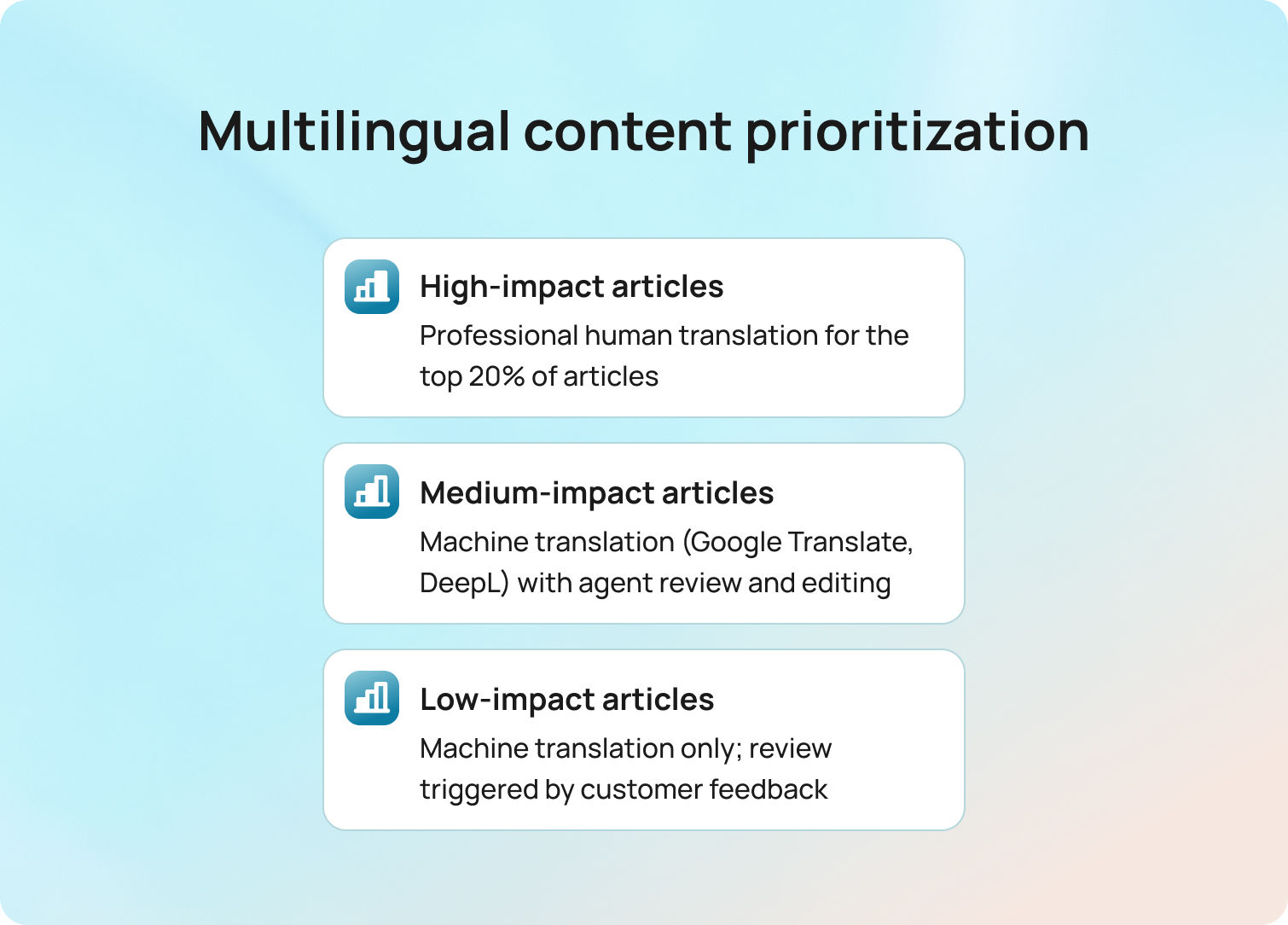
- High-impact articles: Professional human translation for the top 20% of articles (high-volume intents, compliance-driven content).
- Medium-impact articles: Machine translation (Google Translate, DeepL) with agent review and editing.
- Low-impact articles: Machine translation only; review triggered by customer feedback.
Not everything needs translation. Localize article bodies, UI terms, and compliance notes (GDPR language, regional return company policies). Leave product names, version numbers, and technical error codes in English to maintain consistency.
Even machine-translated content should be reviewed by native speakers (agents in that language) to catch terminology errors, cultural mismatches, or awkward phrasing.
BlueTweak offers multilingual support across various channels, including chat, email, SMS, voice, and social media. The AI chatbot uses knowledge base content to deliver context-aware answers in the customer’s language. For live agent interactions, on-the-fly translation is available across both text and voice, allowing conversations to continue in the customer’s preferred language without requiring a switch in tools.
7. Maintain: The 30-Day and 90-Day Routines
Knowledge bases decay without regular maintenance. Establish predictable routines:
30-day routine (tactical):
- Fix top feedback items flagged as "not helpful" by customers.
- Publish missing "how-to" articles for new product features launched in the past month.
- Update canned responses to reference new KB articles.
- Review and triage new ticket categories that spiked in volume.
90-day routine (strategic):
- Audit the top 20 articles by usage: are they still accurate? Do screenshots reflect the current UI?
- Retire duplicates identified through search analytics or agent feedback.
- Refresh visuals (screenshots, diagrams) for articles with high bounce rates.
- Remap intents to new product realities (e.g., a feature has been deprecated; consolidate related articles).
- Review multilingual performance: which languages have the lowest deflection? Prioritize content gaps in those locales.
Tooling Requirements (What to Look For)
To execute this framework, your platform needs:
- Knowledge base (internal + external): Separate libraries for customer-facing and agent-facing content, with version control and content staging.
- AI chatbot grounded on your KB: Retrieves answers from articles rather than generating responses from generic models; prevents hallucinations.
- Ticketing integration: KB articles are surfaced inline during ticket resolution; escalation handoffs include the transcript and articles that have already been presented.
- Analytics (real-time + custom): Track deflection, FCR, AHT, satisfaction by article, language, and channel; export to BI tools for deeper analysis.
- Multilingual support: Real-time translation across chat, email, and voice; chatbot delivers answers in the customer's language from KB content.
- Roles/permissions: Control who can draft, publish, and archive articles, with separate permissions for internal and external libraries.
- Audit logs: Track who edited what and when; essential for governance and compliance.
- Data-location options: EU data residency for GDPR compliance; on-prem options for regulated industries.
- Open APIs/integrations: Connect KB to CRM, BI tools, and custom workflows.
BlueTweak provides all of this (and more) in one unified platform. You get all capabilities available in one customer service solution. Knowledge base with AI chatbot grounding, ticketing integration, analytics, multilingual support, administration tools (roles, audit logs), and open APIs. No vendor sprawl, no feature gating, just transparent pricing at €65/agent/month.
Conclusion
Scalable customer support knowledge management is a workflow: publish fast, govern continuously, and connect knowledge to automation so answers become resolutions. The framework prevents content sprawl, multilingual chaos, and weak feedback loops. It empowers customers and your online community with up-to-date, on-demand support.
Schedule a 30-minute demo to see BlueTweak in action and learn how one platform delivers KB-grounded AI automation, multilingual support, and analytics proving your knowledge base reduces ticket volume.
FAQ For Customer Support Knowledge Bases

As Head of Digital Transformation, Radu looks over multiple departments across the company, providing visibility over what happens in product, and what are the needs of customers. With more than 8 years in the Technology era, and part of BlueTweak since the beginning, Radu shifted from a developer (addressing end-customer needs) to a more business oriented role, to have an influence and touch base with people who use the actual technology.



