



TL;DR
Preventing customer service agent burnout and maintaining strong performance are not competing goals. The same changes that protect agents from feeling overwhelmed, automating repetitive tasks, improving tools, fixing scheduling, directly move the CX metrics that managers are measured on. This guide is for contact center leaders and supervisors who want effective ways to combat burnout without sacrificing service quality.
What Causes Agent Burnout in Customer Service and Why It's a Performance Problem

Agent burnout is not just a well-being issue. It is a business metrics problem. Call center burnout and employee burnout cost contact centers significantly in recruitment, ongoing training, and lost institutional knowledge. CSAT drops when burned-out agents handle customer interactions. FCR falls when fatigued agents take shortcuts. When many employees are experiencing center burnout simultaneously, the entire customer experience suffers.
Three causes of contact center agent burnout stand out specifically.
High repetitive task volume. Answering the same tier-1 questions hundreds of times per shift drains cognitive capacity with no intellectual reward. Agents dealing with an endless queue of identical customer requests quickly lead to disengagement, then exhaustion.
Inadequate tools. Agents who have to toggle between systems, manually search for answers mid-interaction, or handle calls without customer context are carrying unnecessary cognitive load during every workday. Feeling unsupported by the tools the company provides is a fast path to feeling overwhelmed. Poor work-life balance between high-demand calls and recovery time compounds this further.
Unpredictable volume and poor scheduling. Understaffing during peak periods creates acute stress. Overstaffing during lows creates boredom and disengagement. Both extremes affect the agent's well-being and quickly lead to declining quality scores.
According to Insignia Resources, contact center agent turnover averages 30 to 45 percent annually in many organizations, with burnout cited as a leading cause. The cost of replacing a single agent ranges from 50 to 150 percent of the annual salary. Separately, research shows that employees who feel they have adequate support from management are approximately 62% less likely to experience burnout. That is a performance and cost problem, not just a people problem.
Agent Burnout vs. Performance at a Glance
BlueTweak Agent Burnout and Performance Table
| Burnout Driver | Performance Impact | Prevention Strategy | KPI Recovered |
|---|---|---|---|
| High repetitive task volume | AHT inflation, CSAT drop | AI automation of tier-1 queries | AHT, agent concurrency |
| Poor tool access during interactions | FCR drop, handle time extension | KB-grounded agent assist | FCR, AHT |
| Unpredictable scheduling and peaks | Error rate, absenteeism | WFM forecasting and flexible scheduling | SLA compliance, CSAT |
| No escalation path for complex cases | Frustration, disengagement | Clear escalation logic and HITL controls | Agent satisfaction, FCR |
| QA used punitively, not for coaching | Disengagement, defensive behaviour | Coaching-led QA with positive reinforcement | Quality scores, CSAT |
8 Ways to Prevent Customer Service Agent Burnout Without Hurting Performance
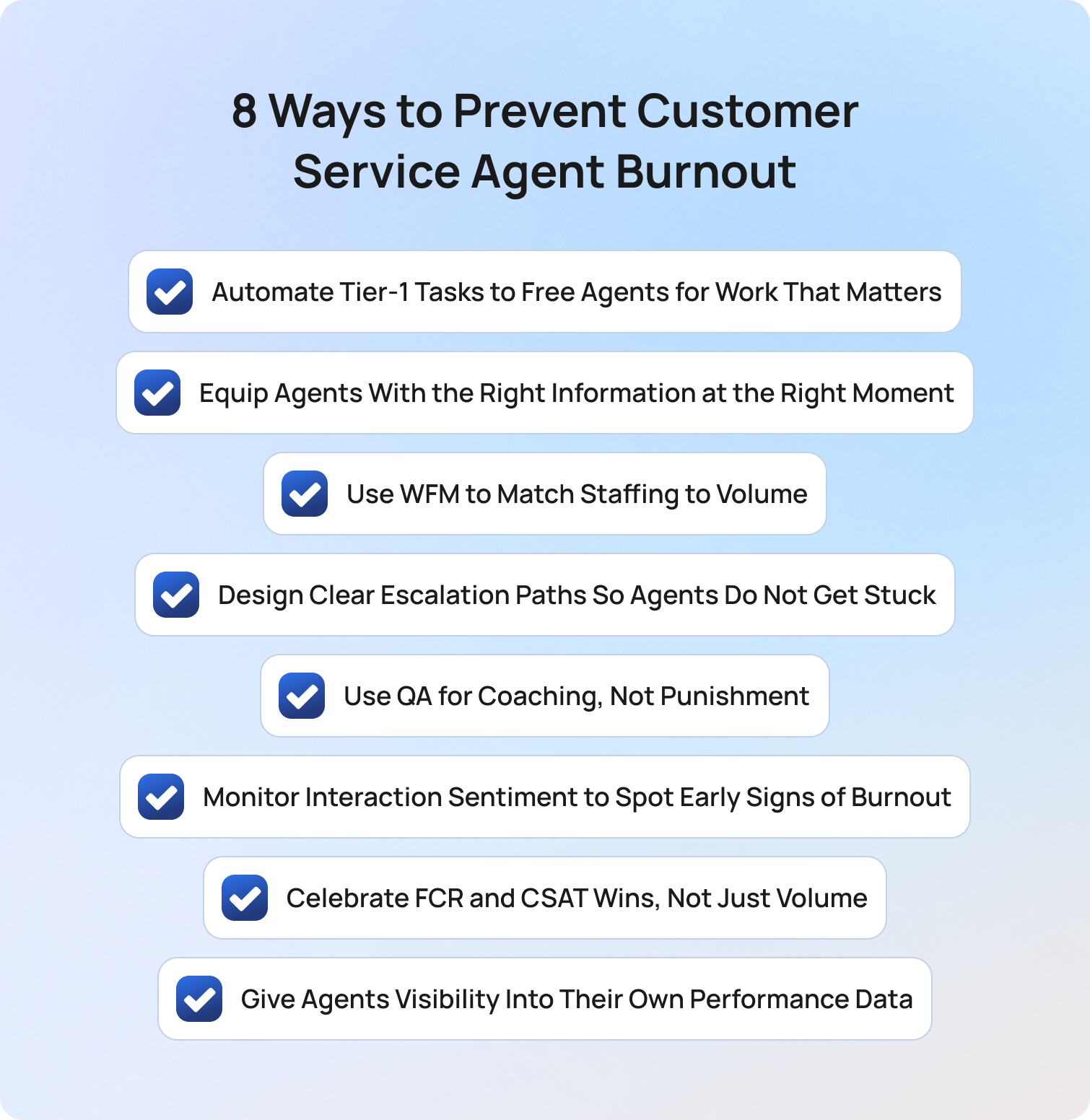
Every strategy below addresses a root cause of burnout and a corresponding performance metric. Where the strategy involves technology, the performance benefit is direct and measurable. Where it involves culture or management practice, the performance benefit operates through reduced attrition and improved engagement.
1) Automate Tier-1 Tasks to Free Agents for Work That Matters
Deploying an AI chatbot and AI voicebot to handle high-volume, low-complexity interactions removes the most repetitive tasks from agent queues. FAQs, order status, password resets, and account updates. When AI handles routine inquiries, agents focus on complex, escalated, and high-value customer interactions that require judgment. That shift is more engaging and less exhausting in equal measure.
This is one of the most effective ways to prevent burnout at the structural level and to genuinely empower agents to do their best work. You are not asking employees to manage stress better. You are removing the source of it. That difference matters both to the agents and to the numbers.
Performance benefit: containment rate improves, agents are available for complex tasks, and AHT on agent-handled interactions typically drops.
2) Equip Agents With the Right Information at the Right Moment
Agents who manually search for answers during live customer interactions carry unnecessary cognitive load on every call and chat. Toggling between tabs, searching knowledge bases, and asking colleagues mid-interaction is friction that compounds across an entire shift. Proposed reply and real-time KB retrieval surfaces the right answer directly in the agent workspace, reducing friction and helping agents feel supported rather than left to fend for themselves.
Supervisors who want to reduce friction quickly should prioritise this before expanding AI autonomy. Maintaining a strong, updated knowledge base and enabling real-time AI coaching directly empowers agents to handle customer interactions with confidence rather than uncertainty. The impact is immediate, and the risk is low. Agents who spend a few minutes less per interaction searching for answers accumulate hours of recovered capacity across a week.
Performance benefit: AHT drops, FCR improves, and agents report higher confidence in their ability to handle customer interactions.
3) Use WFM to Match Staffing to Volume
Understaffing during peak periods forces contact center agents to handle unsustainable volumes under time pressure. That is one of the most reliable triggers for acute burnout in a call center. Overstaffing during slower periods creates disengagement. AI-powered WFM forecasting schedules the right number of agents for predicted volume and supports flexible scheduling that reduces both extremes.
Workload adjustments driven by data rather than gut feel create a more predictable work day for agents. When the workload is predictable, stress is manageable. Scheduling regular breaks into shifts also matters. Enforcing short, frequent breaks during shifts helps agents reset from intense customer interactions, reducing the cumulative emotional strain that builds across a full day.
Performance benefit: SLA compliance improves during peaks, abandon rate falls, and agent satisfaction scores typically improve when workloads are consistent.
4) Design Clear Escalation Paths So Agents Do Not Get Stuck
Agents who cannot resolve a complex interaction because there is no escalation path, no authority to act, and no human-in-the-loop option experience acute frustration and helplessness. Feeling stuck is one of the fastest paths to feeling burnt out. Designing clear escalation triggers and handoff paths removes this failure mode. Agents need to know that when a situation exceeds their scope, there is a clear route forward.
This is equally important for the customer experience. Complex issues and escalating complaints routed to the right person are resolved faster, with less customer frustration on both sides of the interaction.
Performance benefit: FCR improves on escalated interactions, and agents report higher confidence when they know complex cases have a clear path.
5) Use QA for Coaching, Not Punishment
QA programmes that agents experience as surveillance or punishment increase disengagement and anxiety. When the QA module is framed as coaching, it fosters psychological safety and open communication. Recognising strong interactions, identifying development opportunities, and giving agents visibility into their own performance builds confidence rather than eroding it.
Regular one-on-one sessions between managers and agents to discuss workload, feedback, and development goals extend this further, creating a structured cadence for checking in before problems become burnout. Team meetings that share insights from QA reviews, rather than singling out poor performers, build a sense of camaraderie and shared purpose.
Managers who shift QA from a compliance function to a coaching function consistently report improvements in both agent experience and service quality. Giving employees a safe space to talk through performance data with their supervisor, without fear of punishment, is one of the most practical ways to make a difference in both engagement and results.
Performance benefit: quality scores improve when agents understand expectations and receive actionable coaching. CSAT follows.
6) Monitor Interaction Sentiment to Spot Early Signs of Burnout
AI sentiment analysis can flag interactions where agent stress signals are present before they become a burnout event. Tense language, shortened responses, and declining quality scores across a shift. Supervisors who recognize these early signs can intervene proactively, such as a check-in, a regular break, or a workload adjustment, rather than reacting after disengagement has already set in.
Proactive manager intervention is far more effective than any amount of mental health resources offered after the fact. The goal is to prevent burnout, not manage it once it has happened.
Performance benefit: catching early signs reduces absenteeism and attrition. Early coaching improves quality before scores deteriorate.
7) Celebrate FCR and CSAT Wins, Not Just Volume
Contact centers that measure and celebrate only volume metrics, such as calls handled and tickets closed, inadvertently incentivise speed over quality. Agents who are measured primarily on throughput feel like throughput. Shifting recognition in team meetings and one-to-ones to quality metrics such as FCR, CSAT, and positive customer feedback creates a customer-centric culture where agents feel valued for what they achieve, not just how fast they move.
Offering recognition and clear opportunities for career growth also combats feelings of being undervalued, which research consistently identifies as one of the most significant contributors to agent burnout. Creating an environment that encourages collaboration among employees enhances skill development and builds the kind of team culture that serves as a practical buffer against stress.
Employers who make this shift consistently report lower attrition, higher engagement, and stronger quality scores.
Performance benefit: FCR and CSAT improve when agents are motivated to resolve well, not just fast. Attrition falls when agents feel the job recognises their contribution.
8) Give Agents Visibility Into Their Own Performance Data
Agents who have no visibility into their own performance data cannot self-correct or take pride in their own improvement. Real-time dashboards showing individual FCR, CSAT, and AHT, framed as personal development tools, not management surveillance, give agents a sense of agency over their own work. The ability to see improvement over time is one of the most underrated drivers of job satisfaction in a contact center.
Performance benefit: self-awareness of metrics correlates with quality improvement. Agents who see their own progress report higher job satisfaction and are less likely to leave.
How BlueTweak Helps Prevent Agent Burnout Without Sacrificing Performance
BlueTweak applies the capabilities that matter most for agent well-being in a unified platform. Agents work in one workspace rather than toggling between collaboration tools and systems, which itself reduces cognitive load throughout the shift.
AI chatbot and AI voicebot automate tier-1 volume so agents handle work that requires their skills. Proposed reply and KB-grounded responses reduce in-interaction cognitive load. The WFM module forecasts volume and supports flexible scheduling that reduces the peaks-and-troughs stress cycle. The QA module enables coaching-led quality review rather than punitive monitoring. Customer service analytics gives agents visibility into their own performance data as a development tool.
The fastest way to burn out a good agent is to give them bad tools and call it a support role. When agents have what they need, the right information, the right workload, the right feedback, both their well-being and your metrics move in the same direction.

Try BlueTweak for yourself with a 14-day free trial
Try NowFinal Thoughts
Preventing agent burnout and maintaining performance are not competing goals. They are the same goal approached from two different directions. The teams that solve burnout by removing repetitive tasks, improving tools, fixing scheduling, and building coaching-led QA consistently report improvements in both agent retention and CX metrics.
The work day does not have to be a choice between protecting your agents and protecting your numbers.

As Head of Digital Transformation, Radu looks over multiple departments across the company, providing visibility over what happens in product, and what are the needs of customers. With more than 8 years in the Technology era, and part of BlueTweak since the beginning, Radu shifted from a developer (addressing end-customer needs) to a more business oriented role, to have an influence and touch base with people who use the actual technology.



