Proactive vs Reactive Customer Service: How AI Helps Brands Stay Ahead


BlueTweak is an AI Customer Support Platform that unifies every conversation, customer record, and automation into one workspace.
Explore more
Insights, trends, and practical ideas from customer experience and AI
Real-world scenarios showing how teams use BlueTweak to deliver better service
The daily blueprint that guides customer support leadership.
ROI and savings calculators for support teams
See how BlueTweak stacks up against leading customer support platforms
Proactive customer service helps businesses anticipate customer needs, resolve issues earlier, and create smoother customer experiences before frustration escalates. Unlike reactive customer service, which responds after problems occur, proactive customer support uses AI, automation, predictive analytics, and customer data to improve operational efficiency while enhancing customer satisfaction and customer loyalty. Understanding how proactive customer service strategies with AI work is becoming increasingly important for businesses looking to exceed customer expectations, reduce support pressure, and gain a long-term competitive advantage.
Proactive customer service is a customer support approach focused on identifying and resolving issues before the customer initiates contact. Instead of waiting for complaints, businesses anticipate customer behavior, customer concerns, and customer needs to create smoother customer interactions and better outcomes.
Customer expectations have fundamentally changed; today’s customers expect fast responses, personalized experiences, and seamless communication across every touchpoint in the customer journey. Businesses that fail to provide proactive customer support risk falling behind competitors that are already using AI and automation to stay ahead.
According to a 2025 global customer experience study by PwC, customers increasingly rank speed, personalization, and convenience among the most important factors influencing brand loyalty and repeat business. Organizations that proactively address customer pain points are significantly more likely to retain loyal customers and increase customer trust.
The reality is simple: reactive service alone is no longer enough. As businesses scale digital operations, customer support teams face growing pressure to manage more customer queries, more channels, and rising expectations simultaneously. That is why proactive customer service strategies with AI are becoming a critical competitive advantage.
“The companies leading customer experience transformation are no longer waiting for problems to happen. They are using AI and operational insight to predict friction points, personalize engagement, and resolve issues before customers even need to ask for help”

Radu Dumitrescu, Head of Presale & Digital Transformation
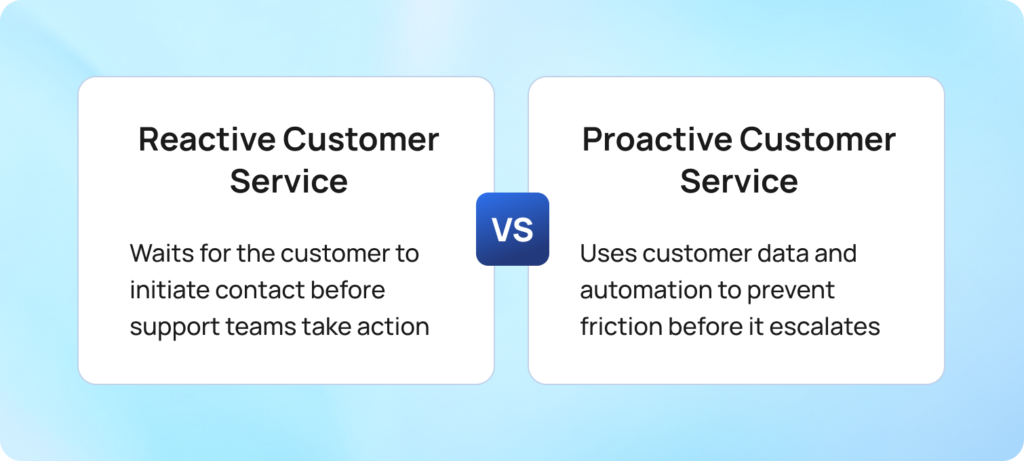
Proactive vs. reactive customer service refers to two fundamentally different approaches to customer support and customer communication. Reactive customer service responds after a customer issue has already occurred. Proactive customer service aims to prevent poor customer service experiences before they happen.
The difference between the two approaches has a direct impact on customer satisfaction, operational efficiency, and long-term customer loyalty.
Reactive customer service waits for the customer to initiate contact before support teams take action. This approach focuses on resolving customer complaints, answering customer inquiries, and managing customer issues after they arise.
Reactive customer service remains necessary for many support situations, but relying on it entirely can create several operational challenges:
Reactive customer service responds effectively in urgent situations, but it rarely addresses the root causes behind recurring customer concerns.
Proactive customer service involves using customer data, behavioral signals, predictive analytics, and automation to anticipate customer needs and prevent friction before it escalates.
Businesses implementing proactive customer service often:
Unlike reactive customer service, proactive support creates experiences where customers feel valued, informed, and supported throughout the customer journey. This proactive approach helps businesses exceed customer expectations while reducing unnecessary support volume.
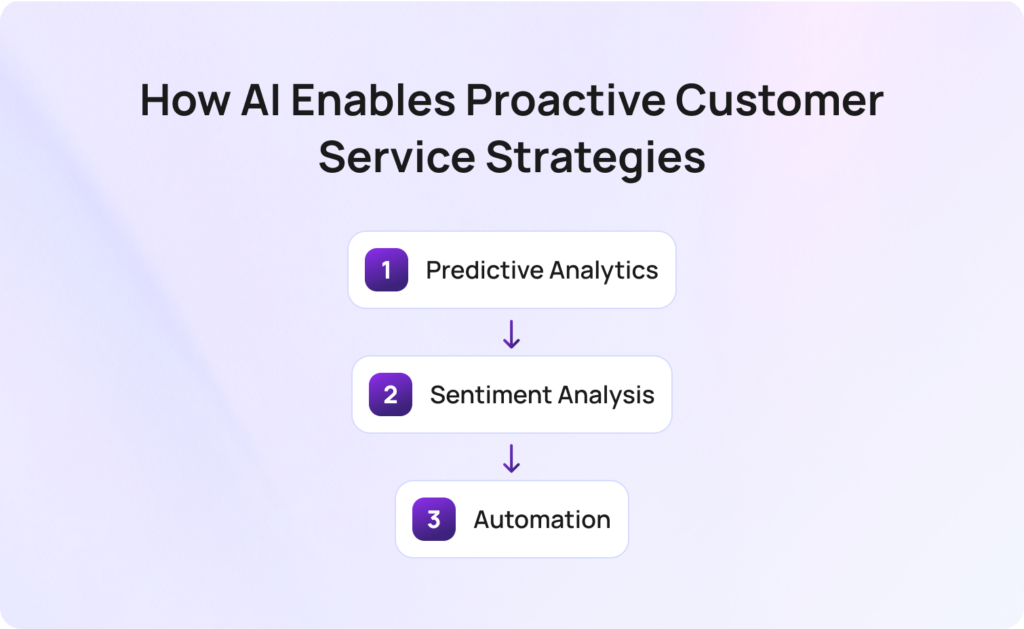
Proactive customer service strategies with AI use automation, predictive analytics, and sentiment analysis to help businesses anticipate customer concerns before they escalate into larger issues.
AI has changed how organizations deliver proactive customer care because it allows support teams to move from reactive to proactive decision-making at scale.
Without AI, identifying customer sentiment patterns or predicting customer issues across thousands of interactions would require enormous manual effort. With AI-powered systems, businesses can continuously monitor customer interactions in real time and take immediate action.
Predictive analytics uses historical customer data and behavioral trends to forecast likely outcomes or customer actions. For example, AI can identify:
This enables businesses to address customer concerns before they negatively affect customer satisfaction.
Sentiment analysis allows organizations to monitor customer sentiment across voice calls, chat, email, surveys, and social channels. Instead of relying solely on post-interaction customer feedback, businesses can continuously evaluate how customers feel during live customer interactions.
This provides valuable insights into:
By monitoring customer sentiment proactively, support teams can intervene earlier and protect customer relationships before dissatisfaction grows.
Automation plays a central role in proactive customer support strategies because it helps businesses deliver timely communication at scale.
Examples of proactive customer service powered by automation include:
| Proactive Service Example | Customer Benefit |
| Shipping delay notifications | Reduces inbound customer inquiries |
| AI-powered self service resources | Faster issue resolution |
| Automated outage alerts | Builds customer trust |
| Personalized onboarding journeys | Improves customer experience |
| Proactive renewal reminders | Increases repeat business |
These proactive strategies help organizations provide proactive customer support without increasing operational complexity.
The benefits of proactive customer service extend far beyond support efficiency. Organizations that successfully implement proactive customer service strategies often improve both operational performance and customer loyalty simultaneously.
Businesses that proactively address customer concerns can reduce friction across the entire customer journey while improving brand perception.
Customers are more likely to remain loyal to businesses that consistently anticipate customer needs and resolve issues quickly.
When customers feel valued and supported proactively, they are more likely to:
This creates stronger customer relationships and increased customer loyalty over time.
Proactive support reduces repetitive customer contacts and prevents avoidable escalations.
By addressing customer issues early, businesses can:
This leads to more efficient resource allocation and stronger operational scalability.
Organizations that deliver proactive customer service differentiate themselves in crowded markets.
Many businesses still rely heavily on reactive customer service models. Companies that successfully transition from reactive to proactive support can create a measurable competitive advantage by delivering faster, smoother, and more personalized customer experiences.
Examples of proactive customer service can be found across industries, particularly among organizations investing heavily in AI, automation, and customer experience transformation.
The most effective proactive customer support strategies combine technology with operational visibility. For example, businesses may:
At BlueTweak, organizations use AI-powered automation and analytics to improve visibility across customer operations and support workflows. One example comes from the packaging industry where a transformation enabled a BlueTweak customer to improve operational reporting visibility and accelerate issue resolution processes across customer support operations. The result was faster identification of recurring customer pain points, improved cross-team collaboration, and a more proactive approach to maintaining service quality and customer satisfaction at scale.
This type of proactive operational insight helps businesses identify customer issues earlier and improve overall customer satisfaction.
Want to move from reactive to proactive customer support? Start a free BlueTweak trial and discover how AI-driven insights, automation, and analytics can help you prevent issues before they impact your customers.
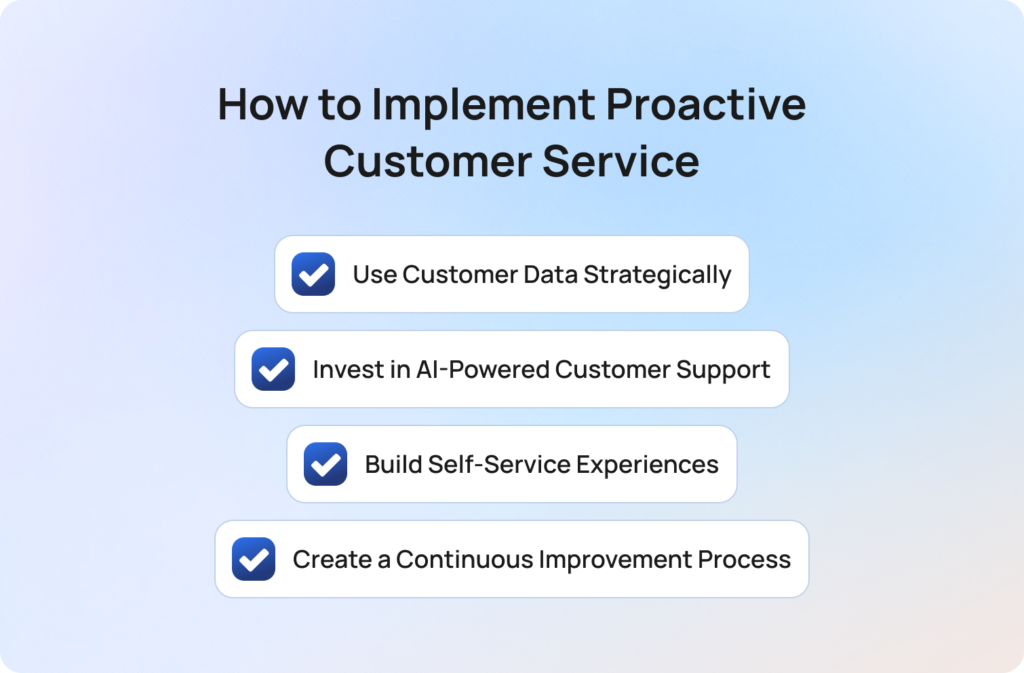
Implementing proactive customer service means businesses need a connected strategy that combines technology, operational alignment, and customer-centric thinking. Organizations looking to deliver proactive customer service effectively should focus on several core areas.
Customer data is the foundation of every proactive customer service approach. Businesses should unify customer interactions, customer feedback, behavioral signals, and operational data to create a clearer understanding of customer needs and customer behavior.
This enables more accurate predictive analytics and more personalized proactive outreach.
AI helps businesses monitor customer sentiment, identify customer pain points, and automate repetitive support processes. For the most successful proactive customer support strategy, use AI to support human agents rather than replace them entirely.
This balance allows businesses to improve speed while maintaining empathy and personalization.
Proactive self-service options help customers solve problems independently before they escalate into support tickets.
Knowledge bases, intelligent FAQs, guided workflows, and AI chat assistants all contribute to a stronger proactive customer service approach.
Proactive service requires ongoing optimization, so businesses should regularly review customer feedback, monitor customer sentiment trends, and analyze support outcomes to identify new opportunities for improvement.
Continuous improvement ensures proactive strategies remain aligned with evolving customer expectations.
The shift from reactive to proactive customer support reflects a broader change in how businesses think about customer experience.
Reactive customer service lies at the center of traditional support models. However, modern organizations increasingly recognize that waiting for customer complaints creates unnecessary friction, operational inefficiency, and lost loyalty.
Proactive customer service differs significantly because the goal is prevention, not simply resolution. Businesses that successfully provide proactive customer service use proactive strategies to prevent poor customer service experiences, helping reduce friction, improve customer satisfaction, and strengthen long-term customer loyalty.
These businesses can:
As AI capabilities continue to evolve, proactive customer service strategies with AI will become an even more important differentiator for organizations focused on long-term customer experience leadership.
If you’re ready to see what proactive customer support could look like in your organization, start a free 14-day BlueTweak trial, no credit card required, or book a personalized demo with one of our specialists. Discover how AI-powered automation, analytics, and customer insights can help you anticipate customer needs, improve customer satisfaction, and stay one step ahead of customer expectations.
Proactive customer service is a support approach where businesses anticipate customer needs and resolve issues before customers ask for help. This often involves predictive analytics, automation, proactive outreach, and customer sentiment monitoring.
Proactive vs reactive customer service differs mainly in timing. Reactive customer service responds after a customer issue occurs, while proactive customer service aims to prevent poor customer service experiences before they happen.
Proactive customer service improves customer satisfaction, reduces customer frustration, strengthens customer loyalty, and creates a better customer experience overall.
AI supports proactive customer service by analyzing customer data, monitoring customer sentiment, identifying customer pain points, and automating proactive support actions in real time.
As Head of Digital Transformation, Radu looks over multiple departments across the company, providing visibility over what happens in product, and what are the needs of customers. With more than 8 years in the Technology era, and part of BlueTweak since the beginning, Radu shifted from a developer (addressing end-customer needs) to a more business oriented role, to have an influence and touch base with people who use the actual technology.