How to Use AI Automation for Support Ticket Backlog Reduction in 2026


BlueTweak is an AI Customer Support Platform that unifies every conversation, customer record, and automation into one workspace.
Explore more
Insights, trends, and practical ideas from customer experience and AI
Real-world scenarios showing how teams use BlueTweak to deliver better service
The daily blueprint that guides customer support leadership.
ROI and savings calculators for support teams
See how BlueTweak stacks up against leading customer support platforms
AI automation for support ticket backlog reduction works through five mechanisms: autonomous tier-1 resolution, intelligent routing and prioritisation, AI agent assist, proactive outreach, and AI-powered self-service. Together, these capabilities reduce ticket volume, accelerate ticket resolution, and help support teams clear backlogs more efficiently. The key is understanding the difference between ticket deflection and ticket containment. A backlog is only reduced when issues are fully resolved, not simply redirected. That is why this article focuses on the metrics that matter most: queue depth, queue age, and containment rate. If your support backlog is growing faster than your team can manage, this guide explains how to reduce inflow, increase throughput, and measure whether AI automation is actually clearing the queue.
Support ticket backlogs rarely appear overnight. They build gradually as ticket volume outpaces the capacity of support teams to resolve incoming requests. Before long, response times slow, SLA breaches increase, and support agents spend more time managing queues than solving problems.
For IT support operations and customer support teams, simply adding headcount is rarely enough to reverse the trend. The backlog often continues to grow while new hires are recruited, onboarded, and trained.
This is why many organizations are turning to AI automation for support ticket backlog reduction. By combining AI agents, intelligent ticket routing, workflow automation, and self-service resolution, platforms like BlueTweak help teams reduce ticket volume, automate repetitive requests, and resolve tickets faster without increasing operational cost.
The challenge is knowing which AI capabilities actually reduce a support backlog, and how to measure whether the backlog is genuinely shrinking. That’s what this guide covers.
A support ticket backlog forms when incoming ticket volume grows faster than a team’s ability to resolve tickets.
Most organizations treat a backlog as a staffing issue; if tickets are piling up, the assumption is that more support agents are needed. Workforce planning remains important, but scheduling alone rarely solves the underlying imbalance between incoming demand and resolution capacity. While additional headcount can provide temporary relief, it rarely addresses the underlying cause of backlog growth. A support backlog is fundamentally a ratio problem, not a headcount problem.
The ratio is simple: incoming requests versus resolution capacity. When ticket volume consistently exceeds the number of tickets a team can close, the queue grows. It does not matter how experienced the team is or how hard they work, the maths eventually wins.
This challenge is becoming more common as organizations support more users, more applications, and more digital services than ever before. Every new system, process, or customer touchpoint creates additional opportunities for support tickets, repetitive questions, access requests, password resets, and service desk enquiries.
The traditional response is to hire, but the problem is that hiring operates on a delay. Effective workforce planning can improve coverage and resource allocation, but even the best schedules cannot solve a backlog if ticket volume continues to grow faster than resolution capacity. Recruitment takes weeks or months, and onboarding takes longer. During that time, incoming requests continue to arrive, and the support backlog continues to grow. By the time new agents become fully productive, ticket volume has often increased again.
This creates a cycle that many support operations know all too well: the team spends months trying to catch up, only to discover the target has moved.
And the situation becomes even harder as the backlog ages. Older tickets are rarely easier tickets; they often involve frustrated users who have already waited for assistance, chased updates, or contacted support through multiple channels. These interactions typically take longer to resolve than fresh tickets, increasing average resolution time and placing additional pressure on support operations.
As resolution times increase, throughput falls. As throughput falls, the backlog grows. The queue begins to feed itself.
This is why backlog-clearing projects frequently fail despite significant effort. Teams focus on adding capacity while ignoring the volume entering the queue each day.
AI automation approaches the problem differently. Rather than increasing the number of people available to process tickets, AI automation reduces the number of tickets requiring human involvement in the first place. Routine requests such as password resets, software provisioning, access management queries, and common knowledge base questions can be resolved automatically before they ever enter the service desk queue.
This distinction matters because preventing a ticket from entering the backlog is often more valuable than resolving it after it has already aged.
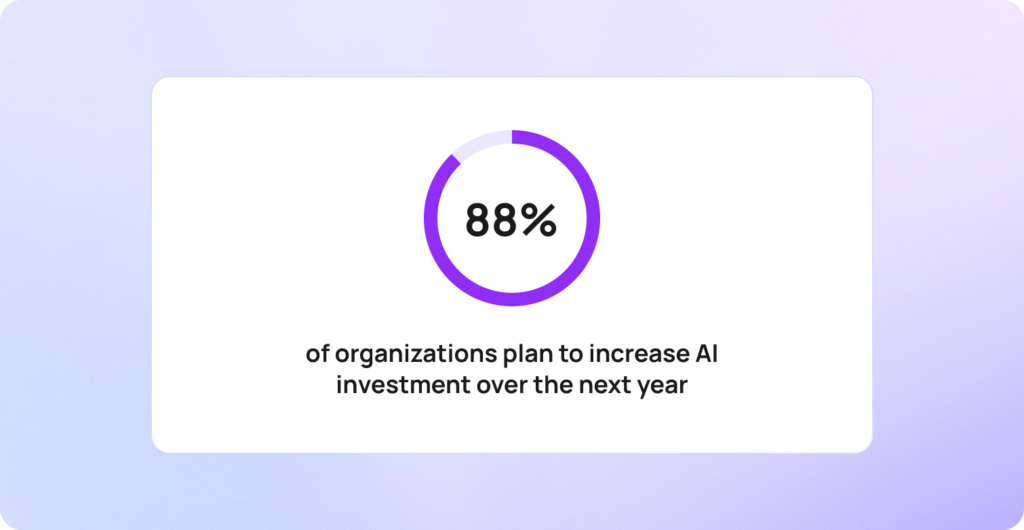
According to PwC’s 2025 AI Agent Survey, 79% of organizations are already using AI agents, while 88% plan to increase AI investment over the next year. The shift reflects a growing recognition that sustainable backlog reduction requires more than additional headcount. It requires reducing the gap between ticket volume and resolution capacity.
The most successful organizations are not simply working through support backlogs faster. They are changing the ratio that created the backlog in the first place.
Support ticket backlog reduction means reducing both the size and age of the queue, not simply reducing visible ticket volume. One of the biggest mistakes organizations make when evaluating AI automation is confusing ticket deflection with ticket containment.
Deflection measures whether a user avoided creating a support ticket during a particular interaction. Containment measures whether the issue was fully resolved without generating a follow-up request.
A user may interact with an AI agent, fail to find an answer, and contact support later through email, phone, or Microsoft Teams. The original interaction may count as a successful deflection, but the underlying issue remains unresolved. The workload has not disappeared. It has simply moved.
This is why support leaders should treat deflection as an activity metric and containment as an outcome metric.
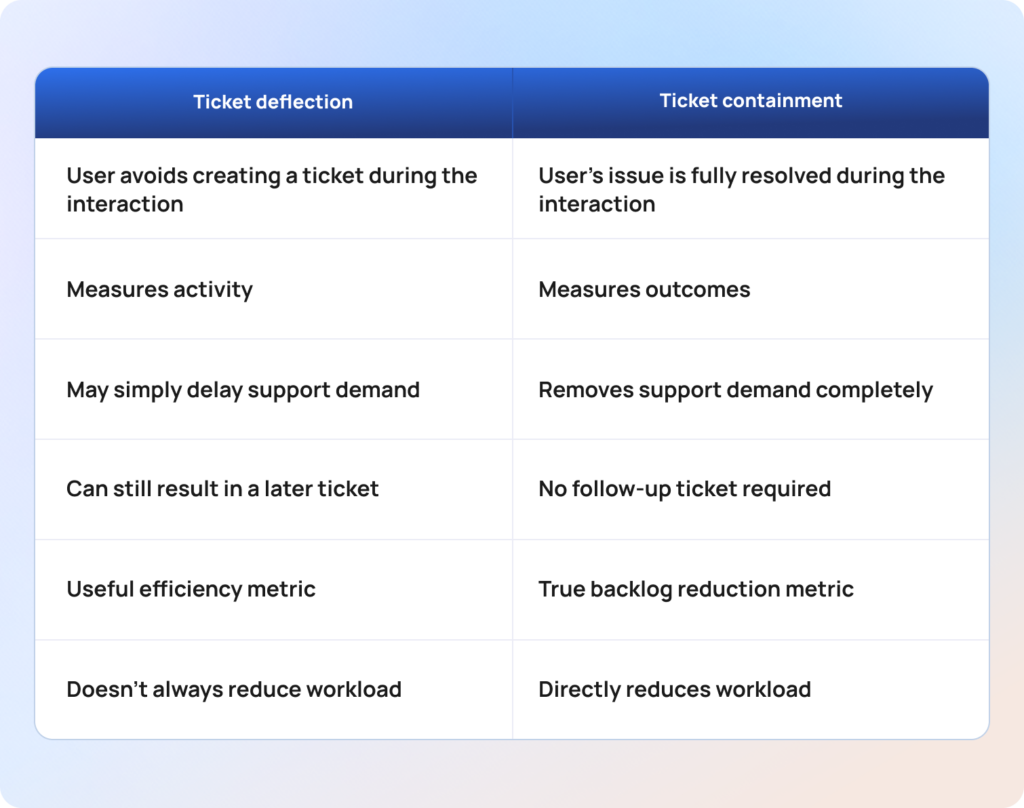
A team reporting a 60% ticket deflection rate may appear highly efficient. However, if users continue to create support tickets later, the backlog remains intact. In some cases, deflection-focused programmes can even increase customer frustration by adding another step before a user reaches support.
True ticket backlog reduction requires containment. For AI automation to reduce a support backlog sustainably, it must resolve issues completely, prevent repeat contacts, and remove demand from the service desk altogether.
This is also why ticket volume alone is an unreliable measure of success.
Support operations should track two metrics together:
| Metric | What it Reveals |
| Queue Depth | The total number of open tickets |
| Queue Age | The age of the oldest unresolved tickets |
This queue depth versus queue age framework provides a more accurate picture of backlog health than ticket volume alone.
If queue depth falls while queue age rises, the backlog is not being cleared. Teams are processing newer tickets while older requests continue to age in the background.
A genuinely improving support operation sees both metrics move in the right direction. Queue depth falls because fewer tickets are entering the system, and queue age falls because older tickets are being resolved faster than new ones arrive. This is the difference between managing a backlog and eliminating one.
AI automation for support ticket backlog reduction combines multiple technologies that reduce incoming ticket volume, accelerate ticket resolution, and improve support team productivity.
Once teams understand the difference between backlog management and backlog reduction, the next question becomes practical: which AI capabilities actually move those metrics? While AI automation is often discussed as a single technology, backlog reduction is typically driven by five distinct mechanisms that work together to reduce inflow, increase throughput, and improve ticket resolution quality.
Not all AI automation mechanisms contribute to backlog reduction in the same way. Some reduce the number of support tickets entering the service desk, while others help support teams resolve existing tickets faster. Understanding the difference is essential when building an effective backlog reduction strategy.
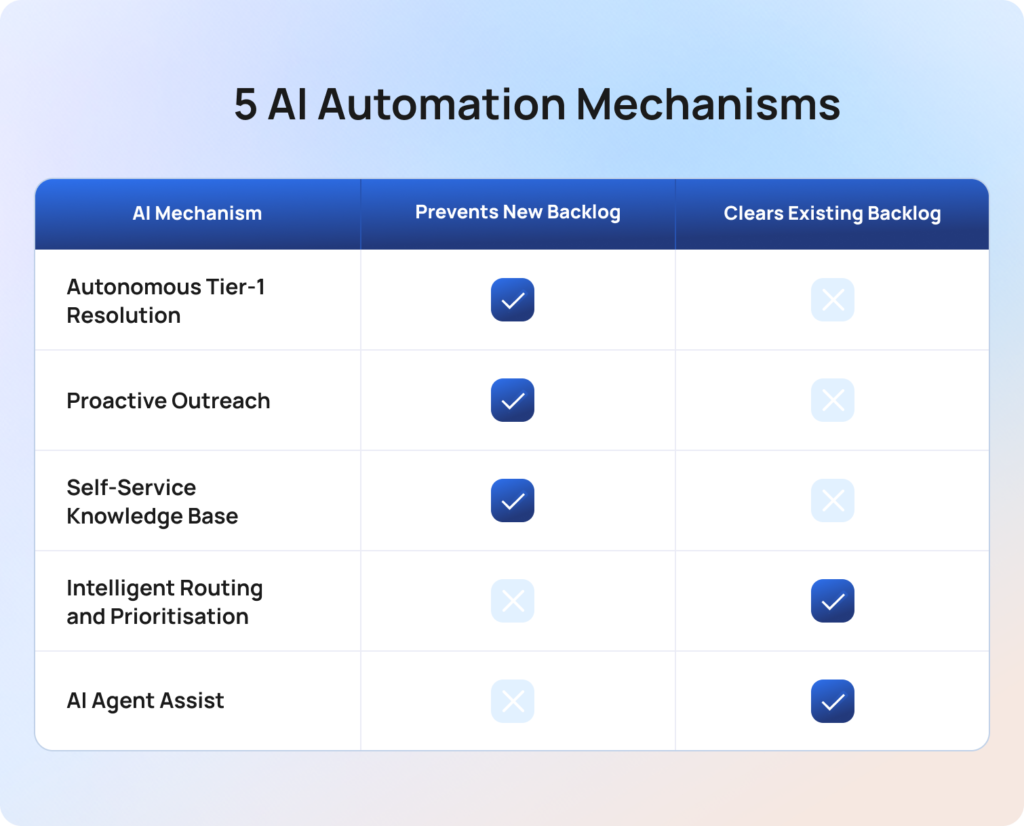
The most effective backlog reduction programmes combine both approaches: reducing demand entering the queue while increasing the speed at which existing tickets are resolved.
While autonomous resolution prevents new tickets from entering the queue, organizations must also ensure the tickets that do arrive reach the right people as quickly as possible.
Autonomous tier-1 resolution uses AI agents to resolve routine support requests without human intervention.
For most support teams, a significant percentage of incoming tickets involve repetitive, predictable requests. Password resets, access requests, account updates, order status queries, billing questions, and common service desk enquiries often follow well-defined processes with known outcomes.
AI-powered virtual agents can handle these interactions automatically by understanding natural language, retrieving relevant information, and delivering an automated resolution in real time.
The biggest benefit is that these tickets never enter the support queue. Rather than helping agents work through an existing backlog, autonomous resolution prevents new backlog formation by removing routine requests before they require agent involvement.
For organizations struggling with growing ticket volume, this is often the fastest way to reduce pressure on support operations because it immediately lowers the rate at which new tickets enter the system.
Reducing delays in ticket assignment improves flow through the queue, but many tickets still require human expertise to reach a successful resolution. Intelligent routing and prioritisation uses AI to ensure support tickets reach the right team, with the right priority, as quickly as possible.
Misrouted tickets are one of the most common contributors to support backlog growth. A ticket assigned to the wrong queue may sit untouched for hours or days before being transferred, increasing queue age and delaying resolution. In many cases, the ticket effectively starts its journey again once it reaches the correct team.
AI-powered ticket triage uses natural language processing to analyse ticket content, identify intent, assess urgency, and route requests automatically. It can also prioritise tickets based on SLA risk, customer value, business impact, or sentiment.
Unlike autonomous resolution, intelligent routing does not prevent new tickets from entering the queue. Instead, it reduces delays within the existing ticket lifecycle, helping support teams work through backlogs more efficiently and preventing tickets from ageing unnecessarily.
AI agent assist helps support agents resolve complex tickets faster by surfacing relevant information and recommending next actions.
Not every support request should be automated. Complex issues, sensitive cases, and requests requiring human judgment will always need human involvement. However, these tickets often consume the greatest amount of agent time.
AI-powered agent assist tools analyse conversation context, retrieve relevant knowledge base articles, surface information from past tickets, and generate suggested responses. Combined with reusable canned responses for common enquiries, these capabilities help support agents maintain consistency while reducing the time spent on repetitive drafting tasks. This reduces the time agents spend searching across multiple tools and allows them to focus on solving the issue itself. For voice-based support operations, AI-generated call transcriptions can also make historical conversations searchable, giving agents faster access to context from previous customer interactions.
For well-implemented deployments, organizations commonly report average handle time reductions of 15–20% during the first year.
Unlike autonomous resolution, agent assist directly addresses existing backlog depth. By reducing the effort required to resolve complex tickets, support teams can increase throughput without increasing headcount, helping older tickets leave the queue faster.
Proactive outreach uses AI and workflow automation to resolve issues before users feel the need to contact support.
A significant percentage of support tickets are predictable. Service outages, payment failures, delayed deliveries, software maintenance windows, and billing cycle changes frequently generate waves of incoming requests that support teams know are coming.
AI-powered workflow automation can trigger targeted communications when these events occur, providing users with timely updates, expected resolution times, or self-service guidance before they submit a support ticket.
The result is fewer incoming requests and lower pressure on support operations during high-volume periods.
For predictable events, well-designed proactive outreach programmes can reduce associated inbound ticket volume by 20–40%. Rather than helping teams clear existing backlogs, this mechanism reduces the rate at which new tickets enter the queue, making backlog reduction efforts more sustainable over time.
A self-service knowledge base enables users to find answers independently without contacting support.
This is often referred to as tier-0 containment because no support interaction is required. Users search for information, find a relevant answer, and resolve the issue themselves without creating a ticket or engaging with a support agent.
Modern AI-powered search capabilities make this process significantly more effective by understanding natural language queries and surfacing the most relevant knowledge base articles, even when users do not use the correct technical terminology. For global organizations, multilingual self-service experiences can further reduce ticket volume by helping users find answers in their preferred language before contacting support.
The effectiveness of this approach depends heavily on knowledge base quality. Outdated, incomplete, or poorly structured content often creates repeat contacts rather than preventing them.
When maintained effectively, a self-service knowledge base delivers the lowest-cost form of ticket resolution available. Every issue resolved through self-service is one less ticket entering the service desk queue, reducing ticket volume and helping prevent future backlog growth.
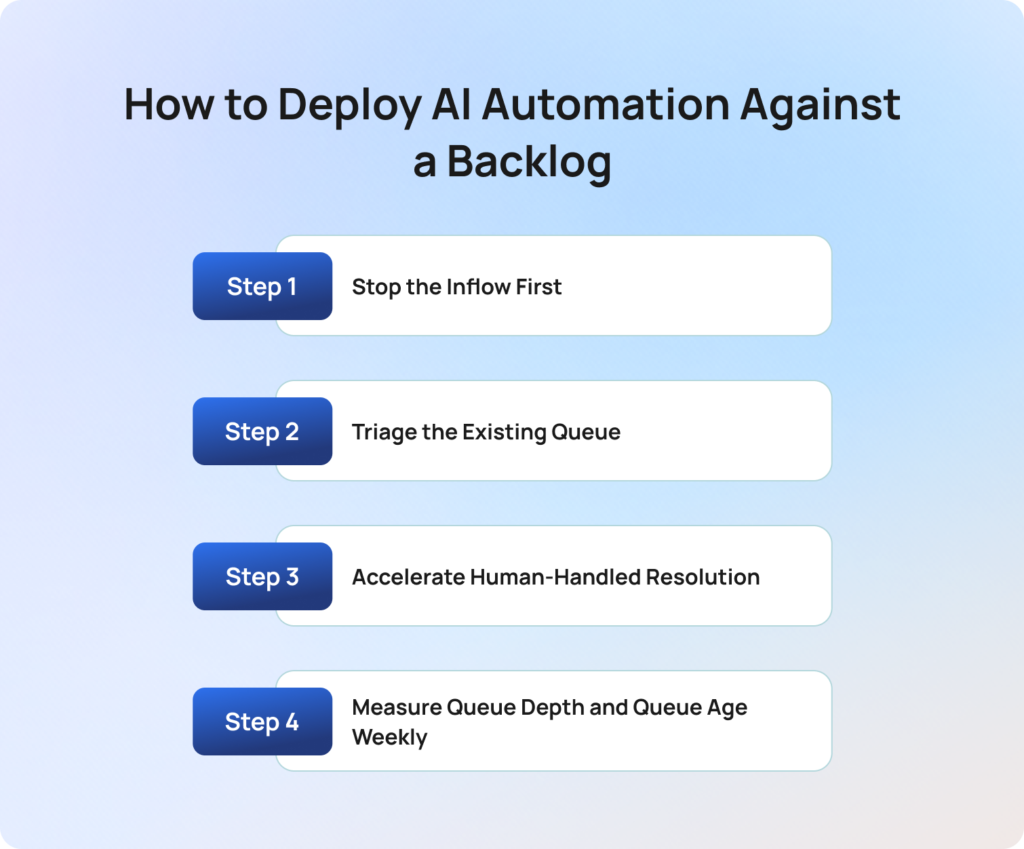
The most effective AI automation programmes follow a specific deployment order that reduces incoming demand before increasing resolution capacity.
Many organizations make the mistake of implementing AI wherever it appears easiest or most visible. The result is often a collection of disconnected automation initiatives that improve individual metrics without materially reducing the support backlog.
Successful backlog reduction requires a more structured approach. Rather than treating every automation opportunity equally, support teams should focus first on reducing the number of tickets entering the queue and then on accelerating the resolution of the tickets that remain. This approach forms what we call the ‘four-step backlog reduction sequence’.
The fastest way to reduce a support backlog is to prevent new tickets from entering it.
Autonomous tier-1 resolution, proactive outreach, and self-service knowledge bases should typically be deployed before attempting to clear the existing queue. Every password reset, access request, or routine enquiry that is automatically resolved is one less ticket competing for agent attention.
Reducing inflow creates breathing room for support teams and prevents the backlog from growing while recovery efforts are underway.
Once inflow is under control, attention should shift to the backlog itself. AI-powered ticket triage can analyse existing support tickets based on urgency, SLA risk, customer value, and business impact. This ensures support agents focus on the tickets that matter most rather than simply working through the queue in chronological order.
The goal shouldn’t be to resolve the oldest ticket first, but to resolve the right ticket next.
Many tickets within a support backlog will still require human judgment. Agent assist tools help support teams resolve these complex issues faster by surfacing knowledge base articles, retrieving information from past tickets, and generating context-aware suggested responses. This reduces manual effort and increases throughput without requiring additional headcount.
As resolution times fall, support teams can work through existing backlog tickets more quickly while maintaining service quality.
Backlog reduction is only successful if the underlying metrics improve. So, support teams should monitor both queue depth and queue age throughout the deployment process. A reduction in open tickets may appear positive, but if older tickets continue to age, the backlog is simply being managed rather than eliminated.
Sustainable backlog reduction occurs when both metrics move in the right direction: fewer open tickets and fewer ageing tickets. This is the clearest indicator that AI automation is reducing backlog pressure rather than shifting it elsewhere in the support process.
Support ticket backlog reduction should be measured using operational outcomes, not activity metrics alone. One of the most common reasons AI initiatives fail to deliver meaningful results is that organizations track the wrong indicators. A falling ticket volume, rising deflection rate, or increase in chatbot usage may look positive on a dashboard, but none of these metrics prove that a support backlog is actually shrinking.
To understand whether AI automation is reducing backlog pressure, support teams need to focus on the metrics that reveal what is happening inside the queue itself.
Queue depth measures the total number of open support tickets at any given point in time. This is typically the first metric teams monitor when tackling a support backlog because it provides a clear view of overall workload. A falling queue depth is generally a positive sign, indicating that support teams are resolving tickets faster than new requests are entering the queue.
However, queue depth alone can be misleading. A backlog may appear to be shrinking simply because incoming ticket volume has slowed temporarily. To understand whether older tickets are genuinely being resolved, queue depth must always be measured alongside queue age.
Queue depth answers one question: how much work is waiting?
The next metric answers a far more important one: how long has it been waiting?
Queue age measures how long open tickets remain unresolved within the support queue. While queue depth shows backlog size, queue age reveals backlog health. A queue containing 500 tickets is not necessarily a problem if those tickets are being resolved within SLA targets. A queue containing 500 tickets that includes hundreds of ageing requests is a very different situation.
Support teams should track the percentage of open tickets older than key thresholds such as 24, 48, and 72 hours, or against their existing SLA commitments.
A healthy operation keeps queue age under control; a backlog problem almost always reveals itself through a growing tail of ageing tickets. This is why queue depth versus queue age provides a more reliable framework for measuring backlog reduction than ticket volume alone.
Containment rate measures whether an issue was fully resolved without generating a follow-up request, while deflection rate measures whether a user avoided creating a ticket during a specific interaction.
Many organizations celebrate improvements in ticket deflection without examining what happens next. If users return later through another channel, the support workload has not been eliminated, it’s simply been delayed.
Containment provides a more meaningful measure of AI effectiveness because it focuses on successful resolution rather than interaction outcomes. A rising deflection rate accompanied by a flat containment rate is often a warning sign that AI automation is moving demand around the support ecosystem rather than removing it.
First contact resolution rate measures the percentage of issues resolved during the first interaction. As AI agents mature and knowledge base quality improves, first contact resolution should increase across both automated and human-assisted channels. Higher first contact resolution rates reduce repeat contacts, lower ticket volume, and improve customer satisfaction.
Monitoring first contact resolution separately for AI-handled and human-handled interactions can also reveal where automation is delivering value and where additional optimisation is required.
If containment appears to be improving while first contact resolution declines, support teams should investigate whether tickets are being closed prematurely rather than genuinely resolved.
Repeat contact rate measures the percentage of resolved tickets that generate another request within a defined period. This is often the clearest indicator of whether backlog reduction is genuine.
When repeat contact rates increase, support teams may appear to be resolving more tickets while actually creating additional demand elsewhere. Users return because their original issue was not resolved fully, creating new workload that eventually re-enters the queue.
For organizations investing in AI automation for support ticket backlog reduction, repeat contact rate acts as an important quality-control metric. Falling repeat contact rates suggest that containment is improving while rising repeat contact rates suggest that apparent backlog improvements may not be sustainable.
Metrics tell you whether a backlog reduction strategy is working; the next step is understanding what those improvements look like in practice.
A support ticket backlog can often be reduced significantly within 90 days when AI automation is deployed in the right sequence and measured against the right outcomes.
Consider a hypothetical support operation with the following characteristics:
| Metric | Starting Position |
| Support Agents | 15 |
| Monthly Incoming Contacts | 8,000 |
| Open Ticket Backlog | 4.000 |
| Ticket Mix | 55% Tier-1, 45% Complex |
| Average Resolution Time | 3.5 Days |
The organization is struggling with growing queue depth, ageing tickets, and increasing SLA pressure. Rather than hiring additional agents immediately, the team follows the four-step backlog reduction sequence.
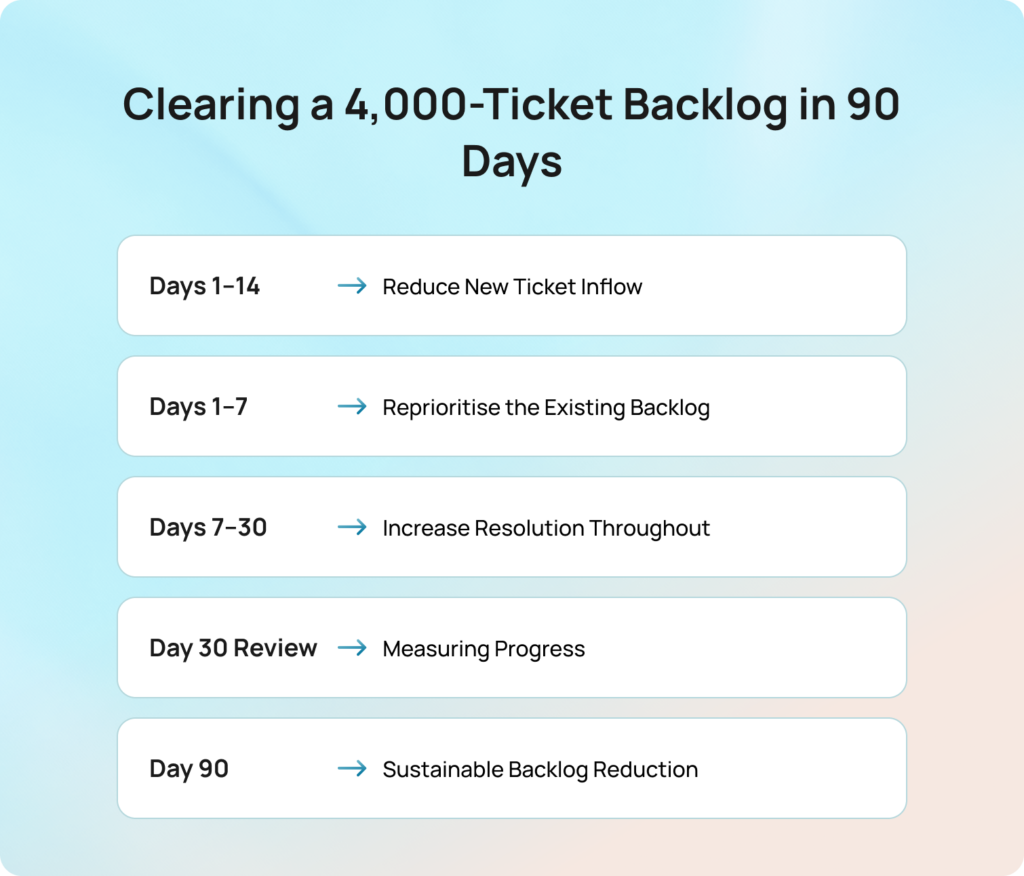
The first priority is stopping unnecessary tickets from entering the queue.
The organization deploys AI-powered autonomous resolution for routine requests such as password resets, access requests, account updates, and common service desk enquiries. Within two weeks, a significant proportion of tier-1 requests are being resolved automatically.
With 55% of monthly contacts falling into repeatable tier-1 categories, the support team no longer receives approximately 4,400 routine tickets each month. This immediately reduces pressure on support agents and prevents the backlog from growing further.
At the same time, AI-powered ticket triage analyses the existing queue.
Tickets are prioritised based on urgency, SLA risk, customer impact, and business value. Instead of simply working through the oldest tickets first, agents focus on the requests that create the greatest operational and customer experience risk.
This improves backlog quality immediately, ensuring the most important issues are resolved first while reducing the number of tickets approaching SLA breach.
Once ticket inflow is under control, attention shifts to the existing backlog.
Agent assist capabilities are introduced to help support agents resolve complex issues faster. AI-powered knowledge retrieval, suggested responses, and access to relevant ticket history reduce the time spent searching for information across multiple tools.
As a result, average handle time for complex tickets falls by approximately 15%, allowing the team to work through more tickets each day without increasing headcount.
After the first month, the organization reviews its backlog metrics.
Queue depth has fallen by approximately 35%, while the number of tickets older than 72 hours is steadily declining. Importantly, queue age is improving alongside queue depth, indicating that older tickets are being cleared rather than hidden behind newer requests.
Containment rates continue to rise as AI agents resolve more tier-1 requests without requiring escalation.
After three months, the support operation looks very different. The original 4,000-ticket backlog has been eliminated, incoming ticket volume remains significantly lower, and support agents are spending the majority of their time on higher-value work rather than repetitive requests.
Most importantly, the improvements are sustainable. The organization hasn’t simply worked through the backlog faster; it’s reduced the volume of work entering the queue while improving its ability to resolve the tickets that remain. This is the difference between a temporary backlog-clearing project and a long-term support operations strategy.
The scenario above is hypothetical, but the principles behind it are proven. Organizations using BlueTweak have successfully streamlined service desk operations through AI-powered ticket automation, intelligent routing, and workflow automation. For examples of how these initiatives have been implemented in real environments, explore the BlueTweak Case Studies page.
Every support operation is different. Factors such as ticket volume, average handle time, labour costs, and containment rates all influence the financial impact of AI automation. Use BlueTweak’s ROI Calculator to estimate potential cost savings and productivity gains based on your own service desk metrics.
BlueTweak combines AI automation, service management, and workflow orchestration capabilities in a single platform designed to reduce ticket volume, accelerate ticket resolution, and improve support operations performance.
The workflow described above is exactly how many organizations begin their backlog reduction journey with BlueTweak. Rather than treating automation as a collection of disconnected tools, BlueTweak brings together the core capabilities required to reduce inflow, increase throughput, and measure backlog reduction accurately. Administrative controls also allow IT teams to manage user roles, permissions, automation rules, and platform configuration from a single environment, reducing the operational overhead associated with managing multiple support tools.
BlueTweak’s AI-powered virtual agents help support teams automate routine requests across chat and voice channels.
Common service desk enquiries such as password resets, access requests, software provisioning, account updates, and knowledge base queries can be resolved automatically without requiring agent intervention. By resolving repetitive tickets before they enter the queue, support teams can reduce ticket volume and prevent new backlog formation.
BlueTweak’s AI Ticket Triage capability helps ensure incoming requests reach the right team as quickly as possible.
Using natural language processing and conversation context, tickets can be categorised, prioritised, and routed automatically based on intent, urgency, SLA risk, and business impact. This reduces delays caused by manual triage and helps support agents focus on the tickets that matter most.
For tickets that require human judgment, BlueTweak provides AI-powered support directly within the agent workflow. Proposed Reply capabilities help agents respond more quickly, while intelligent knowledge retrieval surfaces relevant knowledge base articles, ticket history, and contextual information from across enterprise systems. This reduces manual effort, improves agent productivity, and helps support teams resolve tickets faster without sacrificing quality.
Many support tickets are entirely predictable; BlueTweak enables organizations to automate communications and workflows triggered by service outages, maintenance events, billing issues, access management changes, and other common operational scenarios. By proactively informing users before they contact support, organizations can reduce ticket volume and minimise pressure on service desk teams.
BlueTweak’s Smart Knowledge Base helps users find answers independently through AI-powered search and self-service resolution. Rather than forcing users to navigate static documentation, AI-powered search understands natural language queries and returns the most relevant content. This improves knowledge base effectiveness, increases self-service resolution rates, and reduces unnecessary support requests.
Technology alone does not reduce a support backlog, measurement matters. BlueTweak’s analytics and reporting capabilities bring together queue depth, queue age, containment rate, ticket deflection rate, resolution time, and other operational metrics within a single dashboard. This allows support leaders to distinguish between genuine backlog reduction and deferred demand, ensuring automation initiatives are delivering measurable business outcomes.
Most organizations assume the solution to a growing backlog is adding more people. But backlogs grow because ticket volume increases faster than operational capacity. AI changes that equation by reducing the number of tickets entering the queue while helping agents resolve the remaining ones faster. The result is sustainable backlog reduction, not temporary relief.

Radu Dumitrescu, Head of Presale & Digital Transformation at BlueTweak
The real advantage of BlueTweak is that these capabilities work together. Ticket triage data informs containment reporting, knowledge base gaps highlight opportunities for workflow automation, and agent interactions reveal new self-service opportunities.
Instead of managing multiple tools across the support lifecycle, organizations gain a connected platform designed to improve customer experience, increase user satisfaction, and drive sustainable support ticket backlog reduction.
Ready to see the potential impact on your own service desk? Try out BlueTweak’s ROI Calculator to estimate potential productivity gains, cost savings, and ticket backlog reduction opportunities.
Support ticket backlogs are rarely caused by a lack of effort. More often, they occur because ticket volume grows faster than support teams can resolve incoming requests.
The organizations that reduce backlogs sustainably are reducing inflow through AI-powered automation, accelerate human-handled resolution, and measuring success using queue depth, queue age, and containment rate rather than ticket volume alone.
BlueTweak brings these capabilities together in a single platform, helping organizations automate repetitive requests, improve ticket management, and resolve support tickets faster without increasing operational cost.
If your team is struggling with a growing support backlog, start with a free 14-day trial of BlueTweak, with no credit card required, or book a personalized demo to see how AI automation can help reduce ticket volume and improve support operations performance.
AI automation for support ticket backlog reduction uses technologies such as AI agents, intelligent ticket routing, workflow automation, and self-service knowledge bases to reduce ticket volume and help support teams resolve tickets more efficiently. The goal is to reduce both queue depth and queue age while improving customer satisfaction and operational efficiency.
AI reduces ticket volume by automatically resolving repetitive requests before they reach the service desk. Common examples include password resets, access requests, account updates, software provisioning requests, and answers to frequently asked questions. This process is often referred to as ticket deflection or ticket containment, depending on whether the issue is fully resolved.
Ticket deflection occurs when a user avoids creating a support ticket during an interaction. Ticket containment occurs when the issue is fully resolved without requiring a follow-up request. Containment is generally considered the more valuable metric because it measures actual resolution rather than temporary avoidance of support channels.
The five most effective AI mechanisms for support ticket backlog reduction are autonomous tier-1 resolution, intelligent routing and prioritisation, AI agent assist, proactive outreach, and AI-powered self-service. Together, these capabilities help reduce incoming ticket volume while improving resolution speed for existing tickets.
The most reliable approach is to track queue depth and queue age together. Queue depth measures the number of open tickets, while queue age measures how long those tickets have remained unresolved. Organizations should also monitor containment rate, first contact resolution rate, and repeat contact rate to ensure backlog reduction is genuine and sustainable.
As Head of Digital Transformation, Radu looks over multiple departments across the company, providing visibility over what happens in product, and what are the needs of customers. With more than 8 years in the Technology era, and part of BlueTweak since the beginning, Radu shifted from a developer (addressing end-customer needs) to a more business oriented role, to have an influence and touch base with people who use the actual technology.