



TL;DR
Conversational AI detects customer intent by interpreting the meaning behind customer messages using natural language processing (NLP) and machine learning (ML), enabling accurate, real-time responses. Intent detection is the foundation of every decision in conversational AI, from routing to resolution to escalation. Understanding how it works is what separates high-performing AI support systems from ones that frustrate customers and overload human agents.
What Is Customer Intent Detection?
Customer intent detection is the process by which conversational AI interprets the meaning behind a user’s message, rather than just matching exact words. This is a critical distinction: simple keyword matching looks for specific phrases, while intent detection understands meaning across variations in human language.
For example:
- “I can’t log in.”
- “My account isn’t working.”
- “I’m locked out.”
These messages are quite different, but still express the same user intent. Only true intent recognition can connect them.
In 2026, intent detection is powered by advanced natural language processing (NLP) pipelines and large language models (LLMs) trained on real customer interactions, not static rule-based systems. These models interpret context, tone, and phrasing, enabling far more accurate intent classification across real-world customer conversations. However, accuracy and, more importantly, trust remain active challenges. According to PwC, 58% of consumers say they are only somewhat or not at all comfortable using AI to engage with brands, highlighting a clear gap between AI capability and customer confidence.
This reinforces why intent detection must go beyond simply matching keywords; it’s not just about understanding language, but about interpreting customer intent accurately enough to build trust in every interaction.
How Conversational AI Detects Intent Step by Step
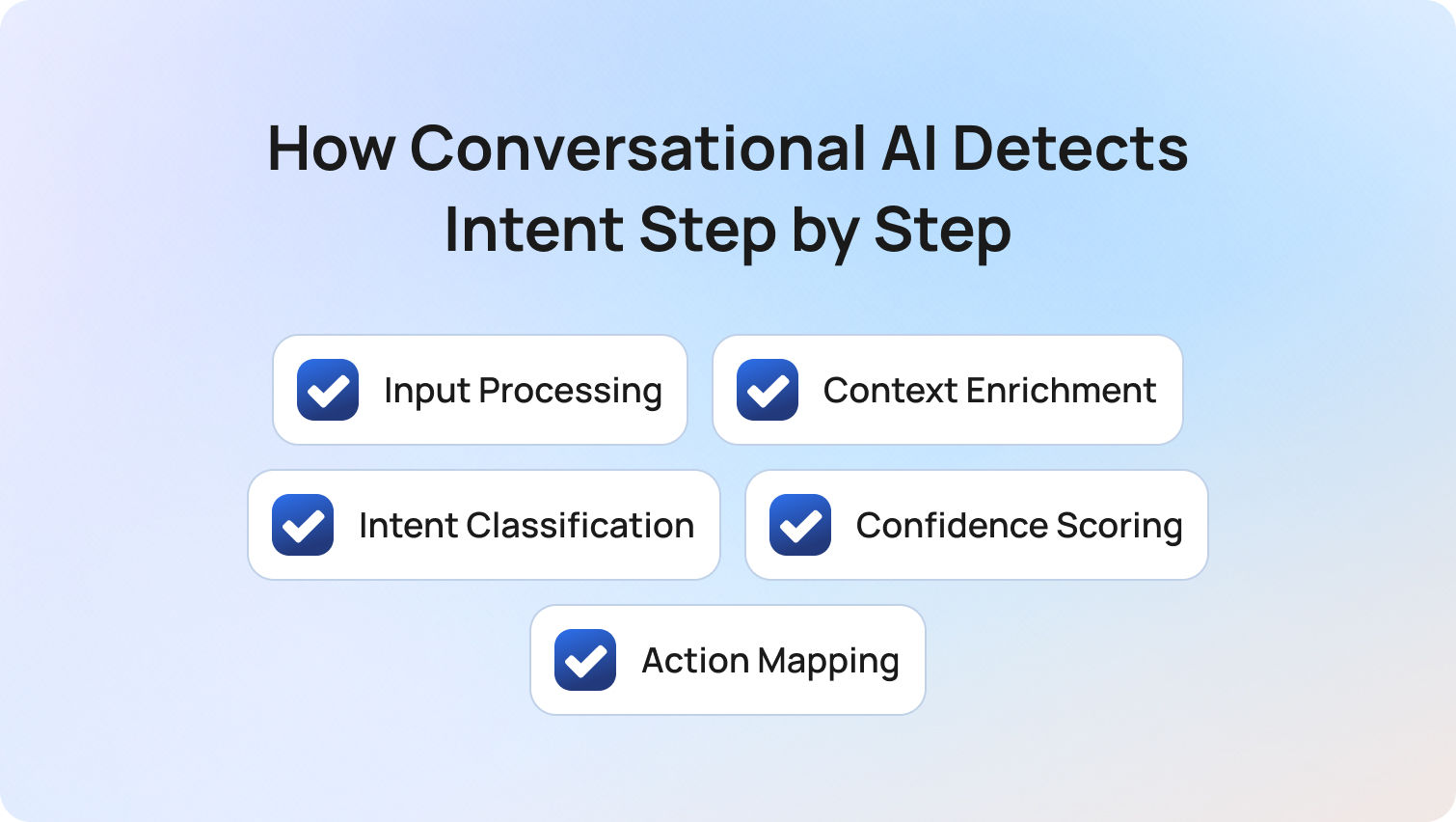
To understand how conversational AI detects intent, it helps to look at what is actually happening behind the scenes. Each step in the process transforms raw customer communication into structured intent data that can drive meaningful action across the support workflow.
1. Input Processing
Every customer interaction begins as unstructured input. When a customer sends a message, the system first processes it by breaking it down into smaller components such as words, phrases, and semantic units. This process, often referred to as tokenization, allows the AI to analyze language in a structured way. At the same time, the system removes noise, including typos, filler words, and inconsistent formatting, so that the underlying meaning becomes clearer.
In voice-based customer interactions, this stage also includes speech-to-text transcription. The quality of this transcription has a direct impact on everything that follows. If the input is misheard or poorly transcribed, even the most advanced intent detection models will struggle to interpret it correctly.
This step is foundational. Without clean, structured input, accurate intent detection simply is not possible.
2. Context Enrichment
Once the input is processed, the system enriches it with context before attempting to classify intent. This context typically includes previous turns in the customer conversation, relevant customer data such as account status or recent orders, and the channel the interaction originated from. Each of these factors influences how a message should be interpreted.
For example, a message like “Where is my order?” carries very different meanings depending on the situation. For a new visitor, it may indicate a general inquiry. For an existing customer who placed an order moments ago, it is likely a real-time order status request. Without context, both messages look identical, but with context, they require completely different responses.
This is where modern conversational AI technology moves beyond simple language processing into true customer understanding.
3. Intent Classification
With context applied, the system can begin intent classification. At this stage, the AI maps the customer’s message to a predefined intent category, such as order status, refund request, technical issue, or account access problem. Unlike earlier systems that relied heavily on exact matches or rigid rules, modern ML models are trained to recognize meaning across variations in human language.
This means the system can correctly interpret paraphrasing, slang, indirect phrasing, and even incomplete sentences. A customer does not need to phrase their query perfectly for the system to understand it.
The quality of intent classification depends heavily on the underlying model and the training data used. Systems trained on real customer conversations consistently outperform those built on synthetic or overly structured datasets.
4. Confidence Scoring
After an intent is identified, the system evaluates how certain it is about that classification. This is done through a confidence score, which reflects how closely the customer’s message matches the predicted intent. When the confidence level is high, the system can proceed with an automated response or trigger a predefined action with minimal risk. When the confidence level is lower, the system may ask the customer a clarifying question or escalate the interaction to a human agent.
Getting this balance right is critical. If the system acts too confidently on uncertain intent, it risks delivering incorrect or irrelevant responses. If it is too cautious, it escalates too many interactions, reducing the efficiency gains that conversational AI is designed to deliver.
Confidence thresholds are not static; they need to be monitored and adjusted over time based on real performance data, customer feedback, and evolving customer behavior.
5. Action Mapping
Once intent is confirmed, the system translates that understanding into action. This is where intent detection connects directly to business outcomes. Depending on the detected intent, the system might retrieve information from a knowledge base, generate a personalized response, trigger an automated workflow, or route the interaction to a specific team. In more complex scenarios, it may escalate the conversation to a live agent with full context attached.
The effectiveness of this step depends on how well intent categories are mapped to real operational workflows. Even highly accurate intent recognition can fail to deliver value if the downstream actions are poorly configured or disconnected from customer needs.
Ultimately, this is the moment where conversational AI either delivers a seamless customer experience or falls short. Intent detection does not create value on its own. It creates value by enabling the right action to happen at the right time, in the right context.
The Hard Part: Handling Ambiguous and Multi-Intent Queries
In real-world customer conversations, intent is rarely clean, singular, or immediately obvious. Customers do not think in predefined or set intents, and they rarely structure their messages in a way that aligns neatly with how systems are configured.
This is where most conversational AI implementations begin to struggle. Not because the technology cannot detect intent, but because the complexity of real customer behavior is underestimated during setup.
Ambiguous Intent
Some customer queries simply do not contain enough information to classify intent with confidence.
- “Can you help me?”
- “I have an issue with my bill.”
These types of customer queries are common, especially at the start of a conversation. From a system perspective, they present a problem: there is no clear intent to map, and acting too quickly risks sending the customer down the wrong path.
Modern conversational AI technology handles this through a combination of strategies:
- Clarification prompts that guide the customer toward providing more specific information
- Contextual inference based on previous customer interactions or known customer data
- Confidence-based escalation when the system cannot reliably determine intent
What separates high-performing systems from underperforming ones is how intelligently these strategies are applied. Poor implementations either over-rely on generic clarification, creating friction, or attempt to guess intent too early, leading to misclassification.
The focus here shouldn’t be on forcing intent detection prematurely, but on progressively refining and understanding while maintaining a smooth customer experience.
Multi-Intent Queries
Customers frequently express more than one intent within a single message, particularly in digital channels where they can type freely.
“I want to change my address and also check my delivery status.”
From a customer perspective, this is efficient. From a system perspective, it introduces complexity. Each intent may require a different workflow, a different data source, or even a different team.
Older conversational AI systems typically identified a dominant intent and ignored the rest. This often resulted in partial resolutions, forcing customers to repeat themselves and increasing overall handling time.
Modern AI-powered systems take a more advanced approach:
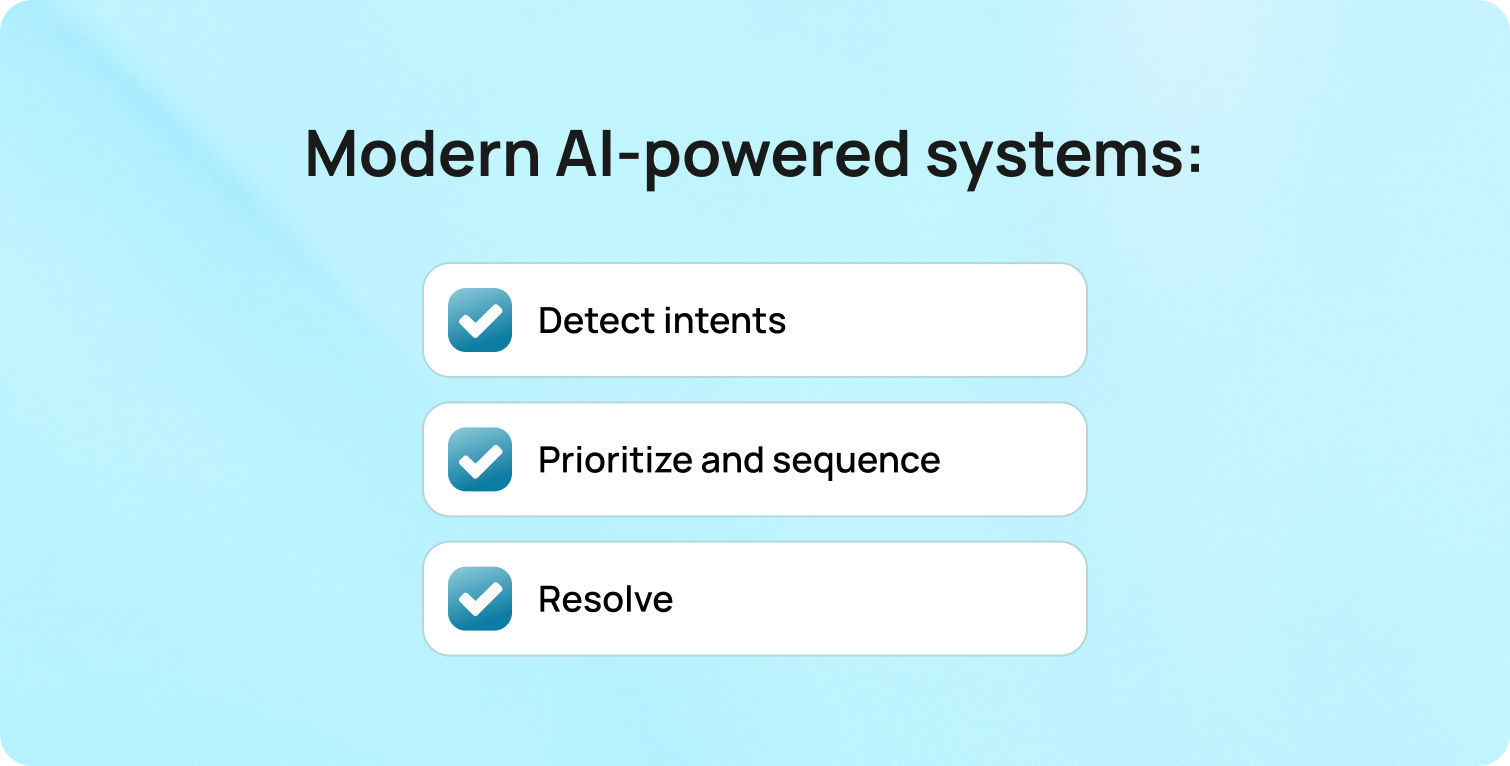
- They detect multiple intents within a single interaction
- They prioritize or sequence those intents logically
- They resolve them either in parallel or step-by-step within the same conversation
This capability is critical for delivering exceptional customer experiences. Customers expect conversations to feel fluid and responsive, not constrained by system limitations.
For CX teams, this also has a direct operational impact. Properly handling multi-intent queries reduces repeat contacts, shortens resolution times, and improves overall customer satisfaction.
Intent Drift Across Conversations
Intent is not static; it evolves as the conversation progresses. A customer may begin with a straightforward request, but as the interaction unfolds, new information, frustrations, or needs emerge. What starts as a billing query can quickly shift into a complaint, and ultimately into a cancellation request.
This phenomenon, often referred to as intent drift, is one of the most overlooked challenges in conversational AI.
Systems that treat each message in isolation struggle here. They may correctly identify the initial intent but fail to adapt as the conversation changes direction. The result is disjointed interactions where the AI appears to “lose track” of the customer’s needs.
Effective conversational AI systems continuously reassess intent across the full customer journey. They maintain context, track changes in customer behavior, and update the detected intent as new signals emerge.
The most common failure we see isn’t the AI misunderstanding intent; it’s teams configuring intent too rigidly. Real customer conversations evolve, and if your system doesn’t adapt to that, accuracy drops fast. Intent detection isn’t a one-time setup, it’s an ongoing optimization layer.

This is where intent detection moves from a technical capability to an operational discipline. The teams that recognize this are the ones that successfully scale conversational AI.
What Happens When Intent Detection Gets It Wrong
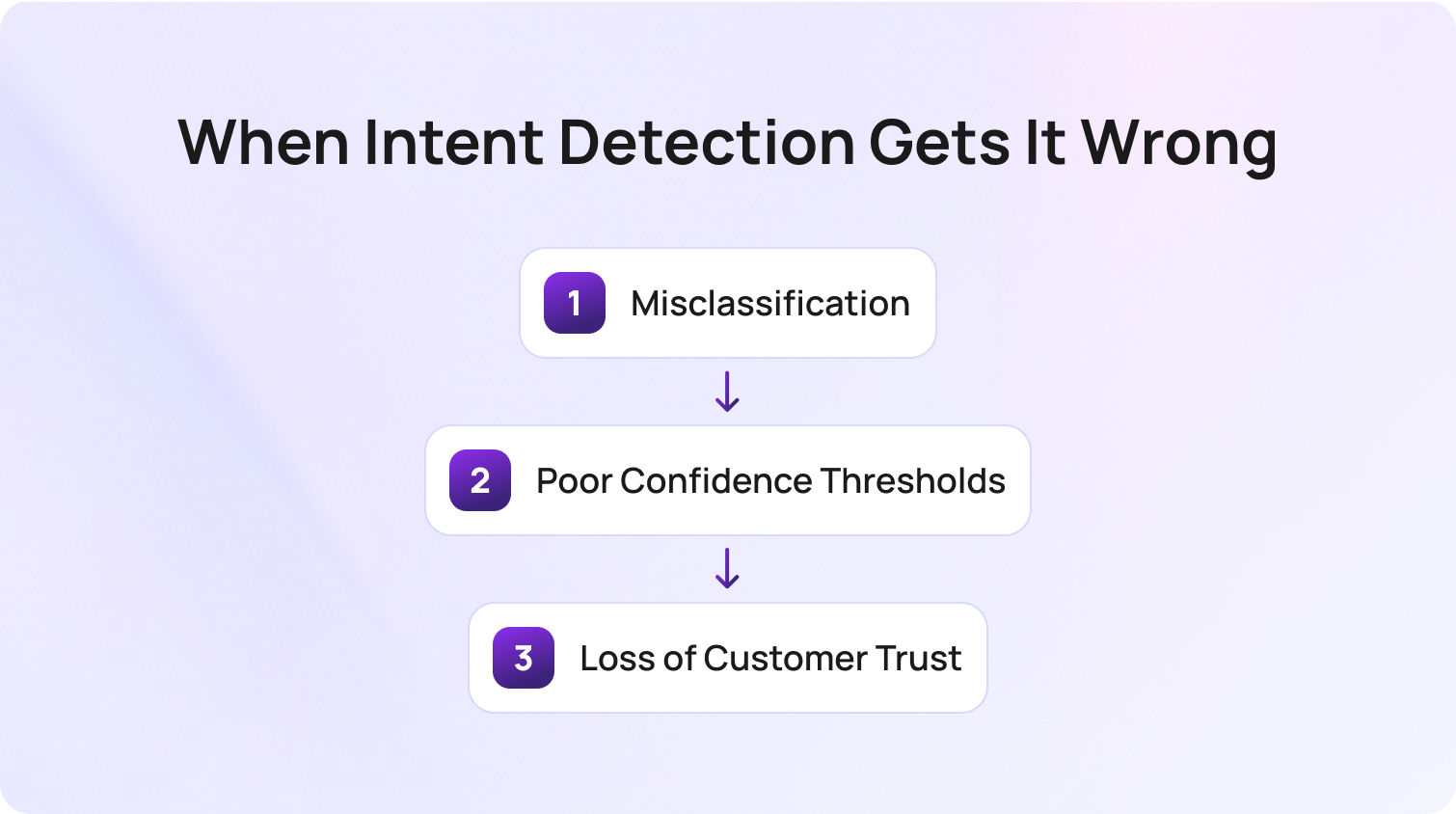
Even with advanced AI models, intent detection is not infallible. What matters is not just accuracy, but how failures are managed and mitigated. When intent detection fails, the impact is rarely isolated. It cascades across the entire customer support system.
Misclassification
When a system incorrectly classifies customer intent, the immediate consequence is misrouting.
- Queries are sent to the wrong team
- Agents receive issues outside their expertise
- Customers are transferred or asked to repeat information
A billing issue routed to a technical support team, for example, creates unnecessary friction. The agent may not have the tools or permissions to resolve the issue, leading to delays and increased handling time.
Over time, repeated misclassification increases operational inefficiency and erodes customer confidence in the system.
Poor Confidence Thresholds
Confidence scoring is one of the most powerful (and most misconfigured) aspects of intent detection.
- If thresholds are set too low, the system acts on weak signals, increasing the likelihood of incorrect responses
- If thresholds are set too high, the system escalates too frequently, reducing the value of automation
In practice, there is no “perfect” threshold. It must be continuously calibrated based on real-world performance, taking into account factors such as query complexity, customer expectations, and business priorities.
Organizations that treat this as a one-time configuration often see performance degrade over time. Those who treat it as an ongoing optimization process achieve significantly better outcomes.
Loss of Customer Trust
The most significant impact of poor intent detection is behavioral. Customers quickly form opinions about AI systems based on their experiences. A single incorrect or irrelevant response can shift a customer’s preference toward speaking with a human agent in future interactions.
- Requests for a live agent increase
- Engagement with AI decreases
- Customer satisfaction declines
This creates a negative feedback loop. As more customers bypass the AI, the system has fewer opportunities to learn and improve, further limiting its effectiveness.
For this reason, intent detection should not only be measured in terms of accuracy, but also in terms of trust signals. Metrics such as repeat escalations, agent request rates, and post-interaction behavior provide valuable insight into how customers perceive the system.
How Intent Detection Connects to Routing and Resolution
Intent detection does not operate in isolation. It is the decision point that determines how every customer interaction is handled. Once intent is identified, it becomes the input for a series of downstream processes that define the overall customer experience.
- Routing logic: Intent determines which team or agent is best suited to handle the query, enabling skill-based routing and more efficient resolution
- Knowledge retrieval: Intent is used to query the knowledge base, ensuring that responses are relevant and contextually appropriate
- Escalation rules: Certain intents, such as cancellations or complaints, may trigger automatic escalation regardless of confidence level
For example, a simple order status request can often be resolved instantly through automation. A complaint, on the other hand, may require priority routing to a specialized team. A cancellation request may always be escalated to a human agent due to its potential business impact.
The key point is that intent detection determines not just what the system understands, but what the system does next.
This is why even small improvements in intent classification accuracy can have a disproportionate impact on overall performance. Better intent detection leads to better routing, faster resolution, and more consistent customer experiences. Conversely, poor intent detection introduces friction at every stage of the process.
How BlueTweak's Conversational AI Handles Intent Detection
BlueTweak approaches conversational AI with a clear principle: intent detection should not be treated as a standalone capability, but as the foundation of the entire customer support system.
Rather than focusing solely on classification accuracy, BlueTweak’s platform is designed to ensure that detected intent translates into meaningful, context-aware action.
- AI models are trained to interpret customer intent across both chat and voice channels, ensuring consistency across different types of customer interactions
- The system maintains context across multi-turn conversations, allowing it to track intent as it evolves over time
- Intent detection is directly connected to routing and escalation logic, ensuring that each interaction is handled appropriately
- Knowledge base integration enables the system to deliver relevant responses grounded in real, up-to-date information
This approach ensures that intent detection is not just technically accurate but operationally effective.
A clear example of this can be seen in BlueTweak’s work with Aeroitalia. The airline faced challenges with fragmented customer data, inconsistent support experiences, and difficulty prioritizing customer queries effectively. By implementing BlueTweak’s AI-powered routing and intent classification capabilities, the organization was able to automatically categorize and route customer messages to the appropriate teams based on context and urgency.
This had a measurable impact on performance. The introduction of AI-driven intent detection and routing reduced backlog tickets and improved response times, contributing to a 33% increase in customer satisfaction and a 45% improvement in agent productivity.
What makes this case particularly relevant is not just the results, but how they were achieved; by combining intent detection with sentiment analysis and contextual data, BlueTweak enabled the support team to prioritize queries more effectively and respond in a way that aligned with customer needs in real time.
This is the difference between intent detection as a feature and intent detection as an operational driver of customer experience. When configured correctly, it does not just understand customer intent; it ensures the entire system responds appropriately.
See how BlueTweak works with a 14-day free trial?
Get Free TrialFinal Thoughts: Why Intent Detection Defines AI Success in Customer Support
Intent detection is the moment where artificial intelligence either succeeds or fails in delivering value.
Every customer interaction, from the simplest order status request to more complex issues, depends on the system’s ability to accurately understand the user's intent and respond appropriately. When intent detection works effectively, it enables AI-powered virtual agents to provide relevant responses, route queries intelligently, and support proactive engagement across the entire customer journey.
For CS teams, this has a direct impact on performance. Accurate intent recognition reduces friction, improves response times, and ensures that customer requests are handled in the right way. Over time, this leads to stronger customer understanding, better alignment with customer needs, and ultimately, enhancing customer satisfaction.
However, the key benefits of conversational AI are not unlocked by technology alone. They come from how well-intentioned detection is configured, monitored, and optimized using real customer data. Teams that actively refine their intent classification models, adjust confidence thresholds, and track how customers respond to AI interactions are the ones that consistently outperform.
In practice, intent detection is not just about understanding language. It is about interpreting customer behavior, identifying pain points, and ensuring that every interaction delivers an appropriate response, whether that comes from an AI agent or a human agent.
For organizations evaluating conversational AI, this is where the real competitive edge lies. The ability to understand intent at scale, across languages, channels, and complex queries, is what separates basic automation from truly intelligent, AI-powered customer support.
If you want to see how this works in real-world scenarios, the next step is simple: explore how BlueTweak’s conversational AI platform applies intent detection to deliver faster, smarter, and more consistent customer experiences; you can book a demo or try it for free now.
Speak with one of our customer support experts today
Book Call
As Head of Digital Transformation, Radu looks over multiple departments across the company, providing visibility over what happens in product, and what are the needs of customers. With more than 8 years in the Technology era, and part of BlueTweak since the beginning, Radu shifted from a developer (addressing end-customer needs) to a more business oriented role, to have an influence and touch base with people who use the actual technology.



