How Support Teams Use Conversational AI to Improve CX in 2026



BlueTweak is an AI Customer Support Platform that unifies every conversation, customer record, and automation into one workspace.
Explore more
Insights, trends, and practical ideas from customer experience and AI
Real-world scenarios showing how teams use BlueTweak to deliver better service
The daily blueprint that guides customer support leadership.
ROI and savings calculators for support teams
See how BlueTweak stacks up against leading customer support platforms
Conversational AI for customer service is software that uses natural language processing and large language models to understand customer intent, answer questions, and assist customers across chat, voice, and messaging channels using natural conversation. In 2026, support teams are using conversational AI customer service platforms to deliver more efficient support, improve CSAT, reduce operational costs, and provide faster responses in a customer’s preferred language across multiple communication channels. This guide to conversational AI for customer service answers the questions of ‘how does conversational AI improve CX outcomes’, where support teams are seeing the strongest results, and offers helpful tips organizations should follow to implement conversational AI successfully.
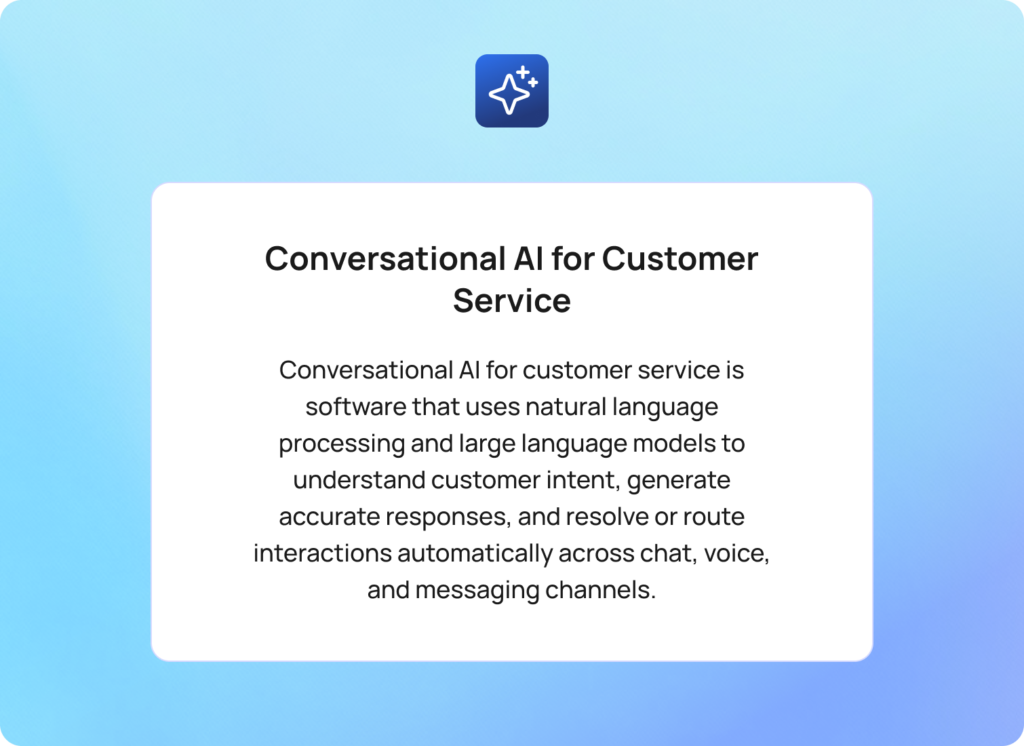
Conversational AI for customer service is software that uses natural language processing and large language models (LLMs) to understand customer intent, generate accurate responses, and resolve or route interactions automatically across chat, voice, and messaging channels.
At a practical level, conversational artificial intelligence enables support systems to understand natural language in the same way customers naturally communicate. Instead of forcing users through rigid workflows, conversational AI works by interpreting customer inputs, identifying intent, and generating relevant answers dynamically. This is the key difference between conversational AI and traditional rule-based chatbots.
Rule-based chatbots follow scripted decision trees. However, these break when customers phrase questions in unexpected ways or move outside predefined support scenarios.
Modern conversational AI customer service platforms use natural language understanding, machine learning, and LLMs to interpret human language more flexibly. They can manage paraphrased customer questions, multi-turn support conversations, slang, incomplete sentences, and context carried across multiple interactions.
Today, conversational AI in customer service typically falls into three categories:
The deployment model matters because evaluation criteria differ significantly. A conversational AI chatbot designed for asynchronous customer messages has very different requirements from a real-time AI voicebot handling inbound support calls.
For a conversational AI tool to be at its most useful and powerful, the technology must be used as part of a broader customer experience and operational strategy.
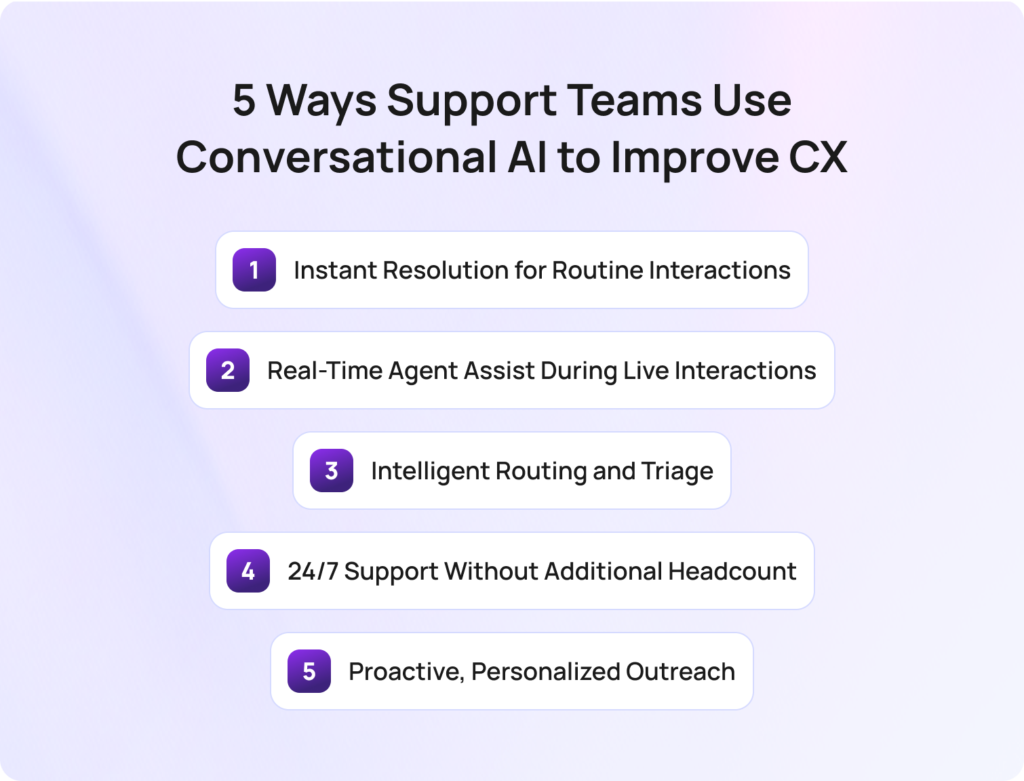
Conversational AI in customer service improves CX when it is tied directly to measurable operational and customer outcomes rather than deployed purely for automation.
The strongest deployments focus on solving specific customer service tasks with clearly defined KPIs attached.
Conversational AI handles high-volume, low-complexity customer inquiries that do not require human judgment. This includes:
When conversational AI software is grounded in an up-to-date RAG-enabled knowledge base, containment rates between 40–70% on tier-one support interactions are increasingly achievable in mature deployments.
These routine customer interactions typically consume a disproportionate amount of agent capacity. The KPI improvements usually include:
This is particularly important for customer service teams managing high inbound volumes across multiple languages and digital channels.
Conversational AI for customer service not only automates interactions autonomously. Increasingly, it works alongside human agents during live support conversations. Modern conversational AI capabilities now include:
This changes how support teams operate because agents spend less time searching support data manually and more time focusing on complex customer interactions.
A 2026 field study conducted with Alibaba customer service operations found that generative AI assistance improved service speed and customer ratings by making agent communication more efficient and informative. The most important strategic shift here is that conversational AI becomes a productivity layer, not simply a deflection tool.
That distinction matters because many customer expectations still center on access to human conversation when complexity or emotion is involved.
Conversational AI customer service systems increasingly act as the front door to support operations. Before a customer ever reaches an agent, conversational AI can classify:
This enables support interactions to route automatically to the correct team, queue, or skill group. But the CX impact is often underestimated; poor routing creates repeat contacts, escalations, customer frustration, and unnecessary transfers. Intelligent triage reduces all of those friction points simultaneously.
Support leaders frequently focus too heavily on automation rates while ignoring routing accuracy. But routing quality often has a larger impact on FCR and CSAT than pure containment rate alone.
Conversational AI for customers extends support availability beyond standard operating hours. For organizations serving global customers across multiple time zones, this removes one of the biggest structural limitations in customer service operations.
Instead of scaling overnight shifts linearly with volume, conversational AI can respond instantly to routine customer queries outside business hours. This improves:
It also creates operational resilience during seasonal spikes and unexpected surges in customer inquiries.
Importantly, the strongest implementations maintain seamless escalation paths to human agents when necessary. Meanwhile, AI-only support experiences without intelligent escalation continue to create customer frustration in many industries.
According to PwC’s 2025 Customer Experience Survey, consumers remain significantly more comfortable using AI for routine support activities like order tracking than for sensitive or emotionally nuanced interactions.
Modern conversational AI not only reacts to customer conversations, but it also initiates them proactively. This includes:
The operational advantage is substantial because proactive support reduces inbound volume before customer issues escalate into live contact. This is where conversational AI strategy increasingly overlaps with customer engagement and retention.
The most mature organizations are now using conversational AI platforms as customer communication infrastructure rather than standalone support automation. That evolution is one of the clearest indicators of where conversational AI in customer service is heading next.
The different types of conversational AI customer service deployments solve different operational problems and improve different CX metrics.
As conversational AI in customer service matures, support leaders are moving away from treating AI as a single-purpose chatbot solution. Instead, organizations are building layered conversational AI strategies that combine automation, agent augmentation, and omnichannel orchestration depending on the complexity of the interaction and the communication channel involved.
The deployment model is important because the operational expectations for an AI chatbot are very different from those of an AI voicebot or an AI agent assist layer. Some conversational AI tools are designed to maximize containment rates, while others focus on improving agent efficiency, routing accuracy, or customer satisfaction during live support interactions.
The table below outlines the primary types of conversational AI for customer service in 2026, how each conversational AI technology works, and the CX metrics support teams most commonly use to evaluate performance.
| Type | How It Works | Best For | Key CX Metric |
| AI chatbot (text) | LLM + RAG knowledge base; handles chat, messaging, and email | Digital-first support teams managing high-volume customer messages | Containment rate, CSAT |
| AI voicebot | Speech recognition + NLP + text-to-speech; handles inbound calls | Voice-heavy customer service operation environments are replacing IVR | AHT, abandon rate, MOS |
| AI agent assists | Suggests replies, surfaces KB content, flags sentiment during live interactions | Teams are improving agent efficiency and consistency | AHT, FCR, concurrency |
| Omnichannel conversational AI | Unified AI layer across various communication channels with shared intent detection | Organizations managing customer interactions across multiple channels | FCR, CSAT, repeat contact rate |
The important thing to note is that conversational AI tools should be evaluated based on the operational problem they are solving, not simply the underlying AI model. Too many conversational AI projects still fail because organizations deploy technology before defining the customer service work they actually want improved.
Conversational AI customer service initiatives succeed when improvements are tied to measurable business outcomes rather than vague automation goals. The strongest implementations consistently improve both operational efficiency and customer experience simultaneously.
Conversational AI reduces resolution time by surfacing relevant answers instantly. For autonomous support, this eliminates handling time entirely on contained interactions.
For agent-assisted workflows, suggested replies and KB retrieval reduce the time agents spend searching for information during support conversations. The operational effect compounds quickly at scale.
Human agents naturally vary in performance based on experience, workload, and fatigue. Conversational AI produces more standardized responses because every interaction draws from the same support systems and knowledge sources.
This consistency becomes especially important for multilingual support environments and globally distributed customer service teams.
The KPI many organizations overlook here is CSAT variance between shifts, teams, and channels.
Conversational AI lowers operational costs through two mechanisms simultaneously:
This distinction matters strategically because the most successful organizations are not necessarily replacing agents; they’re reallocating human effort toward higher-value customer interactions.
Correct routing, accurate answers, and contextual understanding improve first contact resolution significantly. Customers who receive relevant answers the first time are less likely to recontact support or escalate unnecessarily. This directly improves:
The operational gains from conversational AI are therefore cumulative rather than isolated to a single metric.
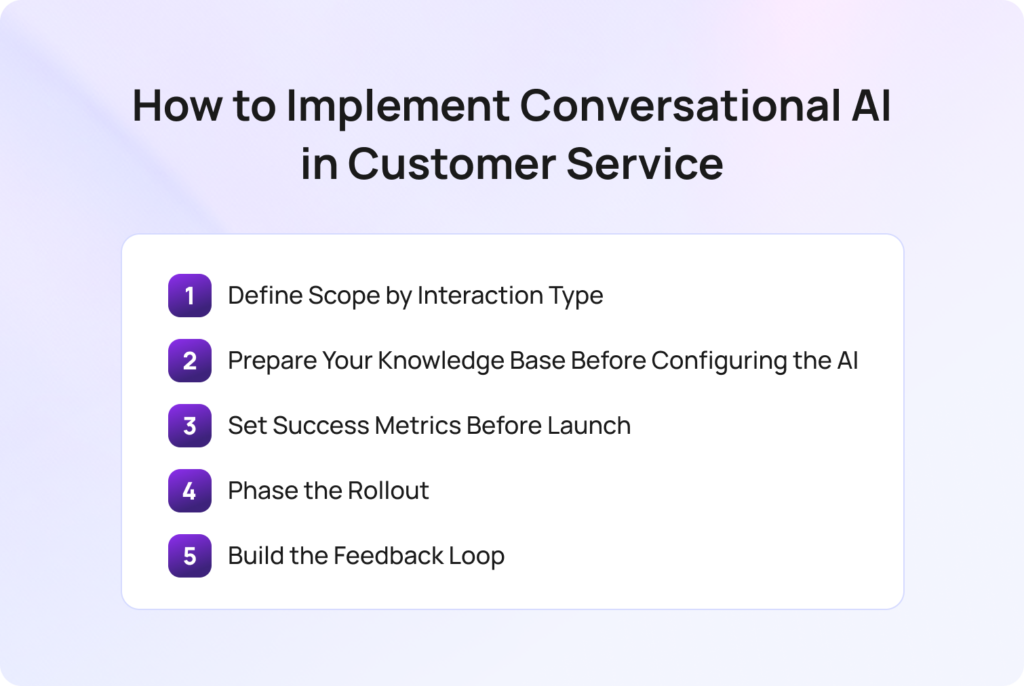
Implement conversational AI successfully by narrowing scope early, grounding responses in reliable knowledge, and measuring outcomes continuously.
Too many conversational AI projects fail because organizations attempt overly broad deployments too early. The technology itself is rarely the primary problem; more often, failure stems from unclear operational goals, inconsistent support data, fragmented ownership, or unrealistic expectations around automation.
Treating conversational AI implementation as a CX transformation initiative rather than a software deployment exercise is the route most successful organizations are taking in 2026. That means aligning customer service teams, knowledge management, IT, operations, and analytics teams around a shared support strategy before launch.
Start with the highest-volume, lowest-complexity customer queries first, as these interactions are most likely to produce strong early containment rates and measurable operational improvements.
The objective is controlled success that builds organizational confidence, rather than maximum automation immediately.
This is a common mistake: attempting to deploy conversational AI across every support scenario simultaneously. Complex billing disputes, emotionally sensitive complaints, or highly technical support cases are rarely the best starting point. Early deployments should focus on repeatable customer service tasks with clear workflows and predictable resolution paths.
Good early-stage conversational AI use cases often include:
This approach creates two advantages: first, it reduces implementation risk while the conversational AI learns from real-world customer conversations; second, it gives support teams time to adapt operationally before introducing more advanced workflows.
Importantly, organizations should map each query type to a target outcome before deployment. For example, if the goal is to reduce inbound call volume, containment rate becomes critical. If the objective is improving customer experience, then CSAT and FCR may matter more than pure automation percentages.
Conversational AI is only as accurate as the knowledge base supporting it, and this remains one of the biggest gaps between pilot performance and production performance in 2026.
Organizations often underestimate the amount of KB cleanup required before conversational AI learns effectively from support data.
Many support environments contain years of duplicated articles, outdated policies, inconsistent terminology, and undocumented escalation processes. Human agents can often work around these gaps through experience and judgment, but conversational AI simply can’t.
Before implementation begins, support leaders should evaluate whether their knowledge base is genuinely usable for AI-driven retrieval. That includes reviewing:
One increasingly important consideration is how conversational AI handles conflicting information. If multiple KB articles provide slightly different answers to the same customer inquiry, response quality quickly becomes inconsistent. This creates customer trust issues and undermines confidence in the AI system internally.
The most mature organizations now assign dedicated KB governance owners as part of conversational AI deployment. In practice, conversational AI implementation often improves knowledge management maturity across the entire customer service operation.
Support leaders should define operational thresholds before deployment begins. This includes:
Without defined metrics, conversational AI projects often drift into subjective evaluation.
This is particularly important because conversational AI success can look very different depending on the organization’s priorities. A support operation focused on reducing operational costs may prioritize automation and AHT reduction, while a premium CX-focused brand may place greater importance on customer satisfaction and escalation quality.
Metrics should also be segmented by interaction type rather than measured globally. For example, conversational AI may perform extremely well on account management queries while underperforming on technical troubleshooting. Measuring everything under one aggregate score hides those operational differences.
Another best practice emerging in 2026 is defining “acceptable failure” conditions before launch. No conversational AI platform will resolve 100% of customer interactions successfully, so the target should be a predictable performance with safe escalation paths.
Launch conversational AI in one channel first, then monitor performance closely for at least two weeks before expanding the scope.
The strongest deployments expand based on operational data rather than implementation timelines.
This phased approach is especially important for omnichannel conversational AI deployments. Customer behavior differs significantly between live chat, email, messaging apps, and voice support; an AI workflow performing effectively in chat may struggle in voice environments where interruptions, accents, and conversational pacing introduce additional complexity.
A controlled rollout also allows support teams to identify operational blind spots before scaling further. These often include:
One of the biggest misconceptions around conversational AI technology is that implementation is primarily technical. In reality, operational adaptation is often the larger challenge. Agents need new workflows, supervisors need new analytics, and support leaders need new QA processes for AI-generated interactions.
Organizations that scale too quickly often create internal resistance because teams lose confidence in the system before optimization is complete.
Every failed interaction becomes training data.
Organizations seeing long-term conversational AI success now treat AI optimization as an operational discipline rather than a one-time deployment project. That means assigning ongoing ownership for:
The most effective support teams now run conversational AI optimization similarly to continuous improvement programs in customer operations. Failed customer interactions are reviewed weekly, escalation trends are analyzed systematically, and KB gaps are corrected continuously. This ongoing refinement process is critical because customer expectations evolve constantly. New products, policy changes, seasonal support trends, and emerging customer behaviors all affect how conversational AI performs over time.
Support leaders should also monitor how conversational AI impacts human agents operationally. One unintended consequence of successful automation is that agents increasingly inherit only the most emotionally charged or technically difficult customer interactions. But without proper workload balancing and coaching support, this can increase agent burnout despite lower interaction volumes overall.
Conversational AI platforms create the most value when they unify customer interactions, support intelligence, and operational analytics inside one connected workspace.
This is where BlueTweak positions its conversational AI platform differently from fragmented point solutions.
Rather than separating voice AI, AI chatbots, agent assist, and analytics into disconnected systems, BlueTweak unifies conversational AI customer service capabilities across both text and voice channels.
Its conversational AI platform supports:
Because both text and voice conversational AI pull from the same knowledge base, organizations can maintain more consistent customer experiences across communication channels.
That consistency becomes increasingly important as customer conversations move fluidly between messaging apps, voice calls, email, and live chat.
BlueTweak also places significant emphasis on operational measurement.
Rather than focusing purely on automation metrics, the platform surfaces interaction-level analytics tied directly to:
That visibility helps support teams identify where conversational AI works effectively, where human escalation remains necessary, and where knowledge gaps still exist.
A strong example of this operational approach can be seen in BlueTweak’s packaging industry case study, where improved reporting visibility and faster issue resolution helped strengthen customer satisfaction outcomes across support workflows.
The biggest mistake organizations are making with conversational AI is assuming the model is the product. In reality, the knowledge layer determines whether the experience feels genuinely helpful or operationally risky. The gap between pilot success and production performance almost always comes down to KB quality, governance, and feedback ownership.

Radu Dumitrescu, Head of Presale & Digital Transformation at BlueTweak
Conversational AI for customer service matters because customer expectations now exceed what traditional support models can sustainably deliver at scale.
The strategic shift happening in 2026 is not simply about automation. It is about operational orchestration.
The organizations seeing the strongest results are using conversational AI to unify customer data, routing, support interactions, and knowledge delivery into a single operational layer.
That creates three major advantages simultaneously:
The companies struggling with conversational AI adoption are typically treating it as a standalone chatbot initiative rather than a transformation of the broader customer service operation. Support teams seeing the strongest results with conversational AI are the ones treating it as central to their operational strategy rather than a standalone automation tool.
If you want to explore how conversational AI can improve FCR, reduce AHT, and create more consistent customer experiences across chat and voice channels, you can book a demo to see BlueTweak in action, or try BlueTweak for free to explore the platform at your own pace with no strings attached.
Conversational AI for customer service is software that uses natural language processing, machine learning, and large language models to understand customer intent, answer customer questions, automate support interactions, and assist human agents across chat, voice, and messaging channels.
An example would be an AI-powered chatbot that handles order tracking requests automatically while escalating complex billing disputes to human agents when necessary. Another example is an AI voicebot replacing traditional IVR systems for inbound customer support calls.
Conversational AI improves customer satisfaction when it delivers accurate answers quickly, routes interactions correctly, maintains context across channels, and escalates seamlessly to human agents when required.
The best conversational AI platform depends on the organization’s support model, communication channels, and operational goals. Most enterprises now prioritize platforms that combine AI chatbot capabilities, AI voice automation, agent assist, omnichannel orchestration, and analytics within one environment.
AI in customer service is used for autonomous support, AI agent assist, intelligent routing, multilingual support, proactive outreach, sentiment analysis, KB retrieval, voice automation, and customer engagement across various communication channels.
As Head of Digital Transformation, Radu looks over multiple departments across the company, providing visibility over what happens in product, and what are the needs of customers. With more than 8 years in the Technology era, and part of BlueTweak since the beginning, Radu shifted from a developer (addressing end-customer needs) to a more business oriented role, to have an influence and touch base with people who use the actual technology.