


12 Ways to Improve Public Sector Customer Service in 2026

Why Customer Service in the Public Sector is Different
Public sector organizations face unique challenges. You serve everyone. You deliver essential services. You operate under budget constraints and strict policy. You also carry a higher bar for privacy and accessibility. Citizens compare you to private-sector businesses that set expectations for speed, clarity, and convenience. The result is a rising gap between public expectations and the reality of complex government services.
There is progress. In the United States, citizen satisfaction with federal government services reached a 19-year high in 2025, demonstrating what is possible when agencies invest in journey design, digital tools, and improved back-office processes.
Policy reinforces that direction. The Biden Administration’s Executive Order 14058 and OMB Circular A-11 Section 280 set out clear requirements for customer experience and service delivery across High Impact Service Providers.
What follows is a practical, research-informed playbook for public sector customer service. Use it to improve service delivery, reduce effort, and increase citizen satisfaction while keeping compliance, cost, and workforce realities in view.
How We Define Public Sector Customer Service
Customer service in the public sector includes every customer interaction across government agencies and government institutions that helps a person understand, apply for, receive, or maintain a benefit or meet an obligation. It spans digital tools, phone calls, in-person visits, and mail. Good customer service means meeting customer expectations with clear information, predictable next steps, and a respectful tone. The goal is better outcomes for citizens and a strong public service experience that builds public trust.
12 Strategies to Improve Customer Service in the Public Sector
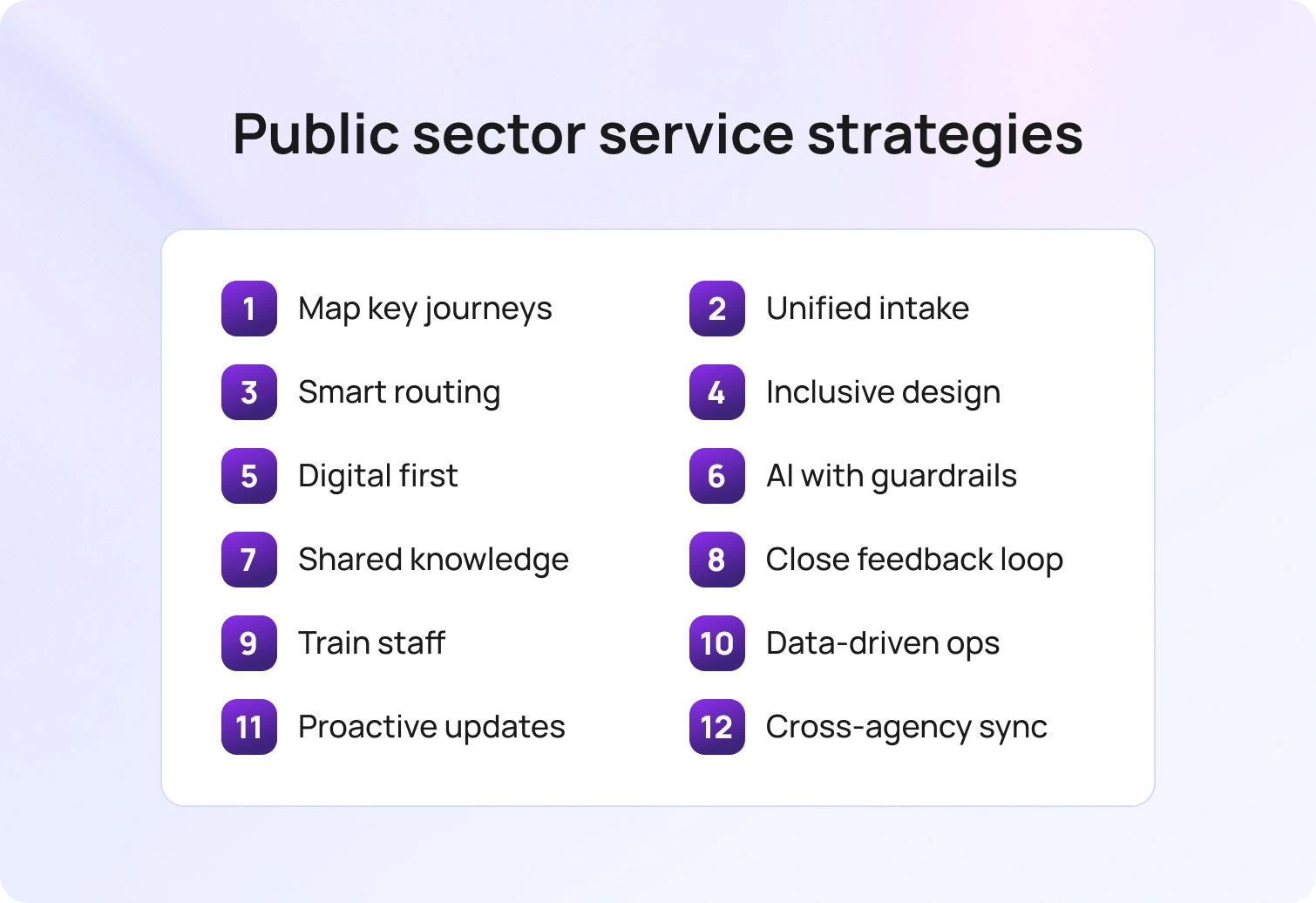
These strategies focus on the few journeys that drive volume and risk. They show how customer service in the public sector improves when intake is unified, standards are clear, and digital tools and conversational AI handle routine tasks. Use them to strengthen public-sector customer service, increase citizen satisfaction, and make every interaction easier.
1. Map priority journeys and remove friction
Start with the top five journeys by volume or risk. Examples include identity verification, benefits applications, appeals, and renewals. Document the steps from the citizen’s point of view. Note handoffs, jargon, and points where people abandon. Align service standards to each step. This creates a clear message across teams and a shared definition of great customer service.
Why it works
Teams stop optimizing tasks in isolation and focus on the customer journey. You reduce repeats and unclear next steps, thereby improving customer satisfaction and reducing costs. Public sector agencies can then communicate status with confidence and set expectations early.
2. Stand up unified intake across channels
Citizens use phone, web, mobile, and walk-in locations. A unified front door captures customer requests consistently and sends them to the right person the first time. Standardize forms, intake scripts, and identity checks. Keep the same service standards across channels so customers feel the same quality whether they call, click, or visit.
Why it works
A single intake reduces rework and prevents the “lost in the system” experience. It also gives your customer support team cleaner data for decision-making and performance management.
3. Route by language, intent, and complexity
Use language and topic detection to route a case to the right skill group. Add a complexity flag for issues that require specialist review. In blended environments, send routine tasks to digital channels and keep complex issues with trained customer service representatives who can make judgment calls.
Why it works
Routing reduces transfers and shortens time to resolution. It directs citizens to the right person without repeating information, thereby increasing citizen satisfaction and protecting public trust.
4. Design for accessibility and inclusion
Follow WCAG guidance. Write forms and letters in plain language. Offer simple language translations where needed. Provide visual and audio alternatives. Train help desk staff to support assistive technologies at counters and via phone. Inclusive design is not optional for public agencies that deliver essential services.
Why it works
Accessible services reduce errors, increase trust, and help solve customer pain points. This is service excellence in practice.
5. Use digital tools where they help, keep human paths open
Digital status trackers, appointment schedulers, and knowledge bases cut avoidable calls and visits. Chat and email help when people cannot travel. Keep a clear path to a human for edge cases, crisis situations, and legal questions. Design escalation rules so the right person responds with authority.
Why it works
Citizens prefer a predictable status and easy next steps. Digital tools provide proactive communication and better services without blocking those who need personal connections.
6. Apply artificial intelligence to routine tasks with guardrails
Start with document classification, translation, suggested replies, and summarization. These uses speed up service provision, let customer service agents focus on complex issues, and keep content consistent. Use a human-in-the-loop model for high-impact decisions.
Why it works
AI increases throughput and improves service quality by handling repetitive steps. Government organizations keep control by grounding answers in approved content and recording decisions for audit. Industry research shows growing adoption of AI in government services as leaders seek to expand digital options and improve service delivery.
7. Build a shared knowledge base and keep it current
Create a single source of truth for eligibility rules, proofs, timelines, and exceptions. Assign owners, set review cadences, and log changes. Link knowledge to website content and agent guidance so customer interactions use the same words and definitions.
Why it works
A shared knowledge base produces consistent answers across public sector services, reduces negative feedback, and supports employee training for new staff.
8. Close the loop on customer feedback
Use short customer satisfaction surveys in the citizen’s language at the end of a transaction. Pair scores with open text to capture qualitative insights. Publish what you changed based on feedback. This shows responsibility and builds a customer-centric culture.
Why it works
Survey respondents provide valuable insights into pain points. Closing the loop signals that customers influence service standards and policy, which improves customer relationships over time.
9. Invest in employee training and engagement
Employees handle complex laws, sensitive moments, and high volumes. Train on policy, empathy, and problem-solving. Give frontline staff clear playbooks and a path to escalate when policy blocks a fair outcome. Recognize great service in real time.
Why it works
Employee engagement has a critical role in citizen satisfaction. When employees feel trusted and prepared, they deliver excellent customer service more often and reduce the number of unhappy customers who feel ignored.
10. Use data analytics for performance management
Track the signals that matter with customer service analytics. Measure wait time, first contact resolution, transfers, abandonment, and sentiment. Break results down by channel, language, and location. Use a simple public dashboard so leaders, staff, and citizens see the same numbers. In the U.S., A-11 Section 280 provides structure for how federal agencies report and govern customer experience.
Why it works
A data-driven approach turns raw customer data into actionable insights. It also reduces debates about definitions and lets teams adjust quickly during peaks.
11. Communicate proactively and clearly
Send status updates at milestones. Confirm what you received, what happens next, and who is responsible. If timelines slip, explain why and give a new date. Keep tone neutral and respectful. Good marketing communications can support service delivery when they inform rather than persuade.
Why it works
Proactive communication reduces inbound volume, sets expectations, and prevents negative experience loops. Citizens feel respected and informed.
12. Strengthen cross-agency coordination
Many services touch multiple public sector organizations. Establish memoranda of understanding for data sharing with privacy safeguards. Standardize reference numbers across agencies. Set joint service standards for handoffs so people do not repeat their story.
Why it works
Coordination prevents gaps between agencies. It shortens the time to benefit and shows the government works as one organization, not a maze of offices.
Measurement That Leaders Can Trust
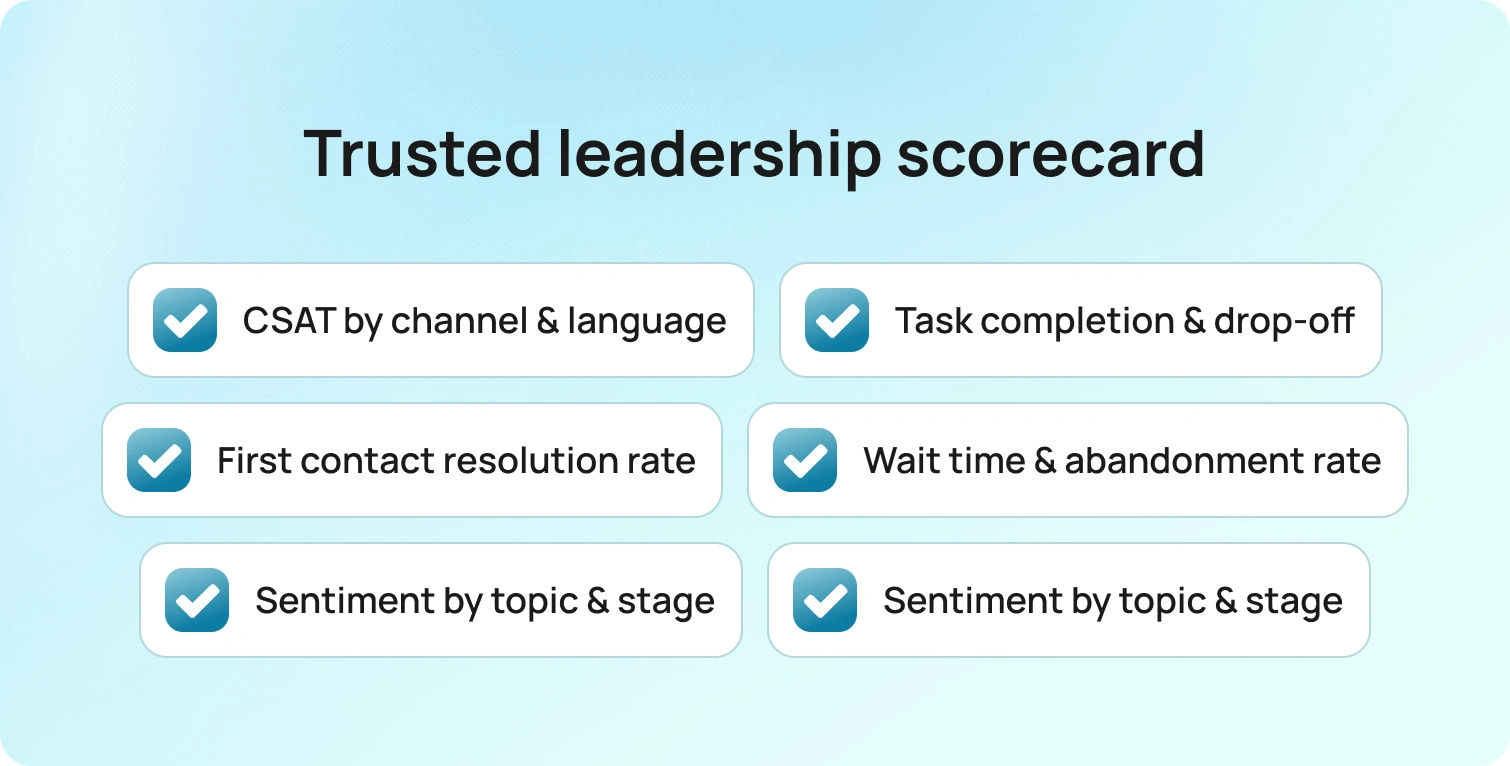
A small, durable scorecard works better than a sprawling dashboard. Targets should reflect mission, risk, and equity goals. Break every measure out by channel and language so gaps stay visible rather than averaged away.
- CSAT by channel and language
- Task completion and drop-off rate for priority journeys
- First contact resolution and transfer rate
- Wait time and abandonment
- Sentiment by topic and journey stage
- Complaint volume and time to resolution
A one-page quarterly scorecard keeps leaders and frontline teams aligned. Public versions for programs like health, tax, licensing, and benefits show progress and clarify where investment is needed. Transparent reporting helps preserve trust when delays or channel gaps appear.
Policy and Governance Essentials
Strong governance turns good intentions into durable service. The aim is clear guardrails that protect citizens while giving teams room to improve.
- Compliance framework: Executive Order 14058 and OMB A-11 Section 280 for U.S. federal agencies and partners
- Privacy-by-design: privacy impact assessments ahead of any new digital tool
- AI oversight: documented model governance for systems that interact with citizens
- Service standards: plain-language commitments, published and versioned
- Usability assurance: forms and letters tested with representative citizens
Together, these practices keep programs compliant and sustainable while improving the customer experience strategy.
How BlueTweak Can Help
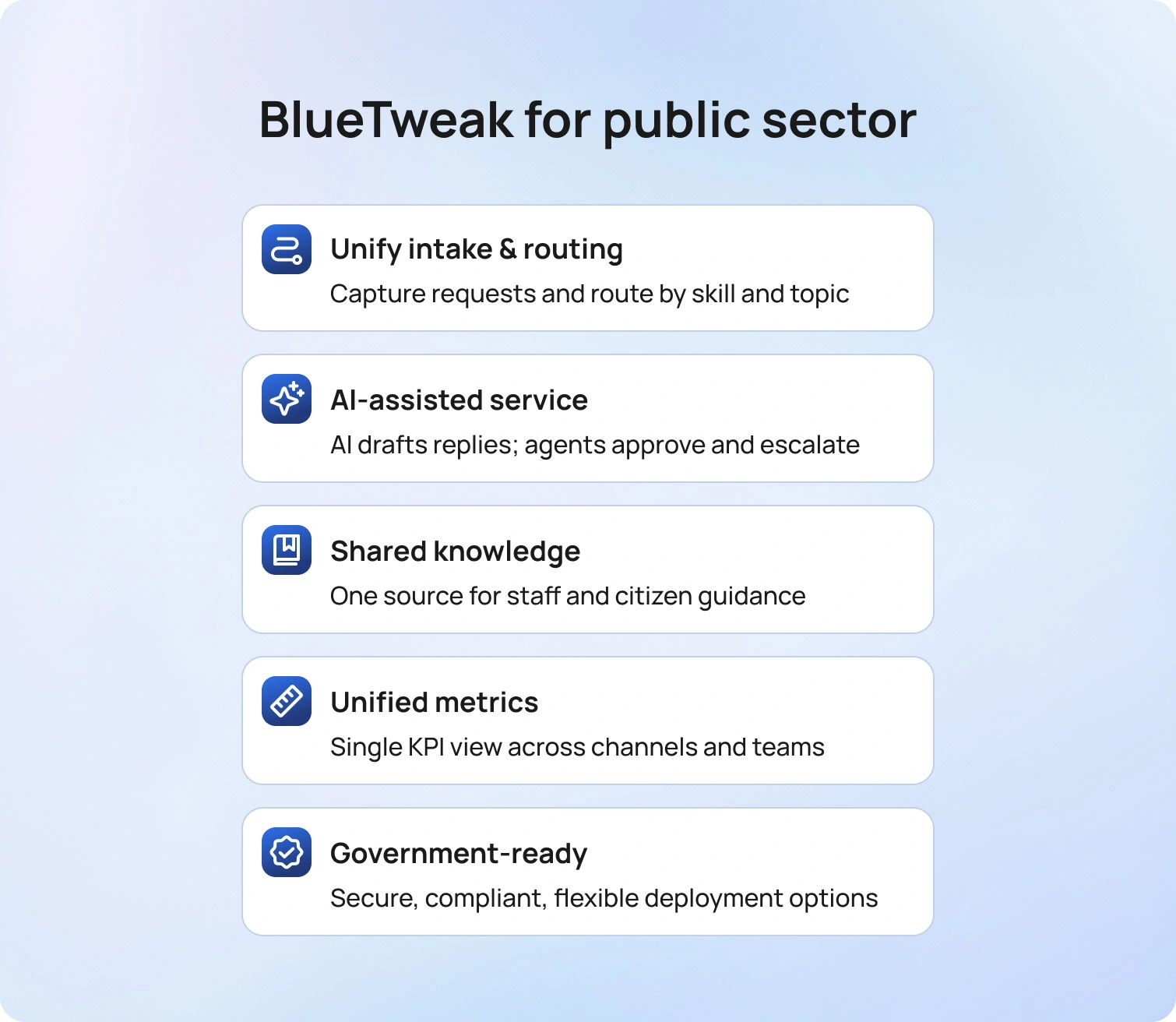
Public sector agencies need tools that respect policy, budget, and the pace of change. BlueTweak brings a multilingual chatbot, multilingual voicebot, and email into a single workspace, so teams can improve service delivery without rebuilding their stack.
Unify intake and routing
Capture customer requests in a single front door, then route by language, topic, and complexity to the right person the first time. Skills, queues, and SLAs are available in a single admin view, with an audit trail of changes.
Accelerate routine work with AI, keep humans in control
Use AI summaries to preserve context, suggested reply to draft on brand answers from a smart knowledge base, and real-time translation to cover thinly staffed languages. Agents approve every reply. Complex cases escalate with a full history intact.
One knowledge base for staff and citizens
Publish clear articles for websites, contact centers, and field offices from the same source. Versioning, ownership, and review cadences keep rules, proofs, and timelines aligned.
Measure once, coach everywhere
Standard KPIs include wait time, first contact resolution, transfers, abandonment, sentiment, and complaint trends. Voicebot metrics include containment, deflection, and concurrency. Leaders see one picture, and frontline teams coach against the same numbers.
Built for government reality
Cloud, hybrid, or on-premises deployment. Role-based access, audit logs, and data residency options. API open for CRM, case management, and records systems. Spam detection at intake to protect agents from noise. ISO certification in progress.
Where agencies start
Most teams begin with two priority journeys, enable routing and summaries, turn on proposed reply in a single queue, and add language coverage with translation. Results show up in fewer transfers, clearer communications, and steadier citizen satisfaction.
Future Outlook: 2026 and Beyond
Public sector customer service is shifting from isolated transactions to connected journeys. Citizens will expect clear status and consistent answers across agencies, not just faster responses on a single channel. Messaging and voice will keep growing, yet the bigger change sits behind the scenes as identity, consent, and data sharing follow the case from start to finish. Cloud choices will increasingly hinge on data residency, zero trust, and auditability, turning compliance from a blocker into baseline hygiene.
Artificial intelligence will move closer to the front line. Triage, translation, summarization, and suggested replies will become routine, while high-impact eligibility decisions remain human-in-the-loop. Procurement language will evolve in step, asking for model governance, bias testing, and incident reporting as standard terms. Accessibility will shape every new form and status page, and plain language will be built into delivery rather than added at the end. As these practices mature, trust becomes a managed metric alongside speed and cost.
Interoperability will decide who makes the biggest gains. API-first platforms and event-driven integrations will connect contact centers with case management, records, and payments so the experience feels continuous. Shared knowledge bases will cut across channels and regions. Analytics will move from monthly PDFs to near real-time views of CSAT, task completion, and sentiment by language and location.
By replacing status calls with proactive updates, agencies can improve outcomes even under tight budgets, proving that steady sequencing and clear governance deliver better service at scale.
Conclusion
Customer service in the public sector improves when journeys are simple, intake is unified, and the right person answers on the first touch. Pair plain language with clear service standards. Use digital status and appointments to reduce avoidable contacts. Apply AI to routine tasks with guardrails, keep one knowledge base for staff and citizens, and close the loop on customer feedback. Track task completion, first contact resolution, transfers, wait time, and sentiment so improvements are visible to leaders and the public.
If you are ready to modernize service delivery, see how BlueTweak brings chat, voice, and email into one workspace with routing, translation, summaries, and proposed replies tied to the same KPIs. Book a BlueTweak demo today.
12 Proven AI Support Use Cases for Telecom Teams (2026)
Why Telecom Needs Automation Now
In 2026, customers expect quick, accurate help on every channel. They also expect updates when service disruptions occur and clear answers to billing inquiries. At the same time, telecom companies must protect sensitive customer information, control operational costs, and maintain stable network performance. Manual processes cannot keep up with customer demands that span multiple communication channels.
In the telecom industry, the goal is reliable service delivery across every channel without increasing costs. Practical customer service automation enables telecom companies to handle demand spikes while protecting privacy and accuracy. GSMA Intelligence reports that 47% of telco AI deployments focus on customer care and 60% are already live, signaling a shift from pilots to production in support automation.
AI customer support automation in telecom addresses this gap. Artificial intelligence and machine learning can analyze customer data, detect customer intent, and trigger actions that guide each customer interaction to the right agent or a reliable digital answer. Done well, automation raises customer satisfaction, reduces repeat contacts, and helps support teams handle inquiries efficiently during spikes.
What AI Customer Support Automation in Telecom Includes
Key AI technologies span several layers that work together:
- Natural language processing to understand unstructured customer inquiries across chat, email, and social
- Generative AI to draft accurate first replies grounded in a knowledge base and policy
- Predictive analytics to anticipate service outages, network failures, and demand surges
- Automated ticketing systems that triage and route by language, intent, and complexity
- Virtual assistants and ai powered chatbots that resolve routine tasks and escalate with context
- Sentiment analysis to spot frustration and prioritize intervention
- Integrations with OSS/BSS and NOC tools to monitor network performance, pull network data, and automate outreach
The stack draws on key AI technologies, from NLP and predictive analytics to orchestration layers, that keep AI automation precise and auditable. Generative AI pairs with NLP and sentiment analysis to keep initial replies helpful and concise. Virtual assistants and AI-powered chatbots handle first-line questions across multiple communication channels while escalating with context.
BlueTweak unifies chat, voice, email, and SMS in one workspace, with language-aware routing, real-time chat translation, AI summaries, proposed reply from a smart knowledge base, workflow automation, WFM, and standard analytics. It integrates through APIs and webhooks, so support can react to network data without switching tools.
12 Proven Use Cases For AI Customer Support Automation
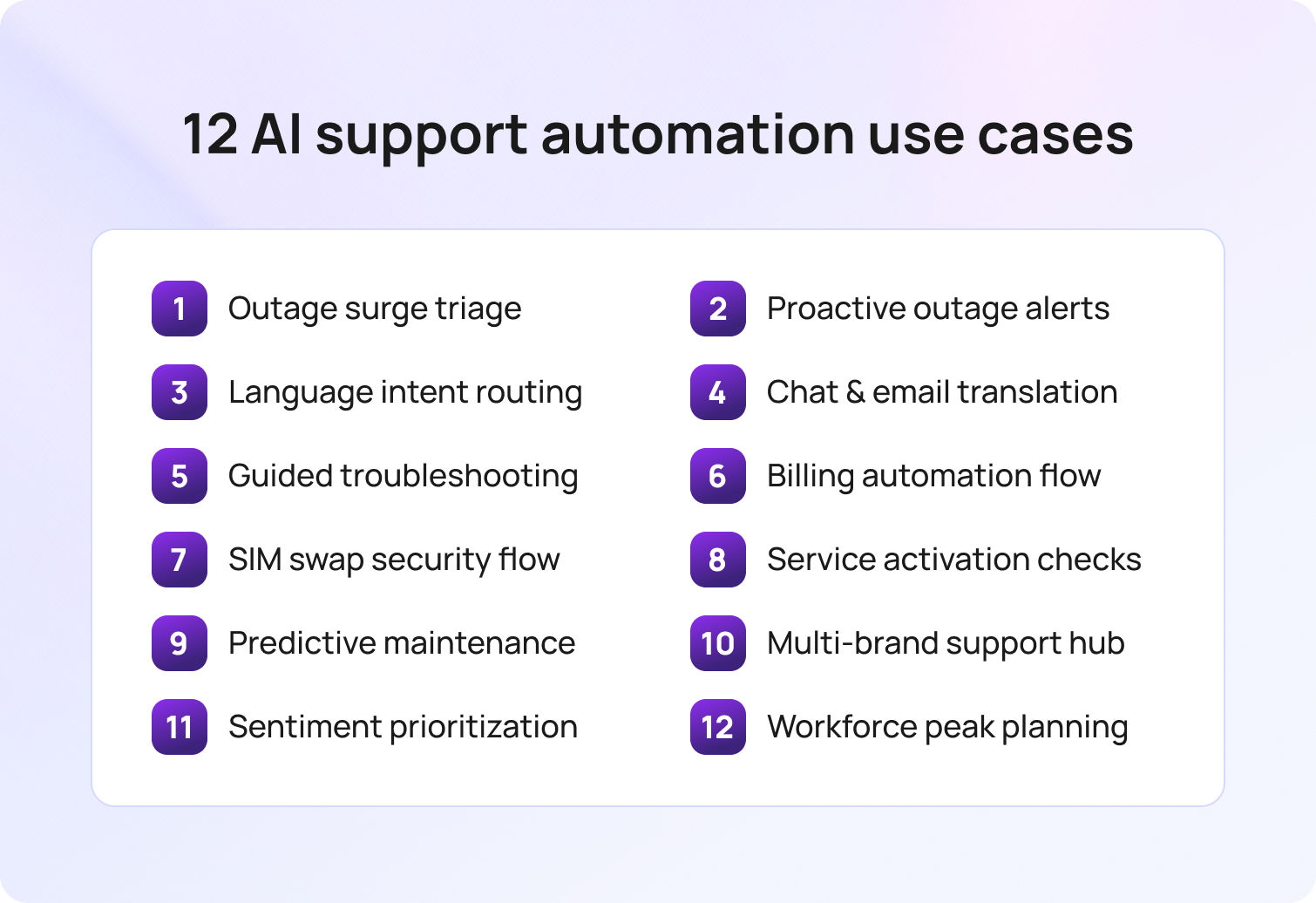
Each use case explains what it is, how it works, why it improves customer experience, and how BlueTweak supports the flow. Track the listed KPIs to measure lift in customer satisfaction and operational efficiency.
1) Outage triage and surge containment
What it is
When a cell site fails or a backbone link flaps, support tickets and incoming calls pile up. AI clusters similar complaints by location, device type, and error language, then links them to live NOC alerts.
How it works
NLP groups customer queries into incident clusters. A unified status card appears for agents and virtual assistants. Customers entering affected ZIP codes receive immediate acknowledgement and an expected response time window. Coordination with network operations ensures frontline messaging stays aligned with live restoration steps and available network resources.
Why it helps
You reduce duplicate troubleshooting, set expectations early, and keep customers informed. Agents focus on edge cases, not the same script 500 times.
Where BlueTweak fits
Connects to external systems via API, classifies and routes new cases, can automate replies and translate in real time, and surfaces incident-level performance. Core KPIs include containment, deflection, sentiment, and FCR; additional customer support metrics, such as wait time and CSAT, can be tracked in analytics.
2) Proactive outage communication across channels
What it is
Customers want to know you see the problem. AI automation can send tailored updates on SMS, email, and in-app when a monitored threshold is crossed.
How it works
When OSS raises an event, automation creates a segment from customer data in the polygon or site footprint and pushes an update with a plain-language status, next check-in time, and safe self-help steps.
Why it helps
Transparent updates cut inbound volume, support customer loyalty, and reduce churn risk during extended maintenance. Clear updates preserve service quality and set realistic expectations for affected telecom services.
Where BlueTweak fits
Sends multilingual updates and AI-assisted replies, with analytics focused on containment/deflection, sentiment, and FCR; additional metrics like CSAT or engagement can be tracked if available in your analytics stack.
3) Real-time language and intent routing
What it is
Customers expect immediate acknowledgment in their language. Language and intent detection at intake routes to the right skill queue.
How it works
NLP detects Spanish billing, French mobile data, or English fiber install questions as they arrive, then applies the response SLA for each queue. Matching intent to skills is the fastest way to respect customer needs without creating new handoffs.
Why it helps
Wrong-queue bounces disappear. Average first response time drops. Escalations become cleaner.
Where BlueTweak fits
Classifies and routes conversations, assists agents to reduce time to first response, and supports multilingual chatbots and other operations. Core KPIs include transfer rate, containment/deflection, sentiment, and FCR; FRT and CSAT may be tracked depending on your analytics setup.
4) Multilingual chat and email translation
What it is
Thin coverage for minority languages slows the first reply. Inline translation keeps the conversation moving. Inline guidance helps agents assist customers in their preferred language without leaving the thread.
How it works
Agents write in their language; customers read in theirs. Brand glossaries protect plan names, device models, and billing codes.
Why it helps
The team replies within SLA while reserving human intervention for complex cases.
Where BlueTweak fits
Provides real-time chat translation and AI-assisted replies, reducing time to first response. Teams can track core outcomes such as containment/deflection, sentiment, and FCR; FRT can be included, depending on the reporting setup.
5) Guided device and network troubleshooting
What it is
Many contacts involve SIM activation, APN settings, eSIM transfer, or ONT resets. AI-powered guides solve these without wait time.
How it works
AI tools walk customers through steps with branched logic and device-specific instructions, then auto-document outcomes.
Why it helps
Automating routine tasks with device-aware flows delivers tailored solutions that resolve common issues on the first touch. Perceived service reliability rises, and truck rolls fall. Customers find answers fast.
Where BlueTweak fits
Uses the knowledge base to assist customers and agents with AI-assisted answers and automation. Core KPIs we track include containment/deflection, transfer rate, sentiment, and FCR; additional metrics, such as AHT or CSAT, can be tracked depending on your analytics setup.
6) Billing inquiry automation with secure handoff
What it is
Billing is high-volume and high-sensitivity. Automation pulls plan details, recent invoices, and add-ons to compose a precise answer.
How it works
AI-powered systems recognize billing intent, retrieve the last bill, highlight deltas, propose an explanation or credit path, and, where policy requires, escalate to an agent for approval. Models analyze customer data to prefill plan details and charges, reducing back-and-forth and speeding approvals.
Why it helps
Clear, fast initial responses cut repeat contacts. Customers feel valued because the reply references their account and plan.
Where BlueTweak fits
Uses a smart knowledge base and proposed replies to speed up the first response. Core outcomes we track include containment/deflection, transfer rate, sentiment, and FCR; additional metrics like FRT or CSAT can be included depending on your reporting setup.
7) SIM swap and identity assurance flow
What it is
Security posture matters. A risky SIM swap or port-out request needs careful validation.
How it works
Automation detects a SIM swap request, triggers stepped-up verification, checks recent customer behavior, and flags risk signals from fraud services. Only then does it create a change order or escalate.
Why it helps
You protect sensitive customer information, stop fraud, and ensure legitimate requests flow smoothly.
Where BlueTweak fits
Applies automatic routing and classification to get the right work to the right queue, with AI summaries to speed review. Core outcomes we track include containment/deflection, transfer rate, sentiment, and FCR; additional metrics can be tracked depending on your analytics setup.
8) Service activation and provisioning checks
What it is
New lines, fiber connects, number porting, IoT SIMs; service activations need clear guidance and visibility.
How it works
Automation collects required fields up front, checks order/prereqs in OSS/BSS, and confirms milestones to the customer.
Why it helps
Fewer back-and-forth loops, faster activations, fewer missed appointments.
Where BlueTweak fits
Connects with external systems through an API-open approach and uses the knowledge base and automation to assist customers and agents. Core outcomes we track include containment/deflection, transfer rate, sentiment, and FCR; additional metrics can be added based on your analytics setup.
9) Predictive maintenance prompts to pre-empt spikes
What it is
Network monitoring and historical performance data can predict trouble before customers call.
How it works
When models flag a sector overheating or rising error rates, support preloads a status note and prepares a targeted FAQ and IVR prompt for that region.
Why it helps
You reduce call spikes and meet customer expectations with steady, proactive communication. Using historical performance data and live telemetry to optimize network performance helps anticipate customer needs before tickets arrive.
Where BlueTweak fits
Connects to external systems through an API-open approach and can assist teams with rapid responses; proposed replies help reduce first-response time. Core KPIs tracked include containment/deflection, sentiment, and FCR; FRT can be included depending on the reporting setup.
10) Multi-brand and wholesale client support in one workspace
What it is
Many telecom providers serve MVNOs or multiple brands. Fragmented tools slow the support process.
How it works
Automation tags cases by brand, applies the right service standards, and keeps reports separate while sharing capacity.
Why it helps
Shared staffing, unified training, isolated analytics. Operational costs fall.
Where BlueTweak fits
Applies automatic routing with WFM/analytics to support operations and proposed replies that reduce time to first response. Core outcomes we track include containment/deflection, transfer rate, sentiment, and FCR; FRT can be included depending on the reporting setup.
11) Sentiment-driven prioritization and coaching
What it is
A polite first reply matters. Sentiment analysis spots tense threads early.
How it works
Models score tone at each step. Negative shifts trigger faster follow-ups, supervisor views, or a tone-checked template.
Why it helps
Lower escalations, better recovery after delays, and rising overall customer satisfaction.
Where BlueTweak fits
Surfaces sentiment and provides call transcription plus AI classification/summarization to support reviews. Core KPIs we highlight include containment/deflection, transfer rate, sentiment, and FCR; additional metrics (e.g., escalation rate or CSAT) can be tracked if available in your analytics stack.
12) Workforce and channel planning for peaks
What it is
Promotions, sporting events, and regional storms. Volume swings are part of the telecommunications industry.
How it works
Forecasts combine historical patterns with event data. Schedules balance voice, chat, and email loads. Rapid-response pools cover unexpected spikes.
Why it helps
Stable average response time, protected SLAs, and fewer queue abandonments.
Where BlueTweak fits
Omnichannel support with WFM/analytics alongside operations; AI-assisted replies help reduce time to first response. Core outcomes we track include containment/deflection, transfer rate, concurrency, sentiment, and FCR; FRT can be included depending on the reporting setup.
Implementation Roadmap For Telecom Providers
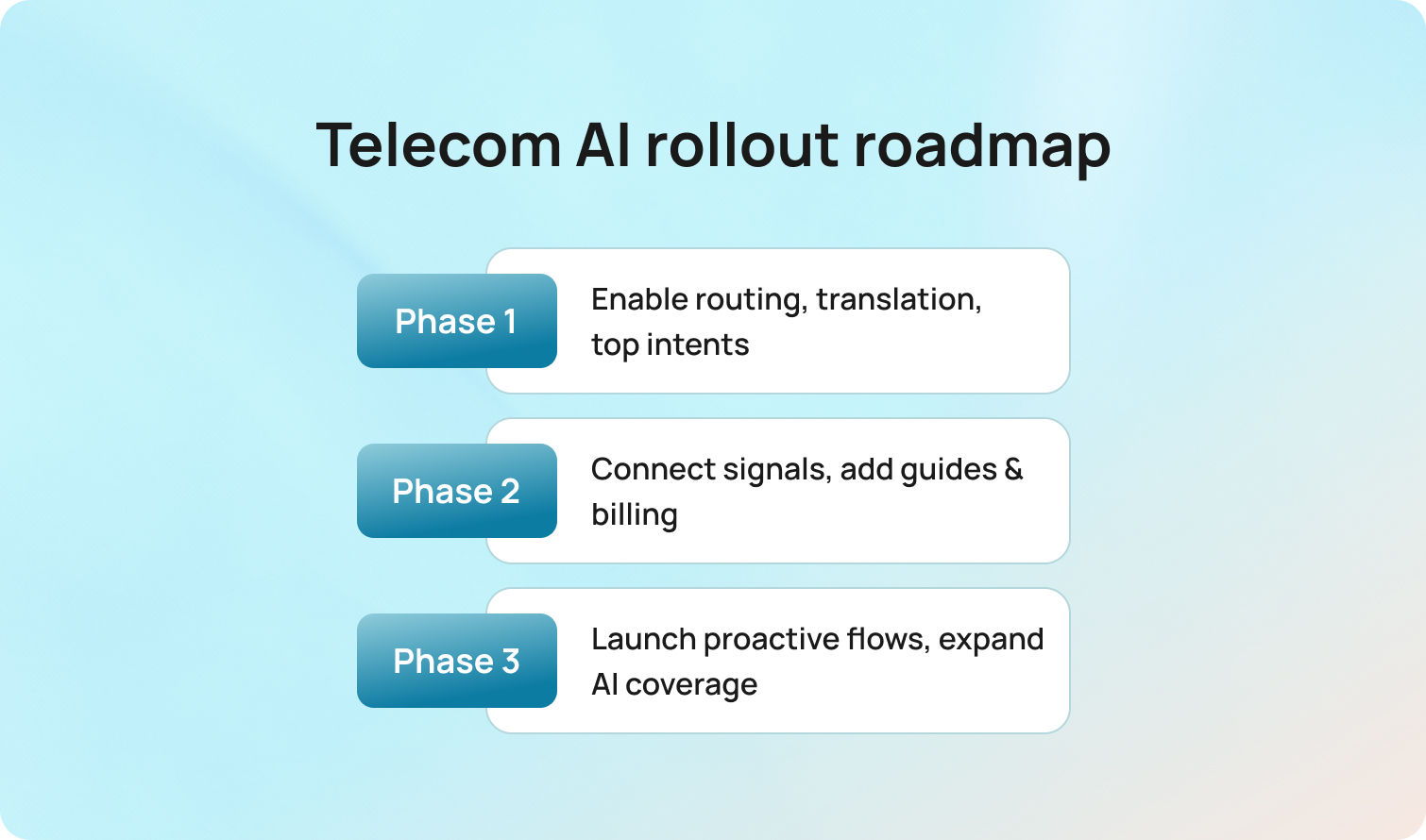
Start small, move fast, and add depth each month.
Phase 1
Enable language and intent routing, inline translation, and proposed reply for the top five intents. Update the ten most-read knowledge articles and localize them. Publish channel-specific FRT targets.
Phase 2
Connect outage and activation signals by API. Launch guided device troubleshooting and secure billing replies. Add sentiment flags for high-value accounts. Train agents on templates and tone.
Phase 3
Introduce proactive outage communications, predictive prompts for at-risk cells, and SIM swap flows with stepped-up verification. Expand virtual assistants to cover more routine support tasks, then tune based on edit logs and CSAT. By this point, teams are running AI solutions at scale while keeping human review for edge cases.
Measurement That Ties to Business Outcomes
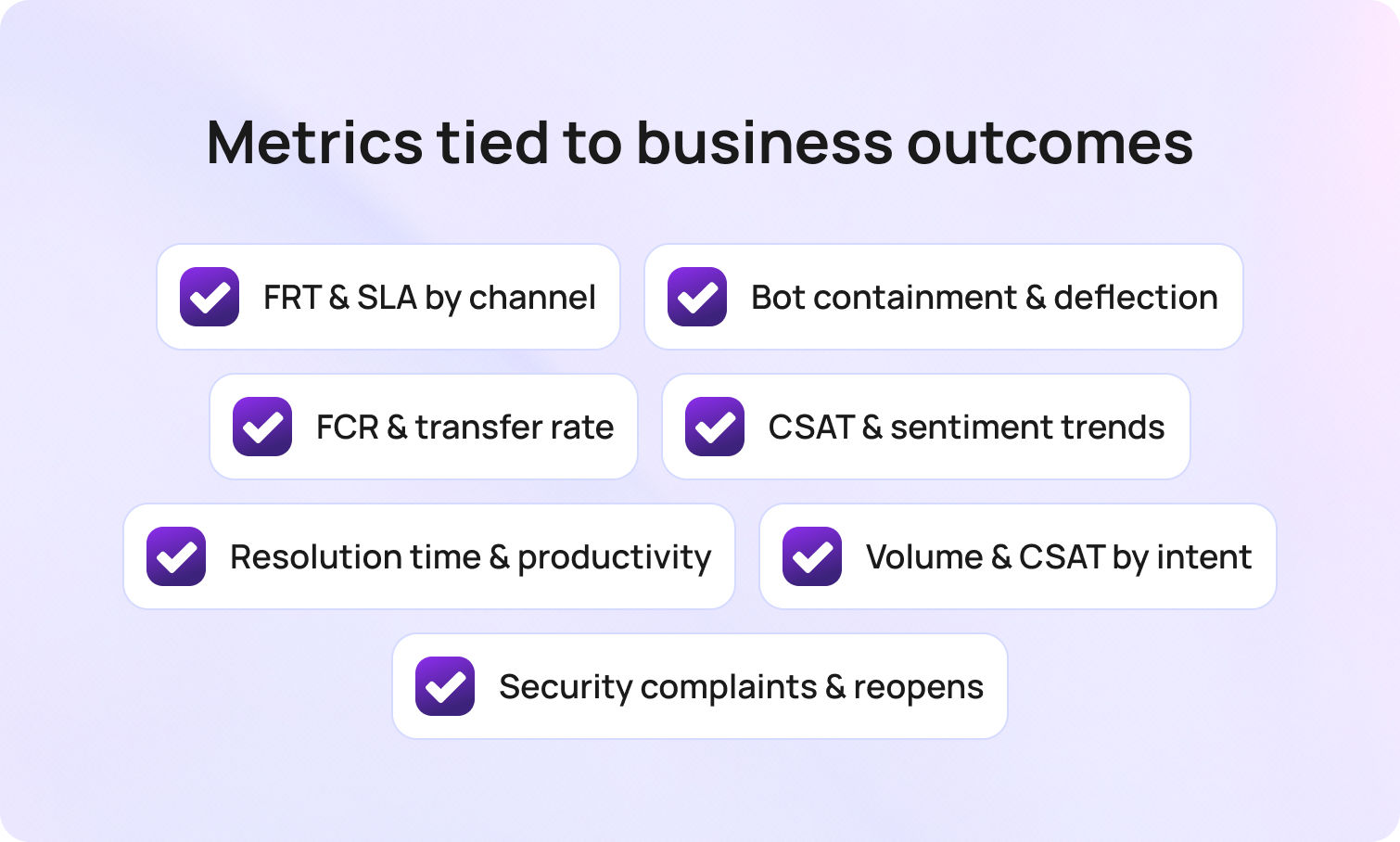
Automation succeeds when customer engagement improves, and costs fall. Review these weekly:
- First response time and percent within response SLA by channel and language
- Containment and deflection from bots and IVR
- FCR and transfer rate to confirm the first response was useful
- CSAT and sentiment after the first reply and after the resolution
- Average resolution time and resolved per agent hour for resource allocation
- Volume and CSAT on billing inquiries, service activations, and outage clusters
- Complaints and reopens on security flows (SIM swaps, number ports)
Tie changes back to revenue drivers: fewer credits during outages, better retention after fast fixes, and significant cost savings from lower manual work.
Privacy, Security, and Governance
Telecom traffic is personal. Keep privacy and security first.
- Limit models to approved sources like your internal knowledge base, policy library, and consented customer data
- Mask sensitive fields in transcripts and restrict who can unmask them
- Log when AI-powered systems propose or translate text, including the sources used
- Provide human agents for eligibility changes, refunds, or sensitive identity checks
- Align with data residency and processor rules for your regions, and audit third-party connections
These controls let you protect sensitive customer information while scaling automation responsibly.
Common Pitfalls to Avoid
Even well-run teams lose minutes to small, repeatable mistakes. The patterns below either inflate your FRT on paper or slow real conversations in ways customers notice. Keep them in view as you tune tools, targets, and workflows.
- Measuring only average time and ignoring business hours or holidays
- Counting auto-replies as meaningful first responses when they do not address the customer’s request
- Setting the same first response SLA across email, chat, and phone
- Letting the internal knowledge base drift while templates multiply
- Treating all tickets equally when some require the right agent and deeper context
Avoid these traps, and your support automation will handle inquiries efficiently without compromising quality.
Future Outlook: 2026 and Beyond
Automation keeps moving to the edge. Operators are wiring live network telemetry into predictive maintenance so fixes can be scheduled before customers feel the dip. Generative AI will be deployed with retrieval-augmented grounding and formal evaluation, so answers cite approved content and reflect the customer’s history and tone.
Enterprises are also getting more hard-nosed about evidence: in the 2026 PwC Global CEO Survey, only 12% of leaders say AI has delivered both higher revenue and lower costs so far, raising the bar for measurable value and auditability. Regulations and infrastructure are catching up: the EU AI Act’s core obligations, including transparency (Article 50) and most high-risk rules, start applying on August 2, 2026, pushing providers to keep model logs and demonstrate controls.
On the stack side, sovereign-cloud options are expanding fast: AWS European Sovereign Cloud went live in Germany in January 2026, with more EU countries on the roadmap, while Microsoft broadened its Sovereign Cloud options and in-country processing commitments through 2025, with additional markets slated by the end of 2026.
What this means: expect tighter coupling between support and infrastructure: predicted fixes flow straight into proactive status updates, agent guidance, and field workflows — with clear audit trails to satisfy EU-grade governance.
Conclusion
The best AI customer support automation in telecom is practical, measurable, and respectful of how telecom networks and business operations work. Automate the repetitive parts, triage, translation, AI-suggested replies, and guided fixes, while keeping human intervention for judgment calls. Track FRT, FCR, CSAT, containment, deflection, and sentiment to verify real gains. With the right foundation, telecom providers improve service reliability, lower operational costs, and boost customer satisfaction. The outcome is better service delivery and service quality across brands and regions, without losing the human touch. BlueTweak brings routing, translation, AI summaries, suggested replies, and reporting into a single workspace for customer support. Request a demo to learn more.

Call Center Workforce Management (2026) Buyer’s Guide
Why Call Centre Workforce Management Matters in 2026
Contact centers are juggling hybrid teams, multiple channels, and rising customer expectations. Leaders now treat call centre workforce management as a strategic system for customer satisfaction and cost control, not just a scheduling tool. In a 2025 benchmark spanning 38 countries, 99% of WFM practitioners said workforce management is essential to business success, underscoring its central role in operational efficiency and agent experience.
At the same time, some sacred processes deserve scrutiny. The familiar “80/20” service level (answer 80% within 20 seconds) still appears in many playbooks, but experts argue it’s not a universal standard and can distract from customer outcomes if applied blindly. Treat SL as a contract shaped by intent, channel, and value, not a default.
Finally, planning must reflect reality. Average handling time (AHT) for service calls has climbed over the last two decades, meaning models built on outdated baselines will be understaffed and miss SLAs.
This guide turns that context into action by defining call center workforce management, highlighting the metrics that matter, outlining step-by-step practices for forecasting, scheduling, and intraday adherence, adding a buyer checklist and a 90-day rollout plan, and showing where BlueTweak fits alongside your WFM stack.
What Call Center Workforce Management Covers
Call center workforce management (WFM) is the discipline of forecasting contact demand, translating that demand into staffing levels, creating and maintaining agent schedules, and implementing real-time adjustments to meet service-level targets at the lowest reasonable operational costs. Done well, WFM raises customer satisfaction, protects employee satisfaction, and provides contact center leaders with a single source of truth for performance decisions.
Core components
- Forecasting & capacity planning: Predict call volumes and handle times across channels using historical data, seasonality, and event overlays.
- Scheduling & shift bidding: Create legally compliant rosters that respect agent preferences, skills, and time-off requests while meeting targets.
- Intraday management: Make real-time changes (break pulls, micro-shifts, channel rebalancing) when reality deviates from the plan.
- Adherence & performance: Track whether agents follow the plan and connect it to key performance indicators such as SL, AHT, first-call resolution, and customer experience strategy.
Analytics & governance: Report outcomes, capture decisions, and comply with labor laws and audit requirements.
The Fundamentals of Call Center Workforce Management in 2026

Before you compare features, align on what “good” looks like for workforce management in your operation. The fundamentals are simple and demanding at the same time: predict demand with enough accuracy to earn trust, translate that forecast into fair schedules that hit service levels without burning people out, and run the day with tight intraday decisions and transparent adherence so customers feel the benefit. With that frame in mind, use the pillars below to pressure-test your 2026 plan.
1) Forecasting that leaders can trust
Goal: Right people, right skills, right intervals.
- Inputs: 12–24 months of interval-level volume and AHT, holidays, promos, price changes, product launches, outages, and marketing calendars.
- Models: ARIMA/exponential smoothing for steady queues; gradient-boosting or Prophet-style models where promotions drive spikes; simple moving averages for thin history.
- Accuracy targets: Aim for ≤5–8% MAPE at the day level for voice and ≤10–12% for digital when volumes are mature; loosen targets for new lines until you have seasonality.
- Practical tip: Forecast workload (contacts × AHT) and convert to FTE, accounting for shrinkage (vacation, sickness, coaching, training, meetings), per site and channel.
What to check in a tool: clear forecast versioning, out-of-the-box short- and medium-term forecasts, and the ability to generate staffing from selected skills on historical data.
2) Scheduling that balances SL and people
Goal: Coverage without burnout.
- Constraints: Skills, cross-skills, multi-channel contact center coverage, lunch/break rules, labor laws, min/max weekly hours, fixed shifts, and agent preferences.
- Methods: Integer/linear programming or heuristic solvers; shift bidding windows; preference-based scheduling for work-life balance; reserve pools for late changes.
Outputs: Publishable rosters, future schedules, exception management, time-off workflows, and self-service swaps.
3) Intraday management that reacts in minutes
Goal: Hold the day when reality changes.
- Tactics: Micro-shifts, voluntary overtime/pulls, moving back-office work, channel rebalancing, and quick knowledge updates when AHT jumps.
- Signals: Interval-level gaps (offered vs forecast), SL at risk, sudden spikes, rising wait times, and above-target abandonment.
- Cadence: 30–60 minute huddles with Ops + WFM, and granular dashboards that let you make real-time adjustments quickly. Practical playbooks beat heroics.
4) Adherence that is fair and transparent
Goal: Reliable coverage with trust.
- Define: What counts as agent availability, handle, ACW, breaks, meetings, training, and exceptions.
- Measure: Schedule adherence at the interval level and variance (how far off, not just how often). Document how adherence ties to coaching, not punishment.
Coach: Focus on patterns, not one-offs; build employee engagement by sharing context on why adherence matters to customers.
Forecasting in Practice: a 5-Step Blueprint
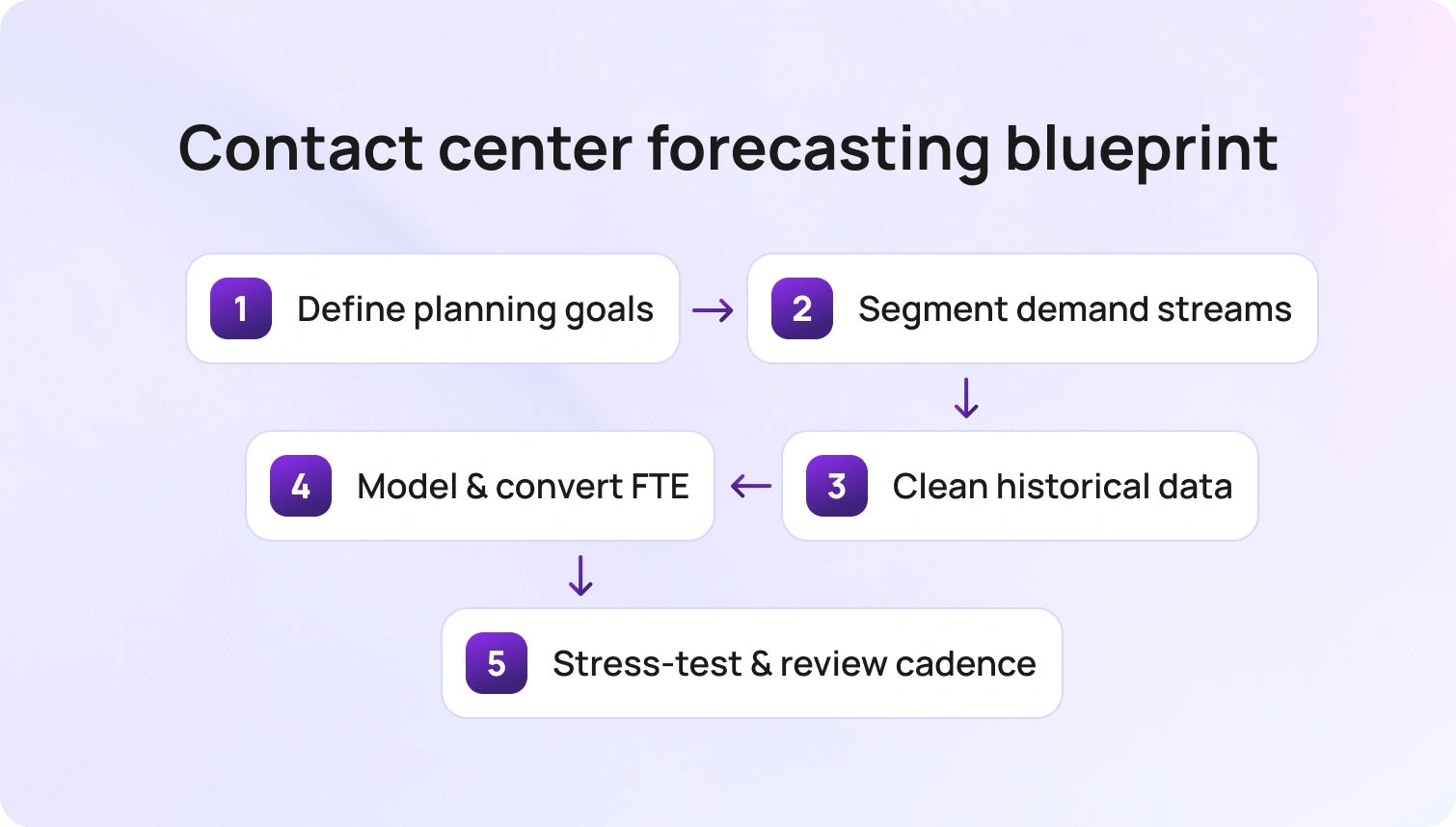
Before models, define the questions your plan must answer: how many agents by skill and channel, where the risk bands sit, and what “good” accuracy means for leadership. Then run this loop.
- Segment the work with intent and channel in mind
Split voice, chat, email, and social, then sub-segment by intent clusters such as billing, outages, and onboarding. Thin lines can be grouped if they share seasonality or skills. The result is cleaner signals and staffing that maps to real customer demand. - Stabilize history so the model learns reality
Tag outages, promotions, and releases; backfill missing intervals; smooth known anomalies rather than deleting them. Attach exogenous calendars for price changes and campaigns. Forecasts trained on labeled history will outperform generic time series. - Choose a base model per segment and evolve
Use classical time-series for stable queues, then layer exogenous regressors or machine-learning approaches for promo-heavy or event-driven lines. New or volatile work can start with moving averages and guardrails until seasonality emerges. Always forecast workload first, then convert to FTE using shrinkage by site and channel. - Stress-test the plan before it hits the floor
Run what-ifs for plus or minus 10% in volume and handle time, then check service-level exposure by interval. Build response playbooks for each scenario so intraday teams know the first three levers to pull when drift appears. - Lock a cadence and make it auditable
Publish a weekly forecast with daily intraday refreshes. Version each release, annotate big swings, and store accuracy metrics such as MAPE or WAPE by queue. Leadership trust improves when they can see why the number changed and how it performed versus actuals.
What to verify in a platform:
Look for forecast versioning, short and medium-term horizons, event overlays, staffing generation from historical skills, and accuracy dashboards by channel and intent. If you cannot see the model’s inputs and the error profile, you cannot manage the risk.
Scheduling That Balances Service Levels and People
Scheduling translates the plan into a contract with your people. Aim for coverage that hits service levels, while protecting fairness, preferences, and compliance.
- Bid windows: Publish monthly rosters with an equitable shift bidding period; freeze critical spans but allow swaps through controlled rules.
- Preference capture: Store recurring constraints (school runs, study days) to place the right agents at the right skills without endless manual edits.
- Flexible blocks: Use 15–30 minute granularity for breaks and offline work; reduce human error with templated patterns.
- Overtime and VTO: Offer in-app sign-ups for real-time management; pay attention to fairness and cost optics.
Compliance: Encode meal/rest rules and weekly caps; audit reports must be easy to export during reviews.
Intraday Management: Holding the Day
Scheduling translates the plan into a contract with your people. Aim for coverage that hits service levels, while protecting fairness, preferences, and compliance.
- Supply levers: Micro-shifts, same-day schedule moves, break pulls, moving meeting time, and tapping reserve pools.
- Demand levers: IVR callback activation, bot/assistant nudges for common intents, and on-the-fly knowledge updates that reduce AHT.
- Visibility: “At a glance” boards for SL at risk, queues breaching, and agent schedules with who is movable.
- Huddles: 30-minute cadence when volatile; hourly when steady. Declare the plan in writing to avoid DM chaos.
(If you’re formalizing intraday, look for playbooks and dashboards that make short-interval adjustments easy to action.)
The Metrics That Matter in 2026 (and How to Use Them)
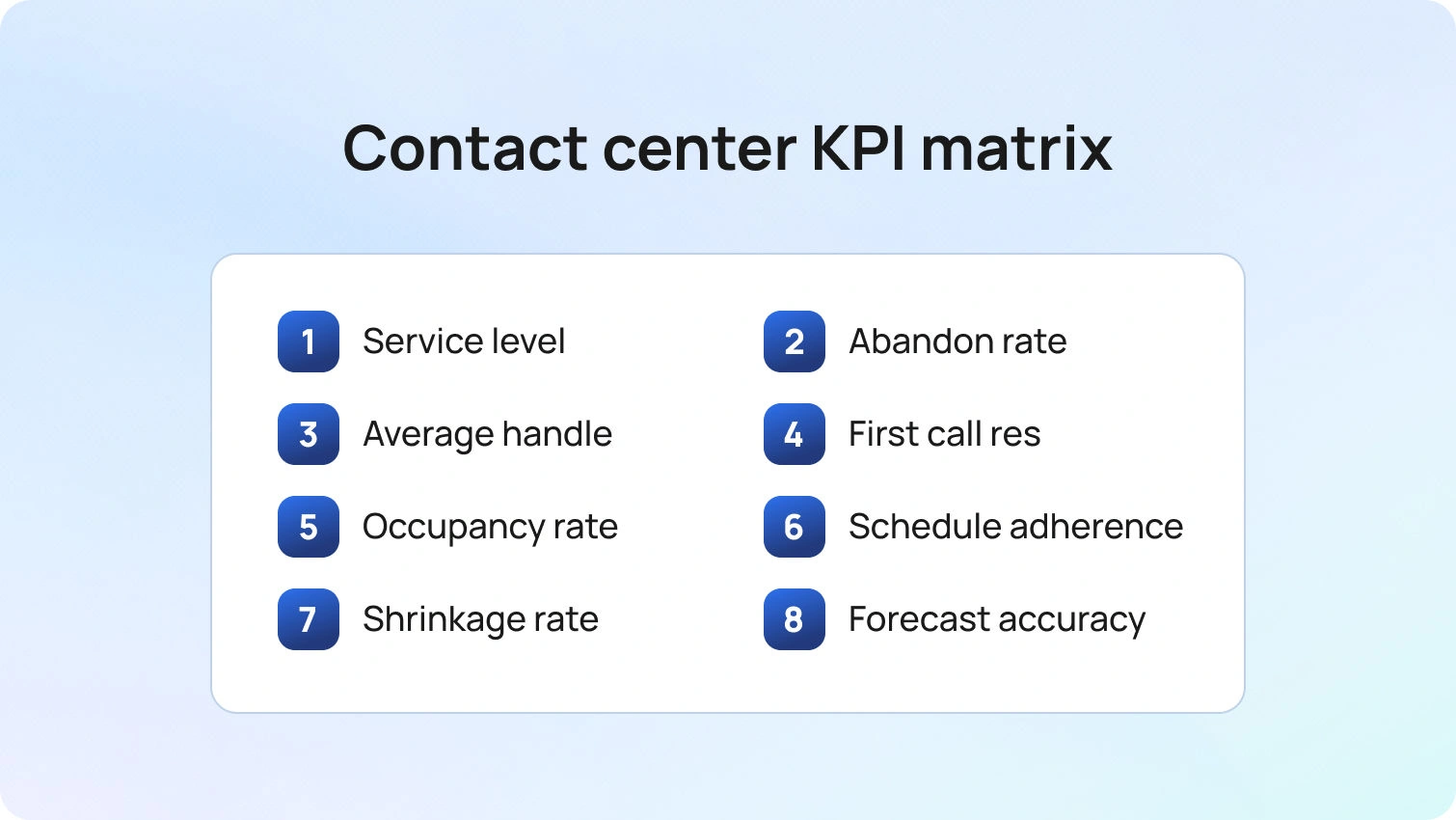
Service level (SL)
Define SL per queue and channel, shaped by customer value and intent rather than a blanket 80/20. Calibrate thresholds for voice, chat, email, and priority lines.
Why this metric: SL represents the promise you make to customers and is the primary constraint your staffing plan must satisfy.
Abandonment
Track both overall abandonment and “abandon after X seconds,” and segment by intent. Expect improvements when IVR menus, callbacks, or status messaging are tuned.
Why this metric: Abandonment reveals the patience curve and the cost of being late, quantifying lost demand that never reaches an agent.
AHT / Average handle time
Include talk, hold, and after-call work, and trend by intent and channel rather than as a single centerwide average.
Why this metric: AHT converts contacts into workload, which drives staffing levels and exposes process or knowledge gaps that inflate effort.
FCR / First call resolution
Tie FCR to deflection quality and knowledge freshness, and read it alongside reopens and transfers. Rising FCR often offsets longer AHT.
Why this metric: FCR is the most direct indicator of service quality and the strongest lever for lowering repeat volume and total cost to serve.
Occupancy and utilization
Set channel-specific guardrails, typically higher for voice than for concurrent chat, to avoid chronic overload.
Why this metric: Occupancy balances efficiency with human sustainability, protecting agent performance and preventing burnout.
Schedule adherence
Measure at the interval level, report variance and percentage, and document clear exception rules.
Why this metric: Adherence connects the plan to reality minute by minute, ensuring the coverage you forecast actually shows up.
Shrinkage
Track planned and unplanned shrinkage separately, with weekly views by site and team, and protect time for coaching and QA.
Why this metric: Shrinkage determines how many paid hours you need to buy to deliver the roster; misestimating it guarantees under-staffing.
Employee satisfaction and attrition
Run short, regular pulses, capture exit themes, and correlate results with schedule stability and preference fulfillment.
Why this metric: Agent sentiment predicts near-term performance and long-term cost, and highlights scheduling and coaching changes that improve retention.
Forecast accuracy (MAPE, WAPE)
Publish targets by channel and intent, version your forecasts, and annotate big deviations so stakeholders understand why the number moved.
Why this metric: Forecast accuracy builds trust in WFM, reduces whiplash in staffing decisions, and keeps the organization aligned on one plan.
2026 Buyer’s Checklist: Workforce Management Tools for Call Centers

Use this list to evaluate workforce management software or a broader workforce management solution bundled with your CCaaS.
Forecasting & planning
- Multiple forecast types (short/medium term), skill-level forecasts, event overlays, and version control.
- Accuracy dashboards (MAPE/WAPE) by queue and channel; alerting for drift.
Scheduling & preferences
- Multi-skill schedules, shift bidding, preference capture, automated time off requests, and labor-rule engines.
- Self-service swaps with guardrails; native mobile access for agents.
Intraday management
- Real-time adherence, “what-if” staffing, and one-click moves across channels.
- Callback/VTO/OT triggers; playbook notes visible to Ops and WFM.
Adherence & performance
- Interval-level adherence with variance; exception handling without ticket storms.
- Links to key performance indicators (SL, AHT, FCR, CSAT) and coaching workflows.
Analytics & governance
- Out-of-the-box reports for service level agreements, shrinkage, staffing variance, and agent performance.
- Audit trails, role-based access, and export to your BI or warehouse.
Architecture
- Open APIs/webhooks, SSO, and workforce management systems that play nicely with your CCaaS, HRIS, payroll, and quality systems.
- Low IT lift to implement; clear roadmap for AI-assisted forecasting and agent experience.
Tip: Compare the tool’s idea of “service levels” to your own. Some vendors still push a one-size metric. If you notice that your current support tool isn’t meeting your needs, it may be time to upgrade your customer support software. Your customers don’t live at “80/20.”
RFP Questions That Separate Real WFM From Reporting
Turn the checklist into proof. Ask vendors to show, not tell.
- Forecasting: “Show the last 12 months of our data with your model. What’s the day-level MAPE by queue? How do you handle promotions and outages?”
- Scheduling: “How do we encode our labor rules and union constraints? Can agents set standing preferences and bid via mobile?”
- Intraday: “Demonstrate a 20% spike: what are the one-click actions to hold SL for voice and chat?”
- Adherence: “How do we define exceptions? Can we report adherence variance as well as percentage?”
- Analytics: “Can we place CSAT/FCR next to SLA and adherence at the intent level?”
- Governance: “What audit logs and role controls exist? How easy is export to our BI stack?”
- Agent experience: “What’s built in for employee scheduling self-service, PTO, and fairness?”
- AI: “What is your roadmap for AI in forecasting and agent engagement? How do you avoid black-box staffing decisions?”
- TCO: “Price model, environments, training hours, and support SLAs; what’s the expected cost savings vs our current state?”
A 90-Day Rollout You Can Actually Ship
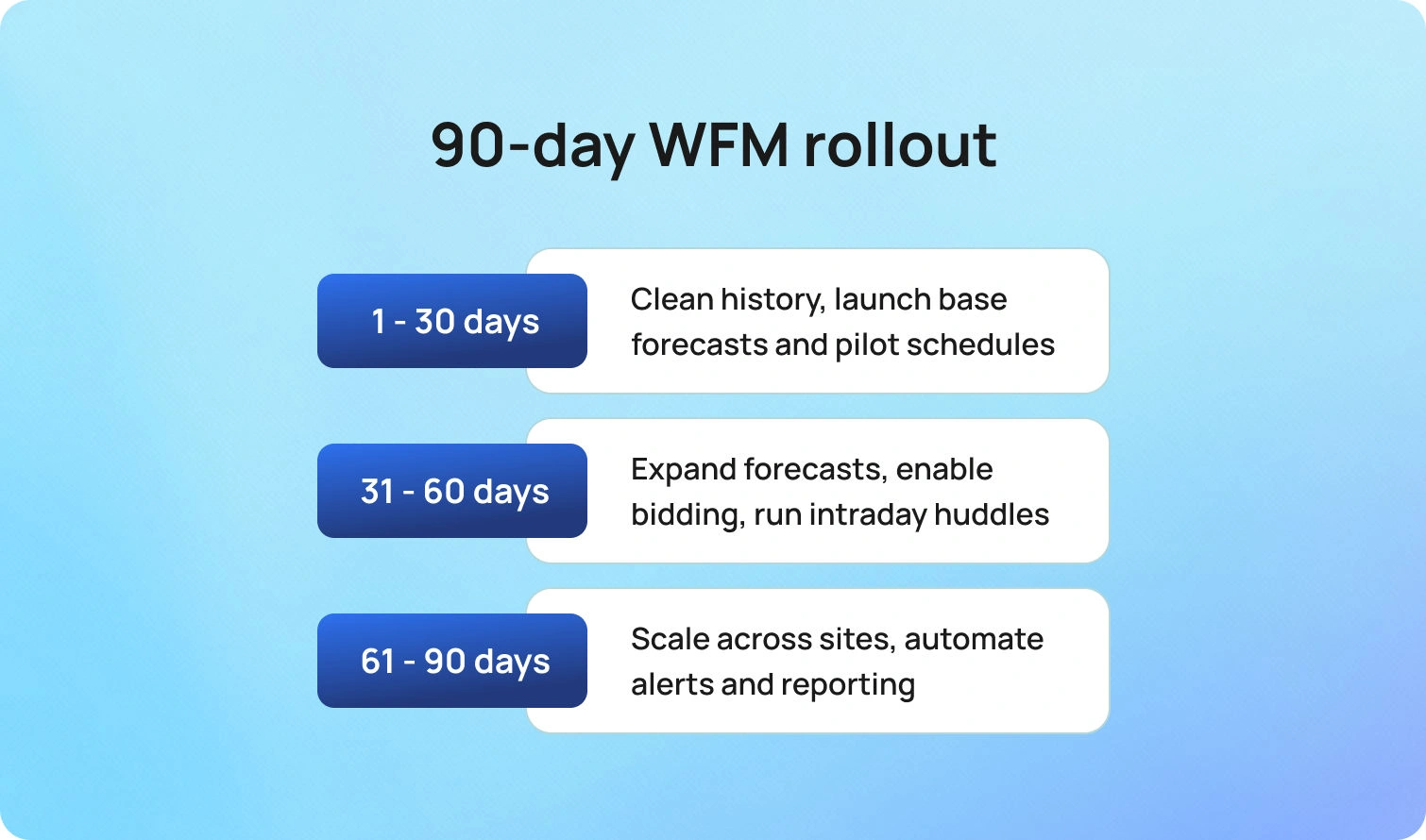
Three sprints take you from baseline to a dependable operating rhythm.
Days 1 to 30: Foundations
Clean twelve to twenty-four months of history and tag events. Stand up base forecasts for the top five queues and publish accuracy targets. Encode labor rules and pilot schedules for one site or team. Define adherence rules and exceptions, and enable interval-level reporting.
Days 31 to 60: Assist and intraday
Expand forecasts to major queues and digital channels. Launch shift bidding and preference capture and enable self-service PTO. Run daily intraday huddles and document playbooks for spikes and outages. Place CSAT and FCR next to SL and handle time by intent in weekly reviews.
Days 61 to 90: Scale and govern
Extend to the remaining sites or brands and roll up to a single WFM calendar. Automate variance alerts and what-if staffing. Publish a monthly WFM report with forecast accuracy, SL attainment, overtime and VTO, adherence variance, and wins or risks. Lock change control with versioned forecasts, schedule approvals, and audit logs.
With the operating model running, decide where WFM sits in your stack.
How BlueTweak helps (WFM Beside Routing and Analytics)
BlueTweak integrates WFM tools alongside omnichannel customer support queues, so planners and supervisors operate from a single workspace. Forecasts and agent schedules sit alongside routing, knowledge, and analytics; leaders can shift staffing by language, brand, and channel in real time while watching SL, AHT, FCR, and adherence for the same intents. That proximity shortens the loop between customer interactions and staffing decisions, improves operational efficiency, and supports global, multi-brand operations with scoped views and role-based access.
If you already own a WFM suite, BlueTweak’s API-open design integrates with external workforce management systems, bringing service level targets, forecast context, and adherence back into standard dashboards so Ops, Finance, and IT share a single picture.
Conclusion
In 2026, workforce management in a call center is the operating system for customer promises. Treat forecasting as a product, scheduling as a contract with your people, and intraday as a disciplined daily sport. Buy or integrate a workforce management solution that is accurate, explainable, and friendly to agents, not just efficient for spreadsheets. Put customer experience and employee satisfaction on the same page as SL and cost, and you’ll meet customer expectations with fewer surprises. If you want call center workforce management besides routing, knowledge, and analytics with real-time levers that Ops will actually use, book a BlueTweak demo.

Top 15 Call Center KPI Benchmarks for 2026
Why Call Center KPI Benchmarking Matters in 2026
By 2027, service leaders expect AI to resolve half of all cases, up from roughly a third in 2025, indicating that KPI baselines for speed, effort, and resolution are shifting. At the same time, customers are 2.6× more likely to buy more when wait times are satisfactory and 2.1× more likely to recommend after first-call resolution, underscoring why benchmarks for ASA, SL, and FCR directly map to revenue.
Benchmarking is not about copying the industry average. It is about locating your current state on a realistic scale, then running a repeatable cadence to close the gap. You will track performance data, compare against external reference points and direct competitors where available, and tune targets by channel, intent, and value. The outcome is a common language for call center performance, faster decision-making, and fewer arguments about “what good looks like.”
In the rest of this article, you’ll get pragmatic call center KPI benchmarks, how to tailor them by channel and intent, and a simple cadence for comparing your performance against industry standards without copying the average.
How To Use Call Center KPI Benchmarks

Treat benchmarks as a playbook, not a scoreboard. Start by anchoring each KPI to a clear decision and the moment in the customer journey it affects, then compare performance in a way that reflects how your center actually operates. With that lens in mind, use the guidance below to set targets that are fair, directional, and immediately actionable.
- Benchmark by channel and intent. AI voicebot, multilingual chatbot, email, social, and messaging have different customer behaviors and different cost structures. A KPI call center benchmark for voice will not fit asynchronous channels.
- Blend external and internal references. Use call center industry and contact center benchmarking reports for directional targets, then compare to your last four to six reporting periods. That mix shows whether you are closing the gap and whether targets are realistic for your mix of incoming calls and outbound calls.
- Tie targets to experience and cost. Customer satisfaction, customer effort score, first call resolution, and abandonment sit on the experience side; occupancy, AHT, cost per contact, and self-service containment are cost drivers. Optimize both to raise agent productivity and maintain operational efficiency.
Publish context with every metric. Center performance metrics only matter when leaders know what changed and what will change next. Write one line on the cause, one line on the fix, and one line on the expected impact.
Top 15 Call Center KPI Benchmarks For 2026
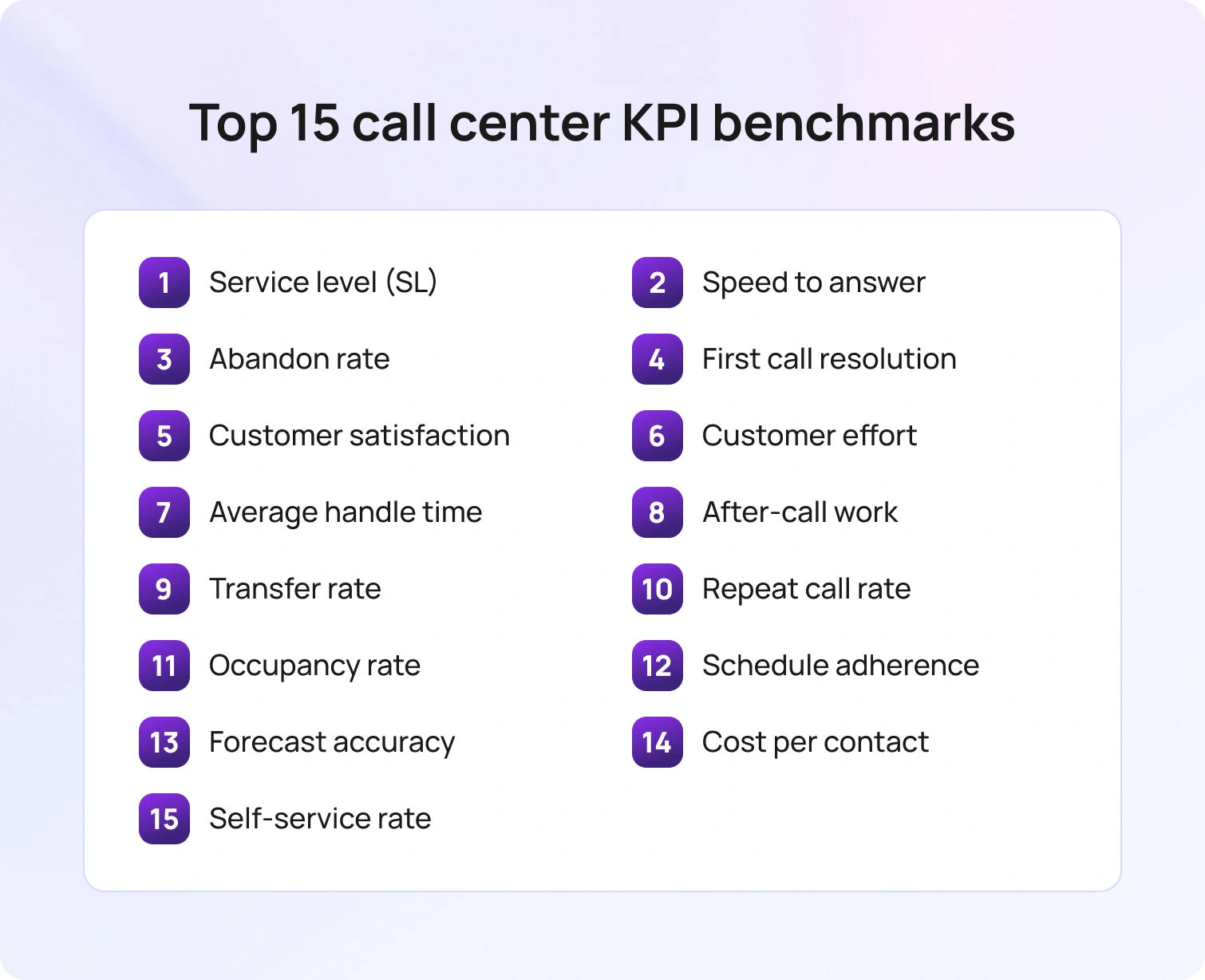
Below are practical call center KPI benchmarks expressed as typical target ranges, not universal rules. Calibrate to your vertical, value segments, and customer journey stage. When in doubt, measure a 90-day baseline, then set targets one notch tighter than your current median.
1) Service level (SL)
What it is: Percent of calls answered within a threshold.
2026 benchmark: Voice queues often sit between 75/30 and 85/20, depending on value and intent. Digital channels should publish response-time SLAs rather than a call-style speed threshold.
Why it matters: SL is your public promise. Hit this, and you cut wait-driven abandonment and poor customer service complaints.
2) Average speed to answer (ASA)
What it is: Time from enter-queue to live answer.
2026 benchmark: 20–40 seconds for voice in mainstream queues; VIP or critical intents trend faster.
Why it matters: ASA influences emotion and primes customer interactions. Long waits spike abandonment rate and repeat calls.
3) Abandonment rate
What it is: The percent of incoming calls that disconnect before being answered.
2026 benchmark: 3–8% for voice after IVR/menu tuning; lower for callbacks. Measure “abandon after X seconds” to remove immediate hang-ups.
Why it matters: Abandonment is a hard cost of delay and a warning light for staffing or menu design.
4) First call resolution (FCR)
What it is: Percent of issues resolved without follow-up or transfer.
2026 benchmark: 70–85% for most call centers, with technical and multi-party cases lower. Track by intent, not centerwide.
Why it matters: FCR drives customer loyalty, reduces repeat volume, and lowers contact center costs.
5) Customer satisfaction (CSAT)
What it is: Post-interaction rating, typically 1–5 or 1–7.
2026 benchmark: 80–90% satisfied on resolved contacts, lower on constrained policies.
Why it matters: CSAT remains the quickest way to assess customer satisfaction at the interaction level.
6) Customer effort score (CES)
What it is: “How much effort did it take to resolve your issue?”
2026 benchmark: Targets vary by scale; aim to keep “difficult” responses below 10–15% on resolved interactions.
Why it matters: CES predicts repeat calls and churn better than satisfaction alone because it captures the effort the average caller invests.
7) Average handle time (AHT)
What it is: Talk + hold + after-call work (ACW).
2026 benchmark: Voice 4–7 minutes for general service; complex tech or regulated queues longer. Chat depends on concurrency and ranges from 6 to 12 minutes per conversation.
Why it matters: AHT converts contact volume into workload and staffing needs. Read it with FCR and quality in mind, so you don’t optimize for speed alone.
8) After-call work (ACW)
What it is: Wrap-up time per contact.
2026 benchmark: 30–90 seconds for mature flows; longer for heavy documentation.
Why it matters: Excess ACW hides process or contact center software issues and reduces agent availability for new calls.
9) Transfer rate
What it is: Percent of contacts moved to another queue or tier.
2026 benchmark: 10–20% for mixed complexity; lower in one-and-done environments.
Why it matters: Transfers extend the customer journey and can signal gaps in routing, knowledge, or agent skills.
10) Repeat call rate
What it is: Share of customers calling back about the same issue within X days.
2026 benchmark: 10–15% for mainstream service when FCR is healthy.
Why it matters: Repeat calls inflate center performance costs and indicate friction with documentation or policy.
11) Occupancy and utilization
What it is: The time agents spend handling work versus waiting.
2026 benchmark: Voice 75–85% occupancy; lower for concurrent chat to avoid overload.
Why it matters: Keeps agents engaged without burnout and protects service quality.
12) Schedule adherence
What it is: A match between planned agent schedules and actual status.
2026 benchmark: 85–92% at the interval level with documented exceptions.
Why it matters: Adherence connects forecasting to reality, ensuring service-level targets remain credible.
13) Forecast accuracy (WAPE/MAPE)
What it is: Error between forecast and actual contacts or workload.
2026 benchmark: Day-level 5–8% for mature voice lines; 10–12% for digital.
Why it matters: Accurate forecasts reduce over-staffing and understaffing, stabilizing response time and agent satisfaction.
14) Cost per contact
What it is: All-in cost divided by the number of contacts handled.
2026 benchmark: Highly variable by industry and channel; the target is a downward trend without harming experience.
Why it matters: Puts operational efficiency and service quality in one view for Finance and Operations.
15) Self-service containment
What it is: Share of intents resolved by IVR, bots, or help center without agent touch.
2026 benchmark: 20–60% depending on automation maturity and intent mix.
Why it matters: High-quality self-service options reduce the number of calls answered and free agents for complex work, lifting FCR on the remaining load.
Call Center KPI Benchmarks by Industry

Every vertical carries different risks, regulations, and emotions. Use these call center KPI benchmarks by industry as starting ranges, then tune them by intent and value tier.
Retail and eCommerce
Customer context: Order status, returns, payments, promotions.
Typical targets: SL 80/20 for voice during business hours, ASA 20–30s, abandonment ≤5%, FCR 75–85%, CSAT 85–90%, CES “difficult” ≤10%.
Notes: High peaks around drops and holidays. Invest in self-service for status and returns to cut repeat calls and raise agent productivity for edge cases.
Banking, Financial Services, Insurance
Customer context: Authentication, fraud, claims, policy changes.
Typical targets: SL 80/20 or faster for high-risk lines, ASA ≤20s on priority, abandonment ≤3–5%, FCR 70–80% with strong compliance notes.
Notes: Transfers may be higher due to entitlements. Tie AHT to quality; rushing increases rework and contact center costs.
Technology and SaaS
Customer context: Setup, billing, troubleshooting.
Typical targets: SL 75/30 for general, VIP faster; FCR 70–85%; AHT can be 7–12 minutes for technical issues; CSAT 85–90%.
Notes: Knowledge freshness and guided workflows are the FCR lever. Track repeat calls within seven days.
Healthcare and Life Sciences
Customer context: Appointments, benefits, medication questions.
Typical targets: SL 80/20 or stricter by regulation, abandonment ≤3–5%, CSAT ≥88% on resolved contacts, transfers controlled by role and privacy rules.
Notes: Compliance extends AHT and ACW; measure empathy and clarity alongside speed to assess customer happiness and service quality.
Travel and Hospitality
Customer context: Changes, disruptions, loyalty.
Typical targets: Highly seasonal. SL flexes by event; ASA 20–40s baseline; FCR 70–80%; abandonment ≤5–8% with virtual hold.
Notes: Proactive messaging reduces spikes. Measure multi-touch journeys rather than single calls in isolation.
Utilities and Telecom
Customer context: Outages, billing, activation.
Typical targets: SL 80/20 normal, surge playbooks for outages; FCR 70–85%; containment high for status updates.
Notes: Separate incident traffic from routine service to prevent benchmarks from blurring during events.
Journey-Lens Benchmarking
Many call centers still look at center metrics in isolation: a voice SLA here, a chat AHT there. In 2026, top programs benchmark the journey:
- Cross-channel FCR. Did the customer get a resolution across the conversation, even if it spanned channels?
- Effort across steps. Use CES to assess how easy the path felt, not just the final call.
- Time to outcome. Replace single-touch averages with “issue start to issue solved” at the intent level.
- Containment quality. Did self-service actually solve the problem, or did it delay an agent interaction and inflate effort?
This lens prevents gaming and aligns targets with the customer journey instead of a siloed queue.
How to Run a Benchmarking Cadence

Think of benchmarking as a tight weekly–monthly rhythm, not a one-off project. You’re building a repeatable loop that compares like with like, turns gaps into owned actions, and shows progress over time. Use the steps below to keep the cadence clear, fair, and relentlessly actionable.
- Define the cohort. Choose the same period last quarter or last year and the same intents.
- Collect clean data. Confirm consistent definitions for calls answered, transfers, repeat calls, and after-call work.
- Compare against references. Use center industry benchmarks plus your own performance history.
- Set target ranges. Publish a floor, target, and stretch per KPI, channel, and intent.
- Attach an action plan. For each gap, assign an owner, a deadline, and the expected impact on customer experience and contact center costs.
Report weekly and monthly. Show trend lines, not snapshots, and include two customer feedback quotes to humanize the data.
Common Pitfalls in Call Center KPI Benchmarking

Benchmarking fails when shortcuts creep in. Guard against these traps so your call center KPI benchmarks stay comparable over time, reflect channel realities, and translate into owned improvements.
- Treating a vendor’s one-size industry average as gospel for your value tiers.
- Mixing definitions across teams so your own performance cannot be trended reliably.
- Optimizing for a single KPI often comes at the expense of others and harms customer interactions.
- Publishing center performance metrics without owners or change logs, which slows improvement.
- Ignoring channel differences. Most call centers need separate targets for voice, chat, email, and messaging.
A 90-Day Plan to Operationalize Benchmarks
Here’s a simple, repeatable rollout that turns benchmarking from a spreadsheet exercise into an operating habit. Use these phases to lock definitions, set targets, and create a weekly rhythm where insights drive action.
Days 1–30: Baseline and definitions
Lock metric definitions, collect twelve months of data, and publish current ranges by channel and top ten intents. Agree on three outcome KPIs for the quarter, such as customer satisfaction score, first call resolution, and abandonment.
Days 31–60: Targets and playbooks
Set floor, target, and stretch for each KPI. Write playbooks for the top five gaps: staffing changes, knowledge fixes, self-service options, and agent training. Turn on a weekly review that shows performance data with one-line causes and one-line actions.
Days 61–90: Measure and iterate
Report call center performance against the new targets, including verbatim customer feedback. Highlight two wins and two risks each week. Adjust targets where the intent mix or seasonality changed. Publish a quarterly “what changed and why” to keep contact center leaders aligned.
How BlueTweak Can Help
BlueTweak makes benchmarking routine. Your channels sit in one workspace, and the core KPIs populate automatically by intent and channel. That includes SL, ASA, abandonment, FCR, CSAT, CES, AHT, ACW, transfers, repeat calls, occupancy, adherence, forecast accuracy, cost per contact, and self-service containment. Leaders see trend lines against floor, target, and stretch, and can pivot from center metrics to underlying conversations in a click.
Clean joins make comparisons trustworthy. APIs and webhooks attach case IDs, intents, brand, language, and queue to every interaction, while AI summaries and sentiment tagging convert raw conversations into structured performance data. That context lets you publish center key performance indicators with one line for the cause, one for the fix, and one for the expected impact, without manual stitching.
Benchmarks become actions, not screenshots. Suggested replies cite the right knowledge article, WFM views align staffing to forecast, SL exposure, and routing rules adjust by intent when repeat calls or transfer rate spike. Teams close gaps with targeted playbooks across staffing, knowledge, and self-service, and BlueTweak tracks outcomes in customer satisfaction, customer effort score, and contact center costs.
If you already own analytics or workforce management software, BlueTweak integrates to keep a single source of truth. If you do not, BlueTweak provides out-of-the-box scorecards, adherence, and intraday views, and intent-level reporting, so you can immediately launch a weekly and monthly benchmarking cadence and measure progress against the 2026 targets outlined in this guide.
Bringing It Together: A Balanced Scorecard for 2026
Great benchmarking pairs numbers with a narrative. Use these call center KPI benchmarks to set intent-level targets by channel, then write short explanations and action plans that tie center KPIs to better customer interactions and lower contact center costs. When you treat benchmarks as a living contract, reviewed weekly, tuned quarterly, you will raise team performance, improve customer satisfaction, and give leaders the clarity they need to invest confidently in call center operations and customer experience.
If you want those call center KPI benchmarks to update automatically and tie directly to actions, BlueTweak brings routing, WFM, knowledge, and analytics into one workspace. Scorecards populate by intent and channel, leaders track trends against targets, and teams get clear next steps. See how it maps to your queues and metrics.

How to Reduce Ticket Volume with Self Service and AI (2026)
Why Reducing Ticket Volume Matters in 2026
In 2026, customers expect instant answers, accurate results, and self-service on every channel. When help is hard to find or feels untrustworthy, simple questions turn into support tickets, queues swell, and confidence dips before the conversation even starts. The shift is structural: most journeys now begin outside your owned surfaces, with 51% of customers starting on third-party platforms like search, YouTube, or ChatGPT. If your content isn’t discoverable and useful there, those queries arrive as tickets from already-frustrated users.
Inside the queue, another gap compounds volume:60% of agents don’t actively promote self-service during interactions, so repetitive questions boomerang back later. Enabling fix-it agents during self-service experience upgrades reduces repeat contacts and protects morale.
Bottom line: lowering support ticket volume isn’t about deflection for its own sake; it’s about removing friction so customers get reliable answers fast, and agents focus on the moments that truly need a human. This article will pinpoint where to start in prioritizing help desk tickets and how to prove impact.
What “Self-Service + AI” Includes (2026)

Self-service only reduces ticket volume when every layer works together: the right content, the right retrieval, and the right handoff. Think of this stack as a closed loop: understand, answer, act, and learn, so most customers solve problems instantly, while complex issues reach the best-equipped human.
Natural language processing (NLP). NLP customer support understands unstructured questions across chat, email, community, and social, so intent, language, and urgency are clear.
Generative AI with grounding (RAG). Drafts accurate first replies from verified knowledge base content and policy, then cites what it used.
AI-powered search. Semantic and vector retrieval return relevant content quickly, improving findability and reducing “no result” dead ends.
Virtual assistants and chatbots. Handle routine tasks and FAQs to deflect tickets, with a clear, respectful path to a human when needed.
Automated ticketing and routing. Applies rules by language, entitlement, and complexity so exceptions land in the right queue with context.
Sentiment and quality analysis. Spots friction early, prevents reopens, and prioritizes threads that need tone-checked coaching or faster follow-up.
System integrations. Connects to product telemetry, billing, CRM, and authentication so self-service can resolve end-to-end actions, not just explain them.
Measurement and feedback. Tracks deflection, search success, and post-self-service CSAT, then feeds insights back into content and assistant skills.
The common thread is precision and auditability. Answers are grounded in approved sources, actions are logged with inputs and variables, and learnings flow into the next iteration, so automation removes work instead of creating more tickets.
12 Proven Use Cases to Reduce Ticket Volume with Self-Service
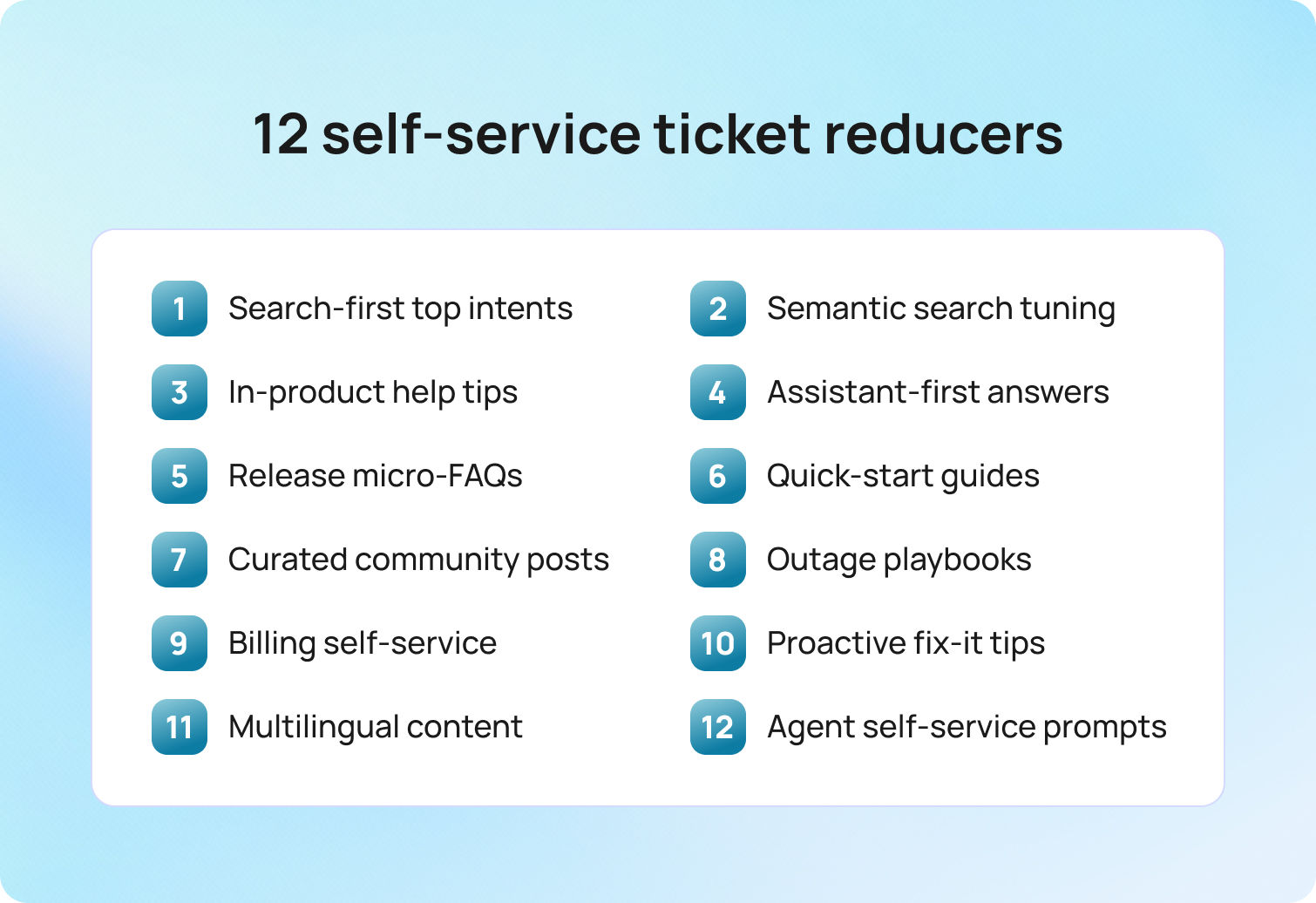
Each use case explains what it is, how it works, why it helps, where BlueTweak fits, and KPIs to track. Use the ones that match your support team and channel mix.
1) Search-first answers for the top 25 intents
What it is
Publish crisp, maintained AI customer support knowledge base (KB) articles for last quarter’s 25 highest-volume intents.
How it works
Each article follows a consistent template: Problem → Short answer → Step-by-step → Edge cases → When to contact support, plus screenshots or a 60-second clip. Add owner + review cadence.
Why it helps
Most customers skim. Clear, structured answers at the top prevent portal/search journeys from turning into tickets.
Where BlueTweak fits
BlueTweak’s smart knowledge base underpins accurate responses, and AI-suggested reply surfaces KB answers to reduce time to first response.
2) AI-powered findability (semantic search + synonyms)
What it is
Vector/semantic search tuned to your taxonomy (product, plan, region) with “did you mean?” and synonym maps.
How it works
Index KB, release notes, and vetted community threads; boost freshness and click-through; instrument “no-result” alerts to drive new content.
Why it helps
Users land on relevant content on the first try, reducing repeat contacts.
Where BlueTweak fits
Use BlueTweak’s AI + API stance and open-to-integration posture to connect your KB/search service and expose results across channels; a suggested reply can surface grounded snippets for agents.
3) Contextual help inside the product
What it is
Inline tooltips, micro-FAQs, and “Need help?” drawers keyed to page/role/state.
How it works
Trigger help based on feature use or errors; surface the exact KB step where confusion spikes; log gaps to your content backlog.
Why it helps
Guides customers without channel-switching and prevents low-complexity tickets.
Where BlueTweak fits
BlueTweak’s API-open approach lets you pipe usage signals into help surfaces and keep answers KB-grounded; agent-side summaries/classification capture context when escalations occur.
4) Assistant-first for simple queries (with human handoff)
What it is
Automation resolves routine questions (“Where’s my invoice?”, “Update my card”, “Reset password”) with a clear path to a person.
How it works
Ground generative answers in approved knowledge base and policy; automate safe actions; escalate when policy or identity checks require humans.
Why it helps
True ticket deflection for repeatable work; agents focus on complex issues.
Where BlueTweak fits
BlueTweak supports AI-assisted replies via suggested replies from the KB, plus automatic routing so escalations land in the right queue with context.
5) Release-note micro-FAQs to preempt spikes
What it is
For every product update, publish a short “What changed?” FAQ (1–3 critical Qs) and link it where users encounter the change.
How it works
Create a KB snippet and agent macro at release; expire or revise in 7–14 days.
Why it helps
Prevents day-one floods from small UX shifts.
Where BlueTweak fits
A smart knowledge base and suggested reply provide agents with ready-to-send guidance; classification/summarization keeps internal context concise during the spike.
6) Visual quick-start guides for new users
What it is
Short “first-10-minute” videos and annotated screenshots that get new users productive fast.
How it works
Embed in onboarding flows and your portal; include “when to escalate” rules to avoid dead ends.
Why it helps
New users resolve basics themselves; agents avoid repetitive walk-throughs.
Where BlueTweak fits
BlueTweak’s knowledge base and suggested replies make these assets reusable across multilingual chat, AI voice bot, and email, ensuring omnichannel consistency.
7) Community answers, curated and surfaced
What it is
Highlight vetted, best-answer community threads for how-to topics and edge cases.
How it works
Moderate for quality; surface alongside KB in search; link from agent macros.
Why it helps
Expands coverage without expanding headcount; reduces long-tail tickets.
Where BlueTweakfits
Use open integration to index curated threads in your search experience and reference them via suggested reply when relevant.
8) Incident playbooks (status + self-service)
What it is
Prebuilt bundles for outages: status copy, top 5 FAQs, IVR/chat prompts, and portal banner text.
How it works
When an alert hits, publish across channels with check-in times; keep a single source of truth that agents and bots reference.
Why it helps
During spikes, clarity deflects the most volume; consistent messaging reduces confusion.
Where BlueTweak fits
BlueTweak is API-open and integration-friendly for ingesting signals; automatic routing and summaries help frontline teams keep responses aligned.
9) Billing & account self-service (guard-railed)
What it is
Self-service flows for safe account tasks (download invoice, update payment method, change address), with a human path for exceptions.
How it works
Automate allowed actions; route policy-sensitive or identity-sensitive cases to agents.
Why it helps
Removes a large chunk of repetitive inquiries; reduces back-and-forth.
Where BlueTweak fits
Use knowledge base-grounded suggested replies for explanations and automatic routing for exceptions; AI summaries speed approval workflows.
10) Proactive “fix-it” tips based on behavior
What it is
Contextual nudges that say “We noticed X—here’s the fix,” delivered in-app or by email.
How it works
Use telemetry to detect common misconfigurations and map each to a KB step or a simple flow.
Why it helps
Solves issues before frustration peaks; prevents avoidable tickets.
Where BlueTweak fits
BlueTweak’s AI + API stance supports tying product signals to knowledge base guidance; classification/summarization keeps agent handoffs crisp if users still escalate.
11) Localization & glossaries for multilingual self-service
What it is
Translate the top 50 articles and common intents; protect brand terms with a glossary.
How it works
Serve localized KB to searchers; preserve terminology; ensure a clear “talk to a person” path for edge cases.
Why it helps
Removes language as a driver of high volume; reduces rework and reopens.
Where BlueTweak fits
BlueTweak provides real-time customer support, AI translation, and language-aware routing (via automatic routing), so escalations land with the right team.
12) Agent enablement to promote self-service
What it is
Prompts, macros, and coaching so agents consistently link the right article/guide.
How it works
Replies include a one-paragraph summary plus “learn more”; train on when to use self-service vs human handling.
Why it helps
Closes the promotion gap, reduces repeat contacts, and improves the support experience.
Where BlueTweak fits
Suggested reply inserts knowledge base-grounded drafts; edit logs and analytics (WFM/analytics support) show adoption and outcomes across channels.
Implementation Roadmap (90 Days)
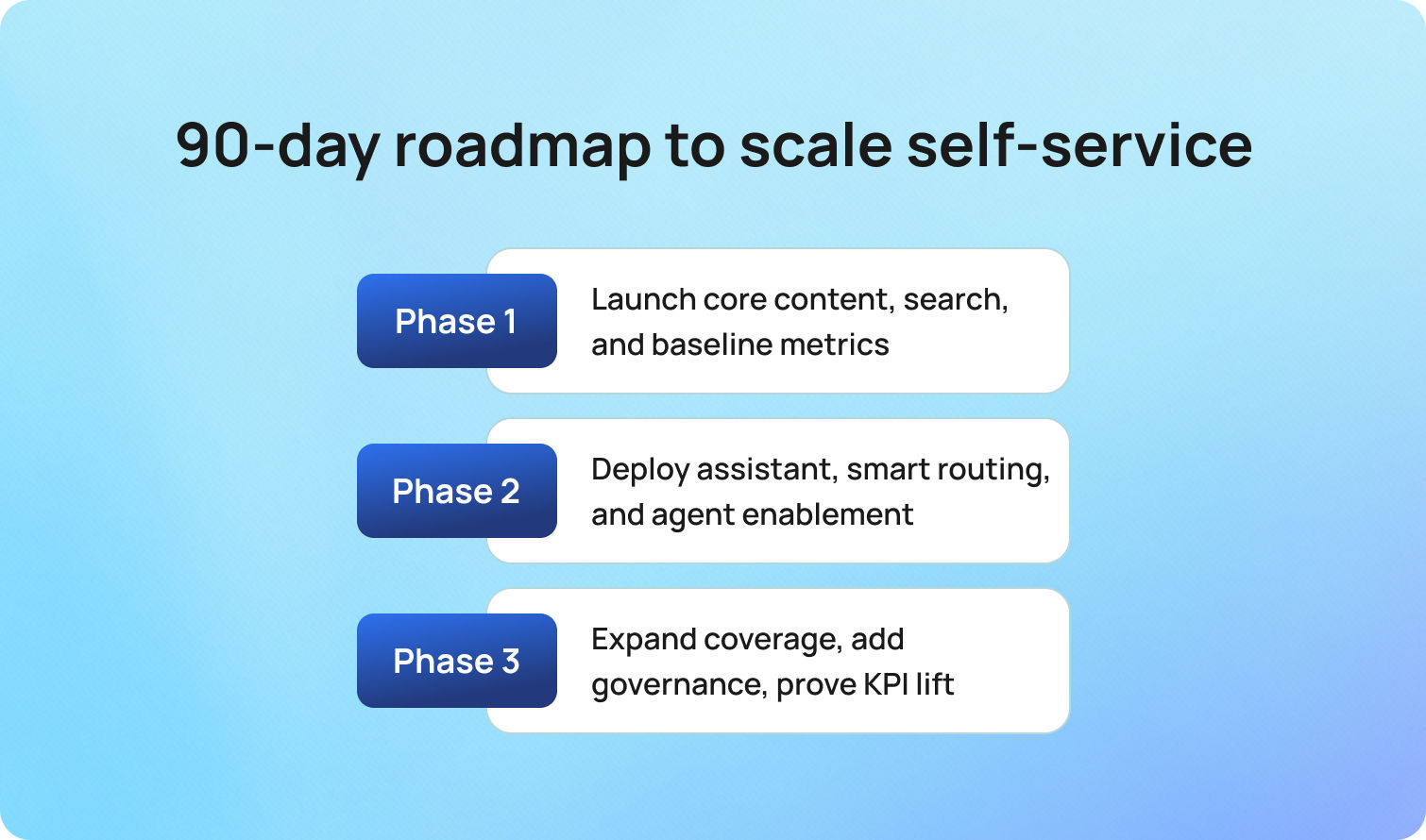
Set the foundation so self-service actually deflects work: ship the must-have content, make it findable, and instrument the basics. In four weeks, you’ll have a measurable baseline and the core loop: content → search → assist → escalate—running end to end.
Phase 1 — Foundations (Weeks 1–4)
- Ship top 25 intents: publish/refresh KB articles + agent macros; add owners and review dates.
- Turn on AI search and analytics; set up no-result alerts to Slack/Jira.
- Add contextual help to 5 friction pages (tooltips/micro-FAQs linked to KB).
- Baseline dashboard: ticket deflection, support ticket volume by intent/channel, CSAT, search success.
Phase 2 — Assist & Escalate (Weeks 5–8)
- Launch assistant for 10 intents with a clear “talk to a person” path; cite KB in replies.
- Enrich routing by language/complexity/entitlement; attach transcript + steps-tried on escalation.
- Enable agents with macro packs and coaching to consistently promote self-service.
Phase 3 — Scale & Govern (Weeks 9–12)
- Localize top 50 articles/intents; enforce glossary and language-aware routing.
- Stand up governance: owners, SLAs, edit/audit logs, and a monthly “what we prevented” report.
- Publish an exec readout with before/after KPIs and next-quarter backlog.
Weekly scorecard: deflection rate, support ticket volume, search success/no-result queries, FRT/FCR on escalations, CSAT after self-service.
Measurement That Ties to Business Outcomes in 2026
Treat measurement as an intent-level story: what customers tried, where self-service resolved the need, and where handoffs or content gaps created avoidable work. Track these narratives over time so CX, Product, and Finance can act on patterns.
- Ticket deflection rate (resolved via article/assistant/community without a ticket).
- Support ticket volume by intent/channel/language.
- FCR and average resolution time (proves clean handoffs when human intervention is needed).
- CSAT & sentiment after self-service and after resolution.
- Search success rate and no-result queries (fuel the backlog).
- Work avoided (articles/assistant usage vs tickets), cost-to-serve per 1k active users.
Common Pitfalls to Avoid

Even strong programs stumble when measurement, governance, or handoffs are fuzzy; align teams on clear definitions and standards so self-service removes work without eroding trust.
- Treating generic auto-replies as deflection; count only issues truly resolved without an agent.
- Allowing poor discoverability, articles that don’t rank or surface in-product still drive tickets.
- Skipping agent enablement; provide macros and coaching to consistently promote self-service.
- Letting content go stale; retire or update and keep owned knowledge clusters current.
- Automating without a human path; ensure an accessible handoff for edge cases and sensitive topics.
- Over-automating complex journeys; reserve skilled agents for higher-risk issues that affect the brand.
Future Outlook: 2026 and Beyond
Self-service is moving from a help center destination to an in-product, moment-of-need layer. Assistants will feel less like clever text and more like governed systems. Answers will be grounded in verified content, actions will be gated by policy, and every step will be logged for audit. The practical outcome is fewer tickets created in the first place because guidance appears exactly where users stumble and can execute safe fixes, not just explain them.
Discovery continues to shift away from owned surfaces. A majority of customer service journeys now start on third-party platforms such as Google, YouTube, and ChatGPT, which means findability and source-of-truth governance matter as much as the prose itself. Meeting customers where they begin is the most reliable way to cut volume before a ticket is opened.
Compliance and sovereignty move from afterthought to design input. The EU AI Act phases in transparency and record-keeping obligations from 2026 to 2027, which pushes teams to demonstrate how an answer was produced and which sources and variables were used. In parallel, cloud providers are expanding sovereign options within the European Union, including AWS's European Sovereign Cloud, which went live in Germany in January 2026. Channel mix keeps tilting toward digital first. Customer service leaders expect self-service and live chat to overtake phone and email in perceived business value within the next two years. That elevates knowledge management, AI-powered retrieval, and clean human handoff from add-ons to core operating capabilities.
Conclusion
The best path to reducing support tickets is practical and measurable: ship high-quality content, make it findable, embed self-service options in-product, and use AI assistants with safe escalation. Track deflection, search success, CSAT, and support ticket volume by intent. With the right foundation, you’ll see fewer tickets, faster first replies, happier support staff, and a better support experience for customers.
BlueTweak brings routing, translation, AI summaries, proposed replies, and reporting into one workspace, so your customer support team can reduce ticket volume while keeping humans on the hardest problems. Book a demo to find out more.

Challenges for Contact Centers in 2026 – BlueTweak
Contact Centers have always been at the forefront of customer service, providing vital support to customers when they need it most. As we head into 2026, contact centers are facing a range of challenges that require careful consideration and proactive solutions. In this article, we’ll explore some of the most pressing challenges that contact centers are likely to face in 2026 and offer some insights into how they can be addressed.
Rising customer expectations
One of the biggest challenges for contact centers in 2026 will be meeting the ever-increasing expectations of customers. Customers expect fast, efficient, and personalized support across multiple channels, including phone, email, chat, and social media. Meeting these expectations requires sophisticated technologies, well-trained staff, and a customer-centric approach.
To address this challenge, contact centers will need to invest in advanced customer service technologies that enable them to deliver a seamless and consistent customer experience across all channels. They will also need to provide ongoing training and development opportunities for their staff, so they can keep pace with the latest customer service trends and technologies.
Read more about: Building Trust in Customer Support: Tips for Creating Long-Lasting Customer Relationships
Data privacy and security
Data privacy and security will remain a top concern for contact centers in 2026, as customers become more aware of the potential risks associated with sharing their personal information online. Contact centers will need to ensure they are using secure technologies and processes to protect customer data and comply with evolving privacy regulations.
To address this challenge, contact centers will need to implement robust data security measures, such as encryption, firewalls, and multi-factor authentication. They will also need to develop comprehensive data privacy policies and procedures and provide ongoing training for their staff to ensure they understand their responsibilities and how to protect customer data.
Recruitment and retention of skilled staff
Read more about: The Power of AI in Customer Support: A Catalyst for Agent Empowerment
Integration of emerging technologies
The rapid pace of technological change means that contact centers must continually adapt and integrate emerging technologies to remain competitive. Emerging technologies such as artificial intelligence, machine learning, and natural language processing offer exciting opportunities to enhance the customer experience and improve efficiency, but they also require significant investments in infrastructure and staff training.
To address this challenge, contact centers will need to develop a clear strategy for integrating emerging technologies into their operations. They will need to assess their current technology stack, identify gaps, and invest in the right technologies to achieve their strategic goals. They will also need to provide ongoing training and development opportunities for their staff to ensure they can effectively utilize these new technologies.
Contact centers face a range of challenges in 2026, but with careful planning and proactive solutions, they can overcome these challenges and continue to deliver exceptional customer service. By investing in advanced technologies, developing comprehensive data security measures, attracting and retaining skilled staff, and integrating emerging technologies, contact centers can position themselves for success in an increasingly competitive landscape.
12 Aircall Alternatives to Consider for Your Contact Center in 2026
From Voice to Full CX: Signs You’re Ready to Expand
You chose Aircall for a clean interface and quick setup. It covers core calling and hands off to your CRM without fuss. As your operation grows, new needs tend to pop up.
Call volume increases, so forecasting and scheduling become more critical. That puts workforce management on the list. AI moves from “nice to have” to “must have,” especially transcription, summaries, and suggested replies grounded in your knowledge base. And once conversations span voice, email, and chat, keeping the full customer story in one place becomes essential.
Costs can shift, too, as you add analytics, integrations, or premium support on top of the base plan.
Make the decision about fit. Map your must-haves and score each platform against them:
- Omnichannel support
- AI depth
- Help desk alignment
- Total cost to operate
This article breaks down why teams explore options beyond Aircall, what to prioritize in 2026, and the platforms worth considering.
Why Teams Look For Aircall Alternatives in 2026
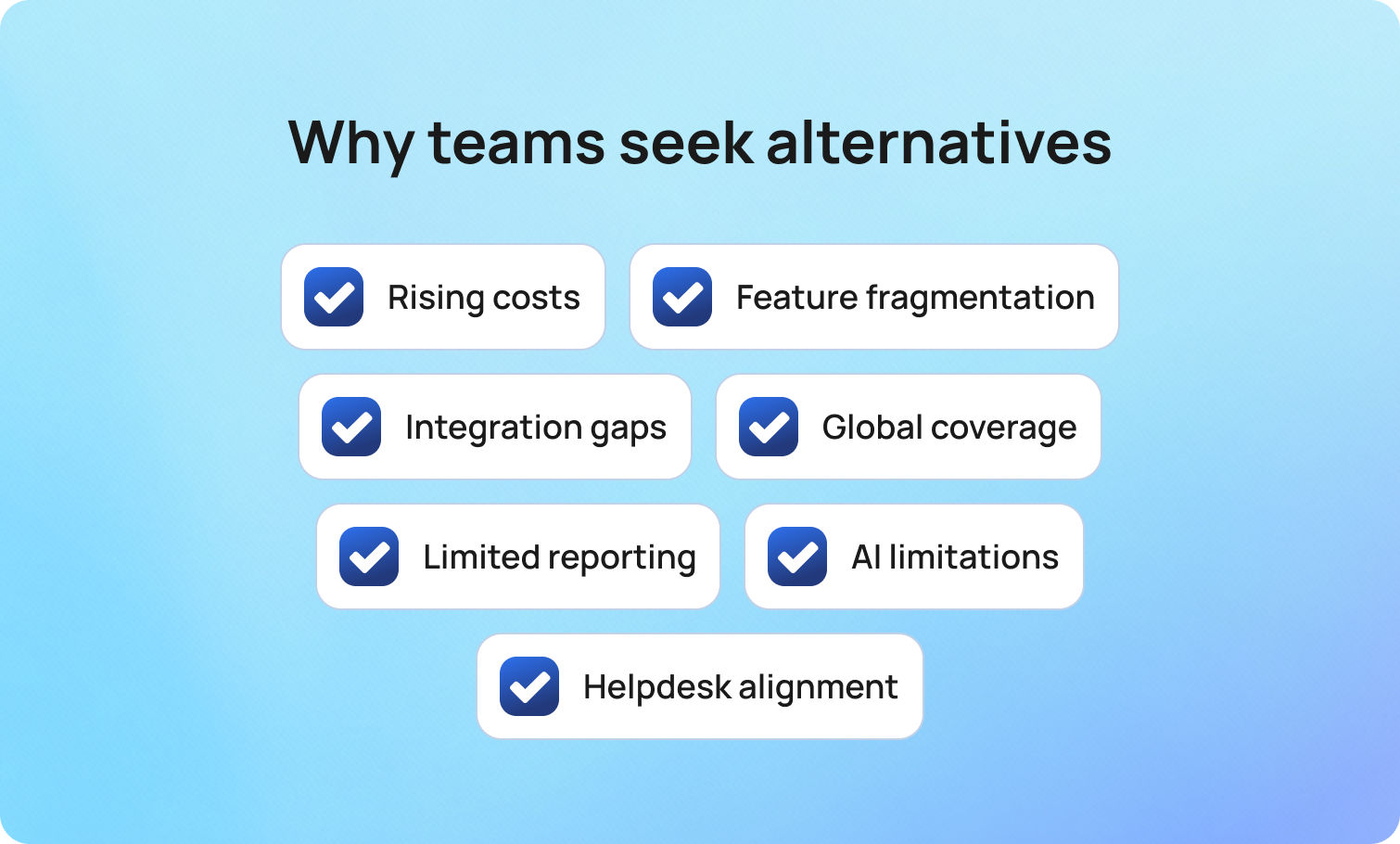
Aircall is an excellent customer support solution, but it may not be the right fit for every business. Here are some of the reasons teams are looking for Aircall alternatives:
- Scaling costs: Per-user pricing compounds as teams grow. When you add advanced features like call analytics, integrations, or premium support, monthly costs climb faster than headcount.
- Limited contact center features without add-ons: Aircall handles voice well but lacks native ticketing, quality assurance, or workforce management. You end up integrating separate tools, which fragments customer data and adds vendor complexity.
- Integration gaps: While Aircall connects to popular CRMs, deeper integrations with help desks, commerce platforms, or business intelligence tools often require middleware or custom development.
- Global number coverage: International calls and toll-free numbers in certain regions can be limited or expensive. Teams supporting global customers need reliable coverage without premium charges.
- Reporting depth: Basic call analytics cover volume and duration. Teams managing complex operations need sentiment analysis, outcome tagging, and dashboards that tie voice data to ticketing and customer satisfaction scores.
- AI feature scope: Aircall's AI capabilities are growing, but may not include knowledge-base-grounded suggested replies or real-time agent coaching. Teams wanting comprehensive AI assistance often look elsewhere.
- Need for tighter help desk alignment: Voice-first platforms work well for sales teams but struggle when customer support requires unified queues, skill-based routing across channels, and context preservation from phone calls to email to chat.
What to Look For in 2026
When evaluating Aircall alternatives, prioritize these dimensions:
Channels
A modern business phone system should handle more than just phone calls; it should also facilitate seamless communication across various channels. Voice calling remains essential, but SMS/MMS messaging, team collaboration tools, and video meetings increasingly matter. For customer support teams, a seamless handoff from voice to chat or email prevents customers from repeating themselves and keeps agents in a single workspace.
AI
AI handles the busywork from start to finish. Every call is recorded and transcribed into searchable text. Those transcripts are condensed into a concise summary highlighting the key points. Suggested replies pull trusted answers from your knowledge base, so agents respond faster and stay consistent. While the call is live, real-time coaching monitors sentiment and keywords, providing timely feedback and guidance. When the call ends, notes and summaries are automatically added to the ticket, so agents don't have to retype details.
Knowledge Base
For support teams, a robust knowledge base integrated with your phone system ensures agents can search for answers mid-call and customers can self-solve through interactive voice response menus. KB-grounded assistance prevents agents from guessing or giving inconsistent information.
Operations
Workforce management analyzes call patterns, forecasts demand, and creates schedules to match. Quality assurance reviews a sample of interactions, scores them against clear rubrics, and flags coaching moments. SLA dashboards keep you current on performance by team, channel, and priority, so leaders can spot risks and adjust in real time.
Security and Administration
Multi-factor authentication, audit logs, role-based permissions, and data retention policies are non-negotiable for compliance. You need controls in place to determine who can change routing rules, access recordings, or modify system configurations.
Integrations
Your contact center solution should integrate with CRM systems (such as Salesforce or HubSpot), help desks (like Zendesk or Freshdesk), commerce platforms (like Shopify or Magento), and business intelligence tools. Open APIs and webhooks enable custom workflows without the need for middleware.
Key Performance Indicators
Track metrics that matter: First-contact resolution shows efficiency, average handle time measures agent productivity, containment rate tracks self-service success, abandon rate reveals capacity issues, concurrency indicates the number of simultaneous interactions agents can handle, sentiment analysis flags frustrated customers, and MOS (Mean Opinion Score) measures voice quality.
Pricing Clarity
Understand seat-based costs vs usage fees. Some platforms charge a monthly fee per user for basic features, then separately meter voice minutes, SMS messages, or AI interactions. Avoid platforms that require expensive add-ons for essential features, such as call recording or smart call routing.
How We Evaluated
This comparison relies on publicly available documentation, feature matrices, and case studies. We used public pricing pages (when available) and noted when you’ll need to contact sales. Pros and cons are evidence-based. No marketing hyperbole. No claims we can't verify.
Must-Have Capability Checklist
While every contact center solution will have its unique features, pros, and cons, it’ll need to include these as a foundational minimum:
- Voice with messaging and basic help desk handoffs, ensuring customer context flows seamlessly between channels.
- Knowledge base integration or strong KB-grounded answers for consistent support.
- AI features include call transcription, summarization, and suggested replies.
- Analytics that track call volume, agent performance, and customer satisfaction.
- Workforce management or quality assurance, either native or through strong first-party modules.
- Security and administration with MFA, audit logs, and role-based permissions.
- Integration capabilities with CRM, help desk, and business systems via APIs.
- Pricing that includes core features without forcing everything into add-ons.
- Surveys to monitor customer satisfaction scores after interactions.
Scoring Rubric
These are the factors we considered when scoring platforms and for choosing which to feature on this list:
- Fit for 20 to 100 agents: We prioritize platforms that work for small to mid-sized teams without requiring enterprise contracts.
- Voice and omnichannel depth: Does it handle voice well and integrate smoothly with other communication channels?
- AI coverage: Agent assist features plus knowledge base grounding, not just basic transcription.
- Workforce management and QA: Native modules reduce vendor complexity and speed time-to-value.
- Time-to-value: How quickly can you deploy and start seeing results?
- Total cost to operate: Include licensing, usage fees, integration costs, and support expenses.
- Security and control: Compliance-ready features for regulated industries.
12 Aircall Alternatives for 2026
The twelve platforms below are the ones teams most often shortlist when they need stronger omnichannel, deeper AI, or simpler operations. Each entry notes core strengths, where it fits best, and what to watch for in terms of pricing and implementation. Use this as a fit check against your must-haves, then dig into trials and demos.
1. BlueTweak — Editor's Choice

BlueTweak is an all-in-one customer service solution that combines voice, email, chat, and social channels with AI-powered automation, workforce management, and quality assurance, all on one platform. Unlike voice-first tools that bolt on ticketing, BlueTweak treats omnichannel support as the foundation, making it a natural fit for teams that have outgrown single-channel solutions, such as Aircall.
Features:
- Unified inbox consolidates voice, email, chat, SMS, and social media into one workspace.
- AI voicebot handles routine calls with context-preserving escalation to human agents
- Call transcription software converts conversations to searchable text automatically.
- Suggested reply drafts responses grounded in the knowledge base for consistent, fast answers.
- Call center workforce management forecasts demand and schedules agents.
- Customer service quality assurance with scorecards and calibration.
- Customer service analytics track sentiment, SLA performance, and outcomes in real time.
Who Uses It: Support teams managing 20 to 100 agents who need omnichannel capabilities, AI assistance, and predictable pricing without add-on complexity.
Pricing: €65/agent/month all-in (ticketing, omnichannel, AI features, WFM, QA, analytics, APIs)
Pros:
- All-in-one platform eliminates vendor fragmentation
- Multilingual customer support with real-time translation
- Multi-brand routing manages multiple product lines or client accounts in one instance
- Fast implementation with guided rollout (weeks, not months)
- Customer support automation includes a KB-grounded chatbot and a voicebot
Cons:
- Newer platform with a more miniature marketplace compared to established players
- Less brand recognition than legacy contact center vendors
- Some advanced security features are planned for future releases
2. Dialpad

Dialpad combines voice, video, and messaging with AI-powered transcription and real-time coaching. It positions itself as a unified communications platform for sales and support teams needing call analytics and CRM integration.
Features:
- Voice calling with automatic call recording and transcription
- Video conferencing and team messaging
- AI-powered call analytics, including sentiment analysis
- Real-time agent coaching with keyword detection
- Integration with major CRM and help desk platforms
- Desktop and mobile devices support
Who Uses It: Sales teams and support teams needing AI-driven insights during calls with strong Salesforce and HubSpot integration.
Pricing:
- Standard (Connect): $15/user/month (annual billing); monthly billing may cost ~$27/user/month
- Pro: $25/user/month (annual billing) — adds CRM integrations, 24/7 support, AI transcription, and analytics
- Enterprise: Custom pricing with newer features
Note: Entry-level pricing covers basic voice/video, but advanced AI coaching and analytics require higher tiers. Check for current regional pricing and contract minimums.
Pros:
- Strong AI features, including real-time transcription and coaching
- Excellent call quality on a reliable internet connection
- User-friendly interface with minimal learning curve
- Good integration capabilities with popular business tools
Cons:
- Limited workforce management features require third-party tools
- International calls and toll-free phone number coverage vary by region
- Advanced analytics are available only on higher tiers
3. Nextiva
Nextiva offers a business communications platform combining voice, video, team collaboration, and basic contact center capabilities. It targets small businesses and mid-market teams seeking unified communications without the complexity of a contact center.
Features:
- Cloud-based phone system with unlimited calling in the US and Canada
- Video meetings and team chat
- Basic call center features, including call queues and intelligent routing
- CRM integration and workflow automation
- Call analytics and reporting
- Mobile and desktop apps
Who Uses It: Small to mid-sized businesses needing a reliable business phone system with basic contact center solution features.
Pricing:
- Core (Small Business): $15/user/month (annual billing): voice, video, SMS for small teams
- Engage/higher tiers: Up to $75/user/month (annual billing): includes more robust contact center capabilities
Note: Serious contact center features push pricing into the mid-to-upper range. Monthly billing may cost more.
Pros:
- Reliable customer support with US-based teams
- Unlimited voice within the US and Canada
- Simple pricing plans without hidden fees
- Good uptime and voice quality
Cons:
- Limited AI capabilities compared to specialized contact center platforms
- Workforce management requires external tools
- Advanced contact center capabilities are less mature than dedicated CCaaS vendors
4. Zoom Phone
Zoom Phone extends Zoom's video conferencing capabilities into cloud communications, offering voice calling, SMS, and contact center add-ons. It fits teams already using Zoom Meetings who want to consolidate vendors.
Features:
- Cloud-based phone system integrated with Zoom Meetings
- Unlimited calling in select countries
- Basic call center software features, including call queues and routing
- SMS/MMS messaging
- Call recording and voicemail transcription
- Integration with Zoom Contact Center for advanced features
Who Uses It: Organizations already using Zoom for video that want to add voice calling and basic contact center solution capabilities.
Pricing:
- Metered: Pay-per-minute pricing
- Unlimited: Flat rate with unlimited calling in select countries
- Global Select: International calling included
- Contact Center: Sold separately with custom pricing
Note: Basic phone system starts affordably, but full contact center capabilities require additional Zoom Contact Center licensing.
Pros:
- Seamless integration with Zoom Meetings and chat
- Familiar user interface for existing Zoom users
- Good video calling quality
- Flexible pricing plans
Cons:
- Contact center capabilities require a separate Zoom Contact Center purchase
- Limited AI-powered features without add-ons
- Workforce management and QA tools are not native
5. 8×8
8×8 offers a unified communications platform that combines voice, video, chat, and contact center software. It targets mid-market and enterprise teams needing comprehensive communication channels in one platform.
Features:
- Business phone system with unlimited calling to multiple countries
- Video conferencing and team messaging
- Contact center platform with omnichannel routing
- Call analytics and quality management
- Workforce management tools
- API and integrations
Who Uses It: Mid-market to enterprise teams managing contact centers with 50+ agents needing omnichannel capabilities.
Pricing:
- Basic (UCaaS): Starting around $24/user/month: basic voice and video
- Contact Center/Advanced CCaaS: $85–140/user/month: full-featured contact center plans with add-ons
Note: When you transition from unified communications to contact center features (omnichannel routing, workforce management, and quality assurance), pricing increases significantly. Many features require "request a quote."
Pros:
- Comprehensive contact center features, including workforce management
- Strong international coverage with toll-free numbers in many countries
- Unified platform reduces vendor complexity
- Good call quality and uptime
Cons:
- Complex pricing with multiple tiers and add-ons
- The user interface can feel dated compared to modern alternatives
- Initial learning curve for advanced features
- Some users report that support response times vary
6. RingCentral

RingCentral combines unified communications with contact center software, offering voice, video, messaging, and advanced contact center capabilities. It serves businesses of all sizes with extensive customization.
Features:
- Cloud communications platform with voice, video, and messaging
- Contact center solution with omnichannel routing
- AI features, including sentiment analysis
- Workforce management and quality assurance
- Extensive integration capabilities
- Desktop and mobile devices support
Who Uses It: Businesses, ranging from small to large enterprises, require scalable unified communications with optional contact center features.
Pricing:
- Core: ~$20/user/month (annual billing)
- Advanced: ~$25/user/month (annual billing)
- Contact Center: Sold separately with custom pricing; higher tiers and add-ons increase costs substantially
Note: The public site shows a starting price of approximately $19.99 for Essentials. Full contact center capabilities require separate licensing, which can add significant per-agent costs.
Pros:
- Extensive customization options and integrations
- Strong contact center platform for large teams
- Comprehensive unified communications features
- Good uptime and call quality
Cons:
- Expensive, especially when adding contact center capabilities
- Steep learning curve due to extensive features
- Contact center features require separate licensing
- Some must have features locked behind higher tiers
7. Talkdesk
Talkdesk focuses on cloud-based contact center software that leverages AI, automation, and workforce management to support customer service and sales teams. It's built for contact centers, not general business communications.
Features:
- Cloud contact center platform with omnichannel routing
- AI features, including sentiment analysis and automation
- Automatic call recording and transcription
- Workforce management and agent performance tracking
- Quality assurance and coaching tools
- Integration with CRM and help desk systems
Who Uses It: Mid-market to enterprise contact centers managing high call volume with emphasis on AI and automation.
Pricing:
- CX Cloud Digital Essentials/Voice Essentials: $85/user/month (entry)
- CX Cloud Elevate: $115/user/month: adds advanced analytics, AI, and orchestration
- CX Cloud Elite: $145/user/month or more: full features with workforce management
Note: These are full contact-center-grade prices. Teams that primarily need a phone system may not require this tier. Pricing reflects annual billing.
Pros:
- Strong AI capabilities, including real-time guidance
- Comprehensive workforce management features
- Excellent analytics and reporting
- Purpose-built for contact centers
Cons:
- Expensive compared to simpler alternatives
- Overkill for teams primarily needing a business phone system
- Requires technical expertise for full setup
- Less suitable for small teams under 20 agents
8. Genesys Cloud CX
Genesys Cloud CX is an enterprise-grade contact center platform with omnichannel routing, AI, workforce management, and quality assurance. It targets large contact centers with complex requirements.
Features:
- Cloud contact center software with comprehensive omnichannel support
- AI features, including predictive routing and automation
- Workforce management and quality assurance native
- Analytics with sentiment analysis
- Extensive integrations
- IVR with AI
Who Uses It: Enterprise contact centers managing hundreds of agents across multiple channels with sophisticated routing and analytics needs.
Pricing:
- CX 1 (Voice): $75/user/month (annual billing): entry contact center, voice only
- CX 2 (Omnichannel): $115/user/month: adds digital channels, QA, and compliance.
- CX 3 (Omnichannel + WEM): $155/user/month: includes Workforce Engagement Management and full omnichannel capabilities
Note: Custom pricing based on agents and features. This is enterprise-grade pricing; smaller teams may find costs prohibitive.
Pros:
- Enterprise-grade scalability and reliability
- Comprehensive contact center capabilities
- Strong workforce management and quality tools
- Extensive AI and automation features
Cons:
- Very expensive, especially for smaller teams
- Complex implementation requires professional services
- Steep learning curve and technical expertise required
- Overkill for businesses under 100 agents
9. CloudTalk

CloudTalk is a cloud-based phone system designed for sales teams and small support teams that require call analytics and CRM integration. It emphasizes simplicity and ease of use.
Features:
- Voice with call recording and analytics
- Intelligent call routing and call queues
- Integration with CRM and help desk tools
- Call analytics and reporting
- Click-to-call and power dialer for sales teams
- International calls with competitive rates
Who Uses It: Sales teams and small teams (5 to 50 users) needing straightforward phone support with CRM integration.
Pricing:
- Starter: ~$19/user/month (annual billing): entry-level calling
- Essential: ~$29/user/month (annual billing): adds integrations and analytics
- Expert: ~$34–39/user/month (annual billing): advanced call center features
Note: Designed for small to mid-sized support teams. Full contact center capabilities may incur higher costs. Monthly billing increases per-user costs.
Pros:
- Simple, user-friendly interface
- Quick setup and implementation
- Good integration with popular CRMs
- Competitive pricing for small teams
Cons:
- Limited contact center features compared to specialized platforms
- No native workforce management or quality assurance
- Basic AI capabilities
- Less suitable for teams needing omnichannel support
10. JustCall
JustCall combines voice, SMS, and basic contact center features aimed at sales and support teams. It positions itself as an affordable alternative with straightforward pricing.
Features:
- Cloud phone system with voice and SMS
- Automatic call recording and basic transcription
- Call routing and IVR
- Integration with CRM and help desk platforms
- Call analytics and reporting
- Sales dialer and automation
Who Uses It: Small to mid-sized sales and teams needing basic phone support and SMS with affordable pricing plans.
Pricing:
- Essentials: Basic voice and SMS
- Team: ~$29/user/month (annual billing)
- Pro/Pro Plus: ~$49/user/month (annual billing): includes AI and analytics
Note: Included minutes and SMS caps apply; usage exceeding these caps may incur additional costs. Check current terms for regional pricing.
Pros:
- Affordable pricing compared to enterprise platforms
- Easy setup and user-friendly interface
- Good SMS/MMS capabilities
- Decent integration options
Cons:
- Limited features compared to complete contact center solutions
- Basic AI capabilities
- No native workforce management
- Call quality depends heavily on the internet connection
11. GoTo Connect

GoTo Connect (formerly Jive) combines unified communications with basic contact center capabilities. It targets small to mid-sized businesses wanting simplicity over extensive customization.
Features:
- Business phone system with voice, video, and messaging
- Basic call center solution features
- Call recording and voicemail transcription
- Team collaboration tools
- Mobile and desktop apps
- CRM integrations
Who Uses It: Small businesses needing a simple business communications platform without contact center complexity.
Pricing:
- Phone System/CX: ~$26–34/user/month (entry level)
- Contact Center: Some sources show higher tiers at $109+/user/month, depending on features
Note: Entry pricing covers basic phone systems. Advanced contact center features significantly increase costs.
Pros:
- Simple pricing and straightforward setup
- Good customer support
- Suitable for teams without expertise
- All the features needed for basic business communications
Cons:
- Limited contact center capabilities
- Basic AI features
- Less suitable for teams managing high call volume
- Fewer integrations than larger platforms
12. Vonage

Vonage offers a unified communications platform that includes voice, video, messaging, and contact center capabilities. It serves businesses of all sizes with flexible deployment options.
Features:
- Cloud communications platform with voice calling and video meetings
- SMS and team messaging
- Contact center available as an add-on
- Call analytics and reporting
- Integration with business systems
- Unlimited office locations support
Who Uses It: Businesses needing flexible communications with optional contact center solution features.
Pricing:
- Mobile: ~$19.99/user/month (annual billing): starting tier
- Premium: ~$29.99/user/month (annual billing)
- Advanced: ~$39.99/user/month (annual billing)
Note: Many advanced features require add-ons, and hidden usage and feature costs may apply. Contact center sold separately.
Pros:
- Flexible deployment options
- Good international coverage
- Comprehensive feature set when fully configured
- Strong API for custom integrations
Cons:
- Contact center features require an add-on purchase
- Pricing can become expensive with add-ons
- Interface is less modern than newer competitors
- Implementation complexity for new features
Putting It All Together: Choose for Fit
The best Aircall alternative depends on your specific needs. If you're primarily a sales team that needs reliable phone calls with CRM integration, platforms like Dialpad or CloudTalk offer simplicity and speed. If you're managing a contact center with 50+ agents, Talkdesk or Genesys Cloud CX offers depth, but at an enterprise pricing level.
However, for teams managing 20 to 100 agents who need omnichannel coverage, AI-powered features, and workforce management without vendor fragmentation, BlueTweak stands out. It consolidates voice, email, chat, and social channels with AI-driven ticket summaries, suggested replies, call transcription, workforce management, and quality assurance into one platform, offering predictable pricing.
When to Shortlist BlueTweak:
- You need more than a phone system; you need a customer service solution that unifies voice, email, chat, and social channels.
- You want AI features like call transcription, ticket summarization, and KB-grounded suggested replies included in base pricing, not sold as expensive add-ons.
- You're managing multiple brands or client accounts and need workspace scoping within a single platform.
- You need workforce management and quality assurance solutions that integrate seamlessly without relying on third-party tools.
- You prefer weeks to deploy instead of months of implementation with professional services.
- You want multilingual customer support with real-time translation that preserves context and meaning.
Request a demo to see BlueTweak's voice capabilities, AI assistance, and omnichannel routing in action. Explore our pricing for transparent costs that include workforce management, quality assurance, and AI features.
Why Net Promoter Score Stalls and How to Fix It
Why Net Promoter Score (NPS) Stalls in Modern Support
Most stalled NPS have the exact same root causes, and they are fixable. Customers move among mobile apps, websites, chat, voice, email, and social channels. When those channels do not share context, when answers vary by agent or by language, and when feedback is collected but not connected to the conversation that caused it, the experience feels random. Randomness erodes trust, reduces customer satisfaction, and suppresses customer loyalty, so the share of promoters shrinks while detractors grow.
The definition matters because it sets the target. The Net Promoter Score measures the likelihood to recommend on a 0-10 scale, groups responses into promoters (9–10), passives (7–8), and detractors (0–6), and calculates the NPS as the percentage of promoters minus the percentage of detractors.
The arithmetic is simple. The work is to find and fix the conditions that turn good products into effortful experiences. Analyzing customer feedback to identify root causes of pain points, such as payment processing problems, is essential to effectively address issues and improve overall satisfaction.
This article explains how to improve Net Promoter Score using AI-powered support. It explains why the problem is important, how to identify the drivers of low scores, gives an action plan to improve Net Promoter Score, and how BlueTweak helps you scale the changes through governance, analytics, and multilingual coverage.
What Is the Problem: Hidden Forces That Depress NPS
Customer loyalty suffers when the service experience creates effort instead of confidence. Negative experiences, such as unresolved complaints or inconsistent service, can significantly impact NPS and should be addressed promptly to prevent escalation. In this section, we outline four common issues that drag down Net Promoter Score across multiple touchpoints and explain why they persist. Use these as a diagnostic lens to align customer expectations with consistent service quality, more intelligent routing, and better use of customer feedback, and create a Net Promoter Score improvement plan.
Fragmented Customer Experiences Across Multiple Touchpoints
When a customer repeats identity and intent at every hop, effort mounts and satisfaction falls. Agents start cold, conversations lose continuity, and customers feel unknown to a brand they already buy from. Repeat contacts, longer handle times, and sentiment drops follow, and those outcomes reduce promoter share. Integration gaps between mobile apps, bots, and live channels are a frequent cause. Consolidation and context passing are the cure.
Inconsistent Knowledge and Uneven Service Quality
If two sources give different answers, customers question both. Product quality is equally crucial, as high product quality builds trust, reduces complaints, and positively influences NPS. Knowledge bases written for text but used in voice, macros that diverge from policy, and translations that miss local phrasing all create inconsistent guidance. Inconsistency feels like unfairness. Fairness and predictability are the foundations of loyalty, so service quality must begin with a single source of truth, clear outcome checks, and language that matches how people actually speak.
Weak Feedback Linkage That Hides Root Causes
Many teams collect an NPS survey with a number and a comment, then stop. While the customer satisfaction score (CSAT) measures immediate satisfaction after customer interactions, NPS provides insight into long-term loyalty and brand perception. Without tying that nps feedback to the chat transcript, the call summary, or the email thread, the real cause remains hidden. Without automated classification, patterns by intent, product, and journey step remain buried. Leadership sees a low promoter score and a pile of anecdotes, not a plan. The fix is to link scores to conversations and to turn open-ended feedback into themes you can measure and assign.
Multilingual Coverage Gaps and Routing Mistakes
Customers want to use their preferred language. If language coverage trails demand, or if routing ignores language and required skill, transfers rise, and patience evaporates. Even when the final answer is correct, the path felt slow. That feeling shows up as negative feedback and low nps scores. The remedy is automatic language detection, quick confirmation, and routing that considers intent, skill, brand, and language in a single decision.
How To Identify NPS Problems Across Customer Experience
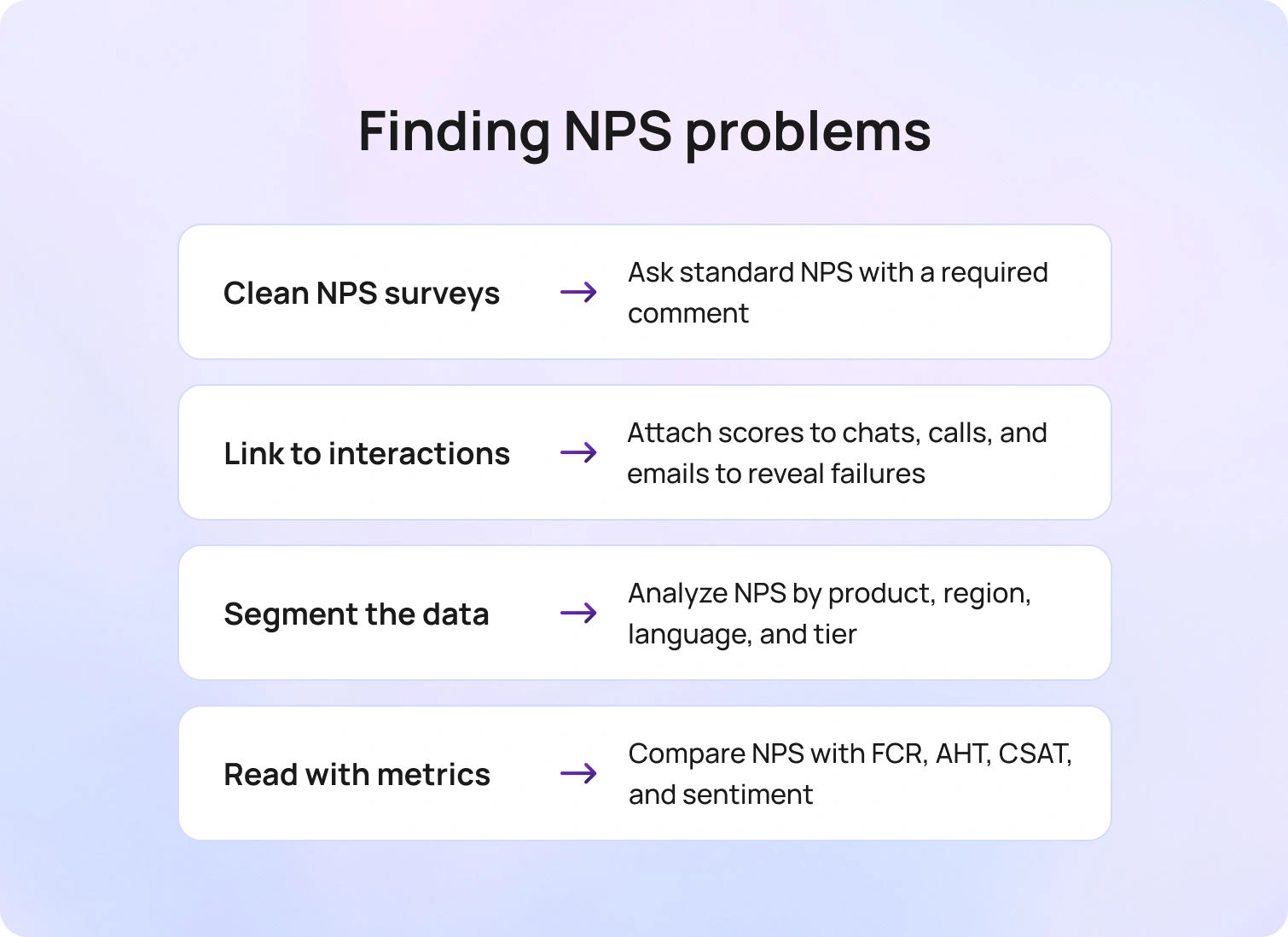
Before you fix anything, you need a trustworthy picture of what is broken and where it lives. The goal is to measure customer loyalty with clean data, then trace low scores to the conversations and decisions that created them. Measuring NPS accurately is essential for gauging customer sentiment and informing business improvements. It's also important to compare your NPS results to industry benchmarks to identify areas for improvement and understand your position within your sector.
This section explains how to make NPS surveys credible, connect NPS data to fundamental interactions across multiple touchpoints, and segment results to make patterns more obvious.
Measure Customer Loyalty with Clean NPS Surveys and Open-Ended Feedback
Use the standard NPS recommended question on a 0–10 scale and keep the wording consistent. A required “Why did you give this score?” field captures the reason, not just the number. The best time to ask is while the experience is fresh, for example, right after a case closes or a delivery completes. Send it through the channel the customer just used (email, SMS, or in-app) to raise response rates without over-soliciting.
Link NPS responses to Real Conversations to Surface Customer Pain Points
Every score and comment should map to the underlying interaction, including chat logs, email threads, and voice transcripts. With that link in place, use AI to tag themes such as billing confusion, shipping delays, login issues, or warranty coverage. Capture sentiment and outcome. Note the path taken, the number of handoffs, and whether self-service was attempted. This lets you connect customer experiences to customer insights and isolate where service quality fell short.
Segment Results to Expose Structural Gaps You Can Address
Review NPS score and comment themes by account tier, geography, product line, brand, and language. Then, compare first-contact resolution and handle time across each segment. If one region or language shows lower NPS and higher transfers, you have a routing or coverage issue. If one product line shows slower answers and more passives, knowledge may be stale. Segmentation converts an overall brand sentiment into concrete, fixable problems.
Compare NPS with Other Customer Satisfaction Metrics
NPS is a summary of the journey, not a verdict on a single touch. Satisfied customers are more likely to become promoters, leading to higher referrals and overall business growth. Read it alongside CSAT, first contact resolution, average handle time, transfer rate, abandon rate, and sentiment. When repeat contacts spike for a specific intent, NPS typically suffers. When sentiment dips for a channel, a tone or pacing adjustment is often needed. By pairing NPS with adjacent signals, you can identify the exact levers that will improve NPS without guesswork.
Why Improving Net Promoter Score Is Critical for Business Growth
NPS is more than a number on a dashboard. It is a directional signal of loyalty, and loyalty is the engine of sustainable growth. Promoters buy again, expand product use, and share positive word of mouth. Loyal customers are essential for driving revenue, fostering brand advocacy, and generating positive word of mouth, making them a cornerstone of long-term business success. Detractors churn quietly or post negative reviews that deter new customers.
Even small shifts in the promoter-to-detractor mix compound over time. That compounding is why senior management, from the CFO to the COO to the CTO, watches NPS performance alongside revenue, churn, and customer lifetime value. An improved NPS signifies stronger customer loyalty, higher satisfaction, and overall brand health, often leading to increased referrals and reduced churn.
Operationally, the improvements that lift NPS are the same improvements that lower the cost to serve. Improving NPS requires continuous, data-driven efforts, cross-department collaboration, and actionable feedback to ensure strategies are practical and customer satisfaction is consistently enhanced. When customers resolve issues on the first contact, repeat volume falls. When knowledge is accurate and phrasing is natural, contact duration shortens.
When routing is correct, fewer people touch each case. AI allows teams to make these changes with precision. It classifies intent, proposes answers grounded in controlled content, summarizes history to remove repetition, and flags risky moments for human review. The result is a more consistent customer experience, better customer satisfaction metrics, and a healthier brand reputation.
Best Practices to Improve Net Promoter Score with AI-Powered Support
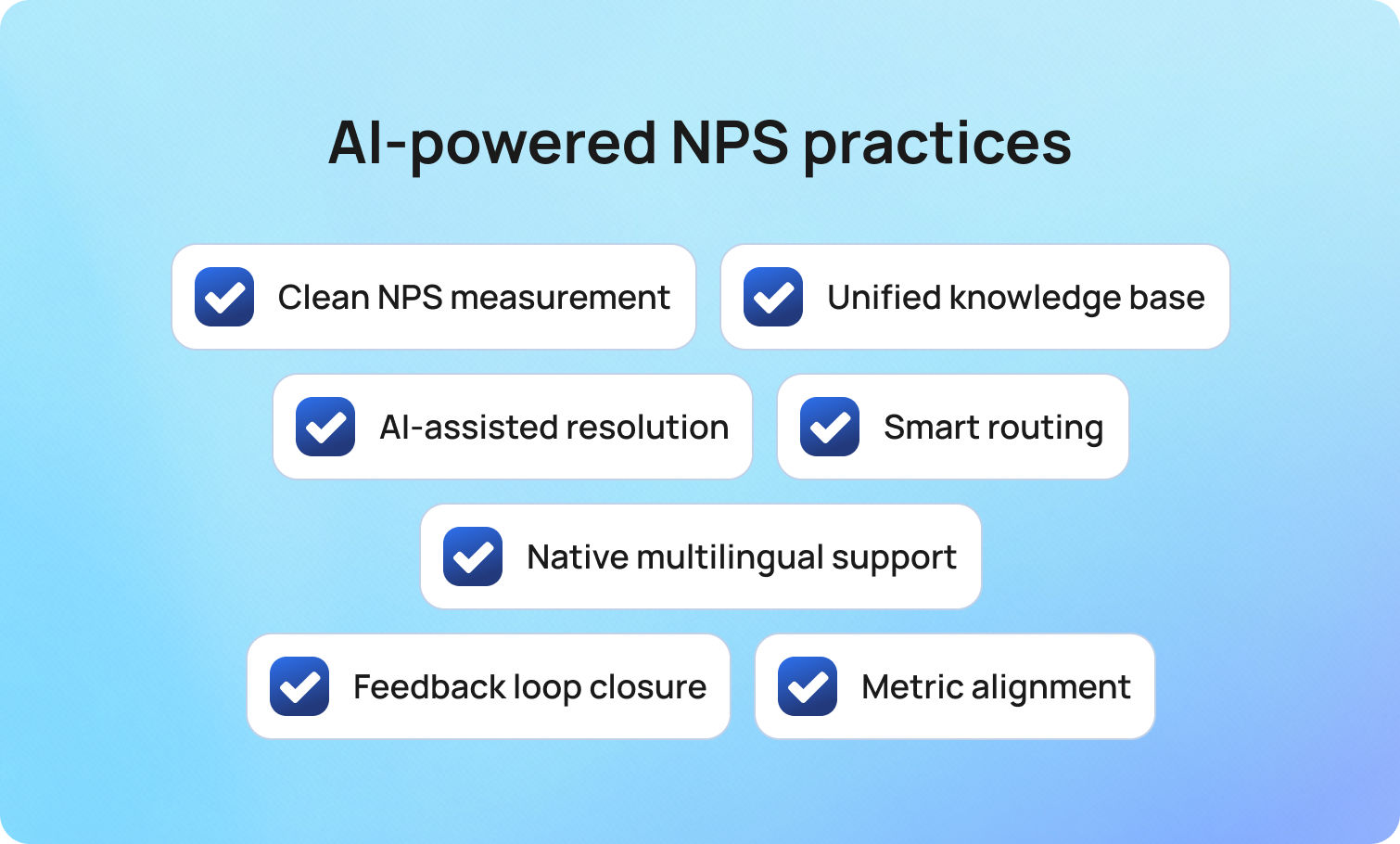
The work to improve your net promoter outcome is practical. Fix the sources of effort, ground answers in a single truth, match language coverage to demand, and use analytics to guide minor, frequent improvements. Providing staff training is essential to ensure they have the knowledge and skills needed to implement NPS-related improvements effectively. AI accelerates each step. It does not replace judgment; it amplifies it with speed, context, and consistency. The following practices turn stalled NPS into measurable progress.
Improve NPS by Calculating Cleanly and Analyzing the Story Behind the Score
Keep the Net Promoter Score calculation transparent and straightforward. Inside the company, publish a short definition that confirms detractors are 0–6, promoters 9–10, and NPS equals the percentage of promoters minus the percentage of detractors. The number is valid, but the comments carry the insight. Use AI to group reasons by theme and by journey step, for example, “return policy unclear in app,” “billing due date moved without notice,” or “agent asked for information already provided.” For each theme, track both frequency and the average score change it drives. The result is an ordered backlog that replaces scattered remarks with clear, prioritized work.
Enhance Customer Satisfaction with a Knowledge Base That Fits Voice, Chat, and Email
A single source of truth is the foundation of loyalty. The knowledge base should map intents to precise, task-oriented articles, with short, verifiable steps and clear outcome checks that an agent can confirm in voice. Phrasing needs to fit each channel so responses feel natural in chat, email, and call scripts. Glossaries and product names stay current in every language, and legal and policy wording remains aligned across markets with each release. When bots and agents draw from the same set of governing articles, customers receive consistent answers, satisfaction rises, and brand reputation steadies.
Reduce Effort with AI Assistance, Faster First Answers, and Correct Routing
AI can classify intent at contact, propose a reply grounded in the knowledge base, and summarize prior history so the customer isn’t asked to repeat details. With that context, agents begin informed rather than facing a blank screen. Routing should consider intent, skill, brand, and language in a single decision, so the first human who responds can resolve it. Routine tasks, such as password resets, address updates, policy-compliant plan changes, and appointment rescheduling, should be handled in self-service with clear outcome confirmations. As simple needs are solved instantly, frustration falls, and the share of promoters grows.
Increase Customer Loyalty with Multilingual Support That Feels Native
Language comfort drives customer sentiment. Detect language automatically, confirm with a short prompt, and converse in the customer’s preferred language. For high-volume paths, build native intents and flows. For the long tail, use real-time translation to avoid coverage gaps. Tune speech recognition for accents and background noise. Update pronunciation guides for product and brand names. Instrument dashboards per language that show NPS, sentiment, first contact resolution, and abandonment rate. When customers feel understood, they become more loyal and recommend more often.
H3: Turn NPS Feedback Into Action and Close the Loop
Detractor comments should trigger automatic follow-ups with the whole conversation context attached and a clear owner. It is vital to encourage customers to provide ongoing feedback by offering incentives and actively addressing their concerns, fostering continued engagement and improvement. A brief thank-you and acknowledgement set the tone, followed by a short update when the fix ships. Quick wins matter: broken links, confusing phrasing, and other minor friction points can lift many experiences at once.
Promoter feedback is an opportunity, so request permission to use it for a testimonial or case study. A monthly summary that lists changes and the resulting NPS movement keeps everyone aligned. Closing the loop signals respect and builds trust, the foundation of advocacy.
H3: Use Customer Experience Metrics Together and Align Incentives to Outcomes
NPS works best when read alongside CSAT, sentiment, first contact resolution, handle time, transfer rate, and abandon rate. The goal is prevention and resolution quality, not raw volume. Track the share of issues solved without repetition to see whether effort is actually falling. When teams are rewarded for low effort and accurate outcomes, behavior shifts, and a rising NPS follows as a natural result of sound operations.
How BlueTweak Improves Net Promoter Score
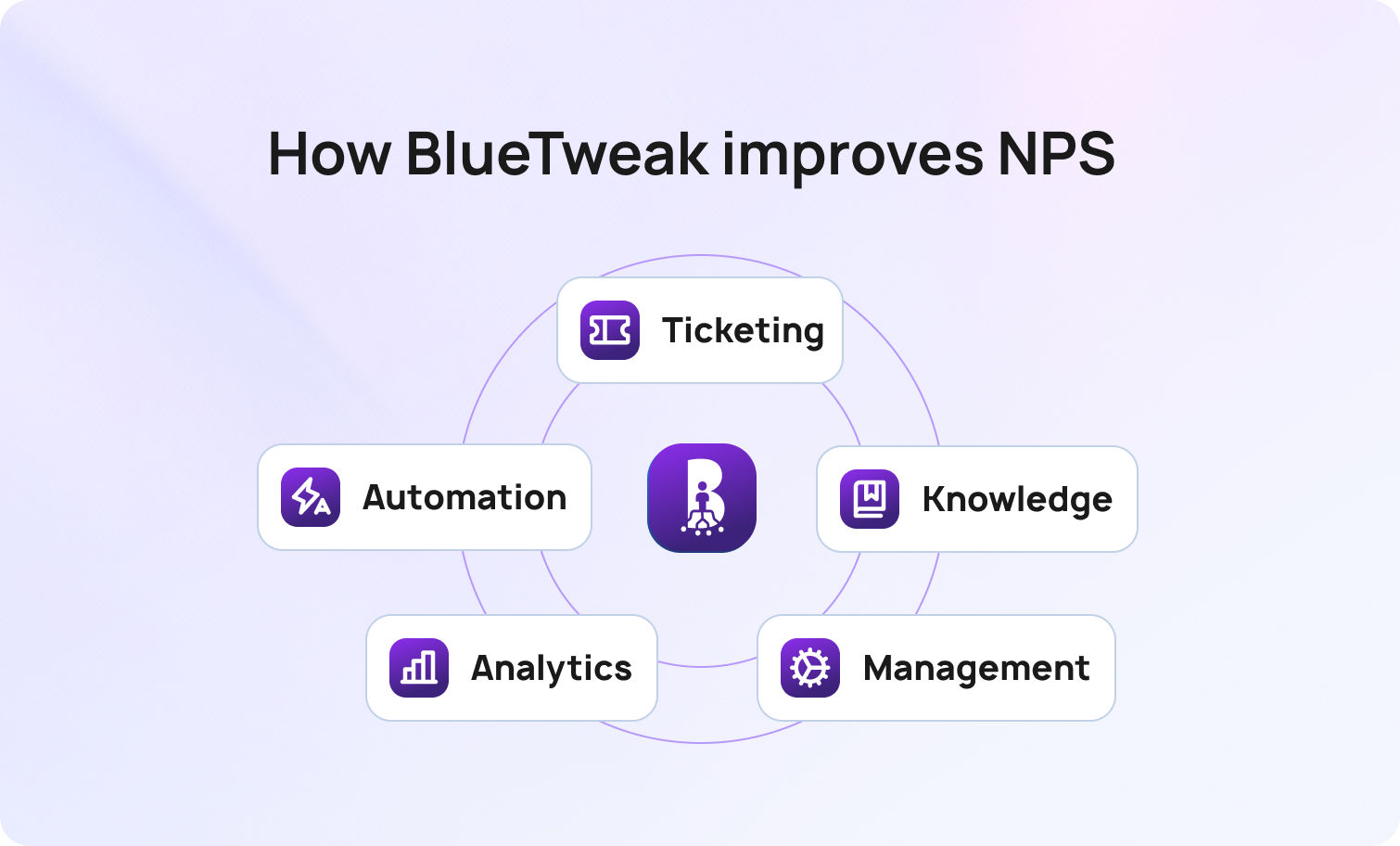
BlueTweak is designed to raise NPS by making high-quality, low-effort support the default. It unifies chat, voice, and email so customers do not repeat themselves, grounds every answer in a smart knowledge base, and turns unstructured comments into insights that product and operations can use.
Each conversation arrives with intent classification and a suggested reply that cites the relevant article. Agents see a succinct, AI-generated ticket summary of prior contacts, so they start with context rather than a blank screen. Routing considers brand, skill, language, and intent in a single decision to reduce transfers and speed resolution. For multilingual audiences, BlueTweak supports real-time chat translation and helps teams localize high-volume flows so phrasing feels native.
Analytics put core service metrics such as first contact resolution, sentiment, transfer, and abandon in one view, with breakouts by channel and use case. NPS can be joined through open APIs, so you can correlate promoter share with operational changes.
Leadership sees which fixes create more promoters and fewer detractors. An API-open design makes it straightforward to connect NPS data and operational metrics to your CRM and BI tools, so the company can measure loyalty and tie improvements to revenue and retention.
BlueTweak’s impact is practical. Customers get accurate answers without effort. Agents respond faster with confidence. Managers see exactly which fixes matter. The outcome is a higher Net Promoter Score, stronger customer satisfaction, and durable business growth.
BlueTweak's co-founder, Chris Kontes, played a key role in establishing and shaping the company's growth and development across various stages and departments.
Improve NPS With AI-Powered Support
The path to a higher Net Promoter Score is straightforward. Calculate the score cleanly, gather open-ended reasons, and connect each response to the real conversation. Then, fix the sources of effort, unify channels so context travels with the customer, and answer from a single governed knowledge base that works in chat, email, and voice. Finally, match language coverage to demand, route by intent and skill, and use analytics to guide weekly improvements. When customers get fast, accurate answers in their preferred language, they remember how it felt, they recommend more, and NPS rises.
BlueTweak helps you operationalize every step. It unifies channels, grounds answers in verified content, proposes the next best reply, summarizes context for handoffs, routes correctly, supports multilingual flows, and measures the signals that influence loyalty.
If your goal is to improve NPS, enhance customer satisfaction, and drive sustainable growth, request a BlueTweak demo. You will see how the right technology turns feedback into progress and passives into promoters.
16 Best Practices to Maximize FCR With Multilingual Voicebots
Why Multilingual Voicebots Lift First Contact Resolution
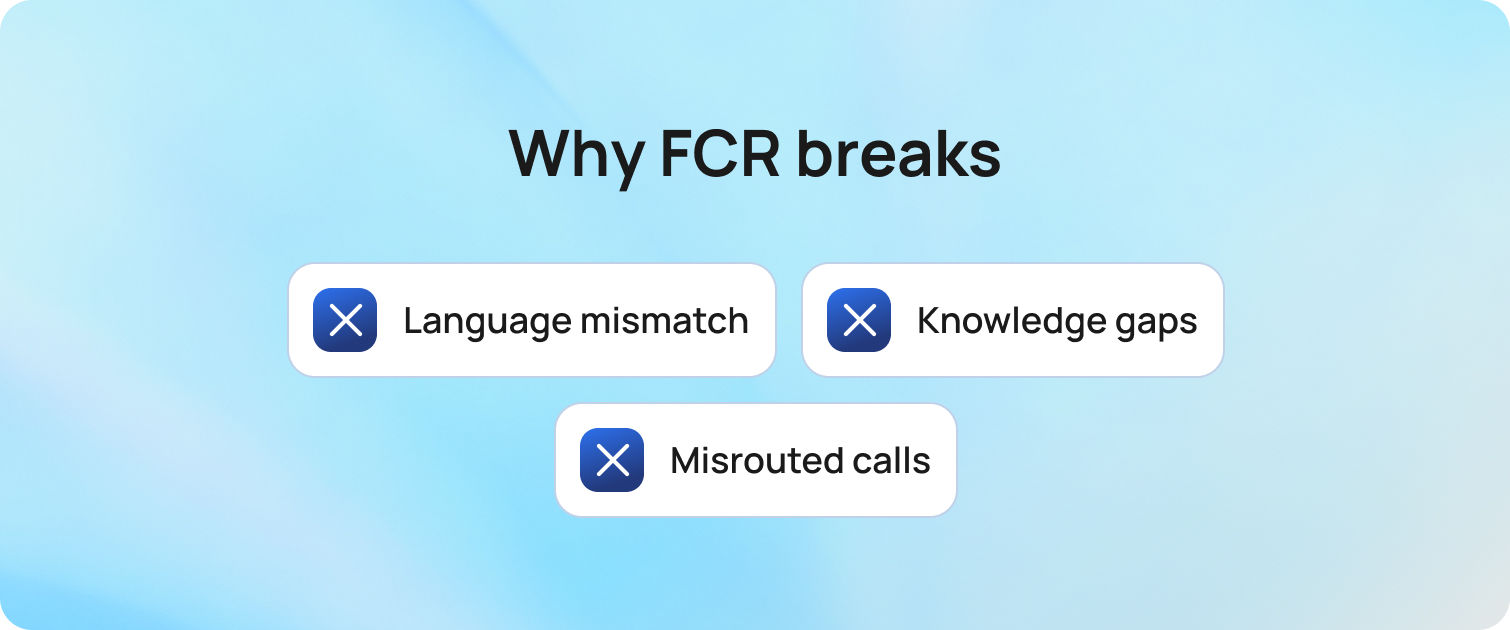
Most first-contact failures can be attributed to three primary causes: language barriers, limited domain knowledge, and routing that directs calls to the wrong queue. A multilingual voicebot tackles each one from the first seconds of the call. Speech recognition tuned for different languages and accents reduces early confusion. Natural language understanding interprets real sentences instead of forcing rigid menu choices. With intent and language identified, intelligent routing directs the caller to the appropriate bot flow or a human agent who has the necessary skills to complete the task.
The payoff shows up in the conversation itself. Multilingual voice agents facilitate complex discussions in multiple languages, allowing customers to communicate naturally and remain engaged. Companies serving a global audience benefit from consistent service across regions, as the same system supports multiple languages without requiring the use of separate tools or processes.
For teams supporting a diverse customer base, this is not a nice-to-have. Callers expect to use their native language, not adapt to a different language for every situation. When the voice assistant detects the customer’s preferred language and mirrors local phrasing, clarifications drop and repetition disappears. Routine requests are resolved through self-service, while more complex issues are directed to the right person on the first attempt. The result is higher first contact resolution and a smoother experience for everyone involved.
This article provides a practical blueprint for enhancing FCR with multilingual voicebots, covering language coverage, automatic language detection, conversation design, and intent-plus-skill routing. It walks through grounding answers in a smart knowledge base, tuning speech recognition, and preserving context during handoffs. It closes with KPIs to track, an optimization cadence, and deployment tips for seamless integration with CRM and existing systems.
16 Best Practices for Higher FCR With Multilingual Voicebots
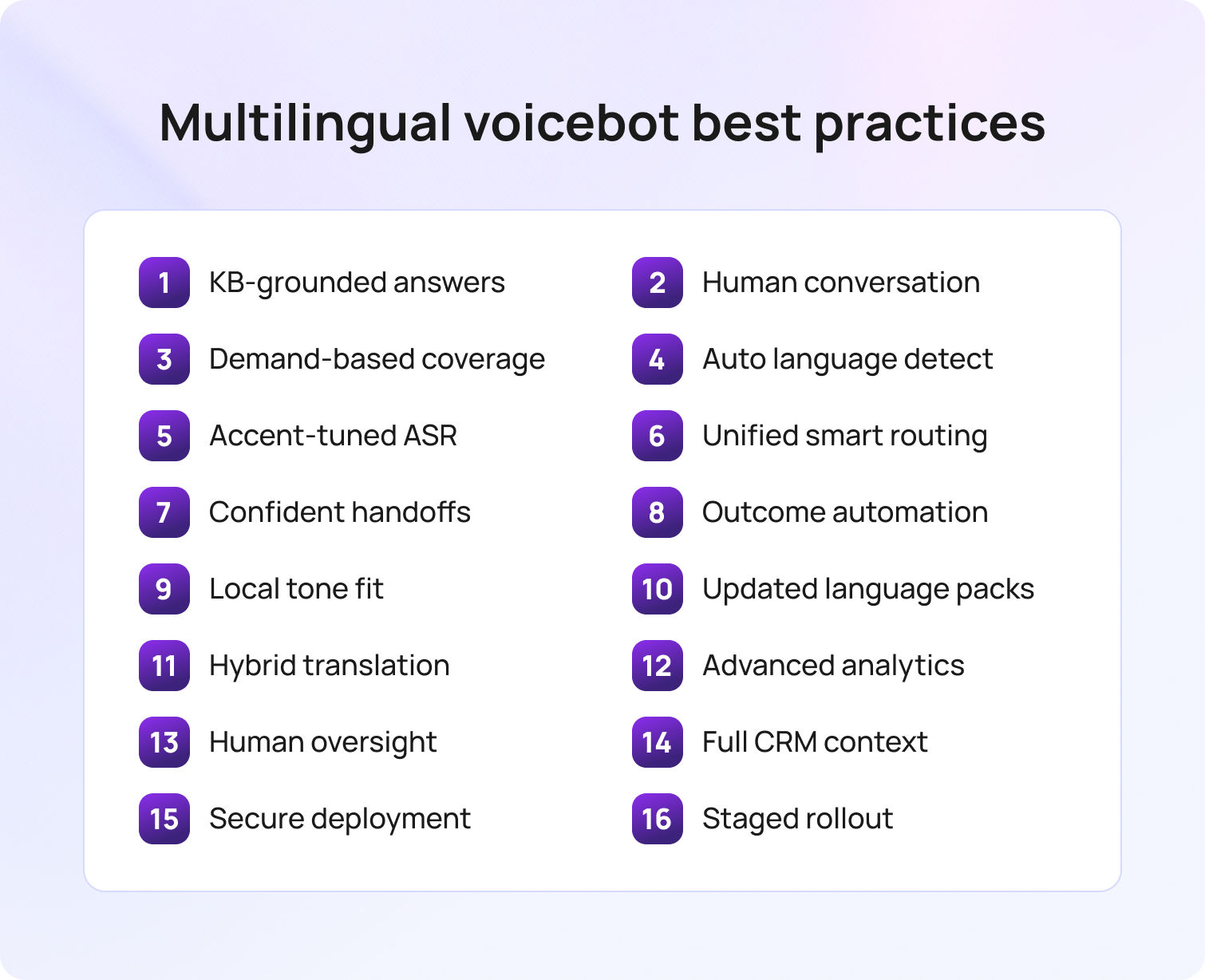
These practices move from language planning to day-to-day operations. Each one is tied to concrete signals, such as containment rate, transfer rate, first contact resolution, abandon rate, sentiment score, concurrency, and average handling time.
AI agents and voice bots are enabling businesses to deliver advanced multilingual support, handling complex customer interactions across various platforms and languages. By adopting these best practices, organizations are enabling businesses to improve customer service outcomes.
When considering solutions, look for AI agents that provide advanced, multilingual, multi-channel support systems, as well as voice bots that can communicate seamlessly across multiple languages to enhance global customer engagement.
1) Ground Answers in a Smart Knowledge Base
Natural language only works as well as the knowledge behind it. Multilingual voicebots that cite a single source of truth provide consistent and accurate information in multiple languages. A smart knowledge base maps intents to precise articles, keeps steps short, and includes outcome checks that work in voice. Multilingual chatbots use the knowledge base to deliver accurate answers in multiple languages, ensuring native-fluency customer support and consistent information globally.
BlueTweak Fit: The smart knowledge base powers suggested replies for agents and grounds bot responses, keeping answers aligned across channels.
2) Design Conversation Flow That Feels Human
Callers want to communicate naturally, not navigate a maze. The goal is to create human-like conversations that feel natural and engaging for callers. Brief recaps, clear next steps, and polite closings establish a professional tone.
Multilingual conversations benefit from phrasing reviewed by native speakers who understand cultural nuances. Every path should end in either a clear resolution or a seamless handoff.
BlueTweak Fit: Classification and summarization maintain conversation context, ensuring agents and channels stay aligned on the same storyline.
3) Match Language Coverage to Real Demand
Strong FCR starts with coverage that reflects reality. Usage volume by region, revenue mix, and channel preference points to the languages that matter most. To maximize FCR, it is essential to cover both common languages and major languages such as English, Spanish, Mandarin, French, German, Portuguese, and Japanese, ensuring broad language coverage and ongoing language expansion. A focused set with depth usually beats a sprawling list with uneven quality. Dialects and accent ranges deserve attention as well, not just the language label.
BlueTweak Fit: BlueTweak unifies chat, email, and voice, so analytics by language show where demand lives and where expansion makes sense. Analytics can also help identify which supported languages should be prioritized for expansion, ensuring continuous improvement and optimal performance across all supported languages.
4) Use Automatic Language Detection with a Quick Confirmation
Callers feel the benefit in the first seconds. Automatic language detection eliminates guesswork, while a brief confirmation ensures that callers are not required to use only one language and avoids lengthy IVR menus. If the language is not supported, the call can be routed to multilingual staff as a fallback, preventing frustration and keeping abandonment rates low.
BlueTweak Fit: Routing can factor detected language alongside brand, skill, and intent, and real-time translation keeps conversations moving across channels.
5) Tune Speech Recognition For Accents and Real Environments
Clear recognition is half the battle, and it shifts with accent ranges, background noise, and speaking speed. In multilingual voice settings, breadth of training data matters, but so does a second layer of review from native speakers who can spot language-specific quirks that generic models miss. With those insights, acoustic tests by language and region highlight exactly where models need tightening.
For critical moments, such as identity checks or payments, a quick confirmation step prevents errors from slipping through. Finally, a custom vocabulary for brand and product terms provides the recognizer with an extra boost where it matters most.
6) Route by Intent, Language, Brand, and Skill in One Step
FCR rises when the first responder can actually solve the problem. Routing decisions should consider detected intent, language, brand, and the required skill set simultaneously. Adding sentiment and customer priority helps protect service levels without breaking policies.
BlueTweak Fit: Automatic routing combines brand, skill, language, and intent. Priority rules can be configured by the team; confirm any sentiment- or tier-based escalation with product documentation before stating it.
7) Set Confidence Thresholds and Make Handoffs Graceful
Language models work on probabilities. Confidence thresholds decide when to confirm or transfer. Good transfers include transcripts, detected language, sentiment, and structured fields, so human agents start at step three rather than step zero. Clean handoffs preserve momentum and protect first contact resolution.
BlueTweak Fit: Summaries and conversation context stay with the case in the unified queue, helping agents pick up the same storyline across channels.”
8) Automate Outcomes Where a Person Adds Little Value
Plenty of requests do not require a human. Password resets, order status updates, plan changes within policy, and appointment rescheduling fall under this category. Clear confirmations build trust, and audit-friendly records ensure honest reporting. These self-service options enhance containment and free up human agents for more complex work.
BBlueTweak Fit: Centralized knowledge and content governance help maintain consistency across macros and articles across channels and languages.
9) Align Tone and Pacing with Local Expectations
Small tone shifts often deliver outsized gains. Formality levels, directness, and cadence vary by region. Native speakers can spot awkward phrasing and tune text-to-speech pronunciation. A few adjustments per language usually raise satisfaction enough to prevent repeat calls.
10) Keep Terminology and Language Packs Current
Product names, policy terms, and plan labels are subject to change. Language packs need to keep up. A glossary per language and a regular sync with product and legal teams prevent drift. Speech recognition vocabularies should be updated with every release to maintain accuracy and relevance.
BlueTweak Fit: A shared smart knowledge base and standardized macros help keep answers consistent across channels and languages.
11) Blend Native-Language Intents with Real-Time Translation
Native models shine on high-volume paths. Translation covers the long tail. A hybrid approach balances quality and scale, particularly for diverse customer bases where maintaining hundreds of separate flows would be challenging.
BlueTweak Fit: Real-time chat translation enables agents to serve customers in their preferred language, and routing can factor in the detected language for the current case across chat, email, and voice.
12) Instrument Advanced Analytics for Quality and Cost
Good decisions rely on clear signals, not hunches. Per-language dashboards that show first contact resolution, containment, transfer, abandonment, sentiment, concurrency, and average handling time make gaps visible at a glance. The same view should break down usage and engagement by intent so trend lines are obvious, not buried in exports. Error markers for misrecognition and misunderstood intents pinpoint the exact turns in the conversation that require a rewrite, a vocabulary tweak, or a confirmation step. With that level of visibility, teams can refine prompts, optimize routing, and demonstrate ROI with before-and-after deltas rather than relying on anecdotes.
BlueTweak Fit: Real-time dashboards and historical analytics provide support, product, and leadership with a shared view of performance and trends across chat, email, and voice. Teams can track core metrics such as FCR, handle time, and abandon rate per language and intent, and visualize sentiment where that signal is captured, keeping optimization efforts grounded in data.
13) Build a Human Oversight Loop with Coaching and Updates
Multilingual programs stabilize when feedback loops are tight. Review a sample of calls for understanding, tone, and policy accuracy. A dedicated team should be responsible for monitoring and optimizing multilingual support systems, ensuring ongoing performance and continuous improvement. Findings should update knowledge base content, training phrases, and scripts to reflect the new information. Coaching becomes specific and measurable when transcripts and summaries highlight patterns by language.
BlueTweak Fit: Reviews and analytics inform coaching, and updates flow back into macros and knowledge base articles so improvements reach daily operations.
14) Integrate with CRM and Existing Systems for Full Context
FCR depends on context. Profile data, owned products, open cases, and regional rules should be at hand. Outcomes need to flow back to the record so sales and service work from the same truth. A multilingual voicebot without this foundation will still generate follow-ups and transfers.
Custom development can tailor integrations and conversation flows to meet specific business needs, providing highly flexible solutions that address unique industry requirements.
BlueTweak Fit: API openness supports CRM and ticketing integrations, with data available for export to analytics platforms for consolidated reporting.”
15) Choose Deployment Models That Satisfy Security and Compliance
Global businesses work under different rules. Private cloud or hybrid options, where required, help hit data residency and latency targets. Enterprise-grade security should encompass authentication, encryption, and administrative controls that provide reassurance to security teams.
BlueTweak Fit: Security and administration meet enterprise expectations, while the platform remains open for integrations.
16) Roll Out Quickly, Then Expand with Proof
Momentum matters. A small launch with two or three languages and a focused set of intents provides a quick signal without risking quality. Expansion follows the data. New languages join once conversation flow, routing, and content governance hold steady. Expanding to new languages enables support for diverse markets and diverse regions, allowing businesses to reach a broader global audience and better understand customer needs across different cultures.
BlueTweak Fit: Unified channels, a smart knowledge base, proposed reply, classification, and summarization, and analytics provide a strong foundation for staged rollouts and measured scaling.
ROI and Real Cost Savings
The cost side becomes tangible when containment and FCR improve simultaneously. Imagine 60,000 monthly calls at an average variable cost of 4.50 dollars per agent-handled interaction. Raising containment for routine intents by 12 to 18 percent and increasing FCR by 6 to 10 percent results in thousands of agent minutes saved each month. Savings are realized through lower talk time, fewer transfers, and fewer repeat contacts. Multilingual voicebots also enhance customer satisfaction by offering personalized support in the caller's native language, resulting in a more positive overall experience.
Top-line impact shows up as well. Multilingual capabilities enable callers to complete sales, enrollment, or renewal actions in their native languages. Automatic language detection avoids early drop-offs created by single-language IVR flows. More conversations in the customer’s preferred language typically increase completion rates and reduce churn in regions where language barriers previously hindered progress. These solutions enhance operational efficiency by automating routine tasks, thereby freeing up human agents to address more complex issues. Additionally, multilingual voicebots enable businesses to expand into global markets by supporting customers across diverse regions through voice technology.
Optimization Practices
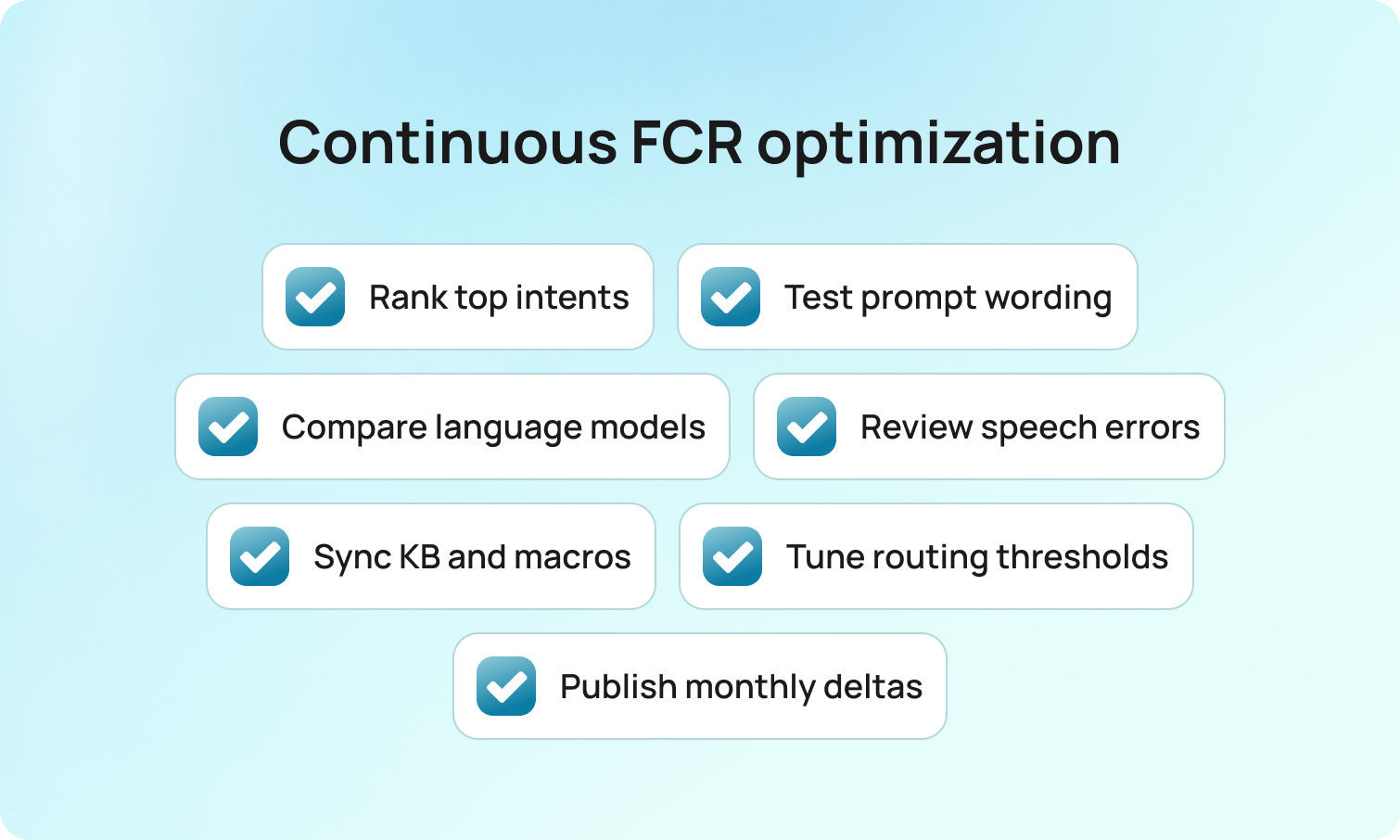
Sustained gains come from a steady cadence, not one-off fixes.
- Rank the top five intents by usage volume, cost, and signals of dissatisfaction.
- Test prompt wording, confirmations, and recap lines for those intents. Simple A/B trials are often enough.
- Compare native-language intent models with translation-first approaches for long-tail needs.
- Review speech errors weekly and update pronunciation guides, custom vocabularies, and training phrases.
- Refresh knowledge base entries and macro variants in parallel so bots and human agents deliver the same answer.
- Adjust routing thresholds and apply sentiment-aware escalation when back-and-forth loops occur.
- Publish a monthly deltas report that includes FCR, containment, transfer, abandonment, and sentiment changes by language.
Future Look
Multilingual voice is shifting from an add-on to an expectation. Three practical trends stand out:
- Richer models by market. Regional phrasing and code-switching will be handled more naturally as language models specialize by market.
- Signal-driven orchestration. Sentiment, customer tier, and recent history will guide live decisions about containment versus transfer, not just language and skill.
- Closer ties to product telemetry. Device data and logs will inform answers during calls, narrowing the gap between customer support and guided troubleshooting.
Future multilingual AI voicebots will incorporate advanced features, including integrations with Google Calendar and CRM systems, powered by large language models, to further enhance communication and automation.
Platforms that blend multilingual voice, a smart knowledge base, analytics, workforce planning, and open APIs will set the standard. BlueTweak aligns with this direction by keeping AI grounded in verified content, enabling multilingual conversations across channels, and offering the operational controls teams expect.
Bring It All Together
Raising first-contact resolution with multilingual voicebots requires more than simply toggling on another language. Results are derived from automatic language detection, robust natural language understanding, and speech recognition optimized for various languages and accents.
Advanced voice bots play a key role in enhancing multilingual customer service by communicating seamlessly across languages, breaking down language barriers, and improving global customer engagement. Conversation design keeps the experience human. Integrations with CRM systems and a smart knowledge base ensure accurate answers. Clean handoffs to human agents preserve momentum when complexity appears. Analytics, QA habits, and coaching lock in the gains.
BlueTweak combines chat, email, and voice into a single platform, adding the essential components that enable multilingual operations to scale: a smart knowledge base, proposed replies, classification and summarization, real-time chat translation, automatic routing, spam detection, analytics, and workforce management. The combination enables multilingual customer support, resolves routine tasks through self-service options, transfers complex issues with complete context, and enhances customer satisfaction while reducing operational costs.
Request a demo to see multilingual voice, intelligent routing, and analytics-driven FCR improvements in BlueTweak.



