Call Center Workforce Management (2026) Buyer’s Guide

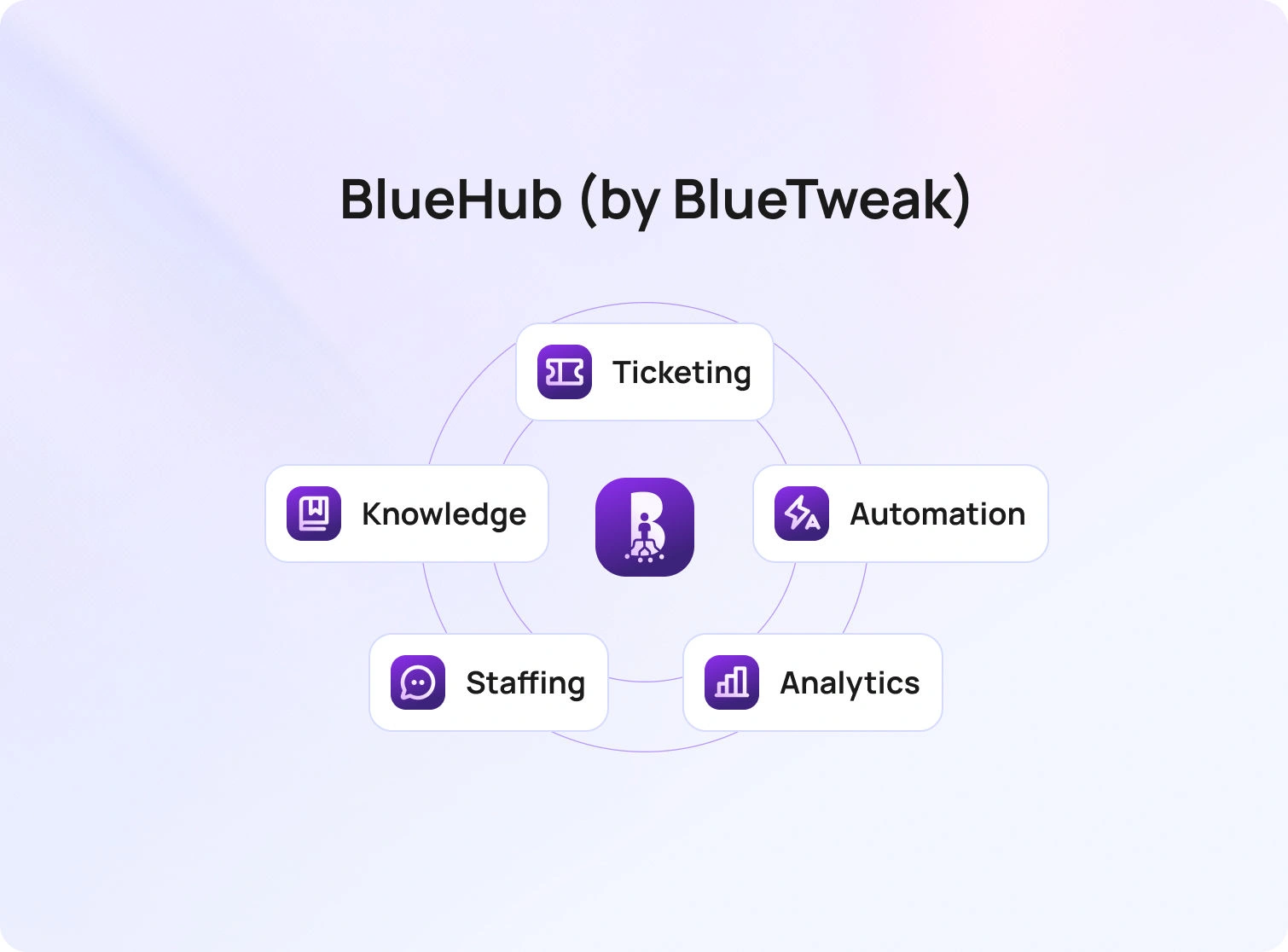


BlueHub unifies every conversation, customer record, and automation into one powerful platform.
Explore more
This guide explains end-to-end call center workforce management: definitions, core metrics, and the tools and practices that matter in 2026. You’ll learn how to size staffing needs with credible forecasting, build fair schedules that respect preferences and labor rules, and run tight intraday management for real-time changes. Included are a buyer’s checklist, RFP questions, a 90-day rollout plan, and how BlueHub fits if you want WFM alongside routing, knowledge, and analytics.
Contact centers are juggling hybrid teams, multiple channels, and rising customer expectations. Leaders now treat call centre workforce management as a strategic system for customer satisfaction and cost control, not just a scheduling tool. In a 2025 benchmark spanning 38 countries, 99% of WFM practitioners said workforce management is essential to business success, underscoring its central role in operational efficiency and agent experience.
At the same time, some sacred processes deserve scrutiny. The familiar “80/20” service level (answer 80% within 20 seconds) still appears in many playbooks, but experts argue it’s not a universal standard and can distract from customer outcomes if applied blindly. Treat SL as a contract shaped by intent, channel, and value, not a default.
Finally, planning must reflect reality. Average handling time (AHT) for service calls has climbed over the last two decades, meaning models built on outdated baselines will be understaffed and miss SLAs.
This guide turns that context into action by defining call center workforce management, highlighting the metrics that matter, outlining step-by-step practices for forecasting, scheduling, and intraday adherence, adding a buyer checklist and a 90-day rollout plan, and showing where BlueHub fits alongside your WFM stack.
Call center workforce management (WFM) is the discipline of forecasting contact demand, translating that demand into staffing levels, creating and maintaining agent schedules, and implementing real-time adjustments to meet service-level targets at the lowest reasonable operational costs. Done well, WFM raises customer satisfaction, protects employee satisfaction, and provides contact center leaders with a single source of truth for performance decisions.
Core components
Analytics & governance: Report outcomes, capture decisions, and comply with labor laws and audit requirements.
Before you compare features, align on what “good” looks like for workforce management in your operation. The fundamentals are simple and demanding at the same time: predict demand with enough accuracy to earn trust, translate that forecast into fair schedules that hit service levels without burning people out, and run the day with tight intraday decisions and transparent adherence so customers feel the benefit. With that frame in mind, use the pillars below to pressure-test your 2026 plan.
Goal: Right people, right skills, right intervals.
What to check in a tool: clear forecast versioning, out-of-the-box short- and medium-term forecasts, and the ability to generate staffing from selected skills on historical data.
Goal: Coverage without burnout.
Outputs: Publishable rosters, future schedules, exception management, time-off workflows, and self-service swaps.
Goal: Hold the day when reality changes.
Goal: Reliable coverage with trust.
Coach: Focus on patterns, not one-offs; build employee engagement by sharing context on why adherence matters to customers.
Before models, define the questions your plan must answer: how many agents by skill and channel, where the risk bands sit, and what “good” accuracy means for leadership. Then run this loop.
What to verify in a platform:
Look for forecast versioning, short and medium-term horizons, event overlays, staffing generation from historical skills, and accuracy dashboards by channel and intent. If you cannot see the model’s inputs and the error profile, you cannot manage the risk.
Scheduling translates the plan into a contract with your people. Aim for coverage that hits service levels, while protecting fairness, preferences, and compliance.
Compliance: Encode meal/rest rules and weekly caps; audit reports must be easy to export during reviews.
Scheduling translates the plan into a contract with your people. Aim for coverage that hits service levels, while protecting fairness, preferences, and compliance.
(If you’re formalizing intraday, look for playbooks and dashboards that make short-interval adjustments easy to action.)
Service level (SL)
Define SL per queue and channel, shaped by customer value and intent rather than a blanket 80/20. Calibrate thresholds for voice, chat, email, and priority lines.
Why this metric: SL represents the promise you make to customers and is the primary constraint your staffing plan must satisfy.
Abandonment
Track both overall abandonment and “abandon after X seconds,” and segment by intent. Expect improvements when IVR menus, callbacks, or status messaging are tuned.
Why this metric: Abandonment reveals the patience curve and the cost of being late, quantifying lost demand that never reaches an agent.
AHT / Average handle time
Include talk, hold, and after-call work, and trend by intent and channel rather than as a single centerwide average.
Why this metric: AHT converts contacts into workload, which drives staffing levels and exposes process or knowledge gaps that inflate effort.
FCR / First call resolution
Tie FCR to deflection quality and knowledge freshness, and read it alongside reopens and transfers. Rising FCR often offsets longer AHT.
Why this metric: FCR is the most direct indicator of service quality and the strongest lever for lowering repeat volume and total cost to serve.
Occupancy and utilization
Set channel-specific guardrails, typically higher for voice than for concurrent chat, to avoid chronic overload.
Why this metric: Occupancy balances efficiency with human sustainability, protecting agent performance and preventing burnout.
Schedule adherence
Measure at the interval level, report variance and percentage, and document clear exception rules.
Why this metric: Adherence connects the plan to reality minute by minute, ensuring the coverage you forecast actually shows up.
Shrinkage
Track planned and unplanned shrinkage separately, with weekly views by site and team, and protect time for coaching and QA.
Why this metric: Shrinkage determines how many paid hours you need to buy to deliver the roster; misestimating it guarantees under-staffing.
Employee satisfaction and attrition
Run short, regular pulses, capture exit themes, and correlate results with schedule stability and preference fulfillment.
Why this metric: Agent sentiment predicts near-term performance and long-term cost, and highlights scheduling and coaching changes that improve retention.Forecast accuracy (MAPE, WAPE)
Publish targets by channel and intent, version your forecasts, and annotate big deviations so stakeholders understand why the number moved.
Why this metric: Forecast accuracy builds trust in WFM, reduces whiplash in staffing decisions, and keeps the organization aligned on one plan.
Use this list to evaluate workforce management software or a broader workforce management solution bundled with your CCaaS.
Forecasting & planning
Scheduling & preferences
Intraday management
Adherence & performance
Analytics & governance
Architecture
Tip: Compare the tool’s idea of “service levels” to your own. Some vendors still push a one-size metric. If you notice that your current support tool isn’t meeting your needs, it may be time to upgrade your customer support software. Your customers don’t live at “80/20.”
Turn the checklist into proof. Ask vendors to show, not tell.
Three sprints take you from baseline to a dependable operating rhythm.
Days 1 to 30: Foundations
Clean twelve to twenty-four months of history and tag events. Stand up base forecasts for the top five queues and publish accuracy targets. Encode labor rules and pilot schedules for one site or team. Define adherence rules and exceptions, and enable interval-level reporting.
Days 31 to 60: Assist and intraday
Expand forecasts to major queues and digital channels. Launch shift bidding and preference capture and enable self-service PTO. Run daily intraday huddles and document playbooks for spikes and outages. Place CSAT and FCR next to SL and handle time by intent in weekly reviews.
Days 61 to 90: Scale and govern
Extend to the remaining sites or brands and roll up to a single WFM calendar. Automate variance alerts and what-if staffing. Publish a monthly WFM report with forecast accuracy, SL attainment, overtime and VTO, adherence variance, and wins or risks. Lock change control with versioned forecasts, schedule approvals, and audit logs.
With the operating model running, decide where WFM sits in your stack.
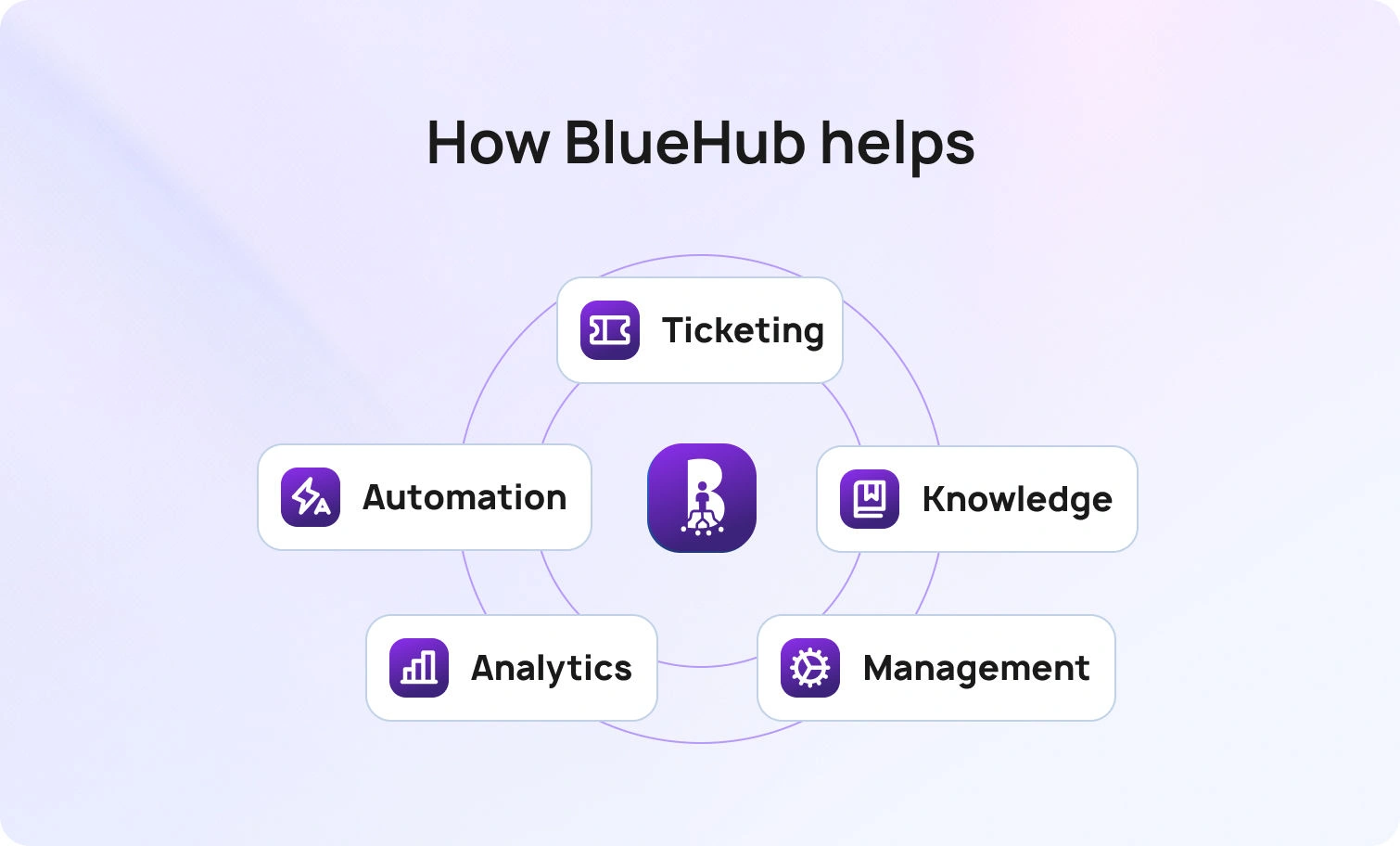
BlueHub integrates WFM tools alongside omnichannel customer support queues, so planners and supervisors operate from a single workspace. Forecasts and agent schedules sit alongside routing, knowledge, and analytics; leaders can shift staffing by language, brand, and channel in real time while watching SL, AHT, FCR, and adherence for the same intents. That proximity shortens the loop between customer interactions and staffing decisions, improves operational efficiency, and supports global, multi-brand operations with scoped views and role-based access (as outlined in BlueHub’s product positioning).
If you already own a WFM suite, BlueHub’s API-open design integrates with external workforce management systems, bringing service level targets, forecast context, and adherence back into standard dashboards so Ops, Finance, and IT share a single picture.
In 2026, workforce management in a call center is the operating system for customer promises. Treat forecasting as a product, scheduling as a contract with your people, and intraday as a disciplined daily sport. Buy or integrate a workforce management solution that is accurate, explainable, and friendly to agents, not just efficient for spreadsheets. Put customer experience and employee satisfaction on the same page as SL and cost, and you’ll meet customer expectations with fewer surprises.If you want call center workforce management besides routing, knowledge, and analytics with real-time levers that Ops will actually use, book a BlueHub demo.
Call center workforce management is the system that predicts customer demand across channels, converts that demand into staffing needs, creates fair agent schedules, and runs adherence and intraday management so service levels are met at an efficient cost. It covers the full cycle for call centers and contact centers alike. Plan from historical data, schedule with skills and agent preferences, adjust in real time, and learn from results. This definition applies to center workforce management in single-brand and multi-channel contact center operations.
Publish service levels by queue and channel, abandonment, average handle time, first call resolution, occupancy, schedule adherence with variance, shrinkage, and forecast accuracy. Segment by intent and contact volume so contact center leaders can see where coaching, knowledge updates, or routing changes will improve the customer experience and employee satisfaction the fastest. Treat 80 over 20 as an input, not a rule for every queue.
Use five to eight percent MAPE at the day level for stable voice lines and ten to twelve percent for digital channels as working targets. Strong workforce management software and systems should support event overlays for promotions and outages, generate staffing levels from skills and historical data, and display error profiles by queue. Forecast accuracy improves when models have a clean history, seasonality, and drivers of call volume and handle time.
Effective intraday management combines clear playbooks, decision rights, and real-time adjustments. Supervisors need the ability to move breaks, shift meetings, activate callbacks, rebalance channels, and reassign agents within minutes while watching agent availability and agent performance. A written huddle cadence keeps Operations and WFM aligned and protects employee engagement during volatile windows.
Keep your workforce management solution and connect it to BlueHub. You will see shared key performance indicators such as service levels, average handle time, first call resolution, and adherence, besides routing and knowledge signals, so that call center operations and contact center agents work from one picture. Supervisors can review agent schedules by brand and language, coordinate shift bidding and time-off requests, and monitor outcomes without tool-hopping. If you do not have a suite, BlueHub also offers workforce management tools for call center teams, so forecasting, scheduling, and intraday views sit next to customer interactions and analytics.
As Head of Digital Transformation, Radu looks over multiple departments across the company, providing visibility over what happens in product, and what are the needs of customers. With more than 8 years in the Technology era, and part of BlueTweak since the beginning, Radu shifted from a developer (addressing end-customer needs) to a more business oriented role, to have an influence and touch base with people who use the actual technology.
Quality
Administration
Workforce Management
Customer Support Analytics
Copyright BlueTweak 2025