



TL;DR
Aircall works well for cloud-based phone basics, but often requires add-ons for advanced analytics, workforce management, or AI grounded in a knowledge base. If you're looking for an all-in-one solution with omnichannel depth and predictable pricing, consider BlueTweak, which is designed explicitly for multi-brand teams and has delivered measurable outcomes (e.g., 326% ROI, 46% cost reduction) when consolidating tool stacks.
From Voice to Full CX: Signs You’re Ready to Expand
You chose Aircall for a clean interface and quick setup. It covers core calling and hands off to your CRM without fuss. As your operation grows, new needs tend to pop up.
Call volume increases, so forecasting and scheduling become more critical. That puts workforce management on the list. AI moves from “nice to have” to “must have,” especially transcription, summaries, and suggested replies grounded in your knowledge base. And once conversations span voice, email, and chat, keeping the full customer story in one place becomes essential.
Costs can shift, too, as you add analytics, integrations, or premium support on top of the base plan.
Make the decision about fit. Map your must-haves and score each platform against them:
- Omnichannel support
- AI depth
- Help desk alignment
- Total cost to operate
This article breaks down why teams explore options beyond Aircall, what to prioritize in 2026, and the platforms worth considering.
Why Teams Look For Aircall Alternatives in 2026
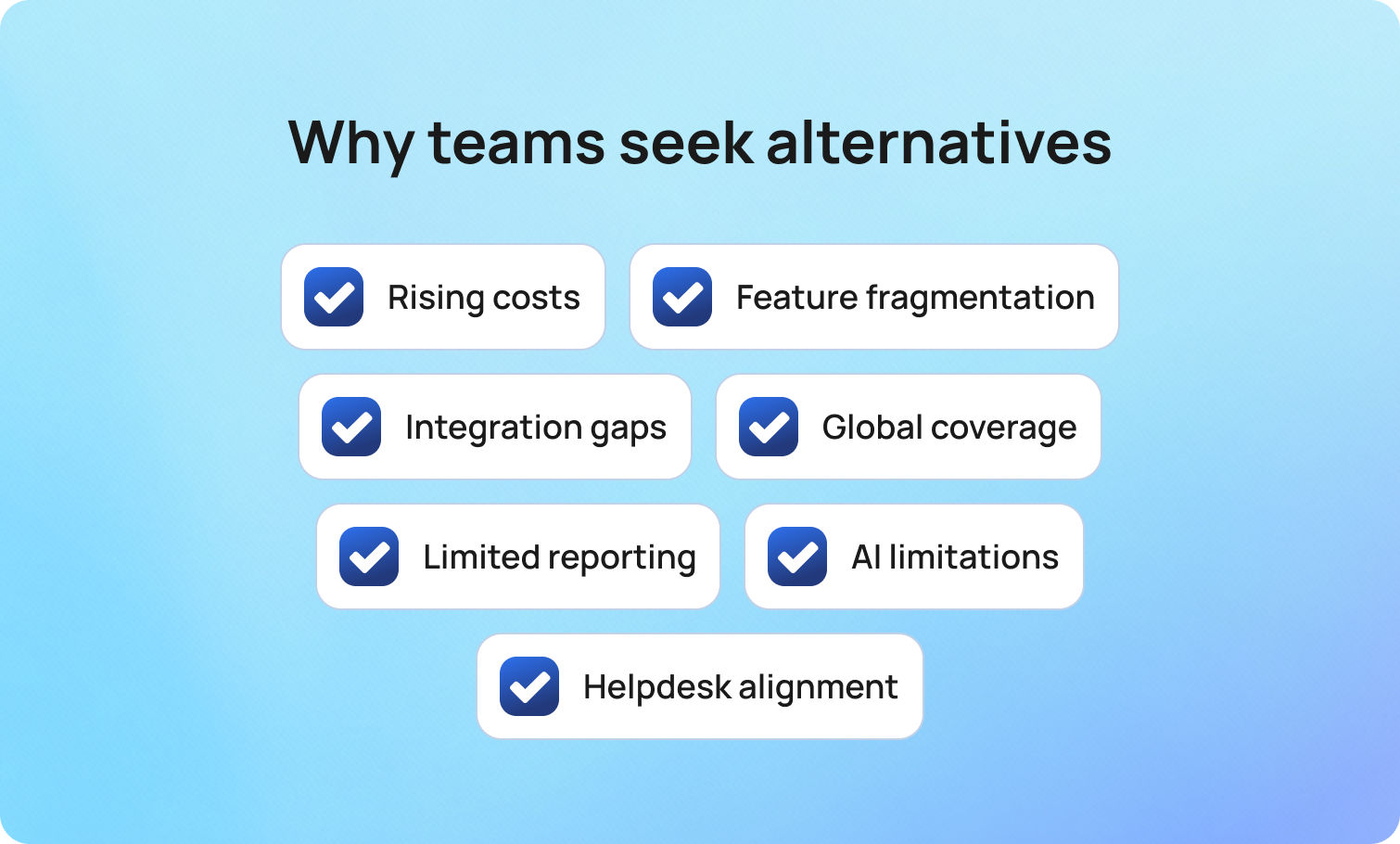
Aircall is an excellent customer support solution, but it may not be the right fit for every business. Here are some of the reasons teams are looking for Aircall alternatives:
- Scaling costs: Per-user pricing compounds as teams grow. When you add advanced features like call analytics, integrations, or premium support, monthly costs climb faster than headcount.
- Limited contact center features without add-ons: Aircall handles voice well but lacks native ticketing, quality assurance, or workforce management. You end up integrating separate tools, which fragments customer data and adds vendor complexity.
- Integration gaps: While Aircall connects to popular CRMs, deeper integrations with help desks, commerce platforms, or business intelligence tools often require middleware or custom development.
- Global number coverage: International calls and toll-free numbers in certain regions can be limited or expensive. Teams supporting global customers need reliable coverage without premium charges.
- Reporting depth: Basic call analytics cover volume and duration. Teams managing complex operations need sentiment analysis, outcome tagging, and dashboards that tie voice data to ticketing and customer satisfaction scores.
- AI feature scope: Aircall's AI capabilities are growing, but may not include knowledge-base-grounded suggested replies or real-time agent coaching. Teams wanting comprehensive AI assistance often look elsewhere.
- Need for tighter help desk alignment: Voice-first platforms work well for sales teams but struggle when customer support requires unified queues, skill-based routing across channels, and context preservation from phone calls to email to chat.
What to Look For in 2026
When evaluating Aircall alternatives, prioritize these dimensions:
Channels
A modern business phone system should handle more than just phone calls; it should also facilitate seamless communication across various channels. Voice calling remains essential, but SMS/MMS messaging, team collaboration tools, and video meetings increasingly matter. For customer support teams, a seamless handoff from voice to chat or email prevents customers from repeating themselves and keeps agents in a single workspace.
AI
AI handles the busywork from start to finish. Every call is recorded and transcribed into searchable text. Those transcripts are condensed into a concise summary highlighting the key points. Suggested replies pull trusted answers from your knowledge base, so agents respond faster and stay consistent. While the call is live, real-time coaching monitors sentiment and keywords, providing timely feedback and guidance. When the call ends, notes and summaries are automatically added to the ticket, so agents don't have to retype details.
Knowledge Base
For support teams, a robust knowledge base integrated with your phone system ensures agents can search for answers mid-call and customers can self-solve through interactive voice response menus. KB-grounded assistance prevents agents from guessing or giving inconsistent information.
Operations
Workforce management analyzes call patterns, forecasts demand, and creates schedules to match. Quality assurance reviews a sample of interactions, scores them against clear rubrics, and flags coaching moments. SLA dashboards keep you current on performance by team, channel, and priority, so leaders can spot risks and adjust in real time.
Security and Administration
Multi-factor authentication, audit logs, role-based permissions, and data retention policies are non-negotiable for compliance. You need controls in place to determine who can change routing rules, access recordings, or modify system configurations.
Integrations
Your contact center solution should integrate with CRM systems (such as Salesforce or HubSpot), help desks (like Zendesk or Freshdesk), commerce platforms (like Shopify or Magento), and business intelligence tools. Open APIs and webhooks enable custom workflows without the need for middleware.
Key Performance Indicators
Track metrics that matter: First-contact resolution shows efficiency, average handle time measures agent productivity, containment rate tracks self-service success, abandon rate reveals capacity issues, concurrency indicates the number of simultaneous interactions agents can handle, sentiment analysis flags frustrated customers, and MOS (Mean Opinion Score) measures voice quality.
Pricing Clarity
Understand seat-based costs vs usage fees. Some platforms charge a monthly fee per user for basic features, then separately meter voice minutes, SMS messages, or AI interactions. Avoid platforms that require expensive add-ons for essential features, such as call recording or smart call routing.
How We Evaluated
This comparison relies on publicly available documentation, feature matrices, and case studies. We used public pricing pages (when available) and noted when you’ll need to contact sales. Pros and cons are evidence-based. No marketing hyperbole. No claims we can't verify.
Must-Have Capability Checklist
While every contact center solution will have its unique features, pros, and cons, it’ll need to include these as a foundational minimum:
- Voice with messaging and basic help desk handoffs, ensuring customer context flows seamlessly between channels.
- Knowledge base integration or strong KB-grounded answers for consistent support.
- AI features include call transcription, summarization, and suggested replies.
- Analytics that track call volume, agent performance, and customer satisfaction.
- Workforce management or quality assurance, either native or through strong first-party modules.
- Security and administration with MFA, audit logs, and role-based permissions.
- Integration capabilities with CRM, help desk, and business systems via APIs.
- Pricing that includes core features without forcing everything into add-ons.
- Surveys to monitor customer satisfaction scores after interactions.
Scoring Rubric
These are the factors we considered when scoring platforms and for choosing which to feature on this list:
- Fit for 20 to 100 agents: We prioritize platforms that work for small to mid-sized teams without requiring enterprise contracts.
- Voice and omnichannel depth: Does it handle voice well and integrate smoothly with other communication channels?
- AI coverage: Agent assist features plus knowledge base grounding, not just basic transcription.
- Workforce management and QA: Native modules reduce vendor complexity and speed time-to-value.
- Time-to-value: How quickly can you deploy and start seeing results?
- Total cost to operate: Include licensing, usage fees, integration costs, and support expenses.
- Security and control: Compliance-ready features for regulated industries.
12 Aircall Alternatives for 2026
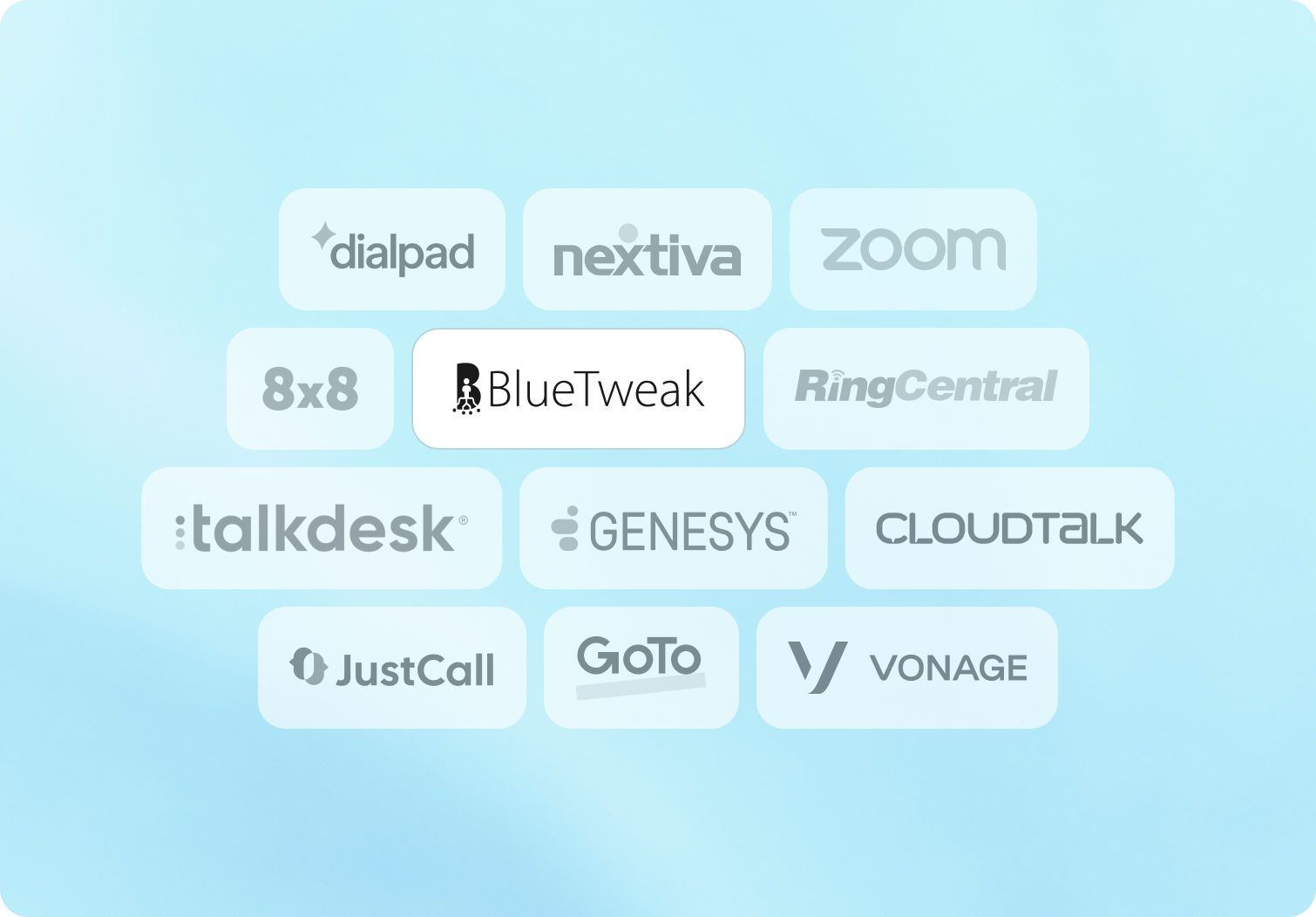
The twelve platforms below are the ones teams most often shortlist when they need stronger omnichannel, deeper AI, or simpler operations. Each entry notes core strengths, where it fits best, and what to watch for in terms of pricing and implementation. Use this as a fit check against your must-haves, then dig into trials and demos.
1. BlueTweak — Editor's Choice

BlueTweak is an all-in-one customer service solution that combines voice, email, chat, and social channels with AI-powered automation, workforce management, and quality assurance, all on one platform. Unlike voice-first tools that bolt on ticketing, BlueTweak treats omnichannel support as the foundation, making it a natural fit for teams that have outgrown single-channel solutions, such as Aircall.
Features:
- Unified inbox consolidates voice, email, chat, SMS, and social media into one workspace.
- AI voicebot handles routine calls with context-preserving escalation to human agents
- Call transcription software converts conversations to searchable text automatically.
- Suggested reply drafts responses grounded in the knowledge base for consistent, fast answers.
- Call center workforce management forecasts demand and schedules agents.
- Customer service quality assurance with scorecards and calibration.
- Customer service analytics track sentiment, SLA performance, and outcomes in real time.
Who Uses It: Support teams managing 20 to 100 agents who need omnichannel capabilities, AI assistance, and predictable pricing without add-on complexity.
Pricing: €65/agent/month all-in (ticketing, omnichannel, AI features, WFM, QA, analytics, APIs)
Pros:
- All-in-one platform eliminates vendor fragmentation
- Multilingual customer support with real-time translation
- Multi-brand routing manages multiple product lines or client accounts in one instance
- Fast implementation with guided rollout (weeks, not months)
- Customer support automation includes a KB-grounded chatbot and a voicebot
Cons:
- Newer platform with a more miniature marketplace compared to established players
- Less brand recognition than legacy contact center vendors
- Some advanced security features are planned for future releases
2. Dialpad

Dialpad combines voice, video, and messaging with AI-powered transcription and real-time coaching. It positions itself as a unified communications platform for sales and support teams needing call analytics and CRM integration.
Features:
- Voice calling with automatic call recording and transcription
- Video conferencing and team messaging
- AI-powered call analytics, including sentiment analysis
- Real-time agent coaching with keyword detection
- Integration with major CRM and help desk platforms
- Desktop and mobile devices support
Who Uses It: Sales teams and support teams needing AI-driven insights during calls with strong Salesforce and HubSpot integration.
Pricing:
- Standard (Connect): $15/user/month (annual billing); monthly billing may cost ~$27/user/month
- Pro: $25/user/month (annual billing) — adds CRM integrations, 24/7 support, AI transcription, and analytics
- Enterprise: Custom pricing with newer features
Note: Entry-level pricing covers basic voice/video, but advanced AI coaching and analytics require higher tiers. Check for current regional pricing and contract minimums.
Pros:
- Strong AI features, including real-time transcription and coaching
- Excellent call quality on a reliable internet connection
- User-friendly interface with minimal learning curve
- Good integration capabilities with popular business tools
Cons:
- Limited workforce management features require third-party tools
- International calls and toll-free phone number coverage vary by region
- Advanced analytics are available only on higher tiers
3. Nextiva
Nextiva offers a business communications platform combining voice, video, team collaboration, and basic contact center capabilities. It targets small businesses and mid-market teams seeking unified communications without the complexity of a contact center.
Features:
- Cloud-based phone system with unlimited calling in the US and Canada
- Video meetings and team chat
- Basic call center features, including call queues and intelligent routing
- CRM integration and workflow automation
- Call analytics and reporting
- Mobile and desktop apps
Who Uses It: Small to mid-sized businesses needing a reliable business phone system with basic contact center solution features.
Pricing:
- Core (Small Business): $15/user/month (annual billing): voice, video, SMS for small teams
- Engage/higher tiers: Up to $75/user/month (annual billing): includes more robust contact center capabilities
Note: Serious contact center features push pricing into the mid-to-upper range. Monthly billing may cost more.
Pros:
- Reliable customer support with US-based teams
- Unlimited voice within the US and Canada
- Simple pricing plans without hidden fees
- Good uptime and voice quality
Cons:
- Limited AI capabilities compared to specialized contact center platforms
- Workforce management requires external tools
- Advanced contact center capabilities are less mature than dedicated CCaaS vendors
4. Zoom Phone
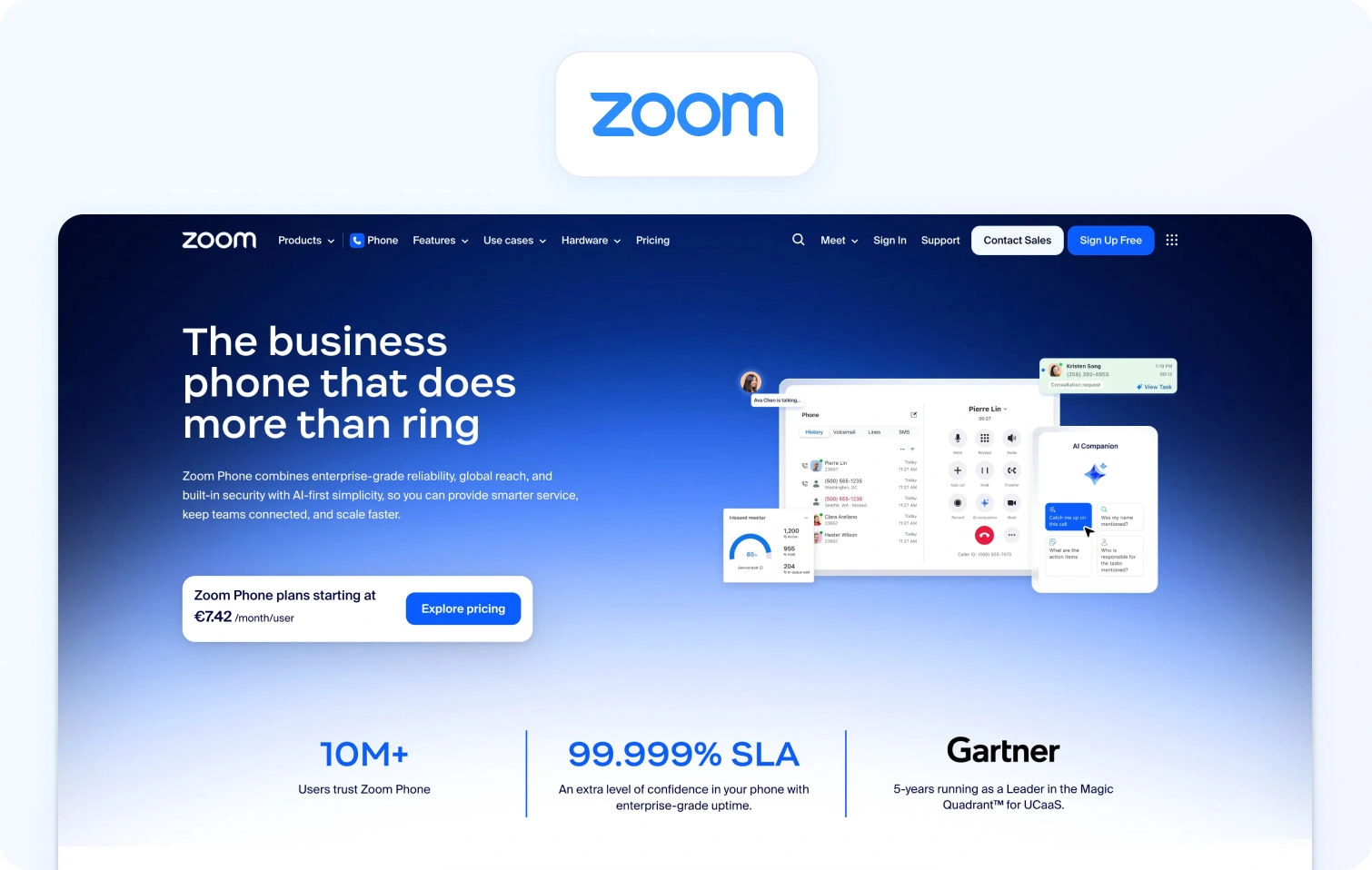
Zoom Phone extends Zoom's video conferencing capabilities into cloud communications, offering voice calling, SMS, and contact center add-ons. It fits teams already using Zoom Meetings who want to consolidate vendors.
Features:
- Cloud-based phone system integrated with Zoom Meetings
- Unlimited calling in select countries
- Basic call center software features, including call queues and routing
- SMS/MMS messaging
- Call recording and voicemail transcription
- Integration with Zoom Contact Center for advanced features
Who Uses It: Organizations already using Zoom for video that want to add voice calling and basic contact center solution capabilities.
Pricing:
- Metered: Pay-per-minute pricing
- Unlimited: Flat rate with unlimited calling in select countries
- Global Select: International calling included
- Contact Center: Sold separately with custom pricing
Note: Basic phone system starts affordably, but full contact center capabilities require additional Zoom Contact Center licensing.
Pros:
- Seamless integration with Zoom Meetings and chat
- Familiar user interface for existing Zoom users
- Good video calling quality
- Flexible pricing plans
Cons:
- Contact center capabilities require a separate Zoom Contact Center purchase
- Limited AI-powered features without add-ons
- Workforce management and QA tools are not native
5. 8×8
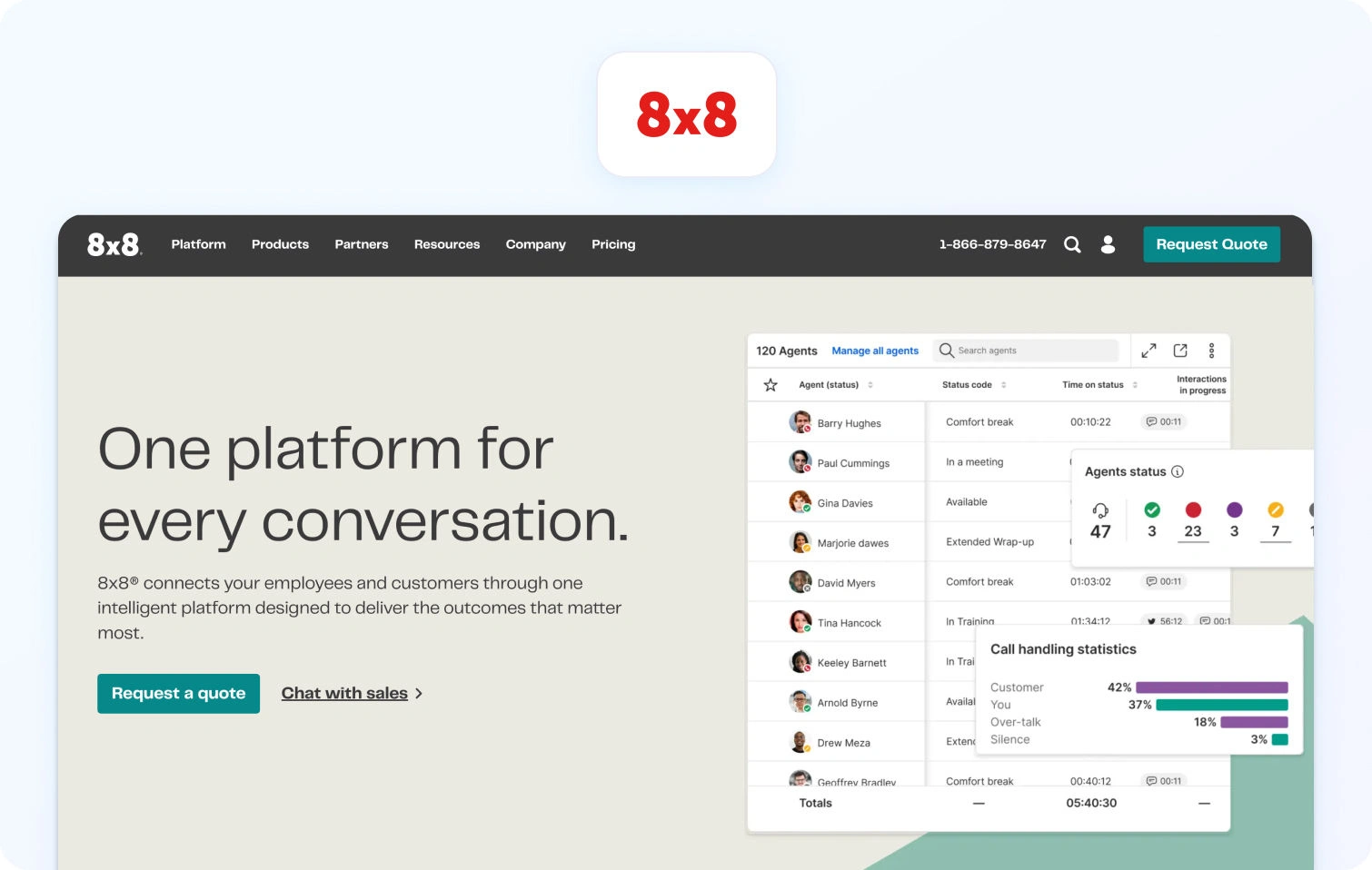
8×8 offers a unified communications platform that combines voice, video, chat, and contact center software. It targets mid-market and enterprise teams needing comprehensive communication channels in one platform.
Features:
- Business phone system with unlimited calling to multiple countries
- Video conferencing and team messaging
- Contact center platform with omnichannel routing
- Call analytics and quality management
- Workforce management tools
- API and integrations
Who Uses It: Mid-market to enterprise teams managing contact centers with 50+ agents needing omnichannel capabilities.
Pricing:
- Basic (UCaaS): Starting around $24/user/month: basic voice and video
- Contact Center/Advanced CCaaS: $85–140/user/month: full-featured contact center plans with add-ons
Note: When you transition from unified communications to contact center features (omnichannel routing, workforce management, and quality assurance), pricing increases significantly. Many features require "request a quote."
Pros:
- Comprehensive contact center features, including workforce management
- Strong international coverage with toll-free numbers in many countries
- Unified platform reduces vendor complexity
- Good call quality and uptime
Cons:
- Complex pricing with multiple tiers and add-ons
- The user interface can feel dated compared to modern alternatives
- Initial learning curve for advanced features
- Some users report that support response times vary
6. RingCentral

RingCentral combines unified communications with contact center software, offering voice, video, messaging, and advanced contact center capabilities. It serves businesses of all sizes with extensive customization.
Features:
- Cloud communications platform with voice, video, and messaging
- Contact center solution with omnichannel routing
- AI features, including sentiment analysis
- Workforce management and quality assurance
- Extensive integration capabilities
- Desktop and mobile devices support
Who Uses It: Businesses, ranging from small to large enterprises, require scalable unified communications with optional contact center features.
Pricing:
- Core: ~$20/user/month (annual billing)
- Advanced: ~$25/user/month (annual billing)
- Contact Center: Sold separately with custom pricing; higher tiers and add-ons increase costs substantially
Note: The public site shows a starting price of approximately $19.99 for Essentials. Full contact center capabilities require separate licensing, which can add significant per-agent costs.
Pros:
- Extensive customization options and integrations
- Strong contact center platform for large teams
- Comprehensive unified communications features
- Good uptime and call quality
Cons:
- Expensive, especially when adding contact center capabilities
- Steep learning curve due to extensive features
- Contact center features require separate licensing
- Some must have features locked behind higher tiers
7. Talkdesk
Talkdesk focuses on cloud-based contact center software that leverages AI, automation, and workforce management to support customer service and sales teams. It's built for contact centers, not general business communications.
Features:
- Cloud contact center platform with omnichannel routing
- AI features, including sentiment analysis and automation
- Automatic call recording and transcription
- Workforce management and agent performance tracking
- Quality assurance and coaching tools
- Integration with CRM and help desk systems
Who Uses It: Mid-market to enterprise contact centers managing high call volume with emphasis on AI and automation.
Pricing:
- CX Cloud Digital Essentials/Voice Essentials: $85/user/month (entry)
- CX Cloud Elevate: $115/user/month: adds advanced analytics, AI, and orchestration
- CX Cloud Elite: $145/user/month or more: full features with workforce management
Note: These are full contact-center-grade prices. Teams that primarily need a phone system may not require this tier. Pricing reflects annual billing.
Pros:
- Strong AI capabilities, including real-time guidance
- Comprehensive workforce management features
- Excellent analytics and reporting
- Purpose-built for contact centers
Cons:
- Expensive compared to simpler alternatives
- Overkill for teams primarily needing a business phone system
- Requires technical expertise for full setup
- Less suitable for small teams under 20 agents
8. Genesys Cloud CX
Genesys Cloud CX is an enterprise-grade contact center platform with omnichannel routing, AI, workforce management, and quality assurance. It targets large contact centers with complex requirements.
Features:
- Cloud contact center software with comprehensive omnichannel support
- AI features, including predictive routing and automation
- Workforce management and quality assurance native
- Analytics with sentiment analysis
- Extensive integrations
- IVR with AI
Who Uses It: Enterprise contact centers managing hundreds of agents across multiple channels with sophisticated routing and analytics needs.
Pricing:
- CX 1 (Voice): $75/user/month (annual billing): entry contact center, voice only
- CX 2 (Omnichannel): $115/user/month: adds digital channels, QA, and compliance.
- CX 3 (Omnichannel + WEM): $155/user/month: includes Workforce Engagement Management and full omnichannel capabilities
Note: Custom pricing based on agents and features. This is enterprise-grade pricing; smaller teams may find costs prohibitive.
Pros:
- Enterprise-grade scalability and reliability
- Comprehensive contact center capabilities
- Strong workforce management and quality tools
- Extensive AI and automation features
Cons:
- Very expensive, especially for smaller teams
- Complex implementation requires professional services
- Steep learning curve and technical expertise required
- Overkill for businesses under 100 agents
9. CloudTalk

CloudTalk is a cloud-based phone system designed for sales teams and small support teams that require call analytics and CRM integration. It emphasizes simplicity and ease of use.
Features:
- Voice with call recording and analytics
- Intelligent call routing and call queues
- Integration with CRM and help desk tools
- Call analytics and reporting
- Click-to-call and power dialer for sales teams
- International calls with competitive rates
Who Uses It: Sales teams and small teams (5 to 50 users) needing straightforward phone support with CRM integration.
Pricing:
- Starter: ~$19/user/month (annual billing): entry-level calling
- Essential: ~$29/user/month (annual billing): adds integrations and analytics
- Expert: ~$34–39/user/month (annual billing): advanced call center features
Note: Designed for small to mid-sized support teams. Full contact center capabilities may incur higher costs. Monthly billing increases per-user costs.
Pros:
- Simple, user-friendly interface
- Quick setup and implementation
- Good integration with popular CRMs
- Competitive pricing for small teams
Cons:
- Limited contact center features compared to specialized platforms
- No native workforce management or quality assurance
- Basic AI capabilities
- Less suitable for teams needing omnichannel support
10. JustCall
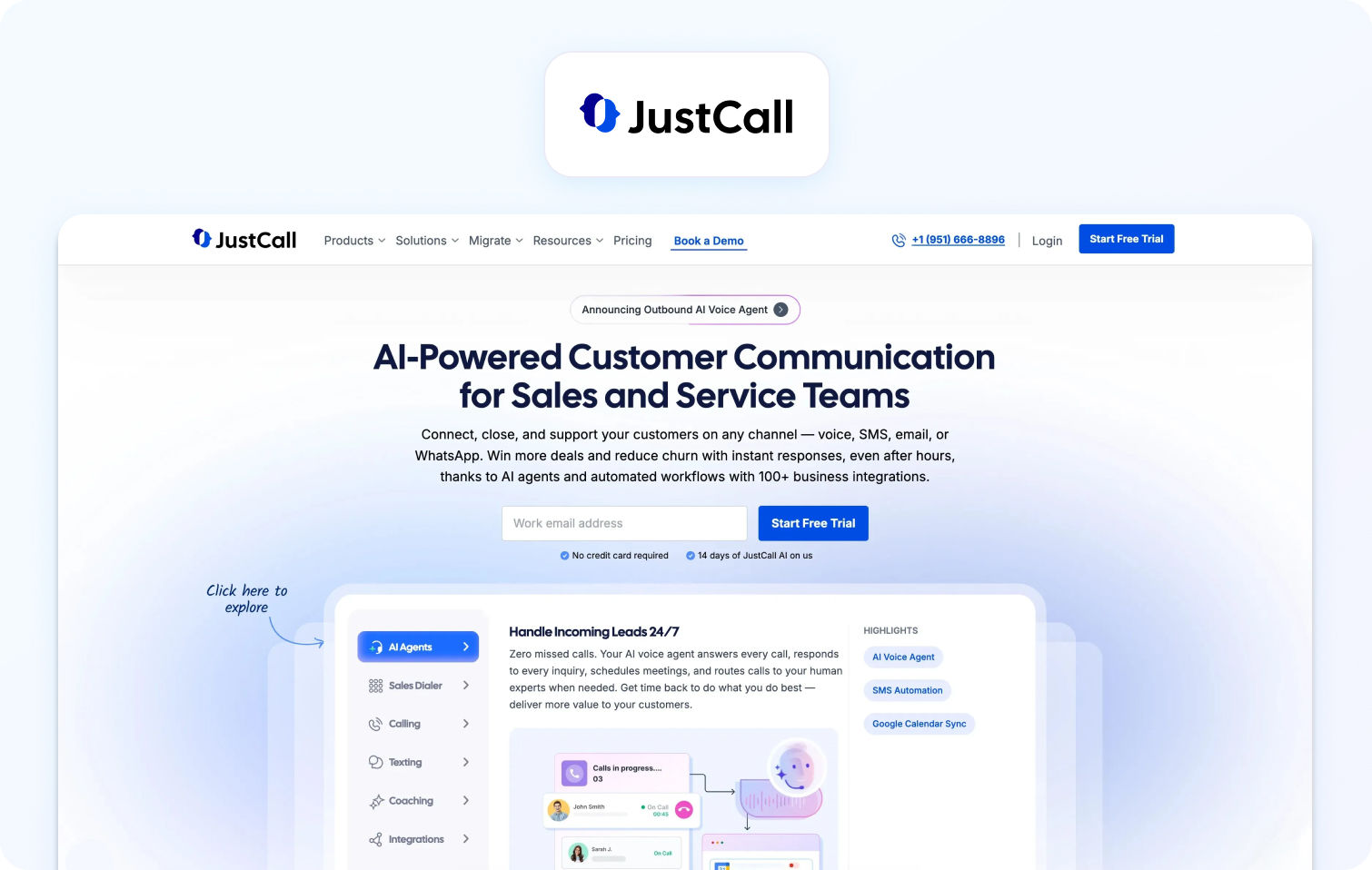
JustCall combines voice, SMS, and basic contact center features aimed at sales and support teams. It positions itself as an affordable alternative with straightforward pricing.
Features:
- Cloud phone system with voice and SMS
- Automatic call recording and basic transcription
- Call routing and IVR
- Integration with CRM and help desk platforms
- Call analytics and reporting
- Sales dialer and automation
Who Uses It: Small to mid-sized sales and teams needing basic phone support and SMS with affordable pricing plans.
Pricing:
- Essentials: Basic voice and SMS
- Team: ~$29/user/month (annual billing)
- Pro/Pro Plus: ~$49/user/month (annual billing): includes AI and analytics
Note: Included minutes and SMS caps apply; usage exceeding these caps may incur additional costs. Check current terms for regional pricing.
Pros:
- Affordable pricing compared to enterprise platforms
- Easy setup and user-friendly interface
- Good SMS/MMS capabilities
- Decent integration options
Cons:
- Limited features compared to complete contact center solutions
- Basic AI capabilities
- No native workforce management
- Call quality depends heavily on the internet connection
11. GoTo Connect

GoTo Connect (formerly Jive) combines unified communications with basic contact center capabilities. It targets small to mid-sized businesses wanting simplicity over extensive customization.
Features:
- Business phone system with voice, video, and messaging
- Basic call center solution features
- Call recording and voicemail transcription
- Team collaboration tools
- Mobile and desktop apps
- CRM integrations
Who Uses It: Small businesses needing a simple business communications platform without contact center complexity.
Pricing:
- Phone System/CX: ~$26–34/user/month (entry level)
- Contact Center: Some sources show higher tiers at $109+/user/month, depending on features
Note: Entry pricing covers basic phone systems. Advanced contact center features significantly increase costs.
Pros:
- Simple pricing and straightforward setup
- Good customer support
- Suitable for teams without expertise
- All the features needed for basic business communications
Cons:
- Limited contact center capabilities
- Basic AI features
- Less suitable for teams managing high call volume
- Fewer integrations than larger platforms
12. Vonage

Vonage offers a unified communications platform that includes voice, video, messaging, and contact center capabilities. It serves businesses of all sizes with flexible deployment options.
Features:
- Cloud communications platform with voice calling and video meetings
- SMS and team messaging
- Contact center available as an add-on
- Call analytics and reporting
- Integration with business systems
- Unlimited office locations support
Who Uses It: Businesses needing flexible communications with optional contact center solution features.
Pricing:
- Mobile: ~$19.99/user/month (annual billing): starting tier
- Premium: ~$29.99/user/month (annual billing)
- Advanced: ~$39.99/user/month (annual billing)
Note: Many advanced features require add-ons, and hidden usage and feature costs may apply. Contact center sold separately.
Pros:
- Flexible deployment options
- Good international coverage
- Comprehensive feature set when fully configured
- Strong API for custom integrations
Cons:
- Contact center features require an add-on purchase
- Pricing can become expensive with add-ons
- Interface is less modern than newer competitors
- Implementation complexity for new features
Putting It All Together: Choose for Fit
The best Aircall alternative depends on your specific needs. If you're primarily a sales team that needs reliable phone calls with CRM integration, platforms like Dialpad or CloudTalk offer simplicity and speed. If you're managing a contact center with 50+ agents, Talkdesk or Genesys Cloud CX offers depth, but at an enterprise pricing level.
However, for teams managing 20 to 100 agents who need omnichannel coverage, AI-powered features, and workforce management without vendor fragmentation, BlueTweak stands out. It consolidates voice, email, chat, and social channels with AI-driven ticket summaries, suggested replies, call transcription, workforce management, and quality assurance into one platform, offering predictable pricing.
When to Shortlist BlueTweak:
- You need more than a phone system; you need a customer service solution that unifies voice, email, chat, and social channels.
- You want AI features like call transcription, ticket summarization, and KB-grounded suggested replies included in base pricing, not sold as expensive add-ons.
- You're managing multiple brands or client accounts and need workspace scoping within a single platform.
- You need workforce management and quality assurance solutions that integrate seamlessly without relying on third-party tools.
- You prefer weeks to deploy instead of months of implementation with professional services.
- You want multilingual customer support with real-time translation that preserves context and meaning.
Request a demo to see BlueTweak's voice capabilities, AI assistance, and omnichannel routing in action. Explore our pricing for transparent costs that include workforce management, quality assurance, and AI features.

As Head of Digital Transformation, Radu looks over multiple departments across the company, providing visibility over what happens in product, and what are the needs of customers. With more than 8 years in the Technology era, and part of BlueTweak since the beginning, Radu shifted from a developer (addressing end-customer needs) to a more business oriented role, to have an influence and touch base with people who use the actual technology.



