



TL;DR
Telecom providers live in a high-volume, high-stakes world where outages, billing questions, and activations all hit at once. This article shows how to use AI customer support software automation in telecom in 2026 to absorb surges, shorten queues, and improve service reliability without losing the human touch. You’ll get concrete, field-tested use cases, the key AI tools behind them, the KPIs to track, and where BlueTweak fits alongside your OSS/BSS stack. These use cases focus on improving customer satisfaction while keeping first replies fast and accurate across languages.
Why Telecom Needs Automation Now
In 2026, customers expect quick, accurate help on every channel. They also expect updates when service disruptions occur and clear answers to billing inquiries. At the same time, telecom companies must protect sensitive customer information, control operational costs, and maintain stable network performance. Manual processes cannot keep up with customer demands that span multiple communication channels.
In the telecom industry, the goal is reliable service delivery across every channel without increasing costs. Practical customer service automation enables telecom companies to handle demand spikes while protecting privacy and accuracy. GSMA Intelligence reports that 47% of telco AI deployments focus on customer care and 60% are already live, signaling a shift from pilots to production in support automation.
AI customer support automation in telecom addresses this gap. Artificial intelligence and machine learning can analyze customer data, detect customer intent, and trigger actions that guide each customer interaction to the right agent or a reliable digital answer. Done well, automation raises customer satisfaction, reduces repeat contacts, and helps support teams handle inquiries efficiently during spikes.
What AI Customer Support Automation in Telecom Includes
Key AI technologies span several layers that work together:
- Natural language processing to understand unstructured customer inquiries across chat, email, and social
- Generative AI to draft accurate first replies grounded in a knowledge base and policy
- Predictive analytics to anticipate service outages, network failures, and demand surges
- Automated ticketing systems that triage and route by language, intent, and complexity
- Virtual assistants and ai powered chatbots that resolve routine tasks and escalate with context
- Sentiment analysis to spot frustration and prioritize intervention
- Integrations with OSS/BSS and NOC tools to monitor network performance, pull network data, and automate outreach
The stack draws on key AI technologies, from NLP and predictive analytics to orchestration layers, that keep AI automation precise and auditable. Generative AI pairs with NLP and sentiment analysis to keep initial replies helpful and concise. Virtual assistants and AI-powered chatbots handle first-line questions across multiple communication channels while escalating with context.
BlueTweak unifies chat, voice, email, and SMS in one workspace, with language-aware routing, real-time chat translation, AI summaries, proposed reply from a smart knowledge base, workflow automation, WFM, and standard analytics. It integrates through APIs and webhooks, so support can react to network data without switching tools.
12 Proven Use Cases For AI Customer Support Automation
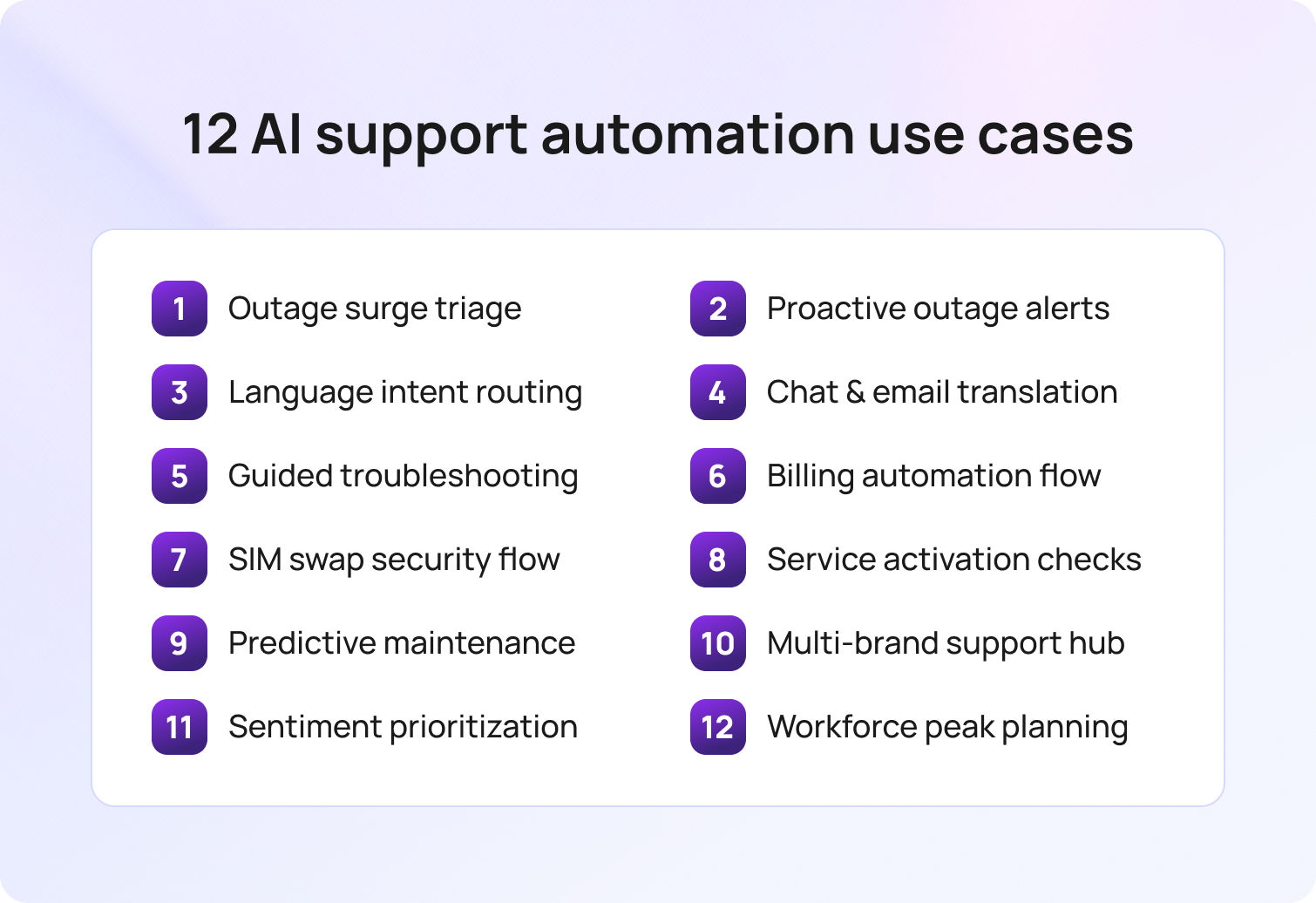
Each use case explains what it is, how it works, why it improves customer experience, and how BlueTweak supports the flow. Track the listed KPIs to measure lift in customer satisfaction and operational efficiency.
1) Outage triage and surge containment
What it is
When a cell site fails or a backbone link flaps, support tickets and incoming calls pile up. AI clusters similar complaints by location, device type, and error language, then links them to live NOC alerts.
How it works
NLP groups customer queries into incident clusters. A unified status card appears for agents and virtual assistants. Customers entering affected ZIP codes receive immediate acknowledgement and an expected response time window. Coordination with network operations ensures frontline messaging stays aligned with live restoration steps and available network resources.
Why it helps
You reduce duplicate troubleshooting, set expectations early, and keep customers informed. Agents focus on edge cases, not the same script 500 times.
Where BlueTweak fits
Connects to external systems via API, classifies and routes new cases, can automate replies and translate in real time, and surfaces incident-level performance. Core KPIs include containment, deflection, sentiment, and FCR; additional customer support metrics, such as wait time and CSAT, can be tracked in analytics.
2) Proactive outage communication across channels
What it is
Customers want to know you see the problem. AI automation can send tailored updates on SMS, email, and in-app when a monitored threshold is crossed.
How it works
When OSS raises an event, automation creates a segment from customer data in the polygon or site footprint and pushes an update with a plain-language status, next check-in time, and safe self-help steps.
Why it helps
Transparent updates cut inbound volume, support customer loyalty, and reduce churn risk during extended maintenance. Clear updates preserve service quality and set realistic expectations for affected telecom services.
Where BlueTweak fits
Sends multilingual updates and AI-assisted replies, with analytics focused on containment/deflection, sentiment, and FCR; additional metrics like CSAT or engagement can be tracked if available in your analytics stack.
3) Real-time language and intent routing
What it is
Customers expect immediate acknowledgment in their language. Language and intent detection at intake routes to the right skill queue.
How it works
NLP detects Spanish billing, French mobile data, or English fiber install questions as they arrive, then applies the response SLA for each queue. Matching intent to skills is the fastest way to respect customer needs without creating new handoffs.
Why it helps
Wrong-queue bounces disappear. Average first response time drops. Escalations become cleaner.
Where BlueTweak fits
Classifies and routes conversations, assists agents to reduce time to first response, and supports multilingual chatbots and other operations. Core KPIs include transfer rate, containment/deflection, sentiment, and FCR; FRT and CSAT may be tracked depending on your analytics setup.
4) Multilingual chat and email translation
What it is
Thin coverage for minority languages slows the first reply. Inline translation keeps the conversation moving. Inline guidance helps agents assist customers in their preferred language without leaving the thread.
How it works
Agents write in their language; customers read in theirs. Brand glossaries protect plan names, device models, and billing codes.
Why it helps
The team replies within SLA while reserving human intervention for complex cases.
Where BlueTweak fits
Provides real-time chat translation and AI-assisted replies, reducing time to first response. Teams can track core outcomes such as containment/deflection, sentiment, and FCR; FRT can be included, depending on the reporting setup.
5) Guided device and network troubleshooting
What it is
Many contacts involve SIM activation, APN settings, eSIM transfer, or ONT resets. AI-powered guides solve these without wait time.
How it works
AI tools walk customers through steps with branched logic and device-specific instructions, then auto-document outcomes.
Why it helps
Automating routine tasks with device-aware flows delivers tailored solutions that resolve common issues on the first touch. Perceived service reliability rises, and truck rolls fall. Customers find answers fast.
Where BlueTweak fits
Uses the knowledge base to assist customers and agents with AI-assisted answers and automation. Core KPIs we track include containment/deflection, transfer rate, sentiment, and FCR; additional metrics, such as AHT or CSAT, can be tracked depending on your analytics setup.
6) Billing inquiry automation with secure handoff
What it is
Billing is high-volume and high-sensitivity. Automation pulls plan details, recent invoices, and add-ons to compose a precise answer.
How it works
AI-powered systems recognize billing intent, retrieve the last bill, highlight deltas, propose an explanation or credit path, and, where policy requires, escalate to an agent for approval. Models analyze customer data to prefill plan details and charges, reducing back-and-forth and speeding approvals.
Why it helps
Clear, fast initial responses cut repeat contacts. Customers feel valued because the reply references their account and plan.
Where BlueTweak fits
Uses a smart knowledge base and proposed replies to speed up the first response. Core outcomes we track include containment/deflection, transfer rate, sentiment, and FCR; additional metrics like FRT or CSAT can be included depending on your reporting setup.
7) SIM swap and identity assurance flow
What it is
Security posture matters. A risky SIM swap or port-out request needs careful validation.
How it works
Automation detects a SIM swap request, triggers stepped-up verification, checks recent customer behavior, and flags risk signals from fraud services. Only then does it create a change order or escalate.
Why it helps
You protect sensitive customer information, stop fraud, and ensure legitimate requests flow smoothly.
Where BlueTweak fits
Applies automatic routing and classification to get the right work to the right queue, with AI summaries to speed review. Core outcomes we track include containment/deflection, transfer rate, sentiment, and FCR; additional metrics can be tracked depending on your analytics setup.
8) Service activation and provisioning checks
What it is
New lines, fiber connects, number porting, IoT SIMs; service activations need clear guidance and visibility.
How it works
Automation collects required fields up front, checks order/prereqs in OSS/BSS, and confirms milestones to the customer.
Why it helps
Fewer back-and-forth loops, faster activations, fewer missed appointments.
Where BlueTweak fits
Connects with external systems through an API-open approach and uses the knowledge base and automation to assist customers and agents. Core outcomes we track include containment/deflection, transfer rate, sentiment, and FCR; additional metrics can be added based on your analytics setup.
9) Predictive maintenance prompts to pre-empt spikes
What it is
Network monitoring and historical performance data can predict trouble before customers call.
How it works
When models flag a sector overheating or rising error rates, support preloads a status note and prepares a targeted FAQ and IVR prompt for that region.
Why it helps
You reduce call spikes and meet customer expectations with steady, proactive communication. Using historical performance data and live telemetry to optimize network performance helps anticipate customer needs before tickets arrive.
Where BlueTweak fits
Connects to external systems through an API-open approach and can assist teams with rapid responses; proposed replies help reduce first-response time. Core KPIs tracked include containment/deflection, sentiment, and FCR; FRT can be included depending on the reporting setup.
10) Multi-brand and wholesale client support in one workspace
What it is
Many telecom providers serve MVNOs or multiple brands. Fragmented tools slow the support process.
How it works
Automation tags cases by brand, applies the right service standards, and keeps reports separate while sharing capacity.
Why it helps
Shared staffing, unified training, isolated analytics. Operational costs fall.
Where BlueTweak fits
Applies automatic routing with WFM/analytics to support operations and proposed replies that reduce time to first response. Core outcomes we track include containment/deflection, transfer rate, sentiment, and FCR; FRT can be included depending on the reporting setup.
11) Sentiment-driven prioritization and coaching
What it is
A polite first reply matters. Sentiment analysis spots tense threads early.
How it works
Models score tone at each step. Negative shifts trigger faster follow-ups, supervisor views, or a tone-checked template.
Why it helps
Lower escalations, better recovery after delays, and rising overall customer satisfaction.
Where BlueTweak fits
Surfaces sentiment and provides call transcription plus AI classification/summarization to support reviews. Core KPIs we highlight include containment/deflection, transfer rate, sentiment, and FCR; additional metrics (e.g., escalation rate or CSAT) can be tracked if available in your analytics stack.
12) Workforce and channel planning for peaks
What it is
Promotions, sporting events, and regional storms. Volume swings are part of the telecommunications industry.
How it works
Forecasts combine historical patterns with event data. Schedules balance voice, chat, and email loads. Rapid-response pools cover unexpected spikes.
Why it helps
Stable average response time, protected SLAs, and fewer queue abandonments.
Where BlueTweak fits
Omnichannel support with WFM/analytics alongside operations; AI-assisted replies help reduce time to first response. Core outcomes we track include containment/deflection, transfer rate, concurrency, sentiment, and FCR; FRT can be included depending on the reporting setup.
Implementation Roadmap For Telecom Providers
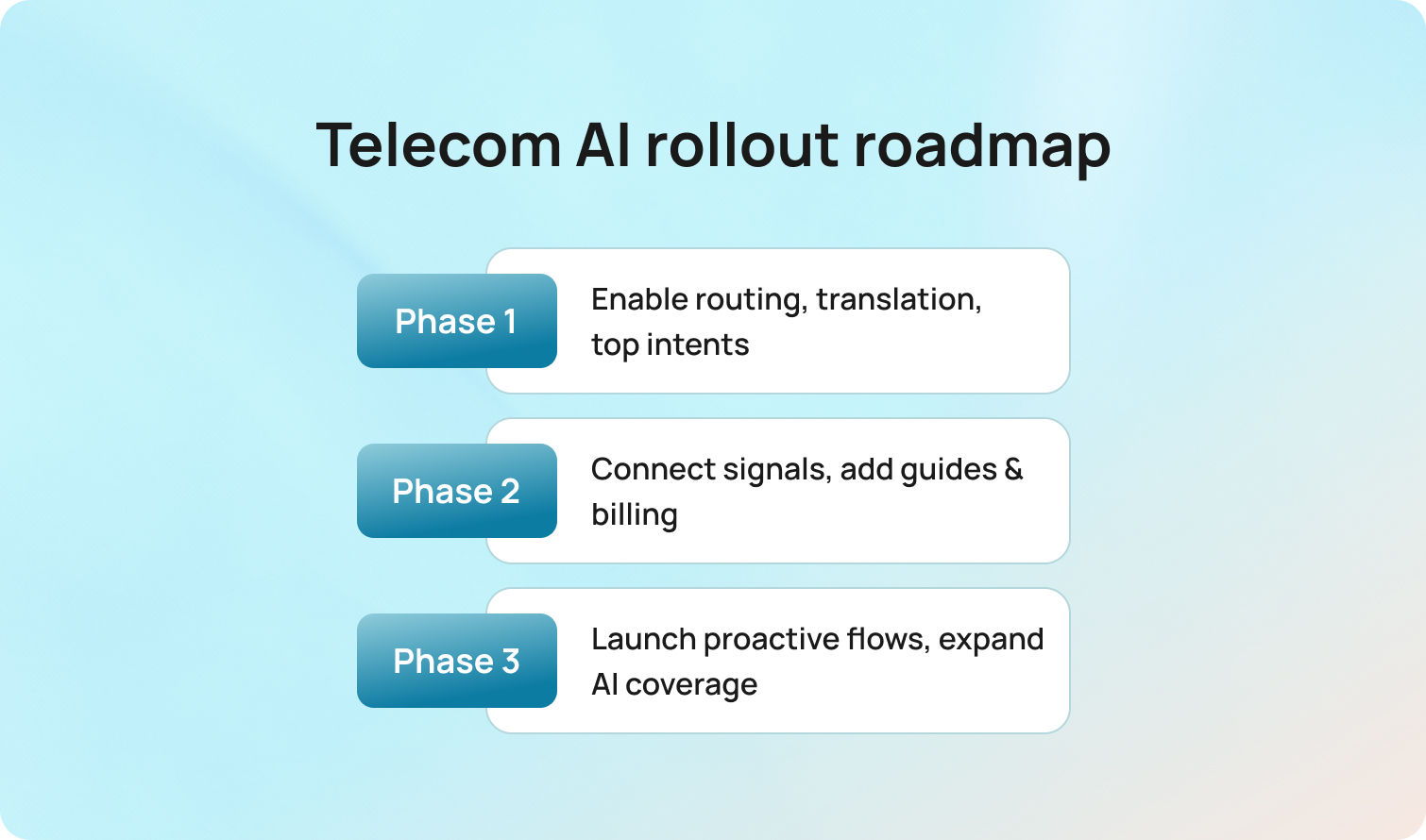
Start small, move fast, and add depth each month.
Phase 1
Enable language and intent routing, inline translation, and proposed reply for the top five intents. Update the ten most-read knowledge articles and localize them. Publish channel-specific FRT targets.
Phase 2
Connect outage and activation signals by API. Launch guided device troubleshooting and secure billing replies. Add sentiment flags for high-value accounts. Train agents on templates and tone.
Phase 3
Introduce proactive outage communications, predictive prompts for at-risk cells, and SIM swap flows with stepped-up verification. Expand virtual assistants to cover more routine support tasks, then tune based on edit logs and CSAT. By this point, teams are running AI solutions at scale while keeping human review for edge cases.
Measurement That Ties to Business Outcomes
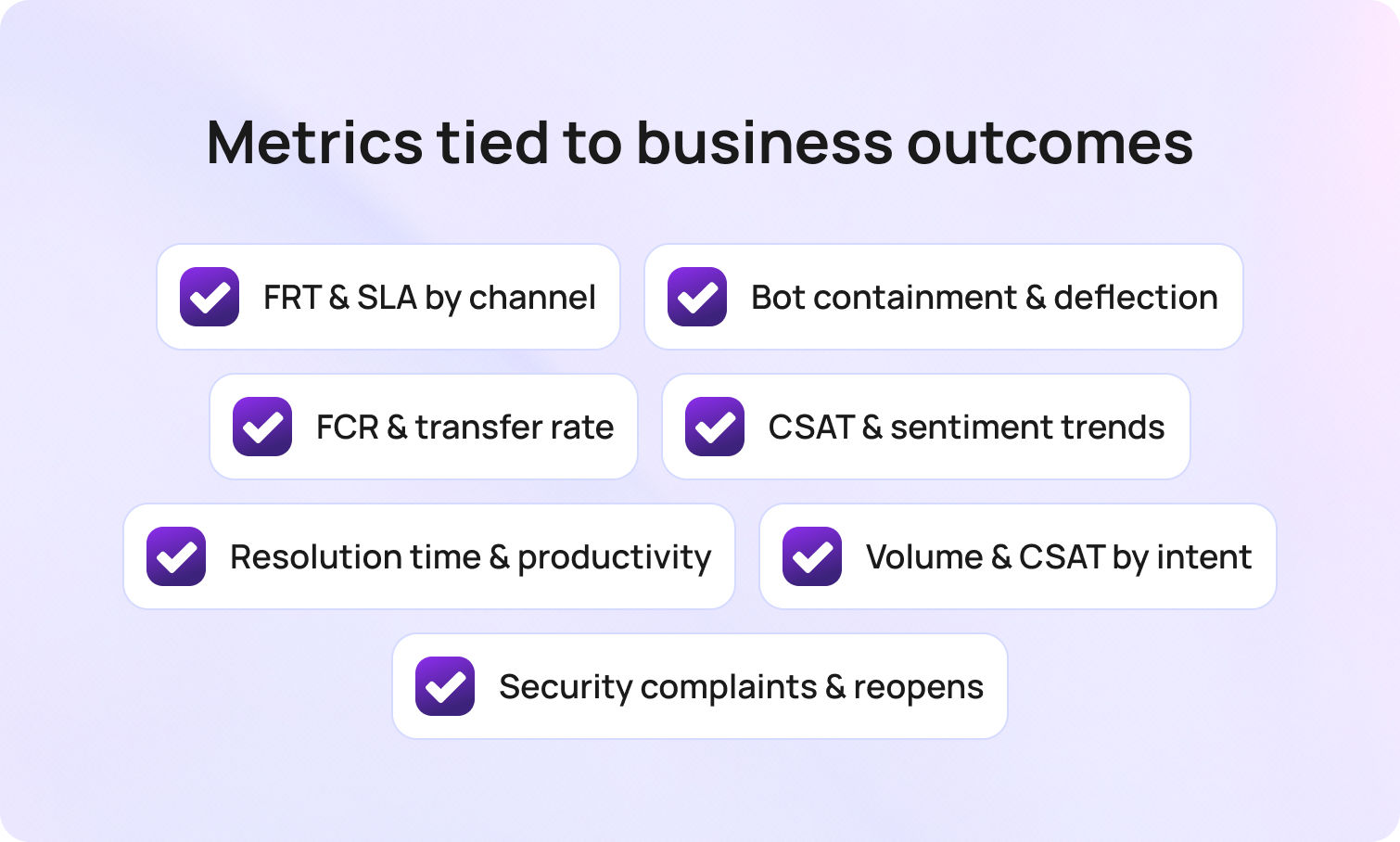
Automation succeeds when customer engagement improves, and costs fall. Review these weekly:
- First response time and percent within response SLA by channel and language
- Containment and deflection from bots and IVR
- FCR and transfer rate to confirm the first response was useful
- CSAT and sentiment after the first reply and after the resolution
- Average resolution time and resolved per agent hour for resource allocation
- Volume and CSAT on billing inquiries, service activations, and outage clusters
- Complaints and reopens on security flows (SIM swaps, number ports)
Tie changes back to revenue drivers: fewer credits during outages, better retention after fast fixes, and significant cost savings from lower manual work.
Privacy, Security, and Governance
Telecom traffic is personal. Keep privacy and security first.
- Limit models to approved sources like your internal knowledge base, policy library, and consented customer data
- Mask sensitive fields in transcripts and restrict who can unmask them
- Log when AI-powered systems propose or translate text, including the sources used
- Provide human agents for eligibility changes, refunds, or sensitive identity checks
- Align with data residency and processor rules for your regions, and audit third-party connections
These controls let you protect sensitive customer information while scaling automation responsibly.
Common Pitfalls to Avoid
Even well-run teams lose minutes to small, repeatable mistakes. The patterns below either inflate your FRT on paper or slow real conversations in ways customers notice. Keep them in view as you tune tools, targets, and workflows.
- Measuring only average time and ignoring business hours or holidays
- Counting auto-replies as meaningful first responses when they do not address the customer’s request
- Setting the same first response SLA across email, chat, and phone
- Letting the internal knowledge base drift while templates multiply
- Treating all tickets equally when some require the right agent and deeper context
Avoid these traps, and your support automation will handle inquiries efficiently without compromising quality.
Future Outlook: 2026 and Beyond
Automation keeps moving to the edge. Operators are wiring live network telemetry into predictive maintenance so fixes can be scheduled before customers feel the dip. Generative AI will be deployed with retrieval-augmented grounding and formal evaluation, so answers cite approved content and reflect the customer’s history and tone.
Enterprises are also getting more hard-nosed about evidence: in the 2026 PwC Global CEO Survey, only 12% of leaders say AI has delivered both higher revenue and lower costs so far, raising the bar for measurable value and auditability. Regulations and infrastructure are catching up: the EU AI Act’s core obligations, including transparency (Article 50) and most high-risk rules, start applying on August 2, 2026, pushing providers to keep model logs and demonstrate controls.
On the stack side, sovereign-cloud options are expanding fast: AWS European Sovereign Cloud went live in Germany in January 2026, with more EU countries on the roadmap, while Microsoft broadened its Sovereign Cloud options and in-country processing commitments through 2025, with additional markets slated by the end of 2026.
What this means: expect tighter coupling between support and infrastructure: predicted fixes flow straight into proactive status updates, agent guidance, and field workflows — with clear audit trails to satisfy EU-grade governance.
Conclusion
The best AI customer support automation in telecom is practical, measurable, and respectful of how telecom networks and business operations work. Automate the repetitive parts, triage, translation, AI-suggested replies, and guided fixes, while keeping human intervention for judgment calls. Track FRT, FCR, CSAT, containment, deflection, and sentiment to verify real gains. With the right foundation, telecom providers improve service reliability, lower operational costs, and boost customer satisfaction. The outcome is better service delivery and service quality across brands and regions, without losing the human touch. BlueTweak brings routing, translation, AI summaries, suggested replies, and reporting into a single workspace for customer support. Request a demo to learn more.

As Head of Digital Transformation, Radu looks over multiple departments across the company, providing visibility over what happens in product, and what are the needs of customers. With more than 8 years in the Technology era, and part of BlueTweak since the beginning, Radu shifted from a developer (addressing end-customer needs) to a more business oriented role, to have an influence and touch base with people who use the actual technology.



