



TL;DR
Use call center KPI benchmarks to set realistic targets, identify performance gaps, and guide investment decisions. In 2026, most call centers and contact centers should track service level, average speed to answer, abandonment rate, first call resolution, customer satisfaction, customer effort score, average handle time, after-call work, transfer rate, repeat calls, occupancy and utilization, schedule adherence, forecast accuracy, cost per contact, and self-service containment. Treat every number as a range by channel and intent, not a single magic target. Pair call center metrics with root-cause narratives and a clear action plan to improve customer satisfaction, operational efficiency, and team performance.
Why Call Center KPI Benchmarking Matters in 2026
By 2027, service leaders expect AI to resolve half of all cases, up from roughly a third in 2025, indicating that KPI baselines for speed, effort, and resolution are shifting. At the same time, customers are 2.6× more likely to buy more when wait times are satisfactory and 2.1× more likely to recommend after first-call resolution, underscoring why benchmarks for ASA, SL, and FCR directly map to revenue.
Benchmarking is not about copying the industry average. It is about locating your current state on a realistic scale, then running a repeatable cadence to close the gap. You will track performance data, compare against external reference points and direct competitors where available, and tune targets by channel, intent, and value. The outcome is a common language for call center performance, faster decision-making, and fewer arguments about “what good looks like.”
In the rest of this article, you’ll get pragmatic call center KPI benchmarks, how to tailor them by channel and intent, and a simple cadence for comparing your performance against industry standards without copying the average.
How To Use Call Center KPI Benchmarks

Treat benchmarks as a playbook, not a scoreboard. Start by anchoring each KPI to a clear decision and the moment in the customer journey it affects, then compare performance in a way that reflects how your center actually operates. With that lens in mind, use the guidance below to set targets that are fair, directional, and immediately actionable.
- Benchmark by channel and intent. AI voicebot, multilingual chatbot, email, social, and messaging have different customer behaviors and different cost structures. A KPI call center benchmark for voice will not fit asynchronous channels.
- Blend external and internal references. Use call center industry and contact center benchmarking reports for directional targets, then compare to your last four to six reporting periods. That mix shows whether you are closing the gap and whether targets are realistic for your mix of incoming calls and outbound calls.
- Tie targets to experience and cost. Customer satisfaction, customer effort score, first call resolution, and abandonment sit on the experience side; occupancy, AHT, cost per contact, and self-service containment are cost drivers. Optimize both to raise agent productivity and maintain operational efficiency.
Publish context with every metric. Center performance metrics only matter when leaders know what changed and what will change next. Write one line on the cause, one line on the fix, and one line on the expected impact.
Top 15 Call Center KPI Benchmarks For 2026
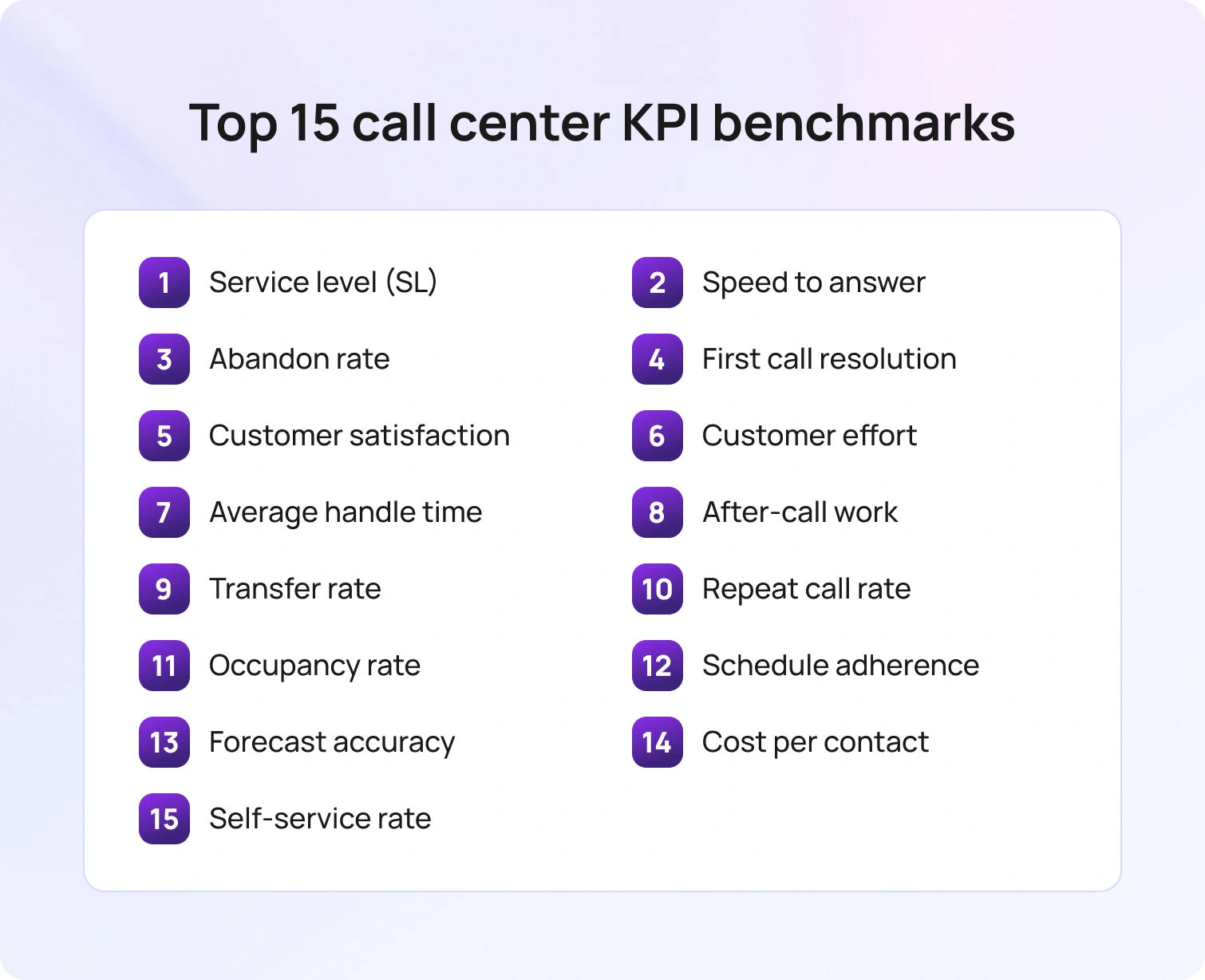
Below are practical call center KPI benchmarks expressed as typical target ranges, not universal rules. Calibrate to your vertical, value segments, and customer journey stage. When in doubt, measure a 90-day baseline, then set targets one notch tighter than your current median.
1) Service level (SL)
What it is: Percent of calls answered within a threshold.
2026 benchmark: Voice queues often sit between 75/30 and 85/20, depending on value and intent. Digital channels should publish response-time SLAs rather than a call-style speed threshold.
Why it matters: SL is your public promise. Hit this, and you cut wait-driven abandonment and poor customer service complaints.
2) Average speed to answer (ASA)
What it is: Time from enter-queue to live answer.
2026 benchmark: 20–40 seconds for voice in mainstream queues; VIP or critical intents trend faster.
Why it matters: ASA influences emotion and primes customer interactions. Long waits spike abandonment rate and repeat calls.
3) Abandonment rate
What it is: The percent of incoming calls that disconnect before being answered.
2026 benchmark: 3–8% for voice after IVR/menu tuning; lower for callbacks. Measure “abandon after X seconds” to remove immediate hang-ups.
Why it matters: Abandonment is a hard cost of delay and a warning light for staffing or menu design.
4) First call resolution (FCR)
What it is: Percent of issues resolved without follow-up or transfer.
2026 benchmark: 70–85% for most call centers, with technical and multi-party cases lower. Track by intent, not centerwide.
Why it matters: FCR drives customer loyalty, reduces repeat volume, and lowers contact center costs.
5) Customer satisfaction (CSAT)
What it is: Post-interaction rating, typically 1–5 or 1–7.
2026 benchmark: 80–90% satisfied on resolved contacts, lower on constrained policies.
Why it matters: CSAT remains the quickest way to assess customer satisfaction at the interaction level.
6) Customer effort score (CES)
What it is: “How much effort did it take to resolve your issue?”
2026 benchmark: Targets vary by scale; aim to keep “difficult” responses below 10–15% on resolved interactions.
Why it matters: CES predicts repeat calls and churn better than satisfaction alone because it captures the effort the average caller invests.
7) Average handle time (AHT)
What it is: Talk + hold + after-call work (ACW).
2026 benchmark: Voice 4–7 minutes for general service; complex tech or regulated queues longer. Chat depends on concurrency and ranges from 6 to 12 minutes per conversation.
Why it matters: AHT converts contact volume into workload and staffing needs. Read it with FCR and quality in mind, so you don’t optimize for speed alone.
8) After-call work (ACW)
What it is: Wrap-up time per contact.
2026 benchmark: 30–90 seconds for mature flows; longer for heavy documentation.
Why it matters: Excess ACW hides process or contact center software issues and reduces agent availability for new calls.
9) Transfer rate
What it is: Percent of contacts moved to another queue or tier.
2026 benchmark: 10–20% for mixed complexity; lower in one-and-done environments.
Why it matters: Transfers extend the customer journey and can signal gaps in routing, knowledge, or agent skills.
10) Repeat call rate
What it is: Share of customers calling back about the same issue within X days.
2026 benchmark: 10–15% for mainstream service when FCR is healthy.
Why it matters: Repeat calls inflate center performance costs and indicate friction with documentation or policy.
11) Occupancy and utilization
What it is: The time agents spend handling work versus waiting.
2026 benchmark: Voice 75–85% occupancy; lower for concurrent chat to avoid overload.
Why it matters: Keeps agents engaged without burnout and protects service quality.
12) Schedule adherence
What it is: A match between planned agent schedules and actual status.
2026 benchmark: 85–92% at the interval level with documented exceptions.
Why it matters: Adherence connects forecasting to reality, ensuring service-level targets remain credible.
13) Forecast accuracy (WAPE/MAPE)
What it is: Error between forecast and actual contacts or workload.
2026 benchmark: Day-level 5–8% for mature voice lines; 10–12% for digital.
Why it matters: Accurate forecasts reduce over-staffing and understaffing, stabilizing response time and agent satisfaction.
14) Cost per contact
What it is: All-in cost divided by the number of contacts handled.
2026 benchmark: Highly variable by industry and channel; the target is a downward trend without harming experience.
Why it matters: Puts operational efficiency and service quality in one view for Finance and Operations.
15) Self-service containment
What it is: Share of intents resolved by IVR, bots, or help center without agent touch.
2026 benchmark: 20–60% depending on automation maturity and intent mix.
Why it matters: High-quality self-service options reduce the number of calls answered and free agents for complex work, lifting FCR on the remaining load.
Call Center KPI Benchmarks by Industry

Every vertical carries different risks, regulations, and emotions. Use these call center KPI benchmarks by industry as starting ranges, then tune them by intent and value tier.
Retail and eCommerce
Customer context: Order status, returns, payments, promotions.
Typical targets: SL 80/20 for voice during business hours, ASA 20–30s, abandonment ≤5%, FCR 75–85%, CSAT 85–90%, CES “difficult” ≤10%.
Notes: High peaks around drops and holidays. Invest in self-service for status and returns to cut repeat calls and raise agent productivity for edge cases.
Banking, Financial Services, Insurance
Customer context: Authentication, fraud, claims, policy changes.
Typical targets: SL 80/20 or faster for high-risk lines, ASA ≤20s on priority, abandonment ≤3–5%, FCR 70–80% with strong compliance notes.
Notes: Transfers may be higher due to entitlements. Tie AHT to quality; rushing increases rework and contact center costs.
Technology and SaaS
Customer context: Setup, billing, troubleshooting.
Typical targets: SL 75/30 for general, VIP faster; FCR 70–85%; AHT can be 7–12 minutes for technical issues; CSAT 85–90%.
Notes: Knowledge freshness and guided workflows are the FCR lever. Track repeat calls within seven days.
Healthcare and Life Sciences
Customer context: Appointments, benefits, medication questions.
Typical targets: SL 80/20 or stricter by regulation, abandonment ≤3–5%, CSAT ≥88% on resolved contacts, transfers controlled by role and privacy rules.
Notes: Compliance extends AHT and ACW; measure empathy and clarity alongside speed to assess customer happiness and service quality.
Travel and Hospitality
Customer context: Changes, disruptions, loyalty.
Typical targets: Highly seasonal. SL flexes by event; ASA 20–40s baseline; FCR 70–80%; abandonment ≤5–8% with virtual hold.
Notes: Proactive messaging reduces spikes. Measure multi-touch journeys rather than single calls in isolation.
Utilities and Telecom
Customer context: Outages, billing, activation.
Typical targets: SL 80/20 normal, surge playbooks for outages; FCR 70–85%; containment high for status updates.
Notes: Separate incident traffic from routine service to prevent benchmarks from blurring during events.
Journey-Lens Benchmarking
Many call centers still look at center metrics in isolation: a voice SLA here, a chat AHT there. In 2026, top programs benchmark the journey:
- Cross-channel FCR. Did the customer get a resolution across the conversation, even if it spanned channels?
- Effort across steps. Use CES to assess how easy the path felt, not just the final call.
- Time to outcome. Replace single-touch averages with “issue start to issue solved” at the intent level.
- Containment quality. Did self-service actually solve the problem, or did it delay an agent interaction and inflate effort?
This lens prevents gaming and aligns targets with the customer journey instead of a siloed queue.
How to Run a Benchmarking Cadence

Think of benchmarking as a tight weekly–monthly rhythm, not a one-off project. You’re building a repeatable loop that compares like with like, turns gaps into owned actions, and shows progress over time. Use the steps below to keep the cadence clear, fair, and relentlessly actionable.
- Define the cohort. Choose the same period last quarter or last year and the same intents.
- Collect clean data. Confirm consistent definitions for calls answered, transfers, repeat calls, and after-call work.
- Compare against references. Use center industry benchmarks plus your own performance history.
- Set target ranges. Publish a floor, target, and stretch per KPI, channel, and intent.
- Attach an action plan. For each gap, assign an owner, a deadline, and the expected impact on customer experience and contact center costs.
Report weekly and monthly. Show trend lines, not snapshots, and include two customer feedback quotes to humanize the data.
Common Pitfalls in Call Center KPI Benchmarking

Benchmarking fails when shortcuts creep in. Guard against these traps so your call center KPI benchmarks stay comparable over time, reflect channel realities, and translate into owned improvements.
- Treating a vendor’s one-size industry average as gospel for your value tiers.
- Mixing definitions across teams so your own performance cannot be trended reliably.
- Optimizing for a single KPI often comes at the expense of others and harms customer interactions.
- Publishing center performance metrics without owners or change logs, which slows improvement.
- Ignoring channel differences. Most call centers need separate targets for voice, chat, email, and messaging.
A 90-Day Plan to Operationalize Benchmarks
Here’s a simple, repeatable rollout that turns benchmarking from a spreadsheet exercise into an operating habit. Use these phases to lock definitions, set targets, and create a weekly rhythm where insights drive action.
Days 1–30: Baseline and definitions
Lock metric definitions, collect twelve months of data, and publish current ranges by channel and top ten intents. Agree on three outcome KPIs for the quarter, such as customer satisfaction score, first call resolution, and abandonment.
Days 31–60: Targets and playbooks
Set floor, target, and stretch for each KPI. Write playbooks for the top five gaps: staffing changes, knowledge fixes, self-service options, and agent training. Turn on a weekly review that shows performance data with one-line causes and one-line actions.
Days 61–90: Measure and iterate
Report call center performance against the new targets, including verbatim customer feedback. Highlight two wins and two risks each week. Adjust targets where the intent mix or seasonality changed. Publish a quarterly “what changed and why” to keep contact center leaders aligned.
How BlueTweak Can Help
BlueTweak makes benchmarking routine. Your channels sit in one workspace, and the core KPIs populate automatically by intent and channel. That includes SL, ASA, abandonment, FCR, CSAT, CES, AHT, ACW, transfers, repeat calls, occupancy, adherence, forecast accuracy, cost per contact, and self-service containment. Leaders see trend lines against floor, target, and stretch, and can pivot from center metrics to underlying conversations in a click.
Clean joins make comparisons trustworthy. APIs and webhooks attach case IDs, intents, brand, language, and queue to every interaction, while AI summaries and sentiment tagging convert raw conversations into structured performance data. That context lets you publish center key performance indicators with one line for the cause, one for the fix, and one for the expected impact, without manual stitching.
Benchmarks become actions, not screenshots. Suggested replies cite the right knowledge article, WFM views align staffing to forecast, SL exposure, and routing rules adjust by intent when repeat calls or transfer rate spike. Teams close gaps with targeted playbooks across staffing, knowledge, and self-service, and BlueTweak tracks outcomes in customer satisfaction, customer effort score, and contact center costs.
If you already own analytics or workforce management software, BlueTweak integrates to keep a single source of truth. If you do not, BlueTweak provides out-of-the-box scorecards, adherence, and intraday views, and intent-level reporting, so you can immediately launch a weekly and monthly benchmarking cadence and measure progress against the 2026 targets outlined in this guide.
Bringing It Together: A Balanced Scorecard for 2026
Great benchmarking pairs numbers with a narrative. Use these call center KPI benchmarks to set intent-level targets by channel, then write short explanations and action plans that tie center KPIs to better customer interactions and lower contact center costs. When you treat benchmarks as a living contract, reviewed weekly, tuned quarterly, you will raise team performance, improve customer satisfaction, and give leaders the clarity they need to invest confidently in call center operations and customer experience.
If you want those call center KPI benchmarks to update automatically and tie directly to actions, BlueTweak brings routing, WFM, knowledge, and analytics into one workspace. Scorecards populate by intent and channel, leaders track trends against targets, and teams get clear next steps. See how it maps to your queues and metrics.

As Head of Digital Transformation, Radu looks over multiple departments across the company, providing visibility over what happens in product, and what are the needs of customers. With more than 8 years in the Technology era, and part of BlueTweak since the beginning, Radu shifted from a developer (addressing end-customer needs) to a more business oriented role, to have an influence and touch base with people who use the actual technology.



