



TL;DR
Citizen satisfaction rises when service delivery is simple, transparent, and consistent across channels. This guide shares practical strategies for customer service in the public sector that address real constraints, such as compliance and budgetary constraints. You will learn how to redesign priority journeys, unify intake, use digital tools and artificial intelligence for routine tasks, and measure what matters to grow public trust over time.
Why Customer Service in the Public Sector is Different
Public sector organizations face unique challenges. You serve everyone. You deliver essential services. You operate under budget constraints and strict policy. You also carry a higher bar for privacy and accessibility. Citizens compare you to private-sector businesses that set expectations for speed, clarity, and convenience. The result is a rising gap between public expectations and the reality of complex government services.
There is progress. In the United States, citizen satisfaction with federal government services reached a 19-year high in 2025, demonstrating what is possible when agencies invest in journey design, digital tools, and improved back-office processes.
Policy reinforces that direction. The Biden Administration’s Executive Order 14058 and OMB Circular A-11 Section 280 set out clear requirements for customer experience and service delivery across High Impact Service Providers.
What follows is a practical, research-informed playbook for public sector customer service. Use it to improve service delivery, reduce effort, and increase citizen satisfaction while keeping compliance, cost, and workforce realities in view.
How We Define Public Sector Customer Service
Customer service in the public sector includes every customer interaction across government agencies and government institutions that helps a person understand, apply for, receive, or maintain a benefit or meet an obligation. It spans digital tools, phone calls, in-person visits, and mail. Good customer service means meeting customer expectations with clear information, predictable next steps, and a respectful tone. The goal is better outcomes for citizens and a strong public service experience that builds public trust.
12 Strategies to Improve Customer Service in the Public Sector
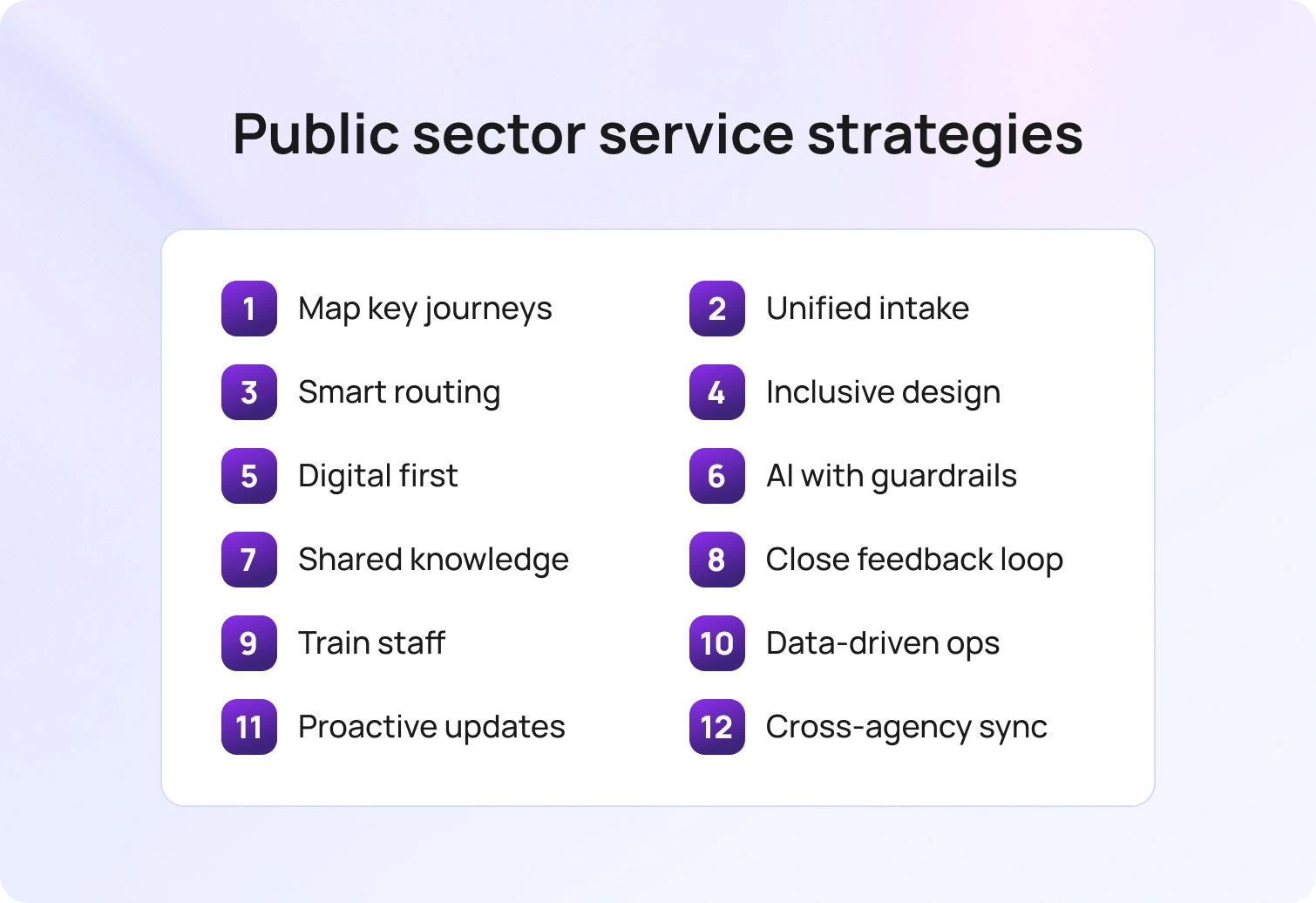
These strategies focus on the few journeys that drive volume and risk. They show how customer service in the public sector improves when intake is unified, standards are clear, and digital tools and conversational AI handle routine tasks. Use them to strengthen public-sector customer service, increase citizen satisfaction, and make every interaction easier.
1. Map priority journeys and remove friction
Start with the top five journeys by volume or risk. Examples include identity verification, benefits applications, appeals, and renewals. Document the steps from the citizen’s point of view. Note handoffs, jargon, and points where people abandon. Align service standards to each step. This creates a clear message across teams and a shared definition of great customer service.
Why it works
Teams stop optimizing tasks in isolation and focus on the customer journey. You reduce repeats and unclear next steps, thereby improving customer satisfaction and reducing costs. Public sector agencies can then communicate status with confidence and set expectations early.
2. Stand up unified intake across channels
Citizens use phone, web, mobile, and walk-in locations. A unified front door captures customer requests consistently and sends them to the right person the first time. Standardize forms, intake scripts, and identity checks. Keep the same service standards across channels so customers feel the same quality whether they call, click, or visit.
Why it works
A single intake reduces rework and prevents the “lost in the system” experience. It also gives your customer support team cleaner data for decision-making and performance management.
3. Route by language, intent, and complexity
Use language and topic detection to route a case to the right skill group. Add a complexity flag for issues that require specialist review. In blended environments, send routine tasks to digital channels and keep complex issues with trained customer service representatives who can make judgment calls.
Why it works
Routing reduces transfers and shortens time to resolution. It directs citizens to the right person without repeating information, thereby increasing citizen satisfaction and protecting public trust.
4. Design for accessibility and inclusion
Follow WCAG guidance. Write forms and letters in plain language. Offer simple language translations where needed. Provide visual and audio alternatives. Train help desk staff to support assistive technologies at counters and via phone. Inclusive design is not optional for public agencies that deliver essential services.
Why it works
Accessible services reduce errors, increase trust, and help solve customer pain points. This is service excellence in practice.
5. Use digital tools where they help, keep human paths open
Digital status trackers, appointment schedulers, and knowledge bases cut avoidable calls and visits. Chat and email help when people cannot travel. Keep a clear path to a human for edge cases, crisis situations, and legal questions. Design escalation rules so the right person responds with authority.
Why it works
Citizens prefer a predictable status and easy next steps. Digital tools provide proactive communication and better services without blocking those who need personal connections.
6. Apply artificial intelligence to routine tasks with guardrails
Start with document classification, translation, suggested replies, and summarization. These uses speed up service provision, let customer service agents focus on complex issues, and keep content consistent. Use a human-in-the-loop model for high-impact decisions.
Why it works
AI increases throughput and improves service quality by handling repetitive steps. Government organizations keep control by grounding answers in approved content and recording decisions for audit. Industry research shows growing adoption of AI in government services as leaders seek to expand digital options and improve service delivery.
7. Build a shared knowledge base and keep it current
Create a single source of truth for eligibility rules, proofs, timelines, and exceptions. Assign owners, set review cadences, and log changes. Link knowledge to website content and agent guidance so customer interactions use the same words and definitions.
Why it works
A shared knowledge base produces consistent answers across public sector services, reduces negative feedback, and supports employee training for new staff.
8. Close the loop on customer feedback
Use short customer satisfaction surveys in the citizen’s language at the end of a transaction. Pair scores with open text to capture qualitative insights. Publish what you changed based on feedback. This shows responsibility and builds a customer-centric culture.
Why it works
Survey respondents provide valuable insights into pain points. Closing the loop signals that customers influence service standards and policy, which improves customer relationships over time.
9. Invest in employee training and engagement
Employees handle complex laws, sensitive moments, and high volumes. Train on policy, empathy, and problem-solving. Give frontline staff clear playbooks and a path to escalate when policy blocks a fair outcome. Recognize great service in real time.
Why it works
Employee engagement has a critical role in citizen satisfaction. When employees feel trusted and prepared, they deliver excellent customer service more often and reduce the number of unhappy customers who feel ignored.
10. Use data analytics for performance management
Track the signals that matter with customer service analytics. Measure wait time, first contact resolution, transfers, abandonment, and sentiment. Break results down by channel, language, and location. Use a simple public dashboard so leaders, staff, and citizens see the same numbers. In the U.S., A-11 Section 280 provides structure for how federal agencies report and govern customer experience.
Why it works
A data-driven approach turns raw customer data into actionable insights. It also reduces debates about definitions and lets teams adjust quickly during peaks.
11. Communicate proactively and clearly
Send status updates at milestones. Confirm what you received, what happens next, and who is responsible. If timelines slip, explain why and give a new date. Keep tone neutral and respectful. Good marketing communications can support service delivery when they inform rather than persuade.
Why it works
Proactive communication reduces inbound volume, sets expectations, and prevents negative experience loops. Citizens feel respected and informed.
12. Strengthen cross-agency coordination
Many services touch multiple public sector organizations. Establish memoranda of understanding for data sharing with privacy safeguards. Standardize reference numbers across agencies. Set joint service standards for handoffs so people do not repeat their story.
Why it works
Coordination prevents gaps between agencies. It shortens the time to benefit and shows the government works as one organization, not a maze of offices.
Measurement That Leaders Can Trust
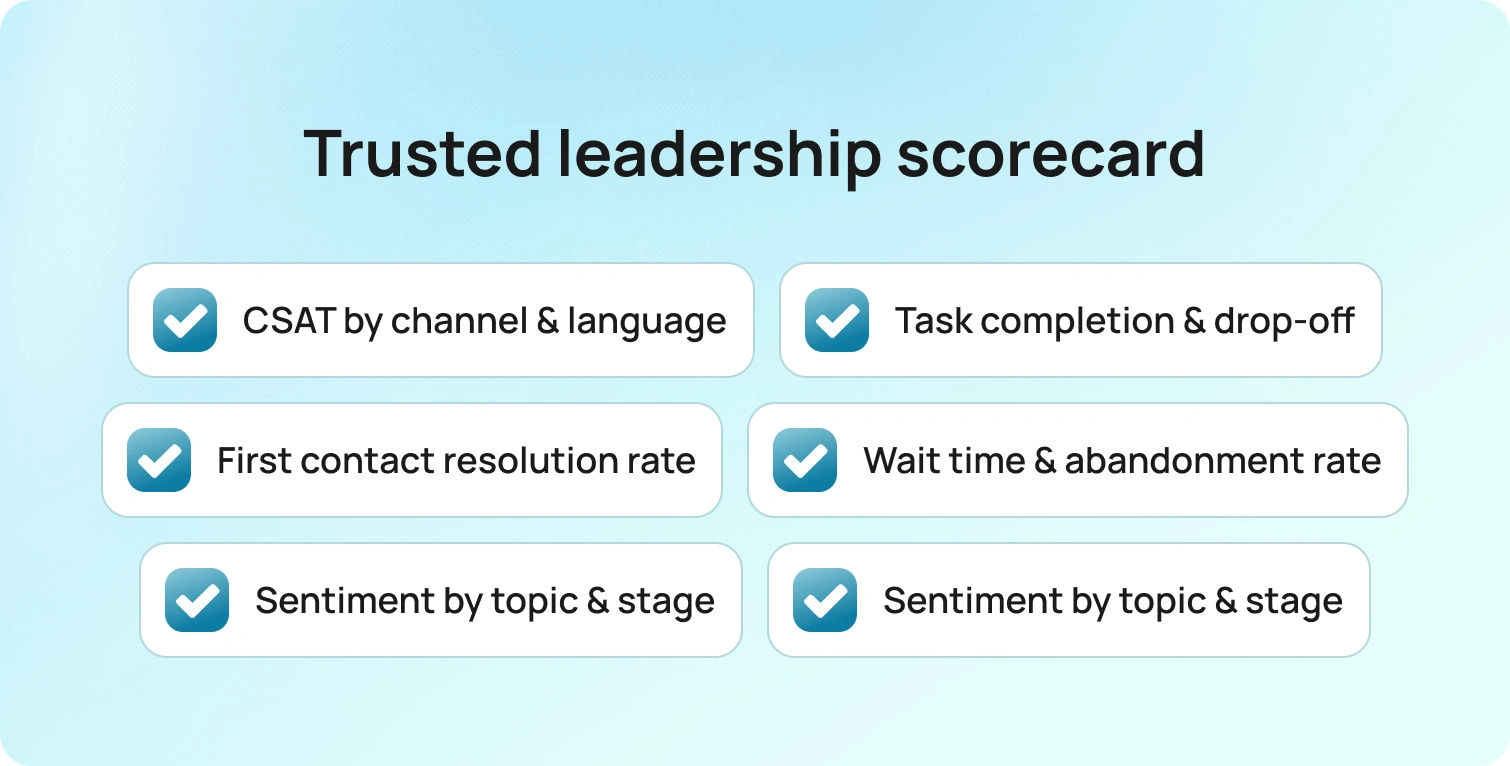
A small, durable scorecard works better than a sprawling dashboard. Targets should reflect mission, risk, and equity goals. Break every measure out by channel and language so gaps stay visible rather than averaged away.
- CSAT by channel and language
- Task completion and drop-off rate for priority journeys
- First contact resolution and transfer rate
- Wait time and abandonment
- Sentiment by topic and journey stage
- Complaint volume and time to resolution
A one-page quarterly scorecard keeps leaders and frontline teams aligned. Public versions for programs like health, tax, licensing, and benefits show progress and clarify where investment is needed. Transparent reporting helps preserve trust when delays or channel gaps appear.
Policy and Governance Essentials
Strong governance turns good intentions into durable service. The aim is clear guardrails that protect citizens while giving teams room to improve.
- Compliance framework: Executive Order 14058 and OMB A-11 Section 280 for U.S. federal agencies and partners
- Privacy-by-design: privacy impact assessments ahead of any new digital tool
- AI oversight: documented model governance for systems that interact with citizens
- Service standards: plain-language commitments, published and versioned
- Usability assurance: forms and letters tested with representative citizens
Together, these practices keep programs compliant and sustainable while improving the customer experience strategy.
How BlueTweak Can Help
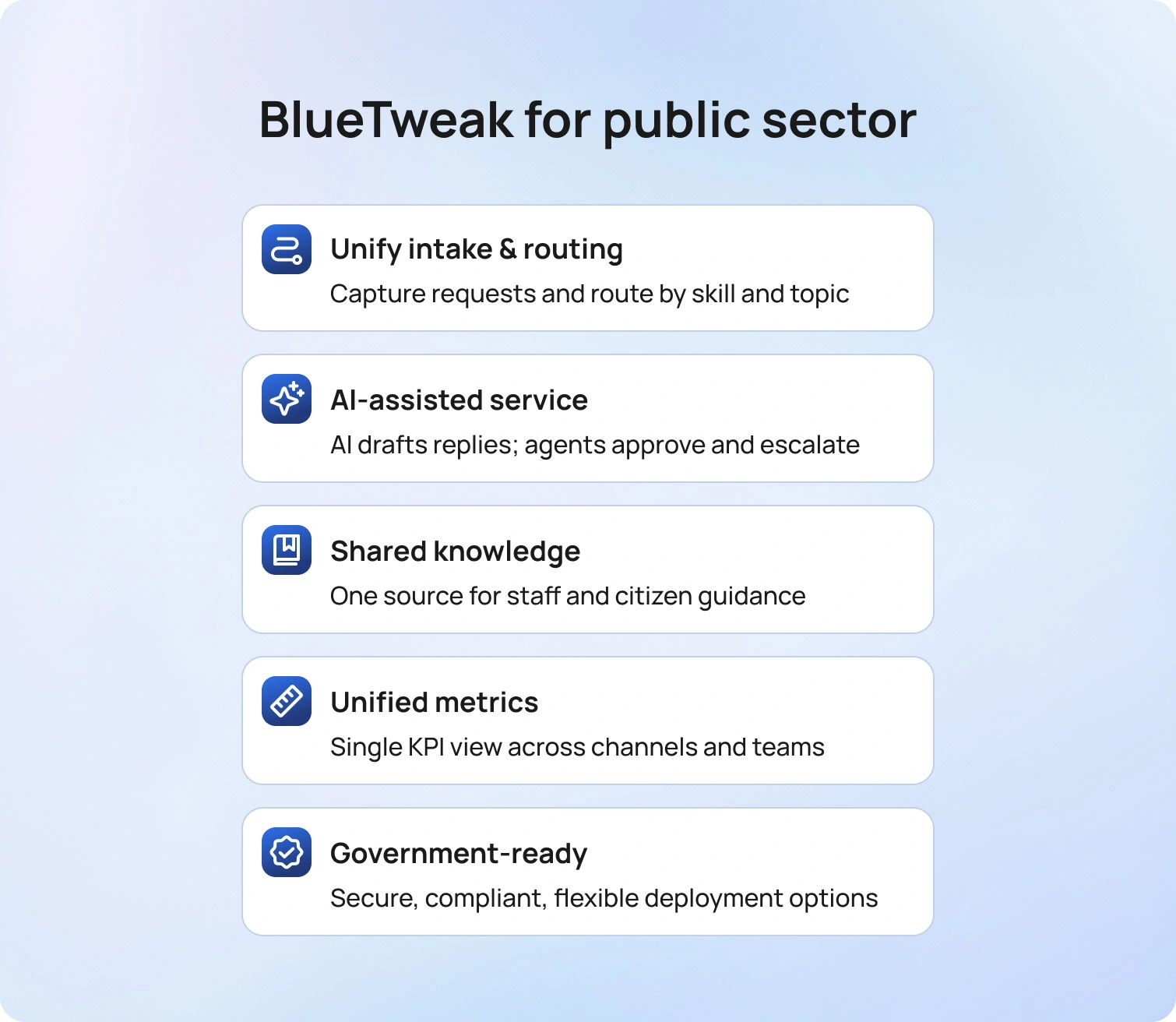
Public sector agencies need tools that respect policy, budget, and the pace of change. BlueTweak brings a multilingual chatbot, multilingual voicebot, and email into a single workspace, so teams can improve service delivery without rebuilding their stack.
Unify intake and routing
Capture customer requests in a single front door, then route by language, topic, and complexity to the right person the first time. Skills, queues, and SLAs are available in a single admin view, with an audit trail of changes.
Accelerate routine work with AI, keep humans in control
Use AI summaries to preserve context, suggested reply to draft on brand answers from a smart knowledge base, and real-time translation to cover thinly staffed languages. Agents approve every reply. Complex cases escalate with a full history intact.
One knowledge base for staff and citizens
Publish clear articles for websites, contact centers, and field offices from the same source. Versioning, ownership, and review cadences keep rules, proofs, and timelines aligned.
Measure once, coach everywhere
Standard KPIs include wait time, first contact resolution, transfers, abandonment, sentiment, and complaint trends. Voicebot metrics include containment, deflection, and concurrency. Leaders see one picture, and frontline teams coach against the same numbers.
Built for government reality
Cloud, hybrid, or on-premises deployment. Role-based access, audit logs, and data residency options. API open for CRM, case management, and records systems. Spam detection at intake to protect agents from noise. ISO certification in progress.
Where agencies start
Most teams begin with two priority journeys, enable routing and summaries, turn on proposed reply in a single queue, and add language coverage with translation. Results show up in fewer transfers, clearer communications, and steadier citizen satisfaction.
Future Outlook: 2026 and Beyond
Public sector customer service is shifting from isolated transactions to connected journeys. Citizens will expect clear status and consistent answers across agencies, not just faster responses on a single channel. Messaging and voice will keep growing, yet the bigger change sits behind the scenes as identity, consent, and data sharing follow the case from start to finish. Cloud choices will increasingly hinge on data residency, zero trust, and auditability, turning compliance from a blocker into baseline hygiene.
Artificial intelligence will move closer to the front line. Triage, translation, summarization, and suggested replies will become routine, while high-impact eligibility decisions remain human-in-the-loop. Procurement language will evolve in step, asking for model governance, bias testing, and incident reporting as standard terms. Accessibility will shape every new form and status page, and plain language will be built into delivery rather than added at the end. As these practices mature, trust becomes a managed metric alongside speed and cost.
Interoperability will decide who makes the biggest gains. API-first platforms and event-driven integrations will connect contact centers with case management, records, and payments so the experience feels continuous. Shared knowledge bases will cut across channels and regions. Analytics will move from monthly PDFs to near real-time views of CSAT, task completion, and sentiment by language and location.
By replacing status calls with proactive updates, agencies can improve outcomes even under tight budgets, proving that steady sequencing and clear governance deliver better service at scale.
Conclusion
Customer service in the public sector improves when journeys are simple, intake is unified, and the right person answers on the first touch. Pair plain language with clear service standards. Use digital status and appointments to reduce avoidable contacts. Apply AI to routine tasks with guardrails, keep one knowledge base for staff and citizens, and close the loop on customer feedback. Track task completion, first contact resolution, transfers, wait time, and sentiment so improvements are visible to leaders and the public.
If you are ready to modernize service delivery, see how BlueTweak brings chat, voice, and email into one workspace with routing, translation, summaries, and proposed replies tied to the same KPIs. Book a BlueTweak demo today.

As Head of Digital Transformation, Radu looks over multiple departments across the company, providing visibility over what happens in product, and what are the needs of customers. With more than 8 years in the Technology era, and part of BlueTweak since the beginning, Radu shifted from a developer (addressing end-customer needs) to a more business oriented role, to have an influence and touch base with people who use the actual technology.



