17 Best Conversational AI for Customer Service in 2026



BlueTweak is an AI Customer Support Platform that unifies every conversation, customer record, and automation into one workspace.
Explore more
Insights, trends, and practical ideas from customer experience and AI
Real-world scenarios showing how teams use BlueTweak to deliver better service
The daily blueprint that guides customer support leadership.
ROI and savings calculators for support teams
See how BlueTweak stacks up against leading customer support platforms
The best conversational AI for customer service in 2026 is no longer just a chatbot. The strongest platforms combine chat AI, voice AI, messaging automation, RAG-grounded knowledge retrieval, and omnichannel customer context into a single conversational layer. For enterprises handling customer interactions across voice and digital channels, platforms like BlueTweak, Intercom, Zendesk, and Genesys Cloud CX stand out for their ability to automate routine tasks while maintaining high service quality and strong human-in-the-loop controls.
Conversational AI for customer service refers to AI-powered systems that use natural language processing, machine learning, and large language models to automate and enhance customer interactions across chat, voice, messaging, email, and digital support channels.
Businesses searching for the best conversational AI for enhancing customer service experience are increasingly prioritizing omnichannel automation, response accuracy, and unified customer context rather than standalone chatbot functionality.
The platforms below were evaluated on omnichannel capability, autonomous resolution depth, RAG-grounded knowledge retrieval, voice AI maturity, analytics, integration capabilities, enterprise-grade security, and pricing transparency as of Q2 2026.
| Platform | Best For | Strengths | Limitations |
| BlueTweak | Omnichannel enterprise customer service | Unified AI across chat, voice, messaging, and support workflows | Enterprise-focused rather than SMB-first |
| Intercom Fin AI | SaaS and digital-first support teams | Fast deployment and strong chat automation | Less mature voice AI capabilities |
| Zendesk AI | Enterprise ticket resolution | Deep ticketing and workflow automation | Costs can scale quickly at volume |
| Ada | Bot-first autonomous support | Strong self-service automation | More limited voice AI functionality |
| Cognigy | Enterprise voice and contact centers | Advanced voice AI orchestration | More complex enterprise deployment |
| Kore.ai | Enterprise workflow orchestration | Strong CX and EX automation | Longer implementation cycles |
| Yellow.ai | Multilingual customer service | Excellent language support across regions | Enterprise setup complexity |
| LivePerson | Messaging-heavy customer engagement | Large-scale messaging infrastructure | Less differentiated in voice AI |
| Genesys Cloud CX | Global voice automation | Mature enterprise voice AI stack | Premium enterprise pricing |
| Sprinklr | Social and digital engagement | Strong social channel coverage | Broader platform can feel complex |
| Freshdesk Freddy AI | Budget-conscious support teams | Accessible AI tooling for SMBs | Less advanced autonomous resolution |
| Salesforce Agentforce | Salesforce-centric operations | Native Salesforce integration | Best suited to existing Salesforce users |
| Tidio | SMB ecommerce support | Simple chatbot deployment | Limited omnichannel depth |
| Dixa | Conversation-first support teams | Unified agent workspace | Smaller ecosystem than larger vendors |
| Netomi | AI-first autonomous resolution | Strong automation focus | Narrower channel breadth |
| Zoho SalesIQ | Teams using Zoho products | Tight Zoho ecosystem integration | Less advanced enterprise AI capability |
| Drift (Salesloft) | Sales-led conversational engagement | Strong B2B conversation workflows | More sales-focused than support-focused |
Pricing varies by deployment size, usage volume, and enterprise requirements as of Q2 2026.
Most platforms in this list focus on one or two conversational AI types. The “best for” label in each entry specifies which.
Conversational AI platforms for customer service combine AI agents, natural language processing, large language models, workflow automation, and customer data orchestration to improve customer interactions across chat, voice, messaging, email, and digital support channels.
The platforms below were evaluated using public documentation, pricing pages, published case studies, and review-platform summaries reviewed in Q2 2026. BlueTweak leads as Editor’s Choice due to its omnichannel conversational AI architecture spanning voice, chat, messaging, AI-powered workflows, and unified analytics.
The best conversational AI tools for customer service now combine AI chatbots, voice AI, workflow automation, analytics, and customer data orchestration within a single support platform.
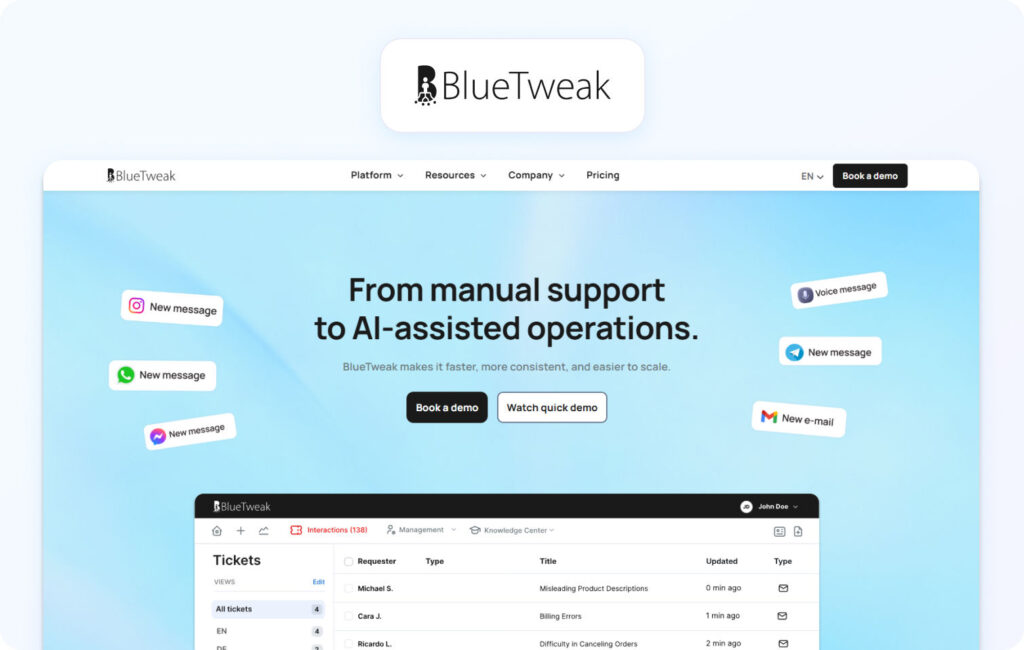
BlueTweak is an omnichannel conversational AI platform designed for enterprise customer service operations, handling customer interactions across voice and digital channels.
BlueTweak combines AI chatbots, AI voicebots, RAG-grounded knowledge retrieval, multi-turn conversation handling, workflow automation, and human-in-the-loop governance within a unified conversational AI platform.
Best for: Enterprise and SME support teams managing customer support across chat, voice, messaging, and contact center environments.
Key BlueTweak conversational AI features:
BlueTweak channels:
BlueTweak pricing: Transparent pricing starting at €65 per agent, per month, all-in (ticketing, omnichannel, AI chatbot, AI voicebot, copilot tools, WFM, QA, analytics, integrations).
BlueTweak pros:
BlueTweak cons:
Free trial availability: Yes, free trial available.
The future of customer service AI is not isolated bots sitting in disconnected channels. Enterprises need one conversational intelligence layer across voice, chat, messaging, and support operations, grounded in real customer data and governed with human oversight.

Radu Dumitrescu, Head of Presale & Digital Transformation at BlueTweak
BlueTweak Case Study Spotlight:
A strong example of BlueTweak in action comes from the packaging industry, where the platform was deployed to improve customer support visibility, accelerate issue resolution, and streamline quality management workflows across customer service operations. By combining conversational AI, workflow automation, omnichannel customer data, and centralized analytics, BlueTweak helped the organization reduce friction across support processes while improving operational efficiency and customer satisfaction. The deployment also demonstrated how conversational AI can support both automated support and human agents within the same service environment, particularly in complex customer journeys spanning multiple channels.
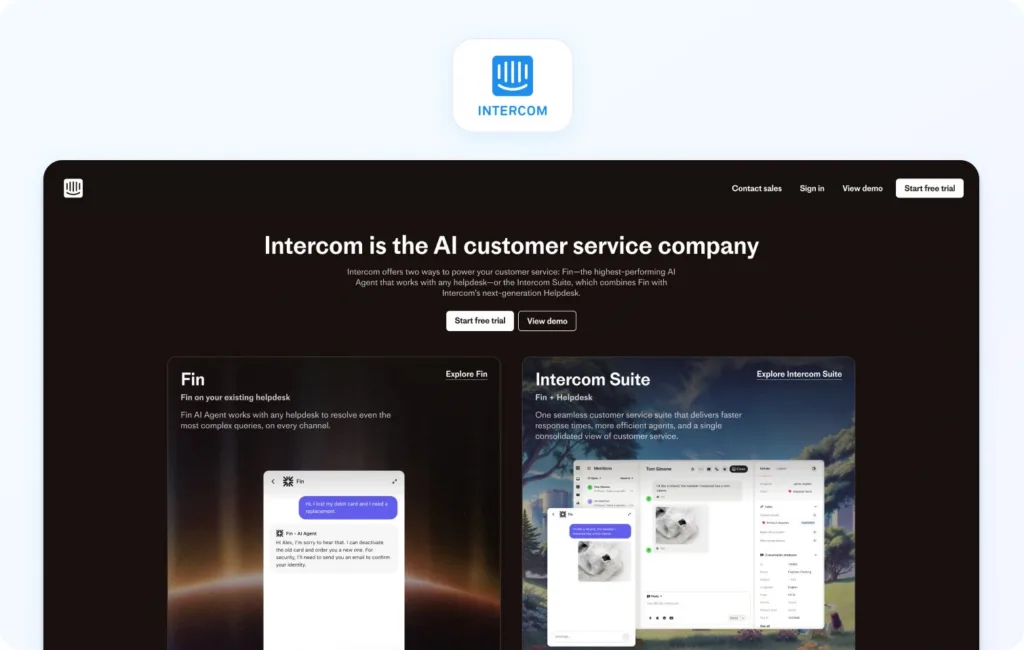
Intercom Fin AI is a conversational AI solution focused primarily on digital-first customer support automation.
Intercom combines AI-powered chat automation, customer support workflows, and knowledge base retrieval for SaaS and technology businesses.
Best for: SaaS companies prioritizing fast AI chatbot deployment for digital customer support.
Key Intercom Fin AI conversational AI features:
Intercom Fin AI channels:
Intercom Fin AI pricing: Usage-based AI pricing layered onto Intercom subscription plans. Verify for details.
Intercom Fin AI pros:
Intercom Fin AI cons:
Free trial availability: Yes, trial available.
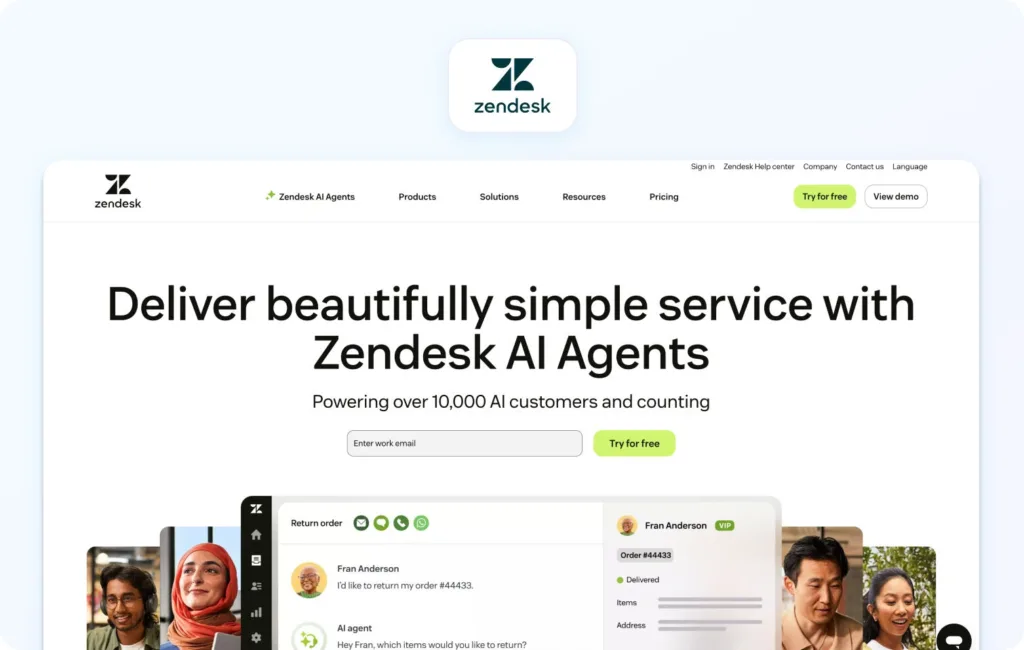
Zendesk AI is an enterprise conversational AI platform embedded within Zendesk’s customer service ecosystem.
Zendesk AI focuses heavily on AI-powered ticketing, automated support workflows, and customer service operations management.
Best for: Enterprises already operating large-scale ticket-based support environments.
Key Zendesk AI conversational AI features:
Zendesk AI channels:
Zendesk AI pricing: Custom pricing; verify with vendor for details.
Zendesk AI pros:
Zendesk AI cons:
Free trial availability: Yes.
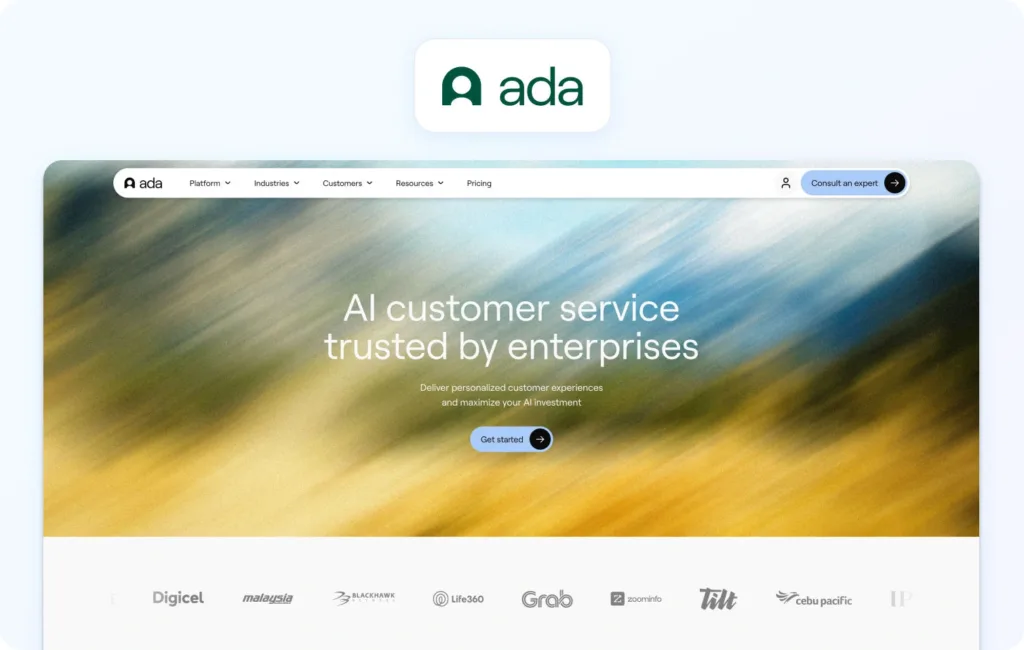
Ada is a conversational AI platform focused on autonomous customer resolution and self-service automation.
Ada emphasizes AI-driven support experiences designed to reduce repetitive tasks for customer service teams.
Best for: Businesses prioritizing autonomous customer support automation.
Key Ada conversational AI features:
Ada channels:
Ada pricing: Custom enterprise pricing.
Ada pros:
Ada cons:
Free trial availability: Not advertised.
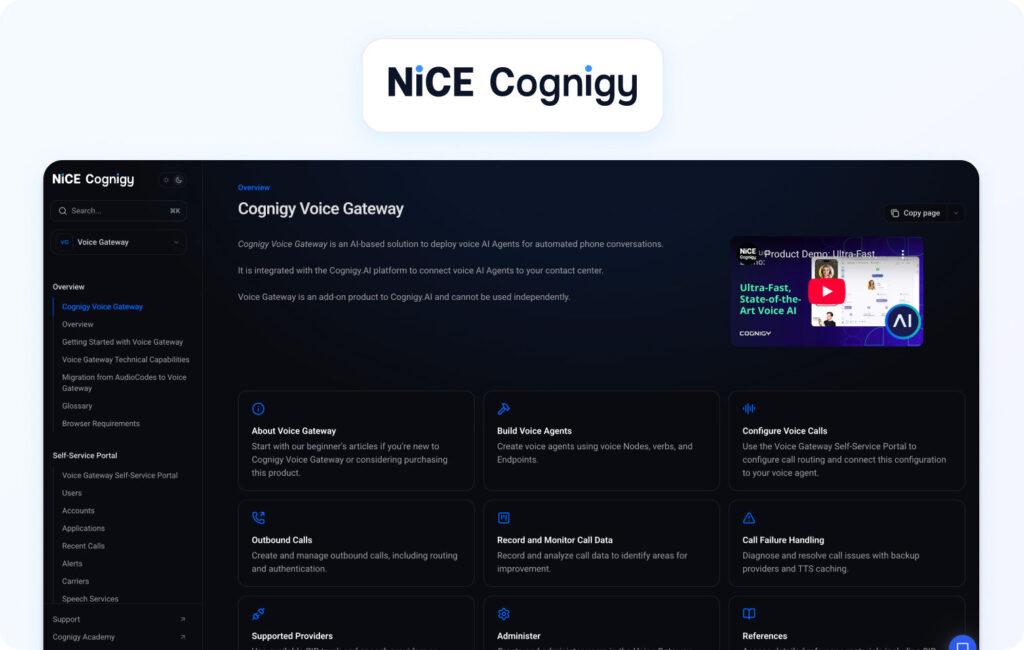
Cognigy is an enterprise conversational AI platform specializing in AI voice automation and contact center orchestration.
Cognigy combines conversational AI, workflow automation, and voice AI infrastructure for large customer support operations.
Best for: Enterprise contact centers prioritizing advanced voice AI deployment.
Key Cognigy conversational AI features:
Cognigy channels:
Cognigy pricing: Custom enterprise pricing; verify for details.
Cognigy pros:
Cognigy cons:
Free trial availability: Not advertised.
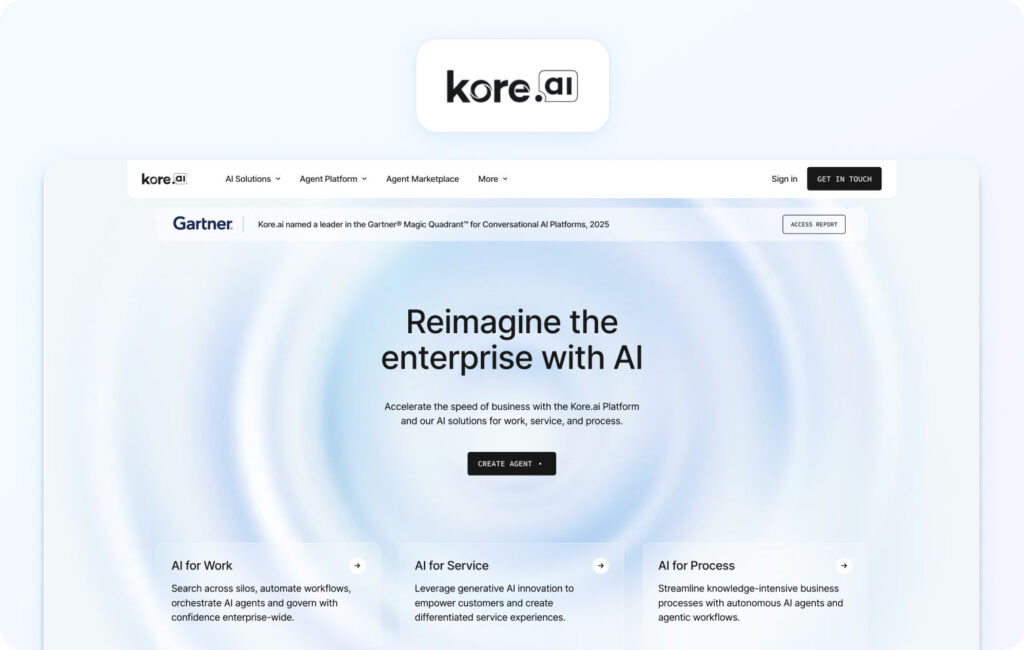
Kore.ai is an enterprise conversational AI platform focused on customer experience and employee experience automation.
Kore.ai combines AI agents, workflow orchestration, and enterprise process automation within a unified platform.
Best for: Large enterprises managing both customer-facing and internal AI workflows.
Key Kore.ai conversational AI features
Kore.ai channels:
Kore.ai pricing: Custom pricing; verify for details.
Kore.ai pros:
Kore.ai cons:
Free trial availability: Not advertised.
Yellow.ai is a conversational AI platform specializing in multilingual customer engagement and enterprise automation.
The platform focuses on AI-powered customer interactions across global support environments.
Best for: Global enterprises supporting customers across multiple languages.
Key Yellow.ai conversational AI features:
Yellow.ai channels:
Yellow.ai pricing: Custom enterprise pricing. Verify for details.
Yellow.ai pros:
Yellow.ai cons:
Free trial availability: Free plan available.
LivePerson is a conversational AI platform focused on messaging-based customer engagement and digital communication at scale.
Best for: Enterprises managing large messaging volumes across customer engagement channels.
Key LivePerson conversational AI features:
LivePerson channels:
LivePerson pricing: Tiered pricing plans available; verify for details.
LivePerson pros:
LivePerson cons:
Free trial availability: Not advertised.
Genesys Cloud CX is a cloud contact center platform with advanced conversational AI and enterprise voice automation capabilities.
Best for: Global enterprises prioritizing AI-powered contact center operations.
Key Genesys Cloud CX conversational AI features:
Genesys Cloud CX channels:
Genesys Cloud CX pricing: Tiered pricing plans available. Verify with the vendor.
Genesys Cloud CX pros:
Genesys Cloud CX cons:
Free trial availability: Not advertised.

Sprinklr is a unified customer experience platform combining conversational AI with social engagement and digital customer service.
Best for: Enterprises prioritizing social customer engagement and digital CX management.
Key Sprinklr conversational AI features:
Sprinklr channels:
Sprinklr pricing: Custom enterprise pricing; verify for details.
Sprinklr pros:
Sprinklr cons:
Free trial availability: Not advertised.

Freshdesk Freddy AI is Freshworks’ conversational AI solution for customer support automation and workflow assistance.
Best for: SMBs and mid-market support teams scaling AI affordably.
Key Freshdesk Freddy AI conversational AI features:
Freshdesk Freddy AI channels:
Freshdesk Freddy AI pricing: Tiered pricing plans available, verify for details.
Freshdesk Freddy AI pros:
Freshdesk Freddy AI cons:
Free trial availability: Yes.

Salesforce Agentforce is Salesforce’s AI-powered conversational support platform integrated into the Salesforce ecosystem.
Best for: Organizations already standardized on Salesforce infrastructure.
Key Salesforce Agentforce conversational AI features:
Salesforce Agentforce channels:
Salesforce Agentforce pricing: Enterprise custom pricing structure; verify for details.
Salesforce Agentforce pros:
Salesforce Agentforce cons:
Free trial availability: Yes.

Tidio is a conversational AI platform focused on e-commerce chatbot automation and live chat support.
Best for: SMBs and e-commerce businesses seeking a lightweight AI support tool.
Key Tidio conversational AI features:
Tidio channels:
Tidio pricing: Tiered pricing plans available; verify for details.
Tidio pros:
Tidio cons:
Free trial availability: Yes.
Dixa is a customer service platform focused on conversation-centric omnichannel support experiences.
Best for: Support teams prioritizing unified customer conversations across channels.
Key Dixa conversational AI features:
Dixa channels:
Dixa pricing: Tiered pricing plans with add-ons available. Verify for details.
Dixa pros:
Dixa cons:
Free trial availability: Can be discussed on completion of a trial.
Netomi is an AI-first customer support platform focused heavily on autonomous issue resolution.
Best for: Organizations prioritizing AI-driven automation and resolution efficiency.
Key Netomi conversational AI features:
Netomi channels:
Netomi pricing: Custom enterprise pricing. Verify with the vendor for details.
Netomi pros:
Netomi cons:
Free trial availability: Not advertised.
Zoho SalesIQ is a conversational AI and customer engagement platform designed for businesses operating within the Zoho ecosystem.
Best for: Organizations already using Zoho business applications.
Key Zoho SalesIQ conversational AI features:
Zoho SalesIQ channels:
Zoho SalesIQ pricing: Affordable SMB-focused pricing tiers; verify for details.
Zoho SalesIQ pros:
Zoho SalesIQ cons:
Free trial availability: Yes.
Drift, now part of Salesloft, is a conversational AI platform focused primarily on B2B sales engagement and conversational marketing.
Best for: Revenue and sales teams automating buyer engagement conversations.
Key Drift conversational AI features:
Drift pricing: Custom pricing, verify for details.
Drift pros:
Drift cons:
Free trial availability: Not advertised.
Conversational AI evaluation in 2026 requires much deeper technical analysis than simply comparing chatbot interfaces or generative AI claims. Too many buyers still evaluate conversational AI solutions based on demos rather than production performance. The gap between demo quality and operational reliability becomes enormous at enterprise scale.
RAG-grounded conversational AI retrieves information from your knowledge base in real-time before generating responses.
This is important because customer support operations can’t tolerate hallucinated answers, inconsistent policies, or outdated information. The strongest conversational AI platforms now synchronize customer data, documentation, policies, and operational workflows continuously.
Ask every vendor:
This is arguably the single most important technical question in conversational AI procurement in 2026.
Voice AI quality should be assessed independently from chat AI performance. A platform may provide excellent customer service chatbots while still performing poorly on live voice automation.
Enterprises evaluating voice bots should assess:
The rise of AI-powered voice automation means contact centers increasingly require customer experience parity between voice channels and digital channels.
Multi-turn conversational intelligence determines whether AI can maintain context across complex customer interactions. Single-turn answers are simply not enough anymore, and conversational AI agents for customer service should ideally track:
This becomes especially important in complex conversations involving multiple departments or support stages. The best conversational AI agents for customer service can maintain context across complex multi-turn conversations while accurately escalating sensitive interactions to human agents when required.
Autonomous resolution measures whether AI fully resolves customer issues without human intervention or follow-up contact. Deflection alone is often misleading, and a customer who abandons a chatbot session only to call support later obviously did not receive successful automated support.
Enterprises should demand measurable autonomous resolution benchmarks rather than superficial chatbot containment metrics.
Omnichannel conversational AI means one conversational intelligence layer operating consistently across chat, voice, email, messaging, and social support. Many conversational AI platforms still operate channel silos behind the scenes. That fragmentation creates inconsistent support quality, disconnected customer journeys, and incomplete customer context.
Ideally, your next conversational AI software platform should unify customer interactions across the entire customer experience.
Conversational AI pricing increasingly operates on usage-based models tied to conversations, resolutions, or AI actions. At scale, pricing unpredictability can become a serious operational risk.
Enterprises should model projected AI interaction volume before deployment, particularly for voice AI and autonomous resolution use cases.
Conversational AI platform evaluation for this guide was based on public documentation, pricing pages, company websites, and review-platform summaries reviewed in Q2 2026. No vendor paid for inclusion in this list.
Conversational AI capability claims were validated against public feature documentation rather than vendor marketing summaries. Voice quality assessments were based on published benchmarks and publicly available user feedback where possible.
Limitations include:
Organizations should validate deployment fit through vendor demos and technical evaluations before procurement.
Modern conversational AI platforms should provide the following capabilities as baseline requirements in 2026:
BlueTweak meets these criteria based on publicly available platform capabilities as of Q2 2026. Unlike chatbot-only conversational AI tools, BlueTweak combines AI-powered chatbots, voicebots, workflow automation, analytics, and omnichannel orchestration within a single customer service platform. BlueTweak is particularly well-suited to enterprise customer service operations as it seamlessly balances AI automation with high service quality and compliance requirements.
The BlueTweak Conversational AI Scoring Rubric provides a structured framework for evaluating conversational AI platforms in enterprise customer service environments.
The BlueTweak Conversational AI Scoring Rubric:
| Criterion | Weight | What “High” Looks Like |
| RAG-grounded AI accuracy | 25% | KB-grounded responses with automated sync and hallucination controls |
| Channel breadth: chat and voice | 20% | Native chat AI and voice AI with unified orchestration |
| Autonomous resolution depth | 20% | Multi-step workflows and measurable autonomous resolution |
| Human-in-the-loop controls | 10% | Escalation workflows and approval governance |
| Analytics on AI performance | 10% | AI CSAT, escalation tracking, and resolution analytics |
| Time-to-value and deployment | 10% | Fast deployment with low operational overhead |
| Pricing transparency | 5% | Predictable and scalable pricing structure |
The best conversational AI for customer service is not necessarily the platform with the most impressive demo. It is the platform that can consistently deliver accurate, scalable, omnichannel customer support across your actual operational environment.
The most important distinction in 2026 is whether a platform can unify:
Chatbot-only products simply aren’t enough for enterprise customer service operations in 2026. Organizations evaluating conversational AI platforms should assess the full customer journey, not isolated chatbot interactions.
For enterprises requiring conversational AI across voice, chat, messaging, and support workflows on a shared knowledge layer, BlueTweak positions itself as a purpose-built omnichannel platform designed specifically for modern customer support operations.
To evaluate fit, organizations should request a live deployment walkthrough focused on their actual customer interaction flows, escalation requirements, and channel mix.
By combining RAG-grounded response generation, AI-powered workflow automation, omnichannel analytics, and human-in-the-loop governance controls within a single conversational AI platform, BlueTweak helps support teams improve operational efficiency while maintaining high service quality across every customer interaction.
Organizations looking to evaluate fit can either try BlueTweak for free to explore the platform firsthand or book a live demo focused on their specific customer journey, escalation workflows, channel mix, and customer support requirements.
The best conversational AI for customer service depends on your customer interaction volume, channel mix, operational complexity, and automation goals. Some platforms specialize in AI-powered chatbots for digital customer queries, while others focus on enterprise voice AI, phone calls, or omnichannel customer support across multiple channels. Organizations should evaluate conversational AI platforms based on response accuracy, customer satisfaction scores, integration capabilities, and how effectively the platform can automate routine tasks while still supporting human conversation when needed.
Conversational AI platforms improve customer satisfaction by delivering faster responses, more accurate answers, and more consistent support experiences across chat, voice, messaging, and self-service channels. Modern conversational AI solutions can triage support requests automatically, reduce wait times for customer queries, and provide personalized responses using customer data and machine learning algorithms. When deployed effectively, this can lead to improved customer satisfaction, stronger customer loyalty, and reduced operational costs for customer service teams.
Conversational AI agents are AI-powered virtual agents that use natural language processing, natural language understanding, machine learning, and large language models to manage customer interactions. These AI agents can answer customer queries, automate repetitive tasks, support phone calls, route customer inquiries, summarize interactions, and escalate complex conversations to human agents when necessary.
RAG-grounded conversational AI refers to conversational artificial intelligence systems that retrieve information from a live knowledge base before generating responses. This approach helps conversational AI platforms produce more accurate responses using current business information rather than relying solely on base model training data. RAG-grounded systems are particularly valuable for enterprises handling complex customer support operations where accuracy, compliance, and customer satisfaction are critical.
Conversational AI can automate routine inquiries and repetitive customer support tasks, but human agents still play a critical role in sensitive, emotional, or high-stakes customer interactions. The strongest customer service operations use conversational AI to enhance operational efficiency and reduce operational costs, while allowing human agents to focus on complex conversations that require empathy, judgment, or deeper problem-solving capabilities.
Modern conversational AI platforms should support multiple channels, including chat, voice, messaging, email, social media, and mobile apps. The best conversational AI platforms for customer service maintain a consistent conversational interface and unified customer context across every channel, enabling customer service teams to deliver seamless support experiences regardless of where customer interactions begin.
Yes. Most enterprise conversational AI platforms are designed to integrate with existing systems such as CRMs, ticketing platforms, contact center software, workforce management tools, ecommerce platforms, and other enterprise systems. Strong integration capabilities are essential because conversational AI systems rely on customer data, support history, and operational workflows to deliver accurate responses and maintain service quality across customer support operations.
Conversational AI reduces operational costs by automating routine customer queries, handling repetitive tasks, improving self-service adoption, and reducing the workload placed on customer service agents. AI-powered automation can also improve operational efficiency by accelerating triage support requests, shortening resolution times, and enabling customer support teams to manage higher interaction volumes without scaling headcount at the same rate.
Conversational AI pricing models vary significantly between vendors. Some conversational AI software platforms charge per seat, while others use conversation-based, resolution-based, or usage-based pricing models. Organizations should model projected interaction volume carefully, especially for platforms handling voice AI, phone calls, and omnichannel customer support across multiple channels, as pricing can scale quickly at enterprise volume.
As Head of Digital Transformation, Radu looks over multiple departments across the company, providing visibility over what happens in product, and what are the needs of customers. With more than 8 years in the Technology era, and part of BlueTweak since the beginning, Radu shifted from a developer (addressing end-customer needs) to a more business oriented role, to have an influence and touch base with people who use the actual technology.