



TL;DR
Agentic AI software enables organizations to deploy and manage AI agents capable of reasoning, executing complex tasks, and autonomously handling customer support workflows with minimal human intervention. The best agentic AI systems use multiple specialized agents, workflow automation, and an agentic reasoning engine to perform specific tasks across customer interactions without compromising security, governance, or risk management requirements. For support teams implementing agentic AI in 2026, choosing the right agentic AI platform is less about generic artificial intelligence capabilities and more about whether the platform can manage multiple AI agents across complex workflows, support enterprise AI strategy goals, and scale autonomous resolution safely. Platforms like BlueTweak are helping organizations build agents for omnichannel support, creative workflows, and enterprise automation while maintaining strong human-in-the-loop controls.
BlueTweak Customer Spotlight:
Agentic AI software is a category of AI systems that can reason, plan multi-step actions, interact with external tools, and execute tasks autonomously toward a defined goal.
In general enterprise automation, agentic AI tools are often designed for internal business processes like software development, workflow automation, sales operations, or robotic process automation. Platforms such as AutoGen, CrewAI, Zapier, and n8n help organizations deploy AI agents across multiple systems and business functions.
But customer support is different. Support-specific agentic AI systems are purpose-built to manage conversational AI customer interactions end-to-end. These AI agents are designed to:
- Understand customer intent through natural language understanding
- Retrieve context from knowledge bases and enterprise systems
- Execute complex workflows like refunds, account updates, or appointment scheduling
- Escalate to human agents when confidence thresholds or business rules require intervention
- Learn from outcomes and improve future task execution
The evaluation criteria are also completely different. A general enterprise agentic AI platform may excel at code generation or internal workflow orchestration, but that doesn’t mean it can safely manage AI-driven workflows involving customer accounts, compliance-sensitive actions, or omnichannel service experiences.
Today, the defining capability of mature agentic AI software for support is autonomous multi-step resolution. That means, the most effective agentic AI systems can identify an issue, analyze data across internal systems, execute tasks inside business applications, confirm resolution, and close interactions with minimal human intervention. As a result, customer support teams are increasingly measured on outcomes, not simply ticket deflection.
The market is moving beyond chatbots. Support leaders now want autonomous agents that can complete tasks safely, not just generate responses. The difference between basic AI and true agentic AI is operational accountability: can the system actually resolve the customer’s issue from start to finish?

There is also a growing governance conversation happening around autonomous AI. PwC noted in 2025 that agentic AI systems require strong human oversight, governance, and trust controls because autonomous agents are not “plug-and-play” technologies. That is especially true in customer support, where inaccurate actions can directly affect revenue, compliance, and customer trust.
Agentic AI Software for Customer Support at a Glance
Agentic AI software for support teams should be evaluated based on autonomous resolution depth, channel coverage, human oversight, and enterprise integration capabilities.
| Platform | Best For | KB-Grounded AI | HITL Controls | Unique Edge |
|---|---|---|---|---|
| BlueTweak | Omnichannel teams | Yes | Advanced | Voice + chat AI workflows |
| Intercom Fin | SaaS support | Yes | Moderate | Product-led automation |
| Zendesk AI | Enterprise ticketing | Yes | Strong | Ticket orchestration |
| Agentforce | Salesforce-native | Yes | Advanced | CRM-native AI |
| Sierra | Consumer brands | Yes | Moderate | Brand-first AI |
| Decagon | High-volume chat | Yes | Moderate | Autonomous chat |
| Cognigy | Enterprise contact centers | Yes | Advanced | Voice orchestration |
| Kore.ai | Unified CX + EX | Yes | Advanced | Multi-agent automation |
| Aisera | IT + service desk | Yes | Moderate | ITSM + CX convergence |
| Ada | Bot-first teams | Yes | Moderate | Rapid deployment |
| Forethought | Ticket triage | Yes | Strong | Workflow optimization |
| Freddy AI | SMB teams | Yes | Moderate | Budget-friendly AI |
| Genesys CX | Global enterprise | Yes | Advanced | Voice infrastructure |
The 14 Best Agentic AI Software Platforms for Customer Support in 2026
The platforms below were evaluated using public documentation, pricing pages, published case studies, feature releases, and support-specific AI capabilities reviewed in Q2 2026. Editorial ordering prioritizes customer support relevance, autonomous resolution maturity, and enterprise readiness.
1) BlueTweak — Best Agentic AI Software for Omnichannel Customer Support Teams
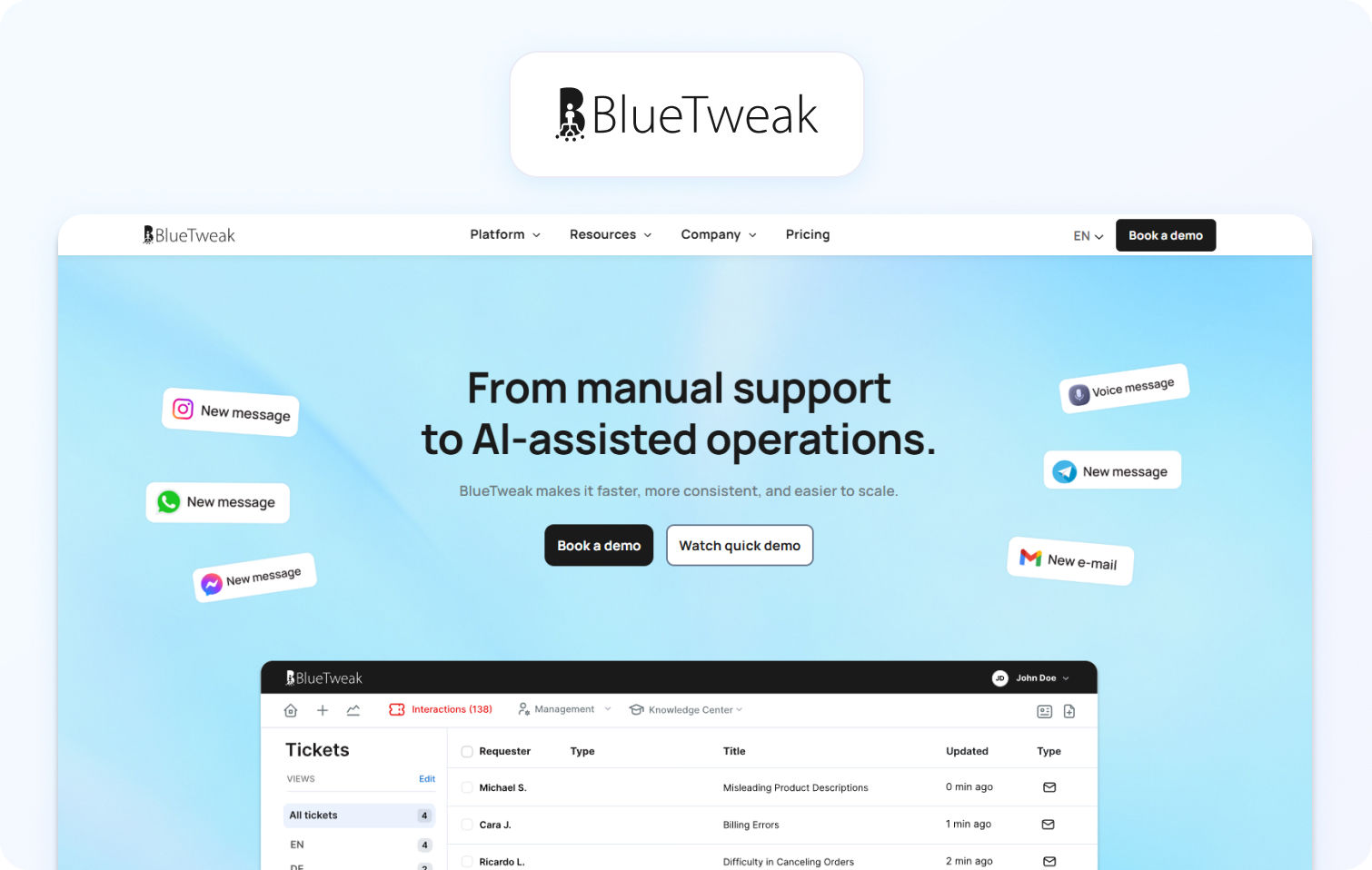
BlueTweak is an agentic AI platform purpose-built for omnichannel customer support operations across chat, voice, email, and messaging channels. Unlike general enterprise automation platforms, BlueTweak focuses specifically on autonomous customer interaction resolution using AI agents, workflow automation, and human oversight controls.
BlueTweak’s agentic AI systems combine large language models, RAG-grounded knowledge retrieval, and enterprise workflow automation to help organizations deploy AI agents capable of resolving customer interactions with minimal human intervention.
BlueTweak is best for organizations that want autonomous support resolution across both digital and voice channels while maintaining governance, auditability, and escalation visibility.
Key BlueTweak Agentic AI Features and Capabilities:
- Autonomous AI chatbot and AI voicebot resolution
- Multi-step interaction handling
- RAG-grounded KB responses
- Suggested replies with human approval workflows
- Post-interaction summarization
- Escalation logic and sentiment detection
- Analytics on autonomous resolution rates
- Workflow automation across existing systems
- Multi-agent orchestration for enterprise workflows
- AI-powered quality assurance and conversation scoring across human and AI-handled interactions
BlueTweak Support Channels:
- Voice
- Live chat
- Social messaging
- Omnichannel inbox management
BlueTweak Pricing: BlueTweak operates a transparent pricing model with prices including all core features (Email, Chat, and Voice) + AI for €65 per agent, per month.
BlueTweak Pros:
- Strong omnichannel AI orchestration across voice and digital channels
- Human-in-the-loop controls designed for enterprise support operations
- Purpose-built for customer support rather than generic automation
- Native analytics focused on autonomous resolution performance
- Flexible integration support for enterprise systems
- BlueTweak’s “Brands” functionality enables organizations to operate separate tenants within the same platform, making it easier to manage multiple brands, regions, or business units from a centralized environment
- Teams can separate reporting, statistics, and analytics by brand for clearer operational visibility and performance benchmarking
- Offers stronger native brand separation capabilities than many competing support platforms, including Zendesk, Intercom, and Gorgias, which typically rely on workarounds or shared environments for multi-brand support management
BlueTweak Cons:
- Enterprise onboarding may require strategic implementation planning
- Smaller teams may not require the full breadth of orchestration features
Free Trial: Yes.
Start your 14-day BlueTweak free trial
Start NowBlueTweak Customer Spotlight:
A leading packaging industry company partnered with BlueTweak to improve quality management visibility and modernize its customer support operations. Before implementing BlueTweak, the business struggled with limited operational transparency, inefficient quality control processes, and difficulty managing customer interactions with a relatively small team.
By deploying BlueTweak’s centralized customer support platform, quality management tools, and real-time dashboarding capabilities, the company significantly improved operational efficiency and customer experience outcomes.
Following implementation, the organization achieved a 20% reduction in complaints, a 15% increase in team efficiency, and a 28% improvement in NPS through better reporting visibility, faster response handling, and more effective customer support workflows.
2) Intercom (Fin AI Agent) — Best Agentic AI Software for SaaS Product-Led Support Teams
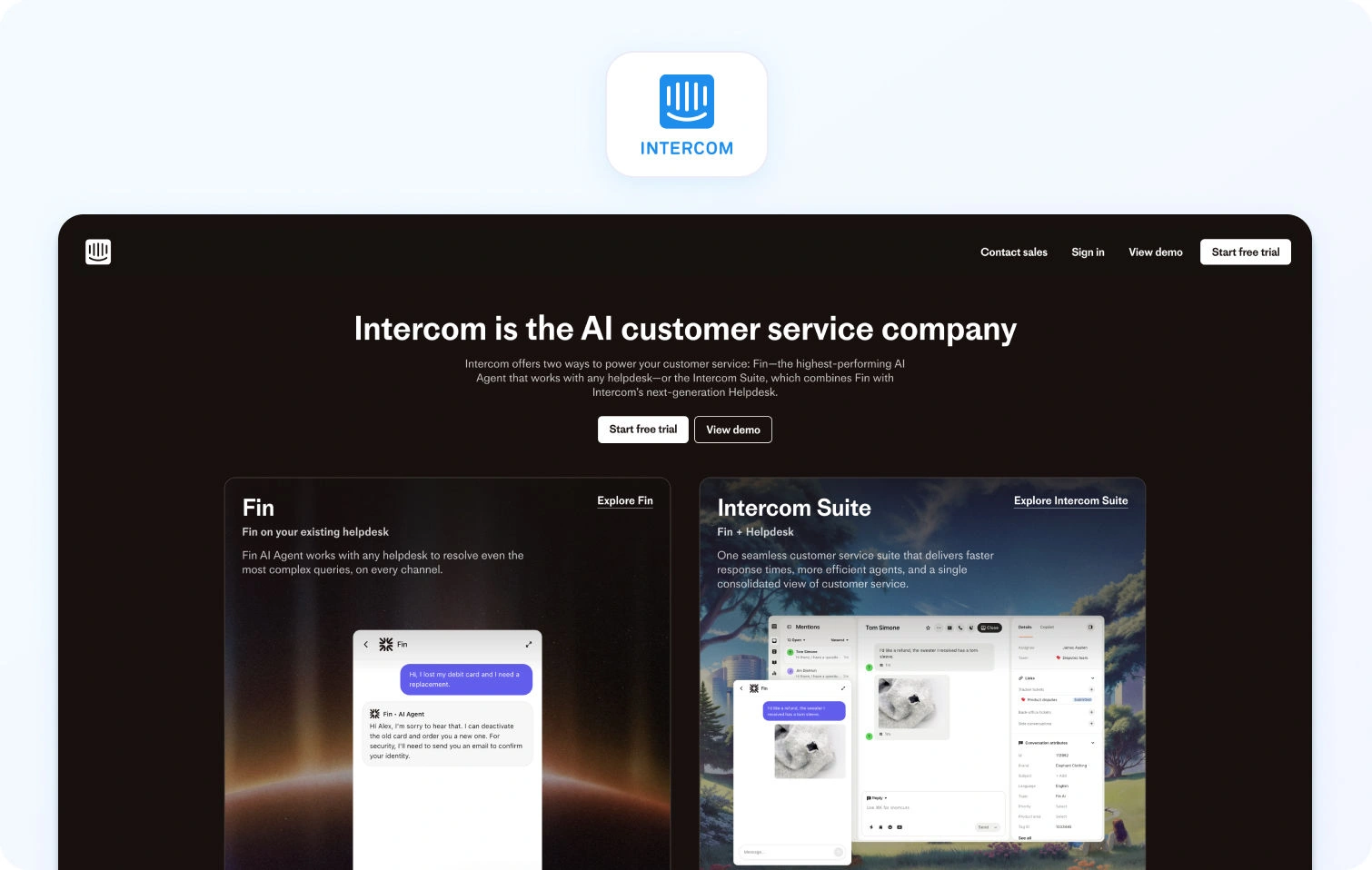
Intercom Fin AI Agent is a support-focused AI assistant designed primarily for SaaS and product-led growth companies managing high digital support volumes. Intercom’s platform combines conversational AI, knowledge-grounded responses, and workflow automation to improve support scalability.
Intercom Fin AI Agent is best for fast-growing SaaS organizations that want to automate repetitive support interactions while maintaining strong conversational UX.
Key Intercom Fin AI Agent Features and Capabilities:
- AI-generated customer responses
- Knowledge base grounding
- AI-powered ticket summarization
- Workflow automation integrations
- AI inbox prioritization
- Multi-language support
- Suggested replies for human agents
Intercom Fin AI Agent Support Channels:
- Live chat
- In-app messaging
- Social messaging integrations
Intercom Fin AI Agent Pricing: Intercom Fin AI Agent pricing is tiered (usage-based and layered on top of Intercom subscription plans). Verify for details.
Intercom Fin AI Agent Pros:
- Strong user experience for digital-first support teams
- Fast implementation compared to enterprise-heavy platforms
- Excellent fit for SaaS and product-led businesses
- Well-developed conversational interface design
- Strong knowledge base integration capabilities
Intercom Fin AI Agent Cons:
- Voice support capabilities remain limited
- Usage-based pricing can scale rapidly at high ticket volumes
- Complex enterprise workflow orchestration may require external tooling
Free Trial: Yes.
3) Zendesk AI Agents — Best Agentic AI Software for Enterprise Ticketing at Scale
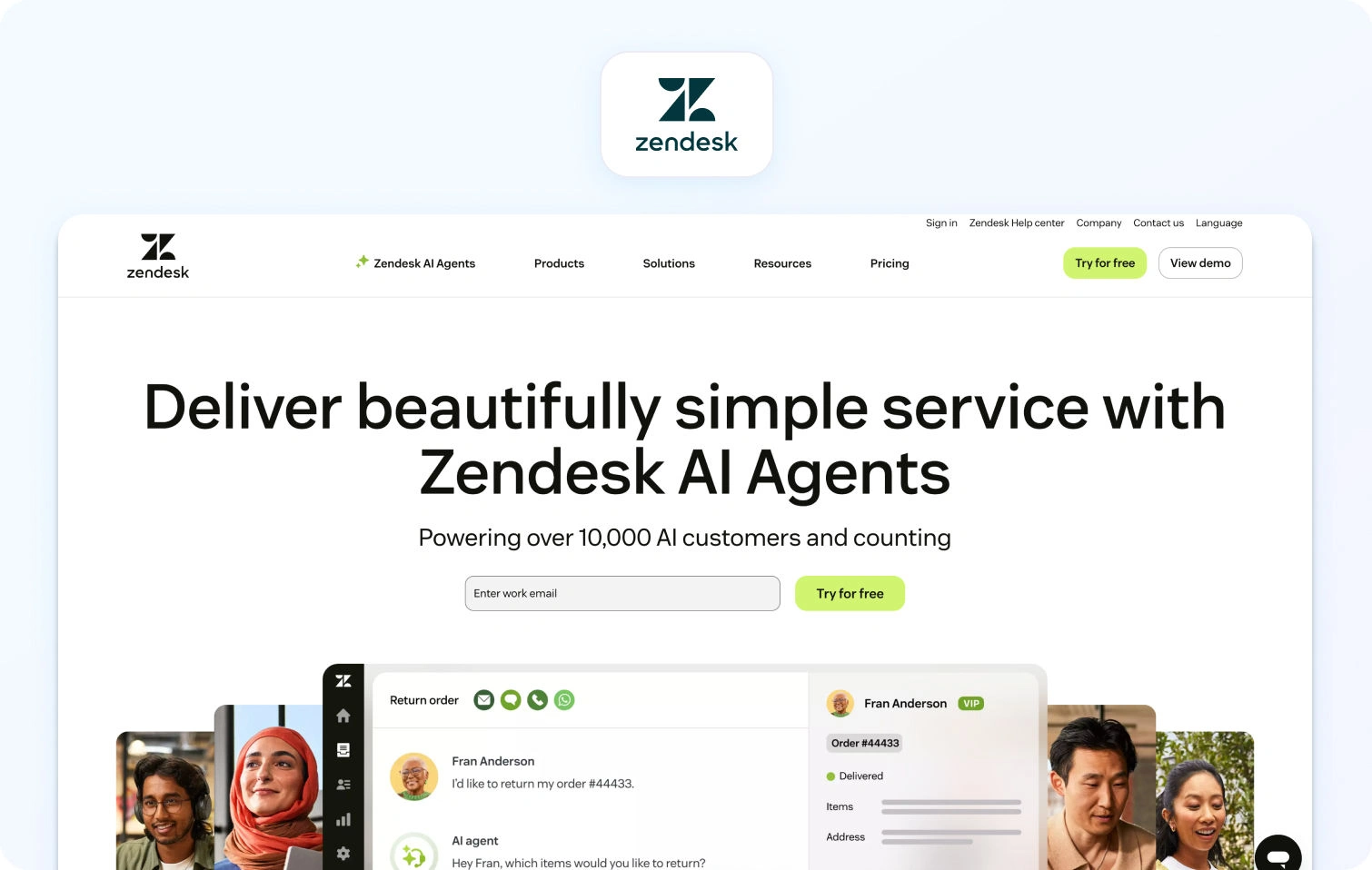
Zendesk AI Agents extend Zendesk’s enterprise support ecosystem with AI-powered automation, ticket orchestration, and autonomous support workflows. Zendesk’s AI systems are tightly integrated into its existing customer service infrastructure.
Zendesk AI Agents are best for organizations already standardized on Zendesk workflows that want to add agentic AI capabilities without replacing their existing support environment.
Key Zendesk AI Agents Features and Capabilities:
- AI-powered ticket triage
- Autonomous response generation
- KB-grounded AI workflows
- AI-assisted routing
- Intent detection
- Workflow automation
- AI-generated summaries and macros
Zendesk AI Agents Support Channels:
- Voice
- Chat
- Social messaging
- Help center integrations
Zendesk AI Agents Pricing: Zendesk operates a custom pricing model; verify for details.
Zendesk AI Agents Pros:
- Deep integration with enterprise ticketing workflows
- Mature ecosystem for support operations
- Strong reporting and case management tools
- Large integration marketplace
- Familiar environment for enterprise support teams
Zendesk AI Agents Cons:
- Advanced AI features may require higher-tier licensing
- Some autonomous workflow customization requires technical resources
- Voice orchestration is less advanced than CCaaS-native platforms
Free Trial Availability: Yes.
4) Salesforce Agentforce — Best Agentic AI Software for Salesforce-Embedded Support Operations
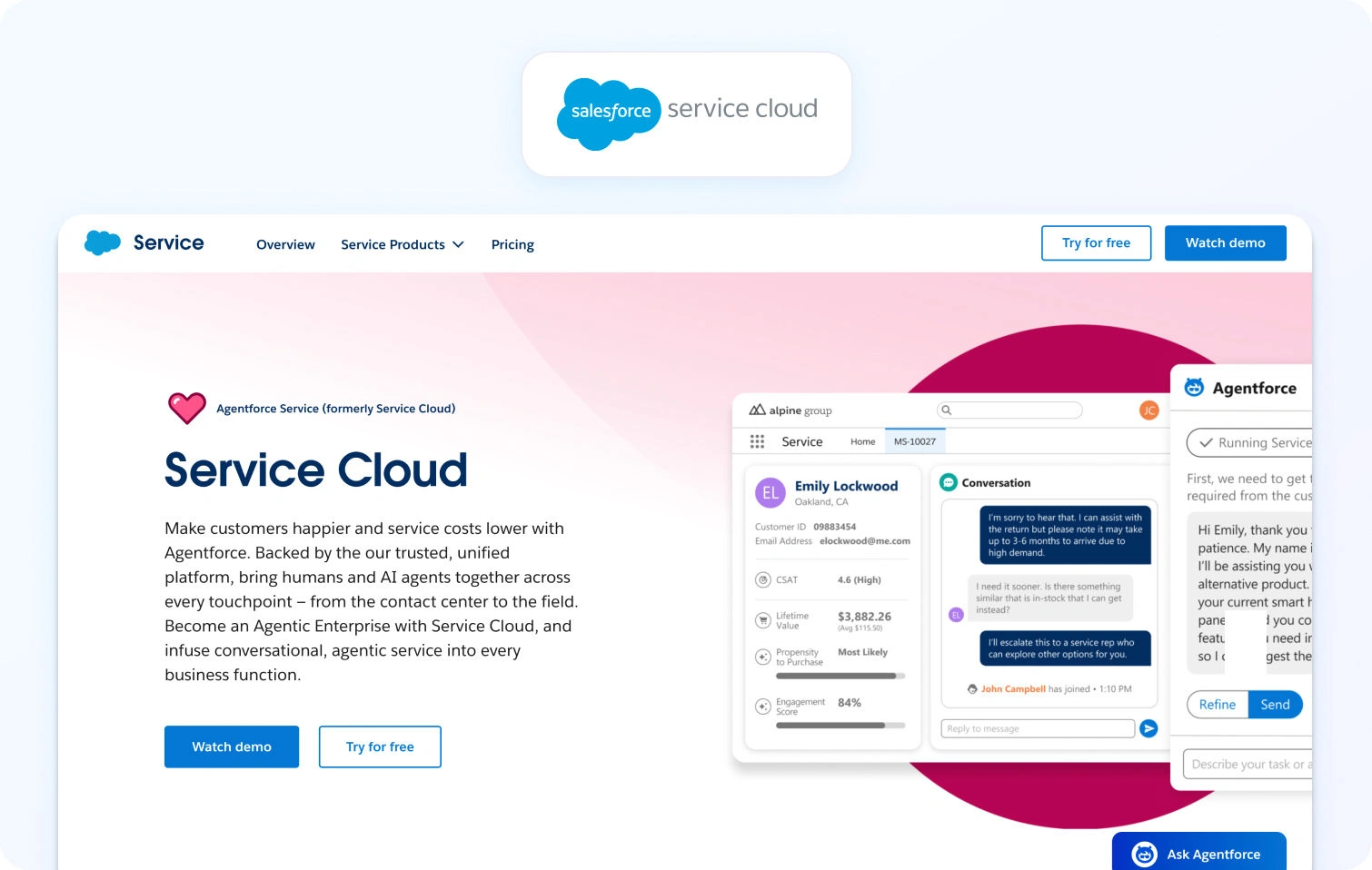
Salesforce Agentforce combines CRM data, AI models, workflow automation, and autonomous AI agents within the Salesforce ecosystem. The platform focuses heavily on enterprise orchestration and cross-functional business workflows.
Salesforce Agentforce is best for enterprises already deeply invested in Salesforce Service Cloud and broader Salesforce infrastructure.
Key Salesforce Agentforce Features and Capabilities:
- AI-powered case resolution
- CRM-native workflow execution
- Einstein AI integration
- Autonomous AI task execution
- Enterprise workflow orchestration
- Cross-departmental automation
- Multi-agent support environments
Salesforce Agentforce Support Channels:
- Voice
- Chat
- SMS
- Social channels
Salesforce Agentforce Pricing: Salesforce Agentforce pricing varies based on Salesforce licensing and AI consumption. Verify for details.
Salesforce Agentforce Pros:
- Deep native integration with Salesforce systems
- Strong enterprise workflow automation capabilities
- Extensive ecosystem and developer tooling
- Scalable enterprise AI infrastructure
- Advanced CRM contextualization
Salesforce Agentforce Cons:
- Implementation complexity can be significant
- Licensing structures may become expensive at scale
- Organizations outside Salesforce ecosystems may face slower deployment timelines
Free Trial Availability: Yes.
5) Sierra — Best Agentic AI Software for Consumer Brand Autonomous Resolution
Sierra focuses on AI-driven customer interactions for consumer-facing brands. The platform emphasizes natural conversational experiences and autonomous customer engagement workflows.
Sierra is best for consumer brands prioritizing conversational UX and AI-driven digital support experiences.
Key Sierra Features and Capabilities:
- Conversational AI workflows
- Autonomous customer interaction handling
- Natural language understanding
- Brand-trained AI experiences
- AI-powered customer assistance
- Context-aware responses
Sierra Support Channels:
- Chat
- Web messaging
- Mobile messaging integrations
Sierra Pricing: Sierra pricing is customized based on deployment scope; verify for details.
Sierra Pros:
- Strong conversational design capabilities
- Focus on customer-facing brand experiences
- Natural and fluid AI interaction quality
- Optimized for digital engagement workflows
- Modern AI-first architecture
Sierra Cons:
- Voice support capabilities are limited
- Enterprise workflow orchestration depth is narrower than broader CX platforms
- Fewer mature operational analytics tools than established enterprise vendors
Free Trial Availability: Not advertised.
6) Decagon — Best Agentic AI Software for High-Volume Autonomous Chat Support
Decagon is an AI-native customer support platform focused on autonomous digital support resolution at scale. The platform emphasizes AI reasoning, workflow automation, and operational efficiency.
Decagon is best for organizations managing large-scale digital support volumes that want to maximize autonomous chat resolution.
Key Decagon Features and Capabilities:
- Autonomous AI chat resolution
- Multi-step workflow execution
- AI-powered ticket handling
- Knowledge-grounded AI responses
- Workflow automation integrations
- AI analytics dashboards
Decagon Support Channels:
- Chat
- Messaging integrations
Decagon Pricing: Pricing is customized based on support volume and workflow complexity; verify for details.
Decagon Pros:
- Strong AI-native support architecture
- Optimized for high-volume support environments
- Strong autonomous workflow capabilities
- Fast AI iteration cycles
- Modern operational analytics
Decagon Cons:
- Voice channel support is less mature
- Smaller ecosystem compared to legacy enterprise vendors
- Enterprise governance tooling may require additional evaluation
Free Trial Availability: Not advertised.
7) Cognigy (NiCE) — Best Agentic AI Software for Enterprise Contact Center Automation

Cognigy specializes in enterprise conversational AI and contact center automation. The platform supports AI agents across voice and digital channels with strong workflow orchestration capabilities.
Cognigy is best for enterprises modernizing large-scale contact center environments.
Key Cognigy Features and Capabilities:
- AI voice agents
- Omnichannel AI workflows
- Multi-agent orchestration
- Enterprise integrations
- Workflow automation
- Real-time agent assistance
- Contact center analytics
Cognigy Support Channels:
- Voice
- Chat
- Messaging
- Contact center telephony integrations
Cognigy Pricing: Custom pricing; verify for details.
Cognigy Pros:
- Strong enterprise voice automation capabilities
- Mature contact center integration support
- Flexible workflow orchestration
- Enterprise governance controls
- Broad channel coverage
Cognigy Cons:
- Enterprise implementation complexity may be high
- Smaller organizations may find deployment resource-intensive
- Pricing transparency is limited publicly
Free Trial Availability: Not advertised.
8) Kore.ai — Best Agentic AI Software for Unified CX and EX Agent Orchestration
Kore.ai delivers enterprise AI orchestration across both customer experience and employee experience workflows. The platform emphasizes multi-agent systems and enterprise automation.
Kore.ai is best for organizations pursuing large-scale AI transformation initiatives across multiple business functions.
Key Kore.ai Features:
- Multi-agent orchestration
- AI workflow automation
- Conversational AI
- Voice and chat AI agents
- Enterprise integrations
- AI analytics and governance
- Workflow builder tools
Kore.ai Support Channels:
- Voice
- Chat
- Messaging
Kore.ai Pricing: Custom pricing; verify for details.
Kore.ai Pros:
- Strong enterprise orchestration capabilities
- Broad automation support across business functions
- Mature governance tooling
- Voice and digital channel coverage
- Flexible AI workflow design
Kore.ai Cons:
- Customer support-specific workflows may require additional customization
- Platform breadth can increase deployment complexity
- Mid-market organizations may find implementation heavyweight
Free Trial Availability: Not advertised.
9) Aisera — Best Agentic AI Software for IT and Customer Service Desk Automation

Aisera combines customer support AI with IT service management automation. The platform focuses on autonomous service workflows across enterprise support functions.
Aisera is best for organizations seeking convergence between IT support and customer support operations.
Key Aisera Features and Capabilities:
- Autonomous service desk workflows
- AI-powered ticket automation
- Workflow orchestration
- Enterprise integrations
- Knowledge retrieval
- AI analytics dashboards
Aisera Support Channels:
- Chat
- ITSM integrations
- Messaging platforms
Aisera Pricing: Pricing is operated on a custom, quote-based subscription model; verify for details.
Aisera Pros:
- Strong ITSM and support convergence
- Broad workflow automation capabilities
- Enterprise integration flexibility
- AI-powered service desk tooling
- Good fit for internal and external support operations
Aisera Cons:
- Customer-facing conversational UX is less specialized
- Voice support capabilities are less mature
- Some workflows may require technical configuration resources
Free Trial Availability: Not advertised.
10) Ada — Best Agentic AI Software for Bot-First Autonomous Customer Service
Ada is a bot-first customer support automation platform focused on digital support scalability and autonomous customer engagement.
Ada is best for organizations prioritizing fast AI deployment and digital self-service automation.
Key Ada Features and Capabilities:
- AI-powered customer support bots
- Workflow automation
- Knowledge-grounded responses
- AI-generated support flows
- Multi-language support
- CRM integrations
Ada Support Channels:
- Chat
- Messaging platforms
- Web support channels
Ada Pricing: Pricing is customized based on deployment scope and support volume. Verify for details.
Ada Pros:
- Fast deployment timelines
- Strong digital self-service workflows
- Easy-to-manage support automation
- Multi-language capabilities
- Good fit for scalable digital support
Ada Cons:
- Voice channel support is limited
- Complex enterprise workflows may require external orchestration
- Deep customization options may be narrower than enterprise-heavy platforms
Free Trial Availability: Not advertised.
11) Forethought — Best Agentic AI Software for AI Triage and Resolution in Support Workflows

Forethought focuses on AI-assisted support workflows, ticket triage, and intelligent case resolution automation.
Forethought is best for support organizations looking to optimize agent efficiency and workflow prioritization.
Key Forethought Features and Capabilities:
- AI ticket triage
- Workflow automation
- Knowledge retrieval
- AI-generated customer responses
- Agent assistance tooling
- Support analytics
Forethought Support Channels:
- Chat
- Ticketing integrations
Forethought Pricing: Tier-based pricing model; ranges not publicly available. Verify for details.
Forethought Pros:
- Strong AI-assisted workflow optimization
- Mature ticket triage capabilities
- Good integration support for help desk ecosystems
- Strong operational visibility tools
- Useful AI augmentation for support teams
Forethought Cons:
- More AI-assist oriented than fully autonomous orchestration platforms
- Native voice support is limited
- Some autonomous workflows require integration-layer customization
Free Trial Availability: Not advertised.
12) Freshdesk (Freddy AI Agent) — Best Agentic AI Software for Budget-Conscious Teams Scaling AI
Freshdesk Freddy AI delivers AI-powered support automation for SMB and mid-market support organizations.
Freshdesk Freddy AI is best for teams seeking lower-cost AI workflow automation within a familiar help desk environment.
Key Freshdesk Freddy AI Features and Capabilities:
- AI-powered support suggestions
- Ticket summarization
- Workflow automation
- Knowledge base integration
- AI-generated responses
- Agent assistance tools
Freshdesk Freddy AI Support Channels:
- Chat
- Voice
- Messaging channels
Freshdesk Freddy AI Pricing: Pricing varies across Freshdesk subscription tiers. Freshdesk Freddy AI is available on some Pro and Enterprise tiers. Verify for details
Freshdesk Freddy AI Pros:
- Accessible pricing compared to enterprise-heavy vendors
- Familiar support platform interface
- Good fit for SMB and mid-market teams
- Fast deployment potential
- Broad Freshworks ecosystem integration
Freshdesk Freddy AI Cons:
- Advanced autonomous resolution depth is more limited
- Enterprise orchestration tooling is less mature
- Some AI capabilities are gated by higher-tier plans
Free Trial Availability: Yes.
13) Genesys Cloud CX — Best Agentic AI Software for Global Enterprise Voice and Digital Support
Genesys Cloud CX combines enterprise contact center infrastructure with AI-powered support automation and workflow orchestration.
Genesys is best for global enterprises managing large-scale voice and omnichannel support environments.
Key Genesys Cloud CX Features:
- AI voice automation
- Contact center orchestration
- Omnichannel workflow management
- AI analytics
- Workforce engagement tools
- AI-powered routing and assistance
Genesys Cloud CX Support Channels:
- Voice
- Chat
- Messaging
- Social support channels
Genesys Cloud CX Pricing: Tiered pricing starting at $75 USD per user, per month (billed annually). Verify for details.
Genesys Cloud CX Pros:
- Strong enterprise voice infrastructure
- Mature contact center ecosystem
- Broad omnichannel support coverage
- Enterprise-grade operational analytics
- Scalable global deployment support
Genesys Cloud CX Cons:
- Pricing structures can become complex at scale
- Deployment timelines may be longer than AI-native platforms
- User experience can feel enterprise-heavy for smaller teams
Free Trial Availability: Trial availability varies by region and deployment model.
14) Gladly — Best Agentic AI Software for People-Centric Omnichannel Resolution
Gladly is a customer service platform focused on conversation-centric support experiences that combine AI workflows with human agent continuity.
Gladly is best for brands prioritizing customer relationship continuity alongside AI automation.
Key Gladly Features and Capabilities:
- Omnichannel conversation management
- AI-assisted workflows
- Customer timeline visibility
- Workflow automation
- Knowledge integrations
- Agent productivity tools
Gladly Support Channels:
- Voice
- Chat
- SMS
- Social messaging
Gladly Pricing: Pricing is customized; verify for details.
Gladly Pros:
- Strong customer continuity experience
- Unified conversation-centric support workflows
- Good omnichannel visibility
- AI support augmentation capabilities
- Human-agent collaboration focus
Gladly Cons:
- Autonomous workflow depth is less advanced than AI-native orchestration platforms
- Enterprise customization may require implementation support
- Public pricing transparency is limited
Free Trial Availability: Not advertised.
What to Look For in Agentic AI Software for Customer Support
Agentic AI software for support teams should be evaluated on autonomous resolution quality, operational governance, and workflow execution capabilities, not just chatbot performance.
The biggest mistake organizations make is evaluating support AI using generic enterprise automation criteria.
Autonomous Resolution Depth
The defining measure of agentic AI in support is complete resolution without human involvement. Ask vendors:
- What autonomous resolution rates are achieved in production?
- Which workflows can the AI fully resolve?
- Which tasks still require human agents?
Multi-Step Action Capability
True agentic AI workflows execute tasks inside enterprise systems. This includes:
- Processing refunds
- Updating accounts
- Booking appointments
- Triggering business processes
- Managing workflow automation across external tools
If a platform only generates responses, it is not delivering full agentic AI capabilities.
RAG-Grounded Knowledge Base Architecture
RAG-grounded AI systems retrieve verified information from knowledge sources in real-time. This dramatically reduces hallucinations and improves consistency.
Support teams should verify:
- KB synchronization frequency
- AI grounding methods
- Knowledge governance controls
- Support for existing systems and internal systems
Human-in-the-Loop Controls
Human oversight is essential for secure agents and enterprise automation. The strongest platforms support:
- Confidence thresholds
- Escalation rules
- Sentiment-based escalation
- Human approval workflows
- AI correction and retraining
This is especially important because governance concerns around autonomous AI continue to grow. Reuters reported in 2025 that Gartner expects more than 40% of agentic AI projects to be abandoned by 2027 due to weak ROI clarity and governance issues. That reinforces an important reality: support AI must be measurable, controllable, and operationally accountable.
Analytics on AI Performance
Support teams need separate analytics and workforce management visibility for AI-handled interactions. Key metrics include:
- Autonomous resolution rate
- AI CSAT
- Repeat contact rate
- Escalation rate
- AI handling time
- Workflow completion success
Total Cost of Ownership
Many agentic AI platforms use usage-based pricing models. Organizations should model pricing carefully against expected support volumes and AI-driven workflow usage.
How We Evaluated These Agentic AI Software Platforms
This evaluation reviewed public documentation, feature pages, pricing structures, published case studies, and third-party review summaries from Q2 2026. No vendor paid for inclusion in this list.
Agentic AI capability claims were validated against publicly available product information and published deployment examples wherever possible.
Limitations:
- No live trials were conducted for every platform
- Autonomous resolution rates vary significantly by deployment quality
- Vendor roadmaps change rapidly in the current agentic AI space
Organizations should validate capabilities directly through vendor demos and proof-of-concept deployments before purchasing decisions.
Must-Have Agentic AI Capability Checklist for Support Teams
Support-focused agentic AI platforms should provide:
- Autonomous multi-step resolution
- RAG-grounded knowledge retrieval
- Human-in-the-loop approval workflows
- Configurable escalation triggers
- Post-interaction summarization
- Omnichannel support coverage
- AI-specific analytics dashboards
- QA scoring for AI-handled interactions
- Compliance audit logging
- Predictable pricing models
- Secure enterprise integrations
BlueTweak Agentic AI Scoring Rubric for Support Teams
The BlueTweak Agentic AI Scoring Rubric helps support leaders evaluate platforms using customer-service-specific operational criteria.
| Criterion | Weight | What “High” Looks Like |
|---|---|---|
| Autonomous resolution depth | 25% | Multi-step resolution with verifiable actions |
| RAG-grounded AI accuracy | 20% | KB-grounded responses with hallucination controls |
| Human-in-the-loop controls | 15% | Approval workflows and escalation governance |
| Analytics on AI performance | 15% | Native AI resolution and CSAT reporting |
| Channel coverage | 10% | Voice plus multiple digital channels |
| TCO and pricing clarity | 10% | Predictable scaling economics |
| Security and compliance | 5% | Audit logs, MFA, governance controls |
Choosing the Right Agentic AI Software for Customer Support
Agentic AI software for customer support should be evaluated based on operational outcomes, not feature volume. The most important distinction is which platform can autonomously resolve your specific support workflows with the right governance, oversight, and scalability.
General enterprise agentic AI tools often require extensive customization for CX use cases. Support-native platforms typically deliver faster deployment, stronger workflow alignment, and better operational visibility for customer-facing teams.
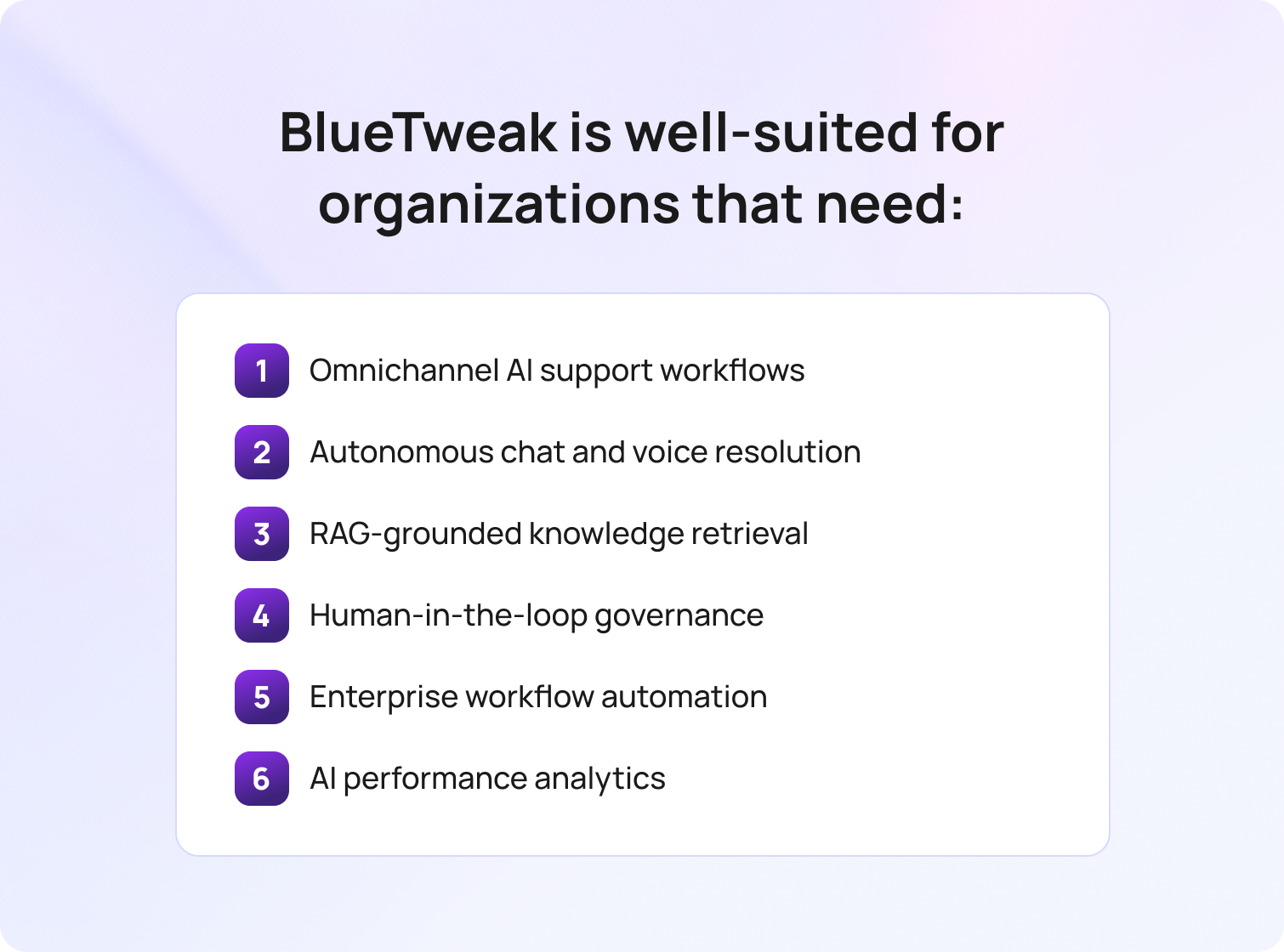
BlueTweak is particularly well-suited for organizations that need:
- Omnichannel AI support workflows
- Autonomous chat and voice resolution
- RAG-grounded knowledge retrieval
- Human-in-the-loop governance
- Enterprise workflow automation
- AI performance analytics
To explore how agentic AI workflows can improve customer support operations, visit BlueTweak and book a demo, or try the BlueTweak platform for free.
Talk to someone about your customer support software needs
Book Call
As Head of Digital Transformation, Radu looks over multiple departments across the company, providing visibility over what happens in product, and what are the needs of customers. With more than 8 years in the Technology era, and part of BlueTweak since the beginning, Radu shifted from a developer (addressing end-customer needs) to a more business oriented role, to have an influence and touch base with people who use the actual technology.



