Radu Dumitrescu

As Head of Digital Transformation, Radu looks over multiple departments across the company, providing visibility over what happens in product, and what are the needs of customers. With more than 8 years in the Technology era, and part of BlueTweak since the beginning, Radu shifted from a developer (addressing end-customer needs) to a more business oriented role, to have an influence and touch base with people who use the actual technology.
Recent articles
7 Proven Use Cases of NLP Customer Support
Start with the Customer’s Words
Picture Monday morning. Your queue is full of long messages, screenshots, and urgent requests written in different languages. Agents are talented, but they spend time translating, searching, and retyping instead of solving. Leaders see the symptoms, reopens, transfers, long handle times, yet the root cause is simple: your system does not understand how customers talk. Traditional systems struggle to understand context and interpret the nuances of customer feedback, making it difficult to accurately address customer needs.
NLP (natural language processing) customer support fixes that gap. It uses AI to process human language, recognize language, detect intent, extract the details agents need, and draft grounded replies that match policy and tone. By processing human language, NLP can interpret intent and meaning more effectively. The result is practical: faster first replies, fewer second contacts, clean data, and a calmer day.
This article walks through 17 specific, field-tested use cases. Each one explains what it does, why it works, how to measure impact, and how BlueHub (by BlueTweak) helps you run it without disrupting the queue.
17 Natural Language Processing Use Cases That Deliver Measurable Wins
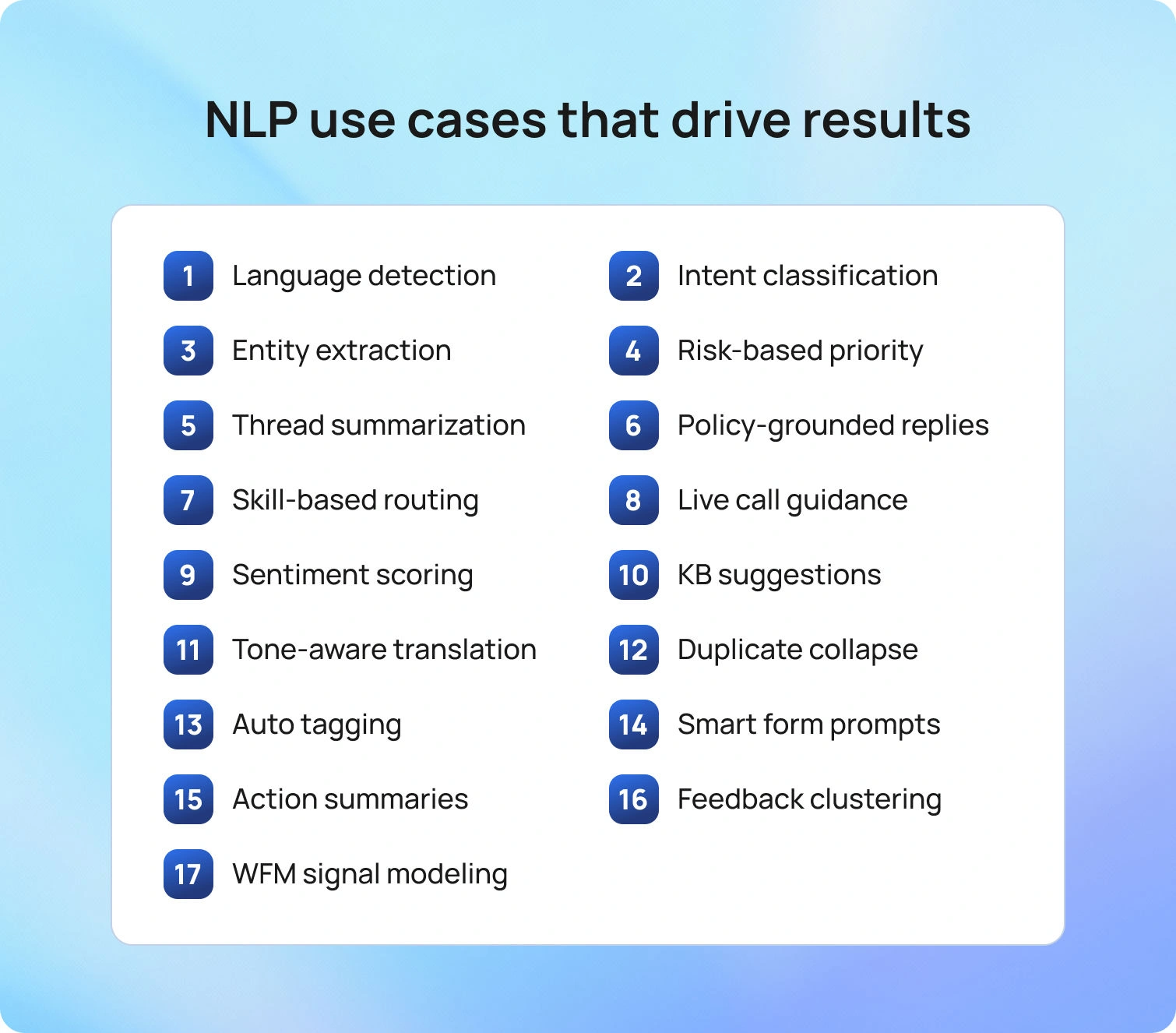
Treat this section as an execution playbook. Begin with two or three high-volume intents, validate impact against clear baselines, then expand methodically. For practical NLP in customer service, it is crucial to integrate NLP with existing systems, such as CRM platforms and ticketing systems. This ensures seamless functionality and maximizes the benefits of NLP in customer service by enhancing efficiency, personalization, and automation.
1) Language Detection at Intake
When a conversation arrives, the first decision is language. NLP identifies the customer’s language across email, chat, social, and voice transcripts and automatically sets the ticket field. That single step improves routing, template selection, and tone from the very first reply. If confidence is low, include a brief confirmation line. In BlueHub, detected language flows into routing and a localized AI customer support knowledge base, so agents start in the correct lane.
Why it works: Correct language enables the correct first move. Multilingual support ensures seamless communication for a diverse customer base, allowing global businesses to provide consistent service across multiple channels and regions.
Measure: Fewer misroutes; faster first response for non-default languages.
2) Intent Classification For Fast Triage
Free text often masks a simple need, such as refund eligibility, identity verification, shipping delays, or outage reporting. NLP algorithms and techniques are used to analyze customer messages, identify patterns, and map them to a compact, well-defined set of intents your team can act on. The proper taxonomy triggers the right lane and snaps the right template into place.
Why it works: Focused categories reduce guesswork and rework.
Measure: Lower manual triage time; fewer transfers; higher SLA attainment on top intents.
3) Entity Extraction to Complete Forms
Customers rarely place data where agents need it. NLP extracts order IDs, invoice numbers, device models, error codes, and emails from messages and attachments, then proposes values for structured fields. Agents confirm with a click.
Why it works: Less hunting, more solving.
Measure: Minutes saved per case; fewer follow-ups for missing details.
4) Priority Hints From Risk Language
Not every P2 carries equal risk. NLP flags phrasing that signals safety, security, legal, or revenue exposure and recommends a tighter update cadence or a one-level priority nudge. Keep human approval in the loop.
Why it works: Urgency aligns with risk, not noise.
Measure: Faster acknowledgments on risk cases; fewer unmanaged VIP escalations.
5) Summarization That Powers a Strong First Reply
Long threads become short, accurate recaps grounded in your knowledge base, generated using natural language generation techniques to ensure concise, empathetic summaries, paired with one concrete next step and a promised update time. Customers relax, and work moves forward.
Why it works: Clear context reduces the need for second touches.
Measure: Higher first-contact resolution; lower second-contact rate.
6) Suggested Replies with Policy Grounding
NLP drafts suggested replies in the customer’s language, using approved templates and localized snippets, leveraging its ability to generate human-like responses. Agents adjust tone and specifics, then send. Keep “approve before send” on sensitive intents until results stabilize.
Why it works: Reuse maintains consistency and speed.
Measure: Agent edit rate; handle time; QA pass rate.
7) Skill- and Language-Aware Routing
Once intent and language are known, routing assigns the case to the first qualified owner based on language, product area, and certification. This process ensures that support agents with the right skills and language abilities handle each case, improving the quality and efficiency of customer support. Overflow rules protect scarce skills, such as payments or identity.
Why it works: Fewer transfers shorten time to resolution.
Measure: Transfer rate; time to first qualified touch; time to resolution.
8) Voice Transcription with Real-Time Guidance
During calls, streaming transcription detects emerging intent and surfaces the next step or checklist in real time (verification, exception handling, required disclosures), keeping agents engaged with the customer. This process relies on advanced speech recognition, a core component of NLP customer support, to accurately interpret spoken language. Additionally, voice assistants powered by NLP can provide real-time guidance and automate responses, further enhancing the efficiency of customer interactions.
Why it works: In-flow guidance beats recall under pressure.
Measure: Voice AHT; after-call work; policy-adherence scores.
9) Sentiment Analysis and Effort Scoring
NLP highlights frustration, urgency, or relief through AI customer sentiment analysis, detects customer emotions to tailor responses, and recommends tone and cadence that fit the moment. Treat outputs as nudges, not hard rules.
Why it works: Emotional context prevents unnecessary escalation.
Measure: Escalation rate; VIP aging; CSAT variance by sentiment band.
10) Automatic Knowledge Suggestions
Semantic search identifies the most relevant paragraph from your knowledge base using the customer’s wording and inserts it into the draft, surfacing the most relevant information for each inquiry. Agents click once, not fifteen times.
Why it works: The right step appears at the right time.
Measure: Article reuse rate; faster replies; fewer reopens tied to missing steps.
11) Multilingual Translation with Tone Controls
Neural translation supports inbound and outbound messages while respecting formality and regional norms, guided by a concise glossary for product and policy terms. Pair with weekly “meaning preserved” checks. Multilingual translation is a key component of comprehensive customer service strategies, enabling businesses to efficiently address diverse customer needs and enhance satisfaction across languages.
Why it works: Accuracy plus appropriateness builds trust.
Measure: FCR and AHT for translated interactions; “meaning preserved” QA scores.
12) Duplicate Detection and Incident Collapse
Outages echo across the inbox. NLP links related tickets to a parent incident and cascades updates in a single note, efficiently managing support tickets during incidents. Agents confirm linkages by clicking to protect quality.
Why it works: One authoritative update beats many inconsistent ones.
Measure: Time saved during incidents; message consistency; faster closure.
13) Auto-Categorization and Tagging for Analytics
Multi-label classification applies product, feature, and root-cause tags from content rather than relying on manual selection. This process helps organize and analyze customer data, enabling better insights into customer needs and support trends. Keep the tag set compact and stable so trends remain meaningful.
Why it works: Clean data drives better planning and product decisions.
Measure: Fewer uncategorized cases; analyst time saved; audit accuracy.
14) Form Pre-Fill and Attachment Prompts
NLP reads the request, interprets specific customer queries, and prompts for the exact screenshot, log, or photo needed to unblock the next step, including the file type and size. Customers attach what matters on the first pass.
Why it works: Correct evidence eliminates avoidable back-and-forth.
Measure: Lower second-contact rate; faster time to unblock.
15) Post-Interaction Summaries and Follow-Up Tasks
Grounded summarization records what happened and creates dated tasks or approvals inside the ticket. Promises stay visible and owned. This step streamlines support processes by ensuring follow-up actions are tracked and accountability is maintained throughout the workflow.
Why it works: Clear handoffs prevent silent drift.
Measure: Reduced after-call work; fewer reopens from missed follow-ups.
16) Feedback Mining and Theme Detection
NPS comments, post-chat surveys, and social posts are rich but noisy. NLP facilitates analyzing customer interactions and feedback, clustering themes, surfacing rising issues with example quotes, and extracting valuable insights that point to likely owners. Share what changed each month.
Why it works: Real customer language guides practical fixes.
Measure: Time from theme to fix; volume drop on targeted issues.
17) Workforce Signals for Better Planning
Language patterns predict effort. NLP converts intent mix, sentiment, translation usage, and transfer patterns into expected handle time and deflection opportunities by region and language, so planners schedule skills, not guesses. By leveraging predictive analytics, organizations can enable proactive support, anticipating customer needs and potential issues, leading to better workforce planning and improved customer experience.
Why it works: Forecasts reflect real work rather than averages.
Measure: Forecast error reduction; overtime avoided; adherence improvement.
ROI in plain terms
Use conservative assumptions tied to familiar levers:
- First-reply acceleration: If grounded suggested replies cut the first response by 1 minute on 30,000 monthly messages at €30/hour, fully loaded, the capacity returned is ~€15,000 per month.
- Transfer reduction: Dropping transfers from 18% to 12% on 20,000 chats at 3 minutes per transfer avoids ~600 hours per month, or ~€18,000.
- Deflection via knowledge matching: A 2-point lift on a 50,000-visit help center removes ~1,000 agent contacts; at 5 minutes each, ~417 hours, ~€12,500.
- Reopen reduction: Moving from 9% to 6% reopens on 15,000 tickets avoids 450 second contacts; at 7 minutes each, ~52.5 hours, ~€1,575.
NLP customer support solutions help reduce operational costs by automating routine tasks, thereby decreasing the need for large support teams and increasing efficiency. These technologies also enhance customer service by improving response times and extracting actionable insights from customer feedback, leading to higher satisfaction. Additionally, NLP improves service quality by enabling more accurate analysis of inquiries and feedback, resulting in more effective support.
These improvements have been implemented to enhance communication and operational efficiency through technological solutions.
Put these side by side, and the question shifts from “why NLP” to “how fast do we want the return.”
Future Outlook For Natural Language Processing: 2026 to 2028
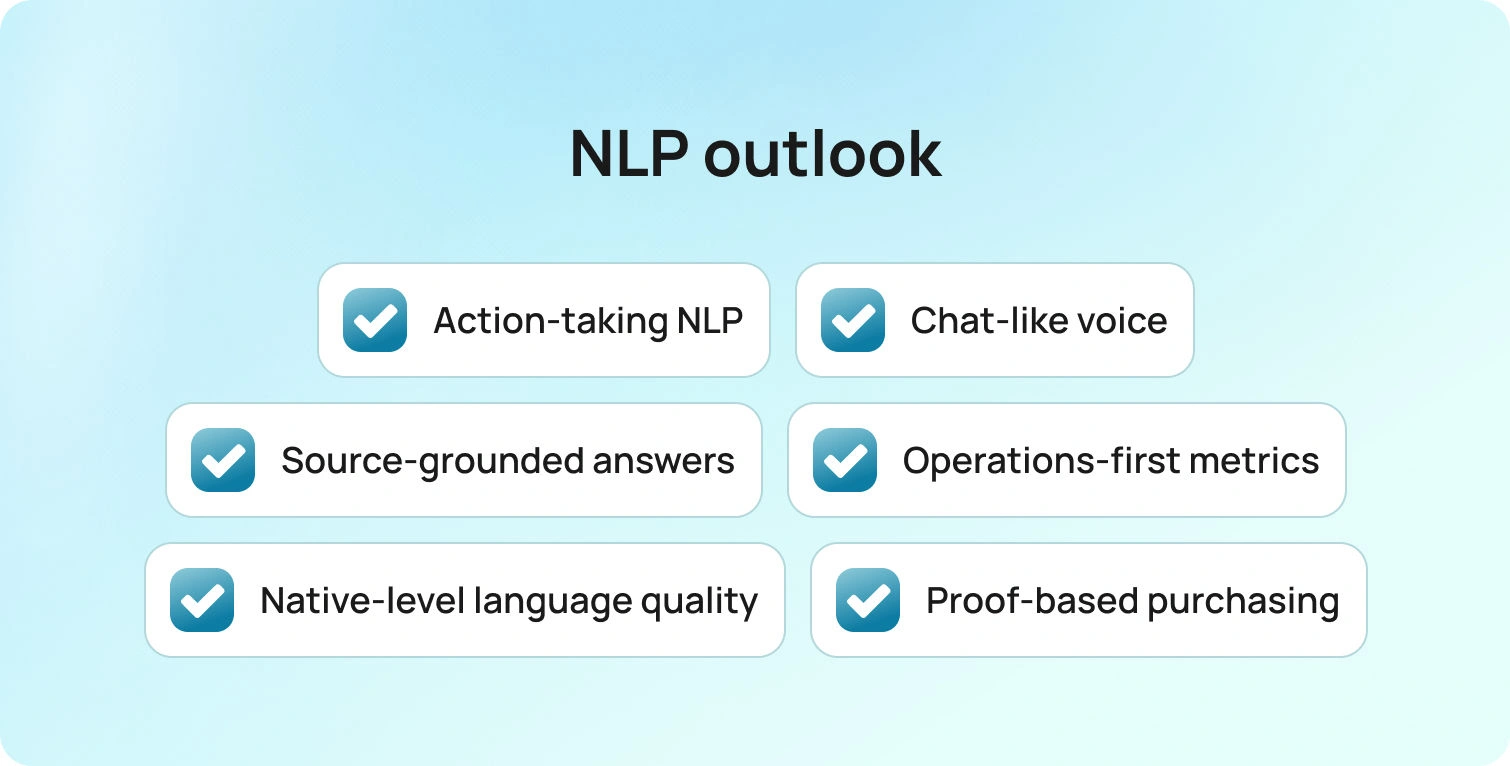
Here’s what’s coming and how it will feel in the day-to-day:
- NLP won’t just draft; it’ll do the work. You’ll approve a recommendation, and the system will open tasks, trigger approvals, update records, and schedule the follow-up. Every step will be logged, so post-mortems are about facts, not folklore.
- Voice will finally feel as smooth as chat. Live transcription, instant language detection, and policy prompts will guide agents mid-call. Multilingual conversations will sound natural, not translated.
- Grounding will be the rule, not the exception. Answers will cite versioned sources. If coverage is missing, the model will indicate this and flag the gap to content owners. There will be no guessing, no “close enough.”
- Success will be measured in operations, not model scores. Expect dashboards that track FCR, AHT, transfers, reopens, and sentiment by intent and language, plus who approved what and the impact minutes later.
- Global quality will feel native. Tone controls, glossaries, and localized templates will make every supported language read as if it were written at home, and this will be verified by routine “meaning preserved” checks.
- Buyers will demand proof. If a platform cannot show where an answer came from, which action it triggered, and how it moved the numbers, it will not make the shortlist.
Looking ahead, large language models and NLP enable computers to understand and generate human language, powering advanced customer support solutions. This technology delivers an enhanced customer experience by personalizing interactions, understanding user intent, and tailoring communication across channels.
Where BlueHub Fits

BlueHub is a unified CX workspace that brings:
together, so NLP operates exactly where agents work. The moment a case opens, language and region are identified, intent is classified, key entities are extracted, and the most relevant knowledge is surfaced. BlueHub provides agent support by helping support agents better understand customer inquiries, automating responses, and streamlining workflows.
The platform also optimizes customer service operations by automating routine tasks and integrating seamlessly with existing systems, enhancing overall service quality. Suggested replies are grounded in your approved articles and templates; translation respects tone and uses glossary terms; and risk cues prompt a tighter cadence when safety, security, legal, or revenue exposure is present.
Operational control is built in. Approvals are configurable by intent, and every suggested action records who approved it, why it was taken, and what happened next. Versioned templates, articles, and prompts are available alongside a visible change log, so audits rely on facts rather than memory. Role-based access, field masking, and data residency options support privacy and compliance. ISO certification is in progress, and all activity is captured in an auditable trail.
Leaders get attribution they can trust. BlueHub links movement in first-contact resolution, average handle time, transfer rate, reopens, SLA attainment, and sentiment to the exact asset or rule that changed, whether it was a template, a route, a checklist step, or a knowledge edit. Workforce management uses the same signals to forecast demand by channel, language, and intent, then publishes skill-aligned schedules that adjust intraday with a single click when reality shifts.
Integration is straightforward. Open APIs and selected connectors bring commerce and CRM data into the same view, so routing, identity, and entitlement checks do not require tab switching. Multitenant controls support multi-brand or multi-client operations with clean separation for routing, reporting, and permissions. You can start with one or two high-volume intents, keep approvals on for sensitive flows, and expand as the data proves lift.
Use NLP in Customer Service to Raise FCR, Cut AHT, and Lift CSAT
Your customers are already telling you what they need. NLP customer support turns those words into a faster first reply, a cleaner handoff, and a confident resolution. By leveraging NLP to enhance customer interactions, you can automate, analyze, and optimize them to deliver a better customer experience and stronger customer relationships.
The 17 use cases here are practical and measurable: detect language, classify intent, extract the details, draft a grounded answer, route by skill, collapse duplicates, mine feedback, and feed the plan with what the queue learned. Keep humans in the loop for sensitive steps. Log changes. Report outcomes in business terms. That is how you turn language into a reliable operating advantage.
BlueHub helps you execute this without pausing the operation. It places advanced NLP AI for customer support where agents already work, grounds every suggestion in your knowledge, and links improvements in FCR, AHT, SLA attainment, and CSAT to the specific change that drove them. If you want to see this in your own data, request a BlueHub demo and leave with a starter plan mapped to your top intents and languages.

14 Best Practices to Maximize FCR with AI Customer Support Voice
Why First Contact Resolution Matters in Voice Support
First Contact Resolution (FCR) is the metric that matters most in voice support. When customers get their issues resolved on the first call, everyone wins: customer satisfaction goes up, operational costs go down, and your customer service team spends less time handling repeat inquiries.
Maximizing FCR is all about using AI technology and advanced natural language processing to:
- Capture intent faster
- Route smarter
- Execute policy-safe actions
- Assist agents with the correct information at the right moment
Examples of AI in customer service show that the most effective implementations combine AI voice assistants in customer support with unified knowledge bases, real-time routing adjustments, and seamless handoffs to human support when needed.
This isn't generative AI running wild. This is grounded, policy-aware automation that continuously improves based on customer feedback and historical data.
Below, we’ll walk through 14 best practices that lift FCR in voice support operations.
14 Ways to Maximize FCR with AI in Customer Service
The 14 practices below focus on the moments that matter most for FCR in voice support: how you store and surface knowledge, how you design your call flows, and how you keep learning from every interaction.
1. Ground Voice Answers in a Single Smart Knowledge Base
Callers receive a single, correct answer, regardless of who answers, whether it's an AI customer support voice agent, a human agent, or an interactive voice response system. Consistency eliminates the "I was told something different last time" problem that drives repeat calls.
How to implement:
Use retrieval-augmented generation (RAG) over a curated knowledge base. Expire stale articles automatically. Attach policy limits by tier, region, and product, so answers reflect actual entitlements. Train models on your company's knowledge and past interactions to ensure AI understands your specific policies.
When artificial intelligence voice customer support systems pull from the same knowledge base that human agents use, you eliminate drift. Customer service solutions that fragment knowledge across systems create inconsistencies, and inconsistencies kill FCR.BlueTweak's Smart Knowledge Base feeds both the AI voicebot and agent-suggested reply AI tools. First responses match across IVR and live agent interactions. Update one article, and the change propagates instantly to all channels (voice, chat, and email).
2. Intent and Entity Capture in the First 10 Seconds
An early, accurate understanding of customer inquiries reduces transfers and misrouting. When AI voice agents for customer support capture intent (what the customer needs) and entities (order ID, email, account number) within the first 10 seconds, the entire service interaction becomes more efficient.
How to implement:
Use automatic speech recognition (ASR) plus natural language understanding (NLU) to confirm intent and key entities via brief reflect-back. For example: "I heard you're calling about order 12345, is that correct?" This gives customers a chance to correct mistakes before the interaction goes off track.
Advanced natural language processing helps AI systems understand customer sentiment and detect customer emotions early, which informs routing decisions and tone adjustments. BlueTweak’s call transcription software, plus classification prompts, confirms during the first moments of the call. Automatic routing uses captured entities to immediately route the call to the correct queue or specialist.
3. Priority Index Routing Mid-Call (Intent × Sentiment × Customer Value)
Hot cases get routed to senior skills on the first interaction. But customer sentiment can shift mid-call, and a routine inquiry might escalate to frustration if the customer reveals additional context. Dynamic routing that updates in real time based on sentiment analysis and customer data ensures high-value or at-risk customers reach the right support agents before frustration turns into customer churn.
How to implement:
Build a Priority Index that combines intent severity, sentiment (detected via AI-driven sentiment analysis), and customer value (VIP tier, lifetime value, churn risk). Update routing decisions as sentiment or risk changes during the same call. Use machine learning algorithms to predict which interactions need immediate human intervention.
This approach improves customer engagement and customer retention by ensuring dissatisfied customers don't wait in standard queues.BlueTweak’s classification and sentiment streams feed into automatic routing in real time. Workforce management (WFM) opens capacity dynamically to accommodate hot cases. Customer service analytics track routing effectiveness by intent, sentiment, and outcome.
4. Policy-Safe Actions Done by the AI Voicebot
Completing the task now (order status lookups, cancellations within limits, password resets) is the fastest path to FCR. When AI voice assistants in customer support can execute routine tasks without human intervention, response times drop and customer satisfaction climbs.
How to implement:
Map approved actions to APIs with guardrails and thresholds. For example, an AI customer service agent can process refunds up to $50 automatically but escalates anything above that threshold for approval. This balances cost efficiency with risk management.
Guarantee that data encryption and security protocols are in place. Customers need to trust that AI systems handle their customer data responsibly, especially when executing financial transactions.BlueTweak's AI voicebot connects to API-open actions with built-in approvals for amounts over defined thresholds. Administration controls ensure policy-safe execution across all automated responses.
5. Warm Handoff with Full Context
Repetition kills FCR. When customers have to repeat their issue to a human agent after interacting with an AI voice customer support system, frustration spikes and resolution slows. Warm handoffs preserve momentum by transferring full context so human agents can pick up exactly where the AI left off.
How to implement:
When the AI customer support voice agent's confidence falls below a threshold (or the caller requests a human), transfer the call with a live summary plus all captured entities. The human agent should see past interactions, customer profile details, and a suggested reply starter to finish the resolution on the same call.
This is how AI in customer service enhances customer interactions without replacing the human touch where it matters.BlueTweak’s summarization flows directly into the ticketing system. Human agents receive an AI ticket summary plus a Proposed Reply starter, enabling them to resolve the issue without asking the customer to repeat themselves.
6. Skill and Language Routing with Real-Time Language Switching
Routing to the correct language or skill on the first try avoids repeat calls. Customers who are forced to navigate English-only systems when they prefer Spanish, for example, often hang up and call back, and that tanks FCR and increases costs.
How to implement:
Auto-detect language during the first few seconds of the call. Route to native speakers or enable real-time translation for chat and voice handoffs. Use multilingual customer support capabilities to serve diverse customer bases without proportionally scaling bilingual headcount.
For skill-based routing, match the complexity of customer requests to agent expertise. Complex customer queries go to senior agents; routine tasks stay with AI voice agents for personalized support or junior team members.BlueTweak’s language detection feeds into automatic routing. Real-time chat translation extends to voice handoffs. Brand-specific and language-specific queues ensure customers reach the right support team immediately.
7. IVR Minimalism with "Say What You Need" Fallback
Deep interactive voice response (IVR) menus cause misroutes and call abandonment. When customers have to navigate six layers of "Press 1 for..." options, they either give up or select the wrong path, both of which hurt FCR.
How to implement:
Keep IVR self-service options to a maximum of 3–5. Always offer a natural-language fallback: "Or, just tell me what you need." The AI voice customer support system interprets the free-form response using natural language processing and routes accordingly.
This self-service approach respects customer needs while reducing friction in the customer journey.BlueTweak's AI voicebot listens to free-form input from the start. Automatic routing resolves natural language requests to the appropriate skills and queues without forcing customers through rigid menus.
8. Probing and Disambiguation Scripts for Similar Intents
Accurate resolution beats fast-but-wrong routing. When intents look similar (exchange vs. refund, billing question vs. payment dispute), asking one or two targeted clarifying questions helps ensure the customer lands on the right solution the first time.
How to implement:
Add 1–2 micro-probes to split look-alike intents. For example: "Are you looking to exchange this item for a different size, or would you prefer a refund?" Build decision trees into your knowledge base so AI voice assistants in customer support can navigate ambiguity systematically.
This prevents the "I'm in the wrong department" problem that drives repeat contacts and lowers customer satisfaction.BlueTweak’s suggested reply templates include micro-probes for ambiguous intents. The smart knowledge base hosts decision trees that guide both AI and human agents through complex scenarios.
9. Agent Assist for Complex Calls (Coach + Next-Best Action)
Human agents still secure FCR on complex issues and sensitive customer emotions. But they need real-time support. AI-assist tools that surface relevant information, canned responses, next-best actions, and policy guardrails during live calls empower agents to resolve issues faster without sacrificing service quality.
How to implement:
Provide real-time suggestions grounded in your knowledge base and policy rules. Surface forms, actions, and suggested replies are inline during the support conversation. Use AI-driven sentiment evaluation to coach agents on tone adjustments.
This is how AI in customer service amplifies human technical expertise rather than replacing it. Support agents gain instant support from AI without losing control of the interaction.BlueTweak’s Agent Copilot delivers suggested reply options and action links during live calls. Customer service quality assurance tools review interactions and feed coaching insights back to the team.
10. Noise, Spam, and Duplicate Call Suppression

Cleaner queues shorten wait times and keep first-call resolution paths clear. When autodialer spam, duplicate tickets, and noise clutter your ticketing system, legitimate customer inquiries wait longer, and longer waits correlate with lower FCR.
How to implement:
Filter autodialers and duplicate calls on ingest. Merge related tickets so agents see the full customer history in one place. Use machine learning algorithms to identify patterns in repeat callers and route them appropriately (e.g., to specialist queues for chronic issues).BlueTweak’s spam detection and deduplication happen at ingest. Customer service analytics flag repeat callers and surface patterns that indicate systemic issues requiring proactive support.
11. Outcome Macros for Recurring Events (Outages, Recalls)
Predictable spikes (shipping delays, product recalls, service outages) sink FCR unless you pre-wire responses. When hundreds of customers call about the same issue, having pre-approved scripts and actions ready ensures consistent, fast resolution.
How to implement:
Pre-approve customer service strategies, scripts, and actions for known events. Prioritize affected callers using customer data (e.g., "purchased affected product in the last 30 days"). Route to dedicated event queues with special SLAs.
Proactive support can prevent volume spikes entirely. Use predictive analytics to anticipate customer needs and address issues before they escalate.BlueTweak’s customer service analytics detect spikes in real time. Pre-built suggested reply templates and routing rules activate automatically. Automatic routing directs affected customers to event-specific queues with adjusted SLAs.
12. Customer Sentiment Monitoring with Auto-Recover Steps
Poor audio quality (low Mean Opinion Score/MOS) and customer agitation derail resolution. If the customer can't hear the agent, or if rising frustration isn't detected early, the call is unlikely to resolve on first contact.
How to implement:
Monitor MOS and prosody signals (tone, pace, volume, emotion) in real time. When MOS drops or agitation spikes, the AI customer support voice agent adjusts strategy: slow pacing, confirm key data verbally, or escalate to a human immediately.
AI-driven sentiment evaluation and emotion detection give support teams early warning signs. This allows for intervention before the customer experience deteriorates beyond recovery.
Call Transcription Software captures cues. The AI Voicebot adjusts its approach dynamically based on audio quality and sentiment. Instant escalation paths ensure complex issues reach human agents when needed.
13. Post-Call Close Loop: Mandatory One-Call QA Sampling
Systematically removing patterns that block FCR requires continuous improvement. Sampling resolved calls, tagging root causes, and updating your knowledge base and templates weekly ensures your AI customer service systems learn from every interaction.
How to implement:
Auto-sample a percentage of resolved calls for quality assurance. Tag root causes (KB gap, policy confusion, system error). Feed findings back into KB updates, canned responses, and routing rules. This closed-loop process is how businesses interact with historical data to drive business growth and cost efficiency.
BlueTweak’s QA workflows use an AI ticket summary to surface key moments. Closed-loop updates flow directly into the knowledge base and suggested reply templates.
14. Return-to-Call Promise with Scheduled Callback
If resolution requires short offline work (checking with another department, waiting for a system update), a scheduled callback preserves "first-interaction closure." The customer doesn't have to call back and start over. Instead, you call them with the solution ready.
How to implement:
Before disconnecting, book a callback slot. The agent rejoins the customer with a prepared solution, full context, and a suggested reply plan for swift closure. This approach enhances customer relationships and demonstrates a commitment to thoroughly resolving customer questions.BlueTweak’s AI Voicebot schedules callbacks automatically. Workforce management reserves agent time, and the ticketing system shows a Proposed Reply plan so the returning agent has everything needed to close immediately.
Improve Your FCR with BlueTweak's AI Customer Service
Maximizing FCR with AI customer support voice is about first-call actionability: capture intent and entities early, use a KB-grounded brain, execute policy-safe actions, and keep routing and workforce management responsive throughout the call.
If you want these practices to run within a single stack, shortlist BlueTweak. Check out transparent pricing and see how BlueTweak's customer service solution can lift your FCR while reducing costs.
Request a demo, and we'll show you how AI customer support voice turns first-call resolution from aspiration to operation.
How to Scale Operations with AI Agent Customer Support
When Volume Outruns Headcount
Most support operations hit the same wall: ticket volume grows faster than headcount, and your existing tools don't actually talk to each other.
You've got dashboards showing AI-powered insights and data-driven insights, but those insights rarely change routing, SLAs, or staffing in real time. Your voice bot doesn't share context with your chat system. Your email queue is a separate universe. And support agents spend half their time hunting for customer information and relevant information across fragmented systems instead of helping customers solve problems.
Add multilingual support and multi-brand operations into the mix, and the chaos multiplies:
- More handoffs
- Higher error rates
- Longer handle times
- Repeat customer inquiries
- SLA breaches
- Rising costs for your business
Customer service departments need better customer experiences across various channels, but fragmented technology stacks make that nearly impossible. Service teams can't deliver consistent service quality when every channel operates in isolation.
This is the problem BlueTweak was built to solve: unifying chat, voice, and email with intelligent routing, workforce management, analytics, and a shared knowledge base in one platform.
But before we get to solutions, let's narrow down what we're actually talking about when we say AI agent customer support.
What Is AI Agent Customer Support?

AI agent customer support refers to policy-guardrailed, task-capable AI entities that can understand customer inquiries, decide on the best action based on customer data and previous interactions, and execute complex tasks across chat, voice, and email.
These aren't the frustrating chatbots from five years ago that forced customers into loops. AI customer support agents integrate with your CRM, order systems, and help desk to access customer information, pull past tickets, and continuously improve their ability to resolve issues. They use natural language processing to understand customer queries and customer needs, then take action within defined limits.
The benefits:
- 24/7 coverage to answer questions and handle service requests without adding night-shift headcount
- Lower Average Handle Time by surfacing relevant information and suggested actions instantly
- Higher containment and deflection on routine tasks
- Better human agent productivity when AI handles repetitive work and feeds insights into routing and workforce management
- Improved customer satisfaction through faster resolution and better customer experiences across the customer journey
The most effective AI customer support agents use multi-agent orchestration:
- One retrieves information
- Another triages intent
- A third executes the action
- A fourth handles quality assurance
This approach increases resolution rates for repetitive, policy-safe work while keeping humans in the loop for complex issues and queries. This matches BlueTweak's approach: AI plus APIs with built-in guardrails, grounded in your knowledge base, and wired into your actual operations, not bolted on as a disconnected layer.
How to Launch AI Agents That Scale Operations
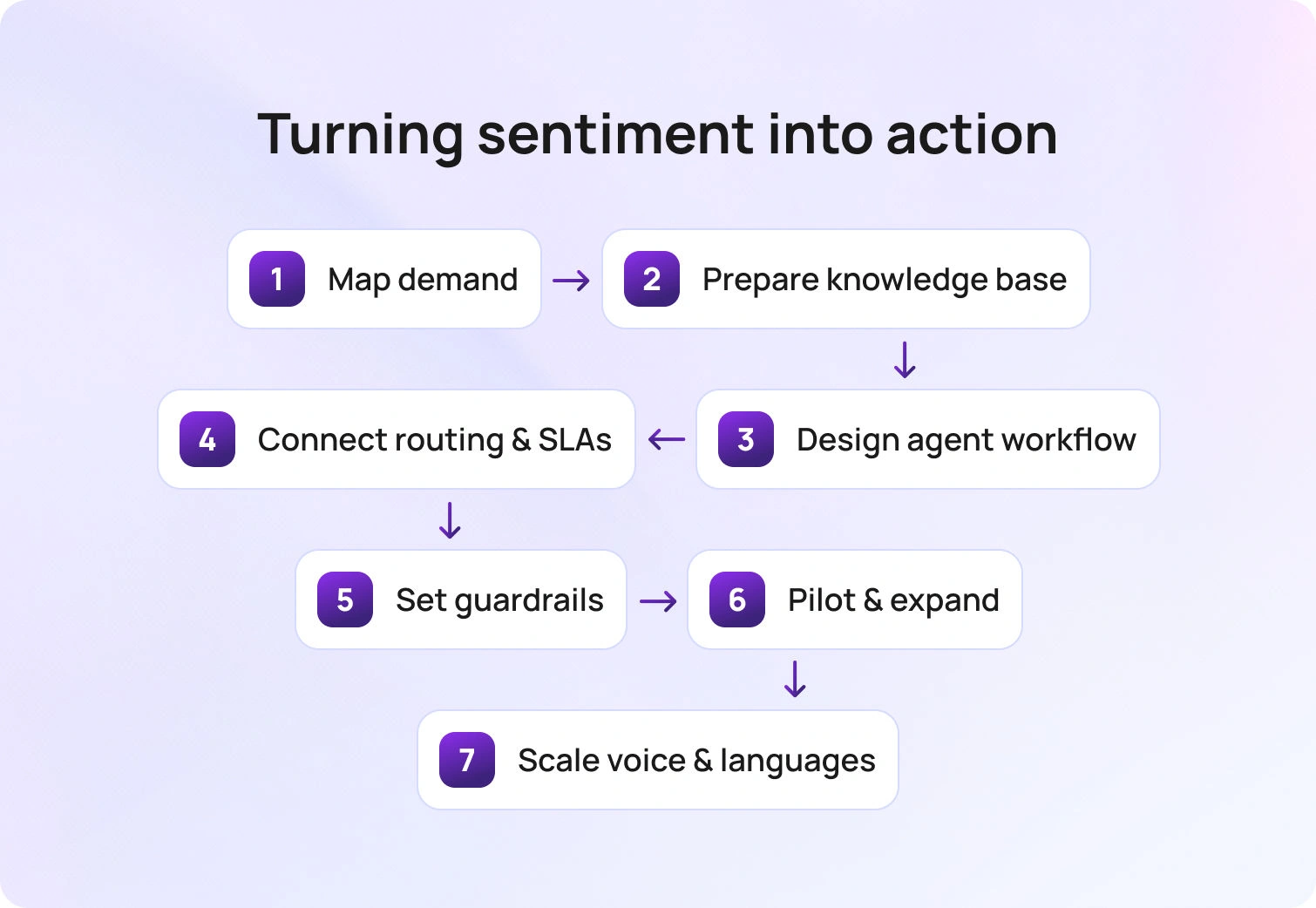
Launching customer support AI agents isn't about flipping a switch. It's about mapping demand, cleaning your knowledge base, designing workflows, connecting systems, and measuring impact. Here's how to do it.
1. Map Demand and Define Automation-Ready Intents
Start by understanding what's actually hitting your support queues and how customers engage with your service teams.
What to do:
Pull 90 days of tickets and calls. Cluster them by intent, language, channel, and brand. Mark, which intents are policy-safe, meaning they have clear rules, defined outcomes, and low risk if executed incorrectly.
Examples of policy-safe intents:
- Order status lookups
- Returns and exchanges (within policy limits)
- Subscription cancellations
- Password resets
- Tracking updates
Analyze customer interactions to understand where human agents spend time on routine tasks versus complex tasks that require judgment.
Deliverables:
- Intent taxonomy (version 1)
- Safe actions matrix (what AI can do, what requires human approval)
- Volume and AHT breakdown per intent
Acceptance criteria:
60–80% of the volume is labeled. You've prioritized 10–20 high-impact intents that represent the bulk of routine work and service requests. This is where your ticketing system and customer service analytics matter. If you can't see intent-level patterns across various channels, you're guessing. For e-commerce companies, this data is fundamental for understanding the customer journey from browse to purchase to post-sale support.
2. Make Your Knowledge Base Production-Ready
Your knowledge base is the foundation of every AI agent interaction. If it's not production-ready, your AI agents will fail to deliver the service quality customers expect.
What to do:
Normalize KB articles with a consistent structure: title, summary, steps, limits, failure states, and citations. Add API references so agents know which systems to call (order lookup, refund processing, account edits). Use natural language instructions that both human agents and AI customer service agents can follow.
Train models on your actual customer interactions and past tickets to ensure AI understands your company's unique terminology and customer preferences.
Deliverables:
- KB quality checklist passed (articles are recent, accurate, and cover edge cases)
- API catalog documenting available actions
- Version-controlled content that can continuously improve based on performance data
Acceptance criteria:
At least 90% of your prioritized intents have full KB coverage and a callable action (via API or workflow). Without this foundation, AI agents will hallucinate answers or give generic responses that frustrate customers . Customer support automation only works when it's grounded in truth and your actual policies.
3. Design the Agent Workflow (Assist → Approve → Auto)
Not every intent should jump straight to full automation. Start with AI-assisted workflows where human agents approve actions before they execute.
What to do:
For each intent, author playbooks that define:
- Required inputs (customer profile, order ID, issue type)
- Validations (eligibility checks, policy limits)
- Steps to resolution
- Fallback paths if something goes wrong
- Escalation criteria for human handoff on complex issues
Design workflows that let your customer service team focus on what matters: building relationships and solving problems that require empathy and judgment.
Deliverables:
- YAML or JSON playbooks for each intent
- Suggested reply templates with KB citations
- Clear escalation criteria
- Data encryption and security protocols for sensitive customer information
Acceptance criteria:
Human agents resolve issues with AI assistance at 80% or higher precision during the pilot phase. Customer satisfaction scores remain stable or improve. Tools like AI ticket summaries and canned responses speed up resolution while maintaining quality. Support agents get real-time access to relevant information without switching between multiple systems.
4. Connect Routing, WFM, and SLAs
AI agents shouldn’t just answer questions. They route work intelligently based on intent, sentiment, urgency, and customer data.
What to do:
Convert intent, sentiment, and urgency signals into a Priority Index. Map that index to specific queues and SLAs. Ensure skill-based and language-based routing so the right agent (human or AI) handles each case. Set thresholds for "hot queues" that need immediate attention.
Consider customer expectations and the customer experience when designing routing rules. Leading companies use AI-powered insights to predict which customers need immediate human attention and which can be served effectively by AI customer service.
Deliverables:
- Routing ruleset
- Hot-queue SLAs
- Intraday workforce management rules (shrinkage, concurrency limits)
- Performance dashboards for managers to track efficiency
Acceptance criteria:
Hot cases land in the correct queue with less than 60 seconds' variance from the target SLA. Customer satisfaction metrics remain above target thresholds. This is where call center workforce management and customer service analytics converge. AI agents optimize the entire flow and help your business deliver better customer experiences.
5. Guardrails, Security, and Approvals
Even the best AI agents for customer support need guardrails. You don't want AI issuing $500 refunds without oversight or editing customer PII without approval.
What to do:
Set role-based approvals for risky actions (refunds above a threshold, account edits, data exports). Implement MFA, audit logs, data encryption, and data retention policies. Use prompts and version control to track what AI said and why.
Double-check that your AI customer service agents engage with customers in ways that meet both customer expectations and regulatory requirements. Users should always know when they're interacting with AI versus human support agents.
Deliverables:
- Policy pack defining approval rules
- Approval matrix by action type and risk level
- Red-team test results (simulated attack scenarios)
- Security documentation for enterprise and regulated industries
Acceptance criteria:
Zero critical policy violations across 200+ test runs. All sensitive customer interactions maintain encryption standards. Administration and security features ensure compliance without slowing down operations. Your customers trust you with sensitive information, and AI agents need to honor that trust. This software-level security is non-negotiable for any company scaling support operations.
6. Pilot, Measure, and Expand
Launch a two-week pilot on 3–5 intents. Measure everything. Fix what breaks. Expand what works.
What to do:
Track these KPIs across all channels:
- First Contact Resolution (FCR): Are issues resolved in one interaction?
- Average Handle Time (AHT): Are resolutions faster?
- Containment: What percentage of inquiries never reach a human?
- Abandon Rate: Are customers hanging up less?
- Recovery ≤24h: For service failures, how fast do you recover?
- Customer Satisfaction (CSAT): Are better customer experiences translating to higher scores?
Run defect reviews twice a week. Look for edge cases, policy gaps, and tone mismatches. Gather data-driven insights to continuously improve AI performance and responses.
Deliverables:
- Pilot scorecard with insights from real-time data
- Fix backlog
- Updated playbooks (v2)
- Go/no-go decision
Acceptance criteria:
Hit your targets. For most service teams, that's a 15–25% reduction in AHT and a 10–20% lift in containment. Customer satisfaction should remain stable or improve. This is where customer service quality assurance tools prove their value. You need visibility into what's working and what's not at the interaction level across conversations and channels.
7. Scale to Voice and Multilingual
Once AI agents are performing well in chat and email, expand to voice and additional languages to deliver services across the whole customer journey.
What to do:
Add call transcription software and prosody signals (tone, pace, emotion) so AI can understand not just what customers say, but how they say it. Enable real-time chat translation or native-language routing so customers receive service in their preferred language and channel.
Deliverables:
- AI voicebot configurations
- Language routing rules
- Multilingual QA sampling plan
- Integration specifications for voice technology
Acceptance criteria:
No CSAT regression on your top two languages. Stable voice quality (MOS scores). Seamless integration between voice and text channels.
Voice is more complex than chat. Customers expect natural conversations. But when done right, AI voicebot systems can handle high-volume inquiries (account balance, order status, appointment changes) and escalate seamlessly to human agents when needed. Multilingual customer support becomes a competitive advantage when AI intelligently handles translation and routing. This is especially valuable for enterprise companies and leading brands serving diverse customer bases.
Scale AI Agent Customer Support with BlueTweak

Everything we've described requires one platform to unify context, ground AI in policy, route intelligently, execute actions safely, and measure impact.
That's what BlueTweak delivers.
- Omnichannel core (chat, calls, email): AI agents see unified context across channels and previous interactions. They consistently propose responses and take action, whether the customer is chatting, calling, or emailing. Customer profile data flows through every customer interaction. This includes social media messengers, so conversations in those channels carry the same unified context and actions.
- Smart Knowledge Base: AI agents are grounded in your knowledge base for accurate, policy-aware suggested replies. Update one article, and the change propagates instantly to all AI agent behavior. This is how you train models effectively and continuously improve performance.
- Automatic Routing and WFM/Analytics: Intent and sentiment signals convert into a Priority Index. Hot cases route automatically. Call center workforce management adjusts staffing in real time based on data and AI-powered insights. Managers see KPI impact by intent, channel, and segment.
- Spam detection, classification, and summarization: Keep queues clean. AI ticket summary provides context for human or AI action, giving support agents instant access to relevant information.
- Real-time chat translation: Multilingual customer support without extra bilingual headcount. Deliver better customer experiences across languages and user preferences.
- Multi-brand operations: Brand-scoped routing, permissions, and customer service analytics enable a single AI framework to serve multiple brands cleanly. Perfect for enterprise companies managing multiple customer service departments.
- Security and Administration: MFA, audit logs, encryption, and administration controls ensure sensitive actions are governed. ISO compliance in progress. This software meets the security expectations enterprise users demand.
BlueTweak doesn't replace your existing tools. It integrates with them and adds the control layer that makes AI agents for customer support automation operational. The platform enables your company to scale support operations efficiently while maintaining the quality and customer satisfaction your brand is known for.
Turn AI Agents Into Real Operational Capacity
If you want to scale without adding headcount, the path is clear. Map demand, harden the knowledge base, design assist to approve to auto workflows, wire routing, and WFM to real signals, set guardrails, pilot, then expand to voice and languages. The outcome is a single operating model in which routine work is handled by AI and complex work reaches the right humans quickly.
BlueTweak gives you one place to do it. Unified context across channels, a knowledge base that actually drives behavior, policy-aware actions, multilingual coverage, and the analytics leaders need to steer by intent, channel, and brand. It does not replace your tools. It connects them and adds the control layer that makes AI agents operational at scale. Request a demo, and we'll show you how AI agent customer support turns operational chaos into scalable efficiency.
14 Best Five9 Alternatives for Contact Centers in 2026
Five9 is designed for large enterprise contact centers, but that often comes with enterprise complexity. Long implementations, modular pricing, seat minimums, and separate AI or workforce management add-ons make it difficult for many growing support teams to justify.
Today's mid-market contact centers need something different: true omnichannel support, AI grounded in company knowledge, workforce management, and quality assurance in one platform that can be deployed quickly.
BlueTweak is one example, combining these capabilities in a single platform with transparent pricing, but it's far from the only option. Below, we compare the best Five9 alternatives for teams evaluating their next contact center platform.
Five9 Alternatives for the Mid Market
Five9 is a strong choice for large enterprise contact centers, but many growing support teams don't need enterprise-level complexity. Long implementation timelines, modular pricing, and add-on costs for AI, workforce management, and quality assurance can quickly increase both cost and administrative overhead.
Instead, mid-market organizations often prioritize faster deployment, transparent pricing, and a unified platform that combines voice, email, chat, social messaging, AI, and workforce management without relying on multiple products or lengthy implementation projects.
This guide compares 14 Five9 alternatives built for customer support teams of 20–100 agents, highlighting each platform's strengths, pricing, AI capabilities, and overall value so you can find the best fit for your business.
Five9 Alternatives At a Glance
If you're short on time, here's a quick overview of how the leading Five9 alternatives compare. We've highlighted each platform's ideal use case, starting price, and whether it includes key capabilities like AI, workforce management (WFM), and omnichannel support. Then we'll dive into each solution in more detail.
*Starting prices reflect the lowest publicly advertised plans available at the time of writing. Enterprise features such as workforce management, advanced AI, omnichannel routing, and quality management may require higher-tier plans, add-ons, usage-based charges, or custom pricing.
While every platform here offers cloud contact center capabilities, they're built for different business needs. Some prioritize enterprise scalability, while others focus on faster deployment, transparent pricing, or AI-powered automation for growing support teams. Below, we'll take a closer look at each solution to help you find the best Five9 alternative for your organization.
14 Five9 Alternatives for 2026
We prioritized platforms that deploy in weeks, not months, built for teams of 20–100 agents, with true omnichannel capabilities, AI grounded in your knowledge base, and native WFM/QA. Expect transparent, all-in pricing and voice as a channel, not the center.
1. BlueTweak: Best for Unified Omnichannel Customer Support

BlueTweak delivers comprehensive customer service on a single platform; omnichannel ticketing, voice, chat, email, social, AI automation, workforce management, and quality assurance. You get all of this without the module sprawl that defines enterprise alternatives. It's built specifically for mid-market teams and eliminates the implementation complexity and cost escalation that push Five9 beyond reach for operations with fewer than 100 agents.
Best for: BlueTweak is best for growing customer support teams that want to unify voice, ticketing, AI, workforce management, and quality assurance in one platform without paying separately for every capability.
Features:
- Ticketing system with intelligent routing by skills, language, priority, and customer history
- AI voicebot handling routine inquiries with warm handoffs, preserving full context
- Call transcription software providing real-time transcription and searchable call records
- Suggested reply and canned responses grounded in the knowledge base for consistency
- AI ticket summary condensing lengthy interactions into actionable briefings
- Call center workforce management with forecasting, scheduling, and adherence tracking
- Customer service quality assurance, providing scorecards, calibration, and coaching
- Customer service analytics tracking sentiment, SLA performance, and outcomes
- Multilingual customer support with real-time translation preserving context
- Customer profile displaying complete interaction history regardless of channel origin
- Customer support automation with KB-grounded chatbot and voicebot
Who uses it: Mid-market contact centers managing 20–100 agents who need complete omnichannel capabilities with AI features and predictable costs without enterprise contracts.
"Many companies evaluating Five9 don't actually need enterprise complexity. They need a platform that unifies every customer conversation, gives agents AI grounded in trusted knowledge, and helps managers improve performance without stitching together multiple vendors. That's exactly what we built BlueTweak to do." — Radu Dumitrescu, Head of Presale & Digital Transformation at BlueTweak
Pricing:
- All-in plan: €65/agent/month includes ticketing, omnichannel (voice, email, chat, social), AI features, workforce management, quality assurance, analytics, and APIs
Note: Single transparent plan instead of tiered bundles. See pricing for details.
Pros:
- Complete platform eliminates module fragmentation and vendor coordination overhead
- KB-grounded AI ensures consistent, policy-compliant responses across all channels
- Native workforce management and quality assurance avoid third-party integration costs
- Implementation measured in weeks with guided deployment versus months of professional services
- Transparent pricing bundles all features without usage surprises or seat minimums
- API-open architecture enables seamless integration with existing CRM and business systems
- Multilingual support with real-time translation scales global operations efficiently
Cons:
- Newer platform with a smaller third-party app marketplace than established providers
- Less brand recognition compared to enterprise-focused Five9 competitors
- Some advanced security features are scheduled for upcoming releases
BlueTweak in Action:
Global BPO provider Conectys implemented BlueTweak's platform to consolidate customer support operations, improve reporting, and give agents faster access to the information they needed. The results included a 30% reduction in data retrieval time, a 40% increase in reporting efficiency, a 35% improvement in customer satisfaction (CSAT), a 25% reduction in resolution times, and a 20% reduction in operational costs, demonstrating how a unified customer support platform can improve both agent productivity and customer experience.
Want to see how BlueTweak compares with Five9? Book a personalized demo and explore omnichannel support, AI automation, workforce management, and quality assurance in one platform.
2. Genesys Cloud CX: Best for Large Enterprise Contact Centers
Genesys Cloud CX competes directly with Five9 at enterprise scale, offering comparable depth in workforce optimization, journey analytics, and AI capabilities across massive agent populations. The platform targets organizations that run global operations, where customization needs justify longer implementation cycles.
Best for: Genesys Cloud CX is best for large enterprises managing complex, global customer service operations. Its advanced journey orchestration, AI, and workforce optimization capabilities are well suited to organizations with hundreds or thousands of agents and the resources to support enterprise-scale deployments.
Features:
- Omnichannel routing across voice, digital channels, and social media
- Journey management connecting customer interactions across touchpoints and departments
- AI-powered features for workforce engagement management
- Quality management with automated evaluations and compliance recording
- Predictive routing using customer data and agent skills
Who uses it: Enterprise contact centers managing hundreds of agents across multiple regions requiring sophisticated journey orchestration and workforce optimization.
Pricing:
- Genesys Cloud CX 1: $75/user/month (billed annually) for voice-first contact centers, including call routing, speech-enabled IVR, outbound campaigns, interaction recording, analytics, native bots, predictive routing, and Agent Copilot.
- Genesys Cloud CX 2: $115/user/month (billed annually) adds digital channels, omnichannel routing, quality assurance and compliance, making it suitable for omnichannel contact centers.
- Genesys Cloud CX 3: $155/user/month (billed annually) adds full workforce engagement management (WEM), including employee performance management, AI-powered forecasting and scheduling, resource management, and speech and text analytics.
- Genesys Cloud CX 4: $240/user/month (billed annually) includes journey management, virtual agents, Supervisor Copilot, Virtual Supervisor, social listening, and 30 AI Experience tokens per named agent for organizations looking to maximize AI-powered customer experiences.
Pros:
- Enterprise-grade scalability supporting thousands of concurrent agents globally
- Deep workforce optimization with advanced forecasting and scheduling algorithms
- Comprehensive journey analytics tracking customer interactions across business units
- Mature integration ecosystem connecting major CRM and business systems
- Strong compliance key features for regulated industries
Cons:
- Extremely expensive for mid-market teams under 100 agents
- Complex implementation requiring months of professional services and technical expertise
- Pricing structure with four tiers plus add-ons creates budget unpredictability
- Steep learning curve demands extensive agent training and ongoing support
- Overkill for straightforward contact center operations focused on customer service
3. NICE CXone: Best for Workforce Optimization and Analytics
NICE CXone delivers enterprise contact center capabilities with particular strength in workforce optimization, quality management, and customer experience analytics. The platform serves organizations prioritizing data-driven performance improvement across large agent populations.
Best for: NICE CXone is best for enterprises that prioritize workforce management, quality assurance, and customer experience analytics. It's a strong choice for organizations looking to optimize large support teams through AI-driven forecasting, coaching, and performance insights.
Features:
- Omnichannel routing with unified customer data across all interaction types
- Advanced workforce management with AI-powered forecasting and scheduling
- Quality management provides automated evaluations and coaching recommendations
- Customer experience analytics tracking behavior patterns and sentiment trends
- Voice of the Customer programs collect and analyze feedback systematically
Who uses it: Large enterprises managing complex contact center operations requiring sophisticated analytics and workforce optimization across hundreds of agents.
Pricing:
- CXone Mpower Omnichannel Suite: $110/agent/month for core omnichannel contact center capabilities, including voice and digital channels, omnichannel routing, recording, analytics, and AI-ready workflows.
- CXone Mpower Essential Suite: $135/agent/month adds workforce engagement features such as screen recording, quality management, supervisor tools, and performance reporting.
- CXone Mpower Core Suite: $169/agent/month adds AI-powered workforce management, including forecasting, scheduling, adherence, performance management, and speech and text analytics.
- CXone Mpower Complete Suite: $209/agent/month adds advanced AI-driven analytics, Voice of the Customer capabilities, interaction analytics, AI copilots, and broader customer experience insights.
- CXone Mpower Ultimate Suite: $249/agent/month plus $0.25 per AI session adds agentic AI capabilities, including AI agents for self-service and proactive engagement, AI-powered automation, and industry-specific AI experiences.
Pros:
- Industry-leading workforce optimization capabilities reduce operational costs significantly
- Comprehensive quality management automates agent evaluation and coaching workflows
- Deep customer experience analytics provide actionable insights for service improvement
- Robust security and compliance features meet stringent regulatory requirements
- Mature platform with proven reliability at enterprise scale
Cons:
- Prohibitively expensive for mid-market operations with limited budgets
- Implementation complexity requires dedicated project teams and external consultants
- Feature richness creates overwhelming options for teams needing straightforward solutions
- Best value requires enterprise-scale deployments across multiple departments
- Pricing tiers and add-ons make the total cost difficult to predict accurately
4. Talkdesk: Best for AI-Powered Contact Center Automation
Talkdesk positions itself as the AI-first alternative to Five9, emphasizing automation, self-service, and visual workflow builders that reduce technical dependencies. The platform targets mid-market to enterprise teams seeking modern interfaces and faster deployment than legacy providers offer.
Best for: Talkdesk is best for organizations looking to automate customer service with AI-powered workflows, virtual agents, and visual routing tools. Its modern interface and rapid innovation appeal to mid-market and enterprise teams embracing AI-first customer support.
Features:
- Visual workflow designer enabling non-technical teams to configure routing and automation
- AI-powered virtual agents handling self-service interactions with natural language understanding
- Agent assists in surfacing knowledge articles and suggested responses during live interactions
- Industry-specific solution packages pre-configured for healthcare, retail, and financial services
- Quality management with automated call evaluations and performance scoring
Who uses it: Mid-market to enterprise contact centers seeking AI-powered automation with faster implementation than traditional CCaaS platforms.
Pricing:
- CX Cloud Digital Essentials: $85/user/month for digital customer engagement, including email, live chat, SMS, social messaging, routing, dashboards, reporting, and API access.
- CX Cloud Voice Essentials: $105/user/month for voice-first contact centers, adding voice engagement, speech recognition, voicemail transcription, routing, business intelligence, and API access.
- CX Cloud Elite: $165/user/month includes all Essentials features plus workforce management, performance management, screen recording, custom reporting, and automated notifications for omnichannel contact centers.
- Industry Experience Clouds: $225/user/month builds on the Elite plan with industry-specific capabilities for sectors including financial services, healthcare, retail, travel, utilities, and government (custom pricing).
Pros:
- Modern, intuitive interface reduces agent training time compared to legacy platforms
- Visual workflow builder empowers business users to configure routing
- Strong AI capabilities, including virtual agents and real-time agent assist
- Industry-specific pre-built solutions accelerate deployment for vertical markets
- Active product development with frequent feature releases and updates
Cons:
- Pricing escalates quickly when adding workforce management and advanced AI
- Workforce optimization capabilities are less comprehensive than Five9 or NICE CXone
- Some enterprise features require moving to top-tier plans with significant cost increases
- Integration depth varies by third-party system compared to established platforms
- Customer support responsiveness is inconsistent according to user reviews
5. RingCentral (MVP + Contact Center): Best for Unified Communications and Customer Support

RingCentral built its business on unified communications and progressively added contact center software capabilities through RingCX. The platform works for organizations that want internal collaboration tools and customer-facing support, and business operations managed through a single vendor.
Best for: RingCentral is best for businesses that want to manage internal communications and customer interactions through a single provider. Organizations already using RingCentral's UC platform can extend into contact center capabilities without switching ecosystems.
Features:
- Unified communications platform integrating phone, messaging, and contact center
- Video conferencing enables agents to escalate customer interactions
- CRM integrations providing customer context within agent workflows
- Quality management with call recording, monitoring, and evaluation tools
- Mobile apps supporting remote and distributed agent teams
Who uses it: Organizations prioritizing unified communications for internal teams alongside contact center capabilities for customer service operations.
Pricing:
- MVP Core: $30/user/month (billed annually) for unified business communications, including unlimited domestic calling, team messaging, HD video meetings, on-demand call recording, AI-powered call summaries, and intelligent IVR.
- MVP Advanced: $35/user/month (billed annually) adds CRM integrations, multi-site support, reporting and insights, increased toll-free minutes and SMS allowances, plus AI writing and productivity tools.
- MVP Ultra: $45/user/month (billed annually) includes everything in Advanced, plus webinars, historical and real-time analytics, unlimited storage, device analytics, and expanded AI capabilities.
- Customer Engagement Bundle: Contact sales for pricing. Builds on MVP Ultra with shared SMS inboxes, enhanced call queue management, business SMS tools, live reporting, and AI-powered customer engagement features.
- RingCX Contact Center: Custom pricing. Adds enterprise contact center capabilities, including omnichannel routing, IVR, workforce engagement, AI-powered agent assistance, analytics, and digital customer engagement.
Pros:
- Single-vendor solution for internal communications and customer-facing operations
- Strong video conferencing capabilities support visual customer engagement scenarios
- Familiar interface for organizations already using RingCentral for team collaboration
- A good mobile experience enables flexible work arrangements for agents
- Reliable voice infrastructure with global coverage and carrier redundancy
Cons:
- Contact center features are less mature than purpose-built CCaaS platforms like Five9
- Pricing complexity between UCaaS (MVP) and contact center (RingCX) tiers
- Workforce management requires additional licensing
- Advanced features are locked behind the enterprise tier with significant cost premiums
- Implementation timeline longer than advertised for complex contact center deployments
6. Dialpad: Best for Google Workspace Organizations

Dialpad started as a cloud phone system leveraging Google's infrastructure and AI capabilities, and it gradually expanded into contact center territory. The platform's differentiator is Vi, its AI assistant providing real-time transcription, coaching, and information surfacing during active calls.
Best for: Dialpad is best for businesses that rely heavily on Google Workspace and want AI-powered voice support. Its real-time transcription and coaching tools make it particularly attractive for distributed customer service and sales teams.
Features:
- Vi AI assistant providing real-time transcription and coaching during customer calls
- Integration with Google Workspace for Google-centric organizations
- Video meetings enabling visual collaboration for complex customer support scenarios
- Speech analytics identifies sentiment shifts and coaching opportunities automatically
- CRM integrations surfacing customer context within the agent desktop
Who uses it: Small to mid-sized businesses prioritizing AI-powered call assistance within the Google Workspace ecosystem.
Pricing:
- Essentials: $80/user/month for core contact center capabilities, including intelligent call routing and queuing, real-time agent monitoring, AI-powered call transcription, call recording, and CRM integrations.
- Advanced: $115/user/month adds AI-powered coaching with live coach cards, expanded digital channels, CRM event logging, and more advanced customer engagement tools.
- Premium: $150/user/month adds AI-powered quality management, advanced analytics, CSAT measurement, and workforce management (available as an included add-on) for larger customer support teams.
Note: Advanced AI capabilities, workforce management, and quality management are reserved for higher-tier plans, making the total cost of ownership significantly higher for teams that need enterprise-grade contact center functionality.
Pros:
- Real-time AI transcription and coaching provide immediate value for agent training
- Native Google Workspace integration eliminates friction for Google-first organizations
- User-friendly interface requires minimal training
- Modern architecture supports remote teams effectively with a cloud-first design
- Responsive customer support and an active product development cycle
Cons:
- Usage-based pricing for telephony and AI features creates unpredictable monthly costs
- Contact center capabilities are less comprehensive than dedicated CCaaS platforms
- Workforce optimization requires third-party tools or manual workarounds
- Voice quality inconsistencies are reported during network congestion or poor connectivity
- Limited customization options compared to enterprise-focused alternatives
7. 8×8: Best for Global Voice Communications

8×8 combines decades of telecommunications experience with cloud-based contact center capabilities, offering tiered X Series packages that scale from basic business phone to comprehensive omnichannel operations. The platform focuses on voice reliability and global coverage.
Best for: 8×8 is best for organizations that prioritize reliable global voice infrastructure alongside cloud contact center capabilities. Its international coverage makes it a good fit for businesses supporting customers across multiple countries.
Features:
- Global voice infrastructure with international calling and local number provisioning
- Omnichannel routing across voice, chat, email, SMS, and social channels
- Speech analytics identifies trends and agent performance patterns automatically
- CRM integrations connecting customer data across Salesforce and other platforms
- Quality management provides call recording, monitoring, and evaluation workflows
Who uses it: Small to mid-sized businesses needing reliable voice infrastructure with scalable contact center capabilities as operations grow.
Pricing:
- 8x8 Contact Center: Custom pricing. Includes omnichannel routing, AI-enabled self-service, workforce engagement management, analytics, Agent Workspace™, Supervisor Workspace™, and secure payment processing.
- 8x8 Engage: Custom pricing. Extends customer engagement beyond the contact center with advanced queue management, conversational intelligence, global communications, and team analytics.
- 8x8 Work: Custom pricing. Provides unified business communications with calling, messaging, video meetings, analytics, and global coverage for distributed teams.
- Communications APIs (CPaaS): Custom pricing. Enables developers to build customer engagement workflows with voice, SMS, messaging, video, authentication, and fraud prevention APIs.
Note: 8x8 no longer publishes public pricing for its contact center products. Businesses must contact the sales team for a customized quote based on deployment size, feature requirements, and support needs.
Pros:
- Established telecommunications infrastructure ensures reliable voice quality globally
- Tiered approach allows gradual scaling from UCaaS to a full contact center
- International calling capabilities support global customer bases effectively
- Mature platform with proven uptime and carrier-grade reliability
- Comprehensive feature set at mid-tier price points compared to premium providers
Cons:
- Pricing is completely opaque, requiring sales engagement for any cost information
- User interface feels dated compared to modern cloud-native alternatives
- Customer support quality varies significantly according to user feedback
- AI capabilities lag behind newer platforms focused on automation
- No public pricing, making it difficult for buyers to compare costs without engaging the sales team
8. Zoom Contact Center: Best for Video-Enabled Customer Support

Zoom Contact Center extends the company's video conferencing dominance into customer service operations, leveraging familiar interfaces and video capabilities to support visual scenarios. The platform targets organizations already invested in Zoom for meetings.
Best for: Zoom Contact Center is best for organizations already invested in the Zoom ecosystem that want to extend familiar collaboration tools into customer support. Its video capabilities make it especially useful for businesses where face-to-face interactions improve the customer experience.
Features:
- Video engagement enabling face-to-face customer interactions
- Integration with the Zoom meetings platform for seamless escalation to specialists
- Real-time transcription providing searchable call records and agent assist
- Quality management with call monitoring and performance evaluation
- Pre-built integrations with popular CRM and ticketing systems
Who uses it: Organizations that use Zoom for internal meetings and want integrated contact center capabilities, particularly for video-enabled customer support.
Pricing:
- Contact Center Essentials: $69/user/month (billed annually) for inbound omnichannel customer support, including voice, video, chat, and SMS, Flow Editor with IVR, real-time transcription, CRM integrations, customer surveys (VoC), and AI-powered features.
- Contact Center Premium: $99/user/month (billed annually) adds outbound dialing, email and social media channels, and co-browsing for more advanced omnichannel customer engagement.
- Contact Center Elite: $149/user/month (billed annually) includes AI Expert Assist, advanced quality management, and workforce engagement management (WEM) for larger contact center operations.
Note: Zoom Contact Center is licensed separately from Zoom Workplace. Additional AI capabilities, telephony services, and other optional features may require add-ons or incur additional usage-based charges.
Pros:
- Strong video capabilities differentiate from voice-only competitors for visual support
- Familiar interface reduces training time for organizations already using Zoom
- Quick deployment for existing Zoom customers leveraging established accounts
- Seamless escalation from contact center to specialist consultations via Zoom meetings
- Reliable infrastructure benefits from Zoom's massive scale and investment
Cons:
- Contact center features are less mature than purpose-built CCaaS platforms
- Usage-based voice pricing creates unpredictable monthly costs
- Workforce optimization capabilities are limited compared to Five9 or NICE CXone
- Best value requires existing Zoom investment for full feature access
- AI capabilities are trailing specialized contact center platforms in sophistication
9. Amazon Connect: Best for AWS-Based Contact Centers
Amazon Connect eliminates per-agent licensing in favor of usage-based pricing calculated by the minute. The platform leverages AWS infrastructure and services, appealing to technically sophisticated organizations comfortable with cloud architecture.
Best for: Amazon Connect is best for technically mature organizations already using AWS infrastructure. Its flexible, usage-based pricing and extensive customization options suit businesses with in-house development resources and highly variable contact volumes.
Features:
- Pay-per-use pricing model charging only for actual contact minutes consumed
- Deep AWS integration enabling custom workflows via Lambda functions
- Contact Lens provides AI-powered conversation analytics and sentiment tracking
- Scalability handling variable call volumes without pre-committed agent licenses
- Programmable contact flows using visual designers or code-level customization
Who uses it: Organizations with technical teams comfortable managing AWS infrastructure, especially those with highly variable contact volumes or existing AWS investments.
Pricing:
- Amazon Connect: Usage-based pricing with no per-agent licensing or seat minimums.
- Voice: $0.038 per voice minute (standard telephony charges apply).
- Chat: $0.010 per message sent or received.
- Email: $0.080 per email sent or received.
- SMS and third-party messaging: $0.014 per message sent or received.
Note: Total costs vary based on communication volumes, telephony usage, AI features, and AWS services, making monthly expenses less predictable than platforms with fixed per-agent pricing.
Pros:
- Usage-based pricing is potentially cost-effective for operations with variable call volumes
- No minimum seat commitments or long-term contracts provide deployment flexibility
- Deep AWS integration enables sophisticated custom workflows and automation
- Highly scalable architecture handles sudden volume spikes
- A programmable platform allows customization for unique business requirements
Cons:
- Requires significant technical expertise to configure, manage, and optimize effectively
- Consumption-based pricing can make monthly costs difficult to forecast, especially as interaction volumes and AI usage increase.
- Workforce management requires third-party solutions, adding cost and complexity
- Steeper learning curve compared to turnkey CCaaS platforms with guided setup
- Best suited for technically sophisticated organizations with dedicated AWS resources
10. Zendesk: Best for Existing Zendesk Customers
Zendesk built its reputation on ticketing and help desk software, later adding voice capabilities through Zendesk Talk and contact center features via add-ons. The platform makes sense for teams already invested in the Zendesk Suite who want to consolidate voice support.
Best for: Zendesk is best for organizations that already use Zendesk Suite for ticketing and want to add voice and contact center capabilities without replacing their existing help desk platform.
Features:
- Unified ticketing across email, chat, voice, and social communication channels
- Self-service knowledge base reduces contact volume through customer self-help
- Marketplace with extensive third-party integrations and custom apps
- Workflow automation reduces manual agent tasks through triggers and macros
- Reporting and analytics tracking team performance and customer satisfaction
Who uses it: Organizations with existing Zendesk investments adding voice and contact center capabilities to established help desk operations.
Pricing:
- Zendesk Suite Team: $55/agent/month (billed annually) for teams that need omnichannel customer support with AI Agents, knowledge base capabilities, messaging, live chat, telephony, and workflow automation.
- Zendesk Suite Professional: $115/agent/month (billed annually) adds advanced AI tools, skills-based routing, IVR, reporting improvements, writing assistance, and deeper support operations management.
- Zendesk Suite Enterprise + Copilot: Custom pricing. Adds advanced AI capabilities including intelligent triage, Auto Assist, generative AI for voice, approval workflows, custom agent roles, and enterprise governance controls.
Note: Zendesk's contact center capabilities are included within Suite plans rather than sold as a standalone Five9-style CCaaS platform. Advanced voice, workforce management, and AI functionality may require higher-tier plans or additional add-ons.
Pros:
- Strong ticketing foundation if already using Zendesk for help desk operations
- Extensive marketplace with thousands of integrations and pre-built apps
- Self-service knowledge base reduces contact volume through effective deflection
- Familiar interface for teams already trained on Zendesk workflows
- Good documentation and active community support forums
Cons:
- Contact center capabilities require stacking multiple add-ons, increasing complexity
- Pricing escalates when adding voice, workforce management, and advanced AI
- Voice features are less mature than purpose-built contact center platforms
- Best value requires a full Zendesk Suite investment across the support organization
- Interface feels dated compared to modern cloud-native alternatives
11. UJET: Best for Mobile-First Customer Support
UJET targets mid-market teams looking for modern, mobile-first customer support experiences, combining voice, digital channels, CRM integrations, and rapid deployment without the complexity of traditional enterprise contact center platforms.
Best for: UJET is best for businesses that prioritize mobile customer experiences and fast deployment. Its mobile-first architecture and straightforward implementation make it a strong option for growing support teams that want modern omnichannel capabilities without enterprise complexity.
Features:
- Mobile SDK enabling in-app voice and messaging without leaving the customer's app
- Omnichannel routing across voice, chat, email, SMS, and social media
- CRM integrations providing customer context within agent workflows
- Smart Actions automates routine tasks based on customer intent
- Advanced reporting, tracking performance metrics across channels
Who uses it: Mid-market companies prioritizing mobile customer experiences and rapid deployment without lengthy implementation projects.
Pricing:
- Basic: $65/user/month for core voice support, including PSTN voice, CRM integrations, standard reports and dashboards, single sign-on, web SDK access, and standard support.
- Pro: $99/user/month adds enhanced agent capabilities, including Agent Desktop Experience, SMS blending, Smart Actions, mobile SDK support, advanced reporting, APIs, data export tools, and premium support.
- Enterprise: $120/user/month adds full omnichannel engagement with chat, email, SMS, and social channels alongside voice capabilities and premium support.
- Digital: $69/user/month for standalone digital customer engagement, including chat, email, SMS, social messaging, in-app voice, agent desktop tools, analytics, APIs, and web/mobile SDKs.
Pros:
- Mobile-first architecture enables innovative in-app customer support experiences
- Faster implementation timeline compared to enterprise platforms like Five9
- Transparent pricing with clear tier differentiation and no hidden fees
- Modern interface requires minimal agent training compared to legacy systems
- Strong focus on customer experience rather than just operational efficiency
Cons:
- Smaller platform with a less mature feature set than established Five9 competitors
- Limited workforce optimization capabilities compared to enterprise-focused providers
- Fewer integrations are available compared to platforms with larger ecosystems
- Less brand recognition may create procurement friction in risk-averse organizations
- Quality management features are less comprehensive than dedicated QA platforms
12. Sprinklr Service: Best for Digital Customer Experience Management

Sprinklr Service approaches contact center operations through a customer experience management lens, unifying social media monitoring, digital engagement, and traditional contact center capabilities. The platform targets enterprises managing brand reputation across digital channels.
Best for: Sprinklr Service is best for large enterprises managing customer engagement across social media, messaging apps, and traditional support channels. It excels in organizations that want to unify customer experience management across multiple departments.
Features:
- Unified console managing social media, messaging apps, and traditional channels
- AI-powered routing assigning interactions based on topic, sentiment, and customer
- Social listening monitoring brand mentions and customer sentiment across platforms
- Workflow automation reduces manual tasks across marketing, sales, and service teams
- Enterprise-grade security and compliance features for regulated industries
Who uses it: Large enterprises prioritizing social media engagement and brand management alongside traditional contact center operations.
Pricing:
- Sprinklr Service Enterprise: Custom pricing. Includes AI-powered omnichannel customer service, unified agent workspace, workflow automation, case management, analytics, quality management, and enterprise governance capabilities.
- Enterprise CXM Platform: Custom pricing. Extends customer service with social media management, conversational AI, customer insights, and cross-functional customer experience management.
Note: Sprinklr no longer publishes self-service pricing for new customers. Organizations must contact the sales team for a tailored enterprise quote based on deployment size, channels, AI requirements, and implementation needs.
Pros:
- Unified platform managing social media, digital channels, and contact center operations
- Strong social listening capabilities monitor brand reputation proactively
- Enterprise-grade security and compliance features
- AI-powered routing optimizes interactions across all engagement channels
- Comprehensive reporting provides a unified view across marketing, sales, and service
Cons:
- No public pricing, making it difficult to compare costs before engaging with sales
- Complex platform with a steep learning curve requiring extensive training
- Overkill for organizations focused primarily on voice and digital customer service
- Best value requires enterprise-wide deployment across multiple departments
- Implementation complexity demands significant internal resources and time commitment
13. CloudTalk: Best for Voice-Focused Small Businesses
CloudTalk provides simple cloud phone and call center capabilities targeting small to mid-sized businesses, prioritizing voice support. The platform emphasizes ease of use and affordable pricing over depth of enterprise features.
Best for: CloudTalk is best for small businesses that primarily handle customer interactions over the phone. It offers an affordable cloud phone solution with core call center features, making it a good choice for teams that don't require advanced omnichannel capabilities.
Features:
- Cloud phone system with advanced call routing and queue management
- Power dialer for outbound sales and follow-up campaigns
- Call analytics tracking volumes, wait times, and agent performance
- CRM integrations connect calls to customer records automatically
- International numbers in 160+ countries supporting global operations
Who uses it: Small to mid-sized businesses focused primarily on voice support without requiring comprehensive omnichannel contact center capabilities.
Pricing:
- Starter: $25/user/month (billed annually) for cloud calling, including AI Voice Agents, global calling, IVR, call routing, power dialer, basic reporting, live monitoring, and standard support.
- Essential: $29/user/month (billed annually) adds unlimited domestic calling, CRM and help desk integrations, workflow automation, advanced call handling, and real-time analytics.
- Expert: $49/user/month (billed annually) adds parallel dialing, advanced monitoring and coaching tools, enhanced outbound calling capabilities, and more comprehensive reporting for growing support and sales teams.
Note: AI Conversation Intelligence, branded caller ID, parallel dialing (on lower tiers), and some advanced calling features are available as paid add-ons.
Pros:
- Significantly more affordable than Five9 for voice-focused operations
- Simple setup and intuitive interface minimize implementation time
- Good integration with popular CRM systems for small business users
- International number provisioning supports global customer bases
- Reliable voice quality with minimal technical configuration required
Cons:
- Limited digital channel capabilities compared to omnichannel platforms
- Basic workforce management features are insufficient for complex operations
- AI capabilities are minimal compared to platforms focused on automation
- Not suitable for teams requiring comprehensive contact center operations
- Smaller ecosystem with fewer integrations than established platforms
14. Vonage: Best for Scalable Business Communications
Vonage combines unified communications with contact center capabilities, leveraging decades of telecommunications experience. The platform serves organizations seeking business phone systems that scale to full contact center operations as needs evolve.
Best for: Vonage is best for businesses that want a cloud phone system capable of growing into a contact center over time. Its unified communications platform provides flexibility for organizations planning to expand customer service operations as they scale.
Features:
- Unified communications platform with voice, video, and team messaging
- Programmable APIs enabling custom integrations and workflows
- Global voice infrastructure with international calling and local numbers
- Contact center capabilities, including routing, IVR, and analytics
- CRM integrations connecting customer data across business systems
Who uses it: Small to mid-sized businesses wanting unified communications with optional contact center capabilities as operations scale.
Pricing:
- Mobile: $19.99/user/month for business calling, SMS/MMS, voicemail, desktop and mobile apps, and unlimited domestic calling.
- Premium: $29.99/user/month adds video meetings, team messaging, VoIP desk phone support, single sign-on, analytics, and business app integrations.
- Advanced: $39.99/user/month adds call recording, visual voicemail with transcription, call groups, and more advanced business communications features.
- Vonage Contact Center (VCC): Custom pricing. Adds omnichannel customer engagement, intelligent routing, workforce optimization, CRM integrations, analytics, and AI-powered contact center capabilities.
Note: The Mobile, Premium, and Advanced plans are part of Vonage Business Communications (UCaaS). Organizations evaluating Vonage as a Five9 alternative will typically require Vonage Contact Center, which is priced separately through a custom quote.
Pros:
- Established telecommunications company with reliable voice infrastructure
- Scalable from a basic phone system to a full contact center as needs grow
- Programmable APIs enable custom integrations for unique requirements
- Good integration with popular CRM and business systems
- Unlimited calling on most plans reduces usage cost concerns
Cons:
- Advanced contact center capabilities require Vonage Contact Center, which is sold separately through custom pricing
- Limited AI capabilities in standard plans compared to modern alternatives
- The interface is less modern than the cloud-native competitors built recently
- Best contact center features locked behind expensive enterprise packages
- Customer support quality is inconsistent according to user feedback
Why Teams Look for Five9 Alternatives in 2026
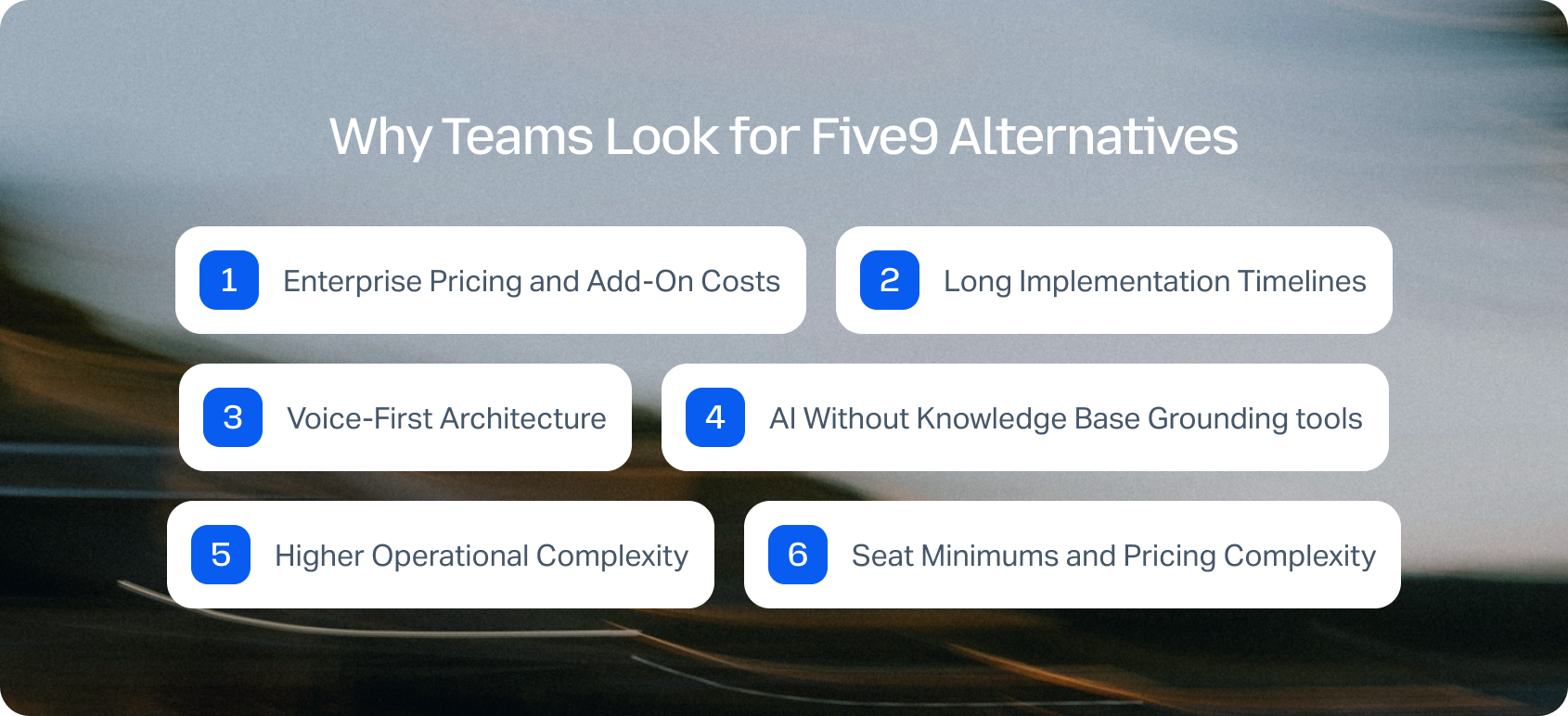
Five9 remains one of the leading enterprise contact center platforms, but it isn't the right fit for every organization. Many growing support teams find that the platform's enterprise-first approach introduces unnecessary complexity, longer deployment times, and higher total costs than they need.
The most common reasons organizations evaluate Five9 alternatives include:
Enterprise Pricing and Add-On Costs
Five9's base platform often requires additional licensing for AI, workforce optimization, quality management, and advanced analytics. As requirements grow, costs can increase significantly, making budgeting more difficult for mid-market organizations.
Long Implementation Timelines
Enterprise deployments frequently require professional services, custom integrations, and extensive configuration before teams can go live. Organizations looking for faster time-to-value often prefer platforms that can be deployed in weeks rather than months.
Voice-First Architecture
While Five9 excels at voice interactions, many modern support teams prioritize true omnichannel customer service where voice, email, chat, SMS, and social messaging are managed from a single workspace with complete customer context.
AI Without Knowledge Base Grounding
Many organizations now expect AI to generate responses using approved company documentation rather than generic language models. Knowledge-grounded AI helps reduce hallucinations, improve consistency, and support compliance requirements.
Higher Operational Complexity
Advanced workforce management, reporting, integrations, and administration are valuable for enterprise organizations, but can introduce unnecessary complexity for smaller customer support teams looking for an easier-to-manage platform.
Seat Minimums and Pricing Complexity
Many Five9 deployments involve annual commitments, enterprise contracts, and pricing that varies depending on licensing, AI features, and add-on modules. For growing teams, transparent per-agent pricing can make budgeting far easier.
What to Look for in a Five9 Alternative
Before choosing a replacement, make sure the platform supports the capabilities your team actually needs.
Curious how much you could save by consolidating your support stack? Try BlueTweak's ROI Calculator to estimate your potential savings before switching.
How We Evaluated These Five9 Alternatives
This comparison is based on publicly available vendor documentation, product pages, feature announcements, and pricing information available as of July 2026. Where vendors do not publish pricing, plans are listed as custom quote. We also considered each platform's AI capabilities, omnichannel functionality, workforce management, implementation requirements, and suitability for mid-market customer support teams.
Must-Have Capability Checklist
When comparing alternatives to Five9 , we recommend prioritizing platforms that offer:
- Omnichannel support across voice, email, chat, SMS, and social
- AI grounded in your knowledge base to reduce hallucinations
- AI-powered transcription, summaries, suggested replies, and agent assistance
- Native workforce management and quality assurance
- Reporting and analytics covering KPIs such as CSAT, FCR, AHT, SLA performance, and sentiment
- Integrations with CRM, ecommerce, help desk, and BI platforms
- Enterprise-grade security, including MFA, audit logs, and role-based permissions
- Transparent pricing without hidden AI, workforce management, or usage-based add-ons
Scoring Rubric
Each platform was evaluated using the following criteria:
- Fit for growing teams: Suitability for organizations of around 20–100 agents, while recognising where platforms are better suited to enterprise deployments.
- Omnichannel capabilities: Support for voice, email, chat, SMS, and social from a unified workspace.
- AI functionality: Breadth of AI features, including knowledge-grounded assistance, automation, and agent support.
- Workforce management and quality assurance: Availability of native scheduling, forecasting, adherence tracking, coaching, and QA tools.
- Time to value: Expected implementation effort, onboarding complexity, and deployment timelines.
- Total cost of ownership: Overall licensing, add-ons, implementation, support, and operational costs.
- Security and administration: Governance, compliance, access controls, and enterprise security capabilities.
Choosing the Right Five9 Alternative
The best Five9 alternative ultimately depends on your team size, customer engagement channels, AI requirements, and long-term growth plans.
For large enterprise contact centers supporting hundreds or thousands of agents, platforms like Genesys Cloud CX and NICE CXone provide the advanced workforce optimization, customization, and global scalability those organizations often require.
However, many growing support teams need something different. If you're looking for an omnichannel platform that's faster to deploy, easier to manage, and doesn't require separate licensing for AI, workforce management, and quality assurance, BlueTweak offers a compelling alternative.
BlueTweak brings together voice, email, live chat, SMS, social messaging, AI automation, workforce management, quality assurance, and reporting in a single platform with transparent pricing and no enterprise seat minimums. Whether you're supporting a growing ecommerce business, a multi-brand customer service operation, or an international contact center, it's designed to scale alongside your team without adding unnecessary complexity.
BlueTweak is a good fit if you:
- Want to manage voice and digital channels from one unified platform
- Need AI powered by your knowledge base rather than generic language models
- Prefer native workforce management and quality assurance instead of third-party tools
- Support multiple brands, products, or regions from a single workspace
- Want to deploy in weeks rather than months
- Need predictable pricing without hidden AI, WFM, or usage-based fees
Ready to see BlueTweak in action? Start your free 14-day trial to explore the platform for yourself (no credit card required). Experience omnichannel customer support, AI-powered automation, workforce management, and quality assurance in one place, and see how quickly your team can get up and running.

How to Train Help Desk Staff in 2026: 17 Best Practices
Why Training Determines Speed and Satisfaction
Let’s be honest. Many teams still place new hires straight into live tickets and trust that experience will close the gaps. The result is predictable: slow resolutions, inconsistent tone, and customers who drop out before the issue is fixed. Failing to meet user expectations can lead to dissatisfaction and a loss of trust.
There is a better path. Effective programs mirror real-world situations, use short, focused practice, and demonstrate their value with visible progress in the queue. When you adopt this approach, you protect first-contact resolution, reduce handle time, and cut repeat contacts, including the silent churn from essential customers you did not prioritize.
This guide shows how to train help desk staff without pausing operations. You will learn a practical sequence you can implement this month, from simulations that build confidence to knowledge habits that travel with every ticket, plus the exact performance signals to watch so you can see what changed and why. Well-trained support staff are essential for meeting both organizational goals and user expectations.
17 Ways to Train Help Desk Staff in 2026

Set the foundation with clarity, a key step in building an effective help desk team, then layer skills that translate directly to live tickets. The steps below move from role definition to simulations, knowledge habits, coaching, and measurable lift in the queue. Implementing the right strategies at each stage is essential for long-term success.
1) Start with a one-page role card
Give each role a single page defining its mission, scope, core tools, and two real-world examples that distinguish it from look-alike edge cases. A clear role card helps employees understand their job functions and expectations. Agents act on what they can see at a glance, so place the card inside the workspace where tickets live and link to deeper references only when needed. The result is faster orientation, fewer handoffs, and decisions that remain consistent across shifts.
Use this foundation to build everything that follows in production. Layer in short simulations that mirror your top intents, KCS-style knowledge habits, three concise message templates per intent, a light coaching loop tied to FCR and reopen rate, and analytics that make improvement visible. Starting with a clear role card turns training from information into action. Establishing a clear course for each role ensures alignment and focus throughout the training process.
2) Train with simulations before you go live
Realistic voice and chat scenarios, anchored to your highest-volume intents, build confidence before agents handle live tickets by creating an immersive environment that mirrors real-world help desk challenges. Each run has a clear objective and a simple rubric that scores probing depth, tone control, and clarity of the next step. Recordings enable quick debriefs where one improvement is captured and applied to the very next ticket.
Short, frequent practice outperforms long, infrequent classes. Sessions stay under ten minutes and recur weekly, so skills become reflexive under pressure. These simulations help agents develop essential desk skills needed for live support, including problem-solving and effective communication. Complexity increases over time, moving from straightforward cases, such as outage updates and account verification, to thornier issues, such as refund eligibility with policy edge cases.
Teams that follow this cadence see fewer early escalations, faster time to independence, and first replies that actually unblock the customer.
3) Build a KCS first knowledge loop
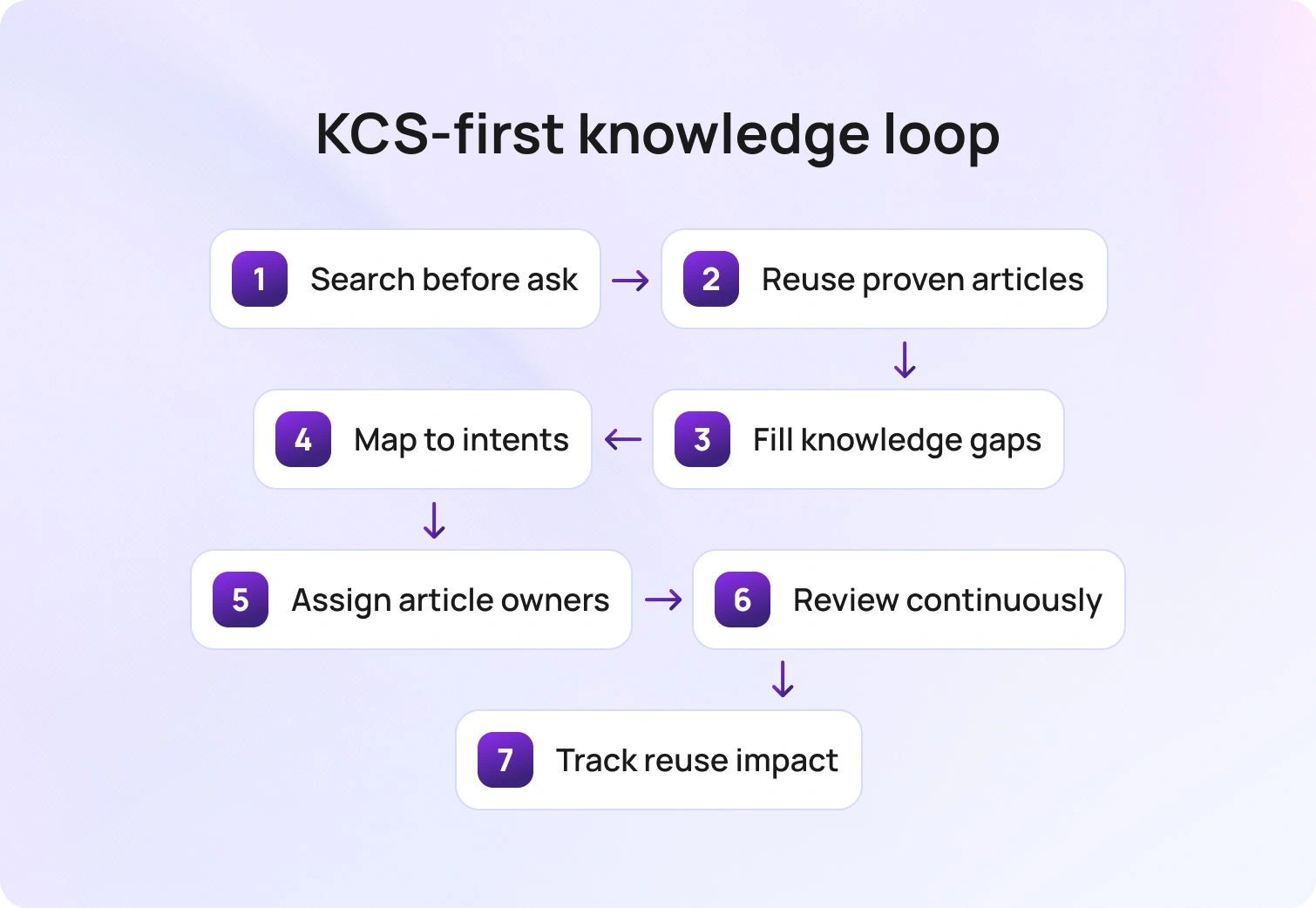
A reliable knowledge base turns every solved ticket into a reusable asset. Thorough documentation is crucial for maintaining consistency and reducing ticket volume, as it ensures that solutions are clearly recorded and easily accessible. In a KCS (Knowledge-Centered Service)-first approach, agents search before they ask, reuse proven articles, refine content when a gap appears, and create new content only when no match exists. The effect is consistency at scale: fewer contradictions, faster answers, and a shared source of truth that travels across shifts and channels.
Implementation works best when guidance appears where the work happens. Map articles to specific forms and intents so the proper steps surface inside the ticket. Give each article an owner and a review date, standardize snippets and screenshots, and publish minor edits continuously rather than saving up for a rewrite. For higher-risk issues, add a brief knowledge check at closure to confirm that the final steps align with policy.
Track simple signals, i.e., article reuse rate, time to update, deflection at intake, and reopens tied to missing guidance, and you will see first contact resolution tighten while repeat contacts fade. Adequate documentation and knowledge sharing also help control ticket volume by empowering users to find solutions independently.
4) Use microlearning for daily improvement
Attention sticks when learning is short, focused, and immediately practical. Microlearning breaks enablement into five- to seven-minute lessons that target a single behavior, allowing agents to practice and return to the queue without losing momentum. Continuous learning opportunities help develop both technical and soft skills in help desk staff. Think of skills like setting a precise next update time, verifying identity in two steps, or attaching the exact evidence a reviewer needs. Each lesson ends with a quick check for understanding, which keeps the signal high and the time cost low.
Over days and weeks, these small wins compound into reliable habits. Coverage remains intact because training fits between tickets, not instead of them. Managers see fewer avoidable follow-ups, faster first replies, and a steady rise in confidence as agents apply each skill in the very following conversation.
5) Space refreshers to protect retention
Skills stick when the brain revisits them over time. Plan brief refreshers days and weeks after the initial lesson so knowledge moves from short-term memory into everyday practice. A simple sequence works well: a two-question quiz to surface knowledge gaps and address them before they impact live performance, a short simulation to apply the concept under light pressure, and a quick review of a recent live ticket to connect learning to results.
This cadence improves recall when it matters most. Agents carry the skill into Monday spikes and incident moments, not just into quiet practice sessions. Leaders see fewer avoidable follow-ups, steadier first contact resolution, and confident execution that holds up across shifts.
6) Coach to a small metric set
Coaching works best when the target is clear, and the feedback is tied to outcomes. Focusing on crucial metrics helps improve performance across the help desk team. Center every session on a short list of operational metrics that matter in the queue: first contact resolution, average handle time, reopen rate, service level attainment, and VIP aging. Share the current baseline, show one recent interaction that illustrates the gap, and agree on a single behavior to practice, such as using an unblocking checklist in the first reply.
Keep the rhythm repeatable and straightforward. Begin with a brief pre-read, review one real ticket together, confirm the specific change the agent will make this week, and schedule a quick follow-up to review the same metric again. This narrow focus turns coaching into visible progress, reduces second touches, and builds confidence by showing agents the cause-and-effect relationship in their own numbers.
7) Standardize three messages per intent

Consistency wins when queues are busy. Effective communication skills are essential for delivering clear, consistent messages to users. For every common request, define three short messages that any agent can use with confidence: a first response that sets the next update time, a progress note that states what changed since the last touch, and a delay note that explains why you are waiting and exactly when you will check again. Clear, repeatable language prevents tone drift, reduces follow-ups, and makes handoffs feel seamless to customers and colleagues. Templates should reside where agents work and auto-merge the essentials, including customer name, ticket ID, promised update time, and any linked knowledge step. Treat reuse as craftsmanship rather than corner-cutting, and refine the phrasing monthly based on QA findings and customer feedback. Over time, these three messages become muscle memory, and your queue shows it through fewer “just checking in” replies and a steadier path to resolution.
8) Teach time to unblock as the first reply goal
The first message should enable progress. A simple test tells you whether it works: after reading the reply, can the customer take a concrete next step without replying? Aim for a single, specific action or request that removes the blocker and keeps the case moving. Developing strong problem-solving skills enables agents to deliver effective solutions in their first reply, ensuring customers can move forward without delay.
Precision matters. Name the exact field to complete, the screenshot to attach, or the command to run, and explain the expected outcome in one line. This approach lowers second-contact rates, improves first-contact resolution, and turns a frustrated exchange into collaborative problem-solving and solution delivery.
9) Train routing and ownership
Speed often rises or falls at the moment of assignment. Teach a simple ownership rule set that removes hesitation: who should claim, when a transfer is justified, and how to complete a clean handoff. A good handoff reads like a brief case file. It includes a one-line summary, the steps already attempted, evidence supporting the next move, and an explicit request to the receiving owner. With this clarity, work no longer bounces between queues, and customers no longer repeat themselves.
Practice the mechanics until they become routine. Use a routing matrix that reflects fundamental skills, languages, products, and risk levels, and let agents rehearse decisions using short scenarios before facing them in a live environment. Add light-load awareness so that claim decisions reflect current capacity and service timers. Effective routing ensures optimal use of available resources and prevents overload on any single agent. As these habits take hold, transfers decline, average handle time falls, and accountability becomes evident from the first touch.
10) Create a lane for security and revenue moments
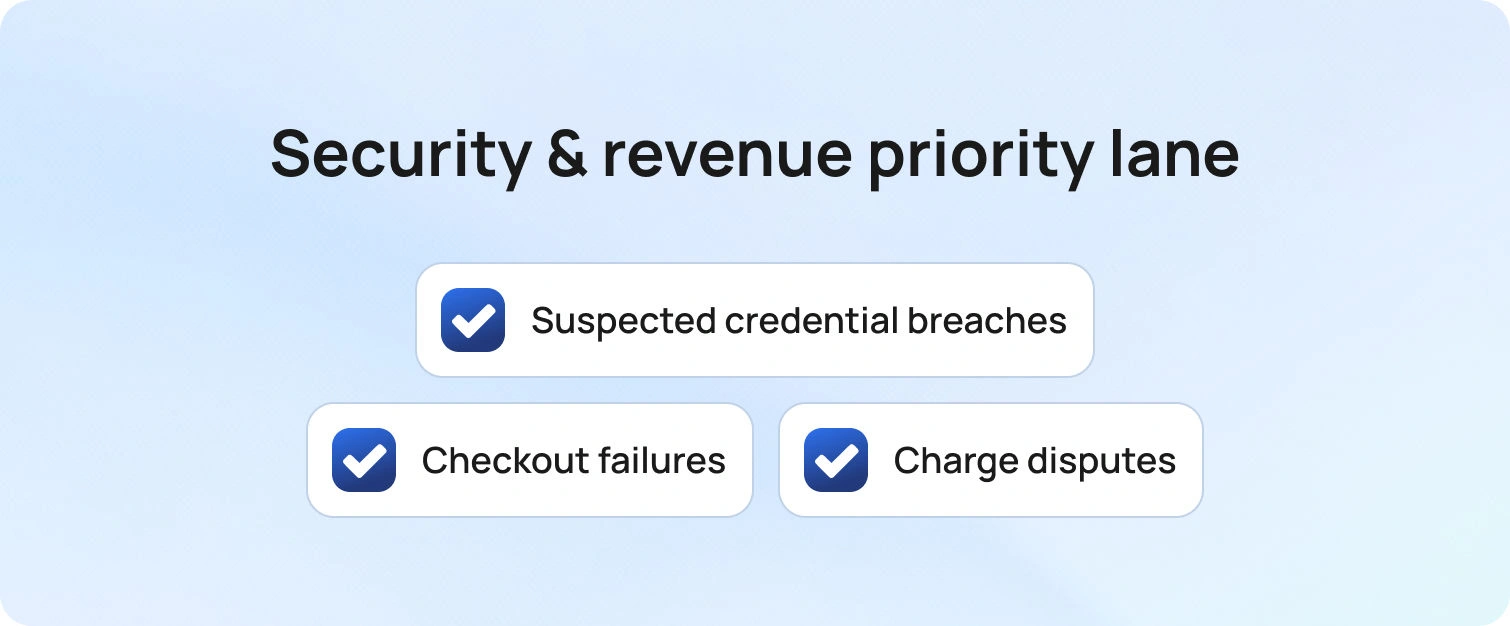
Some requests carry asymmetric risk to trust and revenue, and they deserve a dedicated path. Certain high-risk services require specialized handling and dedicated processes to ensure security and revenue protection. Suspected credential breaches, checkout failures, and charge disputes belong in a clearly labeled lane with higher visibility and faster decision cycles.
Agents working in this lane follow a focused containment checklist covering identity verification, immediate risk reduction, and notification. Customers see a precise next update time, leaders see exposure at a glance, and progress never stalls due to a lack of clarity.
Consistency matters as volume rises. Mark these tickets with priority-raising tags during training so judgment is predictable across shifts and teams. Routing should prioritize the shortest path to a qualified owner with the right tools and approvals, and every handoff should include a concise case summary, the gathered evidence, and the specific action requested. With this structure in place, time-to-containment drops, refunds, and reversals are handled cleanly, and confidence improves for both customers and auditors.
11) Practice sentiment handling
Emotions shape outcomes as much as facts, especially when customers feel stuck. Training should include realistic scenarios that model frustration, urgency, and relief, so agents recognize cues early and respond with steady, confident language. A simple three-part pattern keeps interactions on track: acknowledge the effort already made, state the action underway, and commit to a specific next checkpoint with a time-bound target.
This approach reduces escalation pressure and the risk that VIP cases linger without attention. Teams become predictable under stress, customers feel guided rather than managed, and leaders see fewer unnecessary transfers. Over time, consistent sentiment handling turns tense moments into opportunities to demonstrate care, competence, and follow-through. Recognizing and responding to customer emotions can also boost agent motivation and job satisfaction, helping maintain high-quality support and positive team morale.
12) Certify on the tools you actually use
Certification should reflect the work agents face every day. Industry-recognized certifications, such as CompTIA A+, and up-to-date software training are essential for maintaining high standards in help desk operations. Combine a concise overview of external frameworks with hands-on mastery of your own forms, macros, approvals, reports, and dashboards. Define clear pass criteria, such as completing an end-to-end identity verification flow, resolving a priority-two ticket while meeting timers, and submitting a change with the correct audit trail. Assessment becomes a demonstration of proficiency rather than a memory test.
A production-like sandbox with realistic data lets new hires practice safely and build confidence before they touch live tickets. Close the program with a short capstone scenario and a checklist that an evaluator can score in minutes. Issue an internal credential tied to specific capabilities and refresh it quarterly by reviewing changes to templates, routes, software updates, and policies. Managers gain visibility into readiness, time-to-independence declines, and agents begin live work with the muscle memory they need.
13) Pair rookies with situational mentors
Mentorship works when it is specific to the work. Mentorship programs engage new professionals by exposing them to real-world scenarios and accelerating their development within the help desk team. Instead of a vague buddy system, match each new agent with mentors for defined situations such as incidents, billing, identity, and VIP care.
The mentor’s brief is clear. Review two recent tickets each week, highlight one behavior to strengthen, and demonstrate the gold standard using a live example from your queue. Keep sessions to ten minutes so momentum is never lost, and capture the single improvement you expect to see in the agent’s next set of tickets.
Structure builds consistency. Provide a simple checklist for each situation that covers mission, scope, required evidence, and the expected customer update cadence. Schedule mentor office hours on the team calendar, rotate pairings monthly to broaden exposure, and record outcomes in a lightweight log that captures the coached behavior and the follow-up result. Over a few cycles, new agents gain confidence, handoffs get cleaner, and leaders can see readiness improve without pulling people away from the queue.
14) Turn QA into a learning engine
Quality review should be the shortest route from insight to improvement. Regular QA reviews help teams identify common challenges, such as training difficulties, role changes, and problem-solving complexities, and turn them into actionable lessons. Start with a small, representative sample each week and score it against a simple rubric covering verification, clarity of the first reply, completeness of the handoff, and accuracy of the final resolution.
Patterns matter more than one-off misses, so translate recurring gaps into bite-sized lessons and, when needed, minor edits to templates or knowledge. Each lesson includes an owner, an expected behavior change, and a date by which the update will be visible in the queue.
Closing the loop turns review into results. After two weeks, run a quick spot check on the same metric to confirm the shift, publish the before-and-after to the team, and capture any follow-up tweaks in a brief change log. Rotate the sample across intents and shifts to maintain fairness, calibrate reviewers regularly, and keep feedback specific enough that an agent can apply it to the next ticket. Over time, QA becomes a steady engine for sharper first replies, fewer reopens, and coaching that earns back more time than it consumes.
15) Cross-train with shadow days
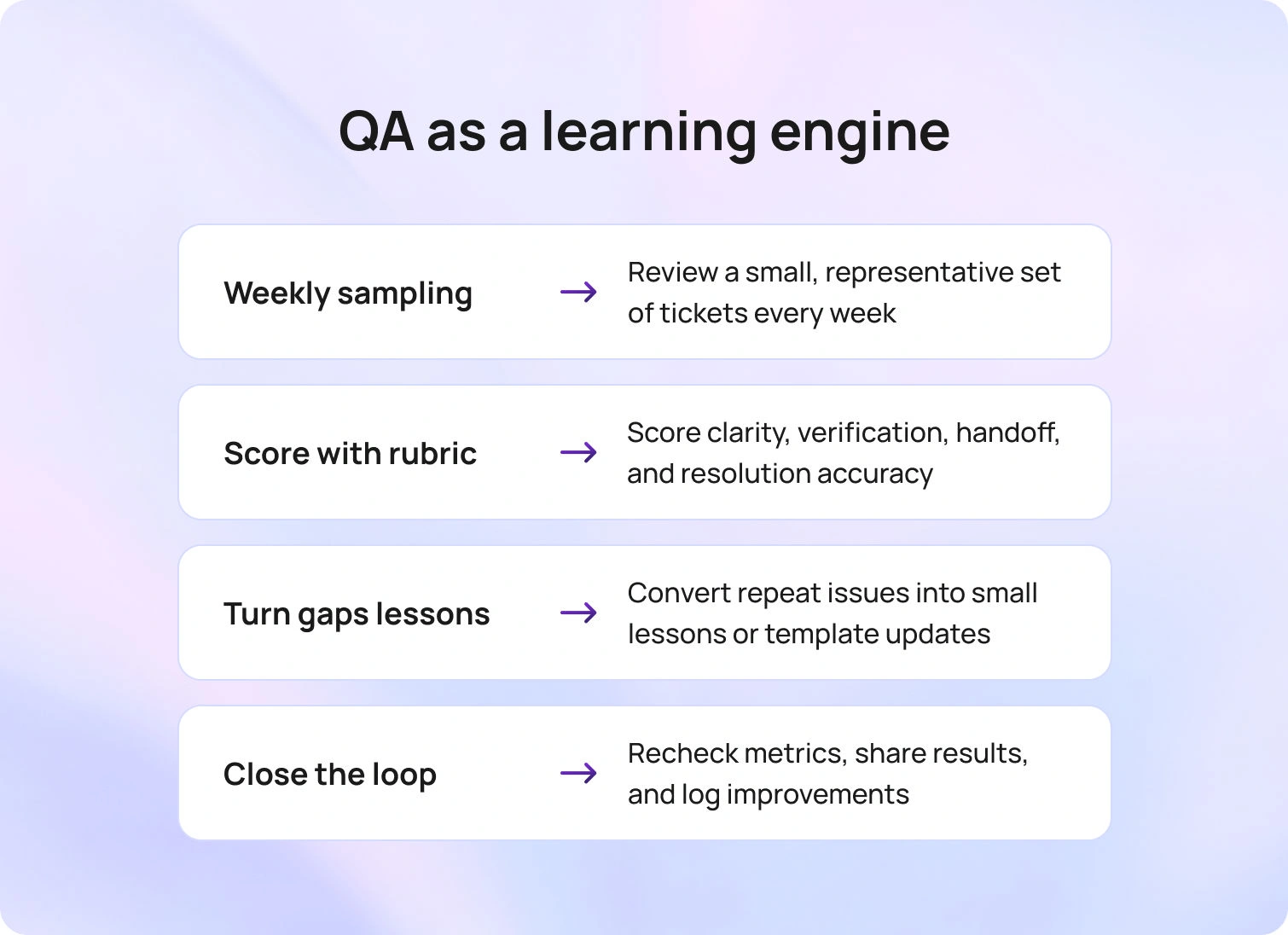
Understanding the work on either side of a ticket sharpens judgment. Rotate agents through adjacent queues for one day each month to see where requests originate and how downstream teams resolve them. The experience exposes hidden dependencies, clarifies what truly blocks progress, and reveals which details matter most to peers who are ready to take the next step.
Maintaining a transparent change log helps the entire organization stay aligned and informed about process updates.
Capture the learning while it is fresh. Ask for a five-question recap that names one upstream action that created extra work, identifies the single field that most often determines priority, lists the evidence that speeds approval, proposes one template improvement, and notes one behavior to try in the next shift. Over time, these short rotations produce cleaner handoffs, fewer avoidable transfers, and stronger prioritization under pressure.
16) Keep a public change log
Transparency speeds adoption and keeps everyone aligned. Publish a simple record of what changed in templates, forms, routes, and knowledge, along with the reason for the change and the specific metric you expect to move. Measuring the impact of training on the help desk team and desk team is essential for continuous improvement. When the log is easy to find and written in plain language, agents know which behaviors to adjust, leaders can trace decisions, and coaching conversations stay anchored in facts rather than preference.
Consistency matters as much as content. Update the log as part of the release process, link entries from the places agents work, and reference it during standups and one-to-ones. Over time, the log becomes institutional memory, reducing tribal knowledge, shortening onboarding, and clarifying why service levels and satisfaction improved.
17) Measure training ROI in the live queue
Results belong in the queue, not only in a slide deck. Choose one behavior to improve, such as adding a precise next update time in the first reply, publishing the lesson on Monday, and tracking movement for two weeks in first contact resolution, average handle time, and reopen rate. Keep scope tight by focusing on two or three high-volume intents so the signal is clear.
Share what you find in the same rhythm every time. Post a short note with the before and after numbers, a screenshot of the trend, and one sentence that explains what changed. If results are flat, refine the lesson or template and rerun the test. Measured this way, training earns calendar time and budget because the link between practice and performance is visible to everyone. Consistently improving support quality in this way helps build loyal customers over time.
How BlueHub Helps You Execute Help Desk Training
BlueHub (by BlueTweak) turns training into everyday execution by placing guidance exactly where work happens. As a comprehensive service desk solution, BlueHub integrates training, knowledge, and performance management to support best practices in support team management. Simulations run in the same workspace agents use for tickets, keeping practice realistic and making results easy to compare over time. Knowledge is mapped to forms and intents, so the moment an agent opens a ticket, the correct article appears, and suggested replies include the precise steps the customer needs. Templates live beside every case and automatically merge
The next update time, turning your three-message standard into a consistent habit that reduces follow-ups and clarifies ownership. Routing aligns skills, language, and risk tags to move work along the shortest path to completion, while VIP exposure and service timers keep promises visible to agents and leaders. Quality findings translate into brief lessons that agents complete between tickets, and analytics connect each lesson, template, or routing adjustment to movement in first-contact resolution, handle time, reopen rate, service-level attainment, and VIP aging. In one platform, BlueHub unifies training, knowledge, routing, and measurement so you can see the lift without pausing operations.
From Intent to Impact, Fast
You set out to learn how to train help desk staff to protect first-contact resolution, lower handle time, reduce reopens, and keep VIPs visible while the queue keeps moving. The practices in this guide give you a compact, durable program that integrates into your current workflows. You now have simulations that reflect real intents, knowledge capture that improves every day, short lessons that use spacing for retention, and coaching tied to five clear operational metrics.
The outcomes are practical and measurable. Teams that train where the work happens move faster and work more calmly. Investing in well-trained employees leads to more efficient operations and higher customer satisfaction. The core lesson is straightforward. Clear role cards, short, focused lessons, and visible timers change behavior more reliably than long courses.
Begin with a role card for each seat, publish 3 standard messages for each top intent, and select one metric to improve over the next two weeks. Log every change, share the result, and repeat. Keep language clear, keep scope tight, and align every lesson to live tickets. BlueHub brings training, knowledge, routing, and analytics into one place so you can see the lift and keep it. Ready to translate intent into performance? Request a BlueHub demo and get a starter plan mapped to your top intents.

How To Use AI In Customer Service For Personalized Experiences
A Practical Approach to AI in Customer Service
Many teams want the benefits of AI without turning support into a lab experiment. The reality on the ground is tool sprawl, fragmented workflows, and unreliable answers that don’t meet customer needs, pushing agents back to the phone.
AI technology, such as chatbots and natural language processing, is transforming customer service by providing scalable, efficient, and 24/7 support across digital and omnichannel retail strategies.
AI creates value when it assists people. The objective is not blanket automation; the objective is consistent personalization across channels to ensure that AI improves customer service. It is crucial to design and implement reliable AI systems that can adapt to various customer service scenarios, ensuring they understand and process customer interactions effectively.
That means adapting content, tone, routing, and actions to customer context, then proving impact with meaningful KPIs:
- First Contact Resolution (FCR)
- Average Handle Time (AHT)
- Abandon Rate
- Recovery within 24 hours
- CSAT and CES
By automating routine tasks and enabling more strategic, personalized support, AI is transforming customer service and allowing representatives to focus on higher-value interactions.
This guide explains the core concepts behind effective AI in customer service, the key tradeoffs to manage, and a step-by-step path to implementation that preserves your current workflows while raising performance.
What Is AI-Powered Personalized Customer Service?

AI-powered personalized customer service is the use of artificial intelligence to adapt content, tone, routing, and actions based on customer context.
It’s about delivering the correct response in the right tone through the right channel with the proper follow-up action. And then measuring whether that approach actually improved customer satisfaction and support operations.
To make personalization work at scale with your customer service operations, you need a few foundational pieces:
Unified customer profile: Every interaction should pull from a single source of truth: order history, open cases, language preference, lifecycle stage, entitlements, and channel behavior. No more asking customers to repeat themselves.
Knowledge-base-grounded generation: AI answers must be anchored in your actual policies and procedures, not hallucinated out of thin air. If the AI doesn’t know, it should say so or route to a human agent.
Policy-safe actions via APIs: Personalization is hollow without execution. AI should trigger actions (refunds, reships, reschedules) within policy limits, with approval workflows for any risky actions.
Consent and governance: Capture only the customer data you need, document consent, respect retention rules, and ensure compliance across every channel.
Training and continuously refining AI modelswith relevant customer data is essential to improve personalization and adapt to changing customer needs.
Machine learning enables AI to learn from customer interactions, analyze data, and improve responses over time, making support more accurate and efficient.
When these pieces work together, you get:
Faster first-right answers: Agents (or AI agents) pull the correct policy, apply the proper tier limits, and respond in the customer’s preferred language.
Fewer transfers: Smart routing sends VIP customers, non-English speakers, and high-risk orders to the correct queue or specialist from the start.
Consistent tone across channels: Whether the customer reaches you via AI customer service chatbot ,AI voicebot, or email, the experience feels cohesive, not like dealing with three different companies.
This is the foundation. Everything else builds on it. Effective customer service requires ongoing monitoring, integration of AI with existing workflows, and collaboration between human agents and AI systems.
Why AI Customer Service Matters for Personalization
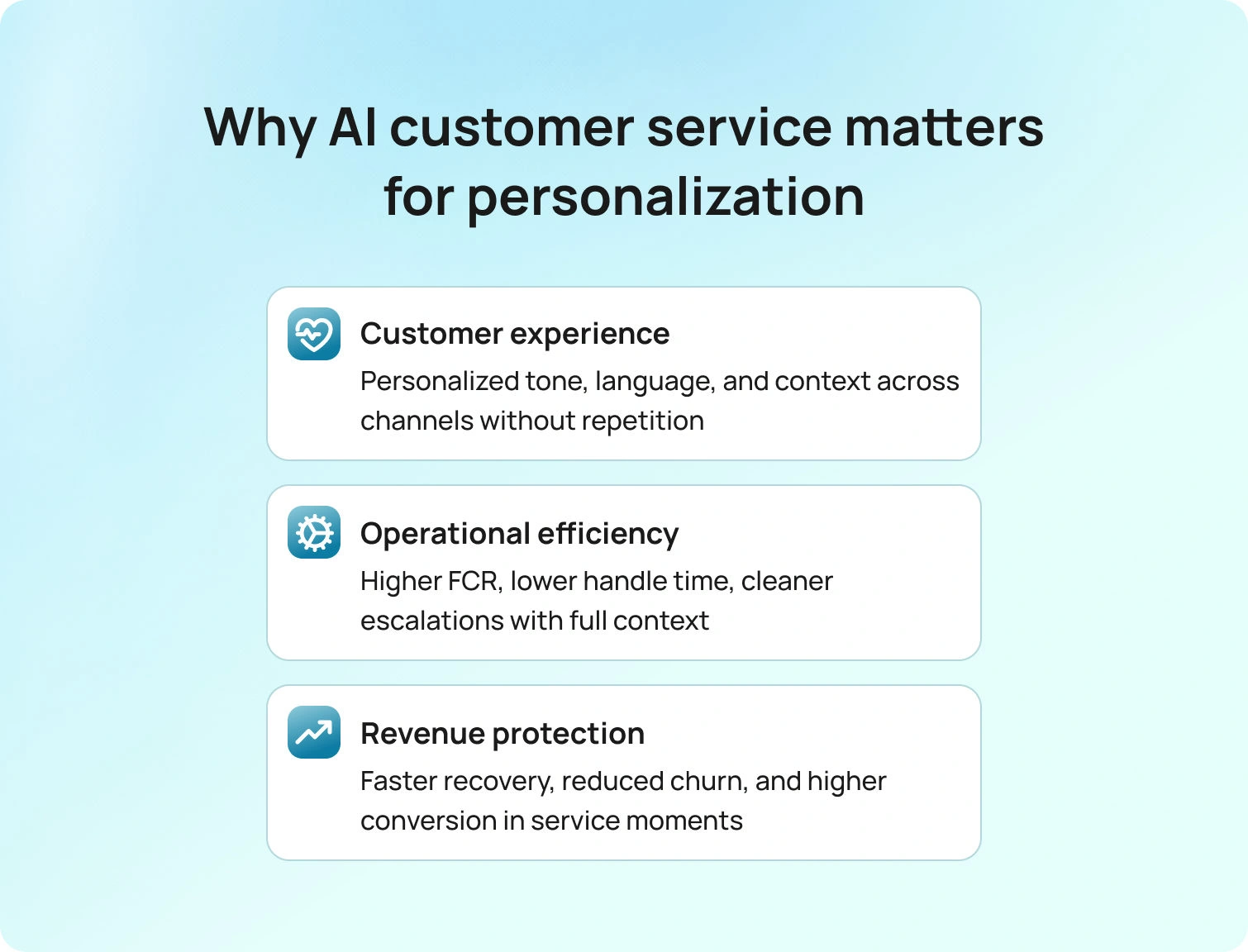
Personalization isn’t a nice-to-have anymore. It’s a measurable lever for three outcomes that matter to every support leader: customer service experience, operational efficiency, and revenue protection. Adopting innovative customer service strategies that leverage AI technology enables organizations to meet evolving customer expectations and deliver more personalized support.
- Customer Experience
AI enables businesses to deliver exceptional service by providing personalized, seamless experiences across both online and offline channels, meeting or exceeding customer expectations.
- Operational Efficiency
AI-powered customer service solutions can integrate with existing CRM platforms using APIs or connectors to automate routine tasks, enhance support efficiency, and personalize responses.
- Revenue Protection and Growth
1. Customer Experience (CX)
Customer expectations have gone up. They expect you to know who they are and what they need. When AI delivers the correct language, tone, and context continuity across channels, customers feel heard. They don’t have to repeat themselves. They don’t get stuck in loops. They get answers that actually solve their problems.
AI tools also enhance customer engagement by providing real-time, proactive support across multiple channels, helping to build long-term loyalty and deeper connections with the brand.
This is where natural language processing and analyzing customer data come into play. AI tools that understand customer sentiment and detect emotions can adjust tone on the fly: empathetic for service failures, concise for transactional requests, and encouraging for complex troubleshooting. AI can analyze customer sentiment to better understand and interpret customer emotions and opinions, allowing businesses to personalize interactions more effectively.
All these AI-driven capabilities contribute to improving customer satisfaction by streamlining support, reducing wait times, and delivering more personalized service.
2. Operational Efficiency
Personalization drives the metrics that keep your cost center in check:
Higher FCR and Containment: When AI surfaces the correct answer (grounded in your knowledge base) and executes the right action, customers don’t come back with the same issue. In contact centers, these AI-driven efficiencies allow human agents to focus on more complex customer issues, improving customer relationships through better understanding and support.
Lower AHT and Abandon: Customer support automation handles routine inquiries at scale, freeing human agents for complex issues. AI excels at handling routine inquiries, streamlining operations, and reducing wait times. Support agents benefit from AI automation, as it enables them to dedicate more time to high-value interactions, improving overall support efficiency. Faster resolutions mean shorter handle times and fewer customers hanging up in frustration.
Cleaner escalations: When AI escalates to a human, it passes along complete context, including the customer profile, past interactions, AI ticket summary, and sentiment analysis.
3. Revenue Protection and Growth
AI in customer service isn’t just a cost play. It’s a revenue play.
Better recovery on negative experiences: When a delivery fails or a product breaks, personalized AI can detect the issue, trigger proactive outreach, and offer the correct resolution (exchange, refund, discount) before the customer churns. Predictive AI can anticipate customer needs and enable businesses to reach out proactively, addressing issues before they escalate. Recovery within 24 hours correlates directly with customer retention.
Higher conversion on service-adjacent flows: Customers who reach out about exchanges, renewals, or upgrades are already engaged. Personalized support, powered by predictive analytics and customer behavior insights, can guide them toward the best outcome for both parties. Adequate AI-driven support leads to customer success by ensuring better outcomes and higher satisfaction.
Personalized AI support also helps businesses build stronger customer relationships by fostering trust, loyalty, and deeper engagement.
5 Ways to Use Customer Service AI to Move Metrics
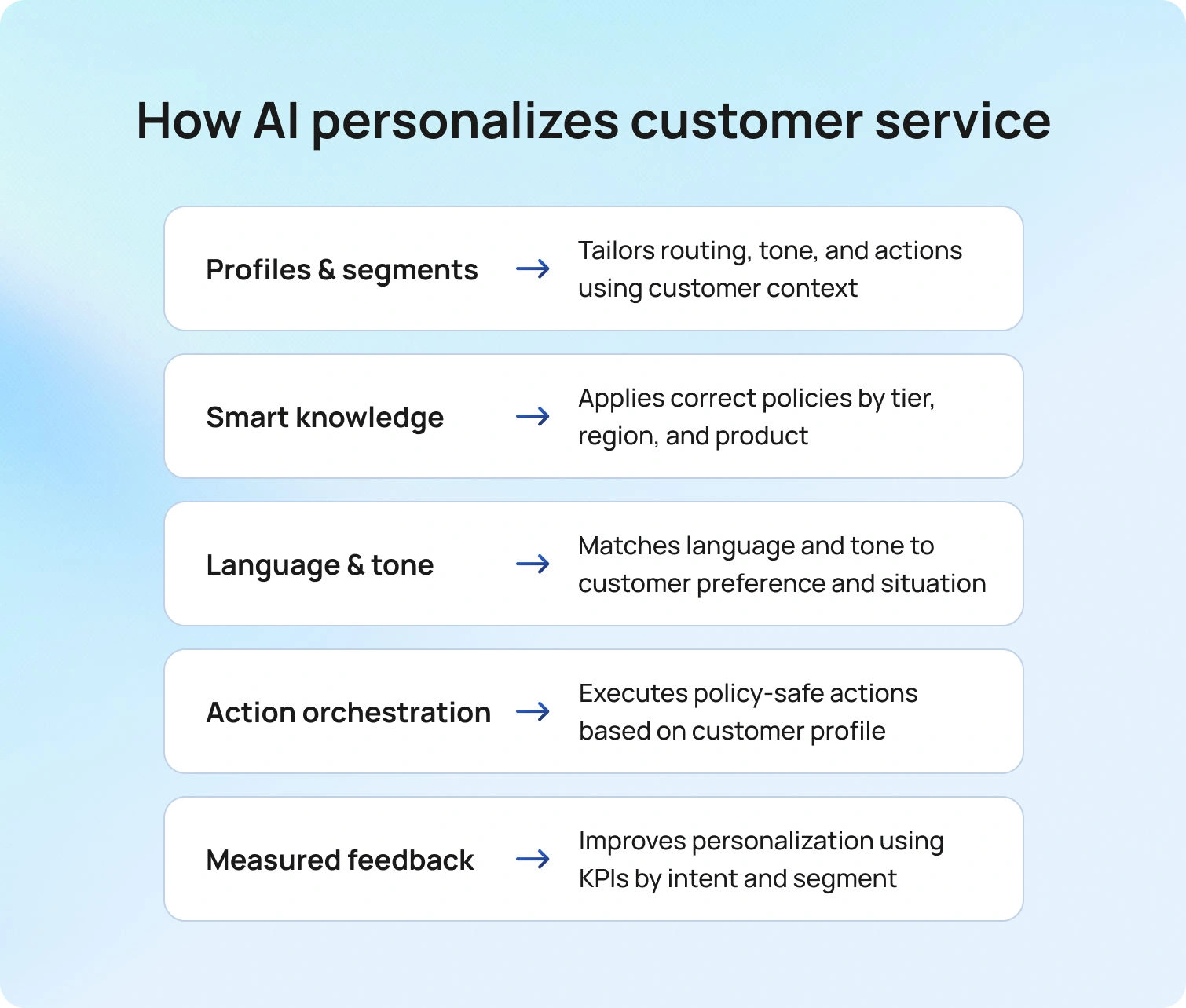
Alright, let’s get tactical. AI tools are designed to enhance and streamline various customer service functions, making support more efficient and responsive. With AI, customer service offers such as faster response times and improved support are now possible, addressing common challenges like long wait times.
In this context, customer service refers to the integration of AI technologies to automate responses, support agents, and improve the overall customer experience. Here are the five building blocks you need to deliver AI-powered personalization that shows up in your dashboards.
1. Profiles & Segments
Personalization starts with knowing your customer. But knowing doesn’t mean hoarding every data point you can grab. It means capturing only the data necessary to adapt the service effectively.
What to capture:
- Lifecycle stage - First-time buyer? Repeat customer? At-risk for churn?
- Tier and entitlements - VIP? Standard? What are their refund limits, warranty terms, and RMA windows?
- Language and location - Preferred language, time zone, and regional policies.
- Order and case history - Recent purchases, open tickets, past interactions.
- Channel preferences - Do they prefer chat, email, or phone?
- Customer preferences - Capture preferences from customer interactions to tailor support and product recommendations.
Document consent for everything. Respect retention rules. Use only what you need.
How it personalizes:
Routing: VIP customers, non-English speakers, and high-risk orders jump to the correct queue or specialist. Call center workforce management becomes smarter when routing is driven by actual customer context.
Tone and template: A customer with a recent delivery failure gets a “Recovery” tone (concise, apologetic, time-bound). A new user gets a “Guidance” tone—step-by-step, encouraging. Canned responses and suggested replies adapt automatically.
Actions: Tier-based limits drive what’s offered. A VIP might get a no-questions-asked refund; a standard customer gets an exchange. Policy rules are baked into the system, not left to agent discretion.
Analyzing profiles and segments helps businesses understand customer behavior, enabling more relevant and practical support.
This is the foundation of every personalized interaction. Without a unified customer profile, you’re just guessing.
2. Smart Knowledge Base
Your knowledge base is the single source of truth for every answer your team (human or AI) gives. If it’s not in the KB, it shouldn’t be said.
AI-powered chatbots use a knowledge base to respond to customer queries instantly, providing automated, accurate answers in real time. These AI systems can also handle initial customer inquiries by leveraging the knowledge base to deliver fast, consistent responses as the first point of contact.
Still, your KB can’t just be a static library of articles. It needs to be policy-aware, parameterized, and version-controlled to support customer service chatbots effectively.
What that means:
Policy-aware articles: Every KB entry should know the rules: return windows by tier, warranty coverage by product, and refund limits by region. When AI pulls an answer, it applies the right policy before composing the response.
Parameterized with variables: Instead of writing 50 variations of “Your return window is X days,” write one article with a variable: “Your return window is {tier.return_window} days.” The system fills in the blank based on the customer’s profile.
Failure states included: What happens if the customer is outside the return window? If the product isn’t eligible for warranty, what should I do? The KB should cover edge cases, not just happy paths.
Citations and sources: Every answer should be traceable back to an authoritative source. This prevents hallucinations and makes customer service quality assurance way easier.
How it personalizes:
Policy-aware answers: AI applies the right policy by tier, region, and product before generating a response. No more generic “Please contact us for details.”
Proposed reply (KB-based): Instead of agents typing from scratch, AI suggests a reply grounded in the KB (pre-filled with the customer’s specific details) and the agent approves or tweaks it. This is where the AI ticket summary and suggested reply help.
Drift control: Update one KB article, and the change cascades across chat, voice, email, and templates. No more version drift between channels.
Article proposal: When AI detects recurring customer questions or content gaps, it suggests new KB articles for your team to approve. This keeps your KB fresh without manual guesswork.
A smart KB enforces answers. And that’s how you scale quality.
3. Language & Tone
Getting the correct answer is half the battle. Delivering it in the correct language and tone is the other half.
Language matters.
If your customer base is global, you need multilingual customer support that translates and adapts the entire experience.
AI detects the language of each incoming message and replies in that language. No language-selection menus. No awkward handoffs.
Call transcription software identifies the caller's language early (even mid-call) and adjusts ASR (speech recognition) and TTS (text-to-speech) for the rest of the conversation. High-service-qualityAI voicebot systems can route to the appropriate queue or agent without forcing the customer to press buttons.
Tone matters even more.
The same answer delivered in the wrong tone can tank customer satisfaction. AI needs to switch tone by scenario:
Recovery tone (for service failures): Concise, apologetic, time-bound. "We're sorry your order was delayed. We've already issued a refund and upgraded your shipping for next time."
Guidance tone (for onboarding or troubleshooting): Step-by-step, encouraging, patient. "Let's walk through this together. First, check that the device is plugged in..."
Transactional tone (for quick confirmations): Brief, confirmatory, no fluff. "Done. Your subscription renews on March 15th."
Standardize salutations, sign-offs, and empathy phrases by segment and channel. This guarantees every customer interaction feels consistent, whether they're chatting with a human agent, an AI customer service chatbot, or reading an email.
How it personalizes:
By matching language and register to the customer's preference and customer history, you eliminate friction. Customers feel understood. And when they feel understood, they're more forgiving when things go wrong.
4. Orchestration & Actions
Personalization without action is just theater. If AI tells a customer "You're eligible for a refund," but the agent still has to log in to three systems to process it, you've gained nothing in enhancing customer satisfaction.
What orchestration looks like:
Map every primary intent (customer requests, return inquiry, subscription change, appointment reschedule) to a policy-safe API call. AI suggests the action, checks it against policy limits, and either executes it automatically or routes it for approval.
Examples:
- If the refund is under the tier-based threshold, AI processes it instantly. If it's over, it routes to a supervisor with full context.
- AI checks inventory, confirms eligibility, and triggers the action. No agent hunting through systems.
- Upgrade, downgrade, pause, all driven by APIs that respect entitlements and billing rules.
- High-value customers and churn-risk cases get routed to specialists. First-order issues with save opportunities get flagged for customer support teams.
How it personalizes:
- Instead of offering the same options to every customer, AI tailors the offer to each customer's segment value and policy. A first-time buyer with a damaged product might get an exchange and a discount code. A repeat VIP might get a refund, no questions asked.
- If sentiment analysis detects frustration or churn risk, the system routes to a specialist who can intervene. Customer service analytics feed these routing decisions in real time.
This is where AI can enhance customer service. And it's all enabled by a robust ticketing system and administration layer that enforces policy, tracks approvals, and logs every action for compliance.
5. Measurement
If you can't measure it, you can't improve it. And if you can't prove ROI, you won't get budget to scale.
What to measure:
Report on these KPIs by intent × channel × segment × language:
First Contact Resolution (FCR): What percentage of issues are resolved in the first interaction?
Average Handle Time (AHT): How long does each interaction take?
Abandon Rate: How many customers hang up or leave the chat before resolution?
Containment: What percentage of customer inquiries are resolved by AI without escalation?
Recovery ≤24h: For service failures, how quickly do you resolve and recover the customer?
CSAT / CES: What do customers say about the experience?
Review defects twice a week. Look for patterns: specific intents, languages, or segments where performance drops. Feed winners back into canned responses, routing rules, and call center workforce management. Retire what doesn't move KPIs.
How it personalizes:
When you measure by segment and intent, you can personalize at scale. You learn that Spanish-speaking customers prefer phone over chat. VIP customers abandon when wait times exceed 30 seconds. First-time buyers need more guidance on returns.
Customer service analytics and customer service quality assurance tools make this possible. Without them, you're flying blind.
The customer feedback loop is simple: measure → learn → adjust → repeat.
That's how operational personalization becomes a competitive advantage.
How BlueTweak Helps You Implement This Playbook

Everything we’ve covered requires one place to store context, ground answers in policy, route by language, skill, and value, execute safe actions, and measure deltas by segment and intent.
That’s what BlueTweak is built for.
BlueTweak is an omnichannel customer service solution for chat, voice, and email, with an AI-ready knowledge base, intelligent routing, approval workflows, customer service analytics and quality assurance, and open APIs for orchestration.
Why it matters to this playbook:
Profiles & Segments: Unified intake and routing across every channel. Customer profile data flows through every interaction.
Smart KB: Grounded answers with variable limits and policy awareness.Suggested reply and canned responses pull directly from your KB.
Language & Tone: Multilingual customer support with tone adaptation by scenario. Call transcription software and AI voicebot capabilities ensure consistency across voice and text.
Orchestration & Actions: API-based task execution with guardrails. Customer support automation handles routine tasks; humans handle exceptions.
Measurement: Customer service analytics by intent × segment × language. Administration and call center workforce management dashboards close the loop.
BlueTweak's customer service solution doesn’t force you to rip and replace your entire stack. It integrates with your existing tools and gives you a control layer that makes AI-powered personalization operational, not aspirational. Seamless integration with your current platforms enhances operational efficiency and customer experience by unifying workflows across channels. BlueTweak also empowers service professionals by enabling collaboration between AI and human agents, ensuring high-quality support for complex customer needs. You can check out transparentpricing to see the exact operational costs to get started.
Conclusion
This isn't about replacing your human customer service teams. It's about equipping them with AI tools that handle routine tasks, surface the proper context, and suggest the best action. This helps them focus on what humans do best: empathy, judgment, and complex problem-solving.
Ground every customer interaction in your knowledge base. Track results by intent, channel, segment, and language to improve service delivery. Wire the deltas back into templates, routing, and workforce management. Then iterate.
That's how you use AI in customer service to boost results. Not by chasing the latest conversational AI trend, but by building an AI system that learns, adapts, and proves its value every single day. Request a demo, and we'll show you how BlueTweak turns AI complexity into operational clarity.

How To Manage A Help Desk Team At Scale Without Burning Out Agents
Why Scaling a Help Desk Team Without Burnout Matters
Backlogs rarely explode overnight. They creep in when intake is vague, routing is manual, and communication is inconsistent. Customers feel it first through slow responses, unclear timelines, and avoidable escalations. Agents feel it next as repetitive tasks multiply, context switching increases, and breaks vanish. Leaders feel it last when SLAs slip, customer satisfaction scores dip, and hiring cannot keep up with churn.
A healthy help desk does three things well. Delivering high-quality service through consistent standards and meeting customer expectations is essential for long-term success. It shapes demand with self-service and knowledge. It moves real work to the right people with predictable rules. It protects capacity with schedules, coaching, and sensible metrics. Help desks serve as centralized hubs for technical issue resolution and internal IT support, streamlining ticket management and enabling proactive support. Do those three at scale, and the customer experience improves while the team’s energy stops leaking away.
Adopting industry best practices and benchmarking against recognized standards is essential to ensure help desk operations consistently meet customer expectations and deliver exceptional customer experiences. Engaging key stakeholders, including customers, business leaders, and IT teams, is crucial to ensuring quality and compliance in service delivery.
This article provides a practical operating model for managing a help desk team across multiple channels, brands, and time zones. You will see the structures, playbooks, and tools that keep service desk operations calm and consistent, plus the habits that prevent burnout without sacrificing speed.
The Management Operating System: 9 Pillars
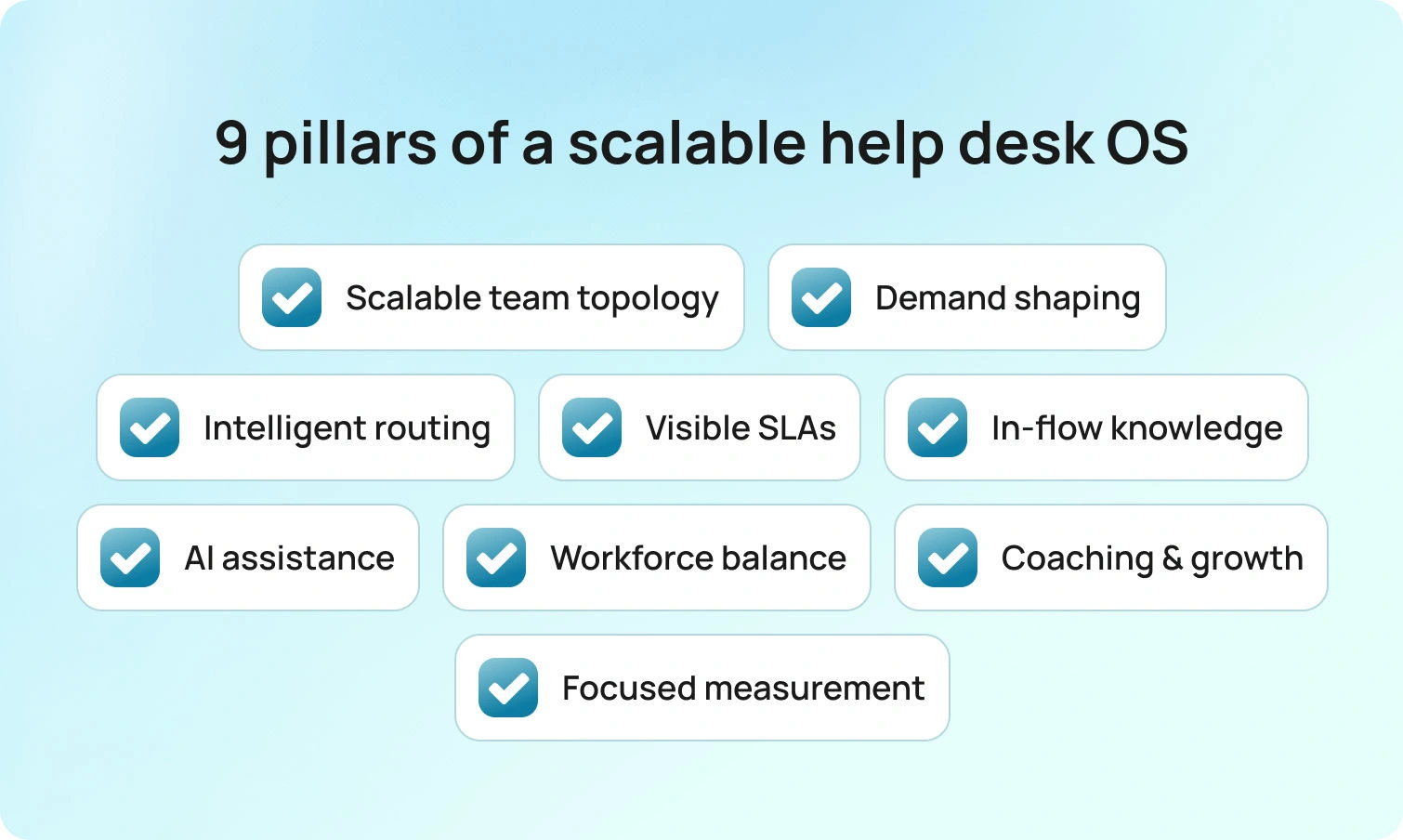
These pillars show exactly how work moves from intake to coaching, so your team resolves faster, communicates clearly, and stays healthy as volume grows.
The operating system is built on key strategies and a commitment to continuous improvement to optimize help desk performance.
1) Team Topology That Scales
A service desk team runs more smoothly when roles are explicit and light, with each team member’s responsibilities clearly defined to enhance efficiency and accountability. Assigning specific duties and automating repetitive tasks for each team member further improves team efficiency and ensures accountability. L1 (frontline) handles verification, triage, and well-documented fixes; L2 (specialists) takes on deeper diagnosis, configuration changes, and cross-team coordination; L3 (engineering or vendor) owns product defects and durable fixes.
Empowering support agents through ongoing training and fostering a supportive workplace culture enables them to provide more effective customer support. Providing tailored training, soft skills development, and regular feedback mechanisms for help desk agents enhances customer service and operational efficiency. During peak hours, a triage role monitors the firehose and filters incoming tickets before they reach the queues. A rotating desk captain manages spikes, approvals, and vendor blockers, so agents stay focused on cases rather than on orchestration.
For IT service desk teams, assign name owners for incidents, requests, problems, and changes, even if they sit in the same pod. The IT service desk team plays a critical role in managing system changes, minimizing disruptions, and ensuring effective communication with users. That clarity cuts back and forth, speeding service requests that cross other departments.
Artifacts to copy:
Role cards with mission, scope, and handoff rules. L1 = verification and documented fixes; L2 = advanced diagnosis and configuration; L3 = defects and durable fixes. Clear handoff triggers keep work moving without debate.
On-call calendar and escalation matrix with names and targets. One live schedule shows who covers each domain and the expected acknowledgment time, while the matrix maps severity paths and after-hours behavior, so the next step is obvious.
Captain’s checklist (daily forecast, coverage, blockers, top risks). A single page aligns staff to peaks, surfaces dependencies, and flags likely trouble—so the plan is posted early, agents stay focused, and customers stay informed.
2) Shape Demand at the Front Door
Volume is not solely determined by headcount, but at the point of entry. Intake forms should collect system, location or brand, urgency, entitlement, steps taken, and the appropriate attachment types. A help desk system can streamline the collection and management of support requests by ensuring all relevant information is captured at the point of entry. Conditional fields keep simple requests quick and expand for complex ones.
The self-service portal should suggest answers inside the form based on keywords and categories, not after submission. Self-service portals empower users to resolve common issues independently, reducing agents' workload and improving overall efficiency. Customers get help faster, and agents avoid preventable ping-pong.
Add a short pre‑submission checklist for common use cases, such as password resets, access requests, device swaps, or VPN access. Pair it with a self-service knowledge base that includes screenshots matching today’s UI. Tie each article to the same fields the form expects. The effect is immediate: fewer tickets for repetitive tasks that drain energy, and better starting data for the remaining tickets.
Micro‑templates:
Short, copy-and-paste prompts you can add to your intake form and portal to reduce back-and-forth and improve first-touch quality.
- Field hint: “Attach a screenshot of the exact error dialog. Please redact personal data.” Why: reduces back-and-forth and speeds up first response.
- Attachment rule: “Logs accepted: .txt or .log, max 5 MB. For screenshots, use .png or .jpg.” Why: prevents unusable files and repeated requests.
- Pre-check (password/MFA): “Tried self-reset and device restart? If not, run both now and note results.” Why: deflects quick wins and gives L1 precise starting data.
- Pre-check (access request): “Manager approval attached, role requested, start date confirmed, justification provided.” Why: stops approvals from stalling in the queue.
- Error copy capture: “Paste the exact error text or code shown on screen.” Why: improves searchability and knowledge suggestions.
- Privacy note: “Remove personal identifiers from attachments. If unsure, tick ‘redaction needed,’ and we will guide you.” Why: protects data and sets expectations.
- Submit blocker: “Almost there: select your device type and add a screenshot to continue.” Why: ensures completeness at the door instead of in the queue.
Deflection success copy: “This article should resolve the issue. If not, submit the form, and we will pick up with these details.” Why: keeps the path clear, regardless of whether self-service works.
3) Route By Skill, Language, and Risk
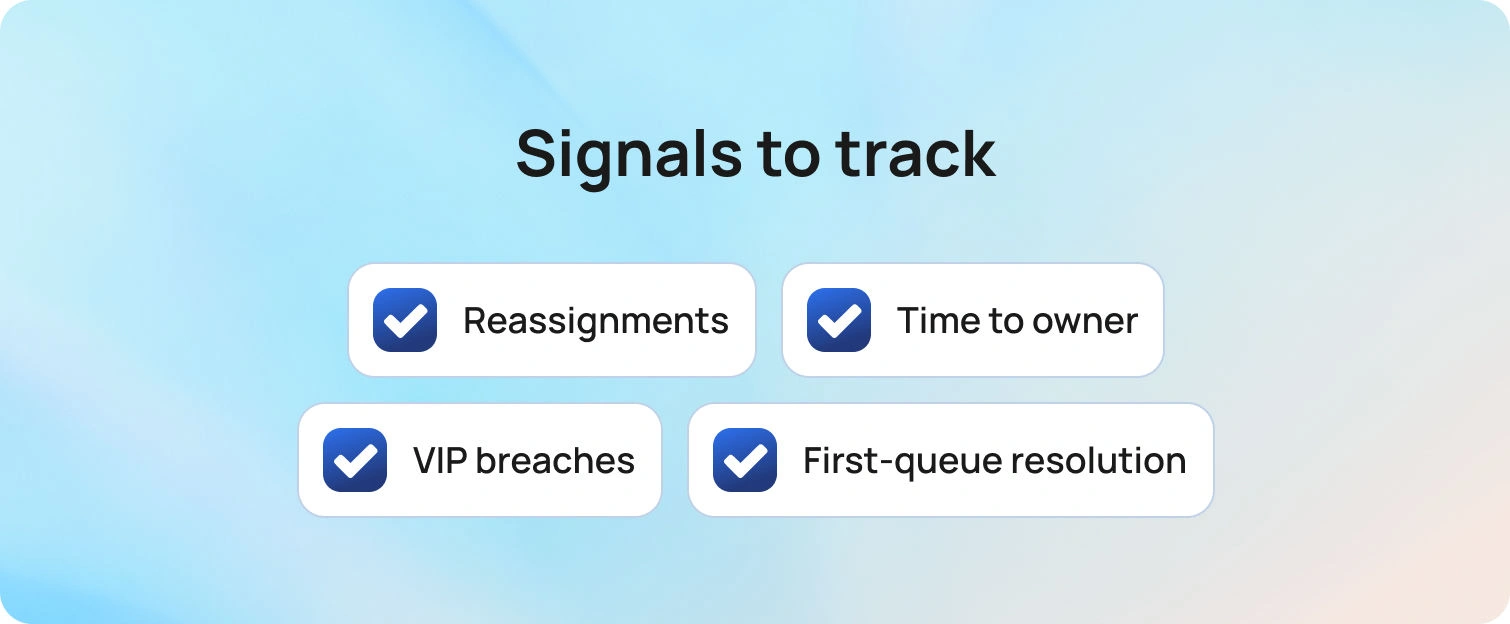
Routing sets the queue’s rhythm. Start by automatically classifying intent, detecting language, and assigning priority based on real impact, blending severity with customer tier. Automated ticket routing is essential to ensure support requests are directed to the right agents quickly, streamlining workflows and reducing response times.
Complex work should be assigned to specialists who can complete it without handoffs, while repeatable requests should flow to the team with the quickest, most reliable closure. VIP items deserve a dedicated view with clear timers so they never get lost amid low-impact work. Clear ownership, visible priorities, and short paths to the right expertise turn routing from a guessing game into a steady heartbeat the whole team can trust.
Keep the model simple and consistent across channels. Queues organized by intent and risk make the workload visible at a glance, helping leaders balance capacity early and helping agents manage tickets efficiently across multiple channels, so they can focus on what they do best. Service requests that require approval can be paused in a pre-approval lane with automated reminders, while incidents move directly to action with the next step already defined. The outcome is fewer reassignments, faster first qualified touches, and more predictable resolution times.
Signals to track: reassignments per ticket, minutes to first qualified owner, VIP breach ratio versus overall, and the percentage of tickets resolved in their initial queue.
4) Make SLAs and Communication Visible
SLAs work only when clocks are visible, and status language is plain. Put the first-response and resolution timers in the same view that agents use all day. Trigger reminders before a breach and send concise, clear status updates. Utilize multiple communication channels, such as email, phone, social media, and live chat, to keep stakeholders informed with timely updates. Keep the status model simple: New, In progress, Pending customer, Waiting on vendor, Resolved, Closed.
Build a customer communication playbook with three reusable templates per intent: first response, progress update, and delay notice. Map each to a target time and a trigger. Proactive communication is essential for building trust, so ensure your playbook supports this approach. Customers trust timelines when messages arrive at consistent moments, delivering consistent updates, and match what they see in the customer portal.
Copy‑ready lines:
- First response: “We are investigating and will update you by 14:00 local time.”
- Delay: “We are waiting for vendor logs and will check again at 10:00.”
5) Put Knowledge Where People Actually Work
Knowledge works when it is concise, current, and accessible. Articles should mirror the live UI and list the exact fields and commands. Surface them in the portal during submission and in the agent console during handling. Use a one‑click rating or a two‑line comment to collect customer feedback and agent notes. When agents deviate from the article path, nudge the owner to review the deviation. Short edits made weekly beat lengthy rewrites that never ship.
Pair the knowledge base with a brief author’s guide: scope, title pattern, verification step, expected output, and related issues. Implementing effective knowledge management systems is essential for capturing and sharing expertise, ensuring that valuable information is accessible across the organization.
That shared structure keeps desk agents writing consistently, fosters a culture of knowledge sharing among team members, and gives customer service teams confidence that articles will match reality.
6) Use AI to Remove Toil Without Removing Judgment
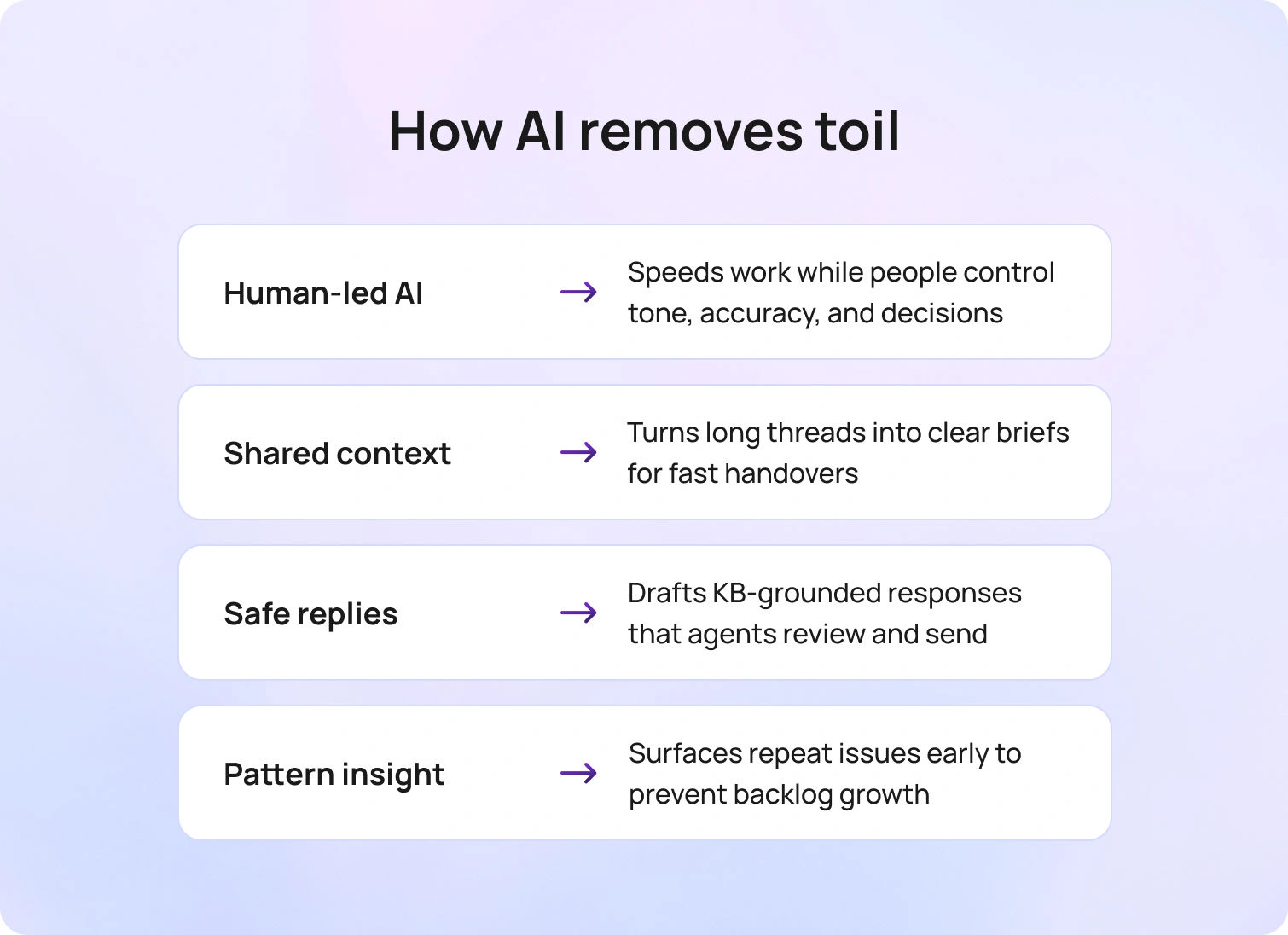
AI should feel like a strong assistant, not a replacement. The goal is to build momentum: faster context understanding, quicker first drafts, and fewer repetitive steps, while people retain control of tone, accuracy, and final decisions.
Context comes first. Long email chains and chat logs collapse into a short, brief that states what happened, what is blocked, and what to do next. Shift handovers no longer feel like cold starts because the next analyst sees the same concise snapshot, linked to the ticket and the relevant knowledge article. When a customer writes in a different language, automatic detection and in-place translation keep everyone in the same conversation without exporting text to another tool.
Drafting then becomes easier, not risky. Suggested replies are pulled from approved knowledge and current SOPs, so the wording stays on-brand and citations point to the exact article section that supports the answer. Agents review, personalize, and send, so response time drops without sacrificing the human judgment customers expect. When a fix requires command or policy text, the draft includes the exact snippet and a short explanation of why it applies, reducing back-and-forth.
Voice should not be a blind spot. Call transcription is stored in the same record as chat and email, so the entire history is visible to the entire team. Follow-ups no longer start with “what did we say on the call,” and problem investigations have the quotes and timestamps needed to move faster. Repeated phrases and error codes are searchable, enabling practical clustering and trend analysis in day-to-day work. AI-powered predictive support can anticipate ticket volumes, detect anomalies, and recommend preventive actions, helping teams proactively address issues before they escalate.
Patterns deserve attention, too. Auto-clustering highlights repeat tickets by symptom, device, version, or region, helping leaders identify a root-cause candidate before the backlog swells. A brief weekly review highlights key cluster insights, such as knowledge updates, a new intake field, or a routing rule that routes work to the right team sooner.
Guardrails make this safe and reliable. High-risk intents use an approval step before a message is sent or a change is applied. Anything that touches sensitive data or policy gets mandatory human review. Every AI-generated draft is labeled as a draft; edit history is stored with the case; and acceptance rate and edit distance are tracked, enabling managers to identify where content or process needs work by leveraging performance data. Grounding responses in your own knowledge base prevents hallucinations and maintains consistent compliance language.
Used this way, AI removes toil while agents keep the call. Customers get faster, more transparent communication. Analysts spend more time solving and less time re-reading or retyping. Automation saves agents valuable time, allowing them to focus on complex, high-priority issues. Leaders see cleaner notes, fewer repeats, and a steady increase in first-contact resolution without asking the team to work longer hours.
Guardrails: Label AI content as Draft, log edits, and review acceptance rate weekly to spot content gaps and process friction.
7) Workforce Management and a Healthy Pace
Even great workflows stall if shifts fight the volume curve. Forecast by hour, channel, language, and intent. Schedule skills to match peaks. These practices help drive operational efficiency by optimizing support processes and ensuring resources are allocated where they are most needed. Keep small overflow pools trained on common intents for short spikes. Protect deep‑work windows for L2 and L3 so complex cases do not get drowned out by interruptions.
Build a humane cadence. Ten‑minute standup covers yesterday’s misses, today’s forecast, and one fix, fostering open communication within the team. Midday check rebalances queues and confirms coverage for late‑day peaks. The end-of-day handoff uses a two-line template: current status, following action, and known risks. Encourage breaks that agents actually take. The point is not to squeeze every minute but to maintain a positive work environment where people can think clearly.
Wellbeing signals: occupancy over 85 percent for weeks, rising after‑hours pings, and a growing stack of partial lunches. Treat those as risks, not badges of honor.
8) Coaching, Careers, and Continuous Learning

Teams move faster and stay healthier when growth is visible, and feedback is specific. Make coaching part of the work week, not a quarterly event. Pick two tickets per person, read them together, praise one behavior to keep, and coach one to adjust. Use process improvements to enhance team performance by identifying areas for efficiency gains and leveraging analytics or automation where possible. Keep the comments concrete: what worked, what to try next time, and what “good” looks like in your playbook. Patterns from these short sessions feed your next update to templates, SOPs, or the knowledge base.
Learning sticks when people teach each other. Run a monthly brown-bag session where an agent walks through a thorny problem, shows the steps that solved it, and the team documents the fix in internal documentation. The presenter gets recognition, and the whole desk gains a repeatable path. Rotate the slot so newer analysts can build confidence and specialists can spread their expertise.
Careers should have a clear path. Create a simple ladder that moves from L1 to specialist or team lead, with parallel tracks for technical depth and people leadership. Structured career development and ongoing training are essential for professional growth and employee motivation. Tie advancement to mentoring, knowledge contributions, incident leadership, and quality metrics, not only volume. Give managers a small budget of time for shadowing, pair work on complex tickets, and short project assignments that stretch skills without risking SLAs.
Learning needs to fit the day. Offer short online courses and product change notes that agents can complete in focused windows. Pin key updates inside the console so the lesson appears where the step is used. Track who authored or updated articles and celebrate those contributions in team meetings. Continuous learning then feels like part of the job, not extra homework.
Measure the habits, not just the outcomes. Look for coaching touches per person, knowledge edits shipped, and the share of tickets that now follow the documented path. As those numbers rise, reopen rates fall, handoffs get cleaner, and agents see a future that does not require burning out to get ahead.
Encourage teams to regularly brainstorm and implement desk improvement ideas to boost efficiency, performance, and customer satisfaction.
9) Measure What Matters, Improve One Thing at a Time
Track a small set of key performance indicators: first contact resolution, handle time, SLA hit rate, reopens, and CSAT, while also tracking key metrics to monitor progress. Add queue health metrics: minutes to first qualified owner, percentage with more than one reassignment, and backlog age by intent. Use analytics to identify bottlenecks in help desk processes. Meet weekly to pick one friction point to fix. Add a missing intake field, tune a route, tighten a status template, or update one article. Tiny, specific edits shipped weekly beat grand redesigns that stall.
Close the loop with a one‑page “change log” that pairs every tweak with the metric it should move, and review desk metrics to ensure improvements are practical. Share it in your intranet so team members see how small shifts lift team performance and positively impact overall help desk performance.
How BlueHub Helps Teams Scale Without Burning Out
Morning used to start with guesswork. Tickets arrived half-completed, a VIP incident went unnoticed amid routine requests, and the team spent its first hour chasing basics. WithBlueHub (by BlueTweak) in place, the first ten minutes feel different. As help desk and desk software, BlueHubstreamlines support tickets, unifies communication, and ensures requests are routed efficiently. Intake forms adapt to context, so simple requests stay short and complex ones collect approvals and screenshots. Analysts open cases that are ready for action rather than another round of back-and-forth. Integrating with Jira Service Management can further enhance help desk operations through customizable workflows, SLA monitoring, and automation.
By midmorning, the queues are steady. BlueHub classifies intent, detects language, and assigns priority based on real impact, so complex work lands with specialists and repeatable requests flow to the fastest closers. VIP items sit in a dedicated view with visible clocks. People know what they own and why it matters, which removes the quiet stress of constant triage.
Customers hear from you before they need to ask. First response and resolution timers are in the same view agents use, and status templates send plain updates at the right times. The portal suggests likely fixes during submission, and the agent console surfaces the same articles as fields change. Answers match the current UI, so confidence grows on both sides of the conversation. Managing customer interactions effectively across channels ensures a seamless and high-quality support experience.
Afternoon handoffs no longer feel like cold starts. Long threads collapse into a short, brief that explains what happened, what is blocked, and what to do next. Suggested replies draw from your knowledge base, so the tone stays on-brand while the analyst edits and sends. Call transcripts are stored in the same record as chat and email, giving the team a single, clean history and fewer duplicates. Using internal notes enhances cross-team coordination and keeps everyone aligned without cluttering inboxes. Integrating Microsoft Teams facilitates real-time collaboration and information sharing within help desk workflows.
Leads stay ahead of the curve. Workforce management sits next to the queues, not in a separate tab. Hourly, channel, language, and intent forecasts inform schedules, and real-time views show where pressure is building. Two cases move to a quieter queue before SLAs slip. The team feels supported rather than rushed.
Improvement becomes routine instead of an overhaul. BlueHub ties outcomes to the exact form, route, article, or template that changed. First-contact resolution improves after an intake tweak. Handle time falls when a reply template is tuned. Reopens the drop once a verification step is added. Minor fixes every week add up to calmer days and steadier results. BlueHub streamlines IT workflows, reducing manual tasks and improving productivity.
For service providers and multi-brand teams, the same story holds. Multi-tenant reporting keeps each client’s data clean while one support team serves many. Leaders see what is happening across brands without losing the detail needed to act. Service desks and support teams work together to resolve technical issues and deliver support efficiently. Internal IT teams benefit from automation, request management, and stakeholder engagement to improve IT service delivery and operational efficiency.
The net effect is simple to feel and easy to measure. Tickets arrive complete, routing is predictable, customers receive timely updates, and agents finish the day with energy to spare. BlueHub turns good practice into a daily rhythm, enabling teams to scale without burning out.
From Survival Mode to a Sustainable, High-Performance Help Desk
Scale comes from a simple system you can run every day. Shape demand at the front door, route by skill and risk, keep SLAs and communication visible, and put current knowledge in the path of work. Use AI to remove repetitive steps while people make the decisions that matter. Match staffing to real demand, coach with concrete examples, and improve one friction point each week so gains compound.
If you want the whole model running in one place, BlueHub maps each step to no-code workflows your team can use right away. Intake becomes complete, routing becomes predictable, and updates arrive on time. Agents finish their days with energy to spare, and customers receive fast, consistent resolutions across every channel. See BlueHub in action with a 15-minute demo and watch a ticket move from intake to closure with clarity at every step.
How To Measure Help Desk Performance: 21 Metrics That Matter
Why Measurement Should Mirror the Work
Monday, 9:05 a.m. The queue looks calm, yet your inbox is not. A customer asks for an update for the second time, a VIP copies a director, and two analysts debate ownership of a stubborn access request. The dashboard says handle time is down. It also says reopenings are up. Neither explains why the team feels stretched or why customers keep chasing status.
The gap is clarity. Customers notice slow first responses and vague timelines long before they answer a survey. Agents feel the drag of missing details, unclear handoffs, and tickets that boomerang. Leaders see green SLA charts that hide aging VIP work and quiet backlogs. Without the proper measures, you fix symptoms and miss the cause. With the proper measures, you see the pattern behind the noise: where demand is spiking, where work stalls, which promises break, and which changes actually help. These patterns provide valuable insights that enable data-driven decisions to improve help desk performance.
This article focuses on the numbers that reveal that story. You will not see vanity charts. You will see a small set of metrics that capture what customers feel, what agents can change today, and what leaders can tune this week. The goal is simple: clearer decisions and calmer days.
How to Measure Help Desk Performance: The 21 Metrics That Matter
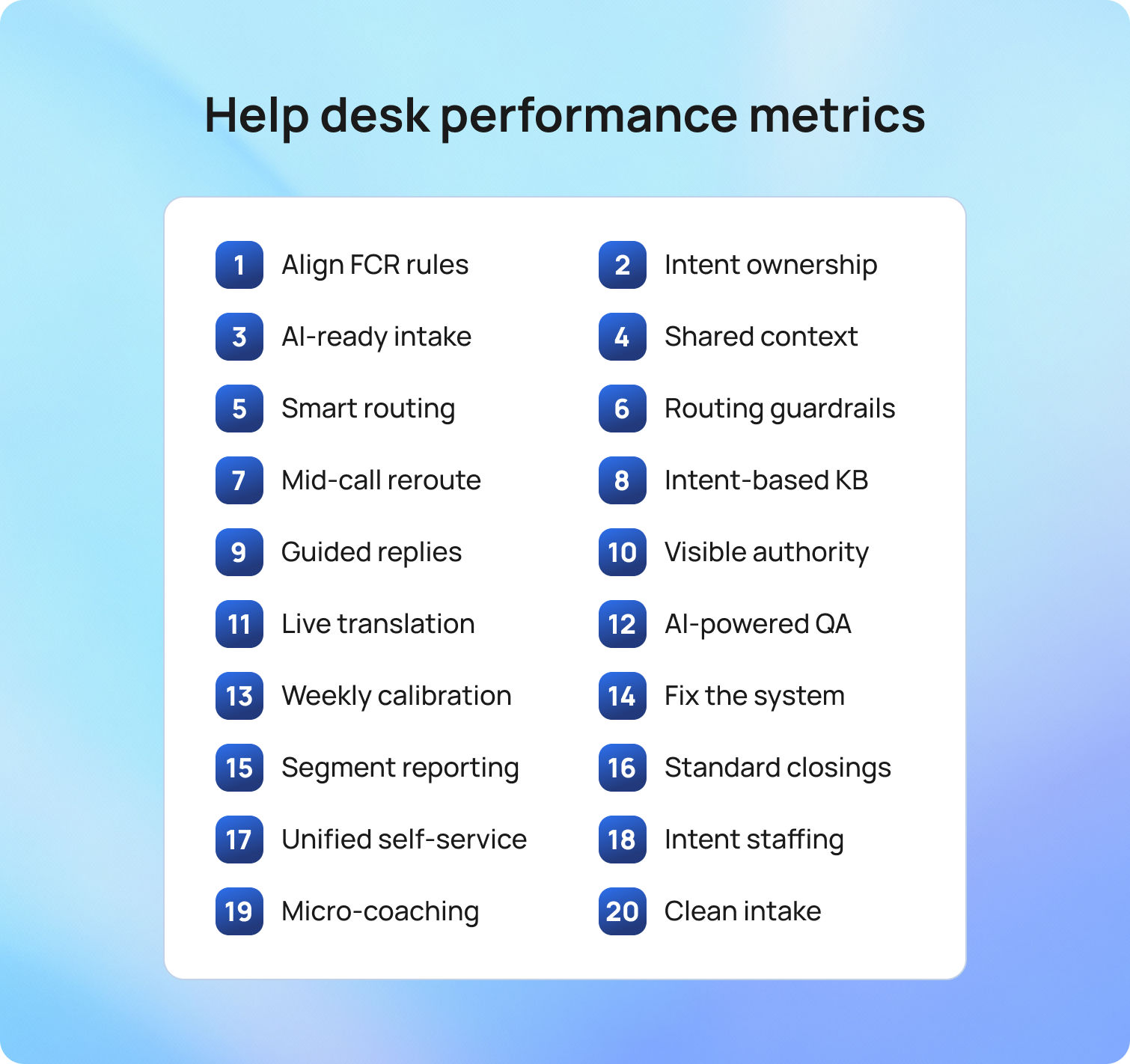
Strong measurement starts with a clear picture of demand, follows how work moves, and ends with what customers felt and what held up the fix. The metrics below work together in the order shown. Tracking these metrics is essential for improving support and service desk performance, support operations, and overall process optimization to deliver better outcomes. Read them as a storyline rather than isolated numbers: volume and mix set the stage, speed and flow show pacing, quality and accuracy confirm outcomes, productivity and cost reveal the effort required, reliability shows whether promises held, and team signals tell you if the pace is sustainable.
1) Ticket Volume
Ticket volume is the count of support tickets opened in a defined period (often tracked as support channel ticket volume and compared as support tickets opened vs. resolved within a specific period). It frames the load your support team carried and gives context to every other number. Segment by intent and channel so a spike in chat for complex billing does not hide in a single total. Volume by itself is neutral; pair it with deflection and self-service usage to see whether fewer tickets reflect better design or silent abandonment.
2) Ticket Volume by Channel
Channel mix shows how demand arrives across portal, email, chat, voice, and social. Each channel carries a different context and speed. Different channels may generate different types of support requests, requiring agents to perform a variety of support tasks to resolve them efficiently. Chat suits quick, well-understood fixes, while email fits attachments and approvals. Knowing the mix lets you place skills by hour and language so the customer service team is present where customers actually show up.
3) Ticket Creation to Qualification
Creation-to-qualification measures the time from ticket creation to the first assignment with the right skills and permissions. It combines intake quality and routing clarity into a single value. Long waits often point to vague forms, missing attachments, or guesswork on ownership. Conditional fields, simple pre-checks, and routing by intent, language, and risk shorten this interval and give analysts a clean first move. Streamlining and continuously improving support processes at this stage can significantly reduce delays and improve efficiency.
4) First Response Time (FRT)
First response time tracks minutes from creation to the first meaningful human reply, often referred to as the initial contact with the customer. Customers relax when an early update sets expectations in plain language. Empty acknowledgments distort the metric and damage trust. Visible SLA timers in the queue view and short, copy-ready first responses keep timing predictable without encouraging shortcuts.
5) Average Resolution Time (Time to Resolution, TTR)
TTR measures the whole journey from creation to resolution and shows whether work is advancing or idling. Tracking average and overall resolution times is key to understanding how efficiently the team resolves issues. Count only allowed pauses such as Pending customer or Waiting on vendor with a visible reason. If FRT (first resolution time) improves while TTR worsens, handoffs or unclear next steps are likely. A brief daily unblock huddle often clears the few items that jam everything else.
6) In Progress Age
In progress age is the median age of active tickets. It exposes quiet drift that averages can hide. Monitoring in-progress age helps identify and manage the ticket backlog, ensuring that unresolved tickets do not accumulate unnoticed. Report medians and percentiles to avoid distortion from a single long case. Protect focus windows for L2 and L3 queues, where specialists diagnose complex issues and engineers deliver durable fixes, so deep work can be completed without constant interruptions. When this value drops, customers feel genuine movement and response times improve where it matters.
7) Backlog and Backlog Age
Backlog counts open tickets and their age by intent. Comparing opened and closed tickets over time helps teams allocate resources effectively and optimize resource allocation to prevent backlog growth. It is the honest view of debt. Older items usually signal missing steps, unclear ownership, or stalled approvals. Tackle one intent at a time and pair the push with a small intake or routing fix so the problem does not return next week. Track VIP backlog age to prevent a quiet risk.
8) First Contact Resolution (FCR)
FCR is the share of tickets resolved after the initial qualified touchpoint with no additional agent interaction (also known as the first-contact resolution rate). It reflects how well intake and knowledge match reality. Segment by intent and language so you target work that can truly be solved at first touch. Draft replies to approved articles and surface them during submission to lift FCR without sacrificing tone.
9) Contact Resolution Rate
Contact resolution rate asks whether the fix holds. Measure the percentage of tickets that remain solved after a defined window, such as seven days. A dip here often means rushed closures or weak verification. Ensuring the resolution fully addresses the customer's issue is essential for maintaining a high contact resolution rate. Clearer closure notes and a short confirm-outcome step reduce returns without slowing the queue.
10) Reopen Rate
Reopen rate is the percentage of tickets that return after resolution. Every reopen adds cost and erodes confidence. Capture why cases come back so you can separate misunderstandings from defects or missing entitlements. A small verification step for higher-risk intents and a tighter resolution template usually bring this down.
11) Transfer Rate
Transfer rate is the share of tickets that change owners at least once. Reassignments add reading time and break context. Treat valid specialist handoffs differently from misroutes. Clear handoff triggers in role cards and queues organized by intent reduce unnecessary transfers, giving support agents more time to solve tickets and allowing each to focus on resolving tickets efficiently.
12) Escalation Rate
Escalation rate is the percentage of tickets pushed to a higher tier or a vendor. A well-trained IT support team can handle more issues at the first level, reducing unnecessary escalations. Healthy operations do not aim for zero; they aim for justified escalations with clear evidence. Watch trends by intent. A sudden rise often signals a new product issue or a knowledge gap. Pair escalations with fast article updates and short teach-backs so L1 can handle the next one.
13) SLA Compliance
SLA (service level agreement) compliance reports the percentage of tickets that meet first response and resolution targets, making it one of the most essential service desk KPIs. It reflects both predictability and speed. Pauses should be limited to clear states with visible reasons. Breach warnings belong in the live queue view so action happens in time, not in a retro report after the promise is already broken.
14) VIP Exposure and Aging
VIP exposure shows open VIP tickets by severity and age, along with the next promised update. Effective service desk management ensures VIP tickets receive timely attention. It prevents high-risk work from aging quietly under routine requests. You do not need a separate process for VIPs, only timely visibility and scheduled communication that matches expectations. When this stays clean, leaders support rather than chase status.
15) Customer Satisfaction Score (CSAT)
CSAT measures how satisfied customers are at the end of a case, with customer satisfaction surveys as the primary tool for collecting this feedback. Keep the survey short and send it when the outcome is fresh. A single question with an optional comment usually tells you enough. If CSAT looks fine while message sentiment sours, adjust status timing and template tone before problems spread.
16) Customer Effort Score (CES)
CES asks how much effort customers had to put into resolving an issue. It shines a light on intake friction, unclear updates, and handoffs. Ask after an unlock, access grant, or device swap when memory is fresh. Then remove the step that customers most often stumble on. CES improves, and so does overall satisfaction, as higher CES scores are closely associated with greater user satisfaction.
17) Net Promoter Score (NPS)
NPS reflects willingness to recommend and sits within the broader customer experience, with high NPS scores serving as a strong indicator of customer loyalty. Support influences it through tone, speed, and fix quality. Use NPS to inform cross-functional work with product and operations rather than to grade an individual agent. When support themes explain swings in NPS, you have evidence to focus on the next improvement.
18) Average Handle Time (AHT)
AHT is the active work time per ticket. Monitoring AHT helps assess agent productivity and identify areas for improvement. Treat it as a lens on waste, not a speed trap. Extended reading and repetitive writing are common culprits. Thread summaries, reply drafts grounded in the knowledge base, and in-flow article snippets lower AHT while protecting service quality, which matters more than shaving seconds that customers can feel.
19) Agent Utilization Rate
Utilization compares productive time to scheduled time. Sustained values in the high eighties or nineties suggest a team running hot. Short peaks happen; long strain predicts attrition. Forecast by hour and language, keep a small overflow pool trained on common intents, and protect deep work windows. Utilization settles, and team performance rises, while optimal utilization reflects the team's ability to handle workload efficiently and serves as a key indicator of the team's performance.
20) Cost Per Ticket
Cost per ticket is the total support costs divided by the number of tickets resolved in a period, providing insight into the overall efficiency of support services. It provides a financial view of performance and helps justify investments. Durable reductions come from fewer repeats and faster first-qualified ownership, rather than shifting work to customers. When FCR rises and reopens fall, the cost per ticket drops in a way customers appreciate.
21) Knowledge Engagement
Knowledge engagement blends article usage, feedback, and update cadence, and strong knowledge engagement is essential for delivering high-quality technical support. It answers whether the self-service library and agent articles actually help. Track which pieces appear during submission, which are used during handling, and which receive a quick thumbs-up. Nudge authors when agents deviate from recommended steps. Minor, steady edits keep helpful content and lift FCR without a rewrite project.
How These Metrics Connect
Connections tell the story. A faster first response with a longer time to resolution often means handoffs or unclear procedures. A drop in TTR paired with rising reopens reveals rushed closures. Stable FCR with worsening sentiment points to tone or timing issues rather than technical gaps. The chain is the point, and it is how to measure help desk performance without drowning in charts. Understanding the relationships between desk metrics and service desk metrics is key to making meaningful improvements.
A change log that pairs a minor fix with expected movement in two or three connected metrics makes learning fast. Add model and OS to the device swap intake, and you should see fewer reopens, a shorter path to the qualified owner, and a modest drop in handle time. If the signals do not move, revisit the fix.
How to Set a Baseline in One Week
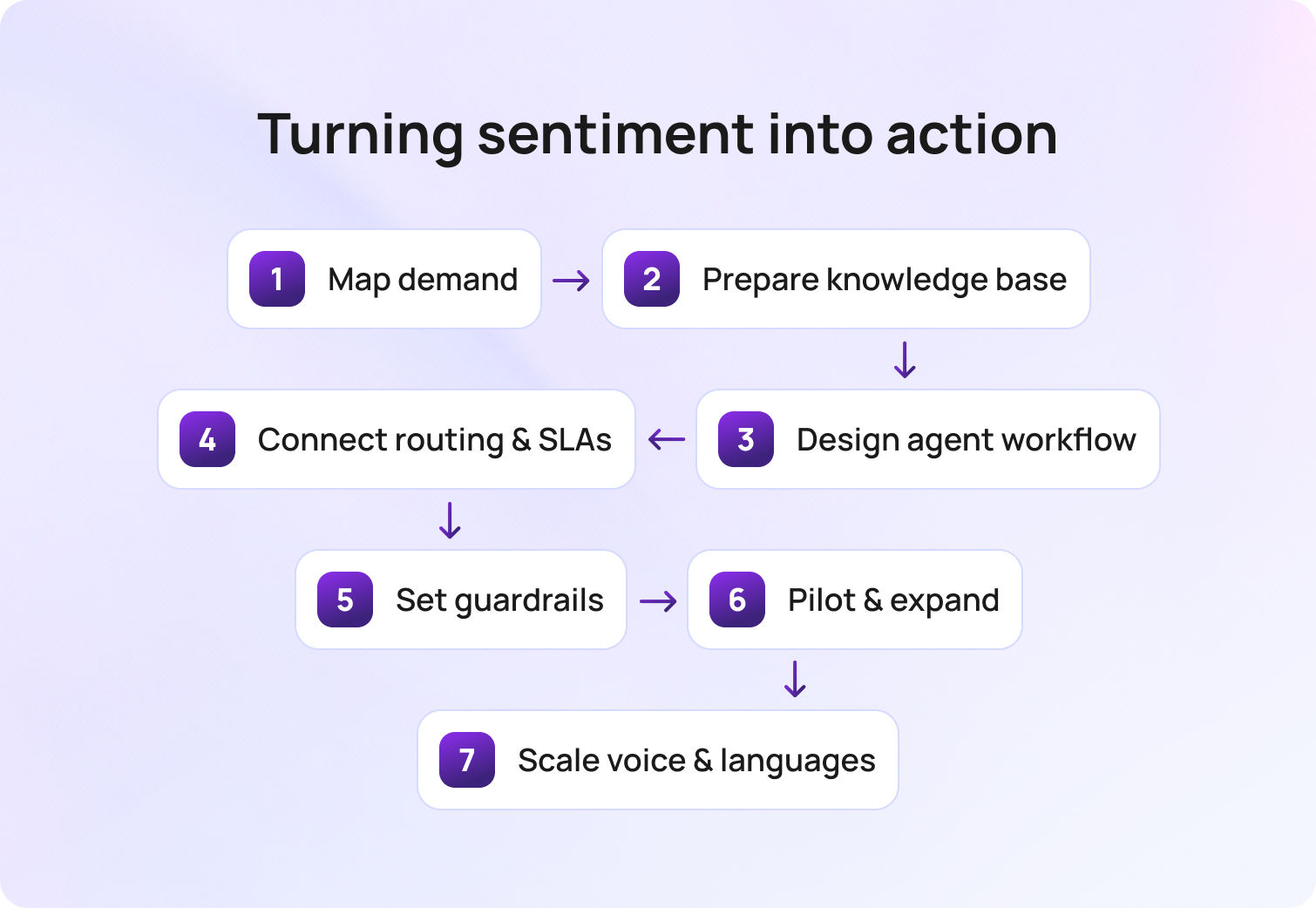
A solid baseline does not require a quarter or a BI project. It needs one shared window, precise definitions, clean data, and a simple loop that ties changes to results. The goal is a view your team trusts enough to act on every week.
Pick the window and freeze it. A rolling 28-day period smooths holidays and odd weeks without hiding problems. Set the clock on Monday morning and keep the same cadence each week. Everyone knows what “this period” means, which stops calendar confusion before it starts.
Write the glossary first. Publish a one-page list of metric names and formulas. Define first response time, time to resolution, first contact resolution, reopen rate, SLA compliance, backlog age, and any VIP views you plan to show. Note what counts as a pause, which statuses qualify as resolved, and whether you use business hours or calendar hours. Lock it. The glossary prevents later debates that waste time.
Choose a single source of truth. Pull every metric from the same workspace so the numbers line up with how people actually work. Tickets, SLAs, knowledge usage, AI drafts, and staffing should feed the same dataset. Integrating customer data from systems such as CRM, billing, and analytics provides a unified, accurate view of support performance. If you must combine systems, declare the join keys upfront and test them on a small slice before you scale.
Focus on trends, not trophies. Targets are helpful, but trends tell the story you can act on. Show this week versus the prior four and the same window last quarter. Celebrate direction with context. A decrease in time to resolution is only good if reopens are not increasing.
Segment where it matters. Report by intent, channel, and language so averages do not hide risk. Password resets should not mask payroll incidents. Chat performance should not be judged by email complexity. Segmenting reveals where a minor fix can move a real number.
Publish a change log next to the dashboard. Pair every tweak with the metric it should move. “Added device model and OS to swap intake” should link to expected drops in reopens and handle time for that intent. Review the log in the same meeting where you review the numbers. Cause and effect become explicit.
Assign owners and meeting rhythm. Name a data owner for the extract, a lead for the glossary, and a facilitator for the weekly review. Keep the meeting tight. Ten minutes on the five anchors, ten minutes on one fix, five minutes on the change log. Decisions become routine rather than dramatic.
Validate with a small audit. Pick ten tickets from the period and hand-check the timestamps and statuses against your formulas. Confirm that paused states are applied correctly, that resolved means the same thing across queues, and that VIP tags are accurate. Fix any drift before you broadcast the dashboard.
Close the loop with one improvement. Use the baseline to pick a friction point and ship a small change within the week. Add a missing intake field, tweak a routing rule, clarify a delay template, or update one article that does the most damage when it is wrong. Check the impact in the following review and write two lines in the log.
Let the platform do the heavy lifting. BlueTweak makes it quicker because intake, routing, timers, knowledge,AI ticket summaries, staffing, and analytics live in one place. The same data powers both dashboards and decisions, which means less reconciliation and more actual improvement.
How BlueTweak Turns Measurement Into Weekly Wins

Monday starts with a short review, not a scramble. The team opens BlueTweak and sees the five anchors in one place: first response time, time to resolution, SLA compliance, reopen rate, and CSAT. A pattern stands out. Reopens ticked up on device swaps. You click the device-swap intent and read recent tickets in the same workspace, complete with AI summaries, call transcripts, and the exact steps agents took.
The fix is minor and immediate. In conditional intake, you set a model and OS as required, with a clear field hint and an attachment rule for screenshots. In dynamic routing, you tighten the rule so that complex swaps go to the L2 device pod with German-language coverage when needed. In status templates, you add a one-line verification at closure. Each change takes minutes because forms, routing rules, and templates live next to the queue rather than in a separate admin tool.
By Friday, the impact is visible. Analytics show first-touch quality up, minutes to a qualified owner down, and reopens easing. A linked change log pairs each edit with the movement it produced, so there is no guesswork about cause and effect. Knowledge base usage confirms that agents opened the updated article in flow, and AI reply drafts grounded in that content kept tone consistent while speeding responses.
The next week follows the same rhythm. A late-afternoon slowdown in billing emails is shown in the workforce management view, alongside the queues. You shift one agent for two hours and watch SLA timers settle before they breach. A quick check of multi-channel views confirms that chat is handling simple requests, while email handles longer approvals.
Over time, this quiet loop becomes the operating habit. This approach enables teams to consistently deliver exceptional customer support and create a positive customer experience. Minor edits ship quickly, numbers move in the right direction, and the day feels calmer because measurement and action are on the same screen in BlueTweak.
Numbers That Power Faster Resolutions
A strong measurement system looks simple at first glance and precise underneath. The families cover demand, speed, quality, reliability, cost, and team health. The individual metrics have definitions that do not change, formulas anyone can calculate, and trends that point to one practical fix.
When intake improves, the time to a qualified owner falls. When knowledge sits in the path of work, first-contact resolution improves. When status language becomes clear, second contacts drop. When pauses are visible and justified, SLA compliance becomes trustworthy. The chain is the point, and it is how to measure help desk performance without drowning in charts.
If you want to see this model operating in one place, BlueTweak maps each metric to the workflow that moves it and shows its impact in days. Tracking support issues and addressing customer concerns are central to effective help desk measurement. See BlueTweak in action with a short demo and watch a ticket move from intake to resolution with the right metrics front and center.

How to Prioritize Help Desk Tickets: 21 Strategies for Faster Resolution
Why Prioritization Decides Speed and Satisfaction
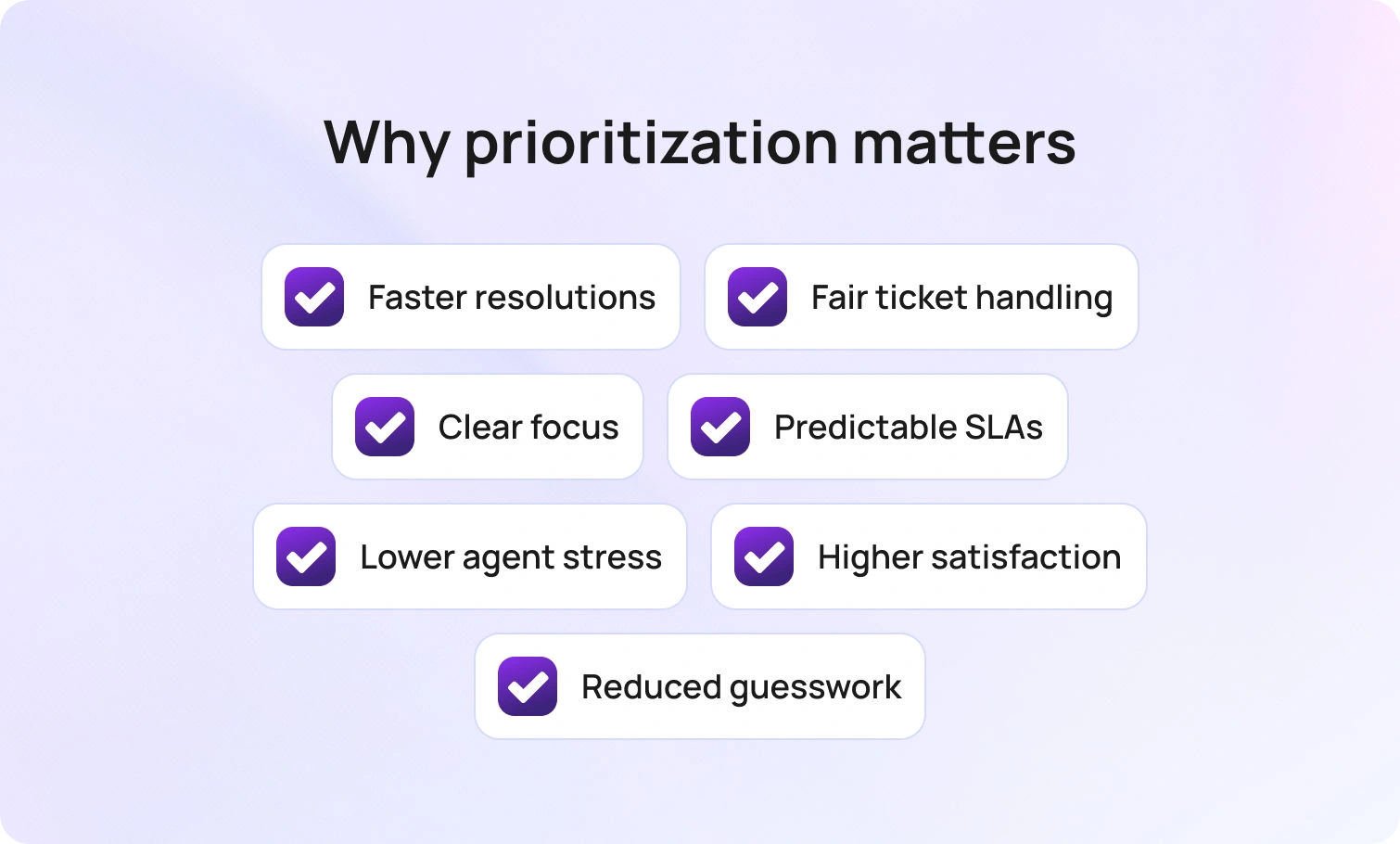
Monday, 9:07 AM. The queue looks deceptively calm at fifty-two tickets, but that surface tranquility is a lie. A critical payroll outage sits three rows down simply because the subject line reads “Cannot access system,” while five password resets shout for attention in all caps. A VIP replies to an old thread, skipping the portal entirely.
Then a device swap request arrives with no model number, bouncing between agents twice before anyone can begin work on it. Your customers feel this disorder as slow, uneven, and frustrating service. Your agents feel it as endless interruptions and stressful guesswork. Customer service and support agents rely on efficient ticket management to handle inquiries and maintain consistent communication; without it, their work becomes chaotic. Your leaders feel it when SLA charts look green while truly important work quietly ages.
A clear, universal prioritization system fundamentally changes the day.
The most common mistake I see in help desk operations isn't a bad tool or an undertrained team but the absence of a shared definition of urgency. When 'critical' means something different to every agent, priority becomes whoever shouts loudest, and the queue reflects politics rather than risk. Once you anchor the entire team to two questions: how many people are affected and how fast is the damage growing, the conversation shifts from opinion to evidence, and resolution times follow almost automatically.
— Radu Dumitrescu, Head of Presale & Digital Transformation, BlueTweak
By using factors such as impact and urgency, you establish a shared language in which the loudest voice no longer wins. High-impact work automatically rises to the top and receives a tight, focused communication cadence. Routine requests are routed into a short, well-lit lane and finished quickly.
Instead of hidden rules, promises appear as visible timers, ensuring action occurs before a deadline slips. The result is far more than just faster resolution time. When a well-organized customer support team is in place, it improves customer satisfaction by ensuring that important issues are addressed promptly and consistently. It leads to fairer treatment for everyone, steadier queues for your team, and the mental space for agents to actually think.
The strategies that follow are practical and deeply connected. You will learn to set priorities with clarity, route tickets with confidence, communicate in plain language, and shorten the lifespan of routine tickets so the truly urgent work receives the swift attention it deserves. Efficient ticket management is key to achieving both speed and customer satisfaction.
21 Strategies to Prioritize Help Desk Tickets for Faster Resolution

Your working queue needs more than just rules; it needs innovative tools. You need guidelines that your team can apply in under a minute, signals that show exactly when to bend the rule, and small, consistent habits that keep the entire system honest.
The following 21 strategies are the best practices for help desk management. Optimizing help desk operations and desk operations is essential for effective ticket management, as it streamlines workflows, improves resolution times, and ensures your team can handle support requests efficiently. They are designed to cut through the noise, optimize your processes, and ensure that your team is always working on the right thing at the right time. Get ready to turn your chaotic queue into a smooth, efficient operation.
1) Decide Priority in Seconds with Scope and Velocity
Priority should never become a debate. Two simple questions settle it instantly: How many people or systems are affected (Scope), and how quickly harm will grow if nothing changes (Velocity)? This clarity ensures consistency and speed.
Organizations can prioritize tickets based on predefined criteria such as customer value, urgency, or impact. Priorities can also be set based on factors such as customer plan tiers, spending habits, or the overall impact on business operations, aligning with a prioritization-based approach to optimize support efficiency and response times.
A P1 is an unacceptable, broad outage that puts your money or reputation at immediate risk. P2 captures severe degradation for a large group, which is worsening by the minute. P3 fits contained issues that can wait for a development sprint, and P4 covers cosmetic or housekeeping work you can batch later.
How BlueTweak helps: Priority is determined by your configured rules for ticket fields (and any mapped symptoms). Selecting it starts the right timers and escalations in the queue.
Talk with one of our customer support experts to learn more
Learn More2) Tie Promises to Visible Clocks
Every priority level needs a mandatory first-response and resolution target that everyone, including your customer, can see. These Service Level Agreements (SLAs) must be visible to your agents. Visible response times and resolution times help ensure that support tickets are handled promptly, meeting customer expectations and improving overall support efficiency. Reminders should arrive well before a breach, and customers should see the same next-update time in their portal view. Using empty acknowledgments just to stop the clock without moving the work only trains people to chase you.
How BlueTweak helps: SLA timers and pre-approved templates are available alongside each ticket. Templates auto-merge the next promised update time, and your customer portal/messages display it when enabled.
3) Route to the First Qualified Owner
Speed starts with the very first person who touches the case. Automated routing by intent, component, language, customer tier, and sensitivity ensures database failures go straight to specialists and access requests funnel into an approval flow before a human wastes time.
Ticket assignments can be automated to assign tickets to the most suitable agents or other teams based on expertise, language skills, and current workload, improving support efficiency and resolution times. The goal is fewer transfers and the shortest possible path to someone who can finish the job. When that first qualified touch lands early, resolution time falls without burning out your team.
How BlueTweak helps: Routing rules combine skill profiles with ticket signals to place work with the right owner. Live workload and SLA-risk indicators make emerging bottlenecks obvious, so teams can rebalance before timers turn red.
4) Raise Safety, Security, and Revenue Work One Level
Not all P2s are equal. Urgent issues such as a suspected credential breach, a payment failure during checkout, or potential data exposure warrant a higher lane and a tighter update cadence. By raising these asymmetric risks by one level, you protect the business without rewriting your entire process. A short, two-step containment checklist keeps the first five minutes crisp; the normal flow then resumes with more frequent customer updates.
High-priority tickets may also be assigned to customers who contribute more money to the business, ensuring their issues are resolved promptly and supporting key revenue streams.
How BlueTweka helps: When configured, risk tags raise priority by 1 level, trigger a short containment checklist, and automatically apply a more frequent status cadence.
5) Make VIP Exposure Obvious and Predictable
Special handling for your VIPs doesn't require secret, custom rules. You just need one clean, obvious view that shows their severity, age, and the next promised update. The standard priority definitions still apply, but with earlier warnings and a firmer communication cadence. This lets leaders stop chasing urgent Slack pings for status and focus on clearing genuine blockers.
How BlueTweak helps: A VIP filter surfaces severity, age, and the next promised update, while SLA timers appear alongside each VIP ticket in the queue (and customer portal when enabled) for quick monitoring.
6) Judge First Replies by Time to Unblock
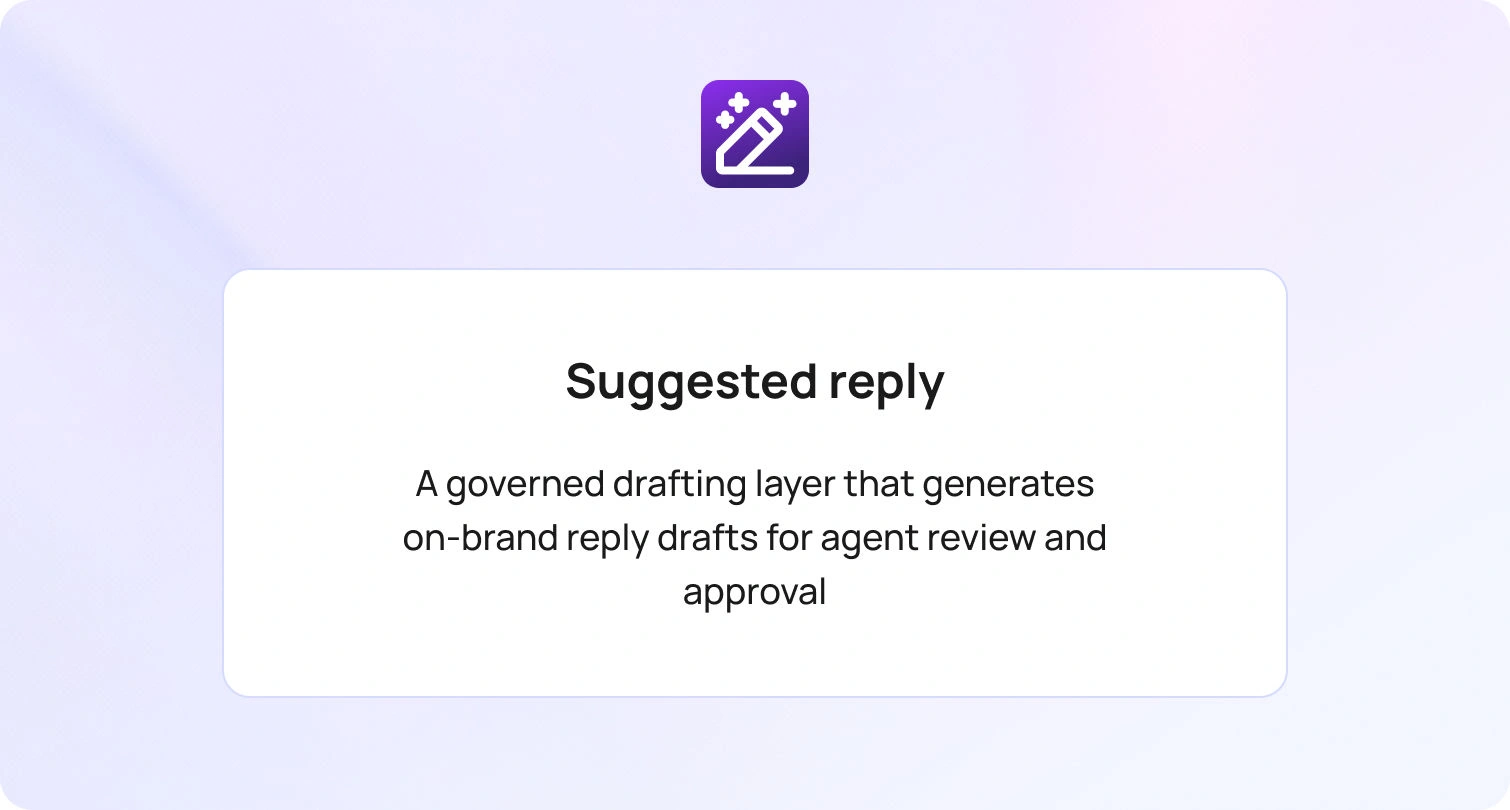
Customers instantly relax when your first message provides an effective initial response, one that either removes the blocker or asks for one specific thing that unlocks the next step. Effective initial responses can set the tone for the entire support interaction, ensuring customers feel heard and supported from the start.
A screenshot of the exact error dialog beats a vague log request, and a single command to run beats a wall of text. Your agents then move immediately to the following action rather than starting a second conversation to clarify the first. This habit drastically drops second-contact rates and builds trust.
How BlueTweak helps: Suggested replies propose the next best step from the mapped knowledge article, allowing the agent to insert the correct unblocking hint with a single click.
7) Allow Only Two Pauses and Always Log the Reason
Timers should pause only when you are waiting for a customer or vendor. Everything else keeps aging. Every pause must have a clear reason and a scheduled check-in time to prevent items from slipping into oblivion. When fake pause states disappear, your queues become honest, and your real internal bottlenecks become impossible to ignore.
How BlueTweak helps: When configured, tickets can pause only in Pending customer or Waiting on vendor status; a pause reason is required, and scheduled reminders nudge the customer until they respond or the timer expires.
8) Break Ties with Age and Breach Risk
Two P2s are not equally urgent. When priority levels match, work the older ticket or the one closest to its SLA target. Simple, automatic tie-breakers make the top of the ticket queue obvious and instantly defensible. This significantly reduces stress and prevents arguments over who picks next.
How BlueTweak helps: Queue sorting combines priority, ticket age, and SLA progress to surface the next best ticket at the top based on your configured rules.
9) Collapse Incident Duplicates and Talk in One Place
Outages inevitably echo across the inbox. Linking all child tickets to a single parent, posting a single, clear status update there, and cascading that note to every linked case eliminates retyping and ensures consistent messaging. Customers hear the same thing, at the same time, with the same next update. Closure becomes one simple motion instead of fifty small ones.
How BlueTweak helps: Auto-clustering can propose a parent, and once tickets are linked, bulk actions (i.e., status, tags, and updates) can be applied to all children in a single step based on your configuration.
10) Deflect Routine Work Inside the Form
The cheapest ticket is the one that never opens. Providing self-service options, such as displaying the correct knowledge article as a customer types, often resolves the issue on the spot. Making essential information available through knowledge articles and forms empowers users to resolve issues independently. If it doesn’t, the form requires the customer to provide exactly what the article expects, including the correct attachment type and size, so the first touch still moves quickly. Volume falls, and what remains arrives complete.
How BlueTweak helps: A centralized knowledge base is available in the portal and the agent console. Agents can insert the correct step into a reply with one click, and customers see those same steps during submission when enabled.
11) Use Sentiment and Stage as Gentle Nudges
Some messages carry inherent churn risk or involve active revenue. Strong negative sentiment or an active pre-sale conversation deserves a one-level nudge and a quick human review, not a disruptive leap across the entire matrix. This pressure-measured valve maintains system fairness while giving reputation and revenue the timely attention they need.
How BlueTweak helps: Flags can suggest a one-level priority increase and preload an empathetic template with a concrete next step for the agent to review and send.
12) Assign to the Shortest Path to Done
Round-robin feels fair but guarantees transfers. A simple skills matrix for languages, systems, and certifications gets the ticket to the person or small pool that closes it fastest. For a small team, efficient ticket assignment and workload management are essential to handle support tickets effectively and maintain high responsiveness. Transfers drop, notes stay clean, and customers no longer hear “I am moving this to the right team.” The work finishes where it starts.
How BlueTweak helps: Skills and schedules are within routing, and when performance-based routing is enabled, the engine can favor the pool with stronger historical close rates for that intent.
13) Standardize Three Messages Per Intent
Every common request should include three short, standardized messages: a first response that sets the next update time, a progress note that explains what changed, and a delay that explains why and when you will check again. Reusing these simple templates removes tone drift and guesswork.
Using email templates and canned responses can streamline communication, maintain consistency, and reduce follow-up emails by ensuring customers receive timely, clear updates. Customers stop asking for updates once they know when the next one will arrive.
How BlueTweak helps: Templates sit beside the queue, auto-merge ticket details, and, when enabled, can send on schedule or on status changes, with optional agent review.
14) Spin Up a Triage Lane Only During Floods
Monday mornings, major launches, and outages don't care about your schedule. A small, temporary triage lane that quickly confirms priority, tags correctly, requests one missing item, and routes with confidence keeps the main queues moving. The lane shuts down as soon as the wave passes. This ensures the support team maintains momentum without having to rewrite regular roles.
How BlueTweak helps: A triage view shows newly arrived tickets with only the critical fields and offers one-click assignment and routing based on your configured rules.
15) Batch Similar Tickets to Protect Attention
Context switching kills speed. Allow agents to pull a batch of similar or repetitive tickets in a row for tasks such as device swaps, password resets, or license grants. A small checklist and a smart macro keep outcomes consistent and fast. Routine work declines, leaving more focus on complex issues.
How BlueTweak helps: Filters can serve a “next five” batch of similar tickets, and macros bundle the reply, tags, field updates, and internal steps into a single action.
16) Park Approvals in a Pre-Approval Lane
Access and purchasing requests often stall while someone else decides. Holding them in a specific pre-approval lane with gentle reminders keeps your active queue honest. Once approval lands, routing resumes without a human babysitting the case. You save time for work that can be moved now.
How BlueTweak helps: Conditional intake can launch an approval request, set the ticket to a paused state with a visible reason, and, once the approval is approved, automatically resume routing based on your workflow rules.
17) Respect Change Windows and Schedule Safely
Urgency does not erase the calendar. Maintenance windows and freeze periods exist for a reason. Scheduling the fix for the next available safe slot and informing the customer precisely when it will occur reduces risk and builds trust. Reliability counts just as much as speed.
How BlueTweak helps: Maintenance calendars and blackout rules can block unsafe windows and, when you schedule a safe slot, automatically set the status to “Scheduled” with the promised time.
18) Tag Why Priority Changed So Patterns Emerge
Priority changes aren’t random if you record the reason why. A tiny set of reason tags, like safety, security, revenue, VIP, legal, deadline today, vendor wait, or duplicate to parent, turns judgment into objective data. Reviews move quickly, and process tweaks are much easier to justify. Documenting process changes and actively soliciting feedback from the team can further improve ticket management efficiency.
How BlueTweak helps: One-click tags create a reliable audit trail and feed built-in trend charts, so you track patterns without separate spreadsheets.
19) Keep Low-Priority Work Short with In-Path Knowledge
Protecting high-priority space means finishing low-priority items quickly. Knowledge articles should mirror your live UI, name the exact fields, and appear during submission and handling. Small, weekly edits keep them accurate without heavy rewrites. The long tail of common issues gets shorter and less noisy.
How BlueTweak helps: Knowledge appears in the portal and the agent console; agents can insert the correct step into a reply with one click, and customers see the same steps during submission when enabled.
20) Watch Five Anchors and Change One Thing Each Week
Healthy systems improve in small, measurable steps. First response time, time to resolution, SLA compliance, reopen rate, and VIP aging tell you exactly where friction lives. Pick one lever, make a tiny change, and watch for movement next week. Your confidence grows when numbers respond to edits you can easily explain.
How BlueTweak helps: Analytics can tie movement to the exact form, route, or template version you changed, and a built-in change log records who changed what and when. By leveraging ticket analytics, you can make data-driven decisions that inform strategic improvements in your support operations.
21) Teach with One-Page Role Cards, Not Binders
People remember what they use frequently. A single-page card for triage, incidents, approvals, and escalations that spells out the mission, scope, handoff triggers, and two clear examples makes decisions faster and more consistent. New hires ramp quicker, and veterans avoid process drift. For new employees, clear role cards help them quickly understand their responsibilities in ticket management and accelerate onboarding. The playbook becomes muscle memory.
How BlueTweak helps: Role cards can open in context within the console and, when mapped to intents or ticket types, display the version that applies to the ticket you are viewing.
Practical Templates You Can Copy Today
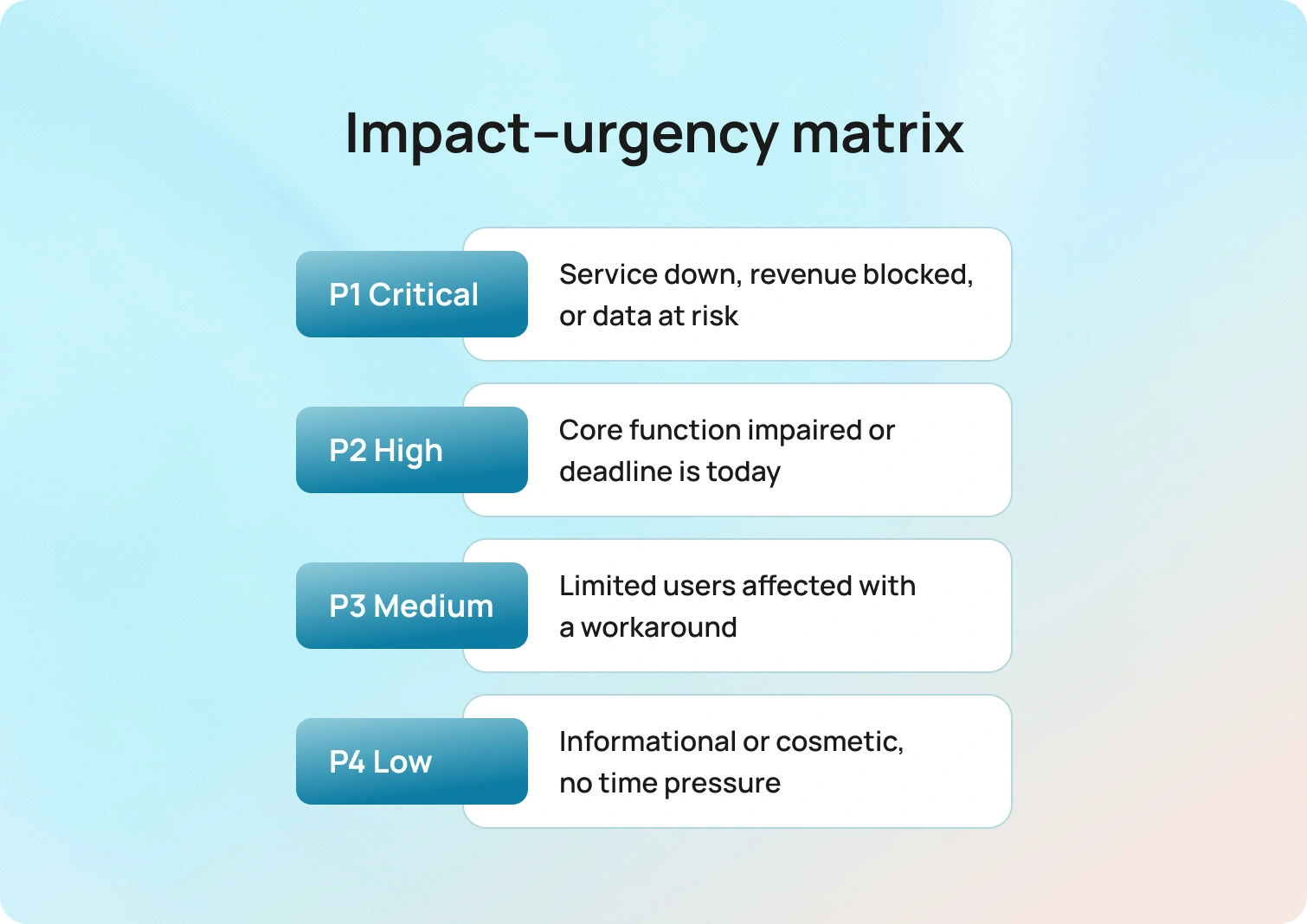
Use this simple matrix to turn noisy queues into clear choices. Define impact and urgency once, then use the four levels below as short, reusable paragraphs you can paste into playbooks, status pages, and training.
These templates can be used by service desks, customer service departments, and customer service teams to standardize communication and streamline support operations.
When describing support channels in your templates, be sure to include phone calls, as many customers expect multi-channel support options such as email, live chat, social media, and phone for a seamless customer experience.
Impact–urgency matrix
P1 Critical: Service is unavailable for a department, revenue is blocked, or data is at risk.
Examples: payroll system down on payday; suspected credential breach; urgent support request by phone; critical bug in software features.
P2 High: A core function is impaired for many users, or the deadline is today.
Examples: VPN fails at a location; order processing delays during a promotion; multiple customer inquiries about access issues; high-priority support requests.
P3 Medium: One user or a small group is affected with a workable workaround.
Examples: device swap; single mailbox sync issue; customer question about device settings; bug report on non-essential software features.
P4 Low: Informational requests or cosmetic issues without time pressure.
Examples: report formatting; general inquiry about features; low-priority customer questions; non-urgent general inquiries.
Three status templates per intent
First response: “We are investigating the [issue]. Next update by [local time]. If available, please attach a screenshot of the exact error dialog. For urgent issues, you may also contact us via phone call.”
Progress: “We are working with [vendor/team] and will check again at [time]. Current ticket status: [one line].” Desk software can automate ticket status updates, supporting efficient ticket management and streamlining workflows.
Delay: “We are waiting for [approval/logs]. We will review at [time] and update you.”
Approval lane prompt: “Your access request is almost ready. Please confirm the manager’s approval and the role name. Once attached, your request moves automatically.”
Duplicate parent note: “We identified an incident affecting [system]. Your ticket is linked to the parent case. You will receive the next update by [time]. No action is needed from you.”
Reason tags lists: Safety, security, revenue, VIP, legal, deadline today, vendor wait, duplicate to parent.
Start Prioritizing: Turn Chaos into a System
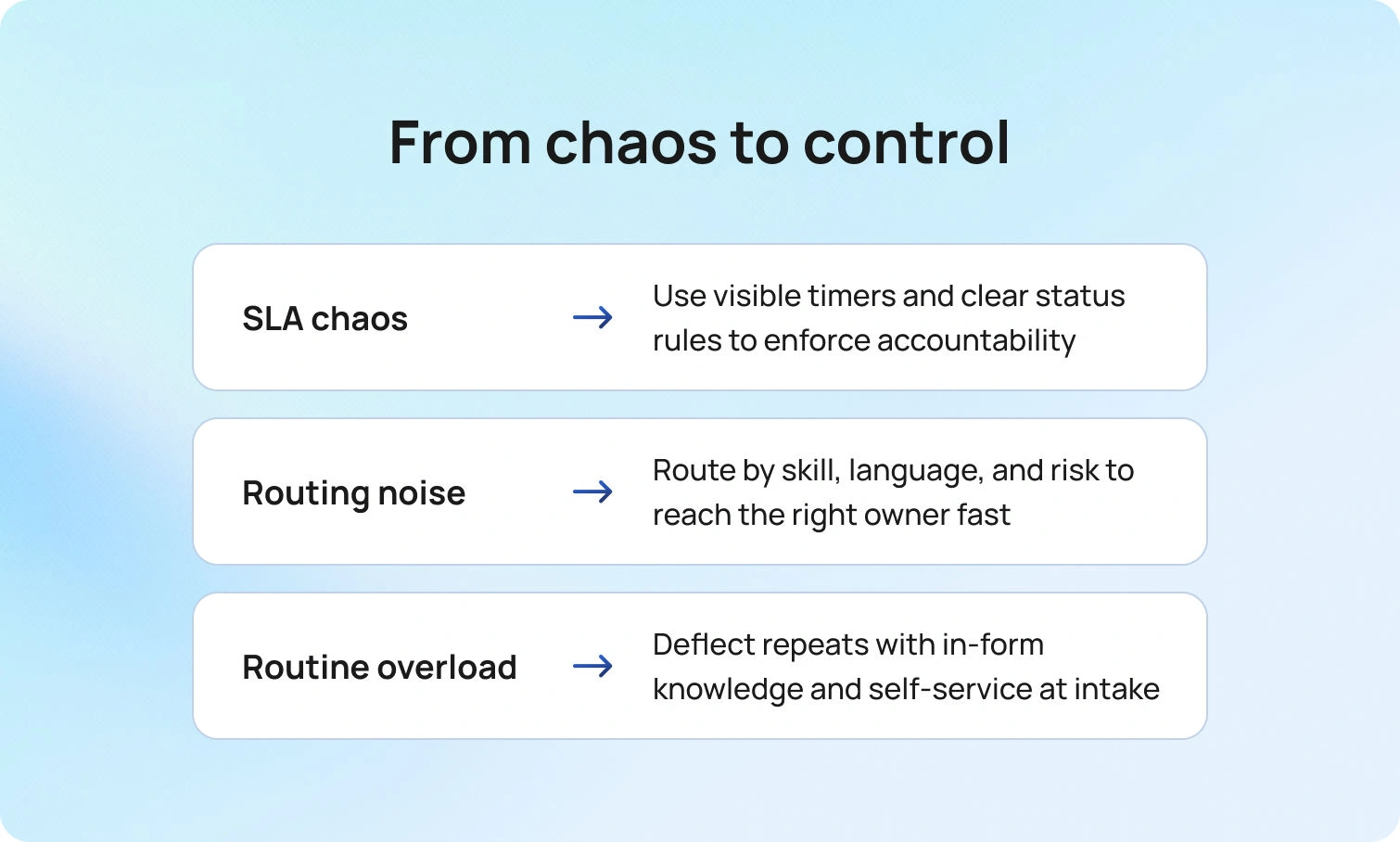
Prioritization works when it is simple enough to use every minute and precise enough to defend in a review. We’ve shown how a plain impact–urgency matrix creates shared judgment, how visible SLA timers enforce accountability, and how intelligent routing prevents unnecessary handoffs. By creating a higher lane for safety, security, and revenue, and by using deflection at intake to shorten routine tickets, you guarantee that truly urgent items receive the focused attention they need. This isn’t just about faster tickets; it’s about weekly, predictable tuning that turns noise into measurable, drama-free progress.
Your next move depends on your most significant pain point.
- If your primary need is strict SLA control with auditable timers and cadence, anchor on the priority matrix and status templates first.
- If your challenge is noisy queues spanning many languages and brands, focus immediately on routing by skills, language, and VIP exposure.
- If your pain is routine work, starving urgent cases, invest in in-form deflection and knowledge embedded directly into your console.
BlueTweak brings all these essential pieces together into a single seamless screen. Conditional intake sets priority correctly. Skill and risk-based routing put work in the right hands. Timers and templates keep promises visible. Knowledge appears exactly where the work is happening.
By leveraging automation and natural language processing, BlueTweak reduces manual tasks, integrates with other systems, and improves customer support by automating the matching of inquiries to solutions and streamlining workflows. Every action, from inserting a knowledge step into a reply to viewing customer status, is unified. Analytics connect each small process change to a visible result, which is how a policy transforms into a calmer, more confident day for your customers and your team.
Ready to stop guessing and start governing your queue? Book a demo of BlueTweak today to see how easily you can implement these strategies and bring sanity back to your help desk.
Book a BlueTweak Demo Today
Book Demo