



TL;DR
AI in customer service augments your team. It sharpens context, personalizes every interaction, and delivers measurable gains in first contact resolution, handle time, CSAT, and recovery speed. This guide details how to implement AI with clear guardrails and minimal disruption.
A Practical Approach to AI in Customer Service
Many teams want the benefits of AI without turning support into a lab experiment. The reality on the ground is tool sprawl, fragmented workflows, and unreliable answers that don’t meet customer needs, pushing agents back to the phone.
AI technology, such as chatbots and natural language processing, is transforming customer service by providing scalable, efficient, and 24/7 support across digital and omnichannel retail strategies.
AI creates value when it assists people. The objective is not blanket automation; the objective is consistent personalization across channels to ensure that AI improves customer service. It is crucial to design and implement reliable AI systems that can adapt to various customer service scenarios, ensuring they understand and process customer interactions effectively.
That means adapting content, tone, routing, and actions to customer context, then proving impact with meaningful KPIs:
- First Contact Resolution (FCR)
- Average Handle Time (AHT)
- Abandon Rate
- Recovery within 24 hours
- CSAT and CES
By automating routine tasks and enabling more strategic, personalized support, AI is transforming customer service and allowing representatives to focus on higher-value interactions.
This guide explains the core concepts behind effective AI in customer service, the key tradeoffs to manage, and a step-by-step path to implementation that preserves your current workflows while raising performance.
What Is AI-Powered Personalized Customer Service?

AI-powered personalized customer service is the use of artificial intelligence to adapt content, tone, routing, and actions based on customer context.
It’s about delivering the correct response in the right tone through the right channel with the proper follow-up action. And then measuring whether that approach actually improved customer satisfaction and support operations.
To make personalization work at scale with your customer service operations, you need a few foundational pieces:
Unified customer profile: Every interaction should pull from a single source of truth: order history, open cases, language preference, lifecycle stage, entitlements, and channel behavior. No more asking customers to repeat themselves.
Knowledge-base-grounded generation: AI answers must be anchored in your actual policies and procedures, not hallucinated out of thin air. If the AI doesn’t know, it should say so or route to a human agent.
Policy-safe actions via APIs: Personalization is hollow without execution. AI should trigger actions (refunds, reships, reschedules) within policy limits, with approval workflows for any risky actions.
Consent and governance: Capture only the customer data you need, document consent, respect retention rules, and ensure compliance across every channel.
Training and continuously refining AI modelswith relevant customer data is essential to improve personalization and adapt to changing customer needs.
Machine learning enables AI to learn from customer interactions, analyze data, and improve responses over time, making support more accurate and efficient.
When these pieces work together, you get:
Faster first-right answers: Agents (or AI agents) pull the correct policy, apply the proper tier limits, and respond in the customer’s preferred language.
Fewer transfers: Smart routing sends VIP customers, non-English speakers, and high-risk orders to the correct queue or specialist from the start.
Consistent tone across channels: Whether the customer reaches you via AI customer service chatbot ,AI voicebot, or email, the experience feels cohesive, not like dealing with three different companies.
This is the foundation. Everything else builds on it. Effective customer service requires ongoing monitoring, integration of AI with existing workflows, and collaboration between human agents and AI systems.
Why AI Customer Service Matters for Personalization
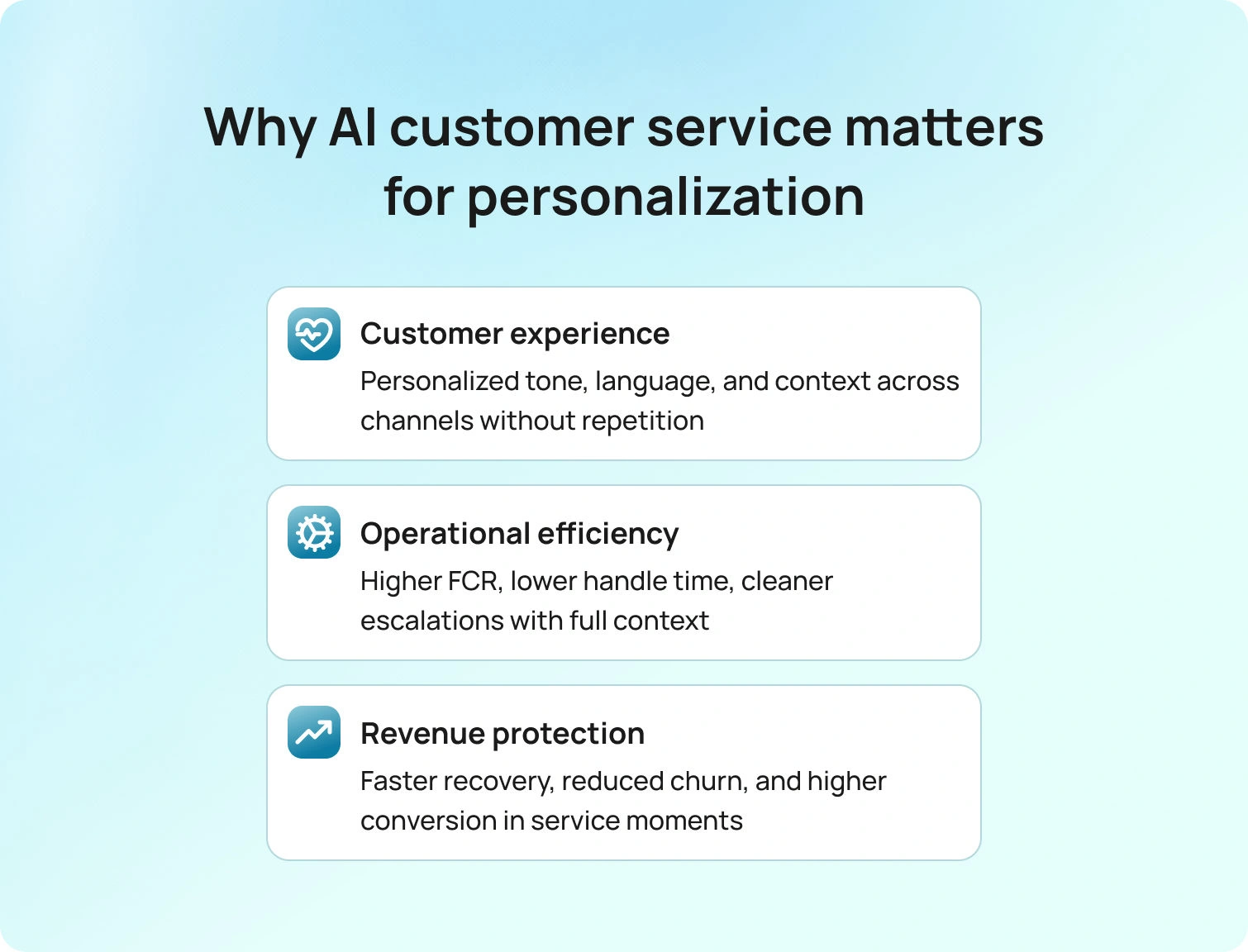
Personalization isn’t a nice-to-have anymore. It’s a measurable lever for three outcomes that matter to every support leader: customer service experience, operational efficiency, and revenue protection. Adopting innovative customer service strategies that leverage AI technology enables organizations to meet evolving customer expectations and deliver more personalized support.
- Customer Experience
AI enables businesses to deliver exceptional service by providing personalized, seamless experiences across both online and offline channels, meeting or exceeding customer expectations.
- Operational Efficiency
AI-powered customer service solutions can integrate with existing CRM platforms using APIs or connectors to automate routine tasks, enhance support efficiency, and personalize responses.
- Revenue Protection and Growth
1. Customer Experience (CX)
Customer expectations have gone up. They expect you to know who they are and what they need. When AI delivers the correct language, tone, and context continuity across channels, customers feel heard. They don’t have to repeat themselves. They don’t get stuck in loops. They get answers that actually solve their problems.
AI tools also enhance customer engagement by providing real-time, proactive support across multiple channels, helping to build long-term loyalty and deeper connections with the brand.
This is where natural language processing and analyzing customer data come into play. AI tools that understand customer sentiment and detect emotions can adjust tone on the fly: empathetic for service failures, concise for transactional requests, and encouraging for complex troubleshooting. AI can analyze customer sentiment to better understand and interpret customer emotions and opinions, allowing businesses to personalize interactions more effectively.
All these AI-driven capabilities contribute to improving customer satisfaction by streamlining support, reducing wait times, and delivering more personalized service.
2. Operational Efficiency
Personalization drives the metrics that keep your cost center in check:
Higher FCR and Containment: When AI surfaces the correct answer (grounded in your knowledge base) and executes the right action, customers don’t come back with the same issue. In contact centers, these AI-driven efficiencies allow human agents to focus on more complex customer issues, improving customer relationships through better understanding and support.
Lower AHT and Abandon: Customer support automation handles routine inquiries at scale, freeing human agents for complex issues. AI excels at handling routine inquiries, streamlining operations, and reducing wait times. Support agents benefit from AI automation, as it enables them to dedicate more time to high-value interactions, improving overall support efficiency. Faster resolutions mean shorter handle times and fewer customers hanging up in frustration.
Cleaner escalations: When AI escalates to a human, it passes along complete context, including the customer profile, past interactions, AI ticket summary, and sentiment analysis.
3. Revenue Protection and Growth
AI in customer service isn’t just a cost play. It’s a revenue play.
Better recovery on negative experiences: When a delivery fails or a product breaks, personalized AI can detect the issue, trigger proactive outreach, and offer the correct resolution (exchange, refund, discount) before the customer churns. Predictive AI can anticipate customer needs and enable businesses to reach out proactively, addressing issues before they escalate. Recovery within 24 hours correlates directly with customer retention.
Higher conversion on service-adjacent flows: Customers who reach out about exchanges, renewals, or upgrades are already engaged. Personalized support, powered by predictive analytics and customer behavior insights, can guide them toward the best outcome for both parties. Adequate AI-driven support leads to customer success by ensuring better outcomes and higher satisfaction.
Personalized AI support also helps businesses build stronger customer relationships by fostering trust, loyalty, and deeper engagement.
5 Ways to Use Customer Service AI to Move Metrics
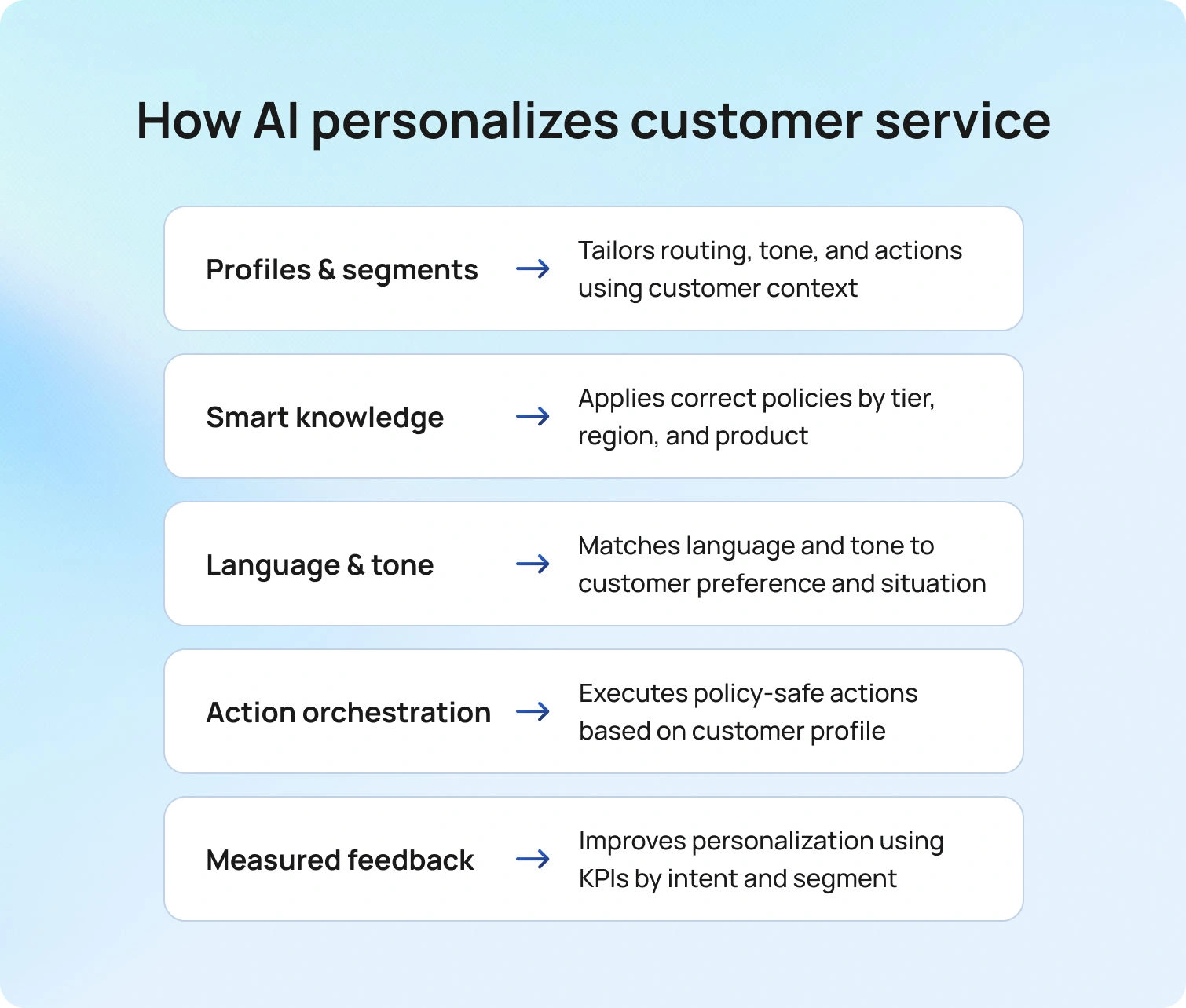
Alright, let’s get tactical. AI tools are designed to enhance and streamline various customer service functions, making support more efficient and responsive. With AI, customer service offers such as faster response times and improved support are now possible, addressing common challenges like long wait times.
In this context, customer service refers to the integration of AI technologies to automate responses, support agents, and improve the overall customer experience. Here are the five building blocks you need to deliver AI-powered personalization that shows up in your dashboards.
1. Profiles & Segments
Personalization starts with knowing your customer. But knowing doesn’t mean hoarding every data point you can grab. It means capturing only the data necessary to adapt the service effectively.
What to capture:
- Lifecycle stage - First-time buyer? Repeat customer? At-risk for churn?
- Tier and entitlements - VIP? Standard? What are their refund limits, warranty terms, and RMA windows?
- Language and location - Preferred language, time zone, and regional policies.
- Order and case history - Recent purchases, open tickets, past interactions.
- Channel preferences - Do they prefer chat, email, or phone?
- Customer preferences - Capture preferences from customer interactions to tailor support and product recommendations.
Document consent for everything. Respect retention rules. Use only what you need.
How it personalizes:
Routing: VIP customers, non-English speakers, and high-risk orders jump to the correct queue or specialist. Call center workforce management becomes smarter when routing is driven by actual customer context.
Tone and template: A customer with a recent delivery failure gets a “Recovery” tone (concise, apologetic, time-bound). A new user gets a “Guidance” tone—step-by-step, encouraging. Canned responses and suggested replies adapt automatically.
Actions: Tier-based limits drive what’s offered. A VIP might get a no-questions-asked refund; a standard customer gets an exchange. Policy rules are baked into the system, not left to agent discretion.
Analyzing profiles and segments helps businesses understand customer behavior, enabling more relevant and practical support.
This is the foundation of every personalized interaction. Without a unified customer profile, you’re just guessing.
2. Smart Knowledge Base
Your knowledge base is the single source of truth for every answer your team (human or AI) gives. If it’s not in the KB, it shouldn’t be said.
AI-powered chatbots use a knowledge base to respond to customer queries instantly, providing automated, accurate answers in real time. These AI systems can also handle initial customer inquiries by leveraging the knowledge base to deliver fast, consistent responses as the first point of contact.
Still, your KB can’t just be a static library of articles. It needs to be policy-aware, parameterized, and version-controlled to support customer service chatbots effectively.
What that means:
Policy-aware articles: Every KB entry should know the rules: return windows by tier, warranty coverage by product, and refund limits by region. When AI pulls an answer, it applies the right policy before composing the response.
Parameterized with variables: Instead of writing 50 variations of “Your return window is X days,” write one article with a variable: “Your return window is {tier.return_window} days.” The system fills in the blank based on the customer’s profile.
Failure states included: What happens if the customer is outside the return window? If the product isn’t eligible for warranty, what should I do? The KB should cover edge cases, not just happy paths.
Citations and sources: Every answer should be traceable back to an authoritative source. This prevents hallucinations and makes customer service quality assurance way easier.
How it personalizes:
Policy-aware answers: AI applies the right policy by tier, region, and product before generating a response. No more generic “Please contact us for details.”
Proposed reply (KB-based): Instead of agents typing from scratch, AI suggests a reply grounded in the KB (pre-filled with the customer’s specific details) and the agent approves or tweaks it. This is where the AI ticket summary and suggested reply help.
Drift control: Update one KB article, and the change cascades across chat, voice, email, and templates. No more version drift between channels.
Article proposal: When AI detects recurring customer questions or content gaps, it suggests new KB articles for your team to approve. This keeps your KB fresh without manual guesswork.
A smart KB enforces answers. And that’s how you scale quality.
3. Language & Tone
Getting the correct answer is half the battle. Delivering it in the correct language and tone is the other half.
Language matters.
If your customer base is global, you need multilingual customer support that translates and adapts the entire experience.
AI detects the language of each incoming message and replies in that language. No language-selection menus. No awkward handoffs.
Call transcription software identifies the caller's language early (even mid-call) and adjusts ASR (speech recognition) and TTS (text-to-speech) for the rest of the conversation. High-service-qualityAI voicebot systems can route to the appropriate queue or agent without forcing the customer to press buttons.
Tone matters even more.
The same answer delivered in the wrong tone can tank customer satisfaction. AI needs to switch tone by scenario:
Recovery tone (for service failures): Concise, apologetic, time-bound. "We're sorry your order was delayed. We've already issued a refund and upgraded your shipping for next time."
Guidance tone (for onboarding or troubleshooting): Step-by-step, encouraging, patient. "Let's walk through this together. First, check that the device is plugged in..."
Transactional tone (for quick confirmations): Brief, confirmatory, no fluff. "Done. Your subscription renews on March 15th."
Standardize salutations, sign-offs, and empathy phrases by segment and channel. This guarantees every customer interaction feels consistent, whether they're chatting with a human agent, an AI customer service chatbot, or reading an email.
How it personalizes:
By matching language and register to the customer's preference and customer history, you eliminate friction. Customers feel understood. And when they feel understood, they're more forgiving when things go wrong.
4. Orchestration & Actions
Personalization without action is just theater. If AI tells a customer "You're eligible for a refund," but the agent still has to log in to three systems to process it, you've gained nothing in enhancing customer satisfaction.
What orchestration looks like:
Map every primary intent (customer requests, return inquiry, subscription change, appointment reschedule) to a policy-safe API call. AI suggests the action, checks it against policy limits, and either executes it automatically or routes it for approval.
Examples:
- If the refund is under the tier-based threshold, AI processes it instantly. If it's over, it routes to a supervisor with full context.
- AI checks inventory, confirms eligibility, and triggers the action. No agent hunting through systems.
- Upgrade, downgrade, pause, all driven by APIs that respect entitlements and billing rules.
- High-value customers and churn-risk cases get routed to specialists. First-order issues with save opportunities get flagged for customer support teams.
How it personalizes:
- Instead of offering the same options to every customer, AI tailors the offer to each customer's segment value and policy. A first-time buyer with a damaged product might get an exchange and a discount code. A repeat VIP might get a refund, no questions asked.
- If sentiment analysis detects frustration or churn risk, the system routes to a specialist who can intervene. Customer service analytics feed these routing decisions in real time.
This is where AI can enhance customer service. And it's all enabled by a robust ticketing system and administration layer that enforces policy, tracks approvals, and logs every action for compliance.
5. Measurement
If you can't measure it, you can't improve it. And if you can't prove ROI, you won't get budget to scale.
What to measure:
Report on these KPIs by intent × channel × segment × language:
First Contact Resolution (FCR): What percentage of issues are resolved in the first interaction?
Average Handle Time (AHT): How long does each interaction take?
Abandon Rate: How many customers hang up or leave the chat before resolution?
Containment: What percentage of customer inquiries are resolved by AI without escalation?
Recovery ≤24h: For service failures, how quickly do you resolve and recover the customer?
CSAT / CES: What do customers say about the experience?
Review defects twice a week. Look for patterns: specific intents, languages, or segments where performance drops. Feed winners back into canned responses, routing rules, and call center workforce management. Retire what doesn't move KPIs.
How it personalizes:
When you measure by segment and intent, you can personalize at scale. You learn that Spanish-speaking customers prefer phone over chat. VIP customers abandon when wait times exceed 30 seconds. First-time buyers need more guidance on returns.
Customer service analytics and customer service quality assurance tools make this possible. Without them, you're flying blind.
The customer feedback loop is simple: measure → learn → adjust → repeat.
That's how operational personalization becomes a competitive advantage.
How BlueTweak Helps You Implement This Playbook

Everything we’ve covered requires one place to store context, ground answers in policy, route by language, skill, and value, execute safe actions, and measure deltas by segment and intent.
That’s what BlueTweak is built for.
BlueTweak is an omnichannel customer service solution for chat, voice, and email, with an AI-ready knowledge base, intelligent routing, approval workflows, customer service analytics and quality assurance, and open APIs for orchestration.
Why it matters to this playbook:
Profiles & Segments: Unified intake and routing across every channel. Customer profile data flows through every interaction.
Smart KB: Grounded answers with variable limits and policy awareness.Suggested reply and canned responses pull directly from your KB.
Language & Tone: Multilingual customer support with tone adaptation by scenario. Call transcription software and AI voicebot capabilities ensure consistency across voice and text.
Orchestration & Actions: API-based task execution with guardrails. Customer support automation handles routine tasks; humans handle exceptions.
Measurement: Customer service analytics by intent × segment × language. Administration and call center workforce management dashboards close the loop.
BlueTweak's customer service solution doesn’t force you to rip and replace your entire stack. It integrates with your existing tools and gives you a control layer that makes AI-powered personalization operational, not aspirational. Seamless integration with your current platforms enhances operational efficiency and customer experience by unifying workflows across channels. BlueTweak also empowers service professionals by enabling collaboration between AI and human agents, ensuring high-quality support for complex customer needs. You can check out transparentpricing to see the exact operational costs to get started.
Conclusion
This isn't about replacing your human customer service teams. It's about equipping them with AI tools that handle routine tasks, surface the proper context, and suggest the best action. This helps them focus on what humans do best: empathy, judgment, and complex problem-solving.
Ground every customer interaction in your knowledge base. Track results by intent, channel, segment, and language to improve service delivery. Wire the deltas back into templates, routing, and workforce management. Then iterate.
That's how you use AI in customer service to boost results. Not by chasing the latest conversational AI trend, but by building an AI system that learns, adapts, and proves its value every single day. Request a demo, and we'll show you how BlueTweak turns AI complexity into operational clarity.

As Head of Digital Transformation, Radu looks over multiple departments across the company, providing visibility over what happens in product, and what are the needs of customers. With more than 8 years in the Technology era, and part of BlueTweak since the beginning, Radu shifted from a developer (addressing end-customer needs) to a more business oriented role, to have an influence and touch base with people who use the actual technology.



