



TL;DR
Customer service workforce management forecasts demand, schedules the right skills, steers intraday adjustments, and measures outcomes, so help is fast and consistent at the lowest viable cost. In 2026, it is data-first and agent-centric, blending historical and live signals while accounting for shrinkage and multi-skill work. BlueHub unifies ticketing, voice, chat, WFM, knowledge, and analytics so you can forecast, schedule, and adapt in one place. The impact shows up in FCR, AHT, SLA attainment, and CSAT.
Why Call Center Workforce Management Decides Both Cost and Customer Experience
Every leader has felt the gap between the plan and the day. The spreadsheet said demand would be normal; the queue says otherwise. One team is overstaffed and idle; another is drowning; and your most experienced agents are stuck in routine work because the routing is outdated or the knowledge is buried.
Customer service workforce management fixes that gap by treating capacity as a product: forecast demand precisely, schedule the right mix of skills and languages, adjust intraday without disruption, and coach toward behaviors that shorten time to resolution. Effective workforce management is essential for maintaining service quality and operational efficiency in contact centers, ensuring the right resources are in place to meet customer needs.
This guide turns workforce management and customer service from abstract concepts into an operating system you can run each week, essential for call center workforce management. You will learn how to:
- Set a realistic shrinkage
- Model multi-skill interactions
- Use AI responsibly
- Create intraday playbooks that protect SLAs
You will also see how to connect staffing to outcomes, so you can explain headcount needs in the language of SLA risk, revenue protection, and customer retention.
17 Workforce Management Best Practices for 2026

Picture the end state: the plan for next week is believable; agents know why their schedules look the way they do; leaders can see precisely where risk lives, and intraday moves are small and frequent rather than large and chaotic. Efficient schedules and a transparent scheduling process not only optimize staffing and call-volume forecasts but also drive higher agent and employee engagement and overall job satisfaction by balancing business needs with agent preferences and supporting employee well-being. The practices that follow work together to make that day normal.
1) Forecast With Layers, Not a Single Number
Strong forecasts blend historical data with real-time context. Start with a baseline using at least 18 months of historical data by channel, intent, and language, and incorporate customer trends to better predict customer demand. Layer on seasonality, marketing calendars, product launches, and known policy changes.
Then add a real-time correction based on the last 7 to 14 days to keep the model sensitive to current reality. Treat email, chat, voice, and social separately because their arrival patterns and handle times differ. Publish the forecast components so finance, marketing, and operations can challenge the assumptions before the week starts.
Leveraging predictive analytics can further enhance workforce forecast accuracy by identifying patterns in historical data and anticipating shifts in customer demand.
2) Plan Shrinkage Honestly and Review It Every Quarter
Schedules fail when shrinkage is wishful. Separate planned shrinkage (PTO, training, meetings) from unplanned (sick time, emergencies) and calculate both from your own history. Most teams under-budget unplanned shrinkage and then scramble. Treat shrinkage like a budget you manage: publish the current rate, compare plan vs. actual each month, and adjust rules for meeting sizes and training slots so you protect coverage without starving development.
3) Build Schedules Around Skills and Languages, Not Just Bodies
Headcount alone is meaningless if the skills do not match demand. Create a skills matrix that includes channel proficiency, product depth, language ability, and compliance certifications. Agent scheduling should not only align with these skills but also account for agent preferences, empowering agents to manage and customize their schedules where possible.
Schedule based on the expected mix of intents, not the average, and keep small “reserve” blocks for spillover skills, such as payment disputes or identity verification. The result is fewer transfers, cleaner notes, and faster resolution.
4) Use Multi-Skill Simulation to Set Realistic Service Levels
Multi-skilled agents change queue math. A simple Erlang-C approach often underestimates wait time when skills are blended and priority rules are in place. Run simulations that mirror your routing: which calls or chats each pool can handle, which skills are scarce, and how often VIP or incident traffic preempts routine work.
Use those results to set targets that your team can actually hit, and to justify targeted hiring when the model shows a structural gap. Balancing agent availability with optimal staffing levels is essential to maintaining service levels and ensuring you have the right coverage to meet customer demand efficiently.
5) Create Fair, Flexible Schedules with Clear Rules
Agents value predictability and choice. Publish schedule generation rules that balance business needs and fairness: how far in advance schedules are posted, how much rotation exists between early and late shifts, how weekend work is assigned, and how split shifts are used.
Offer self-service shift swaps and partial-day PTO requests with automatic approval windows to reduce manager workload. Implementing flexible scheduling practices not only streamlines agent scheduling but also supports work-life balance, leading to higher agent satisfaction and reduced turnover. More flexibility means higher adherence because people can shape their week without having to beg for exceptions.
6) Protect Adherence by Fixing Root Causes, Not By Policing
Lower adherence usually points to planning issues, not laziness. Review the top reasons for missed adherence, meeting overflows, long after-call work, and back-office tasks that conflict with live channels, and fix them systematically. Track adherence as “ready when expected” rather than a gotcha, and coach with context: a ten-minute slip during an outage is not the same as a repeat pattern on quiet days.
7) Run Intraday Like Air-Traffic Control
Even the best plan drifts. Intraday management is the art of making small, timely moves: pull one person from email to chat for an hour, trigger a micro-break during a lull, or temporarily raise deflection by surfacing a targeted article at intake. Modern WFM systems support real-time team management and dynamic scheduling, enabling agile intraday adjustments through real-time insights and AI-powered schedule modifications.
Define thresholds for action (e.g., service-level performance over the last 15 minutes and backlog growth) and provide team leads with a short menu of allowed actions. Minor adjustments early beat heroic rescues later.
8) Use AI to Predict Spikes and Guide Which Lever to Pull
Customer service workforce management increasingly uses pattern detection to identify emerging spikes before they breach SLAs. AI can monitor for rapidly rising intents, seasonal drift, or channel shifts after a marketing campaign. The value is not just an alert; it is a recommendation: extend shifts by 30 minutes in region A, move 2 Spanish speakers to refunds, and surface a shipping article for the next 2 hours.
With machine learning, these systems can automate scheduling and optimize resource allocation in real time, ensuring the correct number of agents are available to handle predicted spikes efficiently. Customer service workforce management increasingly uses pattern detection to identify emerging spikes before they breach SLAs.
9) Forecast Handle Time with Segmentation, Not Averages
Average handle time hides the truth. Segment AHT by intent, channel, and customer segment (for example, plan tier or region) and forecast each separately. Track the two behaviors that move AHT the most: time to unblock in the first reply and number of transfers. That information becomes coaching fodder and lets planners spot where knowledge gaps or tool friction are driving long calls.
10) Route For the Shortest Path to Done
Round-robin, or “first free,” routing appears fair but creates unnecessary transfers. Build routing around intent, language, and certification so the first qualified person gets the work. This is workforce management customer service in practice: staffing and routing operate as a single system. You reduce rework, lower handle times, and keep high-value experts focused where they matter.
11) Make Self-Service Part of the Staffing Plan
Deflection is a capacity you do not have to buy. Treat knowledge and forms as headcount multipliers by measuring the percent of issues resolved before they hit the queue and by capturing the evidence self-service generates for agents. Self-service options contribute to more efficient service delivery by ensuring customers can quickly resolve common issues, reducing the need for direct agent intervention, and improving overall service quality.
The planner should expect higher-than-adequate capacity during periods when self-service is particularly strong, such as predictable password resets after holidays or shipping surges after promotions.
12) Align Quality, Coaching, and Schedules
Training and QA time are not luxuries. Block them as part of the plan and target them at the intents driving wait time and reopens. Adopt a simple QA rubric that maps directly to your operational levers: first-reply clarity, use of the correct template, handoff completeness, and policy compliance.
Monitoring performance and implementing effective performance management are essential for driving improvements in employee performance, as they help identify areas for coaching and ensure that staff development aligns with operational goals. Coaching then becomes a staffing strategy because better behaviors shorten calls and reduce rework.
13) Publish a Change Log That Explains What Moved the Numbers
People follow what they understand. Every week, publish a short change log: what changed in schedules, routing, knowledge, or templates; why you made the change; and what you expect to happen to SLA, AHT, or reopens. When agents see the cause-and-effect relationship, adherence increases and resistance to schedule changes declines. Executives get the narrative they need to defend the plan.
14) Use Fair Rules For Time-Off and Extra Hours
Time-off and overtime policies shape culture. Use transparent, seniority-aware bidding for high-demand days off and offer voluntary extra hours when the plan is short. Then, publish the remaining time-off pool by month so agents can plan realistically. You will see fewer last-minute surprises and a more stable adherence pattern.
15) Treat Back-Office and After-Contact Work as First-Class Demand
Back-office processing, case research, and follow-up emails consume real hours. Forecast and schedule them like any other work, with tickets or tasks that appear in the same queueing system and the same WFM plan.
Effective management of labor resources ensures all types of work, including back-office and after-contact tasks, are appropriately accounted for and staffed, preventing inefficiencies and maintaining service quality. If you ignore this demand, it will steal from live channels and degrade service levels without any explanation.
16) Explain Headcount with Scenarios, Not Absolutes
Finance and operations align faster when you present staffing as options: what we get for the cost. Model three scenarios, protecting 80, 90, and 95 percent service levels, showing the incremental headcount, cost, and risk to revenue or retention for each. Scenario planning in this way clarifies the staffing required to meet different service-level targets, making it easier to forecast and optimize workforce allocation. This keeps debates on outcomes rather than on whether the “ask” is too big.
17) Report Outcomes in the Language of Customers and CFOs
Excellent WFM reporting does not stop at the service level. Tie your plan to first-contact resolution, reopen rate, abandonment, and VIP aging. Reporting on first-call resolution, agent performance, and customer satisfaction demonstrates the value of workforce management by showing how improvements directly impact the customer experience and operational efficiency.
Show how schedule adherence and routing improvements cut transfers and shorten time to refund or activation. Include a simple ROI view: hours saved from self-service, value of prevented breaches or chargebacks, and the cost of missed SLAs. When reports connect staffing to business outcomes, headcount becomes a strategic discussion rather than a monthly fight.
Connecting WFM to Agent Experience and Retention
Schedules are more believable when agents have agency. Offer self-service shift trades, visible PTO balances, preference capture for days and channels, and transparent rules for exceptions. These practices not only empower contact center agents but also improve employee satisfaction by accounting for agent availability during scheduling, leading to better morale and engagement.
Align coaching to the metrics that matter and keep sessions short and weekly. Use “situational mentors” for incidents, billing, or identity flows so new hires can accelerate without pulling senior staff off the floor for hours at a time. Finally, publish wins: when a micro-lesson cuts second touches on refunds by ten percent, show the chart and thank the people who tried something new.
ROI and the Business Case
A credible plan shows cash impact in four levers—adherence, AHT, deflection, and overtime. Effective customer service workforce management helps reduce costs by optimizing scheduling, forecasting, and resource allocation, thereby lowering labor and overall operational costs.
- Adherence: +5 pts (82%→87%) on 120,000 monthly contacts at 6% abandonment prevents ~1,200 lost interactions per point; multiply by your retention or conversion value.
- AHT: −1 min on 35,000 contacts returns ~583 hours/month; at €30/hour ≈ €17,500 redeployable capacity.
- Deflection: +1 pt on a 50,000-contact intent removes ~500 agent contacts; at 5 min AHT ≈ , 417 hours/month avoided.
- Overtime: Cutting 4%→2% on 12,000 staffed hours avoids 240 premium hours; at 1.5× the rate, it equals the cost of ~360 standard hours.
For more insights on reducing customer support costs, including strategies such as self-service, automation, and outsourcing, see our detailed guide.
Show these side by side to shift the conversation from “why headcount” to “which service-level risk delivers the best return.
Future Outlook: Workforce Management in 2026 to 2028
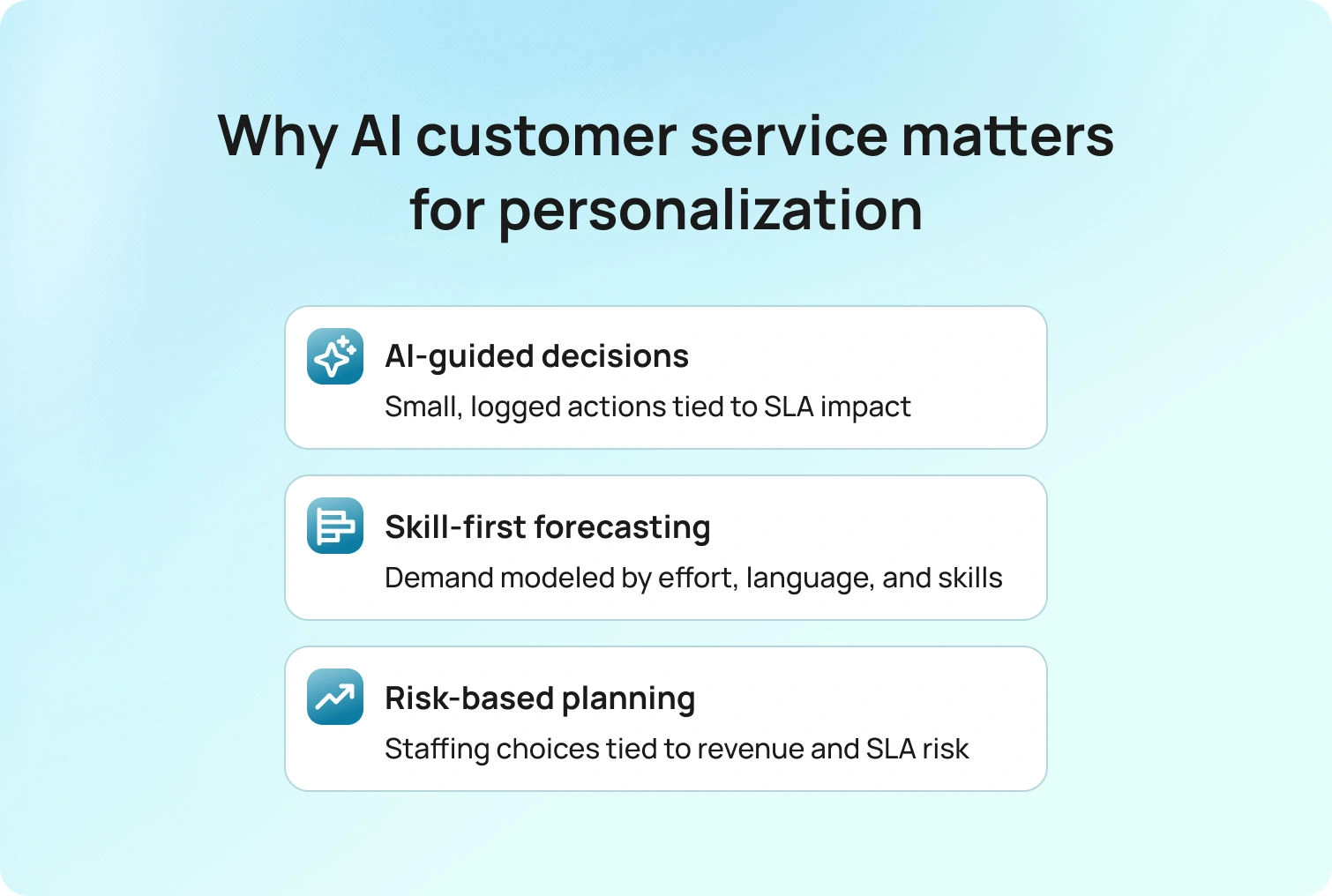
AI will shift from raising alerts to proposing minor, reversible adjustments with a stated impact and an SLA percentage. Each recommendation will carry an approval, a reason, and an outcome log, so reviews rely on evidence rather than opinion. Teams that work this way experience fewer large intraday swings and more stable service levels.
Forecasting will move beyond volume-only views to blend three inputs:
- Arrivals by channel
- Expected effort per intent
- The mix of required languages and certifications
Schedules will better reflect actual work rather than averages, reducing transfers by routing the correct case to the right person the first time. At the same time, agent tools will make flexibility part of the offer. Self-service shift trades, partial-day PTO, and preference capture for channels and shifts become standard, increasing adherence and reducing attrition by building flexibility into the system rather than granting it as an exception.
Intraday management becomes a shared discipline with clear thresholds and a short list of permitted moves. Typical actions include a temporary shift from email to chat, a targeted knowledge nudge for a spike in intent, or a brief burst of callback capacity. Many centers adopt 15-minute cadence check-ins that keep adjustments small and continuous.
Quality, coaching, and workforce management operate as a single loop: QA findings trigger micro-lessons scheduled within the planner, and the next forecast reflects the expected impact on handle time. Leaders can then attribute improvements in first-contact resolution and AHT to specific changes in templates, routes, or training.
Compliance expectations rise as role-based access, auditable change logs, and configurable retention windows become table stakes. Privacy and labor rules are reflected directly in staffing and scheduling, thereby removing manual workarounds and reducing audit risk. The right workforce management software and comprehensive solutions are becoming essential for center and contact center workforce management, ensuring compliance and operational efficiency.
Adopting a center workforce management solution supports future-ready operations by leveraging AI and automation to optimize scheduling, forecasting, and real-time management. Voice remains strategic, as real-time speech understanding and translation are narrowing the gap between native and non-native calls. Voice will play a role in trust-heavy scenarios such as payments, healthcare, and outage management, with AI summarization enabling accurate follow-ups across channels.
Finally, business cases focus on risk and return, shifting budget discussions from absolute headcount to scenario choices that trade coverage and cost against revenue risk and lifetime value. The most credible plans show precisely how a one-point gain in adherence or deflection translates into hours, euros, and SLA protection.
How BlueHub Helps
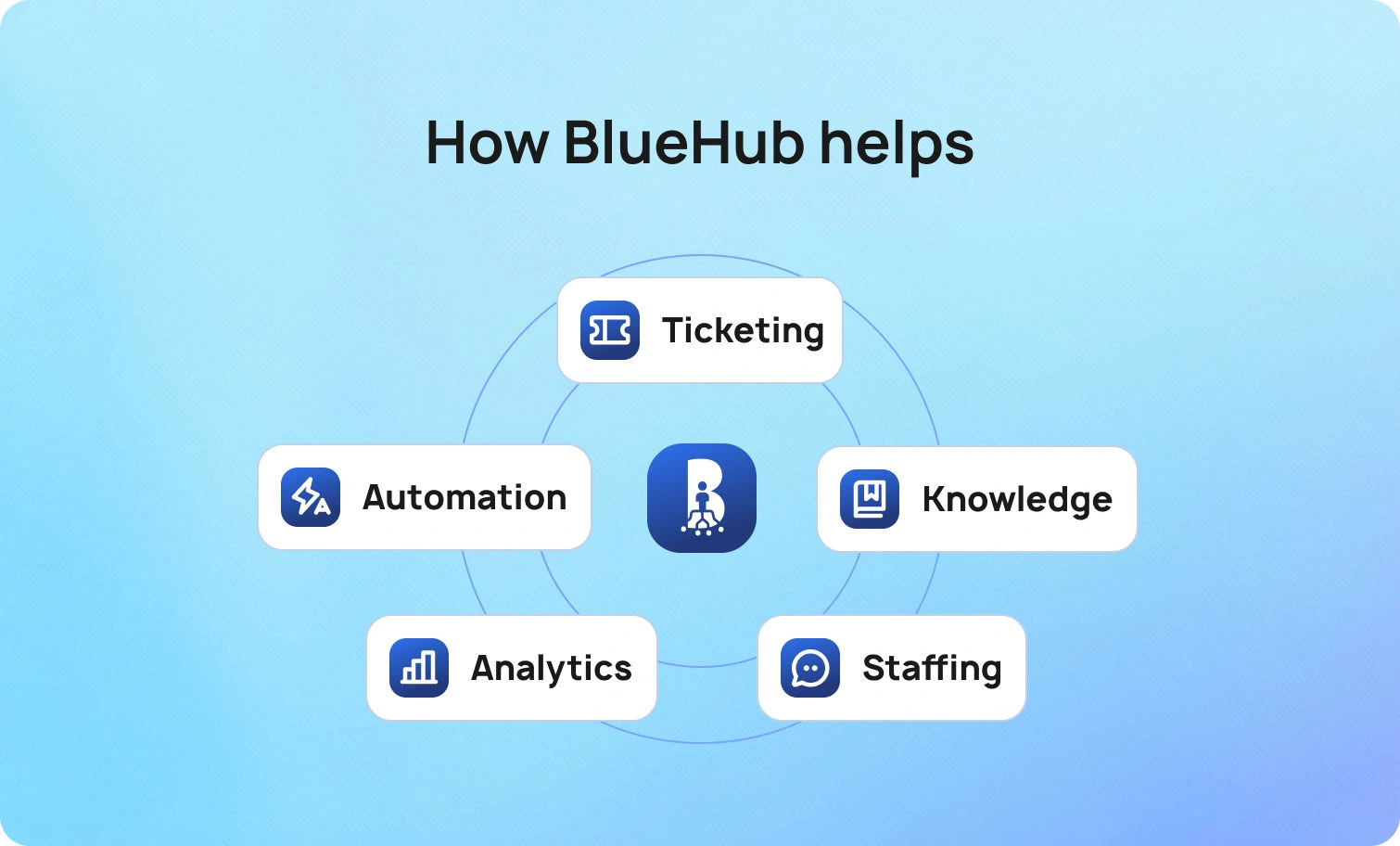
BlueHub is an AI-ready CX operating system that integrates:
- omnichannel ticketing
- voice bot software
- a knowledge base
- workforce management
- robust communication tools that support agent engagement and training
That matters because plans are only as good as their execution. Forecasts use the same data as the queue. Schedules and shift trades live where agents already work. Intraday moves change routing in real time.
BlueHub’s WFM tools streamline workforce management, giving contact center managers instant access to key metrics, including agent performance and availability, to optimize scheduling, forecasting, and staffing. Quality and coaching feed the next forecast. Analytics attributes improvements to the specific template, form, or route you changed, so debates about staffing and service levels are grounded in shared facts.
If you want to run customer service workforce management with fewer surprises and clearer trade-offs, this is the shortest path to improving customer service.
From Strategic Plan to Reliable Daily Execution
The promise of customer service workforce management is simple. Customers get help when they need it from someone who can actually solve the problem, and you hit your SLAs without overspending. The practices in this guide, i.e., layered forecasting, honest shrinkage, skill-based scheduling, intraday discipline, and outcome-driven coaching, turn that promise into a weekly rhythm. When you add AI that identifies the smallest useful move and reports on how staffing ties to business outcomes, the plan becomes credible and the day becomes calmer.
BlueHub brings planning and execution onto a single screen. The platform supports resource management and schedule creation through advanced employee scheduling features, enabling you to optimize staffing, reduce manual effort, and improve agent satisfaction. You can forecast demand by channel, language, and intent, publish skill-aligned schedules with clear rules, make intraday adjustments with a single click as conditions change, and coach to the metrics that matter with analytics that show exactly what improved. If you are ready to make workforce management and customer service a competitive advantage, request a BlueHub demo.

As Head of Digital Transformation, Radu looks over multiple departments across the company, providing visibility over what happens in product, and what are the needs of customers. With more than 8 years in the Technology era, and part of BlueTweak since the beginning, Radu shifted from a developer (addressing end-customer needs) to a more business oriented role, to have an influence and touch base with people who use the actual technology.



