



TL;DR
These examples of AI in customer service show how to reduce operational costs and speed up customer experience without replacing your team. Start with classification and proposed replies, wire in routing and workforce management, then automate policy-safe actions. Each example includes what it is, which KPIs it moves, and how to implement it.
The Building Blocks of AI-Powered Support
Most conversations about AI in customer service are heavy on hype and light on specifics. Leaders hear about transformative AI but rarely see concrete examples of AI in customer service that optimize operational costs and customer satisfaction.
The reality is simpler: AI customer service works when you deploy specific patterns that solve specific problems.
You don't need a moonshot. You need:
- Auto-classification that routes tickets correctly
- Suggested replies grounded in your knowledge base that cut response times
- Voice transcription that eliminates after-call work
- Priority routing that prevents abandonments
This guide breaks down AI in customer service examples you can implement now. Each example of AI in customer service includes what it is, where it fits in your workflow, which KPIs it moves, and how to implement it.
15 Examples of AI in Customer Service You Can Implement Now
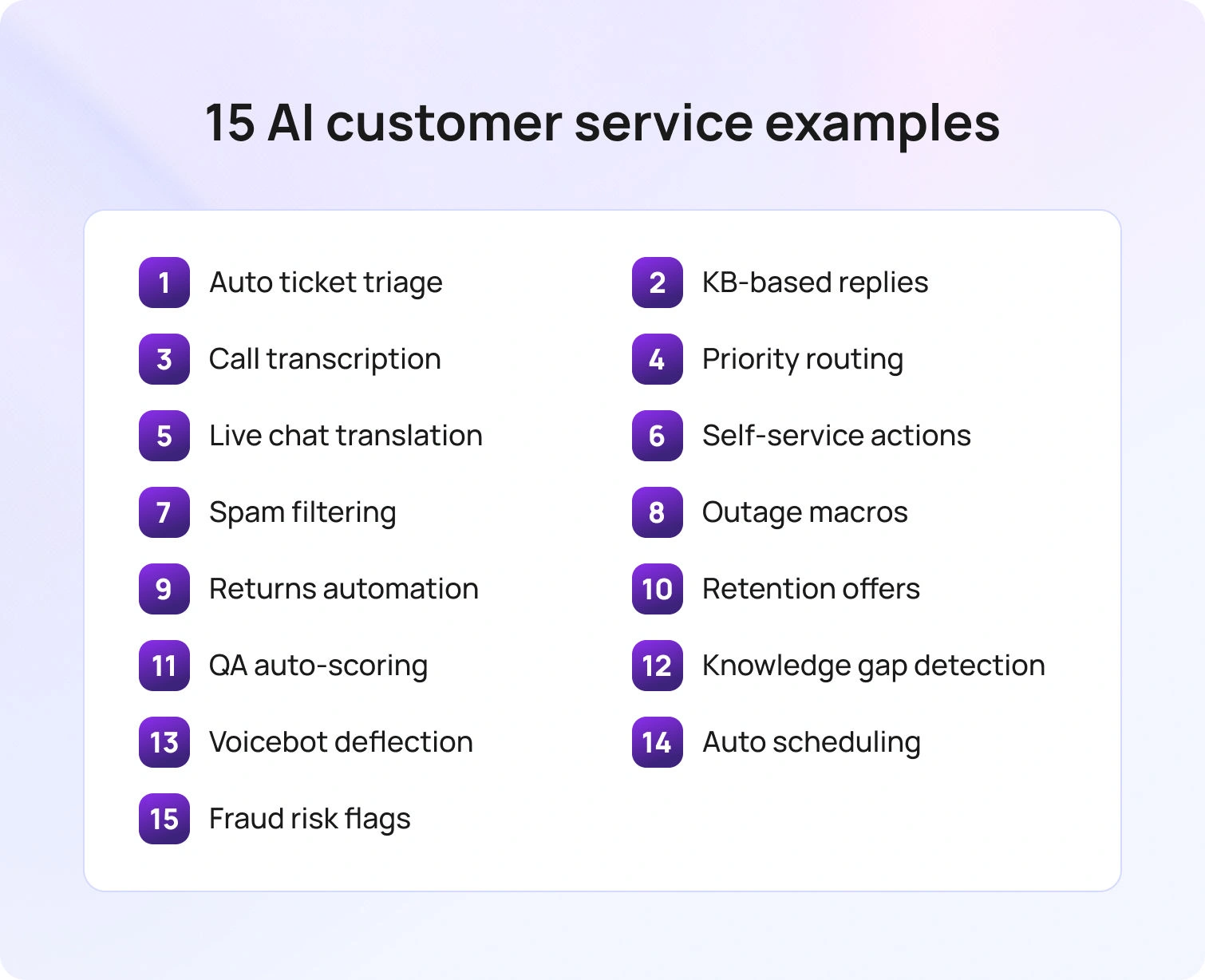
The following examples translate AI concepts into execution. They show what to implement, how it integrates with your current stack, and the measurable outcomes you can expect.
1. Auto-Triage and Ticket Classification
Auto-triage automatically classifies customer inquiries by intent (billing, returns, technical support), language, urgency, and brand on ingest, and that’s before a human agent ever touches the ticket. This eliminates manual sorting and misrouting for support teams, recovering 2–3 minutes of wasted capacity per ticket. When support agents spend time just figuring out what a ticket is about, that's operational costs you can cut immediately.
This fits at the entry point of your ticketing system. Every customer request (whether via chat, email, or voice) is tagged and routed instantly using natural language processing to understand customer inquiries and categorize them accurately.
KPIs to track:
- Average Handle Time (AHT) ↓ (agents don't waste time understanding context)
- First Contact Resolution (FCR) ↑ (right agent gets the correct ticket)
- Abandon Rate ↓ (faster routing reduces wait times)
How to implement:
Train classification models on 90 days of historical data from past interactions when implementing AI. Set confidence thresholds (e.g., 85% confidence = auto-route; below that = flag for human review). Use machine learning algorithms to continuously improve accuracy based on customer feedback and agent corrections. BlueTweak) has a classification feature that feeds directly into automatic routing to send tickets to the correct queue or agent based on intent, sentiment, and customer data.
2. Knowledge Base-Grounded Suggested Replies for Email and Chat
AI drafts complete answers grounded in your knowledge base, complete with citations, so agents can review, edit if needed, and send with one click. This reduces time spent drafting responses and eliminates repetitive typing. An agent who takes 5 minutes to write an email can do it in 30 seconds with AI-generated suggested replies.
This fits in email and chat workflows where customer service agents handle routine tasks and customer questions that have documented answers. Instead of starting from scratch, agents get policy-aware, personalized support drafts that maintain service quality while speeding response times.
KPIs to track:
- AHT ↓ (agents don't type from scratch)
- Time to First Response (TTFR) ↓ (faster initial replies)
- FCR ↑ (accurate, complete answers reduce follow-ups)
- Customer Satisfaction ↑ (consistent, quality responses improve customer experience)
How to implement:
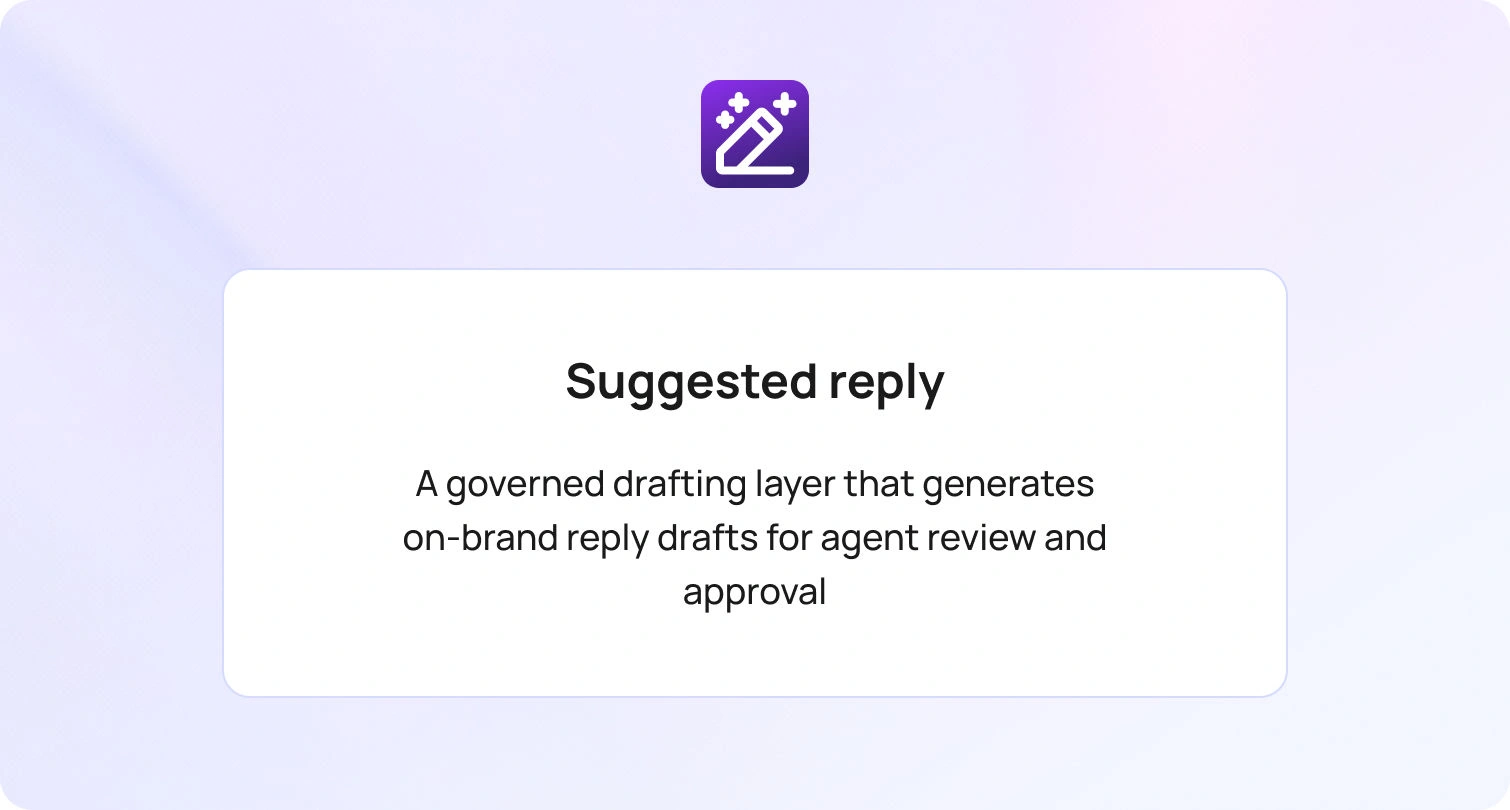
Ground AI in your company's knowledge base. Double-check KB articles include policy limits, edge cases, and citations. Use retrieval-augmented generation (RAG), so AI pulls facts from authoritative sources rather than hallucinating. Train models on your tone and canned responses to maintain brand voice.BlueTweak's knowledge base feeds suggested replies with policy-aware drafts, and updates to the KB propagate instantly to all suggested replies across channels.
3. Voice Call Transcription with Instant Case Summary
Voice call transcription uses advanced natural language processing to capture conversations in real time, then generates instant summaries that flow directly into the ticketing system. This eliminates manual note-taking and speeds handoffs between agents. At scale, this means your customer service team can handle more customer requests without adding headcount.
This fits in voice support operations where agents spend significant time documenting what happened during calls. Instead of typing notes while trying to remember details, AI technology automatically captures everything, highlighting key points such as issue description, resolution steps, subsequent actions, and customer sentiment detected during the conversation.
KPIs to track:
- AHT ↓ (less time documenting calls)
- Handle Time Variance ↓ (standardizes wrap-up across agents)
- Customer Experience ↑ (agents focus on customer relationships, not note-taking)
How to implement:
Deploy call transcription software that captures conversations in real time. Use AI to generate summaries highlighting key points: issue, resolution, next steps, and customer sentiment. Store summaries in the ticket for future reference and to assist agents in subsequent interactions.BlueTweak's call transcription software (and AI ticket summary) flows directly into tickets, so human agents see the full context instantly, enabling faster resolution.
4. Priority Index Routing (Sentiment + Urgency + Customer Value)
Priority Index routing converts risk signals (sentiment analysis, urgency keywords, customer tier) into a dynamic score that routes high-risk cases to senior agents or hot queues with tighter SLAs. This prevents costly escalations and recontacts by addressing customer emotions and frustration early, before they turn into churn. When you catch dissatisfied customers before they hang up or post negative reviews, you save more than the cost of premium routing.
This fits at the routing layer of your customer service solution, especially for multi-channel support operations where customer data flows from multiple touchpoints. The system continuously monitors service interactions and adjusts routing decisions mid-conversation based on changing sentiment or new information about customer history and value.
KPIs to track:
- Abandon Rate ↓ (dissatisfied customers don't wait in standard queues)
- Recovery ≤24h ↑ (at-risk customers get immediate attention)
- Customer Churn ↓ (proactive support intervention prevents defection)
- Customer Retention ↑ (high-value customers receive prioritized service)
How to implement:
Use sentiment analysis and AI-driven sentiment analysis to detect frustration, urgency, and risk in customer interactions. Build a scoring model that combines sentiment from support conversations, customer history from past interactions, lifetime value from customer data, and issue severity. Route high-priority cases to specialists immediately. Integrate predictive analytics to anticipate customer needs and identify patterns in customer behavior that signal churn risk.BlueTweak's classification and sentiment signals feed automatic routing in real time, while workforce management (WFM) adjusts staffing dynamically to handle hot cases without blowing SLAs.
5. Real-Time Chat Translation
Real-time chat translation uses artificial intelligence to translate customer inquiries and agent responses instantly for multilingual customer support. This avoids the cost of hiring niche-language pods; instead of staffing separate Spanish, French, German, and Mandarin teams, one team serves all languages with AI translation support.
This fits in chat and email support for global operations where language diversity traditionally drives up costs. Customers get instant support in their preferred language without waiting for bilingual human agents.
KPIs to track:
- Containment ↑ (customers get help in their language without waiting)
- Abandon Rate ↓ (no language barriers = less frustration)
- Conversion ↑ (especially in sales-adjacent support interactions)
- Customer Satisfaction ↑ (meeting customer needs in their preferred language)
How to implement:
Deploy real-time translation for chat and email using advanced natural language processing. Double-check that translations maintain tone and context, not just literal word-for-word conversion. Use customer profile data to remember language preferences for repeat customers. Train models on your company's terminology and service strategies to accurately translate technical terms and brand-specific language.
BlueTweak provides real-time translation with brand- and language-based routing, so customers receive instant support in their preferred language.
6. Self-Service Status Lookups and Policy-Bound Refunds
Self-service automation handles routine tasks without human intervention. Each self-service resolution saves 5–10 minutes of agent time, deflecting repetitive, low-value tickets and freeing support agents to focus on complex tasks that require technical expertise and human support.
This fits in self-service channels and as automated responses within agent workflows. Customers can get instant support for routine tasks 24/7, while policy-safe guardrails guarantee refunds and actions stay within approved limits.
KPIs to track:
- Containment ↑ (routine tasks never reach agents)
- FCR ↑ (issues resolved immediately)
- AHT ↓ (for tickets that do reach agents, repetitive questions are already answered)
- Customer Satisfaction ↑ (faster resolution improves customer experience)
How to implement:
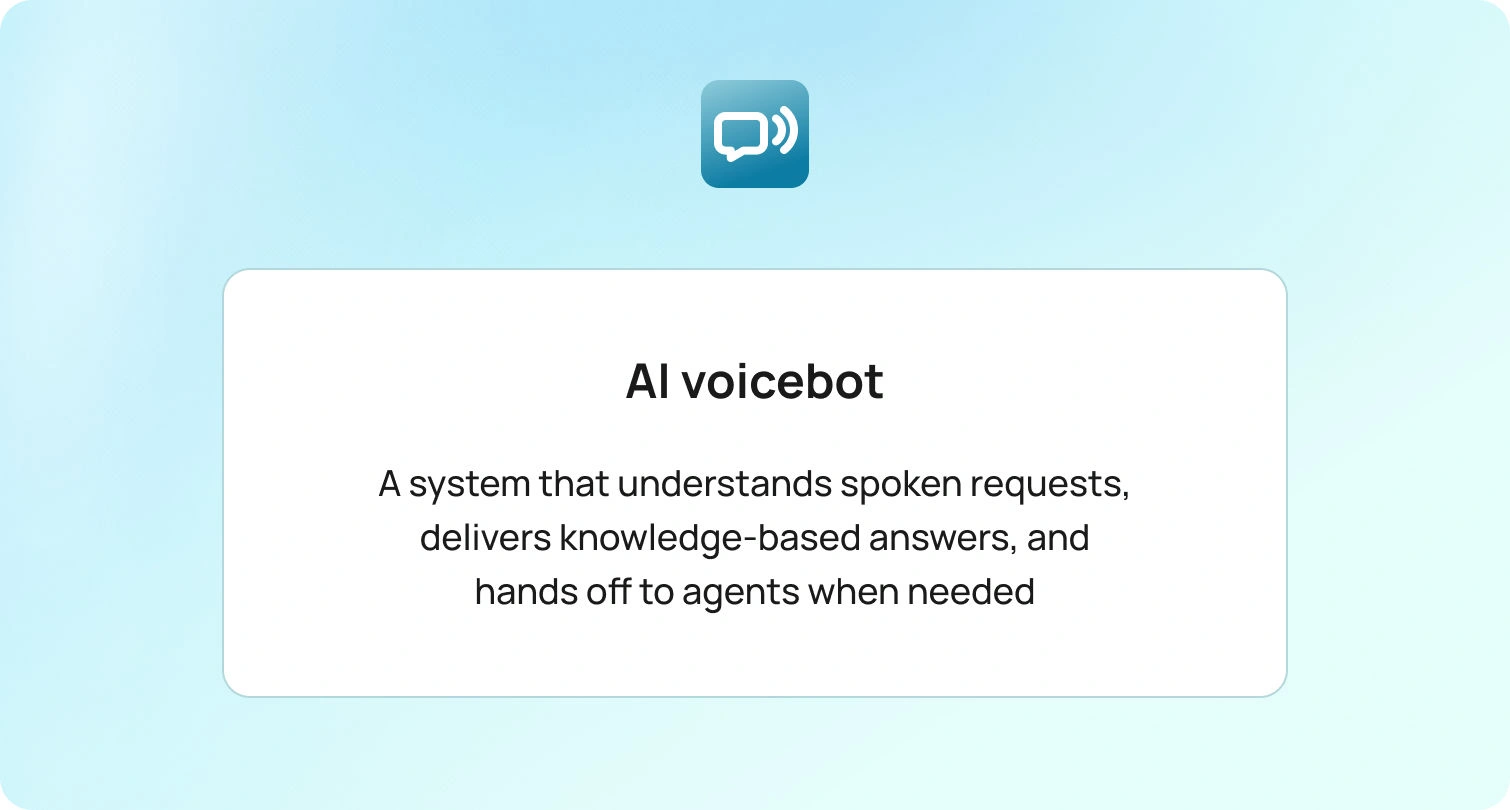
Connect your AI customer service chatbot or AI voicebot to order management and payment APIs. Script policy-safe actions using company knowledge (refunds under $X auto-approve; above that, route for human approval). Ground all self-service options in your knowledge base to prevent hallucinations. Use machine learning to continuously improve understanding of requests and enhance customer interactions over time. BlueTweak's API-open architecture enables safe, policy-bound automation, while administration controls set approval thresholds for risky actions.
7. Spam and Noise Filtering
Spam and noise filtering automatically removes autoresponders, duplicate tickets, promotional replies, and other non-actionable items from your queue before agents see them. Fewer agent touches on junk tickets means cleaner queues, shorter wait times for real customer inquiries, and lower costs.
This fits at ingest, before tickets enter your ticketing system. Filtering noise early helps support teams only see legitimate customer issues that require attention.
KPIs to track:
- Abandon Rate ↓ (cleaner queues = shorter wait times)
- AHT ↓ (agents don't waste time on junk tickets)
- Agent Productivity ↑ (focus on genuine customer inquiries)
How to implement:
Train spam-detection models on historical data using machine-learning algorithms. Flag autoresponders, duplicate submissions, out-of-office replies, and promotional responses. Merge related tickets automatically so agents see the full customer history in one place. Monitor false positives to ensure legitimate customer inquiries aren't accidentally filtered out.BlueTweak's spam detection filters noise on ingest, keeping queues clean, while customer service analytics flag patterns in duplicate submissions so you can address root causes.
8. Proactive Outage and Recall Macros (Multi-Channel)
Proactive outage and recall macros detect volume spikes from known events (shipping delays, product recalls, service outages) and push pre-approved responses across all channels to support business growth. This scales one-to-many messaging during events: instead of 500 agents answering the same question 500 times, AI broadcasts the answer once to reduce costs.
This fits in crisis response and high-volume event management within customer service operations. Proactive support reaches customers before they even contact you, reducing inbound volume and preventing frustration that leads to customer churn.
KPIs to track:
- Abandon Rate ↓ (customers get instant answers during spikes)
- AHT ↓ (pre-scripted responses eliminate agent guesswork)
- CSAT dip minimized (proactive communication prevents frustration)
- Inbound Volume ↓ (customers get answers before calling)
How to implement:
Use predictive analytics to detect spikes in specific intents (e.g., "delayed shipment"). Pre-approve event-specific canned responses and route affected customers to dedicated info queues. Send proactive support messages via email or SMS before customers even call, using customer data to identify who's affected. Create playbooks for common events so your customer service team can respond instantly when issues arise.
BlueTweak detects spikes in real time and activates suggested reply templates to customers in event queues with adjusted SLAs.
9. Returns and RMA Automation
Returns and RMA automation validate return eligibility, generate shipping labels, and schedule pickups (all automated via API calls within the support workflow). This replaces multi-step human workflows (agent checks policy, emails label, logs case) with instant, policy-safe automation that cuts resolution time from 10+ minutes to under 1 minute.
This fits within e-commerce and product-based customer service teams handling high volumes of return requests, where automating routine tasks creates immediate cost efficiencies and better customer experiences.
KPIs to track:
- FCR ↑ (returns processed in one interaction)
- TTFR ↓ (instant label generation)
- Customer Satisfaction ↑ (frictionless returns improve customer experience)
- AHT ↓ (automated workflow eliminates manual steps)
How to implement:
Connect your ticketing system to warehouse and logistics APIs. Script validation rules using company knowledge (purchase date, product condition, return window). Auto-generate labels for eligible returns; escalate exceptions to human agents. Use history to identify patterns in return behavior and flag potential fraud or abuse for review.BlueTweak's API-open actions, along with approval workflows, handle standard returns instantly while escalating edge cases, and the suggested reply includes return instructions and tracking links automatically.
10. Suggested Upsell and Retention Offers in Service (Policy-Safe)
AI suggests policy-safe retention offers when resolving service issues to recover unhappy customers and prevent customer churn. This offsets support costs with retained revenue. When agents have support from AI-assist tools that suggest the right offer at the right moment, customer retention improves.
This fits into service recovery workflows where customer sentiment is negative, but retention is still possible. By analyzing customer sentiment and behavior, AI technology uses this data to anticipate customer needs and suggest offers that address customer concerns while staying within policy limits.
KPIs to track:
- Recovery ≤24h ↑ (faster resolution of service failures)
- Customer Satisfaction ↑ (appropriate compensation improves experience)
- Churn ↓ (retention offers prevent defection)
- Customer Lifetime Value ↑ (retained customers generate more revenue)
How to implement:
Build offer matrices tied to issue severity, customer value, and history. Use sentiment analysis to identify when customers are at risk. Script policy-safe offers. Require approval for high-value offers. Train your customer service team on when to present offers and how to frame them as solutions.
BlueTweak's suggested reply includes KB-linked retention offers with built-in approval workflows for amounts above thresholds.
11. QA Auto-Sampling and Coaching Prompts
QA auto-sampling automatically scores a percentage of cases using customer service quality assurance rubrics, then surfaces coaching snippets for managers. This replaces blanket QA (reviewing everything) with targeted coaching (focusing on what actually needs improvement).
This fits in continuous improvement workflows where support operations need to identify areas for improvement without manually reviewing thousands of customer conversations. AI systems analyze service interactions for quality issues, policy violations, and coaching opportunities.
KPIs to track:
- Recontact Rate ↓ (better first-time resolution)
- FCR ↑ (quality improvements stick)
- Customer Satisfaction ↑ (consistent service quality)
- Agent Performance ↑ (targeted coaching drives improvement)
How to implement:
Define your QA rubric (accuracy, tone, policy adherence, resolution completeness). Auto-sample 5–10% of resolved cases. Use AI to score interactions against the rubric and flag outliers for human review. Generate coaching prompts based on common defects.
BlueTweak's AI ticket summary feeds into QA rubrics, tracking deltas to show how coaching impacts performance over time.
12. Knowledge Gap Detection
Knowledge gap detection identifies intents with low confidence scores or high handle times, then proposes new knowledge base articles to fill those gaps. This creates a continuous improvement loop:
- AI spots what agents struggle with
- Suggests content to fix it
- Performance improves over time
The cost lever is reducing escalations and shortening handle time by giving agents (and AI) better information.
This fits in knowledge management workflows where customer service operations need to keep company knowledge current without manually tracking every gap. Generative AI can even draft article content based on how successful agents handled similar complex customer queries.
KPIs to track:
- FCR ↑ over time (better knowledge = better resolution)
- AHT ↓ (agents find answers faster)
- Escalation Rate ↓ (fewer "I don't know" moments)
How to implement:
Use customer service analytics to flag intents with consistently long handle times or low FCR. Review transcripts to understand what information is missing. Draft KB articles (or use AI to draft them) and route for approval. Publish to the knowledge base and measure impact on handle time and resolution rates for those intents.
BlueTweak flags gaps automatically, and new content publishes directly to the knowledge base, where it immediately improves AI and human agent responses.
13. Voicebot Deflection for FAQs with Warm Handoff
AI voicebot deflection handles simple intents like account balance, order status, and appointment confirmations, then hands off to human agents with full context when complex issues arise. This combines the cost efficiency of automation (handling mundane tasks) with the service quality of human support (handling complex tasks).
This fits at the front end of voice support, especially for high-volume contact centers where most calls are simple customer questions that don't require human agents.
KPIs to track:
- Containment ↑ (simple intents resolved by AI)
- Abandon Rate ↓ (fast answers reduce frustration)
- AHT ↓ (human agents handle fewer, shorter calls)
- Customer Satisfaction maintained (warm handoffs preserve experience)
How to implement:
Deploy an AIvoicebot for high-volume FAQs. Ground responses in your knowledge base for accuracy. Set confidence thresholds for when to escalate. When escalating, transfer with a full transcript and summary so human agents don't make customers repeat themselves.BlueTweak's AI voicebot handles routine inquiries, and when escalation is needed, it flows into the agent workspace for seamless handoffs.
14. Appointment and Field Service Scheduling
Appointment and field service scheduling automation lets agents (or customers) book and reschedule appointments via API, eliminating back-office handoffs. This removes 3–5 minutes per scheduling request and reduces customer effort by letting customers pick times that work for them without phone tag or email chains.
This fits in service operations with field technicians, installation teams, or appointment-based support, where scheduling coordination traditionally requires multiple touchpoints and manual calendar management.
KPIs to track:
- FCR ↑ (appointments booked in one interaction)
- TTFR ↓ (instant scheduling)
- Customer Satisfaction ↑ (customers get convenient time slots)
- No-show Rate ↓ (automated reminders reduce missed appointments)
How to implement:
Connect your ticketing system to scheduling and calendar APIs. Enable customers or agents to view available slots and book directly. Add validation prompts (service area, eligibility checks). Send automated confirmations and reminders. Use customer data to suggest convenient times based on past interactions.BlueTweak's API-open actions with validation prompts enable instant scheduling, and the suggested reply includes confirmation details and next steps automatically.
15. Fraud and Return-Abuse Pattern Flags (Support-Safe)
Fraud and return-abuse detection flags risky intents and requires approval before processing. This prevents costly mistakes such as fraudulent refunds, policy abuse, and chargebacks without slowing legitimate requests. The cost savings come from avoiding fraud losses that far exceed the cost of manual review.
This fits within customer service operations that handle financial transactions, returns, account changes, or other high-risk actions, where businesses interact with both legitimate customers and bad actors.
KPIs to track:
- Chargebacks ↓ (prevent fraudulent transactions)
- Rework ↓ (fewer mistakes requiring correction)
- Policy Compliance ↑ (risky actions properly reviewed)
- Fraud Loss ↓ (caught patterns before completion)
How to implement:
Train machine learning algorithms on patterns in customer behavior that correlate with fraud or abuse. Flag accounts or requests that match risk profiles. Route flagged cases to specialized teams for review. Maintain audit logs for compliance and learning.
BlueTweak's classification plus approval workflows flag risky cases with full audit logs without degrading service for legitimate customer interactions.
The Future of AI in Customer Service
The next wave of AI in customer service will move beyond answering questions to executing complicated tasks with full auditability and human oversight.
Expect AI agents that execute policy-bound actions via APIs with support for edge cases. This shift transforms how businesses interact with customers at scale.
A single Smart Knowledge Base will give consistent answers across chat, voice, and email, eliminating drift between channels and ensuring every customer interaction reflects current knowledge.
AI systems will detect risk signals (late shipments, product recalls, service outages) and stage Suggested Replies before tickets spike, enabling proactive communication that prevents customer inquiries entirely.
BlueTweak's trajectory: BlueTweak maintains an API-open, KB-first architecture so teams can grow from assist to safe automation without re-platforming, evolving from AI-assist tools to fully autonomous agents as their confidence and operational maturity increase.
AI in Customer Service That Optimizes Costs & Customer Experience
Applied to specific jobs in the flow (classification on ingest, suggested replies, intelligent routing by risk and value, transcription with summaries, and policy-safe self-service), AI in customer service lowers cost while improving speed and satisfaction. The 15 examples show a disciplined path: place each capability where it does the most work, track AHT, FCR, TTFR, abandonment, and CSAT, then move from assist to safe automation.
If you are ready to operationalize these patterns across chat, voice, email, and self-service, BlueTweak unifies them on a single platform. Book a demo today to learn more.

As Head of Digital Transformation, Radu looks over multiple departments across the company, providing visibility over what happens in product, and what are the needs of customers. With more than 8 years in the Technology era, and part of BlueTweak since the beginning, Radu shifted from a developer (addressing end-customer needs) to a more business oriented role, to have an influence and touch base with people who use the actual technology.



