Biggest Challenges Training AI for Customer Support Intent Recognition (2026)



BlueTweak is an AI Customer Support Platform that unifies every conversation, customer record, and automation into one workspace.
Explore more
Insights, trends, and practical ideas from customer experience and AI
Real-world scenarios showing how teams use BlueTweak to deliver better service
The daily blueprint that guides customer support leadership.
ROI and savings calculators for support teams
See how BlueTweak stacks up against leading customer support platforms
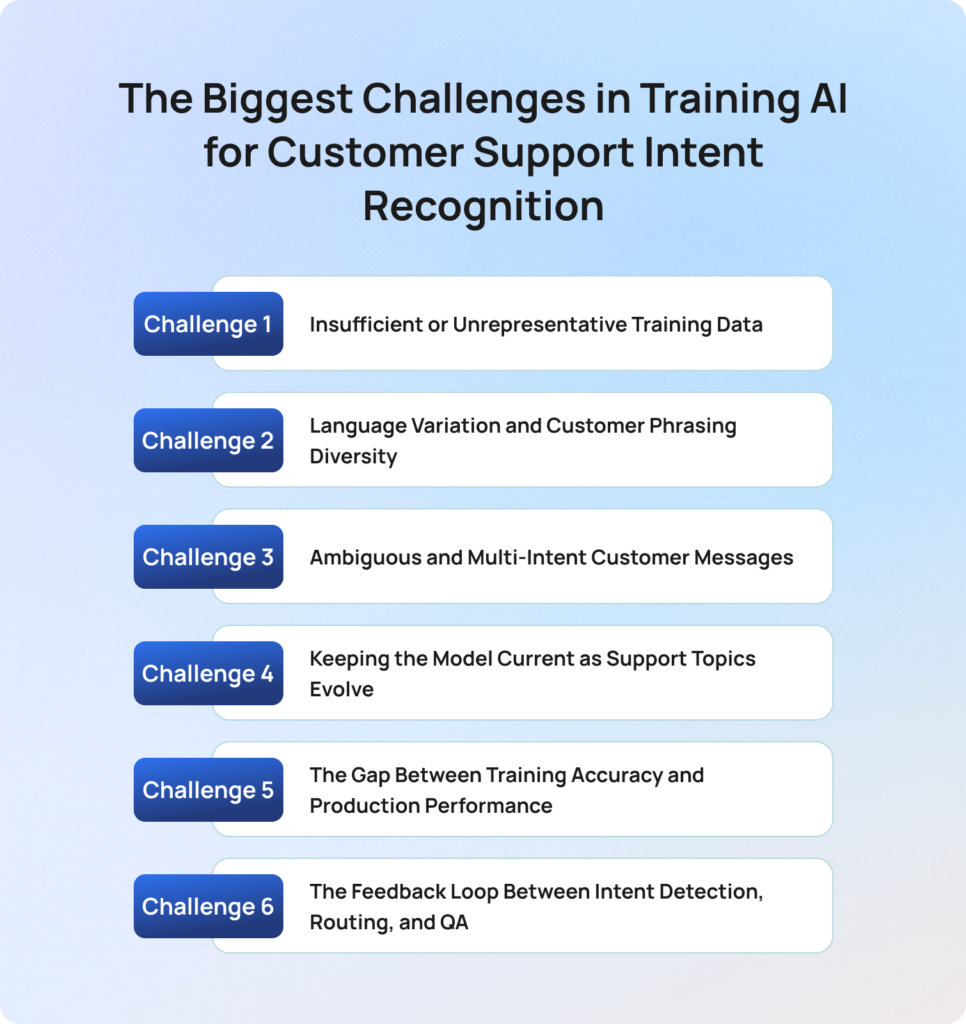
Training AI for customer support intent recognition means building a model that correctly classifies what a customer wants from their message. The failure modes are almost always in the training data, not the technology. The six biggest challenges are bad training data, phrasing variation, ambiguous and multi-intent messages, concept drift, the test-to-production accuracy gap, and broken feedback loops between intent detection, routing, and QA. All six are fixable.
Customer intent recognition in customer support is the process of teaching AI models to classify what a customer wants from their message accurately enough to trigger the right automated action or route the interaction to the right human agent.
Understanding how AI intent recognition works starts with the training data. The model maps customer input to a predefined intent category using natural language processing NLP and natural language understanding to interpret human language as it actually appears in real-world customer conversations. In practice, that training data consists of historical support tickets, live chat transcripts, voice call transcripts, and email threads, each labelled with the intent they represent: refund request, account access issue, shipping query, cancellation, escalation, and so on.
Support is a harder domain to train for than most other NLP applications. Customer queries are often incomplete, emotionally charged, or phrased in ways that do not map to any clean category. The vocabulary shifts constantly as products change. Customer expectations are high: people expect the AI system to understand their needs without requiring them to repeat themselves.
And unlike a closed-domain task like booking a flight, customer intent in support can range from a simple password reset to a complex complaint spanning account status, customer history, and several previous interactions.
If you want to understand how conversational AI detects customer intent once the model is live, that is covered separately. This article is about what makes training that model hard in the first place.
The most common root cause of intent model failure is not a flaw in the algorithm. It is a flaw in the data the algorithm was trained on.
When a support team launches a new product, opens a new communication channel, or handles a new category of customer inquiry for the first time, there is no historical data to draw from. The model has never seen these customer interactions before.
This cold start problem forces teams into an uncomfortable choice: deploy with no coverage for the new intent class, guess at how customers will phrase queries and build synthetic examples, or wait until enough real interactions accumulate before training. During that waiting period, every interaction in the new category is misrouted or unhandled.
Most support queues are dominated by a handful of high-frequency customer requests: password resets, billing queries, order status checks. These intents are well-represented in training data. Rare but high-value intents (churn signals, escalation triggers, compliance-sensitive requests) have far fewer examples.
A model trained on imbalanced data learns to classify the common intents reliably and performs poorly on the rare ones. The result is that the interactions most in need of accurate intent detection are the ones the model handles worst.
Support tickets used as training data are labelled by human agents, and agents are inconsistent. One agent writes “refund request.” Another writes “wants money back.” A third writes “billing dispute.” All three map to the same customer intent, but the model sees three different labels.
Poor labelling quality introduces noise that degrades classification accuracy regardless of how sophisticated the underlying machine learning models are. The fix requires minimum sample thresholds per intent class before deployment, active learning loops that surface uncertain classifications for human review, and a labelling quality audit before each retraining cycle.
Customer feedback and user feedback captured post-interaction are also valuable insights for identifying which intent classes produce inaccurate responses. Teams that route this signal back into training achieve accurate intent recognition significantly faster than those relying on internal labels alone.
The connection between labelling quality and first contact resolution is covered in depth in the AI ticket classification guide, which is worth reading before you define your intent taxonomy.
Customers do not describe their problems the way a training dataset expects. This is one of the most persistent challenges in training AI for customer support intent recognition and one of the least discussed.
Consider these four messages: “My package hasn’t arrived.” “Where is my order?” “I’ve been waiting two weeks and nothing has shown up.” “Is my delivery lost?”
All four map to the same customer intent: a delivery status query. But a model trained on one phrasing pattern and tested on another will misclassify real-world customer conversations at a rate that aggregate accuracy scores hide.
Paraphrase augmentation during training, specifically generating alternative phrasings for each intent class, is the standard fix. Pre-trained language models, which have been exposed to broad human language patterns, significantly reduce this problem compared to models trained from scratch on a narrow support corpus. AI-powered intent recognition that draws on diverse training corpora is better at recognizing intent across the full range of ways businesses interact with their customers.
The way a customer phrases something on live chat differs from an email, a voice call, or a social media message. Chat messages tend to be short and colloquial. Emails are longer and more formal. Voice transcripts include false starts, filler words, and incomplete sentences.
A model trained on email transcripts and deployed on voice or chat will underperform, not because the intent is different but because the surface form of natural language varies by channel.
Voice channels introduce speech recognition outputs with transcription noise and incomplete sentences. Sentiment analysis adds a further layer: customers expressing frustration and customers making neutral factual requests may use near-identical phrasing, and a model without sentiment analysis capability cannot distinguish between them. Chat channels reflect informal customer behavior and abbreviated phrasing. Each channel expresses the same underlying customer needs and customer preferences differently.
Omnichannel customer support operations that handle customer interactions across multiple communication channels need intent models trained on channel-stratified datasets, or at a minimum, evaluated separately by channel to surface where accuracy degrades.
For teams providing multilingual support, the phrasing variation problem compounds further. The same customer intent expressed in French, Dutch, and Portuguese will produce very different input tokens. Regional dialects and code-switching (customers mixing languages mid-message) add a layer that many intent detection models are not trained to handle.
The result is that multilingual customer interactions are systematically underserved by models trained predominantly on one language.
Single-intent classification models fail most visibly on the customer interactions that matter most. Complex queries are also the ones most likely to contain ambiguous or multiple intents.
“I need help with my account” contains no deterministic classification signal. The model must either attempt a classification based on the most common account-related user intent it has seen, ask the customer a clarifying question, or escalate to a human agent.
Guessing wrong triggers a misroute. Asking a clarifying question adds friction. Escalating everything with low confidence is expensive.
Understanding how intent detection works handles this ambiguity is what separates AI-powered systems that provide relevant responses from those that produce detected intent errors at scale. The solution is a properly calibrated confidence threshold: if the model’s confidence score falls below a defined level, the interaction goes to a human agent rather than being auto-routed. Most teams deploy without tuning this threshold, which means the model assigns classifications even when it should not.
Customers frequently combine intents in a single message. “I want to cancel my subscription, but first I need a refund for last month’s charge” contains two separate customer requests requiring two separate workflows. Most intent classification models are trained to output a single label per input. On a multi-intent message, the model either classifies on the dominant intent and ignores the secondary one, or fails on both.
The BlueTweak Intent Hierarchy Model addresses this by classifying primary and secondary intent slots separately, ensuring that both the cancellation workflow and the refund request are captured and routed without requiring the customer to send two separate messages.
Virtual assistants and virtual agents that handle multi-intent queries correctly enable better customer interactions and free human agents to focus on more complex tasks rather than recovering from misrouted tier-1 queries.
In longer customer conversations, intent can change. A conversation that starts as a delivery query can shift to a complaint, then to a refund request, as the customer learns more about what happened.
Models trained on single-turn inputs do not handle this shift reliably. Conversation-level context windows that re-evaluate intent as new customer input arrives are required for accurate intent detection in complex, multi-turn interactions. Contextual understanding of the full customer journey is what makes intent recognition technology reliable in practice rather than in controlled tests.
Context-aware AI suggested replies are one practical output of getting this right: the system can respond appropriately because it is tracking how customer intent shifts across the conversation, not just what was said in the first message.
A model trained on last year’s support tickets degrades the moment the product, policy, or customer base changes. Concept drift, the gradual shift in the statistical distribution of live traffic away from the training distribution, is one of the most underestimated challenges in training AI for customer support intent recognition.
New products launch and introduce customer queries that the model has never classified. Policies change and shift the language customers use to describe their problems. Seasonal events such as a peak shipping period, a billing cycle change, or a product recall generate spikes in query types that the training data does not represent.
Each of these events erodes model accuracy silently. There is no error message. Misclassifications are assigned with the same confidence as correct ones.
Most teams retrain on a scheduled cadence: quarterly or biannual cycles driven by the calendar rather than performance signals. Accuracy degradation accumulates between cycles, and the team only discovers the problem when customer satisfaction scores drop or escalation rates rise.
Enhancing customer satisfaction and customer engagement through AI-driven customer service requires continuous learning. The model must improve as customer behavior evolves, not just when the next calendar retrain is scheduled.
When a genuinely new intent emerges (a new product fault, an unexpected policy change, a public incident generating a spike in a specific type of customer query) the model has no class for it. It routes the new query as the closest approximation from its existing intent taxonomy.
Which is often wrong. And which generates handle time, repeat contacts, and dissatisfied customers before anyone notices the misroute pattern.
The fix is live customer service analytics that monitor per-intent accuracy in real time, with automated alerts that trigger retraining when a specific intent class drops below threshold, and a fast-path process for adding new intent categories before misrouted tickets accumulate.
A model that achieves 92% accuracy in testing can perform significantly worse in production. This is one of the most common and most avoidable failures in AI-powered customer support deployments in 2026. It is not a model quality problem. It is an evaluation methodology problem.
Test data is drawn from the same historical corpus as training data. It represents the past. Production traffic includes edge cases, new customer phrasings, and query types that emerged after the training cutoff. The model was never exposed to them.
Accuracy on a historical test set tells you how well the model performs on data that looks like your training data. It tells you very little about how it performs on the next six months of live customer interactions.
Overall accuracy is a poor metric for intent classification in customer support. A model that correctly classifies 95% of high-frequency intents but fails on 40% of rare ones looks excellent in aggregate. It is not. The interactions it gets wrong are disproportionately likely to be the high-value, high-sensitivity ones: churn signals, escalation triggers, compliance queries that most require accurate routing.
Evaluating intent detection models on per-intent precision and recall, not overall accuracy, surfaces these failure patterns before they reach production. Precision measures how often the model is correct when it assigns a given label. Recall measures how often it correctly identifies a given intent when it is present. Both matter. Neither is visible in an aggregate accuracy score.
Deploying without a properly calibrated confidence threshold means the model assigns classifications at high confidence even when it is uncertain. A customer input that genuinely falls between two intent categories gets assigned to one of them as if the classification were clear. The routing system acts on that. The customer arrives at the wrong team. The agent sees a misrouted ticket with no flag that the AI system was uncertain.
The result is not just a failed interaction. It is an operational costs problem, because recovering a misrouted interaction costs more than handling it correctly the first time. Accurate intent recognition is the foundation of accurate responses, personalized responses, and the operational efficiency that customer expectations increasingly demand.
Per-intent confidence threshold calibration, which means setting different escalation thresholds for different intent classes based on the cost of a misclassification, is standard practice in well-deployed support ticket automation systems. It is rarely implemented at first deployment and rarely revisited after.
Intent recognition does not operate in isolation. Its output feeds the routing system, which feeds the QA process, which generates the data that should feed back into the next training cycle. When that loop is broken, training failures propagate downstream and accumulate silently.
A routing system that relies on intent labels from an underperforming model sends interactions to the wrong team. Agents receive tickets outside their skill area. Handle time increases. Customer satisfaction drops. First contact resolution falls.
How well an AI customer support platform handles the routing integration layer is one of the clearest differentiators between systems that work in production and ones that look good in a demo.
The customer in this scenario does not know that an AI system misclassified their request. They know they explained their problem, were transferred, and had to explain it again. What they experience is bad service. What the data shows is a rising escalation rate that no one has attributed to an intent classification problem.
The customer journey breaks not at the moment of human intervention, but at the moment the AI agent made a silent misclassification that no one caught. Customer service teams that surface these failures quickly are the ones that recover fastest.
Every time a human agent overrides an AI classification by reassigning a ticket to a different category, transferring an auto-routed interaction, or escalating a query the AI system marked as tier-1, they are creating a labelled training example. The model got it wrong. The agent corrected it. That correction is the most accurate signal available for improving accurate intent classification over time.
AI agents and virtual agents that improve through this loop reduce the volume of queries requiring human intervention, freeing agents to focus on complex tasks where judgment genuinely matters: from account status disputes to queries that resemble tailored financial advice more than a standard FAQ resolution.
Most teams do not have a structured process for capturing these overrides as training data. The corrections happen. The improved labels are never fed back into the retraining pipeline. The same misclassification pattern repeats in the next deployment cycle.
AI quality assurance scoring across 100% of interaction surfaces, interactions where the AI system performed poorly: wrong routing, poor response quality, unnecessary escalation. These QA flags are the richest available signal for identifying which intent classes are underperforming in production.
Teams that feed QA data back into their training pipeline close the feedback loop that makes continuous improvement practical rather than aspirational.
Tracking per-intent performance metrics through a proper customer service analytics layer is what turns QA flags into actionable retraining signals rather than numbers on a dashboard no one acts on.
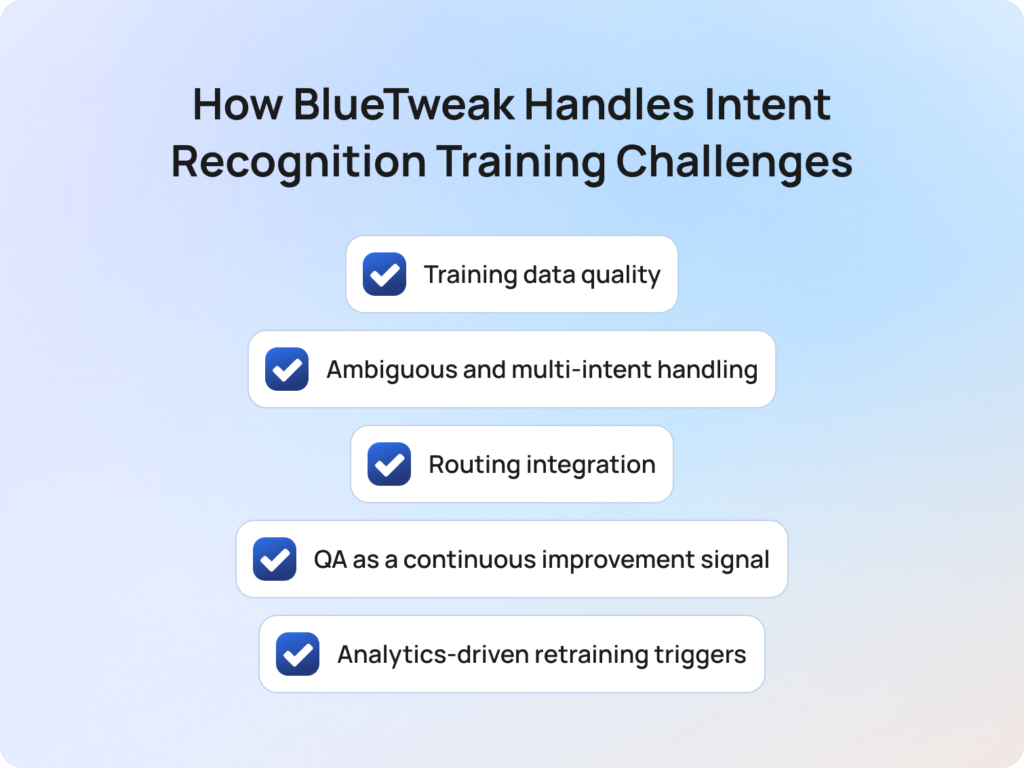
Most of the challenges above trace back to the same structural gap: intent recognition is treated as a one-time deployment problem rather than an ongoing operational discipline. Train the model, launch it, move on. BlueTweak is built on the premise that AI-powered customer support requires the same continuous learning commitment as the human teams it supports.
Training data quality. BlueTweak’s conversational AI is grounded in support-specific interaction data rather than general-purpose language corpora, reducing the distribution mismatch that causes production degradation. The Smart Knowledge Base provides the structured content layer that grounds automated responses in verified information, reducing the gap between what the model classifies and what it can actually resolve.
Ambiguous and multi-intent handling. BlueTweak’s confidence scoring and escalation triggers prevent low-confidence classifications from reaching the customer as if they were certain. When customer intent is ambiguous, the interaction is routed to a human agent rather than being misclassified. Virtual agents handle tier-1 interactions where intent is clear and consistent. Human agents focus on the complex queries where contextual understanding and judgment are required.
Routing integration. Intent classification output connects directly to the AI Ticket Triage system, closing the loop between classification and routing correction. Agent overrides are captured as labelled training signals rather than lost as one-off corrections.
QA as a continuous improvement signal. The QA module scores 100% of interactions, not the 5 to 15% that manual review covers. QA flags on misrouted or poorly resolved interactions surface directly as retraining candidates rather than disappearing into an aggregate satisfaction score.
Analytics-driven retraining triggers. Rather than retraining on a calendar schedule, BlueTweak surfaces per-intent accuracy signals through the analytics and reporting layer. Teams see when a specific intent class starts underperforming before that degradation affects CSAT or escalation rates.
The teams that get the most out of AI in customer support are not the ones with the most sophisticated models. They are the ones with the tightest feedback loops. Every misclassification is a training example. Every agent correction is a signal. The system gets better only if you build the infrastructure to capture those signals and act on them.

Radu Dumitrescu, Head of Presale and Digital Transformation at BlueTweak
Intent classification is one piece of a larger picture. How AI improves customer support across the full operation is worth reading alongside this.
The challenges in training AI for customer support intent recognition are not technology problems. They are data quality problems, evaluation methodology problems, and operational discipline problems.
Insufficient training data, language variation, ambiguous customer intent, concept drift, the test-production gap, and broken feedback loops are all fixable with the right process, the right measurement infrastructure, and the right commitment to treating intent recognition as an ongoing practice rather than a one-time deployment.
Customer service teams that build this discipline see the key benefits compound over time: more accurate intent classification, better routing, higher first contact resolution, and customer interactions that feel genuinely responsive rather than mechanically routed. AI-powered intent recognition that learns continuously is what enables businesses to meet customer needs at scale and deliver exceptional customer experiences.
The customer experience does not improve because the model is smarter. It improves because the model keeps getting better.
If you want to go deeper into what happens once the model is deployed, how conversational AI detects customer intent in real time covers the full detection pipeline.
Start your free trial and see how BlueTweak handles intent recognition against your own support data.
The six most common causes are: bad or imbalanced training data, phrasing variation across channels, ambiguous and multi-intent messages, concept drift as support topics change, the gap between test and production accuracy, and the absence of a feedback loop from routing errors back into training. All are operational problems, not technology problems.
Test data is drawn from historical interactions; live traffic includes new phrasings and query types the model was never exposed to. That distribution shift causes accuracy to fall. Aggregate accuracy scores also hide per-intent failures: a model at 94% overall can be failing on 35% of the rare intent classes that matter most.
Multi-intent messages require hierarchical classification rather than a single-label output. The BlueTweak Intent Hierarchy Model classifies primary and secondary intent slots separately, so a customer who asks to cancel and request a refund in the same message gets both intents routed correctly.
Retrain in response to live performance signals, not on a fixed calendar. Quarterly cycles let concept drift accumulate silently for months before anyone notices. The practical standard is continuous per-intent accuracy monitoring with automated alerts that trigger retraining when a specific intent class drops below the threshold. Customer service analytics covers which signals surface degradation earliest.
Misclassified intent produces misrouted tickets: the wrong team receives the interaction, handle time rises, first contact resolution falls, and the customer repeats themselves. QA flags on those misroutes are the richest available retraining signal, but only if they feed back into the training pipeline.
As Head of Digital Transformation, Radu looks over multiple departments across the company, providing visibility over what happens in product, and what are the needs of customers. With more than 8 years in the Technology era, and part of BlueTweak since the beginning, Radu shifted from a developer (addressing end-customer needs) to a more business oriented role, to have an influence and touch base with people who use the actual technology.