



TL;DR
AI-powered customer sentiment analysis enables real-time emotion detection across email, chat, and voice, automatically prioritizing customers with angry emotions, routing them to the right agents, and triggering faster response protocols. This guide shows you which signals matter, how to build routing rules that respond to urgency, and when a platform like BlueTweak makes sense for teams managing omnichannel support at scale.
Scores Without Action Equal Missed Escalations
Most artificial intelligence sentiment analysis tools generate visually appealing dashboards with color-coded emotion scores, providing a clear representation of the sentiment. Your team sees a spike in negative sentiment. Someone mentions it in a meeting. Then nothing changes operationally.
Sentiment scores sit in analytics platforms while your ticketing system routes every email in the order it arrived. Unfortunately, this still places upset customers with serious customer support tickets in the same queue as someone inquiring about your business hours.
The core issues:
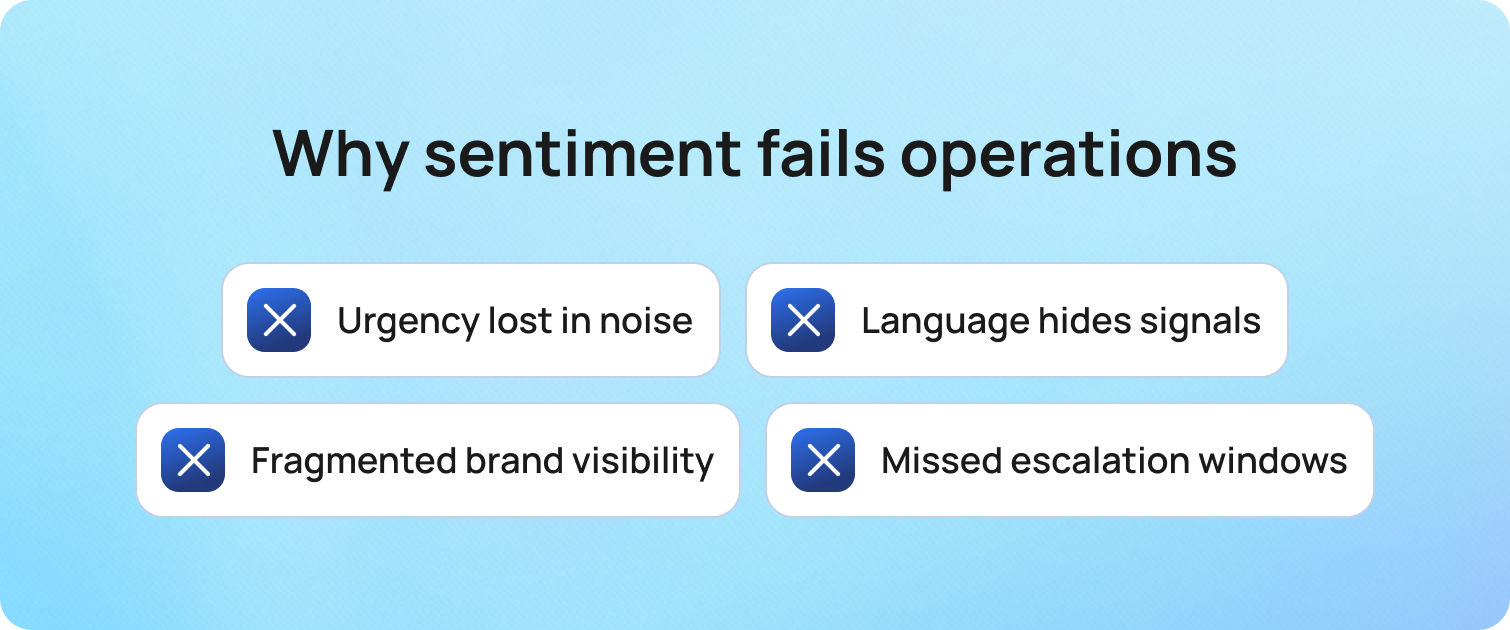
- Noise drowns out real urgency. Spam, routine questions, and low-priority customer feedback flood your queue. True negatives (customers at risk of churning) blend into the background. Agents triage based on subject lines or timestamps, rather than emotional state.
- Multilingual complexity hides signals. A frustrated customer writing in Spanish or switching mid-conversation from English to French often gets misrouted or stuck with an agent who can't fully understand the context. Language barriers delay triage when speed matters most.
- Multi-brand chaos fragments visibility. If you support three product lines under different brands, negative sentiment in Brand A's queue might not trigger alerts in your central view. Patterns emerge too slowly to prevent damage.
- Escalation windows close before anyone notices. By the time a supervisor reviews last week's sentiment trends, the angry customer has already canceled, left a one-star review, or moved to a competitor.
This leads to slower triage, repeat contacts from the same frustrated customers, abandoned conversations, and measurable churn. Your agents feel the pressure but lack the artificial intelligence tools to act on what the data is already telling you.
In this article, sentiment signals that correlate with urgency across email, chat, and voice are identified, and their translation into routing rules, SLA tiers, and supervisor alerts is explained, along with copy-and-paste templates for rapid adoption. It also outlines when to deploy BlueTweak to link sentiment with auto-triage, multilingual routing, and real-time analytics, ensuring that high-risk customers are directed to the right agent first.
Why Aspect-Based Sentiment Analysis Matters in 2025
AI used for customer sentiment analysis in 2025 isn't just keyword spotting. It's a real-time classification of customer emotion and intent across every channel (email, chat, and voice), enriched with account context such as billing status and order history, which helps identify emerging trends based on previous sentiment patterns.
Modern systems process natural language at scale. They pull in data from multiple modalities: a chatbot conversation where someone types "I want a refund," a voice call where pitch and volume spike mid-sentence, and an email littered with capital letters and exclamation marks. Then they combine those signals with contextual risk factors.
The best implementations follow a human-in-the-loop model:
- Assist: AI flags high-priority cases and suggests responses, but agents approve everything.
- Approve: For routine negatives, AI drafts replies; agents click send after a quick review.
- Automate safe actions: Low-risk sentiment analysis tasks get handled without human intervention, freeing agents for complex escalations.
The shift from earlier traditional sentiment analysis models is the integration with operational systems. Scores don't live in isolation. Instead, they trigger routing changes, adjust SLAs, and preload agents with context to support interactions.
H3: KPI & ROI Model
If you can't tie customer sentiment analysis AI to measurable outcomes, you're just collecting data. Here are the metrics that matter, particularly focusing on the emotional tone of customer interactions :
Primary KPIs:
- First Contact Resolution (FCR): When sentiment triggers correct routing, customers are immediately directed to the right agent, eliminating the need to bounce between queues.
- Average Handle Time (AHT): Faster triage and context-loaded agents resolve negative cases more efficiently.
- Abandon Rate on Negative Cases: Hot-queue SLAs reduce wait times for frustrated customers before they abandon the call or close the chat.
- Recovery Rate: Percentage of negative sentiment cases that shift to neutral or positive within 24 hours.
- Churn Proxy: Track repeat contacts from the same customer. Multiple negative interactions within a short window signal high risk.
ROI calculator:
Start with these inputs:
- Monthly volume of negative-sentiment tickets
- Current average handle time for escalations
- Fully loaded cost per agent hour
- Baseline recovery rate (how often you turn a negative experience around today)
Then model the impact:
- Faster triage: If sentiment-based routing reduces AHT for negative cases by 15%, calculate the hours saved, then multiply by the agent's cost.
- Higher FCR: Routing to the correct specialist queue the first time reduces repeat contacts. Estimate the number of tickets avoided × the cost per ticket.
- Improved recovery rate: If proactive outreach or a faster response increases recovery from 40% to 60%, estimate the revenue retained from customers who would have otherwise churned.
- Reduced abandonment rate: Shorter waits for hot-queue cases mean fewer customers giving up. Track revenue lost per abandoned high-value interaction.
Even conservative assumptions show a measurable impact. A 200-seat customer support team handling 50,000 tickets monthly, with 10% flagged as highly negative, might save over 500 agent hours per month while retaining six figures in at-risk revenue.
The Artificial Intelligence Signals That Detect Frustration and Urgency
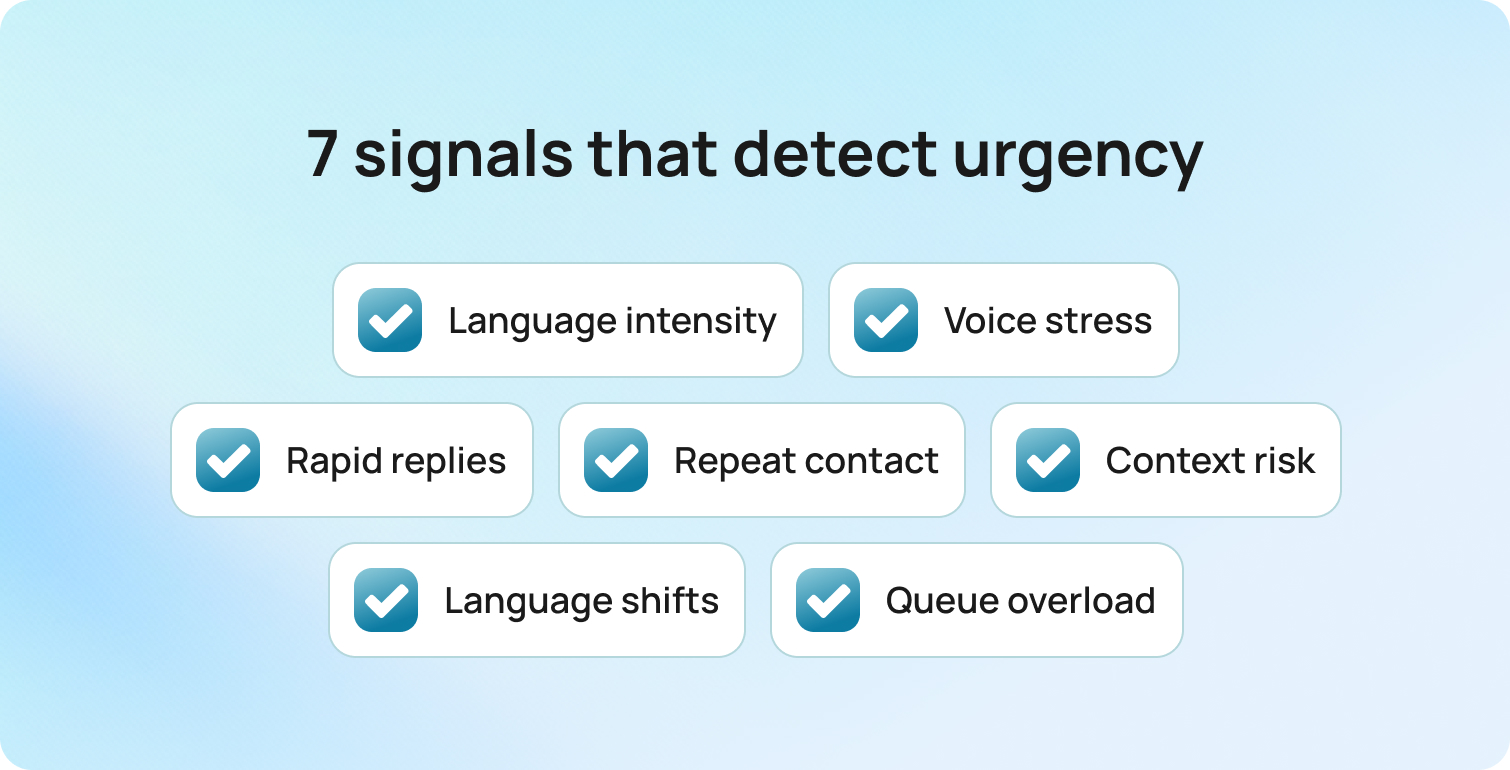
Before building rules, it helps to define the signals that actually indicate risk. The following section breaks down text, acoustic, and behavioral cues—across languages and channels—that most reliably flag frustration and urgency.
Lexical & Semantic Cues
Start with the obvious: caps lock, profanity, repeated exclamation marks, phrases like "cancel my account," "speak to a manager," or "this is unacceptable." Modern natural language processing (NLP) models go deeper. They catch sarcasm, detect passive-aggressive phrasing, and recognize negative sentiment even when customers stay polite.
Paralinguistic Voice Cues
Call transcription software, paired with prosody analysis, listens for more than just words. Pitch spikes, increased volume, speaking over the agent, long pauses, or sudden tone shifts all signal escalation risk. When someone's voice cracks or they interrupt repeatedly, the system prioritizes the conversation to prevent it from derailing completely.
Conversation Dynamics
Textual data finds patterns and gains valuable insights beyond individual messages:
- Reply latency: A customer who responds within seconds to every message is likely actively engaged, but may also be agitated.
- Repeated contact: The third interaction on the same issue within 48 hours must auto-escalate.
- Looped macros: If an agent sends the same canned response twice, the customer is likely stuck in a frustrating cycle.
These dynamics underscore the limitations of sentiment scores in capturing the urgency.
Contextual Risk Factors
Layer in customer data that changes priority:
- VIP tier: High-value accounts get faster routing regardless of sentiment.
- Outage cohort: If 200 customers in the same region experience downtime, their tickets automatically jump to the front of the queue.
- Recent failed delivery or payment dispute: These create compounding frustration; sentiment analysis combined with account status triggers immediate escalation.
Multilingual Cues
Multilingual customer support introduces unique challenges. Language switches mid-conversation, mistranslation markers, or phrases that don't translate cleanly all signal confusion or mounting frustration. Modern systems detect these cues and either route the user to a native-language agent or activate real-time translation assistance, ensuring context is not lost.
Spam and Noise Filtering
One underrated function of AI sentiment analysis customer service systems: automatically discarding non-issues. Marketing inquiries, bot traffic, and low-priority requests get filtered, so your hot queue only shows true negatives. This keeps agents focused on the conversations that matter.
Agent State and Workload Management
Call center workforce management integration enables the system to recognize when queues are overloaded, allowing for more effective management of resources. If sentiment spikes during a product launch or outage, the platform rebalances routing to prevent SLA breaches. Frustrated customers don't sit in a backlog while agents in another queue handle routine questions.
BlueTweak integrations that power these signals: Call transcription for voice analysis, AI Ticket Summary to surface patterns across interactions, multilingual support for global teams, and workforce management to optimize routing under load.
How to Fix the Problem (from Sentiment to Action)
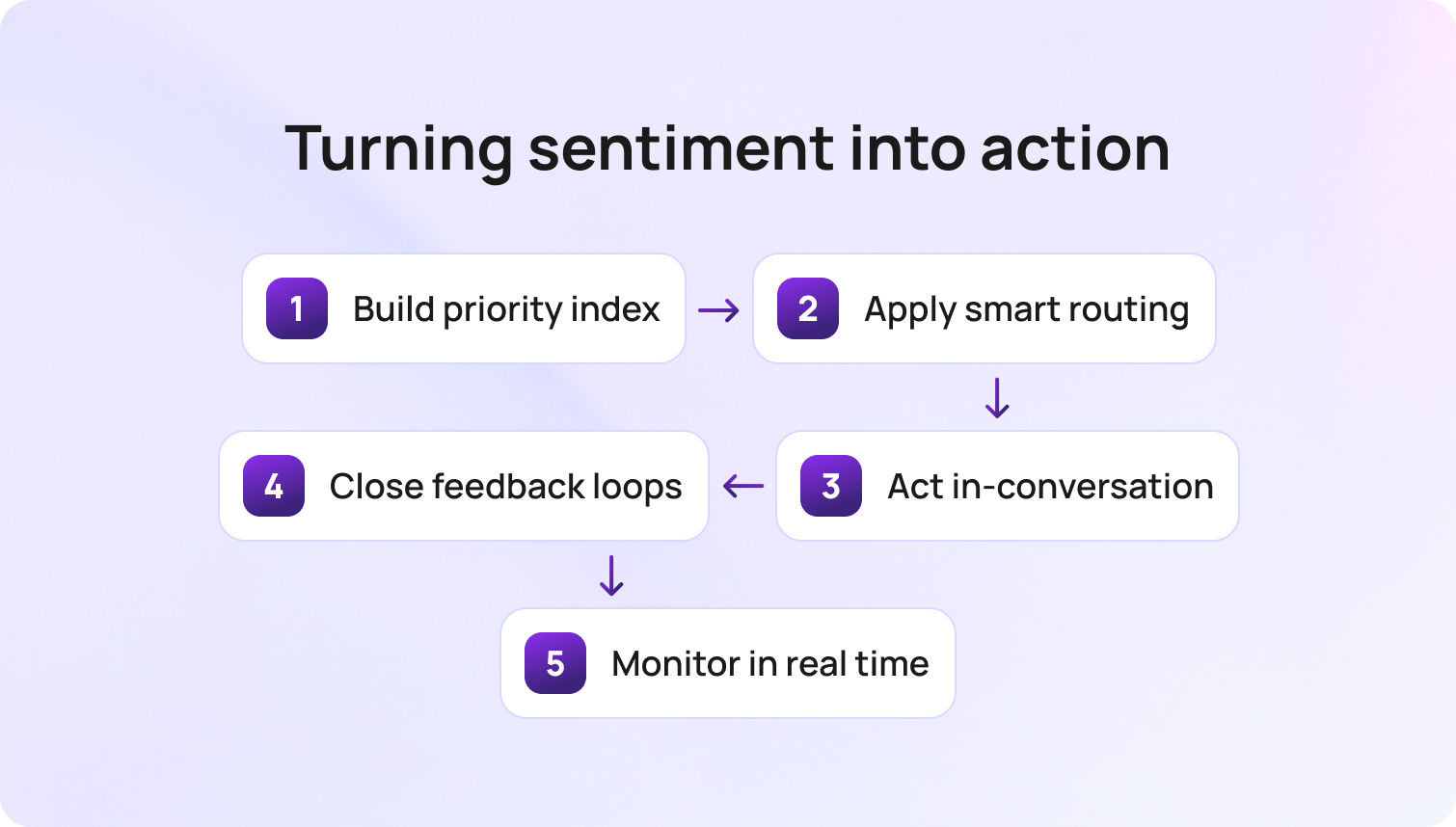
Identifying negative sentiment is step one. The real value lies in connecting scores to operations.
1. Build a Priority Index
Don't rely on raw sentiment scores alone. Create a composite Priority Index that combines:
- Normalized sentiment score ranging from -1 (highly negative) to +1 (highly positive)
- Urgency features like billing risk flags, outage impact, account value, or repeat contact count
Example formula: Priority Index = (Sentiment Score × Weight₁) + (Urgency Score × Weight₂)
Tickets above a threshold (say, PI ≥ 0.7) route to your hot queue with the shortest SLA.
2. Define Routing Rules That React in Real Time
Your ticketing system should execute logic like:
- High negative scores + VIP tier: Senior agent queue with preloaded suggested reply templates pulled from your knowledge base.
- Language = Spanish + negative scores: Route to native Spanish-speaking agents or activate translation assist.
- Product = Billing + sentiment = highly negative: Specialist queue with authority to issue refunds without supervisor approval.
- Voice call + prosody alert: Immediate callback offer via AI voicebot if hold time exceeds two minutes.
These rules turn valuable insights into operational changes that happen automatically.
3. In-Conversation Actionable Insights
Don't wait until after the interaction to respond. When sentiment crosses a threshold mid-conversation:
- Throttle the chatbot. If an AI customer service chatbot is frustrating the customer, hand off to a human immediately.
- Switch to a human with full context. Load the customer profile, interaction history, and sentiment timeline to prevent the agent from asking redundant questions.
- Preload proposed replies. Pull relevant KB articles and draft a response so the agent can personalize and send instead of writing from scratch.
- Offer a proactive callback. If wait times are long, let the customer choose a callback time instead of holding.
4. Post-Interaction Customer Feedback Workflows
After resolving a highly negative case:
- Mandatory QA sample. Route a percentage of high-priority interactions to customer service quality assurance reviewers to catch coaching opportunities.
- Trigger retention workflow. If sentiment didn't improve, flag the account for proactive outreach.
5. Real-Time Dashboards and Analytics
Your customer service analytics should show:
- Sentiment heatmap by brand, channel, and product line in real time
- SLA breaches filtered by priority index
- Recovery rate within 24 hours—how many negative interactions shifted to neutral or positive
- Sentiment trends over time to spot systemic issues before they spiral
- Social media monitoring to monitor the entire customer journey
These dashboards inform daily triage decisions and alert supervisors to emerging problems.
BlueTweak's operational integration: Automatic routing based on sentiment and context, suggested replies that accelerate recovery, an AI voicebot for callback management, and unified analytics across customer support channels.
Governance, Bias, and Qualit
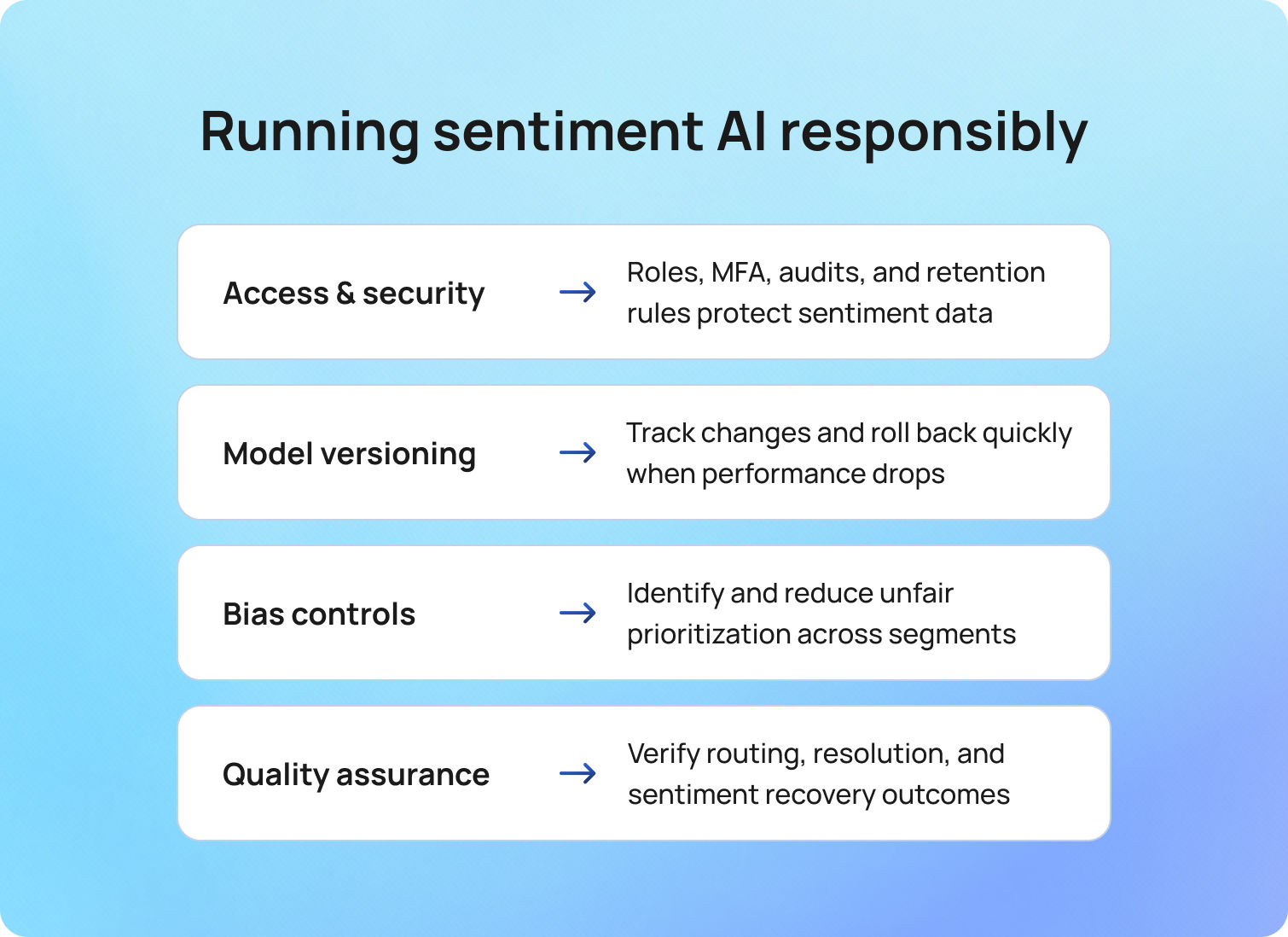
AI-enabled customer sentiment analysis systems make decisions that affect customer experience, future customer expectations, and revenue. That requires governance.
Administration and Security
Administration tools should enforce:
- Role-based access control: Not every agent needs to override routing rules or see VIP account details.
- Multi-factor authentication (MFA): Protect access to sentiment data and model configurations.
- Audit logs: Track customer sentiment by examining who modified routing logic, adjusted thresholds, or reviewed sensitive customer interactions.
- Data retention policies: Define how long overall sentiment scores and conversation transcripts are stored, especially for compliance-heavy industries.
Prompt and Model Version Control
As you tune sentiment models or adjust routing prompts, version everything. If a change tanks FCR or increases escalations, you need to roll back quickly. Document what changed, why, and which KPIs you're monitoring.
Bias Controls
Machine learning models trained on historical data can inherit biases. A model that learned from past routing decisions might systematically under-prioritize certain customer segments or over-flag others.
Mitigate this by:
- Excluding protected attributes like age, gender, or ethnicity from training data
- Reviewing false positives and false negatives across demographic groups
- Human review loops for edge cases where automated decisions might be wrong
Quality Assurance
Customer service quality assurance for sentiment-driven workflows should include:
- Rubric for hot-queue cases: Did the agent acknowledge frustration? Did they resolve the issue on first contact? Did sentiment improve?
- Track recovery rate and CSAT deltas: Measure whether sentiment-based prioritization actually improves customer satisfaction.
- Spot-check routing decisions: Periodically audit whether tickets with a negative score got routed correctly and resolved within SLA.
BlueTweak's governance features: Centralized administration with role-based access, audit trails, and integrated QA tools that surface high-priority cases for review.
How BlueTweak Helps Improve Sentiment Analysis
Not every team needs to build sentiment analysis from scratch or stitch together five tools to make it work. BlueTweak fits specific patterns:
You Want One Stack for Omnichannel Support
If you're managing voice, email, and chat with separate platforms, customer emotions get fragmented. Sentiment detected in a chatbot conversation doesn't carry over when the customer calls. Email history is stored in one system, while voice transcripts reside in another.
BlueTweak centralizes everything. Call transcription feeds into the same record as chat logs and email threads. Sentiment scores update in real time across channels. Agents see a unified customer profile regardless of how someone contacts you.
Your Knowledge Base Needs to Drive Faster Recovery
When an agent handles a highly negative case, they shouldn't waste time searching for answers. BlueTweak's knowledge base integration surfaces relevant articles automatically based on the issue and customer sentiment. Suggested replies combine KB content with conversation context, allowing agents to personalize and send responses instead of writing from scratch.
Multi-Brand Operations Need Unified Analytics
Supporting multiple product lines or regional brands creates visibility gaps. BlueTweak's customer service analytics roll up trends across brands while allowing you to drill into specific queues. You can spot patterns and route resources accordingly.
You Prefer Predictable Pricing with AI Features Included
Some platforms charge separately for sentiment analysis, call transcription, chatbot interactions, and advanced routing.BBlueTweak's pricing bundles AI-powered customer sentiment analysis with all core features. You don't pay extra when sentiment detection flags more cases or when multilingual support scales up.
You Need Customer Support Automation That Learns from Sentiment
BlueTweak's automation doesn't just handle routine questions; it also addresses complex inquiries. It learns from sentiment data to decide when to escalate. If a chatbot interaction starts trending negative, the system hands off to a human before frustration peaks. If an email reply doesn't resolve the issue and sentiment stays low, the platform triggers follow-up workflows automatically.
Turning Sentiment Into Action
Customer sentiment analysis AI only delivers value when scores drive action. Beautiful dashboards don't reduce churn. Routing rules that prioritize angry customers and adjust SLAs based on urgency are crucial when conducting sentiment analysis effectively.
Start with the assist layer: use sentiment scores to preload agents with context, surface suggested replies, and flag cases for human review. Then automate safe actions while keeping humans in the loop for complex escalations. Continuously adjust your thresholds and review recovery rates to ensure you're capturing the right signals.
If you're managing omnichannel support at scale, dealing with multilingual complexity, or supporting multiple brands under one roof, you need a customer service solution that integrates sentiment analysis with routing, automation, and analytics. BlueTweak was built for exactly that.
Request a demo to see sentiment-based routing in action

As Head of Digital Transformation, Radu looks over multiple departments across the company, providing visibility over what happens in product, and what are the needs of customers. With more than 8 years in the Technology era, and part of BlueTweak since the beginning, Radu shifted from a developer (addressing end-customer needs) to a more business oriented role, to have an influence and touch base with people who use the actual technology.



