How to Build a Customer Centric Strategy That Drives Real Growth



BlueTweak is an AI Customer Support Platform that unifies every conversation, customer record, and automation into one workspace.
Explore more
A customer-centric strategy puts your customers at the center of every decision you make. It’s a mindset that shapes your entire business model, company culture, and business operations. Learn the customer-centric strategy definition, key elements for success, and practical steps to implement a customer-centric approach.
Most companies say they’re customer-centric. They talk about customer satisfaction. They collect customer feedback, and they measure net promoter scores.
But when you dig into how they actually operate, decisions still get made based on what’s convenient for internal processes, what the development team wants to build, or what makes sense from a cost perspective.
The customer-centric culture doesn’t actually exist.
Real customer centricity is different. It’s when meeting customer expectations drives your business strategy, not the other way around. It’s when you design your customer journey around what customers need, not what’s easiest to implement. It’s when your entire organization, from leadership to support agents, operates with a customer-first philosophy.
Below, we explore what a customer-centric strategy is, why it matters, and how to build one that works.
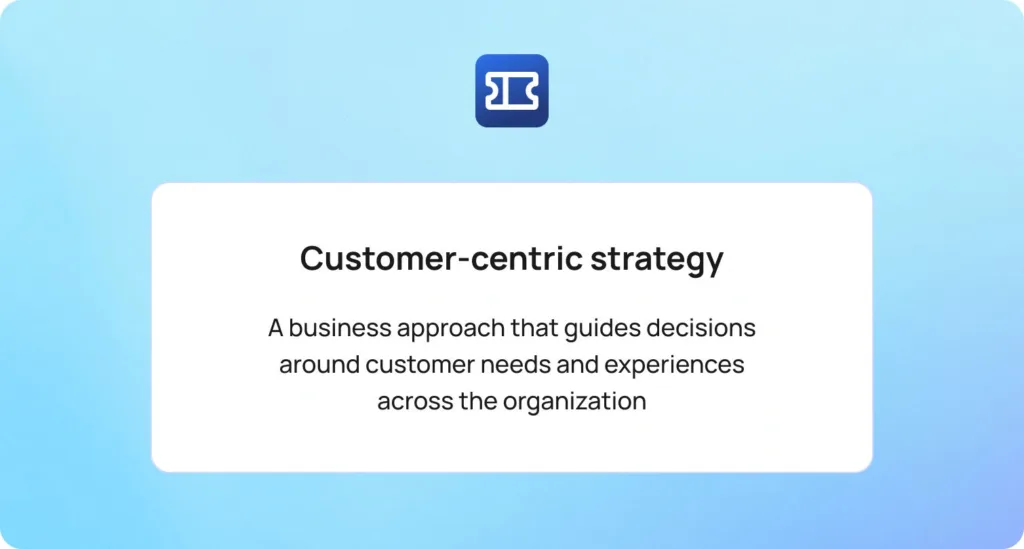
Customer-centric strategy definition: it’s a business approach that prioritizes customer needs, preferences, and experiences in every decision you make.
But here’s the customer-centric strategy that really matters: it’s about building a customer-centric business where every team (product, marketing, sales, customer service, operations) asks, “How does this impact our customers?” before making decisions.
A customer-centricity strategy isn’t just about being nice to customers or responding to complaints quickly. It’s a fundamental shift in how you operate. Customer-centric organizations design their entire business model around delivering value at every customer interaction.
The difference between a customer-centric company and everyone else is that customer-centric companies:
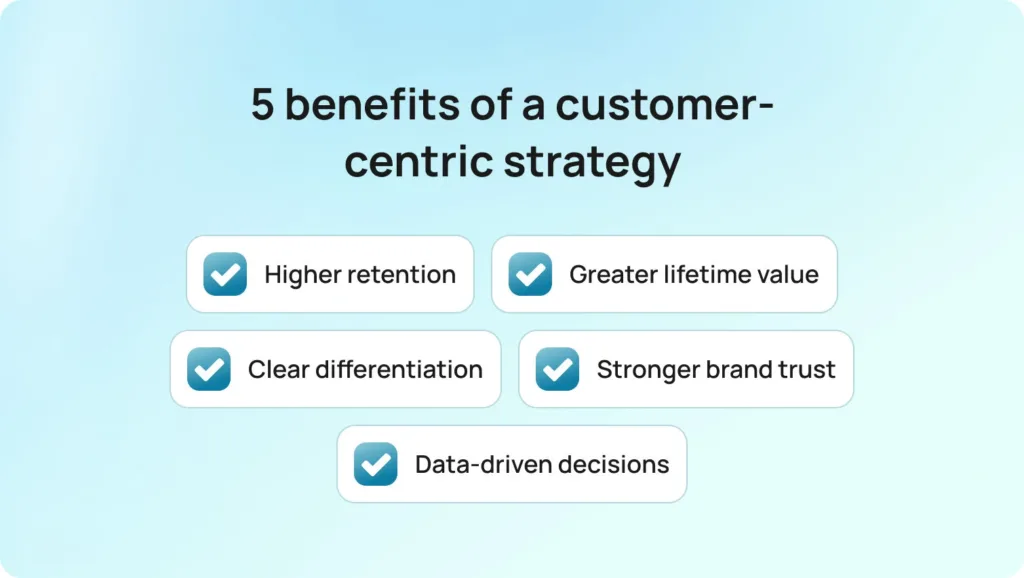
The benefits of a customer-centric strategy are measurable and significant:
When you consistently meet customer expectations and deliver positive experiences, customers stay. Customer retention goes up. Your customer churn rate goes down.
Loyal customers spend more over time. They’re less price-sensitive. They give you permission to make mistakes because you’ve built trust.
A customer-centric approach turns new customers into repeat customers. When you understand customer pain points and proactively solve them, people come back. Acquiring new customers almost always costs more (a lot more) than retaining existing ones.
By focusing on customer lifetime value instead of one-time transactions, you build sustainable growth that compounds over time.
In crowded markets where products are similar, customer experience becomes the differentiator. A customer-centric model gives you a competitive edge because most companies still operate with product-first thinking.
When competitors focus on features, customer-centric strategies win by focusing on outcomes.
Satisfied customers tell people. In the age of social media and online reviews, your brand reputation is built (or destroyed) by customer experiences. Customer-centric companies benefit from positive word-of-mouth that no marketing budget can buy.
Brand loyalty goes beyond logos and advertising. It’s about consistently delivering on promises and meeting customer expectations.
When you collect customer feedback systematically and use customer data to inform decisions, you make smarter choices. You stop guessing what customers want and start knowing. This deep understanding of consumer behavior, communication preferences, and pain points leads to better products, better service, and better business outcomes.
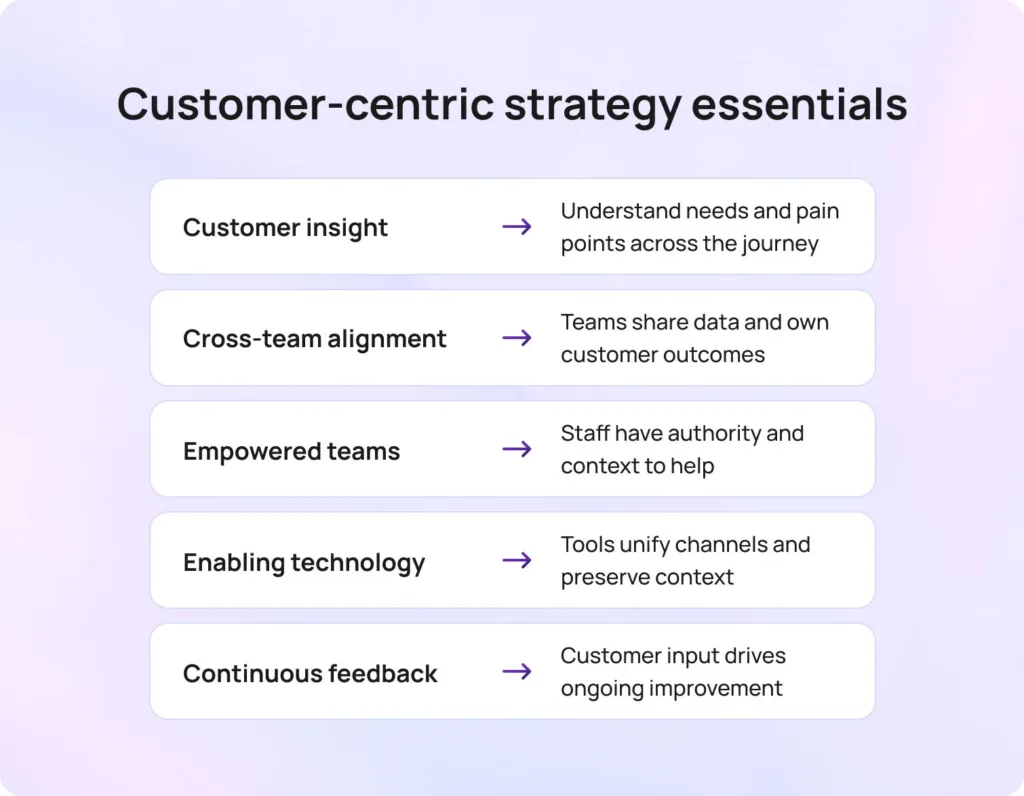
Building a customer-centric business requires several core elements working together:
You can’t serve customers if you don’t understand them. Customer-centric organizations invest in understanding their customer base through:
This is an ongoing effort to stay connected to customers’ evolving needs.
True customer centricity breaks down silos. When your development team, marketing, sales, and customer service teams all share the same customer data and work toward the same customer outcomes, magic happens.
Cross-functional collaboration means everyone takes ownership of the customer experience. Product teams design with customer feedback in mind. Marketing creates content that addresses real customer issues. Support agents share insights that inform product development.
Your employees shape every customer interaction. Empowering them means:
Customer-centric metrics should measure how well employees deliver positive experiences.
The right tools make customer centricity possible at scale. An omnichannel customer support platform unifies customer interactions across multiple devices and channels (phone, email, chat, social media) so you can maintain context and continuity.
Features like AI-powered ticket summaries, suggested replies, and real-time chat translation help agents deliver personalized service faster.
The goal isn’t more technology. It’s technology that helps you better understand and serve customers.
Customer centricity means never being satisfied with “good enough.” Establish feedback loops that capture customer insights continuously:
Use this data to continuously improve your product, service, and processes.
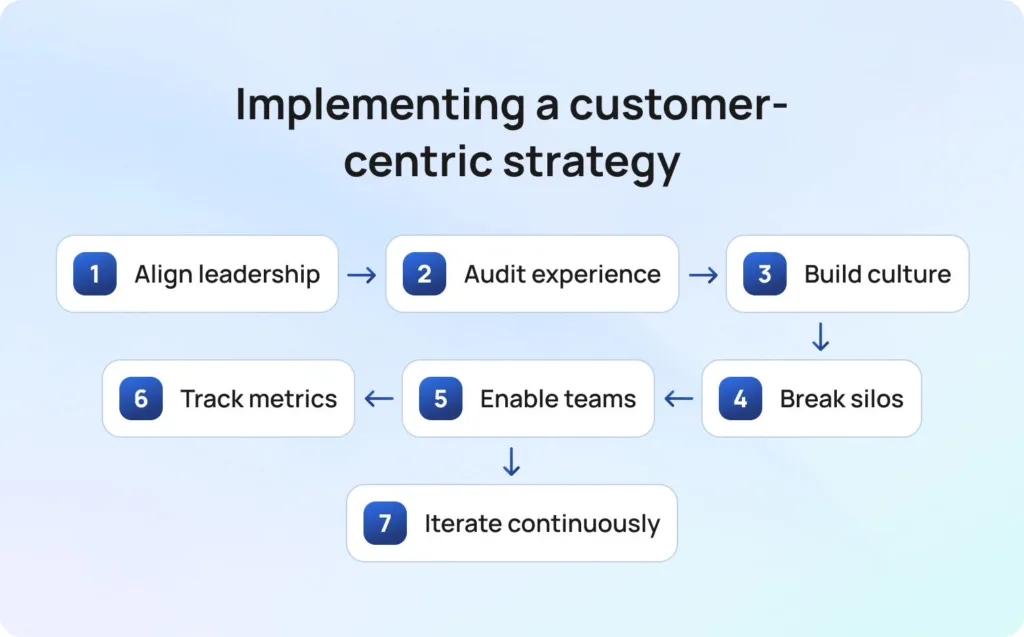
Customer centricity starts at the top. Without leadership buy-in, you’ll struggle to create lasting change. Your executives need to understand why a customer-centric approach drives business success and commit to it publicly.
Define what customer centricity means for your organization. What does it look like in practice? What behaviors do you want to encourage? How will you measure success?
This vision becomes your north star for decision-making.
Before you can improve, you need to understand where you are now. Map your customer journey from first contact through ongoing relationships. Identify pain points where customers get frustrated or confused.
Talk to your customer service team. They know where the problems are. Review customer feedback and complaints. Review your customer churn rate and identify why customers leave.
This audit reveals gaps between what you think you deliver and what customers actually experience.
Culture change is hard but essential. You need everyone, from executives to frontline employees, operating with a customer-first philosophy.
Start by sharing customer stories internally. When someone on the development team hears directly from a frustrated customer, it hits differently than reading a ticket summary. Create rituals to review customer feedback regularly.
Adjust your company culture by:
Employee experience shapes customer experience. If your team feels supported and valued, they’ll treat customers the same way.
Customer-centric companies don’t let organizational charts get in the way of customer outcomes. Create mechanisms for cross-functional collaboration:
When marketing, product, and support work together instead of in isolation, you deliver consistent experiences that build trust.
Equip your team with tools that enable customer centricity. BlueHub brings together everything you need (omnichannel customer support, AI-powered features, customer service analytics, and workforce management) on a single platform designed around the customer journey.
Train your team on the customer-centric model itself. Help them understand how to use customer data ethically and effectively. Teach them to recognize and respond to different customer pain points.
Track metrics that reflect customer outcomes:
These customer-centric metrics tell you whether your strategy is working.
Your customer-centric strategy is an ongoing commitment to prioritize customers in everything you do.
The best customer-centric organizations never stop asking, “How can we serve customers better?”
Customer expectations keep rising. What delighted customers last year is now just the baseline. Customer-centric companies that continuously improve will thrive. Those who don’t will struggle.
Fortunately, building a truly customer-centric organization gives you sustainable growth. Loyal customers become advocates. Repeat customers drive profitability. Your brand reputation strengthens. Your competitive edge widens.
And in a world where most companies still pay lip service to customer centricity without actually doing the work, doing it right makes you stand out.
See howBlueHub makes it easier to put customers at the center of everything you do. Request a demo to see how it works.
While these terms are often used interchangeably, customer-centric is more comprehensive. Customer-focused usually refers to prioritizing customer needs in specific areas, such as service or support. Customer-centric means building your entire business model, company culture, and business operations around customer outcomes.
Building a customer-centric culture isn’t a quick fix. Small changes can yield results in weeks (such as improving response times or personalizing communications), but transforming your organization typically takes 12-18 months. The timeline depends on your starting point, company size, and commitment level.
Essential customer-centric metrics include:
– Customer lifetime value (measures long-term relationship value)
– Net promoter score (indicates loyalty and willingness to recommend)
– Customer retention and churn rates (show if customers are staying)
– Customer satisfaction scores (track happiness with interactions)
– Customer effort score (measures how easy you are to work with)
Also track repeat-business rates and time-to-resolution for customer issues. The specific metrics matter less than consistently measuring and acting on what you learn.
BlueHub unifies every interaction (email, chat, voice, social, bots) into a single customer view, so teams act on context, not guesswork. Agents get AI ticket summaries and suggested replies to resolve issues faster, while journey-aware routing ensures customers land with the right skill or brand team. Built-in analytics and WFM keep SLAs visible in real time, and feedback loops (CSAT, tags, reason codes) flow back into product and ops so you continuously improve.
Yes. BlueHub tracks CSAT, NPS, time to resolution, first-contact resolution, deflection, and repeat-contact drivers out of the box, with role-based dashboards for execs, ops, and frontline leads. You can segment by brand, language, or channel, and export via API to your BI stack. The result: shared, trustworthy metrics that align product, marketing, and support around customer outcomes.
As Head of Digital Transformation, Radu looks over multiple departments across the company, providing visibility over what happens in product, and what are the needs of customers. With more than 8 years in the Technology era, and part of BlueTweak since the beginning, Radu shifted from a developer (addressing end-customer needs) to a more business oriented role, to have an influence and touch base with people who use the actual technology.