Intercom vs Kustomer vs BlueTweak: Which CS Platform Is Best? (2026)


BlueTweak is an AI Customer Support Platform that unifies every conversation, customer record, and automation into one workspace.
Explore more
Insights, trends, and practical ideas from customer experience and AI
Real-world scenarios showing how teams use BlueTweak to deliver better service
The daily blueprint that guides customer support leadership.
ROI and savings calculators for support teams
See how BlueTweak stacks up against leading customer support platforms
BlueTweak vs Intercom vs Kustomer is ultimately a question of what your customer support teams need most from their technology stack. Intercom is a strong fit for SaaS companies and digital-first businesses that prioritize conversational support, in-app messaging, and AI-powered customer engagement, while Kustomer excels for organizations that need deeper customer data integration, extensive customization options, and a complete view of customer interactions across multiple channels. BlueTweak, however, is the stronger choice for teams looking to combine voice AI, advanced automation, quality assurance, and operational insights within a single platform, reducing reliance on other tools while maintaining the right balance between AI efficiency and human intervention as support operations scale.
Choosing between Intercom, Kustomer, and newer alternatives such as BlueTweak is no longer just a question of comparing features.
Today’s customer support teams are under pressure to manage growing interaction volumes, deliver personalized support across multiple channels, improve agent productivity, and introduce AI-powered automation without sacrificing service quality.
For many businesses, the challenge is not finding a platform that can manage customer conversations. It is finding one that can support the entire operation, from customer data and workflow automation to voice support, quality assurance, and performance visibility.
While Intercom and Kustomer remain popular choices, an increasing number of organizations are also evaluating platforms like BlueTweak as they look to consolidate tools and build a more scalable support function.
Customer support platforms are evolving from simple ticketing and chat tools into AI-powered systems that help businesses manage customer interactions, automate workflows, and improve customer experience across every channel.
Historically, businesses evaluated customer support software based largely on channel coverage. If a platform could successfully manage email, chat, social media, and phone interactions from a unified inbox, it was often considered sufficient.
Today, support leaders face a much broader set of requirements. They are expected to improve efficiency, increase agent productivity, implement AI automation, and maintain personalized human support, often without increasing headcount. At the same time, customers expect faster responses and seamless experiences regardless of channel.
According to PwC’s 2025 Customer Experience Survey, 80% of consumers say speed, convenience, knowledgeable help, and friendly service are the most important elements of a positive customer experience. At the same time, customers continue to place significant value on human interactions, creating pressure on organizations to balance automation with personalized support while still meeting rising expectations for fast, seamless service.
As a result, comparisons such as Intercom vs Kustomer are increasingly focused on capabilities beyond traditional ticket management. Businesses are evaluating AI agents, customer data integration, omnichannel support, voice capabilities, quality assurance, and operational visibility alongside more familiar customer service features.
The sections below compare Intercom, Kustomer, and BlueTweak across the areas that matter most to modern support organizations, helping you determine which platform is best aligned with your current requirements and future growth plans.
The table below provides a high-level comparison of Intercom, Kustomer, and BlueTweak across the criteria most frequently evaluated by customer support leaders.
| Evaluation Criteria | Intercom | Kustomer | BlueTweak |
| Best For | SaaS companies, early stage startups, digital-first businesses | Customer-centric enterprises needing deep customer insights | Omnichannel AI-powered support teams |
| AI Automation | Strong chatbot automation and AI agents | Strong workflow automation and customer data integration | AI automation across voice, chat, email, and QA workflows |
| Customer Data & Context | Good customer context for support and engagement | Deep customer insights with a complete customer timeline | Unified operational and interaction insights |
| Voice Support | Available, but not a core strength | Available through Kustomer Voice | Native voice AI capabilities |
| QA & Oversight | Limited native QA capabilities | Some quality monitoring features | 100% automated QA coverage |
| Pricing Approach | Per-seat pricing plus AI resolution-based charges | Custom enterprise pricing | Flexible pricing aligned to operational outcomes |
| Best Avoided By | Teams handling high-volume voice interactions | Smaller teams seeking fast implementation | Organizations seeking a simple live chat solution only |
Key Takeaway: Intercom is strongest for conversational support and customer engagement, Kustomer excels at customer data and omnichannel context, while BlueTweak is designed for organizations that require voice AI, automated quality assurance, and unified operational oversight.
Choosing between these platforms depends largely on how your support operation is structured today and where you expect it to be in the next few years.
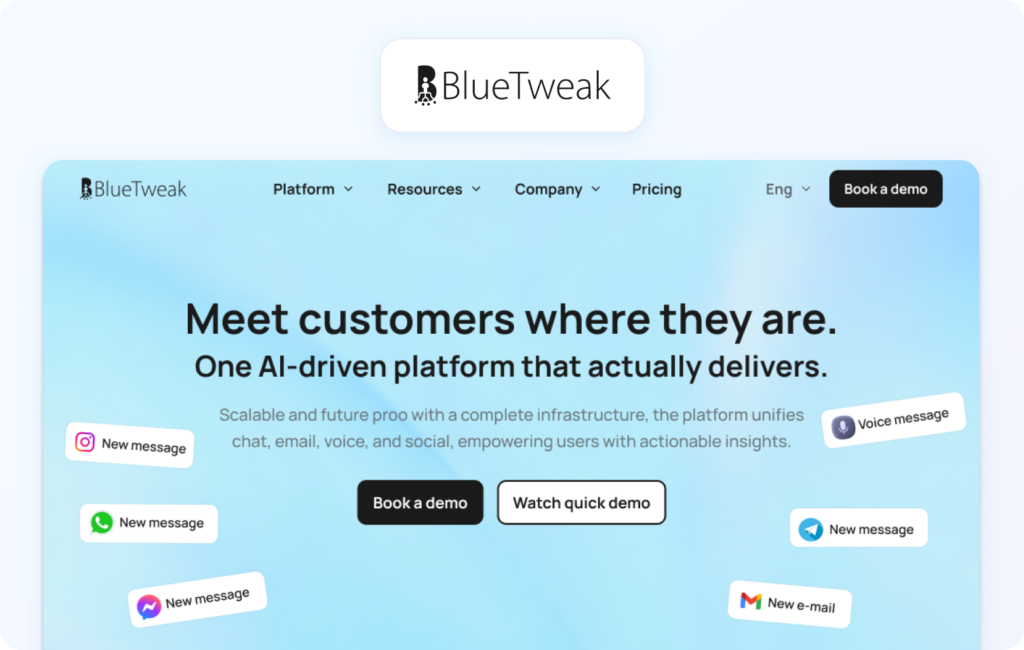
BlueTweak is an AI-powered customer support platform designed for organizations that need to unify voice, chat, quality assurance, and operational insights.
Most Kustomer vs Intercom comparisons focus on messaging channels, automation workflows, or customer data management. Increasingly, however, support leaders face a different challenge. The problem is not managing conversations; it’s managing quality, consistency, and performance across every channel simultaneously. This is where BlueTweak steps in.
Rather than focusing exclusively on chat or customer records, BlueTweak combines:
This approach addresses a growing reality for customer service leaders. According to PwC’s 2025 Customer Experience Survey, 70% of executives say customer expectations are evolving faster than their organizations can adapt, while 86% of consumers still consider human interaction moderately or very important to their brand experience. The challenge is no longer choosing between AI and people. It is orchestrating both effectively.
The future of customer support isn’t about replacing agents with AI. It’s about giving every interaction, whether voice or digital, the same level of visibility, consistency, and intelligence. That’s where most support platforms still fall short

Radu Dumitrescu, Head of Presale & Digital Transformation at BlueTweak
BlueTweak is particularly well-suited to organizations managing high-volume customer interactions, contact centers, and support operations where quality assurance and operational visibility are business-critical. However, it is less suited to businesses simply looking for a standalone live chat widget or basic messaging platform.
The benefits of this approach can be seen in BlueTweak’s work with Conectys, a global outsourcing provider that was struggling with fragmented data, reporting inefficiencies, and limited visibility across support operations.
By implementing BlueHub, Conectys reduced data retrieval times by 30%, increased reporting efficiency by 40%, improved customer satisfaction scores by 35%, and reduced resolution times by 25%. More importantly, the project highlights a broader shift taking place across customer support: organizations are increasingly prioritizing unified operational visibility and actionable insights over adding more standalone tools to an already complex tech stack.
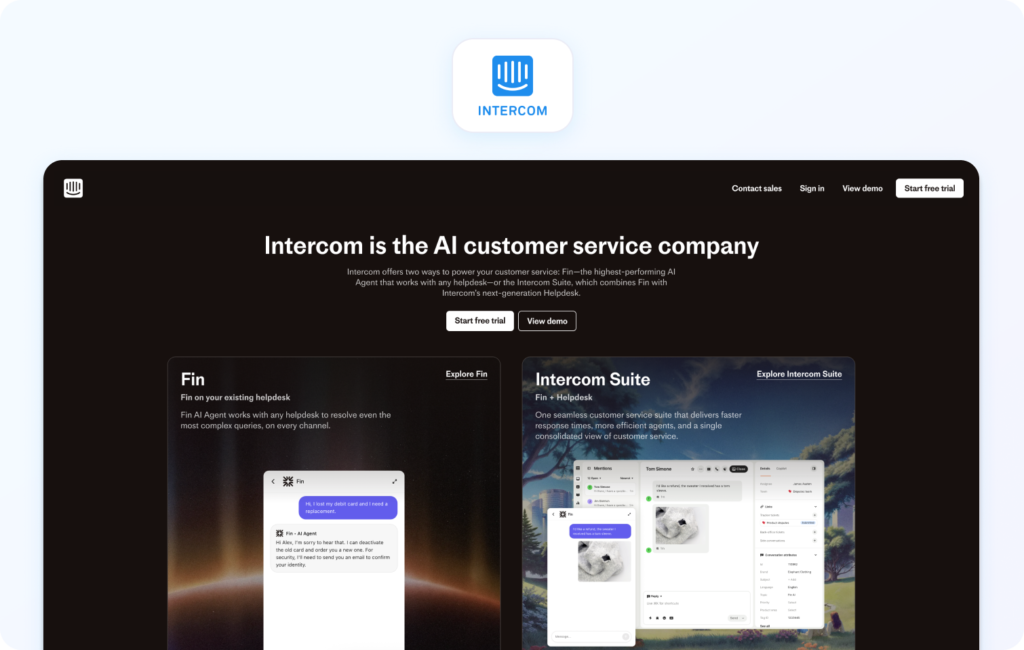
Intercom is a customer service platform focused on conversational support, customer engagement, and AI-powered messaging.
Intercom has built its reputation around creating seamless customer conversations through live chat, in-app messaging, help centers, and AI-powered chatbots. For many software companies, Intercom became the default platform for combining customer support and customer engagement within a single interface.
One of Intercom’s biggest strengths is its user experience. The platform offers intuitive collaboration tools, strong knowledge base functionality, and AI agents that can resolve routine customer support requests. Businesses that prioritize digital channels often find that Intercom enables efficient customer support without significant complexity.
Intercom also offers strong integration capabilities, allowing support teams to connect customer data from various business systems and maintain context across customer interactions.
The limitation is that Intercom’s core DNA remains rooted in messaging. As support operations expand into voice channels, quality assurance programs, and omnichannel support environments, many organizations find themselves supplementing Intercom with additional tools to fill operational gaps.
Kustomer is a customer service platform built around unified customer data and omnichannel customer support.
Unlike Intercom, which began with messaging, Kustomer was designed around creating a complete customer timeline. Every customer interaction, regardless of channel, contributes to a full view of the customer journey.
Kustomer excels in environments where customer data integration is a priority. Support agents can access detailed customer history, previous customer conversations, and behavioral data from a single interface. This makes personalized support easier to deliver at scale.
The platform also provides robust workflow automation, advanced routing, and omnichannel support capabilities across email, chat, social media, SMS, and phone channels.
However, Kustomer’s strength in customization can also create a steeper learning curve. Organizations often require more implementation effort and administrative resources to fully realize the platform’s capabilities.
For enterprises with complex customer journeys, this investment can pay dividends. For smaller teams, it may feel heavier than necessary.
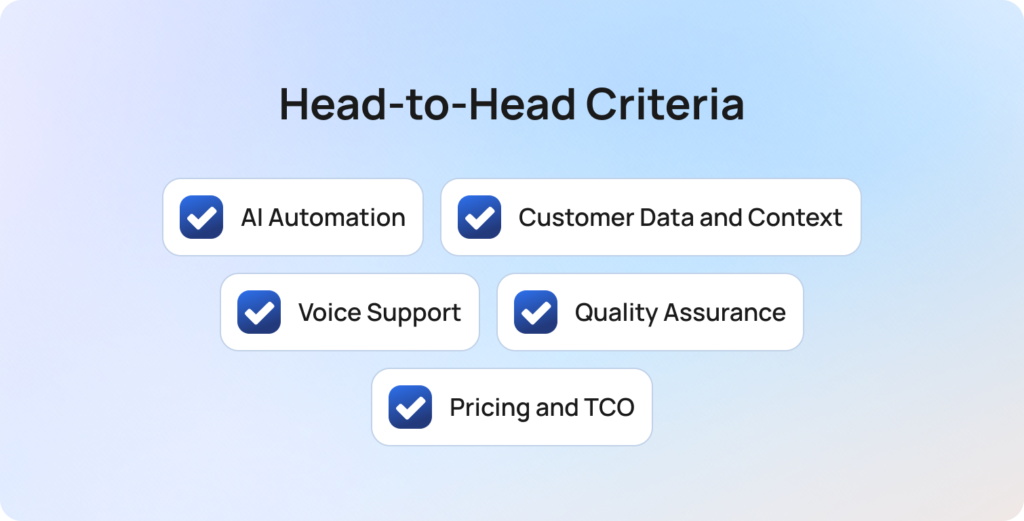
Comparing Intercom, Kustomer, and BlueTweak across core evaluation criteria helps clarify which platform aligns best with specific support requirements.
While all three platforms support customer service operations, they take very different approaches to automation, customer context, voice capabilities, and operational oversight. Looking beyond feature lists and marketing claims can help reveal which solution is best suited to your team’s workflows, support channels, and growth plans.
The following comparison breaks down five of the most important decision-making criteria, highlighting where each platform stands out and where it may be less suitable depending on your needs.
AI automation refers to the ability to resolve customer requests, automate workflows, and improve support efficiency without increasing agent workload.
Intercom’s AI capabilities are largely focused on customer-facing interactions. Its AI agents, chatbot automation, and in-app messaging tools help digital-first businesses deflect routine support requests and improve response times. Kustomer takes a more workflow-oriented approach, using customer data, automated routing, and omnichannel processes to streamline internal operations and support more complex customer journeys.
BlueTweak expands automation beyond conversations alone. In addition to supporting customer-facing automation, it applies AI to voice interactions, quality assurance, performance monitoring, and operational optimization. For organizations looking to automate not only customer support, but also the processes that sit behind it, this creates a broader operational impact.
Verdict: Intercom is strong for chatbot automation, Kustomer excels at workflow automation, and BlueTweak offers the most comprehensive approach to operational automation.
Customer data and context determine how effectively support teams can deliver personalized support and maintain continuity across customer interactions.
Kustomer was built around a customer-centric model, giving agents a complete timeline of interactions, transactions, and engagement history. This makes it particularly strong for organizations that prioritize customer data integration and deep customer insights. Intercom also provides valuable customer context through conversation history and behavioral data, but its focus remains more closely tied to engagement and communication workflows.
BlueTweak takes a broader view by combining customer interaction data with operational insights, QA findings, and performance metrics. For businesses that want visibility into both the customer journey and how support teams are performing, this provides a different layer of intelligence beyond traditional customer records.
Verdict: Kustomer remains the strongest option for customer data and context, while BlueTweak offers additional operational visibility that many growing support teams value.
Voice support refers to how effectively a platform manages phone-based customer interactions and voice automation.
Both Intercom and Kustomer support voice channels, but neither platform was originally built around voice as a core capability. Intercom’s strengths remain rooted in messaging and customer engagement, while Kustomer integrates voice interactions into its broader omnichannel customer timeline to provide additional context for agents.
BlueTweak positions voice as a central component of the support experience. Its native voice AI capabilities help automate routine interactions, improve call handling efficiency, and surface insights from customer conversations. For contact centers and teams handling large call volumes, this can reduce reliance on separate voice technology providers.
Verdict: Intercom and Kustomer support voice effectively, but BlueTweak is the stronger option for organizations where voice plays a significant role in customer service delivery.
Quality assurance helps organizations maintain service quality, identify coaching opportunities, and ensure consistency across customer interactions.
Intercom and Kustomer both provide reporting and monitoring capabilities that support QA initiatives, but quality assurance is not a primary focus of either platform. As a result, many organizations still rely on manual reviews, additional tools, or sampling methods to evaluate performance.
BlueTweak places QA at the center of its offering. Automated quality assurance enables organizations to review 100% of customer interactions rather than small samples, creating greater visibility into agent performance, compliance risks, and customer experience trends. For larger support operations, this can significantly reduce management overhead while improving consistency.
Verdict: BlueTweak stands out as the clear leader for organizations that view quality assurance as a strategic priority rather than a reporting function.
Pricing and total cost of ownership (TCO) should be evaluated based on more than subscription fees alone. Implementation effort, scalability, and the number of additional tools required can have a significant impact on long-term costs.
Intercom offers relatively accessible pricing for digital-first businesses, although costs can increase as AI usage and team size grow. Kustomer’s custom enterprise pricing provides flexibility but can make direct cost comparisons more difficult. Both platforms may require additional solutions for areas such as voice technology, quality assurance, or operational reporting, depending on business requirements.
BlueTweak takes a more transparent approach; its public pricing of €65 per agent/month allows organizations to understand costs upfront. In addition, the platform’s combination of voice AI, automated QA, reporting, workforce management, and operational oversight can reduce reliance on multiple standalone tools. For support leaders evaluating both software spend and operational efficiency, this can make forecasting and scaling significantly easier.
Verdict: The best value depends on your requirements, but BlueTweak’s transparent pricing model and broader feature coverage can deliver a lower long-term TCO for organizations seeking a more unified support technology stack
Before making a decision, it’s worth calculating the potential return. BlueTweak’s Customer Support ROI Calculator can help you estimate the impact that AI automation, automated QA, and operational efficiencies could have on your support costs and team performance.
The best customer support platform isn’t necessarily the one with the most features; it’s the one that aligns most closely with your support channels, customer expectations, operational complexity, and long-term growth plans.
After comparing Intercom, Kustomer, and BlueTweak across automation, customer data, voice support, quality assurance, and pricing, a clear pattern emerges: each platform is designed to solve a different problem. So, the decision becomes much easier when you focus on the primary challenge your support team is trying to solve today, as well as the challenges you expect to face in the next two to three years.
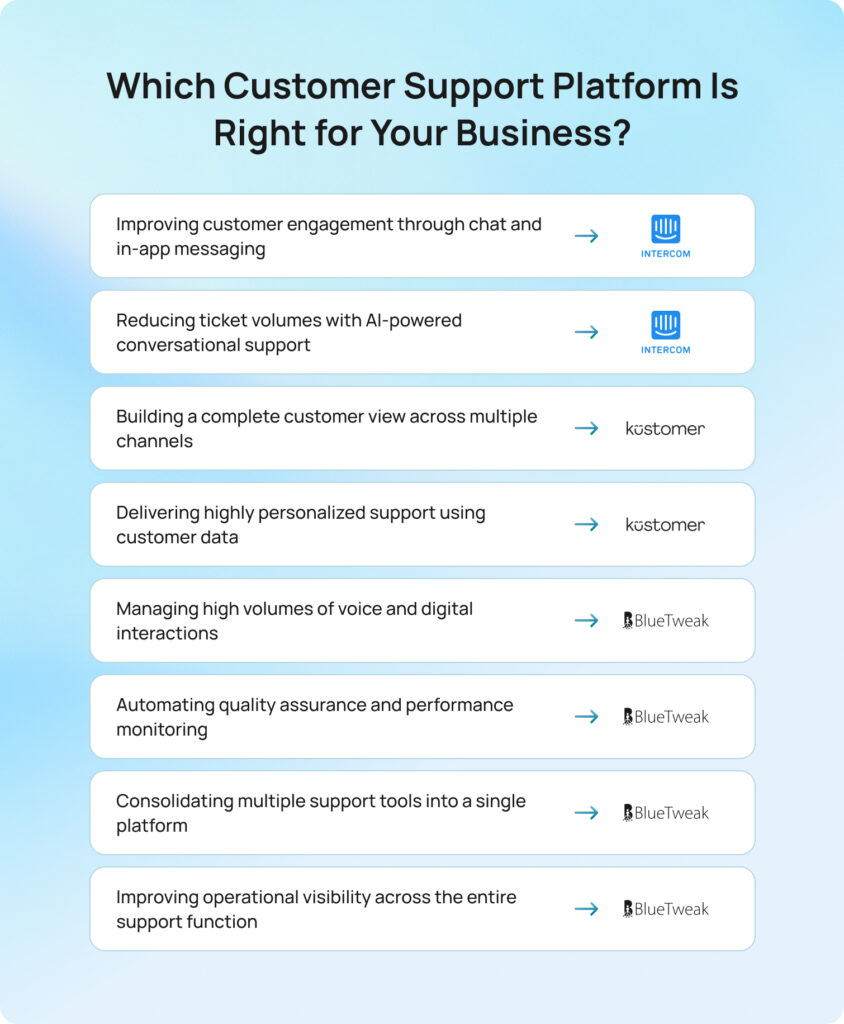
Intercom is often the better choice for SaaS companies, product-led businesses, and digital-first organizations that want to improve customer engagement and provide fast, efficient support through chat and in-app messaging.
If most of your customer interactions take place through digital channels, and your priority is reducing ticket volumes through AI-powered chat, self-service resources, and proactive customer support, Intercom offers a mature and user-friendly platform. It is particularly well-suited to smaller teams and growing businesses that want strong functionality without significant implementation complexity.
Intercom may become less suitable, however, as support operations expand into more complex voice environments or require dedicated quality assurance and operational oversight capabilities.
Kustomer is often the stronger choice for organizations that view customer data as the foundation of their support strategy. Its customer-centric architecture makes it particularly valuable for businesses managing large customer bases, complex customer journeys, or multiple support channels. Teams that need deep customer insights, detailed interaction histories, and a complete customer view will often find Kustomer’s approach more powerful than traditional ticket-based systems.
For enterprises focused on creating highly personalized support experiences across multiple customer touchpoints, Kustomer’s customer data capabilities remain one of its strongest differentiators. The trade-off is that implementation and ongoing administration can require greater investment than simpler support platforms.
BlueTweak is best suited to organizations that have moved beyond basic chat and ticket management and are looking to optimize the entire support operation.
If your team manages high volumes of customer interactions across voice and digital channels, struggles with manual quality assurance processes, or lacks visibility into operational performance, BlueTweak addresses challenges that traditional customer service platforms often leave unresolved.
Rather than focusing solely on customer conversations, BlueTweak helps organizations understand how effectively those conversations are being handled. Native voice AI, automated quality assurance, operational reporting, and AI-powered performance insights provide support leaders with a more complete picture of customer experience delivery.
For organizations where customer support has become a strategic business function rather than a simple service desk, BlueTweak offers capabilities that extend well beyond conventional customer support software.
The Bottom Line:
Intercom and Kustomer both solve important customer support challenges, but for organizations that need voice AI, automated quality assurance, omnichannel support, and greater operational visibility, neither platform was built to deliver all of those capabilities within a single solution.
BlueTweak closes that gap, helping support teams automate more processes, improve quality at scale, and gain a clearer view of performance across every customer interaction.
If you’re evaluating alternatives to Intercom or Kustomer, start a 14-day free BlueTweak trial (no credit card required) or book a personalized demo to see how AI-powered voice support, automated QA, and unified operational visibility can help your team deliver better customer experiences at scale.
Neither platform is universally better. Intercom is often preferred by SaaS companies and digital-first businesses that prioritize customer engagement, in-app messaging, and conversational support. Kustomer is often preferred by organizations that need deeper customer data integration, omnichannel support, and a complete customer view.
The biggest difference is their core focus. Intercom was built around customer communication and engagement, while Kustomer was designed around customer data and relationship management. Both support multiple channels, but they approach customer support from different perspectives.
Pricing can vary significantly depending on team size, feature requirements, AI usage, and implementation needs. Intercom generally offers more transparent public pricing, while Kustomer typically uses custom enterprise pricing. Businesses should evaluate total cost of ownership rather than subscription costs alone.
Many organizations begin looking at alternatives when they require capabilities that extend beyond chat and ticket management. Common reasons include the need for voice AI, automated quality assurance, unified operational reporting, deeper performance insights, or a desire to consolidate multiple support tools into a single platform.
BlueTweak is best suited to organizations managing high volumes of customer interactions across voice and digital channels. It is particularly valuable for support teams seeking AI-powered automation, 100% QA coverage, operational visibility, and a more unified approach to customer support management.
As Head of Digital Transformation, Radu looks over multiple departments across the company, providing visibility over what happens in product, and what are the needs of customers. With more than 8 years in the Technology era, and part of BlueTweak since the beginning, Radu shifted from a developer (addressing end-customer needs) to a more business oriented role, to have an influence and touch base with people who use the actual technology.