



TL;DR
Customer support cost reduction AI works by reducing the four primary support cost lines: agent labor, cost per interaction, scaling costs, and quality failure costs. The six most effective AI mechanisms are autonomous tier-1 containment, AI agent assist, post-interaction summarization, intelligent routing, proactive outreach, and AI-powered quality assurance. However, many organizations fail to realize projected savings because they measure deflection instead of containment, rely on blended quality metrics, and count headcount savings before they actually materialize. This guide is designed for support leaders, operations managers, and finance stakeholders building a business case for AI solutions for customer support cost reduction and faster responses.
Customer support cost reduction AI is most effective when it lowers operational costs without damaging customer satisfaction or service quality.
Support leaders are under pressure from every direction. Customer expectations continue to rise, interaction volumes keep growing, and leadership teams expect support operations to do more with less. The challenge is that traditional cost-cutting measures often create new problems. Reduced staffing levels can increase wait times, lower first contact resolution rates, and generate poor customer experiences that drive churn.
This is where customer support cost reduction AI has changed the conversation; rather than simply reducing headcount, AI allows support teams to automate routine inquiries, increase agent productivity, and improve customer experience simultaneously. Platforms such as BlueTweak help organizations combine conversational AI, agent assistance, workflow automation, and quality management in a way that delivers measurable efficiency gains without sacrificing service quality. Understanding how AI improves customer support is the first step towards building a credible business case for investment and so the key is understanding which costs AI can genuinely reduce, which costs remain unchanged, and how to measure savings accurately over time.
Before exploring specific AI customer support cost reduction strategies, it is important to understand where support costs actually come from.
Understanding Your Customer Support Cost Structure
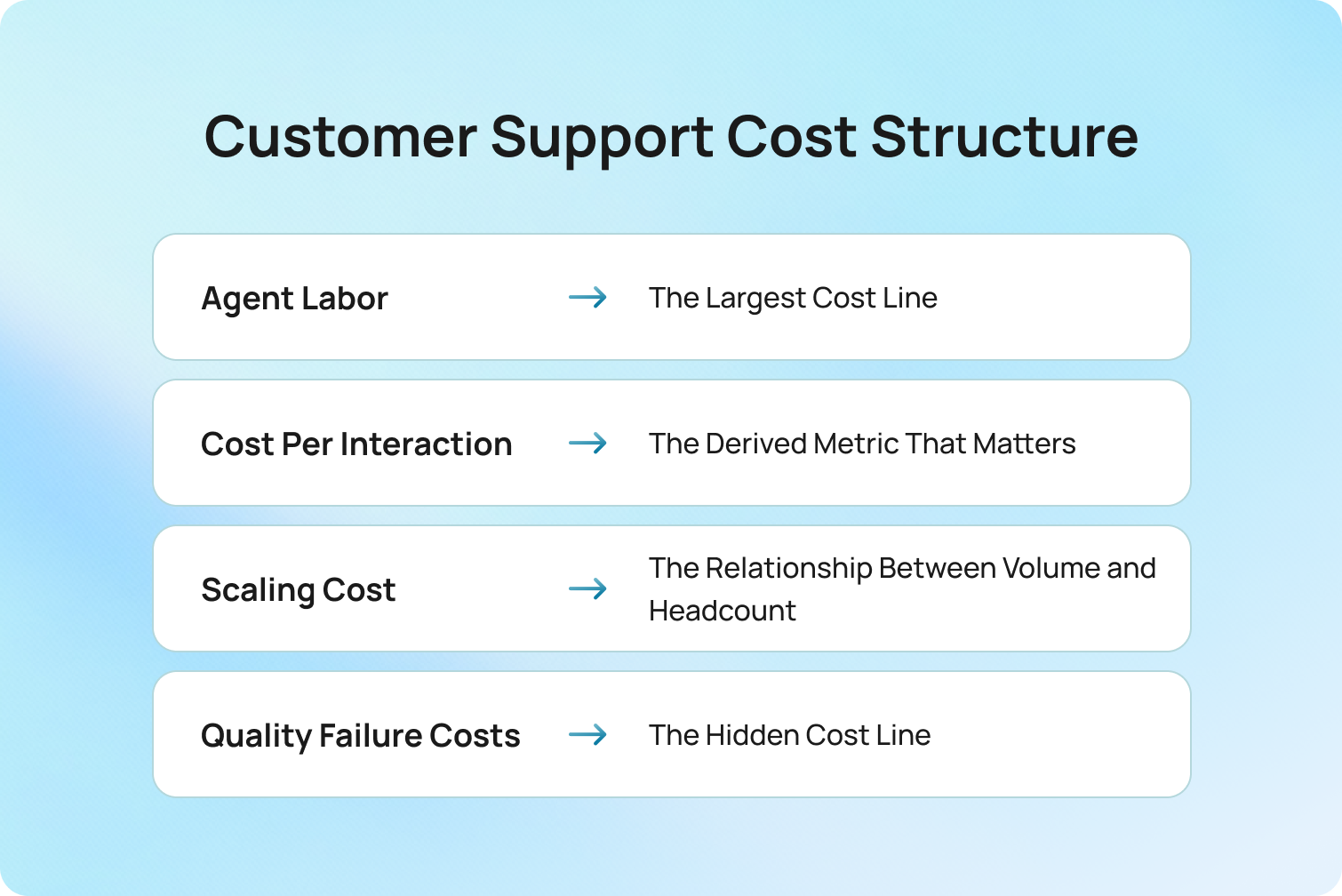
Customer support cost structure refers to the complete set of expenses required to deliver support services across all customer interactions. Many business cases fail because they start with AI capabilities instead of support economics. If leadership can’t clearly see which cost line an AI initiative affects, projected ROI becomes difficult to defend. Understanding support costs first creates a more credible foundation for any investment decision.
Agent Labor: The Largest Cost Line
Agent labor is typically the largest component of customer support costs. Research from the McKinsey Global Institute finds that today's AI technologies could theoretically automate more than half of current US work hours, with customer service roles among those most exposed, given their high concentration of repeatable, process-driven tasks. This makes labor the dominant cost driver and the primary target for efficiency improvements in support operations.
The fully loaded cost of a support agent extends well beyond salary. It includes benefits, payroll taxes, management overhead, recruitment expenses, onboarding costs, training investment, software licenses, and productivity losses associated with attrition. Many organizations underestimate support costs because they focus only on wages.
This omission matters. Deloitte Digital's 2023 Global Contact Center Survey found that 63% of contact center leaders reported facing staffing shortages, with workforce management and talent retention ranking among the top operational concerns; a picture that has persisted into more recent editions of the survey. According to research from the QATC (Quality Assurance & Training Connection) and SQM Group, annual contact center agent attrition rates commonly range from 30% to 45%, meaning the true cost of an agent seat is substantially higher than the wage bill alone.
Cost Per Interaction: The Derived Metric That Matters
Cost per interaction measures the average cost of handling a customer contact and is calculated by dividing total support costs by total interactions handled. This is the primary metric that customer support cost reduction AI influences.
AI can reduce cost per interaction in two ways. First, AI agent assist tools help support agents resolve issues faster, increasing the number of interactions handled per hour. Second, autonomous AI agents can fully resolve repetitive queries without human intervention, eliminating labor costs on those interactions entirely.
For support leaders focused on reducing customer service costs, cost per interaction is often the clearest indicator of operational efficiency.
Scaling Cost: The Relationship Between Volume and Headcount
Scaling cost describes how support costs increase as customer interaction volume grows. Without AI automation, support organizations typically scale in a linear fashion. More customers create more support requests, which require more support agents; as a result, labor costs rise alongside volume.
Customer support cost reduction AI changes this relationship. When AI agents successfully resolve high-volume, repetitive queries, the marginal cost of handling additional interactions falls dramatically. This allows organizations to support growth without proportional increases in staffing costs. Over time, these efficiency gains compound, creating significant savings that extend beyond a single budget cycle.
Quality Failure Costs: The Hidden Cost Line
Quality failure costs are the financial consequences of poor customer experiences, repeat contacts, escalations, complaints, and customer churn. These costs rarely appear in support budgets, but they can quickly outweigh short-term savings generated by aggressive cost reduction initiatives. A support team may appear more efficient after reducing staffing costs, yet increased repeat contacts and declining customer loyalty can create larger downstream losses.
Customer expectations have moved well beyond speed. Empathy, context, and consistency across interactions are now baseline expectations, and when support fails to deliver them, churn follows quickly and quietly.
PwC’s 2025 Customer Experience Survey highlights the scale of that risk: 52% of consumers surveyed said they stopped buying from a brand because of a bad experience with its products or services, while 29% stopped due to poor customer experience, either online or in person. When customer support quality declines, the resulting impact on revenue can exceed any immediate operational savings.
This is why successful AI deployments focus on both cost efficiency and maintaining high service quality. Reducing customer support costs without protecting customer satisfaction rarely produces sustainable results.
6 AI Mechanisms That Reduce Customer Support Cost to Serve
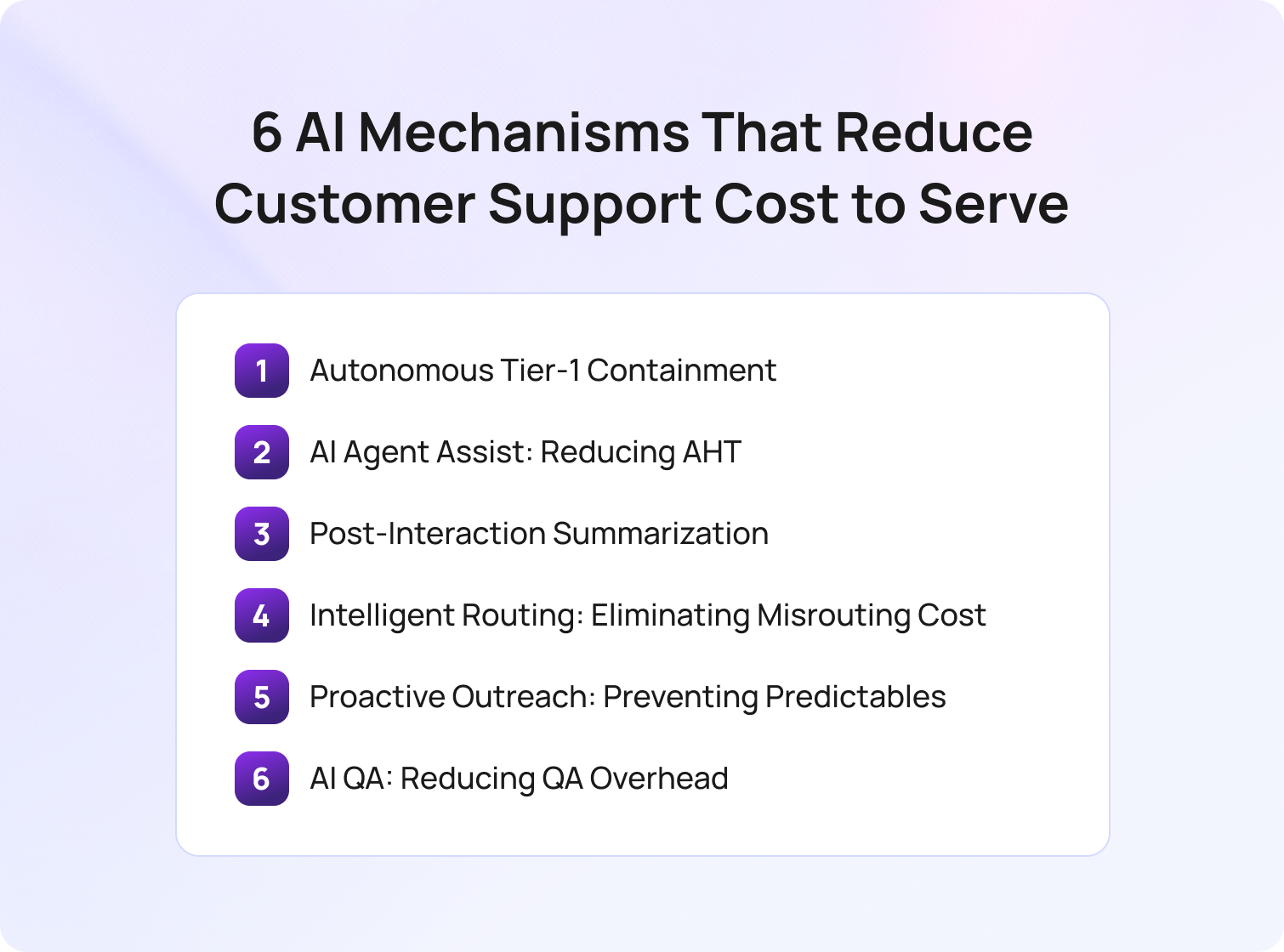
Customer support cost reduction AI reduces costs through a combination of automation, productivity improvements, and quality optimization across the support lifecycle.
Not every AI capability targets the same cost line; some reduce labor costs directly, while others lower interaction volume, improve operational efficiency, or protect against quality failure costs. The most successful deployments introduce these capabilities in a deliberate sequence rather than attempting to automate everything at once.
1. Autonomous Tier-1 Containment
Autonomous tier-1 containment uses AI agents and conversational AI for customer service to resolve routine customer queries without human intervention. The cost reduction mechanism is straightforward: every successfully contained interaction eliminates agent handle time and removes labor cost from that ticket entirely. This makes containment one of the most powerful ways to reduce customer support costs at scale.
The distinction between containment and deflection is important. A contained interaction is fully resolved by AI, while a deflected interaction simply avoids an agent, often pushing customers toward self service tools without confirming resolution. Effective deployments use confidence thresholds and escalation rules to ensure unresolved issues are transferred to human agents before customer frustration increases.
2. Intelligent Routing: Eliminating Misrouting Cost
Intelligent routing uses AI to classify customer intent, urgency, sentiment, and required expertise before assigning a support request. Misrouted interactions create hidden costs because the same issue is effectively handled multiple times. Customers are transferred between queues, agents spend time re-evaluating requests, and customers often repeat information they have already provided.
AI-powered routing reduces this waste by immediately directing interactions to the correct destination. The result is lower handling costs, improved first contact resolution, and faster service. For support leaders balancing cost reduction with customer satisfaction, routing often delivers benefits across both objectives simultaneously.
3. Post-Interaction Summarization: Eliminating Wrap-Up Time
Post-interaction summarization automatically generates structured conversation summaries immediately after a support interaction ends.
Many support teams underestimate how much time is spent on after-call work, ticket notes, and CRM updates. While each interaction may only require a few minutes of wrap-up, those minutes accumulate significantly across thousands of monthly support tickets.
By automatically creating summaries, action items, and customer records, AI eliminates repetitive administrative tasks and increases available agent capacity. An additional benefit is improved CRM data quality, which supports better reporting, forecasting, and customer experience initiatives across the business.
4.AI Agent Assist: Reducing AHT Without Reducing Quality
AI agent assist provides real-time recommendations, knowledge retrieval, suggested responses, and customer context while support agents handle interactions.
Instead of replacing human agents, agent assist improves their productivity. By reducing the time spent searching documentation, drafting replies, and locating account information, support teams can handle more customer interactions with existing staffing levels.
Research from Deloitte's State of Generative AI in the Enterprise found that nearly three-quarters of respondents reported their most advanced GenAI initiative was meeting or exceeding ROI expectations; reflecting a broader pattern of measurable productivity gains as organizations move from experimentation to deployment. Agent assist represents one of the most direct routes to that kind of operational return in support environments. Importantly, human approval remains in place for every outgoing response, ensuring service quality is maintained while handle times fall.
5. Proactive Outreach: Preventing Predictable Contacts
Proactive outreach uses AI automation to identify predictable customer concerns and communicate before a support request is created. Many support interactions are entirely foreseeable: delivery delays, payment failures, service outages, and subscription issues often generate spikes in inbound volume because customers lack information.
Rather than waiting for customers to contact support, AI can trigger personalized messages that answer likely questions before they occur. This reduces inbound ticket volume, lowers staffing costs, and improves customer experience by eliminating unnecessary effort. Customers receive updates proactively rather than needing to chase answers themselves.
6. AI QA: Reducing QA Overhead While Improving Quality Coverage
AI quality assurance automatically evaluates customer interactions against predefined quality standards and compliance criteria. Traditional QA programs typically review only a small sample of interactions because manual evaluation is time-intensive. This limits visibility and creates blind spots that allow service quality issues to persist.
AI QA enables quality coverage across 100% of customer interactions while reducing the administrative burden placed on QA teams. Coaching decisions remain human-led, but support leaders gain a far more complete view of performance trends, compliance risks, and customer experience issues. This protects both support quality and the quality failure cost line discussed earlier.
The value of these six mechanisms increases when they operate as part of a connected support ecosystem. However, many AI business cases still fail because they underestimate the operational costs required to sustain these improvements over time.
The Hidden Costs That Undermine AI Cost Reduction Projections
Hidden costs are the ongoing operational investments required to sustain AI performance after deployment.
Pre-deployment business cases often focus heavily on projected savings while giving limited attention to the operational requirements that sustain those savings over time. As a result, many support leaders discover six months after launch that containment rates have fallen, customer satisfaction has declined, or support costs have begun rising again.
The issue is not that AI failed, but that the operating costs required to maintain performance were never included in the original model.
Many of these challenges mirror the wider hidden costs of inefficient customer support systems, which often remain invisible until support costs begin to rise.
Knowledge Base Maintenance
Knowledge base maintenance is the ongoing process of keeping support content accurate, complete, and up to date.
Most modern AI-powered customer service platforms rely on retrieval-augmented generation (RAG) and an accurate customer service knowledge base to provide responses grounded in trusted company information. This means the quality of AI responses depends directly on the quality of the underlying knowledge base.
An outdated article, missing policy update, or incomplete troubleshooting guide can reduce containment rates and generate inaccurate responses. Those inaccuracies often create repeat contacts, escalations, and complaints that increase support costs rather than reduce them. Knowledge base maintenance is not an administrative overhead. It is a direct driver of customer support cost reduction AI performance and ROI.
Model Retraining and Optimization
Model optimization is the ongoing process of improving AI accuracy as customer behaviour, products, and business processes evolve.
Support environments are constantly changing. New products launch, policies are updated, customer expectations shift, and entirely new contact reasons emerge. AI models that performed well at launch can gradually become less effective if they are not reviewed and refined.
This can include intent classification updates, confidence threshold adjustments, workflow improvements, and retraining activities. Whether handled internally or by a technology partner, these activities require time and budget. Yet many cost reduction models treat AI deployment as a one-time investment rather than an ongoing operational capability.
Escalation Handling Overhead
Escalation handling overhead is the additional cost created when AI-to-human handoffs are poorly designed.
Not every customer interaction should be handled autonomously. Complex issues, sensitive situations, and high-value customers often require human intervention. The challenge is ensuring those escalations occur efficiently.
When customer context, conversation history, and previous actions are passed directly to the support agent, handle times remain low. When that information is missing, customers are forced to repeat themselves and agents must restart the discovery process. Even adding two or three minutes to every escalation can significantly increase operational costs at scale.
Failed Self-Service Follow-Up Volume
Failed self-service follow-up volume refers to customer contacts generated after an unsuccessful attempt to resolve an issue independently.
This is one of the most misunderstood costs in customer support operations.
A customer who fails to find an answer through self service often arrives at a live support channel frustrated and carrying additional context that must now be unpacked. These interactions frequently take longer to resolve than first-contact inquiries because the customer has already attempted multiple resolution paths.
This is why support leaders should be cautious when evaluating deflection metrics. Reducing immediate agent contacts is only valuable if the customer issue is actually resolved. Failed self-service can become a cost generator disguised as a cost reduction metric.
The organizations that achieve significant savings are not the ones with the highest automation rates. They are the ones that understand the full cost structure of customer support and measure outcomes rigorously. The next step is building a financial model that captures both the savings and the hidden costs before presenting a business case to leadership.
How to Calculate Customer Support Cost Reduction from AI
Calculating customer support cost reduction AI requires measuring both the savings generated and the costs incurred across the full support operation. Many ROI projections fail because they rely on vendor assumptions or isolated metrics. A credible business case should use operational data, conservative assumptions, and a clear methodology that finance stakeholders can validate.
The framework below provides a practical approach for estimating savings while avoiding the most common modelling mistakes.
Step 1: Establish Fully-Loaded Cost Per Interaction
Fully-loaded cost per interaction measures the true cost of resolving a customer contact across all support channels. The calculation should include agent salaries, benefits, payroll taxes, management overhead, software licenses, recruitment costs, onboarding costs, and attrition-related expenses.

For example, a support team with monthly operating costs of $250,000 handling 25,000 interactions would have a fully-loaded cost per interaction of $10.
This figure becomes the foundation for every subsequent cost reduction calculation.
Step 2: Model Containment Savings
Containment savings represent the labor cost eliminated when AI resolves customer queries without human intervention. The goal is to estimate how many interactions can realistically be contained and compare the cost of AI resolution against the cost of human resolution.
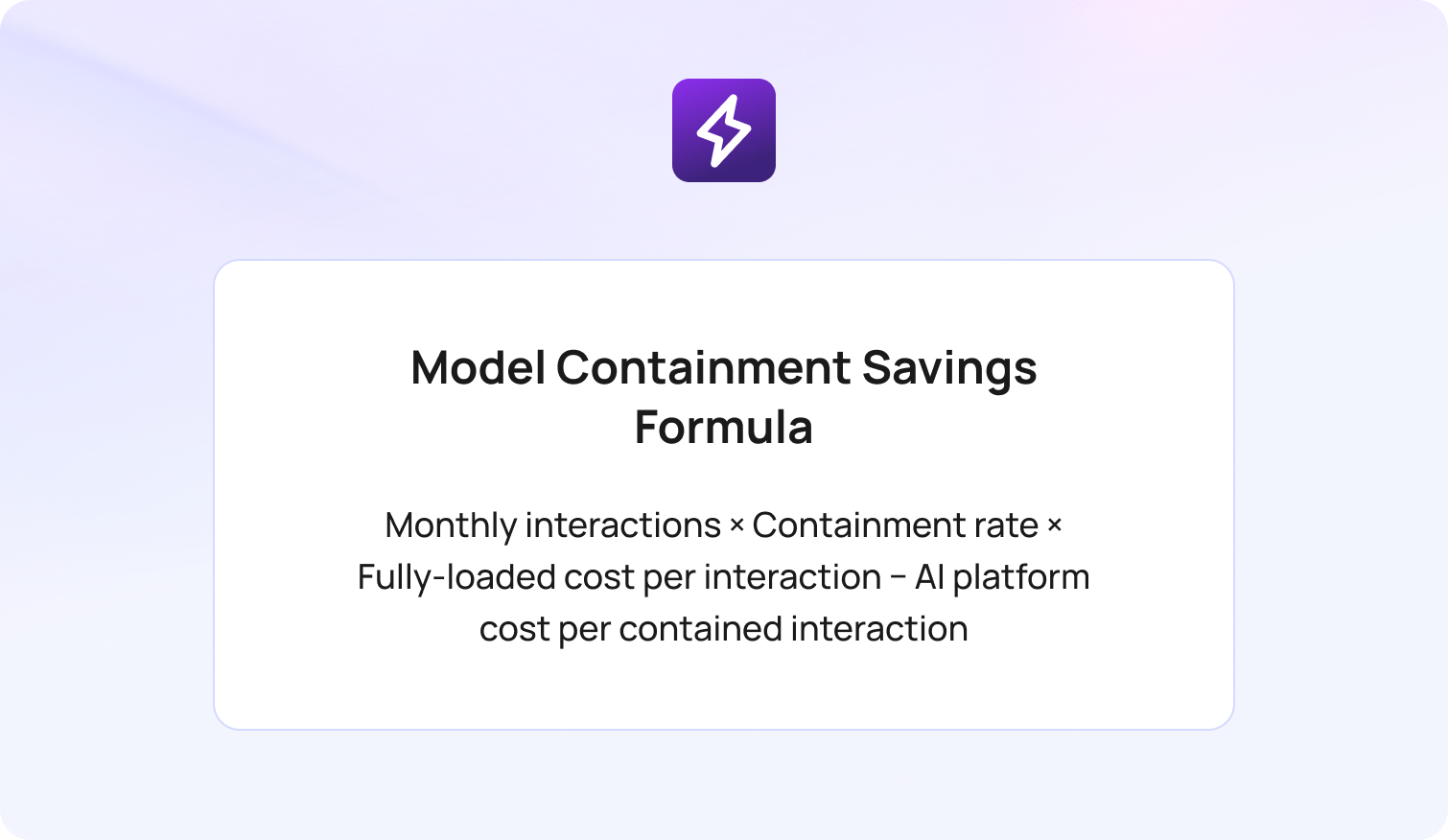
Consider a support operation handling 25,000 monthly interactions with a fully-loaded cost per interaction of $10.
| Scenario | Containment Rate | Monthly Interactions Contained | Gross Monthly Saving |
|---|---|---|---|
| Conservative | 30% | 7,500 | $75,000 |
| Mid-Range | 45% | 11,250 | $112,500 |
| Optimistic | 60% | 15,000 | $150,000 |
Industry benchmarks vary significantly depending on channel complexity, knowledge base maturity, and deployment scope. This is why support leaders should use conservative assumptions initially and refine projections as operational data becomes available.
Step 3: Model AHT Reduction Savings
Average handle time reduction savings measure the productivity gains created when AI helps agents resolve interactions faster. Agent assist, knowledge retrieval, suggested replies, intelligent routing, and automated summaries all contribute to lower handle times.
A conservative Year 1 assumption is typically a 15% to 20% reduction in average handle time. Rather than treating this as an immediate headcount reduction, organizations should model it as additional capacity that can absorb future growth, reduce overtime, or delay new hiring.
This distinction is important because capacity only becomes a financial saving once it is converted into avoided labour costs.
Step 4: Account for Hidden Costs
Hidden costs are the operational investments required to sustain AI performance after launch. Before calculating net savings, organizations should include:
- Platform licensing and infrastructure costs
- Knowledge base maintenance resources
- Model optimisation and retraining activities
- Escalation handling overhead
- Internal governance and compliance requirements
Ignoring these costs creates an inflated ROI projection that may not survive financial scrutiny. Including them creates a more realistic model and improves confidence in the business case.
Step 5: Calculate ROI and Break-Even
ROI measures the financial return generated after all costs have been considered.
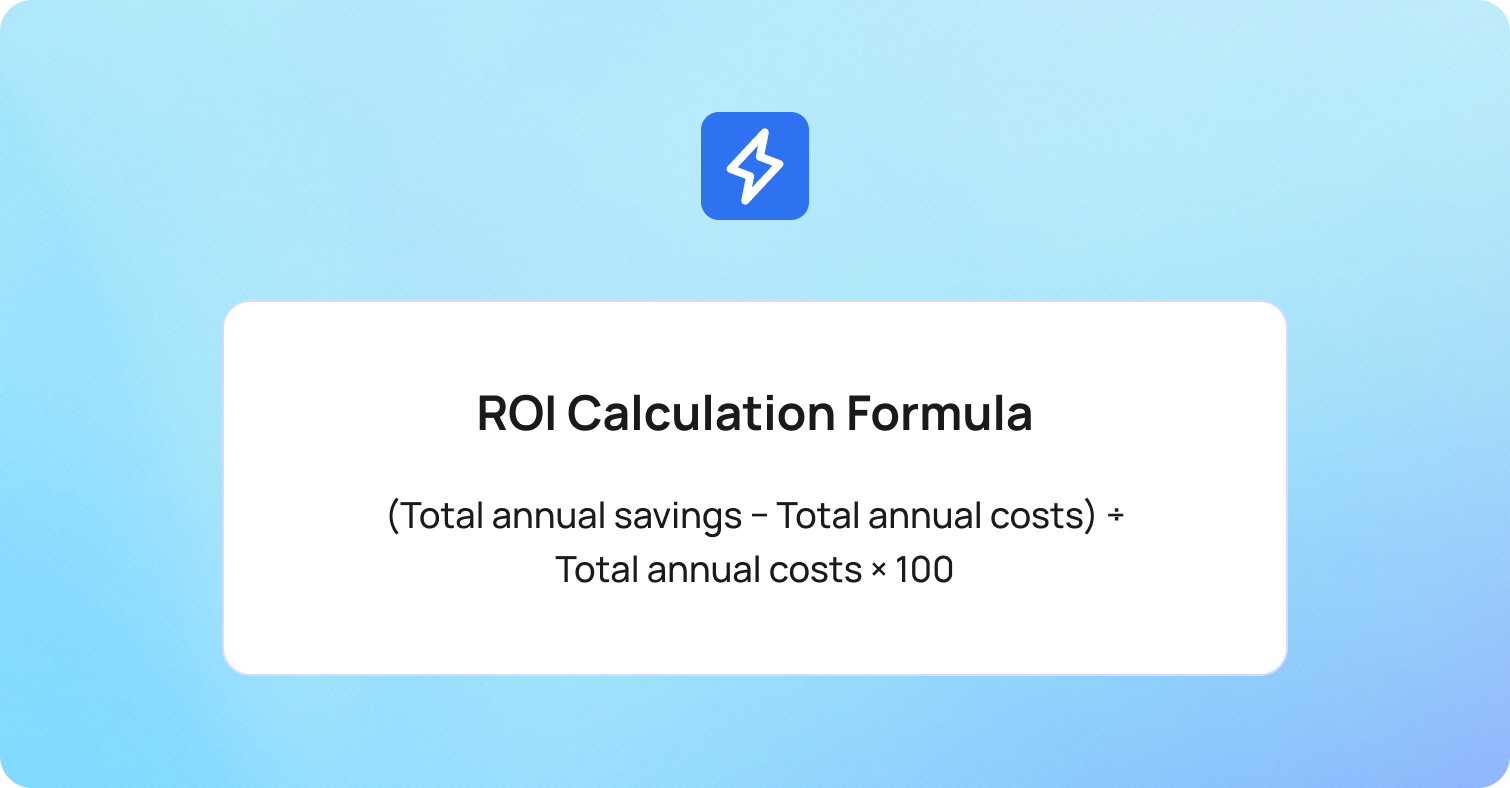
Break-even occurs when cumulative savings exceed cumulative investment.
For a well-scoped deployment operating at conservative containment rates, break-even commonly occurs within 60 to 90 days. However, timelines vary based on support volume, implementation scope, and the maturity of existing support operations.
Before presenting an AI investment proposal to leadership, it is worth pressure-testing the numbers. BlueTweak's ROI Calculator helps support leaders model containment savings, AHT improvements, hidden costs, and break-even timelines using real operational assumptions, giving finance teams a clearer picture of potential returns.
A financial model is only as valuable as the measurements used to validate it. Once AI is live, support leaders need a clear framework for determining whether projected savings are actually being realised.
Measuring Whether AI Is Actually Reducing Your Cost to Serve
Measuring customer support cost reduction AI requires tracking both cost outcomes and customer experience outcomes over time. This can be the point of make-or-break for many AI initiatives.
Most organizations have no shortage of dashboards, reports, and customer service analytics, but the problem is that they often track the wrong metrics, or track the right metrics in a way that obscures the true impact of AI. Cost reduction that appears impressive after 30 days can disappear by day 180 if containment rates fall, repeat contacts rise, or customer satisfaction declines.
Support leaders who consistently realise long-term savings focus on a small set of operational metrics that reveal whether AI is reducing costs or simply moving them elsewhere.
The 5 Metrics That Confirm Cost Reduction
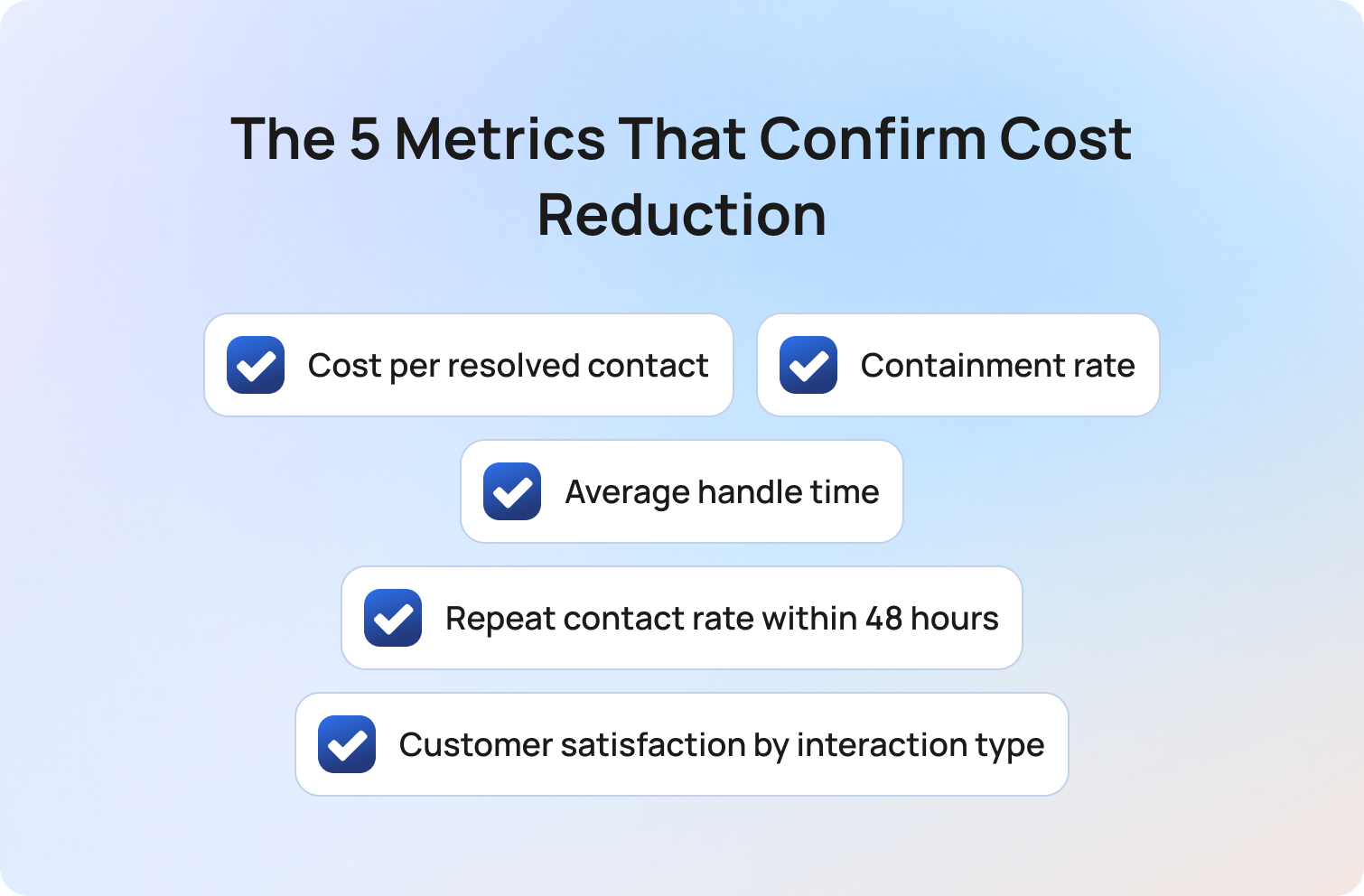
The most reliable measurement framework combines operational efficiency metrics with customer experience indicators.
Cost per resolved contact
This should be tracked separately for AI-handled and human-handled interactions. Combining both into a single average makes it difficult to understand where savings are actually being generated and whether those savings are increasing over time.
Containment rate
Containment rate measures the percentage of interactions fully resolved by AI without human intervention. This is one of the clearest indicators of AI performance because it directly reflects how many customer queries are being resolved without agent labor costs.
Average handle time (AHT)
Support leaders should separate handle time from wrap-up time when measuring AHT. This makes it easier to identify whether improvements are coming from agent assist, AI ticket summaries, workflow automation, or a combination of all three.
Repeat contact rate within 48 hours
A falling cost per interaction means little if customers are returning multiple times for the same issue. Tracking repeat contacts helps identify situations where apparent cost savings are being offset by unresolved customer needs.
Customer satisfaction by interaction type
AI-handled interactions and human-handled interactions should be measured separately. This provides a clearer view of support quality and helps identify opportunities to expand or refine automation scope.
Taken together, these metrics provide a more complete picture of whether customer support cost reduction AI is generating sustainable operational improvements.
The Three Measurement Errors That Make Savings Disappear
Measurement errors are one of the biggest reasons projected AI savings fail to materialise. While many organizations deploy capable technology, they still struggle to demonstrate ROI because the metrics they report to leadership do not accurately reflect operational performance.
The following mistakes appear repeatedly in post-deployment reviews.
Deflection vs. containment
Deflection measures whether customers avoided contacting a human agent. Containment measures whether the customer's issue was actually resolved.
A customer who abandons a chatbot session, leaves a self-service portal, or postpones contacting support may count as deflected in some reporting models. If that same customer returns later with the same issue, no meaningful cost reduction has occurred.
Containment should always be the primary metric because it reflects successful resolution rather than temporary avoidance.
Blended CSAT
Blended customer satisfaction scores can hide emerging service quality issues. For example, AI may successfully remove repetitive queries from agent queues, allowing support agents to spend more time on complex cases. Human-handled CSAT may improve as a result.
At the same time, AI-handled interactions could be generating lower satisfaction scores. When both groups are combined, the decline can remain hidden for months. Measuring customer satisfaction separately for AI and human interactions provides a more accurate view of customer experience.
Counting headcount savings before they exist
AHT reduction creates capacity, but capacity is not the same thing as savings.
Many business cases assume that a 20% productivity improvement immediately translates into a 20% reduction in staffing costs. In reality, the additional capacity often absorbs future growth, reduces overtime, or improves service levels before any direct labor savings appear.
Support leaders should only count headcount savings once they are reflected in avoided hiring, reduced contractor spend, or lower staffing costs.
“The biggest mistake organizations make is treating AI metrics as proof of ROI. A chatbot can have a high deflection rate and still increase support costs if customers come back later with the same issue. The only metrics that matter are the ones that connect operational efficiency with customer outcomes. If containment, cost per resolved contact, and customer satisfaction are all moving in the right direction together, the savings are real.”

This is where a finance-led approach to AI becomes essential. The focus shouldn’t just be on reducing contacts or automating routine tasks, but on reducing customer support costs while maintaining high service quality and protecting long-term customer loyalty.
Understanding what to measure is only half of the equation. The next step is selecting a platform that can deliver these improvements while providing the visibility required to prove ROI from day one.
How BlueTweak Helps Reduce Customer Support Costs at Scale
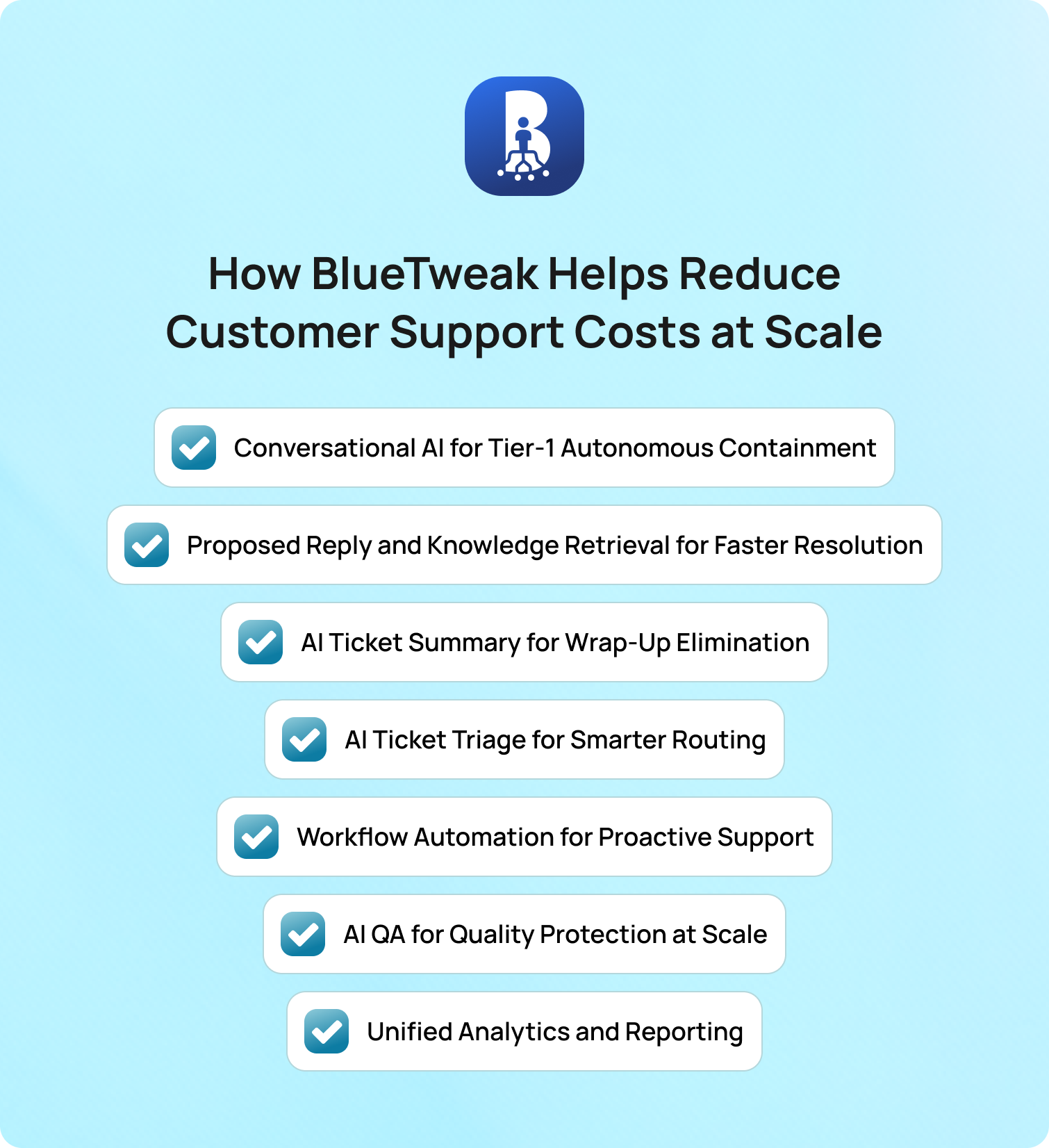
BlueTweak helps organizations reduce customer support costs by combining AI automation, agent productivity tools, workflow optimization, and quality management within a single platform.
Many support teams adopt multiple point solutions to address different operational challenges. One tool handles chat automation, another manages quality assurance, a third supports workflow automation. While each may deliver value individually, fragmented systems often create disconnected data, inconsistent reporting, and missed optimisation opportunities.
BlueTweak takes a different approach by connecting the six cost reduction mechanisms discussed throughout this article within a unified ecosystem.
Conversational AI for Tier-1 Autonomous Containment
BlueTweak's Conversational AI enables organizations to automate routine customer queries while maintaining clear escalation paths for complex issues.
By resolving repetitive requests autonomously, support teams can reduce cost per interaction, lower agent workload, and improve response times. Confidence thresholds and escalation workflows help ensure customers receive human intervention when required, protecting both service quality and customer satisfaction.
Proposed Reply and Knowledge Retrieval for Faster Resolution
BlueTweak's Proposed Reply and knowledge retrieval capabilities provide support agents with relevant information and draft responses in real time.
This reduces time spent searching documentation, improves consistency, and enables agents to resolve customer interactions more efficiently. The result is lower average handle time, greater agent productivity, and improved operational efficiency without sacrificing support quality.
AI Ticket Summary for Wrap-Up Elimination
BlueTweak's AI Ticket Summary automatically generates structured interaction summaries as soon as a conversation ends.
Removing manual note-taking reduces wrap-up time and increases available agent capacity across every interaction. It also improves CRM data quality, making reporting, forecasting, and customer journey analysis more accurate.
Combined with broader support ticket automation initiatives, summarization helps eliminate repetitive administrative work and improve operational efficiency.
AI Ticket Triage for Smarter Routing
BlueTweak's AI Ticket Triage analyses customer requests and routes them to the most appropriate team or specialist.
By reducing misrouting and unnecessary transfers, support teams can improve first contact resolution rates, reduce handling costs, and deliver faster service. Customers reach the right person sooner, while agents spend less time reprocessing requests that should have been routed elsewhere.
Workflow Automation for Proactive Support
BlueTweak's workflow automation capabilities help organizations identify predictable customer issues and communicate proactively.
Whether notifying customers about service disruptions, payment failures, delivery delays, or account updates, proactive support reduces inbound ticket volume and prevents avoidable contacts from reaching support queues in the first place.
AI QA for Quality Protection at Scale
BlueTweak's QA module evaluates customer interactions automatically, providing broader coverage than traditional sampling-based approaches.
Support leaders gain visibility into quality trends across the entire operation, enabling faster coaching, improved compliance monitoring, and more consistent customer experiences. This helps protect the quality failure cost line while reducing QA overhead.
Unified Analytics and Reporting
BlueTweak's customer service analytics and reporting analytics capabilities bring cost, quality, and operational performance metrics together in a single view.
Rather than relying on custom dashboards built across multiple systems, support teams can track containment rates, cost per resolved contact, customer satisfaction, and operational performance from one platform. This makes it easier to measure progress, identify optimisation opportunities, and demonstrate ROI to leadership.
The value of this approach is reflected in real-world deployments. For example, BlueTweak's work with Aeroitalia helped streamline customer support operations through intelligent automation and improved service workflows, demonstrating how operational efficiency and customer experience improvements can be achieved simultaneously.
Most importantly, BlueTweak makes customer support cost reduction measurable from day one. The metrics that matter most, including containment rate, cost per resolved contact, and customer satisfaction by interaction type, are tracked natively within the platform rather than requiring extensive reporting workarounds.
Final Thoughts: Sustainable Customer Support Cost Reduction Starts with Measurement
Customer support cost reduction AI works because it targets multiple cost lines simultaneously. Autonomous containment reduces the cost of routine interactions. Agent assist improves productivity. Intelligent routing, workflow automation, and AI QA eliminate operational inefficiencies while protecting service quality.
The organizations that achieve significant savings are not necessarily the ones with the most automation. They are the ones that understand their cost structure, account for hidden costs from the outset, and build a measurement framework before deployment begins. By tracking containment, cost per resolved contact, repeat contact rates, and customer satisfaction together, support leaders can demonstrate sustainable ROI rather than short-term improvements that fade over time.
If you're evaluating AI customer support cost reduction strategies, the next step is seeing how these capabilities perform in your own environment. Start a 14-day free trial with no credit card required to explore BlueTweak's AI-powered support platform firsthand, or book a demo to see how BlueTweak can help your team reduce customer support costs while maintaining high service quality.
Start your 14 day free trial today. No credit card required.
Get Started
As Head of Digital Transformation, Radu looks over multiple departments across the company, providing visibility over what happens in product, and what are the needs of customers. With more than 8 years in the Technology era, and part of BlueTweak since the beginning, Radu shifted from a developer (addressing end-customer needs) to a more business oriented role, to have an influence and touch base with people who use the actual technology.



