



TL;DR
Crisis management in customer service is no longer reactive damage control; it is a structured discipline that protects customer satisfaction, customer loyalty, and long-term customer relationships. When a crisis strikes, organizations need a clearly defined crisis management plan, robust crisis communications, and technology that enables teams to respond quickly across communication channels. AI-powered triage, real-time sentiment monitoring, and proactive updates help manage customer inquiries at scale while keeping customers informed with up-to-date information. Modern customer support platforms, such as BlueTweak, enable organisations to coordinate these responses through automation, omnichannel visibility, and intelligent ticket prioritisation.
Why Crisis Management in Customer Support Matters More Than Ever
Crises such as service outages, product recalls, security incidents, or negative media attention are an unavoidable reality for most organizations. In any crisis situation, customer support teams become the primary point of contact between the business and its customers, handling urgent customer requests, addressing customer concerns, and managing frustrated customers who expect clarity and reassurance.
How effectively those teams respond can significantly influence customer trust, brand reputation, and long-term retention, particularly when every interaction shapes the wider customer’s journey.
During moments of disruption, customers want transparency, up-to-date information, and access to all the details that affect their accounts, services, or customer data. Without a structured crisis plan, organizations risk inconsistent messaging, delayed responses, and poor coordination across account management and support functions. This can quickly escalate operational challenges, increase the estimated cost of recovery, and cause lasting damage to brand reputation.
In contrast, organisations that prepare clear communication frameworks, develop prepared answers for high-risk scenarios, and invest in training, including racial bias training and escalation protocols, are far better positioned to respond effectively and measure success against defined key metrics.
According to PwC’s 2025 Customer Experience Survey, more than half of consumers (52%) say they stopped using or buying from a brand because of a bad product or service experience, and nearly a third (29%) stopped due to poor overall customer experience, either online or in person.
This makes structured crisis management in customer support essential not only for protecting brand equity and customer relationships today, but also for building resilience against future crises that could disrupt the customer’s journey tomorrow.
Increasingly, organisations are also strengthening crisis readiness through specialised customer service platforms such as BlueTweak and similar AI-enabled support systems, which help teams coordinate communications, prioritise customer queries, and maintain visibility across multiple support channels during high-pressure incidents
Understanding the Impact of Customer Support Crises

When a crisis occurs, customer support becomes one of the most strategically important functions in the organization. It is no longer simply a reactive service channel, but the operational center for protecting brand trust, managing stakeholder expectations, and stabilising customer relationships.
A poorly handled support response can escalate a manageable issue into a reputational event. Conversely, a well-structured and empathetic response can strengthen loyalty and differentiate the brand in a crowded market.
Below are the four most significant areas of impact.
Trust Erosion
Trust is built through consistency, reliability, and transparency over time. During a crisis, customers look for immediate acknowledgement, clear next steps, and reassurance that the organization is in control of the situation.
If communication is delayed, vague, or defensive, customers begin to question competence and accountability. Even temporary uncertainty can trigger long-term scepticism, particularly in industries where reliability and data security are critical.
Customer support teams, therefore, play a central role in maintaining trust. Clear explanations, realistic timelines, and proactive updates reduce speculation and demonstrate leadership. Trust is preserved through honesty and responsiveness.
Reputation Damage
The pace at which information spreads has fundamentally changed crisis dynamics. Social media platforms, online reviews, and news aggregation sites amplify customer experiences in real time. A single unresolved issue can become a widely shared narrative within hours.
This means crisis management must extend beyond resolving individual tickets. It requires coordinated messaging, a consistent tone of voice, and real-time monitoring of public sentiment.
Customer support teams need visibility into broader communication strategies, while communications teams require insight into frontline customer feedback. When these functions operate in isolation, inconsistency emerges. When they collaborate, organizations can maintain clarity and control over the narrative.
Technology also plays a critical role. A modern support platform that integrates omnichannel communications, sentiment monitoring, and workflow automation enables faster and more aligned responses.
Customer Churn and Revenue Impact
Customer dissatisfaction during a crisis doesn't just mean complaints; it often results in churn.
In subscription-based and SaaS environments, retention is directly tied to customer experience. A crisis that increases response times, reduces service quality, or creates uncertainty around reliability can accelerate cancellations and contract non-renewals.
The financial impact extends beyond immediate revenue loss; customer acquisition costs continue to rise across industries, and losing existing customers during a crisis increases the long-term cost of growth. This is why proactive outreach during crises is so important. Customers who feel informed and supported are significantly more likely to remain loyal, even if they were affected by the issue itself.
Legal and Regulatory Exposure
Certain crises carry regulatory consequences. Data breaches, compliance failures, financial errors, or safety incidents may involve legal scrutiny and reporting obligations.
Customer support teams must be aligned with legal and compliance stakeholders from the outset. Messaging should be accurate, documented, and consistent with regulatory requirements.
Failure to involve legal expertise early can create additional risk, particularly if public statements contradict internal findings or regulatory filings. Structured crisis protocols reduce this exposure and ensure that the organization responds responsibly.
How to Build an Effective Crisis Management Plan for Customer Support
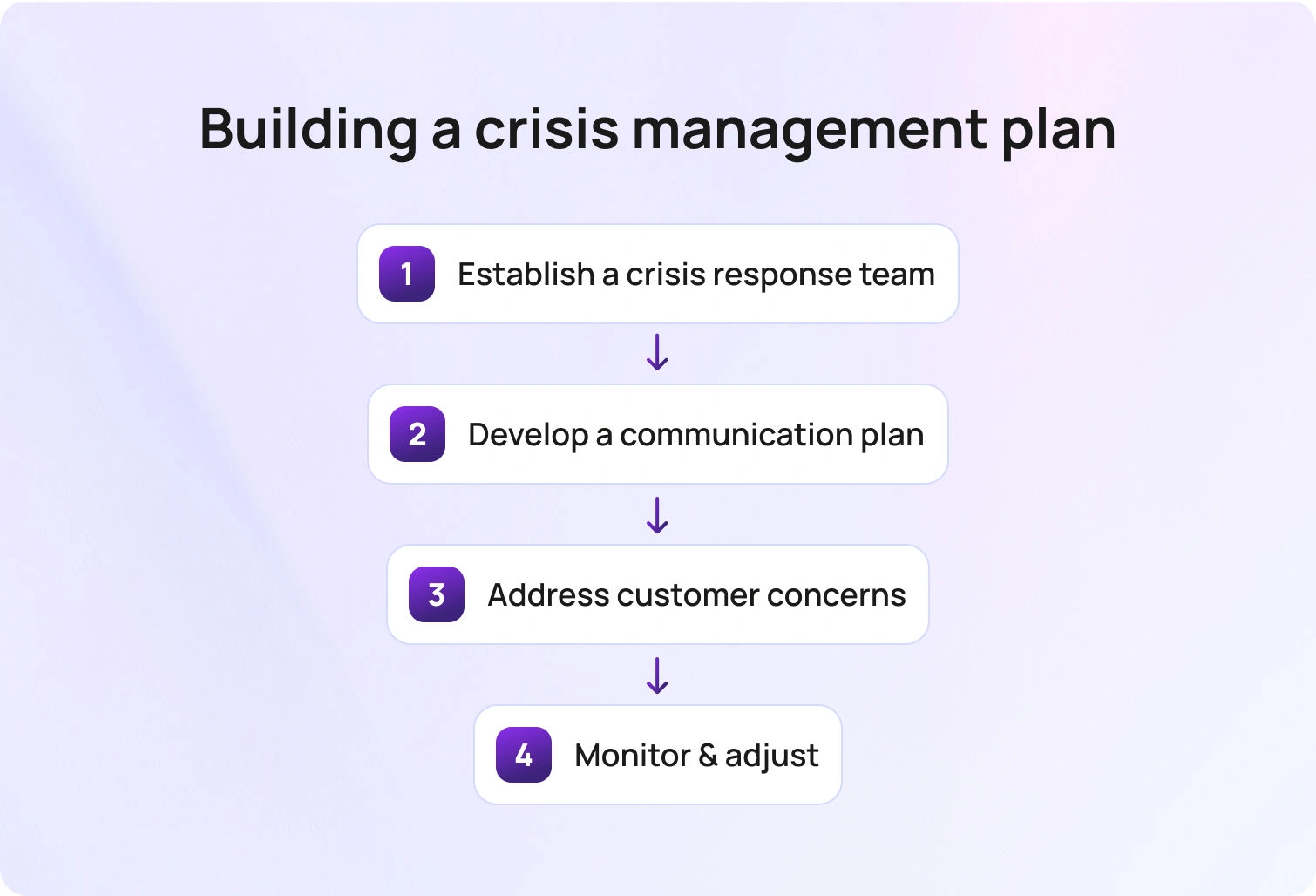
A documented crisis management framework ensures clarity, accountability, and speed.
Step 1: Establish a Cross-Functional Crisis Response Team
Crisis management cannot sit exclusively within the customer support function. While support teams handle frontline interactions, strategic decisions require broader organizational input.
An effective crisis response team should include:
- Customer support leadership
- Public relations or communications specialists
- Legal and compliance representatives
- Senior leadership
- Operations or IT leadership when service disruption is involved
This cross-functional structure ensures that decisions are aligned across departments and that messaging remains consistent internally and externally.
Defining Key Roles and Responsibilities
Once the team is established, clearly defined roles and responsibilities are essential. Without clear ownership, crisis response efforts can slow down as teams duplicate work or wait for approvals. Assigning specific responsibilities in advance ensures the organisation can respond quickly and maintain clear communication during high-pressure situations.
Key roles within a crisis response team often include:
- Spokesperson: Responsible for external media statements and public updates to ensure messaging remains consistent.
- Information Lead: Oversees the collection and verification of operational data so teams are working with accurate information.
- Legal or Compliance Advisor: Reviews customer-facing updates and public statements to ensure regulatory requirements are met.
- Customer Support Liaison: Provides real-time insights from support channels, highlighting emerging customer concerns, common queries, and sentiment trends.
Clearly defined responsibilities allow organisations to coordinate their crisis response more efficiently, reduce confusion, and ensure customer communications remain accurate and timely.
Step 2: Develop a Structured Communication Framework
Communication is the foundation of effective crisis management in customer support. Customers do not expect perfection, but they do expect clarity.
An effective communication framework should include the following principles:
Transparency
Acknowledge the issue promptly. Avoid defensive language or attempts to minimise impact. Clearly state what is known, what is being investigated, and when the next update will be provided.
Consistency Across Channels
Email updates, website notices, in-app notifications, chat responses, and social media messaging should align in tone and content. Discrepancies create confusion and undermine credibility.
Timeliness
Early acknowledgement reduces speculation. Even if all details are not yet available, confirming awareness of the issue reassures customers that action is underway.
Audience-Specific Messaging
Customers, partners, employees, and investors may require different levels of detail and context. Tailored communication improves clarity and reduces unnecessary alarms.
Active Monitoring
Monitoring social media, review platforms, and support queues in real time allows organizations to identify misinformation or escalating concerns before they spread further.
Improving first response time and building a robust omnichannel strategy are foundational elements of crisis readiness.
Step 3: Prioritise Impacted Customers with Proactive Support
During a crisis, reactive support is not sufficient. Customers who are directly affected should feel prioritised and informed.
Providing extended or 24-hour support coverage during high-impact incidents can significantly reduce frustration. Establishing a dedicated hotline or email queue ensures that crisis-related queries are not lost within general support traffic.
Maintaining up-to-date FAQs and knowledge base content can also help reduce repetitive enquiries and empower customers with self-service solutions during high-volume incidents. When customers can quickly access accurate information about known issues, expected resolution timelines, or temporary workarounds, support teams are able to focus their attention on more complex or urgent cases.
Equally important is tone. Agents should be trained to acknowledge customer concerns empathetically, clarify next steps clearly, and provide realistic timelines. Scripted or generic responses during a crisis often appear dismissive, so personalized, human communication is essential.
Step 4: Monitor Performance and Adapt in Real Time
Crisis management doesn’t end after the initial announcement. Continuous monitoring is required to evaluate whether the response strategy is effective.
Key metrics to track include:
- First response time
- Average resolution time
- Customer satisfaction scores
- Net Promoter Score fluctuations
- Ticket volume trends
- Social sentiment analysis
Establish structured feedback loops between frontline support teams and leadership. Support agents often detect emerging concerns before they are visible at the executive level.
If messaging is unclear or customer sentiment worsens, adjustments should be made quickly. Agility is increasingly a defining characteristic of resilient organizations.
Best Practices for Maintaining Customer Trust During and After a Crisis
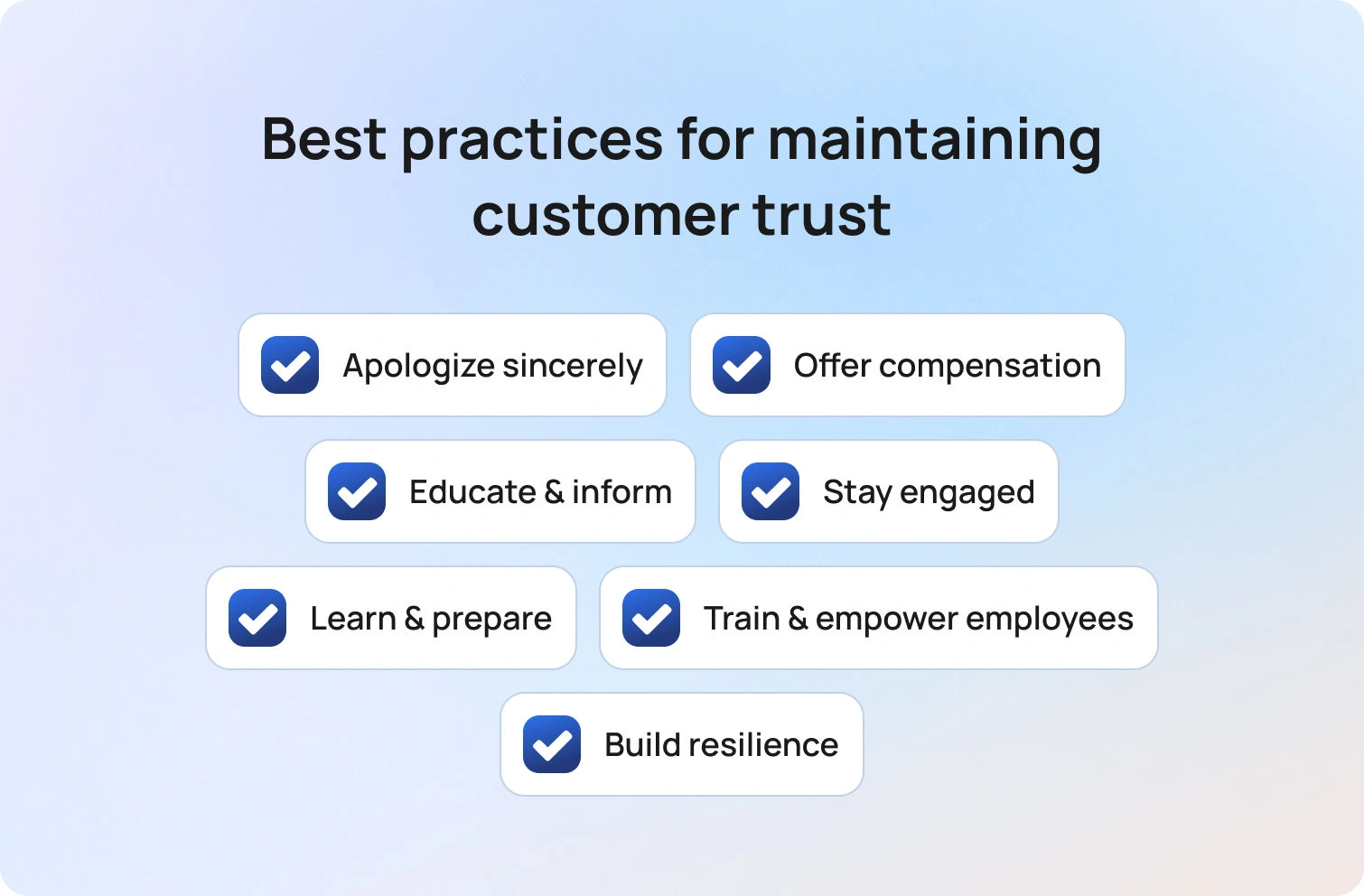
Customers do not judge brands solely on the existence of problems. They judge them on accountability, transparency, and the consistency of follow-through. Moving beyond response management and into trust preservation requires deliberate action, thoughtful communication, and a clear demonstration that lessons have been learned.
Issue a Clear and Direct Apology When Appropriate
If the organization is at fault, responsibility should be acknowledged directly. Avoid conditional phrasing that shifts blame or minimises impact. A sincere apology, combined with a clear action plan, reinforces accountability.
Offer Fair Compensation Where Relevant
Depending on the severity of the disruption, compensation such as service credits or refunds may be appropriate. These gestures demonstrate goodwill and reduce the likelihood of churn.
Provide Educational Guidance
If customers can take steps to protect themselves or mitigate impact, provide structured, easy-to-follow instructions. Clarity reduces anxiety and restores a sense of control.
Maintain Communication After Resolution
Once the issue is resolved, communicate what caused the problem, how it was fixed, and what changes have been implemented to prevent recurrence. Post-crisis transparency is critical for long-term trust.
Conduct a Comprehensive Post-Crisis Review
After stability is restored, conduct a formal evaluation of the response. Identify bottlenecks, communication gaps, and operational weaknesses. Update crisis playbooks accordingly and run simulation exercises to strengthen readiness for future incidents.
Resilience is not built during the crisis itself. It is built in the preparation and reflection that surround it.
The Role of Technology in Crisis-Ready Customer Support
Crisis management in customer support is not purely a people challenge. It is an infrastructure challenge.
When ticket volumes spike, response expectations accelerate, and public scrutiny increases, manual processes quickly break down. Without the right systems in place, even the most capable support teams can become overwhelmed.
Platforms such as BlueTweak, along with other AI-powered customer service systems, are increasingly designed with crisis scenarios in mind, enabling organisations to coordinate messaging, automate notifications, and manage sudden spikes in customer enquiries. Technology does not replace empathy or judgment. However, it enables speed, consistency, and coordination at scale. Organizations that invest in the right support infrastructure before a crisis are significantly better positioned to respond with clarity and control.
Below are the key technological capabilities that strengthen crisis readiness.
Automated Status Updates and Proactive Notifications
During high-impact incidents such as service outages or product disruptions, customers want information more than they want repetition.
Automated status updates, in-app banners, and proactive email or SMS notifications reduce inbound ticket volume by addressing common concerns before customers need to reach out. This preserves agent capacity for complex or high-risk cases.
A well-designed notification framework ensures that customers receive:
- Immediate acknowledgement of the issue
- Clear explanation of impact
- Expected resolution timelines
- Follow-up confirmation once resolved
Proactive communication not only reduces pressure on support teams but also signals operational maturity.
For an example of how targeted notification systems can enhance customer communication during operational events, see BlueTweak's Custom Notification Feature Integration for an airline company.
AI-Assisted Ticket Triage and Prioritisation
In a crisis, not all tickets carry equal risk. AI-assisted triage tools can automatically categorise and prioritise tickets based on urgency, customer tier, sentiment, or regulatory sensitivity. This ensures that high-impact cases are escalated immediately while lower-risk enquiries are routed efficiently.
Intelligent routing also reduces response times and prevents critical issues from being buried within general queues.
Importantly, AI should augment human decision-making, not replace it. Oversight mechanisms and clear escalation pathways remain essential, particularly when legal or compliance considerations are involved.
Real-Time Sentiment and Volume Monitoring
Crisis response requires real-time visibility. Dashboards that track ticket volumes, response times, social media mentions, and sentiment trends allow leadership teams to detect escalation patterns early. Sudden spikes in negative sentiment or repeated themes across channels can indicate communication gaps or emerging risks.
This data-driven visibility enables proactive adjustments to messaging and resource allocation. Without this insight, organizations are often reacting to symptoms rather than managing root causes.
Scalable Omnichannel Communication
Customers engage across multiple channels, including email, live chat, social media, phone support, and in-app messaging. During a crisis, fragmentation across these channels creates inconsistency and confusion.
An integrated omnichannel support platform ensures that:
- Conversations are centralised
- Customer history is visible across touchpoints
- Messaging remains consistent
- Escalations are tracked transparently
This cohesion is critical when response speed matters and multiple teams are collaborating under pressure.
Knowledge Base and Self-Service Enablement
A dynamic, easily updated knowledge base is a critical crisis asset. When common questions are addressed clearly and publicly, customers can self-serve rather than submitting tickets.
This reduces inbound volume and empowers customers with immediate clarity.
However, static documentation is insufficient. Crisis-ready knowledge bases must be updated in real time and aligned with official messaging to avoid misinformation.
Building Technological Resilience Before It Is Needed
Perhaps the most important principle is this: crisis technology cannot be improvised mid-incident.
Infrastructure decisions, workflow automation, escalation protocols, and reporting dashboards should be designed and tested before disruption occurs. Simulation exercises can help identify bottlenecks and system limitations under surge conditions.
Organizations that treat customer support technology as a strategic investment rather than a cost center consistently outperform those that rely on manual coordination.
Crisis readiness is not defined by whether an issue occurs. It is defined by how controlled, coordinated, and customer-focused the response appears when it does.
Crisis Management as a Competitive Advantage
Customer service crisis management determines how an organisation performs when customer expectations are under pressure and demand for clarity is at its highest. When a crisis strikes, whether due to technology failures, natural disasters, negative media coverage, or a public health emergency, the company’s response shapes trust, customer loyalty, and long-term reputation.
Organisations that manage crises effectively rely on clear communication protocols, structured crisis response strategies, and strong alignment across internal stakeholders to ensure consistency across all communication channels.
A documented crisis management plan ensures that crisis response efforts are coordinated rather than improvised, helping organisations protect business continuity and strengthen customer relationships when unexpected disruptions occur.
In the context of crisis management, customer service, structure, and preparedness determine whether incidents erode trust or reinforce it.
Final Thoughts: The Future of AI in Crisis-Ready Customer Support
AI is increasingly central to modern crisis response strategies. From AI-assisted ticket triage and prioritisation to real-time monitoring of customer feedback and key metrics, intelligent systems provide valuable insights that allow the customer service team to respond effectively when pressure is highest.
AI-powered platforms enable organisations to identify affected customers, directly contact important customers, prioritise key customers, and manage customer satisfaction without overwhelming customer support agents. These tools also help teams maintain ongoing communication and ensure customers receive up-to-date information during complex service disruptions.
Solutions such as BlueTweak, alongside other AI-enabled customer support platforms, support this shift by enabling automated notifications, intelligent ticket routing, and centralised visibility across communication channels. This allows organisations to coordinate crisis communications more effectively and respond to spikes in customer demand with greater control.
However, technology alone is not enough. Good customer service still relies on active listening, transparent communication, and empathy when addressing customer concerns and customer complaints.
According to the 2026 Edelman Trust Barometer Global Report, 64% of respondents say they trust businesses to “do what is right,” highlighting how fundamental trust is to customer retention and long-term reputation.
This underlines a clear reality for customer support leaders: how a company manages crises (from transparent communication protocols to AI-enabled triage and real-time monitoring) shapes customer loyalty, customer satisfaction, and the overall customer experience.
By combining structured crisis management plans, continuous improvement, and AI-powered support technology, organisations can ensure that crisis response efforts protect the overall customer experience while reinforcing customer trust across the entire customer journey.
If you're looking to strengthen your crisis management customer service strategy, the right technology can make a significant difference. Book a demo with BlueTweak to see how intelligent support infrastructure can help your team respond faster, communicate more clearly, and protect customer trust when it matters most.

As Head of Digital Transformation, Radu looks over multiple departments across the company, providing visibility over what happens in product, and what are the needs of customers. With more than 8 years in the Technology era, and part of BlueTweak since the beginning, Radu shifted from a developer (addressing end-customer needs) to a more business oriented role, to have an influence and touch base with people who use the actual technology.



