



TL;DR
AI customer support bot deployment challenges are usually caused by weak deployment planning rather than the AI model itself. Most failures happen during three key stages: pre-deployment, launch, and scaling. This is where issues such as poor Knowledge Base readiness, weak escalation design, and lack of governance lead to customer frustration and low containment rates. This guide explains the 13 most common deployment mistakes teams make in 2026, alongside practical frameworks for improving customer satisfaction, operational oversight, and long-term AI performance.
Why AI Bot Deployments Fail More Often Than Teams Expect
AI customer support bot deployment challenges often emerge because teams mistake a successful pilot for a production-ready support system. Many AI systems perform well during internal testing, only to fail once real customers interact with them at scale. That gap between pilot performance and live deployment is where most customer service problems begin. Support teams often blame the model when the real issue is deployment planning.
The reality is that AI customer service challenges are usually operational, not technological; a bot can generate accurate answers in a controlled environment and still create customer frustration in production if the deployment process is weak.
One major issue is the knowledge base quality at launch. AI systems rely on training data, conversation history, and structured knowledge base content to deliver context-aware responses. When the KB is incomplete, outdated, or inconsistent, AI chatbots generate wrong answers from day one. That first impression matters; once customers and support agents lose trust in the system, rebuilding confidence becomes significantly harder.
Another common issue is that many support operations teams focus on deflection rate rather than containment rate or customer satisfaction. A customer who abandons chat, submits multiple support requests, or calls back later is not a successful deflection. It is unresolved customer effort disguised as efficiency.
The third issue is the absence of a post-launch feedback loop. Teams deploy AI tools, monitor basic metrics for a few weeks, and assume the system will improve automatically… It won’t. Without structured review processes, actual support tickets never feed back into KB updates, escalation tuning, or model refinement.
This is one of the biggest misconceptions in AI deployment today: AI systems do not become more accurate simply because they are live. They become more accurate when support teams actively govern them.
The biggest deployment mistake we see is teams treating AI like a software installation instead of an operational program. Launch day is not the finish line. It is the start of a continuous optimization cycle that requires governance, QA, and human oversight.

Pre-Deployment Mistakes: What Goes Wrong Before Launch?
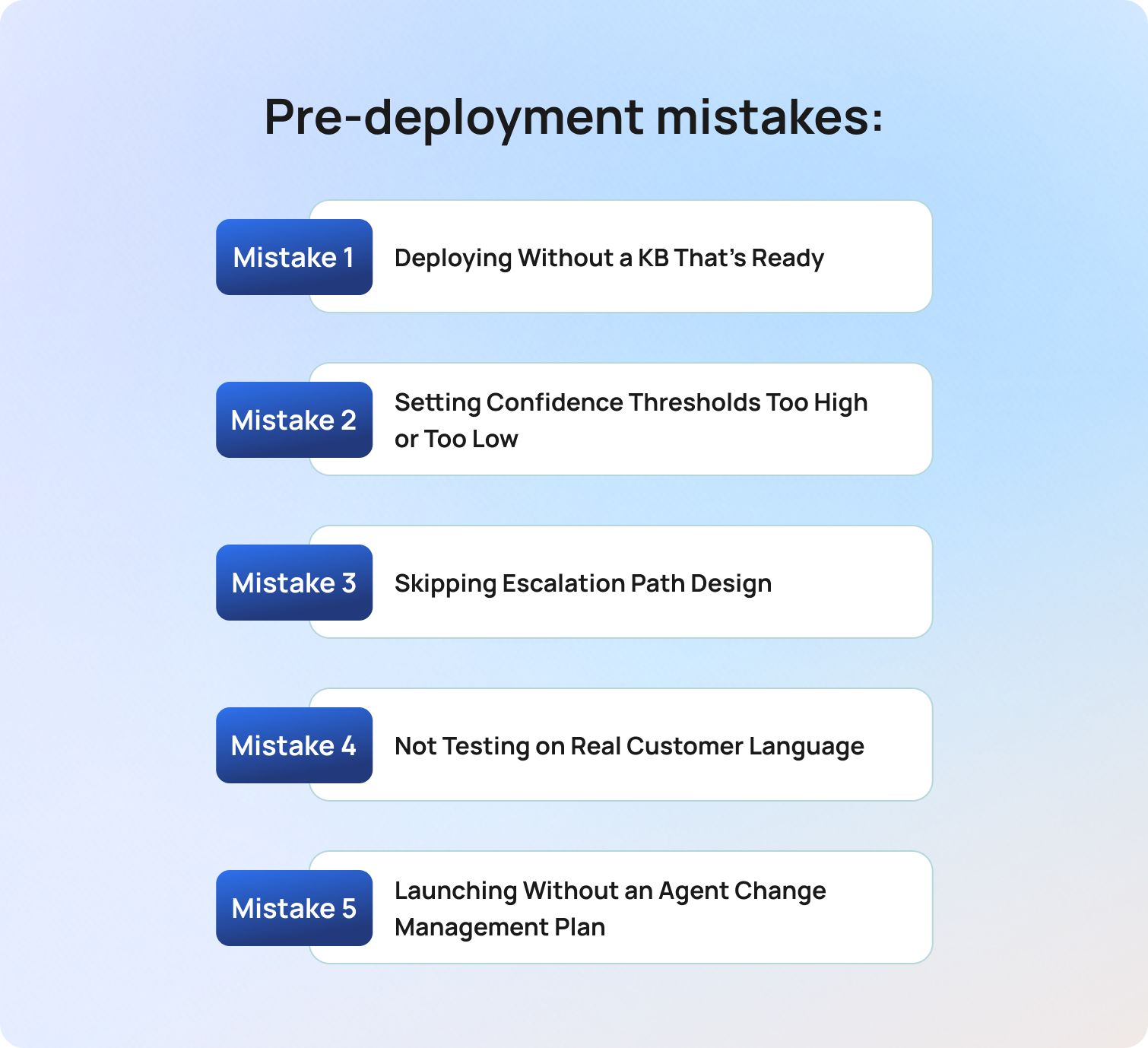
Pre-deployment mistakes are the most important AI customer support bot deployment challenges because the planning phase determines how the system performs in production.
The deployment phase that most damages long-term AI performance is not launch day; it is the weeks before it. The decisions made during planning, KB preparation, escalation mapping, and threshold configuration determine whether a bot enhances customer satisfaction or creates customer frustration at scale.
Mistake 1: Deploying Without a KB That's Ready
A deployment-ready knowledge base is complete, structured, reviewed for accuracy, and capable of supporting consistent answers across high-volume customer inquiries.
As of 2026, most enterprise AI systems rely heavily on retrieval-augmented generation (RAG) architectures. That means the AI agent is only as accurate as the knowledge base it queries.
When teams deploy AI customer support before the KB is fully prepared, the consequences appear immediately:
- Incorrect answers on common support requests
- Inconsistent responses across channels
- Escalation spikes from frustrated customers
- Declining customer trust in automated responses
The most common KB mistake is assuming volume equals quality. Thousands of documents do not help if the information is duplicated, outdated, or missing coverage for high-volume support tickets. The fix is to establish a KB readiness threshold before launch. That threshold should include:
- Coverage for the top 10–20 customer inquiry categories
- SME review and approval
- Removal of duplicate or conflicting articles
- Structured formatting optimized for AI retrieval
- Clear ownership for future updates
Support teams should never set a go-live date before the KB passes readiness review.
Mistake 2: Setting Confidence Thresholds Too High or Too Low
Confidence thresholds define when an AI customer service bot responds autonomously and when it escalates to human agents. This is one of the most common technical deployment mistakes because thresholds directly influence customer experience, response speed, and escalation volume.
If thresholds are set too high, the AI agent escalates almost every interaction. Support teams lose the cost savings and efficient processes that justified the deployment in the first place. If thresholds are set too low, the bot handles interactions it should not attempt. That creates incorrect answers, customer frustration, and damaged brand reputation.
Many companies make the mistake of configuring thresholds based on vendor demos rather than their own data. Vendor demos are designed around clean queries and ideal scenarios, but real customer language is messy.
The best approach is to start conservatively. Configure thresholds that create slightly more escalations than the long-term target, then reduce thresholds gradually as QA data accumulates.
The safest deployment strategy is not maximum automation on day one, but rather controlled automation with measurable oversight.
Mistake 3: Skipping Escalation Path Design
Escalation design is a core system function that determines how AI customer support transitions interactions to human agents. Many support teams treat escalation as an edge case, but in reality, escalation is the mechanism that protects customer satisfaction when AI confidence falls.
When escalation paths are poorly designed, customers get trapped inside automated loops. The AI asks repetitive questions, fails to resolve the issue, and forces customers to repeat information after transfer. That creates unnecessary customer effort and damages customer loyalty quickly.
Before launch, support operations teams should map every escalation trigger, including:
- Confidence threshold failures
- Negative sentiment detection
- VIP customer tags
- Sensitive account details
- Complex interactions require emotional intelligence
- High-risk requests involving data protection or customer records
Each escalation trigger should include a clearly documented handoff process:
- Which team receives the escalation
- Which channel does the escalation move into
- What conversation history transfers automatically
- What customer data is visible to the support agent
This is why BlueTweak emphasizes a HITL (human-in-the-loop) deployment model; AI customer service works best when human agents remain active reviewers, coaches, and escalation owners.
Mistake 4: Not Testing on Real Customer Language
Production-ready AI deployment testing uses real customer interactions rather than scripted internal examples. Many AI companies demonstrate strong intent accuracy during testing because the test data is unrealistically clean. Real customer service interactions include:
- Typos
- Slang
- Multiple questions in one message
- Emotional phrasing
- Incomplete sentences
- Multiple languages
- Frustrated customers using inconsistent wording
Bots that perform well in controlled testing environments often struggle once exposed to actual support tickets. The fix is simple but frequently ignored: test using historical customer service interactions.
Support teams should source at least 200 real interactions across each of their top 10 query categories. That dataset should include both successful and failed conversations. This will help improve:
- Intent detection accuracy
- Context-aware responses
- Multilingual support quality
- Escalation trigger reliability
- Customer satisfaction during live deployment
Real customer language is the only reliable predictor of production performance.
Mistake 5: Launching Without an Agent Change Management Plan
Agent change management is the process of preparing support agents to work alongside AI systems during deployment and scaling.
This deployment risk is consistently underestimated, as many organizations assume resistance comes from fear of replacement. In practice, resistance often comes from distrust in the system itself. Agents who believe the bot produces wrong answers stop using suggested replies, bypass escalation workflows, and weaken the feedback loop that improves performance.
Support teams should involve agents before launch, not after. That means:
- Including agents in KB review
- Using support agents to test automated flow quality
- Explaining the HITL oversight model clearly
- Setting realistic expectations about initial AI accuracy
- Sharing QA results transparently after launch
Teams that position AI customer support as a collaborative tool rather than a replacement system achieve stronger adoption and faster optimization.
Launch Mistakes: What Goes Wrong at Go-Live?
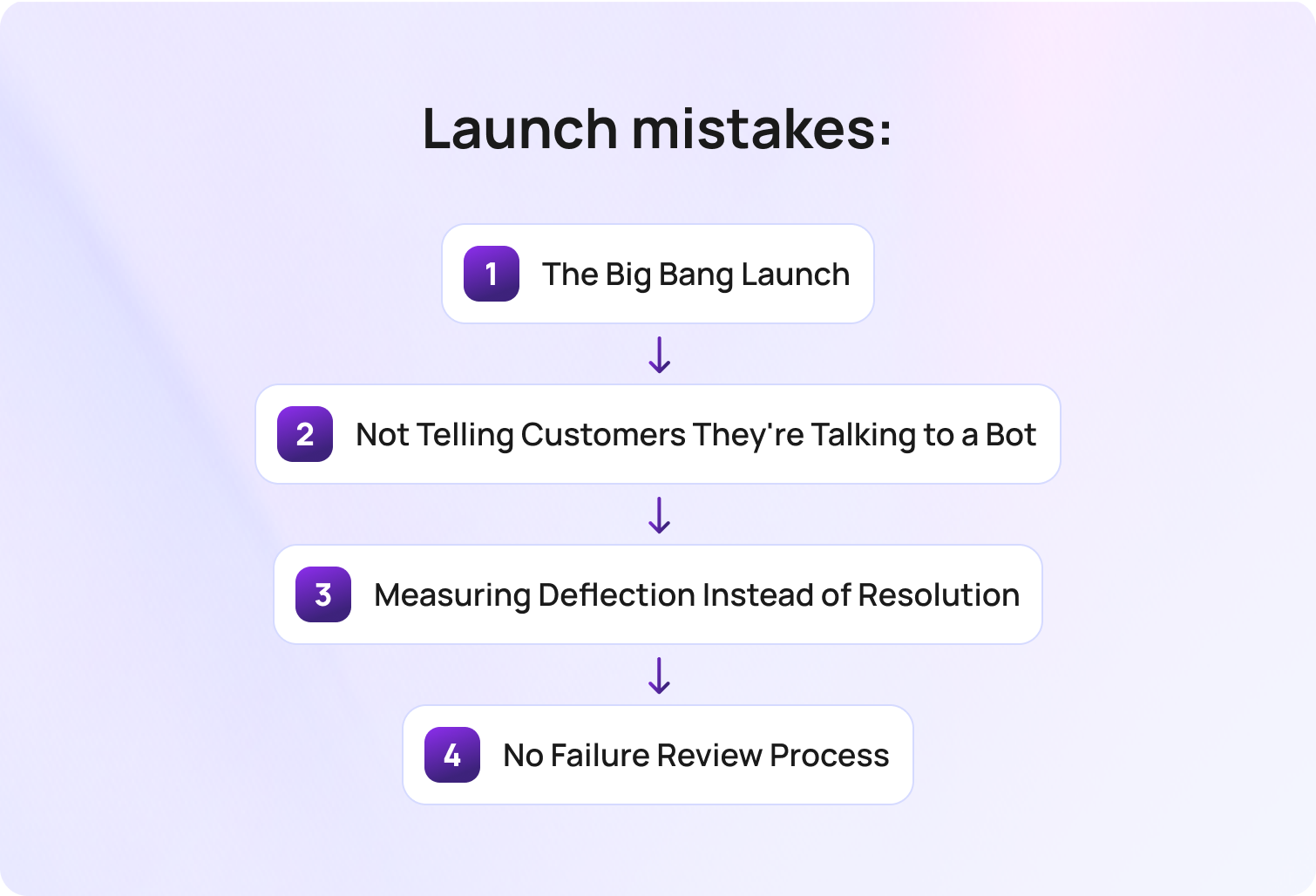
Launch-phase AI customer support bot deployment challenges are the most visible because they affect customer trust immediately. The mistakes made during go-live compound quickly because first impressions define how customers and support teams perceive the AI system moving forward.
Mistake 6: The Big Bang Launch
A big bang launch deploys AI customer support across all channels and query types simultaneously. This is one of the riskiest deployment strategies because it removes the ability to isolate failures.
When teams deploy AI across every customer service channel at once, they create operational complexity before the system has enough QA data to guide optimization. The safer approach is phased deployment.
Start with:
- One support channel
- High-confidence query types
- Low-risk customer inquiries
- Structured escalation oversight
Good examples include password resets, order status requests, shipping questions, and FAQ workflows.
After two weeks of QA review, containment analysis, and CSAT monitoring, teams can expand the bot’s scope gradually.
Mistake 7: Not Telling Customers They're Talking to a Bot
Transparency in AI customer service means clearly informing customers when they are interacting with automated systems. Customer expectations around disclosure have shifted significantly between 2024 and 2026, with most now expecting brands to disclose AI usage at the beginning of interactions.
Beyond compliance considerations around GDPR and emerging AI regulations, there is also a practical CX issue: customers become significantly more frustrated when they discover mid-conversation that they were speaking with a bot without being informed.
According to Deloitte’s 2025 Connected Consumer research, 70% of consumers express concerns about data privacy and security when using digital services, particularly as AI becomes more embedded in customer interactions. This creates a direct expectation gap: customers don’t reject AI customer service, but they do expect clarity, control, and transparency when it is used.
That expectation makes early disclosure a critical driver of trust, customer satisfaction, and long-term customer loyalty.
This issue can be mitigated with a simple deployment standard:
- Disclose AI use immediately
- Explain how escalation works
- Make human support accessible
- Avoid forcing customers into automated-only channels
Customers are typically more forgiving of AI limitations when expectations are set correctly from the outset.
Mistake 8: Measuring Deflection Instead of Resolution
Deflection metrics measure how many interactions avoid human escalation, while resolution metrics measure whether the customer issue was actually solved.
This distinction matters more than many support teams realize because a deflected interaction is not necessarily a successful one. Customers may reopen tickets, call back later, or post complaints on social media.
This creates hidden customer service challenges that distort performance reporting. Support operations teams should prioritize:
- Containment rate
- Post-interaction CSAT
- Repeat contact rate
- Escalation quality
- Resolution accuracy
Containment rate is especially important because it measures full resolution without additional human follow-up.
Deflection without resolution simply transfers cost from one channel to another. This is also where thought leadership around AI customer service needs to mature. Many AI deployment conversations still prioritize operational efficiency over customer outcomes, but this is a mindset that is becoming increasingly outdated.
The most successful AI customer service leaders today are balancing automation with trust, emotional intelligence, and measurable customer satisfaction.
Mistake 9: No Failure Review Process
A failure review process is a structured QA workflow for identifying, categorizing, and fixing bot interaction failures after launch. Many teams deploy AI systems and review failures informally, but that approach breaks quickly at scale.
Without a formal review cadence, support operations teams miss the patterns that drive rapid improvement. The first 30 days after deployment are especially important because they reveal:
- Knowledge base gaps
- Incorrect escalation triggers
- Weak intent detection
- Poor automated responses
- Query categories with high customer frustration
Every deployment should assign a weekly failure review owner. That review process should include:
- QA scoring for sampled conversations
- Categorization of failure causes
- KB update prioritization
- Escalation path tuning
- Reporting on high-volume error patterns
Post-Launch Mistakes: What Goes Wrong When You Scale?

Post-launch AI deployment challenges emerge when support teams expand automation faster than governance processes can keep up.
Many organizations survive launch successfully but encounter major customer service problems during scaling because oversight models that worked at low volume fail under larger workloads.
Mistake 10: Not Updating the KB as the Business Changes
Knowledge base decay happens when business processes, products, or policies evolve faster than the AI knowledge base. A KB that was accurate during deployment can become outdated within weeks in high-change environments.
When outdated information remains inside the support system, AI chatbots continue generating inaccurate responses with complete confidence. That creates one of the most damaging forms of customer frustration because the responses sound authoritative while being wrong.
The solution is governance. Support teams should:
- Assign KB ownership formally
- Define review cadences
- Build workflows for agent feedback
- Flag outdated articles proactively
- Prioritize updates for high-volume query types
Agents handling escalated interactions are often the first people to identify KB gaps, so their feedback should feed directly into KB maintenance processes.
Mistake 11: Scaling Scope Without Scaling Oversight
Scaling oversight means updating QA, escalation, and governance processes whenever the AI deployment scope expands. Many support teams expand into new channels or query types without recalibrating thresholds, testing workflows, or retraining agents. That creates inconsistent performance across support operations.
Every expansion should be treated as a new mini-deployment. This should include:
- KB preparation
- Confidence threshold tuning
- QA review setup
- Agent briefing
- Controlled rollout sequencing
Teams that scale AI customer support successfully understand that operational governance must scale alongside automation.
Mistake 12: Ignoring Repeat Contact Rate
Repeat contact rate measures how often customers recontact support regarding the same unresolved issue. This is one of the strongest indicators that automation is failing silently.
A customer may appear successfully deflected during the initial interaction while still remaining unresolved. When customers contact support again within 48 hours on the same issue, it often signals:
- Incorrect answers
- Incomplete resolutions
- Escalation failures
- Broken automated flow logic
- Poor context awareness
Support teams should monitor repeat contact rate by query type rather than as an overall average. That level of granularity helps identify where automation genuinely works and where oversight needs to increase. If the repeat contact rate exceeds threshold levels for a specific workflow, escalation rules should tighten immediately.
Mistake 13: No Governance Model for Expanding AI Autonomy
AI governance is the process of defining how and when the scope expands safely. Many companies expand autonomy informally because of operational pressure. The problem is that unmanaged expansion removes the quality controls that protect customer experience.
Organizations should document clear expansion criteria before increasing AI autonomy. Those criteria should include:
- QA score thresholds
- CSAT minimums
- Error rate targets
- Repeat contact rate benchmarks
- Escalation performance metrics
One practical governance approach is requiring sustained low error rates and stable CSAT performance over a defined review period before expanding automation into more sensitive workflows.
There is a major difference between deploying a chatbot and running a governed AI customer support program. Sustainable deployments come from structured oversight, consistent QA, and disciplined rollout decisions, not from automation volume alone. So, scaling successfully depends less on the sophistication of the model and more on the quality of the operational controls surrounding it.
A Deployment Plan That Avoids These Mistakes
BlueTweak has developed a stage-by-stage deployment methodology designed to reduce AI customer support bot deployment challenges before they affect customers. It explains how to structure deployment correctly from the start.
The framework below provides a practical deployment plan that support teams can operationalize immediately.
The BlueTweak Bot Deployment Framework

Phase 1: Pre-Deployment (Weeks 1–4)
- Define deployment scope
o Identify the top 10–20 query types by volume and confidence level.
o Prioritize low-risk, high-frequency customer inquiries first.
- Achieve KB readiness before setting launch dates
o Validate coverage across priority workflows.
o Remove duplicate or outdated documentation.
o Secure SME approval for customer-facing accuracy.
- Configure confidence thresholds conservatively
o Favor escalation over risky automation during early deployment.
o Tune thresholds using real interaction data after launch.
- Map escalation triggers and handoff workflows
o Define escalation conditions clearly.
o Ensure full conversation history transfers to support agents.
- Test using real customer language
o Use at least 200 historical interactions.
o Include frustrated customers, multilingual support cases, and complex interactions.
- Brief support teams thoroughly
o Explain the HITL model.
o Clarify agent responsibilities.
o Set expectations around iterative optimization.
Phase 2 — Launch (Week 5 onwards)
- Define deployment scope
o Identify the top 10–20 query types by volume and confidence level.
o Prioritize low-risk, high-frequency customer inquiries first.
- Achieve KB readiness before setting launch dates
o Validate coverage across priority workflows.
o Remove duplicate or outdated documentation.
o Secure SME approval for customer-facing accuracy.
- Configure confidence thresholds conservatively
o Favor escalation over risky automation during early deployment.
o Tune thresholds using real interaction data after launch.
- Map escalation triggers and handoff workflows
o Define escalation conditions clearly.
o Ensure full conversation history transfers to support agents.
- Test using real customer language
o Use at least 200 historical interactions.
o Include frustrated customers, multilingual support cases, and complex interactions.
- Brief support teams thoroughly
o Explain the HITL model.
o Clarify agent responsibilities.
o Set expectations around iterative optimization.
Phase 3 — Scaling
- Define deployment scope
o Identify the top 10–20 query types by volume and confidence level.
o Prioritize low-risk, high-frequency customer inquiries first.
- Achieve KB readiness before setting launch dates
o Validate coverage across priority workflows.
o Remove duplicate or outdated documentation.
o Secure SME approval for customer-facing accuracy.
- Configure confidence thresholds conservatively
o Favor escalation over risky automation during early deployment.
o Tune thresholds using real interaction data after launch.
- Map escalation triggers and handoff workflows
o Define escalation conditions clearly.
o Ensure full conversation history transfers to support agents.
- Test using real customer language
o Use at least 200 historical interactions.
o Include frustrated customers, multilingual support cases, and complex interactions.
- Brief support teams thoroughly
o Explain the HITL model.
o Clarify agent responsibilities.
o Set expectations around iterative optimization.
How BlueTweak Supports AI Bot Deployment at Every Stage
BlueTweak helps organizations manage AI customer support bot deployment challenges through a governance-first deployment model built around operational oversight, QA visibility, and controlled automation.
During pre-deployment, BlueTweak helps support teams structure the knowledge base that grounds AI responses. The platform allows organizations to configure confidence thresholds by intent category before launch, helping teams deploy AI safely rather than aggressively.
During launch, BlueTweak’s conversational AI platform supports configurable escalation triggers, enabling support operations teams to route sensitive interactions directly to human agents. The QA module begins scoring bot interactions from launch day, giving teams immediate visibility into incorrect answers, escalation failures, and customer satisfaction trends.
As deployments scale, BlueTweak surfaces containment rate, repeat contact rate, CSAT trends, and interaction-level analytics directly inside the platform. That visibility becomes critical as support teams expand automation into more complex workflows. BlueTweak also maintains the human-in-the-loop model through suggested replies and agent oversight capabilities, helping organizations expand AI customer service without losing human accountability.
One example of this operational approach can be seen in BlueTweak’s AI-powered customer support transformation project for a growing e-commerce client, where the deployment focused on reducing repetitive support workloads, improving operational visibility, and creating more scalable support processes. Rather than pursuing automation for its own sake, the project emphasized controlled implementation, workflow optimization, and measurable improvements in support efficiency.
You don’t need the most advanced models to make AI customer support work for you. But you do need clear deployment governance, the strongest QA processes, and the discipline to expand automation gradually instead of chasing full autonomy too early.
Final Thoughts: Building a Structured AI Deployment Strategy That Customers Actually Trust
AI customer support bot deployment challenges happen at three distinct stages: pre-deployment, launch, and scaling. Most organizations focus their risk management efforts on launch day while overlooking the planning phase, where the most consequential deployment decisions are made.
The organizations that tend to get the most value from AI customer support are not necessarily the ones with the most advanced AI tools. More often, they are the teams with:
- Structured deployment frameworks
- Strong KB governance
- Clear escalation design
- Human oversight models
- Measurable QA processes
- Disciplined scope expansion
The difference between successful AI deployment and failed automation is rarely the model itself; it is the operational discipline surrounding deployment.
As AI customer service continues evolving, the organizations that win customer trust will need to balance automation with transparency, governance, and measurable customer outcomes.
If your organization is preparing to deploy AI customer support or improve an underperforming deployment, BlueTweak can help you design a deployment strategy that scales responsibly. Get in touch to book a BlueTweak demo, or try BlueTweak for free today.
Get your free 14-day free trial
Get free trial
As Head of Digital Transformation, Radu looks over multiple departments across the company, providing visibility over what happens in product, and what are the needs of customers. With more than 8 years in the Technology era, and part of BlueTweak since the beginning, Radu shifted from a developer (addressing end-customer needs) to a more business oriented role, to have an influence and touch base with people who use the actual technology.



