14 Use Cases That Turn AI Customer Service Implementation Challenges Into Real Results



BlueTweak is an AI Customer Support Platform that unifies every conversation, customer record, and automation into one workspace.
Explore more
Insights, trends, and practical ideas from customer experience and AI
Real-world scenarios showing how teams use BlueTweak to deliver better service
The daily blueprint that guides customer support leadership.
ROI and savings calculators for support teams
See how BlueTweak stacks up against leading customer support platforms
AI scales when outcomes, people, and a unified platform move in lockstep. This article tackles the challenges of implementing AI in customer service and shows how 14 plays turn those blockers into measurable wins by progressing Assist → Approve → Automate and running on one stack (voicebot, chatbot, knowledge base, analytics, and workforce management). Examples are drawn from BlueTweak delivery playbook, with pricing and outcomes documented in BlueTweak materials.
AI in customer service doesn’t fail due to a lack of models; it fails because day-to-day operations are often messy. Teams juggle multiple tools for a single customer journey, so context gets lost, and leaders argue over mismatched reports. Peaks arrive faster than schedules can flex, SLAs wobble, and the cost of covering more languages climbs. Security reviews add another layer of protection, especially when customer data or payments are involved. None of these problems is exotic; they’re routine, and they compound.
This article demonstrates how to overcome implementation challenges by leveraging 14 practical use cases. Each one pairs a specific blocker with a concrete pattern that moves in a controlled sequence (Assist → Approve → Automate) so you can start safely, learn fast, and only automate what’s genuinely low-risk. Where examples mention tools, they illustrate the pattern rather than prescribe a vendor.
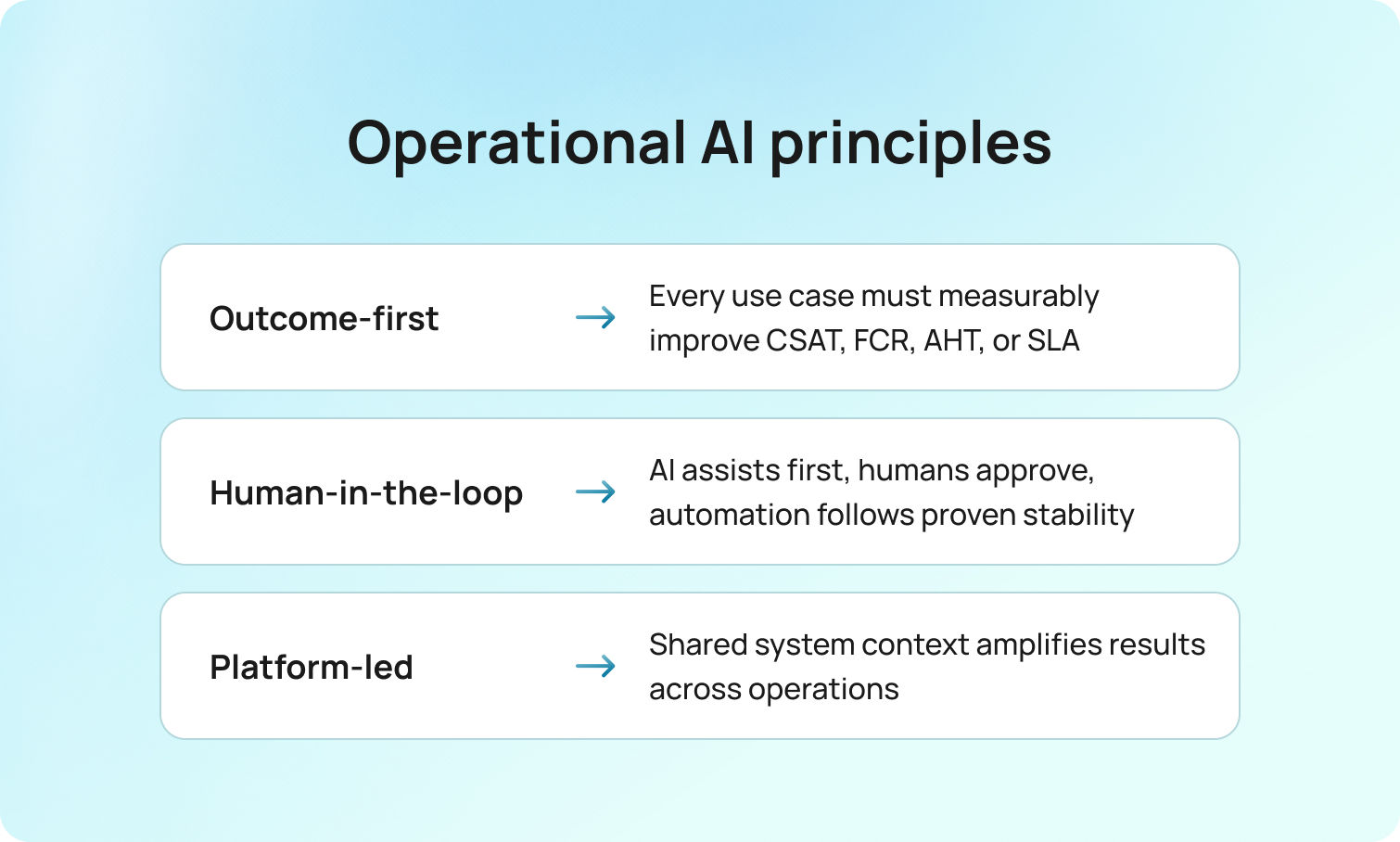
These principles are the operating rules behind the 14 use cases. They decide which plays you run, how you run them, and how you prove they worked.
Outcome-first means every play earns its spot by moving one of four targets: CSAT, FCR, average handle time, or SLA adherence. That’s why the first cluster focuses on quick, measurable lifts: virtual agents for repetitive requests and agent assist to cut typing (#1–#2), multilingual coverage to remove a capacity bottleneck (#3), and routing that reduces reassignments (#4). If a proposed use case can’t show movement on those metrics in a pilot, it doesn’t progress.
Human-in-the-loop defines the cadence of each use case. We start in Assist (AI drafts, humans decide), move to Approve (AI proposes, humans confirm), and automate only the narrow, low-risk steps that have proven stable in production. That pattern can be seen in sentiment-aware triage (#5), knowledge governance tied to suggested replies (#6), and human-designed handoffs that prevent talled handoffs (#13). The result is safer wins early, then sustained gains as confidence grows.
Platform-over-point tools explain why the use cases connect, rather than living as one-off fixes. When channels, knowledge, customer support analytics, and workforce planning share the same context, improvements reinforce each other: WFM plans to the real demand that routing and deflection create (#7), analytics surfaces cross-brand patterns that feed proactive moves (#8, #12), privacy controls make approvals faster instead of slower (#9), and integrations prevent manual rekeying between systems so answers reflect real customer data (#10). Call transcription and summaries capture what was learned and push it back into the knowledge base (#11), while governance ensures everything is released on a steady rhythm (#14).
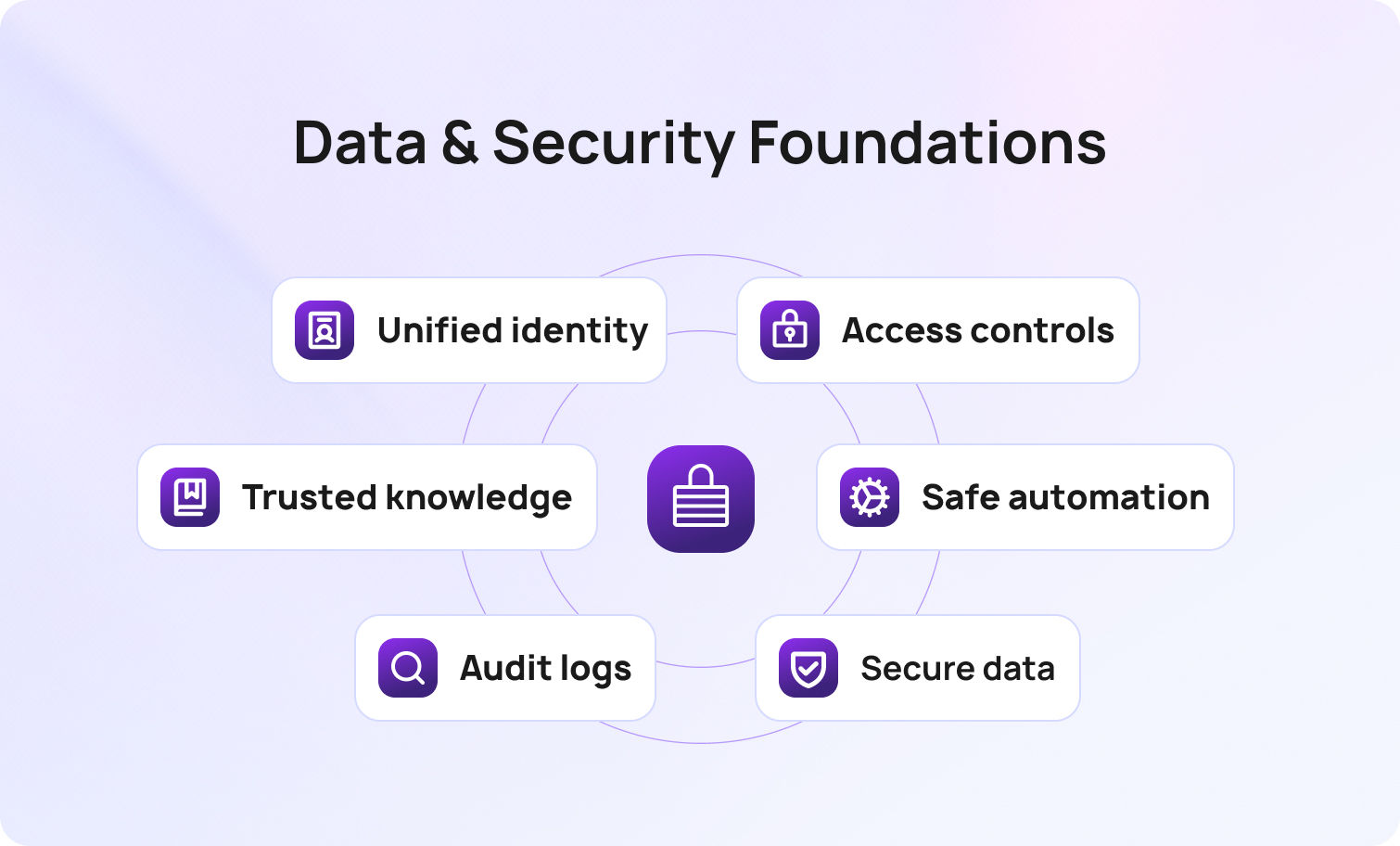
Data and security are the green light, not the epilogue. When identities are stitched across channels, assistants and agents always know who they’re helping and what the customer is entitled to. That single view keeps authentication simple, makes routing smarter, and allows any reply, whether automated or human, to accurately reflect the real account state, rather than relying on guesswork.
Robust data and security practices are crucial for maintaining customer trust, particularly when handling sensitive information, such as account balances.
A governed knowledge base is the second pillar. Clear ownership, versioning, and approvals mean answers are consistent, auditable, and safe to reuse. With a living KB in place, you can start in Assist (AI drafts), move to Approve (AI proposes, humans confirm), and only then automate tightly bound steps without debating content quality every time.
Finally, access and audit controls remove friction from change. Role-based permissions, MFA, session policies, and exportable audit logs let security sign off once and monitor continuously. Options like IP allowlists and data-location choices keep regulated teams comfortable, so you can iterate on flows, prompts, and articles without reopening a full risk review.
Together, these foundations make early wins shippable and keep the Assist → Approve → Automate progression moving, so we can apply them now in the 14 use cases.
Each use case addresses a specific blocker and demonstrates how AI is used to complement, rather than replace, human customer service. By integrating AI thoughtfully, organizations can ensure the human touch is preserved for complex or sensitive interactions, maintaining empathy and trust. To keep the narrative connected, each play highlights how it advances the next step in the journey.
The implementation challenge is not simply “we have lots of routine contacts”; it’s that virtual agents, designed to handle a wide range of customer inquiries and routine tasks, are often rolled out without a clear intent taxonomy, confidence thresholds, authentication rules, and escalation design.
Design the assistant around a governed intent library with per-intent guardrails, including minimum confidence, required data, allowable actions, and a clear line for when to hand off. Add step-up authentication where the answer touches identity or money, and package escalation with transcript, steps completed, and customer context.
Results include fast resolutions on low-risk intents, efficient handling of routine tasks and customer inquiries, lower average handle times, and higher CSAT scores, with clean handoffs for any ambiguous issues. BlueTweak supports this with voice/chat bots grounded in a governed KB and with structured escalations into the agent desktop.
The AI challenge is ungrounded drafting; models generate plausible text that drifts from policy or tone, creating review churn and brand risk.
Fix it by implementing retrieval-augmented generation tied to your knowledge base and recent interaction history, then require human approval as the default operating mode. Enforce inline citations that link back to the KB and provide style controls to ensure drafts match the voice. Log accept/ edit/ reject to improve prompts and content.
Results are shorter time to first response, fewer errors, and a sustained lift in first-contact resolution because agents make decisions, not first drafts. Human agents are essential for reviewing and personalizing responses to ensure customer needs are met, especially in nuanced or sensitive situations. BlueTweak’s proposed reply follows the “AI writes, agent approves” pattern with citations and KB grounding.
The AI challenge is translation fidelity and terminology control, rolling out multilingual models without glossaries, domain terms, or guardrails risks misinforming customers and breaching policy.
Stand up language detection at intake, apply neural translation with term glossaries and do-not-translate lists, and route sensitive/regulatory topics to specialists in the target language. Keep humans in the loop on edge cases and feed corrections back into the glossary.
Results include 24/7 coverage in customers’ preferred languages, stable costs, and improved SLA adherence across time zones. BlueTweak delivers multilingual voice and text with domain terminology controls and specialist routing where required. By providing support in multiple languages and delivering personalized service, organizations can meet diverse customer needs and enhance the overall customer experience.
The AI challenge is a cold start for routing models without labeled data and a current skills inventory; intent classifiers can’t reliably put work in the correct queue.
Bootstrap labels from historical tickets, define a living skills matrix (who handles what, where, and when), and use human feedback loops to correct misroutes. Add priority features (customer value, deadlines, churn risk) to inform routing decisions.
Results include fewer reassignments, shorter waits, and cleaner workloads, which make every downstream AI assist more accurate. BlueTweak provides automated tagging, skills-based routing, and queue controls to operationalize this.
The AI challenge is a signal without action. By using sentiment analysis to prioritize responses and tailor interactions, organizations can focus on enhancing customer satisfaction. However, many haven’t wired these insights into routing, alerting, or coaching, so risk hides in volume.
Connect real-time sentiment to policy: thresholds that trigger lane changes to senior agents, supervisor alerts when spikes occur, and post-incident reviews that feed the KB. Pair with reason codes so you can separate “angry” from “at risk.”
Results are faster saves on high-risk contacts, fewer public escalations, and a tighter loop between detection and prevention. BlueTweak links sentiment signals to routing and analytics, enabling leaders to act now and learn later.
The AI challenge is hallucination from stale or fragmented knowledge. Assistants and agents answer from different sources, or sensitive content lacks ownership and approvals.
Treat the KB like a product: clearly define owners, versioning, review cadence, sensitivity flags, and measure its usefulness. Serve both bots and agents from the same KB via retrieval so every draft and bot reply cites controlled content.
Results include consistent answers, safe deflection, and FCR gains that compound because fixes are implemented in one place. BlueTweak’s hierarchy, versioning, approvals, and KB-driven replies ensure alignment between bots and Proposed Reply.
The AI challenge is mismatched staffing after deflection. As automation absorbs volume and changes the mix (from shorter, simpler contacts to longer, more complex ones), schedules don’t adapt, and SLAs wobble.
Close the loop between AI signals and WFM. Forecast with intent and deflection rates, schedule to expected concurrency, and watch adherence alongside live queue health. Reallocate in-day based on spikes flagged by routing and sentiment.
Results are steadier SLAs, higher productivity, and clear headroom to expand automation safely. BlueTweak’s WFM integrates analytics and routing, so capacity tracks the work that AI actually reshapes.
The AI challenge is attribution. Pilots “feel good,” but fragmented metrics make it impossible to prove deflection, FCR, or AHT moved because of AI.
Standardize definitions across channels and brands (CSAT, FCR, backlog, handle time, deflection), instrument assist approvals and bot success/failure, and run control groups or A/Bs where feasible. Combine live and historical views in a single tool that operators use on a daily basis.
Results are credible ROI stories and fast iteration because teams act on shared facts, not stitched exports. BlueTweak provides pre-built dashboards and custom reports, allowing for the AI impact to be visible and comparable. Unified analytics delivers insights into every customer interaction.
The AI challenge is security review gridlock; unclear access, retention, or auditability stalls every use case.
Adopt a privacy-by-design approach: implement encryption in transit/at rest, use RBAC with least privilege for agents/bots/admins, enforce MFA and session policies, maintain exportable audit logs, establish IP allowlists, and provide data-location options. Document data maps and retention so risk can be approved once and monitored continuously.
Results are faster deployments, fewer incidents, and a safe runway to iterate prompts/intents without reopening risk debates. BlueTweak exposes these controls in admin and infra settings; ISO progress is documented.
The AI challenge is context-free assistance. Without CRM, commerce, billing, or order data, AI gives plausible but incomplete guidance.
Start with a minimum viable integration set tied to top intents (identity/entitlements from CRM, orders/payments from commerce, shipping from warehouse systems). Read before you write: prefer retrieval and side-effects that can be audited.
Results include fewer tabs and rekeys, higher-quality resolution, and a wider envelope for safe automation, as steps can be verified and validated. Selecting the right AI solution and integrating it into a comprehensive AI system ensures that AI solutions deliver accurate and relevant support, thereby improving both customer experience and operational efficiency. BlueTweak offers APIs, SaaS connectors, and per-flow feature toggles to meet governance.
The AI challenge is no training substrate. In call centers, the richest context lives in voice, but without transcripts and summaries of past interactions, models and KBs learn slowly and inconsistently.
Capture accurate transcripts with speaker separation and timestamps, then generate concise summaries (including issue, actions, outcome, and follow-ups) that link to tickets and KB articles. Index them so search and retrieval can use the content immediately.
Results include improved coaching, fewer repeat contacts on the same issue, and a faster path to safe automation, as policy guidance is available in text format. BlueTweak includes call transcription and AI summaries wired to tickets and KB.
The AI challenge is models that predict but don’t operationalize; anomaly flags exist, but nothing changes in production.
Convert predictions into playbooks: when returns spike, publish banners and guided flows; when payment failures increase, send targeted replies; when region-specific delays occur, adjust capacity. Track outcomes and feed them back into models.
Results are stabilized queues, protected brand sentiment, and time for teams to plan instead of firefighting. BlueTweak’s live dashboards, trend reports, and predictive routing connect detection to action.
The AI challenge is context loss at the boundary. Automation hands off late or thin, forcing customers to repeat themselves and agents to rediscover facts.
Define escalation criteria early to ensure that complex issues and complex queries are routed to a human agent for resolution. Package a comprehensive payload, including the transcript, steps taken, authentication state, KB citations, and next-best actions. In the agent UI, surface that context and a grounded suggested reply so resolution continues, rather than restarting.
Results include shorter journeys, higher post-handoff CSAT, and the confidence to expand automation, as it never leaves the customer stranded. BBlueTweak’s workspace centers on Suggested Reply, unified histories, and KB context.
The AI challenge is model and content drift; prompts change, intents sprawl, and articles age, eroding accuracy.
Establish ownership (RACI), change control for prompts/intents/articles, and an evaluation harness with real conversation snippets. Run a quarterly refresh with rollback plans; publish quality dashboards (accuracy, citation rate, hallucination flags, policy exceptions).
Results are steady quality, quick recovery from regressions, and compounding gains across channels and brands. Ongoing governance and iteration also foster customer loyalty and enable more personalized customer interactions as the system adapts to evolving needs. BlueTweak’s implementation playbook codifies workflows, approvals, and configuration patterns for safe iteration.
The set covers inbound efficiency, customer satisfaction, and operational transparency. Virtual assistants and AI-powered systems automate repetitive tasks, enabling more efficient solutions for common queries and improved execution of customer service tasks. Agents handle exceptions with better context and fewer tabs. Leaders steer with unified data instead of reconciling disconnected reports. Collectively, these use cases deliver improved customer experiences, high-quality service, and efficient solutions while automating and enhancing customer service tasks. Reported outcomes include lower ticket volume, higher FCR, and a substantial cost and ROI profile when implemented on a consolidated stack.
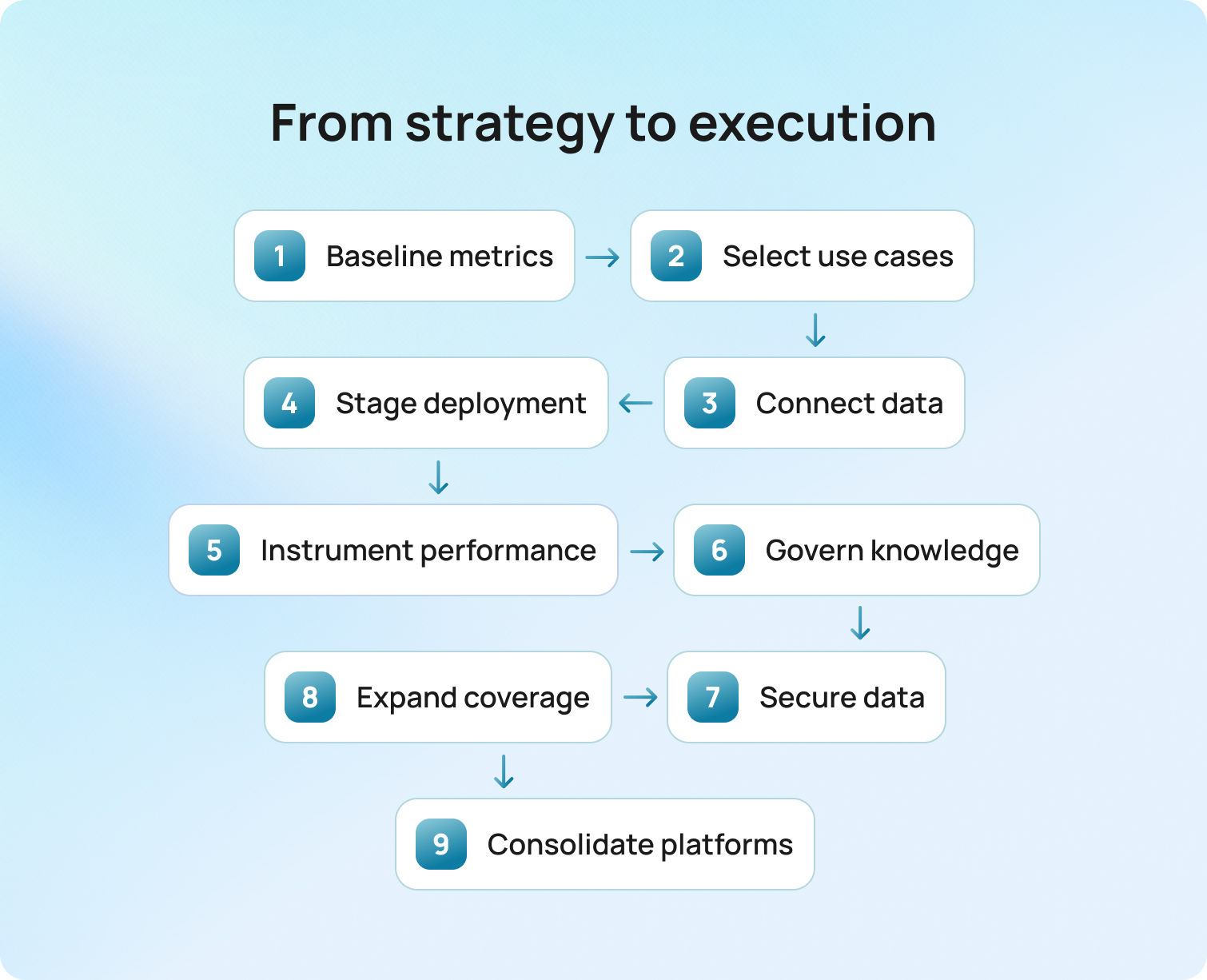
A concise blueprint helps programs move from presentations to production. Careful planning is essential for implementing AI and leveraging AI technology to meet the needs of customers in modern support environments. The steps below address buyer concerns, including integration and security.
1) Frame the problem using operational baselines. Start with three metrics, one for each queue and channel. CSAT, FCR, and average handle time identify the first candidates for change. Teams with multi-brand operations incorporate cross-project normalization into their view for consistent comparisons.
2) Choose use cases with clear success criteria. Target high volume and low ambiguity first. Password resets, order status, warranty checks, and billing lookups meet this test under most policies. Design guardrails for identity, payments, and any regulated topics that require human involvement.
3) Connect data sources before releasing assistants. A short integration list goes a long way. CRM for identity and entitlements, commerce for orders and payments, and warehouse for shipping all feed relevant responses. BlueTweak’s API and integration approach are designed to simplify this step.
4) Deploy in assist mode first, then approve, then automate. Assist mode de-risks the rollout and proves value quickly. Approve mode teaches policies and exposes content gaps; only then should low-risk flows move to full automation (e.g., after-hours). Only then should low-risk flows move to full automation for after-hours coverage. The assistance in approving the auto sequence aligns with BlueTweak’s messaging and mitigates risk.
5) Instrument everything. Dashboards and custom reports make progress visible and help isolate regressions. Cross-brand analytics keep vendors and internal teams aligned. BlueTweak surfaces these views natively for live and historical analysis.
6) Govern content and prompts like a product. Assign owners to KB sections. Require approvals for sensitive changes. Track usage, deflection, and article helpfulness, then retire or merge weak entries. KB governance features in BlueTweak, including versioning and approvals, support this discipline.
7) Formalize data privacy controls and audits. Restrict access to sensitive customer data using role-based permissions. Enforce MFA and session policies. Retain audit logs and export them to the SIEM of choice. BlueTweak exposes these control points for administrators and security teams.
8) Expand to multilingual coverage and workforce changes. Introduce multilingual support in the top two languages first, then scale it up. Adjust schedules and staffing as deflection and concurrency improve. WFM features and language tools in BlueTweak help match capacity to demand.
9) Consolidate platforms to lock in gains. Retire point tools that duplicate functions, and move reporting into a single analytics layer. Consolidation reduces costs and provides AI with a stable foundation with fewer moving parts. BlueTweak’s all-in-one footprint is structured for this outcome.
Executives expect proof that automation improves both the customer experience and the P&L. The list below summarizes the typical movements when programs follow the blueprint.
Cost and ROI. Documented improvements with a consolidated stack and AI-driven deflection.
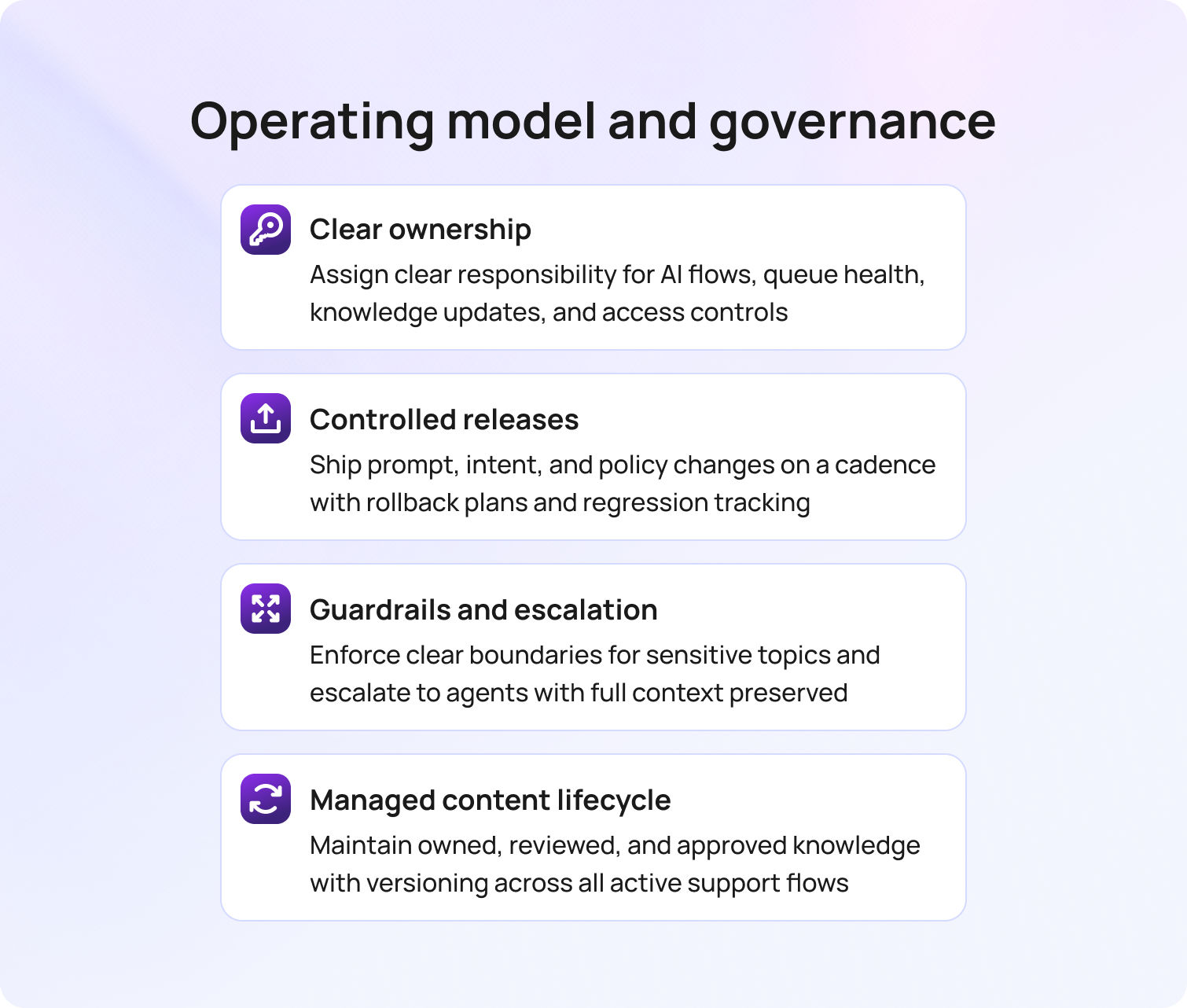
AI in customer service performs best when operating under an explicit model.
Roles and responsibility. Product operations owns AI flows and prompts. Support operations owns queue health and WFM. Knowledge owners maintain articles and approve changes. Security owns access policies and audits. BlueTweak exposes the control points needed by each group through administration and configuration features. Customer service leaders leverage insights into customer behavior and preferences to inform governance and operational decisions, ensuring that AI-driven support aligns with evolving customer needs.
Release management. Changes to intents, prompts, and policies occur on a weekly basis, with rollback plans in place. Analytics track regressions in deflection, handle time, and CSAT. Issues trigger reviews that include article updates or routing adjustments.
Guardrails and escalation. Topics that require human judgment, such as identity, refunds, and compliance, always escalate. Assistants explain limits and transfer with context. Agents receive transcripts and KB citations, and follow best practices to preserve continuity.
Content lifecycle. KB entries include owners, review dates, and links to affected flows. Versioning and approvals are enforced for sensitive domains. BlueTweak provides KB version management and approvals to support this lifecycle.
AI programs carry reputational and regulatory risk. A minimal control set fits most sectors.
BlueTweak configuration aligns with these expectations and surfaces administrative controls for each item above. ISO progress appears in the security section of the positioning materials.
The strongest business cases tie deflection and handle time savings to a single platform model. Consolidating tickets, bots, knowledge, analytics, and WFM simplifies vendor management and reduces failure points, which shortens time to value.
BlueTweak offers transparent pricing at €65 per agent per month for the entire stack, emphasizing a fast time to value in mid-market and enterprise contexts. Outcome evidence includes ticket reduction, efficiency gains, and higher FCR.
AI in customer service reaches its full potential when it complements people, rather than trying to replace them. The 14 use cases above provide support leaders with a concrete playbook that addresses AI customer service implementation challenges through a balanced mix of automation and human support. A consolidated platform simplifies the integration of AI with existing systems, protects sensitive customer data, and enables operations to measure progress with shared dashboards.
BlueTweak was built for this reality, covering ticketing, voice, chat, bots, analytics, knowledge, and WFM in one stack, with multilingual capability and enterprise controls. Documented outcomes include substantial reductions in ticket volume, higher FCR, and a clear ROI profile.
Schedule a BlueTweak demo to map use cases to current volumes, languages, and channels, and to see how governance and analytics anchor the rollout.
No. BlueTweak integrates with CRMs and other systems through APIs, complementing existing tools as consolidation occurs in phases. Features can be customized or disabled for specific flows.
Support operations and knowledge owners maintain flows and content. Security manages access and auditing. Product operations coordinates release cycles and rollback plans. BlueTweak’s versioning, approvals, and admin capabilities support this division of labor.
Agent assist and clean routing deliver the fastest wins: Suggested Reply, AI summaries, and skills-based routing cut response times and reduce repeat work; BlueTweak ships these out of the box so teams see measurable gains in the first sprint.
Administration controls include MFA, role-based access, and audit logs, with options for IP range restriction, data-location selection, and custom SSL for stricter environments; BlueTweak supports these controls so security and compliance teams can enforce policy without slowing operations.
Language detection and translation let assistants and agent workspaces operate across multiple languages, while sensitive or regulated interactions route to specialists to maintain quality; BlueTweak applies this model across chat, voice, email, SMS, and social with native routing and auditability.
As Head of Digital Transformation, Radu looks over multiple departments across the company, providing visibility over what happens in product, and what are the needs of customers. With more than 8 years in the Technology era, and part of BlueTweak since the beginning, Radu shifted from a developer (addressing end-customer needs) to a more business oriented role, to have an influence and touch base with people who use the actual technology.