


Radu Dumitrescu

As Head of Digital Transformation, Radu looks over multiple departments across the company, providing visibility over what happens in product, and what are the needs of customers. With more than 8 years in the Technology era, and part of BlueTweak since the beginning, Radu shifted from a developer (addressing end-customer needs) to a more business oriented role, to have an influence and touch base with people who use the actual technology.
Recent articles

Customer Feedback 2.0: Turning Complaints into Opportunities for Improvement
In the customer-centric business landscape, the voice of the customer has never been more powerful. Customer feedback, once relegated to surveys and comment cards, has evolved into a dynamic force that can shape the future of a company.
The Evolution of Customer Feedback
Historically, businesses have always valued customer feedback to some extent. However, the way feedback is collected and its role in decision-making have undergone significant transformations.
Traditional Feedback Methods
Surveys and Comment Cards
These were once the primary means of gathering customer feedback. Customers would fill out paper forms or respond to emails, providing their thoughts and suggestions.
Customer Service Calls
Phone-based customer support often served as an indirect source of feedback. Agents would note common issues or complaints and report them to management.
In-Person Feedback
Retail businesses relied on face-to-face interactions to gauge customer satisfaction. This could include conversations with sales associates or managers.
While these methods provided valuable insights, they suffered from several limitations:
Low Response Rates
Surveys and comment cards often yielded a limited response rate, making it challenging to get a comprehensive picture of customer sentiment.
Delayed Feedback
It took time to collect and analyze feedback, which meant that businesses often responded reactively rather than proactively.
Limited Insights
These methods often generated surface-level feedback and lacked the depth required for meaningful improvements.
The Digital Age of Feedback
Online Reviews and Ratings
Platforms like Yelp, TripAdvisor, and Amazon allowed customers to publicly share their opinions, making feedback more accessible and visible.
Social Media
Customers began venting their frustrations or expressing delight on platforms like Twitter and Facebook, where their feedback could go viral in seconds.
Online Surveys and Feedback Forms
Digital surveys and feedback forms became more interactive and engaging, increasing response rates. Feedback Apps and Widgets: Businesses started using dedicated feedback tools on their websites and apps, making it easier for customers to provide input.
The Value of Customer Feedback 2.0
In the era of Customer Feedback 2.0, businesses have come to recognize that feedback isn’t just about gauging satisfaction; it’s about driving improvement. Companies that embrace this mindset understand the profound impact customer feedback can have on their operations, product development, and customer support processes.
Read more about: The Power of AI in Customer Support: A Catalyst for Agent Empowerment
Strategies for Collecting Customer Feedback Effectively
To harness the power of Customer Feedback 2.0, businesses must adopt effective strategies for gathering customer insights. Here are some key approaches:
Multi-Channel Feedback Collection
Diversify the channels through which you collect feedback. This includes online surveys, feedback forms on your website or app, social media monitoring, and even traditional channels like phone surveys. The more avenues you provide, the more likely you are to capture a wide range of opinions and experiences. Real-Time Feedback enable customers to provide feedback in real time, especially during critical touchpoints such as after a purchase, support interaction, or website visit. Real-time feedback allows for immediate issue resolution and prevents customers from turning to public platforms to vent their frustrations. Incentives for Feedback encourage customers to share their opinions by offering incentives such as discounts, exclusive access, or entry into sweepstakes. Incentives can significantly boost response rates.
Feedback Integration
Integrate feedback collection into your business processes. For instance, tie feedback prompts to specific actions or events, like post-support surveys after a customer service interaction. This ensures that feedback is consistently gathered and acted upon. Sentiment Analysis and Text Analytics Leverage AI and machine learning tools to analyze the sentiment and content of customer feedback. This enables you to identify trends, common issues, and emerging problems more efficiently than manual analysis.
Read more about: Building Trust in Customer Support: Tips for Creating Long-Lasting Customer Relationships
Leveraging Negative Feedback for Improvement
Negative feedback can be the most valuable type of feedback if handled correctly. Instead of viewing it as a setback, savvy businesses see negative feedback as an opportunity for growth and transformation. Here’s how:
Prompt and Personalized Responses
Respond promptly to negative feedback, acknowledging the issue and demonstrating empathy. Personalize your responses by addressing the customer by name and offering solutions or remedies.
Root Cause Analysis
Dig deep to uncover the root causes of recurring issues mentioned in negative feedback. Are there common themes or systemic problems that need to be addressed? Identify these and prioritize them for resolution.
Feedback-Driven Product Development
Negative feedback can provide insights into product or service deficiencies. Use this feedback to iterate and improve your offerings.
Employee Training and Empowerment
If negative feedback is related to employee behavior or service quality, invest in training and empowerment programs. Equipping your staff to handle challenging situations can turn negative experiences into positive ones.
Transparency and Communication
When you make improvements based on negative feedback, communicate these changes to your customers. Transparency builds trust and demonstrates your commitment to their satisfaction.
Customer Feedback 2.0 is not just a buzzword; it’s a fundamental shift in how businesses collect, interpret, and act upon customer feedback. In today’s digital age, feedback is more accessible and influential than ever before. By adopting effective strategies for feedback collection and embracing negative feedback as an opportunity for improvement, companies can not only enhance customer satisfaction but also drive innovation and growth. In this era, complaints aren’t merely problems; they are the keys to unlocking a brighter future for businesses willing to listen and adapt.
Crisis Management Customer Service: A Step-by-Step Guide to Protecting Trust and Reputation
Why Crisis Management in Customer Support Matters More Than Ever
Crises such as service outages, product recalls, security incidents, or negative media attention are an unavoidable reality for most organizations. In any crisis situation, customer support teams become the primary point of contact between the business and its customers, handling urgent customer requests, addressing customer concerns, and managing frustrated customers who expect clarity and reassurance.
How effectively those teams respond can significantly influence customer trust, brand reputation, and long-term retention, particularly when every interaction shapes the wider customer’s journey.
During moments of disruption, customers want transparency, up-to-date information, and access to all the details that affect their accounts, services, or customer data. Without a structured crisis plan, organizations risk inconsistent messaging, delayed responses, and poor coordination across account management and support functions. This can quickly escalate operational challenges, increase the estimated cost of recovery, and cause lasting damage to brand reputation.
In contrast, organisations that prepare clear communication frameworks, develop prepared answers for high-risk scenarios, and invest in training, including racial bias training and escalation protocols, are far better positioned to respond effectively and measure success against defined key metrics.
According to PwC’s 2025 Customer Experience Survey, more than half of consumers (52%) say they stopped using or buying from a brand because of a bad product or service experience, and nearly a third (29%) stopped due to poor overall customer experience, either online or in person.
This makes structured crisis management in customer support essential not only for protecting brand equity and customer relationships today, but also for building resilience against future crises that could disrupt the customer’s journey tomorrow.
Increasingly, organisations are also strengthening crisis readiness through specialised customer service platforms such as BlueTweak and similar AI-enabled support systems, which help teams coordinate communications, prioritise customer queries, and maintain visibility across multiple support channels during high-pressure incidents
Understanding the Impact of Customer Support Crises

When a crisis occurs, customer support becomes one of the most strategically important functions in the organization. It is no longer simply a reactive service channel, but the operational center for protecting brand trust, managing stakeholder expectations, and stabilising customer relationships.
A poorly handled support response can escalate a manageable issue into a reputational event. Conversely, a well-structured and empathetic response can strengthen loyalty and differentiate the brand in a crowded market.
Below are the four most significant areas of impact.
Trust Erosion
Trust is built through consistency, reliability, and transparency over time. During a crisis, customers look for immediate acknowledgement, clear next steps, and reassurance that the organization is in control of the situation.
If communication is delayed, vague, or defensive, customers begin to question competence and accountability. Even temporary uncertainty can trigger long-term scepticism, particularly in industries where reliability and data security are critical.
Customer support teams, therefore, play a central role in maintaining trust. Clear explanations, realistic timelines, and proactive updates reduce speculation and demonstrate leadership. Trust is preserved through honesty and responsiveness.
Reputation Damage
The pace at which information spreads has fundamentally changed crisis dynamics. Social media platforms, online reviews, and news aggregation sites amplify customer experiences in real time. A single unresolved issue can become a widely shared narrative within hours.
This means crisis management must extend beyond resolving individual tickets. It requires coordinated messaging, a consistent tone of voice, and real-time monitoring of public sentiment.
Customer support teams need visibility into broader communication strategies, while communications teams require insight into frontline customer feedback. When these functions operate in isolation, inconsistency emerges. When they collaborate, organizations can maintain clarity and control over the narrative.
Technology also plays a critical role. A modern support platform that integrates omnichannel communications, sentiment monitoring, and workflow automation enables faster and more aligned responses.
Customer Churn and Revenue Impact
Customer dissatisfaction during a crisis doesn't just mean complaints; it often results in churn.
In subscription-based and SaaS environments, retention is directly tied to customer experience. A crisis that increases response times, reduces service quality, or creates uncertainty around reliability can accelerate cancellations and contract non-renewals.
The financial impact extends beyond immediate revenue loss; customer acquisition costs continue to rise across industries, and losing existing customers during a crisis increases the long-term cost of growth. This is why proactive outreach during crises is so important. Customers who feel informed and supported are significantly more likely to remain loyal, even if they were affected by the issue itself.
Legal and Regulatory Exposure
Certain crises carry regulatory consequences. Data breaches, compliance failures, financial errors, or safety incidents may involve legal scrutiny and reporting obligations.
Customer support teams must be aligned with legal and compliance stakeholders from the outset. Messaging should be accurate, documented, and consistent with regulatory requirements.
Failure to involve legal expertise early can create additional risk, particularly if public statements contradict internal findings or regulatory filings. Structured crisis protocols reduce this exposure and ensure that the organization responds responsibly.
How to Build an Effective Crisis Management Plan for Customer Support
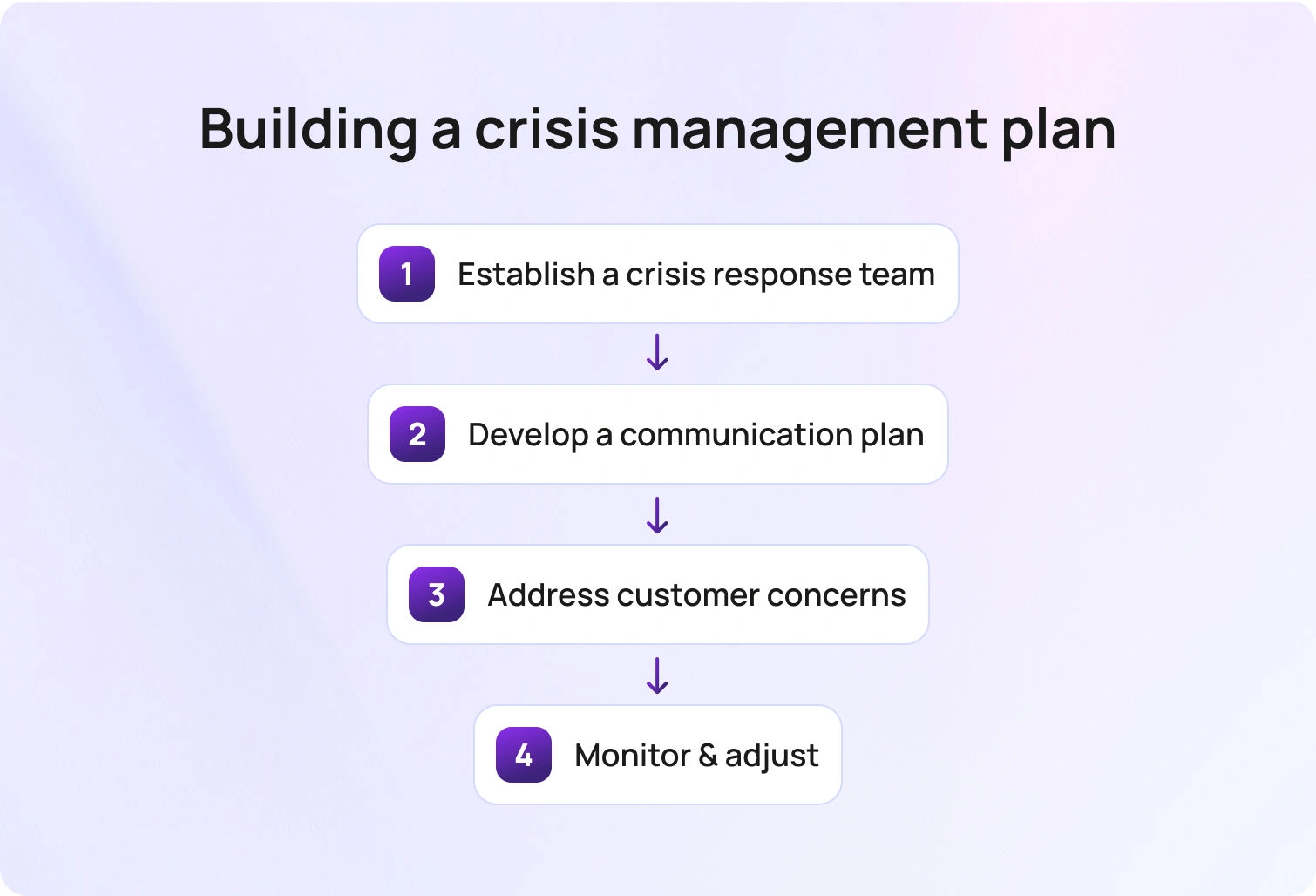
A documented crisis management framework ensures clarity, accountability, and speed.
Step 1: Establish a Cross-Functional Crisis Response Team
Crisis management cannot sit exclusively within the customer support function. While support teams handle frontline interactions, strategic decisions require broader organizational input.
An effective crisis response team should include:
- Customer support leadership
- Public relations or communications specialists
- Legal and compliance representatives
- Senior leadership
- Operations or IT leadership when service disruption is involved
This cross-functional structure ensures that decisions are aligned across departments and that messaging remains consistent internally and externally.
Defining Key Roles and Responsibilities
Once the team is established, clearly defined roles and responsibilities are essential. Without clear ownership, crisis response efforts can slow down as teams duplicate work or wait for approvals. Assigning specific responsibilities in advance ensures the organisation can respond quickly and maintain clear communication during high-pressure situations.
Key roles within a crisis response team often include:
- Spokesperson: Responsible for external media statements and public updates to ensure messaging remains consistent.
- Information Lead: Oversees the collection and verification of operational data so teams are working with accurate information.
- Legal or Compliance Advisor: Reviews customer-facing updates and public statements to ensure regulatory requirements are met.
- Customer Support Liaison: Provides real-time insights from support channels, highlighting emerging customer concerns, common queries, and sentiment trends.
Clearly defined responsibilities allow organisations to coordinate their crisis response more efficiently, reduce confusion, and ensure customer communications remain accurate and timely.
Step 2: Develop a Structured Communication Framework
Communication is the foundation of effective crisis management in customer support. Customers do not expect perfection, but they do expect clarity.
An effective communication framework should include the following principles:
Transparency
Acknowledge the issue promptly. Avoid defensive language or attempts to minimise impact. Clearly state what is known, what is being investigated, and when the next update will be provided.
Consistency Across Channels
Email updates, website notices, in-app notifications, chat responses, and social media messaging should align in tone and content. Discrepancies create confusion and undermine credibility.
Timeliness
Early acknowledgement reduces speculation. Even if all details are not yet available, confirming awareness of the issue reassures customers that action is underway.
Audience-Specific Messaging
Customers, partners, employees, and investors may require different levels of detail and context. Tailored communication improves clarity and reduces unnecessary alarms.
Active Monitoring
Monitoring social media, review platforms, and support queues in real time allows organizations to identify misinformation or escalating concerns before they spread further.
Improving first response time and building a robust omnichannel strategy are foundational elements of crisis readiness.
Step 3: Prioritise Impacted Customers with Proactive Support
During a crisis, reactive support is not sufficient. Customers who are directly affected should feel prioritised and informed.
Providing extended or 24-hour support coverage during high-impact incidents can significantly reduce frustration. Establishing a dedicated hotline or email queue ensures that crisis-related queries are not lost within general support traffic.
Maintaining up-to-date FAQs and knowledge base content can also help reduce repetitive enquiries and empower customers with self-service solutions during high-volume incidents. When customers can quickly access accurate information about known issues, expected resolution timelines, or temporary workarounds, support teams are able to focus their attention on more complex or urgent cases.
Equally important is tone. Agents should be trained to acknowledge customer concerns empathetically, clarify next steps clearly, and provide realistic timelines. Scripted or generic responses during a crisis often appear dismissive, so personalized, human communication is essential.
Step 4: Monitor Performance and Adapt in Real Time
Crisis management doesn’t end after the initial announcement. Continuous monitoring is required to evaluate whether the response strategy is effective.
Key metrics to track include:
- First response time
- Average resolution time
- Customer satisfaction scores
- Net Promoter Score fluctuations
- Ticket volume trends
- Social sentiment analysis
Establish structured feedback loops between frontline support teams and leadership. Support agents often detect emerging concerns before they are visible at the executive level.
If messaging is unclear or customer sentiment worsens, adjustments should be made quickly. Agility is increasingly a defining characteristic of resilient organizations.
Best Practices for Maintaining Customer Trust During and After a Crisis
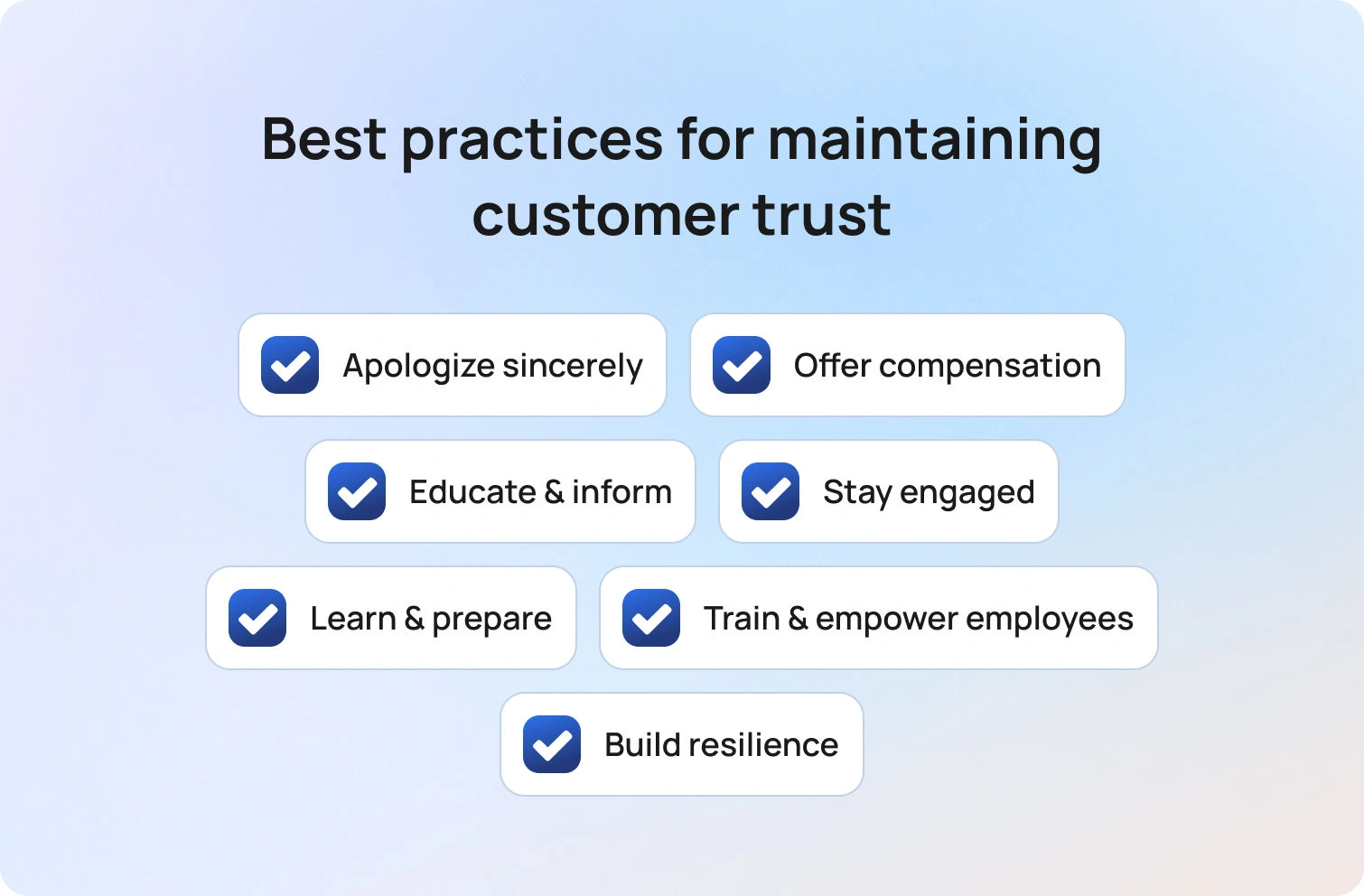
Customers do not judge brands solely on the existence of problems. They judge them on accountability, transparency, and the consistency of follow-through. Moving beyond response management and into trust preservation requires deliberate action, thoughtful communication, and a clear demonstration that lessons have been learned.
Issue a Clear and Direct Apology When Appropriate
If the organization is at fault, responsibility should be acknowledged directly. Avoid conditional phrasing that shifts blame or minimises impact. A sincere apology, combined with a clear action plan, reinforces accountability.
Offer Fair Compensation Where Relevant
Depending on the severity of the disruption, compensation such as service credits or refunds may be appropriate. These gestures demonstrate goodwill and reduce the likelihood of churn.
Provide Educational Guidance
If customers can take steps to protect themselves or mitigate impact, provide structured, easy-to-follow instructions. Clarity reduces anxiety and restores a sense of control.
Maintain Communication After Resolution
Once the issue is resolved, communicate what caused the problem, how it was fixed, and what changes have been implemented to prevent recurrence. Post-crisis transparency is critical for long-term trust.
Conduct a Comprehensive Post-Crisis Review
After stability is restored, conduct a formal evaluation of the response. Identify bottlenecks, communication gaps, and operational weaknesses. Update crisis playbooks accordingly and run simulation exercises to strengthen readiness for future incidents.
Resilience is not built during the crisis itself. It is built in the preparation and reflection that surround it.
The Role of Technology in Crisis-Ready Customer Support
Crisis management in customer support is not purely a people challenge. It is an infrastructure challenge.
When ticket volumes spike, response expectations accelerate, and public scrutiny increases, manual processes quickly break down. Without the right systems in place, even the most capable support teams can become overwhelmed.
Platforms such as BlueTweak, along with other AI-powered customer service systems, are increasingly designed with crisis scenarios in mind, enabling organisations to coordinate messaging, automate notifications, and manage sudden spikes in customer enquiries. Technology does not replace empathy or judgment. However, it enables speed, consistency, and coordination at scale. Organizations that invest in the right support infrastructure before a crisis are significantly better positioned to respond with clarity and control.
Below are the key technological capabilities that strengthen crisis readiness.
Automated Status Updates and Proactive Notifications
During high-impact incidents such as service outages or product disruptions, customers want information more than they want repetition.
Automated status updates, in-app banners, and proactive email or SMS notifications reduce inbound ticket volume by addressing common concerns before customers need to reach out. This preserves agent capacity for complex or high-risk cases.
A well-designed notification framework ensures that customers receive:
- Immediate acknowledgement of the issue
- Clear explanation of impact
- Expected resolution timelines
- Follow-up confirmation once resolved
Proactive communication not only reduces pressure on support teams but also signals operational maturity.
For an example of how targeted notification systems can enhance customer communication during operational events, see BlueTweak's Custom Notification Feature Integration for an airline company.
AI-Assisted Ticket Triage and Prioritisation
In a crisis, not all tickets carry equal risk. AI-assisted triage tools can automatically categorise and prioritise tickets based on urgency, customer tier, sentiment, or regulatory sensitivity. This ensures that high-impact cases are escalated immediately while lower-risk enquiries are routed efficiently.
Intelligent routing also reduces response times and prevents critical issues from being buried within general queues.
Importantly, AI should augment human decision-making, not replace it. Oversight mechanisms and clear escalation pathways remain essential, particularly when legal or compliance considerations are involved.
Real-Time Sentiment and Volume Monitoring
Crisis response requires real-time visibility. Dashboards that track ticket volumes, response times, social media mentions, and sentiment trends allow leadership teams to detect escalation patterns early. Sudden spikes in negative sentiment or repeated themes across channels can indicate communication gaps or emerging risks.
This data-driven visibility enables proactive adjustments to messaging and resource allocation. Without this insight, organizations are often reacting to symptoms rather than managing root causes.
Scalable Omnichannel Communication
Customers engage across multiple channels, including email, live chat, social media, phone support, and in-app messaging. During a crisis, fragmentation across these channels creates inconsistency and confusion.
An integrated omnichannel support platform ensures that:
- Conversations are centralised
- Customer history is visible across touchpoints
- Messaging remains consistent
- Escalations are tracked transparently
This cohesion is critical when response speed matters and multiple teams are collaborating under pressure.
Knowledge Base and Self-Service Enablement
A dynamic, easily updated knowledge base is a critical crisis asset. When common questions are addressed clearly and publicly, customers can self-serve rather than submitting tickets.
This reduces inbound volume and empowers customers with immediate clarity.
However, static documentation is insufficient. Crisis-ready knowledge bases must be updated in real time and aligned with official messaging to avoid misinformation.
Building Technological Resilience Before It Is Needed
Perhaps the most important principle is this: crisis technology cannot be improvised mid-incident.
Infrastructure decisions, workflow automation, escalation protocols, and reporting dashboards should be designed and tested before disruption occurs. Simulation exercises can help identify bottlenecks and system limitations under surge conditions.
Organizations that treat customer support technology as a strategic investment rather than a cost center consistently outperform those that rely on manual coordination.
Crisis readiness is not defined by whether an issue occurs. It is defined by how controlled, coordinated, and customer-focused the response appears when it does.
Crisis Management as a Competitive Advantage
Customer service crisis management determines how an organisation performs when customer expectations are under pressure and demand for clarity is at its highest. When a crisis strikes, whether due to technology failures, natural disasters, negative media coverage, or a public health emergency, the company’s response shapes trust, customer loyalty, and long-term reputation.
Organisations that manage crises effectively rely on clear communication protocols, structured crisis response strategies, and strong alignment across internal stakeholders to ensure consistency across all communication channels.
A documented crisis management plan ensures that crisis response efforts are coordinated rather than improvised, helping organisations protect business continuity and strengthen customer relationships when unexpected disruptions occur.
In the context of crisis management, customer service, structure, and preparedness determine whether incidents erode trust or reinforce it.
Final Thoughts: The Future of AI in Crisis-Ready Customer Support
AI is increasingly central to modern crisis response strategies. From AI-assisted ticket triage and prioritisation to real-time monitoring of customer feedback and key metrics, intelligent systems provide valuable insights that allow the customer service team to respond effectively when pressure is highest.
AI-powered platforms enable organisations to identify affected customers, directly contact important customers, prioritise key customers, and manage customer satisfaction without overwhelming customer support agents. These tools also help teams maintain ongoing communication and ensure customers receive up-to-date information during complex service disruptions.
Solutions such as BlueTweak, alongside other AI-enabled customer support platforms, support this shift by enabling automated notifications, intelligent ticket routing, and centralised visibility across communication channels. This allows organisations to coordinate crisis communications more effectively and respond to spikes in customer demand with greater control.
However, technology alone is not enough. Good customer service still relies on active listening, transparent communication, and empathy when addressing customer concerns and customer complaints.
According to the 2026 Edelman Trust Barometer Global Report, 64% of respondents say they trust businesses to “do what is right,” highlighting how fundamental trust is to customer retention and long-term reputation.
This underlines a clear reality for customer support leaders: how a company manages crises (from transparent communication protocols to AI-enabled triage and real-time monitoring) shapes customer loyalty, customer satisfaction, and the overall customer experience.
By combining structured crisis management plans, continuous improvement, and AI-powered support technology, organisations can ensure that crisis response efforts protect the overall customer experience while reinforcing customer trust across the entire customer journey.
If you're looking to strengthen your crisis management customer service strategy, the right technology can make a significant difference. Book a demo with BlueTweak to see how intelligent support infrastructure can help your team respond faster, communicate more clearly, and protect customer trust when it matters most.

The AI Revolution in Customer Support Platforms: Boosting Business Performance and Customer Satisfaction
In the fast-paced and hyperconnected business landscape, customer support has emerged as a critical component of a company’s success. As consumers become increasingly discerning and demand faster, more personalized service, businesses are turning to artificial intelligence (AI) to revolutionize their customer support platforms.
Understanding AI in Customer Support
Artificial intelligence in customer support refers to the integration of machine learning, natural language processing (NLP), and other AI technologies into customer service operations. These systems are designed to automate and optimize various aspects of customer support, from answering frequently asked questions to resolving complex issues. Let’s explore how AI is used in customer support platforms:
Chatbots and Virtual Assistants
Chatbots and virtual assistants are perhaps the most recognizable AI applications in customer support. These AI-powered agents are capable of handling routine inquiries, providing quick responses, and guiding customers through simple problem-solving processes. They are available 24/7, reducing response times and improving accessibility.
Natural Language Processing
Natural Language Processing is the backbone of AI-powered customer support. It enables machines to understand and interpret human language, allowing them to analyze customer inquiries, identify intent, and extract relevant information. This technology ensures that responses are contextually relevant and can even detect customer emotions.
Predictive Analytics
AI can analyze historical data to predict customer behavior and preferences. This helps companies anticipate customer needs and offer personalized recommendations, enhancing the customer experience and increasing the likelihood of upselling or cross-selling.
Automated Ticketing Systems
AI-driven ticketing systems can categorize and prioritize support requests based on urgency and complexity, ensuring that critical issues are addressed promptly. This streamlines the support process and improves issue resolution times.
Read more about: Unlocking Success: The Benefits of a Customer Support Platform
Sentiment Analysis
AI can analyze customer interactions to gauge sentiment and satisfaction levels. By monitoring customer sentiment in real-time, companies can proactively address issues and improve customer satisfaction.
Self-Service Portals
AI-driven self-service portals allow customers to find answers to their questions and troubleshoot issues independently. These platforms are enriched with knowledge bases, FAQs, and chatbots, reducing the need for human intervention and empowering customers to find solutions quickly.
The Benefits of AI in Customer Support
Implementing AI in customer support platforms offers a multitude of advantages for businesses. Here are some key benefits:
Cost Efficiency
AI-powered customer support reduces the need for a large workforce to handle routine tasks, leading to significant cost savings. Companies can allocate their human agents to more complex and value-added tasks.
24/7 Availability
AI-driven chatbots and virtual assistants are available round the clock, ensuring that customers can get assistance whenever they need it, irrespective of time zones or working hours.
Rapid Responses
AI can process and respond to customer inquiries in real-time, drastically reducing response times. This immediate feedback enhances the overall customer experience.
Consistency
AI ensures that responses to customer queries are consistent and accurate. There are no variations in the quality of service, regardless of the time of day or the agent handling the request.
Scalability
AI systems can handle an ever-increasing volume of customer inquiries without a proportional increase in resources. This scalability is particularly beneficial for growing businesses.
Data-Driven Insights
AI gathers vast amounts of customer data, which can be analyzed to gain valuable insights into customer behavior, preferences, and pain points. This data-driven approach enables companies to make informed decisions and tailor their offerings to customer needs.
Read more about: The Power of AI in Customer Support: A Catalyst for Agent Empowerment
How AI Enhances Business Performance
AI isn’t just a customer support tool; it’s a catalyst for overall business improvement. Here’s how it can enhance business performance:
Improved Efficiency
By automating routine tasks and streamlining support processes, AI frees up human agents to focus on more complex and creative tasks. This improved efficiency can lead to better resource utilization and reduced operational costs.
Enhanced Productivity
AI systems can handle a large volume of customer inquiries simultaneously, increasing the productivity of the support team. Human agents can also access AI-powered tools that provide relevant information and suggestions in real-time, helping them resolve issues faster.
Higher Customer Retention
AI enables companies to proactively address customer issues, leading to higher customer satisfaction and retention rates. Satisfied customers are more likely to become loyal brand advocates, contributing to long-term business success.
Competitive Advantage
Businesses that embrace AI in customer support gain a competitive edge by offering faster, more personalized, and efficient service. This can attract new customers and retain existing ones, ultimately boosting market share.
Cost Reduction
AI’s ability to automate repetitive tasks and optimize processes leads to significant cost savings. Fewer human agents are needed to handle routine inquiries, reducing labor costs while maintaining or improving service quality.
Real-time Insights
AI provides real-time insights into customer interactions and feedback. Companies can use this information to identify emerging trends, respond to issues promptly, and adapt their strategies to meet changing customer expectations.
Elevating Customer Satisfaction
The goal of AI in customer support is to enhance customer satisfaction. Here’s how AI achieves this:
Personalization
AI analyzes customer data to provide personalized recommendations, offers, and responses. Customers feel valued when a company understands their individual needs and preferences, leading to higher satisfaction.
Speed and Convenience
AI ensures quick and convenient access to support, reducing wait times and simplifying issue resolution. Customers appreciate efficient service that respects their time.
Consistency
AI provides consistent service quality, eliminating human errors and variations in customer interactions. Consistency builds trust and reliability, key factors in customer satisfaction.
Proactive Support
AI can identify potential issues and address them proactively. For example, it can detect patterns of customer dissatisfaction and trigger alerts for human agents to intervene before the problem escalates.
Accessibility
AI-driven platforms are accessible to a wider range of customers, including those with disabilities or language barriers. This inclusivity demonstrates a commitment to serving all customers, further enhancing satisfaction.
Read more about: Choosing the Right Customer Support Platform: A Comprehensive Guide
Continuous Improvement
AI continuously learns and adapts based on customer interactions. This iterative process leads to continuous improvement in service quality, aligning with evolving customer needs and expectations.
The integration of artificial intelligence (AI) into customer support platforms represents a transformative leap forward in the way businesses engage with their customers. Through the deployment of chatbots, natural language processing, predictive analytics, and other AI-driven solutions, companies are revolutionizing their customer service operations. The benefits of this technological evolution are multifaceted, encompassing cost efficiency, 24/7 availability, rapid responses, and enhanced data-driven insights, all of which significantly contribute to business performance and customer satisfaction. AI’s impact extends beyond the confines of customer support, permeating every facet of an organization. It enhances efficiency, boosts productivity, and provides a competitive advantage in a fast-paced market. Real-time insights derived from AI-powered systems empower businesses to make informed decisions and adapt swiftly to changing customer preferences. Above all, the true power of AI lies in its ability to elevate customer satisfaction. By personalizing interactions, ensuring speed and convenience, delivering consistent service, offering proactive support, and promoting accessibility, AI-driven customer support platforms demonstrate a commitment to customer-centricity. This commitment fosters customer loyalty, advocacy, and ultimately, long-term business success.
In the ever-evolving landscape of customer support, one thing is clear: AI is not just a trend; it’s a transformative force that has the potential to redefine customer service standards and reshape the way businesses engage with their audience. It is a powerful ally in the pursuit of both operational excellence and customer-centricity. Therefore, for businesses looking to remain competitive and thrive in the digital age, the incorporation of AI into customer support platforms is not an option—it is an imperative.
Unlocking Success: The Benefits of a Customer Support Platform
In today’s hyper-connected, digitally driven world, customer service has become a cornerstone of business success. It’s no longer enough to simply offer a great product or service; you must also provide exceptional customer support. This is where a customer support platform steps in, serving as a powerful ally for businesses of all sizes. In this article, we’ll delve deep into the benefits of a customer support platform, exploring why you should choose one and how its features can help transform your customer support efforts.
The Crucial Role of Customer Support
Before we delve into the merits of a customer support platform, let’s understand why customer support is so critical for businesses.
Enhancing Customer Loyalty
Excellent customer service breeds loyalty. When customers feel heard and valued, they are more likely to remain loyal to your brand, even in the face of competition.
Word-of-Mouth Marketing
Happy customers become brand advocates. They spread positive word-of-mouth, attracting new customers without any marketing spend on your part.
Reducing Churn
Providing effective support can significantly reduce customer churn. Customers are less likely to leave if they believe you can solve their problems.
Data Collection
Customer interactions are a goldmine of information. They can help you understand market trends, identify product issues, and uncover new opportunities for improvement.
Read more about: The Perfect Duo: AI Chatbots and Human Agents in Harmony for Customer Support
Why Choose a Customer Support Platform?
A customer support platform is essentially a centralized system that streamlines all your support activities. It provides tools and features that help your support team manage customer inquiries, resolve issues, and create meaningful connections with customers. Here are compelling reasons to choose one:
Improved Efficiency
A customer support platform automates various tasks, reducing manual effort and the risk of errors. It allows your team to handle more inquiries in less time, which is particularly crucial during peak periods.
Enhanced Customer Experience
These platforms offer multiple channels for customer interaction, such as email, chat, social media, and phone support. This flexibility ensures that customers can reach out using their preferred method, making their experience more convenient and comfortable.
Better Organization
Customer support platforms provide robust ticketing systems that help organize customer inquiries. Each inquiry becomes a ticket, allowing support agents to track, prioritize, and assign them efficiently. This ensures that no customer inquiry falls through the cracks.
Knowledge Management
Most platforms include a knowledge base feature, which is a repository of articles, FAQs, and guides. Customers can often find solutions to common problems here without needing to contact support, saving both their time and yours.
Analytics and Reporting
These platforms offer powerful analytics tools that allow you to track key support metrics. You can gain insights into customer satisfaction, response times, resolution rates, and more, enabling data-driven decision-making.
Read more about: Choosing the Right Customer Support Platform: A Comprehensive Guide
Scalability
As your business grows, your customer support needs will too. A good customer support platform is scalable, allowing you to add more agents, channels, and features as your business expands.
Integration Capabilities
Many customer support platforms integrate seamlessly with other business tools like CRM systems, email marketing software, and e-commerce platforms. This ensures that customer support is not siloed but interconnected with the rest of your business operations.
How Features of a Customer Support Platform Transform Customer Support
Customer support platforms come equipped with a wide array of features designed to streamline and optimize the support process. Let’s delve into these features and understand how they benefit your business.
Multi-Channel Support
Modern consumers expect to reach out for help through various channels, from email and chat to social media and phone support. A customer support platform consolidates all these channels into one interface, ensuring that no inquiry goes unnoticed, and responses are consistent across all platforms.
Ticketing System
The ticketing system is the backbone of a customer support platform. It organizes customer inquiries into tickets, making it easy for support agents to manage, track, and prioritize them. This ensures that no inquiry is forgotten, and each one is handled systematically.
Automated Responses
Automation is a game-changer in customer support. Customer support platforms allow you to set up automated responses for common queries, freeing up your support agents to focus on more complex issues. This not only reduces response times but also ensures consistency in your support messaging.
Knowledge Base
A knowledge base is a self-service resource that empowers customers to find answers to their questions independently. Customer support platforms often include a knowledge base feature, where you can create and maintain articles, FAQs, and guides. This reduces the number of inquiries your support team receives and helps customers find solutions quickly.
Analytics and Reporting
Data is king in today’s business landscape, and customer support is no exception. Customer support platforms offer robust analytics and reporting tools that allow you to track and measure various metrics: Customer satisfaction: Gauge how happy your customers are with your support. Response and resolution times: Identify bottlenecks and areas for improvement. Ticket volume: Understand when your support team is busiest. Common issues: Spot trends and recurring problems, allowing you to address them at their root.
Integration with CRM
Your customer support platform doesn’t operate in isolation; it’s part of your broader customer relationship management (CRM) ecosystem. Integration with your CRM system allows you to access customer data and history, providing support agents with valuable context when interacting with customers.
Agent Collaboration
Collaboration among support agents is crucial for effective problem-solving. Customer support platforms often include features like internal notes, ticket assignments, and team chat to facilitate communication and cooperation among your support team.
Self-Service Options
In addition to the knowledge base, many customer support platforms offer other self-service options like chatbots. These AI-powered bots can handle routine inquiries, freeing up your human agents for more complex issues. They are available 24/7, ensuring that customers can get help whenever they need it.
Customer Feedback and Surveys
To continuously improve your support efforts, customer feedback is invaluable. Customer support platforms often include tools for collecting feedback and running surveys, allowing you to understand where you’re excelling and where you need to make improvements.
Read more about: Revolutionizing Customer Support: A Guide to Implementing Omnichannel Solutions
Mobile Accessibility
Mobile accessibility features in customer support platforms enable support agents to respond to inquiries and monitor support metrics from their smartphones or tablets, ensuring that customer support is always within reach.
A customer support platform is not just a tool; it’s a strategic asset that can transform your business. By choosing the right platform and harnessing its features effectively, you can supercharge your customer support efforts, enhance customer satisfaction, and ultimately drive business success. Exceptional customer support is a differentiator that can set your business apart. Investing in a customer support platform is not just a choice; it’s a necessity to thrive in a customer-centric world. So, if you haven’t already, it’s time to explore the possibilities and embrace the benefits of a customer support platform to unlock your business’s full potential.

Customer Experience Management: The Key to Building Lasting Relationships
Customer Experience Management (CEM) has transitioned from being a buzzword to a strategic imperative, as organizations recognize the profound impact it can have on customer loyalty, brand perception, and ultimately, the bottom line.
Understanding Customer Experience Management
Customer Experience Management involves the holistic approach of orchestrating all touchpoints a customer has with a company, aiming to provide consistently exceptional interactions and exceed customer expectations. This encompasses every interaction, from browsing a company’s website, purchasing a product, seeking customer support, to post-purchase engagement. CEM is about creating a seamless and delightful journey across all these phases, ultimately fostering a deep emotional connection between the customer and the brand.
The Importance of Customer Experience
Several factors contribute to the growing significance of customer experience in today’s business landscape:
1. Differentiation
As products and services become increasingly commoditized, the way companies engage and serve their customers becomes a critical differentiator. A memorable customer experience can set a brand apart from its competitors.
2. Customer Loyalty
A positive experience breeds loyalty. When customers feel valued and understood, they are more likely to return, become repeat buyers, and even act as brand advocates, driving referrals and positive word-of-mouth.
3. Brand Perception
Customer experience directly impacts how a brand is perceived. A single negative experience can spread quickly through social media and tarnish a company’s reputation, while consistent positive experiences can enhance brand equity.
4. Revenue Impact
Research consistently shows that companies that prioritize customer experience outperform their peers. Customers are willing to pay a premium for a superior experience, leading to increased customer lifetime value and overall revenue growth.
Read more about: Customer Experience Benefits: Reasons to Invest in CRM Software
Strategies for Effective Customer Experience Management
Crafting an exceptional customer experience requires a strategic approach and ongoing dedication. Here are some key strategies for effective Customer Experience Management:
1. Customer Understanding
Truly understanding your customers, their needs, preferences, and pain points is fundamental. This involves gathering data, conducting surveys, and analyzing customer behavior to tailor experiences to their expectations.
2. Journey Mapping
Mapping out the customer journey helps identify touchpoints and potential pain points. This allows you to optimize each interaction, ensuring a consistent and positive experience throughout.
3. Omnichannel Consistency
Customers interact with brands across various channels, from social media to physical stores and websites. Maintaining a consistent experience across these channels is essential to avoid confusion and enhance the overall experience.
4. Personalization
Leveraging customer data to personalize interactions can make customers feel valued. Personalized recommendations, offers, and communication contribute to a more tailored experience.
5. Employee Engagement
Happy employees tend to provide better customer service. Ensuring that your employees are motivated, well-trained, and aligned with the company’s customer-centric values is crucial.
6. Feedback Utilization
Actively listen to customer feedback and take action on it. This demonstrates that you value their input and are committed to continuous improvement.
7. Innovation
Embrace innovation to meet evolving customer needs. This could involve adopting new technologies, experimenting with novel service models, or introducing features that simplify the customer journey.
Read more about: Elevating Business Growth Through Exceptional Customer Service: Key Strategies and Insights
Realizing the Benefits
Companies that successfully implement effective Customer Experience Management can reap a multitude of benefits:
1. Customer Advocacy
Satisfied customers become brand advocates, driving organic growth through positive word-of-mouth.
2. Reduced Churn
A well-managed customer experience can reduce customer churn rates as customers are less likely to switch to competitors.
3. Revenue Growth
Improved customer loyalty and increased customer lifetime value lead to higher revenues over time.
4. Brand Differentiation
Exceptional experiences differentiate a brand, making it stand out in a crowded market.
5. Employee Satisfaction
A customer-centric culture often results in happier and more engaged employees, leading to better service and lower employee turnover.
Read more about: BlueTweak’s Custom Notification Feature Integration for Airline Company
In the age of empowered consumers and fierce competition, Customer Experience Management is no longer optional but essential. Building and maintaining exceptional customer experiences require dedication, strategy, and a commitment to constant improvement. Companies that prioritize and invest in their customers’ journey are well-positioned not only to survive but to thrive in the dynamic business landscape, fostering enduring relationships that extend far beyond individual transactions.

Strategies to Enhance Retail Customer Engagement: Building Lasting Connections
In today's dynamic and competitive retail landscape, customer engagement has emerged as a pivotal factor in determining the success of a business. Beyond the traditional transactional approach, retailers are increasingly focusing on building meaningful relationships with their customers. These relationships not only boost sales but also create loyal advocates who contribute to long-term success. In this article, we will explore a range of strategies that retailers can employ to improve customer engagement and foster lasting connections.
Personalized Shopping Experience
One of the most effective ways to engage customers is by offering personalized shopping experiences. Utilizing data analytics and customer insights, retailers can tailor product recommendations, discounts, and content to align with individual preferences. Personalization not only enhances customer satisfaction but also makes them feel valued and understood, increasing the likelihood of repeat visits and purchases.
Seamless Omni-Channel Experience
Modern customers expect a seamless experience across various retail channels, whether it's physical stores, online platforms, mobile apps, or social media. Creating a consistent brand image and providing a smooth transition between these channels is essential for keeping customers engaged. A customer should be able to start a shopping journey on one platform and seamlessly continue it on another without any disruptions.
Read more about: The Art of Proactive Customer Service: Enhancing the Customer Journey
Interactive In-Store Experiences
Physical stores remain a cornerstone of retail, and creating engaging in-store experiences can set a brand apart. Retailers can leverage technologies such as augmented reality (AR) and virtual reality (VR) to enhance the shopping process. Interactive displays, try-before-you-buy features, and engaging product demonstrations can immerse customers in the brand story and create memorable interactions.
Loyalty Programs and Rewards
Loyalty programs are a classic yet effective strategy for driving customer engagement. Offering rewards, exclusive discounts, and early access to new products incentivizes repeat purchases and fosters a sense of belonging. Moreover, these programs allow retailers to gather valuable customer data, enabling them to refine their strategies further.
Read more about: How to Handle Customer Complaints and Turn Complaints into Opportunities
Content-rich Engagement
Engaging customers isn't just about selling products—it's also about providing value beyond the transaction. Retailers can create and share content that educates, entertains, and solves customer problems. Blogs, videos, tutorials, and user-generated content can establish the brand as an authority in its industry and encourage customers to interact and share their thoughts.
Social Media Engagement
Social media platforms are powerful tools for connecting with customers on a personal level. Regular and engaging posts, interactive polls, behind-the-scenes glimpses, and responding promptly to comments and messages can foster a sense of community. User-generated content and hashtags can also encourage customers to share their experiences and build a buzz around the brand.
Read more about: Adapting to Customer Expectations: A Holistic Approach to Customer Experience
Customer Feedback and Involvement
Listening to customer feedback and involving them in decision-making processes can make them feel invested in the brand's success. Surveys, reviews, and feedback forms provide insights into areas for improvement and showcase the brand's commitment to customer satisfaction. Implementing changes based on customer suggestions can demonstrate that their opinions truly matter.
Exceptional Customer Service
Outstanding customer service is a timeless pillar of customer engagement. Prompt responses to inquiries, addressing concerns effectively, and going the extra mile to resolve issues can turn a dissatisfied customer into a loyal advocate. Investing in well-trained staff and efficient communication channels is crucial for delivering exceptional service.
In the fast-paced world of retail, customer engagement is the key to building lasting relationships and staying ahead of the competition. By personalizing experiences, providing seamless omni-channel interactions, and fostering a sense of community, retailers can create an environment where customers feel valued and understood. From interactive in-store experiences to social media engagement, each strategy contributes to a holistic approach that nurtures strong connections between retailers and their customers. Embracing these strategies not only drives sales but also cultivates brand loyalty that can withstand the test of time.

Safeguarding Businesses in Uncertain Times: The Power of AI
In an ever-evolving global landscape, businesses are constantly exposed to a myriad of uncertainties ranging from economic fluctuations to unforeseen pandemics. Navigating through these unpredictable waters requires adaptability, resilience, and innovative strategies. One of the most transformative solutions that has emerged to safeguard businesses in such uncertain times is Artificial Intelligence (AI). The integration of AI technologies into various business processes has demonstrated remarkable potential to enhance decision-making, streamline operations, and mitigate risks.
The Current Landscape of Uncertainty
Over the past decade, the business environment has witnessed unprecedented levels of uncertainty. Economic recessions, geopolitical tensions, and now the ongoing aftermath of the COVID-19 pandemic have highlighted the need for robust strategies that can ensure business continuity and resilience. A recent survey conducted by a leading management consulting firm revealed that over 90% of executives consider their business models to be at risk due to external factors beyond their control.
The Role of AI in Mitigating Uncertainties
Artificial Intelligence, a branch of computer science that focuses on creating intelligent machines capable of replicating human cognitive functions, has risen as a powerful tool to counteract uncertainties. AI offers several ways through which it can safeguard businesses:
1. Data-Driven Decision Making
AI-driven analytics enable businesses to harness the power of vast amounts of data. By analyzing historical patterns, current trends, and market signals, AI algorithms can generate insights that aid in making informed decisions. This is particularly valuable during uncertain times when traditional forecasting methods may falter. According to a study by a global professional services network, businesses that utilize AI for decision-making can enhance their accuracy by up to 35%, allowing them to better anticipate market shifts and optimize their strategies accordingly.
2. Risk Management and Fraud Detection
In times of uncertainty, risk management becomes paramount. AI-powered risk assessment models can analyze an array of factors and identify potential threats. Furthermore, AI’s ability to detect anomalies and unusual patterns makes it an invaluable asset in fraud prevention. A report by a prominent auditing and consulting firm indicates that AI-driven fraud detection systems can improve detection rates by up to 50% while reducing false positives.
3. Supply Chain Resilience
Supply chain disruptions often accompany uncertain times. AI can enhance supply chain resilience by predicting potential disruptions, optimizing inventory management, and suggesting alternative suppliers. By analyzing various data sources, including weather patterns, transportation data, and economic indicators, AI algorithms can help businesses mitigate the impact of supply chain disturbances. A study conducted by researchers at a renowned technological institute found that businesses using AI to manage their supply chains were better equipped to respond to disruptions and experienced 50% less inventory shortages.
4. Customer Insights and Engagement
Maintaining customer loyalty during uncertain times is crucial. AI-powered customer relationship management (CRM) systems can analyze customer behavior, preferences, and sentiment, helping businesses tailor their offerings and communication strategies. By understanding customer needs, businesses can adapt their products and services to align with changing demands. A report from a leading customer relationship management company reveals that companies using AI in their CRM systems witnessed an average increase of 30% in customer satisfaction.
Read more about: Crisis Management in Customer Support: Navigating Difficult Situations with Grace
Embracing the AI Advantage
While AI offers immense potential in safeguarding businesses during uncertain times, its successful implementation requires a well-defined strategy. Here are some steps to consider:
1. Data Acquisition and Quality
Ensure access to relevant and high-quality data for AI analysis. Clean and structured data is essential for accurate insights.
2. Talent Acquisition and Training
Hire or upskill employees with AI expertise to effectively leverage AI technologies. Building a data-savvy workforce is crucial.
3. Ethical Considerations
AI usage should adhere to ethical guidelines, ensuring privacy, transparency, and fairness in decision-making processes.
4. Pilot Projects
Begin with small-scale AI implementations to test their effectiveness before scaling up across the organization.
5. Continuous Learning
AI is an evolving field. Stay updated with the latest advancements and adapt AI strategies accordingly.
Read more about: The AI Revolution in Customer Support Platforms: Boosting Business Performance and Customer Satisfaction
In conclusion, the ever-changing business landscape demands innovative solutions to safeguard businesses against uncertainties. Artificial Intelligence emerges as a formidable ally in this endeavor. By harnessing the power of AI for data-driven decision-making, risk management, supply chain resilience, and customer engagement, businesses can navigate uncertain times with greater confidence and resilience. However, successful integration requires careful planning, strategic implementation, and an unwavering commitment to ethics and excellence.
Read more about: Embracing Customer Experience Automation: The Future of Business Interactions

Customer Experience Benefits: Reasons to Invest in CRM Software
In today’s competitive business landscape, providing exceptional customer experiences is crucial for success. Customers expect personalized interactions, seamless communication, and efficient service across multiple channels. This is where Customer Relationship Management (CRM) software plays a pivotal role. CRM software enables businesses to manage and enhance customer experiences, leading to improved customer satisfaction, loyalty, and ultimately, business growth. In this article, we will explore the key CRM customer experience benefits and the reasons why investing in CRM software is a wise decision.
Enhanced Customer Understanding
One of the primary benefits of CRM software is the ability to gain a comprehensive understanding of your customers. CRM systems consolidate customer data from various touchpoints, including interactions, purchase history, preferences, and demographics. By analyzing this data, businesses can develop detailed customer profiles, identify trends, and anticipate customer needs. This information empowers businesses to provide personalized experiences, tailor marketing campaigns, and offer relevant products or services, ultimately increasing customer satisfaction.
Streamlined Communication
Efficient communication is vital for delivering exceptional customer experiences. CRM software centralizes all customer interactions, whether through phone calls, emails, social media, or live chats, in a single platform. This unified view enables customer service representatives to respond promptly and consistently, regardless of the communication channel. With access to the customer’s history and preferences, representatives can provide relevant and personalized solutions, leading to improved customer satisfaction and loyalty.
Read more about: Elevating Business Growth Through Exceptional Customer Service: Key Strategies and Insights
Improved Customer Service
CRM software equips businesses with the tools to optimize their customer service processes. It enables the automation of routine tasks, such as ticket management, routing inquiries, and follow-ups. By automating these processes, customer service teams can focus on providing high-quality support and resolving complex issues promptly. Additionally, CRM systems often include self-service portals or knowledge bases, allowing customers to find answers to their queries independently. This self-service capability enhances the overall customer experience by providing immediate assistance and reducing response times.
Read more about: Customer Experience Management: The Key to Building Lasting Relationships
Increased Sales Effectiveness
CRM software can significantly boost sales effectiveness and revenue generation. By leveraging CRM data, businesses gain valuable insights into customer behaviors, preferences, and buying patterns. Sales teams can identify cross-selling or upselling opportunities, tailor their pitches, and focus on high-potential leads. Moreover, CRM systems often provide sales automation features, such as lead scoring, pipeline management, and forecasting, enabling sales teams to prioritize their efforts and close deals more efficiently. These capabilities ultimately lead to increased sales productivity, higher conversion rates, and improved revenue streams.
Personalized Marketing Campaigns
Effective marketing requires personalized messaging that resonates with customers. CRM software empowers businesses to segment their customer base based on demographics, behavior, preferences, and purchase history. With this segmentation, marketers can create targeted campaigns that deliver the right message to the right audience at the right time. By tailoring marketing efforts to individual customer needs and preferences, businesses can improve engagement, response rates, and conversion rates. CRM software also enables tracking and analysis of marketing campaigns, providing insights into their effectiveness and allowing for data-driven decision-making.
Proactive Customer Retention
Retaining existing customers is more cost-effective than acquiring new ones, and CRM software plays a vital role in customer retention strategies. CRM systems help businesses identify at-risk customers by analyzing their interactions, purchasing patterns, and satisfaction levels. With this knowledge, businesses can take proactive measures, such as personalized offers, loyalty programs, or targeted communications, to prevent churn and foster long-term customer loyalty. CRM software also facilitates customer feedback and surveys, enabling businesses to continuously improve their products, services, and customer experiences.
Investing in CRM software is a strategic decision that brings substantial benefits to businesses. By leveraging CRM capabilities, businesses can enhance customer understanding, streamline communication, improve customer service, increase sales effectiveness, and personalize.

What’s Next for the Voice of the Customer Market?
The Voice of the Customer (VoC) market has witnessed significant growth and transformation over the past few years. As organizations increasingly recognize the value of customer feedback and insights, the VoC market has emerged as a crucial component of business strategies. However, as technology advances and customer expectations evolve, it is essential to explore what lies ahead for the Voice of the Customer market. In this article, we will discuss the trends and developments shaping the future of the VoC market.
Advanced Analytics and Artificial Intelligence
One of the most prominent trends in the VoC market is the integration of advanced analytics and artificial intelligence (AI). Traditional methods of gathering customer feedback, such as surveys and focus groups, are being augmented or replaced by AI-powered solutions. Natural Language Processing (NLP) and machine learning techniques enable organizations to analyze large volumes of unstructured customer data, including social media posts, online reviews, and customer support interactions. These insights provide businesses with a deeper understanding of customer sentiment, preferences, and pain points, enabling them to make data-driven decisions.
Omnichannel Feedback Collection
Customers now interact with businesses through multiple touchpoints, including websites, mobile apps, social media platforms, and in-person interactions. To capture a holistic view of the customer experience, organizations are adopting omnichannel feedback collection strategies. This approach ensures that customers can provide feedback through their preferred channels, making it easier for them to share their opinions and experiences. By aggregating data from various sources, businesses can gain comprehensive insights into the customer journey and identify areas for improvement.
Read more about: The Power of Humanized Digital Experiences: Beyond Discounts and Loyalty Perks
Real-Time Feedback and Actionability
In today’s fast-paced digital world, real-time feedback is becoming increasingly important. Customers expect their voices to be heard and acted upon promptly. As a result, the VoC market is shifting towards real-time feedback collection and analysis. Organizations are leveraging technologies such as chatbots and sentiment analysis tools to capture and process customer feedback in real-time. This enables businesses to address customer issues immediately, deliver personalized responses, and enhance overall customer satisfaction.
Read more about: The Rise of Voice Technology
Personalization and Customer Engagement
Personalization has become a key driver of customer loyalty and satisfaction. In the VoC market, personalization is not limited to marketing and product recommendations. It extends to the way organizations collect and utilize customer feedback. By tailoring feedback collection methods to individual preferences, businesses can improve response rates and gather more accurate insights. Moreover, personalized responses and follow-ups demonstrate a commitment to customer engagement and foster stronger customer relationships.
Read more about: Navigating the Future: Customer Support Trends for 2024
Predictive Analytics and Proactive Customer Service
While VoC has traditionally focused on understanding past and present customer experiences, the future will see an increased emphasis on predictive analytics and proactive customer service. By leveraging historical data and machine learning algorithms, organizations can anticipate customer needs, identify potential issues, and offer proactive solutions. This proactive approach to customer service not only improves customer satisfaction but also helps prevent problems before they occur, leading to cost savings and an enhanced brand reputation.
The Voice of the Customer market is evolving rapidly, driven by advancements in technology and changing customer expectations. Advanced analytics, AI, omnichannel feedback collection, real-time feedback, personalization, and predictive analytics are all shaping the future of VoC. Organizations that embrace these trends and leverage customer insights to drive business decisions will be well-positioned to deliver exceptional customer experiences, foster loyalty, and gain a competitive edge in the marketplace. As the VoC market continues to evolve, it is essential for businesses to stay agile and adapt to the changing landscape to stay ahead of the competition.



