


Radu Dumitrescu

As Head of Digital Transformation, Radu looks over multiple departments across the company, providing visibility over what happens in product, and what are the needs of customers. With more than 8 years in the Technology era, and part of BlueTweak since the beginning, Radu shifted from a developer (addressing end-customer needs) to a more business oriented role, to have an influence and touch base with people who use the actual technology.
Recent articles
Customer Service Automation: Balancing AI Efficiency & Human Touch
What Automated Customer Service Is and Where Humans Still Matter
Automated customer service definition: The use of technology to handle customer interactions without direct human intervention.
This includes everything from automated responses to customer inquiries, AI-powered chatbots that answer common questions, and automated ticketing that routes requests to the right agent.
However, it’s not about replacing humans entirely. The most effective automation in customer service works alongside support teams, handling repetitive tasks so agents can focus on situations that require empathy, creativity, and critical thinking.
Modern customer service automation tools include:
- AI chatbots that understand natural language processing
- Automated ticket routing systems
- Self-service with knowledge base articles
- Interactive voice response (IVR) systems
- Workflow automation for routine service tasks
The goal isn't to eliminate the human touch. It's to free up the customer service team so they can deliver it where it matters most. This article defines automated customer service, outlines the core tools, and demonstrates how to strike a balance between AI speed and human judgment across real-world workflows and industries.
Advantages of Automated Customer Support
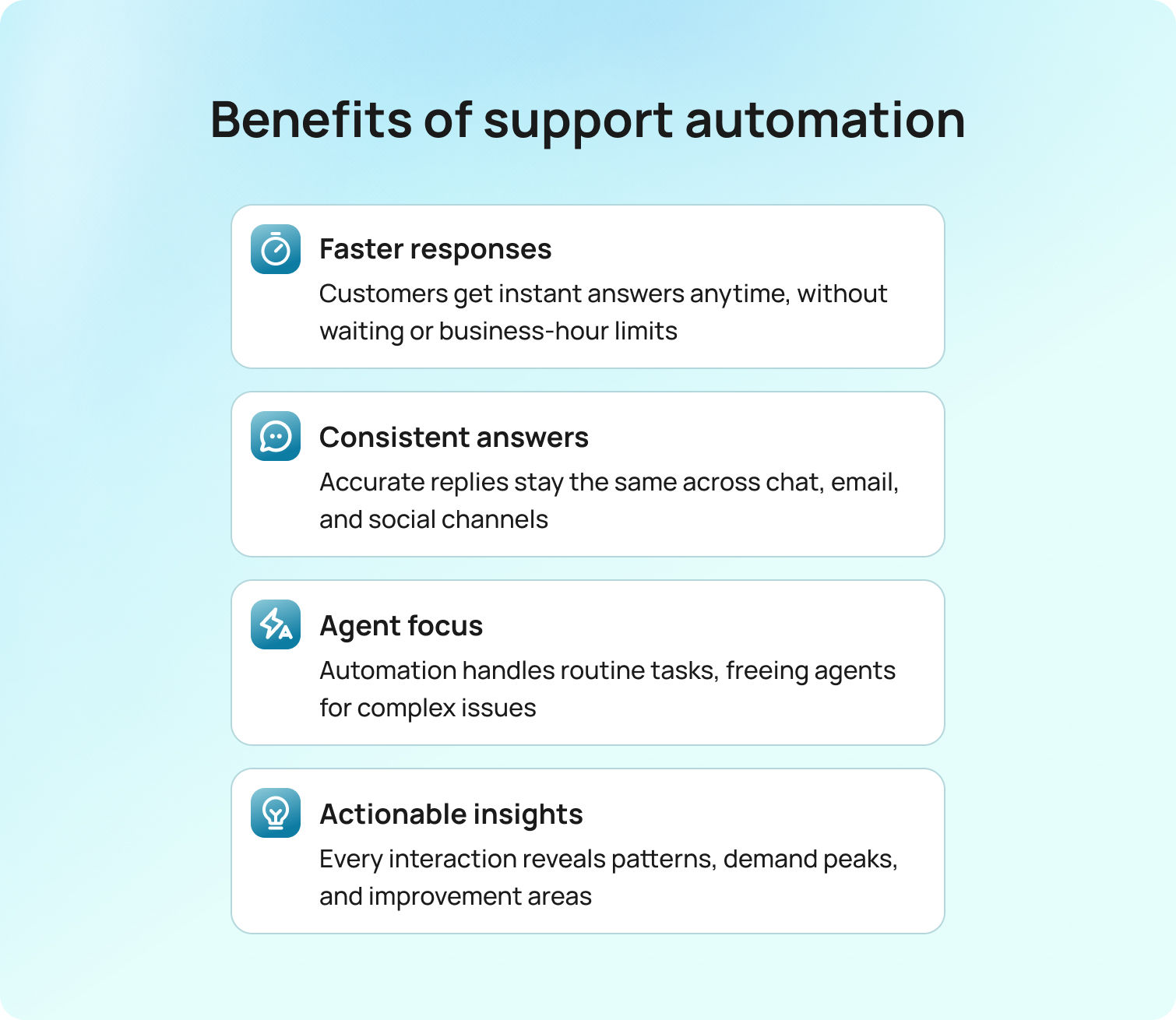
Here are just a few of the advantages companies are realizing with customer service automation:
- Faster Response Times
- Consistent Omnichannel Support
- More Time for Complex Problem-Solving
- Data-Driven Insights
1. Faster Response Times
Automated customer service solutions respond instantly. No hold music, no "your call is important to us" messages. When a customer inquires about their order status at 2 AM, an AI-powered chatbot provides an immediate response rather than making them wait until business hours.
2. Consistent Omnichannel Support
Automated customer service tools ensure that every customer receives the same accurate information, regardless of the channel they use to reach out, whether it's chat, email, or social media. Human agents might phrase things differently or occasionally miss a detail, but automated systems deliver consistent, error-free responses every time.
This consistency is crucial when handling massive volumes of customer inquiries during peak periods. Automated customer service software maintains quality even when customer requests spike.
3. More Time for Complex Problem-Solving
Customer service and support automation excel when automating tasks such as password resets, FAQ responses, and basic troubleshooting. Automating these mundane tasks frees agents to focus on the problems that truly require human intervention.
4. Data-Driven Insights
Automated customer service systems track every interaction to give clear visibility into customer needs, common pain points, and areas for improvement. This data shows patterns humans might miss:
- Which articles and documentation get the most views
- What time of day sees the highest volume of customer queries
- Which automated responses lead to the best outcomes
- What questions do customers ask most frequently
These insights help refine the customer service strategy by not guessing what customers want, but by watching what they do.
AI in Customer Service Automation: What Works in Practice
When people think about AI customer service automation, they often picture basic chatbots. However, modern automation tools do much more. Natural language processing (NLP) now understands context, sentiment, and intent, meaning automated systems can detect when a customer is frustrated and escalate to a human agent before the situation deteriorates.
BlueTweak's AI-powered features include sentiment analysis that automatically flags unhappy customers for immediate attention from support agents who can provide personalized support.
How to translate that into a build plan: first, map the top intents you handle today and note where conversations succeed or stall. That gives you a picture of what should be automated, augmented, or escalated.
From there, apply the 80/20 rule. Identify the 20% of customer questions that make up 80% of your volume. These are perfect candidates for automated customer service.
Common automated customer service examples include:
- Order tracking and status updates
- Password resets and account access
- Basic product information and pricing
- Scheduling appointments
- Return and refund policy questions
- Store hours and location information
For routine customer service tasks, automated customer service provides instant answers, while human agents focus on issues that require judgment calls, empathy, or creative problem-solving.
It’s all about knowing when to hand off. Automated support options should seamlessly transfer to human agents when the conversation gets complicated or emotional. BlueTweak's smart routing guarantees customers never feel stuck talking to a bot when they need a person.
How to Build Automated Customer Service That Customers Like
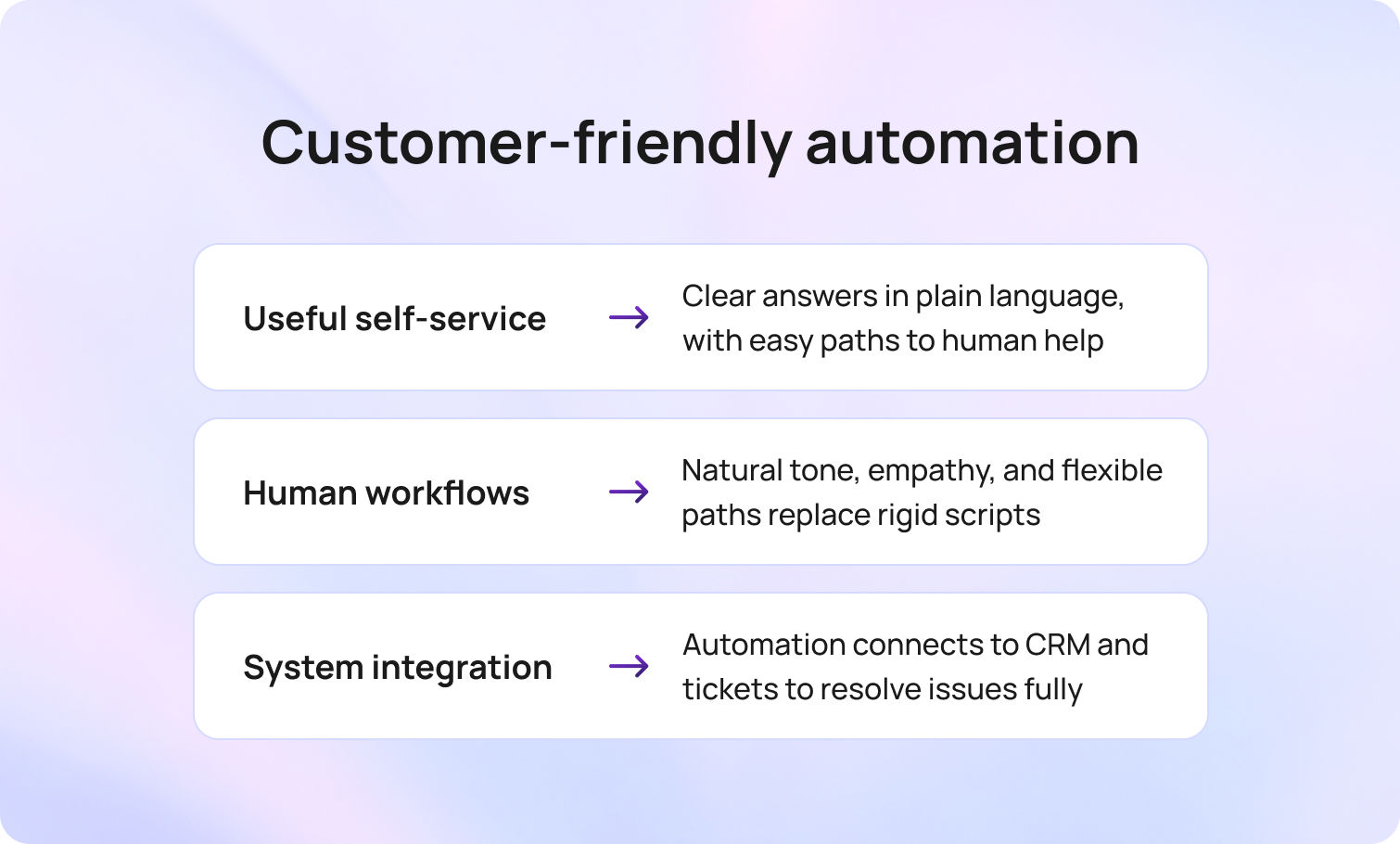
Automation doesn’t automatically mean better. You’ll need to do your due diligence to build workflows that actually help customers. Here’s how to do it:
1. Start With Self-Service Options
Self-service portals reduce ticket volume by letting customers find answers independently. But only if they're actually helpful. A knowledge base stuffed with outdated articles and technical jargon frustrates customers more than it helps.
Effective self-service means:
- Search functionality that understands how customers phrase questions, not just how you phrase answers
- Articles written in plain language, not corporate speak
- Regular updates based on what customers are actually asking
- Clear paths to contact a human agent when self-service isn't enough
BlueTweak's knowledge base uses AI to surface the most relevant articles based on customer context, rather than just keyword matching.
2. Design Automated Workflows That Feel Human
The best automated customer service software feels responsive. When you automate customer service interactions, you're aiming for efficiency without sacrificing personal touch.
This means:
- Using conversational language in automated responses, not robotic scripts
- Acknowledging customer frustration instead of ignoring it
- Offering multiple resolution paths instead of forcing everyone down the same funnel
- Being transparent about what's automated and what isn't
Customers don't hate automation—they hate bad automation. They hate being trapped in phone trees, repeating information, or receiving irrelevant responses from chatbots that fail to understand context.
3. Integrate Automation With Your Existing Systems
Automated customer service fails when it doesn't integrate with your existing systems. If your chatbot can't access order status from your CRM, it's not really automating anything. It's just adding an extra step before customers reach a human agent.
Integration means your automated systems can:
- Pull customer data from your CRM to personalize interactions
- Update ticketing systems automatically
- Sync with inventory management for accurate product information
- Connect with scheduling tools for appointment booking
BlueTweak integrates with existing systems without requiring an IT team to rebuild everything from scratch. Customer service operations continue to run while automation layers are gradually implemented.
When Human Agents Still Matter Most
Automation doesn’t replace agents. Sometimes, the human touch is the only touch that can fix the problems. Automated customer service handles facts efficiently. It struggles with feelings. While automation tools excel at routine customer service tasks, certain situations demand the emotional intelligence and creative thinking that only human agents can provide.
Keep human agents for:
- Emotionally charged situations: When customers are angry, confused, or dealing with sensitive issues, support agents read between the lines, pick up on tone, and adjust their approach accordingly. A well-timed apology or sincere acknowledgment of frustration can build customer loyalty in ways that automated responses can't.
- Complex problems require creative solutions: issues that don't fit standard categories necessitate human judgment. Support teams connect dots across multiple systems, find workarounds when standard processes don't apply, and make judgment calls about when to make exceptions.
- Relationship-building interactions: Human agents remember previous interactions, follow up proactively, and treat customers as individuals rather than ticket numbers. This personalized support increases customer satisfaction in ways automated customer service response systems can't measure.
- Non-standard situations: When the rulebook doesn't have an answer, human agents think creatively, escalate internally to the correct department, and understand the full context of a customer's history and needs.
The goal of customer service automation is to eliminate the noise, allowing your agents to focus on high-value interactions that truly build customer relationships.
Implementing Automated Customer Service Without Losing the Human Touch
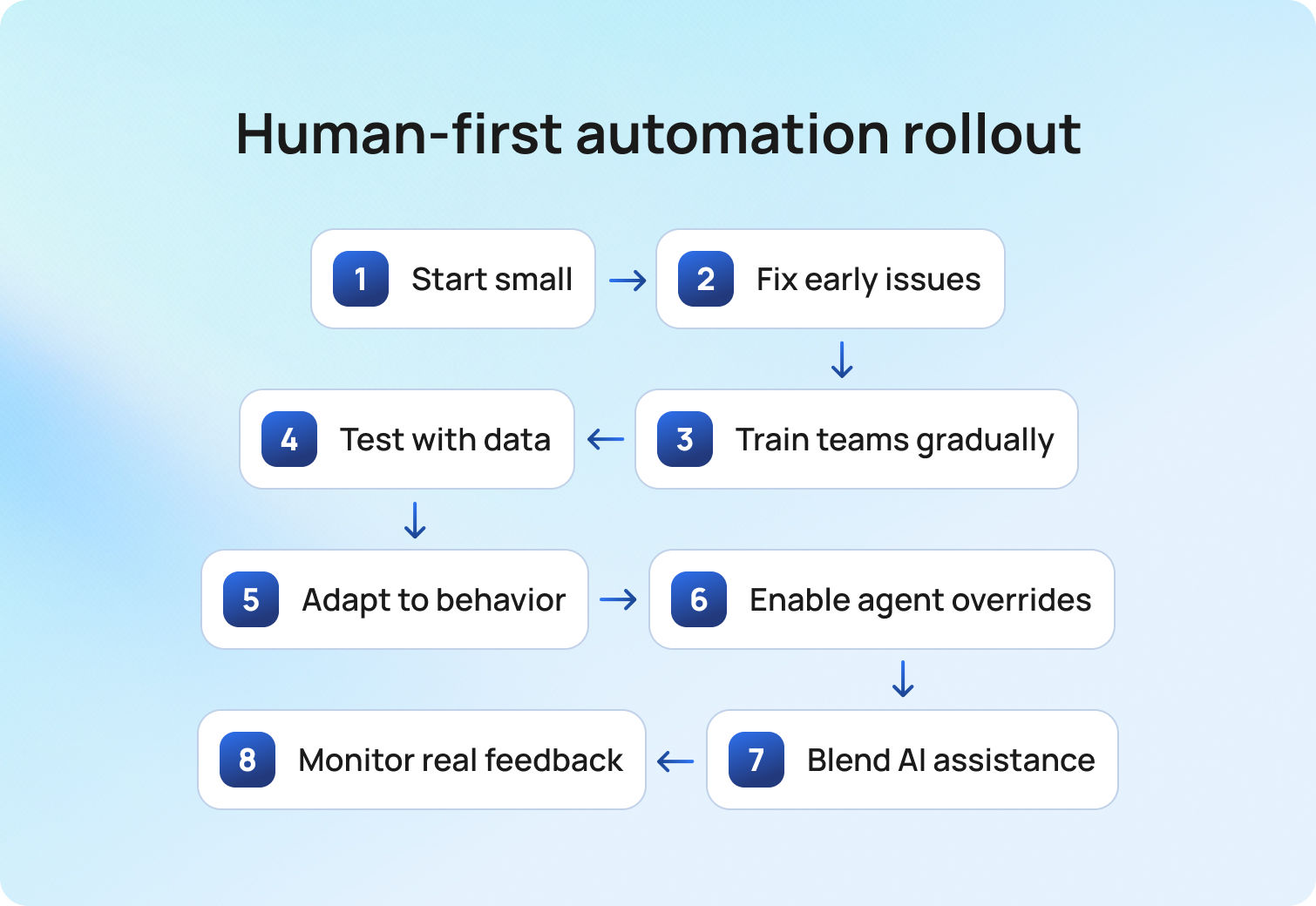
Don't try to automate customer service operations overnight. Many companies rush into full automation, end up with frustrated customers, and leave their support teams distrustful of the new tools. A gradual, thoughtful approach maintains the human element while achieving efficiency.
Start small and scale based on results:
- Begin with one high-volume, low-complexity task and get it working smoothly before expanding
- Identify issues before they affect all customers
- Train your team on new automation tools without overwhelming them
- Gather data on what works before making big investments
- Adjust based on real customer behavior, not assumptions
Train your team to work alongside automation:
- Teach staff how automated ticket routing works and when to override it
- Show them how to use AI-generated response suggestions without sounding robotic
- Help them recognize when customers are frustrated with automated support options
- Train them to leverage customer data from automated systems for better personalized support
Monitor customer feedback and key metrics. Track what actually happens, not just what you hoped would happen. Watch customer satisfaction scores before and after automation, resolution times, escalation rates from automated systems to human agents, self-service portal usage, and customer effort scores.
But don't just watch numbers. Read the actual feedback. Customers will tell you when automation helps and when it frustrates.
Examples in Automating Customer Service
E-commerce and Handling Order Inquiries at Scale
E-commerce companies deal with thousands of "where's my order?" questions daily. Automated customer service tools handle these instantly by pulling data from shipping systems and presenting it in a customer-friendly format.
But automation also catches problems early. If tracking shows a package stuck at a distribution center, the system can proactively alert customers and offer solutions before they even reach out. This proactive support reduces customer inquiries while actually increasing customer satisfaction.
Financial Services Balancing Security and Convenience
Banks and financial institutions utilize customer service automation for routine tasks, such as balance checks, transaction history, and card activation. But they maintain strict protocols for escalating to human agents when security concerns arise.
The key is risk-based routing. Low-risk questions get automated responses. High-risk situations (such as suspected fraud, significant transactions, or account access issues) are immediately connected to support agents who can verify identity and make informed judgments.
SaaS Companies and Technical Support That Scales
Software companies use automation in customer service to handle common technical questions through documentation and interactive troubleshooting tools. When customers report bugs or complex issues, automated ticketing systems gather relevant information before routing to the right agent.
This pre-qualification means support agents receive tickets with system logs, screenshots, and reproduction steps already attached. They spend less time gathering information and more time actually solving customer issues.
The Future of Customer Service Automation
Automation tools continue to get smarter, but the fundamental principle remains the same: utilize technology for efficiency and reserve humans for empathy. Companies that succeed with automated customer service understand this delicate balance. They:
- Automate repetitive tasks so support teams have bandwidth for complex problem-solving
- Use AI for instant responses while maintaining clear paths to human agents.
- Leverage customer data for personalization without making customers feel surveilled.
Automated customer service software handles high volumes and speeds. Human agents provide judgment and emotional intelligence. Together, they create customer service operations that meet customer expectations for both efficiency and personalization.
The businesses winning at customer service aren't the ones with the most automation. They're the ones that automate strategically, keeping the human element exactly where customers value it most.
Schedule a demo to see how BlueTweak can transform your customer support automation.

Unleashing the Power of Proactive Customer Support: Anticipating Needs for Enhanced Experiences
In the fast-paced world of customer service, the shift from reactive to proactive support is gaining momentum. This comprehensive exploration illuminates the strategic significance of proactive customer support, outlining the benefits it brings to both businesses and customers. Additionally, practical approaches to anticipate and fulfill customer needs before they arise are discussed.
I. The Essence of Proactive Customer Support
1.1 Moving Beyond Reactive Solutions
While reactive customer support addresses issues after they arise, proactive support takes a preemptive approach, identifying and addressing potential problems before they impact the customer. This forward-thinking strategy enhances customer satisfaction by demonstrating a commitment to preventing challenges and fostering a positive customer experience.
1.2 Anticipating Customer Needs
Proactive support involves a deep understanding of customer behaviors, preferences, and historical data to anticipate their needs. Leveraging data analytics and customer insights allows businesses to predict issues, provide timely assistance, and create a sense of personalized care that goes beyond standard reactive support.
1.3 Building Customer Trust and Loyalty
Proactive support is a cornerstone for building trust and fostering customer loyalty. When customers experience a business actively addressing their needs before problems escalate, it not only resolves issues efficiently but also establishes a robust foundation for long-term relationships.
Read more about: The Art of Proactive Customer Service: Enhancing the Customer Journey
II. Benefits and Strategies of Proactive Support
2.1 Increased Customer Satisfaction
Proactive support leads to increased customer satisfaction by minimizing disruptions and inconveniences. Addressing potential issues before customers even notice them demonstrates a commitment to providing a seamless and positive experience.
2.2 Cost-Efficiency and Resource Optimization
Anticipating and preventing issues before they escalate can lead to cost savings. Proactive support reduces the need for extensive reactive measures, optimizing resources and allowing businesses to allocate support personnel more efficiently.
2.3 Leveraging Technology for Predictive Insights
Technology, including predictive analytics and machine learning, plays a pivotal role in proactive support. Businesses can harness these tools to analyze customer data, identify patterns, and predict future needs, enabling them to take preemptive actions.
III. Challenges and Ethical Considerations in Proactive Support
3.1 Balancing Proactivity and Intrusiveness
While proactive support is beneficial, businesses must strike a balance to avoid being perceived as intrusive. Understanding the fine line between anticipating needs and respecting customer privacy is crucial for maintaining trust.
3.2 Data Privacy and Security
Proactive support heavily relies on customer data. To address potential concerns, businesses must prioritize data privacy and security, ensuring that customer information is handled ethically and in compliance with relevant regulations.
3.3 Transparency in Proactive Measures
Maintaining transparency about proactive measures is essential for building customer trust. Businesses should communicate clearly about how they use customer data to anticipate needs and provide proactive support, fostering openness and trust.
IV. Implementation Strategies for Proactive Customer Support
4.1 Cultivating a Customer-Centric Culture
Implementing proactive customer support requires a cultural shift within an organization. It's not merely about adopting new technologies but fostering a mindset that puts the customer at the center. Encourage employees at all levels to prioritize customer needs, emphasizing the importance of anticipating and exceeding expectations.
4.2 Training and Skill Development
Equipping your team with the necessary skills is crucial for the success of proactive support. Training programs should focus on data analysis, customer behavior interpretation, and effective utilization of predictive tools. By investing in your team's capabilities, you ensure they are well-prepared to navigate the complexities of proactive customer service.
4.3 Continuous Improvement and Adaptation
Proactive support is an ongoing process that requires continuous improvement. Regularly assess the effectiveness of your strategies, gather feedback from customers and internal teams, and adapt your approach accordingly. This iterative process ensures that your proactive support remains aligned with evolving customer expectations.
Read more about: Building Trust in Customer Support: Tips for Creating Long-Lasting Customer Relationships
V. The Future Landscape of Proactive Customer Support
5.1 Integration of Artificial Intelligence (AI) and Automation
As technology advances, the integration of AI and automation will play a pivotal role in enhancing proactive support. AI algorithms can analyze vast amounts of customer data in real-time, providing instant insights and enabling businesses to predict and address issues before they impact the customer.
5.2 Expanding Proactive Support Across Channels
The future of customer service is omnichannel, and proactive support should seamlessly extend across all customer touchpoints. Whether it's social media, email, or chat, businesses need to proactively engage with customers on their preferred platforms, creating a cohesive and integrated experience.
5.3 Personalization Through Predictive Personalization
Going beyond traditional personalization, predictive personalization involves anticipating individual customer preferences before they explicitly express them. By leveraging predictive analytics, businesses can tailor their products, services, and interactions to align with each customer's unique needs.
VI. Measurement and Metrics for Proactive Support
6.1 Customer Satisfaction Metrics
Traditional metrics like Net Promoter Score (NPS) and Customer Satisfaction (CSAT) remain relevant for measuring proactive support. Evaluate how well your proactive initiatives align with increased customer satisfaction and loyalty.
6.2 Issue Resolution Time
Analyzing the time taken to resolve issues proactively provides insights into the efficiency of your strategies. The quicker potential problems are addressed, the more positive the impact on customer satisfaction.
6.3 Predictive Accuracy
For businesses leveraging predictive analytics, measuring the accuracy of predictions is essential. Track how well your systems forecast customer needs and issues, refining them based on the actual outcomes.
VII. Crafting a Roadmap for Proactive Support Implementation
7.1 Assessment and Readiness
Before diving into proactive support, assess your organization's readiness. Evaluate existing support structures, technological capabilities, and employee readiness. This assessment provides a baseline for future improvements.
7.2 Pilot Programs and Testing
Rather than a full-scale rollout, consider implementing proactive support through pilot programs. Test different strategies, gather feedback, and refine your approach based on real-world results.
7.3 Scalable Integration
Once the effectiveness of proactive support strategies is validated through pilot programs, scale the integration gradually. Ensure that the infrastructure, both technological and organizational, can support a broader implementation.
VIII. The Human Element in Proactive Support
8.1 Empathy in Proactive Interactions
While technology plays a crucial role, the human touch remains irreplaceable. Train support teams to inject empathy into proactive interactions, ensuring that customers feel valued and understood.
8.2 Proactive Communication
Communication is key in proactive support. Keep customers informed about potential issues, updates, and personalized recommendations. Transparent and timely communication builds trust and reinforces the customer-business relationship.
Read more about: Proactive vs. Reactive Customer Service: Enhancing the Customer Experience
IX. Challenges and Future Considerations
9.1 Adapting to Shifting Customer Expectations
As customer expectations continue to evolve, businesses must stay agile. Proactively adapting strategies to align with changing expectations is essential for long-term success.
9.2 Ethical Considerations in Predictive Analytics
As businesses leverage predictive analytics, ethical considerations surrounding data usage become paramount. Establish clear guidelines and practices to ensure customer data is handled ethically and in compliance with privacy regulations.
Conclusion
In an era where customer expectations are continually evolving, proactive support emerges as a powerful strategy for businesses committed to delivering exceptional customer experiences. By anticipating needs, resolving issues before they escalate, and leveraging technology for predictive insights, businesses can set the stage for enhanced customer satisfaction, loyalty, and long-term success. Proactive support is not just a trend; it's a transformative approach that propels businesses into a new realm of customer-centric excellence.
As businesses navigate the ever-changing landscape of customer service, embracing the proactive paradigm becomes not just a choice but a necessity for those aiming to lead in customer-centricity. By making proactive customer support an integral part of their strategy, businesses can forge ahead into a future where customer experiences are not just met but exceeded, creating a lasting impact on both their customers and their bottom line.

Elevating Customer Engagement: The Transformative Role of Chatbots in Modern Support Strategies
Chatbots are pivotal in the modern customer support strategies. By seamlessly integrating chatbots into the customer service framework, businesses can optimize responses, streamline operations, and provide a personalized experience that goes beyond conventional transactional interactions. This comprehensive discussion encompasses the rise of chatbots as virtual assistants, their role in handling routine queries, and the potential for personalization through leveraging customer data. Acknowledging the evolving nature of chatbots, the article highlights the importance of continuous learning and improvement to ensure sustained effectiveness aligned with evolving customer expectations. However, in navigating the integration of chatbots, businesses must also confront challenges and ethical considerations, such as maintaining transparency, guarding against biases in algorithms, and striking the right balance between automation and human oversight. As businesses grapple with the intricacies of customer support, the strategic integration of chatbots emerges not merely as a tool but as a vital partner in delivering exceptional customer service in the digital age.
I. The Rise of Chatbots in Customer Support
1.1 Chatbots as Virtual Assistants
Chatbots have evolved beyond mere automation, becoming sophisticated virtual assistants capable of handling routine queries and even assisting in complex problem-solving. Their 24/7 availability ensures instant responses, adding significant value to the overall customer experience.
1.2 Streamlining Frequently Asked Questions
A fundamental role of chatbots is streamlining responses to frequently asked questions. By automating routine interactions, support teams can redirect their focus towards addressing more intricate issues, leading to increased efficiency and faster resolution times.
1.3 Personalization Through Chatbots
Contrary to popular belief, chatbots have the potential to enhance personalization. Leveraging customer data, they can recognize individual preferences and history, offering tailored solutions that contribute to a more engaging and customer-centric experience.
Read more: Transforming Customer Service: The Rise of Automation and AI
II. Benefits and Best Practices of Chatbot Integration
2.1 Enhanced Efficiency and Scalability
The integration of chatbots significantly enhances the efficiency and scalability of customer support operations. Capable of handling a large volume of inquiries simultaneously, chatbots free up human agents to tackle more complex issues, ensuring timely responses to a broader customer base.
2.2 Seamlessly Integrating Human Touch
Successful chatbot deployment requires finding the delicate balance between automation and the human touch. Businesses should design chatbots to seamlessly hand off interactions to human agents when needed, ensuring a personalized and empathetic touch, particularly in complex or emotionally charged situations.
2.3 Continuous Learning and Improvement
Chatbots are dynamic entities that can evolve through continuous learning. By analyzing customer interactions, businesses can identify areas for improvement, refine responses, and ensure that chatbots remain effective and aligned with evolving customer expectations over time.
2.4 Unlocking Predictive Analytics
An emerging frontier in chatbot utilization is the integration of predictive analytics. By analyzing customer behavior and historical data, chatbots can anticipate customer needs, enabling proactive and personalized interactions that foster a deeper connection with the brand.
III. Challenges and Ethical Considerations in Chatbot Integration
3.1 Maintaining Transparency
Transparency is paramount when deploying chatbots. Businesses must ensure that customers are fully aware when they are interacting with a chatbot. Maintaining openness about the capabilities and limitations of automated assistance is essential to building and retaining trust.
3.2 Guarding Against Bias
Chatbots learn from historical data, which may contain biases. To mitigate the risk of perpetuating biases in customer interactions, businesses must actively monitor and adjust chatbot algorithms, promoting fairness and equality in the support they provide.
3.3 Balancing Automation with Human Oversight
While chatbots offer efficiency, human oversight is indispensable. Businesses should establish clear protocols for when human intervention is required, ensuring that complex issues or emotionally charged situations are handled with empathy and understanding.
3.4 Ethical Data Usage
As custodians of customer data, businesses must prioritize ethical data usage in chatbot interactions. Implementing robust data protection measures and ensuring compliance with privacy regulations are crucial steps in building and maintaining customer trust.
Read more: Harnessing the Power of AI in Customer Support: Impact and Innovations
IV. Future Trends in Chatbot Evolution
4.1 Integration with Augmented Reality (AR) and Virtual Reality (VR)
The future of chatbots lies in their integration with AR and VR technologies. This convergence could enable immersive customer support experiences, allowing users to interact with virtual agents in a three-dimensional space.
4.2 Natural Language Processing Advancements
Advancements in natural language processing (NLP) are poised to make chatbots even more conversational and adept at understanding nuanced customer queries. This evolution will contribute to a more seamless and human-like interaction.
4.3 Emotional Intelligence in Chatbots
The integration of emotional intelligence in chatbots is a burgeoning area of research. Future chatbots may not only recognize emotions in customer queries but respond with empathy, further enhancing the quality of customer interactions.
Read more: The Crucial Role of Feedback Integration in Omnichannel AI-Driven Platforms
As businesses navigate the intricacies of customer support, the strategic integration of chatbots emerges not only as a tool but as a vital partner in delivering exceptional customer service in the digital age. Thoughtful implementation of chatbots can unlock unprecedented efficiency, provide highly personalized experiences, and contribute significantly to overall customer satisfaction. In an era of digital innovation, chatbots transcend their role as mere tools; they become indispensable partners in fostering meaningful and enduring customer relationships. By embracing the evolving landscape of chatbot technology, businesses can stay at the forefront of customer support excellence and drive sustainable success in a dynamic market.

Revolutionizing Customer Support: A Guide to Implementing Omnichannel Solutions
In the dynamic landscape of customer support, meeting customer expectations goes beyond personalized interactions. It systematically explores the strategic avenues through which businesses can harness the potential of these platforms to not only meet but surpass customer expectations. The focus is on how organizations can adeptly leverage omnichannel support to streamline communication, elevate customer experiences to unprecedented heights, and forge enduring bonds of brand loyalty. Moreover, it explores how businesses can build lasting brand loyalty.
I. Understanding Omnichannel Support
1.1 Beyond Traditional Channels
Omnichannel support goes beyond phone and email interactions. It integrates various communication channels such as live chat, social media, and messaging apps into a cohesive platform. This approach ensures that customers can seamlessly transition between channels without losing the context of their interactions.
1.2 Consistency Across Channels
A key aspect of omnichannel support is maintaining consistency across all channels. Customers expect a unified experience, where information and context are readily available, regardless of the channel they choose. Achieving this consistency requires a comprehensive omnichannel strategy.
1.3 Personalization in Omnichannel
While addressing customers across multiple channels, personalization remains paramount. Omnichannel support platforms empower businesses to access customer data from various touchpoints, enabling personalized interactions that resonate with individual preferences and history.
Read more: Customer Satisfaction and Reducing Costs: Omnichannel Customer Support Platforms
II. Enhancing Customer Experiences with Omnichannel
2.1 Real-time Responsiveness
Omnichannel support enables real-time responsiveness by consolidating communication channels. This ensures that customer queries and concerns are addressed promptly, leading to increased satisfaction and positive brand perception.
2.2 Proactive Issue Resolution
By integrating customer data from various touchpoints, businesses can proactively identify and address issues before customers even reach out. This anticipatory approach enhances customer satisfaction and builds trust in the brand’s commitment to resolving concerns.
2.3 Empowering Customer Service Representatives
Omnichannel platforms empower customer service representatives with a holistic view of customer interactions. This comprehensive understanding allows representatives to provide more informed and efficient support, ultimately leading to improved customer experiences.
Read more: Harnessing the Power of AI in Customer Support: Impact and Innovations
III. Implementing Omnichannel Support Platforms
3.1 Selecting the Right Platform
Choosing the right omnichannel support platform is crucial. Businesses must evaluate platforms based on their scalability, integration capabilities, and alignment with the organization’s specific customer support needs.
3.2 Integration with Existing Systems
Seamless integration with existing systems is vital for the success of an omnichannel support platform. This ensures a unified view of customer data and facilitates efficient communication between different departments within the organization.
3.3 Training and Onboarding
Effective implementation of an omnichannel support platform requires comprehensive training and onboarding for customer service representatives. Ensuring that the team is proficient in utilizing the platform optimally is essential for reaping its full benefits.
IV. Challenges and Ethical Considerations in Omnichannel Support
4.1 Data Security and Privacy
With increased integration of customer data, ensuring data security and privacy is a critical concern. Businesses must implement robust security measures to protect sensitive customer information.
4.2 Balancing Automation and Personalization
While automation is a key feature of omnichannel support, striking the right balance between automated responses and personalized interactions is essential.
4.3 Transparency in Communication
Maintaining transparency in how customer data is used and stored is vital for building trust. Ethical considerations include clearly communicating the purposes of data collection and obtaining customer consent.
Omnichannel support represents a paradigm shift in customer service, offering businesses the opportunity to exceed customer expectations across various communication channels. Implementing and optimizing an omnichannel support platform is not just a technological upgrade; it’s a strategic move to foster long-term customer loyalty and success.
As the business landscape continues to evolve, embracing omnichannel support becomes a cornerstone for organizations committed to delivering exceptional customer experiences. The saying holds true: “Connect with your customers seamlessly, and they will connect with your brand faithfully.”

Crafting a Personalized Customer Experience: A Path to Brand Loyalty and Success
In today’s hyper-competitive business landscape, one thing is clear: customers expect more than just products or services. They want a personalized experience that transcends the transactional nature of business. It’s not enough to see customers as mere numbers; instead, they crave a sense of being valued as individuals. This article explores the critical importance of delivering personalized customer experiences, the impact of customer understanding on brand loyalty, and strategies to meet these expectations in an era where 66% of customers expect companies to understand their needs and expectations.
I. The Significance of Personalization
1.1 Treating Customers as People, Not Numbers
When customers reach out to your team, they seek a connection. They don’t want to be treated as mere statistics or ticket numbers in your support queue. Instead, they desire an interaction that resonates with their unique needs and expectations. A personalized experience begins with recognizing the individuality of each customer and understanding that their case is important.
1.2 The Role of Empathy
A personalized customer experience revolves around empathy. Empathy is the cornerstone of building meaningful relationships with customers. It involves understanding their emotions, concerns, and objectives. A customer wants to feel that your representative cares deeply about resolving their issues, and this can only be achieved through a genuine display of empathy.
1.3 Moving Beyond One-Size-Fits-All Approaches
In an age where every customer interaction is recorded, there’s no excuse for employing a one-size-fits-all approach. The nature of support cases varies significantly, and each case should be treated with the necessary adaptability. By tailoring your approach to each customer’s unique situation, you show that you value them as an individual.
Read more about: Building Trust in Customer Support: Tips for Creating Long-Lasting Customer Relationships
II. The Connection Between Understanding and Loyalty
2.1 The Power of Customer Understanding
Customer understanding is the bedrock upon which personalized experiences are built. Understanding your customers involves knowing their preferences, past interactions, and anticipating their needs. This knowledge allows you to be proactive in your support, showing that you are prepared to handle unexpected situations and rarely scrambling for solutions.
2.2 Loyalty and Personalization
Customers are not only inclined to buy from brands that understand them, but they also tend to stay loyal to these brands. Loyalty is an outcome of repeated personalized experiences that demonstrate your commitment to the customer. When customers feel understood and valued, they are more likely to return, leading to long-term brand success.
2.3 The 66% Expectation
The statistic that 66% of customers expect companies to understand their needs and expectations is a stark reminder of the new reality in the business world. To meet this expectation, companies must go beyond standard customer service and invest in understanding their customers on a deeper level.
Read more about: The Rise of Customer Experience: A Strategic Imperative for Modern Businesses
III. Strategies for Delivering Personalized Experiences
3.1 Data-Driven Personalization
One of the most effective ways to understand your customers is through data analysis. By collecting and analyzing customer data, you can gain insights into their preferences, purchase history, and pain points. This information enables you to create tailored experiences that resonate with individual customers.
3.2 Implementing AI and Machine Learning
Artificial intelligence and machine learning technologies have transformed customer service. These technologies can analyze vast amounts of data and provide real-time insights, enabling you to make informed decisions on how to personalize interactions with customers.
3.3 Personalization at Scale
The challenge for large businesses is delivering personalized experiences at scale. This involves creating systems and processes that allow your team to interact with thousands or even millions of customers in a way that feels personal. It can be achieved through segmentation, automation, and smart use of technology.
3.4 Training and Empowering Your Support Team
Your support team plays a crucial role in delivering personalized experiences. Training them to understand the importance of empathy and customer understanding is paramount. Empowered and motivated team members are more likely to go the extra mile to provide personalized service.
3.5 Feedback Loops
To continuously improve your customer understanding, it’s essential to have feedback loops in place. Collecting feedback from customers after interactions and using it to refine your approach can help bridge the gap between customer expectations and your service.
IV. Challenges and Ethical Considerations
4.1 Privacy Concerns
As companies gather more customer data for personalization, privacy concerns become increasingly important. Striking a balance between customer understanding and privacy protection is a challenge that companies must navigate carefully.
4.2 Avoiding Over-Personalization
While personalization is crucial, over-personalization can feel invasive to customers. Striking the right balance is essential to provide personalized experiences without crossing boundaries.
4.3 Ethical Use of Customer Data
Ethical considerations in the use of customer data are paramount. Companies must be transparent about data usage and obtain customer consent. A breach of trust can have long-lasting negative consequences.
In a world where customers demand personalized experiences, understanding their needs and expectations is no longer an option; it’s a necessity. The statistic that 66% of customers expect companies to understand them serves as a stark reminder of this new reality. By treating customers as individuals, embracing empathy, and adapting to unique situations, businesses can foster loyalty, which is the cornerstone of long-term success. Strategies such as data-driven personalization, AI and machine learning, and feedback loops can help deliver personalized experiences at scale. As the saying goes, “Know thy customer, and they shall know you as their brand of choice.”

Transforming Customer Service: The Rise of Automation and AI
In the fast-paced world of customer service, efficiency is the name of the game. The ability to respond swiftly and effectively to customer inquiries, resolve issues, and provide exceptional support is crucial for building and maintaining a loyal customer base. However, this demanding field often involves repetitive, mundane tasks that can drain the productivity and morale of customer service personnel. In response to this challenge, automation and artificial intelligence (AI) have emerged as powerful allies in streamlining customer service operations. In this article we explore how automation and AI are revolutionizing the customer service landscape by taking over routine tasks, enhancing efficiency, and improving the overall customer experience.
I. The Repetitive Nature of Customer Service Tasks
Customer service representatives routinely encounter tasks that require repetition and precision. These tasks may include solving common problems, transferring calls to specialized departments, or sending follow-up notes to customers. While essential, these actions can become tedious and time-consuming, leading to inefficiencies and the potential for human error.
1. Solving Common Problems
Common customer issues, such as password resets, order tracking, and account information updates, represent a significant portion of inquiries. Customer service agents find themselves answering the same questions repeatedly, which can be monotonous and unproductive.
2. Transferring Calls
In a complex customer service environment, calls often need to be transferred to specialized departments or experts who can provide the necessary assistance. Manually routing calls can lead to delays and inaccuracies, as it relies on human judgment and availability.
3. Sending Follow-Up Notes
After resolving customer issues, it’s common practice to follow up with the customer to ensure their satisfaction or provide additional information. Manually sending follow-up emails or messages can consume valuable time that could be better spent addressing other customer concerns.
Read more about: Insights from Cutting-Edge Research in Customer Support and Service
II. The Role of Automation in Customer Service
Automation, in the context of customer service, involves using technology to perform routine tasks without human intervention. It offers several advantages that are particularly beneficial in the face of repetitive actions.
1. Improved Efficiency
By automating routine functions, customer service teams can significantly improve their efficiency. For instance, a well-structured automated system can categorize and assign cases to the appropriate agents or departments with great accuracy and speed. This leads to faster response times and more streamlined operations.
2. Reduced Human Error
Automation minimizes the risk of human error, which can be especially critical in customer service. Mistakes, such as assigning cases to the wrong department or sending incorrect information, can result in customer dissatisfaction and potential damage to a company’s reputation.
3. Enhanced Consistency
Automation ensures consistency in handling repetitive tasks. Automated systems follow predefined rules and procedures rigorously, which helps maintain consistent service quality, regardless of the agent handling the task.
Read more about: Elevating Business Growth Through Exceptional Customer Service: Key Strategies and Insights
III. The Rise of Artificial Intelligence in Customer Service
Artificial intelligence, often powered by machine learning and natural language processing, is taking automation in customer service to the next level. AI can analyze and understand customer inquiries, engage in meaningful conversations, and offer solutions without the need for human intervention. Here’s how AI is transforming the industry:
1. Chatbots: AI-Powered Customer Service Agents
Chatbots have become a staple in modern customer service. These AI-driven virtual agents are capable of handling a wide range of customer inquiries, from simple questions to more complex issues. Chatbots operate 24/7, ensuring that customers receive prompt assistance at any time of day. They can provide immediate responses, gather essential information, and even route inquiries to human agents when necessary.
2. Natural Language Processing
One of the key strengths of AI in customer service is its ability to understand and process natural language. AI-driven chatbots can engage in dynamic conversations with customers, interpreting their queries, emotions, and context. This allows for more personalized and effective interactions, ultimately leading to higher customer satisfaction.
3. Sentiment Analysis
AI can analyze customer sentiment by examining the language, tone, and content of customer inquiries. This capability enables businesses to gauge customer satisfaction and identify potential issues before they escalate. By proactively addressing concerns, companies can enhance customer loyalty and reduce the risk of negative feedback or reviews.
Read more about: Embracing Customer Experience Automation: The Future of Business Interactions
IV. The Implementation of Automation and AI in Customer Service
The successful integration of automation and AI in customer service requires careful planning, technology adoption, and a customer-centric approach.
1. Defining Objectives
Before implementing automation and AI, companies need to define their objectives clearly. What are the specific tasks they want to automate, and what are the expected benefits in terms of efficiency and customer satisfaction?
2. Selecting the Right Tools
Choosing the appropriate tools and technologies is crucial. Companies must consider their existing systems and infrastructure, as well as the scalability and flexibility of the chosen solutions. Additionally, it’s essential to partner with reputable vendors or develop in-house expertise in AI and automation.
3. Training and Integration
Introducing automation and AI into an existing customer service framework requires proper training for both agents and customers. Agents need to understand how to work alongside these technologies, and customers should be informed about the availability and capabilities of chatbots or automated systems.
4. Continual Improvement
Customer service automation and AI are not static solutions. Continuous monitoring, analysis, and improvement are essential to ensure that these technologies evolve and adapt to changing customer needs and market trends.
V. Real-World Applications
The impact of automation and AI in customer service can be witnessed across various industries. Let’s explore some real-world applications that demonstrate the benefits of these technologies.
1. E-Commerce
In the e-commerce sector, customer inquiries related to order status, product information, and returns are prevalent. Automation and AI-driven chatbots can assist customers by quickly providing information about their orders, guiding them through return processes, and suggesting similar products based on their purchase history.
2. Banking and Finance
Customer service in the banking and finance industry often involves routine tasks like balance inquiries, transaction history, and account updates. Automated systems can handle these inquiries efficiently, freeing up human agents to focus on more complex financial issues or advisory services.
3. Healthcare
Automation and AI have also found their way into healthcare customer service. Appointment scheduling, prescription refills, and general health information inquiries can be managed by chatbots. Additionally, AI can be utilized to analyze patient feedback and improve healthcare services.
4. Travel and Hospitality
In the travel and hospitality sector, automation and AI help with booking reservations, managing loyalty programs, and providing travel information. Chatbots can assist customers in booking flights, hotels, and rental cars while also offering travel tips and local recommendations.
VI. The Future of Customer Service: Challenges and Opportunities
As automation and AI continue to transform customer service, several challenges and opportunities emerge on the horizon.
1. Data Privacy and Security
The increasing reliance on AI and automation in customer service requires a heightened focus on data privacy and security. Companies must ensure that customer data is protected and compliant with relevant regulations, such as GDPR or HIPAA.
2. Personalization
AI allows for more personalized customer interactions, but it also raises expectations. Customers increasingly expect tailored experiences and solutions. Companies must strike a balance between personalization and respecting customer privacy.
3. Workforce Adaptation
The integration of automation and AI may raise concerns about job displacement. However, these technologies can also create new roles, such as chatbot developers, data analysts, and AI trainers. Companies need to invest in workforce adaptation and provide training to ensure a smooth transition.
4. Customer Expectations
As customers become more accustomed to AI-driven customer service, their expectations will continue to rise. Meeting these expectations requires ongoing investment in technology, training, and quality assurance.
Automation and artificial intelligence have ushered in a new era for customer service. By taking over routine tasks, such as solving common problems, transferring calls, and sending follow-up notes, these technologies have revolutionized the industry. They improve efficiency, reduce human error, and enhance the overall customer experience.
As AI-driven chatbots become more adept at understanding natural language and customer sentiment, the potential for transforming customer service is boundless. The integration of automation and AI requires careful planning, training, and continual improvement to deliver on their promise of efficiency and customer satisfaction. In the coming years, businesses that effectively harness these technologies will stand out in the competitive customer service landscape. By embracing automation and AI, companies can streamline their operations, strengthen customer relationships, and provide exceptional support, ultimately driving long-term success in the digital age.

The Rise of Customer Experience: A Strategic Imperative for Modern Businesses
In today’s fiercely competitive business landscape, the shift towards prioritizing customer experience has emerged as a game-changer. As customers wield increasing power over the buying process, many businesses are placing customer experience at the forefront of their strategies. In fact, a staggering 63% of companies are dedicating more time and resources to enhance the customer experience. This article explores the significance of this trend, its impact on customer expectations, and why failing to prioritize customer experience can spell trouble for businesses in today’s market.
The Customer Experience Revolution
In recent years, a significant transformation has taken place in the world of business. Companies are acknowledging that the key to success lies not just in acquiring customers but in retaining and delighting them through exceptional customer experiences. This paradigm shift is driven by several factors, including changing customer behaviors, technological advancements, and increased competition.
Changing Customer Behaviors
Customers today are more informed, discerning, and empowered than ever before. The rise of the internet and digital technologies has given consumers access to a wealth of information and choices at their fingertips. They can easily compare products, read reviews, and voice their opinions on social media. With this increased power, customers have come to expect more from the businesses they patronize.
Technological Advancements
Technology has not only changed the way customers interact with businesses but also provided companies with the tools to create memorable experiences. From AI-driven chatbots and personalization algorithms to seamless e-commerce platforms, technology has opened up new avenues for enhancing the customer journey.
Increased Competition
The business landscape is more crowded than ever, and competitors are just a click away. This intense competition has made it imperative for companies to differentiate themselves not only through the quality of their products or services but also through the quality of the experiences they provide.
Read more about: Unleashing the Power of Proactive Customer Support: Anticipating Needs for Enhanced Experiences
The Data-Backed Priority
The fact that 63% of companies are now investing more time and resources into prioritizing the customer experience underscores the gravity of this shift. It’s not just a hunch or a fleeting trend; it’s a data-backed imperative. Let’s delve deeper into why businesses are embracing this transformation.
Enhanced Customer Loyalty
Prioritizing customer experience isn’t just about making customers happy; it’s about building long-lasting relationships. Happy customers tend to be loyal customers. They are more likely to return for repeat purchases and recommend your business to others. In an age where customer acquisition costs are often high, nurturing customer loyalty can significantly boost your bottom line.
Improved Brand Reputation
A positive customer experience contributes to a strong brand reputation. Satisfied customers are more likely to become brand advocates, sharing their positive experiences with friends and followers. This word-of-mouth marketing can be a powerful asset, helping your brand gain credibility and trust.
Reduced Churn Rate
Focusing on customer experience can help reduce customer churn, which is crucial for subscription-based and SaaS businesses. When customers have a seamless and satisfying experience, they’re less likely to cancel their subscriptions or switch to competitors.
Increased Revenue
Companies that prioritize customer experience often see a direct impact on their revenue. By creating exceptional experiences that resonate with customers, businesses can increase upsell and cross-sell opportunities. Additionally, customers are often willing to pay a premium for products or services they perceive as offering exceptional value.
Data-Driven Decision Making
In the age of big data, businesses are leveraging customer data to understand their preferences, pain points, and behaviors. This data-driven approach allows companies to tailor their strategies and offerings to align with customer expectations, leading to more effective marketing and sales efforts.
Read more about: Elevating Customer Engagement: The Transformative Role of Chatbots in Modern Support Strategies
The Rising Tide of Customer Expectations
While more businesses are striving to meet the evolving customer expectations, this very effort is contributing to the upward spiral of these expectations. As customer experience becomes a competitive battleground, customers come to expect nothing less than outstanding service. Here are some areas where expectations are rising:
Personalization
Customers now expect businesses to know them intimately and cater to their individual preferences. Personalization, once a novelty, has become the norm. Customers appreciate product recommendations, tailored content, and personalized communications.
Seamless Omnichannel Experiences
With customers interacting with businesses through various channels, they expect a seamless transition between them. Be it in-store, online, mobile, or social media, customers want a consistent and integrated experience.
Speed and Convenience
In today’s fast-paced world, customers value speed and convenience. They expect quick response times, fast delivery, and hassle-free returns. A delay in any of these areas can lead to dissatisfaction.
Exceptional Customer Support
Prompt, effective, and empathetic customer support is no longer a nice-to-have; it’s a must. Customers expect quick resolutions to their issues and a support team that truly understands and cares about their concerns.
Transparency and Trust
Customers are increasingly concerned about transparency and trust. They want to know where their products come from, how they’re made, and whether a company upholds ethical and sustainable practices.
Read more about: Crafting a Personalized Customer Experience: A Path to Brand Loyalty and Success
The Consequences of Neglecting Customer Experience
As the tide of customer expectations rises, businesses that fail to prioritize the customer experience may find themselves in troubled waters. Neglecting this crucial aspect of business can result in various negative consequences:
Loss of Customers
Customers are quick to switch to competitors if their expectations aren’t met. Neglecting customer experience can lead to customer churn, causing a loss of revenue and market share.
Negative Brand Image
A poor customer experience can tarnish a brand’s image. Negative reviews, social media backlash, and word-of-mouth can spread quickly, damaging a company’s reputation.
Reduced Profits
Ineffective customer experience strategies can lead to reduced profits. Businesses may struggle to attract and retain customers, impacting their top and bottom lines.
Missed Growth Opportunities
Failing to understand and address customer needs can lead to missed growth opportunities. Businesses that don’t invest in customer experience may fail to tap into potential markets or expand their offerings effectively.
Competitive Disadvantage
In an environment where customer experience is a key differentiator, neglecting it can put a business at a significant competitive disadvantage. Competitors who prioritize customer experience may steal market share and gain an edge in the industry.
Strategies to Prioritize Customer Experience
For businesses looking to embrace the customer experience revolution, several strategies can help them make the transition successfully:
Customer Journey Mapping
Understanding the customer journey is crucial. By mapping out the various touchpoints and interactions customers have with your brand, you can identify pain points and opportunities for improvement.
Collect and Analyze Data
Leverage customer data to gain insights into their behaviors and preferences. This data can inform personalization efforts and help tailor your products and services to better meet customer needs.
Invest in Training and Empowerment
Frontline employees, such as customer service representatives, play a critical role in the customer experience. Invest in training and empower them to address customer concerns effectively and provide exceptional service.
Embrace Technology
Technology can be a powerful ally in enhancing the customer experience. Use AI and automation to streamline processes, provide 24/7 support, and personalize interactions.
Solicit and Act on Feedback
Encourage customers to provide feedback and reviews and take action on the insights gained. This not only shows that you value their input but also helps you make tangible improvements.
Cultivate a Customer-Centric Culture
Foster a company culture that prioritizes the customer. Ensure that every employee, from top management to the front lines, understands the importance of customer experience and is aligned with this mission.
The Future of Customer Experience
The trend of prioritizing customer experience is not just a passing phase but a fundamental shift in the business landscape. As technology continues to advance and customer expectations rise, businesses must adapt to stay relevant and competitive. The future of customer experience is likely to see the following trends:
AI and Automation
AI will play an increasingly significant role in personalization, chatbots, and data analysis, allowing businesses to provide more efficient and tailored experiences.
Eco-Friendly Practices
Sustainability and ethical considerations will become integral to the customer experience, with environmentally conscious consumers expecting companies to align with their values.
Augmented Reality (AR) and Virtual Reality (VR)
AR and VR technologies will enhance the customer experience in various industries, such as retail, real estate, and entertainment.
Voice Commerce
The growth of smart speakers and voice assistants will create new opportunities for businesses to engage with customers through voice commerce.
Blockchain for Transparency
Blockchain technology will be used to enhance transparency and traceability, providing customers with information about the origin and journey of products.
In the current business landscape, prioritizing customer experience is not a choice; it’s a strategic imperative. The fact that 63% of companies are dedicating more resources to enhance customer experience reflects a data-backed recognition of its significance. Failing to prioritize customer experience can result in customer loss, brand damage, reduced profits, missed growth opportunities, and a competitive disadvantage. The rise in customer expectations, driven by changing behaviors, technological advancements, and increased competition, makes it imperative for businesses to adapt and deliver exceptional experiences.
By mapping customer journeys, analyzing data, investing in training, embracing technology, and cultivating a customer-centric culture, companies can thrive in this customer-centric era. Looking ahead, the future of customer experience will continue to evolve, driven by AI, sustainability, AR, voice commerce, and blockchain. Businesses that stay ahead of these trends and continuously innovate their customer experience strategies will be the leaders of tomorrow. Remember, in today’s marketplace, it’s not just about selling products or services; it’s about creating memorable experiences that keep customers coming back for more.

Elevating Business Growth Through Exceptional Customer Service: Key Strategies and Insights
Customer service is a pivotal element in the world of business. In fact, it plays a pivotal role in shaping the overall performance and growth of a business. According to a recent survey, a staggering 73% of business leaders have reported a direct correlation between customer service and the overall performance of their companies. Moreover, a substantial 64% of business leaders attribute a positive impact on their growth to exceptional customer service. This data underlines the fact that businesses are increasingly recognizing the vital role that customer service plays in their success. As a result, companies are ramping up their investments in various facets of customer service to ensure their customers have an exceptional experience. In this article, we will explore the key areas of focus for businesses aiming to leverage customer service for growth.
Customer service is a pivotal element in the world of business. In fact, it plays a pivotal role in shaping the overall performance and growth of a business. According to a recent survey, a staggering 73% of business leaders have reported a direct correlation between customer service and the overall performance of their companies. Moreover, a substantial 64% of business leaders attribute a positive impact on their growth to exceptional customer service. This data underlines the fact that businesses are increasingly recognizing the vital role that customer service plays in their success. As a result, companies are ramping up their investments in various facets of customer service to ensure their customers have an exceptional experience. In this article, we will explore the key areas of focus for businesses aiming to leverage customer service for growth.
The Customer-Centric Approach
Understanding Customer Expectations
In a rapidly evolving market, customer expectations are continually changing. To meet these expectations, businesses must first understand what their customers desire. Through surveys, feedback, and data analysis, companies can gain valuable insights into what their customers expect.
Personalization
Personalization is key to enhancing customer experience. Customers appreciate it when businesses tailor their interactions to their specific needs. This can be achieved through personalized marketing, product recommendations, and even addressing customers by their names. Personalization creates a strong bond between customers and businesses.
Omnichannel Support
Today’s customers engage with businesses through various channels, such as email, social media, live chat, and phone calls. It is crucial for businesses to provide consistent and seamless support across these channels to ensure a cohesive and convenient customer experience.
Investing in Employee Training
Skill Development
Customer service representatives are the face of a business. They interact directly with customers, making it essential for them to possess the necessary skills to address customer inquiries and concerns effectively. Investing in continuous training programs can elevate the quality of customer interactions.
Empathy and Soft Skills
Customer service isn’t just about solving problems; it’s also about understanding and empathizing with customers. Training employees in soft skills like active listening and empathy can significantly impact the quality of customer service.
Product Knowledge
Customer service representatives should have an in-depth understanding of the products or services they are offering. This knowledge empowers them to provide accurate information, troubleshoot effectively, and offer valuable insights to customers.
Leveraging Technology
Customer Relationship Management (CRM) Systems
CRM systems enable businesses to manage and analyze customer data effectively. This data can be used to personalize interactions, track customer history, and improve customer service overall.
Chatbots and AI
Chatbots and artificial intelligence can enhance customer service by providing instant responses to common queries and facilitating 24/7 support. These technologies also free up human agents to focus on more complex customer issues.
Data Analytics
Data analytics tools can help businesses gain insights into customer behavior and preferences. This data can be used to refine products, services, and marketing strategies, ultimately improving customer satisfaction and loyalty.
Read more: Aeroitalia Revolutionizes Passenger Experience Through Innovative Collaboration with BlueTweak
Consistent Communication
Proactive Communication
Customers appreciate proactive communication from businesses. Providing updates on orders, delivery schedules, or potential issues can instill confidence and reduce customer anxiety.
Timely Responses
Responding promptly to customer inquiries and issues is crucial. Delayed responses can frustrate customers and harm the overall customer service experience.
Feedback Loops
Creating feedback loops by soliciting and acting on customer feedback is essential for continuous improvement. Businesses should encourage customers to provide their opinions and suggestions, and then make meaningful changes based on this input.
Empowering Employees
Decision-Making Authority
Customer service representatives should be given the autonomy to make decisions within certain boundaries. This empowers them to resolve customer issues more effectively and swiftly.
Recognition and Incentives
Recognizing and rewarding exceptional customer service can boost employee morale and motivation. Incentives, bonuses, or awards for outstanding performance can encourage employees to consistently provide excellent service.
Employee Well-being
Happy employees are more likely to deliver outstanding customer service. Businesses should prioritize employee well-being through work-life balance, mental health support, and a positive work environment.
Measuring and Analyzing Performance
Key Performance Indicators (KPIs)
Establishing relevant KPIs, such as response time, customer satisfaction scores, and resolution rates, can help businesses measure and improve their customer service performance.
Data-Driven Decision Making
Utilizing data and performance metrics to make informed decisions and adjustments in customer service strategies is vital. This ensures that efforts are focused on areas that will have the most significant impact on customer satisfaction and business growth.
Continuous Improvement
Customer service is an evolving field. Businesses should always strive for continuous improvement by learning from both successful and unsuccessful interactions and making necessary adjustments.
Read more: Harnessing the Power of AI in Customer Support: Impact and Innovations
Creating a Culture of Customer Service
Leadership Buy-In
To succeed in delivering exceptional customer service, an organization’s leadership must be committed to this goal. Leaders should set an example and prioritize customer satisfaction.
Training at All Levels
Customer service training should extend beyond frontline representatives to include all employees. Every member of the organization should understand the importance of customer service and its role in business growth.
Aligning Objectives
Customer service objectives should be aligned with broader business goals. This ensures that every effort made in improving customer service contributes directly to the company’s growth.
The importance of customer service in business growth cannot be overstated. The data reveals that customer service has a direct impact on a company’s overall performance and its growth. By adopting a customer-centric approach, investing in employee training, leveraging technology, maintaining consistent communication, empowering employees, measuring performance, and creating a culture of customer service, businesses can excel in this critical area.
As businesses continue to invest in customer service, they will find themselves better positioned to meet their customers’ needs, foster brand loyalty, and ultimately drive business growth. Customer service is not just a department within an organization; it is a core component of its identity and a crucial driver of its success.
Read more: The Art of Proactive Customer Service: Enhancing the Customer Journey

Building Trust in Customer Support: Tips for Creating Long-Lasting Customer Relationships
Today, building trust with customers has become more critical than ever before. Trust is the foundation of long-lasting customer relationships, and it plays a pivotal role in customer support interactions. When customers trust a business, they are more likely to remain loyal, make repeat purchases, and even become brand advocates.
The Significance of Trust in Customer Support
Trust as the Cornerstone
Trust is the cornerstone of any successful customer support strategy. Customers need to feel confident that a business will fulfill its promises and meet their needs. Without trust, customers may hesitate to engage with a company or choose to take their business elsewhere. Building trust in customer support is, therefore, essential for retaining customers and fostering loyalty.
Impact on Customer Loyalty
Trust plays a pivotal role in customer loyalty. Loyal customers are not only more likely to make repeat purchases but also to recommend the business to others. Trustworthy customer support experiences are key drivers of this loyalty, as customers feel valued and understood when they can rely on a company’s support team.
Mitigating Customer Concerns
Customers often approach customer support when they have concerns or encounter problems. Trustworthy support agents can reassure customers and provide solutions with confidence, alleviating their worries. Conversely, a lack of trust can lead to customer frustration and even escalation of issues.
Actionable Tips for Building Trust in Customer Support
Building and maintaining trust in customer support requires a deliberate approach. Here are some actionable tips that businesses can implement to create long-lasting customer relationships:
Transparency is Key
Transparency is a fundamental element in building trust. Customers appreciate honesty and openness. Here’s how to incorporate transparency into your customer support practices:
Clear Communication
Ensure that your support team communicates clearly and concisely. Avoid jargon or overly technical language that might confuse customers.
Honesty About Limitations
If your team cannot provide an immediate solution or if a resolution is expected to take some time, be upfront about it. Inform the customer about the situation and set realistic expectations.
Pricing and Policies
Clearly outline pricing structures, return policies, and terms of service. Avoid hidden fees or complicated terms that can erode trust.
Read more about: Choosing the Right Customer Support Platform: A Comprehensive Guide
Consistency Matters
Consistency is another crucial aspect of trust-building. Customers want to have consistent experiences when they interact with your business. Here’s how to maintain consistency:
Training and Guidelines
Ensure that your customer support team receives consistent training and guidelines. This helps in providing uniform responses and solutions to common issues.
Standard Operating Procedures
Develop and maintain standard operating procedures for various support scenarios. This ensures that customers receive consistent service regardless of the support agent they interact with.
Monitoring and Feedback
Continuously monitor customer support interactions and gather feedback from customers. Use this information to improve consistency and address any issues that may arise.
Empathy and Active Listening
Empathy is a powerful tool in building trust. When customers feel heard and understood, they are more likely to trust your support team. Here’s how to incorporate empathy into customer support:
Active Listening
Train your support agents to actively listen to customers. Encourage them to ask clarifying questions and paraphrase customer concerns to show that they are engaged and attentive.
Empathetic Responses
Encourage support agents to respond empathetically to customer issues. Acknowledge the customer’s feelings and concerns, and express genuine empathy.
Read more about: Elevating Customer Support Excellence: The Crucial Role of Feedback Integration in Omnichannel AI-Driven Platforms
Personalization
Whenever possible, personalize interactions by addressing customers by their names and referencing previous interactions or purchase history. This demonstrates that you value and remember their business.
Timely and Reliable Responses
Providing timely and reliable responses is essential for building trust in customer support. Customers expect quick resolutions to their issues. Here’s how to ensure your support team meets these expectations:
Response Times
Establish clear response time expectations for different support channels. Aim to respond to inquiries promptly, even if a full resolution will take longer.
Follow-Up
After resolving an issue, follow up with the customer to ensure they are satisfied, and that the problem has been fully addressed. This demonstrates your commitment to their satisfaction.
Consistent Availability
Maintain consistent availability for customer support across different time zones and regions. Use automation or outsourcing to ensure 24/7 support if necessary.
Build Trust Through Social Proof
Social proof can be a powerful tool for building trust with potential customers. Here are some strategies to leverage social proof in your customer support efforts:
Customer Reviews and Testimonials
Encourage satisfied customers to leave reviews and testimonials. Share these on your website and other marketing materials to showcase the positive experiences of others.
Case Studies
Develop case studies that highlight successful customer interactions and problem resolutions. These stories can demonstrate your team’s expertise and commitment to customer satisfaction.
Read more about: BlueTweak’s Custom Notification Feature Integration for Airline Company
Use of Trust Badges
Display trust badges, certifications, and awards prominently on your website and in your email communications. These symbols of recognition can instill confidence in your brand.
Learn from Mistakes and Improve
Nobody is perfect, and mistakes can happen. However, how your business handles mistakes can significantly impact trust. Here’s how to turn errors into opportunities for trust-building:
Ownership of Mistakes
When a mistake occurs, take ownership of it. Acknowledge the issue and apologize sincerely. Customers appreciate businesses that admit fault and work to make things right.
Quick Remediation
Move swiftly to rectify mistakes and provide a solution to the customer. The faster you address the issue, the more likely you are to regain trust.
Prevent Recurrence
After resolving a mistake, analyze the root cause and implement measures to prevent similar errors in the future. Communicate these improvements to your customers to show your commitment to their satisfaction. Building trust in customer support is not a one-time effort but an ongoing commitment. Trust is the bedrock upon which long-lasting customer relationships are built. By prioritizing transparency, consistency, empathy, timely responses, and the use of social proof, businesses can create an environment where customers feel confident in their interactions and are more likely to remain loyal. Remember that trust takes time to develop but can be lost in an instant, so make building and maintaining trust a central focus of your customer support strategy. When customers trust that you have their best interests at heart, they are more likely to become not just customers but loyal advocates for your brand.



