


Radu Dumitrescu

As Head of Digital Transformation, Radu looks over multiple departments across the company, providing visibility over what happens in product, and what are the needs of customers. With more than 8 years in the Technology era, and part of BlueTweak since the beginning, Radu shifted from a developer (addressing end-customer needs) to a more business oriented role, to have an influence and touch base with people who use the actual technology.
Recent articles

Mastering Productivity in Customer Service: Insights to Become an Exceptional Agent
As businesses embrace the transformative potential of AI-based solutions, the role of agents in call centers evolves, demanding a blend of human expertise with technological prowess. This synergy empowers agents to leverage AI tools for more efficient problem-solving and customer engagement while maintaining the human touch essential for empathetic communication.
Moreover, this evolution underscores the importance of continuous training and upskilling for call center agents to adapt to the dynamic landscape of customer service.
Understanding the Evolution: AI-Based Call Center Solutions
The advent of AI-based call center solutions marks a paradigm shift in the customer service industry. With AI innovative tools, businesses now possess the means to streamline operations, enhance customer experiences, and boost productivity. These technologies serve as invaluable aids to agents, augmenting their capabilities and enabling them to handle complex queries with finesse.
Leveraging Technology
AI is not here to replace human agents; it is rather designed to augment their abilities. By automating routine tasks, such as information retrieval and basic issue resolution, AI-powered chatbots for customer service free agents to focus on tasks that require human intuition and empathy.
This symbiotic relationship between human agents and AI technologies lays the foundation for unparalleled efficiency and customer satisfaction.
Read more about: The Power of AI in Customer Support: A Catalyst for Agent Empowerment
Key Strategies for Success
1. Continuous Learning and Development
Staying updated with the latest trends and technologies is imperative. Agents should engage in ongoing training programs to harness the full potential of AI-based tools and refine their customer service skills.
2. Effective Time Management
Time is a precious commodity in customer support. Utilizing time-tracking tools and prioritizing tasks based on their urgency and impact can significantly enhance productivity and minimize response times.
3. Harnessing Data Insights
AI-powered call center solutions generate a wealth of data that can be leveraged to optimize workflows and improve service delivery. Agents should capitalize on these insights to identify trends, anticipate customer needs, and personalize interactions.
4. Seamless Integration of AI Technologies
Integrating AI chatbots for customer service seamlessly into existing workflows is essential for maximizing efficiency. Agents should familiarize themselves with these tools and explore ways to leverage their capabilities to streamline processes and enhance productivity.
Will AI Replace Call Center Agents?
The notion of AI replacing call center agents is a common concern among industry professionals. However, while AI technologies undoubtedly automate certain aspects of customer support, they cannot replicate the human touch and empathy that agents bring to interactions. Instead of viewing AI as a threat, agents should embrace it as a valuable ally in their quest to deliver exceptional customer experiences.
Empowering Agents with Advanced Tools
Agents must harness the power of AI solutions to streamline workflows and enhance productivity. These sophisticated tools, such as call center artificial intelligence software and its features, empower agents to deliver efficient and personalized support experiences.
By leveraging these technologies, agents can efficiently handle a higher volume of inquiries while upholding high service standards, thereby driving operational efficiency and bolstering customer satisfaction.
Read more about: Elevating Customer Support Excellence: The Crucial Role of Feedback Integration in Omnichannel AI-Driven Platforms
Knowledge Sharing
Agents should actively participate in knowledge-sharing sessions and collaborative problem-solving exercises to leverage collective expertise and insights. By nurturing a culture of collaboration, organizations can harness the collective intelligence of their teams and drive innovation in customer service delivery.
Through collaborative efforts, agents can combine their knowledge and skills to effectively address complex issues and deliver exceptional customer experiences.
Adapting to Changing Customer Expectations
Customer expectations are constantly evolving in response to technological advancements and market trends. To remain relevant, agents must adapt to these changing expectations and embrace new ways of delivering services.
AI-powered chatbots for customer service provide a prime example of how technology can be leveraged to meet the evolving needs of customers. By proactively embracing change and embracing innovative solutions, agents can position themselves as trusted advisors and deliver value-added experiences that exceed customer expectations.
Mastering productivity as a call center agent in the era of AI-based solutions requires a strategic blend of technological proficiency, continuous learning, and a customer-centric mindset. By harnessing the power of AI technologies and adopting best practices, agents can elevate their performance and redefine the standards of excellence in customer service.
Read more about:Unleashing the Power of Proactive Customer Support: Anticipating Needs for Enhanced Experiences
Customer Service Ethics: A Manager’s Guide to Doing Right
Beyond Compliance, Toward Fairness
Ethics in customer service is about recognizing the importance of doing right by customers even when no one's watching. It's the difference between following a compliance policy because you have to and treating customers fairly because it matters.
Customer service ethics cover everything from how you handle customer data to whether you're honest about product limitations, and they reflect your company's actions.
- It's telling a customer when a competitor's product might actually fit their needs better.
- It's admitting mistakes instead of deflecting blame.
- It's respecting someone's time by giving straight answers instead of scripted runarounds.
These aren't abstract moral principles. They're practical standards that determine whether customers trust you, remain loyal to you, and recommend you to others. Ethical customer service lays the foundation for genuine customer satisfaction and relationships, rather than one-and-done transactions.
Why Customer Service Values and Ethics Matter
Customers can tell when they're being manipulated, upsold unnecessarily, or given the runaround. They might not call it unethical practices, but they feel it.
And they remember.
Ethical behavior in customer service signals that you value the relationship more than the immediate sale, contributing to long-term success. When a support team admits a mistake, offers a refund without a fight, or recommends a cheaper option that better fits the customer's needs, they're building trust that translates to customer loyalty.
Customers remain loyal to companies they trust, even when competitors might offer lower prices. That competitive advantage comes directly from ethical considerations in customer service.
Unethical Behavior Destroys Your Brand Reputation
One viral complaint about unethical customer service can undo years of marketing. We've all seen companies get destroyed online for misleading customers, refusing reasonable refunds, or training agents to obstruct rather than help.
Your company's reputation is built by every customer interaction. Support teams are the front line of your brand reputation. When they operate with customer service standards, they protect the business. When they cut corners or prioritize metrics over people, they put everything at risk.
Ethical AI for Customer Service
AI ethics in customer service creates challenges that didn't exist five years ago, highlighting the need for social responsibility. Automated systems make decisions that affect real people: who gets prioritized, what responses customers see, and how their data gets used.
Ethical considerations in AI-driven customer service include:
- Transparency about automation: Customers deserve to know when they're speaking with a bot rather than a human.
- Bias in routing and prioritization: Does your AI system treat all customers fairly, regardless of their background or how much they've spent?
- Data privacy: What information are you collecting, how are you using it, and who has access?
- Accountability for AI mistakes: When automated responses give wrong information or routing fails, who takes responsibility?
BlueTweak's AI features include built-in transparency indicators and human oversight options, making ethical AI for customer service central to automation.
Core Ethical Principles in Customer Service
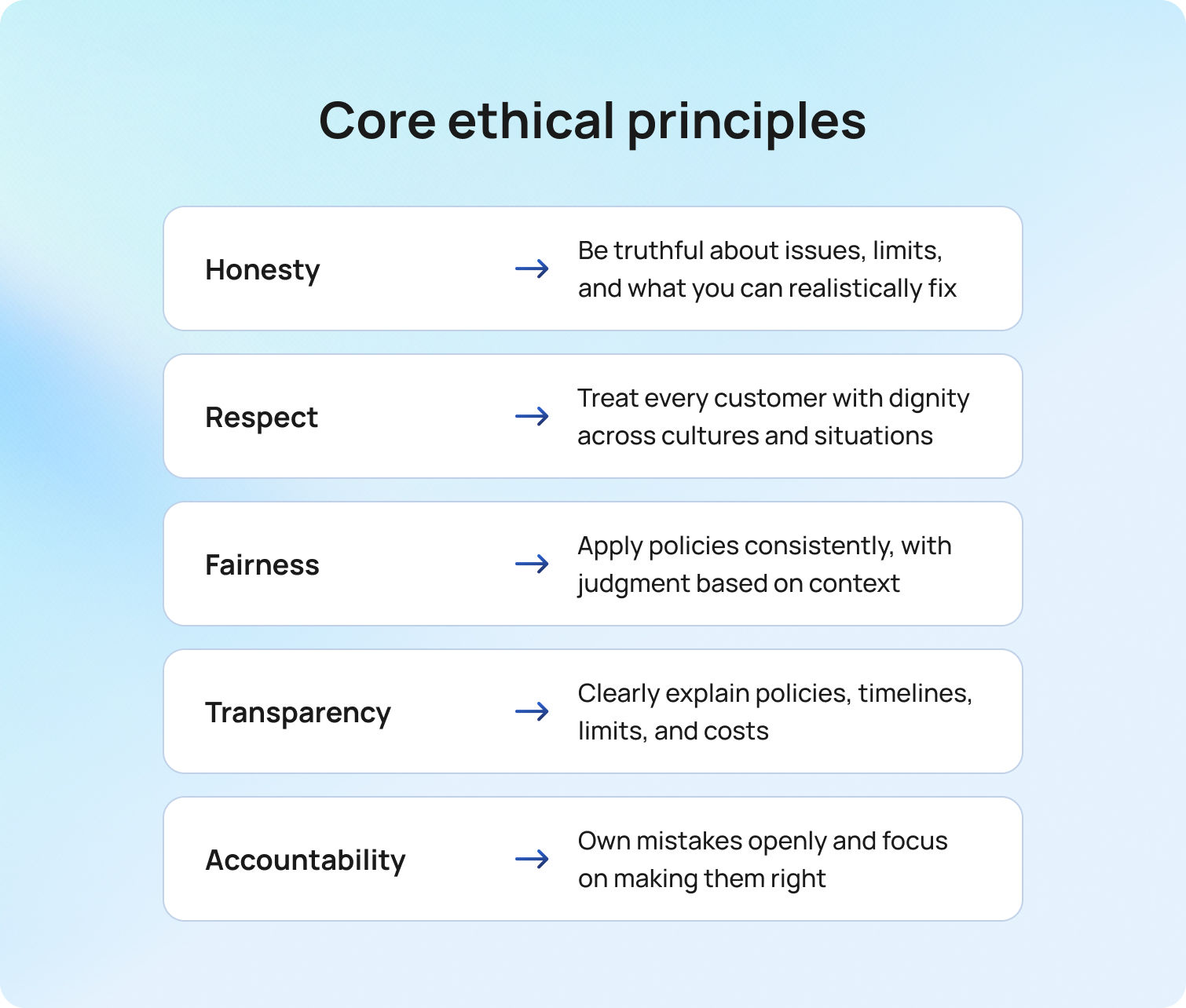
These are the ethical principles that should guide every customer service decision:
- Honesty: Tell the truth about what your product does, what went wrong, and what you can realistically fix. Don't make promises you can't keep to close a ticket or calm someone down temporarily.
- Respect: Treat every customer as a human being, worthy of your time and attention, regardless of their account value or how they're speaking to you. This includes respecting different cultures, different communication styles, and different values.
- Fairness: Apply policies consistently. If you bend the rules for one customer, you need a principle for when you would (or wouldn't) do the same for others. Fair doesn't always mean identical treatment—it means appropriate treatment based on circumstances and individual customer feedback.
- Transparency: Be clear about policies, limitations, timelines, and costs. Don't hide information in fine print or use deliberately confusing language. If customers need to know something to make an informed decision, tell them.
- Accountability: Own mistakes. Whether they're your personal error, your team's mistake, or a company-wide problem, taking responsibility is both ethical and practical. Customers forgive mistakes much more readily than they forgive dishonesty.
Empathy: Understand that behind every ticket is a person with a problem that matters to them. Empathetic language recognizes that you're dealing with human beings, not ticket numbers.
Common Ethical Issues in Customer Service (And How to Handle Them)
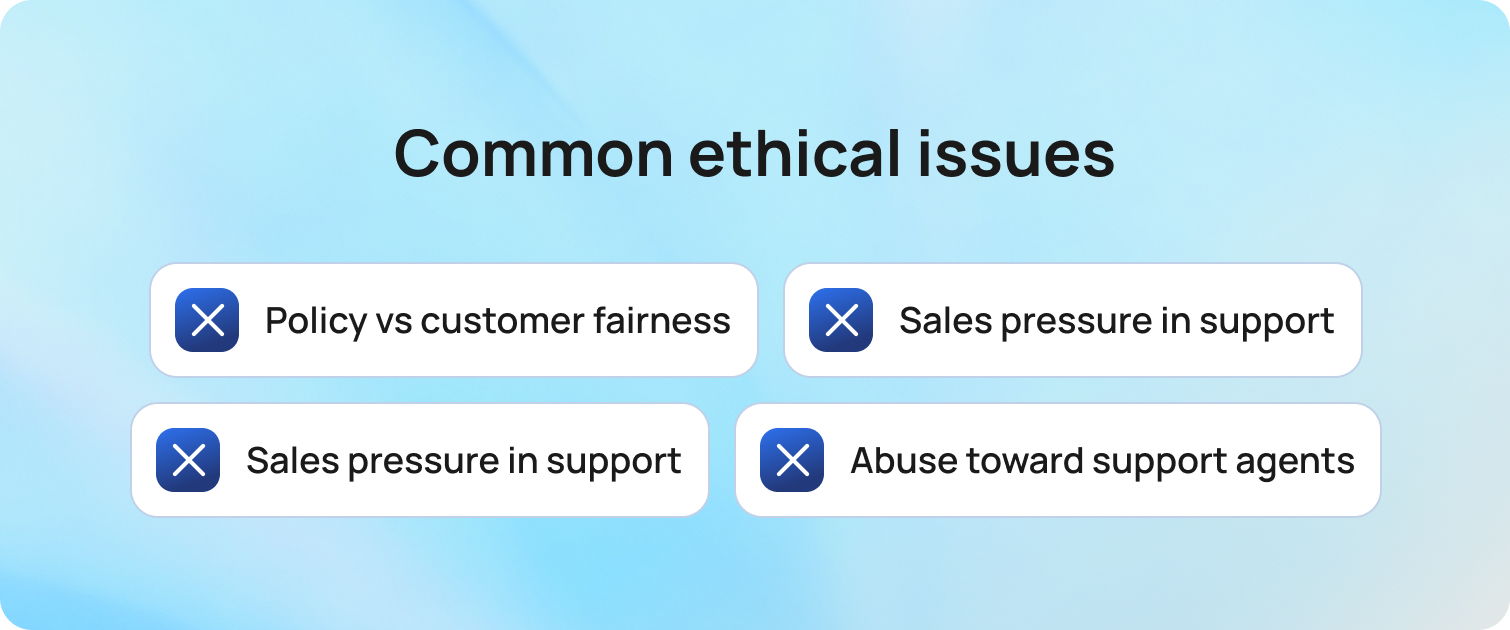
Here’s a handful of the most common ethical issues we see in customer service. We also provide recommendations on how to handle them properly.
When Policy Conflicts With Doing Right by the Customer
You'll face customer service situations where following the rulebook results in an obviously unfair outcome. Maybe someone missed a return deadline by one day due to a family emergency. Maybe a longtime loyal customer ran into a technical issue that falls outside your support scope.
How do ethical considerations affect customer service here? Rigid rule-following often feels safe, but it can be unethical. Ethical decision-making means understanding that policies are guidelines for typical situations (not substitutes for judgment).
The answer isn't abandoning all policies. It's training your support team to recognize when a situation warrants escalation, exception, or creative problem-solving. Give them authority to make judgment calls within defined boundaries.
Balancing Sales Pressure With Customer Needs
Some businesses pressure support teams to upsell during service interactions. This creates ethical dilemmas when customers clearly don't need the upgrade, can't afford it, or are calling about a problem the upsell won't fix.
Ethics and customer service mean your support team's job is solving problems. If upselling is part of the role, it should be:
- Genuinely helpful to the customer's situation
- Presented as an option, not a requirement
- Never disguised or manipulated
- Never prioritized over resolving the original issue
Customers who feel they're being sold to when they need help don't become happy customers — they become former customers.
Data Privacy and Information Handling
Your support team has access to sensitive customer information: purchase history, personal details, and communication records. Business ethics in customer service require protecting this information, using it only for legitimate purposes, and being transparent about how you handle it.
This includes:
- Not sharing customer information with unauthorized people (even coworkers who are "just curious")
- Using customer data only for service purposes, not for personal interests
- Following data protection regulations like GDPR
- Being honest with customers about what information you need and why
When Customers Treat Support Agents Badly
Telephone ethics customer service goes both ways. While agents should treat customers with respect, ethical considerations in customer service also mean protecting their team from abuse.
You can set clear guidelines that allow agents to end interactions when customers cross lines (threats, slurs, sustained verbal abuse). Ethical customer service doesn't mean accepting mistreatment. It means treating human beings (including your employees) with dignity.
Building a Customer Service Code of Ethics
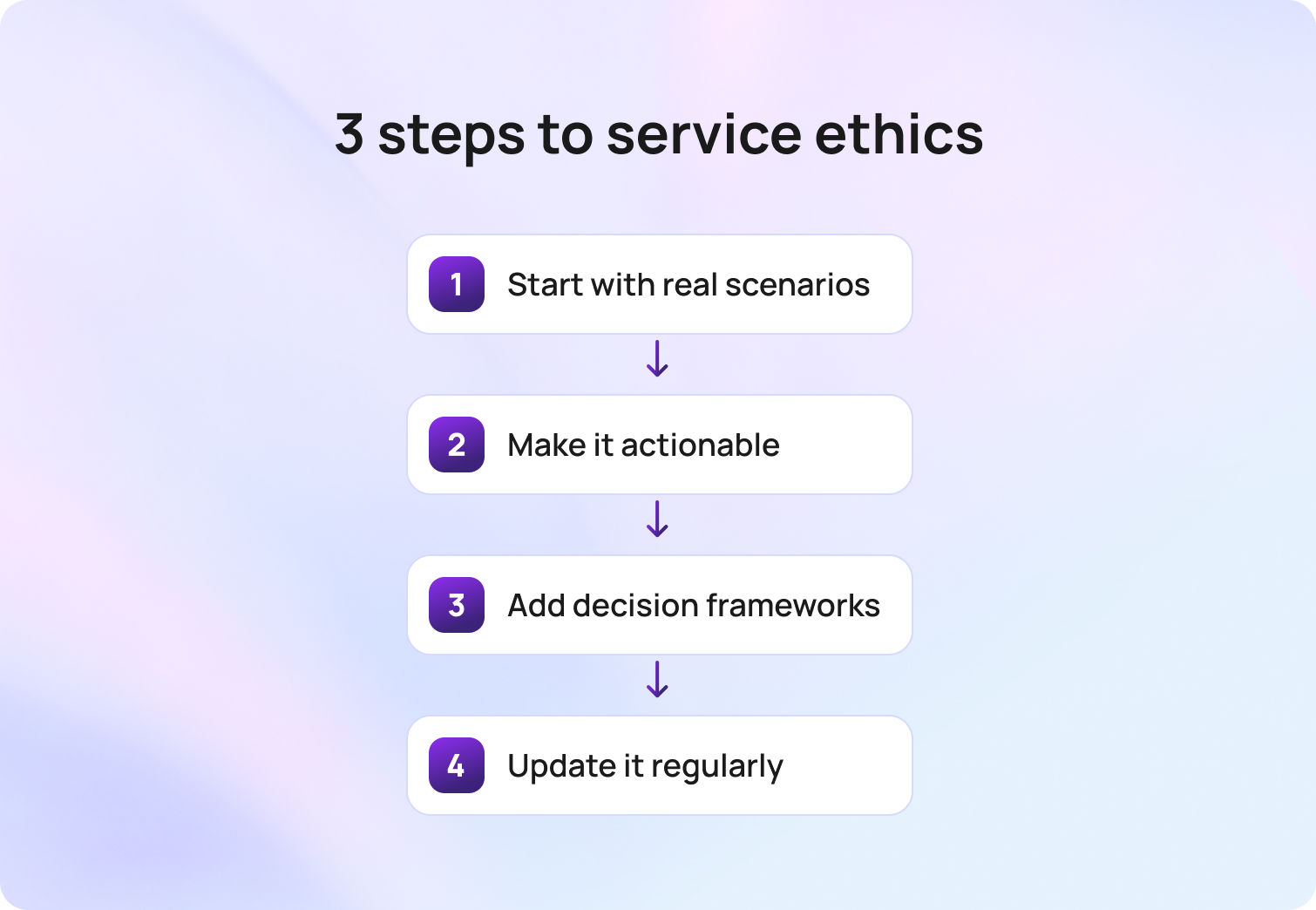
A code of ethics customer service document shouldn't be a legal boilerplate that nobody reads. It should be a practical guide that your team actually uses when facing ethical concerns.
Start with real scenarios your team faces:
- What do we do when a customer asks us to bend a rule?
- How do we handle customers who are clearly being taken advantage of by our confusing pricing?
- When do we escalate, and when do we make our own judgment call?
- How do we balance the company's interests with the customer's interests?
Make it actionable:
Instead of "We value integrity," write "If you realize you gave a customer incorrect information, contact them immediately to correct it—even if they've already closed the ticket."
Include decision-making frameworks:
When facing an ethical dilemma, ask:
- Would I be comfortable if this interaction were made public?
- Am I treating this customer the way I'd want my family treated?
- Am I following our stated values, not just our written policies?
- What's the long-term impact on customer trust?
Update it regularly:
Your customer service code of ethics should evolve as you encounter new ethical issues. When your team faces a situation where the answer isn't clear, use it to refine your code.
How Ethical Considerations Affect Customer Service Operations
Regular training on customer service ethics helps teams navigate gray areas where scripts don't help. Role-playing ethical dilemmas, discussing real situations, and hearing leadership explain why specific values matter all reinforce ethical behavior.
This training should cover:
- Common ethical issues specific to your business
- How to recognize when they're facing an ethical decision
- Who to escalate to when unsure
- Examples of good ethical decision-making from your own team
Create a Culture Where Ethics Matter
If leadership says "do what's right for the customer" but punishes agents for missing metrics when they spend extra time on complex cases, you're creating a culture where ethical customer service takes a back seat to numbers.
Ethical considerations in customer service require the ability to discern right from wrong in various situations.
- Leadership that models ethical behavior
- Metrics that don't incentivize shortcuts or dishonesty
- Recognition for agents who handle ethical dilemmas well
- Protection for whistleblowers who spot unethical practices
Support Agents in Diverse Customer Interactions
Your support crew deals with customers from diverse cultures, backgrounds, and values. What's considered respectful communication varies. How people express frustration differs. Context matters.
Ethics in customer service means training your team to:
- Recognize their own biases and assumptions
- Ask clarifying questions rather than assuming
- Find common ground despite different communication styles
- Adjust their approach while maintaining ethical standards
This isn't about being all things to all people—it's about treating diverse people fairly while holding to core principles.
The Business Case for Customer Service Ethics
Ethical behavior in customer service is morally right and good business. Ultimately, it’s a win-win for everyone involved.
- Customer retention costs less than acquisition: Loyal customers who trust you stick around. Unethical practices might squeeze short-term revenue, but they destroy long-term customer relationships.
- Word-of-mouth matters more than ever: One ethically-handled complaint that goes viral can be the best marketing you never paid for. One unethically handled situation can become a PR disaster.
- Your team stays longer: Employees want to work for companies they're proud of. High turnover in support often stems from forcing agents to do things that feel wrong—aggressive upselling, denying reasonable requests, and following policies that obviously harm customers.
You avoid legal and regulatory issues: Many ethical standards are also legal requirements. Building a culture of customer service ethics means compliance becomes natural instead of forced.
Move Beyond the Bare Minimum
The bare minimum is to follow the law and avoid apparent violations. Customer service ethics means going further. It means choosing to do right even when you could technically get away with less.
This looks like:
- Proactively fixing problems before customers notice
- Being honest about limitations instead of overpromising
- Giving customers information that helps them, even if it means they choose a competitor
- Treating every customer like they matter, not just the high-profile accounts
Companies that operate this way build reputations that become competitive advantages. They build customer experiences that people remember and recommend.
The current situation in customer service is that ethics often get framed as limitations: things you can't do, lines you can't cross. Better to frame them as what you stand for: honesty, fairness, respect, accountability.
These aren't restrictions on good service. They're the foundation of it.
Provide better customer service with tools purpose-made for improved interactions. Schedule a demo to see how BlueTweak expands what’s possible in customer support.

Aeroitalia Revolutionizes Passenger Experience Through Innovative Collaboration with BlueTweak’s Advanced Customer Support Platform
In the airline sector, where the vast skies connect people and places, the paramount importance of passenger satisfaction lies at the heart of every aviation company's mission. A key facet of this satisfaction hinges upon the critical interaction between passengers and the customer support services provided by airlines.
As travelers embark on their journeys, the seamless orchestration of services and the ability to address queries or concerns promptly become imperative. Recognizing the delicate equilibrium between technology and personalized service, aviation companies strive to create an environment where passengers not only traverse physical distances but also feel supported and valued throughout their entire travel experience. This intersection of technology and human-centric approaches is exemplified by the strategic collaboration between Aeroitalia and BlueTweak, signifying a leap forward in Aeroitalia's commitment to revolutionizing the travel experience.
Unique Support
At the core of this groundbreaking collaboration is the cutting-edge customer support platform, seamlessly integrating artificial intelligence to create a responsive and efficient support system. The decision to align forces with BlueTweak stems from their shared focus on enhancing customer satisfaction across every interaction.
AI Integration
The partnership is a strategic move aimed at revolutionizing the aviation industry's approach to customer support. This integration not only enhances operational efficiency but also contributes to an elevated customer satisfaction experience for Aeroitalia passengers.
Liviu Barbu, Director of Customer Service at Aeroitalia, articulates the significance of this collaboration, stating, "(…) our commitment to providing exceptional service is deeply ingrained in our organizational culture. We are excited about our partnership with BlueTweak, a company that mirrors our values and shares our dedication to a customer-centric approach. Their innovative solutions align seamlessly with our mission, enhancing our ability to deliver personalized and efficient support to our passengers. Together, we embark on a journey to elevate the standards of customer experience in the aviation industry."
Read more about: Navigating the Future: Customer Support Trends for 2024
Synergistic Human-AI Dynamics
Aeroitalia's customer support philosophy centers around a harmonious blend of human expertise and AI intelligence, ensuring a holistic and responsive support system for passengers. This collaboration signifies a strategic integration of advanced technology and a customer-centric approach.
Transparent Support Services
In a customer-centric move, Aeroitalia affirms its commitment to transparency by not charging extra for contacting their support team. This practice aligns seamlessly with the company's dedication to providing accessible and hassle-free support to passengers.
Multichannel Support Excellence
Aeroitalia's dedication to offering exceptional customer support across diverse channels is evident. While prioritizing voice support, the airline embraces chat, email, SMS, and webform interactions, catering to the diverse preferences and needs of their passengers.
Georgiana Vezeanu, Chief Marketing Officer at BlueTweak, states, “Our collaboration represents a paradigm shift in the aviation industry's approach to customer experience. By combining AeroItalia's commitment to excellence with BlueTweak's innovative customer support platform, we are poised to redefine industry standards. This partnership signifies a harmonious convergence of expertise and strategy, propelling both companies to the forefront of the industry. We are excited to showcase the power of intelligence in customer support and set a new benchmark for excellence.”
Read more about: Harnessing the Power of AI in Customer Support: Impact and Innovations
Pushing Boundaries in the Aviation Industry
Aeroitalia and BlueTweak's cooperation signifies a shared vision of pushing the boundaries in the aviation industry. Through the integration of advanced technology and a customer-centric approach, this partnership aims to redefine the travel experience and set new benchmarks for excellence.
The collaboration between Aeroitalia and BlueTweak is not merely a technological integration; it is a strategic alliance that holds the promise of reshaping the very fabric of the passenger experience in the aviation sector. With a keen focus on customer satisfaction, operational efficiency, and innovative support services, this collaboration is set to chart new territories in the realm of air travel.
About Aeroitalia
Aeroitalia is a prominent name in the aviation industry, committed to providing unparalleled travel experiences through a customer-centric approach and innovative solutions.
Read more about: Aeroitalia Revolutionizes Passenger Experience Through Innovative Collaboration with BlueTweak’s Advanced Customer Support Platform

Harnessing the Power of AI in Customer Support: Impact and Innovations
Today, the mix between technology and customer service has become imperative for thriving enterprises. As customer expectations surge, the integration of Artificial Intelligence (AI) into customer support functions has become crucial for organizations striving to meet the ever-growing demands of their clientele.
AI customer support, characterized by a suite of technologies including machine learning, natural language processing (NLP), and chatbots, represents a significant paradigm shift in the provision of customer service.
Redefining Service Excellence
Omnichannel AI-driven platforms are designed to meet the dynamic needs of modern businesses, where customers engage across multiple touchpoints. The integration of various channels—be it chat, email, social media, or phone—ensures a seamless and unified customer experience. However, the true power of these platforms lies not only in their ability to handle diverse channels but also in their commitment to continuous improvement through customer feedback.
The Forefront of Efficiency
Efficiency in contact centers is built on AI customer support bots, sophisticated virtual assistants equipped with advanced cognitive capabilities. These AI customer support bots leverage machine learning algorithms to understand customer inquiries, provide accurate responses, and resolve issues in real-time.
By deploying customer support AI chatbots, organizations can ensure round-the-clock availability, deliver consistent service across multiple channels, and significantly reduce response times, thereby enhancing operational efficiency and customer satisfaction.
Personalized Interactions
Generative AI for customer support is a groundbreaking innovation in personalized service delivery. Unlike traditional rule-based systems, generative AI possesses the ability to create contextually relevant responses based on the specific nuances of each customer interaction.
By harnessing generative AI for customer support, organizations can deliver highly personalized and engaging support experiences, anticipate customer needs, and foster deeper connections with their clientele, thereby enhancing brand loyalty and advocacy.
Read more about:The Human Touch in a Digital World: Navigating the Interplay of Automation and Personalization in Customer Support
The Impact of AI in Customer Support
The integration of AI into customer support yields plenty of benefits that extend across organizational performance and customer experience:
Enhanced Efficiency
AI-powered customer support systems streamline processes, automate routine tasks, and optimize workflows, resulting in significant improvements in operational efficiency and cost-effectiveness.
Improved Scalability
AI in customer support enables organizations to effortlessly scale their support operations to meet fluctuating demand, ensuring consistent service delivery and customer satisfaction, even during peak periods.
Personalized Experiences
AI-driven customer support facilitates personalized interactions, enabling organizations to tailor their support offerings to the unique preferences and needs of individual customers, thereby enhancing engagement and loyalty.
Benefits of AI in Customer Support
Cost Savings
By automating repetitive tasks and optimizing resource allocation, AI in customer support helps organizations reduce operational costs while maintaining service quality.
Greater Accessibility
AI-powered customer support systems ensure round-the-clock availability, providing customers with instant assistance regardless of time or location.
Data-Driven Decision Making
AI analytics provide organizations with valuable insights into customer behavior, enabling data-driven decision-making and continuous improvement of support strategies.
AI Ethics and Responsibility
While AI has revolutionized customer support, organizations must also prioritize ethical considerations in its deployment. Ensuring transparency, fairness, and accountability in AI algorithms and decision-making processes is paramount to building trust with customers and stakeholders.
Future Trends in AI Customer Support
Looking ahead, the evolution of AI in customer support is poised to continue, with advancements in areas such as emotion recognition, predictive analytics, and augmented reality reshaping the future of customer interactions.
The integration of AI into customer support represents a significant milestone in the evolution of customer service, offering organizations unprecedented opportunities to enhance efficiency, scalability, and personalization.
By harnessing the power of AI customer support bots and generative AI, organizations can deliver exceptional support experiences, foster deeper customer relationships, and drive sustainable growth in an increasingly competitive marketplace. As AI technologies continue to advance, businesses must embrace innovation and adapt to evolving customer expectations to remain competitive and future-proof their operations.
Read more about: Navigating the Future: Customer Support Trends for 2024

The Power of AI in Customer Support: A Catalyst for Agent Empowerment
In the dynamic landscape of customer support, Artificial Intelligence (AI) has emerged as a pivotal tool, revolutionizing the role of support agents and redefining customer interactions. This exploration examines the profound impact of AI on customer support agents, highlighting results and percentage-based metrics that underscore the significant changes facilitated by this technological evolution.
AI-Powered Automation for Efficient Query Handling
AI's capacity to automate routine tasks has significantly improved the efficiency of customer support operations. Organizations leveraging AI-driven automation report a substantial 30% reduction in the manual workload for support agents. This reduction empowers agents to redirect their efforts toward more complex problem-solving tasks, resulting in quicker response times and enhanced customer satisfaction.
The incorporation of AI-powered automation not only expedites query resolution but also ensures that support agents can dedicate more time to addressing intricate issues. This shift in focus contributes to an overall improvement in the quality of customer support interactions, fostering a positive impact on customer satisfaction levels.
Predictive Analytics Enhancing Issue Resolution
The integration of predictive analytics into customer support processes has proven invaluable in preemptively identifying and addressing potential customer issues. Organizations employing AI-driven predictive analytics report a significant 40% reduction in the number of escalated issues. This reduction not only prevents customer dissatisfaction but also allows support agents to allocate their time more effectively, focusing on resolving critical and high-impact problems.The utilization of predictive analytics in customer support not only streamlines issue resolution but also aids in building a proactive support environment. By foreseeing potential challenges, support agents can proactively address customer concerns, further contributing to an enhanced customer experience.
Chatbots Driving First-Line Support Efficiency
AI-driven chatbots have become a cornerstone for efficient handling of routine queries. Organizations embracing chatbots report a remarkable 50% improvement in first-response resolution rates. This improvement underscores the pivotal role of chatbots in swiftly managing repetitive queries, enabling human agents to concentrate on more intricate customer issues and enhancing overall support quality.
The deployment of AI-driven chatbots not only accelerates first-response resolution but also provides a seamless and consistent customer experience. Chatbots, equipped with AI capabilities, ensure that customers receive accurate and prompt information, contributing to heightened customer satisfaction and loyalty.
Enhanced Customer Insights and Personalization
AI not only aids in query resolution but also plays a pivotal role in understanding customer behavior and preferences. By analyzing vast datasets, AI provides support agents with valuable insights into individual customer histories and interaction patterns. This data-driven approach allows agents to offer personalized solutions, creating a more tailored and engaging customer experience. Insights from organizations employing AI for customer insights reveal a notable 25% increase in customer satisfaction levels.This personalized interaction goes beyond issue resolution, fostering a deeper connection between the customer and the brand. Support agents armed with AI-driven insights can anticipate customer needs, recommend relevant products or services, and address concerns before they arise. The combination of personalized support and proactive engagement not only enhances customer satisfaction but also contributes to increased customer loyalty and brand advocacy.
Read more:Understanding Customer Pain Points: Strategies for Effective Resolution
Continuous Learning and Adaptability
One of the key strengths of AI in customer support is its ability to continuously learn and adapt to evolving customer needs. Machine learning algorithms analyze interactions and feedback, allowing AI systems to refine and improve their performance over time. Organizations leveraging AI-driven customer support witness a remarkable 35% increase in the accuracy of issue resolution. This ongoing learning process not only ensures more accurate and efficient support but also positions support agents to stay ahead of emerging trends and challenges.
As customer preferences and market dynamics evolve, AI-equipped support agents can seamlessly adapt, providing relevant and up-to-date information. This adaptability not only enhances the overall agility of customer support teams but also future-proofs organizations against unforeseen changes in the business landscape.
Strategic Resource Allocation and Cost Savings
Beyond improving customer satisfaction, AI in customer support offers tangible benefits in terms of resource allocation and cost-effectiveness. The automation of routine tasks, coupled with predictive analytics, allows organizations to allocate human resources strategically. Insights from companies adopting AI-driven support mechanisms reveal a noteworthy 20% reduction in operational costs.By automating repetitive tasks and optimizing workflows, organizations can redirect resources to areas that require human expertise. This strategic allocation ensures that support agents can focus on complex problem-solving, elevating the overall quality of customer interactions. Additionally, the cost savings achieved through AI implementation can be reinvested in further enhancing customer support infrastructure or other strategic initiatives, creating a positive ripple effect throughout the organization.
Read more:The Power of Humanized Digital Experiences: Beyond Discounts and Loyalty Perks
In conclusion, the integration of AI into customer support operations is a transformative force, significantly impacting the capabilities and efficiency of support agents. The results emphasize the tangible benefits organizations experience through AI, such as reduced manual workload, improved issue resolution, and enhanced first-response efficiency. As businesses continue to harness the power of AI in customer support, the evolution towards more agile, responsive, and customer-centric support ecosystems is inevitable.
The percentages and metrics solidify the notion that AI is not just a technological innovation but a strategic imperative for organizations committed to delivering unparalleled customer experiences. As we look ahead, the continued integration of AI in customer support promises to redefine industry standards and elevate the role of support agents in shaping exceptional customer journeys.

Revolutionizing Customer Experience: Insights from Cutting-Edge Research in Customer Support and Service
In today's hyper-competitive business landscape, providing exceptional customer support and service is no longer a luxury but a necessity. Companies across industries are increasingly recognizing the pivotal role of customer experience in shaping their success. To gain a comprehensive understanding of the evolving dynamics in customer support, we delve into recent research findings that shed light on the strategies and trends shaping these crucial aspects of modern business.
I. The State of Customer Expectations
A. Dynamic Customer Expectations
Recent studies reveal a paradigm shift in customer expectations. Consumers now demand more than just satisfactory service; they seek personalized, seamless, and proactive support. The days of reactive customer service are fading away as customers expect companies to anticipate their needs and address issues before they arise.
B. The Role of Technology
Technology is a driving force in shaping customer expectations. Advances in artificial intelligence (AI), chatbots, and automation are providing businesses with tools to enhance customer interactions. Research suggests that customers are increasingly comfortable with AI-driven support, especially when it streamlines processes and accelerates issue resolution.
II. The Impact of Omnichannel Support
A. The Rise of Omnichannel
Customers today engage with companies across multiple channels, from traditional phone calls to social media and live chat. Research highlights the importance of offering a seamless, omnichannel experience, where customers can transition effortlessly between channels without compromising the quality of service. Companies investing in omnichannel support are reaping the rewards of higher customer satisfaction and loyalty.
B. Challenges in Implementing Omnichannel Support
While the benefits of omnichannel support are evident, research identifies challenges in its implementation. Maintaining consistency across channels, integrating data from various touchpoints, and ensuring a unified customer journey remain complex tasks. Companies need to invest in robust systems and processes to overcome these challenges and deliver a cohesive omnichannel experience.
Read more:Revolutionizing Customer Support: A Guide to Implementing Omnichannel Solutions
III. The Human Touch in a Digital Era
A. Balancing Automation and Human Interaction
While automation and AI are transforming customer support, the human touch remains irreplaceable. Research suggests that customers appreciate a blend of automation for efficiency and human interaction for empathy and understanding. Striking the right balance between technology and human touch is crucial for delivering a customer experience that resonates with modern expectations.
B. Emotional Intelligence in Customer Service
Studies highlight the growing importance of emotional intelligence in customer service interactions. Customer support representatives equipped with high emotional intelligence can better understand and empathize with customer concerns, leading to more positive and memorable experiences. Companies are increasingly prioritizing emotional intelligence training for their customer-facing teams.
Read more:What’s Next for the Voice of the Customer Market?
IV. Data-Driven Insights for Customer Success
A. Harnessing the Power of Data
In the age of big data, companies are leveraging customer data to gain valuable insights. Research emphasizes the role of data analytics in understanding customer behavior, preferences, and pain points. By harnessing the power of data, businesses can make informed decisions, personalize customer interactions, and pre-emptively address issues.
B. Privacy Concerns and Ethical Practices
As companies collect and analyze vast amounts of customer data, research underscores the importance of privacy and ethical practices. Customers are increasingly concerned about how their data is handled, and businesses that prioritize transparency and ethical data practices build trust and credibility.
V. Customer Feedback and Continuous Improvement
A. The Value of Customer Feedback
Customer feedback is a goldmine of information for businesses seeking to enhance their customer support and service. Research emphasizes the significance of actively seeking and analyzing customer feedback to identify areas for improvement and measure the effectiveness of customer service initiatives.
B. Implementing a Culture of Continuous Improvement
Companies that prioritize a culture of continuous improvement in customer service outperform their competitors. Research suggests that fostering a mindset of ongoing enhancement, supported by robust feedback mechanisms, allows businesses to adapt to changing customer expectations and stay ahead in the competitive landscape.
Read more:Adapting to Customer Expectations: A Holistic Approach to Customer Experience
VI. Challenges and Opportunities in Global Customer Support
A. Cross-Cultural Considerations
For businesses operating on a global scale, understanding and addressing cross-cultural differences is paramount. Research delves into the challenges of providing consistent and culturally sensitive customer support across diverse regions and highlights strategies for overcoming these hurdles.
B. Language and Communication Challenges
Effective communication is at the heart of successful customer service. Research identifies language barriers as a significant challenge, particularly in multinational customer support operations. Companies are exploring innovative solutions, such as multilingual support teams and translation technologies, to bridge these communication gaps.
In conclusion, the landscape of customer support, service, and experience is undergoing a profound transformation driven by evolving customer expectations and technological advancements. As businesses navigate these changes, the insights gleaned from recent research become invaluable in shaping strategies that prioritize customer satisfaction and loyalty.
Whether through the adoption of omnichannel support, the judicious use of technology, or the cultivation of emotional intelligence, companies that proactively embrace these trends are poised to lead the way in delivering exceptional customer experiences.
As the business landscape continues to evolve, staying attuned to the latest research findings will be essential for companies seeking to thrive in the dynamic world of customer support and service.

Choosing the Right Customer Support Platform: A Comprehensive Guide
In the digital age, where customer satisfaction is paramount, selecting the right customer support platform is a critical decision for businesses of all sizes. A robust customer support system not only addresses user issues but also plays a pivotal role in shaping the overall customer experience. In this article, we will explore the criteria for selecting a customer support platform.
Understanding the Importance of Customer Support
Before delving into the criteria for selecting a customer support platform, it's essential to grasp why customer support is a cornerstone of business success. In a competitive market, where customers have various choices, providing exceptional support can be a key differentiator. Excellent customer support not only resolves issues but also fosters customer loyalty, positive word-of-mouth, and repeat business.
Key Criteria for Choosing a Customer Support Platform
1. Multi-Channel Support:
Ensure the platform supports multiple communication channels, such as email, live chat, phone, and social media.
Customers today prefer diverse communication options. A platform that integrates various channels streamlines communication and enhances accessibility.
2. Ticketing System:
Evaluate the ticketing system's efficiency, automation capabilities, and customization options.
A robust ticketing system organizes and prioritizes customer issues, improving response times and overall efficiency.
3. Knowledge Base:
Assess the platform's ability to create, organize, and maintain a comprehensive knowledge base.
A well-structured knowledge base empowers customers to find solutions independently, reducing the workload on support agents.
4. Automation and AI Integration:
Look for features like chatbots, automated responses, and AI-driven insights.
Automation streamlines routine tasks, enabling support teams to focus on complex issues, ultimately enhancing productivity and response times.
5. Scalability:
Evaluate how well the platform can scale with the growth of your business.
As your customer base expands, the support platform should seamlessly accommodate increased workloads without compromising performance.
6. Analytics and Reporting:
Examine the analytics and reporting tools for insights into support performance.
Data-driven decisions are crucial for improving customer support. Analytics help identify trends, measure agent performance, and enhance overall service quality.
7. Integration Capabilities:
Check the platform's compatibility with other tools and software used in your organization.
Seamless integration with CRM, help desk, and other business applications ensures a cohesive workflow and a unified view of customer interactions.
8. Customization Options:
Assess the level of customization available for workflows, ticket forms, and user interfaces.
Customization tailors the platform to your specific business needs, improving user experience and overall efficiency.
9. Collaboration Features:
Look for collaborative tools that enable internal communication and knowledge sharing among support agents.
Effective collaboration ensures that complex issues are resolved promptly, providing a unified front in addressing customer concerns.
10. Security and Compliance:
Ensure the platform complies with data protection regulations and industry-specific standards.
Protecting customer data is paramount. A secure platform builds trust and safeguards sensitive information from potential breaches.
Read more:Building Trust in Customer Support: Tips for Creating Long-Lasting Customer Relationships
Decision-Making Process: Step-by-Step Guide
1. Define Your Requirements:
Clearly outline your business's unique needs and challenges to identify the specific features and capabilities required in a customer support platform.
2. Research and Shortlist:
Research available customer support platforms, considering industry reviews, user feedback, and case studies. Shortlist platforms that align with your defined requirements.
3. Demo and Trial Period:
Request demos from the shortlisted vendors and, if possible, engage in a trial period. This hands-on experience will provide insights into the platform's usability and compatibility with your business processes.
4. Evaluate Costs and ROI:
Consider the total cost of ownership, including licensing fees, implementation costs, and potential training expenses. Assess the return on investment (ROI) by weighing the platform's benefits against its costs.
5. Seek References:
Reach out to existing customers of the shortlisted platforms to gather firsthand insights into their experiences. Ask about the platform's strengths, weaknesses, and overall satisfaction.
6. Scalability and Future-Proofing:
Ensure that the selected platform can grow with your business. Assess its scalability and future-proofing capabilities to avoid the need for frequent system changes.
7. Security and Compliance Check:
Verify the platform's security measures and its compliance with relevant data protection regulations. Prioritize platforms that prioritize the security and privacy of customer information.
8. Vendor Support and Training:
Evaluate the level of support provided by the vendor, including training options and ongoing assistance. A responsive vendor support team is crucial for resolving issues promptly.
9. Final Decision:
Consolidate the gathered information, analyze the pros and cons of each platform, and make an informed decision based on your business's unique requirements and priorities.
Read more:Customer Experience Benefits: Reasons to Invest in CRM Software
Choosing the right customer support platform is a strategic decision that directly impacts the success of a business. By carefully considering the criteria mentioned above and following a systematic decision-making process, organizations can ensure they invest in a platform that not only addresses current needs but also positions them for future growth and success in delivering exceptional customer support. Remember, the right customer support platform is not just a tool; it's a partner in building lasting customer relationships and fostering business success.

Enhancing Customer Satisfaction and Reducing Costs: The Power of Omnichannel Customer Support Platforms
In today's rapidly evolving business landscape, customer satisfaction and cost-effectiveness are two paramount factors that can make or break a company. As businesses strive to stay competitive, the need for efficient customer support solutions has become more crucial than ever. Omnichannel customer support platforms are emerging as a game-changer, offering a seamless and integrated experience across various communication channels. This article explores how omnichannel customer support platforms can decrease costs and simultaneously increase client satisfaction, supported by relevant studies and examples.
1. The Evolution of Customer Support
1.1 Traditional Customer Support Challenges
Traditional customer support models often involved siloed communication channels, leading to fragmented and inconsistent customer experiences. Call centers, email support, and live chat operated independently, resulting in a lack of cohesion and understanding of the customer's journey.
1.2 Rise of Omnichannel Customer Support
Omnichannel customer support integrates various communication channels, such as phone, email, chat, social media, and more, into a unified platform. This approach allows businesses to provide a seamless and consistent experience as customers transition between channels. The shift from multichannel to omnichannel is driven by the desire to meet customers where they are and offer a holistic support experience.
2. Decreasing Costs Through Omnichannel Support
2.1 Efficiency and Resource Optimization
Studies have shown that implementing omnichannel support can significantly enhance efficiency and resource allocation. Companies with strong omnichannel customer engagement strategies retain an average of 89% of their customers, compared to 33% for those with weak strategies.
Omnichannel platforms streamline processes, enabling agents to handle multiple interactions concurrently. This reduces the need for additional staff, leading to substantial cost savings. A study found that companies adopting omnichannel strategies experienced a 25-30% reduction in operational costs.
2.2 Self-Service Options
Omnichannel support empowers customers to resolve issues independently through self-service options. Organizations offering effective self-service options through omnichannel platforms experienced a 20% reduction in support costs. Additionally, customers appreciate the convenience of finding solutions on their own, contributing to increased satisfaction.
3. Increasing Client Satisfaction with Omnichannel Support
3.1 Personalized and Contextual Interactions
One of the key advantages of omnichannel support is the ability to provide personalized and contextual interactions. When customers reach out for support, an omnichannel platform allows agents to access a comprehensive history of interactions across all channels. This ensures a more personalized and informed response, demonstrating that the company values the customer's time and loyalty.
A study revealed that 84% of customers feel frustrated when the agent does not have information about their previous interactions. Omnichannel support addresses this pain point, leading to a more positive customer experience.
3.2 Reduced Customer Effort
Customer effort refers to the ease with which customers can resolve issues or obtain information. High customer effort is often associated with dissatisfaction and reduced loyalty. Omnichannel support platforms focus on minimizing customer effort by providing a seamless transition between channels and resolving issues in a timely manner.
A study found that reducing customer effort has a more significant impact on loyalty than exceeding customer expectations. Omnichannel support, by its nature, simplifies the customer journey, leading to decreased effort and increased satisfaction.
Read more: Elevating Customer Engagement: The Transformative Role of Chatbots
4. Case Studies Illustrating Success
4.1 E-commerce Success
An e-commerce giant is renowned for its customer-centric approach. The company seamlessly integrates various channels, including website, mobile app, and voice-enabled devices, to offer a unified shopping experience. Studies show that this company's emphasis on omnichannel support has contributed to its exceptional customer satisfaction ratings and customer retention rates.
4.2 Coffee Retailer
A global coffee retailer leverages omnichannel support to bridge the gap between its digital and in-store experiences. Through the retailer's mobile app, customers can order ahead, pay digitally, and earn rewards. The seamless integration of these channels enhances customer convenience and satisfaction. Studies indicate that this coffee retailer's omnichannel strategy has led to increased customer loyalty and higher average transaction values.
Read more: Enhancing Customer Experiences through Immersive CX
5. Overcoming Challenges in Implementing Omnichannel Support
5.1 Integration and Technology Challenges
While the benefits of omnichannel support are evident, businesses often face challenges in implementing and integrating these platforms. Technological complexities, legacy systems, and data silos can hinder the seamless flow of information across channels. Companies must invest in robust integration solutions and user-friendly interfaces to ensure a smooth transition to omnichannel support.
5.2 Employee Training and Adaptation
The success of omnichannel support depends on the proficiency of support agents in navigating and utilizing the platform effectively. Employee training programs should be comprehensive, addressing the nuances of each channel and emphasizing the importance of a unified customer experience. Studies emphasize the need for ongoing training to keep support teams updated on new features and best practices.
Read more: Navigating the Future: Customer Support Trends for 2024
6. The Future of Omnichannel Customer Support
6.1 Emerging Technologies and Trends
The future of omnichannel customer support is marked by the integration of emerging technologies. Artificial intelligence (AI), chatbots, and predictive analytics are poised to play a significant role in enhancing the efficiency and effectiveness of customer support. Studies suggest that companies embracing these technologies within their omnichannel strategy are likely to see further improvements in customer satisfaction and cost reduction.
6.2 Data-Driven Decision Making
As omnichannel support platforms accumulate vast amounts of customer data, the ability to extract actionable insights becomes crucial. Businesses can leverage analytics tools to gain a deeper understanding of customer behavior, preferences, and pain points. Studies demonstrate that organizations employing data-driven decision-making processes within their omnichannel strategies are better equipped to make informed decisions and further optimize customer satisfaction.
Omnichannel customer support platforms represent a transformative approach to addressing the dual challenges of decreasing costs and increasing client satisfaction. Supported by numerous studies and real-world examples, the evidence is clear: businesses that prioritize the seamless integration of communication channels and personalized customer interactions are poised for success in the modern marketplace.
As technology continues to advance and customer expectations evolve, the role of omnichannel support will only become more central to the success of businesses across industries. By embracing this paradigm shift and investing in the right technology and training, companies can achieve a delicate balance between operational efficiency and customer-centricity, ultimately creating a winning formula for sustained growth and competitiveness.

Elevating Customer Support Excellence: The Crucial Role of Feedback Integration in Omnichannel AI-Driven Platforms
In the fast-paced realm of customer support, where interactions transcend traditional boundaries and seamlessly traverse various channels, the need for a comprehensive and intelligent solution has never been more critical. Omnichannel AI-driven platforms stand at the forefront of innovation, and in this blog article, we'll explore the indispensable importance of feedback integration, shedding light on the pivotal role of the survey feature and how it contributes to delivering impactful feedback for businesses.
Understanding the Omnichannel Landscape
Omnichannel AI-driven platforms are designed to meet the dynamic needs of modern businesses, where customers engage across multiple touchpoints. The integration of various channels—be it chat, email, social media, or phone—ensures a seamless and unified customer experience. However, the true power of these platforms lies not only in their ability to handle diverse channels but also in their commitment to continuous improvement through customer feedback.
The Essence of Feedback Integration
Feedback integration is the linchpin that elevates customer support from merely reactive to proactively insightful. In the context of omnichannel AI-driven platforms, it involves seamlessly incorporating customer feedback mechanisms into the fabric of the platform. This integration fosters a loop of continuous improvement, where every interaction becomes an opportunity to refine and enhance the customer experience.
Real-Time Insights for Rapid Response
One of the primary advantages of feedback integration in omnichannel AI-driven platforms is the ability to capture real-time insights. Customers can provide feedback instantly, allowing businesses to identify and address issues promptly. This rapid response mechanism ensures that customer concerns are not only acknowledged but swiftly resolved, contributing to increased satisfaction and loyalty.
Survey Feature: Unveiling the Customer Experience Landscape
At the heart of feedback integration strategies lies the survey feature—a powerful tool that enables businesses to gain nuanced insights into the customer experience. Surveys can be strategically deployed at various touchpoints, gauging satisfaction levels, identifying pain points, and uncovering areas for improvement.
Read more:Elevating Customer Engagement: The Transformative Role of Chatbots in Modern Support Strategies
The Role of the Survey Feature
Customizable Surveys for Tailored Feedback
The survey feature empowers businesses with the flexibility to create customizable surveys tailored to their unique needs. Whether measuring customer satisfaction post-interaction or gathering insights on specific aspects of the support process, the survey feature ensures that feedback is both meaningful and relevant.
Multi-Channel Survey Deployment
In the omnichannel landscape, customers interact through diverse channels. The survey feature accommodates this diversity by facilitating multi-channel survey deployment. Whether a customer engages through chat, email, or any other channel, the survey seamlessly follows, ensuring a comprehensive understanding of the customer’s journey.
Data-Driven Decision Making
Surveys within omnichannel AI-driven platforms are not just about collecting feedback; they are about transforming raw data into actionable insights. Businesses can leverage the power of analytics to identify trends, patterns, and correlations in customer feedback. This data-driven approach empowers businesses to make informed decisions that resonate with customer needs and expectations.
Read more:Crafting a Personalized Customer Experience: A Path to Brand Loyalty and Success
Delivering Impactful Feedback for Business Growth
Enhanced Customer Satisfaction and Loyalty
By actively seeking and addressing customer feedback, businesses can enhance overall customer satisfaction. Satisfied customers are more likely to become loyal patrons, contributing to long-term business growth and positive brand advocacy.
Agile Adaptation to Customer Needs
Customer preferences and expectations evolve over time. The survey feature allows businesses to stay agile and adapt to these changes. Continuous feedback ensures that businesses can proactively align their strategies with shifting customer needs, staying ahead in a competitive landscape.
Building a Customer-Centric Culture
The integration of feedback mechanisms fosters a customer-centric culture within organizations. When every team member recognizes the value of customer feedback, it becomes a shared responsibility to deliver excellence. This cultural shift is instrumental in creating a sustainable foundation for long-term success.
Read more:Customer Feedback 2.0: Turning Complaints into Opportunities for Improvement
Elevating Customer Support to Unprecedented Heights
In the realm of customer support, where each interaction is a crucial touchpoint, feedback integration becomes the catalyst for growth and improvement. The commitment to providing a robust, omnichannel AI-driven platform extends beyond efficient handling of queries—it actively shapes a customer-centric ecosystem. The survey feature, with its ability to unveil the customer experience landscape, empowers businesses to glean impactful insights, foster continuous improvement, and ultimately elevate customer support to unprecedented heights. As businesses embrace the symbiotic relationship between feedback integration and customer satisfaction, the journey towards excellence becomes not just a strategy but a defining principle in the dynamic landscape of customer support.



