


Radu Dumitrescu

As Head of Digital Transformation, Radu looks over multiple departments across the company, providing visibility over what happens in product, and what are the needs of customers. With more than 8 years in the Technology era, and part of BlueTweak since the beginning, Radu shifted from a developer (addressing end-customer needs) to a more business oriented role, to have an influence and touch base with people who use the actual technology.
Recent articles

Enhancing the Customer Experience with AI Customer Support Platforms
Delivering exceptional customer experiences is crucial for maintaining a competitive edge. It is no longer sufficient to provide a good product or service; companies must ensure that every customer interaction is memorable and positive. As AI-powered solutions become more prevalent, their role in enhancing customer experience (CX) is increasingly significant.
Transforming Customer Experience Management
Customer experience management (CXM) has evolved to focus on providing consistent and seamless service across all customer touchpoints. Customers expect businesses to work efficiently on their behalf. This integration ensures a cohesive and unified customer journey.
Consistency is a key driver of customer satisfaction. While extraordinary customer service stories grab attention, it is the everyday, reliable interactions that truly build customer loyalty.
The Role of AI in Customer Support
To enhance their customer support capabilities, businesses are increasingly turning to AI. AI-driven customer support platforms offer significant improvements in efficiency through automation, enabling faster responses and personalized interactions at a scale. However, the true value lies in combining AI with human touch.
AI should augment, not replace, human interactions. Integrating AI with human support teams enhances response accuracy and efficiency, allowing human agents to tackle complex issues requiring empathy and creativity.
Read more about:Revolutionizing Customer Experience: Insights from Cutting-Edge Research in Customer Support and Service
Addressing CXM Implementation Challenges
Implementing effective CXM strategies presents several challenges. Organizations often struggle to align internal objectives with customer-centric goals. It is crucial to view internal metrics through a customer-focused lens. For example, goals like reducing call times may boost operational efficiency but could harm overall customer satisfaction if not managed properly.
Securing leadership support is vital for successful CX initiatives. Backing from top management ensures resource allocation and facilitates organizational change. Demonstrating the ROI of CX investments through compelling customer stories and actionable insights can persuade decision-makers to provide the necessary support.
Utilizing Data for Enhanced CX
A cornerstone of effective CXM is extracting actionable insights from data. Advanced analytics tools allow businesses to track customer interactions across various channels and proactively identify pain points. This data-driven approach informs operational adjustments and guides product improvements based on customer feedback.
Understanding customer preferences and behavior is essential. By using AI to analyze customer sentiment and predict needs, companies can address issues before they escalate, leading to higher satisfaction and retention rates.
Expanding Omnichannel Communication using AI in Customer Support
Modern customers expect seamless interactions across multiple channels, from chatbots and social messaging to traditional phone support. While diversifying communication channels can improve accessibility, it is crucial to ensure adequate resources to maintain quality standards.
Supporting each channel effectively is essential. Businesses must align channel expansion with their operational capabilities to deliver consistent service experiences across all platforms.
Read more about: Revolutionizing Customer Support: A Guide to Implementing Omnichannel Solutions
The Future of CXM & AI Customer Support Platforms
As companies navigate the complex landscape of modern customer expectations, integrating AI into CXM strategies offers both challenges and opportunities. By using AI Customer Support Platforms to automate routine tasks and personalize interactions, businesses can elevate their customer service standards while freeing up human agents to build meaningful connections.
Read more about: Choosing the Right Customer Support Platform: A Comprehensive Guide
Ultimately, the future of customer experience lies in the synergy between AI and human empathy. This combination promises to redefine how businesses engage with their customers, foster lasting relationships, enhance brand loyalty, and thrive in an increasingly competitive market.
By adopting a comprehensive approach to CXM—driven by AI insights and supported by human intuition—organizations can create exceptional customer experiences that lead to sustained success.

Superior Customer Support – Best Practices & AI Transparency
Utilizing artificial intelligence (AI) to enhance customer support services is becoming increasingly critical. According to recent studies, 65% of customer experience (CX) leaders view AI as a strategic necessity, noting that it has revolutionized previous CX operations.
Despite its immense potential, many businesses are still exploring how to optimally integrate advanced AI to improve customer interactions. This article provides insights and best practices into utilizing AI for superior customer support, with a focus on AI transparency and best practices to ensure an exceptional customer experience.
Understanding AI-Driven Customer Experience & Best Practices
An AI-driven customer experience involves employing AI technologies—such as machine learning, chatbots, and digital agents—to deliver quick, efficient, personalized, and proactive customer interactions at scale. This approach enhances customer satisfaction, boosts the productivity of CX teams, and helps businesses reduce costs.
1. Delivering Exceptional Customer Service at Scale
AI enables businesses to handle higher support volumes without compromising customer satisfaction. AI tools can provide agents with valuable insights to personalize interactions. For instance, AI can identify and label customer intent, sentiment, and language, equipping agents with the necessary context to address customer needs effectively. Additionally, deploying bots across various channels—such as email, social media, and live chat—allows businesses to scale their support operations, especially during peak times like the holiday season or product launches.
2. Providing 24/7 Support
Customers expect immediate, round-the-clock support, whether from humans or bots. AI-driven digital agents can engage in natural, human-like conversations at any time, ensuring that customers receive prompt responses to their inquiries. This not only improves customer satisfaction but also frees up human agents to handle more complex issues. AI tools can also assist agents by suggesting prewritten responses based on the context of the conversation, further speeding up response times and reducing wait times.
3. Accelerating Team Onboarding
AI can facilitate the onboarding process for new customer service agents by acting as a virtual assistant. It can provide real-time tips, feedback, and examples of how to handle various customer inquiries. This support helps new hires get up to speed more quickly, improving overall team productivity and efficiency.
Read more about: Ticket Data for Proactive Support: Building Long-Term Relationship
The Importance of AI Transparency. Customer Experience Best Practices
As AI becomes more integrated into customer support, ensuring transparency is paramount. Customers and agents alike need to understand when they are interacting with AI and how their data is being used.
Transparent AI best practices for customer support include:
- Clear Communication: Inform customers when they are engaging with an AI-driven tool or agent. Transparency about the use of AI helps build trust and sets realistic expectations for interaction.
- Data Privacy: Ensure that customer data is handled securely and transparently. Provide clear information about data usage and storage and allow customers to opt out if they choose.
- Ethical AI: Implement ethical guidelines for AI usage to avoid biases and ensure fair treatment of all customers. Regularly audit AI systems to detect and mitigate any biases that may arise.
Read more about: Communication Mastery: Best Practices for Agents in Customer Support Interactions
Best Practices for Implementing AI in Customer Support
To maximize the benefits of AI in customer support, businesses should follow these best practices:
- Start Small: Begin with a pilot program to test AI tools and gather feedback. This approach allows for adjustments and improvements before a full-scale rollout.
- Integrate Seamlessly: Ensure AI tools integrate smoothly with existing customer support systems. This integration minimizes disruptions and maximizes the efficiency of both AI and human agents.
- Focus on Training: Train customer support teams to work effectively with AI tools. Comprehensive training ensures that agents understand how to leverage AI insights and support to enhance their performance.
- Monitor and Adjust: Continuously monitor AI performance and gather feedback from both customers and agents. Use this feedback to make necessary adjustments and improvements to AI systems.
- Maintain Human Touch: While AI can handle many tasks, maintaining a human touch is crucial for complex or sensitive customer interactions. Ensure a seamless handoff to human agents when needed.
Read more about: The Power of AI in Customer Support: A Catalyst for Agent Empowerment
Integrating AI into customer support offers significant advantages, including enhanced efficiency, improved customer satisfaction, and reduced operational costs. By focusing on AI transparency and adhering to best practices, businesses can ensure that AI-driven customer support enhances rather than detracts from the customer experience. As AI technology continues to evolve, staying informed and adaptable will be key to leveraging its full potential in customer support operations.

Benefits of Using Chatbot Templates to Improve Customer Experience
Chatbots have revolutionized customer support by offering efficient, scalable, and consistent interactions. From answering queries to collecting contact information, chatbots perform various tasks, significantly improving the customer experience. By utilizing chatbot templates, businesses can quickly deploy sophisticated conversational AI solutions that enhance agent productivity and customer satisfaction.
Chatbot templates are pre-built conversational flows designed to guide customers through specific tasks using artificial intelligence (AI). These templates are customizable, allowing businesses to tailor them to their specific needs and branding. Templates eliminate the need to build chatbots from scratch, making them accessible to companies of all sizes.
Benefits of Using Chatbot Templates for Your Customers
Utilizing chatbot templates offers several advantages for your customer experience:
- Quick Deployment: Chatbot templates enable rapid implementation of conversational AI experiences without extensive development time.
- No Developer Support Required: Businesses can set up and customize chatbots without needing a dedicated developer team.
- High Customizability: Templates can be tailored to fit the unique needs and tone of the business, ensuring consistent brand communication.
- Scalability: Chatbots can handle multiple inquiries simultaneously, increasing support capacity without additional headcount.
- Enhanced Agent Productivity: By automating routine tasks, chatbots free up human agents to focus on more complex and value-added interactions.
Read more about: Elevating Customer Engagement: The Transformative Role of Chatbots in Modern Support Strategies
Levels of Chatbot Complexity
Chatbots can be classified into different levels based on their complexity and functionality:
- Rule-Based Chatbots: These bots operate based on predefined rules and scripts. They are ideal for handling straightforward tasks like FAQs and basic customer queries.
- AI-Powered Chatbots: Utilizing natural language processing (NLP) and machine learning, these chatbots understand and respond to a wider range of queries, providing more personalized and context-aware interactions.
- Contextual Chatbots: These advanced bots can remember past interactions and use context to offer relevant responses, making the customer experience seamless and coherent.
Reducing Agent Workload with Chatbots
Chatbots and Chatbot Templates significantly ease the workload for customer support agents by automating repetitive and time-consuming tasks:
- Handling Routine Inquiries: Chatbots can manage frequently asked questions, allowing agents to focus on complex issues that require human intervention.
- Data Collection: Bots can gather essential information from customers, such as contact details and order numbers, streamlining the support process for agents.
- Providing 24/7 Support: Chatbots offer round-the-clock assistance, ensuring customer queries are addressed even outside regular business hours.
- Managing Reservations and Orders: For businesses in hospitality and e-commerce, chatbots can handle bookings and orders, reducing the need for agent involvement.
Read more about: The Power of AI in Customer Support: A Catalyst for Agent Empowerment
The Role of Employee Development
Employee development involves enhancing the skills and knowledge of employees through training, workshops, and mentoring. This investment in employees’ growth can significantly boost morale, job satisfaction, and career advancement.
- Benefits for Employees: Development opportunities provide employees with a clear path to growth within the company, increasing their engagement and loyalty.
- Impact on Customer Experience: Trained and skilled employees can deliver better service, leading to smoother customer interactions and higher satisfaction rates. They can handle customer issues more efficiently and effectively, creating a more positive customer experience.
Implementing Chatbot Templates in Customer Support
To effectively use chatbot templates in your in Customer Support, follow these steps:
- Determine Your Needs: Identify the specific tasks you want your chatbot to perform based on your business requirements.
- Select a Template: Choose the most appropriate chatbot template from your chatbot builder.
- Customize the Conversation: Modify the conversation flow to align with your brand’s tone and customer interaction style.
- Set Up Triggers: Define triggers that activate the chatbot based on customer actions, such as visiting a specific page or completing a purchase.
- Test the Chatbot: Ensure the chatbot functions correctly by testing it in various scenarios.
- Deploy the Chatbot: Once tested, launch the chatbot and monitor its performance to make necessary adjustments.
Read more about: Navigating the Future: Customer Support Trends for 2024
Chatbots are invaluable tools in modern customer support, offering efficient, scalable, and personalized interactions. By leveraging chatbot templates, businesses can quickly deploy sophisticated AI solutions that enhance customer experiences and improve agent productivity. As chatbots continue to evolve, their ability to handle complex tasks will further revolutionize the customer support landscape, making them an essential component of any comprehensive customer service strategy.

The Crucial Role of User-Friendly Platforms in Customer Service Support Excellence
Providing exceptional customer service support has become paramount for businesses striving to maintain a competitive edge. Customers expect prompt assistance, personalized interactions, and seamless experiences across various channels. As such, having a reliable customer support service is a necessity for any company aiming to thrive in the market.
In essence, a customer support platform serves as the backbone of a company's interaction with its clientele. It encompasses a range of tools and technologies designed to streamline communication and enhance the overall support experience. From traditional call centers to modern live chat systems and AI-powered chatbots, these platforms offer a diverse array of functionalities to fulfill the needs of customers.
Moreover, the significance of user-friendliness cannot be overstated when it comes to customer support platforms. A user-friendly interface not only simplifies the interaction process for customers but also enhances the efficiency of support agents. Intuitive navigation, clear instructions, and seamless integration with other systems contribute to a smoother workflow and faster resolution times. Whether accessed via desktop or mobile devices, a customer support platform should prioritize ease of use to ensure accessibility for all users, regardless of their technological proficiency.
The role of AI is to revolutionize customer support service
An omnichannel customer support platform has gained considerable traction in recent years. With consumers increasingly utilizing multiple channels to reach out to businesses, it has become imperative for companies to adopt an omnichannel approach to support.
An omnichannel customer support platform enables seamless integration across various communication channels, including phone, email, social media, and live chat. This unified approach ensures a consistent and cohesive experience for customers, regardless of the channel they choose to interact with.
The role of AI in revolutionizing customer support cannot be overlooked. AI-powered chatbots have emerged as invaluable assets for businesses seeking to automate routine inquiries and enhance response times.
By leveraging natural language processing and machine learning algorithms, these chatbots can understand and respond to customer queries in real-time, significantly reducing the workload on human agents.
Additionally, they can analyze customer data to provide personalized recommendations and anticipate potential issues, thereby delivering a more proactive support experience.
Read more about:Elevating Business Growth Through Exceptional Customer Service: Key Strategies and Insights
Upgrading customer support platforms is essential
In customer support adaptability is crucial. Businesses must remain agile and responsive to evolving customer needs and market trends. This entails continually refining and upgrading their customer support platforms to stay ahead of the curve. Whether it's incorporating new communication channels, enhancing AI capabilities, or optimizing user interfaces, there's a constant push for innovation. By staying proactive and embracing change, companies can ensure that their support systems remain relevant and effective.
The data generated through customer interactions serves as a goldmine of insights for businesses. Customer support platforms equipped with robust analytics capabilities enable companies to harness this data effectively.
By analyzing trends, identifying pain points, and tracking customer satisfaction metrics, businesses can gain a deeper understanding of their clientele and tailor their support strategies accordingly. This data-driven approach not only facilitates targeted problem-solving but also enables proactive decision-making, ultimately driving improvements in overall service quality and customer retention.
Read more about: The AI Revolution in Customer Support Platforms: Boosting Business Performance and Customer Satisfaction
A customer support platform should strike a balance between automation and human touch
Collaboration between human agents and AI technologies is essential. While AI-driven chatbots excel at handling routine inquiries and providing quick resolutions, there are instances where human intervention is indispensable.
Complex issues, sensitive matters, or simply the need for human empathy may necessitate the involvement of support personnel. Therefore, a well-rounded customer support platform should strike a balance between automation and human touch, seamlessly integrating both to deliver a comprehensive and personalized support experience that truly resonates with customers.
By investing in robust customer support solutions, businesses can not only meet but exceed the expectations of their clientele.
From seamless omnichannel engagement to AI-driven automation, the key lies in leveraging technology to enhance the overall support experience. In doing so, companies can forge stronger relationships with their customers and position themselves for sustained success in today's competitive marketplace.
Read more about: Crisis Management in Customer Support: Navigating Difficult Situations with Grace

Ticket Data for Proactive Support: Building Long-Term Relationship
“I read this some years ago 'Customer service should not be a department. It should be the entire company.' Since then, I've made it my mission to ensure that every facet of our organization, especially my department, embodies this ethos. In a world increasingly defined by AI and rapid advancements, we can't afford to overlook the potential benefits these technologies hold for customer service. It's time to bridge the gap between traditional approaches and the AI-driven future, ensuring that every customer interaction is not just efficient but deeply human."
- Head of Contact Centre, Delivering Company
The traditional approach to customer support revolves around reactive measures, where businesses respond to issues as they arise, typically through ticketing systems. However, where customer experience is predominant, proactive support has become essential for fostering long-term relationships with the clientele.
Proactive support represents a shift from the conventional reactive model to a proactive engagement strategy aimed at anticipating customer needs and addressing potential issues before they escalate. At its core, proactive support is about being anticipatory rather than reactive, empowering businesses to stay ahead of customer concerns and consistently deliver exceptional experiences.
A key aspect of implementing proactive support is by using customer support ticket data effectively. Traditionally, ticket data has been viewed simply as a record of customer issues and resolutions. However, this data holds invaluable insights that can drive proactive engagement strategies. By analyzing ticket data trends, businesses can identify recurring issues, patterns, and pain points, enabling them to take preemptive action to prevent future occurrences.
One significant advantage of utilizing ticket data for proactive support is the ability to anticipate customer needs. By identifying common issues through ticket analysis, businesses can proactively provide relevant resources, guides, or solutions to customers, even before they reach out for assistance. This not only enhances customer satisfaction by preemptively addressing concerns but also demonstrates a proactive commitment to customer success.
Read more about: The Perfect Duo: AI Chatbots and Human Agents in Harmony for Customer Support
Moreover, using ticket data for proactive support enables businesses to personalize their interactions with customers effectively. By understanding the specific challenges faced by individual customers, businesses can tailor proactive outreach efforts, such as personalized recommendations or proactive troubleshooting tips, to address their unique needs. This personalized approach promotes a deeper sense of connection and loyalty, laying the foundation for long-term relationships.
Furthermore, proactive support fueled by ticket data empowers businesses to proactively identify and resolve systemic issues. By analyzing ticket data for recurring trends, businesses can pinpoint underlying issues within their products or services and take proactive measures to address them. This not only improves the overall customer experience but also enhances product quality and reliability, ultimately driving customer satisfaction and retention.
Steps to Building Long-Term Relationships
Building long-term relationships between customers and companies, particularly in the context of addressing complaints, requires a systematic approach.
- Active Listening: Actively listen to customer complaints, understanding their concerns and frustrations without interruption.
- Empathy and Understanding: Show empathy towards the customer's situation, acknowledging their feelings and validating their experience.
- Prompt Resolution: Aim for prompt resolution of the issue, demonstrating a commitment to addressing the customer's concerns in a timely manner.
- Follow-Up: Follow up with the customer after the issue has been resolved to ensure their satisfaction and address any lingering concerns.
- Continuous Improvement: Use feedback from customer complaints as an opportunity for continuous improvement, identifying areas for enhancement and implementing necessary changes to prevent similar issues in the future.
By following these steps, companies can effectively build trust, loyalty, and long-term relationships with their clientele.
Read more about: Choosing the Right Customer Support Platform: A Comprehensive Guide
Proactive support driven by ticket data analysis offers businesses a powerful tool for building long-term relationships with customers. By anticipating needs, personalizing interactions, and addressing issues before they escalate, businesses can enhance customer satisfaction, loyalty, and retention.
Maximizing customer support ticket software effectively allows companies to transition from reactive to proactive customer support, fostering a culture of proactive engagement and continuous improvement.
Embracing proactive customer support not only benefits individual customer interactions but also contributes to the overall success and sustainability of businesses. As businesses navigate the evolving demands of the marketplace, integrating proactive support strategies rooted in ticket data analysis will be crucial for staying ahead and building enduring relationships with customers.

The Perfect Duo: AI Chatbots and Human Agents in Harmony for Customer Support
This harmonious blend of AI chatbots for customer service and human agents is revolutionizing the customer support experience, offering a seamless combination of automation and personalized assistance that caters to the diverse needs of modern consumers.
Businesses are constantly on the lookout for innovative solutions that can streamline processes, enhance efficiency, and elevate customer satisfaction. One such solution that has gained significant traction in recent years is the integration of AI-powered chatbots into customer service alongside human agents.
The Rise of AI Chatbots for Customer Service
AI chatbots have emerged as indispensable tools for businesses seeking to optimize their customer service operations. These intelligent virtual assistants can handle routine inquiries, resolve common issues, and provide instant responses, thereby significantly reducing response times and ensuring consistent support availability.
By harnessing the power of artificial intelligence through AI chatbot services, companies can not only streamline their customer service processes but also enhance overall efficiency and productivity.
Human Touch: Importance of Human Agents in Customer Service
While AI chatbot services excel in automating repetitive tasks and handling straightforward queries, they are complemented by the human touch provided by skilled customer support agents. Human agents bring empathy, understanding, and problem-solving abilities to the table, addressing complex issues that require nuanced decision-making and emotional intelligence.By collaborating with AI chatbots in customer service, human agents can focus on resolving complex challenges and delivering personalized assistance tailored to each customer’s unique needs.
Read more about: The Power of AI in Customer Support: A Catalyst for Agent Empowerment
Optimizing Efficiency with AI powered chatbots
The interaction between human agents and AI-powered chatbots for customer service extends beyond augmenting each other's capabilities; it also enhances operational efficiency and cost-effectiveness for businesses. AI chatbots handle a significant portion of routine inquiries, freeing up human agents to concentrate on more strategic tasks that require human intervention.
This optimized division of labor not only accelerates issue resolution but also optimizes resource utilization, ultimately driving down operational costs while maximizing productivity.
Continuous Improvement using AI Chatbot Services
The integration of AI-powered chatbots for customer support enables businesses to gather valuable insights into customer behavior, preferences, and pain points. By analyzing interactions with AI chatbot services, companies can identify patterns, trends, and areas for improvement, allowing them to refine their products, services, and support processes continuously.
This data-driven approach empowers businesses to proactively address customer needs, enhance satisfaction, and foster long-term loyalty.
Striking the Right Balance between Human Agents and AI Chatbots in Customer Service
However, while AI chatbots offer numerous benefits, they are not without their limitations. Complex inquiries, nuanced conversations, and emotionally charged interactions may exceed the capabilities of an AI customer support chatbot, necessitating human intervention.
Recognizing the importance of striking the right balance between human agents and AI chatbots in customer service, businesses must deploy AI chatbots strategically, leveraging them for routine tasks while ensuring seamless handoffs to human agents when necessary.
Embracing Innovation
Embracing innovation, such as integrating AI chatbot customer service alongside agents, is key to delivering superior customer support experiences that set your brand apart from the competition. By leveraging the power of AI chatbot services and human expertise in harmony, businesses can create a customer-centric support ecosystem that not only meets but exceeds the expectations of today's discerning consumers.
Unlocking the Potential of AI Chatbots
Incorporating AI chatbots into your customer support strategy isn't just about automating processes; it's about unlocking the full potential of your support team. By offloading routine tasks to AI chatbots, human agents can focus on high-value activities that require critical thinking, creativity, and empathy.
This not only enhances the quality of customer interactions but also empowers your team to deliver truly exceptional service that fosters customer loyalty and advocacy.
Building Trust and Confidence
By providing customers with prompt, accurate, and personalized support through the perfect duo of AI chatbots and human agents, businesses can instill confidence and trust in their brand. Whether it's resolving an issue swiftly or going the extra mile to exceed expectations, every interaction is an opportunity to build stronger relationships with your customers and enhance brand loyalty in the long run.
The synergy between AI chatbot services and human agents represents the future of customer support excellence. By harnessing the strengths of both automation and human expertise, businesses can deliver exceptional customer experiences that drive satisfaction, loyalty, and long-term success.
As technology continues to evolve, embracing this perfect duo of AI chatbots and human agents will undoubtedly propel businesses towards new heights of excellence in customer service.
This perfect duo represents the convergence of technology and humanity, efficiency and empathy, automation, and personalization.
By embracing this synergy and harnessing the collective strengths of AI and human intelligence, businesses can create a support ecosystem that not only meets but exceeds customer expectations, driving satisfaction, loyalty, and long-term success.
Read more about: Revolutionizing Customer Support: AI for Superior Customer Experience

How to Build a Customer Centric Strategy That Drives Real Growth
Designing the Journey Around Customers, Not Org Charts
Most companies say they're customer-centric. They talk about customer satisfaction. They collect customer feedback, and they measure net promoter scores.
But when you dig into how they actually operate, decisions still get made based on what's convenient for internal processes, what the development team wants to build, or what makes sense from a cost perspective.
The customer-centric culture doesn't actually exist.
Real customer centricity is different. It's when meeting customer expectations drives your business strategy, not the other way around. It's when you design your customer journey around what customers need, not what’s easiest to implement. It's when your entire organization, from leadership to support agents, operates with a customer-first philosophy.
Below, we explore what a customer-centric strategy is, why it matters, and how to build one that works.
What Is a Customer Centric Strategy?
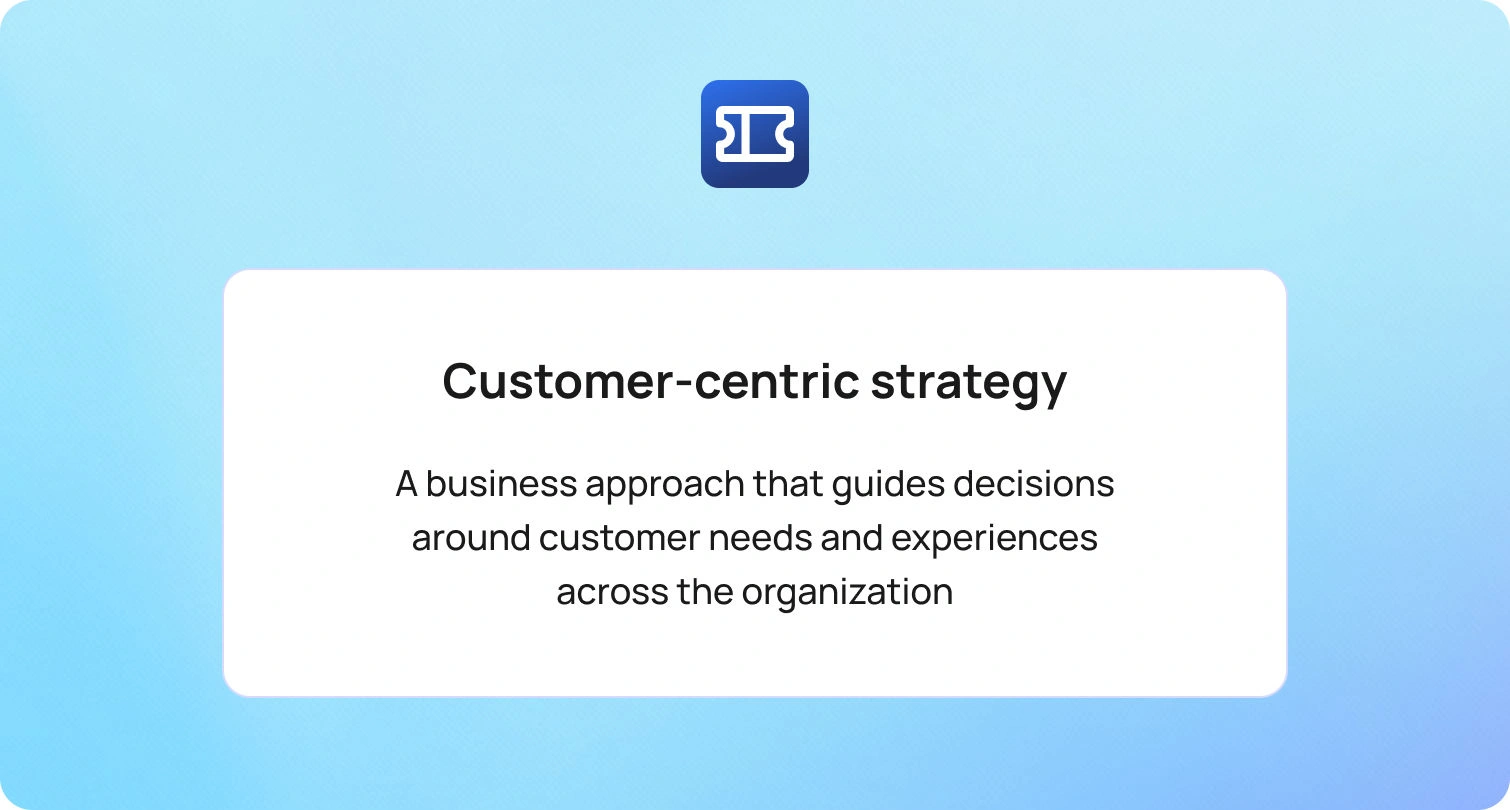
Customer-centric strategy definition: it's a business approach that prioritizes customer needs, preferences, and experiences in every decision you make.
But here's the customer-centric strategy that really matters: it's about building a customer-centric business where every team (product, marketing, sales, customer service, operations) asks, "How does this impact our customers?" before making decisions.
A customer-centricity strategy isn't just about being nice to customers or responding to complaints quickly. It's a fundamental shift in how you operate. Customer-centric organizations design their entire business model around delivering value at every customer interaction.
The difference between a customer-centric company and everyone else is that customer-centric companies:
- Use customer data to anticipate customer needs before problems arise
- Continuously improve based on customer feedback
- Measure success by customer outcomes
- Build a customer-centric culture where satisfying customers is everyone's job
5 Benefits of a Customer Centric Strategy
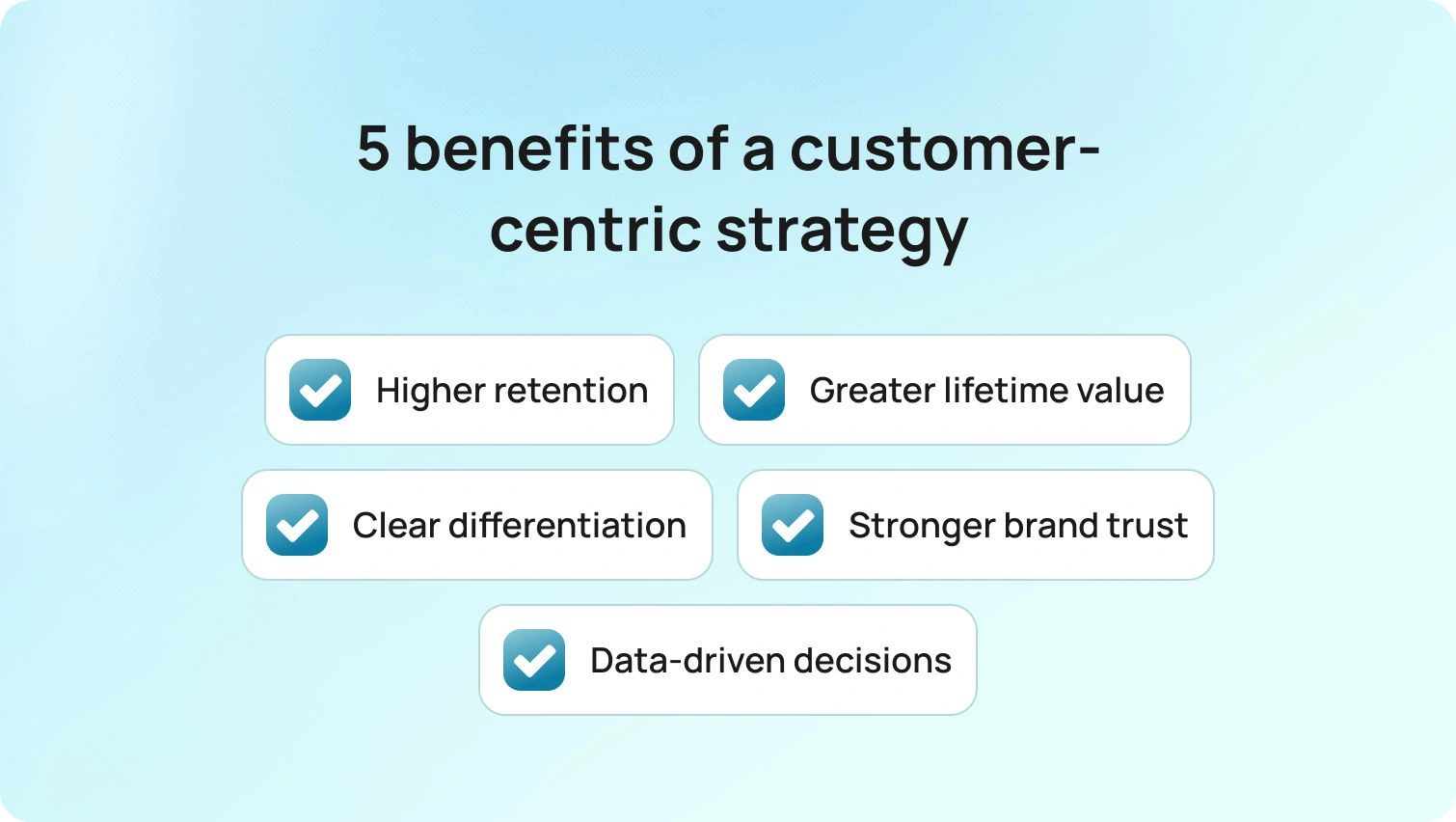
The benefits of a customer-centric strategy are measurable and significant:
1. Increased Customer Loyalty and Retention
When you consistently meet customer expectations and deliver positive experiences, customers stay. Customer retention goes up. Your customer churn rate goes down.
Loyal customers spend more over time. They're less price-sensitive. They give you permission to make mistakes because you've built trust.
2. More Repeat Business and Higher Lifetime Value
A customer-centric approach turns new customers into repeat customers. When you understand customer pain points and proactively solve them, people come back. Acquiring new customers almost always costs more (a lot more) than retaining existing ones.
By focusing on customer lifetime value instead of one-time transactions, you build sustainable growth that compounds over time.
3. Competitive Edge Through Differentiation
In crowded markets where products are similar, customer experience becomes the differentiator. A customer-centric model gives you a competitive edge because most companies still operate with product-first thinking.
When competitors focus on features, customer-centric strategies win by focusing on outcomes.
4. Stronger Brand Reputation and Brand Loyalty
Satisfied customers tell people. In the age of social media and online reviews, your brand reputation is built (or destroyed) by customer experiences. Customer-centric companies benefit from positive word-of-mouth that no marketing budget can buy.
Brand loyalty goes beyond logos and advertising. It's about consistently delivering on promises and meeting customer expectations.
5. Better Business Decisions Based on Real Data
When you collect customer feedback systematically and use customer data to inform decisions, you make smarter choices. You stop guessing what customers want and start knowing. This deep understanding of consumer behavior, communication preferences, and pain points leads to better products, better service, and better business outcomes.
Key Elements of a Customer Centric Strategy
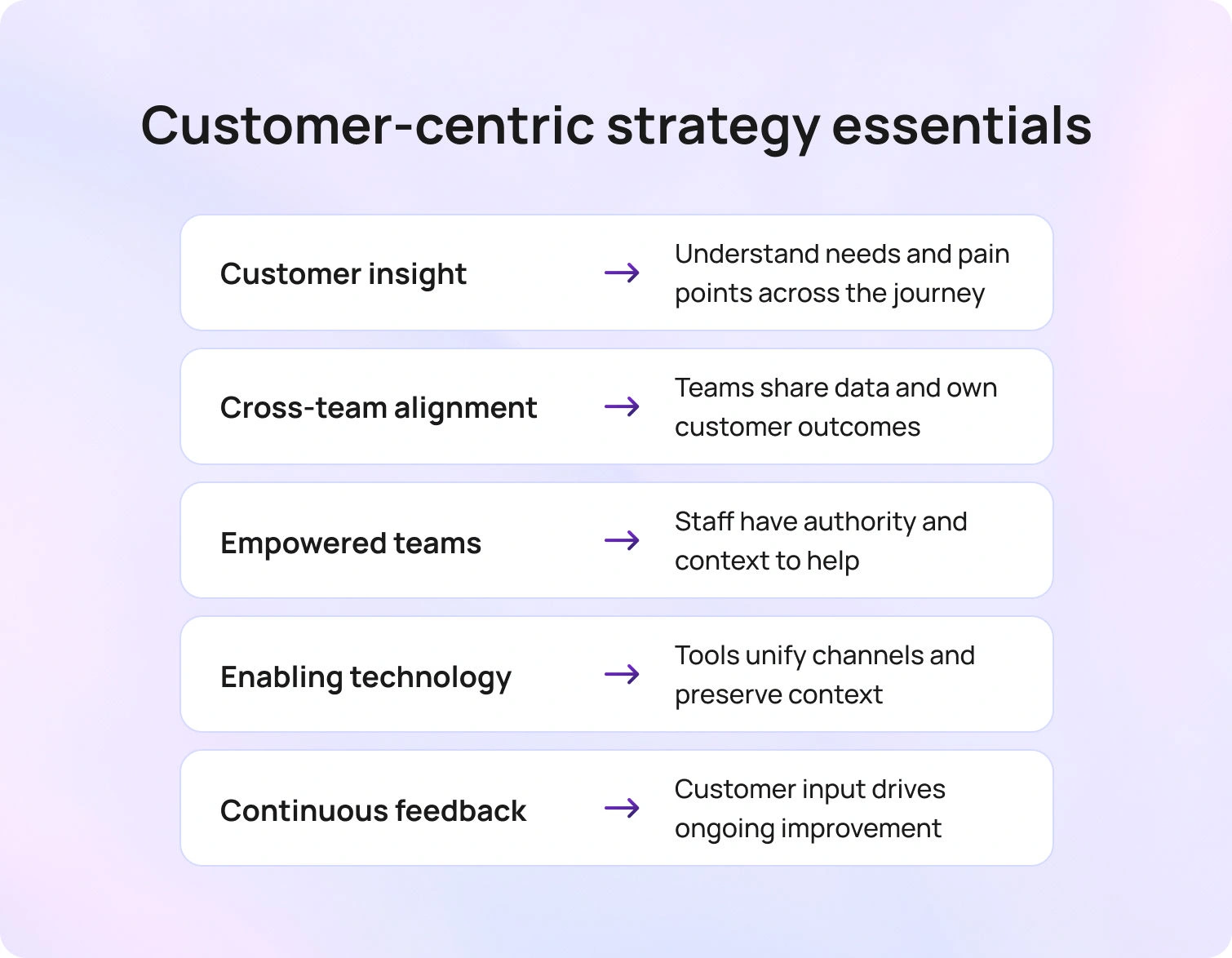
Building a customer-centric business requires several core elements working together:
1. Deep Customer Understanding
You can't serve customers if you don't understand them. Customer-centric organizations invest in understanding their customer base through:
- Collecting customer feedback through surveys, interviews, and direct conversations
- Analyzing customer data to identify patterns in behavior and preferences
- Mapping the customer journey to understand every touchpoint
- Creating detailed customer personas that guide decisions
- Monitoring customer pain points and expectations continuously
This is an ongoing effort to stay connected to customers' evolving needs.
2. Cross-Functional Collaboration
True customer centricity breaks down silos. When your development team, marketing, sales, and customer service teams all share the same customer data and work toward the same customer outcomes, magic happens.
Cross-functional collaboration means everyone takes ownership of the customer experience. Product teams design with customer feedback in mind. Marketing creates content that addresses real customer issues. Support agents share insights that inform product development.
3. Empowered Employees with Customer First Mindset
Your employees shape every customer interaction. Empowering them means:
- Training them to understand the customer-centric approach
- Giving them authority to solve customer issues without endless approvals
- Providing access to customer data so they can personalize service
- Rewarding customer-centric behaviors, not just sales numbers
- Building emotional intelligence so they can handle complex situations
Customer-centric metrics should measure how well employees deliver positive experiences.
4. Technology That Enables, Not Complicates
The right tools make customer centricity possible at scale. An omnichannel customer support platform unifies customer interactions across multiple devices and channels (phone, email, chat, social media) so you can maintain context and continuity.
Features like AI-powered ticket summaries, suggested replies, and real-time chat translation help agents deliver personalized service faster.
The goal isn't more technology. It's technology that helps you better understand and serve customers.
5. Continuous Improvement Based on Feedback
Customer centricity means never being satisfied with "good enough." Establish feedback loops that capture customer insights continuously:
- Post-interaction surveys that measure overall satisfaction
- Regular check-ins with key accounts
- Analysis of support tickets to identify recurring customer issues
- Monitoring social media for unsolicited feedback
- A/B testing changes to measure customer response
Use this data to continuously improve your product, service, and processes.
How to Implement a Customer Centric Strategy: Practical Steps
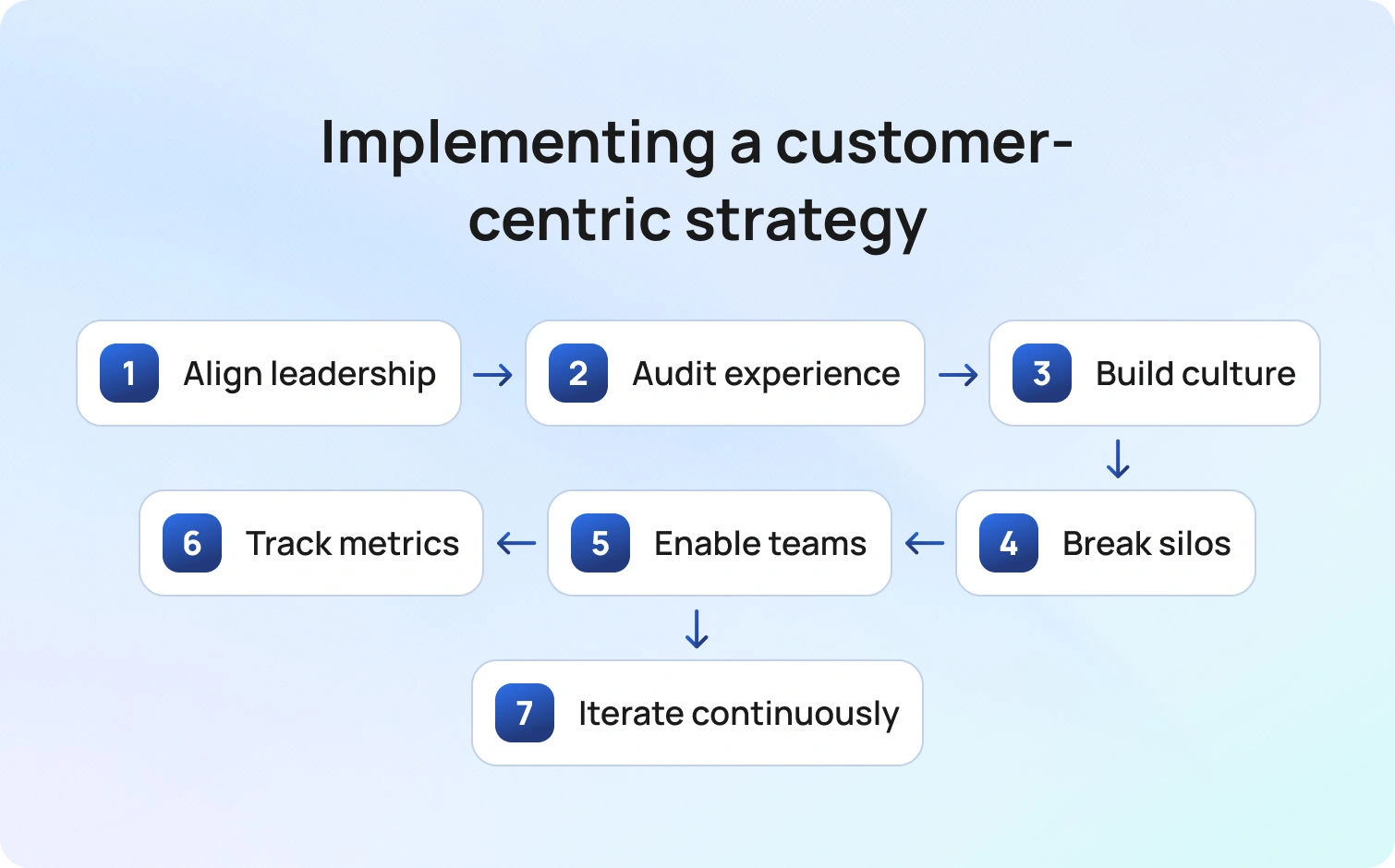
Step 1: Get Leadership Buy-In and Define Your Vision
Customer centricity starts at the top. Without leadership buy-in, you'll struggle to create lasting change. Your executives need to understand why a customer-centric approach drives business success and commit to it publicly.
Define what customer centricity means for your organization. What does it look like in practice? What behaviors do you want to encourage? How will you measure success?
This vision becomes your north star for decision-making.
Step 2: Audit Your Current Customer Experience
Before you can improve, you need to understand where you are now. Map your customer journey from first contact through ongoing relationships. Identify pain points where customers get frustrated or confused.
Talk to your customer service team. They know where the problems are. Review customer feedback and complaints. Review your customer churn rate and identify why customers leave.
This audit reveals gaps between what you think you deliver and what customers actually experience.
Step 3: Build a Customer Centric Culture
Culture change is hard but essential. You need everyone, from executives to frontline employees, operating with a customer-first philosophy.
Start by sharing customer stories internally. When someone on the development team hears directly from a frustrated customer, it hits differently than reading a ticket summary. Create rituals to review customer feedback regularly.
Adjust your company culture by:
- Making customer impact a factor in performance reviews
- Celebrating employees who go above and beyond for customers
- Sharing customer success stories widely
- Hiring for a customer-centric mindset, not just skills
- Creating space for teams to solve customer issues creatively
Employee experience shapes customer experience. If your team feels supported and valued, they'll treat customers the same way.
Step 4: Break Down Silos Through Cross-Functional Collaboration
Customer-centric companies don't let organizational charts get in the way of customer outcomes. Create mechanisms for cross-functional collaboration:
- Regular meetings where different teams share customer insights
- Shared customer data platforms everyone can access
- Joint projects that require collaboration
- Customer journey maps that show how different teams impact the experience
When marketing, product, and support work together instead of in isolation, you deliver consistent experiences that build trust.
Step 5: Invest in the Right Tools and Training
Equip your team with tools that enable customer centricity. BlueHub brings together everything you need (omnichannel customer support, AI-powered features, customer service analytics, and workforce management) on a single platform designed around the customer journey.
Train your team on the customer-centric model itself. Help them understand how to use customer data ethically and effectively. Teach them to recognize and respond to different customer pain points.
Step 6: Measure What Matters with Customer Centric Metrics
Track metrics that reflect customer outcomes:
- Customer satisfaction scores (CSAT)
- Net promoter score (NPS)
- Customer lifetime value
- Customer retention rates and customer churn rate
- Repeat purchase rates
- Customer effort score
- Time to resolution for customer issues
These customer-centric metrics tell you whether your strategy is working.
Step 7: Continuously Improve and Adapt
Your customer-centric strategy is an ongoing commitment to prioritize customers in everything you do.
- Review performance regularly
- Celebrate wins
- Learn from failures
- Adjust your approach based on what customer data tells you
- Stay curious about evolving customer expectations and communication preferences.
The best customer-centric organizations never stop asking, "How can we serve customers better?"
The Future of Customer-Centric Business
Customer expectations keep rising. What delighted customers last year is now just the baseline. Customer-centric companies that continuously improve will thrive. Those who don't will struggle.
Fortunately, building a truly customer-centric organization gives you sustainable growth. Loyal customers become advocates. Repeat customers drive profitability. Your brand reputation strengthens. Your competitive edge widens.
And in a world where most companies still pay lip service to customer centricity without actually doing the work, doing it right makes you stand out.
See howBlueHub makes it easier to put customers at the center of everything you do. Request a demo to see how it works.

Communication Mastery: Best Practices for Agents in Customer Support Interactions
Every interaction between an agent and a customer presents a unique opportunity to foster loyalty, resolve issues, and enhance brand reputation. However, achieving excellence in customer interactions requires more than just basic communication skills—it demands a mastery of best practices that encompass empathy, efficiency, and adaptability.
Customer Support Agents - Best Practices
Customer support best practices are a set of guidelines and strategies aimed at optimizing the customer experience and maximizing satisfaction. These practices encompass various aspects of communication, problem-solving, and relationship-building, all geared towards ensuring that every interaction leaves a positive impression on the customer.
By adhering to these best practices, agents can not only resolve issues effectively but also create meaningful connections with customers, fostering long-term loyalty and advocacy.
Online Customer Support
With customers expecting seamless assistance across a variety of digital channels, including email, chat, and social media, online customer support has become increasingly prevalent. The focus is on leveraging technology and communication tools to deliver efficient and personalized assistance to customers. By embracing these practices, businesses can effectively meet the needs of their digital customers, enhancing satisfaction and loyalty in the process.
Optimizing Software Customer Support
For businesses offering software products or services, optimization is essential for ensuring smooth operations and customer satisfaction. This practice encompasses providing comprehensive product knowledge and offering timely technical assistance. By implementing software optimization, businesses can streamline the support process, reduce resolution times, and enhance the overall customer experience.
Enhancing Customer Experience
Call centers serve as central hubs for customer communication, handling a diverse array of inquiries and issues. By adopting best practices, organizations can optimize efficiency, improve agent productivity, and enhance the overall customer experience. These practices include implementing advanced call routing algorithms, providing ongoing training and support for agents, and leveraging data analytics to identify trends and improve service delivery.
Driving Operational Excellence
Effective call center management is essential for ensuring the smooth and efficient operation of a call center. This encompasses various strategies, including workforce management, performance monitoring, and quality assurance.
By implementing best practices for call center management, organizations can optimize resource allocation, improve agent morale and retention, and ultimately deliver superior customer experience.
Read more about: Revolutionizing Customer Support: A Guide to Implementing Omnichannel Solutions
Benefits of best practices for call center management
Improved Customer Satisfaction
Well-trained agents equipped with best practices can resolve issues more efficiently, leading to higher levels of customer satisfaction.
Enhanced Agent Morale
Empowering agents with the tools and strategies they need to succeed fosters a positive work environment, leading to higher morale and lower turnover rates.
Increased Efficiency
By adhering to the best, agents can streamline processes and workflows, allowing them to handle more inquiries in less time.
Strengthened Brand Reputation
Consistently delivering exceptional service through best practices helps build a positive brand image and fosters customer loyalty and advocacy.
Mastering communication in customer interactions is a multifaceted endeavor that requires dedication, skill, and a commitment to excellence. By embracing the best and empowering agents with the tools and training they need to succeed, organizations can elevate the customer experience and drive long-term success.
Discover the many advantages of using our omnichannel customer support platform

Elevating Customer Support: Indicators It’s Time to Improve Customer Experience
Amidst this paradigm shift, companies are increasingly recognizing the need to prioritize and invest in strategies that enhance customer experiences. As technology continues to shape consumer behaviors and expectations, the importance of upgrading support platforms to meet these demands becomes imperative. This article aims to delve into the signs indicating when it's time to upgrade your support platform, coupled with insights into the pivotal role of customer experience management in fostering business success.
The Core of Modern Business Practices
At its essence, customer experience management encapsulates every interaction a customer has with a brand, spanning from initial engagement to post-purchase support. It encompasses the holistic perception that customers develop about a company based on their cumulative experiences across various touchpoints.
As businesses strive to deliver seamless experiences across multiple channels, the role of a customer experience manager becomes increasingly pivotal. These professionals are tasked with orchestrating strategies that optimize customer interactions, thereby driving brand loyalty and advocacy.
Unlocking Insights
Customer experience analytics enable businesses to gain actionable insights into consumer behavior, preferences, and pain points. By leveraging sophisticated analytics tools, organizations can decipher complex data sets to uncover patterns, trends, and correlations. These insights empower businesses to make informed decisions, tailor marketing strategies, and enhance support platforms to better align with customer needs and expectations.
A Strategic Imperative
As markets become increasingly saturated and competitive, companies must embark on a journey of customer experience transformation. This entails a strategic overhaul of existing processes, technologies, and organizational cultures to prioritize customer-centricity. Customer experience transformation transcends mere technological upgrades; it necessitates a fundamental shift in mindset and approach. By fostering a culture of innovation and continuous improvement, businesses can future-proof their operations and deliver exceptional customer experiences that drive sustainable growth.
Driving Growth
A robust digital customer experience strategy is paramount for engaging customers across online platforms and channels. It involves leveraging cutting-edge technologies, such as artificial intelligence and machine learning, to personalize interactions and streamline processes. Moreover, a well-defined digital customer experience strategy enables businesses to stay agile in the face of rapid technological advancements, thereby maintaining a competitive edge in the marketplace.
Read more about: Choosing the Right Customer Support Platform: A Comprehensive Guide
Evaluating Customer Support Platform Effectiveness
Measuring the effectiveness of support platforms requires the use of key performance indicators (KPIs) and customer experience metrics. These metrics provide quantitative insights into various aspects of the customer journey, including satisfaction levels, response times, and issue resolution rates. By regularly monitoring metrics, businesses can iteratively optimize their support platforms to deliver superior customer experiences.
Continuous Improvement
Customer experience optimization is a perpetual journey rather than a destination. It entails the iterative refinement of support platforms, processes, and strategies to better meet customer needs and expectations. By embracing a culture of continuous improvement, businesses can foster innovation, drive efficiencies, and enhance customer satisfaction. Moreover, it enables organizations to stay agile and responsive in a rapidly changing market landscape, positioning them for long-term success and sustainability.
Investing in Solutions
Businesses must invest in advanced support platforms and solutions to meet the evolving needs of their customers. Whether it's adopting omnichannel support capabilities, implementing AI-powered chatbots, or leveraging data analytics for predictive support, investing in the right technologies can make a significant difference. By prioritizing customer support experience and embracing innovation, businesses can differentiate themselves in the marketplace and build lasting customer relationships.
Driving Innovation
Innovation lies at the heart of exceptional customer experiences. By embracing innovation in customer experience services, businesses can stay ahead of the curve and deliver perfect solutions to their customers. These services encompass a wide range of offerings, including personalized support, proactive problem-solving, and anticipatory assistance. Leveraging advanced technologies such as AI and automation, businesses can streamline processes, reduce response times, and deliver tailored experiences that resonate with customers. By investing in customer experience services, companies can foster loyalty, drive retention, and position themselves as industry leaders in customer satisfaction and innovation.
Read more about: Enhancing Customer Satisfaction and Reducing Costs: The Power of Omnichannel Customer Support Platforms
Flexible Support Platforms
As consumer preferences continue to evolve, businesses must ensure that their support platforms remain flexible and adaptable. A one-size-fits-all approach no longer suffices in today's dynamic marketplace. Instead, companies must embrace agility and responsiveness, offering support solutions that can quickly scale and evolve to meet changing customer needs.
Whether it's through cloud-based platforms, modular architectures, or API integrations, flexibility is key to delivering seamless experiences that anticipate and exceed customer expectations. By investing in flexible support platforms, businesses can future-proof their operations and stay ahead of the curve in an ever-changing landscape.
Power of Collaboration
By fostering partnerships and alliances with other industry players, businesses can tap into a wealth of expertise and resources to drive innovation and excellence. Collaborative initiatives, such as co-creation workshops, industry consortia, and knowledge-sharing networks, enable businesses to gain fresh perspectives and insights into customer needs and preferences.
Moreover, collaboration fosters a culture of collective responsibility and accountability, where stakeholders work together towards a common goal of delivering exceptional customer experiences. By harnessing the power of collaboration, businesses can unlock new opportunities for growth and differentiation in the marketplace.
The journey towards elevating customer experiences requires a strategic blend of customer experience management, data analytics, digital strategy, and continuous improvement. By incorporating these strategies and insights into their operations, businesses can position themselves at the forefront of the customer experience revolution and chart a path towards sustained success and prosperity.
Discover the many advantages of using our omnichannel customer support platform



