


Radu Dumitrescu

As Head of Digital Transformation, Radu looks over multiple departments across the company, providing visibility over what happens in product, and what are the needs of customers. With more than 8 years in the Technology era, and part of BlueTweak since the beginning, Radu shifted from a developer (addressing end-customer needs) to a more business oriented role, to have an influence and touch base with people who use the actual technology.
Recent articles

Voice vs. Text in Customer Support Service: Choosing the right medium for your audience
As customer support service continues to undergo significant transformation, businesses must cater to a diverse range of communication preferences. While traditional phone calls have long been the cornerstone of support, text-based options like chat and messaging are rapidly gaining traction.
This presents a critical question for customer support departments: voice or text support – which reigns supreme? The answer, as with most things in customer service, is a nuanced "it depends". Choosing the right communication medium hinges on a deep understanding of your customer base and the specific nature of their inquiries.
Understanding Your Customers: Demographics and Data
The foundation of effective communication lies in understanding your audience. Here's where customer demographics and data analysis come into play:
- Generational Preferences: younger demographics, may favor the ease and convenience of text support and older generations, might find phone calls more familiar and reassuring.
- Past Support Interactions: Analyze your support data to identify trends in channel usage. Are there specific issue types that consistently gravitate towards text or voice support?
- Sentiment Analysis: Leverage sentiment analysis tools to gauge customer emotions across different channels. This can help identify situations where a phone call might be better suited to address frustration or complex situations.
Read more about: Navigating the Future: Customer Support Trends for 2024
The Power of the Human Voice: Building Rapport and Tackling Complexity
Despite the rise of text-based support, the human voice remains a powerful tool in building customer relationships. Voice support offers distinct advantages:
- Rapport Building: The ability to interact naturally fosters trust and a sense of connection between the agent and the customer.
- Emotive Intelligence: Human agents can readily gauge customer emotions through tone of voice, allowing for a more empathetic and personalized approach.
- Navigating Complexity: For intricate technical problems or sensitive situations requiring detailed explanation, a voice call allows for a clearer back-and-forth dialogue.
Read more about: The Role of UX in Customer Support: Enhancing user experiences
The Efficiency of Text: Scalability and Convenience
Text-based support offers a compelling alternative, particularly for its:
- Scalability: Agents can manage multiple chats simultaneously, drastically reducing wait times for customers.
- Documentation: Text-based communication provides a clear record of the interaction, allowing for easy reference and future troubleshooting.
- Asynchronous Communication: Customers can reach out on-the-go and get answers at their own pace, fostering a sense of convenience and flexibility.
Read more about: Elevating Customer Support: Indicators It’s Time to Improve Customer Experience
The Magic of Omni-Channel Customer Support: Catering to Diverse Preferences
The most effective approach isn't about choosing exclusively between voice or text, but rather offering a comprehensive omni-channel strategy. This empowers customers to choose the communication method that best suits their needs:
- Multi-Channel Access: Provide a seamless experience by offering support via phone, chat, email, and social media platforms.
- Seamless Transitions: Allow customers to effortlessly switch between channels during an interaction, ensuring a smooth and uninterrupted resolution.
Choosing the Right Medium: Context is King
Ultimately, the optimal communication channel hinges on the specific context of the customer interaction. Consider these factors:
- Issue Complexity:
- Simple questions: Text support.
- Intricate problems: Voice call.
- Customer Context: The customer's emotional state plays a role. If a customer seems frustrated, a phone call might be the best way to de-escalate the situation and offer personalized support.
By prioritizing a deep understanding of your audience and offering a robust blend of voice and text support options, you can create a customer support experience that is both convenient and effective. Remember, happy customers are loyal customers, and fostering positive interactions is crucial for long-term success.
BlueHub Helpdesk software - check our omnichannel helpdesk software with advanced features!

Customer Effort Score (CES): Simplifying the support experience
Customers today crave simplicity. They shouldn't have to navigate a maze to get help. This is where reducing customer effort becomes your secret weapon. Customer Effort Score (CES): by streamlining the support experience, you boost satisfaction, loyalty, and ultimately, your business's success.
Designing a Frictionless Journey
Imagine a customer facing an issue. Their ideal scenario? A support process that's as smooth as possible. Your platform can help create this reality by:
- Simplifying ticket submission: Make it easy for customers to submit tickets through various channels (website, mobile app, etc.) with clear instructions and pre-filled forms where possible.
- Intelligent routing: Automatically route tickets to the most qualified agents based on issue type and agent expertise. This reduces wait times and ensures customers get the right help quickly.
- Seamless omnichannel support: Allow customers to switch seamlessly between support channels (phone, chat, email) without losing context or repeating information.
Empowering Your Support Heroes
Your agents are the frontline of your support experience. Equip them with the tools and information they need to be customer heroes:
- Comprehensive knowledge base: A well-organized knowledge base with articles, tutorials, and FAQs empowers agents to answer common questions quickly and efficiently.
- Contextual information: Provide agents with real-time customer data and past interaction history so they can personalize support and avoid asking repetitive questions.
- Automated solutions: Utilize features like canned responses and self-service tools to streamline repetitive tasks and free up agents' time for complex issues.
Read more about: The Perfect Duo: AI Chatbots and Human Agents in Harmony for Customer Support
Understanding Your Customers
Reducing customer effort isn't a one-time fix. It's an ongoing process of improvement. Here's how your platform can help you listen to your customers:
- Feedback surveys: Gather valuable insights through post-interaction surveys to understand customer pain points and areas for improvement.
- Sentiment analysis: Analyze customer interactions to identify frustrations and areas of confusion that might be causing extra effort.
- Support ticket trends: Monitor ticket volume and type to identify recurring issues and proactively address them through knowledge base updates or improved product design.
Read more about: The Crucial Role of Feedback Integration in Omnichannel AI-Driven Platforms
Self-Service and Proactive Communication
Empower your customers to help themselves with robust self-service options:
- Interactive knowledge base: Make your knowledge base searchable and user-friendly with features like search filters, step-by-step guides, and even video tutorials.
- Community forums: Create a space where customers can connect with each other, share knowledge, and find solutions from their peers.
- Chatbots: Utilize chatbots for basic troubleshooting and frequently asked questions, freeing up agents for more complex issues.
Proactive communication is key to reducing customer effort. Keep your customers informed about product updates, service outages, or potential issues they might encounter, so they're not left wondering.
Read more about: Navigating the Future: Customer Support Trends for 2024
Elevating Customer Support to Unprecedented Heights
Finally, track your progress in reducing customer effort by measuring your Customer Effort Score (CES). This metric helps you understand how much effort customers perceive they need to exert to get their issues resolved. Your platform can help you collect CES data through surveys and use it to identify areas for further improvement.
By implementing these strategies with the help of your customer support platform, you can create a frictionless support experience that delights your customers and keeps them coming back for more. Remember, happy customers are loyal customers and reducing customer effort is a surefire way to achieve that.

The Role of Soft Skills in Customer Support: Training for Empathy and Communication
Technical knowledge is a cornerstone of customer support, but there's another, often underestimated, set of tools: soft skills for customer support. These interpersonal abilities are the foundation for positive customer interactions, leading to the ultimate goals – satisfaction and loyalty.
Identifying the soft skills for customer support All-Stars: Empathy, Active Listening, and Problem-Solving
- Empathy: Stepping into the customer's shoes is key. Understanding their frustration with a bug or disappointment with a product builds rapport and shows you care.
- Active Listening: It's more than just waiting to talk. Pay close attention to their concerns, ask clarifying questions, and acknowledge their emotions. Let them know you're hearing them.
- Problem-Solving: Be quick! Analyze the situation, identify potential solutions, and guide the customer toward a resolution that leaves them feeling heard and valued.
Read more about: The Art of Proactive Customer Service: Enhancing the Customer Journey
Building the Perfect Team: Training Programs for Success
Investing in soft skills training empowers your team to navigate customer interactions with confidence.
- Interactive Workshops: Engage your team in workshops that explore communication techniques, conflict resolution strategies, and emotional intelligence. It's learning by doing, not just listening.
- Scenario-Based Learning: Present real-world customer situations and have agents role-play different approaches. This allows them to practice active listening, empathy, and problem-solving in a safe space.
- Mentorship Programs: Pair experienced agents with newcomers to share best practices and provide ongoing feedback. It's a win-win – knowledge transfer and skill development.
Read more about: Communication Mastery: Best Practices for Agents in Customer Support Interactions
Practice Makes Perfect: Role-Playing and Simulations
Take training to the next level with role-playing exercises and simulations.
- Test their communication skills: Practice clear and concise explanations, avoiding technical jargon and focusing on active listening to customer concerns.
- Develop emotional intelligence: Simulations can expose agents to frustrated or angry customers, allowing them to hone their de-escalation skills and respond with empathy.
- Sharpen problem-solving muscles: Scenario-based simulations let agents test different approaches to resolving issues, building their confidence in tackling complex situations.
Feedback for Growth: Integrating Soft Skills Assessment
Don't let development stop at training. Integrate soft skills assessment and feedback into performance evaluations. This can involve:
- Peer Reviews: Have team members observe interactions and provide constructive feedback on communication skills, empathy, and problem-solving techniques. Peers see things differently, offering valuable insights.
- Customer Satisfaction Surveys: Include questions that gauge customer perception of agent helpfulness, attentiveness, and overall interaction experience. The customer's voice matters most.
Read more about: Elevating Customer Support Excellence: The Crucial Role of Feedback Integration in Omnichannel AI-Driven Platforms
The Empathy Edge: Cultivating Customer Loyalty
By fostering soft skills within your customer support team, you unlock a powerful formula for exceptional customer experience. When agents excel at empathy, active listening, and problem-solving, positive interactions become the norm. Customers feel valued, trust is built, and loyalty flourishes.
Imagine this winning formula at work: a customer frustrated with a technical glitch encounters an agent who listens attentively, empathizes with their situation, and guides them towards a swift resolution. This positive interaction strengthens the customer's perception of your brand, making them more likely to return and recommend your services.
The key to unlocking this potential lies in a two-pronged approach: investing in soft skills for customer support training and development for your team and equipping them with a robust customer support platform. When these elements come together, your customer service operation transforms into a well-oiled machine, fostering enduring customer loyalty and propelling your business forward.

Why Customer Service Communication Makes or Breaks Your Brand
Communication That Defuses, Resolves, and Retains
A customer reaches out, frustrated about a billing issue. Your agent responds with a copy-paste template that feels robotic and dismissive. The customer gets angrier. The situation escalates.
Eventually, they leave and take their business elsewhere.
Now imagine a different outcome. The same frustrated customer gets a response that acknowledges their concern, uses friendly language, and walks them through a solution. They feel heard. The problem gets solved. They stay and may even tell their friends about the excellent customer service they received.
That's the difference between customer service that works and communication that falls flat. And it's why the importance of communication in customer service can't be overstated.
Below, we break down customer service communication, explain why it's essential, and show how to master it so your team becomes the voice your brand deserves.
What Is Customer Service Communication?
Customer service communication is every interaction between your team and your customers. That could be through calls, live chat, email, social media, or messaging apps. It's how you communicate with customers across multiple communication channels to answer customer inquiries, resolve issues, and build strong customer relationships.
However, it's not just about what you say. It's about how you say it.
The role of communication in customer service goes way beyond exchanging information. It shapes how customers feel about your brand, whether they trust you, and whether they come back, ultimately leading to excellent customer service.
Good communication in customer service includes:
- Clear communication that customers understand immediately
- Active listening so customers feel heard
- Positive communication that keeps interactions constructive
- Proactive communication that anticipates customer needs before problems arise
When you nail these communication skills, you create positive customer experiences that drive good customer relationships, loyalty, and repeat business.
Why Is Communication Important in Customer Service?
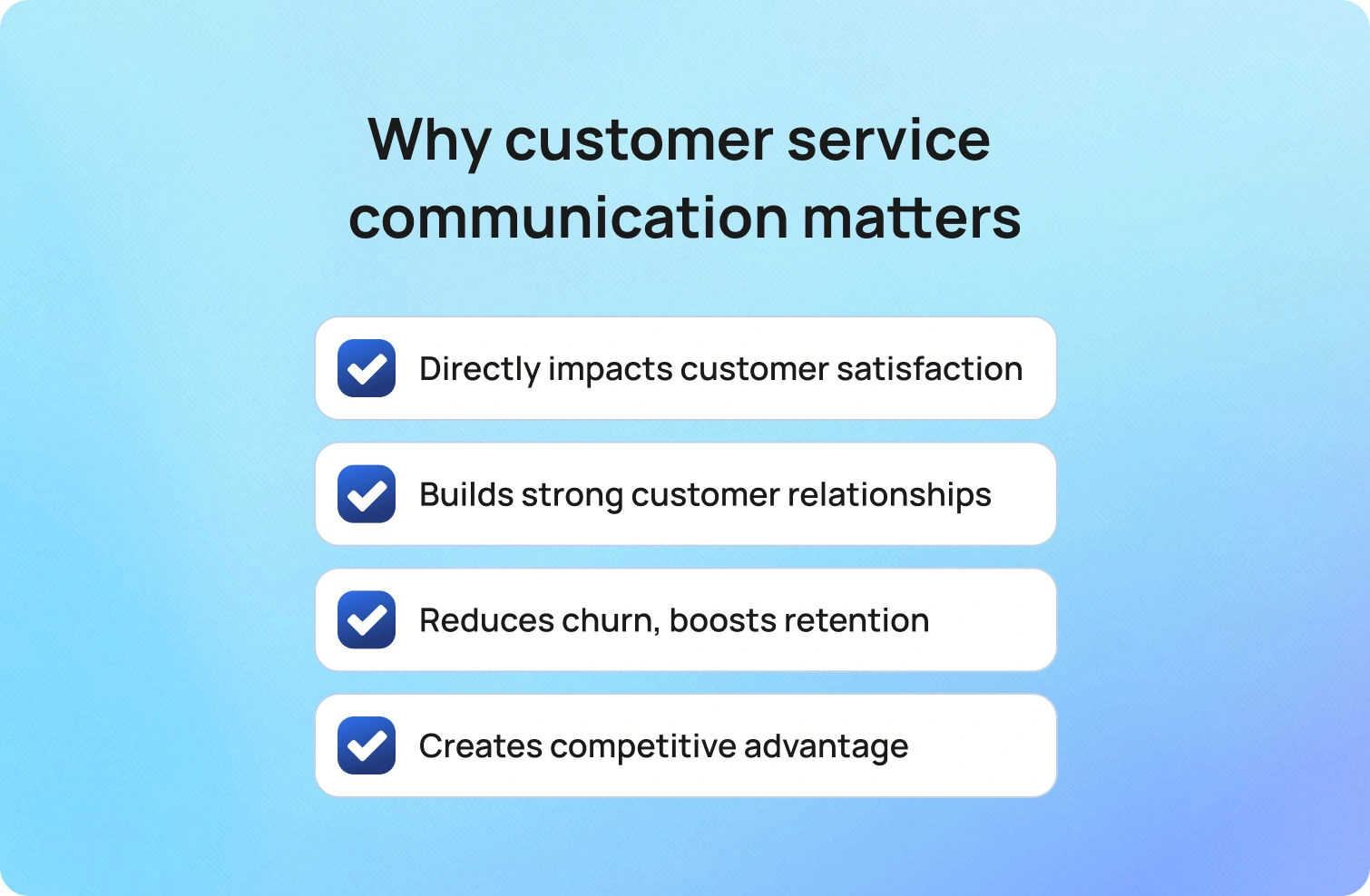
Practical communication matters in customer service because it is the foundation for everything else you aim to achieve.
1. It Directly Impacts Customer Satisfaction
Customers don't remember every feature of your product. But they absolutely remember how your support team made them feel. When your team communicates effectively, customer satisfaction scores go up. When communication breaks down, you get bad customer service experiences that tank your brand reputation.
Clear, empathetic communication makes customers feel valued. And when customers are heard, they're more willing to work with you to find a solution.
2. It Builds Strong Customer Relationships
Customer relationship management is a mindset. Every interaction is a chance to strengthen (or weaken) your relationship with that person. Excellent customer service communication turns transactional exchanges into meaningful conversations. When you communicate with customers in a way that's personal, helpful, and respectful, you solve problems and build trust.
3. It Reduces Churn and Increases Customer Retention
Companies with strong customer communication strategies have higher customer retention rates. That’s because customers stick with brands that make them feel understood.
When your team masters effective communication techniques in customer service, you reduce frustration, resolve issues faster, and give customers fewer reasons to leave.
That translates directly to business growth.
4. It Creates Competitive Advantage
Exceptional customer service is one of the few real differentiators left when enhancing the overall customer experience. Your communication efforts can set you apart from competitors who are still sending robotic, unhelpful responses.
When customers consistently have positive experiences with your support team, they become loyal advocates who spread positive word-of-mouth and social media feedback.
Choosing the Right Customer Service Communication Methods
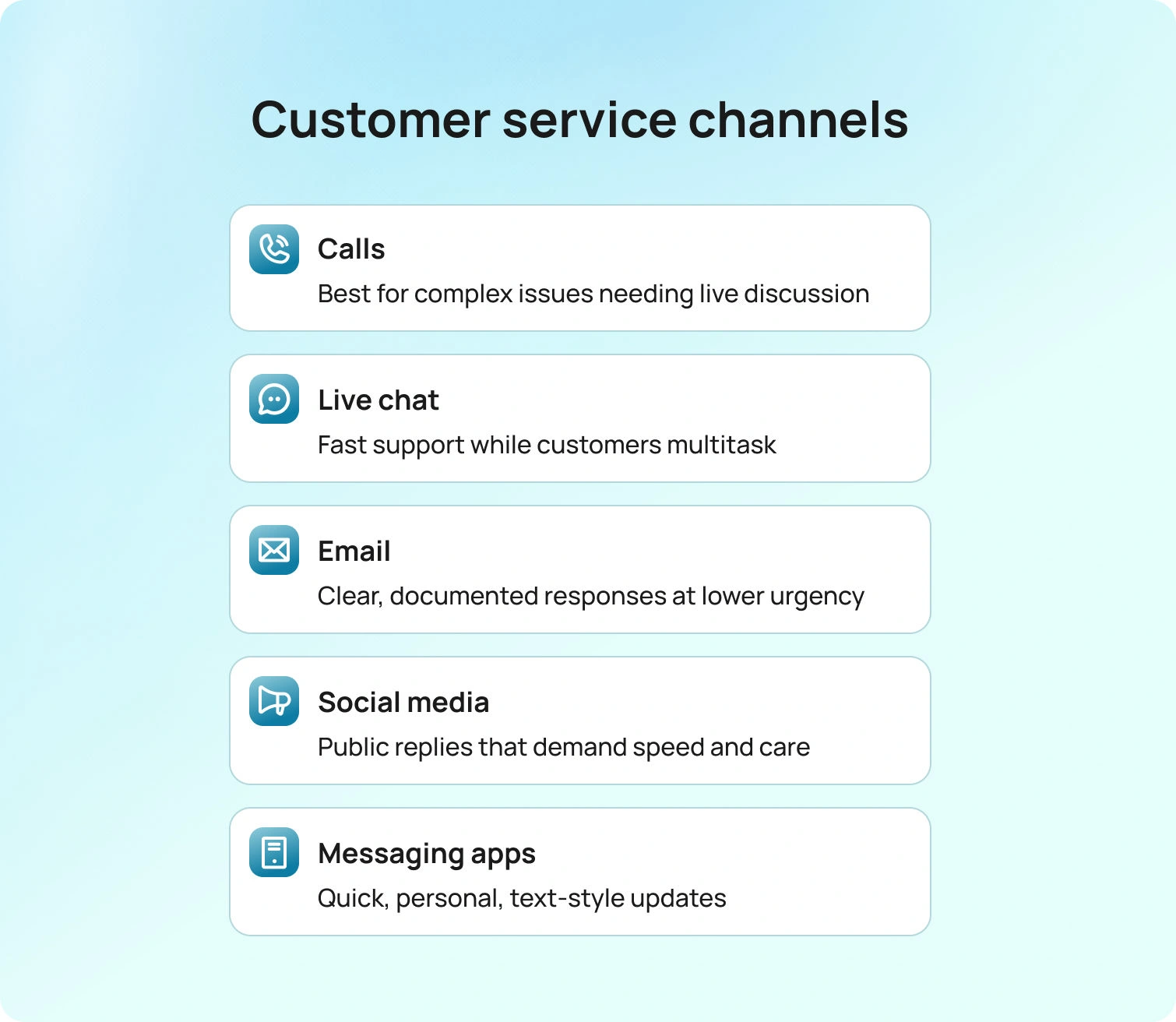
Not all communication channels are created equal. Different customers have different preferences, and your customer service team needs to meet them where they are.
Here are the primary communication methods in customer service and when to use them:
1. Calls
Phone interactions are important for complex issues that require back-and-forth communication. They enable immediate problem-solving and help service professionals pick up on tone and emotion. But they're also time-intensive, and not everyone wants to be on hold.
2. Live Chat
Chat is fast, convenient, and increasingly expected. Customers can multitask while waiting for responses, and your team can handle multiple conversations simultaneously. AI-powered chatbots can handle routine customer queries while human agents focus on complex issues.
3. Email
Email works well for detailed explanations and when customers need documentation of the conversation. It's less urgent than chat or phone, but requires strong written communication skills to avoid misunderstandings.
4. Social Media
Social media communication is public, which means every response is visible to potential customers. It requires quick turnaround and careful messaging, since you're essentially providing customer service on stage.
5. Messaging Apps
Platforms like WhatsApp and Facebook Messenger offer the convenience of texting with the professionalism of business communication. They're perfect for quick updates and personalized messages. The best customer service communication strategy uses multiple channels and lets customers choose their preferred method. An omnichannel customer support platform makes this seamless by unifying all customer communication channels in one place.
6 Customer Service Communication Techniques That Work
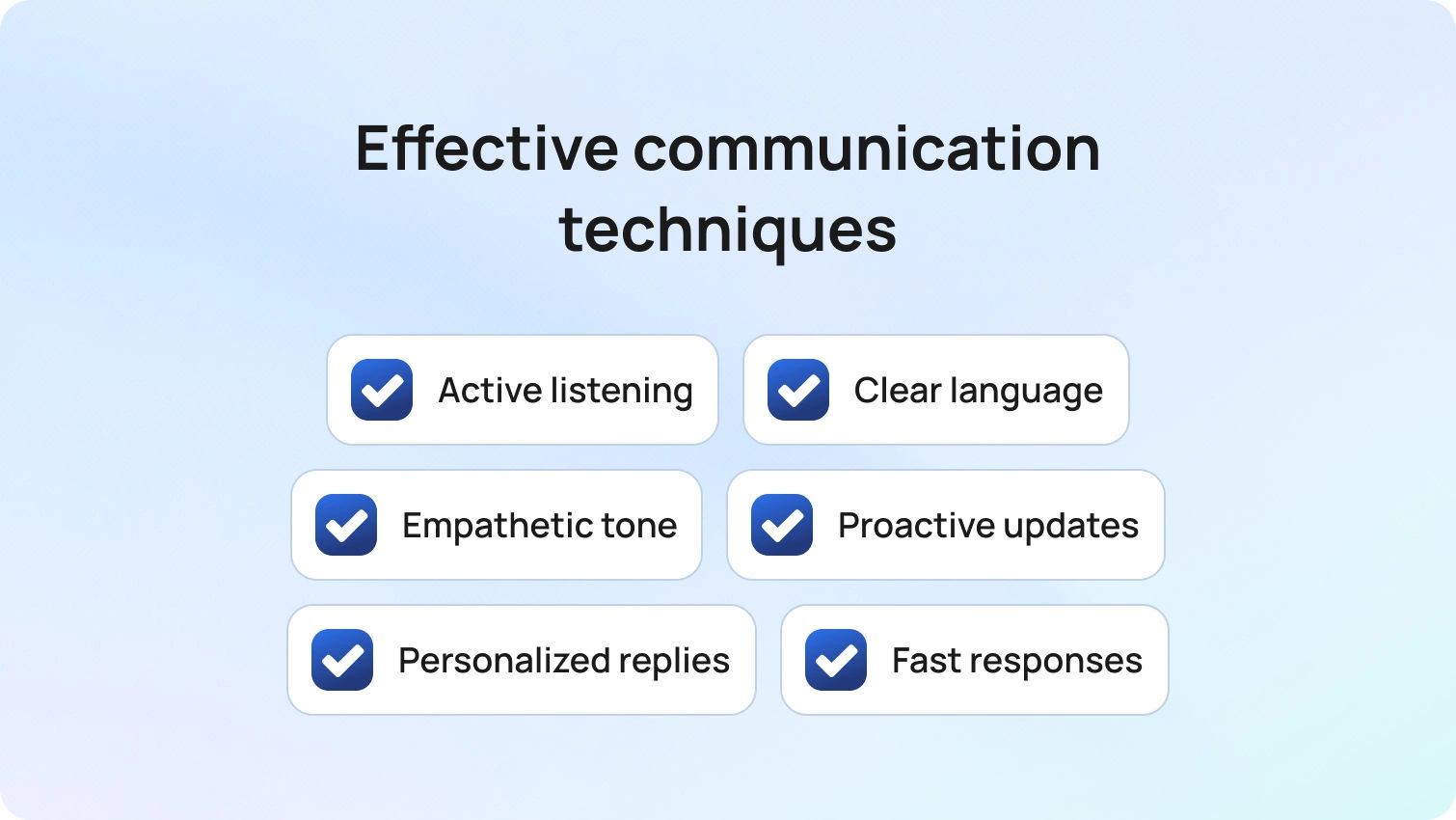
Here are the communication techniques in customer service that separate good teams from great ones:
1. Practice Active Listening
Active listening means truly hearing what customers are saying instead of waiting for your turn to respond. Read (or listen to) the whole message before crafting your reply. Ask clarifying questions. Repeat back what you've heard to confirm understanding.
When customers are heard, half the battle is already won.
2. Use Clear Communication
Avoid jargon, technical terms, or vague language. Your job is to make sure customers understand every step of the process. Break complex explanations into simple steps. Use short sentences. Be specific.
Bad: "We'll escalate this to the backend team for resolution."
Good: "I'm sending this to our technical team. You'll hear back within 24 hours with a solution."
3. Master the Right Tone
Written words in customer service are tricky because you don't have vocal cues to convey warmth. That's where tone matters.
- Start every interaction with empathy
- Acknowledge the customer's frustration or concern
- Use friendly language that feels human, not robotic
- Always maintain a positive attitude, even when dealing with difficult situations
Check out our guide on customer service best practices for more on tone and messaging.
4. Be Proactive, Not Just Reactive
Don't wait for customers to reach out with problems. Proactive communication means anticipating issues and reaching out first:
- Send updates on known issues
- Follow up after resolutions to make sure everything's still working
- Share tips that help customers get more value from your product
Proactively engage with customers, and you'll see customer engagement and satisfaction scores climb, leading to more positive feedback.
5. Personalize Every Interaction
Not every customer is the same, so you can’t treat them all the same way. Use customer data to understand their history, preferences, and past interactions. Reference previous conversations. Use their name. Tailor messages to their specific situation.
Personalized communication makes customers feel valued as individuals and not just ticket numbers.
6. Respond Fast
Speed matters. Customers expect quick responses, especially on channels like chat and social media. Set clear expectations about response times and stick to them. Use canned responses for common questions to speed up the process without sacrificing quality.
When you combine fast responses with clear, empathetic communication, you create exceptional customer service experiences.
Practical Customer Service Communication Examples
Let's look at some real examples to see these principles in action.
Example 1: The Robotic Response (Bad)
"Your ticket has been received. Reference number: 847392. Expected resolution time: 24-48 hours."
What's wrong here? Zero empathy. No acknowledgment of the customer's issue. No human touch. This is the kind of customer service that makes people feel like just another number.
Example 2: The Human Response (Good)
"Hi Sarah, I see you're having trouble with your billing. That's frustrating, especially when you're trying to get things sorted quickly. I've reviewed your account and identified the issue. It was a duplicate charge processed in error. I've issued a refund, and you'll see the credit within 2-3 business days. I'm really sorry for the inconvenience. Let me know if you need anything else!"
This works because it:
- Uses the customer's name
- Acknowledges the frustration
- Explains what happened clearly
- Provides a specific timeline
- Apologizes genuinely
- Offers continued support
That's effective communication and customer service working together.
How to Build a Customer Service Communication Plan
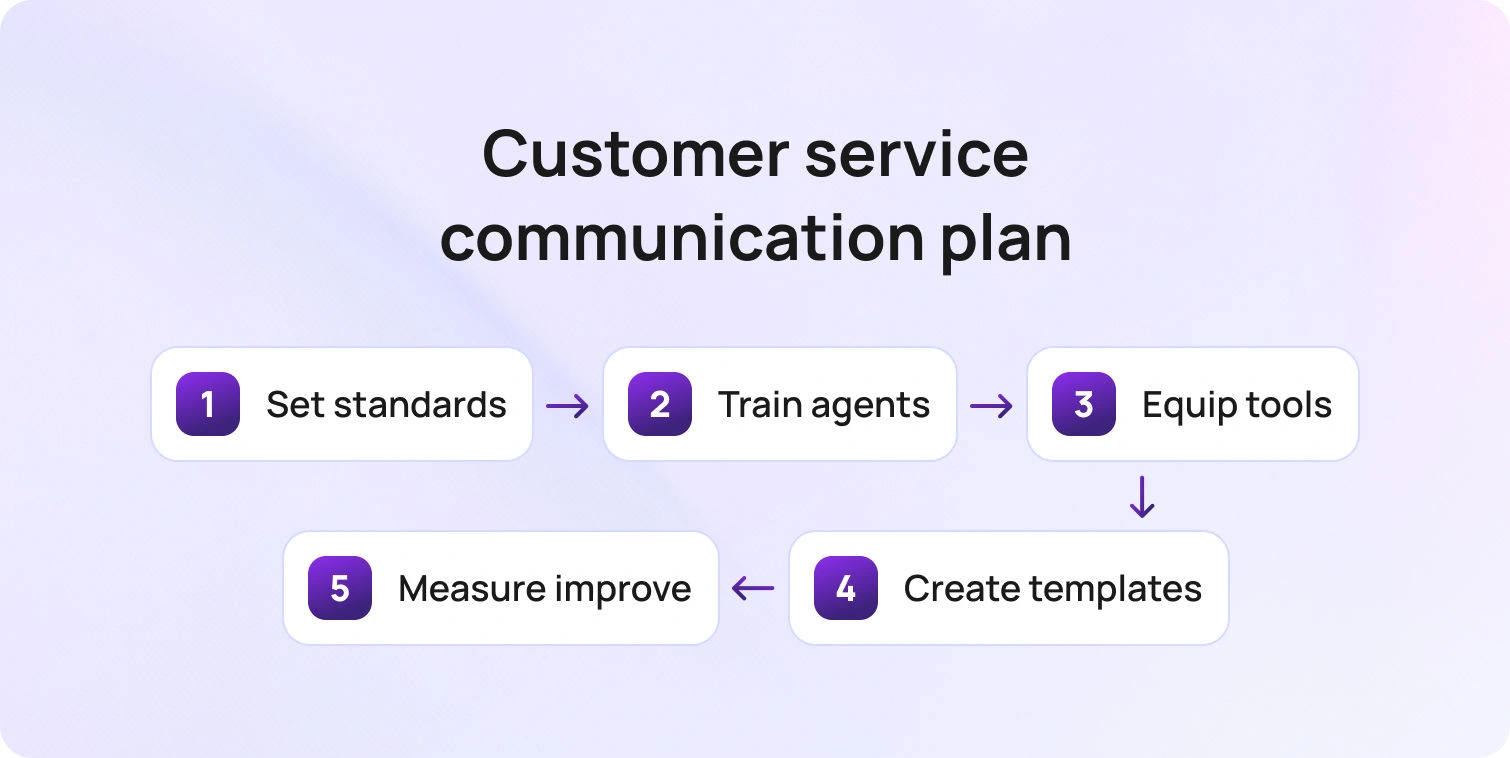
This plan is your roadmap for consistent, high-quality interactions. Here's how to create one:
1. Define Your Communication Standards
What does excellent customer service communication look like for your brand? Document your expectations around:
- Response time targets for each communication channel
- Tone guidelines (formal vs. casual, technical vs. simple)
- Language to use (and avoid)
- Escalation protocols
- Follow-up procedures
2. Train Your Team
Communication skills aren't innate. They are learned. Invest in training that covers:
- Listening techniques
- Written best practices
- Handling difficult customers
- Using support tools effectively
- Understanding customer expectations
Regular coaching and feedback help your customer service team improve communication skills over time.
3. Equip Your Team with the Right Tools
Your support team needs tools that enable effective communication across multiple channels. That means:
- A unified inbox that brings together email, chat, social media, and calls
- AI-powered features like proposed replies and ticket summaries that speed up responses
- Knowledge base tools so agents can find answers fast
- Real-time chat translation for customers who speak different languages
- Analytics to track communication performance and customer satisfaction
BlueHub (by BlueTweak) brings all of this together on a single platform, making it easier for your team to deliver consistent, high-quality communication across every channel.
4. Create Communication Templates
Templates save time and ensure consistent messaging. Build a library of customer service communication examples for:
- First response acknowledgments
- Common questions and solutions
- Escalation notifications
- Follow-up messages
- Thank you, and feedback requests
Just make sure your team personalizes these templates. Because nobody likes feeling like they're talking to a robot.
5. Measure and Improve
Track key metrics like:
- Customer satisfaction scores (CSAT)
- First response time
- Resolution time
- Customer feedback sentiment
- Retention rates
Use this data to identify communication gaps and refine your customer service communication strategy over time.
How BlueHub Strengthens Customer Service Communication
BlueHub (by BlueTweak) brings every channel into a single omnichannel workspace across voice, chat, email, SMS, and social. Agents see the full context and history, which helps keep tone consistent and replies accurate. AI assistance suggests replies that align with your brand, produces instant ticket summaries that make handoffs seamless, and provides translation so language is never a barrier. A searchable knowledge base sits beside every conversation to help teams deliver clear answers the first time. Leaders gain the insight needed to coach and improve. Journey-aware analytics track response time, resolution time, CSAT, sentiment, and first-contact resolution across brands. Quality assurance tools and audit trails surface conversations that need review. Integrated workforce management helps you meet SLAs, and native multitenant routing lets one team support multiple brands with clear separation and shared visibility. The result is communication that defuses tension, resolves issues faster, and retains customers at scale.
Make Top-Notch Communication Your Competitive Edge
Most companies still get this wrong. They're sending automated responses, making customers repeat themselves across channels, and treating support as a cost center rather than a relationship builder.
That's your opportunity.
When you master customer service, you stand out. You create exceptional customer service experiences that turn first-time customers into lifelong advocates.
In a world with endless options, such lasting relationships and customer loyalty are worth their weight in gold.
See how BlueHub (by BlueTweak) makes it easy to deliver consistent, high-quality support across every channel, from phone calls to social media to messaging apps. Request a demo to see it in action.

The Role of UX in Customer Support: Enhancing user experiences
The role of User Experience (UX) in customer support is pivotal, especially with the integration of advanced technologies like AI. Companies are transforming their support platforms into seamless, intuitive, and highly efficient systems.
Customer Support Experience: Designing Intuitive Self-Service Portals and Knowledge Bases
A well-designed self-service portal is the cornerstone of effective customer support. These portals empower users to find solutions independently, reducing the need for direct interaction with support agents. Key elements of intuitive design include:
- Clear categorization: Information should be categorized logically, making it easy for users to navigate through topics.
- Effective search functionality: A search bar that predicts and auto-completes queries can drastically reduce the time users spend looking for information.
- Visual aids: Incorporating videos, infographics, and screenshots can help users understand solutions more quickly and effectively.
Optimizing Navigation and Search Functionalities
A seamless navigation experience is critical for users seeking support. Optimizing navigation and search functionalities involves implementing breadcrumb navigation to allow users to track their location within the portal and easily backtrack if needed.
Advanced filters can help users narrow down search results to find relevant information faster. Leveraging AI to provide personalized search results based on user behavior and query context enhances the relevance of information retrieved.
Read more about: Superior Customer Support – Best Practices & AI Transparency
Integrating Support Seamlessly Within the Product Interface
Support should be easily accessible without disrupting the user’s workflow. Seamless integration within the product interface can be achieved by embedding chatbots or help widgets directly within the application to provide instant access to support.
Offering contextual help such as tooltips, FAQs, and guides within the context of the application’s features helps users understand functionalities without leaving the interface. Real-time assistance, such as live chat or AI-driven bots, can offer immediate support, improving customer experience by resolving issues on the spot.
Gathering User Feedback and Conducting UX Testing for Continuous Improvement
Continuous improvement of the support platform is essential for maintaining high levels of customer satisfaction. This can be accomplished through incorporating feedback options such as surveys, ratings, and comment sections within the support portal to provide valuable insights.
Regular UX testing with real users helps identify pain points and areas for enhancement. Using analytics to track user behavior and interactions with the customer support portal can also inform improvements.
Read more about: How to Handle Customer Complaints and Turn Complaints into Opportunities
Advantages for Customer Satisfaction
Focusing on UX in customer support platforms offers numerous advantages for customer satisfaction:
- Increased efficiency: Intuitive design and easy navigation reduce the time customers spend searching for help, leading to quicker resolutions.
- Higher engagement: Seamless integration and accessible support options keep customers engaged with the product, enhancing their overall experience.
- Greater autonomy: Well-designed self-service portals empower customers to solve problems independently, increasing their confidence and satisfaction.
- Personalized experience: AI-driven search and support tools provide tailored assistance, making customers feel valued and understood.
- Continuous improvement: Regularly gathering and acting on user feedback ensures that the support platform evolves with customer needs, maintaining high satisfaction levels.
Read more about: The Crucial Role of User-Friendly Platforms in Customer Service Support Excellence
Incorporating UX principles into customer support platforms is not just about making interfaces look good; it's about creating an environment where users can effortlessly find the help they need.
By designing intuitive self-service portals, optimizing navigation, integrating seamless support within the product, and continuously gathering user feedback, companies can greatly enhance the user experience. The result is not only increased customer satisfaction but also a more efficient and effective support system.

Customer Support Strategies for High-Volume Periods: Managing Peaks Effectively
Managing customer support during high-volume periods is crucial for maintaining customer satisfaction and loyalty. Effective customer support strategies can make the difference between a seamless customer experience and a chaotic one.
Key strategies to ensure your customer support team handles peak periods efficiently:
Creating Scalable Support Workflows and Staffing Plans
One of the foundational customer support strategies for managing high-volume periods is to establish scalable support workflows. This involves creating flexible processes that can expand or contract based on demand. Consider the following steps:
- Dynamic Workforce Management: Develop a flexible staffing plan that allows you to scale your team quickly. This can include cross-training employees to handle multiple roles and creating a roster of part-time or temporary staff who can be called in during peak periods.
- Standardized Procedures: Implement standardized procedures for common issues to streamline responses. Ensure all team members are trained on these procedures to maintain consistency and efficiency.
Implementing Temporary Customer Support Solutions
Temporary customer support solutions, such as AI-powered chatbots, can be invaluable during high-volume periods. Chatbots can handle a large number of routine queries, freeing up human agents to deal with more complex issues.
- AI-Powered Chatbots: Deploy AI-driven chatbots to manage simple and frequently asked questions. These bots can provide instant responses and operate 24/7, significantly reducing wait times for customers.
- Automated Ticketing Systems: Use automated systems to categorize and prioritize tickets based on urgency and complexity. This helps ensure that critical issues are addressed promptly, while less urgent matters are queued for later attention.
Read more about: Crisis Management in Customer Support: Navigating Difficult Situations with Grace
Strategies for Proactive Communication and Managing Customer Expectations
Proactive communication is key to managing customer expectations during high-volume periods. Keeping customers informed about potential delays and providing them with self-service options can greatly enhance their experience.
- Preemptive Notifications: Send out notifications to inform customers of expected delays or high traffic times. Transparency helps manage customer expectations and reduces frustration.
- Self-Service Portals: Offer robust self-service options where customers can find answers to common questions or troubleshoot issues independently. This can include a comprehensive knowledge base, FAQs, and tutorial videos.
Read more about: Ticket Data for Proactive Support: Building Long-Term Relationship
Using Analytics to Predict and Prepare for High-Volume Periods
Leveraging analytics can help you anticipate high-volume periods and prepare accordingly. Data-driven insights enable you to optimize your resources and prevent potential bottlenecks.
- Historical Data Analysis: Examine past data to identify patterns and trends in customer inquiries. This can help you predict peak periods and plan your resources effectively.
- Real-Time Monitoring: Implement real-time monitoring tools to track current support volumes and adjust resources on the fly. This allows you to respond dynamically to sudden increases in demand.
Read more about: The Art of Proactive Customer Service: Enhancing the Customer Journey
Post-Peak Analysis and Lessons Learned for Future Planning
After the high-volume period subsides, conducting a thorough analysis is essential for continuous improvement. Understanding what worked well and identifying areas for improvement can enhance future support strategies.
- Performance Metrics Review: Analyze key performance indicators (KPIs) such as response times, resolution rates, and customer satisfaction scores. Identify any bottlenecks or inefficiencies in your processes.
- Feedback Collection: Gather feedback from both customers and support staff to gain insights into their experiences. Use this information to refine your strategies and improve your support operations for future peak periods.
Read more about:Revolutionizing Customer Experience: Insights from Cutting-Edge Research in Customer Support and Service
By implementing these customer support strategies, businesses can effectively manage high-volume periods, ensuring that customer support remains responsive and efficient.
Preparing in advance, leveraging technology, and continuously refining processes are essential to maintaining high levels of customer satisfaction, even during the busiest times.

Reducing Customer Support Costs: Efficiency without Sacrificing Quality
Businesses are increasingly adopting innovative approaches to streamline customer support processes and deliver timely solutions and reduce customer service costs.
Implementing self-service options empowers customers to resolve issues independently, reducing the volume of support tickets and enabling support teams to focus on more complex queries. Automation technologies play a crucial role by automating repetitive tasks such as ticket routing and initial responses, improving response times and ensuring consistent service delivery.
Key Strategies for Reducing the Costs of Customer Support
- Implementing Self-Service Options: Providing comprehensive knowledge bases, FAQs, and troubleshooting guides enables customers to find solutions independently, reducing the workload on support teams and optimizing resource allocation.
- Automating Repetitive Tasks: Utilizing AI-driven tools for tasks like ticket categorization and basic inquiries accelerates response times and minimizes human error, enhancing overall efficiency and reducing operational costs.
- Outsourcing Non-Core Support Functions: Partnering with specialized providers for functions such as tier-1 support, and multilingual assistance allows businesses to scale support operations effectively while maintaining service quality and optimizing costs.
Investing in comprehensive training programs for support agents ensures they possess deep product knowledge, effective communication skills, and advanced problem-solving abilities. Well-trained agents are better equipped to handle inquiries efficiently on the first contact, reducing escalations and enhancing overall service quality.
Continuous professional development ensures agents stay updated on product updates and industry trends, enabling them to deliver personalized and proactive support experiences that drive customer loyalty and satisfaction.
Read more about:Enhancing Customer Satisfaction and Reducing Costs: The Power of Omnichannel Customer Support Platforms
Achieving cost efficiencies in customer support operations requires a strategic approach that integrates self-service options, automation technologies, strategic outsourcing, agent training, and continuous process optimization.
By adopting these integrated strategies, businesses can streamline operations, reduce operational costs with customer support services, and elevate service quality simultaneously.
Embracing innovation, leveraging advanced technologies, and prioritizing customer-centricity are essential for businesses to succeed in delivering exceptional support experiences that foster long-term customer relationships and drive sustainable growth in competitive markets.
Harnessing Data Analytics for Continuous Improvement
Data-driven insights play a crucial role in optimizing customer support operations and reducing the costs. By analyzing support metrics, customer feedback, and operational data, businesses can identify patterns, trends, and pain points in the customer journey.
Advanced analytics tools provide actionable insights that enable businesses to streamline workflows, prioritize initiatives, and enhance service efficiency and effectiveness. Continuous monitoring and optimization of support processes based on data analytics empower businesses to proactively address challenges, improve service delivery, and drive continuous improvement across the support ecosystem.
Read more about: Navigating the Future: Customer Support Trends for 2024
Achieving cost efficiencies in customer support operations requires a strategic approach that integrates self-service options, automation technologies, strategic outsourcing, agent training, and continuous process optimization.
By adopting these integrated strategies, businesses can streamline operations, reduce operational costs with customer support services, and elevate service quality simultaneously.
Embracing innovation, leveraging advanced technologies, and prioritizing customer-centricity are essential for businesses to succeed in delivering exceptional support experiences that foster long-term customer relationships and drive sustainable growth in competitive markets.

AI Customer Support vs. Human Support: Finding the right balance
Customer support has become a crucial element for businesses aiming to enhance customer satisfaction and loyalty. Integrating AI into customer support operations offers several advantages, particularly in handling routine inquiries and FAQs. However, human support still holds significant value, especially in complex or emotional situations. Finding the right balance between AI and human agents is key to optimizing overall support efficiency.
AI-powered support systems offer numerous strengths:
- 24/7 Availability: Ensuring customers receive timely assistance regardless of time zones.
- Speed and Efficiency: Quickly processing and responding to common questions, reducing wait times.
- Consistency: Providing uniform information, minimizing errors and inconsistencies.
- Scalability: Handling large volumes of inquiries simultaneously, ideal for businesses experiencing high traffic.
- Cost-Effectiveness: Reducing the need for extensive human resources, leading to significant cost savings.
Read more about: Enhancing the Customer Experience with AI Customer Support Platforms
Despite these strengths, human agents offer irreplaceable advantages in customer support services. They provide empathy and emotional support, crucial for resolving issues that AI may not fully comprehend. Humans can tailor their responses to the specific context and needs of each customer, creating a more personalized experience.
Human customer support agents excel in handling complex or nuanced issues that require critical thinking and problem-solving skills. Direct human interaction also helps build trust and rapport with customers, fostering long-term relationships.
To effectively integrate AI and human agents in customer support services, businesses can implement a hybrid support model where AI handles routine inquiries, and human agents take over complex or emotional cases.
Using AI to triage and categorize customer inquiries can ensure that they are directed to the appropriate human agents when necessary.
Read more about: Benefits of Using Chatbot Templates to improve Customer Experience
Continuous training for AI systems is essential to handle evolving customer needs and behaviors, while establishing feedback loops where human agents can provide insights to improve AI performance. Designing systems that allow seamless transitions between AI and human agents ensures a smooth customer experience.
Ethical considerations are crucial when integrating AI into customer support. Ensuring that AI systems comply with data privacy regulations and protect customer information is paramount. Businesses should clearly communicate to customers when they are interacting with AI versus a human agent to manage expectations.
Regular audits of AI systems help identify and mitigate any biases that may affect the quality of support. Establishing clear guidelines for accountability in case of errors or issues arising from AI interactions is also important.
Read more about: The Perfect Duo: AI Chatbots and Human Agents in Harmony for Customer Support
In conclusion, the synergy between AI and human agents in customer support services can significantly enhance customer service operations. By leveraging the strengths of both, businesses can provide efficient, empathetic, and high-quality support, ultimately leading to improved customer satisfaction and loyalty.

Customer Support in E-commerce: Strategies for online retailers
Customer support is a crucial element that can make or break an e-commerce business. Effective customer support not only resolves issues but also builds trust and fosters long-term relationships with customers.
Implementing Live Chat Support in E-commerce platforms, for Real-Time Customer Assistance
One of the most effective ways to provide immediate support to customers in e-commerce industry is through live chat. Unlike traditional email or phone support, live chat offers real-time assistance, allowing customers to get their questions answered quickly and efficiently.
This instant support can significantly reduce the frustration that customers often experience while waiting for a response. Additionally, live chat can handle multiple queries simultaneously, making it a cost-effective solution for high-volume e-commerce platforms.
Optimizing Self-Service Options such as FAQs and Knowledge Bases
Empowering customers to find answers on their own can greatly enhance their experience while reducing the workload on customer support teams. Comprehensive FAQs and detailed knowledge bases are essential tools in this regard.
These resources should be easily accessible and regularly updated in e-commerce platforms, to reflect the latest information about products, services, and policies. An optimized self-service portal can help customers resolve common issues independently, leading to higher satisfaction and lower support costs.
Read more about:Elevating Customer Engagement: The Transformative Role of Chatbots in Modern Support Strategies
Leveraging Customer Data to Personalize Support Interactions in E-commerce
Personalization is a powerful tool in customer support for e-commerce clients. By leveraging customer data, online retailers can tailor their interactions to meet individual needs and preferences. This can be achieved using customer profiles that include purchase history, previous support interactions, and browsing behavior.
Personalized support not only makes e-commerce customers feel valued but also enables support agents to provide more relevant and efficient assistance. For instance, knowing a customer's past purchases can help agents recommend suitable products or solutions.
Read more about:Unleashing the Power of Proactive Customer Support: Anticipating Needs for Enhanced Experiences
Strategies for Handling Returns, Refunds, and Order Tracking Efficiently
Handling returns, refunds, and order tracking are critical aspects of e-commerce customer support.
- Efficient processes in these areas can significantly enhance customer satisfaction and loyalty.
- Clear and simple return policies, prompt processing of refunds, and accurate order tracking information are essential.
- Automated systems can streamline these processes, reducing errors and saving time for both customers and support staff.
Additionally, providing customers with regular updates on their order status can prevent unnecessary inquiries and build trust.
Integrating Support Systems with E-commerce Platforms for Seamless Operations
To ensure smooth and efficient customer support operations, it is crucial to integrate support systems with e-commerce platforms. This integration allows for seamless data flow between various systems, enabling support agents to access all relevant customer information in one place.
The integration of support systems with e-commerce platforms enhances the efficiency of support interactions and improves the overall customer experience. It also allows for better tracking of customer issues and more accurate performance metrics, facilitating continuous improvement of support services.
Key Strategies for Enhancing Customer Support in E-commerce
- Implement Live Chat Support:
- Provide real-time assistance.
- Handle multiple queries simultaneously.
- Optimize Self-Service Options:
- Create comprehensive FAQs and knowledge bases.
- Ensure resources are easily accessible and regularly updated.
- Leverage Customer Data:
- Use customer profiles to personalize interactions.
- Tailor support to individual needs and preferences.
- Efficient Handling of Returns, Refunds, and Order Tracking:
- Simplify return policies.
- Process refunds promptly.
- Provide accurate order tracking information.
- Integrate Support Systems with E-commerce Platforms:
- Enable seamless data flow between systems.
- Improve efficiency of support interactions.
- Track customer issues and performance metrics effectively.
Read more about:Elevating Business Growth Through Exceptional Customer Service: Key Strategies and Insights
By implementing live chat support in e-commerce shops or platforms, optimizing self-service options, leveraging customer data for personalized interactions, and ensuring efficient handling of returns, refunds, and order tracking, online retailers can significantly enhance their customer support services.
Furthermore, integrating support systems with e-commerce platforms can streamline operations and improve the overall customer experience. By adopting these strategies, e-commerce businesses can build stronger relationships with their customers, leading to increased loyalty and long-term success.



