


Omnichannel Customer Support: The Complete Guide For Modern Teams

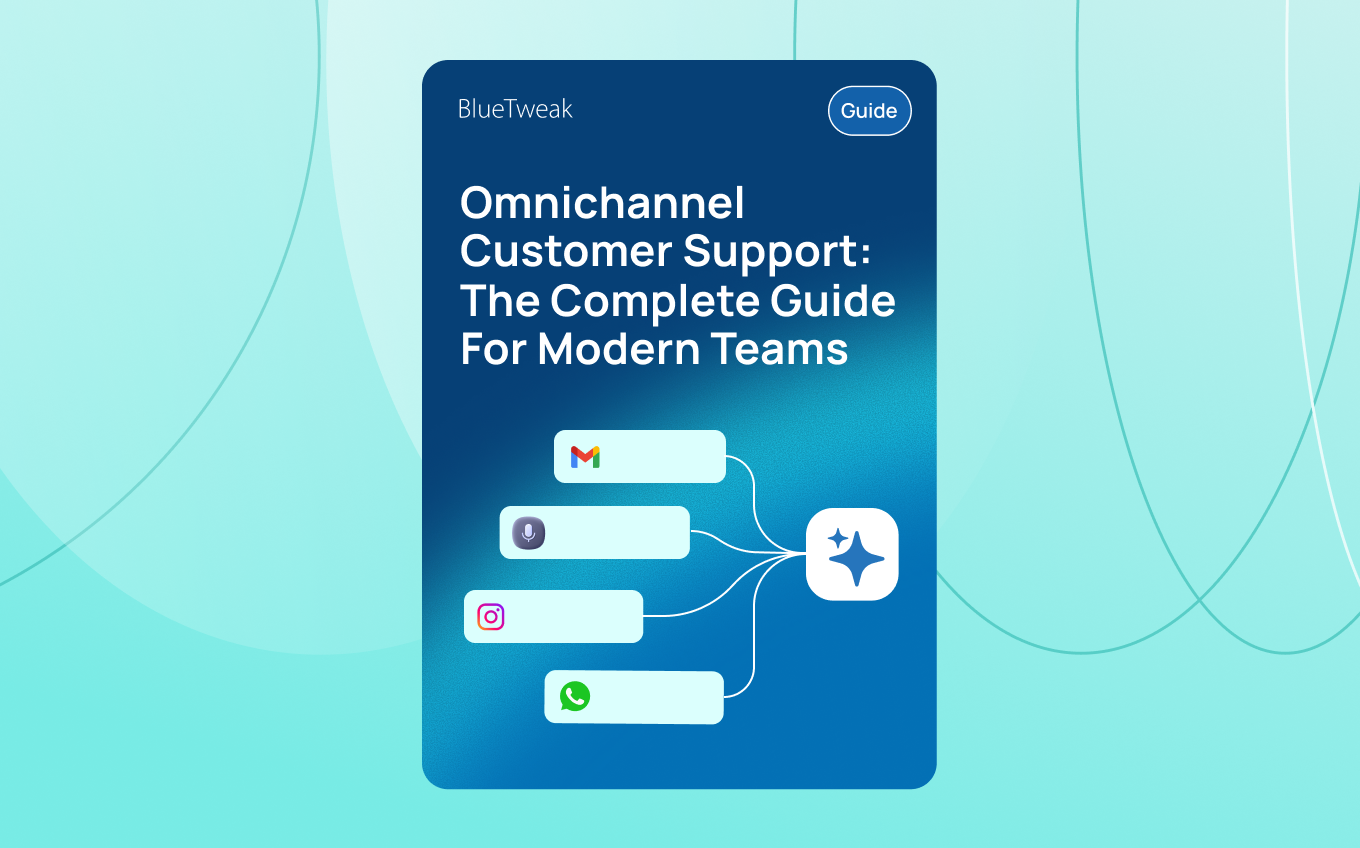


BlueHub unifies every conversation, customer record, and automation into one powerful platform.
Explore more
Omnichannel customer support involves maintaining a single, continuous conversation across multiple channels, including email, chat, voice, and social media, with shared context and consistent service levels. Modern teams utilize unified platforms that integrate channels with intelligent knowledge bases, AI-powered routing, and real-time analytics, ensuring customers never have to repeat themselves.
Your customer starts a conversation on chat, doesn’t get an answer, and decides to send an email. Still frustrated, they call. Three channels, three agents, same question repeated each time. By the time someone actually solves the problem, your customer is exhausted, and your team has wasted hours.
That’s what happens when you run multichannel customer support without connecting the dots. Each channel lives in its own silo. Agents can’t see what has already happened. Context disappears between conversations.
And customers feel like they’re starting over every single time.
Omnichannel customer service addresses this by treating every interaction as part of a single, continuous conversation. Email, chat, voice, social media platforms, and messaging apps all feed into a unified system. Agents see the whole customer journey. Routing rules work across channels. Service levels stay consistent. Customers get faster answers without the frustration of repeating themselves.
For support teams, this means cleaner queues, better forecasting, and fewer escalations that could have been prevented. For leadership, it means reliable reporting, simpler governance, and measurable impact on customer retention.
Everyone wins.
If you’re still managing separate inboxes for each channel, this guide shows you what you’re missing and how to rectify the issue.
Omnichannel customer support is a single, continuous conversation across email, chat, voice, social media, and SMS, with a shared source of truth and context for both human agents and bots.
Traits that define it:
The ticketing system sits at the center. Every interaction becomes a record. Context builds over time. Agents, bots, and analytics all pull from the same data.
This system views customer interactions as a continuous relationship, rather than isolated events.
Ultimately, customers get faster answers because agents don’t waste time asking for information that’s already in the system. They explain their problem once, and every subsequent interaction builds upon the last one.
Fewer repeat explanations mean less frustration. A consistent tone and outcome across channels builds trust: a customer who has a great chat experience expects the same seamless support when they call or email.
First-contact resolution rates increase when agents have the complete story. They resolve issues on the first try, rather than transferring customers between queues or re-asking the same questions.
Containment and deflection improve when bots and the knowledge base collaborate. Routine questions are answered through self-service before they reach an agent, allowing your team to focus on more complex problems that require human judgment and expertise.
Average handle time drops because agents aren’t digging for context or transferring calls. Abandonment rates fall, too—customers trust they’ll get help without waiting in multiple lines.
Forecasting gets easier when you can spot patterns across every channel instead of guessing from fragments. With that visibility, WFM can balance workloads across email, chat, and voice in real time, so staffing decisions feel straightforward instead of stressful.
Reliable cross-channel reporting reveals where customers actually struggle, rather than leaving you to juggle five dashboards that don’t communicate with each other. Escalations are cleaner when routing rules behave the same everywhere. Governance is simpler and safer when you manage a single platform with unified security and compliance controls, rather than a patchwork of tools.
All of this translates to lower operational costs and higher customer retention. Teams that scale omnichannel customer support see measurable improvements in customer satisfaction scores and agent productivity within the first quarter.
Customer service analytics built into the platform give you real-time visibility into what’s working and what needs adjustment.
Before the tactics, align on the fundamentals that make omnichannel work. The following section defines each concept in plain language and shows how it drives faster resolution and a smoother customer journey.
Multichannel customer service involves providing support through multiple channels, including email, chat, and phone. But each channel operates independently:
Omnichannel customer service ties every touchpoint together. One platform handles all channels, and context follows the customer from chat to email to voice. The knowledge base powers answers everywhere, and cross-channel reporting surfaces patterns you would miss in silos.
Here’s what changes:
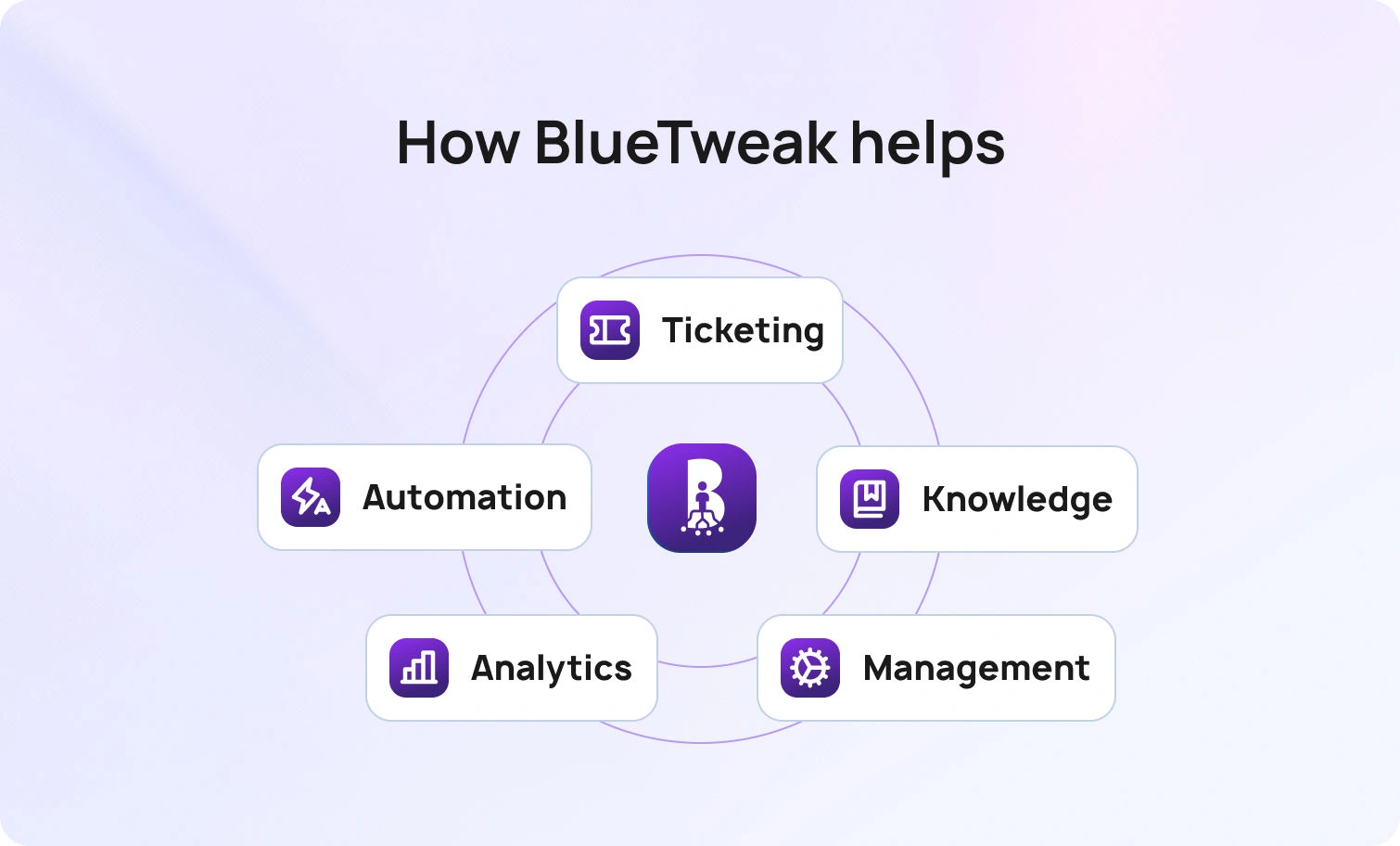
BlueHub is a customer service solution that handles multiple communication channels, a knowledge base, and analytics all in one platform, so you’re not stitching together tools that don’t integrate with each other.
Channels include email, live chat, voice, social media, and SMS. All of them feed into a unified queue where support agents see every interaction, regardless of how it arrived.
Routing signals determine which agent handles each request:
BlueHub handles unified intake and routing across channels. The AI voicebot can handle routine voice interactions while the ticketing system tracks everything in one place.
An intelligent knowledge base powers classification, summarization, and suggested replies across every channel.
Proposed replies for agents maintain consistency and speed. Instead of writing responses from scratch, agents get a draft pulled from KB content that they can personalize and send. This maintains a consistent tone and reduces the time spent on routine responses.
AI ticket summary tools reduce reading time by condensing long email threads or chat transcripts into key points. Spam and duplicate detection keep queues clean, allowing agents to focus on real customer issues.
Real-time chat translation preserves tone and context when customers switch languages during a conversation, ensuring seamless communication. This prevents frustrated customers from getting stuck with agents who can’t understand them.
BlueHub combines the knowledge base with suggested reply features and AI-driven ticket summaries, allowing agents to spend less time searching and more time solving problems.
AI customer service chatbot tools grounded in your knowledge base handle routine questions without human intervention. When the bot can’t answer or detects frustration, it escalates to a human agent, preserving full context so the customer doesn’t have to start over.
AI voicebot handles status lookups, appointment scheduling, and other structured flows. Event-driven notifications and proactive outreach enable you to reach customers before they need to contact support—such as sending shipping updates or service restoration notices.
Well-structured self-serve options don’t replace human agents. They filter out routine questions, allowing your customer service team to focus on complex issues that require judgment and empathy.
BlueHub offers both AI chatbot and AI voicebot capabilities that connect to the same knowledge base your agents use, ensuring consistency across automated and human interactions.
Analytics provide real-time SLA performance, cohort reports by brand, channel, and intent, as well as exports and APIs for business intelligence tools. You need visibility into what’s working and what’s breaking before customers churn.
Call center workforce management forecasts demand by interval, schedules agents to meet concurrency and SLA targets, and re-forecasts intraday when volume spikes unexpectedly. Without this, you’re either overstaffed and wasting money or understaffed and missing SLAs.
Customer service quality assurance auto-samples interactions by risk level and evaluates them against a rubric tied to sentiment and keywords. This catches coaching opportunities and ensures consistent quality across digital channels.
BlueHub provides a single pane for key performance indicators with hooks into staffing and QA workflows, so you’re not managing three separate systems.
Administration and security require role-based permissions, multi-factor authentication, audit logs, data retention policies, and change tracking. Not every agent needs access to override routing rules or view sensitive customer data.
Governance means your knowledge base is the source of truth. Version control, publishing gates, and a multilingual article strategy ensure content accuracy and consistency. When you update an article, the change should be reflected everywhere, including chatbot responses, suggested replies, and agent search results.
Change management encompasses agent enablement, macro governance (defining who can create canned responses and how they’re reviewed), and escalation hygiene (ensuring that high-priority cases are handled urgently).
BlueHub offers centralized administration with brand-scoped workspaces, allowing teams supporting multiple products to operate independently while leadership maintains oversight. However, while BlueHub supports these governance capabilities, some advanced security features are available through API integration and will expand as part of the platform roadmap.
You need one platform (or a tightly integrated set of tools) that handles channels, routing, knowledge base, bots, analytics, workforce management, quality assurance, and administration.
Context should never drop between systems.
The alternative is stitching together separate vendors for chat, email, voice, KB, and analytics. That approach creates integration gaps where customer information gets lost, routing rules break, and reporting becomes a manual nightmare.
Modern omnichannel customer support platforms centralize all information, enabling agents to work within a single interface and allowing data to flow automatically between systems.
If you’re evaluating omnichannel customer support software, here’s what you need:
Those are the must-haves, but a few helpful extra nice-to-haves can go a long way. They include:
BlueHub is API-open and app-friendly, which means you can connect it to existing systems without rebuilding your entire stack.
The following section provides a concise overview of the pros and cons, enabling you to assess the suitability before making an investment.
Omnichannel customer support isn’t a plug-in you install and forget. It’s a process of unifying channels, connecting them to a smart knowledge base, and using analytics to continuously improve.
Start by consolidating your channels into a unified queue. Add AI-powered routing that considers brand, skill, language, and intent. Ground your chatbot and suggested replies in a knowledge base that stays current. Then layer in workforce management and quality assurance to optimize for both customer experience and operational efficiency.
Focus on the metrics that matter: first-contact resolution, containment and deflection rates, average handle time, abandon rates, and sentiment shifts. Publish deltas every 30 days to track improvements and identify areas where adjustments are needed.
If you’re managing support for multiple brands, dealing with high volumes across email, chat, and voice, or trying to scale without proportional increases in headcount, you need the best omnichannel customer service software that connects everything in one place.
BlueHub was built to deliver personalized support at scale with unified channels, AI-powered automation, and real-time analytics. See how it works by booking a demo.
Omnichannel customer support integrates email, chat, voice, social media, and SMS into a single unified system. Customers can switch channels without repeating themselves, and agents see the full context no matter how someone reaches out. BlueHub provides this unified workspace so every interaction lives in a single, continuous thread.
Multichannel offers several channels that operate separately, so history and context often get lost between handoffs. Omnichannel connects all channels so context follows the customer. If someone starts a chat and then calls, the agent already sees what happened. BlueHub keeps that shared context intact across every channel.
Higher first-contact resolution, faster response times, improved CSAT, better agent productivity, and stronger retention. Teams handle more volume without proportionally hiring more staff because automation and smart routing reduce repetitive work. BlueHub adds AI summaries, suggested replies, and skills-based routing to lift speed and accuracy.
Email, live chat, voice, SMS, and social platforms like Facebook and X are common, with many teams also using WhatsApp or in-app messaging. The key is to support the channels your customers actually use and manage them from one workspace. BlueHub natively unifies these channels in a single queue.
It lowers customer effort. People don’t have to restate their issue when switching channels, and agents deliver faster, consistent answers with full context. Understanding preferences and history leads to smoother resolutions and higher satisfaction. BlueHub’s unified timeline and knowledge tools make this continuity effortless.
AI powers chatbots and voicebots for routine questions, drafts knowledge-grounded replies, summarizes long threads, and prioritizes by sentiment so urgent cases rise to the top. In BlueHub, these AI capabilities run inside the same omnichannel workspace, helping agents work faster while sensitive steps still require human approval.
As Head of Digital Transformation, Radu looks over multiple departments across the company, providing visibility over what happens in product, and what are the needs of customers. With more than 8 years in the Technology era, and part of BlueTweak since the beginning, Radu shifted from a developer (addressing end-customer needs) to a more business oriented role, to have an influence and touch base with people who use the actual technology.
Quality
Administration
Workforce Management
Customer Support Analytics
Copyright BlueTweak 2025
