12 Use Cases For AI in Omnichannel Customer Support That Drive Results (2026)


BlueTweak is an AI Customer Support Platform that unifies every conversation, customer record, and automation into one workspace.
Explore more
Insights, trends, and practical ideas from customer experience and AI
Real-world scenarios showing how teams use BlueTweak to deliver better service
The daily blueprint that guides customer support leadership.
ROI and savings calculators for support teams
See how BlueTweak stacks up against leading customer support platforms
AI in omnichannel customer support maintains a continuous conversation across multiple channels, analyzes customer data in real-time, and recommends the best action for both customers and agents. The result is faster resolutions, higher customer satisfaction, and steadier operations. Below are 12 practical use cases, what to look for in a platform, and a fast way to pilot without months of meetings.
Customer expectations rose while communication channels multiplied. A single customer might start on social media, continue in chat, and finish on a phone call. Without an omnichannel customer service strategy anchored by AI, context gets lost, repetitive intake burns time, and the same issue spawns three separate cases. AI changes the shape of the work. It links identities across different channels, maintains context throughout the entire customer journey, and converts unstructured customer inquiries into structured work that the customer service team can resolve without having to start over.
AI also elevates agent productivity. Instead of juggling tabs and copying and pasting history, support agents see a single timeline for the entire customer journey, complete with the relevant knowledge article, suggested responses grounded in approved content, and a clear next step. Leaders transition from guessing to reading live customer insights, tracking agent performance, and adjusting existing workflows. The organizations that win combine a unified customer support platform with lightweight, safe AI tools, so human agents stay in control and customers feel valued with consistent service across multiple communication channels and digital platforms.
Many teams prefer a centralized workspace that combines ticketing, knowledge, automation, and analytics. BlueTweak is an example that combines omnichannel support, AI assistance, and reporting on the same screen, enabling changes to routing, content, or SLAs to be implemented quickly in production.
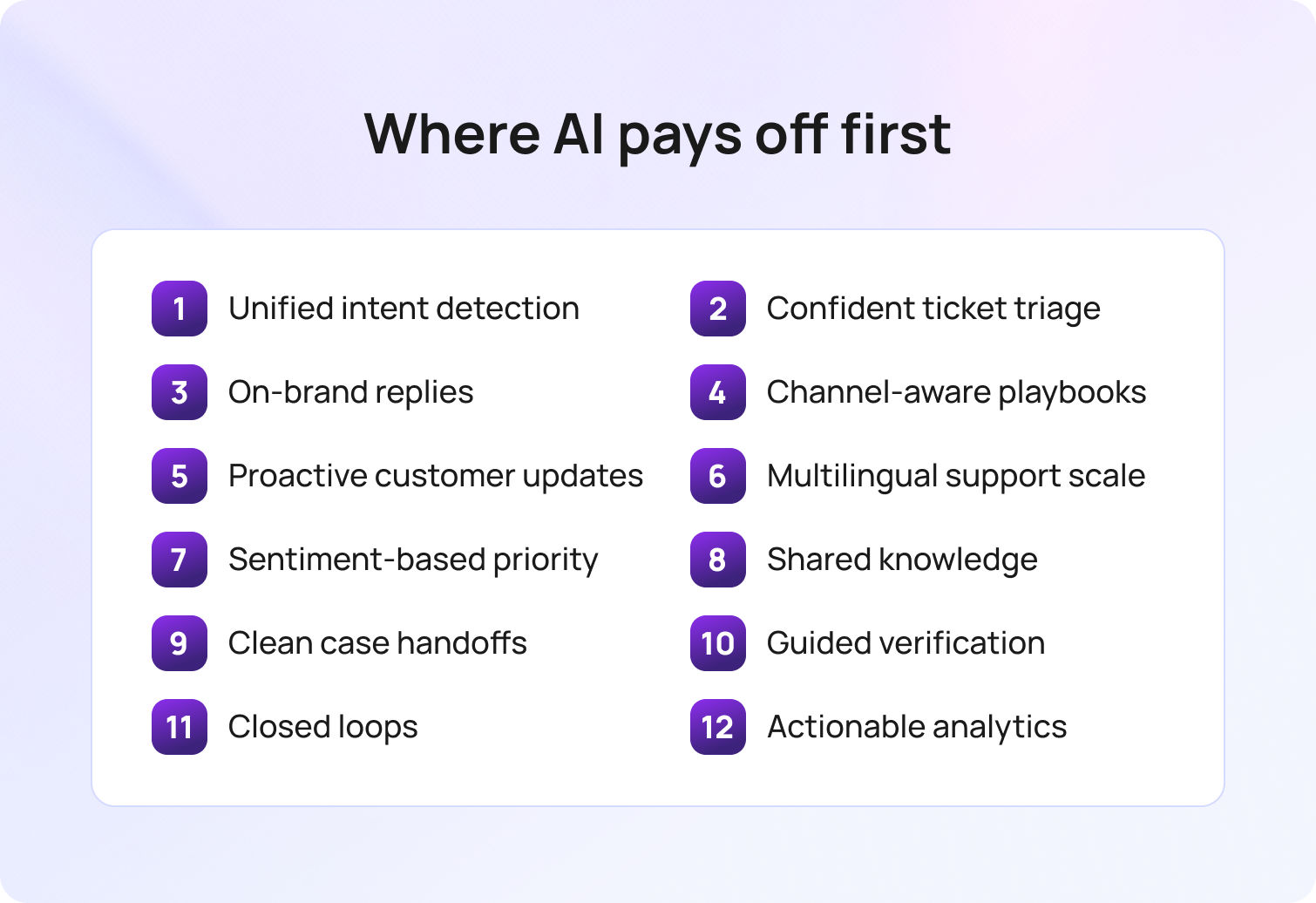
The strongest stacks connect identities across touchpoints, ground responses in approved content, and maintain human control. With that frame, these use cases consistently drive results, improve agent productivity, and enhance customer satisfaction.
One customer, many touchpoints. AI links identities across multiple platforms and recognizes the same issue described differently on social media channels, chat, email, and phone calls. Instead of three tickets, a single case is managed by a single owner with full context. Duplicate handling disappears, customer interactions stay coherent, and the customer experience feels like a single, seamless interaction.
BlueTweak’s unified timeline keeps history, purchase history, and preferences in one place, so the customer service representative doesn’t have to ask the same question twice.
Why it works: Intent detection and identity resolution combine to form a single thread from scattered messages. Customers get a consistent experience, and support teams stop reworking the same problem.
Incoming customer queries are classified by intent with a clear confidence score. High-confidence cases are automatically routed to the right team. Middle-confidence cases show two likely labels for one-click confirmation. Low-confidence cases prompt a clarifying question that preserves context rather than relying on guesswork. Misroutes fall, first-contact outcomes rise, and the entire customer journey avoids painful transfers.
Why it works: Machine learning algorithms trained on real conversation patterns reduce human error in early routing, and visible confidence ensures that human agents remain in control.
Grounded suggestions pull from the knowledge base and current customer data. Agents skim, adjust tone, attach a link, and send. Response times shrink while voice, policy, and compliance stay consistent across channels. Messages align with the brand because the model is grounded in approved content and the internal knowledge base.
Why it works: AI-powered customer service accelerates drafting without forcing canned text. The blend of speed and judgment enhances customer satisfaction while maintaining governance integrity.
Email invites detail and links. SMS and in-app messaging demand brevity. Social prefers short reassurance plus a public link to the next step. AI selects the most suitable variant based on channel, device, and customer preferences, resulting in a higher completion rate for customers who resolve their issues.
In BlueTweak, categories and channels can be mapped to playbooks/macros and articles, so the agent’s view automatically surfaces the appropriate version once it is configured.
Why it works: Matching the message to the medium increases completion rates and reduces the need for back-and-forth communication across different channels.
Patterns in conversation data, inventory management, and order status trigger targeted updates in the customer’s preferred channel. Shipping delays, renewal reminders, planned maintenance, or known issues are communicated to customers before they ask. That is proactive support that reduces volume and builds trust.
Why it works: Predictive analytics spot risks early and turn potential tickets into clear, timely updates. Customers reward that with higher engagement and brand loyalty.
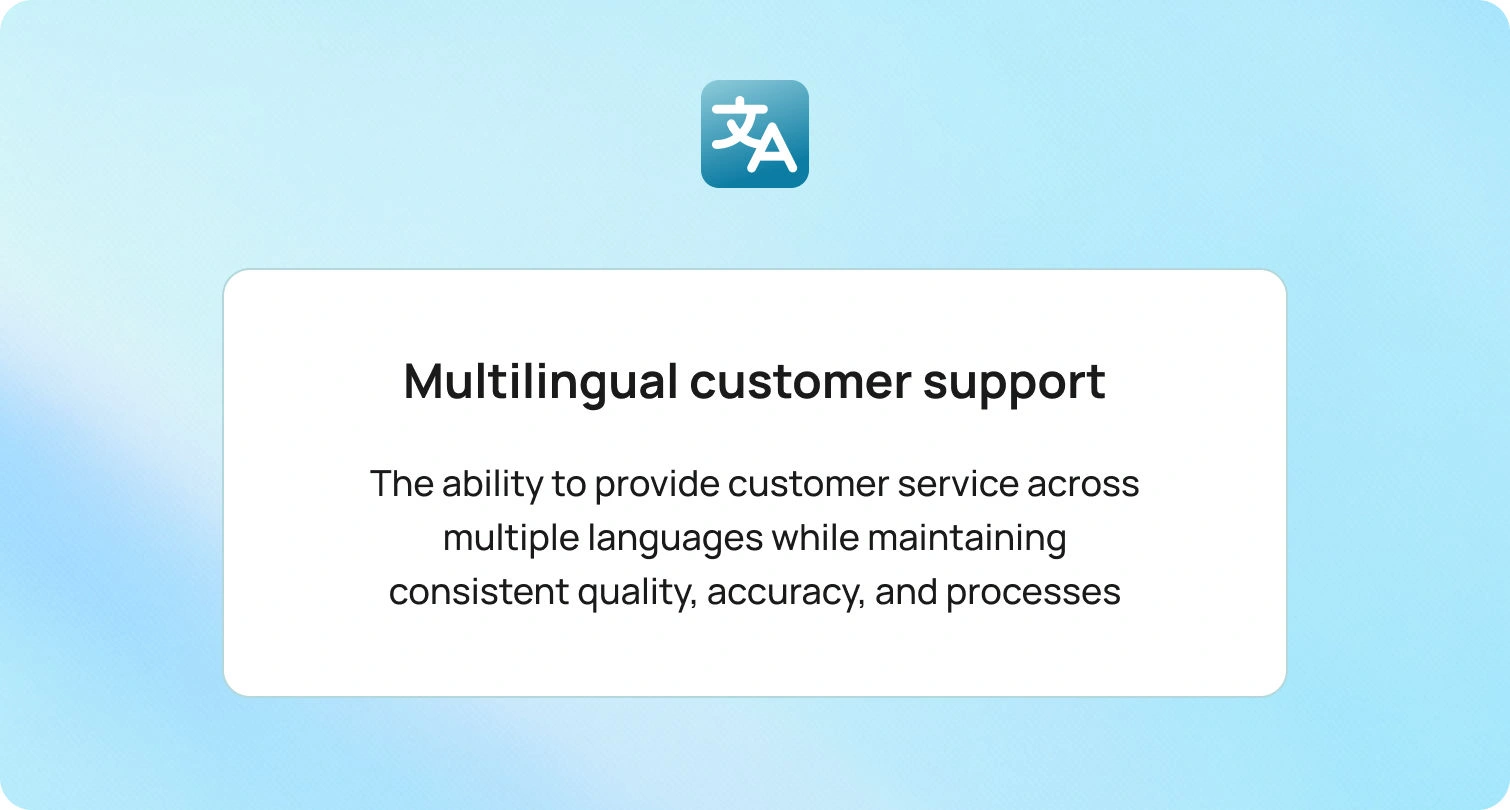
Language is detected at intake. Drafts use an approved glossary for product names and policy terms. Agents confirm intent and send localized replies that feel native across regions without forking core workflows.
In BlueTweak, language detection can be combined with region-specific SLA calendars and templates, allowing the same workflow to run globally while respecting local expectations once configured by administrators.
Why it works: Multilingual AI meets customers in their own language, expanding reach, improving accessibility, and increasing conversion without duplicating processes.
Real-time sentiment analysis reads the room. Urgent or frustrated tones influence priority and template choice. Escalations surface early, tense moments receive empathetic phrasing, and handoffs include the emotional context so the next agent can adjust immediately. The outcome is calmer threads, fewer reopens, and a smoother omnichannel customer experience.
Why it works: AI systems that interpret emotions help humans respond with care. That is how enhanced customer service drives retention.
One knowledge base powers both self-service and agent guidance. The right article appears in context based on category and channel. Customers see the same answer in the help center that agents see during the live conversation. Search terms with no results are converted into content requests.
In BlueTweak, a single knowledge article can be displayed in both the agent view and the self-service portal. Updating it once allows the change to propagate to both experiences, subject to publishing permissions and cache/locale settings.
Why it works: Unified knowledge reduces handle time and improves deflection. It also keeps answers consistent across multiple channels.
When a case transitions from social to email, or from chat to phone, AI summarizes who said what, what was promised, and what remains outstanding. Handoffs start informed, customers do not repeat themselves, and managers can audit decisions without having to hunt through side chats. Summaries also help after-hours teams rejoin the thread with full context.
Why it works: Concise, accurate summaries maintain context across the entire customer journey and keep momentum through channel changes.
Guided ID checks request only the required fields in the current channel and route exceptions to specialists for further review. Sensitive steps stay behind human approval. Customers complete verification within the conversation they initiated, without needing to switch or take redundant steps.
Why it works: Tailored flows meet security needs while maintaining a quick and channel-appropriate experience.
After the fix, a brief check-in in the original channel confirms success, invites a one-question CSAT survey, and links to helpful resources. If something is still off, the case is reopened with full context. Reopen rates fall and relationships strengthen.
Why it works: Closing the loop shows care, turns a solved issue into a positive memory, and fuels customer insights for future improvements.
Leaders view time to first response, FCR, sentiment, and ticket trends by channel and intent in one place. Routing rules or article content changes in the same screen. Top AI customer support tools with multichannel communication are converging on this pattern; BlueTweak emphasizes insight-to-edit in a single workspace so teams do not stall between analysis and execution.
Why it works: Analytics connected to the workflow shorten the distance from learning to doing, creating a durable advantage.
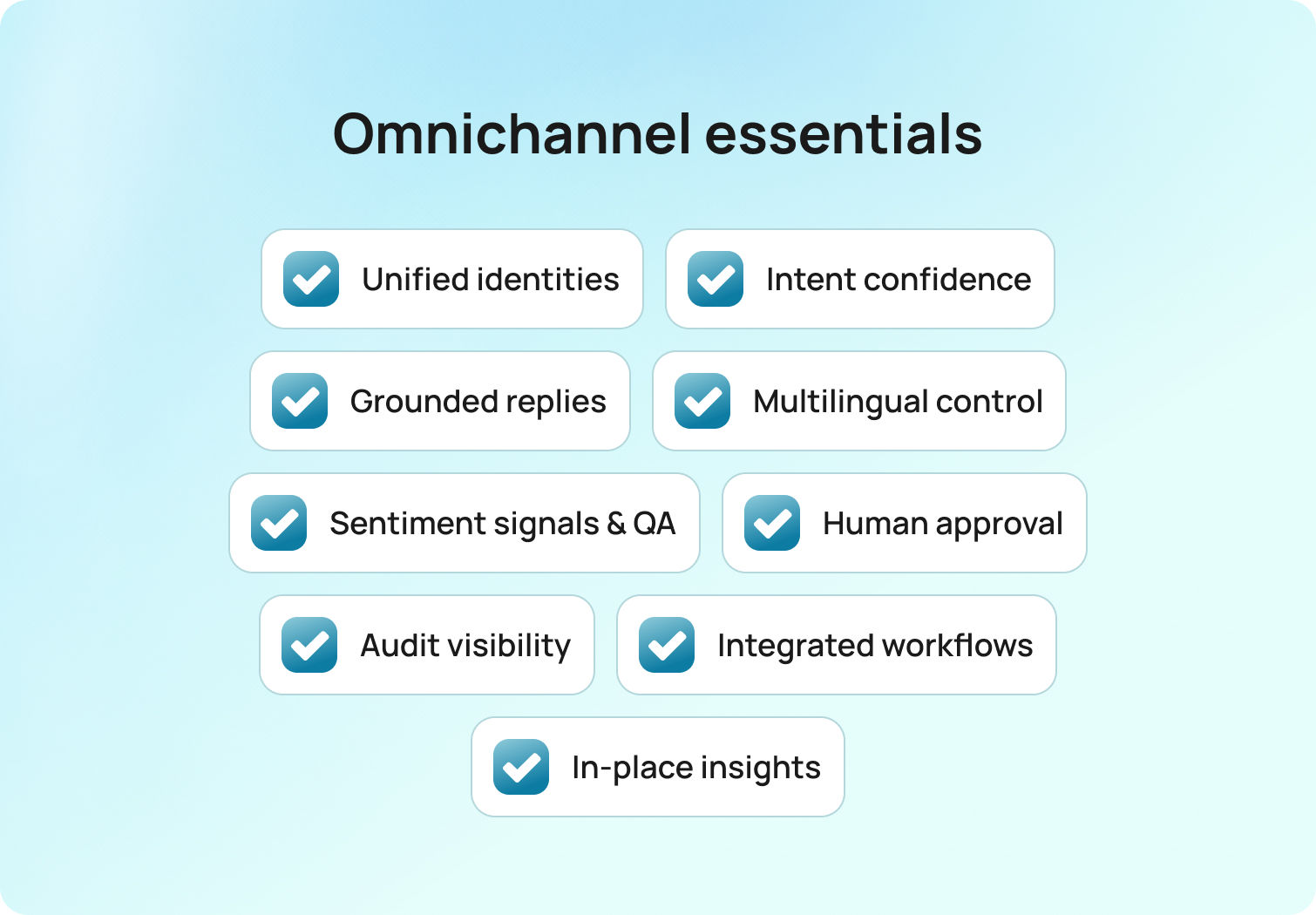
A credible platform for omnichannel customer support with AI should resolve a few non-negotiables. It should unify identities across communication channels and maintain context throughout the customer journey. It should provide intent classification with confidence and rationale, grounded reply suggestions that draw from approved content, multilingual support with a controlled glossary, and sentiment analysis that can safely influence priority and tone. It should keep humans in the loop for sensitive actions and expose audit trails that explain how decisions were made. It should connect SLAs, routing, macros, and knowledge without spreadsheets.
Finally, it should transform customer data into actionable customer insights that managers can use to optimize flows without needing to export data to another tool.
BlueTweak provides a centralized workspace that combines ticketing, knowledge management, workflow automation, analytics, and workforce scheduling. Teams can design and publish flows that run at intake, while identity resolution, AI assist features, and reporting operate in the same environment to keep omnichannel strategies aligned with day-to-day work.
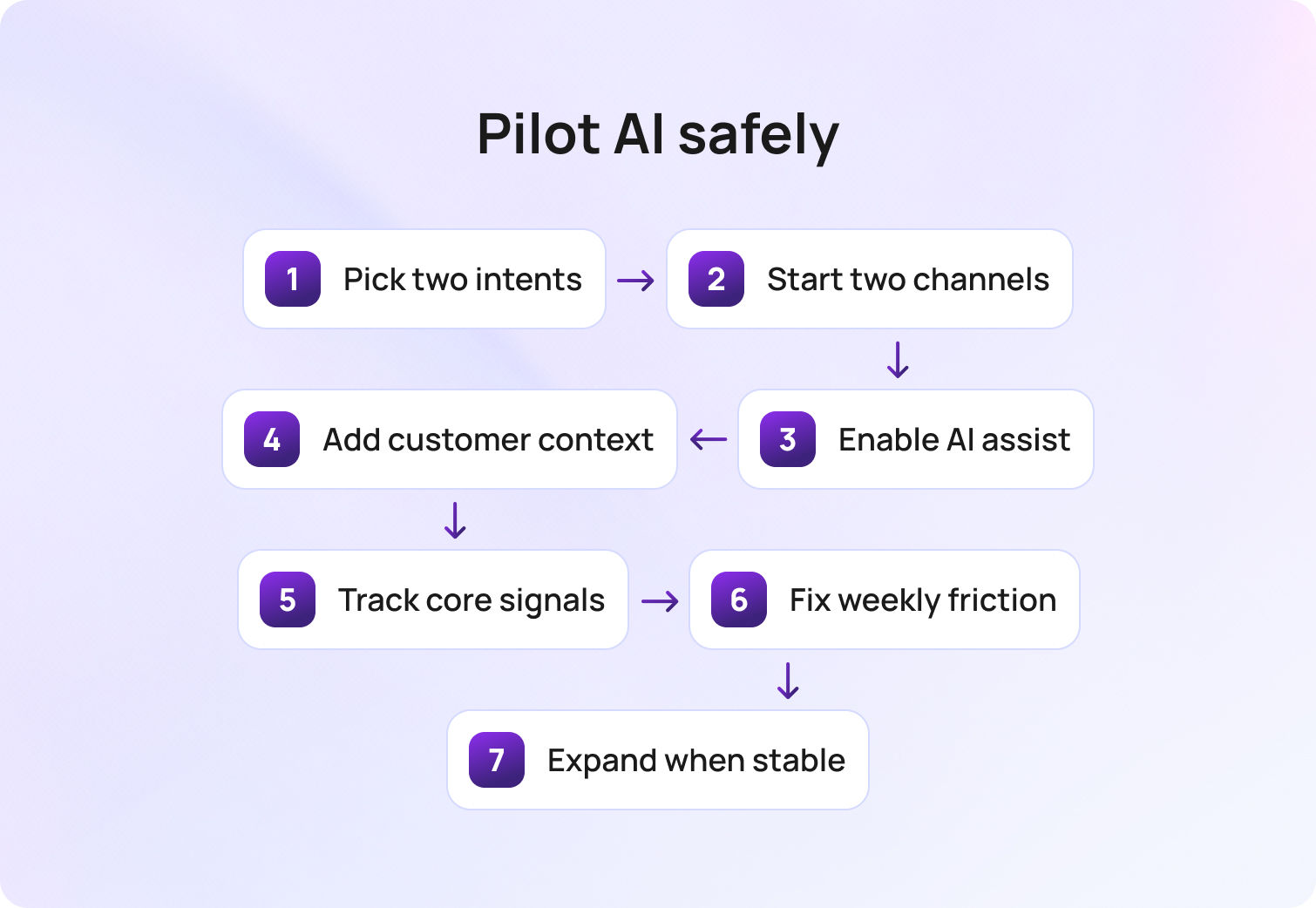
Start small and real. Pick two high-volume intents across two channels. Enable intent classification with confidence, knowledge-grounded reply suggestions, and sentiment-aware priority. Connect CRM to provide customer context, ensuring replies accurately reflect plan tier and purchase history. Track three signals for two weeks: time to first reply, first-contact resolution, and sentiment trend. Fix one friction point each week. When stable, add a third channel and proactive notifications for predictable events, such as renewals or shipment delays. The goal is a calm center that scales, not a flashy demo that cannot survive production.
Keep AI behind approval for refunds, legal topics, and identity risks. Limit models to allowed sources and maintain a clear audit log, allowing a customer service representative to explain a decision later. Publish tone and language guidelines that show how to acknowledge frustration, decline requests, and offer next steps. Review content weekly. The combination of explainable decisions, grounded content, and measured rollouts protects both customers and brand reputation.
For customers, the experience feels simple. Answers arrive quickly, the conversation never resets, personalized support acknowledges preferences, and tailored solutions anticipate needs. For support teams, routine queries move faster, complex work gets more focus, and agent performance improves because the system maintains context and supplies the right step at the right time. For leaders, journey-level analytics reveal volume trends by intent and channel, informing staffing and content priorities. This is transforming customer service from reactive triage to proactive, data-driven service delivery.
Organizations that adopt omnichannel customer service with AI experience steadier workloads, cleaner handoffs, and measurable improvements in customer engagement and retention. They deliver fast across multiple channels without sacrificing tone or accuracy. They use AI-driven analytics to analyze customer data, predict demand, and tune flows early. They earn a competitive advantage by offering a seamless and personalized experien
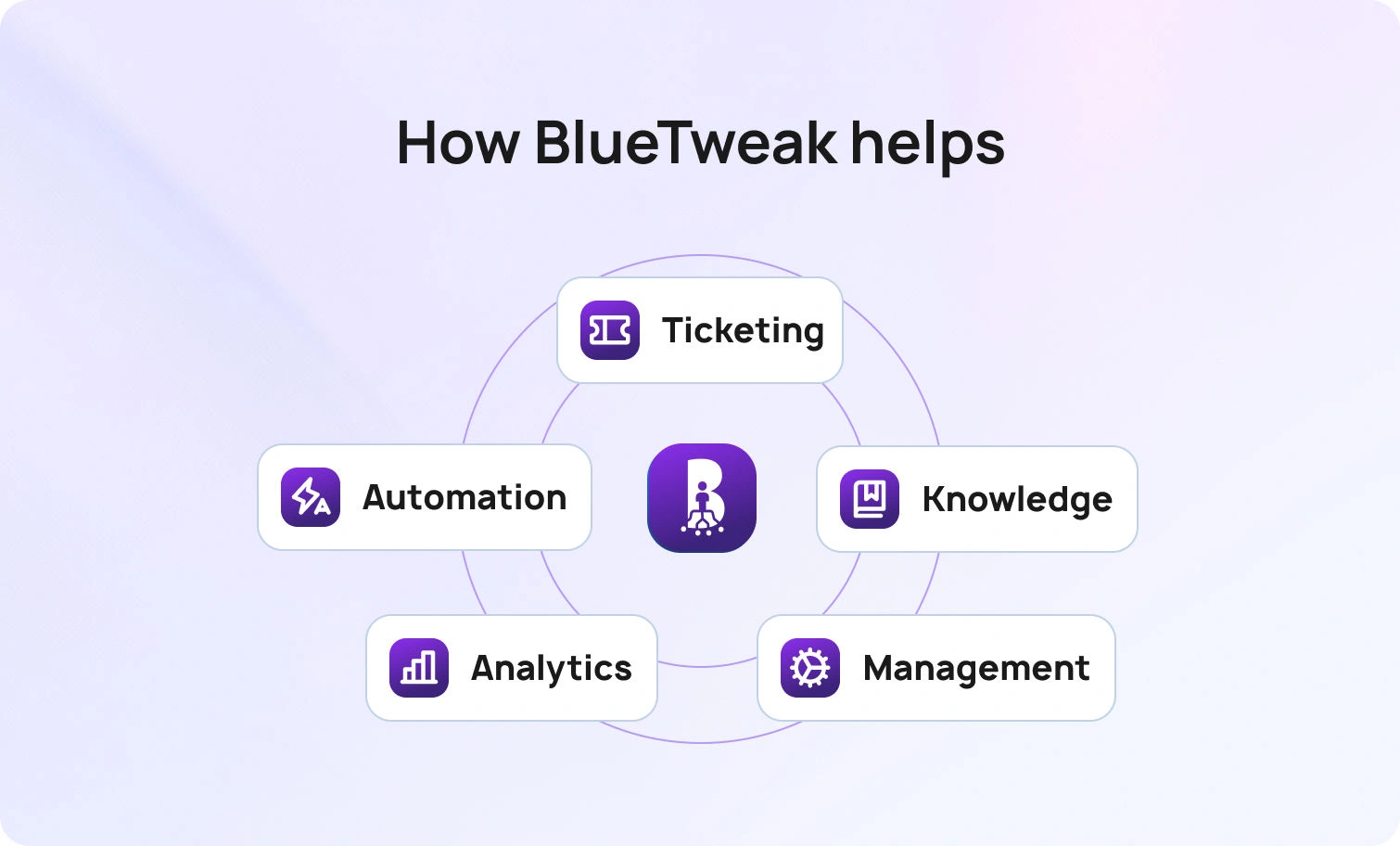
BlueTweak combines ticketing, knowledge, workflow automation, analytics, and staffing into a single workspace, enabling omnichannel support to operate as a unified system, not a collection of tabs. Teams design the flow once and run it at intake, with identity resolution, intent classification with confidence, and grounded reply suggestions available on the same screen that agents use. Category and channel mappings link to playbooks and articles, so the correct version appears automatically. Language detection pairs with region-specific SLAs, letting one process work globally while respecting local expectations.
A single knowledge article powers both the agent view and the self-service portal, so one update improves both paths. Leaders watch time to first reply, FCR, sentiment, and ticket trends by channel, then adjust routing, content, or SLAs in place. The result is consistent service across multiple channels,
AI in omnichannel customer support is most valuable when it maintains a single story across channels, assists human agents in determining the next step, and converts customer data into actionable guidance at the point of work. Start with identity resolution, intent detection, and grounded suggestions. Tie the knowledge to categories. Add sentiment for prioritization and multilingual support for reach. Measure the journey, not the silo. The payoff is consistent service, calmer queues, and sustained gains in customer satisfaction.
Request a BlueTweak walkthrough to watch one ticket move across channels with complete context, AI-guided steps, and live analytics that turn insight into edits on the same screen.
Multichannel gives customers many entry points (email, chat, phone, social) that often operate independently. With BlueTweak’s omnichannel approach, every interaction lives in a single, continuous thread, so when a customer switches from chat to phone, the agent sees the shared context and the conversation doesn’t reset.
Kick off with AI that delivers quick, reliable wins in BlueTweak: identity resolution, intent classification with confidence/rationale, knowledge-grounded reply suggestions, and sentiment-aware prioritization. These cut rework, lift first-contact resolution, and keep tone consistent across channels.
No. In BlueTweak, AI handles routine queries, summaries, and next-step prompts, while complex requests stay human-led. The best results come from “assist → approve → auto”: agents stay in control, and sensitive actions require approval.
Track time to first reply, first-contact resolution, sentiment by channel, duplicate-ticket reduction, and deflection to self-service. BlueTweak’s journey-level dashboards make it easy to review weekly and adjust routing, knowledge articles, or templates on the spot.
BlueTweak unifies ticketing, knowledge, automation, analytics, and workforce management, enabling omnichannel support, AI assistance, and reporting, all within a single workspace. That design helps manage interactions across the entire customer journey and turn customer insights into changes without leaving the screen.
As Head of Digital Transformation, Radu looks over multiple departments across the company, providing visibility over what happens in product, and what are the needs of customers. With more than 8 years in the Technology era, and part of BlueTweak since the beginning, Radu shifted from a developer (addressing end-customer needs) to a more business oriented role, to have an influence and touch base with people who use the actual technology.