Intercom vs Help Scout vs BlueTweak: Which To Implement In 2026?


BlueTweak is an AI Customer Support Platform that unifies every conversation, customer record, and automation into one workspace.
Explore more
Insights, trends, and practical ideas from customer experience and AI
Real-world scenarios showing how teams use BlueTweak to deliver better service
The daily blueprint that guides customer support leadership.
ROI and savings calculators for support teams
See how BlueTweak stacks up against leading customer support platforms
When comparing Intercom vs Help Scout, the real difference comes down to how your team manages customer interactions and which help desk features matter most. Intercom is built for AI-first messaging, with strong AI features, AI assistants, and proactive messages designed for high-volume live chat widget engagement. Help Scout focuses on a simpler help desk experience with a clean ticketing system, unified inbox, and solid self-service options that suit many small businesses. BlueTweak offers a third option for teams that need a more fully integrated platform covering chat, voice, and support tickets in one place.
Choosing between Help Scout and Intercom isn’t just about picking a chat widget or a shared inbox anymore. In 2026, customer experience leaders face a much deeper strategic question: how to build a support operation that meets rising customer expectations while still keeping costs, complexity, and tool sprawl under control.
Customers are redefining what good service looks like. According to a 2025 survey from Gartner, more than half of all customer service journeys now begin on third-party platforms such as search engines, YouTube, or generative AI tools, not just on a brand’s own site or social pages. This shift highlights two realities: service must be discoverable where customers already are, and experiences need to be seamless across channels, not just reactive in a single inbox or chat feed.
At the same time, adoption of AI and automation in support continues to accelerate, driven by operational efficiency and customer expectations. But simply adding AI isn’t a panacea. Too many teams find that “AI features” without clear governance, knowledge control, or integration with existing workflows create noise rather than value. The result is a landscape where automation must be purposeful, knowledge-grounded, and channels unified.
This evolving context is why comparisons like Intercom vs Help Scout remain relevant in 2026. One platform may win on conversational automation, another on simplicity. But today’s leaders need to think beyond features: they need clarity on how each solution supports omnichannel service, integrates AI responsibly, and scales predictably as support volumes and customer expectations grow.
Increasingly, that conversation also includes platforms like BlueTweak. For teams that have outgrown a simple inbox but don’t want to assemble a stack of separate tools for chat, voice, reporting, and automation, unified CX platforms are becoming a practical alternative. Instead of choosing between conversational automation or operational simplicity, solutions like BlueTweak aim to provide a single environment where tickets, chat, voice, analytics, and AI work together as support operations scale.
When comparing Intercom vs Help Scout vs BlueTweak, it helps to step back from feature lists and look at the structural differences in how each platform approaches customer support. While the tools may overlap in areas like messaging, ticketing, and automation, they are built around very different operational philosophies.
Intercom is designed around conversational engagement and AI-driven messaging, making it popular with product-led teams that prioritize real-time chat and automation. Help Scout takes a more streamlined approach, focusing on a clean shared inbox and self-service tools that help lean teams manage support without heavy configuration.
BlueTweak sits in a slightly different category. Rather than centering the experience around chat or email, it positions itself as a unified CX platform that brings tickets, chat, voice, analytics, and workforce management into a single operational environment. For teams that are scaling beyond startup simplicity but don’t want the complexity of enterprise CX suites, this approach can provide a more structured foundation for multi-channel support.
The table below summarizes how each platform is positioned operationally in 2026, not just what features exist, but how each vendor approaches AI, omnichannel service, and support team scalability.
| Capability | Intercom | Help Scout | BlueTweak |
| Who it’s for | Digital-first SaaS and product-led teams prioritizing conversational CX | Lean teams wanting shared inbox simplicity without heavy admin | Scaling teams (20–100 agents) running multi-brand or multilingual support |
| Core strength | AI-forward conversational customer service suite | Email-first shared inbox with lightweight self-service | Unified CX operating system built for structured growth |
| Voice | Available by plan (verify specifics) | No native voice | Native voice is integrated into the same queue and reporting layer |
| Omnichannel | Chat-centric, with expanded channel options | Email + Beacon chat | Chat, tickets, and voice unified in one operational environment |
| AI | Fin AI Agent + Copilot; managed knowledge sources | AI drafting + Docs-based assistance (verify by plan) | Knowledge-base-grounded AI with human oversight and operational controls |
| Knowledge Base / Self-Service | Help Center powered by managed knowledge | Docs + Beacon widget | Single source of truth powering agents, bots, and multilingual routing |
| WFM / QA | Varies by plan | Limited WFM depth | Built-in workforce management and QA visibility without add-ons |
| Security / Admin | Enterprise controls by tier | Straightforward roles and permissions | Role-based controls, audit logs, and multi-brand governance (ISO in progress) |
| Pricing model | Seat-based tiers + AI/usage-style elements (verify) | Published tier pricing | €65/agent/month anchor with clearer packaging for mid-market teams (verify usage components) |
When evaluating Help Scout vs Intercom vs BlueTweak, many buyers focus on feature parity. But a more useful lens is operating philosophy. Each platform represents a different approach to how customer support should function in 2026. Understanding that philosophy helps you avoid choosing a system that feels right at 10 agents, but restrictive at 40.

Intercom has evolved from a live chat tool into a broader, AI-forward customer service suite. Today, its positioning centers around conversational support, automation, and AI-driven resolution. Fin AI Agent and Copilot are designed to assist, and in some cases autonomously resolve, customer conversations using managed knowledge sources.
Intercom’s strength lies in real-time engagement. It is built around messaging-first workflows, where conversations flow naturally between automation and human agents. For product-led and SaaS businesses that want support tightly integrated into the customer journey, this model is compelling.
However, Intercom assumes operational readiness for automation. Teams must:
It is not a lightweight inbox solution, but rather a configurable, AI-layered environment. That can be a powerful option, but it requires clarity on governance, measurement, and cost modeling.
In short, Intercom is best understood as a conversational CX suite where AI and automation sit at the center of the service model.
Help Scout takes a different path. Its foundation is the shared inbox; simple, clean, and email-first. Docs provides knowledge base functionality, and Beacon acts as the customer-facing entry point for chat and self-service.
Help Scout avoids unnecessary complexity and focuses on enabling teams to respond quickly and collaboratively without heavy configuration. For lean teams, especially those prioritizing email support with light chat capability, this simplicity is often considered a competitive advantage. Implementation is typically faster, admin overhead is lower, and the learning curve is minimal.
Where Help Scout can feel limiting is in deeper operational layers. Native voice, workforce management tooling, and complex multi-brand routing are not its primary focus; it is intentionally streamlined.
Help Scout is best understood as a modernized shared inbox platform with integrated self-service, ideal for teams that want structure without suite-level complexity.

BlueTweak is positioned differently. Rather than centering on either chat automation or inbox simplicity, it frames itself as a unified customer experience (CX) operating system for scaling teams.
BlueTweak brings tickets, chat, voice, bots, workforce management, analytics, and a knowledge-base-grounded AI layer into a single operational environment. The focus isn’t just on responsiveness, but also visibility and control across channels, brands, and regions.
This matters particularly for teams in the 20–100 agent range, where complexity increases quickly:
At this stage, stitching together separate tools for telephony, reporting, QA, and chat can create blind spots. BlueTweak’s positioning is that these components should exist inside one governed system, rather than across five dashboards.
It is not a chat-only automation suite, nor is it a minimalist inbox tool. It is built for organizations that have moved beyond startup simplicity, but do not want enterprise bloat.
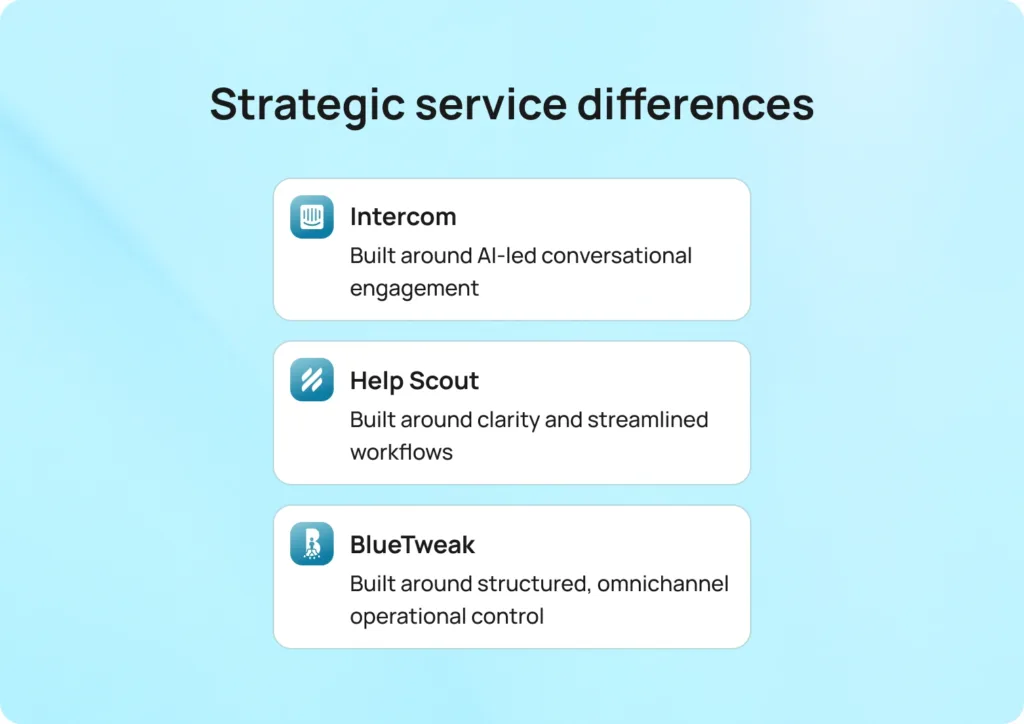
The Intercom vs Help Scout vs BlueTweak debate often starts with channels and features, but mature CX decisions rarely hinge on feature checklists; they hinge on operating model alignment.
Those are fundamentally different trajectories.
The decision, then, isn’t about which tool has more features, but rather, which platform matches the complexity you have today, as well as the complexity you’re likely to inherit over the next 24 months.
Choosing for month one is easy. Choosing for year two is where most teams get it wrong.
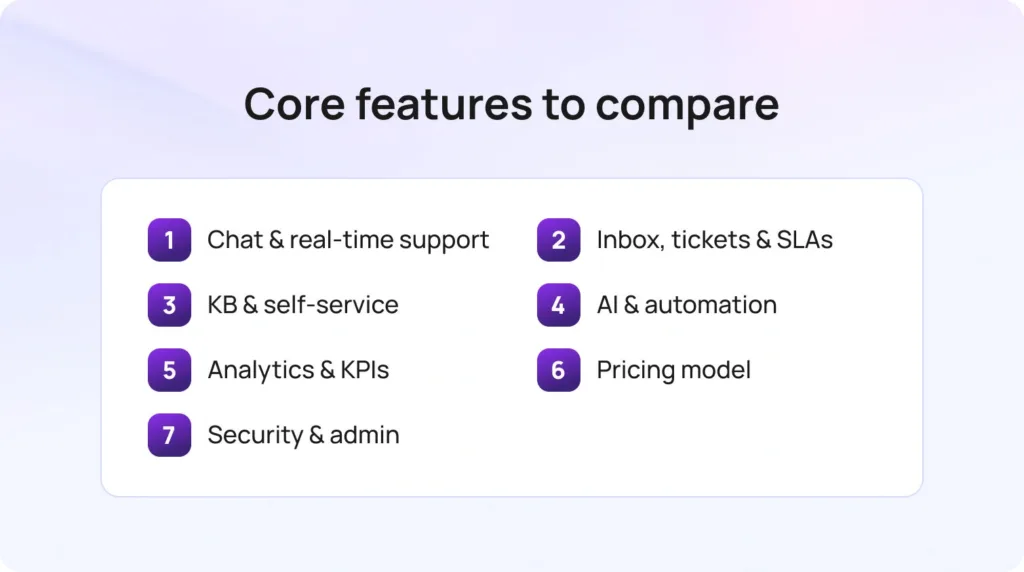
High-level positioning is useful, but buying decisions are made in the details. When evaluating Help Scout vs Intercom vs BlueTweak, this is the stage where nuance matters: how messaging behaves under load, how SLAs function across channels, how AI is governed, how reporting scales, and how cost shifts as usage patterns evolve.
The sections below focus on how each platform behaves operationally, especially as complexity increases.
Real-time support is where Intercom and Help Scout most visibly diverge, and where BlueTweak positions itself differently again.
Intercom is built around conversational messaging. Live chat is not an add-on; it is the core workflow. Automation, AI agents, and human agents operate within a unified conversational thread. For digital-first businesses where chat volume is high and immediate engagement drives revenue, this architecture is a strength.
However, chat-first systems assume conversational maturity: routing rules, automation design, and AI supervision require ongoing tuning.
Help Scout delivers chat primarily through Beacon. It works well as a support entry point layered onto an inbox-centric workflow. For teams that view chat as a complement to email rather than the primary support channel, this lighter implementation reduces admin complexity.
BlueTweak approaches chat as one channel within a broader operational system. Chat, tickets, and voice share queue logic and reporting. The differentiator here is context continuity; agents are not switching systems to handle different real-time vs asynchronous conversations.
If real-time chat sits at the heart of your acquisition or retention strategy, Intercom’s conversational architecture and automation depth give it a structural advantage. But if chat plays a secondary role to email-based support and you’re primarily optimizing for simplicity and speed, Help Scout’s lighter implementation may be entirely sufficient.
However, if chat needs to operate alongside voice and ticket workflows inside a single operational framework, without agents toggling between systems or managers reconciling separate reporting layers, BlueTweak becomes a strategically relevant choice. The distinction isn’t just about chat capability; it’s about how seamlessly that capability integrates into the broader support environment as complexity increases.
Inbox design shapes agent productivity more than most teams realize.
Intercom incorporates helpdesk-style workflows inside its suite, with automation layered heavily into routing and resolution. SLAs and collaboration features vary by plan, so teams should validate exact capabilities during evaluation. The system is designed for speed and automation leverage.
Help Scout prioritizes clarity. The shared inbox model is intentionally straightforward: conversations, assignments, notes, and tags. For lean teams, this simplicity minimizes friction and onboarding time.
BlueTweak focuses on cross-channel SLA consistency. Ticketing logic extends across chat, email, and voice, allowing teams to manage performance targets holistically. Multi-brand routing and structured escalation paths are core considerations, not bolt-ons.
The question here isn’t “does it have SLAs?” It’s whether SLAs remain visible and enforceable as channels and brands multiply.
Self-service maturity directly impacts cost per ticket.
Intercom powers its Help Center and AI workflows through managed knowledge sources. This creates a tightly integrated environment where content can directly fuel AI resolution. However, governance becomes critical: what content is exposed, how it’s versioned, and how it’s targeted should all be validated.
Help Scout pairs Docs with Beacon. It’s a clean model: publish helpful articles, surface them contextually, and reduce inbound volume. For smaller teams, this simplicity often delivers quick wins.
BlueTweak positions its knowledge base as a single source of truth powering both agents and AI. Because it sits inside a broader operational framework, knowledge routing can be tied to brand, language, or queue logic. That matters for multilingual and multi-region support teams.
In 2026, self-service is centered on whether your knowledge strategy reduces volume without increasing AI unpredictability.
AI is no longer optional in the Intercom vs Help Scout discussion, but its implementation varies meaningfully.
Intercom’s Fin AI Agent and Copilot are designed to resolve conversations and assist agents. The model is automation-forward. Buyers should clarify how AI resolutions are defined, how usage is billed, and how knowledge boundaries are enforced.
Help Scout focuses AI primarily on drafting assistance and self-service enhancement. It is typically augmentation rather than autonomous resolution, though exact capabilities vary by plan.
BlueTweak emphasizes knowledge-base-grounded AI with human oversight. Rather than maximizing autonomous resolution volume, the focus is on measurable improvements in handle time, first contact resolution, and multilingual efficiency.
This focus on governed automation is reflected in real-world implementations. In one BlueTweak deployment for a growing e-commerce company, AI-powered support workflows helped increase ticket deflection by 45% and reduce interaction time by 30%, allowing the team to scale support without proportionally increasing agent headcount. The case highlights how combining AI with structured knowledge and unified channels can improve both efficiency and customer satisfaction.
For teams looking to implement AI responsibly, BlueTweak also offers proposed replies that help agents maintain quality and consistency while leveraging automation.
This is where thought leadership matters: AI success in 2026 is not about volume handled. It is about governed deflection with predictable cost dynamics.
As teams scale, reporting depth becomes a constraint.
Intercom provides analytics tied to conversations, automation, and AI performance. Teams should validate SLA tracking depth and how AI outcomes are measured within reporting layers.
Help Scout offers clear, accessible reporting aligned with its simplicity model. For straightforward environments, this is often sufficient. Scaling teams should evaluate whether multi-brand or workforce performance visibility requires additional tooling.
BlueTweak integrates analytics with workforce management and QA visibility. For 20–100 agent teams, real-time dashboards across brands and channels reduce the need for separate BI or WFM systems.
Reporting is often where tool sprawl begins; the more fragmented the channel stack, the more fragmented the data.
Pricing is often where the Help Scout vs Intercom comparison becomes clearer. Once features align, the real question is how each platform’s cost model behaves as agent counts, automation usage, and channel volume increase.
Intercom uses seat-based tiers, with AI and usage-style elements layered in depending on plan. As automation increases, usage metrics may become more influential in total cost. Teams should model growth scenarios, not just current volume.
Help Scout presents published tier pricing that feels straightforward. Feature access varies by plan, so mapping your required capabilities to the correct tier is essential.
BlueTweak anchors pricing at €65 per agent per month, positioned for mid-market clarity. Usage-based elements should be verified where applicable, but the model is structured around operational predictability rather than layered AI charges.
At smaller team sizes, pricing differences between platforms are often marginal. But as support organizations grow, particularly beyond 50 agents, usage assumptions, automation volume, and channel expansion can start to materially influence total cost.
Security and administrative control rarely dominate early product demos, but they become critical once a support platform is embedded into daily operations. Customer service systems often contain sensitive customer data, internal notes, and performance metrics, which means governance, access controls, and auditability should be evaluated early in the intercom vs help scout decision process.
Intercom provides a range of security and compliance capabilities across its platform tiers, including data processing controls, regional hosting considerations, and administrative permissions. Because Intercom increasingly incorporates AI-driven workflows, teams should also confirm how AI interactions are logged, how knowledge sources are governed, and how conversation data is stored or retained. These details can vary by region and plan, so reviewing official documentation during procurement is essential.
Help Scout follows a simpler model that aligns with its broader philosophy of operational clarity. Teams can manage roles, permissions, and access controls within the shared inbox environment, while auditability and retention settings can be configured to support internal governance requirements. For organizations operating in regulated environments, confirming how these controls map to internal compliance policies is an important evaluation step.
BlueTweak emphasizes administrative visibility and control across multi-brand support environments. Role-based permissions and audit logs help teams maintain governance as agent counts grow and operational complexity increases. BlueTweak also enables teams to manage multiple brands or support queues within a single environment, simplifying administrative oversight for larger support organizations. The platform is ISO 27001 certified, providing assurance around information security and data governance. When evaluating alternatives, teams should also confirm the compliance certifications and security standards maintained by other vendors under consideration.
For growing support organizations, these controls are less about ticking a compliance checkbox and more about maintaining operational discipline. As teams scale, the ability to manage access, monitor changes, and maintain clear governance over customer data becomes an increasingly important part of platform selection.
Feature comparisons help narrow a shortlist, but long-term platform decisions are often made on total cost of ownership. In the Help Scout vs Intercom discussion, the list price rarely tells the full story. Pricing models can behave very differently as agent counts grow, automation usage increases, and new channels are introduced.
A useful exercise is to model a realistic 12-month scenario. For example, imagine a support team with 50 agents, moderate chat volume, and a growing self-service strategy. Over the course of a year, several variables can influence total platform cost:
In other words, the most useful pricing comparison isn’t today’s invoice; it’s how the platform behaves once your support operation becomes more sophisticated.
Before committing to any platform, it’s worth clarifying how pricing behaves under real operational conditions:
These questions often reveal cost dynamics that aren’t immediately obvious in pricing calculators.
Choosing a platform is only the first step. Successful deployments typically depend less on the software itself and more on how well the support organization prepares its workflows, knowledge base, and operational processes.
Intercom implementations often focus on preparing the knowledge environment that powers automation and AI. This can involve structuring the Help Center, defining knowledge sources, designing automation flows, and setting up routing rules that ensure conversations reach the right agents. Teams should also plan how they will measure automation success and AI-assisted resolutions.
Help Scout deployments tend to be simpler, but still benefit from thoughtful setup. Structuring inboxes clearly, building a logical information architecture for Docs, and configuring Beacon entry points can significantly influence the effectiveness of self-service. Basic automation and tagging strategies can further improve agent efficiency.
BlueTweak implementations typically focus on bringing multiple channels into one operational system. This often involves unifying chat, email, and voice workflows, structuring the knowledge base so it can ground AI responses, and configuring multi-brand routing and reporting. Rolling out dashboards and workforce management visibility is also an important step for teams managing larger support environments.
This comparison is based on vendor documentation, official feature descriptions, and publicly available pricing information. Where capabilities vary by plan or region, they are indicated as ‘Varies by plan’ or ‘Verify’.
No third-party review platforms were used as evidence. The goal of this article is to provide a clear framework for evaluating help scout vs intercom, while also introducing BlueTweak as an alternative for teams whose operational needs extend beyond either model.
At this stage of the Intercom vs Help Scout vs BlueTweak evaluation, the focus isn’t on finding the universal ‘winner’. Each platform is designed for a slightly different support environment, and the right choice usually reflects the complexity of your CX operation rather than the number of features on a checklist.
Choose Intercom if real-time messaging and AI-led automation are central to your support strategy. Intercom’s conversational architecture is designed for organizations where chat drives customer engagement, and automation is expected to resolve a growing share of interactions.
Choose Help Scout if you want a streamlined shared inbox environment that prioritizes clarity over configuration. Help Scout is well-suited to lean teams that rely heavily on email support, with self-service layered through Docs and Beacon.
Choose BlueTweak if you’re building a support operation that spans multiple channels and requires stronger operational visibility. BlueTweak’s unified approach to tickets, chat, voice, analytics, and workforce management is designed for teams in the 20–100 agent range that want to avoid stitching together multiple systems as they scale.
Choosing the right help desk ultimately comes down to how your team manages customer interactions, scales support, and delivers exceptional customer service as your company grows.
In this Intercom feature comparison, we’ve looked at how each platform approaches support tickets, customer relationships, and modern AI features. While Intercom offers an AI-first approach with tools like AI assistants, AI answers, and instant answers, teams should weigh these capabilities carefully against Intercom’s pricing, especially when usage grows or when moving into higher-tier plans.
For many teams, the decision will hinge on how well a platform balances advanced features, usability, and long-term value. Scout offers a pretty straightforward help desk experience with a strong ticketing system, a unified inbox, and useful self-service options, making it attractive for small businesses or teams prioritizing simplicity.
However, when organizations need multi-channel support, phone support, phone calls, deeper reporting, and powerful automation capabilities, a third option like BlueTweak can provide a fully integrated environment that brings messaging, support tickets, analytics, and workforce tools together in one platform.
The real difference often appears once teams start handling high-volume customers, managing multiple inboxes, or coordinating growing support teams across different platforms. At that stage, factors like automation tools, AI capabilities, proactive support, and how easily new team members can adopt the system all play a role in delivering the level of service customers expect today.
If you’re weighing help desk features, reviewing an intercom pricing comparison, or looking for a cost-effective platform that scales as your customers grow, the most useful step is seeing the system in action.
Book a demo to see how BlueTweak helps teams manage customer interactions, streamline support tickets, and deliver exceptional customer service to customers at scale.
The biggest difference lies in how each help desk platform manages customer interactions and automation. Intercom offers an AI-first messaging experience with tools like AI assistants, AI answers, and a live chat widget, while Scout offers a simpler ticketing system and unified inbox designed for teams that prefer a traditional help desk workflow. BlueTweak acts as a third option, combining messaging, support tickets, analytics, and multi-channel support into a fully integrated platform designed for growing teams and complex customer relationships.
Many teams start with a free plan or lower entry tier, but Intercom’s pricing can become more complex as usage grows. Costs often increase when AI features, messaging volume, or advanced features are added through higher-tier plans like the Pro plan. That’s why an intercom pricing comparison is important when evaluating long-term value, particularly for companies handling large numbers of customers or high-volume support operations.
For small businesses, the right help desk often depends on simplicity and ease of initial setup. Scout offers a pretty straightforward experience with its ticketing system, collision detection, and clean unified inbox, making it easy for a small support team or even a single team member to manage support tickets efficiently. However, businesses expecting growth in customer interactions or wanting stronger AI capabilities may prefer a platform with more advanced features and built-in automation.
Yes, modern help desk features increasingly rely on artificial intelligence to handle repetitive tasks and improve response times. Intercom includes AI assistants, AI summarize, AI answers, and instant answers, while other platforms provide varying levels of automation tools and AI features to help teams respond faster to customers. These tools support proactive support, surface relevant content from knowledge bases, and allow support teams to focus on more meaningful customer relationships.
Before making an informed choice, companies should look beyond surface features and evaluate how a platform handles real-world customer interactions. Key considerations include multi-channel support, the ability to manage multiple inboxes, integrations such as WhatsApp, and how well the platform supports onboarding new team members. Teams should also assess how tools like in-app messages, proactive messages, and phone support help maintain a personal touch while scaling support for more customers across multiple languages.
As Head of Digital Transformation, Radu looks over multiple departments across the company, providing visibility over what happens in product, and what are the needs of customers. With more than 8 years in the Technology era, and part of BlueTweak since the beginning, Radu shifted from a developer (addressing end-customer needs) to a more business oriented role, to have an influence and touch base with people who use the actual technology.