Using AI for Customer Service: Practical Use Cases That Drive Results in 2026



BlueTweak is an AI Customer Support Platform that unifies every conversation, customer record, and automation into one workspace.
Explore more
Insights, trends, and practical ideas from customer experience and AI
Real-world scenarios showing how teams use BlueTweak to deliver better service
The daily blueprint that guides customer support leadership.
ROI and savings calculators for support teams
See how BlueTweak stacks up against leading customer support platforms
Using AI for customer service drives measurable results when AI use cases are matched to specific KPI gaps. This article maps practical AI use cases for customer service across three interaction stages, before, during, and after the customer conversation, so support teams can identify where to deploy AI first and what to measure from day one.
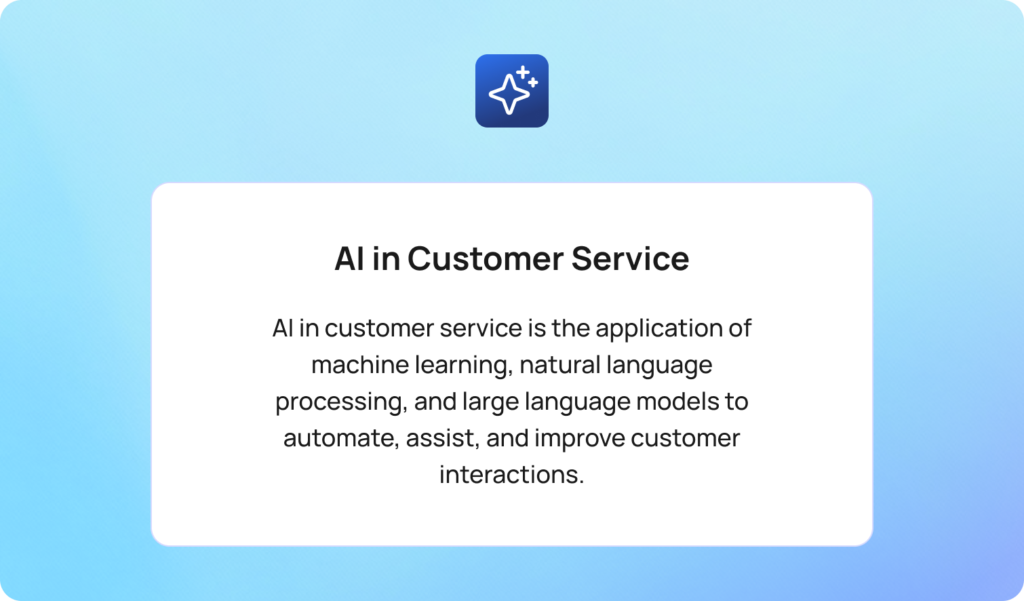
AI in customer service is the application of machine learning, natural language processing, and large language models to automate, assist, and improve customer interactions. It reduces manual work for support agents while improving resolution speed, accuracy, and consistency across customer service operations.
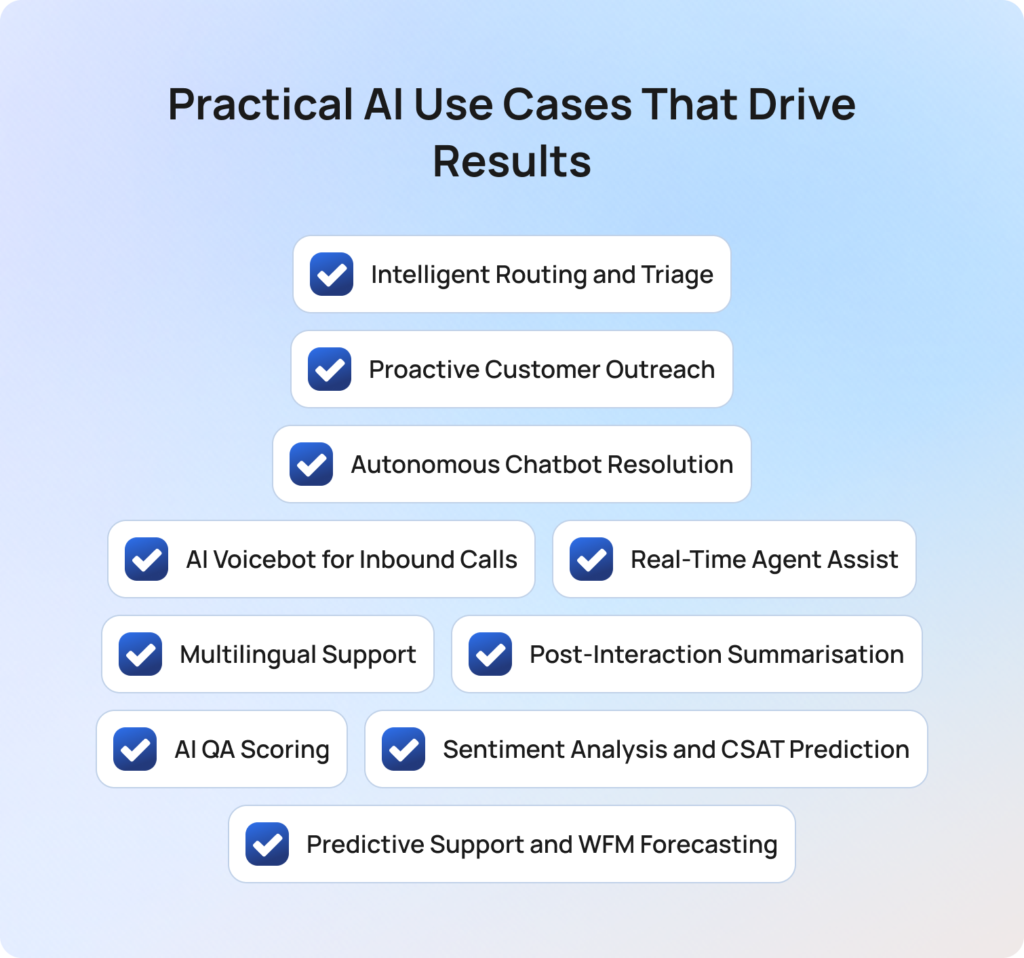
The most useful way to map AI capabilities is by the stage at which they operate. Before the interaction: routing, triage, and proactive outreach. During the interaction: autonomous resolution, real-time agent assist, and real-time guidance. After the interaction: summarisation, QA scoring, and analytics.
Organising AI use cases by interaction stage rather than as a flat feature list is what helps support teams decide where to start. A 2025 Deloitte report found that AI adoption in customer service has increased from 46% in 2023 to 61% in 2025. The teams seeing measurable results are those deploying AI customer service tools against specific interaction types, with clear customer service metrics in place from day one.
Generative AI and machine learning algorithms are reshaping customer service by enabling AI systems to handle not just simple customer requests, but complex, multi-turn conversations that earlier rule-based tools could not manage. For customer service teams, this means AI can now address customer needs across the full interaction lifecycle, not just at the FAQ layer.
| Use Case | Interaction Stage | AI Capability | Primary KPI Impact |
| Intelligent routing and triage | Before | Intent detection, priority scoring | FCR, AHT, misroute rate |
| Proactive outreach | Before | Triggered messaging, order/status alerts | Inbound volume, CSAT |
| Autonomous chatbot resolution | During | RAG-grounded KB, LLM-powered NLP | Containment rate, cost per interaction |
| AI voicebot for inbound calls | During | Voice recognition, NLP, TTS | Abandon rate, AHT, MOS |
| Real-time agent assist | During | Suggested reply, KB retrieval, sentiment alerts | AHT, FCR, concurrency |
| Multilingual support | During | Real-time translation, multilingual NLP | CSAT, first response time |
| Post-interaction summarisation | After | LLM-powered summary generation | AHT (wrap-up time), QA consistency |
| AI QA scoring | After | Automated interaction review | QA coverage, CSAT, and coaching efficiency |
| Sentiment and CSAT analysis | After | Sentiment scoring, CSAT prediction | CSAT, churn risk identification |
| Predictive support and forecasting | After | Volume forecasting, WFM integration | Abandon rate, SLA compliance |
Not every AI use case applies equally to every customer service team. The goal is to match AI capabilities to your primary KPI gaps before deploying, rather than deploying broadly and hoping the numbers move.
AI classifies incoming support tickets and customer inquiries by intent, sentiment, and urgency before they reach an agent. It assigns each interaction to the right team, skill set, and priority queue automatically. This is meaningfully different from rules-based routing: AI systems handle paraphrase, multi-intent customer queries, and entirely new customer requests without requiring manual rule updates.
Correct routing reduces misrouting and the repeated contacts that follow. A customer whose initial customer inquiry reaches the wrong team and who has to contact again counts as two interactions, both with higher-than-necessary handle time.
KPI impact: FCR, AHT on routed interactions, repeat contact rate.
AI-triggered proactive messaging resolves customer needs before they become support tickets. Order updates, delivery alerts, appointment reminders, and outage notifications all fall into this category. Analyzing customer data and customer behavior patterns allows AI-powered tools to identify which trigger events generate the highest inbound contact volume. Teams that act on those patterns report measurable reductions in customer inquiries on predictable issues. The customer gets the information they needed. The team never handles the contact.
KPI impact: inbound contact volume, improving customer satisfaction, and repeat contact rate.
RAG-grounded AI customer service chatbots handle routine inquiries and initial customer inquiries end-to-end without agent involvement. They are grounded in a maintained knowledge base with access to articles that keep responses accurate and current.
The key distinction here is the difference between deflection and containment. Deflection means the customer did not reach an agent. Containment means the issue was resolved without human follow-up. A deflected customer who emails the next day again has not been contained. Track containment rate, not deflection rate.
Well-implemented RAG-grounded chatbot deployments achieve 40 to 70 percent containment on routine tasks and tier-1 query types as of Q2 2026. AI agents that handle routine inquiries free human agents to focus on more complex tasks that require judgment.
KPI impact: containment rate, customer service costs, and agent concurrency.
LLM-powered voice AI handles inbound calls using voice recognition, natural language processing, and text-to-speech. It replaces legacy IVR menus with natural conversation capable of full call resolution, directly reducing customer frustration caused by rigid menu trees.
A platform with strong chat AI may have mediocre voice AI, so it is worth evaluating each channel independently. Voice-specific evaluation criteria include MOS (Mean Opinion Score) for call quality, transcription accuracy across accents, and response latency.
AI voicebots reduce abandonment rate by shortening queue time on routine calls and reduce AHT by resolving tier-1 interactions autonomously, lowering operational costs without reducing service quality.
KPI impact: abandon rate, AHT, cost per call.
AI supports human agents during live customer interactions. It surfaces relevant knowledge base articles, generates proposed replies, flags customer sentiment shifts, and alerts on SLA breach risk. The human leads. AI removes friction. This is the use case with the best time-to-value and the lowest quality risk, because support agents make every final decision.
Real-time agent assist reduces AHT by eliminating manual KB search mid-interaction and improves FCR by surfacing the correct answer faster. It also delivers more consistent service quality across the customer service team. A junior agent with AI assist regularly matches the performance of a senior agent without it.
KPI impact: AHT, FCR, CSAT variance, agent concurrency.
Real-time AI translation and multilingual natural language processing enable support agents to serve customers in their preferred language without dedicated multilingual staffing. In 2026, LLM-powered translation handles nuance and context far more accurately than earlier rule-based approaches. Customer service teams with international operations can expand language coverage to meet customer expectations without proportional headcount increases, maintaining consistent service quality across markets.
KPI impact: first response time for non-primary-language customers, customer satisfaction in multilingual markets.
AI generates a structured summary of each interaction immediately after the conversation ends. Issue identified, actions taken, resolution status, follow-up required. AI ticket summary eliminates wrap-up time entirely. Support agents move to the next interaction without a manual note-writing step.
Analyzing customer data from past interactions improves over time because AI summaries are consistent in structure. Human agents handling returning customers have better context on previous customer requests. Wrap-up time is a hidden component of AHT that many customer service operations do not measure separately. At 100 interactions per agent per day, even a two-minute reduction per interaction compounds significantly.
KPI impact: AHT (wrap-up component), customer data quality.
Automated quality assurance scores AI and human interactions against a defined framework at scale. Tone, accuracy, resolution quality, policy compliance. Traditional QA reviews 5 to 15 percent of interactions. AI QA reviews 100 percent, surfacing coaching opportunities and failure patterns that sampling misses. A systemic issue affecting 3 percent of customer interactions may never appear in a 10 percent sample. It will always appear in a 100 percent review.
AI performance monitoring at this level is what allows customer service operations to maintain service quality as volume scales.
KPI impact: QA coverage rate, improving customer satisfaction, and coaching efficiency.
AI analyzes customer sentiment across customer interactions in real time and post-interaction. It flags at-risk customers before they churn and predicts CSAT scores on interactions where surveys are not returned. Identifying customer frustration early allows teams to intervene before a complaint escalates. Proactive intervention happens before the customer takes their feedback elsewhere.
Analyze incoming support tickets for customer sentiment at scale to identify trends that would be invisible in a manually reviewed sample.
KPI impact: customer satisfaction, churn risk, escalation rate.
AI analyzes historical customer behavior and interaction patterns to forecast volume by channel, time, and query type. This feeds workforce management scheduling to ensure the right number of support agents for predicted demand. Understaffing during peaks creates SLA breaches and CSAT drops. Overstaffing during troughs wastes labour costs. Both the customer experience and operational costs suffer when staffing is misaligned with demand.
KPI impact: abandon rate, SLA compliance, and reducing operational costs.
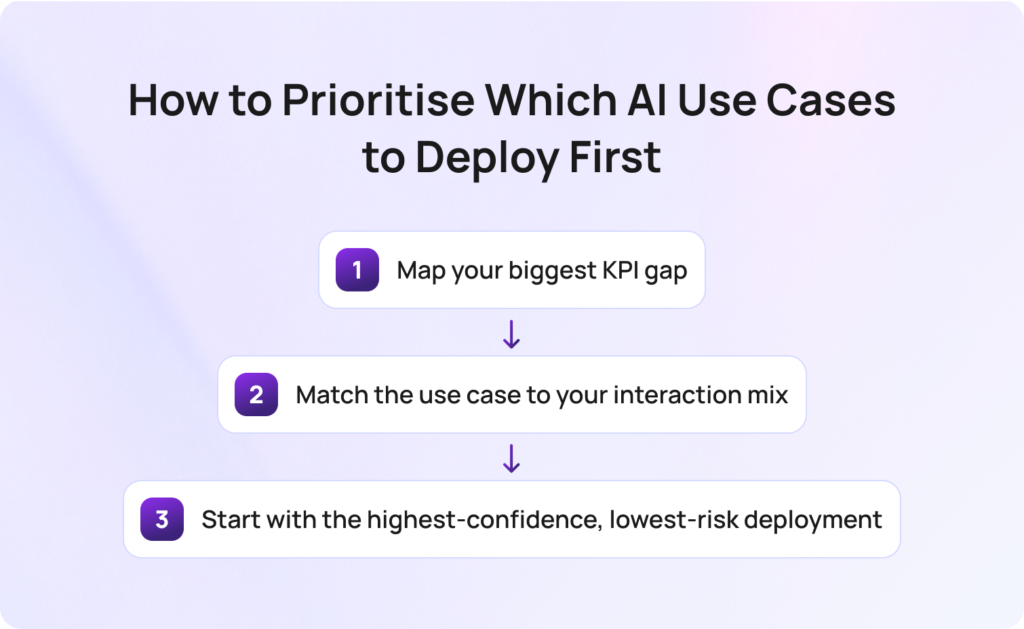
Three steps help customer service teams and support operations leads cut through the noise.
1. Map your biggest KPI gap. Start with the metric furthest from the target. If AHT is the primary problem, agent assist and post-interaction summarisation are the highest-ROI starting points. Both reduce customer service costs directly and carry minimal quality risk. If FCR is the problem, routing accuracy and KB-grounded chatbot resolution are the priority.
2. Match the use case to your interaction mix. High-volume digital channels benefit most from self-service and chatbot resolution. High voice volume benefits most from an AI voicebot and real-time agent assist. Mixed channel operations benefit from omnichannel conversational AI that applies the same AI layer across all channels to deliver consistent service quality.
3. Start with the highest-confidence, lowest-risk deployment. Agent assist and post-interaction summarisation are the two AI use cases with the fastest time-to-value and the lowest failure risk. Human agents still lead in both, and neither exposes a customer-facing AI decision before the team is ready. Deploy these first to build team confidence. Then expand to autonomous resolution once AI performance data confirms the model is ready.
BlueTweak applies the same AI layer across all three interaction stages in a unified platform. It removes the tool sprawl that forces customer service teams to manage separate AI-powered tools for routing, chatbots, agent assist, summarisation, and analytics. This is customer service integrating AI across the full operation, not bolting it on channel by channel.
Before the interaction: Intelligent routing and automation classify incoming support tickets by intent and urgency. KB-grounded AI responses ensure every automated response is based on verified, current knowledge base articles rather than base LLM generation.
During the interaction: The AI customer service chatbot and AI voicebot handle tier-1 autonomous resolution across chat and voice channels. Proposed reply delivers personalized support and real-time agent assist during live customer interactions. Multilingual support extends coverage to address customer needs across languages without additional headcount.
After the interaction: AI ticket summary eliminates wrap-up time. The QA module scores AI and human agents at 100 percent coverage. Customer service analytics surfaces customer sentiment, CSAT prediction, and AI performance data in a single view, helping human customer service teams improve continuously.
Most teams want to start with autonomous resolution because the containment numbers look impressive. The teams that actually hit their ROI targets start with agent assist. AHT comes down from day one, the human stays in control, and you build the performance data you need before you ask AI to act alone.

Radu Dumitrescu, Head of Presale & Digital Transformation at BlueTweak
Final Thoughts
The teams that get the most value from AI in customer service are not those who deploy the most AI. They are those who match each use case to a specific KPI gap, measure from day one, and expand scope based on data rather than assumptions.
Implementing AI in customer service operations delivers the strongest results when each use case is tied to a clear outcome: lower customer service costs, higher customer satisfaction, more consistent service quality, or better customer experience. The interaction-stage framework in this article gives customer service teams a practical starting point for that prioritisation.
AI in customer service covers a wide range of customer service functions: routing and triage of incoming support tickets, autonomous resolution of routine inquiries via AI chatbots and virtual assistants, real-time agent assist during live customer interactions, and post-interaction tasks including summarisation, AI QA scoring, and sentiment analysis. The highest-ROI use cases in 2026 are autonomous tier-1 resolution with 40 to 70 percent containment on routine inquiries, real-time agent assist with AHT reduction of 15 to 30 percent, and post-interaction summarisation that eliminates wrap-up time entirely. Support teams that use AI for customer service consistently across all three interaction stages see the strongest compound improvements in both cost and quality metrics.
Companies using AI for customer service span every major industry. In retail and e-commerce, brands use AI chatbots and voicebots to handle order tracking, returns, and account queries at scale. In financial services, AI manages account inquiries, fraud alerts, and payment support. Airlines use AI to handle booking changes and flight status queries during high-volume disruption periods. In telecoms and SaaS, AI handles tier-1 technical support and onboarding queries. Across all sectors, the common thread is the same: companies using AI for customer service deploy it first on high-volume, routine interaction types where containment rates are highest, and quality risk is lowest.
An AI customer service agent is a conversational AI system that handles customer interactions autonomously. It understands customer intent using natural language processing, retrieves relevant knowledge base articles, and resolves the interaction without involving human agents. A practical example: a customer asks about a delayed order via live chat. A RAG-grounded AI agent retrieves the order status in real time, provides an accurate update, and resolves the customer inquiry without a human agent involved. If the query exceeds the agent’s confidence threshold, it escalates to a human agent with the full customer interaction context transferred.
AI is transforming customer service by reducing average handle time, improving first contact resolution rates, and enabling 24/7 support coverage without proportional headcount increases. According to McKinsey, AI-assisted support operations report 15 to 35 percent AHT reduction on agent-handled interactions and 40 to 70 percent containment on tier-1 autonomous deployments. The most significant impact on customer service operations is the decoupling of support volume growth from headcount growth. Customer service teams can handle significantly more customer interactions without a linear increase in support agents.
The best AI customer service solution depends on your team’s primary KPI gap, channel mix, and interaction type. For customer service teams needing omnichannel AI across voice, chat, and messaging with native WFM and QA, BlueTweak is the Editor’s Choice. AI is included in the base plan, not sold as an add-on. Evaluate platforms on whether AI is native in the base seat, whether knowledge base articles are RAG-grounded, and whether AI performance is reported separately from human agent performance.
The most widely deployed AI use cases in customer service as of Q2 2026 are AI chatbots for autonomous resolution of routine customer inquiries, intelligent routing and triage of incoming support tickets, real-time agent assist via suggested reply and KB retrieval, post-interaction summarisation, and AI-powered QA scoring. Voicebot deployment is growing rapidly as LLM-powered voice recognition matures. Sentiment analysis and predictive analytics are increasingly standard in platforms that include customer service analytics natively.
As Head of Digital Transformation, Radu looks over multiple departments across the company, providing visibility over what happens in product, and what are the needs of customers. With more than 8 years in the Technology era, and part of BlueTweak since the beginning, Radu shifted from a developer (addressing end-customer needs) to a more business oriented role, to have an influence and touch base with people who use the actual technology.