Reduce Support Costs With AI Without Hurting Service Quality



BlueTweak is an AI Customer Support Platform that unifies every conversation, customer record, and automation into one workspace.
Explore more
Insights, trends, and practical ideas from customer experience and AI
Real-world scenarios showing how teams use BlueTweak to deliver better service
The daily blueprint that guides customer support leadership.
ROI and savings calculators for support teams
See how BlueTweak stacks up against leading customer support platforms
Reducing support costs with AI is achievable without sacrificing service quality. AI powered customer service has already helped companies lower support costs by tens of millions in operational expenses. Klarna’s AI customer service deployment is reported to have delivered the equivalent of 700 full-time agents in productivity. These are not edge cases. Transforming customer service with AI and achieving significant cost savings is the expectation for well-run deployments. But it only holds when AI is deployed against the right interaction types, quality safeguards are configured before launch, and success is measured on cost and quality metrics simultaneously. This article covers eight AI cost reduction strategies, the quality risk each one carries, the safeguard that eliminates that risk, and a worked ROI calculation any support operations lead or CFO can use to model realistic savings. It is written for CX directors, support team leads, and finance stakeholders who need a credible, honest answer rather than a vendor benchmark.
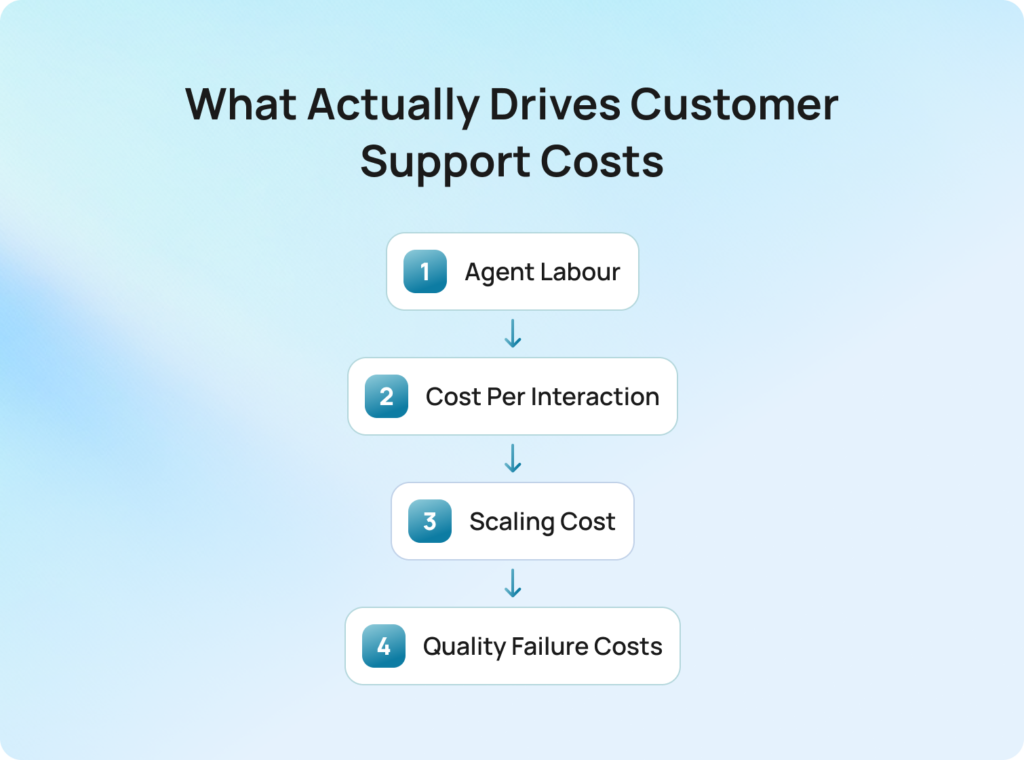
Before modelling AI cost reduction, you need to understand your cost structure. Most support cost reduction programmes target the wrong line items because they are working from an incomplete picture of what customer support costs actually consist of.
Agent labour is the largest cost line in virtually every customer support operation, typically representing 60–70% of total support spend. This includes base salary, benefits, payroll tax, management overhead, and attrition and replacement cost, and most teams undercount it by excluding the last two. Operational costs and business costs beyond the labour line, technology, management, and facilities account for the remaining 30–40%. Teams that want to model AI cost reduction accurately need the full number, not just the wage bill. It is also worth noting that most contact centres do not employ data scientists to build and maintain AI models in-house. The platform you choose determines how much of that capability comes included.
Attrition in customer service operations runs at 25–40% annually in many contact centres. Replacing a trained support agent costs 50–200% of their annual salary when you factor in recruitment, onboarding, and the productivity ramp before a new agent reaches full performance. Excluding this from your fully-loaded cost per agent means your cost reduction projections are built on a number that understates the real cost of human-handled volume.
Cost per interaction, total support cost divided by total interactions handled, is the derived metric that determines whether AI automation is delivering genuine cost reduction or simply redistributing cost.
AI reduces cost per interaction in two ways: by increasing the number of interactions each agent handles per hour (AHT reduction through agent assist tools), and by handling some interactions without an agent at all (containment through autonomous AI resolution). Both move the metric in the same direction. Only containment eliminates the agent cost entirely.
Without AI, contact volume growth requires proportional headcount growth. The tenth thousand new monthly interactions costs roughly the same to handle as the first thousand. With AI agents and AI systems handling tier-1 volume and routine inquiries, growth is absorbed by automation. AI reduces costs most significantly here: the marginal cost of the next batch of interactions falls as containment rate rises. This is the scaling advantage that makes AI cost reduction compound rather than linear for high-growth operations.
This is the cost driver most AI cost reduction models ignore entirely, and it is the one that causes the most aggressive cost-cutting programmes to fail on a medium-term basis.
CSAT decline generates churn. Churn generates customer lifetime value loss. Repeat contacts from unresolved interactions drive up interaction volume without generating revenue. Escalated complaints require more expensive human time to resolve. Human error in stressful, high-volume environments also increases when agents are overloaded, which damages the customer experience and makes the cost of exceptional service even harder to sustain. Customer frustration that reaches social media or review platforms damages customer acquisition costs downstream.
Aggressive AI cost reduction that damages service quality frequently costs more within 12 months than it saves in the first 90 days. Every strategy in this article is evaluated against its quality risk specifically to prevent this outcome.
The BlueTweak Support Cost Reduction Table gives support leads and finance stakeholders a single reference for the cost reduction mechanism, primary KPI impact, quality risk without a safeguard, and the mitigation for each strategy. The “Quality Risk Without Safeguard” column is the editorial differentiator; no competitor includes it because acknowledging quality risk is not in the interest of a vendor who wants to sell you everything at once.
| Strategy | Cost Reduction Mechanism | Primary KPI Impact | Quality Risk Without Safeguard | Mitigation |
| Autonomous tier-1 resolution | Eliminates agent handle cost on contained interactions | Containment rate, cost per interaction | CSAT drop if misclassified interactions are contained | Confidence threshold + escalation triggers |
| AI agent assist | Reduces AHT on agent-handled interactions | AHT, FCR | Low, human makes final decision | None required |
| Intelligent routing | Reduces misrouting and repeat contacts | FCR, repeat contact rate | Low | Quarterly trigger review |
| Post-interaction summarisation | Eliminates wrap-up time per interaction | AHT (wrap-up), CRM data quality | Very low | None required |
| Self-service knowledge base | Deflects interactions to self-service | Inbound volume, cost per ticket | Low if KB is maintained | KB quality review cadence |
| WFM optimisation | Right-sizes staffing to volume | Labour cost, SLA compliance | Understaffing during peaks causes CSAT drop | WFM forecasting accuracy review |
| Multilingual AI | Eliminates dedicated multilingual staffing cost | Labour cost, response time | CSAT drop in multilingual markets if translation quality is poor | NLP quality review per language |
| AI QA (100% coverage) | Reduces QA staffing overhead, improves coaching efficiency | QA coverage, CSAT improvement rate | None, quality improves with broader coverage | None required |
Most AI cost reduction programmes that damage service quality make the same three mistakes. Understanding them is more valuable than any list of cost-saving tactics, because the mistake pattern is consistent and entirely avoidable.
Optimising for deflection, not containment. A deflected customer who follows up via another channel, or abandons the interaction frustrated, is a cost transfer, not a saving. Teams that target deflection rate produce high deflection and declining customer satisfaction scores simultaneously. Deflection is easy to manufacture. Containment requires genuine resolution.
Deploying automation beyond its performance boundary. Artificial intelligence resolves tier-1 routine queries reliably. It performs poorly on emotionally complex interactions, multi-step issues, and trust recovery scenarios. Teams that expand automation scope to hit cost targets before the technology is ready produce bad AI interactions that cost more in customer loyalty damage and repeat contacts than the operational savings justify. Customer frustration from a bad automated experience is harder to recover from than a slow human-handled one.
Cutting quality monitoring alongside agent headcount. When support teams reduce QA staffing as part of a broader cost reduction programme, quality problems accumulate undetected until CSAT has already declined materially. The right sequence is: deploy AI QA to achieve 100% coverage, then reduce manual QA overhead once the automated coverage is proven.
The principle this article applies: every cost reduction strategy below is evaluated against its quality risk, and every strategy includes the safeguard that prevents the cost saving from becoming a quality problem.
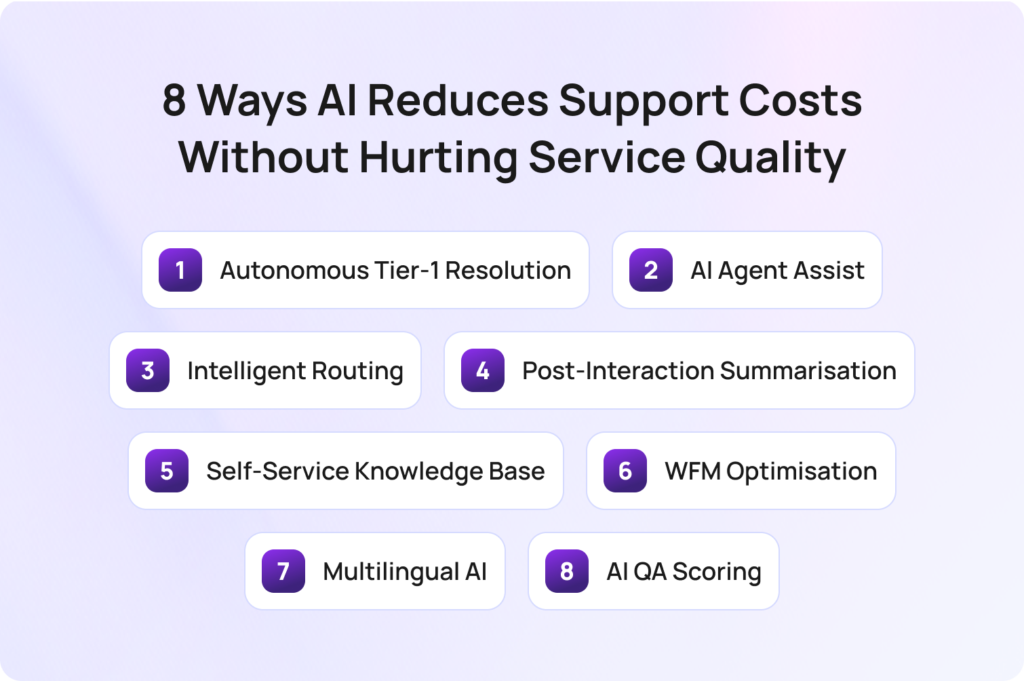
Every strategy below includes three elements: the cost reduction mechanism, the quality safeguard that prevents service decline, and the metrics to track to confirm both are working. Apply all three or accept that cost reduction and quality decline are likely to move together.
Cost mechanism. A RAG-grounded conversational AI chatbot and voicebot handles FAQs, order status, password resets, and account queries end-to-end using natural language processing, eliminating agent handling cost on contained interactions. Well-implemented deployments achieve 40–70% containment on tier-1 query types. Automating routine tasks and repetitive tasks at this scale reduces cost per interaction significantly; the cost efficiency of AI-powered resolution versus human agent handling is typically 60–70% lower per contained interaction. Human agents focus on customer inquiries that require judgment, empathy, and the kind of complex problem-solving that maintains high service quality on the interactions that matter most.
Quality safeguard. Configure confidence thresholds conservatively; interactions below the threshold escalate to a human agent regardless of query type. Define five mandatory escalation triggers before launch: emotional distress, VIP accounts, compliance queries, trust recovery, and complex multi-step issues. Monitor post-interaction CSAT and repeat contact rate per query type. If either deteriorates, narrow the scope immediately.
Metrics to track. Containment rate (not deflection rate), post-bot CSAT, repeat contact rate on bot-handled interactions, escalation rate.
Cost mechanism. Suggested reply and real-time KB retrieval reduce AHT on agent-handled customer interactions by eliminating manual search time and reducing response drafting time. AHT reduction directly increases agent productivity; the same headcount handles more volume, creating efficiency gains without adding staffing costs.
Quality safeguard. The human agent reviews and approves every suggested reply before sending. This is AI at its lowest quality risk: the cost saving is real and the quality floor is maintained by human approval. Human intervention remains at the point where it matters most, the outgoing response.
Metrics to track. AHT (total and by query type), FCR, CSAT, and agent concurrency.
Cost mechanism. Misrouted interactions cost twice, once to handle in the wrong queue, and again when transferred or when the customer contacts again. AI routing by intent, sentiment, and urgency eliminates misrouting and the repeat contacts and escalations it generates. Machine learning models classify every incoming interaction in real time, without the rule maintenance overhead of keyword-based systems.
Quality safeguard. Review routing triggers quarterly as products, policies, and query types evolve. New query types not in training data will be misclassified until the routing logic is updated. Build this review into operations as a standing cadence.
Metrics to track. Misroute rate, FCR, repeat contact rate.
Cost mechanism. Wrap-up time, agent note-writing after each interaction, is a hidden component of AHT that adds 1–5 minutes per interaction across all handled volume. AI ticket summarisation eliminates wrap-up time by generating a structured summary immediately after the interaction ends. At 100 interactions per agent per day, this compounds into significant daily capacity savings.
Quality safeguard. None required. Summarisation is post-interaction and internal. The quality of the summary improves CRM data quality, which improves future interaction quality and the reliability of predictive analytics built on customer interaction history.
Metrics to track. AHT (total vs. handle time only), CRM data completeness.
Cost mechanism. A well-structured, AI-powered self-service knowledge base resolves simple customer queries before a customer opens a chat or calls. Tier-0 containment, the customer self-serves without any AI interaction, is the lowest-cost resolution possible. It also reduces operational expenses without reducing service availability, because the KB is accessible 24/7 without staffing costs.
Quality safeguard. KB quality degrades without maintenance. Assign KB ownership, set a review cadence, and track self-service CSAT separately from agent-handled CSAT. A KB that is not maintained actively will become a source of customer frustration rather than a cost reduction asset.
Metrics to track. Self-service resolution rate, inbound contact volume trend, and self-service CSAT.
Cost mechanism. Overstaffing during low-volume periods wastes labour costs. Understaffing during peaks creates SLA breaches, CSAT drops, and overtime costs. AI-powered WFM forecasting models volume by time, channel, and interaction type, scheduling the right number of support agents for predicted demand. Analyzing historical data on volume patterns, including peaks driven by product launches, billing cycles, and marketing campaigns, is what makes WFM forecasting reliable rather than reactive. Overtime costs fall because peaks are anticipated and staffed accurately.
Quality safeguard. WFM accuracy depends on data quality. Review forecast accuracy monthly and adjust as seasonal patterns, product changes, and marketing campaigns affect volume. Analyzing historical data on volume spikes from predictable business events, launches, billing cycles, and service outages is what makes forecasting reliable rather than reactive.
Metrics to track. Labour cost per period, SLA compliance during peaks, abandonment rate, and forecast accuracy.
Cost mechanism. Dedicated multilingual support teams are expensive to hire, train, and retain. AI translation and multilingual natural language processing serve customers in their preferred language without a proportional increase in multilingual staffing costs. This is one area where AI automation generates immediate cost savings for international operations.
Quality safeguard. LLM-powered translation as of Q2 2026 handles nuance and context far better than earlier rule-based approaches, but quality varies by language. Review translation quality per language in your top markets, and monitor CSAT separately for non-primary-language customers.
Metrics to track. CSAT by language, first response time for non-primary languages, multilingual headcount vs. coverage.
Cost mechanism. Traditional QA reviews 5–15% of interactions. AI QA scoring covers 100% against a defined framework, reducing the QA staffing required for broad quality coverage and improving the coaching efficiency of team leads who now work from complete data rather than samples.
Quality safeguard. This is the one strategy where AI directly protects quality rather than risking it. 100% QA coverage catches quality problems that sampling misses, the agent whose CSAT is consistently below average on a specific query type, the routing rule that is producing poor outcomes on a new product, and the knowledge base gap that is generating repeat contacts. Coaching decisions remain human. AI surfaces the data.
Metrics to track. QA coverage rate, quality score trend (bot-handled and agent-handled separately), coaching frequency, and CSAT correlation with QA score.
No competitor provides a complete, worked calculation for support-specific AI cost reduction. The following framework builds a number any CFO can interrogate.
Formula: (Total annual support cost, including labour, management, technology, facilities) divided by total annual interactions handled.
Illustrative example. A 50-agent team with a fully-loaded cost per interaction of £18, handling 15,000 interactions per month.
Most teams using an incomplete cost figure here are underestimating the true cost of human-handled volume by 20–30%. Include management overhead, technology, training costs, and attrition replacement costs. If you are not counting attrition, your cost per interaction is lower than reality, and your AI ROI projections will understate the return.
Formula: Monthly interactions × target containment rate × fully-loaded cost per interaction minus platform cost per contained interaction = monthly gross saving.
Using the illustrative example of three scenarios:
| Scenario | Containment Rate | Gross Monthly Saving | Platform Cost | Net Monthly Saving |
| Conservative | 30% | £81,000 | £12,000 | £69,000 |
| Mid | 45% | £121,500 | £12,000 | £109,500 |
| Optimistic | 60% | £162,000 | £12,000 | £150,000 |
Conservative is the right number to use for Year 1 planning. Optimistic figures are achievable at 18–24 months with a maintained knowledge base and expanded scope.
Formula: (Current AHT minus projected AHT with AI agent assist) × fully-loaded cost per minute × monthly agent-handled interactions = monthly efficiency saving.
Use a conservative 15–20% AHT reduction estimate for Year 1. Do not use vendor-supplied figures; use published independent benchmarks. McKinsey’s Q1 2026 data shows a 20–30% AHT reduction in mature deployments. Year 1 at 15% is a credible, defensible figure. Improved support efficiency from AHT reduction directly increases customer satisfaction scores because customers wait less and agents resolve more confidently.
Add platform licensing, integration development, knowledge base preparation, and change management. Amortise over 12 months. Subtract from gross saving to arrive at net Year 1 saving.
KB preparation is consistently underestimated. Budget 4–8 weeks of a dedicated resource for initial KB audit and gap closure before launch. This is the investment that determines whether your containment rate reaches 55–70% or plateaus at 30–35%.
ROI% = (Net Year 1 saving divided by total implementation cost) × 100.
Break-even month = implementation cost divided by monthly net saving.
At the conservative scenario in the example above: £69,000 monthly net saving, £85,000 implementation cost. Break-even at month 2. At the mid scenario: break-even at month 1. These are realistic figures for a well-scoped tier-1 deployment, not the headline claims of a vendor pitch.
Use the BlueTweak ROI calculator to run this framework against your own contact volume, cost structure, and containment targets.
Competitors either track cost metrics or quality metrics. Rarely both, simultaneously. This dual-track framework is what separates successful AI implementation from a deployment that looks good on one set of dashboards while the other set quietly deteriorates.
Cost metrics to track:
Quality metrics to track in parallel:
The three pairs most teams track incorrectly:
Deflection rate vs. containment rate. Track containment: resolution without follow-up contact. Deflection without containment is a cost transfer, not a saving. A team reporting high deflection and flat inbound volume is generating more total contacts, not fewer.
Total AHT vs. handle time. Track wrap-up time separately. AI summarisation reduces wrap-up. Agent assist reduces handle time. Conflating them makes it impossible to attribute the saving to the right tool or justify the investment in either.
Aggregate CSAT vs. per-channel CSAT. A CSAT improvement in agent-handled interactions can mask a CSAT decline in bot-handled interactions if only the aggregate is tracked. Improving customer service quality for some customers while degrading it for others is not success, regardless of what the aggregate score shows.
The customer service analytics guide covers how to structure this dual-track measurement framework in practice.
These are the specific failure modes that prevent real-world examples of AI cost reduction from holding at 180 days.
Optimising for deflection rate. The easiest metric to inflate, and the least meaningful. A bot that refuses to escalate inflates deflection while damaging customer satisfaction. Any deployment where deflection rate is the primary KPI is optimised for the wrong outcome.
Deploying before the knowledge base is ready. Cost reduction targets drive teams to go live before KB content is complete. Bot responses grounded in an incomplete KB produce inaccurate answers from day one. Customer trust in the self-service channel is hard to rebuild once it is lost, and the repeat contact volume generated by inaccurate bot responses offsets cost savings faster than most teams’ models. Improving support quality starts with KB readiness, not the go-live date.
Cutting QA alongside headcount. When AI cost savings fund QA team reductions before AI QA coverage is established, quality problems accumulate without detection. AI QA must replace manual QA coverage first; the headcount reduction follows once 100% coverage is confirmed to be working.
Setting ROI expectations based on vendor benchmarks. Published containment rate benchmarks reflect top-quartile figures from mature deployments with high KB quality. Year 1 projections should use 30–40% containment and ramp over 6–12 months. Expectations set against vendor-supplied figures create internal credibility problems when real performance lands where it should.
Ignoring agent change management. Support agents who distrust AI tools override escalations and bypass suggested replies, undermining the AHT savings the deployment was projected to deliver. AI automation eliminates data entry and manual wrap-up as part of improving support quality, but agents need to see this demonstrated, not described. Successful AI implementation requires that agents understand what the AI is doing for them rather than to them. Agent adoption is an operational discipline, not a technology problem. Team provides comprehensive training and structured change management before and after launch.
A final note on scope: AI cost reduction in customer support is part of a broader pattern of AI delivering operational efficiency across business operations. Supply chain management teams have used predictive analytics and predictive maintenance to reduce costs by similar proportions. Supply chain optimization and customer support have more in common than they appear; both involve high-volume, pattern-driven operations where machine learning models identify cost inefficiencies that human review misses. The same principles apply.
Most AI cost reduction failures share a root cause: the tools generating the cost savings are not the same tools measuring whether quality is being maintained. Cost data lives in the ticketing system. Quality data lives in the QA tool. Customer satisfaction data lives in the survey platform. No one sees all three simultaneously until one of them has already broken.
BlueTweak is built on the principle that cost reduction and quality protection are the same operational problem, and they require the same platform to solve.
The conversational AI handles autonomous tier-1 resolution with configurable confidence thresholds and escalation triggers configured before launch, not retrofitted when CSAT drops. Proposed Reply and real-time KB retrieval reduce AHT on agent-handled interactions without removing human approval on outgoing responses. The QA module scores 100% of customer interactions, maintaining quality coverage as headcount is optimised and surfacing coaching opportunities from the full interaction population rather than a sample. The WFM module right-sizes scheduling to predicted volume, reducing overtime costs during peaks and eliminating overstaffing costs during troughs. AI ticket summaries eliminate wrap-up time across all handled customer interactions. The analytics and reporting layer tracks cost and quality metrics side by side, making it impossible to optimise one while the other quietly deteriorates.
Because all of these capabilities run in a unified platform, the feedback loops between them work. QA flags improve the knowledge base. Knowledge base improvements improve containment rate. Containment rate data informs routing scope decisions. Each capability makes the others more effective. This is how BlueTweak helps AI reduce costs while maintaining high service quality: not by choosing one over the other, but by building the measurement infrastructure that confirms both are moving in the right direction. The result is lower support costs and better customer experience at the same time. The data quality that results from this integration is what makes predictive analytics on customer behavior and customer requests reliable rather than directional.
The teams that achieve durable cost reduction are not the ones with the most aggressive targets. They are the ones who treated quality as a constraint, not a trade-off. Every strategy we have seen fail at 180 days failed because quality was deprioritised in the first 90 days to hit a cost number. The recovery cost, in churn, in repeat contacts, in brand damage, was always higher than the short-term savings. The teams that get this right deploy more slowly, scope more conservatively, and end up with lower costs and better customer satisfaction at the same time.

Radu Dumitrescu, Head of Presale and Digital Transformation at BlueTweak
Reducing support costs with AI is one of the clearest value cases in business operations today. The technology is mature, the benchmarks are established, and real-world examples of teams achieving 25–40% cost reductions at 90-day steady state are common enough to be expected rather than exceptional.
The constraint is not the technology. It is the operational discipline to deploy against the right interaction types, maintain the knowledge base as a first-class asset, measure containment rather than deflection, and protect quality monitoring through the transition rather than cutting it. Teams that apply that discipline deliver durable AI cost reduction, saving money on cost per interaction while improving customer satisfaction, reducing customer frustration, and building the customer relationships that drive customer loyalty and customer retention over time.
Teams that skip that discipline report good numbers at 30 days and explain difficult ones at 180.
Book a demo to see how BlueTweak delivers cost reduction and quality protection in one platform, or use the ROI calculator to model your specific cost reduction potential before the conversation starts.
Well-implemented AI deployments consistently achieve a 25–40% reduction in cost per resolved contact within 90 days. IBM research cites up to 30% operational cost reduction across contact centres. McKinsey data shows AI-enabled self-service cutting cost-to-serve by more than 20%. The figure depends on the share of tier-1 volume in your contact mix, current AHT, and the quality of the knowledge base the AI is grounded in. Use conservative containment rate assumptions, 30–40% for Year 1, and build toward 55–70% at 12–18 months.
No, when structured correctly. AI cost reduction damages service quality when teams optimise for deflection rather than containment, deploy automation beyond its reliable performance range, or reduce QA monitoring before AI QA coverage is established. AI cost reduction improves service quality when quality safeguards are configured from launch, 100% QA coverage replaces sampled QA, and CSAT on automated interactions is tracked separately from agent-handled interactions.
Autonomous tier-1 resolution delivers the most immediate cost savings because it eliminates agent cost entirely on contained interactions. The fastest path is: audit your contact mix to identify tier-1 query types that are definitive and short-resolution, ensure the knowledge base covers those types accurately, configure confidence thresholds and escalation triggers, and go live on a narrow scope. Expanding the scope after the containment rate is confirmed is faster and cheaper than recovering from a poorly scoped launch.
Track CSAT on automated interactions separately from agent-handled interactions from day one. Configure confidence thresholds so the chatbot escalates interactions it cannot handle reliably rather than producing low-quality automated responses. Maintain the knowledge base as an active operational asset rather than a one-time implementation. And measure containment rate, not deflection rate. If customers are following up after bot interactions, the cost savings are not real, and the satisfaction impact is already there in the data.
Containment rate and AHT improvements are visible within 30 days of a well-scoped deployment. The first credible cost reduction number, defensible to finance leadership, arrives at 90 days when the containment rate is at steady state and the cost per resolved contact is trackable against the pre-deployment baseline. The full picture, including churn rate impact and compounding savings from continuous improvement through QA and knowledge base feedback loops, requires 180 days of clean data.
As Head of Digital Transformation, Radu looks over multiple departments across the company, providing visibility over what happens in product, and what are the needs of customers. With more than 8 years in the Technology era, and part of BlueTweak since the beginning, Radu shifted from a developer (addressing end-customer needs) to a more business oriented role, to have an influence and touch base with people who use the actual technology.