



TL;DR
Proactive customer service means anticipating customer needs and resolving potential issues before they escalate. Rather than waiting for complaints, businesses identify risks early and act in advance. The key difference in proactive vs reactive customer service lies in timing: proactive support prevents problems, while reactive support responds after something has gone wrong. When implemented effectively, proactive strategies improve satisfaction, loyalty, retention, and revenue. AI can significantly enhance predictive capabilities, but there are shortcomings of AI in proactive customer service, including lack of emotional intelligence and over-automation risks. The strongest approach combines AI-driven insight with empowered human teams.
Proactive Customer Service: Anticipating Needs, Preventing Problems, Elevating Experience
Customer expectations have evolved faster than many companies can adapt; 70% of executives acknowledge this shift, and nearly half of consumers say they’ve stopped buying from a brand due to poor customer experience. This is where anticipating customer needs becomes essential.
At its core, proactive customer service means stepping in before a customer even realizes there’s an issue. Today’s customers expect more than rapid reactions; they want experiences that feel effortless, personalised, and intuitive. Research shows that 68% of customers now expect brands to provide proactive assistance and resolve issues before they notice them themselves.
Take something as simple as a travel update. Instead of waiting for a gate change complaint after a disruption, leading brands send timely alerts and alternative options long before frustration arises. That kind of anticipatory interaction doesn’t just prevent dissatisfaction, it reinforces trust.
When businesses focus on preventing customer frustration instead of only responding to it, the impact is measurable: reduced escalations, higher satisfaction scores, lower churn, and stronger customer loyalty. Proactive customer service isn’t about fixing problems faster; it’s about keeping problems from happening at all.
But how does this differ from traditional support models?
Reactive support waits for customers to initiate contact about a problem. Proactive customer service analyses customer behaviour and signals, reaches out early, and resolves emerging issues before they become full-blown complaints or support deficits.
What is Proactive Customer Service?
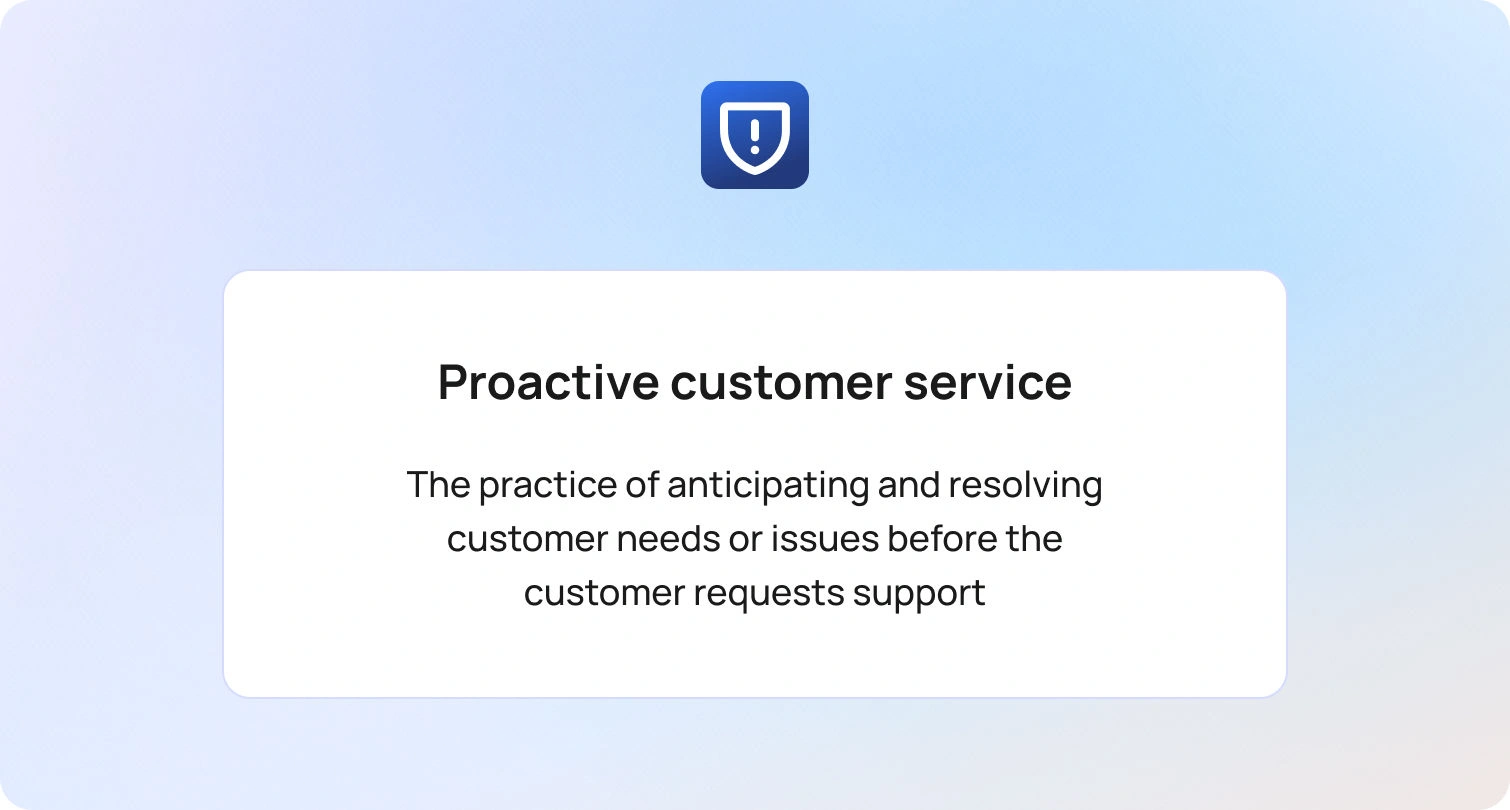
Proactive customer service is the practice of identifying and addressing customer needs or potential problems before the customer has to ask.
Rather than waiting for support tickets, complaint emails, or negative reviews, companies analyze customer data, monitor behavior patterns, and anticipate friction points in advance. They reach out first, fix issues early, and create clarity before confusion sets in.
To fully understand its impact, it helps to examine proactive vs reactive customer service side by side.
Reactive customer service responds after a problem occurs. The customer initiates contact, explains the issue, and waits for resolution. It’s often focused on recovery and damage control.
Proactive customer service, on the other hand, acts before a problem arises. The business initiates communication, prevents disruption, and optimizes the experience. It shifts the focus from fixing dissatisfaction to preventing it altogether.
Understanding the difference between proactive and reactive customer service is critical for organizations aiming to improve retention, reduce operational strain, and build long-term customer trust. In increasingly competitive markets, the brands that win are rarely the ones that respond fastest; they’re the ones that anticipate best.
Why Proactive Customer Service Matters
Implementing proactive strategies to prevent poor customer service experiences can dramatically impact business performance:
- Enhanced Customer Satisfaction: Customers feel understood and valued.
- Increased Loyalty: Anticipating needs builds trust and long-term relationships.
- Positive Word-of-Mouth: Customers share exceptional experiences.
- Higher Sales: Personalized recommendations increase conversions.
- Reduced Support Costs: Fewer inbound complaints lower operational strain.
Proactive Customer Service Examples Across Industries
Below are clear examples of proactive customer service in action.
Airlines
- Real-time flight delay notifications
- Automated gate change alerts
- Personalized seat and meal recommendations
This is a classic example of proactive customer service that reduces stress before it happens.
Retail & E-commerce
- Restock alerts based on purchase history
- Personalized product recommendations
- Delivery delay notifications
Hospitality
- Remembering guest preferences
- Automatic room upgrades for milestones
- Pre-arrival check-in reminders
Banking
- Fraud alerts before transactions finalize
- Spending pattern insights
- Financial planning nudges
Healthcare
- Appointment reminders
- Medication refill notifications
- Preventative care prompts
These examples of reactive and proactive customer service show how businesses can shift from resolving dissatisfaction to preventing it.
Proactive Customer Service Strategies
Understanding the proactive customer service definition is one thing. Operationalising it at scale is another.
Truly proactive organizations don’t rely on isolated tactics. They build structured systems designed to detect risk, anticipate friction, and intervene early. Below are proactive customer service strategies that move beyond surface-level improvements and instead reshape how support functions operate.
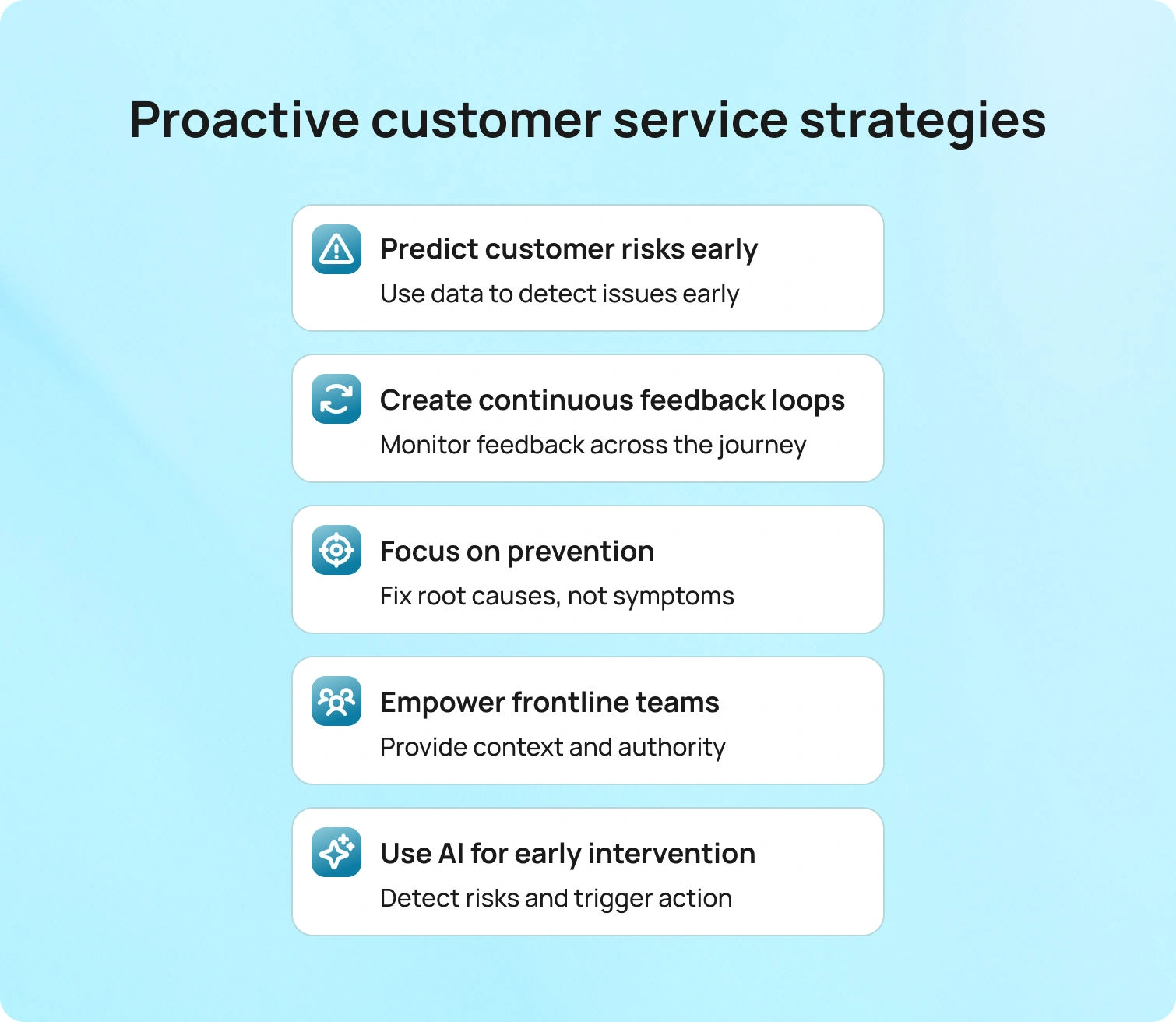
1. Turn Customer Data into Early-Warning Signals
Most businesses collect large volumes of customer data. Far fewer use it predictively.
Proactive customer service begins by identifying leading indicators of dissatisfaction. This might include reduced product usage, repeated logins without task completion, delayed payments, negative sentiment in support interactions, or declining NPS scores. These signals often appear weeks before churn or complaints.
Advanced CRM systems and behavioural analytics tools should be configured not simply to record activity, but to flag risk patterns automatically. The focus must be on earlier intervention when risks arise.
This is one of the most effective proactive strategies to prevent poor customer service experiences: spotting dissatisfaction before it becomes visible to the customer themselves.
2. Build Continuous Feedback Loops, Not One-Off Surveys
Many organizations conduct annual surveys and consider the job done. Proactive businesses treat feedback as a live data stream.
Micro-surveys at key journey stages, post-interaction sentiment analysis, customer health scoring, and structured check-ins allow companies to monitor experience in near real time. The focus should be on identifying friction at specific touchpoints rather than collecting generic satisfaction scores.
When feedback loops are continuous, organizations can course-correct quickly, preventing small irritations from becoming formal complaints.
3. Redesign Processes Around Prevention, Not Resolution
A reactive support model optimises for ticket handling time and resolution rates. A proactive model optimises for ticket avoidance.
This requires examining recurring support themes and asking a different question: not “How do we resolve this faster?” but “Why is this happening at all?”
Proactive and reactive customer service differ fundamentally here. Reactive teams refine workflows to improve response efficiency. Proactive teams eliminate the root causes generating demand in the first place.
That may involve improving onboarding clarity, simplifying billing communication, refining UX flows, or strengthening operational quality controls upstream.
4. Empower Frontline Teams with Context, Not Just Scripts
Frontline employees are often the first to sense emerging issues. However, without data visibility or decision-making authority, they remain reactive by default.
Empowering teams means equipping them with:
- Real-time customer health indicators
- Historical interaction context
- Authority to issue goodwill gestures or escalate early
- Clear guidance on identifying risk signals
When agents can see patterns, not just individual tickets, they can shift from solving isolated problems to preventing future ones.
This is a critical part of how to be proactive in customer service: aligning people, data, and authority.
5. Implement Proactive Customer Service Strategies with AI Carefully
AI is increasingly central to modern proactive customer service strategies. Predictive modelling can identify churn risk, sentiment analysis can detect dissatisfaction, and automated triggers can initiate outreach before customers contact support.
Common proactive customer service examples powered by AI include:
- Automated notifications when service disruptions are detected
- Behaviour-based onboarding prompts
- Intelligent chatbots that surface relevant help content
- Next-best-action recommendations for support agents
However, there are also shortcomings of AI in proactive customer service.
AI systems can misinterpret context, generate false positives, or over-automate sensitive interactions. Predictive models are only as strong as the data feeding them. Poor governance can also create privacy or compliance risks.
Is AI Worth It for Proactive Customer Service?
AI has rapidly become central to proactive customer service strategies with AI, particularly in environments where scale and speed matter. Predictive analytics can identify behavioural anomalies, sentiment shifts, churn risk signals, and service disruption patterns far earlier than manual monitoring ever could. Machine learning models can analyse thousands of data points simultaneously (from product usage trends and support interactions to billing activity and engagement rates), and surface patterns that human teams might not detect until dissatisfaction has already escalated.
In this sense, AI meaningfully strengthens the proactive customer service definition: it allows organizations to anticipate not just common issues, but statistically probable future friction.
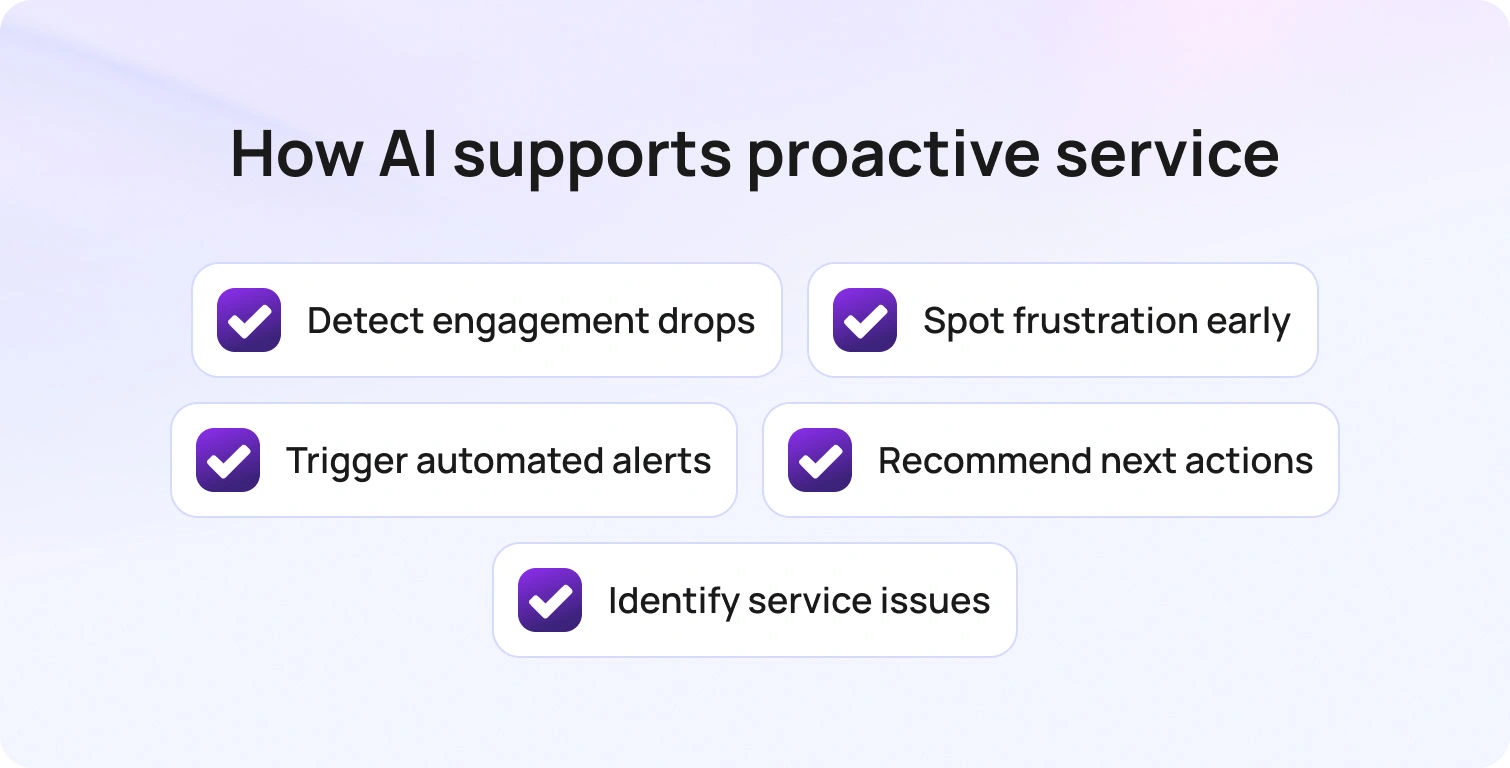
For example, AI can:
- Flag customers whose usage patterns suggest declining engagement
- Detect frustration in written communication before a formal complaint is made
- Trigger automated outreach when operational thresholds are breached
- Recommend next-best actions to agents based on similar historical cases
- Identify systemic service weaknesses across large datasets
These capabilities can dramatically reduce inbound ticket volume and enable earlier intervention, two critical outcomes when comparing proactive vs reactive customer service models.
However, the conversation cannot stop at capability. There are genuine shortcomings of AI in proactive customer service that leaders must weigh carefully.
First, AI lacks contextual judgment and emotional intelligence. It can detect sentiment polarity, but it cannot fully interpret nuance, tone shifts influenced by personal circumstances, or cultural context. In emotionally charged situations, automation can inadvertently amplify frustration rather than alleviate it.
Second, predictive systems are probabilistic by nature. False positives can result in unnecessary outreach, while false negatives can miss genuinely at-risk customers. Over-reliance on predictive scoring without human validation can distort prioritisation.
Third, over-automation creates the risk of impersonality. Proactive outreach that feels scripted, premature, or misaligned with actual customer needs can erode trust. Customers may perceive automated “check-ins” as surveillance rather than support if execution lacks care.
There are also structural considerations: data privacy compliance, governance requirements, model bias, and ethical transparency. Poorly trained models can inadvertently reinforce inequities or misclassify customer segments, undermining both experience and brand integrity.
So, is AI worth it for proactive customer service?
Strategically deployed, yes, but only as an augmentation layer.
The most effective proactive and reactive customer service frameworks do not replace human teams with AI. They equip teams with predictive intelligence that enhances decision-making. AI surfaces risk signals. Humans apply judgment, empathy, and discretion. AI identifies patterns. Humans build relationships.
When implemented thoughtfully, proactive customer service strategies with AI reduce operational strain while increasing personalisation and precision. When implemented carelessly, they risk scaling friction rather than preventing it.
The distinction lies not in the technology itself, but in governance, oversight, and cultural integration. Proactive customer service is not an automation strategy; it’s an organizational mindset that AI can strengthen, but not substitute.
Proactive vs Reactive Customer Service: A Strategic Shift
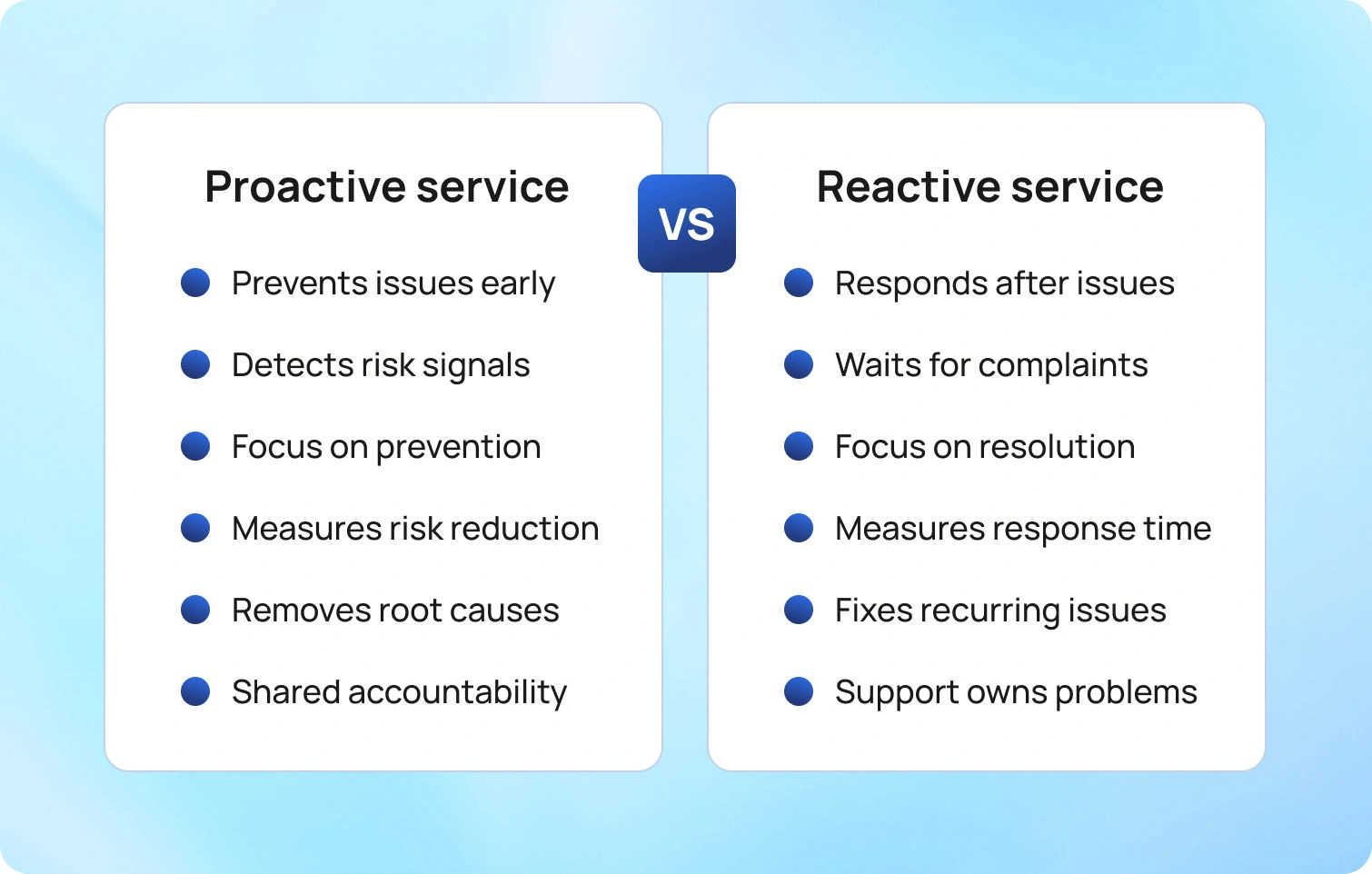
Many organizations still operate within a reactive customer service model. Support teams wait for complaints, tickets, escalations, or cancellations before intervening. Performance is measured by response time, resolution time, and case closure rates. While these metrics are important, they reflect recovery, not prevention.
The move from reactive to proactive customer service is a structural shift in operating philosophy:
- Reactive service assumes friction is inevitable and optimises for fixing it quickly.
- Proactive service assumes friction is preventable and optimises for eliminating it altogether.
This shift requires deliberate change across several dimensions.
Cultural change is foundational. Teams must move from a “firefighting” mentality to a preventative mindset. Instead of celebrating heroic recoveries, organizations must reward early detection, risk mitigation, and systemic improvement.
Process redesign is equally critical. Recurring support themes should trigger root-cause analysis, not simply workflow refinement. If the same billing confusion appears repeatedly, the issue is not agent performance; it is communication design. Proactive strategies to prevent poor customer service experiences start upstream, often in product, operations, or policy.
Technology investment supports this evolution. Monitoring systems, predictive analytics, real-time quality tracking, and intelligent alerts enable earlier visibility into emerging issues. However, technology alone does not create proactivity; it enables it.
Cross-department alignment is often the most overlooked requirement. Customer experience does not sit solely within support. Operations, product, compliance, logistics, and finance all influence friction points. A proactive model demands shared accountability for prevention, not isolated ownership of resolution.
When implemented effectively, the long-term payoff is significant:
- Fewer escalations and crisis scenarios
- Reduced support volume driven by recurring issues
- Improved customer lifetime value
- Stronger retention and loyalty metrics
- Enhanced brand equity built on reliability and trust
Understanding proactive vs reactive customer service at this strategic level reframes support from a cost centre to a preventative growth lever.
How BlueTweak Supports Proactive Customer Service
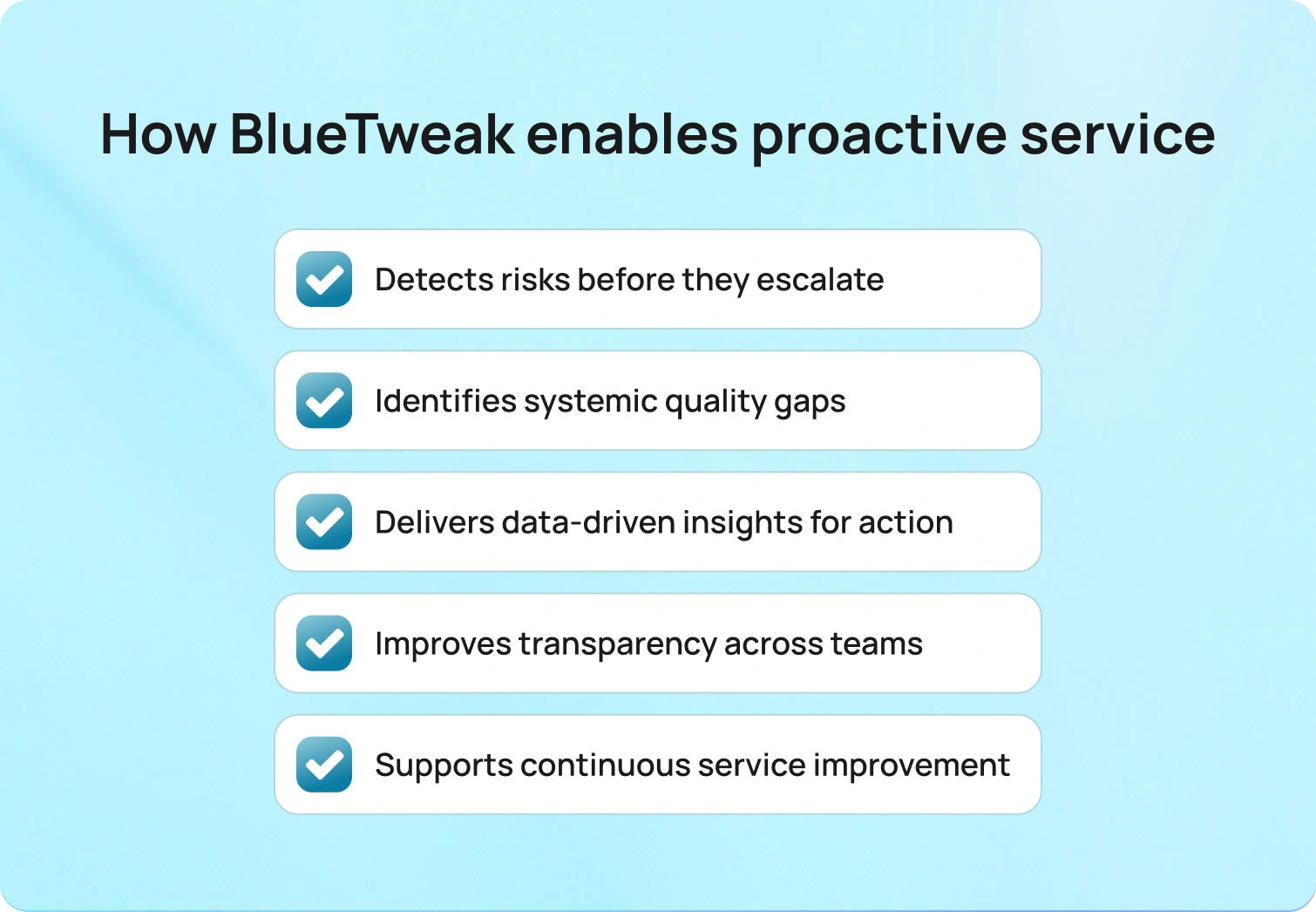
Transitioning from reactive to proactive service requires more than intention. It demands visibility, control, and continuous oversight across operational workflows. This is where BlueTweak plays a critical role.
BlueTweak enables organizations to identify operational risks before they impact customers, shifting the focus from post-incident correction to pre-incident prevention. By monitoring quality metrics in real time, teams gain early-warning visibility into performance deviations that could otherwise translate into service breakdowns.
Rather than waiting for customer dissatisfaction to surface externally, businesses can intervene internally.
BlueTweak supports proactive customer service strategies by:
- Detecting inconsistencies and compliance risks before they escalate
- Highlighting systemic quality gaps across processes
- Providing data-driven insights that inform preventative action
- Creating transparency across departments to reduce siloed blind spots
- Supporting continuous improvement across every customer touchpoint
This operational visibility strengthens proactive and reactive customer service frameworks alike. Reactive capabilities remain necessary, but with stronger monitoring and insight layers, the volume of reactive incidents decreases over time.
Organizations that embed proactive customer service strategies into operational infrastructure don’t simply respond faster; they operate smarter, reduce avoidable friction, and protect customer trust before it is tested.
By embedding proactive strategies into governance, monitoring, and performance systems, businesses move beyond service recovery. They anticipate, they optimize, and ultimately, they lead.
Final Thoughts: The Business Case for Proactive Customer Care
Proactive customer service is not a surface-level enhancement. It is a proactive approach that reshapes how organizations think about customer needs, customer behavior, and long-term growth.
Unlike reactive customer service, which responds to customer complaints and inbound support requests, a proactive customer service approach begins earlier. It focuses on how businesses anticipate customer risk, reduce customer frustration, and exceed customer expectations before problems escalate.
When organizations implement proactive customer service effectively, they shift from managing volume to preventing friction. They monitor customer sentiment, analyse customer interactions for early warning signals, and notify customers before customer issues turn into formal customer inquiries. Instead of relying on phone calls or reactive contact center workflows, they provide proactive customer support at the first sign of risk.
Proactive customer service aims to anticipate customer needs across the full lifecycle. It uses customer relationship management systems and continuous customer feedback to generate valuable insights that guide intervention. Most importantly, it empowers support teams and the wider customer service team to act before dissatisfaction spreads.
The benefits of proactive customer models are clear: improved customer satisfaction, increased customer retention, stronger customer loyalty, and repeat business. By reducing avoidable support requests and recurring customer concerns, organizations free their contact center to focus on complex cases that deepen customer relationships.
To provide proactive customer care at scale, businesses must combine data visibility, governance, and human judgment. AI can enhance detection, but lasting impact comes from thoughtful execution. Organizations that deliver proactive customer service consistently build trust before it is tested, and that trust becomes a durable competitive advantage.
Ready to shift from reactive recovery to proactive prevention? Book a demo today to see how BlueTweak helps you identify risk early, reduce avoidable customer issues, and deliver proactive customer service at scale.

As Head of Digital Transformation, Radu looks over multiple departments across the company, providing visibility over what happens in product, and what are the needs of customers. With more than 8 years in the Technology era, and part of BlueTweak since the beginning, Radu shifted from a developer (addressing end-customer needs) to a more business oriented role, to have an influence and touch base with people who use the actual technology.



