Outsourcing Customer Service vs Conversational AI: Which Is Best in 2026?



BlueTweak is an AI Customer Support Platform that unifies every conversation, customer record, and automation into one workspace.
Explore more
Insights, trends, and practical ideas from customer experience and AI
Real-world scenarios showing how teams use BlueTweak to deliver better service
The daily blueprint that guides customer support leadership.
ROI and savings calculators for support teams
See how BlueTweak stacks up against leading customer support platforms
Outsourcing customer service and conversational AI are not competing strategies. They are complementary tools that work best when matched to the right interaction type. Outsourcing wins for complex interactions, niche language coverage, and seasonal overflow. Conversational AI wins for high-volume routine queries, 24/7 coverage on predictable interaction types, and structured data output. For most teams in 2026, the right answer is a hybrid: AI handles tier-1 volume, outsourcing covers the gaps AI cannot fill, and in-house agents focus on the customer interactions that matter most. This article is for CX directors, support operations leads, and heads of customer service who need a clear, balanced framework for making this decision.
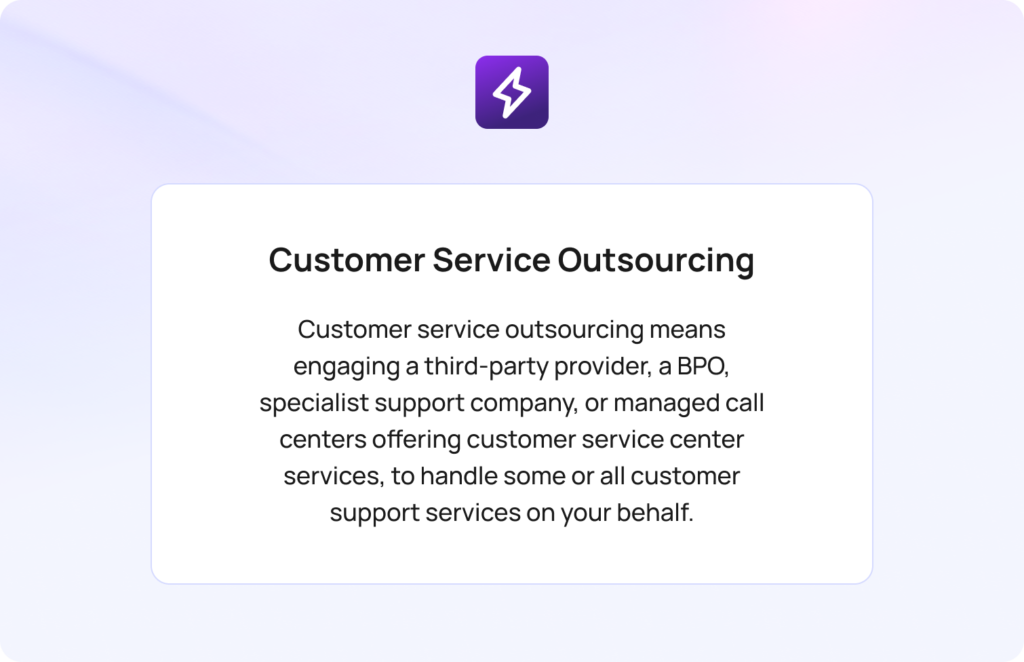
Customer service outsourcing means engaging a third-party provider, a BPO, specialist support company, or managed call centers offering customer service center services, to handle some or all customer support services on your behalf. Used correctly, outsourcing delivers cost reduction while protecting customer loyalty by ensuring every interaction is handled by someone with the capacity and training to resolve it well. The spectrum runs from full outsourcing, where the provider runs the entire support operation, to partial outsourcing, where specific functions are handed off: after-hours coverage, overflow handling, specific communication channels, or multilingual support.
A third model has emerged more recently: BPO-enhanced AI, where an outsourced team operates AI-assisted support on the client’s behalf. In this arrangement, outsourcing customer support and AI are not alternatives; the BPO is the delivery layer, and the AI is the efficiency layer within it.
Outsourcing is not a single model. The right arrangement depends on scope, language requirements, hours of coverage, complexity of customer inquiries, and quality expectations. It is a strategic asset for teams that use it correctly, and a cost centre for teams that treat it as a default.
Conversational AI for customer service is software that uses natural language processing and large language models to understand customer intent and resolve customer interactions autonomously across chat, voice, and messaging channels, without requiring human interaction at each step. Artificial intelligence in customer support has matured significantly; AI systems and AI-powered chatbots built on advanced technology now handle customer inquiries that would have required human agents two years ago. AI in customer service, specifically AI customer service applications, has moved from experimental to operational for most mid-market and enterprise support teams.
In 2026, conversational AI operates in three main deployment types: AI chatbots for text-based channels, voice assistants and voice automation for phone and IVR, and omnichannel AI agents that handle customer requests across various channels from a single system.
The technology handles tier-1 routine tasks reliably: order status queries, FAQs, account updates, password resets, status updates, and routine questions that have definitive answers. It requires human oversight for complex processes, emotionally sensitive interactions, and regulated industries where compliance is non-negotiable. Training AI on your specific product, policy, and customer context is what separates deployments that contain interactions from those that only deflect them.
The BlueTweak Outsourcing vs Conversational AI Comparison Table
| Customer Service Outsourcing | Conversational AI | Hybrid (AI + Selective Outsourcing) | |
| Best for | Complex interactions, niche languages, overflow, 24/7 coverage without AI investment | High-volume routine queries, digital-first teams, predictable interaction types | Most teams, AI handles tier-1 volume; outsourcing covers specialist or overflow needs |
| Cost model | Per-agent or per-interaction; scales with volume | Platform fee + usage; scales without linear headcount cost | Optimised, AI reduces outsourced volume; outsourcing covers gaps AI cannot fill |
| Time to deploy | Weeks to months | Days to weeks if KB is ready | Phased, AI first, outsourcing configured around it |
| Quality control | Dependent on provider; SLA-governed | Dependent on KB quality and threshold configuration | Dual, AI QA for automated interactions; SLA for outsourced |
| Language coverage | Broad, providers can supply native speakers | Strong for top languages; variable for long-tail languages | Best combination, AI for top-language volume; outsourcing for niche languages |
| Unique edge | Human judgment for complex, emotional, cultural nuance | Scales instantly; consistent; no turnover | Lowest total cost and highest coverage combination |
Outsourcing customer service has a genuine, well-established value case. Here is the honest version of it.
Outsourcing shines where AI struggles most. Emotionally complex complaints, multi-step technical troubleshooting, legal or compliance queries, and sensitive account issues all require experienced agents who can apply human judgment in real time. Experienced agents at a specialist BPO often handle these better than an in-house current team stretched across all interaction types and constantly managing volume pressure.
For regulated industries, such as financial services, healthcare, and insurance, where compliance requirements shape every customer conversation, the oversight and documentation infrastructure that established BPOs bring is a meaningful operational advantage.
Multilingual support is the most compelling use case for outsourcing in 2026. Conversational AI handles major languages reliably. For long-tail languages with smaller customer bases, recruiting and retaining native-speaking support professionals in-house is expensive and logistically complex. A BPO with pre-built multilingual capacity is faster and cheaper for language coverage beyond the top three or four.
Building genuine always-on support in-house requires shift structures that are expensive and complex to manage, particularly for customer support teams in single-timezone organisations. BPOs with distributed global teams provide 24/7 coverage without the in-house management overhead, the labor costs of night shifts, or the staff welfare complexity of round-the-clock scheduling.
E-commerce businesses, travel operators, and events companies face demand peaks that would require hiring cycles if staffed entirely in-house. Outsourcing lets support teams scale capacity up and down without those cycles. This is particularly valuable when reactive support is the norm, when customer contact volume spikes unpredictably and in-house teams cannot absorb the surge without time-consuming hiring and onboarding processes. Customer portals and self-service tools reduce some of this volume, but complex peak-period queries still require human handling. AI handles some of this, but for complex seasonal customer requests that require judgment, returns disputes, itinerary changes, and event cancellations, outsourced human teams are often the right solution.
A BPO with an existing trained team, established processes, and operational infrastructure can be operational in weeks. AI deployment requires knowledge base preparation, threshold calibration, and integration work, typically four to eight weeks for a basic deployment. For teams that need coverage fast and can develop the AI layer in parallel, outsourcing first is a defensible sequencing decision.
Conversational AI has an equally strong, equally honest value case.
This is the key difference. Conversational AI handles routine queries, FAQs, order status, password resets, and account updates without a cost-per-interaction that scales with volume. As customer inquiries grow, AI cost grows slowly; outsourced agent cost grows proportionally. The marginal cost of the next thousand interactions is lower with AI than with any human team, in-house or outsourced.
For high-volume operations, this is a transformative economic argument. The cost savings compound as the containment rate improves and the platform cost is spread across increasing interaction volume.
AI applies the same knowledge base-grounded response quality at 100 interactions per day and 100,000. Human agents, whether in-house or from an outsourced team, vary in quality by shift, fatigue, tenure, and training recency. For predictable, routine interaction types where consistency matters more than nuance, AI is a genuine quality advantage, not just a cost argument.
This is also why AI plays a crucial role in exceeding customer expectations on routine touchpoints. Customers expect fast, accurate, personalized service on simple queries. AI-powered chatbots and voice assistants deliver that consistently, without waiting in a queue and without the variability that comes from support agents working across different shifts and experience levels.
Conversational AI is available 24/7 without shift premiums, without overtime costs, and without queue time. For after-hours coverage on routine queries, AI is faster and cheaper than outsourcing. AI chatbots respond in seconds. Response time on outsourced channels is governed by SLA and staffing. For customers who contact support at 2 am with a password reset or an order status question, the AI-handled experience is better.
Every AI-handled interaction generates structured, actionable insights: intent, sentiment, resolution outcome, and CSAT data that flows directly into CRM systems. Outsourced interactions often produce data that is less structured, harder to access, and less integrated with existing workflows. For teams that use support data for product development, CX improvement, and WFM forecasting, AI’s data output is a strategic asset that outsourcing rarely matches.
Agent attrition at BPOs ranges from 30–100% annually in some markets. Every new agent requires onboarding time, training AI on your processes and products, and a quality learning curve before they reach full performance. AI has no turnover. Once the knowledge base is built and thresholds are configured, the system does not require re-onboarding when staff changes.
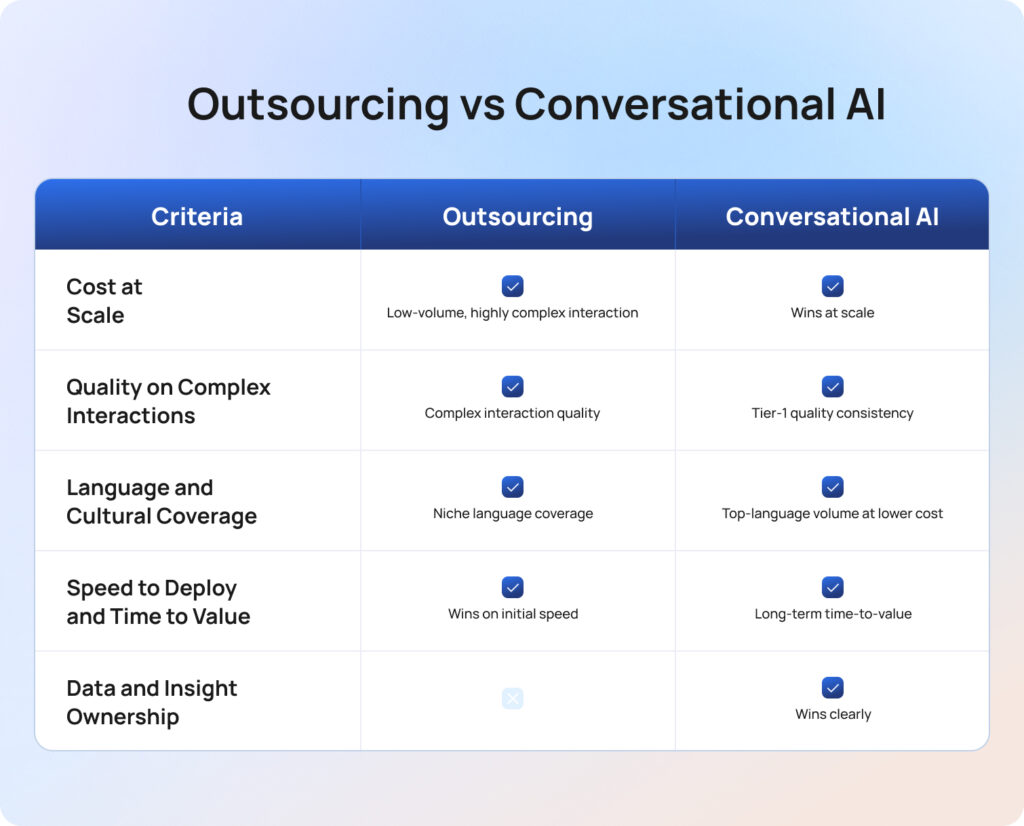
Outsourcing cost scales linearly with interaction volume. More customer interactions mean more agents, which means more cost. Conversational AI cost is largely fixed at the platform level, with usage cost growing more slowly than volume. At low volumes, outsourcing may be cheaper when setup costs are amortised. At high volumes, AI typically delivers a lower cost per interaction than any outsourcing arrangement.
The break-even point depends on your fully-loaded outsourcing cost per interaction versus your AI platform cost plus usage cost per contained interaction. For most operations handling more than 5,000–8,000 interactions per month, AI reaches break-even within 90 days of a well-scoped deployment.
Verdict: AI wins at scale. Outsourcing may win for low-volume or highly complex interaction mixes.
AI handles tier-1 queries with consistent quality. It performs poorly on multi-step complex issues, emotional distress, trust recovery, and compliance-sensitive queries. These are the interactions where human agents, whether in-house or from an outsourced team, deliver better outcomes meaningfully. The quality question depends entirely on your interaction mix: what proportion is routine vs. complex?
Teams with a majority of complex customer interactions will find that AI alone cannot sustain customer satisfaction. For those teams, human customer support remains the quality foundation, and AI assists rather than leads. Experienced agents handle the cases where human judgment is irreplaceable.
Verdict: Outsourcing wins for complex interaction quality. AI wins for tier-1 quality consistency.
Conversational AI in 2026 handles major languages well. For long-tail languages, BPOs can provide native speakers across a wider range. For teams with language requirements beyond the top three or four, outsourcing provides coverage that AI cannot yet match reliably. Cultural nuance, the ability to adjust tone, formality, and framing for different markets, still favours human teams in non-primary languages.
Verdict: Outsourcing wins for niche language coverage. AI wins for top-language volume at lower cost.
A BPO with existing teams can be operational in weeks. AI deployment requires knowledge base preparation and threshold calibration, typically four to eight weeks for a standard deployment, longer for complex integrations. However, AI time-to-value accelerates as containment rate improves and the feedback loops between QA, knowledge base quality, and model performance compound. Outsourcing time-to-value is more stable but does not compound in the same way.
Verdict: Outsourcing wins on initial speed. AI wins on long-term time-to-value.
AI generates structured, integrated data on every customer interaction. Outsourced interactions produce data that is often harder to access, less structured, and less integrated with the client’s existing systems. For teams building a full picture of customer behavior from support data, feeding it into product development, CX strategy, or WFM forecasting, AI gives significantly better data ownership. This is one area where the gap between the two models is both clear and consequential.
Verdict: AI wins clearly on data quality and ownership.
The framing of outsourcing customer service vs conversational AI is a false dichotomy for most teams. The question is not which replaces the other. It is which handles which interaction type most effectively and at the lowest total cost.
A practical hybrid setup looks like this:
AI handles tier-1 volume. A RAG-grounded conversational AI chatbot and voicebot contain high-confidence, routine queries 24/7, order status, account queries, FAQs, repetitive questions, and status updates, reducing the total interaction volume that reaches any human agent, whether in-house or outsourced.
In-house agents handle relationship-critical interactions. High-value customers, complex complaints, and trust recovery scenarios route to agents with the deepest product knowledge and brand alignment. These interactions require human judgment, cultural understanding, and the ability to navigate complex processes that AI cannot handle reliably. Human customer service at its best is reserved for the moments where it matters most.
Outsourcing covers specialist and overflow needs. Niche languages, after-hours overflow on complex customer requests, and seasonal spikes are the best-fit use cases for BPO partners. These are the interactions AI cannot handle and in-house customer support teams cannot cost-effectively staff for. The outsourced team operates on the volume that remains after AI containment, making the outsourcing arrangement leaner and more targeted.
The result: AI reduces the total volume of interactions that need a human agent. Outsourcing fills the gaps that remain. In-house agents focus on the interactions that most require them. Customer retention improves because each interaction type is handled by the most appropriate resource.
This is not a theoretical model. It reflects how the most operationally efficient customer support teams in 2026 are actually structured.
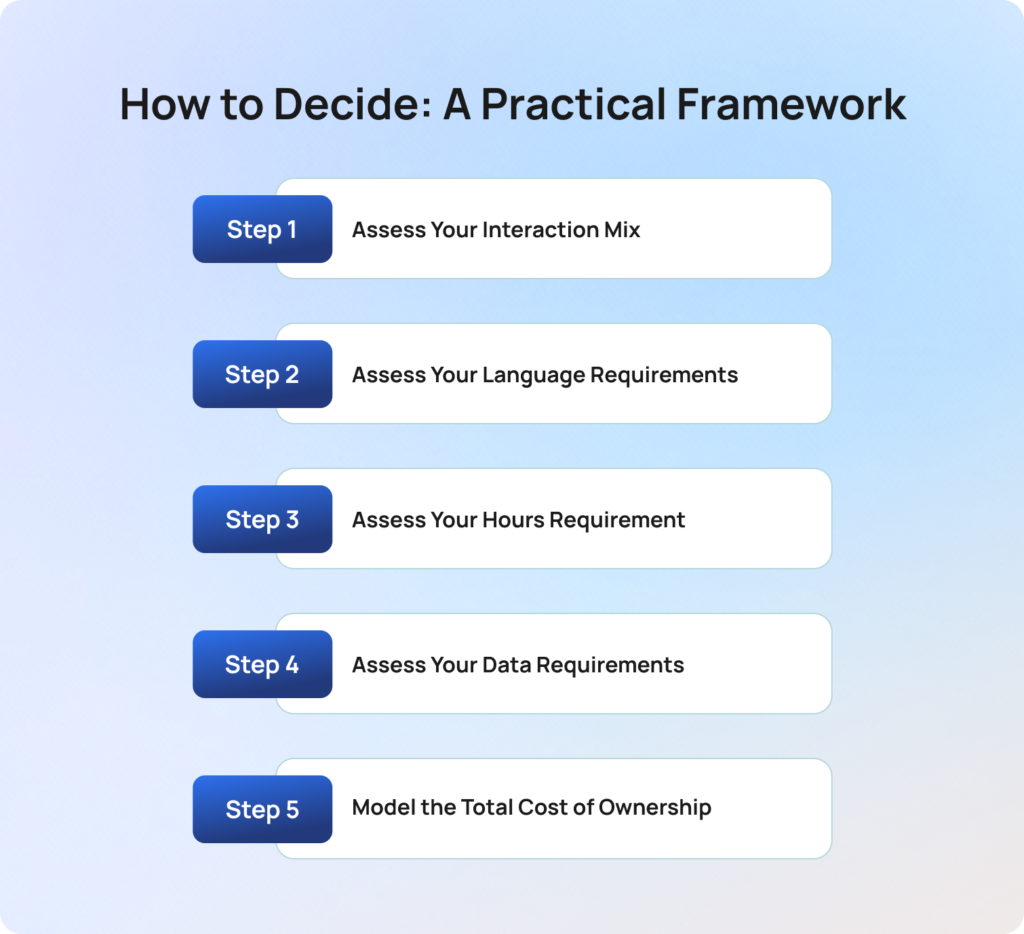
What proportion of your current volume is tier-1 routine queries, FAQ, order status, account updates, repetitive tasks with definitive answers? If more than 40%, conversational AI has a strong cost case. If the majority is complex, multi-step, or emotionally sensitive, outsourcing or in-house human agents are the better primary investment.
How many languages do you actively support? For three or fewer, AI handles the volume well. For broader language coverage, a BPO partner supplements AI for long-tail languages. Multilingual support delivered through a hybrid setup, AI for high-volume top languages, and outsourcing for niche coverage typically achieves better coverage at lower cost than either model alone.
Do you always need support? AI is the lowest-cost 24/7 solution for tier-1 queries. For complex after-hours customer inquiries that require human judgment, outsourcing is the right complement. The combination of AI for routine after-hours volume and outsourcing for complex after-hours queries provides full coverage without building an expensive in-house follow-the-sun operation.
If support data informs product development, CX improvement, or WFM forecasting, AI’s structured data output is a significant advantage. Outsourced interactions produce data that is harder to integrate and often requires additional work before it becomes actionable insights in your CRM systems.
Calculate fully-loaded in-house cost per interaction, outsourcing cost per interaction including management overhead and data integration, and AI platform cost per contained interaction. The comparison often resolves the decision faster than any other single factor. Use the BlueTweak ROI calculator to model your specific numbers across all three scenarios.
BlueTweak is not an argument against outsourcing. It is the platform that makes either model, or both together, work better.
For in-house customer support teams, BlueTweak’s conversational AI handles tier-1 containment across chat and voice, reducing the volume that reaches any human agent. Proposed Reply and real-time knowledge base retrieval improve in-house agent efficiency on the interactions they do handle, enabling human-like conversations grounded in accurate content rather than agent recall. WFM optimises scheduling to predicted volume, reducing labor costs. The QA module scores 100% of customer interactions, maintaining quality as AI handles more volume, and ensuring that saving time on QA overhead does not come at the cost of visibility.
For teams running a hybrid setup with an outsourced team or BPO partner, BlueTweak provides the AI layer that reduces the volume outsourced to the BPO and provides analytics to measure performance across AI-handled and outsourced interactions in one platform. The operational efficiency of the BPO arrangement improves because AI has already filtered out routine tasks, leaving outsourced agents focus on the complex customer inquiries where experienced agents deliver the most value.
Because everything runs on one platform, the data from AI-handled interactions and human-handled interactions flows into the same view. Support inquiries, customer sentiment, containment rate, CSAT, and agent productivity are trackable together, giving support professionals and operations leads the full picture they need to manage both channels effectively without stitching data together across AI tools and separate CRM systems.
Most teams we work with have spent years thinking about this as an either/or decision: do we outsource or do we build AI? The teams that are getting the best results have stopped asking that question. They have mapped their interaction types honestly, deployed AI where it wins on cost and consistency, kept human judgment where it is genuinely needed, and used outsourcing to fill the gaps that neither AI nor their in-house team can cost-effectively cover. When the three work together, the economics are significantly better than any of them alone, and so is the customer experience.

Radu Dumitrescu, Head of Presale and Digital Transformation at BlueTweak
Outsourcing customer service and conversational AI are not competing strategies. They are complementary tools that perform best when matched to the right interaction type.
AI handles high-volume, routine, predictable customer inquiries at the lowest cost and with the best data output. Outsourcing handles complex, niche, or overflow interactions that AI cannot address reliably. In-house agents handle the relationship-critical interactions where brand alignment and human judgment matter most. The teams achieving the best cost and quality outcomes in 2026 are those that deploy all three deliberately, not those that choose one and dismiss the others.
Continuous improvement in this model comes from the feedback loops between them: AI QA improving knowledge base quality, knowledge base quality improving containment rate, containment rate data informing how much volume needs to be routed to outsourced or in-house human teams.
Book a demo to see how BlueTweak supports both in-house and outsourced customer support operations from one platform.
It depends on the interaction volume and mix. At low volumes, outsourcing may be cheaper when AI setup costs are amortised. At high volumes, conversational AI delivers a lower cost per interaction because platform cost is largely fixed while outsourcing cost scales linearly with volume. For teams handling more than 5,000–8,000 interactions per month with a significant proportion of routine queries, AI typically reaches break-even within 90 days. The comparison should be run on fully-loaded cost per interaction across both models, including management overhead and data integration costs for outsourced arrangements.
Not for most teams. Conversational AI handles tier-1 routine queries reliably and consistently. It performs poorly on emotionally complex complaints, multi-step technical troubleshooting, compliance-sensitive queries, and niche language coverage. These are the interaction types where experienced human agents, whether in-house or outsourced, deliver better outcomes. The practical question is not whether AI replaces outsourcing, but which interaction types each handles best and how to design a hybrid setup that routes each type to the most appropriate resource.
A hybrid setup is the most cost-effective approach for most teams. Conversational AI provides always-on support for tier-1 volume at a fraction of the cost of staffing. Outsourcing covers complex after-hours customer inquiries that require human judgment. This combination provides full coverage without building an expensive in-house follow-the-sun operation or outsourcing all volume at the per-interaction cost that entails.
Conversational AI in 2026 handles major languages well through advanced natural language processing. For long-tail languages with smaller customer bases, BPO partners with pre-built multilingual capacity to provide faster and cheaper coverage than recruiting native-speaking agents in-house. The hybrid approach allocates AI to top-language volume and outsourcing to niche language coverage, achieving broader total coverage at lower cost than either model alone.
Conversational AI generates structured, integrated data on every customer interaction, intent, sentiment, resolution outcome, CSAT, directly in your CRM systems. Outsourced interactions produce data that is often less structured, harder to access, and less integrated with existing workflows. For teams that use support data for product development, CX improvement, or WFM forecasting, AI provides significantly better data ownership and more actionable insights than outsourcing arrangements typically allow.
As Head of Digital Transformation, Radu looks over multiple departments across the company, providing visibility over what happens in product, and what are the needs of customers. With more than 8 years in the Technology era, and part of BlueTweak since the beginning, Radu shifted from a developer (addressing end-customer needs) to a more business oriented role, to have an influence and touch base with people who use the actual technology.