



TL;DR
Language barriers in customer service become a structural operations problem at scale. Overcoming language barriers in customer service requires a system. Hiring native speakers for every language your clients speak is not economically viable, but leaving multilingual customers underserved costs more in churn and CSAT than the coverage investment. This guide gives CX managers and support ops leads practical strategies for dealing with language barriers in customer service that scale with volume rather than headcount.
Why Language Barriers Are a Scaling Problem, Not Just a Communication Problem
Imagine a customer reaching out in Portuguese to a support team that only speaks English. Both the customer and the agent want to resolve the issue. The communication barrier between them is not a matter of goodwill. It is a structural gap in how the business has organised its support operations.
Dealing with language barriers in customer service at the individual interaction level, using tips like speak slowly or choose simple words, works for occasional edge cases. It does not work when a growing, diverse customer base spans international markets across different languages and different cultures.
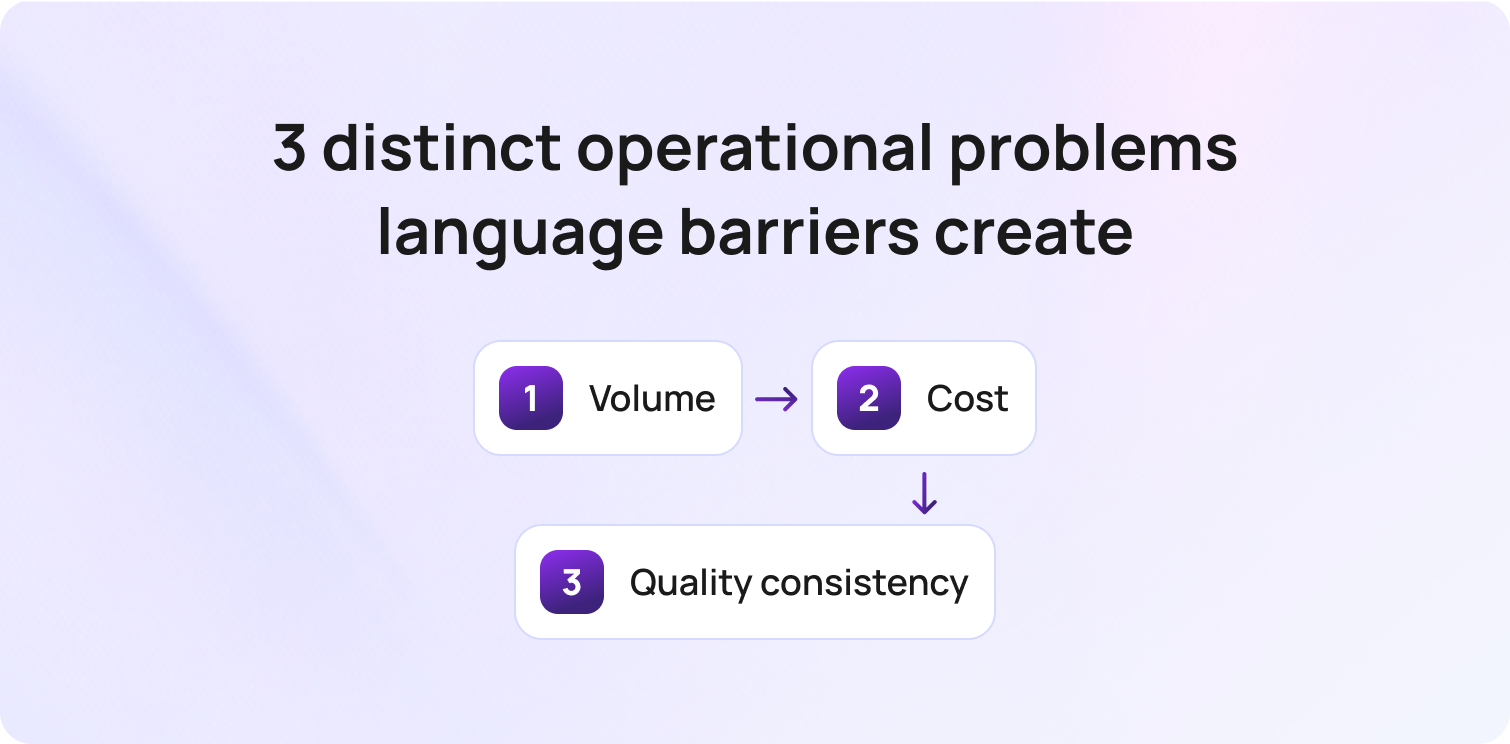
At scale, customer service language barriers create three distinct operational problems.
Volume. As a company expands into international markets, non-primary-language interactions grow proportionally. The question is not how to handle one difficult conversation. It is how to route, respond to, and resolve thousands of interactions monthly in a customer's language your core team does not speak.
Cost. Hiring and retaining native-speaking employees for every language in your customer base is expensive. Most teams can justify native speakers for their top two or three languages. Beyond that, cost and availability create barriers in customer service that go unfilled.
Quality consistency. Clients who do not speak English as a first language, or who do not speak the company's primary language, often receive slower response times, less accurate answers, and lower CSAT than primary-language customers. That gap in service quality affects retention across every industry.
The same principle applies to support. When customers cannot get help in their preferred language, frustration builds quickly, and the gap in service quality shows up in CSAT, repeat contacts, and churn before most teams realise there is a problem."
3 Approaches to Multilingual Coverage and When to Use Each
| Approach | Best For | Cost Model | Language Coverage | Quality Risk | Time to Deploy |
|---|---|---|---|---|---|
| Native-speaking agents | Top 2–3 languages; complex ideas and high-value interactions | High fixed cost; scales with headcount | Limited to hired languages | Low — human judgment and cultural nuance | Weeks to months |
| AI translation tools and multilingual NLP | High-volume tier-1 queries across different languages | Low variable cost; scales without headcount | 50+ languages depending on the platform | Medium — quality varies by language; needs monitoring | Days to weeks |
| Hybrid (native agents + AI translation) | Most teams managing 4+ languages and a diverse customer base | Optimised — AI covers volume; native agents handle complex cases | Broadest coverage | Low — AI handles routine; humans handle nuance | Phased deployment |
For most teams managing more than three languages, the hybrid model delivers the best combination of coverage, cost, and clarity. Native agents handle interactions that require cultural nuance, emotions, and judgment. AI translation tools cover the volume that those agents cannot economically staff for.
6 Ways to Overcome Language Barriers in Customer Service at Scale
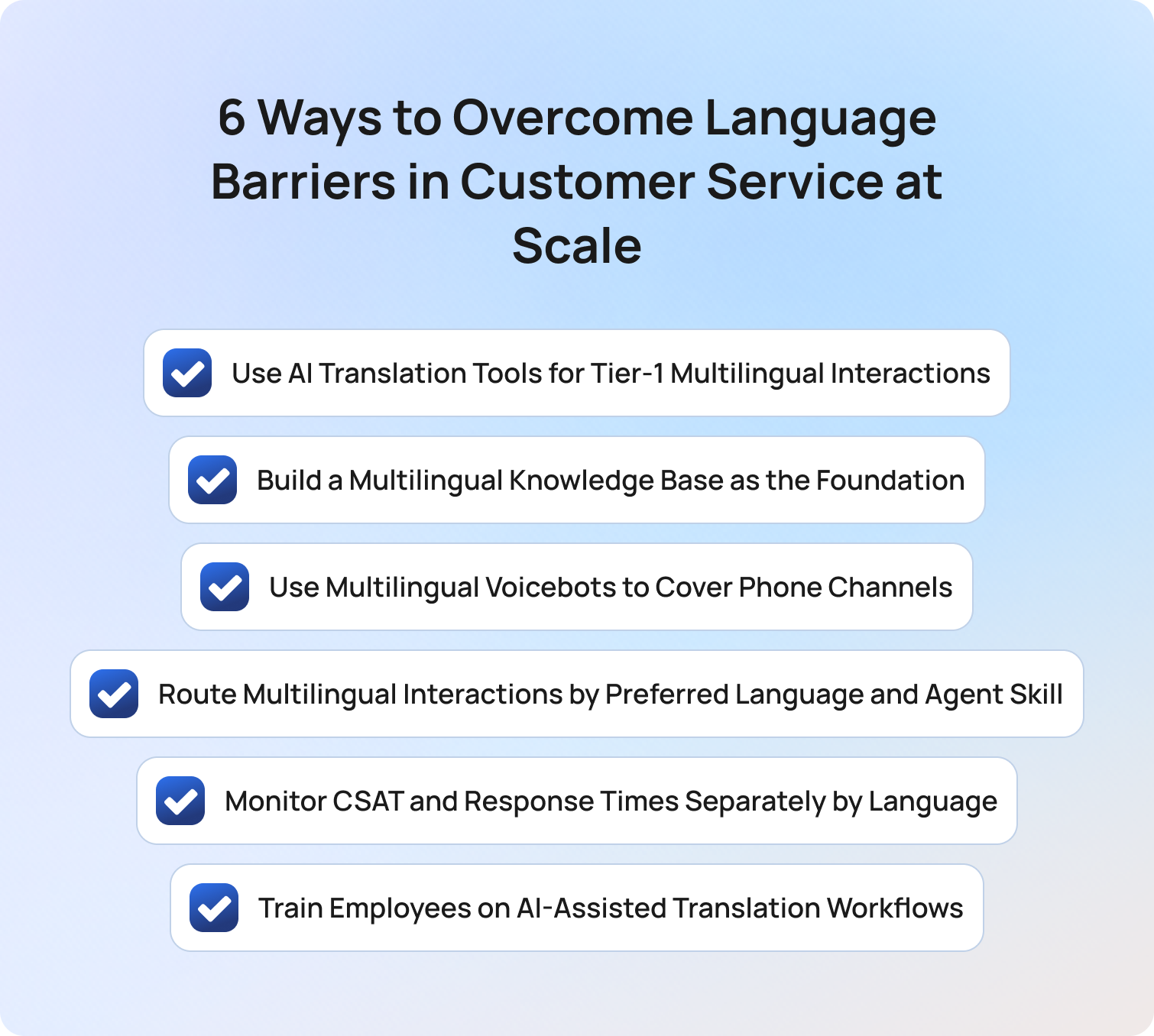
The strategies below address language barriers at the operational level. Each one scales with volume and focuses on building a system for clear communication rather than relying on individual agent ability.
1) Use AI Translation Tools for Tier-1 Multilingual Interactions
AI-powered translation and multilingual NLP handle high-volume, routine customer inquiries across different languages without native-speaking agents. In 2026, LLM-powered tools translate text and interpret context and nuance significantly better than earlier rule-based approaches or a basic tool like Google Translate, making them viable for customer-facing responses on predictable interaction types such as order status, account queries, and FAQs.
Translation services powered by AI now connect customers and agents who do not speak the same language in real time, reducing response times and eliminating the manual steps that slow down multilingual interactions. Start with your highest-volume non-primary languages and monitor CSAT per language from launch.
2) Build a Multilingual Knowledge Base as the Foundation
AI translation quality depends entirely on the source content it translates from. A well-structured, accurate knowledge base in the primary language gives translation tools a reliable foundation. Teams that deploy translation services without first auditing KB quality produce inconsistent outputs across different languages, regardless of the model's capability.
Clear communication starts with clear source content. Before implementing any translation tool, review your knowledge base for outdated information, jargon, and complex ideas that would be difficult to translate accurately into a customer's preferred language.
The most common mistake we see is teams deploying AI translation before they have fixed the underlying KB. The AI will translate whatever is in there, including the outdated, the inaccurate, and the inconsistent. Clean the source first.

3) Use Multilingual Voicebots to Cover Phone Channels
Language barriers in customer service are not limited to chat and email. Phone support often has the lowest multilingual coverage because native-speaking agents are the most expensive to staff. Multilingual voicebots handle inbound calls across different languages using voice recognition and NLP, covering after-hours volume and peak periods without language-specific agent scheduling.
For businesses where the phone is a key channel, this is often the highest-ROI multilingual investment. A voicebot that can speak with clients in their preferred language removes a communication barrier that a human staffing model cannot fill cost-effectively at low volume.
4) Route Multilingual Interactions by Preferred Language and Agent Skill
Intelligent routing that detects a customer's language from the opening message and assigns the interaction to an available native-speaking agent, or to an agent with translation support, reduces handle time and improves first contact resolution for multilingual clients. Preferred language should be a routing criterion alongside intent and urgency. Teams that rely on agents to self-identify language mismatches during a conversation add unnecessary delay and frustration to every multilingual interaction.
Clear communication in the customer's language is essential. Using visual aids where possible, such as links to illustrated guides or video content in the customer's language, can also help bridge gaps when translated text alone does not fully convey the message.
5) Monitor CSAT and Response Times Separately by Language
This is the strategy most companies skip and the one that reveals whether overcoming language barriers in customer service is actually working. Segmenting analytics by language from day one surfaces underperforming language segments before they lead to churn. A company with strong overall CSAT may have significantly lower scores for customers from different backgrounds who communicate in a non-primary language.
Set per-language CSAT and response time targets. Acknowledge performance gaps by language in the same way you would acknowledge any other service quality issue. Treat each language segment as its own benchmark, not a secondary concern.
6) Train Employees on AI-Assisted Translation Workflows
Agents who do not speak a customer's language can still handle interactions effectively in the workplace with real-time AI translation support, provided they understand how to use it and where its limits are. Training support employees on when to trust AI translation output, when to ask for clarification, and when to escalate to a native speaker increases effective language coverage without additional hiring.
Practice matters here. Agents who regularly work with translation tools in realistic scenarios develop the ability to sense when a translated message has lost context or meaning. Building that skill across the team creates a sense of confidence that improves both agent experience and customer experience.
According to a Common Sense Advisory study, 74% of customers are more likely to make a repeat purchase if after-sales support is in their native language. Getting employees comfortable with AI-assisted multilingual workflows is one of the most cost-effective ways to build trust with a diverse customer base across international markets.
How BlueTweak Supports Multilingual Customer Service at Scale
BlueTweak applies AI translation and multilingual NLP across chat, email, and voice channels in a unified platform, removing the need for separate translation services per language or channel.
The multilingual support platform handles tier-1 customer interactions across 100+ languages, grounded in the knowledge base, so responses are accurate and consistent. Multilingual voicebot coverage extends language support to inbound phone calls. Analytics surfaces CSAT, response times, and containment rate by language, giving teams the visibility to identify and resolve multilingual service gaps before they affect retention. Both the customer and the agent benefit from a platform where communication barrier risks are addressed systematically rather than interaction by interaction.
Final Thoughts
Overcoming language barriers in customer service at scale is not about finding the right words in the moment. It is about building a system where clear communication in the customer's preferred language is the default, not the exception. Native-speaking agents handle the interactions that require cultural context and human judgment. AI translation tools and multilingual voicebots cover the volume that those agents cannot staff for. Per-language analytics create the visibility to connect the dots between language coverage and retention.
For a full comparison of platforms that support multilingual customer service, see Best Multilingual Customer Support Software.
Start your free trial or request a demo to see how BlueTweak handles multilingual support at scale.
Get a 14-day free trial
Get Trial
As Head of Digital Transformation, Radu looks over multiple departments across the company, providing visibility over what happens in product, and what are the needs of customers. With more than 8 years in the Technology era, and part of BlueTweak since the beginning, Radu shifted from a developer (addressing end-customer needs) to a more business oriented role, to have an influence and touch base with people who use the actual technology.



