



TL;DR
Customer retention rises when support is fast, accurate, and personal at every step of the customer journey. AI-powered support turns day-to-day customer interactions into timely actions that retain customers, reduce churn, and scale efficiently with customer service automation. This guide shows how to improve customer retention rates with practical plays you can run now, how to calculate customer retention rate and track the key customer retention metrics that matter, and how BlueHub (by BlueTweak) helps teams execute a strong customer retention strategy in one workspace.
From Churn Risk to Repeat Customers
Most teams know retention beats acquisition on cost, but turning that belief into a repeatable system is the challenge. Customers expect companies to respond quickly, remember context, and resolve issues without asking them to repeat information. When handoffs break, channels disagree, or policies are unclear, even loyal customers reconsider.
AI closes the gap between intention and execution. It reads signals across the customer journey, predicts needs, and proposes the best action so agents can respond with the correct information at the right time. The result is fewer escalations, more satisfied customers, and a loyal customer base that stays engaged long after the initial purchase.
This article explains how to improve customer retention rates with AI. You will see the levers behind retention, the simplest way to calculate customer retention rate, the plays that stabilize relationships and encourage repeat business, the key metrics that prove lift, and where BlueHub fits as the workspace that unifies data, service, and orchestration so teams can act on insights in one place.
What Customer Retention Means in 2026 and Why It Matters
Customer retention refers to how well you keep current customers over time. It is the backbone of predictable revenue because retaining existing customers preserves the number of customers you already worked to acquire while increasing customer lifetime value as they continue to buy. A potent customer retention strategy compounds. It improves word-of-mouth, increases the percentage of customers who remain loyal, and reduces reliance on paid customer acquisition.
Retention matters now because acquisition costs rise, channels fragment, and consumers expect companies to meet them with accurate, consistent help. By meeting customer expectations quickly and clearly, support becomes a driver of loyalty instead of a cost line to compress.
24 AI-Powered Support Plays To Improve Customer Retention Rates
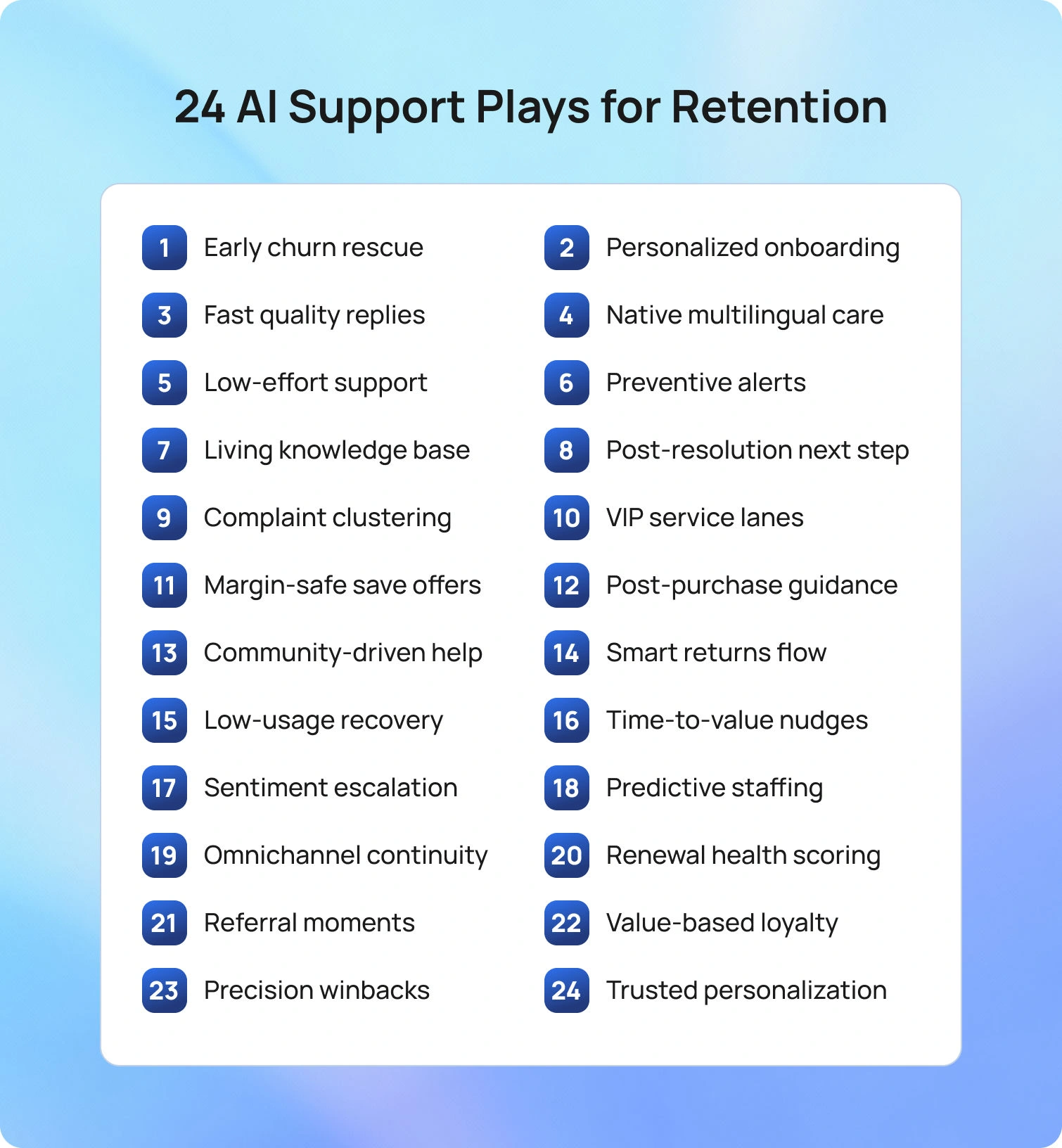
These are the moments that keep customers from leaving: clear, practical steps your team can take without rebuilding the stack. Each play ties to a specific retention driver and shows how AI turns signals into timely actions that protect revenue and loyalty.
1) Predict churn early and route fast
Risk rarely appears out of nowhere. Usage dips, complaint patterns, and negative sentiment usually appear first, so let models surface those accounts and move them to a save queue with tighter SLAs and clear authority to fix root issues.
Rescuers work from a single view of history, entitlements, and prior promises, which makes the first response specific instead of generic. Teams then watch time-to-outreach, save rate, and 60-day spend to prove the lift. BlueHub can surface the risk signal and open the proper workflow without context switching.
2) Personalize onboarding by first purchase
The first month sets the tone. Cohort-specific paths keyed to the first product, customer goal, and early behavior help people reach an “aha” moment quickly. A short check-in, where most users typically stall, helps maintain momentum. Day-30 activation and second-purchase rates indicate whether the flow is working.
3) Suggested replies that keep speed and quality high
Waiting erodes loyalty. Grounded drafts from the knowledge base and conversation history let agents move from writing to refinement, so tone stays on-brand, and links stay correct. Response times drop, accuracy improves, and reopen rates fall. With BlueHub, tickets, knowledge, and suggested replies live in one place, so agents stay in flow.
4) Multilingual support that feels native
Customers want to be understood, not just translated. Real-time translation with an approved glossary keeps terms consistent, while sensitive steps route to native speakers by default. CSAT and first-contact resolution tracked by language confirm you’ve reached parity, not merely coverage.
5) Low-effort service across channels
Great support feels easy. Intent routing, pre-filled context, and verified steps make first-contact resolution the norm, and the conversation continues smoothly from chat to email to voice without repeating details. Effort score and reopen rate are the telltales that you’re removing friction.
6) Proactive alerts that prevent tickets
The best ticket is the one that never happens. Telemetry and historical patterns reveal predictable pitfalls—expiring trials, likely misconfigurations, shipping hiccups—so a brief guide or in-product nudge lands before frustration builds. You’ll see fewer incidents per cohort and steadier satisfaction during spikes.
7) Knowledge that stays current
Out-of-date answers quietly drain trust. AI can spot missing or stale articles through deflection gaps and ticket trends, and owners publish concise updates with clear steps and limits. Handle time and escalations drop together when the truth is easy to find.
8) Personalized next step after resolution
A good close isn’t the end; it’s a bridge. Offer a single next step that aligns with the just-closed case: a checklist, a two-minute tip, or a short how-to, so customers keep moving forward. Engagement and repeat purchase over the next month validate the approach.
9) Complaint clustering to fix root causes
Complaints are a map to what hurts. Automatically group feedback into themes, billing clarity, packaging, and setup, and rank them by churn risk and revenue at stake. Fixing a few big problems beats chasing one-offs, and a short “you said, we did” note shows customers the loop is closing.
10) VIP treatment for high-value cohorts
Some customers bring outsized value and deserve outsized clarity. Priority queues, faster SLAs, and named contacts make benefits tangible rather than theoretical. Renewal and complaint rates relative to a matched non-VIP cohort indicate whether the effort pays off.
11) Save offers that respect margins
Discounts shouldn’t be muscle memory. Eligibility rules ensure incentives appear only when margin, inventory, and policy align, and non-discount fixes, setup help, fee reversals, and faster shipping come first. Post-save CSAT and 90-day contribution keep the program honest.
12) Post-purchase help windows
Buyer's remorse often sets in during week one. A timed message that addresses the top hurdles, with one action per tip, steadies confidence. Expect fewer “how do I” tickets and a healthier repeat-customer rate in the next 30 days.
13) Community and peer answers
Belonging keeps people around. Seed helpful threads, pin the best guides, and recognize members who consistently assist others. Peer solutions reduce load and create credibility you can’t manufacture. Time-to-answer and accepted-solution share become leading indicators of retention.
14) Smart returns that preserve the relationship
A rigid returns policy turns minor annoyances into lost accounts. Let AI decide when a frictionless return or instant exchange will save the relationship and when a human should step in. Clear status and next steps at every stage keep tempers cool; post-return retention tells you if the balance is right.
15) Targeted education for low-usage cohorts
Low usage is a quiet alarm. Identify accounts below healthy thresholds and send a single, focused lesson tailored to their use case, with optional office hours for deeper topics. The goal is visible recovery within two weeks and fewer related tickets.
16) Time-to-value tracking with nudges
Value seen equals value kept. Define the three milestones that matter, monitor progress, and nudge only when a step is missed, ideally with a one-click assist. Better milestone completion should correlate with improved 60-day retention.
17) Sentiment-aware escalations
Tone often shifts before behavior does. When frustration rises mid-conversation, escalate the case to a senior agent or schedule a callback, with a succinct summary and a recommended fix ready. CSAT recovery and lower churn among these threads show the rescue is working.
18) Predictive staffing for peak moments
Queues create churn. Forecast demand by intent, region, and time of day, then staff hot queues before they breach. Reasonable concurrency limits and intraday rules finish the job. Shorter waits and fewer abandons are the visible wins; fewer complaints follow.
19) Omnichannel continuity
Starting over is the fastest way to lose trust. Carry context, history, preferences, and entitlements from email to chat to voice so every reply picks up where the last left off. First-contact resolution rises, and effort falls when the system remembers. BlueHub’s omnichannel customer support makes this continuity the default.
20) Renewal health scores
Subscription risk is measurable. Blend usage, sentiment, billing hygiene, and ticket quality into a single score, then prioritize the lowest-performing cohort with clear save plays. Share patterns with product and marketing so everyone pulls the same lever. Renewal and expansion of previously low scores demonstrate the model's effectiveness.
21) Referral moments after delight
Advocacy peaks right after a great experience. When CSAT hits five stars, invite a review or referral with a two-click path. The ask stays small, the timing precise, and the conversion rate tells you if you nailed it.
22) Loyalty programs tied to value, not vanity
Points alone don’t build loyalty; relevance does. Reward behaviors that predict staying power, healthy usage streaks, peer help, on-time renewals, and make perks immediate and obvious. Compare retention lift for enrolled members against matched non-members to validate design.
23) Winback campaigns with the right first message
Not all churn is final. Lead with the fix to the last issue rather than a blanket discount, then offer a short re-onboarding to smooth the return. Reactivation and second-order rates, versus prior winback attempts, reveal whether the message truly lands.
24) Clear governance that builds trust
Personalization only works when it feels respectful. Be transparent about how data is used, offer simple choices, and keep approvals for sensitive actions behind the scenes so agents can still move quickly. Opt-out and complaint rates are the early pulse checks. With roles, approvals, and audit logs, BlueHub keeps control visible to owners and invisible to customers.
H2: How To Calculate Customer Retention Rate (CRR)

An explicit formula keeps progress visible and honest across the team.
- Choose a time period.
- Record the number of customers at the start (S), the number of new customers acquired during the period (N), and the number of customers at the end (E).
- Calculate customer retention rate: CRR = [(E − N) ÷ S] × 100.
Track CRR alongside related measures such as customer churn, repeat customer rate, purchase frequency, and customer lifetime value CLV. When tracking customer retention rates, break down the results by customer segment, acquisition channel, and initial purchase so you can see where retention rates rise or fall. A reasonable customer retention rate depends on your model; your best benchmark is last quarter’s cohort-level performance.
Key Customer Retention Metrics to Watch

Keep the scorecard short and tied to action.
• Customer Retention Rate and Customer Churn Rate
• Repeat Customer Rate and Purchase Frequency
• Customer Lifetime Value and the ratio of Lifetime Value to customer acquisition cost
• Customer Satisfaction and Effort on resolved tickets, plus complaint and reopen rates
• Time to First Response and First Call Resolution for support queues
• Engagement indicators that matter for your product or service, such as usage milestones or orders per quarter
These are the key customer retention metrics that indicate whether your retention plan is working and where to further improve retention.
Where BlueHub Helps

BlueHub (by BlueTweak) turns retention plans into daily practice by keeping work and data in one place.
- Unified workspace for tickets, AI voicebot, multilingual chatbot, email, and social
- One customer profile with a complete history and context
- AI suggested replies and AI ticket summaries for faster, consistent answers
- Multilingual support that keeps quality steady across languages
Leaders see the metrics that matter by segment, channel, and first purchase:
- Retention rate
- Churn
- Repeat customer rate
- Purchase frequency
- CLV
From the same screen, teams can update routing, publish a knowledge fix, launch a save play, or trigger a targeted retention program for at-risk cohorts.
Future Outlook: Retention Programs In The Next Two Years
Retention will feel more integrated and less scripted.
- Real-time eligibility becomes standard, so save offers and perks appear only when policy, margin, and inventory align
- Sequence intelligence improves recommendations and service moves to reflect where a customer is in a task, not just what was clicked last.
- Invisible governance keeps guardrails and approvals behind the scenes while agents follow a clear, on-brand path to resolution.
Teams that prepare for these shifts will increase customer retention without tool sprawl and will grow a loyal customer base with confidence.
Conclusion: Make Retention A Daily Operating System
Improving customer retention rates is not a one-off campaign. It is a way of running support and success. When customers get quick, accurate help, see relevant guidance at the right time, and feel known across channels, they stay. AI-powered support makes this practical by turning signals into actions that reduce churn, raise repeat business, and increase customer lifetime value.
BlueHub gives teams a single place to do their work. It unifies customer data, accelerates service with grounded responses, personalizes journeys, and links customer retention metrics to the specific conversations and actions that drove them. If the goal is to improve customer retention rate with clarity and speed, bring decisions and execution into the same workspace, and measure progress with cohorts you can trust. Book a BlueHub demo to learn how you can map your retention targets to live journeys, replies, and dashboards that make retention measurable, repeatable, and durable.

As Head of Digital Transformation, Radu looks over multiple departments across the company, providing visibility over what happens in product, and what are the needs of customers. With more than 8 years in the Technology era, and part of BlueTweak since the beginning, Radu shifted from a developer (addressing end-customer needs) to a more business oriented role, to have an influence and touch base with people who use the actual technology.



