16 Ways to Improve Customer Lifetime Value (CLV) With AI (2026)


BlueTweak is an AI Customer Support Platform that unifies every conversation, customer record, and automation into one workspace.
Explore more
Insights, trends, and practical ideas from customer experience and AI
Real-world scenarios showing how teams use BlueTweak to deliver better service
The daily blueprint that guides customer support leadership.
ROI and savings calculators for support teams
See how BlueTweak stacks up against leading customer support platforms
Customer lifetime value improves when average order value, purchase frequency, and customer lifespan rise while acquisition cost stays contained. AI makes this practical by turning customer data and daily interactions into timely actions that retain customers, reduce churn, and build loyalty. This guide explains how to improve customer lifetime value with practical AI plays, the simplest way to calculate inputs, and how to verify real lift. BlueHub (by BlueTweak) unifies workflows and metrics in one place.
Customer lifetime value rises when you keep customers longer, help them buy again, and make each purchase more relevant, while acquisition costs stay in check. Doing that at scale means seeing intent, risk, and opportunity across channels in real time, not weeks later in a dashboard.
AI makes CLV practical. It reads signals throughout the journey, predicts next-best actions, and personalizes timing, offers, and help for each customer. That turns data into timely interventions that reduce churn, increase purchase frequency, and lift average order value, so CLV increases for the segments that matter most.
This article shows how to improve customer lifetime value with AI, step by step. You’ll learn the levers behind CLV, the simplest way to calculate and track them, the plays that lift average order value, purchase frequency, and customer lifespan, and the metrics that prove real impact. We also show how BlueHub fits as the workspace that unifies data, services, and orchestration, enabling teams to act on insights in one place.
CLV comes from three levers working together: higher average order value, higher purchase frequency, and a longer customer lifespan, minus acquisition cost. Treat them as live signals by cohort, not a single company-wide number.
AI turns each lever into action. Personalization increases average order value by suggesting relevant next steps. Lifecycle orchestration lifts purchase frequency with well-timed reminders and offers. Low-effort, first-contact service extends the customer lifecycle by reducing frustration and churn. More intelligent targeting keeps acquisition costs aligned with segments that have proven payback.
With the mechanics clear, the following section covers the specific AI plays that reliably move these inputs.
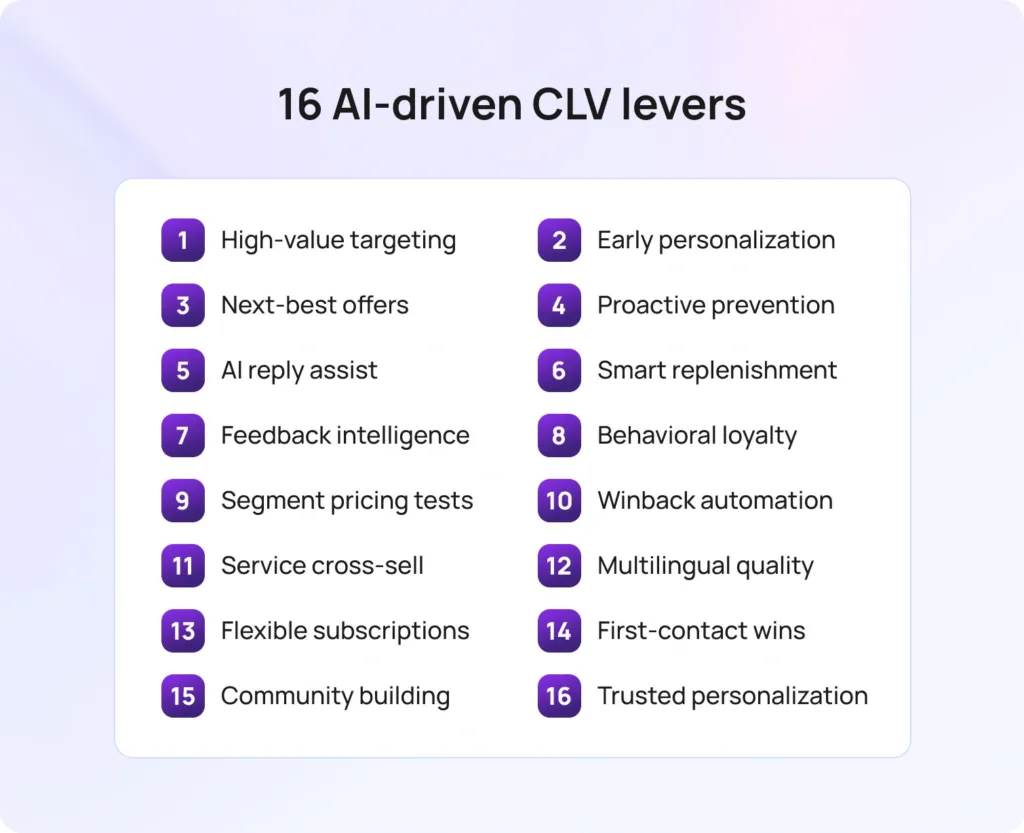
What follows are proven moments to move CLV, each linked to a clear input in the formula and simple enough to pilot this quarter without a big systems overhaul.
Why it matters: Not all customers contribute the same lifetime value; early focus on high-value segments lifts CLV fastest.
AI play: Many programs treat all accounts equally, even though not all customers contribute the same lifetime value. Use predictive models to identify high-value segments based on early behavior, category interest, and service history.
Result: Route proactive customer support and better onboarding for these groups, and tune incentives to reflect expected contribution. This approach quickly increases customer value and reduces wasted marketing efforts.
Why it matters: Early lapses compress average customer lifespan and stall repeat purchases.
AI play: Early lapses compress average customer lifespan. Trigger onboarding nudges keyed to the first product purchased, the customer segment, and observed usage. Point customers to a single next step that proves value, such as a configuration checklist or a short how-to video.
Result: Pair guidance with a light survey to capture valuable feedback. This combination creates happy customers who are far more likely to become repeat buyers.
Why it matters: Generic related items create noise and leave average order value flat.
AI play: Related items are often noise. Use embeddings and purchase sequences to learn natural progressions so recommendations follow customer needs rather than catalog adjacency. If a shopper has just resolved a problem with product A, the system proposes a complementary product to address the next friction point.
Result: When this logic appears in email, on-site, and in service conversations, average order value and repeat purchases increase without harming trust.
Why it matters: Preventing problems extends customer lifespan and protects satisfaction.
AI play: Avoiding a problem is better than resolving one. Predict likely breakpoints from telemetry and service transcripts, then send a short guide or in-product prompt before the issue becomes a contact. For hardware, that can be a simple part-compatibility check. For software, it can be a permissions reminder before a deadline.
Result: Less effort extends customer lifetime and improves customer satisfaction.
Why it matters: Slow responses reduce satisfaction and invite unnecessary repeats.
AI play: Slow responses reduce customer satisfaction and invite repeat contacts. Use AI to assemble grounded first drafts from the knowledge base, conversation history, and current case data. Agents review, adjust tone to match brand identity, and send. The work shifts from writing from scratch to finishing well.
Result: Handle time falls, accuracy improves, and customer relationships strengthen.
BlueHub combines tickets, knowledge, and suggested replies in a single workspace, so support teams move faster without losing control.
Why it matters: Right-time outreach raises purchase frequency without harming trust.
AI play: The right message at the wrong time still fails. Predict depletion windows, usage patterns, and delivery lead times. Send reminders and one-click carts when the probability of need is high, and stay quiet when confidence is low.
Result: This respects customers while lifting purchase frequency and average customer lifetime value, especially in e-commerce business models.
Why it matters: Acting on feedback removes the root causes of churn and low value.
AI play: Collecting customer satisfaction feedback is not the goal; acting on it is. Classify reviews, chats, and calls into themes such as packaging issues, unclear sizing, or billing confusion, then rank them by churn risk and revenue at stake.
Result: Publish a simple you-said we-did note so customers see the loop closing. Fixes tied to clear themes have the fastest impact on customer lifetime outcomes.
Why it matters: Rewards must reinforce actions that extend relationships, not just spending.
AI play: Points that don’t matter don’t build customer loyalty. Build loyalty programs that recognize milestones, referrals, helpful community participation, and problem-free cycles. Calibrate rewards by margin and predicted lifetime value to keep incentives sustainable.
Result: The best programs deliver personalized experiences that make customers feel seen, increasing customer and brand loyalty.
Why it matters: Segment-level price and bundle tests move both AOV and frequency.
AI play: Price and packaging influence both average order value and purchase frequency. Run controlled experiments on bundles and commitment discounts at the customer segment level. Keep tests small, time-bound, and easy to reverse.
Result: Use uplift on contribution and retention, not only top-line sales, to judge success. Over time, these adjustments maximize customer lifetime without eroding trust.
Why it matters: Re-engaging existing customers is often cheaper and faster than acquiring new customers.
AI play: Lapsed existing customers often return with the right prompt. Predict lapse likelihood, choose the lightest-touch offer, and guide re-onboarding. If dissatisfaction drove the lapse, lead with the fix rather than a discount. Coordinate email, SMS, and in-app prompts so the sequence is coherent.
Result: Winbacks directly improve customer lifetime value because reacquired customers typically resume a known pattern of spend.
Why it matters: Post-resolution trust creates a window for helpful, welcomed offers.
AI play: When a service issue ends well, trust is highest. During that moment, propose a single complement that adds clear value. If the issue was shipping, the offer might be a faster shipping method at a loyalty rate on the next order. If the ticket was about setup, the offer could be an accessory that shortens future steps. The tone should be helpful rather than promotional.
Result: This cross-selling style increases average order value without reducing satisfaction.
Why it matters: Language gaps create avoidable churn and shorten customer lifespan.
AI play: Language mismatches create avoidable churn. Use real-time translation with an approved glossary to keep meaning intact across channels. Keep sensitive flows with a human by default.
Result: Consistent quality across languages opens new regions, retains customers who would otherwise leave, and improves CLV globally.
Why it matters: Convenient commitment increases frequency and predictability.
AI play: Commitment beats intention. Offer optional subscriptions with smart cadence and a clear pause or skip option. Add replenishment reminders that match observed usage rather than fixed calendars.
Result: Customers who feel in control stay longer, which raises average customer lifespan and predictable revenue.
Why it matters: Effort is a quiet churn driver that erodes loyalty and repeat business.
AI play: Effort is a quiet driver of churn. Use intent routing, pre-filled forms, and verified steps so agents resolve common issues on the first contact. Pair that with an always-current knowledge base and suggested replies.
Result: The combination reduces reopen rates and keeps customers engaged. BlueHub’s Agent Copilot and customer service analytics help teams see where first-contact resolution slips and how to recover.
Why it matters: Belonging turns satisfied customers into advocates who stay and spend.
AI play: Transactions do not create belonging. Identify engaged customers and invite them to previews, helpful groups, and early access. Recognize contributions that help others succeed.
Result: This creates a sense of community that translates into repeat business, stronger customer relationships, and longer customer lifespan.
Why it matters: Transparency keeps personalization effective and sustainable.
AI play: Personalization in customer experience works when customers understand how it operates. Explain plainly how customer data is used, provide clear choices, and respect preferences. Limit access to sensitive data through role-based access controls and approvals.
Result: When people feel safe and respected, they are more open to the tailored guidance that increases customer lifetime value.
Start simple. Take the average order value, multiply it by the purchase frequency for the period, multiply it by the average customer lifespan, then subtract the customer acquisition cost. That gives you a working CLV estimate you can explain in one sentence.
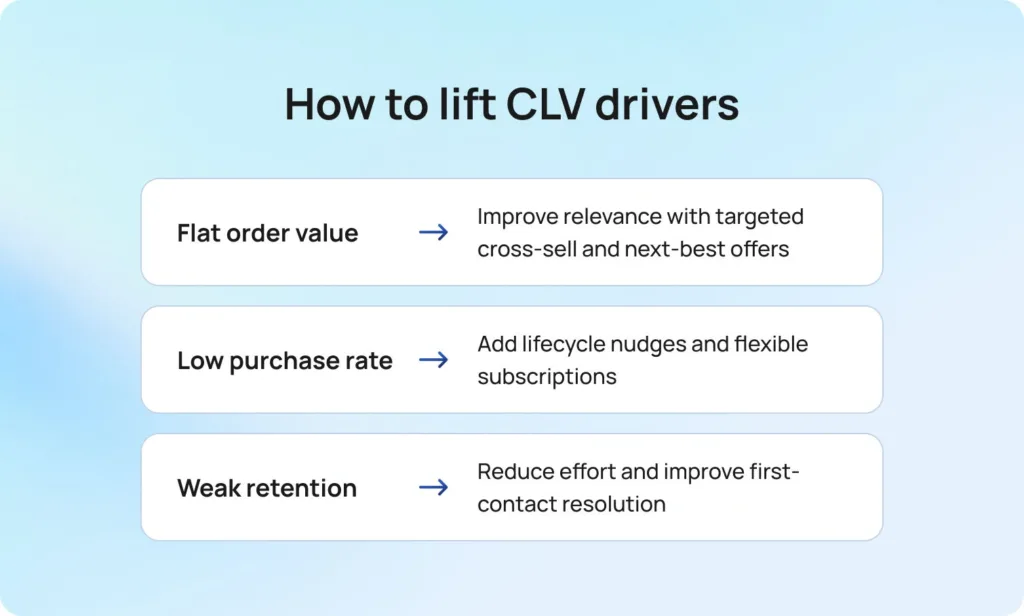
Make it practical by analyzing cohorts rather than relying on a company-wide average. Run the same calculation for a few key segments, such as the first product purchased, acquisition channel, and region. You’ll see where CLV is strongest, where it’s weak, and where an improvement will pay back fastest.
Let the numbers point to the next move.
Keep the math light and the actions specific. The goal isn’t a perfect model; it’s a clear read on which lever to pull, so measuring customer lifetime leads to obvious next steps.
You’re proving lift, not filling a dashboard. The story should be clear at a glance.
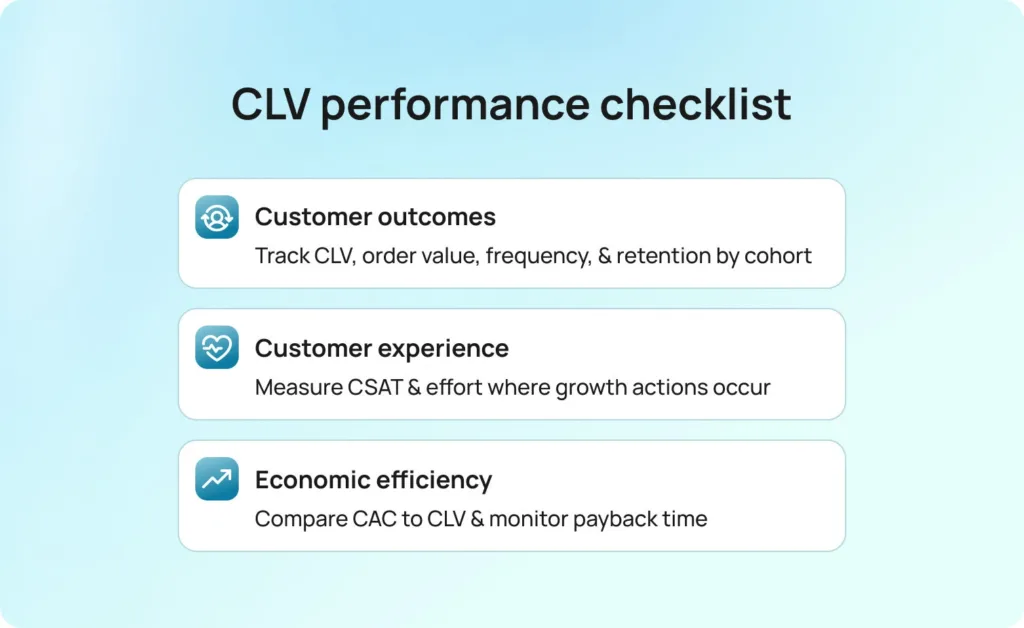
Start with outcomes, but let them speak in context. Average customer lifetime value by cohort shows whether the contribution is rising where effort is focused. Purchase frequency indicates whether lifecycle nudges affect how often people buy. Average order value indicates whether recommendations and conversational cross-selling are relevant rather than loud. Alongside these, average customer lifespan and retention confirm that gains come from customers staying longer, not from one-off spikes.
Experience belongs on the same page. Customer satisfaction and effort should remain steady or improve as CLV rises. A dip in CSAT or a rise in effort suggests extraction, not loyalty, and calls for adjusting the plays rather than the targets.
Efficiency connects the dots to the budget. Customer acquisition cost should trend down relative to CLV as spend shifts toward segments with proven payback. Blended payback time indicates when the acquisition becomes profitable, and whether those gains persist across cohorts.
Evidence beats anecdotes, so measure with cohorts and simple controls. One group receives lifecycle nudges; the matched group does not. The comparison controls for the first product and region. In service, first-contact resolution and reopen rates before and after suggested replies go live show whether quality and speed improved. Results published on a predictable cadence keep teams aligned and help retire work that isn’t moving the numbers.
A compact checklist keeps everyone looking at the same frame:
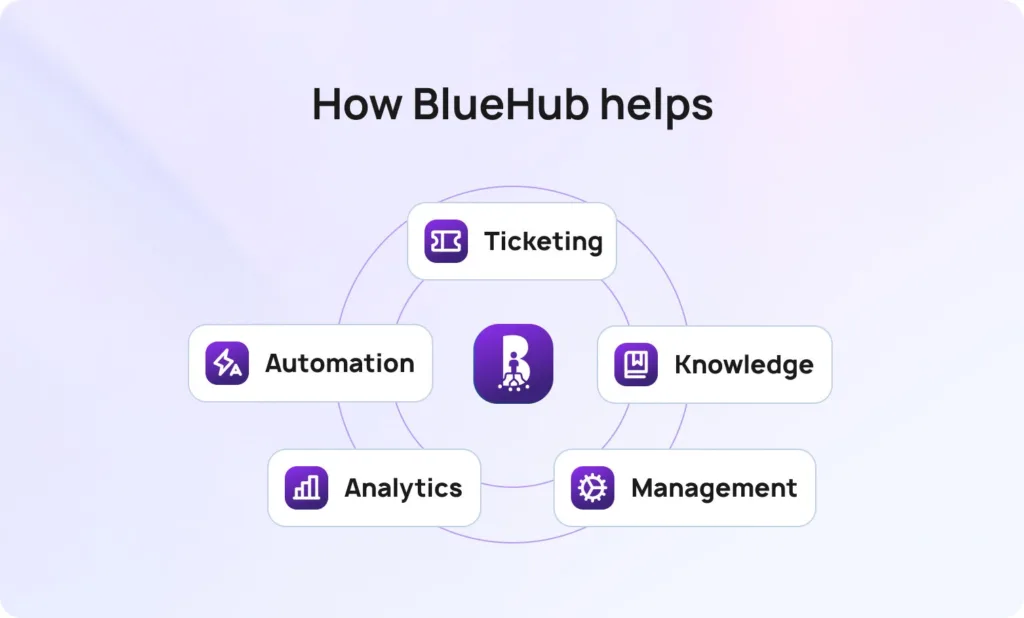
BlueHub by BlueTweak turns CLV strategy into everyday execution by keeping work and data in one place.
Leaders get the metrics that matter, grouped by customer segment:
The next phase of CLV improvement integrates AI planning and execution within the same workspace. Three shifts are coming.
Teams that prepare for these shifts will maximize customer lifetime and grow with confidence.
Improving CLV is not a campaign; it is a way of running the business. Use AI to identify high-value segments, guide the first month, recommend next steps, and keep effort low when customers need help. As average order value, purchase frequency, and average customer lifespan rise together, reliance on paid acquisition falls, and predictable revenue grows.
BlueHub provides teams with a shared workspace for this work every day. It unifies customer data, accelerates service, personalizes journeys, and demonstrates impact with metrics leaders trust. If the goal is to improve CLV without guesswork, the path is to consolidate decisions and execution in one place and measure progress with clarity. Book a BlueHub demo and learn how it can help you map your CLV targets to live journeys, replies, and dashboards that make lifetime value measurable and repeatable.
Customer lifetime value is the total contribution a single customer makes over their lifetime, excluding acquisition costs. It aligns teams around behaviors that create brand loyalty, stronger customer relationships, and real revenue growth. BlueHub helps calculate customer lifetime at the segment level and connects those numbers directly to the conversations and workflows that moved them.
Use the practical version. Multiply average order value by purchase frequency and average customer lifespan, then subtract customer acquisition cost. Validate with cohorts to see differences across regions and categories. Keep measuring customer lifetime simply so actions remain obvious.
Personalized recommendations to lift average order, lifecycle nudges to drive repeat purchases, proactive service to retain customers, and multilingual support to serve more regions. BlueHub makes these moves operational by combining profiles, knowledge, and orchestration in one place, including customer support.
Loyalty programs work when rewards align with behaviors that extend the relationship and increase customer lifetime value, such as referrals, usage milestones, and problem-free cycles. Programs that focus solely on raw spend often miss the actions that truly increase customer lifetime value.
As Head of Digital Transformation, Radu looks over multiple departments across the company, providing visibility over what happens in product, and what are the needs of customers. With more than 8 years in the Technology era, and part of BlueTweak since the beginning, Radu shifted from a developer (addressing end-customer needs) to a more business oriented role, to have an influence and touch base with people who use the actual technology.