



TL;DR
Customer service ethics means treating customers fairly, communicating honestly, and making decisions based on ethical principles rather than convenience. Ethical customer service builds trust, strengthens customer loyalty, and helps businesses create consistent, accountable customer experiences. This guide explores the key ethical principles in customer service, common ethical issues, and practical ways managers can turn customer service values into clear standards and everyday practices.
Customers notice when a support interaction feels designed to protect the business rather than help them. An unnecessary upsell, an evasive answer, inconsistent treatment, or a poorly handled complaint can quickly undermine trust, even when the interaction technically follows company policy.
That's because customer service is a direct reflection of a company's actions and values. Customers may judge an entire business based on a single interaction, particularly when something has gone wrong. When support teams make customers feel valued, listened to, and treated fairly, those interactions can help create happy customers and stronger long-term relationships. When they don't, even one poor experience can damage trust.
The challenge for managers is turning good intentions into consistent ethical behavior across every customer service interaction. Support teams need more than instructions to do the right thing or meet the bare minimum. They need clear guidelines, reliable information, appropriate oversight, and the freedom to use judgment when customer service situations fall outside the usual script.
This also makes customer service ethics part of a company's wider social responsibility. Businesses have a responsibility to consider how their actions affect the people they serve, particularly when customers come from different backgrounds and have different values and expectations.
That is where the right processes and technology can help. BlueTweak gives support teams the ability, and tools, for centralizing approved knowledge, monitoring service quality, and maintaining human oversight, helping managers put ethical customer service principles into practice at scale.
What Is Customer Service Ethics?
Customer service ethics refers to the moral principles and standards that guide how businesses treat customers and make decisions during customer interactions. It means doing what is right for the customer, even when taking the easier or more profitable option would be more convenient.
Customer service ethics mean treating clients fairly, being honest about what you can deliver, and making decisions based on principles rather than convenience. Ethical behavior in customer service builds customer trust, increases loyalty, and protects your company's reputation.
These principles influence everything from how a support team handles customer data to how honestly it communicates about product limitations, pricing, refunds, and response times. They also shape how businesses respond when policies conflict with a customer's individual circumstances.
In practice, ethical customer service means:
- Being honest when a product or solution can’t meet a customer's needs
- Admitting mistakes instead of deflecting blame
- Applying policies fairly while allowing room for appropriate judgment
- Respecting customers' time, privacy, and individual circumstances
- Giving customers clear information so they can make informed decisions
- Taking responsibility when something goes wrong
These aren't simply abstract moral principles. They are customer service standards that influence whether people feel respected and valued, whether they trust a business, and whether they choose to remain loyal over the long term.
Why Customer Service Ethics Matter
Ethical customer service isn’t just about avoiding complaints or meeting a compliance policy. It shapes how customers perceive a business every time they interact with it, from a simple support question to a complex complaint or refund request.
When customers feel that a business is honest, fair, and respectful, they are more likely to trust it and remain loyal. When they feel manipulated, ignored, or treated inconsistently, that trust can disappear quickly. For support managers, customer service ethics therefore have a direct connection to both customer experience and long-term business success.
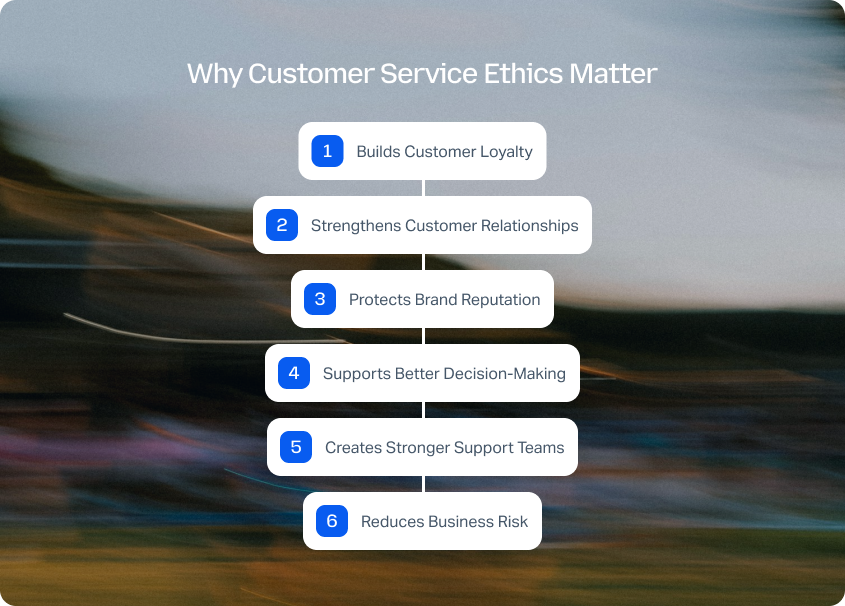
The benefits extend beyond individual customer interactions:
- Builds customer loyalty: Customers are more likely to remain loyal to businesses that consistently treat them fairly and keep their promises.
- Strengthens customer relationships: Ethical behavior helps create long-term customer relationships based on trust rather than short-term transactions.
- Protects brand reputation: Every customer interaction can influence how people perceive a company. Consistent ethical standards help protect that reputation.
- Supports better decision-making: Clear ethical principles give agents a framework for handling situations where a script or policy doesn’t provide an obvious answer.
- Creates stronger support teams: Agents are more likely to feel confident and engaged when they have clear guidelines and aren’t pressured to compromise their personal or professional values.
- Reduces business risk: Ethical practices can support compliance with legal and regulatory requirements while helping businesses identify potentially harmful practices before they become larger problems.
Ultimately, customer service ethics give businesses a way to balance commercial goals with their responsibility to treat customers as human beings. That balance matters because a single interaction may influence whether someone buys again, recommends the company, or takes their business elsewhere.
6 Ethical Principles in Customer Service
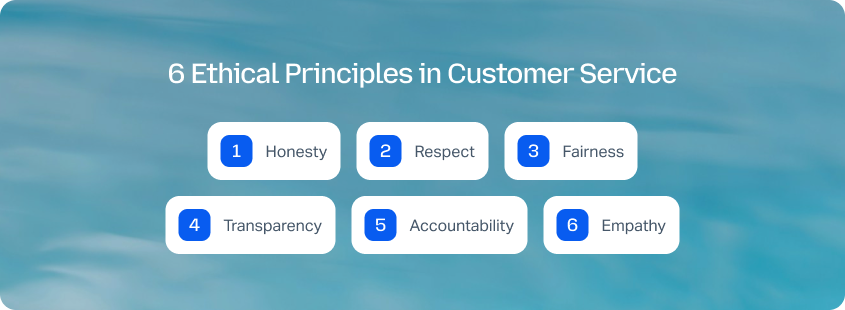
Strong customer service ethics start with a clear set of principles that guide everyday decisions. While individual companies may have different customer service values, the following six principles provide a practical foundation for ethical customer interactions.
1. Honesty
Honesty means giving customers accurate information about products, policies, costs, limitations, and what the support team can realistically deliver.
Agents shouldn’t make promises simply to close a ticket, calm an unhappy customer, or meet a response or resolution target. If something went wrong, acknowledging it honestly is usually more valuable than trying to deflect responsibility.
2. Respect
Respect means treating every customer as a person whose time, circumstances, and concerns matter.
This applies regardless of account value, purchasing history, communication style, or how frustrated someone may be. It also means recognising that customers come from diverse backgrounds and may have different cultures, experiences, and values.
Respect should extend to employees, too. Ethical customer service doesn’t require support agents to accept threats, discrimination, or sustained verbal abuse from customers.
3. Fairness
Fairness means applying customer service standards consistently while recognising that not every situation can be treated identically.
A customer who has missed a return deadline by one day because of exceptional circumstances may reasonably require a different response from someone repeatedly attempting to exploit a policy. Ethical decision-making gives agents clear boundaries while allowing appropriate exceptions or escalation when circumstances warrant them.
4. Transparency
Transparency means giving customers the information they need to make informed decisions.
This includes being clear about pricing, policies, limitations, timelines, automation, and how customer data is used. Businesses should avoid deliberately confusing language or hiding important information behind complicated processes.
Transparency also applies to sales interactions. If an upgrade is genuinely useful, explain why. If it won’t solve the customer's problem, recommending it simply because it increases revenue isn’t ethical customer service.
5. Accountability
Accountability means taking responsibility for mistakes and their consequences.
Whether an error comes from an individual agent, a support process, or the wider business, customers shouldn’t be passed between teams simply to avoid ownership. An accountable support team acknowledges problems, explains what happened where appropriate, and takes action to put things right.
This principle also matters when technology is involved. If an automated system provides incorrect information or routes a customer incorrectly, there should be a clear process for human review and correction.
6. Empathy
Empathy means recognising that every customer interaction involves a human being with a problem that matters to them.
An empathetic response doesn’t necessarily mean agreeing with the customer or giving them everything they ask for. It means understanding their perspective and communicating in a way that shows their situation has been heard and taken seriously.
Empathetic language can be particularly important when customers are frustrated, confused, or dealing with a problem that has a significant impact on them. Combined with honesty, fairness, and respect, empathy helps turn ethical principles into customer care that feels genuine rather than scripted.
Together, these principles provide the moral code behind ethical customer service. The next challenge is applying them when real-world customer service situations create competing priorities.
Common Ethical Issues in Customer Service
Ethical principles are easiest to understand in theory. In practice, support teams regularly encounter situations where the right course of action is less obvious. A company policy may conflict with a customer's circumstances, sales targets may compete with customer needs, or an agent may need to decide how much information to share.
These ethical issues in customer service require more than a script. Teams need clear guidelines, appropriate escalation processes, and enough judgment to apply customer service values to individual situations.
When Company Policy Conflicts With Customer Needs
One of the most common ethical issues arises when following a policy to the letter would produce an obviously unfair outcome.
For example, a customer may miss a return deadline by a single day because of exceptional circumstances, or a technical problem may fall just outside the formal scope of a support agreement. A rigid approach may protect the process while creating a poor customer experience.
The solution isn’t to abandon policies. Instead, managers should define when agents can escalate unusual cases, make reasonable exceptions, or use their own judgment. Clear boundaries allow agents to act fairly without creating inconsistent treatment between customers.
Balancing Sales Pressure With Customer Needs
Support interactions should solve the customer's problem, not turn every conversation into a sales opportunity.
Upselling can be appropriate when a product or upgrade genuinely addresses the customer's needs. It becomes an ethical concern when agents are encouraged to recommend something the customer doesn’t need, can’t reasonably afford, or didn’t ask about while an existing problem remains unresolved.
Ethical sales practices should therefore be:
- Relevant to the customer's situation
- Presented as an option rather than a requirement
- Transparent about costs and benefits
- Secondary to resolving the original support issue
When commercial targets encourage agents to prioritise revenue over customer care, businesses risk damaging both trust and long-term customer loyalty.
Protecting Customer Data and Privacy
Support teams often have access to personal information, purchase histories, account details, and previous customer interactions. Ethical behavior means treating that information with care and using it only for legitimate business purposes.
Teams should have clear guidelines covering who can access customer information, how data should be handled, and what information can be shared. They should also understand relevant data protection requirements and be able to explain, in appropriate terms, why particular information is needed.
Data privacy isn’t simply a technical or legal issue. It is a matter of trust between a business and its customers.
Handling Abusive Customer Interactions
Ethical customer service applies to employees as well as customers.
Support agents should be expected to communicate respectfully, but that doesn’t mean they should tolerate threats, slurs, discrimination, or sustained verbal abuse. Managers can establish clear guidelines for when an agent should warn a customer, escalate an interaction, or end a conversation.
Protecting agents from unacceptable behavior supports a healthier support environment while reinforcing the same principle of dignity that businesses expect their teams to extend to customers.
Managing Ethical Decisions in AI-Powered Support
AI introduces another layer of ethical considerations in customer service. Automated systems can influence which customers are prioritised, what information they receive, how their data is processed, and whether they reach a human agent.
Businesses should consider:
- Transparency: Customers should understand when they are interacting with an automated system where that distinction matters.
- Fairness: AI-driven routing and prioritisation shouldn’t unfairly disadvantage customers based on characteristics unrelated to the service they need.
- Data privacy: Businesses should understand what customer data AI systems use and how it is handled.
- Accountability: There should be a clear human owner when automated systems provide incorrect information or make poor decisions.
- Human oversight: Customers should have a path to human support when automation can’t appropriately resolve their situation.
These safeguards help ensure that technology supports ethical customer service rather than making decisions that are difficult for customers or agents to understand or challenge.
How to Put Ethical Customer Service Principles Into Practice
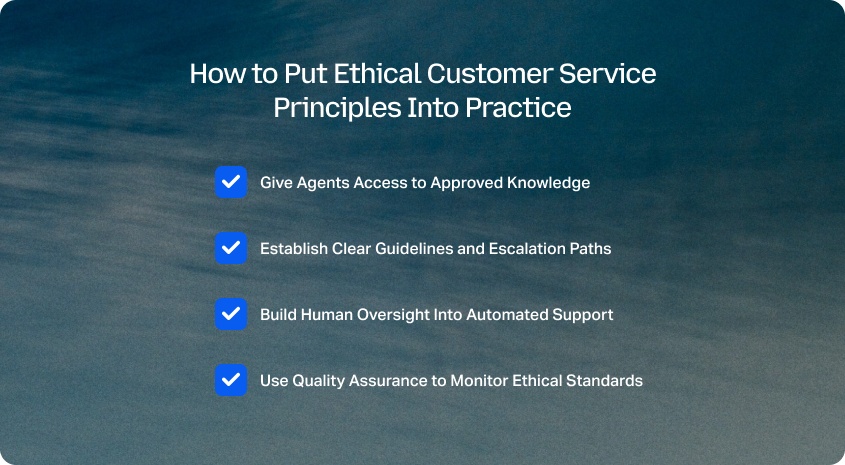
Knowing which ethical principles matter is only the starting point. The bigger challenge is making sure those principles consistently shape customer service interactions, even when teams are busy, policies are unclear, or customers present unusual situations.
Managers can support ethical decision-making by building the right processes around their support teams. Clear guidelines, reliable information, human oversight, and regular quality checks make it easier for agents to do the right thing without having to rely entirely on personal beliefs or judgment.
Give Agents Access to Approved Knowledge
Agents can’t provide consistently honest and transparent answers if they are working from outdated, conflicting, or incomplete information.
A centralized customer service knowledge base can give support teams access to approved information about products, policies, pricing, processes, and common customer questions. This creates a consistent source of truth while reducing the risk that different agents give customers contradictory answers.
For managers, this is also an important part of accountability. When policies or product information change, updating a central source helps ensure those changes are reflected across customer interactions rather than relying on every agent to find and interpret the information themselves.
Establish Clear Guidelines and Escalation Paths
Ethical customer service doesn’t mean expecting agents to make every difficult decision independently. They need to understand which decisions they can make themselves and when a situation should be escalated.
For example, a customer service code of ethics might define when agents can make an exception, offer a refund, share certain information, or involve a manager. Clear escalation paths give agents room to exercise judgment while maintaining consistent customer service standards.
Build Human Oversight Into Automated Support
Automation can improve efficiency, but ethical customer service still requires people to remain accountable for important decisions.
Human oversight gives teams a way to review situations where an automated response is inaccurate, a customer needs additional context, or a decision could have a significant impact on the customer. It also gives customers a route to human support when automation can’t appropriately resolve their situation.
This is particularly important as businesses use AI across more customer service interactions. The goal shouldn’t be to remove human judgment entirely, but to use technology in a way that supports better and more consistent decision-making.
Use Quality Assurance to Monitor Ethical Standards
Quality assurance can help managers identify whether customer service values are actually reflected in day-to-day interactions.
Rather than focusing exclusively on metrics such as response times or ticket volumes, QA processes can assess whether agents:
- Provide accurate and transparent information
- Follow appropriate data-handling practices
- Treat customers respectfully
- Use empathetic language when appropriate
- Apply policies fairly
- Take ownership of customer problems
- Escalate situations when necessary
This creates a feedback loop between the company's ethical standards and what happens in real customer interactions. Managers can use those insights to identify training needs, improve processes, and recognize examples of strong ethical decision-making.
How to Create a Customer Service Code of Ethics
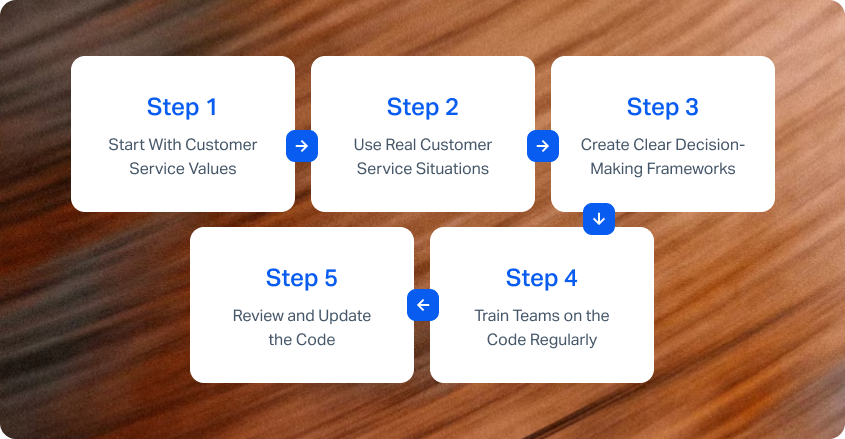
A customer service code of ethics turns broad values such as honesty, fairness, and respect into practical guidance for the people representing your business.
It shouldn’t be a document that exists only to satisfy a compliance requirement. A useful code of ethics helps agents make decisions when the correct response isn’t immediately obvious and gives managers a shared framework for discussing difficult customer service situations.
Start With Your Customer Service Values
Begin by identifying the values that should guide every customer interaction. These might include:
- Honesty
- Fairness
- Respect
- Transparency
- Accountability
- Empathy
The important thing is to define what each value means in practice. "We value honesty" is difficult for an agent to apply without further guidance. "Give customers accurate information, acknowledge mistakes, and never promise an outcome you can’t deliver" provides a much clearer standard.
Use Real Customer Service Situations
Build your code around the ethical issues your support team actually encounters.
Consider questions such as:
- What should an agent do when a customer asks them to bend a rule?
- When is it appropriate to make an exception?
- How should agents respond when company policy creates an unfair outcome?
- When should a customer be transferred to a manager?
- How should agents handle requests for sensitive customer data?
- What should happen when a customer is abusive?
- How should agents respond when they discover that incorrect information was given?
Real examples make a customer service code of ethics much easier to understand and apply than abstract statements about moral principles.
Create Clear Decision-Making Frameworks
Agents won’t always have a policy that tells them exactly what to do. Give them a simple framework for situations where ethical considerations compete.
For example, they can ask:
- Is this fair to the customer?
- Am I being honest and transparent?
- Would I be comfortable explaining this decision publicly?
- Does this align with our stated customer service values?
- Could this decision damage the customer's trust in the long term?
- Should I escalate this situation rather than decide alone?
The aim isn’t to turn every support interaction into a philosophical debate. A practical framework simply gives agents common ground for making consistent decisions when the answer isn’t straightforward.
Train Teams on the Code Regularly
A code of ethics only works when support teams understand how to use it.
Include ethical customer service in onboarding and regular training, and use role-playing to explore realistic scenarios. Managers can also review examples from actual customer interactions, particularly when an agent faced a difficult decision or when an interaction highlighted a gap in existing guidelines.
Regular training helps turn ethical standards from something written in a document into part of the team's everyday decision-making.
Review and Update the Code
Customer service ethics aren’t static. New products, technologies, regulations, customer expectations, and support channels can create new ethical questions.
Review your code of ethics regularly and update it when the team encounters situations that existing guidance doesn’t adequately address. If agents repeatedly face the same ethical dilemma, that is a signal that the business may need a clearer process or policy.
A strong code should therefore evolve alongside the business rather than becoming a document that quickly falls out of date.
Building a Culture of Ethical Customer Service
A customer service code of ethics provides a framework, but culture determines whether that framework is actually followed.
If leadership tells agents to prioritise customers but rewards them solely for speed, sales, or ticket volume, employees may receive conflicting signals about what the business really values. Ethical behavior becomes much harder to maintain when the systems surrounding the support team reward the opposite.
Managers can reinforce ethical customer service by:
- Modelling ethical behavior: Leaders should demonstrate honesty, fairness, accountability, and respect in their own decisions.
- Aligning metrics with customer care: Performance targets shouldn’t encourage agents to rush complex cases, avoid difficult customers, or prioritise sales over solving problems.
- Recognising good judgment: Agents who handle difficult ethical situations well should receive recognition, not simply those who close the most tickets.
- Encouraging escalation: Employees should feel comfortable asking for help when a situation falls outside existing guidelines.
- Creating psychological safety: Agents should be able to raise concerns about unethical practices without fear of unfair consequences.
- Learning from mistakes: When something goes wrong, focus on understanding what happened and improving the process rather than simply assigning blame.
This is particularly important when support teams work with customers from different cultures and backgrounds. What feels clear or respectful to one person may not feel the same to another. Training should encourage agents to recognise assumptions, ask clarifying questions, use empathetic language, and adapt their communication while maintaining the company's core ethical standards.
When ethics are built into training, processes, quality assurance, and leadership expectations, they become part of how the support team operates rather than a set of ideals that only appear in a policy document.
Customer Service Ethics Best Practices
Building ethical customer service into your team requires more than having a code of ethics. Managers also need practical processes that help agents apply those principles consistently across different customer service situations.
The following best practices can help turn ethical standards into everyday customer care.
Put the Customer's Needs at the Center
The customer's immediate request shouldn’t always determine the right outcome, but it should be the starting point for understanding the situation.
Encourage agents to look beyond the individual ticket and consider what the customer is actually trying to achieve. This can help them recommend the most appropriate solution rather than simply following the quickest process or pursuing a sales opportunity.
Putting customer needs first also means being willing to explain when the requested solution isn’t appropriate and offering a better alternative where possible.
Communicate Clearly and Honestly
Clear communication is one of the simplest ways to demonstrate ethical behavior.
Agents should avoid vague promises, deliberately confusing language, or unnecessary jargon. If a resolution will take longer than expected, customers should be told rather than left to guess what is happening. If the business can’t provide the requested solution, the agent should explain why and outline what alternatives are available.
Honest communication may not always produce the answer a customer wants, but it helps maintain trust.
Treat Customers Consistently and Fairly
Fairness requires more than applying exactly the same response to every customer. It means having clear customer service standards while recognising when individual circumstances justify a different approach.
Document common exceptions and escalation paths so agents understand when they can use their judgment. This creates greater consistency without forcing every customer into an inflexible process.
Protect Customer and Employee Dignity
Ethical customer service should create respectful interactions in both directions.
Customers should be treated with patience and empathy, while support agents should have clear protections against threats, discrimination, and abuse. Establishing boundaries for unacceptable behavior allows teams to provide respectful customer care without expecting employees to tolerate harmful interactions.
Make Accountability Part of the Process
When something goes wrong, focus on correcting the problem rather than finding a way to avoid responsibility.
Give agents clear ownership of customer issues and make it easy to involve the right person when they can’t resolve something themselves. Managers should also review recurring mistakes to determine whether the underlying issue is a training gap, unclear guidance, outdated information, or a process that needs to change.
Review Customer Interactions Regularly
Ethical standards are easier to maintain when managers can see how they are being applied in practice.
Regular quality reviews can identify patterns such as inconsistent policy enforcement, unclear communication, missed escalations, or inappropriate handling of customer information. These reviews can then inform coaching and training rather than being used solely as a way to score individual agents.
This creates a continuous improvement process: establish ethical standards, observe how they are applied, identify gaps, and improve the processes supporting the team.
How to Maintain Ethical Standards as Customer Service Scales
Ethical customer service can become harder to maintain as a business grows. More agents, channels, markets, products, and customer interactions create more opportunities for inconsistent decisions.
What works when a manager can personally oversee a small support team may not work when dozens or hundreds of agents are handling customer interactions across different channels and time zones.
Standardize What Should Be Consistent
Some aspects of customer service should have clear, standardised rules.
These might include data-handling requirements, refund policies, escalation criteria, approved product information, and communication standards. Centralising this information gives agents a reliable reference point and reduces the risk of different teams developing their own interpretations.
A customer service knowledge base can support this by providing an approved source for the information agents need during customer interactions.
Leave Room for Human Judgment
Standardisation shouldn’t mean removing judgment from customer service.
Not every customer situation can be anticipated in a policy. Agents need enough flexibility to recognise when a strict application of a rule would create an unfair outcome and understand when to escalate the situation.
The goal is to create clear boundaries, not rigid scripts. Agents should know what they can decide themselves, what requires approval, and what principles should guide their decision.
Monitor Quality Across Channels
As support expands across email, chat, voice, and other channels, managers need visibility into whether ethical standards are being applied consistently.
Quality assurance can help identify differences in how teams communicate, handle sensitive information, apply policies, or resolve customer complaints. It can also highlight strong examples that can be used for coaching and training.
This makes quality assurance part of ethical governance rather than simply a performance measurement exercise.
Keep Training Current
Training should evolve as the business, customer expectations, and support environment change.
Use real customer service situations to refresh teams on ethical decision-making, particularly when new products, policies, markets, or technologies are introduced. Managers should also use recurring issues identified through quality reviews to determine where additional guidance is needed.
Regular training reinforces the idea that customer service ethics are an ongoing responsibility rather than something employees learn once during onboarding.
Create Accountability at the Management Level
Ethical standards need clear ownership.
Managers should know who is responsible for maintaining the customer service code of ethics, updating approved information, reviewing quality issues, and addressing recurring ethical concerns. Leadership should also regularly review whether business targets and incentives support the customer service values the company claims to prioritise.
If the systems surrounding a support team reward behavior that conflicts with ethical standards, even the strongest code of ethics will struggle to make a difference.
The Role of AI in Ethical Customer Service

AI can help support teams respond faster, surface relevant information, and manage large volumes of customer interactions. But using AI responsibly also introduces new questions about transparency, fairness, data, and accountability.
The key is to treat AI as part of the customer service process rather than as a replacement for ethical decision-making.
Use Approved Knowledge to Ground AI Responses
AI-generated answers are only as reliable as the information they draw from. Giving AI access to approved, up-to-date customer service knowledge can help reduce the risk of inconsistent or unsupported answers.
This is particularly important for information such as pricing, policies, product capabilities, and compliance requirements, where an inaccurate answer can directly affect a customer's decision or experience.
Keep Humans Accountable
Automation shouldn’t remove human responsibility. Support teams should have processes for reviewing AI-generated responses, correcting mistakes, and taking over when an interaction requires judgment or empathy. Customers should also have a clear path to human support when an automated system can’t appropriately address their needs.
Human oversight is especially important when a decision could materially affect a customer or when the system encounters a situation outside its expected use.
Be Transparent About Automation
Customers shouldn’t be deliberately misled about whether they are interacting with an AI system. Where disclosure is appropriate, businesses should make the role of automation clear and explain how customers can access human assistance. Transparency helps customers understand what to expect and gives them greater control over the interaction.
Monitor AI for Fairness and Accuracy
AI systems should be reviewed regularly rather than assumed to behave ethically simply because they are automated.
Managers should monitor whether automated routing, prioritisation, or responses produce inconsistent outcomes for different groups of customers. Quality assurance can also help identify inaccurate or inappropriate AI-generated interactions that require correction.
Establish Clear Governance
Ethical AI requires clear ownership, so, define who can approve AI use cases, what information systems can access, when human review is required, and what happens when the technology produces an incorrect or harmful outcome. Document these rules alongside existing customer service policies and ethical standards.
Used responsibly, AI can support more consistent customer service without removing the human judgment that ethical customer care depends on. The objective isn’t simply to automate more interactions, but to ensure that automation remains aligned with the company's commitment to honesty, fairness, transparency, accountability, and respect.
How to Measure and Improve Ethical Customer Service
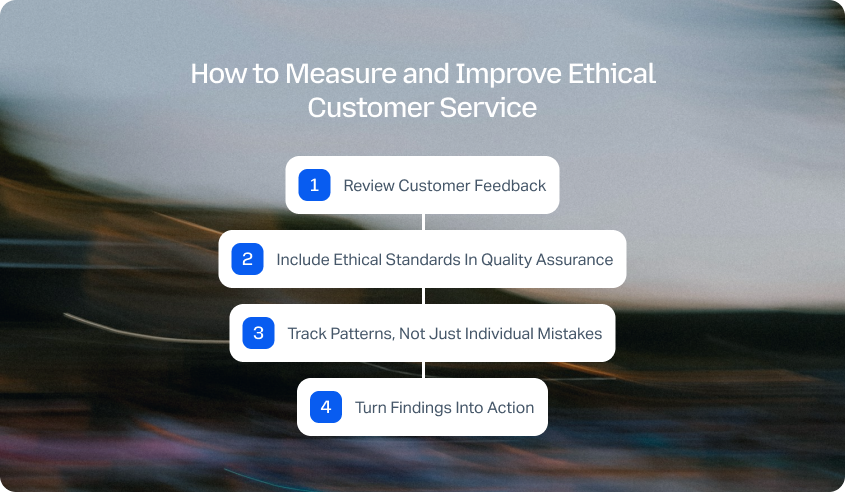
Ethical customer service can be difficult to measure because qualities such as fairness, honesty, and empathy aren’t captured by a single customer service metric. However, managers can use a combination of customer feedback, quality assurance, and customer service analytics to identify whether ethical standards are being applied consistently.
The goal isn’t to reduce ethics to a score. Instead, measurement should help managers spot patterns, identify potential problems, and understand where teams need better guidance or support.
Review Customer Feedback
Customer feedback can reveal when an interaction has failed to meet your ethical standards.
Look beyond overall satisfaction scores and pay attention to recurring comments about:
- Customers receiving conflicting information
- Policies being applied inconsistently
- Difficulty accessing human support
- Unexpected costs or unclear communication
- Customers feeling ignored or dismissed
- Concerns about how personal information was handled
These patterns can highlight gaps in processes that mightn’t be visible through traditional performance metrics.
Include Ethical Standards in Quality Assurance
Quality assurance should assess more than whether an agent followed the correct process or resolved a ticket quickly.
Include relevant ethical standards in interaction reviews, such as accuracy, transparency, respectful communication, appropriate data handling, empathy, and accountability. This gives managers a clearer picture of how customer service values are being reflected in real interactions.
It can also help identify when a performance target is creating unintended behavior. For example, if agents consistently provide rushed answers to meet response-time targets, the issue may be the way performance is being measured rather than the individual agent.
Track Patterns, Not Just Individual Mistakes
One poor customer interaction doesn’t necessarily indicate an ethical problem. Repeated patterns are more useful for identifying where action is needed.
If multiple agents are giving customers incorrect information, for example, the underlying problem could be outdated knowledge rather than a lack of honesty. If agents are repeatedly refusing reasonable exceptions, managers may need to clarify escalation guidelines rather than simply coach individual employees.
Looking at patterns helps businesses address the cause of an issue instead of treating every ethical concern as an isolated employee problem.
Turn Findings Into Action
Measurement only has value when it leads to improvement. Use findings from customer feedback, quality assurance, and support data to update training, improve processes, clarify policies, or revise the customer service code of ethics. When new ethical issues emerge, add relevant examples and guidance so agents are better prepared the next time a similar situation occurs.
This creates a continuous cycle of improvement: set clear ethical standards, monitor customer interactions, identify gaps, and improve the processes that support ethical decision-making.
What Does Good Customer Service Ethics Look Like?
Good customer service ethics means treating customers fairly, communicating honestly, respecting their circumstances, and taking responsibility when things go wrong. But ethical customer service isn’t just about individual decisions. Businesses need clear customer service values, practical guidelines, appropriate oversight, and processes that help support teams apply those principles consistently.
A strong customer service code of ethics gives agents a framework for making difficult decisions, while approved knowledge, quality assurance, regular training, and human oversight help turn that framework into everyday practice.
For managers, the goal isn’t to eliminate every difficult customer service situation. It’s to give teams the principles, information, and support they need to handle those situations with integrity.
When ethical behavior becomes part of the way a support team operates, it can strengthen customer trust, encourage customer loyalty, protect the company's reputation, and create better long-term customer relationships.
BlueTweak helps businesses support more consistent customer interactions with tools for approved customer service knowledge, quality assurance, and human oversight. By combining the right technology with clear ethical standards, businesses can make accountable, human-centered customer care part of every interaction.
Ready to build more consistent, ethical customer service? Book a demo with BlueTweak or try it free for 14 days, no credit card required.

As Head of Digital Transformation, Radu looks over multiple departments across the company, providing visibility over what happens in product, and what are the needs of customers. With more than 8 years in the Technology era, and part of BlueTweak since the beginning, Radu shifted from a developer (addressing end-customer needs) to a more business oriented role, to have an influence and touch base with people who use the actual technology.



