



TL;DR
Customer support challenges in 2026 fall into three categories: volume and efficiency problems, quality and consistency problems, and operational and strategic problems. Most have practical, AI-assisted solutions available to support teams today. This guide covers each of the top customer support challenges with the root cause behind it, the KPI it damages, and the specific fix, so CX managers and support leads can identify where their operation is most exposed and act on it.
What Makes a Customer Support Challenge Hard to Solve?

Most customer support challenges are not caused by a single failure. They are caused by a combination of volume growth outpacing process design, technology gaps that force manual workarounds, and measurement blind spots that hide problems until they are already affecting customer satisfaction and retention.
The result is that customer service teams spend time fixing symptoms: slow response times, low FCR, and inconsistent service quality, without addressing the root causes behind them. Poor routing logic, incomplete knowledge bases, and no automated oversight at scale.
This article addresses both. Each challenge below includes the root cause, the KPI it damages, and the specific fix. According to Salesforce's State of Service report, 80% of customers say the experience a company provides is as important as its products. Bad customer service is not usually the result of bad intentions. It is the result of customer service problems that were never properly diagnosed or resourced. Most of the challenges below are the reasons that the gap exists between stated values and customer reality.
Note on hypothetical customer support challenge examples: Where this article uses scenarios to illustrate a challenge, they are composites drawn from common patterns rather than specific organisations. A hypothetical customer support challenge is useful for illustrating the root cause, but the fixes described are operational and applicable to real teams today.
Customer Support Challenges at a Glance
| Challenge | Root Cause | Primary KPI Impact | Fix Category |
|---|---|---|---|
| High ticket volume | Volume growth without automation | AHT, response time, concurrency | AI automation |
| Slow response times | Manual routing, understaffing | First response time, CSAT, and abandon rate | Routing + WFM |
| Inconsistent quality | No QA at scale; agent variability | CSAT, FCR, repeat contact rate | AI QA + coaching |
| Agent burnout | Repetitive tasks, poor tooling, poor scheduling | Attrition, CSAT, absenteeism | Automation + WFM |
| Lack of customer context | Siloed customer data, no unified profile | AHT, FCR, repeat contact rate | CRM integration |
| Poor knowledge management | Outdated or incomplete KB | Containment rate, FCR, AHT | KB maintenance |
| Channel fragmentation | Separate tools per channel | FCR, CSAT, response time | Omnichannel platform |
| Scaling without losing quality | No automated oversight at volume | CSAT, QA coverage, error rate | AI QA + HITL |
| Poor AI deployment | Wrong use cases, missing oversight | Containment, CSAT, customer trust | HITL framework |
| Misaligned KPIs | Measuring volume over quality | CSAT, FCR, agent engagement | Metrics redesign |
| Reactive rather than proactive service | No triggered outreach system | Inbound volume, CSAT | Proactive outreach |
| Handling angry customers poorly | No real-time sentiment guidance | CSAT, churn, escalation rate | Sentiment AI + training |
| Ticket routing failures | Rules-based routing breaks on paraphrase | FCR, AHT, misroute rate | AI routing |
| Data silos and poor integration | Separate tools with no unified view | AHT, FCR, data accuracy | Platform consolidation |
| Self-service that does not help | Incomplete KB; AI not grounded in content | Inbound volume, containment rate | KB grounding + AI chatbot |
The Top 15 Customer Support Challenges in 2026: How to Fix Them
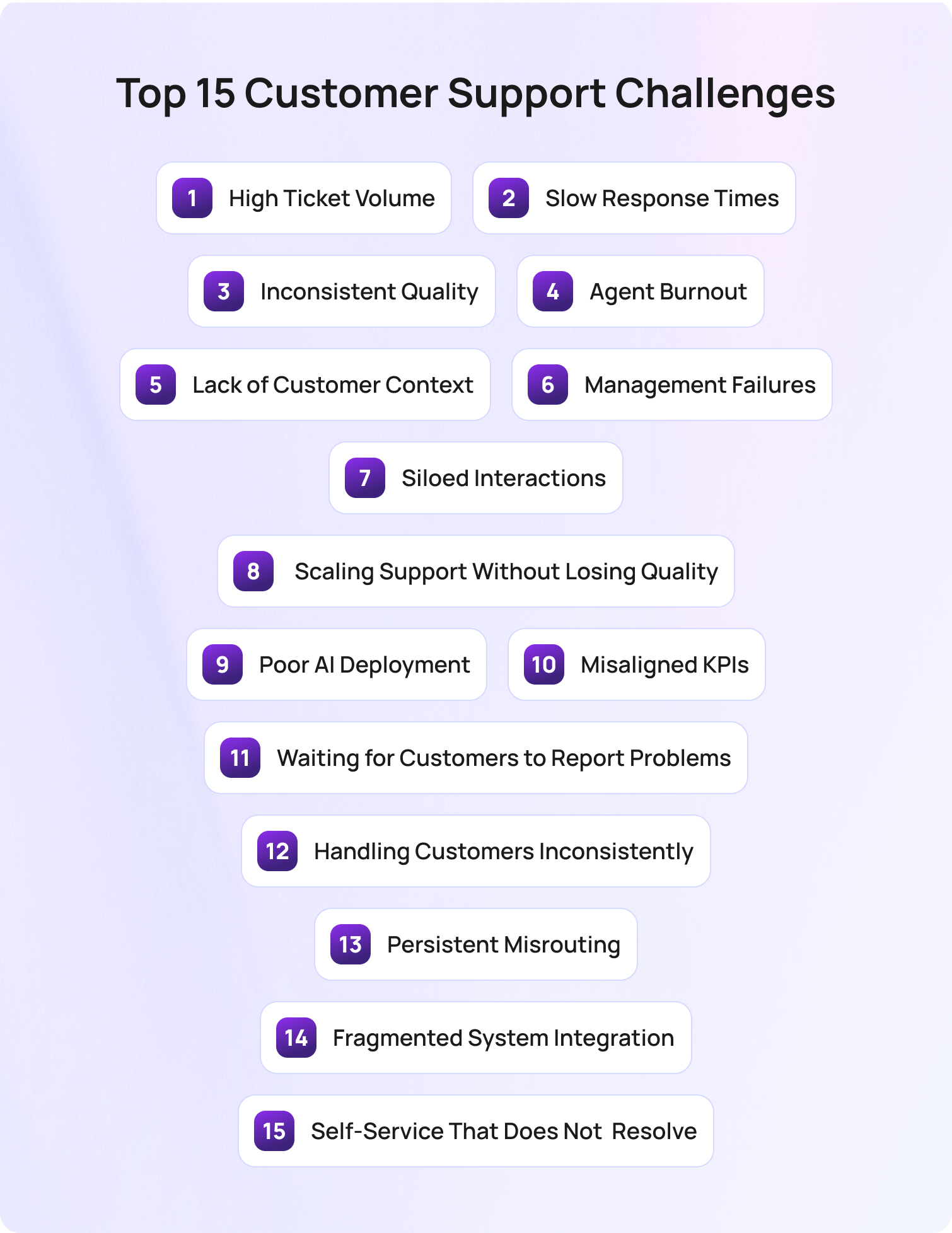
Each challenge below follows the same structure: what the challenge is, the root cause behind it, the KPI it damages, and the specific fix. Where AI capabilities are the solution, the fix names the specific tool to deploy.
1) High Ticket Volume Overwhelming Agent Queues
The challenge. Total inbound contact volume exceeds what customer service representatives can handle without backlogs, extended wait times, and quality shortcuts. This is the pressing customer service challenge most teams encounter first as they grow. Multiple customers submitting customer inquiries simultaneously, across multiple communication channels, creates concurrency pressure that manual workflows cannot absorb.
Root cause. Volume growth was not matched with automation for tier-1 queries. Support agents handle customer interactions that AI could resolve at a fraction of the cost and with higher consistency. The customer service process was built for lower volume and never redesigned.
KPI impact. AHT, response time, abandon rate, and agent concurrency.
The fix. Deploy a RAG-grounded conversational AI chatbot and voicebot to resolve repetitive tickets instantly before they reach agents. Target customer requests where the correct answer is definitive: FAQs, order status, password resets, and account queries. This lets agents focus on complex, high-value customer conversations where human judgment matters. Measure containment rate, not deflection rate. A deflected customer who follows up is a cost transfer, not a resolution.
For a deeper look at how AI removes volume pressure without sacrificing quality, read how AI improves customer support.
2) Slow Response Times Across Channels
The challenge. Customers expect fast answers, particularly on digital channels where expectations are highest. Slow response times are the single most cited driver of customer satisfaction decline in customer service research, and one of the most common reasons customers switch to a competitor. Frustrated customers who wait too long do not stay frustrated silently; they escalate, churn, or leave public feedback that damages your brand's reputation.
Root cause. Manual routing sends customer interactions to the wrong team or into long queues. No prioritisation logic means urgent customer requests wait alongside routine ones. Understaffing during peak periods compounds both. Most common customer service challenges around response times trace back to a customer service process that was not designed to handle current communication channels at the current volume.
KPI impact. First response time, CSAT, and abandon rate.
The fix. Intelligent routing that assigns incoming interactions by intent, urgency, and skill in real time. Pair with WFM forecasting to staff peaks accurately rather than reactively. Teams that address routing and scheduling together see the fastest improvement in response times. For the metrics that reveal where response time is breaking down, see the customer service analytics guide. Providing seamless support across multiple channels also requires that each channel is monitored with equal priority, not siloed into separate queues where some customer calls sit unanswered.
3) Inconsistent Quality Between Agents and Channels
The challenge. Customer satisfaction varies significantly by agent, shift, and channel. Customers receive different quality depending on who picks up the interaction and where. Dissatisfied customers who experienced inconsistent service quality on one channel often abandon that channel entirely. This inconsistency, one of the most common customer service challenges, is often invisible until it shows up in aggregate metrics, by which point customer loyalty has already been affected.
Root cause. No standardised QA at scale. Manual QA reviews only 5 to 15 percent of customer interactions. Ongoing training covers the process but not real-time quality guidance during live interactions. Customer service agents struggle to maintain consistent service quality when they have no live feedback mechanism and no standard for what good customer service looks like in practice.
KPI impact. CSAT, FCR, repeat contact rate.
The fix. AI QA scoring across 100% of interactions to identify patterns that manual sampling misses. Proposed reply standardises response quality during live customer conversations by surfacing KB-grounded responses agents can review and send. Both tools improve service quality and reduce the gap between best and worst performers, creating more consistent, excellent customer service regardless of who is handling the interaction.
4) Agent Burnout and High Turnover
The challenge. Customer service agents experience high stress, cognitive fatigue, and disengagement, leading to attrition that disrupts service quality and increases recruitment and training costs. Contact centre attrition rates frequently exceed 30% annually. When experienced agents leave, customer service representatives who remain absorb additional volume, accelerating the cycle.
Root cause. Repetitive tasks drain cognitive capacity with no intellectual reward. Poor tooling forces service agents to search for answers manually during every customer interaction. Unpredictable scheduling creates peak-period overload and makes it harder for agents to maintain a positive customer experience under pressure.
KPI impact. Attrition rate, CSAT, absenteeism, quality scores.
The fix. Automate repetitive tasks, particularly tier-1 customer inquiries, to remove them from agent queues. Give agents focus on complex, nuanced customer conversations where their skills are genuinely needed. Surface answers instantly during interactions, so agents stop searching. Use Workforce Management to create predictable, manageable workloads. The right tools make the difference between a customer service department that retains its best people and one that constantly replaces them.
5) Lack of Customer Context During Interactions
The challenge. Customer service agents start each interaction without full visibility of the customer's history, previous contacts, account status, or open issues, forcing customers to repeat themselves and agents to ask questions the system should already answer. Customers expect to be known. When a customer feels like a stranger every time they contact support, it signals bad customer service, regardless of how well the agent performs in the moment.
Root cause. Customer data is siloed across CRM, ticketing, and commerce platforms with no unified view in the agent workspace. Full customer journey visibility requires manually switching between tools. Without a unified customer profile, agents cannot deliver the customer context that makes interactions feel personalised and efficient.
KPI impact. AHT, FCR, CSAT, repeat contact rate.
The fix. A unified customer profile that centralises customer data and surfaces full interaction history, account data, and open tickets before the agent responds, providing instant access to the complete customer journey from a single workspace. The customer should never have to repeat themselves. When agents have full customer context from the first message, handle time drops, FCR improves, and the customer experience shifts from transactional to genuinely good customer service.
6) Knowledge Management Failures
The challenge. The knowledge base is incomplete, outdated, or too difficult to search quickly during live customer interactions, leading to inconsistent and inaccurate responses across the team. For customer service agents, this is one of the most damaging customer service problems: they want to give the right answer, but the right tools to find it are not there.
Root cause. KB ownership is unclear. Updates are reactive rather than proactive. Agents do not have a structured way to flag gaps in real time, so customer pain points accumulate silently in the gap between what customers ask and what the KB can answer.
KPI impact. FCR, AHT, containment rate.
The fix. Assign KB ownership with a defined review cadence. Deploy a RAG-grounded knowledge base that AI queries in real time during customer interactions, surfacing the right article at the right moment. Ongoing training should include regular KB updates so customer service representatives always have accurate, current answers. KB quality is the single most important prerequisite for AI accuracy in customer support and for outstanding customer service at scale.
7) Channel Fragmentation and Siloed Interactions
The challenge. Customer interactions across email, chat, social, voice, and messaging are managed in separate tools across multiple channels. Agents have no single view. Customers receive inconsistent experiences depending on which communication channels they use and which agent picks it up. Managing customer expectations across multiple communication channels is impossible when each channel operates independently.
Root cause. Channels were added incrementally to solve individual problems. Each tool has its own customer data, routing logic, and reporting, with no unified customer thread across them. Most customer service challenges around channel consistency trace back to this fragmented infrastructure.
KPI impact. FCR, CSAT, response time, repeat contact rate.
The fix. An omnichannel inbox that unifies all communication channels in one agent workspace with full customer history, regardless of channel. This enables seamless support across multiple channels without requiring customers to restart their customer journey every time they switch contact methods.
8) Scaling Support Without Losing Quality
The challenge. As customer interaction volume grows, consistent service quality declines. The oversight processes that worked at lower volume cannot keep pace. Support teams focus on throughput and quality monitoring, which falls behind one of the most critical challenges experienced in customer support operations as they scale.
Root cause. Manual QA, manual coaching, and human-led oversight do not scale proportionally with volume. When teams grow, quality review coverage shrinks as a percentage of total customer interactions. Customer service practices that worked for 50 agents do not translate to 200.
KPI impact. CSAT, QA coverage rate, error rate, and customer trust.
The fix. Automated QA scoring at 100% coverage maintains oversight regardless of volume. Human-in-the-loop AI frameworks keep humans in control of the interactions that require judgment while AI handles the oversight data collection that makes that judgment possible. To improve service quality at scale, support teams need measurement infrastructure that scales with volume, not manual processes that break under it. The customer service analytics guide covers how to build that measurement layer.
9) Poor AI Deployment Automation That Damages CX
The challenge. Customer service teams deploy AI across interaction types it cannot handle reliably, producing inaccurate responses that damage customer trust and generate repeat contacts that cost more to resolve than the original interaction. This is one of the most avoidable critical challenges experienced in customer support today because the failure pattern is well-documented and preventable.
Root cause. Automation scope is set too broadly at launch. Oversight thresholds are not configured. The distinction between AI-appropriate customer requests and those that require human judgment is not made before go-live. Customer service agents struggle to recover trust after customers have already experienced poor AI responses.
KPI impact. Containment rate, CSAT, repeat contact rate, customer trust.
The fix. Deploy AI only on high-confidence tier-1 customer inquiries initially. Configure escalation triggers for emotional, complex, and compliance-sensitive interactions before launch. Review the scope quarterly as AI performance data accumulates. Poor AI deployment is a customer service process failure, not a technology failure. Exceptional customer service from AI requires the same scoping rigour applied to human agent workflows.
See how BlueTweak's AI Empowerment tools are designed with this in mind.
10) Misaligned KPIs: Measuring Volume Over Quality
The challenge. Customer service teams track and reward volume metrics, such as calls handled and tickets closed, that incentivise speed over resolution quality. The result is declining FCR and customer satisfaction as customer service representatives optimise for throughput rather than outcomes. Teams cannot measure customer satisfaction accurately when the KPIs they use do not reflect what satisfied customers actually look like in the data.
Root cause. KPI frameworks were designed for cost reduction rather than a positive customer experience. Quality metrics exist but are not tied to agent recognition, ongoing training, or team goals. Most customer service challenges around quality are sustained by measurement systems that were never updated to reflect a customer-centric culture.
KPI impact. FCR, CSAT, agent engagement, attrition.
The fix. Reframe team KPIs around FCR, customer satisfaction, and containment rate. Use AI performance analytics to identify patterns across quality and volume separately. To measure customer satisfaction accurately, track how satisfied customers are after the first contact, not how many contacts were processed.
For the full list of customer service metrics that matter in 2026, the BlueTweak customer service analytics guide covers benchmarks and measurement frameworks. You can also use the BlueTweak ROI calculator to quantify what misaligned KPIs are costing your operation.
11) Reactive Support Waiting for Customers to Report Problems
The challenge. Customers contact support because they were not informed before they needed to ask. Avoidable inbound volume is generated daily on predictable trigger events, such as service outages, delivery delays, and payment failures, for which support teams have the data to anticipate. A reactive customer service department is structurally incapable of managing customer expectations because it always responds after the customer's frustration has already formed.
Root cause. No system for triggered proactive outreach. The customer service process is entirely reactive by design, waiting for the customer to initiate contact before addressing a known issue. Communicating proactively requires a workflow that does not exist in most teams.
KPI impact. Inbound contact volume, CSAT, and repeat contact rate.
The fix. Communicate proactively using AI-triggered messaging for order updates, delivery alerts, payment failures, and service outages. When support teams address customer pain points before customers need to ask, inbound volume drops, customer loyalty increases, and the customer experience shifts from damage control to genuine value.
Use the BlueTweak ROI calculator to estimate how much avoidable inbound volume is costing your team, and read how AI improves customer support for the full proactive outreach framework.
12) Handling Angry Customers Inconsistently
The challenge. Handling angry customers is one of the most common customer service challenges and one of the most consequential. Emotionally charged customer interactions are handled inconsistently, often escalating rather than resolving. Frustrated customers and dissatisfied customers who escalate and do not get a resolution are the highest churn risk in any customer base. Customer service agents struggle to detect the emotional shift in real time and adapt their approach before the situation deteriorates.
Root cause. No real-time sentiment detection in the customer service process. De-escalation training is delivered in onboarding and not reinforced in the moment when it actually matters. Ongoing training alone cannot replicate the in-the-moment guidance agents need when a customer feels unheard.
KPI impact. CSAT, churn rate, escalation rate.
The fix. AI sentiment analysis that flags emotional distress during live customer conversations and surfaces guidance for the agent in real time. Catching the shift in customer sentiment before it escalates is significantly less costly than recovering from a complaint. Agents who can address customer concerns in the moment before the customer feels dismissed deliver outcomes closer to exceptional customer service than those working without real-time support.
13) Ticket Routing Failures and Persistent Misrouting
The challenge. Customer interactions reach the wrong team or wrong skill level, requiring transfers that add handle time and frustrate customers who already explained their issue once. For dissatisfied customers, being transferred is often the moment they decide the brand's reputation for good customer service is undeserved. Routing failures are one of the most persistent customer service problems in teams that have grown without updating their routing infrastructure.
Root cause. Rules-based routing relies on keyword matching that breaks when customers phrase their requests in unexpected ways. New query types emerge without triggering a routing rule update because no one owns the customer service process for routing maintenance.
KPI impact. FCR, AHT, misroute rate, customer frustration.
The fix. AI-powered routing that classifies intent, sentiment, and required skill from natural language in real time across multiple channels. No manual rule updates needed when new query types emerge. For the case for AI-driven ticket routing over rules-based systems, the linked article covers the operational and scalability arguments.
14) Data Silos and Fragmented System Integration
The challenge. Support data lives in separate platforms: CRM, ticketing, commerce, and analytics, with no unified operational view. Agents lose time switching tools. Reporting is fragmented. Decisions are made on incomplete customer data. One of the most common customer service challenges in scaling organisations is that the customer service department operates without a single source of truth.
Root cause. Tools were added incrementally to solve isolated problems without considering the data architecture required to centralise customer data for unified support operations. Integration was always the next project.
KPI impact. AHT, FCR, data accuracy, reporting quality.
The fix. Platform consolidation that brings ticketing, AI, analytics, WFM, and customer profile data into one workspace, giving agents instant access to the complete customer journey without switching tools. For teams not ready for full consolidation, explore BlueTweak's contact center integrations for the integration architecture and priority order.
15) Self-Service That Does Not Actually Resolve Customer Issues
The challenge. Self-service options exist but fail to resolve customer queries, generating inbound contacts from customers who have already tried to help themselves and got nowhere. The frustration from a failed self-service attempt makes the follow-up interaction harder to resolve and leaves the customer feeling that the brand's customer service experience is deliberately unhelpful. Improving self-service options is one of the most high-leverage fixes available to support teams managing high inbound volume.
Root cause. KB content is incomplete or not surfaced effectively. AI chatbots are not grounded in the KB and generate inaccurate responses that erode customer trust in the self-service channel. Self-service options cannot address customer concerns that they were never trained to answer.
KPI impact. Inbound volume, containment rate, CSAT for bot-handled interactions.
The fix. RAG-grounded AI chatbot that retrieves accurate KB content rather than generating from a base model. Regular KB review to close content gaps. For a guide to building an AI-powered customer support knowledge base, see the BlueTweak Smart Knowledge Base page, which covers both the architecture and the maintenance cadence. Teams that improve self-service options alongside proactive outreach see the greatest reductions in avoidable inbound volume.
For more on AI-driven self-service done right, see how AI improves customer support.
How BlueTweak Solves the Most Common Customer Support Challenges
Most customer support challenges in 2026 are not people problems. They are customer service process and tooling problems that capable people cannot overcome with effort alone. Building a customer-centric culture starts with giving support teams the right tools, and removing the friction that prevents them from delivering excellent customer service.
Almost every customer service challenge we see traces back to one of two things: volume that the team was never set up to handle efficiently, or quality oversight that stopped scaling when the team started growing. The fix in both cases is the same. You need the right AI capabilities deployed against the right interaction types, with the right measurement in place from day one.

BlueTweak addresses the root causes behind the challenges above in a single unified platform. Conversational AI removes tier-1 volume from agent queues and helps resolve repetitive tickets instantly. The omnichannel inbox eliminates channel fragmentation across all communication channels. The QA module enables 100% interaction scoring to maintain consistent service quality at scale.
Analytics surfaces quality and volume metrics in the same view, making it straightforward to identify patterns and address customer concerns before they compound. WFM forecasting prevents understaffing-driven quality failure. The suggested reply workflow keeps humans in control of sensitive customer interactions while AI reduces the cognitive load of every other one.
Final Thoughts
Most customer support challenges in 2026 share the same root causes: volume outpacing automation, quality oversight not scaling with volume, and fragmented tools creating customer data gaps that support agents cannot overcome manually, whether you are dealing with slow response times, inconsistent service quality, agent burnout, or failed self-service options. The fix in most cases follows the same logic: the right AI capabilities deployed against the right customer interaction types, measured on the right KPIs, with human oversight maintained where it matters most.
A customer-centric culture is not built through mission statements. It is built by removing the customer service problems that prevent good customer service from happening, and giving support teams the right tools, visibility, and AI capabilities to address customer concerns consistently at scale.
Start your free trial today and see how BlueTweak addresses your biggest customer support challenges from day one.
Start your free trial now
Start Now
As Head of Digital Transformation, Radu looks over multiple departments across the company, providing visibility over what happens in product, and what are the needs of customers. With more than 8 years in the Technology era, and part of BlueTweak since the beginning, Radu shifted from a developer (addressing end-customer needs) to a more business oriented role, to have an influence and touch base with people who use the actual technology.



