AI Agent Monitoring Tools: 5 Best Options for Customer Support Teams


BlueTweak is an AI Customer Support Platform that unifies every conversation, customer record, and automation into one workspace.
Explore more
Insights, trends, and practical ideas from customer experience and AI
Real-world scenarios showing how teams use BlueTweak to deliver better service
The daily blueprint that guides customer support leadership.
ROI and savings calculators for support teams
See how BlueTweak stacks up against leading customer support platforms
AI agent monitoring tools help organizations understand how AI agents perform in production, but the metrics that matter depend on who needs to act on the data. Engineering teams often rely on platforms such as Datadog for infrastructure and LLM observability, Arize AI for ML model performance monitoring, Braintrust for LLM evaluation, and Helicone for lightweight tracing and usage analytics. Support operations teams, meanwhile, need visibility into containment rates, customer satisfaction, escalation quality, intent accuracy, and knowledge base gaps. For customer support organizations, purpose-built platforms such as BlueTweak combine agent observability with customer experience insights, making it easier to improve service quality, reduce human intervention, and optimize business outcomes.
AI agent monitoring helps customer support teams understand whether AI-powered interactions are improving customer outcomes or simply automating conversations.
As organizations deploy more AI-powered support experiences across customer service operations, support leaders need visibility into how those agents affect customer satisfaction, escalation rates, containment, and service quality.
Without proper monitoring, it becomes difficult to identify knowledge gaps, investigate poor customer experiences, or understand why performance changes over time.
Purpose-built AI agent monitoring tools such as BlueTweak help support teams move beyond technical metrics and focus on the operational insights that drive customer experience, quality assurance, and business outcomes.
AI agent monitoring is the process of tracking, evaluating, and improving how AI agents perform in real customer interactions.
For Machine Learning (ML) engineers, AI agent monitoring often focuses on latency, token usage, infrastructure metrics, production traces, and model performance. For support operations leaders, the question is different: are AI agents resolving customer issues accurately, consistently, and in a way that improves customer satisfaction?
As organizations deploy more AI systems across customer support, monitoring must move beyond traditional application monitoring and traditional monitoring tools. Deloitte’s 2026 State of AI report found that approximately 80% of organizations deploying agentic AI still lack mature governance capabilities, including real-time monitoring systems and audit trails for agent behavior.
For support teams, the most important metrics include:
These metrics reveal whether AI agents are creating business outcomes or simply closing conversations.
Before comparing tools, it’s worth understanding how different platforms approach AI agent monitoring.
AI agent monitoring tools vary significantly depending on whether they were designed for engineering teams, ML teams, or support operations teams.
The table below compares some of the leading tools for monitoring AI agents from a customer support perspective.
| Tool | Best For | Built for Support? | Pricing |
| BlueTweak | Customer support teams with AI agents in production | Yes, native | All inclusive pricing at €65/agent/month |
| Datadog LLM Observability | Engineering teams monitoring LLM infrastructure | Partial | Tiered pricing |
| Arize AI | ML teams monitoring model performance and drift | No, ML-first | Tiered pricing |
| Braintrust | LLM evaluation and prompt testing | No, dev-first | Tiered pricing |
| Helicone | Lightweight LLM tracing and cost tracking | No, dev-first | Tiered pricing |
Pricing verified June 2026.
The key distinction is not simply features. It’s who can actually act on the insights.
The tools below are evaluated specifically for customer support operations teams rather than ML engineers. Monitoring capabilities, support-specific metrics, deployment requirements, and accessibility for non-technical teams are the primary evaluation criteria. No vendor paid for inclusion in this list.
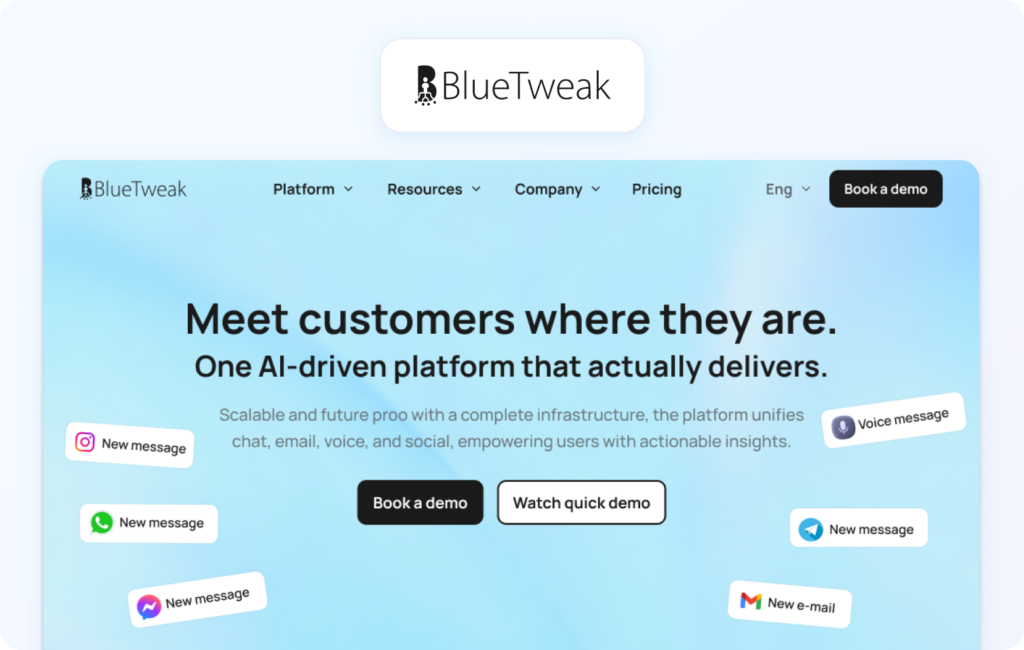
BlueTweak is an AI agent monitoring platform built specifically for customer support operations.
Unlike traditional monitoring tools that focus on API calls, infrastructure monitoring, production traffic, and tool usage, BlueTweak focuses on the metrics support leaders actually use to manage service quality.
BlueTweak’s Key Monitoring Capabilities:
BlueTweak provides visibility into the customer support metrics that matter most:
This matters because support leaders are not typically asking why token usage increased or whether a tool call failed. They are asking why customer satisfaction dropped, why escalation rates increased, or why a particular workflow is producing poor outcomes.
The future of AI agent monitoring is not just understanding what an agent did. It’s understanding whether the customer achieved their goal, and whether the interaction strengthened trust in the brand.

Radu Dumitrescu, Head of Presale & Digital Transformation at BlueTweak
Why This Matters: Most observability tools focus on agent reliability from a technical perspective. BlueTweak, however, focuses on agent performance from a customer experience perspective.
That distinction becomes increasingly important as AI agents move from simple answering customer questions to handling business-critical workflows.
Honest Limitation: BlueTweak is not designed to replace infrastructure-level observability tools. Organizations requiring deep production monitoring, CI/CD visibility, multi-agent tracing, or engineering-focused observability data may choose to complement BlueTweak with a dedicated engineering platform.
Pricing: BlueTweak offers a transparent pricing system at €65 per agent per month, all-in. The platform includes ticketing, omnichannel support, AI functionality, workforce management, quality assurance, analytics, and APIs within a single subscription.
Organizations evaluating AI agent monitoring tools can explore BlueTweak’s capabilities firsthand with a 14-day free trial to see how the platform helps support teams monitor AI agent performance, improve customer satisfaction, and gain greater visibility across customer interactions.
Best For: Customer support teams that need proper monitoring of AI agent workflows without building a separate observability stack.
BlueTweak in Practice: BlueTweak’s work with Europe Direct, a European Union service that helps citizens and businesses access information about EU policies, programs, and regulations, demonstrates how support-focused monitoring, reporting, quality assurance, and AI-powered workflows can improve both operational efficiency and customer outcomes. Facing challenges around multilingual communication, reporting visibility, workflow management, and GDPR compliance, Europe Direct implemented BlueTweak to streamline customer support operations across the EU.
Supporting inquiries across 26 languages, the organization needed greater visibility into performance, service quality, and operational efficiency while maintaining strict compliance requirements. Following the implementation of BlueTweak’s unified customer support platform, Europe Direct achieved:
The project highlights how customer support teams can combine AI-driven automation, quality assurance, and operational analytics to improve both agent performance and customer experience.
Organizations looking to strengthen their AI agent monitoring capabilities can book a personalized demo of BlueTweak to see how support-focused monitoring works in practice.
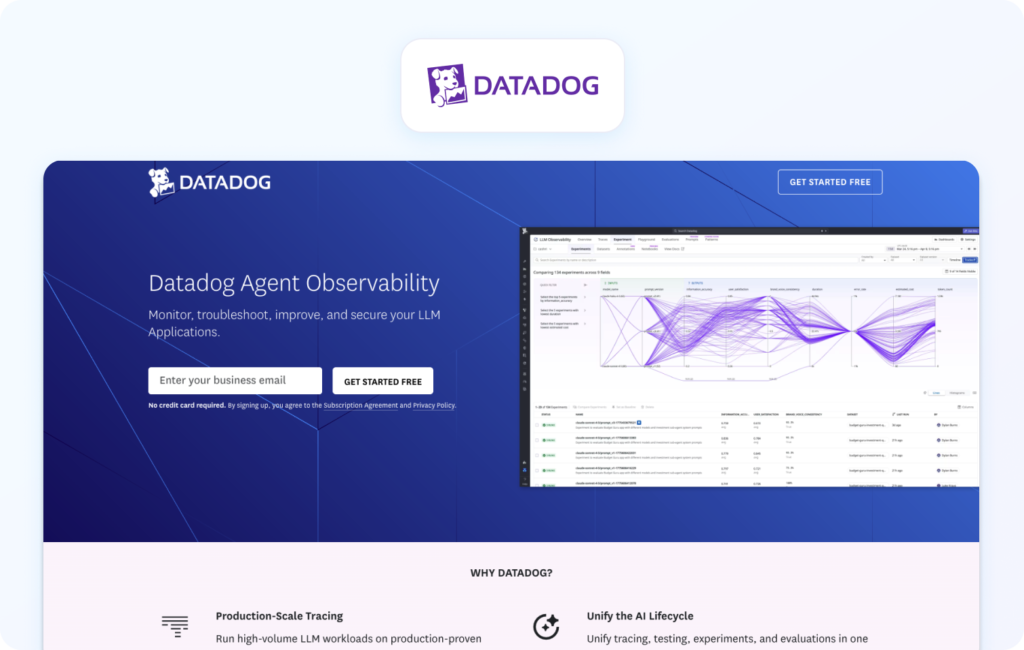
Datadog LLM Observability extends Datadog’s broader observability platform to support AI-powered applications and agent workflows.
The platform is designed primarily for engineering teams that need visibility into production environments, infrastructure metrics, model interactions, and application performance.
Datadog Key Monitoring Capabilities:
Datadog is commonly used by engineering teams managing business-critical AI systems where infrastructure reliability, security posture, and performance analysis are the primary objectives. Datadog provides visibility into:
Why This Matters: Organizations already using Datadog can monitor AI agents alongside traditional applications, reducing the need to introduce additional observability tools.
Engineering teams gain a unified platform for infrastructure monitoring, production monitoring, and AI monitoring, making it easier to identify performance bottlenecks, service disruptions, and unexpected agent behavior.
Honest Limitation: Datadog does not natively surface support-specific metrics such as containment rate, escalation quality, intent classification accuracy, CSAT, or knowledge base gap rate. These typically require custom dashboards and engineering resources to configure.
Pricing: The LLM Observability free tier includes up to 40,000 LLM spans per month, while the Pro plan starts at $160 per month for 100,000 spans, with costs scaling based on span volume and data retention. Organizations running broader infrastructure monitoring will also pay separately for APM, logs, and hosts, so total bills can grow significantly at scale. Verify for details.
Best For: Organizations already invested in the Datadog ecosystem that want AI agent observability integrated into their existing monitoring stack.
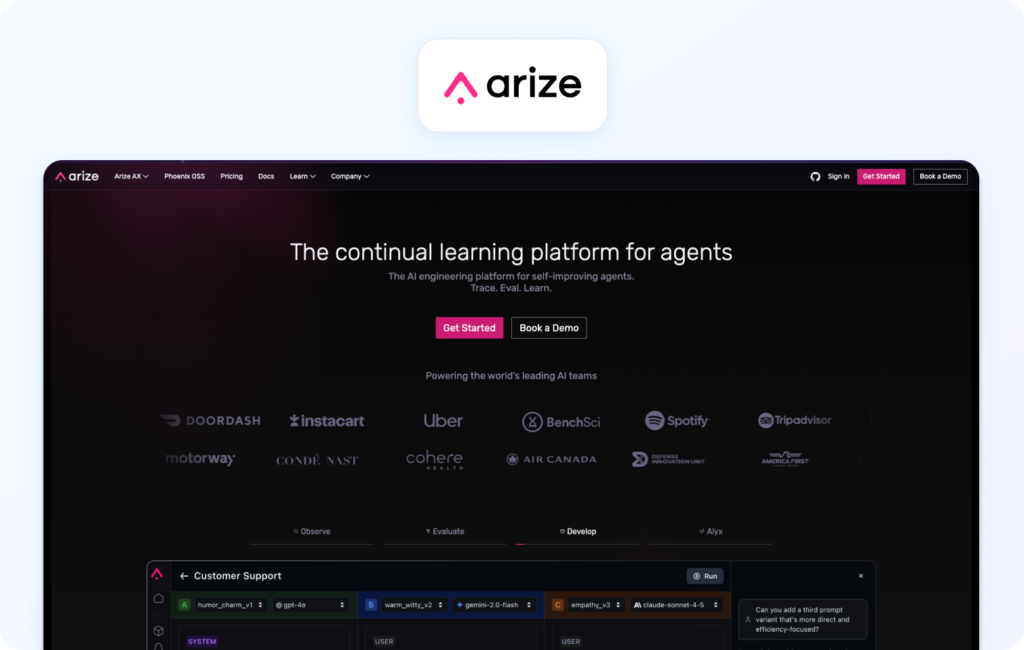
Arize AI is an ML observability platform focused on model performance, explainability, drift detection, and production monitoring. For organizations running custom AI models, Arize provides deep visibility into how model behavior changes over time.
Arize Key Monitoring Capabilities:
Arize is often deployed alongside AI agent platforms where model quality, drift detection, and intent classification performance are considered mission-critical to customer experience. This makes it one of the more specialized monitoring tools for AI agent platforms that rely on custom models and ML workflows. Arize provides:
Why This Matters: Organizations that have built or fine-tuned their own intent classification models need visibility into performance degradation before it impacts customer outcomes.
Arize helps teams identify deviations, uncover the root causes of declining model accuracy, and maintain consistent agent performance across production environments.
Honest Limitation: Arize is designed primarily for ML practitioners. Connecting observability data to customer satisfaction, containment rates, or support outcomes often requires additional integrations and internal expertise.
Pricing: Arize offers a free open-source self-hosted tier alongside a managed free plan for individual developers. The AX Pro plan starts at $50 per month, with enterprise pricing available on request. Costs scale with usage, monitoring volume, and compliance requirements, so verify with the vendor for specifics.
Best For: Organizations with dedicated ML or data science teams responsible for maintaining custom models used within customer support operations.
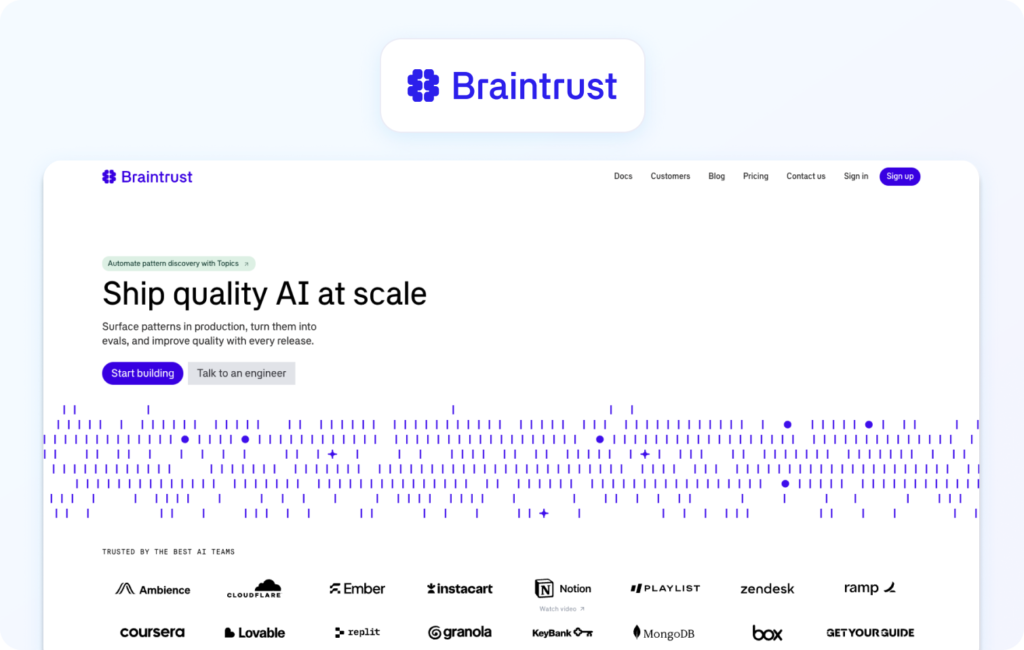
Braintrust is an evaluation platform designed to help teams test, validate, and improve AI agent quality before and after deployment. Rather than focusing exclusively on real-time monitoring, Braintrust specializes in measuring output quality and identifying regressions when prompts, workflows, or underlying models change.
Braintrust Key Monitoring Capabilities:
Braintrust is commonly used as part of a broader AI agent monitoring strategy, helping teams validate changes before deployment while relying on separate tools for production monitoring. Braintrust supports:
Why This Matters: Many organizations rely on third-party foundation models that are updated regularly.
Braintrust helps teams validate whether changes to prompts, models, or workflows introduce the same failures, unexpected behavior, or declines in output quality before those issues reach customers.
Honest Limitation: Braintrust is not a real-time production monitoring tool. It does not provide native visibility into live customer support metrics such as CSAT, containment rate, escalation performance, or sentiment shifts.
Pricing: Braintrust offers a free Starter plan for smaller teams, with the Pro plan at $249 per month. Enterprise pricing is custom-quoted and available via sales. Note that costs scale with data volume (billed at $3/GB) and evaluation scores, so teams running high-volume eval workloads should model this carefully before committing. Verify for details.
Best For: Development, QA, and AI product teams that need structured evaluation and automated regression testing for AI agents.
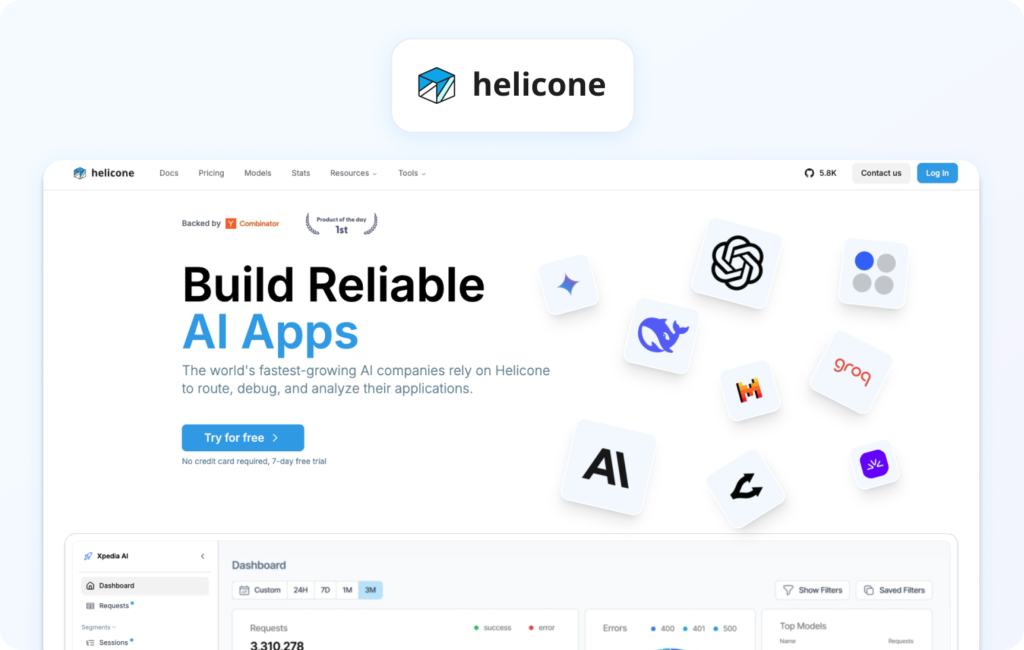
Helicone is a lightweight AI monitoring platform that acts as a proxy layer between applications and large language models. Its primary focus is visibility into requests, responses, costs, and performance without the complexity of a full observability platform.
Helicone Key Monitoring Capabilities
Helicone is frequently used during early-stage AI deployments where visibility into token usage, API calls, and production traffic is more important than advanced customer support analytics. Helicone provides:
Why This Matters: For smaller teams, Helicone offers a fast way to gain visibility into AI agent usage patterns without investing in a large-scale observability stack.
The platform helps teams understand how agents interact with models, how costs accumulate, and where performance issues may be emerging.
Honest Limitation: Helicone is primarily focused on tracing and usage analytics. Support-specific metrics such as containment rate, escalation quality, customer satisfaction, knowledge base gaps, and QA scoring require substantial customization or external reporting systems.
Pricing: Helicone’s Hobby plan is free and covers up to 10,000 requests per month with 7-day data retention. The Pro plan is $79 per month and adds unlimited seats, alerts, and 30-day retention. A Team plan is available at $799 per month for organizations needing compliance certifications and higher throughput. Enterprise pricing is custom; verify with the vendor for specific details.
Best For: Smaller teams seeking lightweight monitoring, token visibility, and cost tracking without significant engineering overhead.
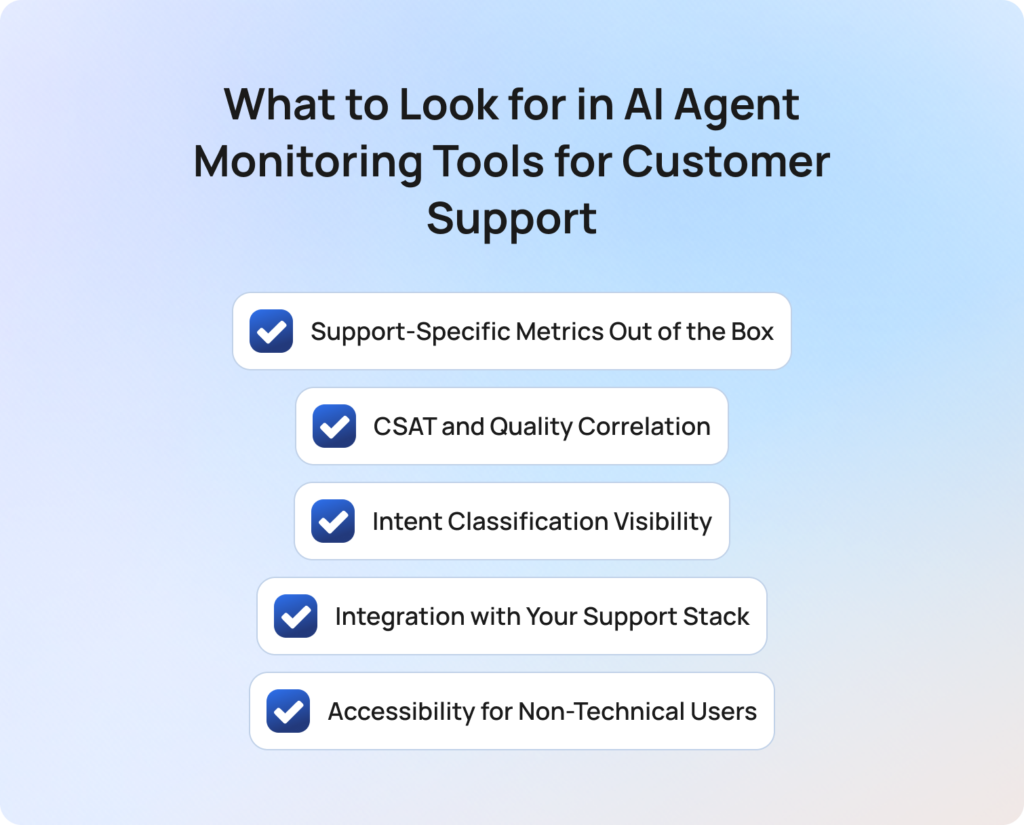
AI agent monitoring tools should help support teams improve outcomes, not simply collect observability data. As AI agent ecosystems become more complex, the most valuable monitoring tools are those that connect agent behavior directly to customer outcomes.
Support-specific metrics are the foundation of effective AI agent monitoring. While many monitoring tools focus on technical performance indicators such as latency, token usage, and API calls, customer support teams need visibility into metrics that directly impact service quality and business outcomes.
The best AI agent monitoring tools should natively surface containment rate, escalation rate, CSAT, intent classification accuracy, and knowledge base gap rate without requiring extensive custom configuration. These metrics help support leaders understand not only whether an AI agent completed a workflow, but whether it successfully resolved the customer’s issue.
Without support-focused reporting, teams often spend significant time building custom dashboards and manually combining data from multiple systems. Native support metrics allow organizations to identify trends faster, optimize agent performance more effectively, and make confident operational decisions based on real customer outcomes.
Customer satisfaction is ultimately the metric that determines whether an AI-powered support experience is delivering value. However, CSAT data becomes far more useful when it can be connected directly to conversation quality and agent behavior.
The strongest agent monitoring tools correlate quality assurance scores, escalation events, intent recognition accuracy, and customer satisfaction outcomes within a single reporting environment. This makes it possible to identify patterns that would otherwise remain hidden. For example, a drop in CSAT may be linked to a specific intent category, a change in agent workflows, or a recurring knowledge gap rather than a broader issue with the AI system itself.
Understanding whether an agent followed the correct process is important. Understanding whether that process resulted in a satisfied customer is what enables support teams to make meaningful improvements to service quality.
Intent classification is one of the most important factors influencing AI agent performance. If an agent misunderstands what a customer is trying to achieve, every subsequent action is built on an incorrect assumption.
Many monitoring tools report overall accuracy scores, but aggregate metrics often hide underperforming categories that have a disproportionate impact on customer experience. A support team may see an acceptable overall accuracy rate while a high-volume intent, such as billing inquiries or account access requests, consistently produces poor outcomes.
Effective monitoring tools provide visibility into performance at the intent level, helping teams identify recurring issues, prioritize optimization efforts, and reduce escalation rates. This level of insight is particularly valuable for organizations managing complex customer journeys across multiple channels and languages.
Monitoring data becomes significantly more valuable when it’s connected to the systems support teams already use every day. AI agent monitoring should not exist in isolation from the broader customer service operation.
The most effective platforms integrate with ticketing systems, CRM platforms, quality assurance workflows, workforce management tools, and reporting environments. This creates a more complete picture of the customer journey and eliminates the need for teams to manually reconcile information from multiple sources.
When monitoring data is disconnected from operational systems, identifying root causes becomes more difficult and acting on insights becomes slower. Seamless integration helps support leaders move from observation to action, allowing them to improve customer outcomes rather than simply generate reports.
AI agent monitoring should empower support operations teams, not create additional dependence on engineering resources. While technical observability tools provide valuable insights, they are often designed for developers, data scientists, and infrastructure teams rather than customer support leaders.
The most effective monitoring platforms present information in a way that allows non-technical stakeholders to identify deviations, investigate blind spots, monitor compliance, and optimize performance independently. This reduces delays, accelerates decision-making, and ensures that operational improvements can be implemented quickly.
Accessibility is often the difference between a monitoring platform that becomes a core part of day-to-day support management and one that is only consulted when a problem occurs. If support leaders cannot easily understand and act on the data, the value of monitoring is significantly diminished.
The best AI agent monitoring tools help teams understand more than what an AI agent did. They help organizations understand whether customer issues were resolved, whether service quality is improving, and whether automation is delivering meaningful business outcomes.
For engineering teams, that may mean infrastructure observability, production monitoring, and model performance insights. For customer support operations teams, the priority is different. Success depends on visibility into containment rates, escalation quality, customer satisfaction, intent accuracy, and knowledge base performance.
That is where BlueTweak stands apart. Rather than adapting engineering-focused observability tools to support use cases, BlueTweak was built specifically to help customer support teams monitor AI agent performance, identify quality issues, and improve customer outcomes without relying on complex custom dashboards or engineering resources.
If you’re evaluating AI agent monitoring tools for customer support, the next step is to see how support-specific monitoring works in practice.
Start a free 14-day trial of BlueTweak to explore its monitoring capabilities firsthand, with no credit card required, or book a personalized demo to see how the platform can help your team monitor AI agents, improve customer satisfaction, and maintain visibility across complex agent workflows.
AI agent monitoring tools are platforms that track, analyze, and evaluate how AI agents perform in production environments. They help organizations monitor agent behavior, output quality, reliability, cost, compliance, and business outcomes. By collecting data from live interactions, these tools make it easier to identify issues, optimize performance, and ensure AI agents behave as expected over time.
Customer support teams need AI agent monitoring to understand whether AI-powered interactions are delivering positive customer outcomes. While engineering teams may focus on infrastructure metrics and production systems, support leaders need visibility into containment rates, escalation rates, customer satisfaction, intent accuracy, and knowledge base gaps. These insights help teams improve service quality, reduce unnecessary human intervention, and maintain customer trust.
AI observability focuses on the technical performance of AI systems, including production traces, token usage, latency, API calls, and infrastructure monitoring. AI agent monitoring builds on observability by measuring how AI agents perform against business objectives, customer experience goals, and operational KPIs. In customer support environments, agent monitoring helps teams understand not just what happened inside the system, but whether the customer received the right outcome.
The most important metrics for customer support AI agents are containment rate, escalation rate, customer satisfaction (CSAT), intent classification accuracy, knowledge base gap rate, sentiment shifts, and quality assurance scores. Together, these metrics provide a complete picture of agent performance and help organizations identify opportunities to improve both efficiency and customer experience.
Businesses should look for an AI agent monitoring platform that aligns with the needs of the teams acting on the data. Support operations teams typically benefit from platforms that provide customer satisfaction insights, quality assurance reporting, and visibility into agent workflows. Engineering teams may prioritize infrastructure observability, production monitoring, and integration with their existing stack. The most effective platforms bring these perspectives together, creating a shared view of performance across technical and operational teams.
As Head of Digital Transformation, Radu looks over multiple departments across the company, providing visibility over what happens in product, and what are the needs of customers. With more than 8 years in the Technology era, and part of BlueTweak since the beginning, Radu shifted from a developer (addressing end-customer needs) to a more business oriented role, to have an influence and touch base with people who use the actual technology.